Archive for the ‘Europe’ category

Op-Ed: ‘Europe, learn from Israel!’: Exclusive interview with Ayaan Hirsi Ali

February 2, 2016

Op-Ed: ‘Europe, learn from Israel!’: Exclusive interview with Ayaan Hirsi Ali, Israel National News, Giulio Meotti, February 2, 2016

Ayaan Hiri Ali(1)

When Theo van Gogh was murdered by an Islamist on a street in Amsterdam, Ayaan Hirsi Ali could not even attend the funeral because she would have put the lives of others at risk. So the Dutch intelligence agreed to take her to the morgue. The next day, bodyguards accompanied her from her home and gave her three hours to pack and leave. From there she went to the air base at Valkenburg, near The Hague, where she would be embark on a plane. The portholes were closed, they told her not to approach them nor go near the door. The plane was full of soldiers. Hirsi Ali was leaving a country at war. They landed at a military base in Maine, in the United States. This is how the love affair between America and the first refugee from Western Europe since the Holocaust began. A story that continues to this very day.

Ayaan Hirsi Ali is still a shadow. But her voice at the telephone is clear, tough, cool. It is that of a young Somali woman who has undergone genital mutilation, who has lived in Saudi Arabia, Ethiopia, Kenya, before being betrothed to a Canadian cousin she had never seen before. Hirsi Ali escaped from Germany to the Netherlands.

She worked as an interpreter in the Islamic Dutch ghettos, she graduated, became a Liberal MP, helped Van Gogh to make the film “Submission” and then disappeared. Now she talks with me about Europe from her think tank, the American Enterprise Institute. Hirsi Ali recently released her third book on Islam, “Heretic”, an optimistic book on the reform of Islam.

Where does your optimism for a reform of the Islamic world come from?“It is a possibility, not a certainty. But I am optimistic because of the violence committed today in the name of Islam, which is creating so much tension, and it is not just committed by individuals, but by states and organizations. People are more and more afraid of radical Islam. In Egypt, in Tunisia, everywhere, there are large numbers of young Muslims who identify themselves as Muslims, but who do not want sharia, Islamic law. Just as many women do not want sharia.”

On February 1, many feminists around the world will celebrate the World Hijab Day, the International Day of the Islamic veil. “It is multiculturalism, the ideology that eliminates the rights of individuals in favor of groups, communities. Europe is committing a cultural suicide.”

What should happen to kick off a reform? “You must first answer a fundamental question: how can someone be Muslim and be in favor of the separation of mosque and state, freedom of expression, rights of the woman? The attitude towards the Qur’an and Muhammad must change, because the Islamists use the Koran and the texts literally. We need a revolt within the house of Islam, against the culture of death, rejecting Sharia, rejecting the jihad, the killing of non-Muslims.”

You were the first authentic dissident in the Islamic world. “The dissidents of Islam are fundamental, because we are those who ask the critical questions, who pursue the critical thinking. Asking the questions means risking your life. It was the same Imam Qaradawi who recognized the role of dissidents when he said that you can not accept apostasy and it deserves death.”

Your name appears in the same list of targets alongside the late director of Charlie Hebdo, Stephane Charbonnier, and other cartoonists. “My name was on the list of Charlie, so I am not surprised by what happened a year ago. Charbonnier and the other journalists were heroes. Unfortunately, today there is a combination of fear and multiculturalism, moral relativism, the sense of guilt for the Muslim population because of colonialism. When I started going to university in the Netherlands, many did not want to hear about the Holocaust in the classroom, they were told not to speak of the Jews of Israel. This served to suppress criticism of Islamic doctrine. We must stop demonizing Israel and learn from it.”

“Unfortunately, today countries like Saudi Arabia do great missionary work in Europe, trying to suppress dissent. Freedom of expression is therefore fundamental for the opening of the Islamic world to reason. But sometimes I think it’s too late. Think about Italy, France, Germany, England, the whole great tension between Muslims and Europeans. In this context it is becoming difficult, more difficult, to exercise the right to freedom of speech.”

“I am happy in America, but even here there are the Muslim Brotherhood and other Islamist organizations. In ten years I have seen a significant radicalization in America”.

One million immigrants have arrived in Germany this year and another million are expected. Hirsi Ali, who was welcomed by Europe as a refugee from Somalia, now asks Europe to stop immigration. “We are at a critical point in Europe today: the immigration of millions of people must be stopped even before Europe stops the indoctrination in the mosques and imams. If we do not stop the brainwashing, there will be another lost generation in Europe. Muslims must stop Sharia now. I keep repeating it, but who is listening?”.

Since Van Gogh was killed and you fled to America, in the Netherlands nobody longer speaks of Islam. Journalists, cartoonists, intellectuals, have all closed their mouths: “The people in the Netherlands who write and talk about Islam and these issues are tired. In the Netherlands, but also in France, many Jews are leaving. In Los Angeles I have Dutch Jewish friends who fled from the Netherlands. There is a terrible brain drain from Europe. In Europe they are all paralyzed, in Italy, in Germany, in France, but the political leadership must banish sharia, its propagation is not acceptable. Because sharia is the worst violation of human dignity. Sharia is against civilization and European culture”.

So speaks a brave woman who carries on her own body the consequences of that poisonous flower.

Germany’s Migrant Deportation Plan: “Political Charade”

February 1, 2016

Germany’s Migrant Deportation Plan: “Political Charade” Gatestone InstituteSoeren Kern, February 1, 2016

♦ N24 television has reported that up to 50% of “asylum seekers” have gone into hiding and their whereabouts are unknown. They presumably include economic migrants and others who are trying to avoid deportation if or when their asylum applications are rejected.

♦ Tens of thousands of migrants destroyed their passports and other identity documents before arriving in Germany. It may take years for German authorities to determine the true identities of these people and their countries of origin.

♦ Even if Germany sends these individuals back to the countries where they first entered the EU (usually Greece, Hungary or Italy), with a borderless Europe, migrants can easily make their way back to Germany.

♦ German authorities are downplaying migrant lawlessness, apparently to avoid fueling anti-immigration sentiment.

♦ Migrants are still coming to Germany at the rate of about 2,000 per day.

♦ “Eight to ten million migrants are still on the way.” – Development Minister Gerd Müller.

After three months of political infighting, Germany’s coalition government has announced new measures aimed at making it easier to deport migrants who are convicted of committing crimes.

The measures emerged in response to voter outrage over the sexual assaults of hundreds of women by migrants in Cologne and other German cities on New Year’s Eve — and alleged attempts by the government and the news media to cover up the crimes.

Known as the Asylum Package II (Asylpaket II), the draft law was announced by the cabinet on January 28 and must now be approved by the Bundestag, the lower house of the German parliament, for it to come into effect.

A central feature of the plan involves increasing the number of migrant reception centers to five, up from two today. The centers would supposedly fast-track legitimate asylum requests submitted by people who can prove they are fleeing war-zones.

The centers would also step up efforts to weed out fraudulent applications submitted by economic migrants who are posing as asylum seekers. The stated aim is to eventually deport those who arrived in Germany under false pretenses.

In addition, the plan would introduce a two-year waiting period for legitimate refugees who want to bring family members to Germany. Exceptions would be made for those who can prove that their family members are being “personally, urgently persecuted.”

The government also said that it would try to limit migration from North Africa by declaring Algeria, Morocco and Tunisia as so-called safe countries, where there is no armed conflict or threat of violence, persecution or torture. This would make it virtually impossible for asylum applications from those countries to be approved.

Critics of the plan say it is more of a political charade than substance and will do little to alleviate Germany’s migration crisis.

First, the German government has lost track of the whereabouts of hundreds of thousands of migrants who entered the country in 2015. N24 television has reported that up to 50% of “asylum seekers” have gone into hiding; their whereabouts are unknown. They presumably include economic migrants and others who are trying to avoid deportation if or when their asylum applications are rejected. The Saarbrücker Zeitung reported that up to 30% of the migrants being sheltered in the eastern German states of Brandenburg, Thuringia and Saxony-Anhalt have “simply vanished.” Separately, German authorities estimate that hundreds of thousands of migrants have entered the country without being registered and whose whereabouts are unknown.

Second, tens of thousands of migrants destroyed their passports and other identity documents before arriving in Germany. It may take years for German authorities to determine the true identities of these people and their countries of origin. This will complicate — and delay — many deportations. Even if Germany sends these individuals back to the countries where they first entered the European Union (usually Greece, Hungary or Italy), with a borderless Europe, migrants can easily make their way back to Germany.

Third, the legal hurdles to deportation from Germany are high. German law states that migrants who commit crimes can only be deported if they are sentenced to prison terms of three years or more. In practice, this rarely happens for most petty crimes. The government is contemplating a change to Section 60 of the Residency Law (Aufenthaltsgesetz) to make it possible to deport migrants sentenced for prison terms of one year. But even if migrants are sentenced for crimes, they cannot be deported to countries that the German government deems “unsafe.” Moreover, migrants cannot be deported to countries where they may face the death penalty.

To many critics, it looks as if the German justice system is being disabled by political correctness. Although migrants are driving a surge in violent crime in cities and towns across Germany, German authorities are downplaying the lawlessness, apparently to avoid fueling anti-immigration sentiment.

A confidential police document leaked to the Rheinischen Post revealed that in 2014, a record-breaking 38,000 asylum seekers in Germany were accused of committing crimes in the country. Analysts believe this figure — which works out to more than 100 crimes a day — is only a fragment: many crimes are not made public.

In Hamburg, police are fighting a losing battle against purse-snatchers. Each year, more than 20,000 purses — roughly 55 a day — are stolen. According to Norman Großmann, the director of the federal police inspector’s office in Hamburg, 90% of the purses are stolen by males between the ages of 20 and 30 who come from North Africa or the Balkans.

In a bestselling new book about the failure of multiculturalism in Germany, Tania Kambouri, a German police officer, describes the breakdown of the German justice system and how German judges are reluctant to punish migrants, including repeat offenders.

Fourth, the German government’s decision to deny asylum requests submitted by migrants from Algeria, Morocco and Tunisia will have little effect in practice. Out of one million migrants who entered Germany in 2015, fewer than 20,000 are believed to have come from those three countries.

Meanwhile, a new poll published by the news magazine, Focus, shows that nearly half the Germans want Chancellor Angela Merkel to resign because of her open-door migration policy: in 2015, it allowed more than one million migrants from Africa, Asia and the Middle East to enter the country.

Still, Merkel steadfastly continues to refuse to implement the one policy that could prevent the migrant crisis from becoming even worse: closing the German borders to keep the migrants out.

Despite snow, ice and freezing temperatures across much of Europe, migrants are still coming to Germany at the rate of about 2,000 per day. More than 54,500 people reached Europe by sea during January 2016, including 50,668 through Greece, according to the United Nations Refugee Agency (UNHCR).

The International Monetary Fund (IMF) estimated that 1.3 million asylum seekers would enter the European Union annually during 2016 and 2017.

In a January 9 interview with Bild, Development Minister Gerd Müller warned that the biggest refugee movements to Europe are still to come. He said that only 10% of the migrants from the chaos in Iraq and Syria have reached Europe so far: “Eight to ten million migrants are still on the way.”

Separately, Germans face being denied visa-free travel to the United States, as U.S. security officials become increasingly alarmed at the proliferation of fake passports that could be used by terrorists. According to a report by Politico:

“In the aftermath of Paris, the U.S. Department of Homeland Security became so worried about the implications for screening travelers to America that it gave France, Belgium, Germany, Italy and Greece a February 1 deadline to fix “crucial loopholes” or lose access to the U.S. visa waiver program. The program allows about 20 million people per year from 38 countries, most of them in Europe, to enter the United States for business or pleasure without a visa.”

1451Left: A new poll shows that nearly half the Germans want Chancellor Angela Merkel to resign because of her open-door migration policy. Right: Interpol has data on 250,000 stolen or lost Syrian and Iraqi passports, including passports that are blank.

According to Politico, in the last five years the number of lost and stolen passports in the EU has doubled. The number of forged passports in the Middle East is also a rising concern. Interpol has data on 250,000 stolen or lost Syrian and Iraqi passports, including passports that are blank.

Eurocrats: No Connection Between Migrants Raping Women and Migration Crisis

January 31, 2016

Eurocrats: No Connection Between Migrants Raping Women and Migration Crisis, Front Page Magazine, Daniel Greenfield, January 31, 2016

ll_1

Also there’s no connection between cars and traffic. Not a one.

The European Commission will be the “voice of reason” and tell the public that there is no link between the migration crisis affecting the continent and attacks on women in Germany, internal minutes disclose, amid growing fears of a “xenophobic” backlash.

The interior ministry, days after the attacks, said that “people with a migration background were almost exclusively responsible for the criminal acts”.

One perpetrator is alleged to have told police he was Syrian, adding: “You have to treat me kindly. Mrs Merkel invited me.”

So you see… no connection.

Now Eurocrats think there’s a connection between any criticism of the migrant invasion and supposed attacks on migrants. Even when some of the attacks, such as some of the fires, were actually started by migrants. Yet there’s no connection between migrants and migrant crime.

Also there’s no connection between Eurocrats lying to the people and the people hating Eurocrats.

“As far as the crimes in Cologne were concerned, he said that these were a matter of public order and were not related to the refugee crisis,” the minutes say.

All crimes are a matter of public order. But if you fill your countries with the people least likely to be “orderly”, then your migration crisis creates a public order crisis.

During the discussion that followed, Mr Juncker’s team stressed “the importance of the Commission’s continuing to play its coordinating role and sounding the voice of reason to defuse tensions and counter populist rhetoric.”

They called for “the unconditional rejection of false associations between certain criminal acts, such as the attacks on women in Cologne on New Year’s Eve, and the mass influx of refugees.”

At the same time, they agreed that they must “respond to the concerns of European citizens, particularly by stressing that Europe was also a union of security and values.”

Actually it’s a union where security plays second fiddle to values. And those values require the destruction of Europe to save European values. Or rather, Eurocratic values.

A European-Iranian honeymoon

January 31, 2016

A European-Iranian honeymoon, Israel Hayom, Prof. Eyal Zisser, January 31, 2016

Last week, the European dam burst. While the continent was turning a cold shoulder to Israel and European entities continued with their threats of boycott, its gates were thrown open to Iran. European leaders put their obsession with Israel aside for an hour or two, and after paying the necessary lip service to International Holocaust Memorial Day, gave Iranian President Hassan Rouhani a royal welcome.

The Iranian president, the smiling face of the Islamic republic, arrived for visits to Italy and France. It was the first visit of its kind since the nuclear deal was signed, a visit that signaled the start of a European-Iranian honeymoon, a visit that will be followed by others like it all over the continent. Rouhani’s visit came days after the economic sanctions on Iran were lifted. It’s no wonder that during the visit, announcements were made about contact between the Iranians and a number of Italian and French companies on deals including a return to European cars being manufactured in Iranian plants and, of course, contracts to purchase Iranian oil. The Iranians are hungry for Europe’s products and technology, while European companies are hungry for Iranian money.

As Rouhani was being received in Europe as an honored guest, Iran’s spiritual leader Ayatollah Ali Khamenei was busy with his longtime hobby of denying the Holocaust. He posted a clip on his website in which he called to investigate whether or not the Holocaust had actually happened, as the Zionists claim it did. But no one in Europe bothered Rouhani with any minor matter like that. After all, it was U.S. Secretary of State John Kerry who urged people not to take Tehran’s calls to annihilate Israel and the U.S. seriously, saying it was only talk. The Europeans also didn’t bother to raise the question of Iranian involvement in regional destabilization, such as in Yemen and Syria, or about Tehran’s support of terrorism. Even questions about respecting human rights and freedom of expression and promoting democracy in Iran itself were removed out of respect for the agenda of the day. Europe, as we know, only asks those questions of Israel.

Indeed, despite Rouhani’s smiles, no change has taken place yet in Iran itself. The conservative camp continues to rule with a fist of iron and supreme leader Khamenei remains firmly at the wheel, or in the hands of the Revolutionary Guard and not Rouhani and his people. So while Rouhani was trying to spread the slogan of a “new Iran” throughout Europe and asking his hosts to turn over a new leaf in the relations between Iran and Europe, the conservatives at home were preparing an unpleasant surprise. Most of the reform camp’s candidates for the parliamentary election scheduled to take place on February 26 were rejected. Even the grandson of late Ayatollah Ruhollah Khomeini, Ahmed Khomeini, who wanted to be elected to the Council of Experts — the Iranian body that oversees the supreme spiritual leader and is responsible for choosing his successor — was rejected on the grounds of “not proving appropriate religious capabilities.”

Iran should be judged not by its words, but by its actions, but the Iranian record speaks for itself. A mere two months after it signed the nuclear agreement with the major world powers in July 2015, Tehran sent thousands of soldiers to Syria to fight on the side of Syrian President Bashar Assad. Painful pictures are coming out of Syria of children dying of hunger in cities under siege by Assad’s forces, Hezbollah fighters, and members of the Iranian Revolutionary Guard. But Iran has been rewarded for its doings in Syria and invited by the U.N. and western countries to take part in a discussion on Syria’s future. The Iranian record also includes ballistic missile tests, to show us what Iranian’s military ambitions are; the arrest of U.S. sailors in the Persian Gulf; and — just like in the good old days — an angry mob setting fire to the Saudi Arabian embassy in Tehran.

The Europeans are choosing to ignore all that as they announce a new chapter in Iranian-European relations. The bill for the honeymoon will be footed by others — in Syria, the Persian Gulf, and Israel.

European Governments Ignoring Security Warnings?

January 30, 2016

European Governments Ignoring Security Warnings? Gatestone InstituteJudith Bergman, January 30, 2016

♦ “We are importing Islamic extremism, Arab anti-Semitism, national and ethnic conflicts of other peoples, as well as a different understanding of society and law.” — From a leaked German intelligence document.

♦ The mayor of Molenbeek, Belgium ignored a list she received, one month prior to the Paris attacks, “with the names and addresses of more than 80 people suspected as Islamic militants living in her area,” according to the New York Times. “What was I supposed to do about them? It is not my job to track possible terrorists,” Mayor Schepmans said.

♦ In October 2015, Andrew Parker, director general of Britain’s Security Service, said that the “scale and tempo” of the danger to the UK is now at a level he has not seen in his 32-year career. British police are monitoring over 3,000 homegrown Islamist extremists willing to carry out attacks on the UK.

The head of the Norwegian Police Security Service (PST), Benedicte Bjørnland, was recently a participating guest at a security conference in Sweden, where she warned against further Muslim immigration.

One cannot,” she said, “assume that new arrivals will automatically adapt to the norms and rules of Norwegian society. Furthermore, new arrivals are not homogenous and can bring ethnic and religious strife with them… If parallel societies, radicalization and extremist environments emerge in the long run,” she added, “We will have challenges as a security service.”

The changes Bjørnland speaks of — parallel societies, radicalization and extremist environments — are nothing new; they have been proliferating throughout Western Europe for years. The Brussels suburb of Molenbeek, which was home to two of the perpetrators of November’s terror attacks in Paris, is known as a “terrorist den.” Yet the mayor of Molenbeek ignored a list she received, one month prior to the Paris attacks, “with the names and addresses of more than 80 people suspected as Islamic militants living in her area,” according to the New York Times. “What was I supposed to do about them? It is not my job to track possible terrorists,” Mayor Schepmans said. “That is the responsibility of the federal police.”

This statement is, in many ways, symptomatic of the European failure to deal with the security problems that Europe faces. The problem is always supposed to be somebody else’s.

Anders Thornberg, the head of the Swedish Security Service (SÄPO), literally begged Swedish society for help: “The Islamist environments have grown considerably in the past five years,” he said “and tensions are growing between various population groups. We need all of society to help fight the radicalization, there are limits to how much faster a security service can run.”

These are sentiments that are rarely, if ever, voiced by official Norway or Sweden. Apparently, the fear of offending Muslim sensitivities has thus far overridden security concerns. But even Sweden, which sees itself as a “humanitarian superpower,” and up until recently had sworn to keep its doors open to all migrants and refugees, has had to reassess its policy. At the end of November 2015, Sweden’s Deputy-Prime Minister Asa Romson, reluctantly and in tears, said that the government had been “forced to take reality into account,” given the huge number of migrants that entering the country. Sweden (and Denmark) tightened their border controls a few weeks ago.

It is questionable, however, whether the warning cries of the Scandinavian security services will have any noticeable impact on the fundamental political course of their political leaders, especially if the latest statements by Swedish Prime Minister Stefan Löfven are anything to take into account.

In an interview at the World Economic Forum in Davos on January 21, Löfven declared that it was “wrong” to mix up either sexual assaults on European women or the threat of ISIS with the mass migration into Europe: “Sexual harassment is not automatically binding to migration and immigration. We have had sexual harassment in Sweden for many, many years, unfortunately,” Löfven told CNBC, thus pretending that the imported Middle Eastern pastime of Taharrush Gamea [collective harassment] of women in Cologne on New Year’s Eve, had nothing to do with migrants.

“What it now takes is to be very clear that this is not appropriate, it is absolutely out of line and we need to take a very clear message now to show to these young girls and women they are of course entitled to walk in the city… without sexual harassment,” Löfven added. No, the girls and the women are not the ones in need of a “clear message.” The men harassing and raping them are — especially in a country now known as the rape capital of the West.

The Swedish prime minister’s refusal to “deal with reality” — including that ISIS terrorists enter Europe together with the migrants — is disturbing and should be of immense concern to Swedish citizens. It also displays the huge gap in perception of the current situation between the Swedish Security Services and the Swedish government.

The head of the Swedish Security and Intelligence Services has every reason, it turns out, to beg Swedish society to help fight the security challenges Sweden is facing. Considering current Swedish government, he is going to need all the help he can get.

The additional gap between the genuine concerns of national intelligence and security services on one hand, and governments’ fear of offending Muslim sensibilities and venturing beyond the politically correct “narratives” on the other hand, is not confined to Sweden, but evident across Western Europe.

European intelligence and security services have warned for a long time that — given the increase of mainly Muslim migration and the ensuing growth of parallel societies and extremist environments — they cannot keep up with the ever-increasing threats of jihadist terrorism, which in the past decade have grown exponentially.

In the Netherlands, the Dutch jihadist movement began a far-reaching process of becoming more professional in late 2010, and adopted propaganda methods developed by British jihadists. “The increasing momentum of Dutch jihadism poses an unprecedented threat to the democratic legal order of the Netherlands,” stated the Dutch intelligence service, AIVD, in the autumn of 2014.

In Germany, the intelligence agencies warned in the early fall of 2015 that, “We are importing Islamic extremism, Arab anti-Semitism, national and ethnic conflicts of other peoples, as well as a different understanding of society and law.” Four major German security agencies made it clear that “German security agencies… will not be in the position to solve these imported security problems and thereby the arising reactions from Germany’s population.” Still, this dire warning, which was leaked to the German press, did not cause Germany’s Chancellor, Angela Merkel, to change her open-door policy. While Germany has introduced border controls, 2000 asylum claims are still processed there every day.

In Britain, the MI5 has openly declared that it cannot stop all terrorist attacks on English soil. In October 2015, Andrew Parker, director general of the Security Service, said that the “scale and tempo” of the danger to the UK is now at a level he has not seen in his 32-year career. He warned that while the threat to the UK from ISIS is on the rise MI5 can “never” be confident in stopping all terror plots.

Little wonder. British police are monitoring over 3,000 homegrown Islamist extremists who are willing to carry out attacks on the UK, British security sources have warned. That is a 50% increase in less than a decade. Already in November 2014, Sir Bernard Hogan-Howe, the Metropolitan Police Commissioner, told an international terrorism conference that 25% of the population growth in the UK had arrived in London in the last 10 years, and posing big challenges for the police force, who could not keep up with the pace of immigration.

The difficulties in properly monitoring so many extremists and effectively preventing them from committing acts of terror has also become a tremendous challenge, compounded by the sheer volume of extremists. Dame Stella Rimington, former head of the MI5, estimated in June 2013 that it would take around 50,000 full-time MI5 spies to monitor 2,000 extremists or potential terrorists 24 hours a day, seven days a week. That would be more than 10 times the number of people employed by MI5.

The situation is not much different in many other European countries. In Germany Hans-Georg Maasen, head of Germany’s BfV domestic security agency, claimed that his office was aware of almost 8,000 Islamic radicals in Germany. He said that all of these extremists advocate violence to advance their goals, with some trying to win over migrants, and that his office receives one or two ‘fairly concrete tips’ of planned terrorist activity each week.

Most European countries – such as Germany, Britain, and France – are operating at their highest terror alert ever. The intelligence services are trying to cope with a situation beyond anything one could have imagined a decade ago.

The fight against the terrorist threat is never going to be won, however, only by pouring more financial resources and manpower into the counter-terrorism effort, although that is of course a necessary first step. As long as the political leaders — the governments — of the national security and intelligence services refuse to openly address the threat, without shrouding the issue in politically correct language – as demonstrated by Löfven — they will never be able to reduce it, let alone eliminate it.

Muslim Refugee Rapes 72-Year-Old Woman, Gets to Stay in Europe

January 30, 2016

Muslim Refugee Rapes 72-Year-Old Woman, Gets to Stay in Europe, Front Page Magazine, Daniel Greenfield, January 30, 2016

Run girl run

Who’s afraid of a few “orphans”? The 72 year-old women who don’t want to be raped by them.

The 72-year-old woman, identified only as Christina F., said: “It was a really hot day and I decided to take my dog for a walk along the Schwechat River, and saw two young men swimming there.”

She said that one of the young men had reached out his hand to her, asking her to help him onto the bank, which she did. She said: “Suddenly, I felt a blow from behind.”

She was grabbed and then pushed to the ground, and the attacker put his hand over her mouth and used his other hand to tear off her clothing.

A friend of the old woman, Hans Vesely, 72, said: “The dog that she had with her was 13 years old and was sadly not up to protecting his mistress from the attack.”

“She is not the same woman anymore. She doesn’t trust being left on her own and does not leave home, and she’s become very weak since the incident,” Vesely said.

The attacker was only caught because he committed another crime after the rape, and was forced to give a DNA sample. The DNA sample provided matched the one found on his elderly victim, and he was arrested.

The teenager, identified only as Wahab M., initially denied the rape, claiming that he was drunk and could not remember what happened. In addition, his friend who was also arrested told police he had not seen anything.

Because at the time he was only 17 years old, Wahab M. was punished by the youth court where the maximum sentence is five years, but because he had no previous convictions and eventually admitted the rape in the face of the DNA evidence, it was reduced to 20 months. The shorter length of sentence means he will not face deportation.

Now if Wahab had done something truly terrible, like be a European who criticizes Muslim migrants, he would be spending years in prison.

The Canadian Temper: A Warning to America

January 30, 2016

The Canadian Temper: A Warning to America, American ThinkerDavid Solway, January 30, 2016

(Should America’s domestic policies be more, or less, like those of Canada? Domestic policies tend to be reflected in foreign policies. We are heading, I think, in the wrong direction. — DM)

The U.S. is clearly heading in the same direction with its national debt swelling exponentially and the inpouring of unvetted “Syrian” migrants exacerbating an already problematic Islamic infiltration. In effect, it’s the same set of cultural attributes, a big spending mentality and an open door policy, of which Canada has long been a shining exemplar. This is why the coming election is perhaps the most critical in U.S. history.

*********************

Canadians have long thought of themselves as morally superior to the supposedly vulgar and abrasive Americans. According to the self-justifying Canadian mythos, we embody a more enlightened and humane outlook on the world. In addition to oil, maple syrup, and lumber, our most valuable export — our gift, we imagine, to our southern neighbors — is our vision of a sustainable and irenic future. Let us examine the most current incarnation of that vision.

Canada is essentially a socialist country, closer to the increasingly decrepit European welfare and statist paradigm than to the (now faltering) classic American model of individual self-reliance. Canada instituted social programs like state-funded medicine relying on major tax hikes long before it became an issue in the U.S., and gambled on multiculturalism as a viable national project, in effect, as a kind of political eschatology. There is no question that the Canadian temper has always been more politically Arcadian than the American.

The current refugee question in particular has become a pivotal and collective expression of this temper, with citizens opening their wallets, hearts, and homes to a migratory influx from the Islamic world. Our self-congratulatory generosity is amply demonstrated in the writings of celebrated Constitutional lawyer Julius Grey. Pontificating in the Montreal Gazette, Grey urges the welcoming of thousands of Syrian migrants as we proceed “to create a society which has, on the one hand, citizens of myriad origins and, on the other, no barriers between them.”

The problem that Grey refuses to confront or even identify is that immigrants and refugees from historically backward, theocratic, anti-Semitic, Sharia-dominated, and terror-sponsoring nations are precisely the ones who are creating “barriers,” such as purpose-built ghettos, no-go zones, closed neighborhoods, special privileges and spaces, an atmosphere of threat, and who have no interest in Western-style “individual autonomy and freedom” — Grey’s chosen vocabulary. Grey is the lawyer for the Muslim-friendly socialist New Democratic Party, but there is not much sunlight between the NDP and the governing Muslim-friendly Liberal Party.

Indeed, in the October 2015 Federal election the Liberals, the NDP and the splinter, reactionary-left Greens ran between them a total of 23 Muslim candidates (the leftist/sovereignist Bloc Québécois fielded two Muslim candidates, raising the combined total to 25 Muslim hopefuls), representing approximately 7 per cent of available parliamentary seats, over twice the Islamic percentage of the population. (The ousted Conservatives fielded only four Muslims.) In the end, the combined electoral seats won by the four left-leaning parties, the Liberals, NDP, Bloc and Greens, clocked in at 71 per cent; the center-right Conservatives polled just 29 per cent. This is the face of Canada today.

During the election campaign, Islam became a prominent issue, with Liberal PM Justin Trudeau claiming that there was no place in his Canada for the previous Conservative government’s “divisive” Islamophobia and exaggerated concern for national security. In his victory speech, Trudeau uttered the inevitable pieties à la Obama: “We beat fear with hope, we beat cynicism with hard work. We beat negative, divisive politics with a positive vision that brings Canadians together.” To a Muslim woman wearing a hijab, he promised “a government that believes deeply in the diversity of this country.”

A perverse illustration of this stupefying attitude comes from the Bank of Nova Scotia (commonly known as Scotiabank), which has welcomed the migrant onslaught with its Welcome Syrians program. (The original webpage featuring large print and colorful graphics now seems to have been scrubbed.) Canada’s third largest bank is offering every Syrian a hundred dollar gift deposit, a $2000 limit unsecured credit card, a free safety deposit box for one year and a $50 unsecured overdraft. Customers who bank at the Scotia and pay monthly fees to maintain their accounts have good reason to feel resentful — unless, of course, they happen to be migrant sympathizers and soft on Islam.

These “Syrians,” not all of whom are Syrians and some of whom are almost surely ISIS jihadists, receive housing, benefits, and gifts without having contributed an iota to the nation’s economy; indeed, they will be a limitless drain on our resources.

The $1.2 billion cost of bringing in these refugees is only the beginning of our fiscal woes. Quoted by the CBC, coordinator Carl Nicholson said “many factors have made the task of housing government-assisted refugees more difficult, including the larger-than expected size of some families that have arrived.” The accompanying photo shows a couple with six toddlers. No wonder the Liberals’ shopworn immigration minister John McCallum has solicited the business community for donations in the amount of $50 million. “I would encourage all Canadians, companies, individuals, communities, to continue to support the effort because we are entering a critical phase,” he said. Darn right on the latter score.

My parents and grandparents, fleeing starving, war-torn Ukraine, worked to the bone to earn a living while contributing through taxes to the national welfare. Many Canadians share the same history, yet they are expected to receive and bankroll a large number of migrants who will take advantage of the innumerable perks that our forebears, who fled famine and civil war and who helped build this country, had never enjoyed or even considered their due.

Richard Butrick cogently argues in an important article for American Thinker that immigrants who came to America in the 19th and early 20th centuries “knew they had to work hard to survive,” at the same time contributing to the nation’s commercial, industrial, and scientific advances. “Immigrants today,” he continues, “know the U.S. is a fail-safe environment,” where they are subsidized and coddled. The so-called “re-energizing” immigration narrative has been superseded by, let’s say, a parasitical model based on muddled sentimentality and false calculations, which Canada has bought into without sober forethought. A country built on welfare migrants is not a country built on hardworking immigrants.

There are some signs that the “Syrian Covenant” is becoming more complicated than originally envisaged, as the initial euphoria for the migrants seems to be waning under an unforgiving reality. I have heard that families that have gloatingly affirmed their “Canadian values” and freely taken Syrians into their homes are petitioning their government for financial help. The City of Ottawa, Canada’s capital, has called for a pause to its hospitality for lack of housing, facilities and funds. Toronto, Vancouver, and Halifax have also asked for a hiatus. The bloom is starting to come off the rose — and the hue off the rose-colored glasses — for many of these fallow enthusiasts. But with further government subventions and the media propaganda blitz saturating what remains of the Canadian mind, the early stages of skepticism and reluctance will probably lead to nothing much.

This is how we do things in Canada. We throw out a Conservative government — itself an anomaly in our political landscape — that steered us safely through the devastating market crash of 2007/8, and objected to Islamic face coverings in citizenship swearing-in ceremonies and to the acceptance of “barbaric” practices in the cultural habits of these new citizens — and bring in a Liberal administration dedicated to increasing the national debt and gradually submerging the country in an effluvium of Muslim migrants and refugees.

The U.S. is clearly heading in the same direction with its national debt swelling exponentially and the inpouring of unvetted “Syrian” migrants exacerbating an already problematic Islamic infiltration. In effect, it’s the same set of cultural attributes, a big spending mentality and an open door policy, of which Canada has long been a shining exemplar. This is why the coming election is perhaps the most critical in U.S. history. A Democrat administration under Billary or Bernie would close the gap between our two countries dramatically. And this is why the candidacies of Donald Trump, for all his flaws, and of the Cruzio amalgam despite the media-generated flap over their eligibility, may determine whether America can return to some degree of sanity and a semblance of its former vitality — or, heaven forfend, become Canada South.


Muslim Refugee “Orphans” Take Over Swedish Train Station, Assault Women

January 26, 2016

Muslim Refugee “Orphans” Take Over Swedish Train Station, Assault Women, Front Page Magazine, Daniel Greenfield, January 26, 2016

inline_thief4


Who’s afraid of a few orphans again?

Swedish police warns that Stockholm’s main train station has become unsafe after being ‘taken over’ by dozens of Moroccan street children.

The all-male migrant teen gangs are spreading terror in the centre of the Swedish capital, stealing, groping girls and assaulting security guards, according to Stockholm police.

Stockholm police estimate that at least 200 Moroccan street children move in the area around the main train station in the centre of the capital, sleeping rough, and living off criminal activity.

‘These guys are a huge problem for us. They steal stuff everywhere and assault security guards at the central station,’ one police officer told SVT.

‘They grope girls between their legs, and slap them in the face when they protest. All police officers are aware of this.

‘I would never let my children go to the central station. No officer would.’

The gangs are made up of orphans who have grown up on the streets of Casablanca and Tanger in Morocco, where authorities estimate there are around 800,000 homeless ‘street children’.

They have all applied for asylum Sweden as unaccompanied minors after travelling through Spain and Germany, a journey which may have taken them years.

How many is Europe supposed to take in? Pro-refugee activists will refer to 17 and 18 year olds as children and with no testing or documentation, even 40-year-old men have been able to get away with claiming to be child refugees.

Meanwhile one of those poor “children”, a rather old child at that, is finally being booted, not out of Europe, but out of Sweden, after his assault was caught on camera.

Shocking video has emerged of a would-be thief hitting, kicking and spitting on a mother after she catches him trying to steal the purse of an elderly woman.

The violent scene took place in the Gamla Stan train station in Stockholm.

A shocking violent scene erupts when the man lashes out, kicking her in the stomach and hitting her across the face.

He quickly walks away and the mum picks up one of her children and take the other by the hand.

But it’s not over yet – the man returns and walks past the woman, who shields her kids from him, protectively.

He spits in her face before disappearing down the stairs.

A Tunisian man, who has been branded ‘the most hated man in Sweden’ after video showed him attacking a woman in front of her two young children and then spitting on her at a metro station in Stockholm, is being deported to Denmark, Expressen.se reports.

He should be sent back to Tunisia, but instead he’s going to be bounced around Europe instead. This is how the Muslim invasion of Europe is succeeding.

The Spreading Scent of Cologne

January 26, 2016

The Spreading Scent of Cologne, Gatestone InstituteDenis MacEoin, January 26, 2016

♦ What appals so many onlookers is that this damage to European societies is being done with open eyes and listening ears, and that many lessons have not been learned.

♦ The mass sexual assaults on New Year’s Eve, and many through the year, are clearly the work of single, mainly young men. In packs, people can more easily give in to anti-social tendencies, but these men from North Africa and the Middle East seem to bring with them social attitudes that make it hard for them to conform with European notions of what is, and what is not, criminal or decent.

♦ Muslim hate speakers are given free rein to address students at many British universities. The double-standard is that the same universities have banned controversial but important speakers or just about anybody who supports the state of Israel. And if speakers are not actually banned, hordes of ideologically-inspired students and outsiders will turn up to disrupt their lectures with shouts, screams, and threats.

The city of Cologne, still famous for its scented water, has become, since last New Year’s Eve, best known for the depredations and misogyny of a growing population of immigrants from North Africa, the Middle East and elsewhere. The events of that evening, when hundreds of women were assaulted, manhandled, and even raped by thousands of migrant newcomers who could not be restrained by the police, spread across the world in days if not hours.

At first, the police played down the seriousness of the incidents, but by January 10th, the BBC reported that the number of criminal cases had risen to 516, forty percent of which were related to sexual assault. According to German police, “Asylum seekers and illegal migrants from North Africa comprise the majority of suspects.” This has been confirmed by Germany’s interior ministry, which has stated that almost all those involved were migrants.
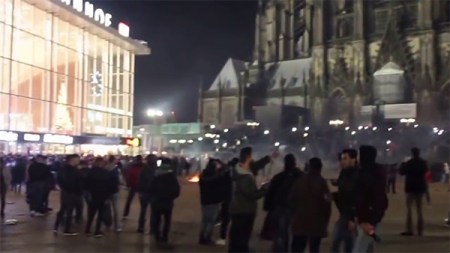
1440A scene from New Year’s Eve in front of Cologne’s central railway station, when hundreds of girls and women were sexually assaulted, mostly by migrants.

Of course, Cologne was only the most prominent city to undergo such an ordeal: According to the Washington Post, “No city was hit harder than Cologne, where gangs of mostly young men are alleged to have ‘hunted’ women, corralling them before groping, assaulting and robbing them.” A smaller number of incidents occurred in other German cities such as Hamburg, Stuttgart, and Frankfurt. In the thirteenth-century city of Bielefeld, more than 500 presumed asylum seekers attacked the Elephant Club , a night spot, and assaulted some of the women there. There were similar cases on the same evening in Austria, Switzerland, Finland and Sweden.

Regular readers of articles by authors such as Soeren Kern or Ingrid Carlqvist at the Gatestone Institute will be fully aware of the widespread breakdown of several European countries as a result of uncontrolled immigration. That includes not just the massive wave of immigration during 2015, but the steady collapse of law and order engendered by earlier influxes of Muslim migrants, notably in Germany, the United Kingdom and France. This has been exacerbated by the problem that, whereas many first generation incomers gradually found ways to integrate within mainstream society, there is a trend among third-generation children to demand rights and concessions above those granted to other citizens.

There are an estimated 750 zones urbaines sensibles (“sensitive urban zones”) in France; many cities in Europe have such high levels of Muslim exclusivity that they have become no-go zones for the police, the fire brigade, social workers and others. According to one report

“It’s not Norway or Europe anymore, except when there is welfare money to be collected. The police have largely given up. Early in 2010 Aftenposten stated that there are sharia patrols in this area, and gay couples are assaulted and chased away. Immigrant Fatima Tetouani says that ‘Grønland is more Muslim than Morocco.'”

Three months earlier, retired police Chief Superintendent Torsten Elofsson of Malmö, Sweden’s third city, declared that the crime rate in the city was skyrocketing due to the influence of uncontrolled immigration and the presence of no-go areas. The French city of Marseilles, with a 30%-40% Muslim population, has been declared “the most dangerous city in Europe” because of an increasing level of extreme violence, riots and rapes.

What appals so many onlookers is that this damage is being done with open eyes and listening ears and that many lessons have not been learned, not just in the past year but over decades. What on earth, many of us ask, could have impelled so many European leaders — among whom German Chancellor Angela Merkel stands out — to have opened their arms to potentially millions of immigrants without imposing checks, registration at the point of entry, or other legal controls?

The whole situation was sparked, of course, by the staggering break-up of Syria over so many years. This break-up has led to the flight of very large numbers of genuine refugees, so many of them risking their lives to bring their children across the Mediterranean in the hope of finding safety in the European Union.

If we are to analyse what has happened, we can do no better than to start with this fact. There is in all of this an irony of mammoth proportions. Welcoming people who fear for their lives and their children’s futures is a strong trait of Western civilization. Unlike so many other cultures, the Judaeo-Christian and post-Enlightenment West has a deeply-rooted commitment to human rights, and those rights are not restricted to ourselves but to all mankind. Both Judaism and Christianity are suffused with a sense of human brotherhood, and that sense has led to the modern ideals of rights for women, people of all races, homosexuals, the disabled, religious minorities, and the victims of violence. Nowhere, perhaps, has this been more visible in the United States, a country that was built on the backs of immigrants.

With this in view, and with the memory of the Holocaust and Europe’s failure to prevent it in mind, it was inevitable that European countries would at first welcome the poor, hungry and distressed of Syria and other places.

But here lies the irony. Our undiscriminating welcome is leading us to welcome people many of whom seem dedicated to bringing about our internal collapse. This collapse may be far from total now, but there are grave misgivings about how Europe will look in the future, and certainly by the end of the century. Politicians, church leaders, and charity bosses have been looking at only one side of the equation.

There may not be a Huntingtonian “Clash of Civilizations” at present, but cultural clashes have been dominating the debate, even if many worthy individuals and organizations prefer to turn a blind eye to their consequences.

There have been cultural clashes throughout history, but in the last two hundred years, they have grown in size and intensity. Under the great Islamic empires, clashes between the Muslim ruling classes and religious minorities were usually held in check by the enforcement of Islamic norms. The Western imperial powers also governed by a combination of force, law and bureaucratic administration.

Modern democracies, however, are disinclined to control the behaviour of individuals and groups. They prefer to give citizens freedom to act and speak within the law. Societies have become multicultural, with tolerance of differences a source of pride. Racism has, thankfully, given way in most places to mutual acceptance. In America, Irish, Polish and Italian Catholics settled within a generation or two to become loyal citizens with a minimum of foreign cultural traits.

This is the positive side of multiculturalism. The presence of different cuisines, music, and art of course enriches society, but there is a negative side too. And that is where this irony comes to the fore. A broad Western value is that individuals may, within the bounds of decency, dress much as they please. With the exception of France, Muslim women are free to wear hijabs or other coverings. The increase of veiled women in, say, Britain, has been startling, given that wearing the hijab is now associated with Muslim self-assertion. Others, however, find the hijab and other styles of veil symbols of the oppression of women. In countries such as Saudi Arabia or Iran, “improperly” veiled women may be fined, flogged, or, in some cases, executed on charges of prostitution. In many instances, passers-by may attack them, as in the acid-throwing attacks by the Ansar-e Hezbollah gangs last year in Iran.

In Western countries, freedom of speech and expression is supposed to be a non-negotiable value of public life, with open comment and debate regarded as the life-blood of an open society (as defined, for example, by the late Sir Karl Popper). But, as case after case has shown in Europe and the United States, freedom of this kind is anathema to all devout Muslims. Novels have been banned; authors and translators attacked, flogged and murdered; cartoons have led to rioting, a film-maker was stabbed through the heart — all for having said or illustrated something that allegedly offended some Muslims. Meanwhile, Muslim radicals make use of their freedom to write, publish, and post on the internet vast quantities of hate speech, that often includes a denial of the right to Western freedoms, not only to themselves but to everyone. What is sauce for the goose has become not sauce for the gander.

While serious attempts are made to remove terror-linked Islamic websites from the internet, there are still hundreds if not thousands of websites that present a non-terrorist form of extremism. As recently reported by London’s Daily Mail, Muslim hate speakers are given free rein to address students at many British universities. The double-standard and hypocrisy is that the same universities have banned controversial but important speakers such as the feminist Germaine Greer, historian David Starkey, or just about anybody who supports the state of Israel. And if speakers are not actually banned, hordes of ideologically-inspired students and outsiders will turn up to disrupt their lectures with shouts, screams, and threats. This happened on 19 January, when a mob of anti-Israel activists at King’s College, London, attacked a talk given by Ami Ayalon, now a peace activist and former head of Israeli secret service Shin Bet and commander-in-chief of the navy. The meeting was disturbed by protestors, thought to be from the KCL Action Palestine student group, who threw chairs, smashed windows, and set off fire alarms.

Not all of these bans have been down to Muslims, but many — including the anti-Israel campaigners — have included a large Muslim presence. Anyone who speaks out against the clash between extremist Islam and European culture is bound to be condemned as a “racist” or an “Islamophobe.” Such is the illiberal “liberal” culture that sees even the mildest concern to be opposed to the “righteous” tendencies of our moral guardians — such as highly conservative Christians like Britain’s intolerant Mary Whitehouse.

The irony of the current situation not only relates to our tolerance of Islamic intolerance, but to a more visceral clash of cultures based on expectations and social habits. When Jews, Irish, Polish, and Hispanic Catholics were first thrown into the American melting pot alongside conservative Protestants, the pain of integrating was lessened because they had broadly similar attitudes on moral and social values. Religious views aside, these were people trained in the Judaeo-Christian tradition, aspiring to, or familiar with, democracy, respectful of women (if not yet believers in sexual equality), and in general averse to crime (if we ignore the mobs from each ethnic group). Finding common ground was not always easy, especially for Jews, but there was a basis upon which to forge allegiances, not least the concept of being citizens of a new country in which there were, in principle, opportunities for everyone.

The immigrants now flooding into Europe may often feel the same, but the events of New Year’s Eve, taken with the no-go zones and the general anti-Western attitudes, suggest that as many of them harbour attitudes that are indeed alien, and often antithetical to, modern Western norms. Only about half of the recent immigrants are Syrian refugees desperate to escape a landscape of ruined cities and daily fighting.

Last October, the New York Times wrote:

Aid groups say the chaotic nature of the human traffic has left them without a full picture of the current wave of people reaching Europe. The United Nations refugee agency says that just over half are Syrians, followed by smaller groups from Afghanistan, Eritrea, Iraq and elsewhere. Sixty-nine percent are men, 13 percent women and 18 percent children.

The largest single group appears to be young men, open to adventure but woefully ill-informed about what they are getting into. Among the dozens of them interviewed recently in Turkey and Greece, only a few spoke any languages other than their native tongue, and most knew little about the countries they hoped to make their new home. Some were surprised to learn that beer and pork are prominent in German cuisine.

During 2015, applications for asylum within the EU came from a total of thirty countries, with Syrians, Afghans and Iraqis at the top. Eritreans also made up a substantial portion. Despite claims that the vast majority are economic migrants, not genuine war refugees, the Economist has cast cold water on this in an article entitled “How many migrants to Europe are refugees?”. Nevertheless, official statistics do not usually include illegal refugees. The chaotic conditions of 2015 made it much easier for illegals to enter, and the people-smuggling trade is known to be vast.

The mass sexual assaults on New Year’s Eve, and many through the year, are clearly the work of single, mainly young men. In packs, people can more easily give in to anti-social tendencies, but these men from North Africa and the Middle East seem to bring with them social attitudes that make it hard for them to conform with European notions of what is, and what is not, criminal or decent. In North Africa and the Middle East, sex outside marriage is risky for both partners, especially in societies where honour-killings take place. The open romantic experience that is common throughout Western countries is not open to Arab men and may only be pursued in Iran through the institution of temporary (mut’a) marriage. For sexual fulfilment in those societies, marriage, or alternative options, are essential. In 2007, Navtej Dhillon, of the Brookings Institute, wrote:

Marriage, long the centerpiece of Middle Eastern life, is in crisis. The reason: a new generation of young men cannot afford to marry–a fact that’s destined to exacerbate many of the region’s social and political problems. Little more than a decade ago, 63 percent of Middle Eastern men married by their late 20s. Today the figure is just over 50 percent. Iran brings up the rear, at 38 percent, with the swathe of Maghreb between the Levant and Morocco only marginally better. Contrast that to Asia, which leads the nuptial race with 77 percent of men aged 25 to 29 being married, followed by 69 percent in Latin America and 66 percent in Africa.

The consequences of these trends are profound. In most Arab countries, a bachelor’s life is devoid of economic and social opportunities. Marriage remains the path to adulthood, social status and legitimate sexual relationships. In contrast to Americans and Europeans, the majority of Arab men in their late 20s are not staying single by choice. They are forced into it by circumstances.

Sometimes young men in North Africa pester Western women, tourists or expatriates, in the wish that they are as hungry for sex as they themselves are and will submit to any man’s advances. Local students in a Moroccan university (women as well as men) once told this writer that there had been a dearth of men in Europe after World War II and that, as a result, desperate European women had swarmed to Africa in search of “real” men who could satisfy their passions. Arguing that this was nonsense, I quickly became aware that they sincerely believed this. Any Western woman who has ever been followed by men in these countries can readily testify to how unpleasant such unwanted attention can be. Part of this unpleasantness is knowing that, if a Western woman tried to lodge a complaint with the police, she would almost certainly be held to blame, whether by dressing in a certain way or simply acting as an independent person.

That is why men who come directly from countries with a wholly different set of sexual mores, and who find themselves on the streets with (to them) scantily-dressed and attractive young women, act in the way they did on New Year’s Eve. Although rapes of women do take place in North Africa and the Middle East, they are rare. Believing that Western women are happy to be raped or fondled and that, as non-Muslims, they may be regarded as “fair game,” is a green light for men brought up in puritanical Islamic societies.

Fortunately, recent events have been something of a wake-up alarm. Norway is already providing classes for refugees on Norwegian cultural norms, including sexual mores. The Danish parliament has debated doing the same, and Belgium has just announced that it will makes classes on “respect for women” obligatory for all non-European migrants and refugees. Will Germany follow? Or will political correctness insist that doing so would be contemptuous of the autonomy and cultural rights of non-white people?

Islam’s Sexual Abuses in Sweden and the “Cultural Challenge”

January 22, 2016

Islam’s Sexual Abuses in Sweden and the “Cultural Challenge” Front Page MagazineNima Gholam Ali Pour, January 22, 2016

yh (1)

It’s really no big secret how the majority of women are treated in the Middle East and in most of the Muslim world. It is also no big secret what the content of the Qur’an and Sunnah says about women and how these writings are interpreted today by a large portion of the Muslim world. At best, women are treated as second class citizens and as property.

******************

The sexual abuse incidents in Europe have exposed the logical flaws in the Swedish debate about immigration and they also show how unprepared Sweden and Europe are in facing the challenges that have arisen because of the migration crisis.

After women were assaulted by “asylum seekers” in several places in Europe, it emerged that it also had happened in Sweden. However, in Sweden this had happened in August 2015 at the “We are Sthlm”  festival where about 150 girls had been victims of sexual abuse by “refugee youths” from Afghanistan.

The reason that this August 2015 incident was not reported until January 2016, was because one of Sweden’s largest newspaper, Dagens Nyheter, and the Swedish police, who had access to the information, did not report these incidents to the public.

Dagens Nyheter is known as a newspaper that romanticizes immigration and multiculturalism but the actions of the police shocked many in Sweden, because the police are one of the institutions in Sweden that many Swedes have great confidence in. The explanation that the police chief Peter Ågren gave for not reporting the sexual abuses in August 2015 was:

“This is a sore point, sometimes, we do not dare to say how things really are because we believe it will play into the hands of the Sverigedemokraterna (Sweden Democrats). We have to take responsibility for this within the police.”

The fact that a Swedish police chief was making political considerations came as a shock to a country that never had to think about what political views the police have. In Sweden, the general view is that police chiefs who let their political views affect their job are found in other countries, mostly in dictatorships, and not in Sweden. That the police chief wants to disfavor the third largest party in the Swedish parliament just makes the situation even more uncomfortable. It must also be said that Sweden’s national police commissioner, since 2015, Dan Eliasson, holds openly hostile views against the fastest rising party in Sweden. One of the famous tweets of the national police commissioner is that he wants to “vomit” over the party-leader of the Sweden Democrats.

At the same time, the Swedish police’s work with newly arrived migrants is completely classified. It is impossible for Swedes to know about the security situation in the homes where “asylum seekers” are staying, or how many of the newly arrived migrants have broken the law.

But this whole situation also reveals much about the important role of culture in the immigration issue. The migration crisis has not only created huge economic costs. Large parts of Sweden and Europe have learned in a furious pace that all migrants coming into Europe have not become feminists or liberals when they crossed the border. Many migrants have brought their cultural framework which includes a clear “non-European” view of women.

It’s really no big secret how the majority of women are treated in the Middle East and in most of the Muslim world. It is also no big secret what the content of the Qur’an and Sunnah says about women and how these writings are interpreted today by a large portion of the Muslim world. At best, women are treated as second class citizens and as property.

During 2015, 70 percent of the 162,877 asylum seekers in Sweden came from Syria, Afghanistan and Iraq. Additionally, 64 percent of the Syrians, 82 percent of the Afghans and 73 percent of the Iraqis were men. The ordinary Muslim “refugee” to Sweden is a young man, so young Muslim men’s views against women in the Muslim world becomes relevant.

The Muslim countries’ legislation can be easily found on the Internet. There are thousands of books on what role women have in countries like Afghanistan and Iraq and the oppression they are enduring every day. Despite this, many in Sweden are surprised that this kind of sexual abuse has occurred. It is as if the Left in Sweden lacks any knowledge of how other cultures view women in other parts of the world.

One would hope that the fact that so many women have been attacked in Europe by young male asylum seekers would make the Swedish Left wake up. After the sexual abuses in Cologne Kerstin Weigl, the columnist for Sweden’s largest newspaper Aftonbladet, wrote:

“All men know that it is wrong to assault women. Yet it happens. It is done in different ways, based on different conceptions of what is accepted, what a man can allow himself, to get away with. But this is everyday life. And in at least me there is a reflex to avoid drunk Swedish men in group. The crucial difference is that Swedish women know that they can notify the police and be taken seriously.”

Two days after her column, where her message was that Swedish girls will “be taken seriously” by Swedish police, it emerged that the police had covered up sexual abuse against girls because the perpetrators were Muslim “asylum seekers”. The Swedish Left’s response to sexual abuse committed by “asylum seekers” has been to portray all Swedish men as rapists in to get away from the fact that those who were behind the latest sexual abuses have been “asylum seekers”. But it is an assertion that feels strange to the Swedish people, who have never seen similar sexual abuses like those committed by the newly arrived “asylum seekers”.

In addition to the Swedish Left’s lack of understanding that all the migrants who come to Sweden will not become feminists at the border, they have also completely missed the power relationships between cultures. 1.6 billion people are part of the Islamic cultural sphere. Sweden has approximately 9.5 million inhabitants. If someone comes to Sweden from a part of the Muslim world, and ends up in a situation where he/she has to choose between Islam and Sweden, the person will usually choose Islam, because Islam is the stronger party. What the Left in Sweden has missed is that the values of 1.6 billion people ends up being stronger than the values of 9.5 million Swedes.

As Sweden does not have a policy of assimilation and has not had any such policy since 1975, there are not many immigrants that are assimilated in the Swedish society and power relations between the Islamic world and Sweden makes it problematic for Muslims to voluntarily embrace the Swedish culture.

It is not only Swedish women who will face a “cultural challenge” in the coming years that will make their lives more frightening and insecure. Women and children who have immigrated to Sweden and live in accommodations for “asylum seekers” live risky and precarious lives as well. Despite the fact that the Swedish police does not report about the security situation in the accommodations of “asylum seekers”, there has been reports about rape attempts in these accommodations, in Swedish media.

The fact is that if you come into Europe and then migrate through safe countries all the way to Sweden, then you are not really a refugee. A refugee seeks refuge at the first safe country. Having thousands of frustrated young men with a medieval attitude towards women in a country where women have a liberal way of life creates the conditions for a cultural confrontation. We have already seen some of the consequences of such a cultural confrontation in the sexual abuses that occurred in different cities in Europe.

Sweden and Europe will learn that even if democracy, freedom, equality between women and men and human rights are things that are respected in Europe, there are cultural discourses in which these things are not respected. Sweden and Europe will learn in the near future, the hard way, why women do not go out alone on the streets of Kabul.

The difficulties that Europe will face is a consequence of ignorance and arrogance disguised as ideology. There has been an establishment that has had an illusion that people belonging to an expansionist civilization like Islam will come to Europe and then when they’re here, they’ll just embrace European values. The establishment in Europe has believed that young men who have been brought up with a medieval view towards women will suddenly start respecting women. This establishment is now colliding with reality and thus finds itself in an ideological crisis.

The multicultural ideology that gives influence to non-European cultures in European nations is under current circumstances a threat to Europe and the European nations’ identities and freedoms.

Europe and Sweden are compelled to embrace an ideology, because of the massive migration that has taken place, where the society has to stand up and support the national culture and let this culture continue to steer the development of society while having a workable policy of assimilation without empty phrases and political slogans, that can be implemented.

The sexual abuses, carried out by “asylum seekers”, in European cities are a part of a larger crisis that right now is about how women should dress, and how and where women should move, but in the long term it will be about issues that concern the entire European society. If European nations do not firmly confront this Islamic “cultural challenge,” then they will pay a much higher and painful price than they have done so far.