Archive for the ‘Diversity’ category

Sweden’s Holy War on Children’s Books

May 21, 2016

Sweden’s Holy War on Children’s Books, Gatestone InstituteJudith Bergman, May 21, 2016

♦ Taken to its extremes, the urge to cleanse a culture of elements that do not live up to the politically correct orthodoxy currently in political vogue unsettlingly echoes the Taliban and ISIS credos of destroying everything that does not accord with their Quranic views. The desire “not to offend,” taken to its logical conclusion, is a totalitarian impulse, which threatens to destroy everything that disagrees with its doctrines. Crucially, who gets to decide what is offensive?

♦ The question arises: How much purging and expiation will be needed to render a country’s culture politically correct?

♦ “When we have days of carnivals and music the goal is that these days should be experienced as positive by everyone. The Swedish flag is not allowed as part of carnival dress. … Positive and bright feelings must be in focus. … School photos must obviously be free of national symbols.” — Swedish school in Halmstad.

♦ Rome covered up its classical nude statues for a visit from Iran’s president, Hassan Rouhani, in January 2016. A decade ago, who would have even imagined such sycophancy?

In 1966, one of Sweden’s most popular children’s writers, Jan Lööf, published Grandpa is a Pirate, an illustrated children’s book, which featured, among other characters, the wicked pirate Omar and the street peddler, Abdullah. The book has been a bestseller ever since, and has been translated into English (as My Grandpa is a Pirate), Spanish, French and other languages. Ten years ago, 100,000 copies of it were even distributed to the Swedish public with McDonald’s Happy Meals, as part of an initiative to support reading among children.

Ah, but those were the days of yesteryear! Now, fifty years later, the book is no longer tolerable. The now 76-year-old author told Swedish news outlets that his publisher recently said that unless he rewrites the book and changes the illustrations, it will be taken off the market. The publisher also threatened to withdraw another of his books unless it is redone: it features an illustration of a black jazz musician who sleeps with his sunglasses on.

Lööf’s publisher, the Swedish publishing giant Bonnier Carlsen, says that it has not yet made a final decision and that it only views the rewriting and re-illustrating of the books as “an option.” There is no doubt, however, that they consider the books in question extremely problematic.

“The books stereotype other cultures, something which is not strange, since all illustrations are created in a context, in their own time, and times change,” said Eva Dahlin, who heads Bonnier Carlsen’s literary department.

“But if you come from the Middle East, for instance, you can get tired from rarely being featured on the good side in literary depictions. Children’s books are special because they are read over a longer period of time and the norms of the past live on in them, unedited. As an adult, one may be wearing one’s nostalgic glasses and miss things that could be seen as problematic by others.”

Dahlin further explained that the publishing house spends a lot of time reviewing older publications, to check if such “problematic” passages occur. She added that the publishing house does not check for only culturally sensitive passages:

“There are many female editors, and therefore we have probably been more naturally aware of gender-biased depictions than these type of questions. But now we have better insights and a greater awareness of these issues.”
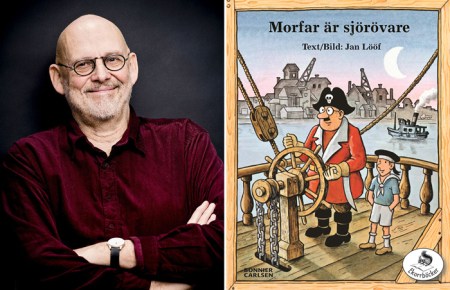
1612One of Sweden’s most popular children’s writers, Jan Lööf, was recently told by his publisher that unless he makes his bestselling 1966 book, Grandpa is a Pirate, more politically correct by rewriting it and changing the illustrations, it will be taken off the market

Sweden is no stranger to “literary revisions” of this kind, or other cultural revisions in the name of political correctness. Both Pippi Longstocking and other children’s books have gone through assorted revisions or have even been taken off the market. In the Pippi Longstocking television series, a scene in which Pippi squints her eyes to look Chinese has been edited out altogether, so as not to offend anyone. In 2013, a popular, award-winning Danish children’s book, Mustafa’s Kiosk, by Jakob Martin Strid, was taken off the market in Sweden after complaints on Swedish social media that it was racist and “Islamophobic.” Ironically, the author wrote it in 1998, when he was staying in Indonesia, the world’s most populous Muslim country, as “an anti-racist statement.” Tellingly, the book had been on the Swedish market since 2002 with no complaints. In his response to the criticism, the Danish writer noted that an equal and non-racist society only comes about “when you are allowed to make (loving) fun of everyone.” “I also make fun of Norwegians,” he added.

In 2014, after complaints on Swedish social media that some of its candy was “racist,” the Haribo company decided to change one of its products, “Skipper Mix,” which consisted of candies shaped in the form of a sailor’s souvenirs, including African masks.

The question arises: How much purging and expiation will be needed to render a country’s culture politically correct?

That question raises an even bigger one: How high is the price of political correctness in terms of “cleansing” the past and present of perceived slights, anywhere, to just about anyone?

Taken to its extremes, the urge to cleanse a culture of elements that do not live up to the politically correct orthodoxy currently in political vogue unsettlingly echoes the Taliban and ISIS credos of destroying everything that does not accord with their Quranic views. The desire “not to offend,” taken to its logical conclusion, is a totalitarian impulse, which threatens to destroy everything that disagrees with its doctrines. Crucially, who gets to decide what is offensive?

What begins innocently enough, by taking out passages from books that may hurt someone’s feelings, can end up turning into something far more sinister, as it indeed has in Sweden. Former Swedish Prime Minister Frederik Reinfeldt famously stated in 2014 that Sweden belongs to immigrants, not to the Swedes who have lived there for generations. He thereby communicated that he believes the future of Sweden will be shaped by non-Swedes, showing a curious contempt for his own culture.

This contempt has spread fast throughout official Sweden. In 2014, a Swedish school in Halmstad forbade displaying the Swedish flag, after a student painted his face in the Swedish colors for a carnival. In its new rules, the school specified why:

“Most students look forward to school traditions. When we have days of carnivals and music the goal is that these days should be experienced as positive by everyone. The Swedish flag is not allowed as part of carnival dress. … Positive and bright feelings must be in focus. … School photos must obviously be free of national symbols.”

However, the “precedent” for such rules had already been set ten years prior, in 2004, at a school in Vaargaarda, when two girls had worn printed sweatshirts which happened to display the Swedish flag and the word “Sweden.” They were told that this kind of clothing was not allowed at school. One of the girls told reporters that singing the national anthem had also been forbidden at the school.

In 2012, two members of Sweden’s parliament suggested that statues of the Swedish Kings Carl XII and Gustav II Adolf should be removed, because they represent a time when Sweden was a great military power, “a dark time in our country as well as in other countries, which were affected by Swedish aggression,” as the MPs wrote in the motion. Instead, the MPs suggested, the squares of central Stockholm should be adorned in a way such that they “signal peace, tolerance, diversity, freedom and solidarity.”

In 2013, a Baroque painting of the nude goddess Juno was removed from the restaurant of the Swedish parliament, ostensibly to avoid offense to feminist and Muslim sensibilities.

The above should not be discarded as crazy practices peculiar to Sweden. On the contrary, they present a perfect case-study of the consequences of politically correct culture driven to the extreme.

Indeed, these consequences are already proliferating across the Western world. One particularly noteworthy instance took place when Iranian president Hassan Rouhani visited Rome in January 2016. To prevent Rouhani having “a hormonal shock and ripp[ing] up the freshly signed contracts with our Italian industries,” as one Italian columnist, Massimo Gramellini, wrote, Rome covered up its classical nude statues. Who would have even imagined such sycophancy a decade ago?

In Britain, students have recently campaigned for the removal of symbols of British imperialism, such as a statue of Cecil Rhodes at Oxford University. These students claim the campaign is not only about the statue itself, but that it is “…a campaign against racism at Oxford, of which the Rhodes statue is a small but symbolic part.” Already in 2000, the London Mayor Ken Livingstone suggested that statues of two 19th-century British generals should be removed from Trafalgar Square in London, based on his own ignorance:

“The people on the plinths in the main square of our capital city should be identifiable to the generality of the population. I haven’t a clue who two of the generals there are or what they did. I imagine that not one person in 10,000 going through Trafalgar Square knows any details about the lives of those two generals. It might be time to look at moving them and having figures ordinary Londoners and other people from around the world would know.” The problem with all this, of course, is that most of London’s wealth and greatness in terms of art and architecture is due largely to British colonialism, so the question is just how many buildings would be left standing in the British capital, if one were to take this issue and bring it to its logical conclusion.

The trouble with wanting to scrub the cultural and historical slate clean, as it were, is, of course, that countries cannot just press “delete” on their culture and history. Such a move would entail not just the removal of books, paintings and statues, but a complete purge. Those who truly care for history will know that this experiment has already been attempted, not once but several times over, by the various communist and Nazi movements of the twentieth century. While there is little comparison between those movements and the culture of political correctness, the impulse governing them all nevertheless remains the same: To forge and impose one singular “truth” on everyone, rooting out everything that does not fit the utopian mold. That is neither “diverse” nor “tolerant.”

The Real Containment

November 19, 2015

The Real Containment, Steyn on Line, Mark Steyn, November 19, 2015

1594It works for Barry Manilow concerts, so why not against ISIS?

[T]he biggest obstacle to a vigorous ideological pushback is the west’s politico-media class – Obama, Kerry, Merkel, Cameron, Justin Trudeau, etc – who insist that Islam and immigration can never be a part of the discussion, and seem genuinely to believe that, say, more niqabs on the streets of western cities is a heartwarming testament to the vibrancy of our diversity, rather than a grim marker of our descent into a brutal and segregated society in which half the population will be chattels forbidden by their owners from feeling sunlight on their faces.

**********************

Because (per Obama’s latest complaint) of “how decentralized power is in this system”, over 30 American governors have told the President they don’t want him shipping battalions of “Syrian” “refugees” to their states. He, in turn, has sneered that his critics are scared of “widows and orphans”. With his usual brilliant comic timing, he said this a couple of hours before a female suicide bomber self-detonated in St Denis.

Nonetheless, the presidential-gubernatorial split is an interesting development. Obama has responded with a brand new hashtag: #RefugeesWelcome. If you live in Hashtagistan, this is another great hashtag to add to such invincible hashtags as #PeaceForParis, #JeSuisCharlie, #UnitedForUkraine and, of course, #BringBackOurGirls. If you live in the real world, the magic hashtags don’t seem to work so well, and these governors seem to think #RefugeesWelcome will perform no better for New Mexico and New Hampshire than the others have worked out for Paris, Ukraine and Boko Haram-infested West Africa.

So reality is not yet entirely irrelevant – and reality is on the march:

Dinajpur:

An Italian priest is fighting for his life in northern Bangladesh after being shot and seriously wounded by unidentified gunmen.

The attack on Wednesday is the latest in a series targeting foreigners in the country, which have been blamed on Islamic militant groups including Islamic State.

Marseilles:

A Jewish teacher has reportedly been stabbed in Marseille by three people claiming to be ISIS supporters… The suspects, who were reportedly wearing ISIS badges, made anti-semitic comments before stabbing the teacher.

London:

A married couple plotted an Isil suicide bombing of the London Underground or Westfield shopping centre around the tenth anniversary of the 7/7 suicide attacks, a court heard on Tuesday.

Mohammed Rehman, 25, and his wife Sana Ahmed Khan, 24, had enough bomb material to “cause multiple fatalities”…

Tegucigalpa:

Honduras Detains Five Syrians Said Headed To U.S. With Stolen Greek Passports

Ottawa:

The man arrested Tuesday trying to enter Parliament carrying a hidden meat cleaver probably has mental illness and isn’t a terrorist, the head of the RCMP said Wednesday.

Toronto man Yasin Mohamed Ali, 56, was arrested outside the Centre Block of Parliament in Ottawa and appeared in court Wednesday.

Hmm. “Mentally ill” “Toronto man”… But then, as John Kerry has assured us, all of the above is nothing to do with Islam. Objecting to mass murder in your country of nominal citizenship is also nothing to do with Islam:

France: Only 30 Muslims Show Up For Rally Against Paris Jihad Attacks

What’s the punchline? “…and seven of those were wearing suicide belts”?

ISIS is not itself the cause of the problem. What ISIS is is the most effective vehicle for the cause – which is Islamic imperialist conquest. What ISIS did in the Paris attacks was bring many disparate elements together – Muslims born and bred in France, Muslim immigrants to other European countries, recently arrived Muslim “refugees”… An organization that can command numerous assets of different status – holders of 11 different passports – and tie them all together is a formidable enemy. Playing whack-a-mole on that scale will ensure we lose, and bankrupt ourselves in the process.

Meanwhile, the caliphate is coining it: ISIS is the wealthiest terrorist organization in history, making billions of dollars a year from oil sales, bank raids, human smuggling, extortion and much else. So they have a ton of money with which to fund their ideological goals.

And yet, as I say, ISIS is merely the vehicle for the ideology, which in the end can only be defeated by taking it on. You can’t drone the animating ideas away. And the biggest obstacle to a vigorous ideological pushback is the west’s politico-media class – Obama, Kerry, Merkel, Cameron, Justin Trudeau, etc – who insist that Islam and immigration can never be a part of the discussion, and seem genuinely to believe that, say, more niqabs on the streets of western cities is a heartwarming testament to the vibrancy of our diversity, rather than a grim marker of our descent into a brutal and segregated society in which half the population will be chattels forbidden by their owners from feeling sunlight on their faces.

But best not to bring that up. So the attackers got suicide bombs to within a few yards of the French president. And a football match intended to show that European life goes on ended in cancellation, security lockdowns and the German chancellor being hustled away to safety. And the Belgian government has admitted it can no longer enforce its jurisdiction in parts of its own capital city within five miles of Nato headquarters… And yet, for all that, the European papers are surprisingly light on analyses of what’s going on. The multiculti diversity omertà is ruthlessly enforced, and few commentators (and even fewer editors and publishers) want to suffer the taint of “Islamophobe!” or “Racist!” Easier just to run another piece on how heartwarming that Eiffel peace symbol is – as even my old friends at the Telegraph, a supposedly “right-wing” paper, did.

Responding to Steve Sailer’s column “Four Ways To Save Europe”, Kathy Shaidle comments:

Sailer assumes Europe wants to be saved.

Whereas Europe is like, “What black eye? No, I ran into a door. Everything’s cool. You must be weird or something…”

Europe as a battered wife in denial – just like Tamerlan Tsarnaev’s all-American hometown girl.

Meanwhile, during the moment of silence for the dead of Paris, Turkish soccer fans aren’t shy about yelling “Allahu Akbar!”. It was, in fact, the least silent “moment of silence” of all time. Euphemism, circumspection and self-censorship are strictly for the infidels.

So is the gubernatorial pushback (against a president who calls them bigots and racists) a sign that the sappy hashtags are having a harder time post-Paris? Or is it just a passing phase in the immediate aftermath of mass slaughter?

Donald Trump had a good line at his Massachusetts rally on Wednesday night:

ISIS is ‘contained’? The only thing that’s contained is us.

Whether that’s true in America, it’s certainly true of the European political discourse. And, unless that changes, in Sweden, Belgium, Austria and elsewhere, we are approaching a point of no return.

~On Thursday evening, I’ll be checking in with Sean Hannity coast to coast on Fox News at 10pm Eastern/7pm Pacific.

Selective Outrage on Campus

November 13, 2015

Selective Outrage on Campus, The Gatestone InstituteAlan M. Dershowitz, November 12, 2015

(“Safe spaces,” in which infantile narcissists are shielded from ideas inconsistent with their own perceptions and which they therefore deem offensive are becoming an unfortunate part of the college experience. Freedom from ideas they find offensive trumps freedom of speech. Here’s a link to an article I posted at my blog yesterday titled Infants in University Land. It deals with the recent mess at my alma mater, Yale College. — DM)

Following the forced resignations of the President and Provost of the University of Missouri, demonstrations against campus administrators has spread across the country. Students — many of whom are Black, gay, transgender and Muslim — claim that they feel “unsafe” as the result of what they call “white privilege” or sometimes simply privilege. “Check your privilege” has become the put-down du jour. Students insist on being protected by campus administrators from “micro-aggressions,” meaning unintended statements inside and outside the classroom that demonstrate subtle insensitivities towards minority students. They insist on being safe from hostile or politically incorrect ideas. They demand “trigger warnings” before sensitive issues are discussed or assigned. They want to own the narrative and keep other points of view from upsetting them or making them feel unsafe.

These current manifestations of a widespread culture of victimization and grievance are only the most recent iterations of a dangerous long-term trend on campuses both in the United States and in Europe. The ultimate victims are freedom of expression, academic freedom and the free exchange of ideas. Many faculty members, administrators and students are fearful of the consequences if they express politically incorrect or dissident views that may upset some students. So they engage in self-censorship. They have seen what had happened to those who have expressed unpopular views, and it is not a pretty picture.

I know, because I repeatedly experienced this backlash when I speak on campuses. Most recently, I was invited to deliver the Milton Eisenhower lecture at Johns Hopkins University. As soon as the lecture was announced, several student groups demanded that the invitation must be rescinded. The petition objected to my mere “presence” on campus, stating that my views on certain issues “are not matters of opinion, and cannot be debated” and that they are “not issues that are open to debate of any kind.” These non-debatable issues include some of the most controversial concerns that are roiling campus today: sexual assault, academic integrity and the Israel-Palestine conflict. The protesting students simply didn’t want my view on these and other issues expressed on their campus, because my lecture would make them feel unsafe or uncomfortable.

The groups demanding censorship of my lecture included Hopkins Feminists, Black Student Union, Diverse Sexuality and General Alliance, Sexual Assault Resource Unit and Voice for Choice. I have been told that two faculty members urged these students, who had never heard of me, to organize the protests, but the cowardly faculty members would not themselves sign the petition. The petition contained blatant lies about me and my views, but that is beside the point. I responded to the lies in my lecture and invited the protesting students to engage me during the Q and A. But instead, they walked out in the middle of my presentation, while I was discussing the prospects for peace in the Middle East.

According to the Johns Hopkins News-Letter, another petition claimed that “by denying Israel’s alleged war crimes against Palestinians,” I violated the university’s “anti-harassment policy” and its “statement of ethical standards.” In other words, by expressing my reasonable views on a controversial subject, I harassed students.

Some of the posters advertising my lecture were defaced with Hitler mustaches drawn on my face. Imagine the outcry if comparably insensitive images had been drawn on the faces of invited minority lecturers.

I must add that the Johns Hopkins administration and the student group that invited me responded admirably to the protests, fully defending my right to express my views and the right of the student group to invite me. The lecture went off without any hitches and I answered all the questions — some quite critical, but all polite — for the large audience that came to hear the presentation.

The same cannot be said of several other lectures I have given on other campuses, which were disrupted by efforts to shout me down, especially by anti-Israel groups that are committed to preventing pro-Israel speakers from expressing their views.

The point is not only that some students care less about freedom of expression in general than about protecting all students from “micro-aggressions.” It is that many of these same students are perfectly willing to make other students with whom they disagree with feel unsafe and offended by their own micro- and macro-aggressions. Consider, for example, a recent protest at the City University of New York by Students for Justice in Palestine that blamed high tuition on “the Zionist Administration [of the University that] invests in Israeli companies, companies that support the Israeli occupation, hosts birthright programs and study abroad programs in occupied Palestine [meaning Israel proper] and reproduces settler-colonial ideology throughout CUNY though Zionist content of education.”

Let’s be clear what they mean by “Zionist”: they mean “Jew”. There are many Jewish administrators at City University. Some are probably Zionists. Others are probably not. Blaming Zionists for high tuition is out and out anti-Semitism. It is not micro-aggression. It is in-your-face macro-aggression against City University Jews.

Yet those who protest micro-aggressions against other minorities are silent when it comes to Jews. This is not to engage in comparative victimization, but rather to expose the double standard, the selective outrage and the overt hypocrisy of many of those who would sacrifice free speech on the altar of political correctness, whose content they seek to dictate.

Germany’s Sharia Refugee Shelters – “Bulk of Migrants Cannot Be Integrated”

October 1, 2015

Germany’s Sharia Refugee Shelters – “Bulk of Migrants Cannot Be Integrated” Gatestone InstituteSoeren Kern, October 1, 2015

  • Christians, Kurds and Yazidis in the shelters are being attacked by Muslims with increasing frequency and ferocity.
  • “I fled from the Iranian secret service because I thought that in Germany I could finally live my faith without persecution. But in the refugee shelter, I cannot admit that I am a Christian, or I would face threats… They treat me like an animal. They threaten to kill me.” — An Iranian Christian in a German refugee shelter.
  • “We have to dispense with the illusion that all of those who are coming here are human rights activists. … We are getting reports of threats of aggression, including threats of beheading, by Sunnis against Shiites, but Yazidis and Christians are the most impacted. Those Christian converts who do not hide their faith stand a 100% probability of being attacked and mobbed.” — Max Klingberg, director of the Frankfurt-based International Society for Human Rights.
  • “We are observing that Salafists are appearing at the shelters disguised as volunteers and helpers, deliberately seeking contact with refugees to invite them to their mosques to recruit them to their cause.” — Hans-Georg Maaßen, head of German intelligence.
  • Police are urgently calling for migrants of different faiths to be housed in separate facilities. Some politicians counter that such segregation would go against Germany’s multicultural values.
  • “The bulk of the migrants who are arriving here cannot be integrated.” — Heinz Buschkowsky, former mayor of Berlin’s Neukölln district.

Muslim asylum seekers are enforcing Islamic Sharia law in German refugee shelters, according to police, who warn that Christians, Kurds and Yazidis in the shelters are being attacked by Muslims with increasing frequency and ferocity.

Muslim migrants from different sects, clans, ethnicities and nationalities are also attacking each other. Violent brawls — sometimes involving hundreds of migrants — are now a daily occurrence.

Police say the shelters, where thousands of migrants are housed together in cramped spaces for months at a time, are seething cauldrons ready to explode. The police are urgently calling for migrants of different faiths to be housed in separate facilities.

Some politicians counter that such segregation would go against Germany’s multicultural values, while others say that separating hundreds of thousands of migrants by religion and nationality would be a logistical impossibility.

As the consequences of unrestrained migration become apparent, the tide of public opinion is turning against the government’s open-door policy. Observers say that German Chancellor Angela Merkel, the so-called most powerful woman in the world, may have met her Waterloo.

A report published by the newspaper Die Welt on September 27 sheds light on the targeting of Christians by Muslims in German refugee shelters. The paper interviewed an Iranian convert to Christianity who said:

“In Iran, the Revolutionary Guards arrested my brother in a house church. I fled from the Iranian secret service because I thought that in Germany I could finally live my faith without persecution. But in the refugee shelter, I cannot admit that I am a Christian, or I would face threats.

“Muslims wake me before the crack of dawn during Ramadan and say that I should eat before sunrise. When I decline, they call me a kuffar, an unbeliever. They spit at me. They treat me like an animal. They threaten to kill me.”

At a refugee shelter in Hemer, a town in North Rhine-Westphalia, 10 Algerian asylum seekers attacked a Christian couple from Eritrea with glass bottles. The Muslims said they were angry that the man was wearing a cross. They ripped the cross from his neck and stole his money and cellphone.

Die Welt also interviewed an Iraqi Christian family from Mosul who were living at a refugee shelter in the Bavarian town of Freising. The father said that threats by Islamists were a daily fact of life. “They shouted at my wife and hit my child,” he said. “They say: ‘We will kill you and drink your blood.'” Life in the shelter, he said, was as if in a prison.

According to the director of the Munich-based Central Committee for Oriental Christians, Simon Jacob, these incidents are only “the tip of the iceberg.” “The actual number of attacks is very high,” he said. “We have to expect further conflict, which the migrants bring to Germany from their homelands. Between Christians and Muslims. Between Shiites and Sunnis. Between Kurds and extremists. Between Yazidis and extremists.”

Max Klingberg, the director of the Frankfurt-based International Society for Human Rights (Internationale Gesellschaft für Menschenrechte, IGFM), says that much of the aggression is being perpetrated by Afghans and Pakistanis, who are “even more Islamic than some Syrians and Iraqis.” He warns that conflict in the refugee shelters will only become worse:

“We have to dispense with the illusion that all of those who are coming here are human rights activists. Among those who are arriving here now, a substantial number are at least as religiously intense as the Muslim Brotherhood.

“We are getting reports of threats of aggression, including threats of beheading, by Sunnis against Shiites, but Yazidis and Christians are the most impacted. Those Christian converts who do not hide their faith stand a 100% probability of being attacked and mobbed.”

In a September 29 interview with the newspaper Passauer Neue Presse, the head of the German police union (Deutschen Polizeigewerkschaft, DPolG), Rainer Wendt, warned that “brutal criminal structures” have taken over the refugee shelters and that police are overwhelmed and unable to guarantee safety and security. He called for Christians and Muslims to be separated before someone gets killed:

“We have been witnessing this violence for weeks and months. Groups based on ethnicity, religion or clan structures go after each other with knives and homemade weapons. When these groups fight each other at night, all those German citizens who welcomed the migrants with open arms at the Munich train station are fast asleep, but the police remain awake and are left standing in the middle…

“We can only estimate the true extent of violence because women and children are often afraid to file a complaint. Since it is also about sexual abuse and rape…

“Sunnis are fighting Shiites, there are Salafists from competing groups. They are trying to impose their rules in the shelters. Christians are being massively oppressed and the Sharia is being enforced. Women are forced to cover up. Men are forced to pray. Islamists want to introduce their values and order at the shelters.

Wendt gave the interview days after 300 Albanian migrants clashed with 70 Pakistani migrants at a refugee shelter in Calden, a town in the state of Hesse, on September 27. More than a dozen people, including three police officers, were injured in the melee, which erupted after two migrants got into a fight while waiting in line at the canteen. It took 50 police officers several hours to restore order at the shelter, which is home to 1,500 migrants from 20 different countries.

More than 60 migrants, including ten children, were injured after Pakistanis and Syrians clashed at the same shelter on September 13. The fight broke out just after midnight, when someone sprayed mace into a tent filled with sleeping migrants. Police did not inform the public about the fight for more than a week, apparently to prevent fueling anti-immigrant sentiments.

Violent brawls are becoming commonplace at German refugee shelters across the country.

1275In the past two months alone, dozens of violent brawls and riots between different groups of migrants have erupted in Germany’s refugee shelters.

On September 30, migrants went on a rampage at a refugee center in Braunschweig, a city in Lower Saxony. On September 29, Syrian migrants clashed at a refugee shelter in Gerolzhofen, a small town in Bavaria. Also on September 29, migrants from Algeria and Mali clashed at a refugee center in Engelskirchen, a town in North Rhine-Westphalia.

On September 28, more than 150 Syrians and Pakistanis clashed at a refugee shelter on Nöthnitzer Straße in Dresden. The migrants attacked each other with wooden planks and metal bars. Two dozen police officers were needed to restore order. More than 30 Syrians and Pakistanis clashed at the same shelter on August 10.

Also on September 28, between 100 and 150 migrants of different nationalities clashed at a refugee shelter in Donaueschingen, a town in the Black Forest. The trouble started over a dispute about who should be able to use the shower facilities first. On September 22, more than 400 migrants marched through town to protest conditions at the same facility. On September 15, a male migrant was attacked by another migrant for using a female bathroom at the shelter.

On September 24, around 100 Syrians and Afghans clashed at a refugee shelter in Leipzig, the largest city in Saxony. The fight broke out after a 17-year-old Afghan pulled a knife on an 11-year-old Syrian girl at the shelter, which houses 1,800 migrants. On September 23, migrants clashed at a refugee shelter for unaccompanied minors in Nuremberg.

On September 3, Syrian migrants attacked security guards at a refugee shelter in the Moabit district of Berlin. Also on September 3, Iraqi migrants attacked security guards at a refugee shelter in Heidelberg. A total of 21 squad cars were dispatched to restore order. On September 2, Algerian and Tunisian migrants clashed at the same shelter. A dozen police cars were deployed to restore order.

On September 3, migrants clashed at a refugee shelter in Hövelhof, a town in North Rhine-Westphalia. On September 2, migrants clashed at a refugee facility in Wolgast, a town in Mecklenburg-Vorpommern. Also on September 2, migrants clashed at a refugee center inGütersloh, a town in North Rhine-Westphalia.

On September 1, migrants clashed at a refugee shelter in Delitzsch, a town in Saxony. A 27-year-old Tunisian migrant was killed after being stabbed by a 27-year-old migrant from Morocco. Also on September 1, a 15-year-old Somali migrant stabbed a 15-year-old Egyptian migrant with a scissors at a refugee center in the Groß Borstel district of Hamburg.

On September 1, Somali, Syrian and Albanian migrants clashed at a refugee center inTegernsee, a small town in Bavaria. Also on September 1, migrants clashed at a refugee shelter in Heidelberg.

On August 31, Libyan and Tunisian migrants clashed at a refugee shelter in Hoyerswerda, a town in Saxony. Also on August 31, migrants clashed with each other and with security guards at a refugee shelter in Heidelberg. On August 30, a 25-year-old Sudanese migrant was arrested for going on a rampage at a refugee shelter in Jesteburg, a small town in Lower Saxony.

On August 29, a 17-year-old Algerian migrant was arrested for robbing the cellphones of other migrants at a refugee center in Elzach, a town in Baden-Württemberg. On August 25, 60 migrants went on a rampage at a refugee shelter in Karlsruhe.

On August 24, a migrant from Montenegro was stabbed by a migrant from Algeria at a refugee shelter in Seevetal, a town in Lower Saxony.

On August 22, Afghan migrants clashed at a refugee shelter in Rotenburg, a town in Hesse. Also on August 22, at least 20 migrants went on a rampage at a refugee center in Grafing, a town near Munich.

On August 21, migrants clashed at a refugee facility in Schwetzingen, also in Baden-Württemberg. Also on August 21, migrants clashed at a refugee center in the Marienthal district of Hamburg.

On August 16, 50 migrants attacked each other with broken tree branches, umbrellas and trash cans at a refugee center in Friedland, a town in Lower Saxony. The facility, which has a capacity of 700, is home to 2,400 migrants.

On August 19, at least 20 Syrian migrants staying at an overcrowded refugee shelter in the eastern German town of Suhl tried to lynch an Afghan migrant after he tore pages from a Koran and threw them in a toilet. More than 100 police officers intervened; they were attacked with stones and concrete blocks. Seventeen people were injured in the melee, including 11 refugees and six police officers. The Afghan is now under police protection. The president of the German state of Thuringia, Bodo Ramelow, said that to avoid similar violence in the future, Muslims of different nationalities must be separated.

On August 10, 40 migrants clashed at a refugee shelter on Bremer Straße in Dresden.

On August 1, 50 Syrians and Afghans clashed at the same shelter. More than 80 police officers were needed to restore order.

According to Jörg Radek, the vice chairman of Germany’s police union, (Gewerkschaft der Polizei, GdP), police have reached the “absolute breaking point,” and Christian and Muslim migrants should be housed separately. In a September 28 interview with the newspaper Die Welt, Radek said:

“Our officers are increasingly being called to respond to confrontations in refugee shelters. When there are 4,000 people in a shelter which only has space for 750, this leads to aggression where even something as insignificant as a walk to the restroom can lead to fisticuffs.

“We must do everything we can to prevent further outbreaks of violence. I think it makes perfect sense to separate migrants according to their religion.”

Not everyone agrees. In an interview with N24 television, the former mayor of the Neukölln district of Berlin, Heinz Buschkowsky, warned that if migrants are separated by religion and nationality, Germany risks the permanent establishment of parallel societies throughout the country.

Buschkowsky said the first lesson migrants must learn when they arrive in Western countries is tolerance, and if they refuse to accept people of other faiths, their asylum applications should be rejected. He expressed pessimism about the possibility of integrating the current wave of migrants into German society: “The bulk of the migrants who are arriving here cannot be integrated.”

Meanwhile, the head of German intelligence, Hans-Georg Maaßen, was warned that radical Muslims in Germany are canvassing the refugee shelters looking for new recruits. He said:

“Many of the asylum seekers have a Sunni religious background. In Germany there is a Salafist scene that sees this as a breeding ground. We are observing that Salafists are appearing at the shelters disguised as volunteers and helpers, deliberately seeking contact with refugees to invite them to their mosques to recruit them to their cause.”

The editor of the newspaper Neue Westfälische, Ansgar Mönter, reports that Salafists in Bielefeld, a city in North Rhine-Westphalia, have already infiltrated refugee centers in the area by bringing toys, fruits and vegetables for the migrants.

Mönter says “naïve” politicians are contributing to the radicalization of refugees by are asking Muslim umbrella groups in the country to reach out to the migrants.

Mönter points out that the main Muslim groups in Germany all adhere to fundamentalist interpretations of Islam and are anti-Western in outlook. Some groups have ties to the Muslim Brotherhood while others want to implement Sharia law in Germany. According to Mönter, politicians should not be encouraging these groups to establish contact with the new migrants.

12 Hair-Raising Facts from Congressional Terror Report

September 30, 2015

12 Hair-Raising Facts from Congressional Terror Report, Clarion ProjectRyan Mauro, September 30, 2015

Islamic-State-Victory-Parade-HPAn Islamic State victory parade

Yesterday, the House Homeland Security Committee released the final report of its Task Force on Combating Terrorist and Foreign Fighter Travel and its conclusions weren’t pretty. The following are a dozen hair-raising facts from the bipartisan report:

“Today, we are witnessing the largest global convergence of jihadists in history.”

If you consider how the jihad in Afghanistan against the Soviets impacted the terrorist threat to the West, then we’re in for a heap of trouble due to the jihad in Syria, Iraq and elsewhere.

About 10,000 foreign fighters joined the jihad against the Soviets over roughly a 10-year period, with only 3-4,000 fighter joining at once. Today, over 25,000 foreign fighters are currently in Syria and the civil war is only four years old. When it started in 2011, the number of foreign fighters was a mere 1,000.

“We have largely failed to stop Americans from traveling overseas to join jihadists … Several dozen also managed to make it back into America.”

This stunning conclusion will add ammunition to efforts to revoke the passports of Americans who are believed to have joined jihadists overseas. Aside from constitutional objections, one rebuttal has been if the government has the evidence to show an American has joined terrorists, then it can simply arrest them if they try to re-enter. The report shows that these American traitors have been able to evade detection and come back home to potentially carry out attacks and/or radicalize others.

“The U.S. government lacks a national strategy for combating terrorist travel and has not produced one in nearly a decade.”

This statement, unfortunately, speaks for itself.

“The unprecedented speed at which Americans are being radicalized by violent extremists is straining federal law enforcement’s ability to monitor and intercept suspects.”

Over 250 Americans have joined or tried to join the jihadist groups in Iraq and Syria, including around 30 females. They come from 19 states, with 26% coming from Minnesota, 12% from California and 12% from New York/New Jersey.

“There have now been twice as many ISIS-inspired terror plots against the West in 2015 than there were in all of 2014.”

This conclusion is unsettling—and charitable. A review by terrorism expert Patrick Poole found that the number of Islamist terrorism cases in the U.S. this year was double that of the previous two years combined. And that was as of about four months ago.

“[ISIS] is believed to have inspired or directed nearly 60 terrorist plots or attacks against Western countries, including 15 in the United States.”

“Military officials estimate airstrikes have killed over 10,000 [ISIS] extremists, but new foreign fighters replace them almost as quickly as they are killed.”

This substantiates the admission that the U.S. fight with ISIS was at a “stalemate.” Our analysis of the numbers led to thesame conclusion back in May. If you look at ISIS’ membership and territorial expansion, the U.S. is barely making a dent.

Additionally, optimistic claims of success exempt ISIS’ growth outside of Iraq and Syria. The Committee mentions reports that there are “hundreds, if not thousands” of ISIS members in Afghanistan now and the Libyan government believes it is dealing with 5,000 of its own jihadist foreign fighters now.

“Gaping security weaknesses overseas—especially in Europe—are putting the U.S. homeland in danger…”

The report raises several warnings about European security procedures, a pressing issue considering that about 1,550 fighters from France, 700 from Germany and 700 from the United Kingdom have joined the jihad in Syria and Iraq. The Committee found that counter-terrorism checks at European borders and airports are insufficient.

One-third of the international community does not issue fraud-resistant E-Passports or utilize the INTERPOL databases that contain the names of terrorists.

“In short, information about foreign fighters is crossing borders less quickly than the extremists themselves.”

The report emphasizes that intelligence-sharing remains a severe problem. There isn’t even an international comprehensive database of foreign fighter names.

“The federal government has failed to develop clear early intervention strategies—or ‘off-ramps’- to radicalization—to prevent suspects already on law enforcement’s radar from leaving to join extremists.”

Someone who is actively trying to join a group like ISIS or Al-Qaeda is probably too far gone to be rescued, unless they get a brutal wakeup call when they see the caliphate first-hand. The report states that 80% of foreign fighters download extremist propaganda and/or engage a jihadist online. It is critical that we target the ideology that precedes the violent act.

“Few initiatives exist nationwide to raise community awareness about foreign fighter recruitment and to assist communities with spotting warning signs.”

The report says that 75% of foreign fighter arrests in the U.S. happen due to the involvement of a confidential informant who is close enough to the suspect to provide the critical evidence. Presumably, this would be a Muslim in most cases. This is why Islamist propaganda that demonizes the FBI and its informants must be rebutted, such as when the Council on American-Islamic Relations (CAIR) claims that the War on Terror is “made up” by the FBI and its informants are paid to frame innocent Muslims.

“The Administration has launched programs to counter-message terrorist propaganda abroad, but little is being done here at home.”

The report isn’t exactly kind to our ideological strategy abroad, either. It says the U.S. government has not exploited the opportunity presented by “jaded jihadists”— Islamist terrorists who join the caliphate, realize it wasn’t all it was cracked up to be and flee. For example, a State Department video featuring such testimonies had only 500 views over two months.


The Myth of Muslim Radicalization

June 18, 2015

The Myth of Muslim Radicalization, Front Page Magazine, Daniel Greenfield, June 18, 2015

Usaama RahimUsaama Rahim

Mainstreaming extremism is . . . Obama’s policy. It’s the logic behind nearly every Western diplomatic move in the Middle East from the Israel-PLO peace process to the Brotherhood’s Arab Spring. And these disasters only created more Islamic terrorism.

****************

After some of its quarter of a million Muslims headed to join ISIS, Quebec decided the answer was a $2 million anti-radicalization center headed by a specialist in cultural sensitivity. But if you’re about to be beheaded by a masked ISIS Jihadist, a specialist in cultural sensitivity isn’t going to help you much.

Western governments nevertheless keep rolling out their culturally sensitive approaches to fighting ISIS.

The key element in Obama’s strategy for fighting ISIS isn’t the F-15E Strike Eagle, it’s a Twitter account run by a Muslim Brotherhood sympathizer which claims to “Counter Violent Extremism” by presenting moderate Islamists like Al Qaeda as positive role models for the Islamic State’s social media supporters.

So far 75% of planes flown on combat missions against ISIS return without engaging the enemy, but the culturally sensitive State Department Twitter account has racked up over 5,000 tweets and zero kills.

Cultural sensitivity hasn’t exactly set Iraq on fire in fighting ISIS and deradicalization programs here start from the false premise that there is a wide gap between a moderate and extremist Islam.  Smiling news anchors daily recite new stories about a teenager from Kentucky, Boston or Manchester getting “radicalized” and joining ISIS to the bafflement of his parents, mosque and community.

And who is to blame for all this mysterious radicalization? It’s not the parents. It certainly can’t be the moderate local mosque with its stock of Jihadist CDs and DVDs being dispensed from under the table.

The attorney for the family of Usaama Rahim, the Muslim terrorist who plotted to behead Pamela Geller, claims that his radicalization came as a “complete shock” to them.

It must have come as a truly great shock to his brother Imam Ibrahim Rahim who claimed that his brother was shot in the back and that the Garland cartoon attack had been staged by the government.

It must have come as an even bigger shock to Imam Abdullah Faaruuq, the Imam linked to Usaama Rahim and his fellow terrorist conspirators, as well as the Tsarnaev brothers, who had urged Muslims to “grab onto the gun and the sword.”

The culturally insensitive truth about Islamic ‘radicalization’ is that it is incremental.

There is no peaceful Islam. Instead of two sharply divided groups, peaceful Islam and extremist Islam, there is a spectrum of acceptable terrorism.

Muslim institutions have different places on that spectrum depending on their allegiances and tactics, but the process of radicalization is rarely a sharp break from the past for any except converts to Islam.

The latest tragic victim of radicalization is Munther Omar Saleh; a Muslim man living in New York City who allegedly plotted to use a Tsarnaev-style pressure cooker bomb in a major landmark such as the Statue of Liberty or the Empire State Building. Saleh claimed to be following orders from ISIS.

Media coverage of the Saleh arrest drags out the old clichés about how unexpected this sudden radicalization was, but what appears to be his father’s social media account shows support for Hamas.

Likewise one of Usaama Rahim’s fellow mosque attendees said that Rahim and another conspirator had initially followed the “teachings of the Muslim Brotherhood” but that he had been forced to cut ties with them when they moved past the Brotherhood and became “extreme”.

Despite the media’s insistence on describing the Muslim Brotherhood as a moderate organization, it has multiple terrorist arms, including Hamas, and its views on non-Muslims run the gamut from the violent to the genocidal.

A year after Obama’s Cairo speech and his outreach to the Muslim Brotherhood, its Supreme Guide announced that the United States will soon be destroyed, urged violent terrorist attacks against the United States and “raising a jihadi generation that pursues death just as the enemies pursue life.”

Despite this, Obama continued backing the Muslim Brotherhood’s rise to power across the region.

There are distinctions between the Muslim Brotherhood and Al Qaeda, but the latter is a splinter group of the former. Al Qaeda’s current leader came out of the Muslim Brotherhood. A move from one to the other is a minor transition between two groups that have far more in common than their differences.

And since the Brotherhood controls much of the Islamic infrastructure in the United States, the idea that Munther Omar Saleh or Usaama Rahim became radicalized because they went from a Jihadist group that takes the long view in the struggle against the infidel, putting political structures into place to make a violent struggle tactically feasible, to a Jihadist group that focuses more on short term violence, is silly.

Radicalization isn’t transformational; it’s incremental.

It’s the Pakistani kid down the block deciding that instead of joining the Muslim Students Association and then CAIR to build Islamist political structures in America, he should just cut to the chase and kill a few cops to begin taking over America now.

Radicalization is the moderate Imam who stops putting on an act for PBS and the local politicians and moves to Yemen where he openly recruits terrorists to attack America instead of doing it covertly at his mosque in Virginia.

Radicalization is the teenage Muslim girl who forgets about marrying her Egyptian third cousin and bringing him and his fifty relatives to America and goes to join ISIS as a Caliphate brood mare instead.

It’s not pacifism giving way to violence. Instead it’s an impatient shift from tactical actions meant to eventually make Islam supreme in America over many generations to immediate bloody gratification. ISIS is promising the apocalypse now. No more waiting. No more lying. You can have it tomorrow.

Radicalization does not go from zero to sixty. It speeds up from sixty to seventy-five.

It builds on elements that are already there in the mosque and the household. The term “extremism” implicitly admits that what we are talking about is not a complete transformation, but the logical extension of existing Islamic beliefs.

Omar Saleh seemed cheerful enough about Hamas dropping Kassam rockets on Israeli towns and cities. Would he have supported his son setting off a bomb in the Statue of Liberty? Who knows, but his son was already starting from a family position that Muslim terrorism against non-Muslims was acceptable.

Everything else is the fine print.

When Usaama Rahim followed the way of the Muslim Brotherhood, he was with a moderate group whose spiritual guide, the genocidal Qaradawi was the godfather of cartoon outrage and had endorsed the murderous Iranian fatwa against Salman Rushdie.

The slope that leads from Qaradawi’s cartoon rage to trying to behead Pamela Geller isn’t a slippery one; it’s a vertical waterfall. And this is what radicalization really looks like. It doesn’t mean moderates turning extreme. It means extremists becoming more extreme. And there’s always room for extremists to become more extreme which turns old extremists into moderates while mainstreaming their beliefs.

In the UK, Baroness Warsi, Cameron’s biggest mistake, blamed Muslim radicalization on the government’s refusal to engage with… radicals. Or as she put it, “It is incredibly odd and incredibly worrying that over time more and more individuals, more and more organisations are considered by the government to be beyond the pale and therefore not to be engaged with.”

The reason why the government is refusing to “engage” with these organizations is that they support terrorism in one form or another. Warsi is proposing that the UK fight radicalization by mainstreaming it.

Mainstreaming extremism is also Obama’s policy. It’s the logic behind nearly every Western diplomatic move in the Middle East from the Israel-PLO peace process to the Brotherhood’s Arab Spring. And these disasters only created more Islamic terrorism.

The Muslim teenagers headed to join ISIS did not come out of a vacuum. They came from mosques and families that normalized some degree of Islamic Supremacism and viewed some Muslim terrorists as heroes and role models. It’s time for Western governments to admit that the ISIS Jihadist is more the product of his parents and his teachers than of social media Jihadis on YouTube and Twitter.

Radicalization doesn’t begin with a sheikh on social media. It begins at home. It begins in the mosque. It just ends with ISIS.

The Postcolonial Rot Spreads Beyond Middle East Studies

June 15, 2015

The Postcolonial Rot Spreads Beyond Middle East Studies, Front Page Magazine, June 15, 2015

middle-east-scholarships

Middle East Studies programs, Kramer writes, “came under a take-no-prisoners assault, which rejected the idea of objective standards, disguised the vice of politicization as the virtue of commitment, and replaced proficiency with ideology.” The ideology, of course, comprised the old Marxist narrative of Western colonial and imperial crimes, a Third Worldism that idealizes the dark-skinned, innocent “other” victimized by Western depredations, and the juvenile romance of revolutionary violence.

*****************

In theory, Middle East Studies programs are a good idea. One of the biggest impediments to countering modern jihadism has been the lack of historical knowledge about the region and Islam. But even the attention and urgency that followed the terrorist attacks on 9/11 have not led to such knowledge. The result has been policies pursued both by Republicans and Democrats that are doomed to fail, as the current chaos in the region attests.

Rather than enlightening citizens and policy-makers, Middle Eastern Studies programs have darkened our understanding. As Martin Kramer documented in his important 2002 study Ivory Towers on Sand, most programs have become purveyors not of knowledge but of ideology. Under the influence of literary critic Edward Said’s historically challenged book Orientalism––“a work,” historian Robert Irwin has written, “of malignant charlatanry, in which it is hard to distinguish honest mistakes from willful misrepresentations”­­––Middle East Studies programs, Kramer writes, “came under a take-no-prisoners assault, which rejected the idea of objective standards, disguised the vice of politicization as the virtue of commitment, and replaced proficiency with ideology.” The ideology, of course, comprised the old Marxist narrative of Western colonial and imperial crimes, a Third Worldism that idealizes the dark-skinned, innocent “other” victimized by Western depredations, and the juvenile romance of revolutionary violence.

Yet Said’s baleful influence has not been limited to Middle East Studies programs, one of which has been created at my campus of the California State University, replete with the problems Kramer catalogues. It has insidiously corrupted much of the humanities and social sciences, operating under the innocuous rubric of “postcolonial” studies, which to the unwary suggests a historical rather than an ideological category. Through General Education courses that serve students across the university, and in departments like English that train primary and secondary school teachers, Saidian postcolonial ideology has been shaping the attitudes and presumed knowledge of Islam and the Middle East far beyond the reach of Middle East Studies programs.

Said’s dubious argument in Orientalism is that the work of Western scholars on the Middle East embodied “a Western style for dominating, restructuring, and having authority over the Orient,” thus creating the intellectual infrastructure for justifying colonialism and imperialism. As such, every European scholar perforce was “a racist, an imperialist, and totally ethnocentric.” For social science and humanities departments committed totally to the multiculturalist melodrama of white racism and oppression of the dark-skinned “other,” Said’s work seemingly provides scholarly bona fides to ideas that are in fact expressive of illiberal grievance politics.

English departments have been particularly vulnerable to Said’s work, for he overlaid his bad history with watered down Foucauldian ideas about the relationship of power to discourse. Thus English professors seduced by the poststructuralist theory ascendant in 1978 when Orientalism was published found in that book a seemingly sophisticated theoretical paradigm that shared both poststructuralism’s disdain for objectivity and truth, and its “hermeneutics of suspicion,” the notion that the apparent meaning of a discourse is a mask for the sinister machinations of power at the expense of the excluded “other.”

More important, postcolonialism is a politically activist theory, bound up as it is in the politics of the Middle East, especially the Arab-Israeli conflict. Now English professors could avoid the legitimate charge that poststructuralism, despite its patina of leftist ideology, was in fact an evasion of politics, a “symbolic politics,” as historian Russell Jacoby put it, “a replacement for, and a diversion from, the gritty politics of the community and the street.” On the contrary, the purveyors of postcolonialism were on the barricades, struggling to liberate Palestinians and other Muslims oppressed by a neo-imperialist America and its puppet Israel. Rather than pampered elitists guaranteed jobs for life, now the professors could fancy themselves freedom fighters and champions of the ex-colonial brown peoples still exploited and oppressed by the capitalist, racist West.

Finally, the dogma of multicultural “diversity” now firmly enshrined in American universities likewise has found Saidian postcolonialism a useful tool for interpreting and teaching literature, one that exposes the Western literary canon’s hidden racism and oppression. Moreover, in a university like Fresno State, half of whose students are minorities, a postcolonial perspective can establish a rapport with minority students who are encouraged to interpret their own experiences through the same lens of unjust exclusion and hurtful distortions of their culture and identity. At the same time white students are schooled in their privilege and guilt, minorities can be comforted by a narrative that privileges them as victims of historical oppression, one masked by the unearned prestige of the classics written by “dead white males.” Now minority students learn that Shakespeare’s Caliban is the true hero the Tempest with whom they should identify, the displaced victim of rapacious colonialists and slavers like Prospero who unjustly define the indigenous peoples as savages and cannibals in order to justify the brutal appropriation of their lands and labor.

Over the thirty years I have taught in the California State University, I have seen this transformation of the English department. Reading lists dominated by contemporary ethnic writers are increasingly displacing the classics of English literature, and even when traditional works are on the list, the books are often taught from the postcolonial perspective. New hires more and more comprise those Ph.D.’s whose specialties lie in ethnic or “world” literature, replacing the Shakespeare scholars and others trained to teach the traditional English and American literary canon. The traditional content of a liberal education––“the best which has been thought and said in the world,” as Matthew Arnold wrote––is disappearing, replaced by multicultural melodramas of Western crime and guilt.

More important for the culture at large, many of these students will go on to earn teaching credentials and staff public schools. They will carry the postcolonial ideology into their own classrooms, influencing yet another generation and reinforcing a received wisdom that will shape their students’ understanding of the important threats to our national security and interests emanating from the Middle East, especially jihadism. And it will encourage ordinary citizens to assent to the demonization of our most valuable regional ally, Israel, currently battling the Boycott, Divest, and Sanction movement that can more easily gain traction among those who from grade school to university have been exposed to the postcolonial ideology.

The damage done to our foreign policy by Middle East Studies is obvious. The influence of the godfather of such programs, Edward Said, on the social sciences and humanities departments like English is more insidious and subtle. But it is no less dangerous.

Spain in the Eye of the Storm of Jihad

June 6, 2015

Spain in the Eye of the Storm of Jihad, The Gatestone InstituteSoeren Kern, June 6, 2015

(Right of return? — DM)

  • The Islamists are especially interested in converts who have not yet taken on Muslim names and whose official IDs still have their Christian names, so they can purchase weapons without drawing the attention of police.
  • At least 50,000 Muslim converts are currently living in Spain. Police say that converts are especially susceptible to radicalization because they are facing increasing pressure from Islamists who are calling on them to carry out attacks to “demonstrate their commitment” to their new faith.
  • Spain has also become a key entry point for human trafficking mafias being used by jihadist veterans seeking to return to Europe after fighting in the Middle East.
  • “Turkey is the Seven-Eleven of false passports.” — Spanish agent working on a human trafficking case.

Spanish security forces have arrested a total of 568 jihadists over the past ten years in 124 separate operations against Islamic terrorism, Spanish Interior Minister Jorge Fernández Díaz revealed at an African security conference in Niger on May 14.

Fernández Díaz said that “constant police and judicial actions” have helped Spanish authorities prevent another large-scale terrorist attack similar to the March 2004 Madrid train bombings, in which nearly 200 people were killed and more than 2,000 were injured.

At the same time, Fernández Díaz has warned that it is “very probable” that Islamic terrorists will strike Spain at some point in the future; he has estimated the probability of an attack to be 70%.

At a two-day terrorism conference held in Madrid on April 23 and 24, Fernández Díaz said that at least 115 Spanish jihadists — including at least 15 women — are now known to have joined the Islamic State. He added that 14 jihadists had returned to Spain; nine of those are in prison and five remain free.

In January, Fernández Díaz said the number of Spanish jihadists abroad was 70, which implies a jump of more than 40 new jihadists in the first four months of 2015 alone. In August 2014, the first time that Fernández Díaz provided an official estimate, he said there were 51 Spanish jihadists fighting abroad.

Meanwhile, “dozens” of jihadists and other Islamic radicals are entering Spain from neighboring France, where they are said to be “asphyxiating” due to a government crackdown following theCharlie Hebdo attacks in Paris in January. (On April 29, French President François Hollande announced that a force of 7,000 troops would be deployed to patrol French streets on a permanent basis.)

According to an anonymous Spanish intelligence operative interviewed by El Confidencial, a media outlet based in Madrid, French jihadists are moving to Spain because they feel they have “greater room for movement” on the Iberian Peninsula. They include individuals “suspected” of being Islamic radicals, but for whom there is insufficient proof for either government to arrest them.

The report says that most of the jihadists from France are moving to Catalonia and Spain’s Mediterranean coast, where they are attempting to “blend in” with Muslim communities there. Also known as the Spanish Levant, the region roughly corresponds with what was once known as Xarq al-Ándalus, territories that were occupied by Muslim invaders for nearly five centuries.

Al-Andalus is the Arabic name given to those parts of Spain, Portugal and France occupied by Muslim conquerors (also known as the Moors) from 711 to 1492. Many Muslims believe that territories Muslims lost during the Christian Reconquista of Spain still belong to the realm of Islam. They claim that Islamic law gives them the right to return there and re-establish Muslim rule.

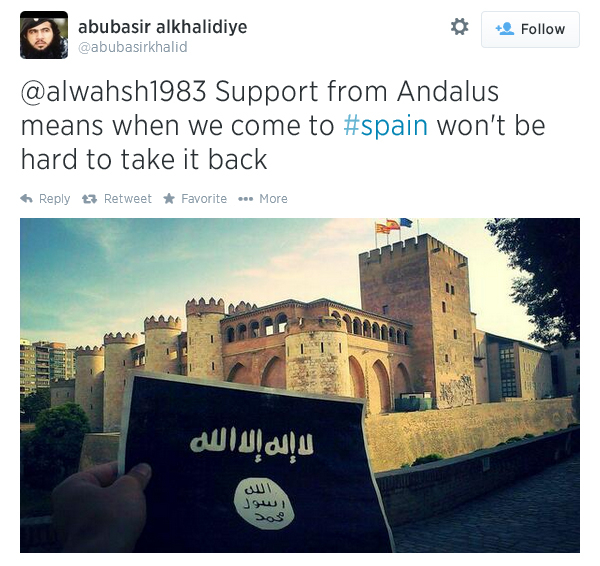
In July 2014, jihadists with the Islamic State produced a video in which they vowed to liberate al-Andalus from non-Muslims and make it part of their new Islamic Caliphate. The video showed a jihadist speaking in Spanish with a heavy North African accent, warning:

“I say to the entire world as a warning: We are living under the Islamic flag, the Islamic caliphate. We will die for it until we liberate those occupied lands, from Jakarta to Andalusia. And I declare: Spain is the land of our forefathers and we are going to take it back with the power of Allah.”

639A tweeted photo of an Islamic State supporter holding the Islamic State’s black flag of jihad in front of Aljafería Palace in Zaragoza, Spain

Counter-terrorism authorities are now warning that the Islamic State is actively looking for Spanish converts to Islam who possess gun licenses and who can legally purchase rifles and shotguns. The Islamists are especially interested in converts who have not yet taken on Muslim names and whose official IDs still have their Christian names, so that they can purchase weapons without drawing the attention of police.

At least 50,000 Muslim converts are currently living in Spain. Police say that converts are especially susceptible to radicalization because they are facing increasing pressure from Islamists who are calling on them to carry out attacks to “demonstrate their commitment” to their new faith. “Converts are the perfect breeding ground for Islamism,” according to a Spanish intelligence operative.

These concerns have been confirmed in a new report published by the Spanish Institute of Strategic Studies, an organ of the Ministry of Defense, which warned that so-called lone wolves pose the biggest threat to Spain and other European countries.

“They are activists who secretly swear allegiance to [Islamic State leader] Abu Bakr al-Baghdadi and act independently without making contact with anyone, so locating them becomes a living hell,” the report said. It added:

“Terrorists no longer need to communicate directly with the leadership of the organization to which they belong, or use the telephone or emails to know exactly what to do, when and under what circumstances. There is no longer any need for prior contact to establish the type of signals to be used, the conditions and dimensions of an attack or any restrictions.

“These tactics end the dream of the intelligence services to control everything through the systematic interception of communications and the use of satellite imagery. If there is no communication, it is not possible to intercept anything.”

Spain has also become a key entry point for human trafficking mafias being used by jihadist veterans seeking to return to Europe after fighting in the Middle East. A report prepared by Spanish border police identifies three main routes of entry — Africa, South America and Europe — and warns that human trafficking is “more lucrative than cocaine trafficking.”

According to the report:

“The proliferation of organizations trafficking in human beings and taking advantage of counterfeit documentation is resulting in the introduction of thousands of people into European countries. The problem is compounded when one considers that European jihadist veterans who have fought in Syria and Iraq on behalf of the Islamic State are using the same networks to facilitate their return. Many have arrest warrants in different countries (Spain, France, UK, etc.) and Islamic State members may cross our borders to carry out terror attacks in Europe.”

In November 2014, police in Madrid arrested 18 individuals — eight Lebanese, four Spaniards, three Syrians, one Ecuadorian, one Moroccan and one Ukrainian — accused of running smuggling operation to bring people from Syria into Spain. Police estimate that the cell, which had branches in Lebanon and Turkey, generated earnings of between €50,000 ($55,000) and €100,000 ($110,000) each month. According to one of the agents working on the case, “Turkey is the Seven-Eleven of false passports.”

Meanwhile, at least 60 jihadists in Catalonia are said to be waiting for a signal from the Islamic State to attack, according to the Madrid-based El País newspaper. The warning was given during a closed-door meeting of anti-terrorism police held in late April in Viladecans, a town near Barcelona.

The unofficial meeting was convened after a counter-terrorism operation in Catalonia was compromised, when some jihadists were allegedly tipped-off that they were about to be arrested. Although the exact circumstances of the imbroglio remain unclear, it appears to have been the result of poor inter-agency coordination between counter-terrorism police in Madrid and Catalan police known as the Mossos d’Esquadra. The two groups were apparently investigating the same Islamist cell without consulting each other.

The meeting in Viladecans, attended by 130 agents from different police forces — Mossos, Civil Guards, national and local police — from across the country, got together to discuss their mutual concerns about “the lack of training of law enforcement to combat jihadist terrorism.”

Much of the daylong meeting was used to share information about how to detect “radicalization processes” and how to distinguish ordinary Muslims from Salafists and jihadists. A counter-terrorism specialist said that one of the key problems faced by police is that “jihadists have infiltrated society, they drink alcohol, eat pork and dress like a Westerner and are undetectable.”

One of the organizers of the event, Alex Pérez of a local branch of the International Police Association, said:

“We go out on the street every day but we do not have the tools needed to combat threats against the public. Some of us are digging into our own pockets to train ourselves, protect ourselves and provide an adequate service to society.”

Another police officer summed it up this way: “We are screwed and will be much worse off in the future because there are radicals increasingly inclined to attack.”

Goodbye to the First Amendment

June 5, 2015

Goodbye to the First Amendment, Pat Condell via You Tube, January 5, 2015

(What’s left of it, anyway. — DM)


The “Speech-Denialists”

June 2, 2015

The “Speech-Denialists,” The Gatestone InstituteDaniel Mael, June 2, 2015

  • In denying the average college student the opportunity to hear, think, question and learn, these minority organizations violated the basic principles of a liberal arts education and what higher learning should presumably be about: challenging assumptions and talking openly about issues that might cause discomfort.
  • Both micro-sensitivity and political correctness require at best, obfuscating information, and at worst, silencing it.

On college campuses, teachers, students and sometimes even administrators seem to have become ever more eager to block any idea with which they disagree.

Often it appears as if their first impulse is to demonize the individual or organization presenting the offending idea, rather than to address the substance of the argument and open a discussion in the “free marketplace of ideas.”

On the campus of Lake Superior State University, wall postings “deemed offensive, sexist, vulgar, discriminatory or suggestive will not be approved.” The campus code of conduct states that if students fail to comply, they may be disciplined — a rule that was named “Speech Code of the Month” for May by the Foundation for Individual Rights in Education (FIRE).

1092Lake Superior State University’s campus code of conduct states that wall postings “deemed offensive, sexist, vulgar, discriminatory or suggestive will not be approved.” (Image source: Bobak Ha’Eri/Wikimedia Commons)

Increasingly, individuals and groups, perhaps unknowingly betraying the spirit of classic liberalism, seek to shame or ridicule dissenting opinion into silence. Both in politics and on college campuses, it seems as if aggressive shaming has replaced the art of persuasion as the favored means of argumentation. Substantive, non-politically correct discussion is now at a premium.

In her recently published book The Silencing, life-long liberal and Fox News contributor Kirsten Powers documents the escalating efforts of people claiming to be liberal to silence dissent on issues they regard as contentious. The tactic follows what Powers calls the “authoritarian impulse to silence.”

On issues ranging from campus “speech codes” to feminism, these self-described liberals are unwilling to entertain the notion that a well-intentioned individual from the other side of the aisle might have a different remedy for the problems of the day.

When feminist scholar Christina Hoff Sommers of the American Enterprise Institute gave a lecture on the campus of Oberlin University on the topic of campus sexual assault and due process, protesters labeled her a “rape denialist” and claimed that they felt “unsafe.” Perhaps we should begin calling such protesters “due-process denialists.”

When the subject is religion, these “liberals” maintain a disingenuous double standard. “While the illiberal left seems to hold a special animosity to Christianity,” Powers notes, in a remark that could also apply to Israel, “it is strangely protective of Islam, despite the fact that orthodox Muslims oppose same-sex marriage.” Not only are Muslim attitudes toward gay marriage overlooked or roadsided completely, but if anyone dares to discuss the issue of minorities in the Muslim-majority world, they are labeled “racist,” “Islamophobic,” or other slurs at arm’s reach.

Meanwhile, critics are unrelenting in their animosity toward observant Christians’ views of homosexuality. “If you think about it, we are at the water’s edge of the argument that mainstream Christian teaching is hate speech,” Senator Marco Rubio recently told CBN News. “Because today we’ve reached the point in our society where if you do not support same-sex marriage you are labeled a homophobe and a hater.”

Last year, at Brandeis University, when I sought to bring a human rights display highlighting the oppression of LGBTQ individuals in Yemen, Saudi Arabia and Iran, the initiative was blocked in a flood of administrative bureaucracy. The member of the administration with whom I met was clearly not thrilled by the idea.

Meetings with a gay rights group and the Muslim Students Association (MSA), however, were just as telling. Hoping to solicit partnerships in the initiative, I explained to leaders and members of both organizations that the project was not about Islam, but about how, on a routine basis, certain governments murder people who identify as LGBTQ. Members of the gay rights organization expressed concern about “Islamophobia,” while members of the Muslim Students Association expressed concern about “homophobia.” The initiative was rejected. Both groups evidently prioritized the emotional and intellectual comfort of the campus community over drawing attention to the plight of innocent LGBTQ individuals in the Muslim world.

In denying the average college student the opportunity to hear, think, question and learn, these minority organizations violated the basic principles of a liberal arts education and what higher learning should presumably be about: challenging assumptions and talking openly about issues that might cause discomfort. It is still puzzling why the LGBTQ club and the MSA are not at the forefront of defending other members of their respective groups, regardless of where they may live.

Both micro-sensitivity and political correctness require at best, obfuscating information, and at worst, silencing it. It is incumbent upon those who recognize the dangers of the ever-expanding “speech-denialists” in the “political correctness” movement to put up a fight — figuratively, of course.


