Archive for September 2016

Canadian Red Cross Outsources Guide for Refugees to CAIR

September 28, 2016

Canadian Red Cross Outsources Guide for Refugees to CAIR, Clarion Project, John Goddard, September 28, 2016

canada-red-cross-booklet-hpPhoto: images from the teacher’s guide

The Canadian Red Cross has funded a teachers’ guide depicting Canadian society as practicing a “terrorist ideology of hate” against Muslims.

The guide, written ostensibly to coach teachers on how to help Syrian refugee children adapt, suggests that “hate,” “discrimination” and “Islamophobia” amount to a terrorist ideology, and that non-Muslim Canadians are its perpetrators. The solution is Islam, the guide says.

“The core values and central tenants of Islam are immutable,” it says, “and are the best counter-narrative to the terrorist ideology of hate.”

The Red Cross is expressing vague misgivings about the publication.

“The original intention… was to provide educators with a resource to help children deal with cultural transition and possible trauma due to war and significant cultural change,” the charity’s spokesperson said in an interview. “In our view, the majority of the publication achieves its intended purpose, but there are specific areas that we don’t feel fit with its original intention.”

To produce the booklet, the Red Cross gave $3,000 from its “Syrian refugee resettlement fund” to the National Council of Canadian Muslims (NCCM), formerly CAIR-Canada. The group changed its name three years ago after its parent organization, the Washington-based Council on American-Islamic Relations (CAIR), was repeatedly shown to have ties to the Muslim Brotherhood and Hamas.

Canada has accepted 31,000 Syrian refugees in the past year, but the guide shows less concern for refugee children than for “Canadian Muslim youth.” The word “refugees” does not even appear in the title, “A Guide for Educators: Helping Students Deal with Trauma Related to Geopolitical Violence & Islamophobia.”

The 16-page booklet portrays Muslim youth as under attack not from Islamic State terrorists or President Bashar al-Assad’s Syrian forces, but from non-Muslim Canadians.

“To constantly feel under attack, to have to defend one’s faith, and to be continuously called upon to condemn the actions of criminals and terrorists is emotionally traumatic,” the booklet says.

The word “trauma” appears often, mostly referring to Muslim life in Canada. “Trauma can be related to historical events such as the history of colonization,” the guide says. And: “Being marginalized and categorized as ‘the other’… can be traumatic.”

The guide includes specific tips for teachers. One is to examine oneself for anti-Muslim bias — “recognize your own judgments and biases.” Another is to let Muslims proselytize in schools — “provide space for Muslim students to speak to their peers about their faith.”

In italics, the tip sheet says: “Care should be taken by teachers on the language and tone they take when discussing world events and the Islamic faith.”

TV commentator Ezra Levant put the last point in plainer language. “This is an instruction to anybody working in the school system to shut-up about Islam — it is a favored religion,” he said last week on his online news channel, The Rebel.

The self-described conservative channel sent the Red Cross more than $25,000 this summer to help with forest-fire relief in Fort McMurray, Alberta, but will never donate to the Red Cross again, Levant told viewers of The Ezra Levant Show.

“I think the Red Cross should withdraw its support [for the booklet] and apologize to Canadians,” he said.

Two years ago, the Royal Canadian Mounted Police abruptly cut its collaboration with the NCCM on a “United Against Terrorism” guide. The police force “could not support the adversarial tone” of the booklet, they said.

The Red Cross said its specific objections to the teachers’ booklet include three reprinted op-ed pieces. One is by the head of the Winnipeg-based Islamic Social Services Association, a partner on the booklet, comparing the circumstances of Canadian Muslims to that of Japanese-Canadians interned during World War Two.

“We are in discussions with the organization that produced the publication,” the Red Cross spokesperson said. “I’m not sure what the end result will be.”

Another collaborator on the guidebook was the Canadian Human Rights Commission, an ostensibly neutral federal government body, which “translated the booklet into French to reach a broader audience,” a spokesperson said.

Two years ago, the NCCM sued then-Prime Minister Stephen Harper and his press secretary for libel when the press secretary referred to NCCM as “an organization with documented ties to a terrorist organization such as Hamas.” The case is still before the courts.
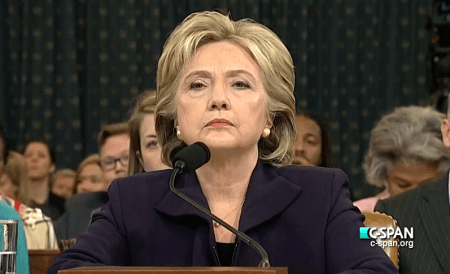
Comey: Clinton Aides Refused To Cooperate Without Immunity

September 28, 2016

Comey: Clinton Aides Refused To Cooperate Without Immunity, Jonathan Turley’s Blog, Jonathan Turley, September 28, 2016

grimhill

Hillary Clinton’s position on the email scandal has repeatedly changed from its first emergence in the presidential campaign from denial of bad judgment to the denial of the use of the private server for any classified information to the denial of any material “marked” as classified to the denial of seeing or understanding classified markings. However, one claim has remained unchanged. Clinton has maintained that she and her staff have “cooperated fully” with investigators. That claim was previously shown to be untrue when it was revealed that neither Clinton nor her staff would agree to speak with State Department investigators even though they said that such interviews were needed to determine the scope any damage to national security or security breaches. Now, however, the lack of cooperation has been put into sharper relief with the testimony of FBI Director James B. Comey this week. My column this week raised serious misgivings over the handling of the investigation with the disclosure of five immunity grants by the Justice Department, including one given to Cheryl Mills. Those misgivings were raised with Comey before the United States Senate Homeland Security and Governmental Affairs Committee where Comey revealed the extent to which Clinton aides refused to cooperate, including an assertion of the privilege against self-incrimination raised before answering questions about a key telephone conference conversation before the infamous “bitbleaching” over email records being sought by Congress. Comey testifies today before the House Oversight Committee. I am currently scheduled to discuss these issues tonight on the O’Reilly Factor.

Comey insisted that there was nothing “irregular” about the deal given Mills despite the countervailing concerns detailed in my column. His defense of the immunity deals was that the Clinton staff would not cooperate without being protected from criminal prosecution based on their answers or cooperation. The lack of cooperation was captured in the fact that Mills refused to turn over her laptop without such an immunity grant. This was government information needed in a criminal investigation and Mills refused until they gave her immunity. So here is a laptop with potential criminal information and classified information, but Mills withheld it as leverage for immunity under an “active production immunity” deal.

cheryl_d-_mills

Corey’s defense of the deal was highly dubious: “The FBI judgment was we need to get to that laptop. We need to see what it is. This investigation’s been going on for a year. And this was, in the negotiation, a tool that her lawyer asked for, that the Department of Justice granted so we could get the laptop.” So the Justice Department gave immunity to one of the highest ranking individuals and the figure most often cited as at risk for criminal charges . . . to get a laptop that the FBI could have secured through a order of production. The assumption of a long drawn out fight also assumed that the public disclosure of the Clinton staff withholding key information would not have forced the hand of Mills. Comey also did not address the bizarre role of Mills who, despite being a key and immunized witness, was allowed to sit in on Clinton’s questioning.

As for Paul Combetta, an employee at Platte River Networks, who deleted information that he reportedly knew was being sought by Congress, Comey insisted that “The department granted immunity to the one fellow who erased the stuff so that we could figure out, did anybody tell you to do this, did anybody ask you do this, to see if we could make an obstruction case — we couldn’t.” So you gave immunity to a witness who was facing a real threat of criminal charge and would be likely eager for a plea bargain? Immunity was not needed to get that individual to cooperate but it is also a questionable defense when you also gave immunity to the very high-ranking officials who was involved in the key decisions over the deletion of the emails.

Magnifying these concerns further is a recent disclosure of FBI material from the investigation, including “302 forms” from FBI interviews. There is a telling passage included in one such report from the end of page 18. The paragraph is assumed to refer to the interview of Combetta or another Platte River employee. When the FBI turned to that key telephone conference with Kendall and Mills. The witness immediately stops cooperating and invokes his privilege against self-incrimination under the Fifth Amendment. It was a telling invocation over a conversation with Clinton’s lawyers. Yet, the Justice Department gave both Combetta and the key Clinton aide in the conversation, Mills, immunity.

Putting aside the questionable judgment behind such immunity grants, one thing is clear: as with the total refusal to cooperate with the State Department investigation, there was a refusal to cooperate with the FBI investigation by key Clinton figures until they received grants of immunity — even without public records.

Netanyahu defends ties with Russia, citing mutual interests

September 28, 2016

Source: Netanyahu defends ties with Russia, citing mutual interests | The Times of Israel

In New York, PM highlights shared concerns about Islamic militants, Syria, and Moscow’s interest in Israeli tech; insists US remains top ally

September 26, 2016, 7:14 pm
Prime Minister Benjamin Netanyahu speaking September 22 2016 at the Hudson Institute gala in New York City. (Rick Gilbert via JTA)

Prime Minister Benjamin Netanyahu speaking September 22 2016 at the Hudson Institute gala in New York City. (Rick Gilbert via JTA)

WASHINGTON (JTA) — Israeli Prime Minister Benjamin Netanyahu said that outreach between Israel and Russia made sense because of shared concerns about militant Islam, a desire to avoid clashes in Syria, and Russia’s interest in Israeli technology.

Netanyahu appeared in New York on September 22 to receive the Herman Kahn award from the conservative Hudson Institute, named for one of the think tank’s founders.

He was pressed by his interviewer, Roger Hertog, a philanthropist who is one of Hudson’s benefactors, to explain why Russian President Vladimir Putin has been seeking closer relations with Israel, given Russia’s military backing for the Assad regime in Syria and its sale of an anti-missile system to Iran.

The “first interest is to make sure that militant Islam doesn’t penetrate and destabilize Russia,” Netanyahu replied. “There are many, many millions of Muslims in Russia, including in greater Moscow, I think it’s up to two million. And the concern that Russia has, which many other countries have, is that these populations would be radicalized.”

Another reason is to avoid a clash in airspace bridging Israel and Syria, where Russian combat aircraft are bombing enemies of the regime of Bashar Assad. “We can coordinate in order not to crash and clash with each other,” Netanyahu said.

Given Russia’s influence in Syria, Netanyahu said, Russia was also a useful conduit to keep Israel’s enemies from being empowered. Notably, another Assad ally is Hezbollah, the Iran-allied Shi’ite Lebanese militia that has warred frequently with Israel.

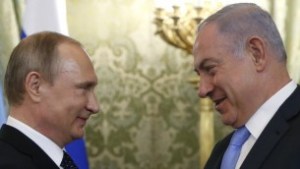
Russian President Vladimir Putin (L) welcomes Prime Minister Benjamin Netanyahu during a meeting at the Kremlin in Moscow on June 7, 2016. (AFP Photo/Pool/Maxim Shipenkov)

Russian President Vladimir Putin (L) welcomes Prime Minister Benjamin Netanyahu during a meeting at the Kremlin in Moscow on June 7, 2016. (AFP Photo/Pool/Maxim Shipenkov)

“We don’t want to see in the aftermath in Syria, whether with an agreement or without an agreement, we don’t want to see an Iranian military presence, we don’t want to see Shi’ite militias which Iran is organizing from Afghanistan, from Pakistan, and we certainly don’t want to see Iranian game-changing weapons being transferred through Syrian territory to Hezbollah in Lebanon,” the Israeli prime minister said.

Another factor was Russian interest in Israeli technology. Putin is “interested in technology and Israel is a global source of technology in many areas that are of interest to Russia — agriculture, dairy production, you name it, the standard fare.”

Finally, Netanyahu said, Israel has a substantial Russian-speaking minority.

“There’s a cultural, a human bridge,” he said. “We have a million Russian speakers in Israel. These and other reasons, I think, inform Russia’s policies. And I think it’s very important that we have this relationship.”

To applause, Netanyahu reasserted that Israel’s premiere alliance is with the United States.

“With the United States, we certainly have shared interests, but it’s the one alliance we have, and there may be one or two others, but nothing like this, that is based on shared values,” he said.

Obama, world leaders to attend Peres’s funeral in Jerusalem

September 28, 2016

German, Canadian, French and Australian heads of state, along with Britain’s Prince Charles, also set to fly to Israel for Friday event; late president’s body to lie in state at the Knesset Thursday

Source: Obama, world leaders to attend Peres’s funeral in Jerusalem | The Times of Israel

September 28, 2016, 10:02 am
US President Barack Obama meets with Israeli President Shimon Peres in the Oval Office of the White House on June 25, 2014, in Washington, DC (AFP/Mandel Ngan)

US President Barack Obama meets with Israeli President Shimon Peres in the Oval Office of the White House on June 25, 2014, in Washington, DC (AFP/Mandel Ngan)

Israeli authorities were gearing up for the funeral of the country’s ninth president, Shimon Peres, who died early Wednesday morning at the age of 93.

US President Barack Obama would attend the Friday event, the Foreign Ministry said, along with Secretary of State John Kerry. Presidential nominee Hillary Clinton will also take a break from campaigning to attend the funeral with her husband, former president Bill Clinton, the ministry said. However, Clinton’s campaign reportedly later clarified that she would not be attending.

In addition, Britain’s Prince Charles, German Chancellor Angela Merkel, French President Francois Hollande, Canadian Prime Minister Justin Trudeau, Australian Prime Minister Malcolm Turnbull and President of Mexico Enrique Peña Nieto confirmed their attendance.

A spokesperson for the Catholic Church in Israel dispelled rumors that Pope Francis would attend.

Also named as attendees were the president of Togo, Faure Gnassingbé; the president of Romania, Klaus Iohannis; and Her Royal Highness Beatrix of the Netherlands.

A former aide to Peres said his body would lie in state at the Knesset from Thursday morning before the state funeral, at Mount Herzl, the country’s national cemetery, in Jerusalem.

Yona Bartal, his former aide, told Channel 10 that the plans were in line with Peres’s wishes.

Ben Gurion Airport was gearing up to receive the many world leaders, guests and journalists who are expected to arrive for the funeral. Workers are preparing additional parking areas for the increased number of airplanes that will arrive.

Meanwhile, the Education Ministry instructed schools throughout the country to dedicate an hour Wednesday morning to talk about Peres’s life and deeds.

Peres died in his sleep at around 3 a.m. local time on Wednesday, Rafi Walden, his personal physician who is also his son-in-law, told AFP.

News of Peres’s stroke earlier this month sent shockwaves through the country, which feared the imminent loss of the last surviving link to its founding fathers.

Over a seven-decade career, the elder statesman of Israeli politics and one of the country’s most admired symbols has held virtually every senior political office, including two stints as prime minister and extended terms as foreign, defense and finance minister. He won the 1994 Nobel Peace Prize for his work in reaching an interim peace agreement with the Palestinians.

Long a divisive personality in politics, Peres finally became one of Israel’s most popular public figures in his later years.

Times of Israel staff and news agencies contributed to this report.

Saudi paper chides Palestinians for rejecting Netanyahu’s Knesset invite

September 28, 2016

Editorial in Saudi Gazette says historic visits such as that of Egypt’s Sadat to Israel ‘can bend the arc of history’

Source: Saudi paper chides Palestinians for rejecting Netanyahu’s Knesset invite | The Times of Israel

September 27, 2016, 1:45 am
Palestinian Authority President Mahmoud Abbas addresses the United Nations General Assembly at UN headquarters, September 22, 2016 in New York City.(Drew Angerer/Getty Images/AFP)

Palestinian Authority President Mahmoud Abbas addresses the United Nations General Assembly at UN headquarters, September 22, 2016 in New York City.(Drew Angerer/Getty Images/AFP)

A Saudi daily newspaper mildly chided the Palestinian leadership and Palestinian Authority President Mahmoud Abbas for “automatically” rejecting an invitation by Israeli Prime Minister Benjamin Netanyahu to address the Israeli Knesset.

Netanyahu issued the invitation to Abbas on Thursday during his address to the United Nations General Assembly in New York. Calling for a return to direct negotiations and a stop to Palestinian incitement, the Israeli leader said he would in turn speak to the Palestinian parliament in Ramallah.

In its editorial published Sunday, the Saudi Gazette wrote that the Palestinians “should not be too quick to dismiss the invitation,” arguing that it was “reminiscent of the one issued by former Israeli Prime Minister Menachem Begin to former Egyptian President Anwar Sadat to visit Israel — and the rest is history.”

The paper said the invite led to the Camp David Accords — and the signing of a peace treaty — which “demonstrated that negotiations with Israel were possible and that progress could be made through sustained efforts at communication and cooperation.”

Egyptian president Anwar Sadat addresses the Israeli Knesset in Jerusalem, November 20, 1977 (photo credit: Flash90)

Egyptian president Anwar Sadat addresses the Israeli Knesset in Jerusalem, November 20, 1977 (photo credit: Flash90)

The editorial also cited then-president Bill Clinton’s 1998 trip to Ramallah to address the Palestine National Council, which the paper argues led to the Palestinian leadership recognizing the right of Israel to exist and approving the removal of clauses from the PLO charter that called for its destruction.

“Despite these two examples of how official visits can bend the arc of history, the Palestinians automatically rejected Netanyahu’s invite to Abbas,” the paper wrote, adding that “it is possible that the aim of the invitation was an attempt by Netanyahu to isolate UN attempts to restart and impose a peace process between Israel and the Palestinians.”

While acknowledging that Netanyahu “rejects a settlement freeze, will not uproot settlements, rejects the 1967 borders as the basis for talks and rejects any division of Jerusalem,” the editorial argued that before Begin’s invitation to Sadat, Israel and Egypt were “mortal enemies, having fought three wars” and that Camp David called for “a five-year transitional period of Israeli withdrawal from the West Bank and Gaza” which would include “the introduction of Palestinian self-government and an end to Israeli settlements in the West Bank.”

“Much of the Arab world derided it as a weak deal. But in hindsight, if the provisions had been carried out, Israel and the Palestinians might not be in the impasse they are in at present,” the Saudi paper argued.

In 2002, Saudi Arabia initiated the Arab Peace Initiative which calls for Israel to cede the territories it captured in the 1967 Six Day War in return for full ties with the Arab world.

Israel has rejected the initiative, though in his address on Thursday Netanyahu said Israel welcomed its “spirit.”

Israel's Prime Minister Benjamin Netanyahu addresses the 71st session of United Nations General Assembly at the UN headquarters in New York on September 22, 2016. (AFP/Jewel Samad)

Israel’s Prime Minister Benjamin Netanyahu addresses the 71st session of United Nations General Assembly at the UN headquarters in New York on September 22, 2016. (AFP/Jewel Samad)

In his speech, Netanyahu also praised developing relations with regional Sunni powers such as Saudi Arabia, saying that they “recognize that Israel is not their enemy but their ally,” and that the “common enemy is Iran and ISIS,” referring to the Islamic State jihadist group based in Iraq and Syria.

“In coming years, we will work together openly,” Netanyahu said Thursday, adding that Israeli relations with these countries were “undergoing nothing less than revolution.”

“The change taking place in the Arab world offers a unique opportunity to advance peace,” he added.

In Debate, Hillary Dodges Blame for Libya, What Obama Called His “Greatest Mistake”

September 27, 2016

In Debate, Hillary Dodges Blame for Libya, What Obama Called His “Greatest Mistake”, Counter Jihad, September 27, 2016

16live1

The first Presidential debate revealed a Democratic candidate who believes she has all the answers even though her failed performance as Secretary of State led directly to the formation of the Islamic State (ISIS), aided the rise of Iran, and furthered much of the chaos in the Middle East.  She cannot learn anything while she believes she already knows everything.  Electing her promises more of the same, and ‘the same’ has been a disaster.

The Republican challenger, meanwhile, has much still to learn about the security structure he would command as President.  Clinton’s strongest moment against him on foreign policy came as she chided him for appearing to suggest that America would not honor its mutual defense treaties with Japan or South Korea.  Nothing is more important to the world than the reliability of America’s word.  Clinton should know that:  it was her former boss, President Obama, who personally kicked off the refugee crisis bedeviling Europe by failing to enforce his red line against Syria’s use of chemical weapons against its own people. His failure to keep his word on a security agreement gave the Syrian regime free rein to wage war on its own population, putting millions on the road to Europe.

Trump’s strongest moment against Clinton came when he accused her of bad judgment in the formation of ISIS.  She attempted to respond by saying that George W. Bush had negotiated the withdrawal from Iraq, and that “the only way that American troops could have stayed in Iraq is to get an agreement from the then-Iraqi government that would have protected our troops, and the Iraqi government would not give that.”

That’s all true, but whose job was it to obtain such an agreement?  That was her job.  She was the one who was supposed to obtain that agreement, and she failed utterly.  As our earlier coverage states:

It was her job to negotiate an arrangement with the Iraqi government that would do two things:  allow a stabilizing US military presence to remain in Iraq, and allow the US Department of State the freedom of movement it would need to step up as guarantors of the peace.  The peace, you see, had been purchased not only by the US military’s victory on the battlefields, but also by its patient negotiation with militants formerly aligned with al Qaeda in Iraq.  These tribes, mostly but not exclusively Sunni, had rejected the terrorism of al Qaeda in Iraq in return for promises of fair treatment from the Iraqi central government.  This included jobs, assistance for communities recovering from the war, and many other things that the government promised to provide in return for the support of these former enemies.  The United States helped to negotiate all these agreements, and promised to see that they would be kept faithfully.

Instead, the Secretary of State failed to produce either a new Status of Forces agreement that would permit US troops to remain in Iraq, or an agreement that would allow State Department personnel to move about the country safely to observe whether agreements were being kept.  In the wake of the precipitous withdrawal of US forces, Prime Minister Maliki moved to arrest Sunni leaders in government, and broke all his promises to the tribes.

The result was that the western part of Iraq once again became fertile ground for an Islamist insurgency.

Clinton was similarly unreflective when she argued that Trump had supported “the actions we took in Libya,” without pausing for a moment to acknowledge what a destabilizing mistake it was.  Effecting regime change with no capacity to control the outcome is what allowed radical groups, including ISIS, to expand into the vacuum.  That one is also her fault personally, as she pushed President Obama to take this action.  Her own President says that he considers ataking her advice on Libya to be his “worst mistake.”  Yet again, she has learned nothing, and does not seem to be aware that there is even anything to learn.

A similar failure to understand the lessons of the recent past occurred in their exchange on NATO.  Trump is right to be critical of the institution’s continuing relevance, but he is criticizing it on the wrong grounds.  That the other nations do not pay their way is true, but it is not the problem with NATO.  That it does not focus on terrorism is partly true, but it does not render the organization obsolete because a resurgent Russia remains a security challenge for western Europe.

Nevertheless, Clinton’s smug response is un-reflective and wrong.

You know, NATO as a military alliance has something called Article 5, and basically it says this: An attack on one is an attack on all. And you know the only time it’s ever been invoked? After 9/11, when the 28 nations of NATO said that they would go to Afghanistan with us to fight terrorism, something that they still are doing by our side.

What Clinton fails to mention here is that, like all of NATO’s decisions, invoking Article 5 must be done unanimously.  The reason to question NATO’s continued relevance is that the Turkish drift into Islamist politics makes it unlikely that a unanimous vote could still be reached.  Turkey has also shown signs recently of falling into Russia’s orbit.  If Turkey becomes a Russian ally in the way that China is, NATO may be rendered obsolete simply because it can never take a decision.  If Turkey becomes a Russian satellite, NATO will indeed have been rendered obsolete.  In either case, NATO’s continued relevance turns on figuring out how to swing Turkey away from Islamist thought and Russian influence, eliminating the unanimity requirement on NATO actions, or else developing a mechanism to expel the Turks from the alliance.   None of that exists, and since Turkey would have to agree to any of those changes, none of it is likely to come to exist.

Finally, on Iran, Clinton is wedded to a policy that Trump rightly describes as a disaster.

You look at the Middle East, it’s a total mess. Under your direction, to a large extent.

But you look at the Middle East, you started the Iran deal, that’s another beauty where you have a country that was ready to fall, I mean, they were doing so badly. They were choking on the sanctions. And now they’re going to be actually probably a major power at some point pretty soon, the way they’re going.

The horror show in Syria is linked to the Iran deal, as Obama decided to let Syria fester in order to pursue Iran’s approval of his deal.  Clinton’s role in this deal is something she herself has celebrated, so she cannot walk away from it.  Since then, Iran has developed new ballistic missiles that make sense only as a delivery mechanism for nuclear payloads.  It has bought advanced anti-aircraft missiles, and installed them around one of the nuclear sites allegedly to be made harmless by this wonderful “deal.”  Why is it hardening this site against air strikes if it intends to live by the deal?  Why develop a delivery mechanism for weapons you don’t intend to build?

Clinton cannot even ask these questions, because she is wedded to her failures.

Reasoning about Islam

September 27, 2016

Reasoning about Islam, Bill Warner Political Islam via YouTube, September 27, 2016

The blurb beneath the video states,

The first key is do not use the Koran and Allah, because the Koran is structured to be hard to understand. Instead, use the Sunna of Mohammed. The Koran says 91 times that Mohammed is the perfect Muslim and he is very easy to understand. We find Mohammed in his traditions, the Hadith, and his biography, the Sira.

When we use Mohammed to explain Islam, we do what the Koran commands. Some Muslims might say that a particular hadith may not valid (meaning they don’t like what it says), but know that almost every hadith that I use is called Sahih (authentic), since I use Bukhari and Abu Muslim.

Sometimes you meet a Muslim who rejects all of the Sunna, so how do you use Mohammed? Simple, the Koran by itself cannot be understood by any person, without knowing the life of Mohammed. No Mohammed equals no understanding of the Koran.

Actually, there is an oddity about the Koran. It is said to be the perfect, exact words of Allah. However, the perfect Koran cannot be understood without knowing Mohammed. However, the life of Mohammed and his traditions were written by people who never met him, but wrote down what they heard from others. In a court of law, this is called hearsay. Hearsay is usually not admissible in our courts. So the perfect book cannot be understood without evidence that cannot be used in our courts. Odd, isn’t it?

Islamic State, a new and deadlier enemy

September 27, 2016

Islamic State, a new and deadlier enemy, The Gorka BriefingSebastian Gorka, PhD, September 26, 2016

isw

An analysis/opinion piece that my wife Katharine and I wrote that was published in the Washington Times:

On the evening of May 2, 2011, America had a chance at closure.

We had lost thousands of our fellow Americans nine years earlier on that beautifully sunny September morning, and thousands more of our citizen-soldiers on the battlefields of Afghanistan and Iraq.

But now President Obama gave the word: The master jihadi is dead.

In an audacious operation deep within Pakistan, Osama bin Laden had been located. And killed. Al Qaeda would soon be described by the commander in chief, as “on the ropes,” condemned to ever-increasing irrelevance. But this was not the end. There would be no closure for our nation.

A new, deadlier enemy has since emerged. A foe responsible for the carnage of San Bernardino and Orlando, and scores of attacks around the world. Now we are at war with the Islamic State — a threat group that has already claimed responsibility for one of the recent attacks — and its new caliph, Abu Bakr al Baghdadi. Al Qaeda may no longer frighten us, but the Islamic State has dethroned it and is on the march.

We may be in the final stages of a presidential campaign which has polarized opinion on all matters, mundane and significant, but the facts speak for themselves.

According to the National Counterterrorism Center, part of the Office of the Director of National Intelligence, the Islamic State currently has “fully operational” affiliates in 18 nations around the world. Two years ago, the number was seven. Some of these branches are far from Iraq and Syria, including Afghanistan, where numerous Taliban commanders have sworn allegiance to Abu Bakr, and Nigeria, where Boko Haram — one of the deadliest jihadi groups active today — has changed its name to the West Africa Province of the Islamic State. According to the analysts of the SITE Intelligence Group, the totalitarian message of jihadism is so popular around the world that since June 2, outside the war zones of Iraq and Syria, there has been a jihadi attack somewhere around the world every 84 hours.

But does this mean that Americans are in greater danger today than on Sept. 10, 2001? Unfortunately, the answer is a resounding yes, and the empirical data is merciless in its incontrovertibility.

In its latest report titled “Muslim-American Involvement with Violent Extremism,” the University of North Carolina has compiled all the metadata on jihadi plots on U.S. soil since 2001. The trend they describe is an exponential one. The number of successful and intercepted terrorist attacks has grown every year (with an inordinate spike in 2009), and most disturbingly, with 2015 witnessing the greatest number of jihadi plots in America since the Sept. 11 attacks 15 years ago. Jihadism has not been weakened. Not abroad. Not in the States. With the attacks in California, Florida, and now apparently Minnesota, and potentially New York and New Jersey, ISIS has displaced al Qaeda, and it has done so here in America, too, not just in the Middle East or Africa.

In our report “ISIS: The Threat to the United States,” we answer the same question for the Islamic State that the University of North Carolina answered for all jihadists secreted within America.

The facts prove than our new enemy is more prevalent than al Qaeda ever was, with federal and state law enforcement arresting three times as many ISIS supports per month than the average for al Qaeda arrests since 2001. Here are the numbers: Since Abu Bakr declared the new caliphate from the pulpit of the Grand Mosque of Mosul at the end of June 2014, we have killed or interdicted 110 terrorists linked to ISIS, (the last one being two weeks ago in Roanoke, Va). And when one looks at what they were actually doing the picture is grimmest of all.

Just over 40 percent had sworn allegiance to ISIS and were set on leaving the United States to fight for jihad in Iraq and Syria. Just under 20 percent were management-level terrorists, the talent-spotters and recruiters who were facilitating the foreign passage of the “travelers,” as the FBI euphemistically calls them. But a full third of the ISIS suspects, like the San Bernardino killers, and Omar Mateen, the Orlando jihadi, had already decided that they could best serve the new Islamic State not by leaving but by killing infidels here on U.S. soil. This is the reality of life in the West today. Whether it is in California or Florida, or in Brussels, Paris or Nice.

As we start the 16th year of what has turned into our longest war ever, we must radically reassess our strategy for victory. The Islamic State has displaced al Qaeda and it is richer, better at propaganda, and has more fighters than bin Laden ever had.

November represents not only a choice of who the new commander in chief should be, but also what our new strategy to defeat ISIS and the global jihadi movement should be. We owe at least this to the memories of those lost on the beautifully sunny morning 15 years ago.

80% of Swedish police consider quitting over Muslim migrant danger

September 27, 2016

80% of Swedish police consider quitting over Muslim migrant danger, Jihad Watch

Sweden may be descending into a crisis as a new report suggests 80 per cent of police officers are considering switching careers due to the danger they face in the field.

Every single day, the “crises” of jihadist incursion on Western soil and continued atrocities in Islamic states keep tallying up in this full blown jihad war. The situation in Sweden has been rapidly deteriorating. Last year, Stockholm released a stunning policy document which dealt with “ISIS fighters returning to the city after having had their fill of rape and beheadings of civilians.” It indicated that:

The city of Stockholm will make it a priority to provide the returning ISIS fighters with housing, free health care (physical and mental) and full financial support, until they have received earmarked jobs. All this of course fast-tracked past the line of law-abiding immigrants and indigenous Swedes.

Why? So that the poor, downtrodden jihadists don’t feel alienated; they need the generous help of Swedish politically correct politicians to help integrate them back into society. Unbelievably, Swedish councilor Rasmus Persson told the news program Tvärsnytt:

We have discussed how we should work for these guys who have come back, and to prevent them from returning to the fighting, and that they should be helped to process the traumatic experiences they have been through.

Not an iota of consideration for the innocent law-abiding citizens of Sweden. It’s no surprise that 80 percent of Swedish police are currently considering quitting; the very profession which is designated to serve and protect is now being insidiously prevented from carrying out that sworn duty by a politically correct leftist-jihadist alliance which has the West under siege.

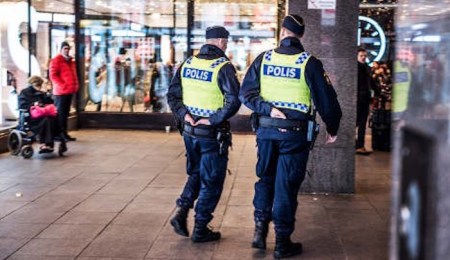
swedish-police

“80 Per Cent Of Swedish Police Consider Quitting Over Migrant Danger”, by Chris Tomlinson,Breitbart, September 20, 2016:

Sweden may be descending into a crisis as a new report suggests 80 per cent of police officers are considering switching careers due to the danger they face in the field.

The criminal situation in Sweden may be heading for an even worse turn as a new report has shown that the vast majority of the Swedish police force is so unhappy they are looking into other careers. Sweden has been rocked by increasing levels of criminality from sex attacks at music festivals, hand grenade attacks and violence toward the police in areas populated mostly by migrants.

The report states that up to three Swedish police quit every day as they feel the government isn’t giving them the tools to tackle the epidemic of criminality Norwegian broadcaster NRK reports.

Swedish police Sergeant Peter Larsson told the broadcaster the challenges Swedish authorities face with the ever decreasing number of officers saying, “We have a major crisis. Many colleagues have chosen to leave. We will not be able investigate crimes, we have no time to travel to the call-outs we are set to do. A worsened working environment means that many colleagues are now looking around for something else.”

Larsson singles out violence against emergency services employees saying, “The violence against us in the police and the paramedics and firefighters, has become much worse. We’re talking about stone throwing, violence, fires. It has become much worse in recent years.”

Tina Svensson, a resident of one of the outer suburbs of Gothenburg says that crime has reached a fever pitch and police rarely ever arrive. Ms. Svensson described a particular incident of violence to the Norwegian broadcaster as an example of her experiences saying, “there were two guys who were shot. With some kind of automatic weapons. Two magazines, perhaps. It may not be what you would expect when you are out walking the dog.”

Ms. Svensson said that many people would not travel to her suburb because of the violence and admitted most were scared to live there.

Much of the crime in Sweden is linked to specific suburbs in large cities like Stockholm and Gothenburg that generally also have a high population of migrants. Suburbs like Rinkeby in Stockholm have become particularly famous for residents attacking journalists on more than one occasion.

Swedish police have accounted for a total of 14 no-go areas in which they rarely venture outside of their heavily fortified police stations for fear of being attacked by locals.

EMISCO and the Ongoing Push Against “Islamophobia” by the OSCE

September 27, 2016

EMISCO and the Ongoing Push Against “Islamophobia” by the OSCE, Gates of Vienna, September 26, 2016

(EMISCO is the European Muslim Initiative for Social Cohesion. OSCE is the Organization for Security Cooperation in Europe. — DM)

Because EMISCO and the Turkish complement were force[d] to acknowledge that the term “Islamophobia” lacks a definition, this question was presented again in this forum. The other question concerned the definition of “new form of racism not based on skin color” and “manifestations of racism” as well. The panel did not answer the question on racism. Quraishy answered that Islamophobia was not about reasonable disagreements. In his closing remarks, however, Bülent Şenay became visibly agitated, went off his prepared notes (he said) and forcefully declared that our asking the question was both Islamophobic and ridiculous because “we all know what it means” and hence “I won’t define it.” He went on to insist, however, that “we must define Islamophobia as a crime.” Of course, defining Islamophobia is an issue because criminalizing an activity that lacks a definition is a serious civil rights and verges on the criminalization of thought.

********************************

The following report was written by the Counterjihad Collective after several members attended an EMISCO side event today at the OSCE/HDIM conference in Warsaw.

emisco-isis

This morning’s side event “The Consequences of Islamophobic Discourse in the European Political Parties” was hosted by EMISCO and chaired by Bashy Quraishy, the General Secretary of EMISCO (European Muslim Initiative for Social Cohesion). the panel was top-heavy with speakers giving country reports on Islamophobia in Europe. The presentations seemed forced and overloaded in the sense that little time was able to be allotted for questions.

bulentsenay

The forum was structured so that the closing statements, given by Bülent Şenay, were delivered after the question-and-answer period to ensure a final word. The panel seemed defensive, with panel members making strident statements about various political parties, labeling them as “racist” and “Islamophobic”. Building on narratives emphasized in 2014, their efforts were aimed at escalating the Islamophobia rhetoric in the guise of racism and gender, with all of the women appearing in head coverings, amid a constant reference to the wearing of headscarves. Also of note was a peculiar omission: the materials associated with side event did not provide the names of the briefers.

Because EMISCO and the Turkish complement were force to acknowledge that the term “Islamophobia” lacks a definition, this question was presented again in this forum. The other question concerned the definition of “new form of racism not based on skin color” and “manifestations of racism” as well. The panel did not answer the question on racism. Quraishy answered that Islamophobia was not about reasonable disagreements. In his closing remarks, however, Bülent Şenay became visibly agitated, went off his prepared notes (he said) and forcefully declared that our asking the question was both Islamophobic and ridiculous because “we all know what it means” and hence “I won’t define it.” He went on to insist, however, that “we must define Islamophobia as a crime.” Of course, defining Islamophobia is an issue because criminalizing an activity that lacks a definition is a serious civil rights and verges on the criminalization of thought.

Professor Bülent Şenay speaks under color of some authority, which makes his observations something more than just the comments of a professor. The professor sits on the OSCE Human Rights Advisory Council, is a founding member of the Governing Board of EMISCO, and was the Diplomatic Counsel¬or for Religious and Cultural Affairs at the Turkish Embassy in The Hague from 2008 to 2012. In September 2013, Professor Şenay oversaw the drafting of a declaration that defined Islamophobia as “a groundless fear and intolerance of Islam and Muslims” that is “detrimental to international peace” such that there “should be recogni¬tion of Islamophobia as a hate crime and Islamophobic attitudes as human rights violations.” The declaration was written for the “International Conference on Islamophobia: Law & Media” in Istanbul, which was co-sponsored by Turkey’s Directorate General of Press and Information and the OIC. At the conference, Turkish President Erdoğan stated that “Islamophobia” is a “kind of racism” that is “a crime against humanity.” In 2014, Şenay felt comfortable chiding the Western audience by saying, “if I were to present a particular favor, this would be the title, ‘A New Cultural ISIS — International Strong Ignorance Syndrome’” as he presented his briefing with the title, “Is¬lamophobia in the 21st Century: International Strong Ignorance Syndrome in Europe (ISIS).” In doing so, Şenay was suggesting that the extremism was in the reactions of the West, not in the acts of ISIS.