Dr. Jasser discusses the Muslim Reform Movement on the Terry Gilberg Show 05.28.2016 via YouTube
Iran: Ayatollah Khamenei Plans Next Supreme Leader, Gatestone Institute, Majid Rafizadeh, May 31, 2016
♦ Since Khamenei took power in 1989, he has shown no deviation from Khomeini’s revolutionary ideologies. Opposing the United States, “the Great Satan,” and the rejection of Israel’s existence are two of the most critical pillars of Iran’s revolutionary ideals — what defines the raison d’être of the Iranian regime, as well as what shapes Khamenei’s ideological and foreign policy.
♦ Other revolutionary core values that Khamenei desires the next supreme leader to hold include supporting Palestinian and Lebanese armed groups against Israel, maintaining Iran’s nuclear program, and being the supreme leader of the entire Islamic world — not only the leader of the Shiites. Khamenei’s official website refers to him as “the Supreme Leader of Muslims,” not the Supreme Leader of “Iran.”
Iran’s Supreme Leader, Ayatollah Ali Khamenei, in the past did not seem to wish to discuss topics linked to his successor — — the next Supreme Leader. Nevertheless, recently the trend has altered. Khamenei has begun dictating his policies, preferences, and priorities in what kind of Supreme Leader he would rather the Iranian regime have, and who, after his death, the Assembly of Experts ought to choose.
In a recent meeting, the 76-year-old Ayatollah Khamenei met with some members of the Assembly of Experts, and pointed out that “a supreme leader has to be a revolutionary” and he advised that members not to “be bashful” in selecting the next Supreme Leader.
Iran’s constitution yields the Supreme Leader the greatest authority in the country. The Supreme Leader is the single most crucial figure, the highest-ranking political and religious authority in Iran. He directly or indirectly controls the three branches of the government; the judiciary, the legislature and the executive branch.
But what does a “revolutionary” exactly mean to Khamenei? From Khamenei’s perspective, a revolutionary supreme leader would be someone who forcefully pursues the ideological principles of Ayatollah Ruhollah Khomeini, the founder of the Islamic Republic, and the core ideals of Iran’s 1979 Revolution.
Since Khamenei took power in 1989, he has shown no deviation from Khomeini’s revolutionary ideologies. Opposing the United States, “the Great Satan,” and the rejection of Israel’s existence are two of the most critical pillars of Iran’s revolutionary ideals — what defines the raison d’être of the Iranian regime, as well as what shapes Khamenei’s ideological and foreign policy.
 Who’s next? Ayatollah Ruhollah Khomeini (left) founded the Islamic Republic of Iran in 1979. He hand-picked Ayatollah Ali Khamenei (right) as his successor for Supreme Leader. Now Khamenei seems to be setting the stage to choose his own successor.
Khamenei believes that Iran would lose its Islamic character, its legitimacy, its appeal among its supporters and the essence of its revolution, as well as endanger the survival of its theocratic political establishment if it were to shift its stance and its policies towards the U.S. and Israel.
Khamenei is the second longest-ruling autocrat in the region. For him, his adherence to these revolutionary ideals are the real reasons behind his success in ruling for more than two decades. In addition, he sees that these are the underlying factors that made his regime immune from powerful opposition, popular uprisings and revolutions such as those in other countries in the region.
Other revolutionary core values that Khamenei desires the next supreme leader to hold include supporting Palestinian and Lebanese armed groups against Israel, maintaining Iran’s nuclear program, and being the vanguard of Islam and the supreme leader of the entire Islamic world — not only the leader of the Shiites. Khamenei’s official website refers to him as “the Supreme Leader of Muslims,” not the Supreme Leader of “Iran.”
Iran’s domestic and foreign policy is anchored in the three pillars of preserving the revolutionary ideology, national interests (regarding economic, strategic and geopolitical spheres) and Iranian nationalism. Khamenei is a firm advocate of prioritizing ideological norms over the other two backbones of the regime.
Khamenei is playing the same game that was played when he was chosen as the Supreme Leader. In this video, one can see how the former president and founder of the Iranian regime, Akbar Rafsanjani, and Ayatollah Khomeini chose Khamenei as the next Supreme Leader.
Unlike what the mainstream media depicts, the Assembly of Experts will not play a crucial role in determining who will be the successor to Khamenei. The Assembly of Experts is a ceremonial political body, with 86 members, who are said to determine the country’s next supreme leader.
It is important to point out that the Assembly of Experts is mainly a rubber-stamp organization; its 86 members were already vetted by the subjective decisions of the hardline political body; the Council of Guardians. The twelve members of the Council of Guardians are appointed directly by the Supreme Leader (six members), and indirectly (nominated by the head of the judiciary and appointed by the Supreme Leader).
The Islamic Revolutionary Guard Corps (IRGC), a hardline branch of the military that was once the child of Iran’s Islamic revolution and has since been transformed into the “Big Brother” of the Iranian regime, is another extremist organization that is acting hand-in-hand with Khamenei to choose the next Supreme Leader behind closed doors.
Khamenei’s efforts to direct the decision of the Assembly of Experts does not reflect the notion that he is concerned that this political body might elect a disqualified person as the next Supreme Leader.
Instead, Khamenei’s latest remarks highlight the notion that he and the senior cadre of the IRGC are setting the stage to elevate their favorite choice for the next Supreme Leader of the Iranian regime.
The Old Generals’ Old Plan, Front Page Magazine, Caroline Glick, May 31, 2016
Originally published by the Jerusalem Post.
The Israeli Left is a one trick pony. As it sees things, all of Israel’s problems – with the Palestinians, with the Arab world, with Europe and with the American Left – can be solved by giving up Judea and Samaria and half of Jerusalem (along with Gaza which we gave up already).
Once Israel does this, the Left insists, then the Palestinians, the Arab world, Europe and Bernie Sanders voters will love us as they’ve never loved us before.
The events of the past quarter century have shown the Left’s position to be entirely wrong. Every time Israel has given the Palestinians land, it has become less secure. The Arabs have become more hostile.
The West has become more hostile. The Palestinians have expanded their demands.
Because of their negative experience with the Left’s policy, most Israelis reject it. This is why the Right keeps winning elections.
Given the failure of its plan, the Left could have been expected to abandon it and strike out on a different course. But it didn’t. Instead it has tried to hide its continued allegiance to its failed withdrawal strategy by pretending it is something else.
A central component of the Left’s concealment strategy is its use of former generals.
Over the past quarter century, and particularly since the Palestinians began demonstrating in 2000 that they have no interest in a state living side by side with Israel, the Left has carted out retired generals at regular intervals to proclaim that continued allegiance to the Left’s failed policy of withdrawal is not irrational.
Every couple of years, a new initiative of former generals – often funded by the EU – is published.
Each in turn uses whatever the popular memes of the day may be to repackage their call for withdrawal from Judea and Samaria and the partition of Jerusalem.
The media, itself dominated by the Left, backs these initiatives. The retired war heroes are paraded before the cameras and presented to the public as responsible adults who have grudgingly entered the political fray, despite their aversion to it, because of their patriotism. Just as they heeded the call of duty and led forces in wars of earlier generations, so today, we are told, they heed the call again, in yet another last-ditch effort to save the country.
Just in time for Avigdor Liberman’s swearing in as defense minister, a new group of old generals released a new version of their old, discredited plan.
A group calling itself “Commanders for Israeli Security” has mobilized an impressive roster of 214 generals that have signed on to a new position paper called “Security First: Changing the rules of the game, a plan to improve Israel’s security-diplomatic position.”
The group has a great website replete with a highend web commercial that has been flooding social media feeds for the past several days. The ad shows a person ripping up a “Peace Now” bumper sticker and replacing it with a call for “Security now, peace later.”
Their plan, the ad proclaims, will improve Israel’s security, strengthen its international position, repair the cleavages in Israeli society and set the conditions for future negotiations with the Palestinians.
Unfortunately, like every leftist plan to date, if the generals get their way and the government takes their advice, the results will be precisely the opposite of what they promise. As has been the case with every other well-packaged withdrawal plan, Israel’s security will be harmed. Our international position will be wrecked. Bernie Sanders voters along with the Europeans will expand their devotion to bashing Israel. And the Sunni Arab states that now flock to us will again abandon us.
The generals’ new package involves opening their plan with a hawkish call for continued Israeli security control over Judea and Samaria, until the Palestinians decide to make peace with us.
But as we soon see, that was just throat clearing.
Having established their sober-mindedness, the generals turn to the Left’s unchanging fantasy.
They call for the government to formally relinquish Israel’s sovereign rights over the vast majority of Judea and Samaria and eastern Jerusalem.
They call for the government to permanently stop respecting the property rights of Jews in the areas of Judea and Samaria outside of the security perimeter.
The more than one hundred thousand Jews who live in those areas, they insist, must be denied all right to property, save the right to sell whatever they now own.
They must not be allowed to build anything – no new houses; no new communities; no new infrastructure.
As for the communities inside the perimeter, the generals insist that those should be permitted to continue respecting Jewish property rights, within limits, albeit. For instance, those communities must not be permitted to expand beyond their current construction boundaries. In other words, Jews can build up, but not out.
Jerusalem, which they believe should never have been unified in 1967, should be effectively partitioned.
The generals call for the municipal government to stop administering the city as a unified mixed Jewish and Arab city. Instead, they say, the city should set up a separate governing authority for Arab neighborhoods in eastern, northern and southern Jerusalem. That separate authority should be responsible for all planning and zoning activities in Arab neighborhoods as well as the education system and every other aspect of the daily lives of the Arabs of the city.
Gaza, which has been operating as a Hamas state since 2007, is also brought in from the cold. The generals call for the government to continue to supply Gaza with everything that Hamas demands – water, electricity, employment in Israel, a Hamas-controlled port. They even call for Israel to allow Europe to pay the salaries of Hamas terrorists.
Moreover, the generals recommend that the government announce that Gaza, Judea and Samaria and partitioned Jerusalem are one political entity, despite the fact that they aren’t.
The generals insist that by taking these steps, Israel will prove its devotion to peace and keep the dream of a Palestinian state alive. As a consequence, they say, the Palestinians will be happy and stop trying to murder Israelis. The Arab world will line up to sign peace treaties with Israel. Europe along with Bernie Sanders’ voters will bury the hatchet and embrace Israel.
The problem with the generals’ newest plan and the ones its replaces is that they all ignore basic facts.
There is no Palestinian constituency for peace with Israel. The more Israel offers the Palestinians, the less interested they are in settling.
By announcing that Israel renounces its claims to Judea, Samaria and Jerusalem, and treating the Jews east of the 1949 cease-fire lines as second class citizens, the generals will not only widen Israel’s social cleavages. They will tell the Palestinians that they are right to feel contempt for us. The worse they behave, the more we will offer them. The more Jews they murder, the more the Jews will turn against one another.
As for improving Israel’s international position, it is hard to understand why the generals refuse to learn the lessons of the Gaza withdrawal. Despite the fact that Israel uprooted 24 Jewish communities in Gaza and northern Samaria, and removed its military forces from the area, without exception, the international community insists that Israel still “occupies” Gaza. How can the generals expect the world to act more fairly towards a more limited withdrawal plan from Judea and Samaria and Jerusalem? As for Gaza, Operation Protective Edge brought out into the open the fact that Egypt, Saudi Arabia, the UAE and other Arab states support Israel in its war against Hamas. They do so because they fear Islamic State and Iran more than they hate Israel, whose power they trust.
If Israel announces its intention of leaving Judea and Samaria, which the Arabs know will become a Hamas enclave faster than Gaza did, the Arab faith in Israel’s power will diminish. As a consequence, if Israel follows the generals’ advice our relations with the Sunnis will worsen, not improve.
It is a tragedy for Israel that the generals have allowed the Left to use them in this way. Their role in perpetuating Israel’s destructive adherence to the devastating two-state policy model diminishes their past contributions and endangers Israel’s future.
The Moment of Truth, Pat Condell via YouTube, May 31, 2016
(Brexit the Movie is available at Warsclerotic, here. — DM)
The blurb beneath the video states,
Do we want to live in a sovereign democracy or a federal dictatorship?
Please watch ‘Brexit The Movie’ before the referendum, not after. This is the most important political decision we will ever make.
https://www.brexitthemovie.com
UK Labour Party Inquiry: Deny, Divert, Cover Up, Gatestone Institute, Douglas Murray, May 30, 2016
♦ Today, as the leader of Her Majesty’s Opposition, Jeremy Corbyn has the opportunity either to tackle anti-Semitism or mainstream it into the UK body politic. The evidence that he has any interest in doing the former are not good.
♦ Whenever the specific question of anti-Semitism was raised, Corbyn would say how opposed he was to all forms of racism, “including Islamophobia.” It has apparently proven impossible for Corbyn to realize the specific nature of anti-Semitism; whenever it has come up, he has used the opportunity to talk not about racial hatred against Jews but what he believes to be an epidemic of hatred towards Muslims.
♦ The British Labour party today evidently is riddled with anti-Semitism from top to bottom, and led by people who want to divert attention from the fact or cover it over entirely. Things can only get worse.
How would you push away a problem you did not want to deal with? The best way, as any addict could tell you, is to pretend that you have dealt with it. The drug-addict pretends to have given up drugs. The alcoholic pretends to have cut down on drink. And the British Labour party pretends to have dealt with its anti-Semitism problem.
Since the start of this year, stories of routine anti-Semitism have emerged from the most junior levels of the Labour party (the Oxford University Labour Club) to the highest levels (a member of Parliament and a member of the party’s National Executive Committee). No one who had followed the career and hobby-horses of the current Labour party leader, Jeremy Corbyn, could have been surprised by this. Anti-Semitism is a swamp he has spent his political life swimming in. But today, this has become not just a problem for him. In recent decades, Jeremy Corbyn’s activities had been of interest only to the small number of people who had hoped to keep the Labour stable clean of anti-Semitism. Today, as the leader of Her Majesty’s Opposition, he has the opportunity either to tackle anti-Semitism or mainstream it into the UK body politic.
The evidence that he has any interest in doing the former are not good. Last month, after online media released anti-Semitic tropes shared and composed by the Labour MP Naz Shah, she was suspended from the party, pending an investigation. The former Mayor of London and Labour grandee Ken Livingstone then spent a week trying to defend Shah by (among other things) explaining which of Hitler’s early policies were not that objectionable. Every day for more than a week, the national newspapers were running headlines about Labour’s anti-Semitism problem. Finally, even this Labour leader realized that something had to be done. And of course the best way to do “something” is to announce an inquiry that will do nothing. This Corbyn soon did, announcing an inquiry that would be led by Shami Chakrabarti, a left-wing human rights advocate, with no expertise in anti-Semitism and a tendency to think well of Islamist extremists. Oddly enough, Chakrabarti — who has made a virtue of her non-party affiliation throughout her career — joined the Labour party on the day that the inquiry was announced.
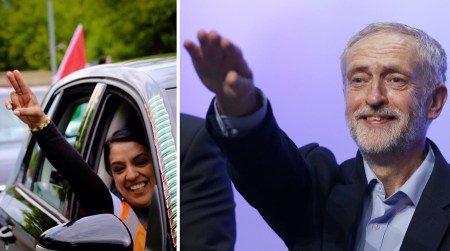 Labour Party MP Naz Shah (left), was recently suspended from the party for composing and sharing anti-Semitic tropes. Labour Party leader Jeremy Corbyn (right), has a tendency to hang around with Holocaust deniers, anti-Semitic hate-preachers and others of a similar ilk, and is a self-declared “friend” of the terror outfits Hamas and Hezbollah.
From the outset, she showed that she was willing to do the precise bidding of her party leader. Not least in ensuring that the point of any inquiry was entirely missed. For immediately upon being announced as the leader of the party’s inquiry into anti-Semitism, Chakrabarti announced that it would make no sense “only” to look into anti-Semitism, and that the inquiry must instead also look into “other forms of racism, including Islamophobia.” In a subsequent interview, she went on to question why the Conservative party had not set up an inquiry into what she alleged was its “Islamophobia.” Of course, this is a side-step that Jeremy Corbyn has very much made his own.
In the run-up to his election as Labour party leader, Corbyn was often asked about his tendency to hang around with Holocaust deniers, anti-Semitic hate-preachers and others of a similar ilk. Apart from not quite owning up to his connections to such people, the other technique he employed at this time was to put on a look of extreme affront and say that he had spent his entire life “fighting racism.” Whenever the specific question of anti-Semitism was raised, he would say how opposed he was to all forms of racism “including Islamophobia.” It has apparently proven impossible for Corbyn to realize the specific nature of anti-Semitism; whenever it has come up, he has used the opportunity to talk not about racial hatred against Jews but what he believes to be an epidemic of hatred towards Muslims.
Leaving aside the obvious fact that Muslims are not a race, there is in any case no evidence whatsoever to support the allegation of Corbyn and others that there is an epidemic of “Islamophobia” in the UK, and specifically no evidence of such an issue in the Conservative party. But this attempt to turn around the narrative was pushed by certain Labour apparatchiks to complain that any and all questioning of the newly elected London Mayor, Sadiq Khan, for his past affiliations with Islamist extremists was not a legitimate line of questioning of the judgement of anyone running for elected office, but instead an “Islamophobic” attack purely motivated by “racism.” Even now, Corbyn supporters are trying to distract attention from their own party’s very evident problem and turn racism allegations around on the Conservative party. None of which suggests any serious desire to get on top of their problem.
We can already predict what the conclusions of the Chakrabarti Inquiry will be, from the manner in which she has started it. Will she able to explain that the main originator of anti-Semitism in the Labour party today comes from its growing Muslim base? If she does identify that, will she then need to have an inquiry into herself for such flagrant “Islamophobia”? More likely she will find the party entirely blameless. Just a few dozen bad apples, and so on. And even then, we now have a nice demonstration of what will happen if any unpleasant findings do accidentally slip through.
The Labour party has another inquiry: into allegations, reported earlier this month, of anti-Semitism at its Oxford University club. Amazingly enough, while that inquiry (led by Baroness Royall) found “difficulties,” it claimed to find no “institutional anti-Semitism.” These careful headline facts having been released, the rest of the report was then swiftly supressed on the orders of the Labour party. Only a bland executive summary and some recommendations were made public, evidently leaving even the author of the inquiry “frustrated.” So there is the state of the British Labour party in 2016. A party evidently riddled with anti-Semitism from top to bottom, and led by people who want to divert attention from the fact or cover it over entirely. The Labour party has a serious problem, and it is in institutional denial. Things can only get worse.
Enemies, Foreign and Domestic, Front Page Magazine, Mark Tapson, May 30, 2016

Enemies, Foreign and Domestic: A SEAL’s Story is a new book by former Navy SEAL Carl Higbie. Higbie was on the Navy SEAL assault team that in the summer of 2007 captured the most wanted man in the Middle East (apart from Osama bin Laden) – Ahmed Hashim Abd Al-Isawi, known as the Butcher of Fallujah. But afterward, Higbie and others in his unit were charged with prisoner abuse when Al-Isawi alleged that they had bloodied his lip.
Suddenly, the “mission accomplished” became a much more challenging ordeal as Higbie et al were threatened with courts-martial over supposedly roughing up a ruthless terrorist. When he went public with his account of what happened, the Navy pushed back hard to save face and protect careers. But Higbie pushed back harder.
Higbie, also the author of Battle on the Home Front: A Navy SEAL’s Mission to Save the American Dream, became a SEAL in 2003 and deployed twice in support of Operation Iraqi Freedom. He is now a political commentator in national media including the Fox News Channel, Wall Street Journal, The Washington Post, The Daily Caller, and Breibart. He graciously agreed to answer a few questions for FrontPage Mag about his lates book, Enemies, Foreign and Domestic.
Mark Tapson: About the mission to capture and extract this high-value target, the Butcher of Fallujah. You and your unit accomplished the mission, handed him over, and all seemed good – but then what happened afterward?
Carl Higbie: After turning over custody to the Master at Arms (MP), the MP admittedly left his post. During this time the prisoner bit his lip (as testified by an oral surgeon) and spit blood on his clothing. Out of fear for his own career, the MP concocted a story that he saw many of us abuse the prisoner. This story was fabricated, as was apparent from his numerous changes in his official statement.
MT: The accusation should have been cleared up quickly, but instead, the Navy did its best to break you and the other suspects down and get confessions out of you. Tell us what happened.
CH: Initially we were investigated by NCIS and their investigation made the recommendation to not charge us. It was our Commanding officer along with General Cleveland that decided to proceed despite the facts. Because of the lack of evidence, they wanted to proceed “general’s mast” where there is no need for evidence and a punishment can be issued arbitrarily. They were doing to his to save face and “make an example” out of us.
We all requested a courts-martial so we would have a fair trial and be able to present evidence in our favor. The command tried to talk us out of this because they knew they would lose. They separated us and threatened us with all kinds of punishments, but we held strong and forced the courts-martial.
MT: Why do you think this guy made such a serious accusation about some of his fellow soldiers, and why do you think the higher-ups weren’t more supportive of the accused, especially considering that the so-called victim was a terrorist?
CH: The higher-ups were afraid of simple allegations, how that would affect their careers. They lost sight of the mission and their duty to their men. They put politically correct public image in front of their oath. They had us pegged for guilty from day one despite ALL the evidence. So much for “innocent until proven guilty.”
MT: What’s your opinion of the Rules of Engagement our warriors were bound by which were so strict that merely bloodying a terrorist’s nose could get you court-martialed? Do you think those ROE are proper or are they hindering our men in the field and perhaps even endangering them?
CH: Rules of engagement are different from guidelines for treating prisoners. I think the Rules of Engagement are atrocious. You cannot have one side playing by a set of rules that does not apply to the other side. War is not a moral endeavor, it is people killing each other; therefore you must be willing to be as ruthless as your enemy.
As for prisoner handling, we should never have stood any discipline after NCIS cleared us and recommended not going forward. This is what investigations are for and they should not be overstepped by a commander who has no knowledge of the situation. Moreover, who cares if a terrorist that we had legal authority to kill had a bloody lip?
MT: After you were eventually cleared, you wrote a book – as a private citizen, not as a SEAL – called Battle on the Homefront based on your experiences, in which you complained about various ways in which Americans are failing to live up to our country’s own exceptionalism. But the Navy brass gave your manuscript the runaround and did their best to suppress publication. Why do you believe they did that, particularly since many of them privately agreed with what you wrote?
CH: I spent almost two years, 24 times the length of time the DOD has allowed by their own standards for the review. At every corner, they stonewalled me, refusing even to conduct a review. I had been consulting an attorney throughout the process who was dumbfounded, as we had continuously jumped through hoops to accommodate their ever-changing requirements.
The book was controversial and no one wanted to review it because they were concerned about how it would affect their careers if they were the ones with the approval stamp on it. The military spent more resources trying to bury it than it would have taken to conduct the review. After a review from NCIS on security, and under advice from my attorney, we published without command approval since they had failed to comply with their own rules.
MT: Since leaving the Navy, you’ve pursued a path as a political commentator in the media. Is that another way you feel you can best serve your country? Do you have political ambitions in the future as well? Tell us about what you’re doing to help reinvigorate the American Dream.
CH: I have pursued the political route because I believe that to be the root of the problem today. I am unsure whether I will run again but I am heavily involved with this presidential race and many other races as well. If we want to fix this nation we have to start at the top.
H/t Joopklepzeiker

Anti-Brexit Shocker: Economists and Faith Leaders Plot Britain’s Downfall, The Daily Bell, Staff, May 30, 2016

Economists overwhelmingly reject Brexit in boost for Cameron … Poll shows 88% of 600 experts fear long-term fall in GDP if UK leaves single market, and 82% are alarmed over impact on household income. -Guardian
Once again, economists remind us that that their profession is at least a questionable one.
Presumably healthy economies are based in private competition not public regulation. Economic progress is made via individual human action.
One person has a product or service and competes against another. And one company against another.
There is room for more than one product or service as consumers have different priorities.
And thus an “economy” is built.
But for some reason, British economists seem to believe that the authoritarian mess that is the European Union is necessary for prosperity.
More:
Relatively few economists have publicly come out saying that leaving the EU would be good for British growth, and only a handful have signed up in support of the pro-Brexit group Economists for Britain.
Most studies of the impact on Britain’s economy of a decision to quit the EU show the uncertainty will hit growth in the short term and the loss of access to the EU’s single market will damage growth for decades to come.
The poll was administered by Ipsos MORI, and received responses from more than 600 economists.
These economists believed in great numbers that leaving the EU would damage the British economy for years to come. Some 61% believe unemployment would expand.
Economists from top institutions such as the Royal Economic Society and the Society of Business Economists replied voluntarily.
The article also tells that 37 “faith leaders” have just written a letter to the Observer newspaper claiming Brexit damages both peace and prosperity.
It’s not clear from the article why leaving the EU would damage peace and prosperity.
The article makes a clearer case for what economists are worried about: “Loss of access to the single market” (67%) and “increased uncertainty leading to reduced investment” (66%).
Presumably economists (and faith leaders?) see their professions somehow enhanced by the EU and diminished by Brexit.
But these views still don’t make much sense.
There are currently reports that the EU is pushing hard for the federalization of Europe via a new tax ID number and also via plans for a pan-European army.
A national insurance number will allow Brussels to identify European (and British) taxpayers and would be a further step toward the institution of an aggressive European tax.
Additionally, new legislation will ban sovereign states from reducing corporate taxation to below 15 percent.
Neither plans for a European army nor the new tax ID number are apparently getting much coverage in Britain.
It really doesn’t matter though. Brussels have proven several times over that the EU’s goal is a United States of Europe.
Surely the economists involved in the survey understand the level of corruption currently infecting the EU.
Those affiliated with the EU receive enormous compensation for useless activities. Regulatory advantages are routinely sold to the highest bidder.
And surely they understand that the decision-making bodies have been purposefully divorced from Parliament. The entire setup of the EU is aimed at producing a mega-state responsible only to a handful of bureaucrats.
How on earth British economists, let alone “faith leaders” can endorse the EU is difficult to imagine.
If Britain stays in the EU, within a decade the country – as it has existed for perhaps a thousand years – will be disassembled.
These economists and faith leaders are content to support the end of Britain.
Faith will not be diminished and industry will not leave if Brexit occurs. But the country will not survive as a historical entity if it remains within Europe.
Conclusion: These two groups are willfully presiding over the end of Britain.
That Kissinger Promise and Obama’s Fulfillment, The Jewish Press, Vic Rosenthal, May 30, 2016
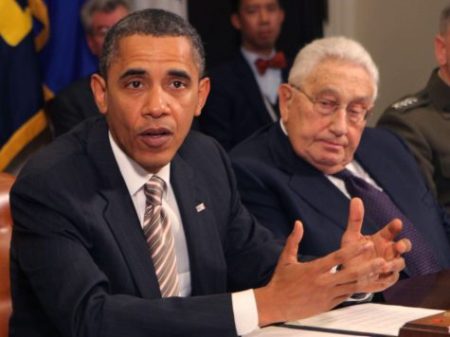 Pres. Obama seated with Henry Kissinger
{Originally posted to the author’s website, Abu Yehuda}
Old realpolitiker Henry Kissinger was in the news recently when he sat down with Donald Trump, to give him the benefit of his experience. It brought to mind Kissinger’s numerous attempts to get Israel out of the territories it conquered in 1967, before, during and – especially – after the Yom Kippur War.
Kissinger went to Iraq in December of 1975 to try to wean the regime away from the Soviet Union and improve relations with the US. In a discussion with Sa’dun Hammadi, the Iraqi Foreign Minister, Kissinger suggested that American support for Israel was a result of Jewish political and financial power, promised that the US would work to force Israel back to pre-1967 boundaries, and indicated that while the US would not support the elimination of Israel, he believed that its existence was only temporary. Here is an excerpt (the whole thing is worth reading):
I think, when we look at history, that when Israel was created in 1948, I don’t think anyone understood it. It originated in American domestic politics. It was far away and little understood. So it was not an American design to get a bastion of imperialism in the area. It was much less complicated. And I would say that until 1973, the Jewish community had enormous influence. It is only in the last two years, as a result of the policy we are pursuing, that it has changed.
We don’t need Israel for influence in the Arab world. On the contrary, Israel does us more harm than good in the Arab world. You yourself said your objection to us is Israel. Except maybe that we are capitalists. We can’t negotiate about the existence of Israel, but we can reduce its size to historical proportions. I don’t agree that Israel is a permanent threat. How can a nation of three million be a permanent threat? They have a technical advantage now. But it is inconceivable that peoples with wealth and skill and the tradition of the Arabs won’t develop the capacity that is needed. So I think in ten to fifteen years, Israel will be like Lebanon—struggling for existence, with no influence in the Arab world. [my emphasis] …
Kissinger also promised that aid to Israel, which he presented as a result of Jewish political influence, would be significantly reduced. He indicated that legal changes in the US – he must have been referring to the creation of the Federal Electoral Commission in 1974 to regulate campaign contributions – would attenuate Jewish power and therefore American support for Israel. Naturally, he didn’t foresee the Israel-Egypt peace agreement, which permanently established a high level of military aid to both countries.
He further promised that the US would support a PLO-run Palestinian state if the PLO would accept UNSC resolution 242 and recognize Israel. This of course is what (supposedly) happened in the Oslo accords.
Kissinger insisted that “No one is in favor of Israel’s destruction—I won’t mislead you—nor am I.” But his hint that a smaller Israel might not survive is clear. Surely he understood that a pre-1967-sized Israel (within what Eban called “Auschwitz lines”) would have no chance of surviving, simply because of the strategic geography of the area.
Kissinger was wrong about the Arabs developing the capability to challenge Israel, but their place has been taken by soon-to-be-nuclear Iran and its proxies, who are significantly more dangerous than the Arab states ever were.
US policy, however, has kept more or less the same shape, except that the hypocrisy of insisting that the US supports the existence of Israel but in a pre-1967 size is even more glaring. The substitution of the PLO for the Arab states as the desired recipient of the land to be taken from Israel has barely made a ripple either in America or among the Arabs, suggesting that the policy is more about Israel giving up land than about the Arabs getting it.
The original motivation for Kissinger’s promises was supposedly the desire of the US to replace the Soviet Union as the patron of the Arab states. After the collapse of the USSR and the end of the Cold War in 1991, however, there was no change in policy. Although the Oslo Accords were initiated by left-wing Israelis, the US eagerly embraced them, and the so-called ‘peace process’ became a permanent stick to beat Israel with.
President Obama is especially adept at emphasizing support for Israel’s existence while at the same time demanding that Israel make concessions that would make her continued existence impossible. Apparently agreeing with Kissinger about Jewish power, Obama has worked to reduce the pro-Israel influence of American Jews in numerous ways, such as by providing access to the White House for groups like J Street and the Israel Policy Forum, while marginalizing traditional Zionist organizations like ZOA.
Kissinger’s almost anti-Semitic claim that US support for Israel is bought with Jewish money was probably untrue in 1975 and is even less so today, when a large proportion of American Jews, including wealthy ones, have chosen their liberal or progressive politics over Zionism. The coming struggle over the introduction of a pro-Palestinian plank into the Democratic platform is an indication that the party and with it, many of its Jewish supporters, is moving toward Obama’s position.
The Obama Administration’s program to extricate itself from the Middle East by empowering Iran as the new regional power has given a new impetus to the policy of shrinking Israel. Iran sees Israel as a major obstacle to its hegemony, for both geopolitical and religious/ideological reasons, and is committed to eliminating the Jewish state. Obama found it necessary to restrain Israel from bombing Iran’s nuclear facilities at least once (in 2012), and seems to be prepared to sacrifice Israel in order to achieve his goal of establishing Iranian regional dominance.
Some would go even further and say that Obama’s primary ideological goal is to eliminate Israel and the Iranian gambit is a means to this end, but that is highly speculative! Or maybe it’s a matter of two birds with one stone.
Henry Kissinger didn’t do us any favors, but I think the anti-Israel thread in American policy would have been strong enough without him, running from Truman’s Secretary of State George C. Marshall all the way to Obama’s stable of anti-Zionists like Rob Malley and Ben Rhodes.
Today Israel is long gone from the Sinai, more recently from Gaza, and probably only thanks to the disintegration of Syria, still holding the Golan Heights. I would like to believe that PM Netanyahu was correct when he said that Israel will never leave the Golan. Regarding Judea, Samaria and Jerusalem, I expect that we are about to begin a very difficult time, as the Obama Administration is likely to mount a campaign in its last days to fulfill Kissinger’s promise to the Arabs at long last.




 anneinpt
 artaxes
 danmillerinpanama
 davidking1530
 Peter Hofman
 Joseph Wouk
 Peter
Peter Louisiana Steve
 WarSclerotic
Recent Comments