H/t Freedom is Just Another Word
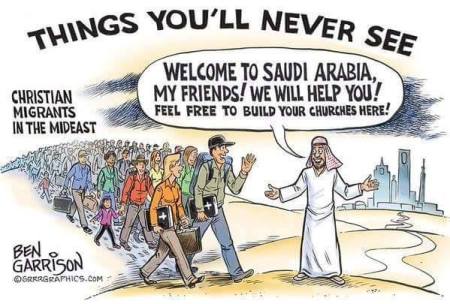
H/t Joopklepzeiker

Pakistan on the Mediterranean, Washington Free Beacon, Michael Rubin, March 28, 2016
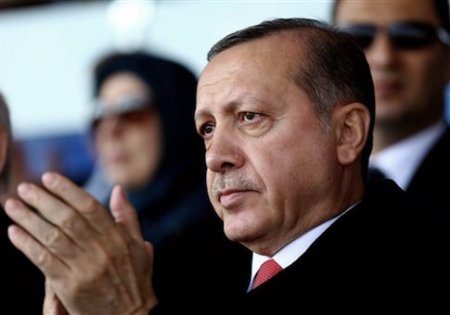
Turkish President Recep Tayyip Erdogan listens during a ceremony to commemorate the 101st anniversary of the Battle of Gallipoli in Canakkale, Turkey, Friday, March 18, 2016. Turkish President Recep Tayyip Erdogan on Friday warned Europe that it, too, could fall victim to attacks by Kurdish militants following a terror attack in Ankara that killed 37 people. (Kayhan Ozer, Presidential Press Service, Pool via AP)
President Obama will welcome Erdoğan to Washington this week for a strategy meeting about countering the ISIS.
**********************
On March 18, European and Turkish diplomats signed off on a comprehensive deal on migrants pouring from Syria, Iraq, and elsewhere in the Middle East through Turkey and into the European Union. Under the terms of the deal, for every illegal migrant the E.U. returns to Turkey, Turkey would send one refugee for resettlement in Europe. Additionally, Turkey and Europe agreed to re-open discussions concerning the Muslim country’s efforts to join the E.U., and Europe agreed to allow Turks visa-free travel throughout the Schengen zone.
Two days after the deal was announced, a Turk who had joined the Islamic State blew himself up among tourists on Istanbul’s Istiklal Street, one of the city’s major shopping and tourism districts. Two days after that, ISIS suicide bombers killed dozens in two separate attacks in Brussels. ISIS called what occurred in Belgium “a drop in the sea” compared with what the terrorists have in store for “nations of disbelief.”
Turkey and its president, Recep Tayyip Erdoğan, have used the growing threat to argue that the West must better conform its policies to Turkey’s desires. In the wake of the Brussels attacks, Prime Minister Ahmet Davutoğlu chided Europe. “Europe has no partner other than Turkey to provide its regional security,” he declared, adding a subtle threat: “They should see this reality and act accordingly.” Meanwhile President Obama will welcome Erdoğan to Washington this week for a strategy meeting about countering the ISIS.
The reality Davutoğlu deliberately ignores, however, is his own country’s role in allowing ISIS to develop and metastasize. The Turkish government is adept at pulling the wool over Western officials’ eyes. Erdoğan pays lip service in meetings with European and American officials to the importance of both democracy and the Turkish partnership with the West, for example, declaring, “Secularism is the protector of all beliefs and religions.” He speaks differently to his Turkish audience. As mayor of Istanbul, he described himself as “the imam of Istanbul” and declared, “Thank God almighty, I am a servant of Shari‘a.” He is famous for his quip, “Democracy is like a streetcar. When you come to your stop, you get off.” In recent years, he has declared his goal to be to “raise a religious generation.”
This “religious generation” is flowing into the cauldron of Syria and Iraq. More than 30,000 foreign fighters from as many as 100 countries now fight with the Islamic State. The bulk of these soldiers—perhaps 90 percent—crossed into the Islamic State from Turkey. Turkish visa policy contributes to the problem. A direct correlation can be drawn between foreign fighters serving ISIS and those nationalities from which Turkish authorities require no visa or provide waivers: Several thousand more Moroccans and Tunisians, who need no visas to transit Turkey, fight with ISIS in Syria and Iraq than Algerians and Libyans, who do. If Erdoğan simply required visas in advance for those under the age of 40 coming from countries like Morocco, Tunisia, Lebanon, and Jordan—or, for that matter, from Russia, the United Kingdom, and Australia—the flood of recruits into the Islamic State would slow to a trickle.
ISIS terrorists regularly traverse the Turkish border, not only for medical care but also for rest and relaxation. Some merchants in Istanbul openly sell ISIS propaganda and promise that proceeds from their sale will benefit the group’s fight in Syria and Iraq. Smugglers peddling contraband oil to fund ISIS rely on Turkey to bring the oil to market, paying off local and perhaps even national officials of the AKP, Turkey’s governing party, along the way.
Turkey has done more than lend passive support to Islamist radicals. In his 13 years in power, Erdoğan has transformed Turkey from a Western-leaning democracy into Pakistan-on-the-Mediterranean. There was, for example,the leak of documents from the Millî İstihbarat Teşkilatı (MİT), Turkey’s intelligence service, showing Turkish support of the Nusra Front, an al Qaeda affiliate operating in Syria. And, rather than give medals to the Turkish soldiers who intercepted truckloads of weaponry destined for Syrian radicals, Erdoğan ordered their arrest.
Likewise, when Turkish journalists exposed—with photographic evidence—the transfer of munitions and other supplies from the Turkish border to ISIS, Erdoğan’s response was not to applaud the media but to seize the newspaper and arrest its editors and many of its reporters.
There is also evidence that, as Kurds fighting ISIS in Kobani in 2014 began to turn the tide against the radical group, Erdoğan and Turkish intelligence officials allowed ISIS fighters to pass through Turkey and attack Kobani from across the border, a flank the town’s largely Kurdish residents assumed was secure.
From the beginning, Erdoğan has looked at the Syrian refugee crisis not as a humanitarian tragedy but an arrow in his quiver. Inside Turkey, he has offered Sunni refugees Turkish citizenship if they settle in Turkish provinces currently dominated by the Shi‘ite offshoot Alevi sect. And, whereas the world condemns ISIS “genocide” against the Yezidi, the Yezidi who sheltered in Turkey were then victimized, again, by local AKP-run municipalities who refused to provide services offered to Sunni refugees.
Allowing Turkey to choose which refugees to send to Europe and promising to eliminate visa restrictions for Turks only rewards Erdoğan for his behavior and gives him additional leverage in his dealings with the West. Nor is this the type of policy Erdoğan’s neighbors would support. Earlier this year, King Abdullah II of Jordan told Congress, “The fact that terrorists are going to Europe is part of Turkish policy and Turkey keeps on getting a slap on the hand, but they are let off the hook.” He added that, “radicalization was being manufactured in Turkey.”
Abdullah’s message fell on deaf in ears in Washington, Brussels, Paris, and Berlin. It is Erdoğan who has the initiative as he pursues the Islamicization of Turkey and neo-Ottoman imperialism. He has built a Pakistan on the Mediterranean: an incubator of terror that markets itself as the only available partner of the West, with tragic results.
Palestinian Columnist: Israel, Not ISIS, Perpetrated Brussels And Paris Attacks As Revenge For Europe’s Hostility Towards It, MEMRI, March 28, 2016
Muwaffaq Matar, a columnist for the Palestinian Authority (PA) daily Al-Hayat Al-Jadida, wrote that ISIS by itself lacks the power and ability to carry out massive attacks like those that occurred recently in Paris and Brussels, and that they were actually orchestrated by Israel, using ISIS as a tool. He claimed that Israel carried out the attacks as revenge for Europe’s recent moves against it, such as the EU’s decision to mark products manufactured in the occupied territories, and the French initiative to convene an international conference for resolving the Palestinian-Israeli conflict, and, if it fails, to recognize a Palestinian state.
The following are excerpts from Matar’s column:[1]
 Muwaffaq Matar (Image: Al-Hayat Al-Jadida, PA)
“The statement of French President [Francois] Hollande – that terrorism struck Belgium but hit the heart of Europe [as a whole] – is perfectly true. [2] However, the day will come, [perhaps] in a quarter of a century, when a French president will declare [the true identity of] those who struck the heart of Europe using the weapons and the tools of ISIS. Following a thorough examination of the situation and the unfolding of events, one definitely realizes that there are no coincidences and that the terror attacks in the capital of Europe were not just a reaction to the arrest of the mastermind behind the Paris attacks, Salah Abdeslam. They came at precisely the right moment for the real element that decided to target the heart of Europe while hiding behind the slogan of ISIS.
“I do not want to point fingers, but why is it that ISIS’s crimes and massacres in France and Brussels coincided with Europe’s first attempt to liberate itself from Israel’s blackmail and from the [guilt] complex over the persecution of the Jews in Europe? [Why did they coincide] with the European parliaments supporting the Palestinians’ right [to a state], for the first time? Was it not France that conceived the idea of an international conference that would lead to ending the conflict and the Israeli occupation of the Palestinian territories? [France] was also the one that threatened to recognize a Palestinian state if Israel refused to turn towards peace with the Palestinians, [peace] that would guarantee their rights as recognized by the UN. [And] was it not the European Union, headquartered in Brussels, that decided to mark the products of the Israeli settlements, thereby [adversely] affecting Israel’s economy?
“Have you heard of the European boycott of Israel, of the effective and impressive activity of [European] activists, and of Israel’s fear of this activity that is gaining momentum? Why then should we not regard this background as the reason [that prompted] those who are harmed by the new Europe [namely Israel] to strike at the heart of Europe, even though the one who physically carried out [the attack] was a barbaric ISIS criminal completely devoid of humanity? The lesson [to be learned] from a crime does not lie solely in its details, in the tools [used to perpetrate it] and in its appearance, but also in the motivations behind it, the circumstances that enabled it, and the [identity of] the true hidden criminal. This is doubly true when it comes to the motivations of those who committed a historic crime against an entire people… and who do not eschew the use of terror, in all its guises and slogans, as a means and a tool to kill three birds with one terror attack: the Palestinian bird, the Arab bird and the European bird.
“Let’s not forget that the compartmentalization that characterizes the activity of the global terror organizations [actually] makes it easy for security apparatuses to infiltrate them and manipulate their members for their own ends. ISIS does not have the ability to strike wherever and however it pleases. Some element or elements have infiltrated it to the core, and are using it as their current tool to take revenge on Europe and rip out its heart.”
Endnote:
[1] Al-Hayat Al-Jadida (PA), March 24, 2016.
[2] Apparently refers to statements made by Hollande in a March 22, 2016 press conference, a few hours after the attacks. Hollande said, inter alia, that “terrorism struck Belgium, but it was Europe that was targeted.” Nytimes.com, March 22, 2016.
Two left feet: Obama’s week of ‘bad optics’ really just bad leadership, New York Post, Kyle Smith, March 27, 2016
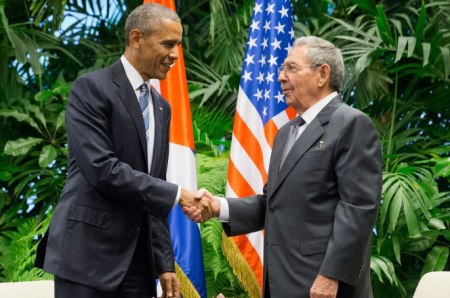 Barack Obama shakes hands with Cuban President Raul Castro. Photo AP
To be a president means regularly to find oneself caught off balance. Sometimes you want to chill at the same moment your enemies move to kill. You may find yourself doing an innocent photo op reading a book to little kids when terrorists launch a coordinated attack on the country.
So let’s have a little sympathy for President Obama this week. It has to be frustrating when you set out to make nice with the leaders of a mass-murdering fanatical regime and at the exact same time a mass murder is carried out by a completely different group of fanatics — the ones you keep saying are no big deal.
It has to get under your skin when you bring a planeload of fanboy hacks with you to a tropical paradise on the understanding that they’ll write nice stories about your kicking back with one half of a pair of homicidal brothers when instead people get all distracted about the tiny detail of 31 people getting killed by a different pair of homicidal brothers.
The president whose acolytes call him No Drama Obama aren’t quite right, but they are on to something. The president does get angry, but not at terrorists, dictators or mass murderers. Every time rage sneaks into his face, he’s talking about his domestic political opponents. He’s talking about budgetary disputes, federal appointments, Constitutional interpretation.
Blood literally running in the streets of Belgium? Heads being cut off by sabers? A movement that wants to kill every Jew and Christian? Shrug. Obama spoke about the ISIS mass murder briefly.
Then he did “the wave” with Raul Castro.
 Obama and Castro wave to the crowd during a exhibition game between the Tampa Bay Rays and the Cuban national team.
As one newspaper headline put it, juxtaposing a photo of Obama doing the tango in Argentina against an image from the latest ISIS atrocity, “Whiskey Tango Foxtrot?” That’s the polite way of referring to the words that are ordinarily indicated by “WTF?”
There are often no great options for a president in times of strain; if President Bush had, when informed that the second plane had hit the World Trade Center, scared the kids by throwing down his copy of “The Pet Goat” and said, “Holy s–t! We’re under attack!” he would have been criticized even more heartily than he was for continuing to read for seven more minutes. (Though it’s hard to grasp exactly what exactly liberals find so outrageous about that notorious delay: Would they be happy if Bush had invaded Afghanistan seven minutes sooner than he did?)
Once Obama decided to go to the ballgame, his only choices were to stick with it and risk looking out of sync with the world’s mood, which is what he did, or ruin his fun day out with a new pal who once ordered up the execution of hundreds of political enemies.
Hey, at least Raul Castro never did anything really vile like declining to appear on a television program with Obama. (In January, The Hill reported, the president grew “visibly angry” when he mentioned the NRA at his gun-control town hall.)
Maybe Obama was invisibly angry with ISIS after the Brussels slaughter. But if you were looking for a signal that he was taking it seriously, you were disappointed. “We defeat them in part by saying, ‘You are not strong, you are weak,’” was his message, reverting to his default reasoning about how terrorism is really all a matter of adjusting your perceptions because the bad guys obviously can’t hurt us if we keep saying we’re not hurt.
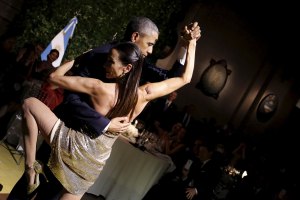 Obama tangos in Argentina.Photo: Reuters
It’s the same logic you heard in high school from your highly educated feminist English teacher, the one who drove a rusted Chevette with a bumper sticker reading, “It will be a great day when schools get all the money they need and the Air Force has to hold a bake sale to buy a bomber.” She told you the best way to beat bullies was to deny them any satisfaction, i.e. to pretend they weren’t pummeling you. “Just curl up into the fetal position, Johnny, you’ll have the last laugh when their punching muscles wear out in an hour or two.” Roughly at the same time, you developed strange new respect for your meathead gym teacher, the one who taught you how to throw a punch in such a way that it would definitely make a nose bleed.
What this week really demonstrated was not that Obama has a wee problem with “the optics” of his job, but that he’s stuck forever in campaign mode, confusing rhetoric with leading. ISIS just laughs and reloads when the president chides them.
Beginning to normalize relations with Cuba is a good idea — but Obama loved the picture of himself giving a speech in Havana so much that he skipped over the part where he’d win concessions from the regime. Giving away the game was his opening bid.
We have the kind of president who would drive away from a car lot congratulating himself on his sweet deal after paying the sucker’s price — plus extra for the “protective undercoating.”
Source: NSA chief ‘makes secret Israel trip to talk Iran, Hezbollah cyber-warfare’ | The Times of Israel
Admiral Rogers said to meet with IDF intelligence officials, including head of 8200 unit, during visit last week

The director of the US National Security Agency, Admiral Michael Rogers, reportedly paid a secret visit to Israel last week to discuss cooperation in cyber-defense, in particular to counter attacks by Iran and its Lebanon-based proxy Hezbollah.
Haaretz newspaper quoted a senior Israeli official as saying that the NSA chief, who also heads the US’s Cyber Command, made the trip to meet with the commanders of the IDF’s famed 8200 intelligence unit, which specializes in signal intelligence (SIGINT) and code decryption. Rogers also met with other senior Israeli intelligence officials, Haaretz said late Sunday, but not IDF Chief Gadi Eisenkot or Military Intelligence director Herzl Halevi.
Over the last two years, Israel has been targeted by a number of cyber-attacks. Officials say hackers affiliated with the Iranian government and Hezbollah, a Shiite terror group long at war with Israel, were behind some of the infiltration attempts.
Earlier this week, Israel said it has charged a Palestinian hacker from Gaza with breaking into the feeds from IAF drones and collecting information on troop movements and civilian flights for Islamic Jihad, a terror group that also has ties to Iran.

Majd Ouida, a 22-year-old Gazan who Israel has indicted for hacking into IDF drone feeds, traffic cameras and other Israeli computer systems, in a Beersheba court on March 23, 2016. (Screen capture: Channel 10)
In June 2015, the Israeli ClearSky cyber-security company said it had discovered an ongoing wave of cyber-attacks originating from Iran on targets in Israel and the Middle East, with Israeli generals among the targets. The goal is “espionage or other nation-state interests,” the firm said.
The hackers use techniques such as targeted phishing — in which hackers gather user identification data using false web pages that look like real and reputable ones — to hack into 40 targets in Israel and 500 worldwide, said ClearSky. In Israel the targets have included retired generals, employees of security consulting firms and researchers in academia.
The US has also seen “intensified cyberspace operations by state and nonstate actors,” Admiral Rogers told the US House of Representatives panel earlier this month, according to a Department of Defense report.
Sisi asks Obama for military intervention to save Egypt from ISIS, DEBKAfile, March 28, 2016
Egyptian President Abdel Fatteh El-Sisi has sent a secret missive to President Barack Obama asking for urgent US military intervention in support of Egypt’s war on the Islamist State in Sinai, before the jihadis pose a real threat to Cairo. DEBKAfile’s exclusive intelligence and counterterrorism sources report that El-Sisi has come to the conclusion that Egyptian army lacks the ability to eradicate the terrorist peril without direct US military support.
In his note, he asks Washington to replicate in Sinai the format of US intervention in the war on ISIS in Iraq and Syria, namely, to send in special operations forces to establish bases and operate drones against jihadist targets. Unless stopped, he warns, the Islamic State is on the point of transforming the Sinai Peninsula into its primary forward base in the Middle East, bolstered by its branches of terror across North Africa, especially in Libya. US intervention is necessary to avert this.
So far, Sisi has received no answer from the White House and no sign of one in the pipeline.
Our military sources note that, given his record as former defense minister and a much-decorated general in the Egyptian army, an appeal to a foreign power for military assistance is out of character and would normally be found unacceptable in his own milieu. It must therefore be seen as a sign of extreme distress over Cairo’s failure to vanquish – or even contain ISIS, which now poses a strategic threat to Egypt proper.
In this situation, the generals in Cairo were dismayed to read a New York Timesleader on March 25, captioned “Time to Rethink US relationship with Egypt,” which faults the Egyptian regime’s human rights record and suggests that the relationship does Washington more harm than good.
The NYT concludes by saying, “Over the next few months, the president should start planning the possibility of a break in the alliance with Egypt. That scenario appears increasingly necessary.”
Since this article appeared out of the blue, it is feared in Cairo that it is President Obama’s way of spurring the Egyptian president’s SOS.
Some high-ranking military figures in Cairo have started talking about alternatives: If Washington refuses to come up with military assistance for fighting the Islamic State, perhaps the time has time to go elsewhere.
An Egyptian appeal to Moscow cannot be ruled out.
Omri Ceren: Dollarizing Iran, Power Line,
(Please see also, Congress Seeks Fight Over Obama Effort to Give Iran Access to US Markets. — DM)
Omri Ceren writes from The Israel Project with the first of three updates on the Obama administration’s latest assistance extended to our enemies in the Islamic Republic of Iran. This is at least a good place to begin and I thought readers would find it of interest. Omri writes with his usual alphabetized footnotes:
Last week the AP revealed the Obama administration is planning to provide Iran with another wave of sanctions relief, because the Iranians are demanding it [a]. The Iranians started prominently demanding new concessions a few weeks ago, and their calls were then taken up by Iran deal supporters [b][c][d][e]. The planned concessions go way beyond the nuclear-related sanctions lifted by the summer deal, and include giving Iran access to U.S. financial markets and the dollar, something administration officials swore last summer would never ever happen [f][g].
The administration’s collapse will drive the conversation this week. There have already been a range of responses from policy analysts, from Congress, and from the press. I’ll send around highlights this morning.
First up: the policy implications. Mark Dubowitz and Jonathan Schanzer – executive director and vice president for research at the Foundation for Defense of Democracies – have a new piece in the WSJ unpacking the debate over this new concession. Schanzer linked to it on Twitter this morning and summarized the argument: allowing Iran access to the U.S. dollar would be “a total implosion of US financial policy on Iran” [h].
The broad points from the piece:
The administration ruled out letting Iran dollarize until the Iranians made their new demand – Treasury Secretary Jacob Lew was adamant during a congressional grilling last July. “Iranian banks will not be able to clear U.S. dollars through New York,” he told the Senate Foreign Relations Committee, or “hold correspondent account relationships with U.S. financial institutions, or enter into financing arrangements with U.S. banks.”… What explains this possible reversal? Most likely, Iran demanded it. Secretary of State John Kerry and Foggy Bottom, always fearful that Tehran will walk away from the nuclear deal, may be ready to comply.
The administration ruled out letting Iran dollarize for a good reason: it will nuke the U.S. greenback and poison the global financial system – Congress is getting ready for a fight. It’s not hard to understand why. The Financial Action Task Force, a global antiterrorism finance body, maintains a severe warning about Iranian financial practices. Last month it warned that Iran’s “failure to address the risk of terrorist financing” poses a “serious threat… to the integrity of the international financial system.” The Treasury Department also recognizes the danger, in 2011 labeling the Islamic Republic a “jurisdiction of primary money laundering concern.” That finding, which remains in place, cites Iran’s “support for terrorism,” and “illicit and deceptive financial activities.”
And now the technical stuff.
The Obama administration will likely claim that letting Iran trade in dollars helps monitor the deal and gives the U.S. leverage to enforce it. The bottom half of the Dubowitz and Schanzer piece dismantles those arguments. Most broadly, Treasury long ago assessed that the cost of giving Iran access to the U.S. financial system outweighed the intelligence benefits. Regarding monitoring, the Iranians won’t directly use their dollars for nefarious purposes – exactly because they know we’d catch them – but will instead use the newfound credibility that dollar access gives their banks for those purposes. Regarding leverage, the U.S. won’t gain any new leverage because Iran will keep their dollars where the US can’t get them. In fact the administration argument on leverage is backwards: Obama officials told Congress over the summer that access to the dollar was being withheld specifically to provide the U.S. with leverage over non-nuclear activities – ballistic missiles, terrorism, human rights, etc – so “why throw away that leverage in exchange for no new concessions?”
The technical policy issues are devastating but they may get overshadowed by the even more devastating political optics: the administration told Congress that it had made a final set of concessions to Iran and promised that access to the dollar would never be granted, then the Iranians came back and demanded access to the dollar, and now the administration is collapsing.
[a] http://bigstory.ap.org/article/b2c1eb1820154a518deb12b85882536e/gop-worries-obama-leaving-door-open-new-iran-relief
[b] https://twitter.com/khamenei_ir/status/707981817434009600
[c] http://www.al-monitor.com/pulse/originals/2016/03/iran-sanctions-jcpoa-banking-khamenei-nowruz-speech.html
[d] http://www.reuters.com/article/us-iran-trade-finance-idUSKCN0WO1Y3
[e] http://thediplomat.com/2016/03/the-real-threat-to-the-iran-deal-tehrans-banking-system/
[f] https://www.treasury.gov/press-center/press-releases/Pages/jl0129.aspx%5D
[g] http://www.washingtoninstitute.org/uploads/Documents/other/SzubinTranscript20150916-v2.pdf
[h] https://twitter.com/JSchanzer/status/714420863991422977
Congress Seeks Fight Over Obama Effort to Give Iran Access to US Markets, Washington Free Beacon, Adam Kredo, March 28, 2016
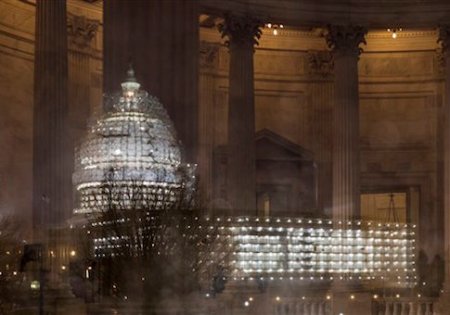
The Capitol in Washington is illuminated during a thunderstorm with the rotunda of the Russell Senate Office Building reflected on the rain-covered windows, late Wednesday afternoon, Feb. 24, 2016. (AP Photo/J. Scott Applewhite)
Leading foreign policy voices in Congress say they are preparing to fight against an Obama administration effort to provide Iran unprecedented access to U.S. financial resources as part of an expanded package meant to address new demands from the Islamic Republic’s for greater economic concessions, according to several conversations between the Washington Free Beacon and top lawmakers.
The Obama administration is currently exploring new options to grant Iran more sanctions relief than promised under the comprehensive nuclear agreement reached last year, just days after Iran’s Supreme Leader gave a speech accusing the United States of interfering with Iranian banking.
Top foreign policy voices in Congress told the Free Beacon in recent days that they are exploring a range of responses if the Obama administration goes through with reported plans to grant Iran further concessions beyond the purview of the nuclear deal, which dismantled key nuclear-related U.S. sanctions against Iran. At least part of this action could violate current U.S. laws, they said.
The planned concessions could include access to the U.S. dollar and financial markets, which the Obama administration promised would never take place under the deal, according to recent disclosures first reported by the Associated Press.
The Iranian government has recently heightened complaints that it is not being granted enough relief from international economic sanctions as a result of the recently implemented nuclear deal.
The Obama administration’s latest move to placate the Iranians comes on the heels of a Free Beacon report last week disclosing that U.S. officials engaged in secret talks with Iran for years before agreeing in January to pay it nearly $2 billion in taxpayer funds.
The reports have generated harsh responses from lawmakers, who say that the administration’s plans would endanger American economic influence and put the entire international financial system at risk from Iran’s illicit finance and money laundering activities.
“Any administration effort to get foreign financial institutions or foreign-based clearing houses to enable Iran’s terror-sponsoring regime to conduct transactions in U.S. dollars ignores American laws and the Financial Action Task Force,” Sen. Mark Kirk (R., Ill.) told the Free Beacon.
“Such an effort would benefit Iran’s terror financiers while fundamentally undermining the USA PATRIOT ACT 311 finding that Iran’s entire financial sector is a jurisdiction of primary money laundering concern,” Kirk said.
It would also undermine “the Financial Action Task Force’s ongoing calls for international countermeasures to protect financial sectors from Iran’s terrorist financing,” explained Kirk, who is backing a new effort in Congress to increase sanctions on Iran as a result of its recent ballistic missile tests, which violate United Nations resolutions.
Rep. Mike Pompeo (R., Kan.), a member of the House Permanent Select Committee on Intelligence, warned that the Obama administration’s latest move could set the stage for the Iranian Revolutionary Guards Corps, or IRGC, to gain a foothold in the U.S. economy.
“As if a windfall of over $100 billion in sanctions relief was too small, and the massive cash influx into Iran from new business deals too paltry, President Obama appears to be looking for ways to make further concessions to Iran,” said Pompeo, who also has backed new legislation to sanction Iran. “This would be comical if it wasn’t so dangerous.”
“American and international businesses can’t ignore the Islamic Revolutionary Guard Corps’ vast control of the Iranian economy and the threat Iranian banks pose to the international financial system,” Pompeo continued in a statement to the Free Beacon.
“In contrast with the absurd policies of the Obama administration, I work with my colleagues in Congress to protect America’s national security interests—just as we have in response to Iran’s recent ballistic missile tests.”
Pompeo is independently investigating the Obama administration’s recent $1.7 billion payment to Iran, which he and others viewed as a “ransom payment” for the Islamic Republic’s recent release of several captured Americans.
Other longtime Iran critics in Congress also expressed concern over administration efforts to provide Iran with even more economic freedom.
“Further sanctions relief would mark the death knell for U.S. sanctions and would represent a boon to the Iranian regime and its Revolutionary Guard Corp,” Rep. Ron DeSantis, a member of the House Foreign Affairs Committee, told the Free Beacon. “The lengths to which the Obama administration is willing to go to empower Iran is breathtaking.”
Rep. Peter Roskam (R., Ill.) explained that the “administration has lost all credibility on Iran” as a result of its efforts to accommodate Iranian demands.
“President Obama and Secretary Kerry have played the pied piper so many times now,” Roskam told the Free Beacon. “Western companies have to make the determination themselves whether or not they want to make their employees and shareholders complicit in funding terrorism.”
When asked to comment on concerns in Congress, a State Department official told the Free Beacon that it is aware of lawmaker requests for more information on “additional sanctions relief.”
The official added that as long as Iran continues to adhere to the nuclear agreement, the United States “will continue” to do the same.
Obama administration officials first guaranteed last year that Iran would not be permitted to conduct foreign transactions in dollars. This promise, however, is being reevaluated as the administration seeks to keep Iran from walking away from the nuclear deal.
Fighting ISIS plays into ISIS’ Hands? Front Page Magazine, Daniel Greenfield, March 28, 2016
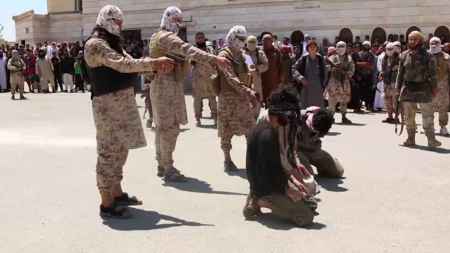
If you’re keeping score, freeing Islamic terrorists from Gitmo does not play into the hands of ISIS. Neither does bringing Syrians, many of whom sympathize with Islamic terrorists, into our country. And aiding the Muslim Brotherhood parent organization of ISIS does not play into the Islamic group’s hands.
However if you use the words “Islamic terrorism” or even milder derivatives such as “radical Islamic terrorism”, you are playing into the hands of ISIS. If you call for closer law enforcement scrutiny of Muslim areas before they turn into Molenbeek style no-go zones or suggest ending the stream of new immigrant recruits to ISIS in San Bernardino, Paris or Brussels, you are also playing into the hands of ISIS.
And if you carpet bomb ISIS, destroy its headquarters and training camps, you’re just playing into its hands. According to Obama and his experts, who have wrecked the Middle East, what ISIS fears most is that we’ll ignore it and let it go about its business. And what it wants most is for us to utterly destroy it.
Tens of thousands of Muslim refugees make us safer. But using the words “Muslim terrorism” endangers us. The more Muslims we bring to America, the faster we’ll beat ISIS. As long as we don’t call it the Islamic State or ISIS or ISIL, but follow Secretary of State John Kerry’s lead in calling it Daesh.
Because terrorism has no religion. Even when it’s shouting, “Allahu Akbar”.
Obama initially tried to defeat ISIS by ignoring it. This cunning approach allowed ISIS to seize large chunks of Iraq and Syria. He tried calling ISIS a JayVee team in line with his recent claim that, “We defeat them in part by saying you are not strong, you are weak”. Unimpressed, ISIS seized Mosul. It was still attached to the old-fashioned way of proving it was strong by actually winning land and wars.
Then Obama tried to defeat ISIS by arming the Islamist allies of Al Qaeda and now a lot more American weapons are in the hands of Islamic terrorists. Some of them are even in the hands of ISIS.
Europe and the United States decided to prove that we were not at war with Islam by taking in as many Muslims as we could. Instead of leading to less terrorism, taking in more Muslims led to more terrorism.
Every single stupid counterintuitive strategy for defeating Islamic terrorism has been tried. And it has failed miserably. Overthrowing “dictators” turned entire countries into terrorist training camps. Bringing Islamists to power in Egypt, Libya and Tunisia led directly to attacks on American diplomatic facilities. The Muslim Brotherhood showed no gratitude to its State Department allies. Instead its militias and forces either aided the attackers or stood by and watched while taking bets on the outcome.
Islamic terrorism has followed an entirely intuitive pattern of cause and effect. There’s a reason that the counterintuitive strategies for fighting Islamic terrorism by not fighting Islamic terrorism don’t work. They make no sense. They never did. Instead they all depend on convincing Muslims, from the local Imam to Jihadist organizations, to aid us instead of attack us by showing what nice people we are. Meanwhile they also insist that we can’t use the words “Islamic terrorism” because Muslims are ticking time bombs who will join Al Qaeda and ISIS the moment we associate terrorism with the I-word.
The counterintuitive strategy assumes that Islamic terrorism will only exist if we use the I-word, that totalitarian Jihadist movements just want democracy and that our best allies for fighting Islamic terrorism are people from the same places where Islamic terrorism is a runaway success. And that we should duplicate the demographics of the countries where Islamic terrorism thrives in order to defeat it.
The West’s counterterrorism strategy makes less sense than the ravings of most mental patients. The only thing more insane than the counterintuitive strategy for defeating Islamic terrorism is the insistence that the intuitive strategy of keeping terrorists out and killing them is what terrorists want.
If you believe the experts, then Islamic terrorists want us to stop them from entering Europe, America, Canada and Australia. They crave having their terrorists profiled by law enforcement on the way to their latest attack. And they wish we would just carpet bomb them as hard as we can right now.
When ISIS shoots up Paris or Brussels, it’s not really trying to kill infidels for Allah. Instead it’s setting a cunning trap for us. If we react by ending the flow of migrants and preventing the next attack, ISIS wins. If we police Muslim no-go zones, then ISIS also wins. If we deport potential terrorists, ISIS still wins.
But if we let ISIS carry out another successful attack, then ISIS loses. And we win. What do we win?
It depends. A concert hall full of corpses. Marathon runners with severed limbs. Families fleeing the airport through a haze of smoke. Only by letting ISIS kill us, do we have any hope of beating ISIS.
Politicians and experts claim that ISIS is insane. It’s not insane. It’s evil. Its goals are clear and comprehensible. The objectives of the Islamic State are easy to intuitively grasp. Our leaders and experts are the ones who are out of their minds. They may or may not be evil, but they are utterly insane. And they have projected their madness on Islamic terrorists who are downright rational compared to them.
Unlike our leaders, Islamic terrorists don’t confuse victory and defeat. They aren’t afraid that they’ll win. They don’t want us to kill them or deport them. They don’t care whether we call them ISIS or Daesh. They don’t derive their Islamic legitimacy from John Kerry or a State Department Twitter account. They get it from the Koran and the entire rotting corpus of Islamic law that they seek to impose on the world.
Our leaders are the ones who are afraid of winning. They distrust the morality of armed force and borders. They disguise that distrust behind convoluted arguments and counterintuitive rationales. Entire intellectual systems are constructed to explain why defeating ISIS is exactly what ISIS wants.
After the San Bernardino shootings, Obama insisted that, “Our success won’t depend on tough talk or abandoning our values… That’s what groups like ISIL are hoping for.” But ISIS does not care whether Obama talks tough, even if it’s only his version of tough talk in which he puffs out his chest and says things like, ”You are not strong, you are weak.” It is not interested in Obama’s “right side of history” distortion of American values either. ISIS is not trying to be counterintuitive. It’s fighting to win.
And our leaders are fighting as hard as they can to lose.
The counterintuitive strategy is not meant to fight terror, but to convince the populace that winning is actually losing and losing is actually winning. The worse we lose, the better our plan is working. And when we have completely lost everything then we’ll have the terrorists right where we want them.
Just ask the dead of Brussels, Paris, New York and a hundred other places.
This isn’t a plan to win. It’s a plan to confuse the issue while losing. It’s a plan to convince everyone that what looks like appeasement, defeatism, surrender and collaboration with the enemy is really a brilliant counterintuitive plan that is the only possible path to a lasting victory over Islamic terrorism.
But intuitive beats counterintuitive. Winning intuitively beats losing counterintuitively. Counterintuitively dead terrorists multiply, but intuitively they stay dead. Counterintuitively, not discussing the problem is the best way to solve it. Intuitively, you solve a problem by facing it. Counterintuitively, collaborating with the enemy is patriotism. Intuitively, it’s treason.

ISIS-linked extremists in Yemen has reportedly carried out their threat to crucify a captured priest, Father Thomas Uzhunnalil, 56, after he was taken hostage during a massacre at a Catholic home. Some 15 people were killed on March 4th after four Islamic extremists posed as visiting family members and then murdered the occupants, including four Indian nuns, two Yemeni female staff members, eight elderly residents and a guard. Also, in Pakistan, at least 70 people are dead in an ISIS attack during the Easter holiday that targeted a playground filled with mothers and children. A Taliban faction Jamaat-ul-Ahrar, which has sworn allegiance to ISIS, took “credit” for the Easter bombing — using bombs loaded with ball bearing to maximize the killing of the children and mothers gathered in the park for the holiday. Islamic extremists who are willing to riot and kill for any slight of their religion have little problem with targeting religious buildings and holidays of other faiths. While such inconsistencies are hardly surprising for a group willing to crucify priests and shoot elderly nuns, the belief that such grotesque acts please Allah remains inconceivable to most people.
Father Uzhunnalil was kidnapped by ISIS gunmen in Yemen three weeks ago. Archbishop of Vienna, Christoph Cardinal Schönborn told a congregation gathered in St. Stephen’s Cathedral in the Austrian capital that the priest had been crucified. The location is a refuge for the elderly operated by Mother Teresa’s Missionaries of Charity in main southern city Aden.
What is equally disturbing with the violence in Pakistan is that, rather than forcing a period of reflection on the rise of Islamic extremism, thousands took to the street to praise the murderer of a moderate politician who was killed by his bodyguard for criticizing the blasphemy laws. The streets were filled with Muslims demanding the adoption of medieval Islamic Sharia laws, including the death penalty for those who insult or defame Islam.




 anneinpt
 artaxes
 danmillerinpanama
 davidking1530
 Peter Hofman
 Joseph Wouk
 Peter
Peter Louisiana Steve
 WarSclerotic
Recent Comments