Archive for October 26, 2015

UK rapist escapes deportation by posing as Syrian refugee

October 26, 2015

UK rapist escapes deportation by posing as Syrian refugee, Front Page Magazine, Daniel Greenfield, October 26, 2015

syrian_refugees_7

Europe has a real Syrian Refugee problem. These days any criminal or migrant can just say the magic words, “Syrian Refugee” and that’s that. Because Syrian refugees are magic. They’re our moral superiors because they tore their country apart killing each other over whether Sunni or Shiite Islam is right. So now they, and anyone claiming to be one of them, is empowered to do anything to Europeans.

An illegal immigrant who attacked and sexually molested a woman within days of smuggling himself into Britain looks set to avoid deportation by claiming he is a Syrian refugee.

A court heard how Abdulrahman Abunasir continues to claim he is a Syrian refugee, despite the fact he allegedly told French authorities who detained him previously that he was Palestinian.

Abunasir submitted his claim for asylum whilst serving an 18-month prison sentence for a horrific random sex attack. The immigrant attacked and molested a woman outside a cafe in London in 2013 as she walked to her boyfriend’s home.

Experts who put the sex attacker through a language analysis test concluded there was a “very high degree of certainty that he was from Egypt” and confirmed he could not answer even the most basic questions about his supposed homeland.

So he might be Egyptian. He might be from Israel. He’s probably not from Syria… but why not send him there anyway? Preferably while wearing a giant cross around his neck. Or maybe an I Love Israel t-shirt.

It might serve as an object lesson to future fake Syrian refugees.

But shockingly he cannot be deported because there is no way of determining with 100% certainty that he does not come from Syria, which is being torn apart by a brutal civil war.

So we’re now at the absolute standard of proof for deportations? Is there a 100% certain way to determine where anyone comes from originally? Why not go with the fossil record?

Judges and probation officers say the pervert is too dangerous to be released in case he attacks other women. Instead he is being held at an immigration detention centre at a cost of more than £40,000 a year to the taxpayer.

We can’t keep him locked up indefinitely. And we can’t deport him. Which means the UK got a little more enriched.

Satire | Army Agrees to Accept 20,000 Syrian Migrants To Meet Retention Goals

October 26, 2015

Army Agrees to Accept 20,000 Syrian Migrants To Meet Retention Goals, Duffel Blog, October 26, 2015

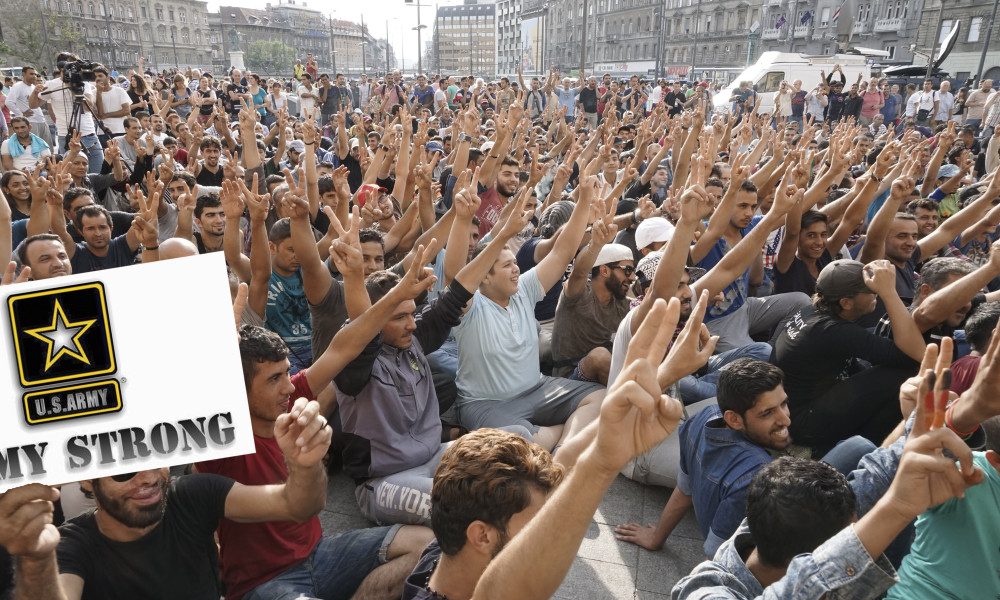
Syrian refugees strike in front of Budapest Keleti railway station. Refugee crisis. Budapest, Hungary, Central Europe, 3 September 2015.

Syrian refugees strike in front of Budapest Keleti railway station. Refugee crisis. Budapest, Hungary, Central Europe, 3 September 2015.

WASHINGTON — Early Wednesday, Pentagon officials announced that the Army will spend $2 billion this year to recruit 20,000 migrants currently fleeing Syria in an attempt to meet their retention goal for fiscal year 2015.

“We have tried everything so far but keep falling short,” said Maj. Gen. Thomas Semands, commander of Army Human Resources Command. “I’ve let in all the gays, transgendereds, and everyone in between. We’re even pretending we will let women serve in the infantry. I guess the next step is to let the deserters of other nations join, eh?”

When told that his microphone was live, Semands added, “What I really mean is, you know, diversity is our strength!”

While some countries in Europe have dedicated tents and funds set aside for incoming asylum-seekers, top Army officials will take it to the next level with barracks and “hot chow” upon their oath of enlistment, pointing out that Germany’s history of building camps is “not that great.”

“We are going to win their hearts and minds whether they like it or not,” said a drill sergeant driving a van picking up refugees in Tampa to bus them to Fort Jackson. “I’m hoping to get to train some of those Muslim cuties over there in the burqas, preferably the one with the pretty eyes.”

“Many of these new recruits have mentioned that they have college degrees. Of course, asking for documentation would be rude given the circumstances,” Semands said. “Needless to say, we are looking forward to adding our newest wave of second lieutenants.”


Escalation of child execution in Iran

October 26, 2015

Escalation of child execution in Iran, Front Page MagazineDr. Majid Rafizadeh, October 26, 2015

(Please see also, Iranian Supreme Leader Khamenei’s Letter Of Guidelines To President Rohani On JCPOA Sets Nine Conditions Nullifying Original Agreement Announced July 14, 2015. According to Supreme Leader Khamenei,

Any sanctions against Iran “at every level and on every pretext,” including terrorism and human rights violations, by any one of the countries participating in the negotiations will “constitute a violation of the JCPOA,” and a reason for Iran to stop executing the agreement. 

He probably need not be concerned.– DM)

photo-by-seysd-shahaboddin-vajedi-wikimedia-commons-iranian-supreme-leader-ayatollah-ali-khamenei-releases-video-propaganda

While Iranian ruling clerics enjoy reaping the economic benefits from the nuclear deal, they also feel triumphant when it comes to the Obama administration’s total disregard of the increasing human rights violations in Iran.

To sustain his nuclear deal, President Obama appears to have made a Faustian bargain with the Iranian leaders: He turns a blind eye to Iran’s sponsorship of terrorism, repressive methods to crack down on social and political freedoms, egregious human rights abuses, while Iran verbally and on the surface, binds itself to the nuclear deal.

This week, Iran’s parliament passed a bill supporting the nuclear deal which was primarily reached between President Obama and the Islamic Republic. Some policy makers were surprised that Iran passed the bill. But why would Iranian leaders not sign a deal that would bring them financial rewards and allow them to be as repressive as they please both domestically and regionally? As I mentioned several weeks ago, it was easy to predict that the Iranian parliament (Majlis) would pass the deal to receive further rewards.

Simultaneously, Iran’s judiciary system has become more emboldened and empowered. This can be seen when they are issuing death sentences at unprecedented levels, particularly for children.  Last week, Iran’s Islamic court executed a juvenile offender on October 13, 2015 in Adelabad Prison, Shiraz. Fatemeh Salbehi, was arrested at the age of 16 because her husband was found dead at home.

She was 16 years old when she was forced into marriage to a man who was thirty. She had never met the man before their marriage.  According to a recent release by the UN Special Rapporteur on the situation of human rights in Iran, Ahmed Shaheed, “These executions are disturbing examples of surging execution rates and questionable fair trial standards in the Islamic Republic of Iran….The Iranian authorities must comply with its international law obligations and put an end to the execution of juvenile offenders once and for all.”

What is intriguing is that Iranian leaders used to take notice when there was an international outcry regarding a human rights or political prisoner case. They used to postpone the case, the execution, or do something to let the global pressure fade away.   But not anymore. In this case, Amnesty International, Amnesty USA, International human rights organizations, and the United Nations’ Office of the High Commissioner for Human Rights pressured the Islamic Republic to refrain from executing Ms. Salbehi and another young man.  But Iran’s answer was implicitly clear: We will execute anyone we like and no one can stop us now.

One must wonder how much the nuclear deal, President Obama’s unwillingness to criticize the Islamic Republic, and President Obama’s actions in legitimizing the Islamic Republic on the global stage have played a role in emboldening and empowering the ruling mullahs and the hardliners rather than influencing them to be more rational and civilized figures.

A week before the execution of Ms. Salbehi, another juvenile was executed. No notice was given to his family or even his attorney. The UN Special Rapporteur on summary executions, Christof Heyns, pointed out, “Let us be clear – these are unlawful killings committed by the State, the equivalent of murders performed by individuals…. These are profound tragedies that demean the value of human life and sully the reputation of the country,” He added “Iran must immediately stop killing children,”

More than 1,000 people will be executed in the year 2015. There has been a surprising rise in the number of executions since Iran scored a victory by signing the nuclear deal. Ms. Salbehi was one of the hundreds of women being executed on a regular basis based on Iran’s Shiite Islamist laws and on gender discrimination. These women are not allowed due process or adequate access to a lawyer. As the Office of the High Commissioner for Human Rights (OHCHR) warned when Ms. Salbehi was hanged on Tuesday, the execution was “in breach of international law banning juvenile executions, and despite reported flaws in her trial and appeal process.”

Finally, It is crucial to point put that we are only hearing about a few cases of human rights violations; only a few of these shocking human rights abuses make their way to the international spotlight. As an Iranian human rights activist and lawyer, Shadi, told me on a phone call from Tehran, “Just step in the Islamic courts and you will see that there are tens of thousands of these cases, particularly regarding innocent women, which the media never hear about.”

Achieving his dream of signing a nuclear deal with Iran should not make President Obama silent about human rights violations, the ever increasing rate of child executions, and ongoing crimes against humanity.

Reuters: Why the U.S. may still have to go to war against Iran

October 26, 2015

Source: Why the U.S. may still have to go to war against Iran

Reuters

By Bennett Ramberg
October 26, 2015
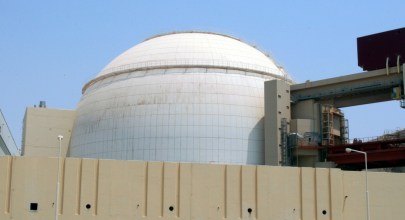
 A general view of the Bushehr main nuclear reactor

Effective enforcement of the Iranian nuclear deal remains a conundrum. Enshrined in the agreement is “snapback” – the restoration of international economic sanctions against Tehran should it violate the deal’s terms. Yet the expected rush of European, Russian and Chinese businesses into Iran would make such unified action questionable.Aware that economic pressure might not be enough, U.S. officials have repeatedly declared “all options” are on the table. Though most have been reluctant to offer details, recent Pentagon talk has focused on a new bunker-buster bomb. Such talk feeds into the growing presumption that Washington would rely on air strikes if Iran violated the agreement.
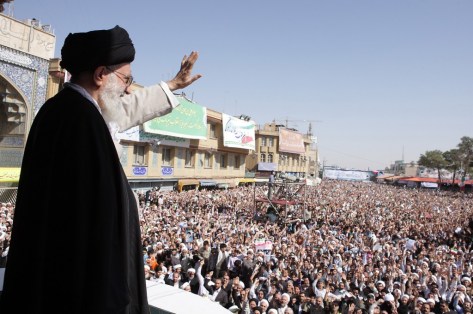
Iran's Supreme Leader Ayatollah Ali Khamenei waves to the crowd in the holy city of Qom, south of Tehran

Yet history shows that forceful alternatives either don’t work or are too dangerous and costly. In addition, past air strikes have proved to be unreliable. So policymakers should indeed consider all options. Previous tactics — including assassination, special-forces sabotage, technology disruption, armed forces mobiliztion, massive bombing and war — deserve another look.

Some tacks have worked better than others. Determining the best course, however, can be complicated. Here’s a list:

1)  Assassination marks the nadir on the violence spectrum. It has reportedly been applied by Israel against Iraqi and Iranian scientists — for example, the bomb, delivered by motor cycle, that struck the car in Tehran in which Majid Shahriari, a senior nuclear engineer, was riding in 2010. But the tactic has failed to seriously hinder nuclear development.
ben-Vemork_Hydroelectric_Plant_1935

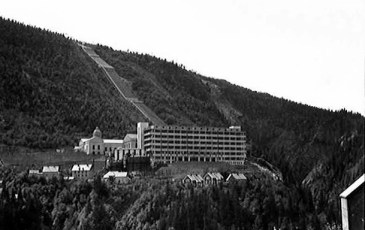
2) Sabotage by special forces of nuclear installations has had more impact but is not enduring. One early application was during World War Two, when British commandos attempted to destroy a plant in Nazi-occupied Norway that produced heavy water, a vital substance Germany required for the nuclear weapons effort. Israel’s 1979 commando detonation of the Osirak reactor core as it sat in a French warehouse awaiting shipment to Iraq marks a second case. In both instances, engineers repaired the damaged equipment within months.

3) Sabotage of a different sort, including cyberattacks on Iran’s uranium- enrichment plants, as well as the adulteration of material imported to fabricate centrifuges, set back Tehran’s nuclear program by months. But that was it.

4) Air strikes. Without the precise delivery systems of current air forces, the United States tried a massive bombing campaign during World War Two to destroy the Norwegian heavy-water plant after Britain’s attempted sabotage failed. Even with that, the allies needed a follow-up commando operation to eliminate the surviving heavy-water stocks. But the success in Norway failed to halt Nazi Germany’s program back in Germany. Scientific barriers proved far more important in undermining the Nazi effort.
ben-Syrian_Reactor_Before_After

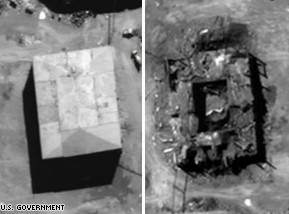
With more advanced aircraft, Israel’s bombardment of Iraq’s Osirak reactor in 1981, and Syria’s Al Kibar reactor in 2007, succeeded far more efficiently. The destruction of Syria’s reactor may be the most effective use of force in history. With few resources to rebuild the North Korean-engineered plant, Damascus abandoned its nuclear effort.

The attack on Iraq’s Osirak reactor told another story. Here, destruction prompted Baghdad to undertake a 10-year covert effort to enrich uranium. By some estimates, Iraq was within a year of succeeding when the 1991 Persian Gulf War broke out.  

But bombing will not prevent efforts at covert reconstruction by countries with the personnel, drive, resources and effective stealth to do the job. Iran, unlike Syria, falls into this category.

5) War or the threat of war. In the end, the only forceful policy that eliminated emerging nuclear weapons programs with certainty — putting aside voluntary monitored relinquishment by former Soviet states, South Africa and Libya — was the successful wars waged against Nazi Germany in World War Two and Iraq in 1991. Occupying military forces in the first case, and international inspectors in the second, were able to eliminate all nuclear contraband.

War, however, remains the most costly option, in both blood and treasure.

It also adds a wrinkle, not in its application, but in its gestation. The Cuban missile crisis demonstrated that threat manipulation — preparations for the use of overwhelming military force to invade the island, coupled with the naval quarantine and the ramping up of the alert status of the nuclear arsenal — intimidated Moscow to abandon its Cuba gambit.

But coercive diplomacy is never a sure thing. Think about the massive buildups undertaken by U.S. and allied forces against Iraq in 1991 and 2003. Both failed to intimidate, and war ensued.

6) There is one last option of the “all options” alternative that policymakers appear loath to talk about: acceptance of Iran as a nuclear armed state. Farfetched? Even the Israelis apparently gave a nod to that possibility when Ehud Barak, former prime minister and defense minister, recently revealed that, between 2010 and 2012, Jerusalem seriously contemplated military action against Iran but then got cold feet.

For Washington to take this course would actually be consistent with historic behavior. When faced with a nuclear buildup in China during the early 1960s, North Korea in recent years and the Soviet Union at the beginning of the Cold War, the United States decided that managing an adversary with an emerging nuclear arsenal was a better course than using force to stop it. Of course, acceptance of Iran into the nuclear club banks that it will be a responsible steward of the bomb.

History’s lessons for halting Iran’s nuclear temptation are sobering. “All options are on the table” may be a nice catch phrase — but if the mullahs attempt a nuclear breakout, only a winning war would guarantee full success.

Half measures, notably air strikes, may buy time to sway Tehran to rethink its nuclear course. But the past’s inconvenient truth remains: Unless Iran complies with the recent agreement and the underlying nuclear Non-Proliferation Treaty, Washington faces a daunting choice should snapback fail. It can go to war or bet that deterrence applied against nuclear adversaries in the past will work again against Iran’s revolutionary regime.

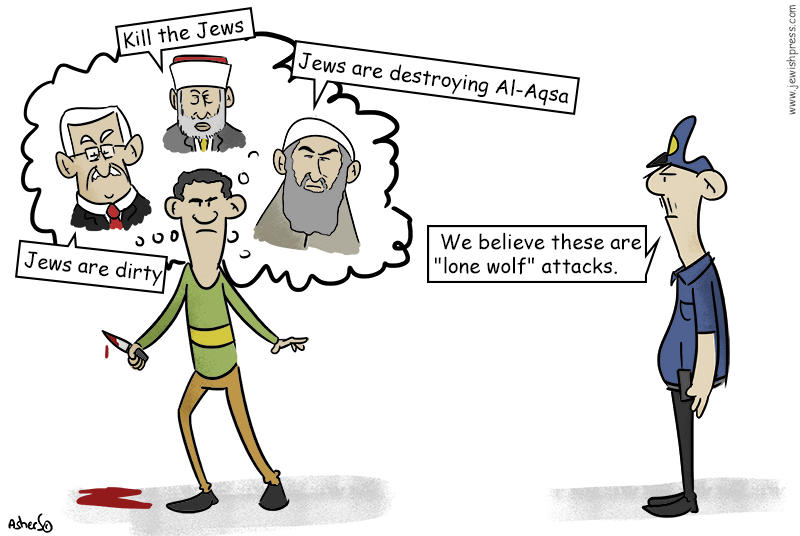
Cartoon of the day

October 26, 2015

H/t The Jewish Press

Lone-Wolf-Attack

Mother of Killed Palestinian Terrorist Pulls Out Knife in Interview, Threatens to Carry Out Attack

October 26, 2015

Mother of Killed Palestinian Terrorist Pulls Out Knife in Interview, Threatens to Carry Out Attack, Middle East Media Research Institute, October 26, 2015


According to the blurb following the video,

Umm Muhammad Shamasne, whose son Muhammad was killed while perpetrating a terror attack on a bus in Jerusalem on October 12, was recently interviewed in her home by the Lebanese Al-Quds TV channel. Offering the interviewer candy to celebrate her son’s martyrdom, Umm Muhammad Shamasne said that she hoped her other sons would follow in his footsteps, and pulled out a knife, threatening: “My deeds will speak louder than words.” The interview aired on October 22, 2015.

Russia overrides Middle East cyber waves

October 26, 2015

Russia overrides Middle East cyber waves, DEBKAfile, October 26, 2015

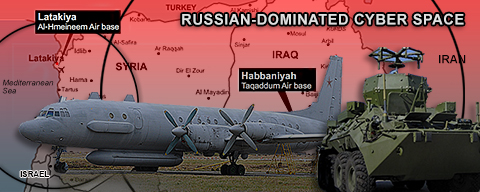
Latakia_Habaniya480

Aloft over Syria, the IL-20 can supply Russian forces and commanders with a complete, detailed picture of the situation on the ground. Its close proximity to Israel, moreover, enables this wonder plane to scoop up a wealth of data from across the border – not just on IDF military movements on the Golan, but also to eavesdrop on electronic activity and conversations in Jerusalem, Military Staff Headquarters in Tel Aviv, Air Force bases in southern Israel and even the nuclear complex in Dimona in the Negev.

******************

The distance as the crow flies between Russia’s Syrian air base Al-Hmeineem near Latakia and its Iraqi host facility at Al Taqaddum Air base is 824 km (445 nautical miles). From the Latakia base to Israel, the distance is just 288 km or 155 nautical miles, a hop and a skip in aerial terms. Syria’s ruler Bashar Assad first let Moscow in with the use of a base where 30 fighter and bombing jets are now parked. Iraqi Prime Minister Haider al-Abadi followed suit Saturday, Oct. 24 by granting the Russian Air force the use of a facility 74 km from Baghdad.

Their presence in the two bases draws a strong arc of Russian aerial control at the heart of Middle East. By boosting its two extremities with state-of-the-art electronic warfare systems, Moscow has imposed a new reality whereby it will soon be almost impossible for any air or ground force, American or Israeli, to go into military action above or inside Syria or Iraq without prior coordination with the Russians.

The bricks of Russian domination are now almost all in place.

In the last week of September, two Ilyushin-20 (IL-20 Coot) super-surveillance planes stole into Syrian airspace, to provide a major upgrade for the Russian air fleet of Sukhoi-30 fighter jets, cargo planes and attack helicopters gathering for combat in Syria.

This was first revealed by DEBKA Weekly’s military and intelligence sources on Oct. 2.

The IL-20s, the Russian Air Force’s top-line intelligence-gathering aircraft, brought over from the Baltic Sea, have exceptional features as an intelligence platform. Their four turboprop engines enable it to stay airborne for over 12 hours, using its thermal and infrared sensors, antennas, still and video cameras, and side-looking airborne (SLAR) radar to collect a wide range of data from long distances, day or night, in almost any kind of weather.

The Coot-20 collates the data gathered and transmits it to intelligence or operational command centers in Moscow or its Latakia air base by powerful jam-resistant communications systems, satellites and other methods.

Aloft over Syria, the IL-20 can supply Russian forces and commanders with a complete, detailed picture of the situation on the ground. Its close proximity to Israel, moreover, enables this wonder plane to scoop up a wealth of data from across the border – not just on IDF military movements on the Golan, but also to eavesdrop on electronic activity and conversations in Jerusalem, Military Staff Headquarters in Tel Aviv, Air Force bases in southern Israel and even the nuclear complex in Dimona in the Negev.

DEBKAfile’s military sources add that an Il-20 Coot has been sighted in the last few days at the Iraqi Al Taqaddum Air base near Baghdad.

Then, on Oct. 4, our sources reveal, another Russian super-weapon was brought to Syria by Russian cargo ships: Nine MT-LB armored personnel carriers fitted with the Borisoglebsk 2 electronic warfare systems, which are among the most sophisticated of their kind in the world.

These APCs were secretly driven aboard tank carriers to Nabi Yunis, which is the highest peak of the Alawite Mountains along the coastal plain of northwest Syria, and stands 1,562 meters (5,125 feet) above sea level. To render the highly complicated Borisoglebsk 2 device system impermeable to attack, our electronic warfare experts describe it as fitted into the interior and walls of the nine APCS, along with receivers that can pick up transmissions on a wide range of frequencies on the electromagnetic spectrum.

From their mountain aerie, its antennas and powerful transmitters are designed to intercept and jam almost any radio signal carried by the electromagnetic waves in military or civilian use.

Russian strategists posted this top-of-the-line system in Syria to enable the Russian air force to operate unhindered in Middle Eastern skies and, just as importantly, to neutralize US-led coalition special forces operating deep within Syrian territory, and block or disrupt the operations of rebel groups and Islamic State forces.

The Borisoglebsk 2 system has only just started rolling off top secret Russian assembly lines. It took five years to plan and manufacture the system, which went into service for the first time at the beginning of this year on the Ukraine battlefield.

From its vantage point in Syria, the Russian electronic warfare system could seriously impair the performance of Israeli intelligence and communication networks arrayed across the Golan and along the northern border in the upper and western Galilee. It could run interference against the IDF’s use of unmanned aerial vehicles (unless they were autonomous), the field operations of Israeli Special Operations forces and air and naval networks, which depend on communications networks in their defense of the country’s northern borders.