Archive for September 9, 2015

Europe’s Migration Crisis

September 9, 2015

Europe’s Migration Crisis, Gatestone InstituteSoeren Kern, September 9, 2015

  • One migrant was asked why he doesn’t want to stay in Hungary. He replied: “[Hungary is] not giving us like in Germany… a house, money…”

  • “It’s not 150,000 migrants coming that some want to divide according to quotas, it’s not 500,000, a figure that I heard in Brussels, it’s millions, then tens of millions, because the supply of immigrants is endless.” — Viktor Orbán, Prime Minister of Hungary.
  • Only 20 of the 12,000 people who crossed the border during the weekend of September 5-6 applied for asylum in Austria. The rest have already moved on to the more generous Germany.
  • In Germany, the number of asylum seekers entering the country in a single month surpassed the 100,000 mark for the first time ever. Germany expects to receive a total of 800,000 refugees and migrants this year, a four-fold increase over 2014.
  • Germany and Sweden are the final destinations of choice for most migrants, lured by the generous benefits they can claim, and the governments’ message that refugees are welcome in unlimited numbers. The open-door immigration policies could draw millions of Muslims into Europe from the Middle East and North Africa.
  • Hundreds of Muslim refugees are converting to Christianity, apparently in an effort to improve their chances of having their asylum applications approved. Under Islam, Muslims who convert to Christianity are guilty of apostasy, a crime punishable by death. The “converts” apparently believe that German officials will allow them to stay if they can be persuaded that they will be killed if they are sent back to their countries of origin.
  • In Bulgaria, a search of five Albanian men trying to cross the border revealed that they were carrying Islamic State propaganda, including videos of decapitations.

Half a million migrants and refugees are known to have entered the European Union during the first eight months of 2015; that number may increase to more than one million before the year is through. This figure does not include individuals who got into the EU undetected.

A total of 364,183 migrants entered the European Union by sea between January and August, compared to 280,000 for the whole of 2014, according to updated statistics published by the International Organization for Migration (IOM) on September 3, 2015.

Of the total maritime arrivals, 245,274 arrived in Greece, 116,649 in Italy, and 2,166 arrived in Spain. The top countries of origin are: Syria, followed by Afghanistan, Eritrea, Nigeria, Albania, Pakistan, Somalia, Sudan and Iraq.

In addition, 132,240 migrants are known to have arrived in the European Union during the first seven months of 2015 by land, crossing from Turkey into Greece and Bulgaria, according to Frontex, the EU’s border management agency. The top three countries of origin are: Syria, Afghanistan and Pakistan.

Germany and Sweden are the final destinations of choice for most migrants, lured by the generous benefits they can claim and the governments’ message that refugees are welcome in unlimited numbers.

If sustained indefinitely, the open-door immigration policies could draw potentially millions of Muslims into Europe from the Middle East and North Africa.

Every European country is being affected by the migration crisis in one way or another. What follows is a brief survey of developments in selected countries.

In Austria, Chancellor Werner Faymann said he would end an emergency measure that allowed more than 10,000 migrants and refugees in Hungary to enter the country unhindered. “We have always said this is an emergency situation in which we must act quickly and humanely,” he said. “We have helped more than 12,000 people in an acute situation. Now we have to move step-by-step away from emergency measures towards normality.”

Only 20 of the 12,000 people who crossed the border during the weekend of September 5-6 applied for asylum in Austria. The rest have already moved on to the more generous Germany. In addition to receiving free clothing, food, housing and healthcare, migrants in Germany also get a monthly cash payment of €143 ($160), compared to only €40 ($45) per month in Austria.

Meanwhile, six people — five Bulgarians and an Afghan with Hungarian residency — have been arrested in connection with the deaths of 71 migrants whose decomposing bodies were found in the back of an abandoned truck on August 27. Police believe the truck, which was left on the side of an Austrian highway, entered into Austria from Hungary. The truck owner is a Bulgarian citizen of Lebanese origin.

In Britain, Prime Minister David Cameron on September 7 announced plans to accept 20,000 Syrian refugees during the next five years. Just days earlier, he said the UK had already taken in enough refugees. Cameron’s position is said to have changed after British newspapers published photographs of the body of a Syrian child washed up on a Turkish beach.

Since then, a petition calling on the government to accept more refugees has garnered more than 400,000 signatures, well above the 100,000 threshold needed to allow for a debate in Parliament.

The petition states: “There is a global refugee crisis. The UK is not offering proportional asylum in comparison with European counterparts. We can’t allow refugees who have risked their lives to escape horrendous conflict and violence to be left living in dire, unsafe and inhumane conditions in Europe. We must help.”

Thousands of economic migrants have attempted to enter the UK illegally through the Channel Tunnel, a 50 kilometer (31 mile) rail tunnel between France to Britain.

In Bulgaria, five jihadists posing as refugees were arrested on August 28 while trying to cross the border at Gyueshevo, one of three checkpoints along the Bulgarian-Macedonian border. Police became suspicious after the five men, Albanians aged between 20 and 24, attempted to bribe the border guards with 175 euros ($195) each. A subsequent search found that the men were carrying Islamic State propaganda, including videos of decapitations.

In the Czech Republic, authorities assigned migrants with numbers, which they wrote on the migrants’ arms and hands with a felt-tip pen. The government said many migrants had no documents and did not speak English, and that this method was the best way to track them. The move was widely criticized because of its connotations with the Jewish Holocaust, when the Nazis tattooed numbers on everyone they sent to concentration camps.

In Denmark, Andreas Kamm, the secretary general of the Danish Refugee Council (Dansk Flygtningehjælp), warned that the current refugee crisis could lead to total collapse of European society. In an interview with the newspaper Jyllands-Posten, Kamm said he believes that Europe is facing “a total Armageddon scenario.” He added:

“We are experiencing a historical imbalance between the very high numbers of refugees and migrants and the global capacity to provide them with protection and assistance. We are running the risk that conflicts between the migrants and local populations will go awry and escalate. The answer cannot be that Europe imports surplus populations. We cannot be required to destroy our own society.”

Danish Finance Minister Claus Hjort Frederiksen said: “I’m most indignant over the Arab countries who are rolling in money and who only take very few refugees. Countries like Saudi Arabia. It’s completely scandalous.”

The Danish government has placed ads in Lebanese newspapers aimed at deterring potential migrants. “Denmark has decided to tighten the regulations concerning refugees in a number of areas,” say the ads, which warn that Denmark recently passed legislation, cutting benefits by up to 50% for newly arrived refugees.

On September 6, Danish police stopped 150 refugees who began marching towards the border with Sweden, known for its more generous asylum policies. The group was among 300 refugees who arrived in Rødby, a busy ferry crossing between southern Denmark and Germany. Scuffles broke out with police when some ran off to avoid having their fingerprints taken, in fear they would be registered as seeking refuge in Denmark and unable to go on to Sweden.

On September 8, Danish police sent back a group of economic migrants who had arrived from Germany. “These are people who do not want to seek asylum and are therefore here illegally. They have been deported and barred from re-entering the country for two years,” police in southern Denmark said in a statement. “This first group was a score of people. More will follow after their cases are processed,” the statement said, adding that they were sent back by bus.

In Finland, Prime Minister Juha Sipila offered to do his part to alleviate Europe’s migration crisis by announcing that Muslim refugees could stay at his unused summer cottage in Kempele, a small town just 184 kilometers (114 miles) south of the Arctic Circle. Average temperatures in Kempele are below the freezing point six months out of the year and the town does not (yet) have a mosque. “I hope this becomes some kind of people’s movement that will inspire many others to shoulder part of the burden in this refugee housing crisis,” Sipila said on state television.

Sipila made his offer one day after his government doubled its estimate for the number of asylum seekers in Finland in 2015 to 30,000. Just two weeks earlier, his government had lifted the estimate to 15,000, which was 10,000 higher than previous estimates. The figures compare to 3,600 asylum seekers in 2014.

During the first five months of 2015, the majority of asylum seekers in Finland — which is stuck in a three-year recession — were economic migrants, not refugees fleeing war zones. According to the Finnish Immigration Service, the top ten countries origin countries for migrants to Finland were: Iraq, Somalia, Kosovo, Afghanistan, Russia, Albania, Nigeria, Syria, Morocco and Algeria.

Meanwhile, some 200 Finns in Salo, home of the once-dominant Nokia cell phone maker, protested against the opening of a reception center for refugees in the town. Demonstrators in the central square shouted slogans such as, “Close the borders” and “Islam will destroy us.” One protestor said: “Finns need to be helped first. Everything has been taken from the unemployed, the poor and the sick. But the coffers are empty. If these centers open, our taxes will go up.”

In France, President François Hollande agreed to take in 24,000 migrants during the next two years. A September 5 poll published by Le Parisien showed that 55% of French voters are opposed to an easing of rules for migrants asking for refugee status, including Syrians fleeing civil war.

The vice president of the anti-immigration National Front party, Florian Philippot, accusedGerman Chancellor Angela Merkel of encouraging migration to Europe so that German industry would be supplied with “slaves.”

“Germany needs cheap slaves to supply its industry,” Philippot said during a speech at a gathering of the National Front in Marseille. “Her proposals to impose migrant quotes are only logical: to serve the cynical interests of German capitalism. The only objective is to bridge the demographic deficit as cheaply as possible.”

In Germany, the number of asylum seekers entering the country in a single month surpassed the 100,000 mark for the first time ever. A record 104,460 asylum seekers arrived in August 2015, bringing the cumulative total for the first eight months of 2015 to 413,535. Germany expects to receive a total of 800,000 refugees and migrants this year, a four-fold increase over 2014.

German officials say that 20,000 migrants and refugees arrived in the country during the weekend of September 5-6. Another wave is expected to arrive within the next few days.

The German government will spend €6 billion ($6.7 billion) to cope with the influx of refugees. State and local governments will receive €3 billion for housing the refugees, and the central government will allocate another €3 billion for benefits for the new arrivals.

Hundreds of Muslim refugees are converting to Christianity, apparently in an effort to improve their chances of having their asylum applications approved. Under Islam, Muslims who convert to Christianity are guilty of apostasy, a crime punishable by death. The “converts” apparently believe that German immigration officials will allow them to stay in Germany if they can be persuaded that they will be killed if they are sent back to their countries of origin.

Muslim migrants have clashed among themselves upon arrival in Germany. On August 19, at least 20 Syrian migrants staying at an overcrowded refugee shelter in the eastern German town of Suhl tried to lynch an Afghan migrant after he tore pages from a Koran and threw them in a toilet.

More than 100 police officers were called in to restore order, but when they arrived they were attacked with stones and concrete blocks. Seventeen people were injured in the melee, including 11 refugees and 6 police officers. The Afghan is now under police protection. The president of the German state of Thuringia, Bodo Ramelow, said that Muslims of different nationalities should be housed separately to avoid similar violence in the future.

In Greece, troops were deployed to the Aegean island of Lesbos, following clashes between migrants and police. More than 15,000 migrants and refugees have arrived on the island, an entry point into the European Union. Migrants are upset over delays in the registration process that has left them stranded on the island, unable to continue their journey to other countries in northern Europe. Scuffles have also broken out between Syrians, who are granted priority in the vetting process, and Afghans, who are forced to wait much longer.

In Hungary, Prime Minister Viktor Orbán proposed sending in the military to seal the country’s southern border with Serbia. He said:

“We’ll bring the border under control step-by-step. We’ll send in the police, then, if we get approval from parliament, we’ll deploy the military. It’s not 150,000 migrants coming that some want to divide according to quotas, it’s not 500,000, a figure that I heard in Brussels, it’s millions, then tens of millions, because the supply of immigrants is endless.”

A spokesman for Hungary’s center-right government, Zoltán Kovács, said the EU’s response to the migration crisis has been a total failure. He said:

“It [the EU] does not differentiate between those who are in real need of help. Genuine refugees are pushed together with economic migrants. We are not facing a refugee crisis, we are facing a migration crisis. People are coming here from a hundred countries around the world. It is completely unacceptable that illegal means of movement are now institutionalized.”

Hundreds of migrants, eager to leave Hungary for the promised land of Germany, were filmed confronting police and refusing food and water. One migrant was asked why he doesn’t want to stay in Hungary. He replied: “[Hungary is] not giving us like in Germany… a house, money…”

1239Dozens of migrants camped in front of central train station in Budapest, Hungary clap and chant “Germany!”

In Iceland, population 330,000, more than 12,000 families offered to open their homes to migrants in a bid to raise the government’s cap of just 50 asylum seekers per year. They responded to a call by Bryndís Björgvinsdóttir, an activist who set up a Facebook page calling on the government to allow ordinary Icelanders to help.

Referring to the refugees, Björgvinsdóttir wrote:

“They are our future spouses, best friends, the next soul mate, a drummer for our children’s band, the next colleague, Miss Iceland in 2022, the carpenter who finally finishes the bathroom, the cook in the cafeteria, a fireman and television host. People of whom we’ll never be able to say in the future: ‘Your life is worth less than my life.'”

In Italy, an 18-year-old asylum-seeker from the Ivory Coast named Mamadou Kamara was accused of murdering an elderly couple in Sicily. Kamara, who was rescued in the Mediterranean Sea on June 8 and brought with other migrants to the port of Catania in Sicily, allegedly broke into a home in the nearby village of Palagonia and slit the throat of Vincenzo Solano, 68, during a robbery that turned violent. His Spanish-born wife, Mercedes Ibañez, 70, fell to her death from a second-floor balcony. Police say Kamara stole a laptop computer, a video camera and a mobile telephone from the couple’s home.

Center-right politician Giorgia Meloni said: “The instigator of the murder of these two innocents is the Italian state, which is responsible for having kept open a migrant facility… which we said should be closed down.”

In Macedonia, police scuffled with thousands of migrants trying to cross into the country from Greece. Foreign Minister Nikola Poposki said:

“In the last several days there has been a dramatic increase of inflow of migrants and we have reached numbers of 3,000 to 3,500 per day which obviously is not something a country of two million people and our resources can handle on a daily basis. We had to reinforce the control of illegal entry of Macedonian territory.”

Hundreds of Muslim migrants shouting “Allahu Akbar” (“Allah is Greater”) rejected Red Cross meals distributed by Macedonian troops because the food is not halal, or legally permissible according to Islamic Sharia law.

In the Netherlands, the government announced new rules that would cut off food and shelter for migrants who fail to qualify as refugees. Failed asylum seekers would be limited to “a few weeks” shelter after being turned down. If they do not agree to return home, they would be deported.

The UN’s Committee on the Elimination of Racial Discrimination criticized the Dutch policy. It said that the basic needs of migrants should be provided unconditionally. Prime Minister Mark Rutte responded by saying that it would be “crazy” to offer permanent shelter to people who refused to leave. “We are talking about the group that can go back,” he said, “whose governments would take them back, but they do not want to go back.”

In Norway, dozens of migrants are arriving via the Arctic Circle. Up to 20 migrants a month are trekking to the far north of Russia and then crossing into the tiny Norwegian town of Kirkenes, which lies around 4,000 kilometers (2,500 miles) north of Damascus.

According to border agreements, it is illegal either to cross the border on foot or to give a lift to someone without papers — a problem Syrian refugees have sidestepped by using bicycles.

“There is no reason to believe that this will stop,” Hans Møllebakken, chief of police in Kirkenes, told Norway’s VG newspaper. “The fact is, if you have money, you can get from Damascus to Storskog in under 48 hours: This is the fast track to Schengen.”

In Slovakia, a spokesman for the Interior Ministry, Ivan Netik, said that his country will only accept Christians when it takes in Syrian refugees under an EU relocation scheme. Speaking to the BBC, Netik said:

“We want to really help Europe with this migration wave but we are only a transit country and the people don’t want to stay in Slovakia. We could take 800 Muslims but we don’t have any mosques in Slovakia so how can Muslims be integrated if they are not going to like it here?”

In Spain, the newspaper El País reported that most asylum seekers see Spain as nothing more than a “stop on the road” to Germany. Many move north after their six months of free financial assistance runs out. “Many of those who reach Spain leave as soon as they can for countries with more generous aid,” the paper reported. “They know there are no jobs here, and that the existing structure cannot cover everyone’s needs.”

The central government in Madrid has placed limits on the amount of aid available, but more than 50 provincial and municipal governments in Spain are now providing migrants with housing and free health care.

Police on September 7 fired rubber bullets at migrants in a detention center in Valencia after more than 50 of them tried to escape. On August 16, at least 35 migrants escaped from a holding facility in Algeciras. On August 15, eight migrants escaped from a detention center in Murcia.

In Sweden, Prime Minister Stefan Löfven on September 6 addressed a pro-refugee rally in Stockholm in which he urged Swedes and other Europeans to do more for migrants. He said: “We need to decide right now what kind of Europe we are going to be. My Europe takes in refugees. My Europe doesn’t build walls.”

An Schibsted/Inizios opinion poll produced for the newspaper Aftonbladet found that 66% of Swedes were prepared to help refugees, but 48% said they have little or no confidence in the government’s approach to the crisis.

At the Vatican, Pope Francis on September 6 called on all Catholic parishes and monasteries in Europe each to house one refugee family. He said the Vatican’s two parishes would lead by example. According to one calculation, “There are about 122,000 Catholic parishes in Europe, according to a study conducted by Georgetown University and published in June. If each of them housed one refugee family consisting of three to four people, about 360,000 to 500,000 refugees could be accommodated in the coming months.”
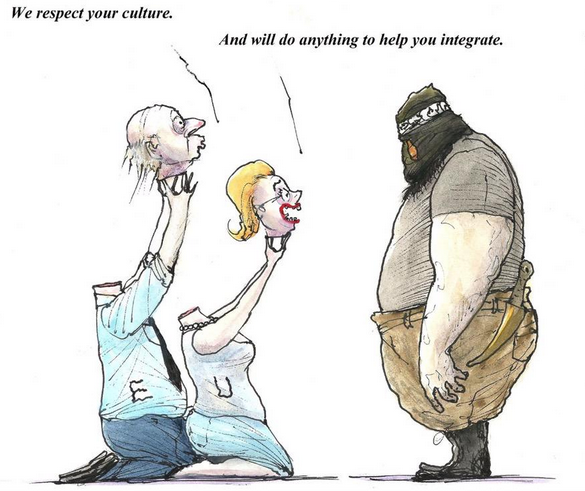

Cartoon of the day

September 9, 2015

H/t Joopklepzeiker

screenshot_332

Street Posters to Advertise Iran as ‘America’s Newest Ally’ at Trump, Cruz Rally

September 9, 2015

Street Posters to Advertise Iran as ‘America’s Newest Ally’ at Trump, Cruz Rally, Washington Free Beacon, September 9, 2015

unnamed (1)

“For the last decade, Iran was isolated, as everyone agreed that its rhetoric and behavior was dangerous, and beyond the pale for civilized nations. Obama’s deal unravels the conscience of the world,” IranTruth director David Reaboi explained. “For this series, we wanted to remind Americans of what they’re getting with a deal with the Islamic Republic of Iran that strengthens the theocratic regime in Tehran.”

************************

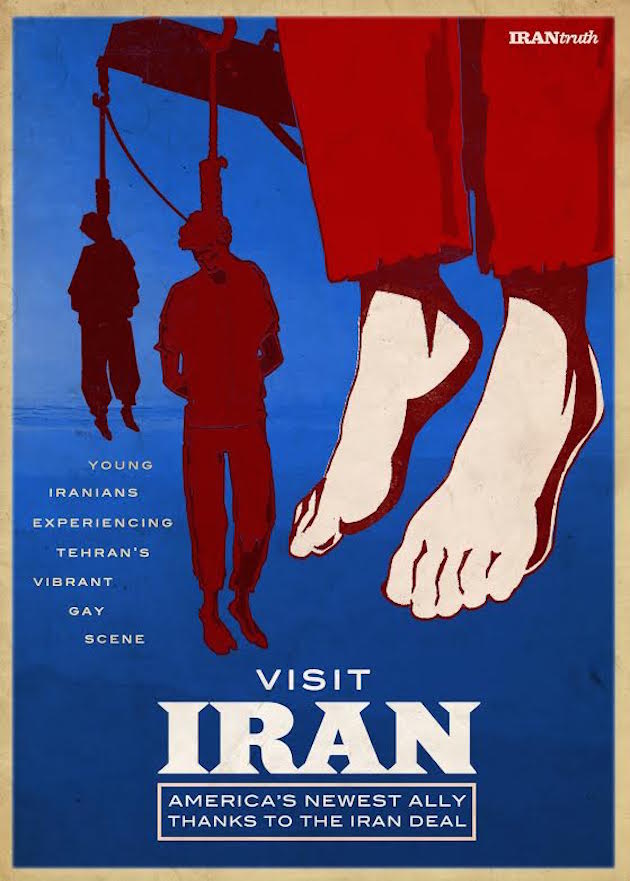
Posters advertising Iran as “America’s newest ally” will be showcased in Washington, D.C., beginning Wednesday at a rally against the nuclear deal on Capitol Hill that Republican presidential candidates Donald Trump and Ted Cruz are expected to attend.

IranTruth, a project of the Center for Security Policy that is devoted to raising awareness about the dangers of the nuclear deal, is behind the posters.

The advertisements, which emulate vintage mid-20th century travel posters and invite Americans to “visit Iran,” spotlight the country’s crimes against women, homosexuals, and political prisoners. “Participate in a public stoning in beautiful Tehran,” one ad reads over a cartoon of an Iranian woman being stoned to death.

gays hanging out

“For the last decade, Iran was isolated, as everyone agreed that its rhetoric and behavior was dangerous, and beyond the pale for civilized nations. Obama’s deal unravels the conscience of the world,” IranTruth director David Reaboi explained. “For this series, we wanted to remind Americans of what they’re getting with a deal with the Islamic Republic of Iran that strengthens the theocratic regime in Tehran.”

The posters will adorn a large billboard truck in the nation’s capital for several days beginning Wednesday at the anti-deal rally which will be co-hosted by the Center for Security Policy. Sen. Cruz (R., Texas) helped organize the event with the help of Tea Party activists and reportedly invited Trump to attend.

On the same day, Democratic presidential candidate Hillary Clinton will speak in support of the deal.

unnamed-21

The poster campaign comes days before lawmakers make their final decisions on the Iran deal. Congress is expected to vote on the agreement sometime before Sept. 17. President Obama recently garnered enough support for the deal among Senate Democrats to avoid having to veto a resolution rejecting the agreement.

Nevertheless, several prominent Senate Democrats, including Sens. Chuck Schumer (D., N.Y.) and Bob Menendez (D., N.J.) have voiced disapproval of the deal.

Sen. Joe Manchin (D., W.Va.) on Tuesday declared his opposition to the deal, saying that the agreement would endanger American security and help fund terrorism.

Republican lawmakers widely oppose the deal, particularly voicing concerns regarding the inspections of Iran’s nuclear facilities that are governed by secret side deals between Tehran and the United Nations agency tasked with completing them, the International Atomic Energy Agency (IAEA).

While the Obama administration has couched the deal as the only alternative to military conflict, a council of retired military leaders recently warned that the nuclear deal will increase the likelihood of war.

A majority of American adults want Congress to reject the agreement, recent CNN/ORC polling found.

unnamed3


Khamenei: Israel won’t survive next 25 years

September 9, 2015

Khamenei: Israel won’t survive next 25 years Taking to Twitter, Iranian leader says Zionists won’t find serenity until destruction, calls US ‘Great Satan’ and rejects any talks with Washington beyond nuke deal By Times of Israel staff September 9, 2015, 12:20 pm

Source: Khamenei: Israel won’t survive next 25 years | The Times of Israel

In this picture released by official website of Ayatollah Ali Khamenei's office on Thursday, Sept. 3, 2015, he is seen speaking in a meeting with members of Iran's Experts Assembly in Tehran, Iran. (Office of the Iranian Supreme Leader via AP)

In this picture released by official website of Ayatollah Ali Khamenei’s office on Thursday, Sept. 3, 2015, he is seen speaking in a meeting with members of Iran’s Experts Assembly in Tehran, Iran. (Office of the Iranian Supreme Leader via AP)

Israel will not survive the next 25 years, Iran’s Supreme Leader Ayatollah Ali Khamenei said Wednesday, making a series of threatening remarks published online.

In a quote posted to Twitter by Khamenei’s official account, Khamenei addresses Israel, saying, “You will not see next 25 years,” and adds that the Jewish state will be hounded until it is destroyed.

The quote comes against a backdrop of a photograph showing the Iranian leader walking on an Israeli flag painted on a sidewalk.

“After negotiations, in Zionist regime they said they had no more concern about Iran for next 25 years; I’d say: Firstly, you will not see next 25 years; God willing, there will be nothing as Zionist regime by next 25 years. Secondly, until then, struggling, heroic and jihadi morale will leave no moment of serenity for Zionists,” the quote from Iran’s top leader reads in broken English.

The quote was apparently taken from a speech given earlier in the day.

The remarks came as US lawmakers began to debate supporting a recent nuclear agreement between Tehran and six world powers. Critics of the deal have pointed to fiery anti-US and anti-Zionist rhetoric as proof that the regime should not be trusted.

The White House and other deal boosters argue that the pact, meant to keep Iran from acquiring a nuclear weapon, is based on verification, not trust.

Khamenei’s statements also reaffirmed his view that the US is a “Great Satan” and that there would be no detente with Washington beyond the nuclear talks.

“We approved talks with the United States about [the] nuclear issue specifically. We have not allowed talks with the US in other fields and we [do] not negotiate with them,” Khamenei said in statements published on his website.

Khamenei is quoted as saying any other talks would be “a tool for penetration and imposing their demands.”

On Twitter, Khamenei said talks with the US were a “means of infiltration and imposition of their wills.”

Quoting the founder of the Islamic Republic and his predecessor as Supreme Leader Ayatollah Ruhollah Khomeini, Khamenei tweeted: “@IRKhomeini stated “US is the Great Satan,” some insist on depicting this Great Satan as an angel.”

The Twitter handle @IRKhomeini is an Iranian government account dedicated to Khomeini’s statements.

Some have pointed to the nuclear deal as an opening for Iran to repair long-frayed ties with the West.

Several senior European officials have traveled to Iran since the nuclear deal was reached to boost economic and diplomatic ties, including Austrian President Heinz Fischer, who on Monday became the first European leader to visit Tehran in over a decade.

On Tuesday, Iranian President Hassan Rouhani signaled that Iran is ready to hold talks with world powers on ways to resolve Syria’s civil war — provided such negotiations could secure peace and democracy in the conflict-torn country, he said.

Iran, together with Russia, backs the embattled regime of Bashar Assad, who is opposed by much of the West.

Iran deal is not a done deal

September 9, 2015

Source: Israel Hayom | Iran deal is not a done deal

Clifford D. May

The debate over the deal U.S. President Barack Obama has cut with Iran’s rulers is supposed to end this ‎week. The New York Times, The Associated Press and others in the media are reporting that the White House ‎has achieved a “victory.” On what basis? ‎

Polls show most Americans — 55% in the most recent Quinnipiac poll — oppose the agreement. ‎Only 25% support it. A bipartisan majority in Congress — 60% — disapproves the deal as ‎well.‎

Not for the first time, Obama is playing by his own rules. The Joint Comprehensive Plan of ‎Action is a nuclear arms control agreement with the world’s leading sponsor of ‎terrorism. Common sense and perhaps the U.S. constitution dictate that it should have been presented ‎as a treaty. But as a treaty, it would need to garner a two-thirds vote in the Senate, reflecting a ‎solid national consensus. ‎

Obama knew he could not achieve that level of support. In the end, he will not even get a ‎simple majority. So he marginalized Congress, creatively framing the deal as a “nonbinding ‎political agreement.” That way, he can veto a congressional vote of no confidence. A ‎supermajority would be required to overcome his veto. Perhaps that’s a victory for the ‎president, but it’s surely a loss for such principles as separation of powers, checks and balances ‎and majority rule. ‎

Obama is hoping for one more “victory.” If he can get Senate Democrats to filibuster, no ‎votes will be cast in the Senate and he won’t need to bother exercising his veto. ‎

Think about that: Every Democratic senator voted for the Iran Nuclear Agreement Review Act. ‎Its sole purpose: to ensure that members of Congress would at least have an opportunity to ‎express their opinions. Those supporting a filibuster will be declaring that, upon reflection, they ‎prefer to muzzle themselves and play no role whatsoever on an issue vital to the security of ‎America and its allies. Perhaps they have more important things to do.‎

It was always a myth, albeit one widely circulated on both the Left and the Right, that ‎congressional disapproval, even if it were veto-proof, would “kill” the deal. As my colleague ‎Mark Dubowitz has said for months, Obama could have plowed ahead regardless using ‎executive powers that Congress would be unlikely to successfully challenge.‎

He would have reiterated that the JCPOA was endorsed by the U.N. Security Council. He ‎would have ignored the fact that the U.N. Security Council includes Russia and China, adversaries of the U.S., ‎and Venezuela, a self-declared enemy of the U.S. serving a term as a nonpermanent member. He ‎would have contended that Congress cannot overrule the “international community.” He would ‎have been wrong — the U.N. is not a global government — but here again I’m not confident that ‎Congress would have found a way to meaningfully contradict him.‎

Last week, Sen. Ben Cardin, the ranking Democrat on the Foreign Relations Committee, ‎declared his disapproval of the deal. On Tuesday, Sen. Joe Manchin did as well. That makes four ‎Democrats in the Senate and, so far, 15 Democrats in the House opposing the agreement. Among ‎the reasons Cardin gave: “It would provide Iran with international endorsement of an ‎industrial-scale nuclear program. Worse, Iran would be economically strengthened by ‎frighteningly quick relief from sanctions and international economic engagement.” ‎

He added: “The agreement talks about normalization of economic relations with Iran and states ‎that the parties shall ‘implement this JCPOA in good faith … based on mutual respect.’ But ‎there cannot be respect for a country that actively foments regional instability, advocates for ‎Israel’s destruction, kills the innocent and shouts, ‘Death to America.'”‎

Cardin was speaking truth to power. Former New York City Mayor Michael Bloomberg, ‎who has belonged to both parties, wrote last month that “if you are a Democrat who opposes the ‎agreement, you are also risking your political career. That’s the message the White House and ‎some liberal leaders are sending.”‎

It’s telling that many Democrats who approve the deal are doing so with less-than-ringing ‎endorsements. Sen. Cory Booker last week called the agreement “dangerous” and “deeply ‎flawed.” The U.S., he recalled, began the talks with the “stated intention of preventing Iran from ‎having the capability to get a nuclear weapon. Unfortunately, it’s clear we didn’t achieve that ‎objective and have only delayed  —  not blocked  — Iran’s potential nuclear breakout.” ‎

There are several ways this deal could still be undone. Even as Obama was sidelining the ‎U.S. Congress, Supreme Leader Ali Khamenei was announcing that the Majlis, Iran’s faux ‎parliament, “should not be sidelined on the nuclear deal issue.” He said he would not tell those ‎officials whether to register their “approval or disapproval” of the agreement. So their votes will ‎count but not those of U.S. senators? And would you be surprised if they demanded a few more ‎concessions from the Great Satan? ‎

Meanwhile, Rep. Mike Pompeo and several other members of Congress are arguing that ‎Obama has failed to comply with the Iran Nuclear Agreement Review Act. That law requires the ‎president to give Congress access to the entire agreement, specifically including “side ‎agreements.” The side agreement between Iran and U.N. inspectors — which contains significant ‎inspection and verification provisions vital to the success of Obama’s deal — remains secret.‎

This Friday happens to be the anniversary of an attack that should have awakened us all to the ‎threat posed by those whose goal is to destroy America. In a saner world, that would concentrate ‎political minds on the wisdom of a deal that will enrich, empower, embolden and re-legitimize ‎the self-proclaimed anti-Western revolutionaries who rule Iran.‎

Clifford D. May is president of the Foundation for Defense of Democracies and a ‎columnist for The Washington Times.

Russia eludes US ban on NATO airspace by roundabout route to Syria via Iraq and Iran

September 9, 2015

Source: Russia eludes US ban on NATO airspace by roundabout route to Syria via Iraq and Iran

Moscow has opened a new roundabout route for its ongoing military airlift from Sevastopol in Crimea and other bases in southern Russia to the Syrian Mezze Airbase in Damascus, debkafile’s exclusive military and intelligence sources disclose.

This route runs over the Caspian Sea and northern Iran and Iraq and terminates with deliveries at Damascus and the new Russian air and ground base at Jablah, near the Syrian port of Latakia.

The Russians have in this way circumvented the strong US applications to Turkey, Greek, Bulgaria and Cyprus, to close their airspace to Russian shipments for its military buildup in Syria.

Washington’s actions had two results – one less and the other more desirable.

1. Tehran and Baghdad have both been pulled into directly supporting the Russian military interventkion in Syria, after Iraq was bullied by Iran to turn down the US request to close its northern skies to Russian shipments.

Washington refrained from addressing this request to Iran, in keeping with its policy of avoiding strains on relations until the nuclear deal was endorsed in Washington and Tehran.

As a result, heavy Russian transports are flying over parts of Iraq where US forces, including ground intelligence teams for guiding US air strikes against ISIS, are deployed. This makes accidental collisions in the sky a real danger. The Americans have therefore slowed down their aerial war on ISIS.

2.  The need for a roundabout air route to Syria has substantially raised the cost of the Russian military expedition. A direct flight over the Mediterranean spans 1,025 km, which the Russian AN-124 (Condor) can cover in two hours. The long way round is three times as long – more than 2,900 km – and takes six hours.
Washington’s challenge to Moscow over air routes to Syria is their first military confrontation over Syria and the new Russian military buildup.
White House spokesman Josh Earnest warned Tuesday night, Sept. 8: “The Russian military buildup would risk confrontation with the counter-ISIL coalition that included the United States.”

He was repeating a similar warning issued a few days ago by Secretary of State John Kerry.
Explicit American threats of a military showdown with Russia over the Middle East is the sort of language not heard for four decades since the 1973 Yom Kippur War which Israel fought against Egypt and Syria.

Support for Iran Nuclear Agreement Falls | Pew Research Center

September 9, 2015


Source: Support for Iran Nuclear Agreement Falls | Pew Research Center

Public Awareness of Issue Has Declined Since July

As Congress prepares to vote on the Iran nuclear agreement, public support for the deal has declined. Currently, just 21% approve of the agreement on Iran’s nuclear program reached between the United States, Iran and other nations. Nearly half (49%) disapprove of the agreement, while three-in-ten (30%) offer no opinion.

09-08-15 Iran 1In mid-July, a week after President Obama announced the deal, 33% of the public approved of the agreement, while 45% disapproved and 22% had no opinion. Over the past six weeks, the share approving of the agreement has fallen 12 percentage points (from 33% to 21%), while disapproval has held fairly steady (45% then, 49% now). Somewhat more express no opinion than did so in July (22% then, 30% now).

09-08-15 Iran 2The latest national survey by the Pew Research Center, conducted Sept. 3-7 among 1,004 adults, finds that the contentious debate over the Iran agreement has not resonated widely with the public. In fact, the share saying they have heard either a lot or a little about the agreement has declined from 79% in July to 69% in the new survey. The share saying they have heard “nothing at all” about it has increased nine percentage points, from 21% to 30%.

09-08-15 Iran 3Republicans are far more likely than Democrats or independents to say they have heard about the agreement, and these differences have widened since July. Today, 86% of Republicans, 69% of Democrats and 63% of independents have heard at least a little about the nuclear agreement. Since July, the percentage of Republicans who say they are aware of the agreement is unchanged (84% then) while declining nine percentage points among Democrats (78% to 69%) and 14 points among independents (77% to 63%).

While the partisan divide over the nuclear agreement remains substantial, support for the deal has slipped across the board since July. Currently, 42% of Democrats approve of the agreement, while 29% disapprove and an identical percentage has no opinion. In July, 50% of Democrats approved, 27% disapproved and 22% had no opinion.

Republican support for the agreement, already low, has dropped even further (from 13% to 6%). Independents’ support for the agreement also has fallen (from 31% to 20%), although – as with Democrats – the share disapproving has held steady since July, at 47%.

09-08-15 Iran 4When opinion about the Iran nuclear agreement is based only on those who have heard a lot or a little about the agreement, opposition to the agreement exceeds support by more than a two-to-one margin (57% to 27%).

Among those aware of the Iran deal, the share approving of the agreement has declined 11 percentage points since July, while the percentage disapproving has risen nine points.


Confidence in Iran’s Leaders, International Monitors

09-08-15 Iran 5The public continues to express little confidence that Iran’s leaders will live up to their side of the nuclear agreement. Just 2% have a great deal of confidence that Iran’s leaders will abide by the agreement, while another 18% say they have a fair amount of confidence. About seven-in-ten (70%) say they are not too confident (28%) or not confident at all (42%) in Iran’s leaders.

These views are largely unchanged since July, though the share expressing no confidence at all in Iran’s leaders to abide by the agreement has risen slightly (from 37% to 42%).

The public remains somewhat more confident in the ability in of the U.S. and international agencies to monitor Iran’s compliance with the agreement. Currently, 42% say they have a great deal (12%) or a fair amount (30%) of confidence in the U.S. and international agencies to track Iran’s compliance, which is little changed from July (46% at least a fair amount of confidence).

09-08-15 Iran 6Since July, the share of Democrats expressing at least a fair amount of confidence in Iran’s leaders to live up to the deal has slipped eight percentage points, from 41% to 33%. Just 8% of Republicans have that level of confidence in Iran’s leaders, which is little changed from July (9%). But since then, the proportion of Republicans who have no confidence at all in Iran’s leaders to abide by the agreement has increased 11 percentage points (from 56% to 67%).

A majority of Democrats (64%) say they have a great deal (16%) or fair amount (48%) of confidence in the ability of the United States and international agencies to monitor Iran’s compliance to the nuclear agreement. Fewer than half as many Republicans (23%) say they are confident in the ability of the U.S. and other nations to ensure that Iran is living up to the agreement. These opinions are little changed from July.

Changing Views of the Iran Agreement

09-08-15 Iran 7Since July, support for the Iran nuclear agreement has fallen across most demographic groups, though in many cases, the share who disapproves has not changed substantially.

Among adults with no more than a high school education, for instance, just 14% approve of the nuclear agreement, while 51% disapprove; roughly a third (35%) do not express an opinion. Since July, approval of the agreement has fallen 13 percentage points among this group (27% then), but disapproval is largely unchanged (50% then). The share not voicing an opinion has risen 12 points (23% then).

College graduates, by contrast, have mixed opinions of the nuclear deal (35% approve, 40% disapprove). In July, somewhat more college graduates approved of the agreement than disapproved (44% vs. 37%).

As was the case in July, people who have heard a lot about the Iran nuclear agreement are more supportive of it than those who have heard less about it. Still, among those who have heard a lot about the agreement, just 34% approve, down nine points from July (43%). Support for the agreement has fallen even more among those who have heard a little about the Iran nuclear agreement (34% to 20%).

Notably, while overall Democratic support for the Iran nuclear agreement has slipped since July, there has been no change among the 33% of Democrats who have heard a lot about the deal. Fully 76% of Democrats who have heard a lot about the agreement approve of it, while just 16% disapprove; that is virtually the same as in July (74% approve vs. 17% disapprove). Among Republicans who have heard a lot about the agreement, 90% disapprove of it, which also is little changed from July (84%).

Less Public Awareness of Nuclear Agreement

09-08-15 Iran 8While the share of Americans with at least some awareness of the nuclear agreement has declined 10 percentage points since July, there has been almost no change in the share who say they have heard a lot about it (35% then, 36% now).

Republicans (49%) are far more likely than Democrats (33%) or independents (36%) to say they have heard a lot about the agreement and that gap appears to have widened somewhat since July.

In terms of overall awareness of the agreement, the decline is particularly pronounced among those with no more than a high school education. In July, 71% of those with a high school degree or less education said they heard at least a little about the Iran nuclear agreement; today 55% report hearing about it. There has been less change in awareness among adults with more education.


Donald Trump: Amateur hour with the Iran nuclear deal

September 9, 2015

Politics as usual has failed, that’s why I need to step in.

Source: Donald Trump: Amateur hour with the Iran nuclear deal

635773279473342780-Trump17


It is hard to believe a president of the United States would actually put his name on an agreement with the terrorist state Iran that is so bad, so poorly constructed and so terribly negotiated that it increases uncertainty and reduces security for America and our allies, including Israel.

It was amateur hour for those charged with striking this deal with Iran, demonstrating to the world, yet again, the total incompetence of our president and politicians. It appears we wanted a deal at any cost rather than following the advice of Ronald Reagan and walking away because “no deal is better than a bad deal.”

After the agreement goes into effect: All nuclear-related sanctions will be lifted. Iran receives a windfall of $150 billion, which will no doubt fund terrorism around the world. Iran will receive notice before any inspections take place. Iran can block inspection of certain facilities. Iran will soon be able to continue expanding its conventional arms and guided missile programs without facing snapback sanctions. Iran can keep American prisoners, including one former U.S. Marine and, very sadly, a Christian minister. Iran can continue to operate about 6,000 centrifuges. Other countries will be free to invest in Iran.

Iran can continue to solidify bonds with Russia, China and North Korea. All these other countries will benefit, and the United States loses on all fronts.

In the end, Iran will be a nuclear state. This will lead to an all-out arms race in the region. All the Middle East, southern Europe and American interests will be within the footprint of Iran’s missiles.

Interestingly, Saudi Arabia and others, who were vehemently opposed to the deal on all fronts, are now in favor — Washington has naively provided new weapons deals and security assurances.

The problem is that Iran poses an existential threat to Israel, our Middle Eastern allies and the United States. If we have to wait until the next president is sworn in to revisit this nuclear weapons agreement, then the next president better be someone who knows how to negotiate and who will do what is best for the United States.

When I am elected president, I will renegotiate with Iran — right after I enable the immediate release of our American prisoners and ask Congress to impose new sanctions that stop Iran from having the ability to sponsor terrorism around the world.

In fact, if I am elected, I am sure the prisoners will be released before my taking office.

We will approach other nations and make it clear that we will not allow Iran to develop nuclear weapons.

We will use all the tools of power available, hopefully avoiding direct action. But make no mistake, a Trump presidency will demonstrate the will to do whatever is necessary to protect the interests of the United States, Israel and its allies.

My opposition to the war in Iraq is well documented. I was against the war from the very beginning, all the way back in 2004. I had the vision and foresight to understand that Iraq and Iran were equal powers, and that our takeover of Iraq, when there was no real evidence of weapons of mass destruction, would be catastrophic for the entire region, enabling Iran and other forces to become a more dangerous threat than Saddam Hussein ever thought of being.

We now have the Islamic State and the threat of nuclear weapons from Iran, both a direct result of the shortsighted incompetence of those in Washington during the war in Iraq and long before.

Negotiating from a position of strength is important. Having the will to follow through is fundamental. A Trump presidency will force the Iranians back to the bargaining table to make a much better deal. A Trump presidency will make America great again.

Businessman Donald J. Trump is seeking the 2016 Republican presidential nomination.

Our World: The Republican fall guys

September 9, 2015

Our World: The Republican fall guys, Jerusalem Post, Caroline Glick, September 8, 2015

Whenever the Iranians leave, they can be depended on to blame US for their decision to vacate their signature. And the Democrats in turn will blame the Republicans for pushing the Iranians over the edge.

***********************

The ayatollahs will ride their nuclear pact with the Great Satan all the way to a nuclear arsenal and regional hegemony, repeating the cycles of brinksmanship, extortion, respite and brinksmanship that they learned from their North Korean teachers.

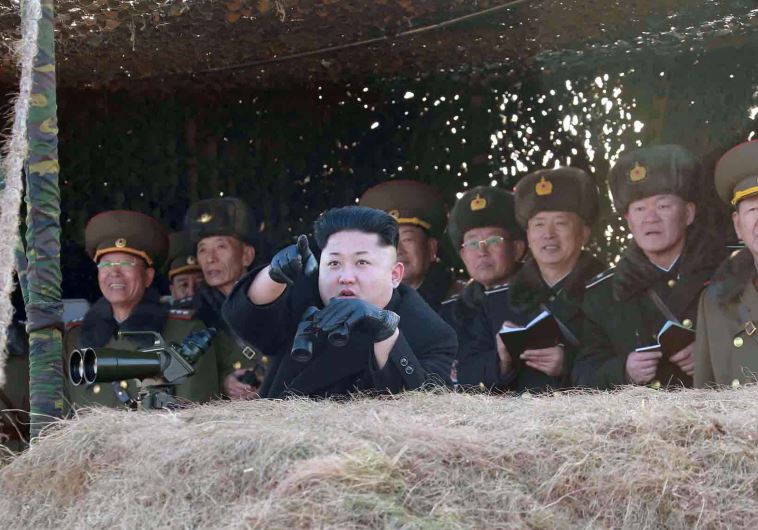
ShowImage (11)Kim Jong-un, North Korea leader. (photo credit:KNS / KCNA / AFP)

The Iran nuclear deal is presented as an international agreement between the major powers and Iran. But the fact is that there are really only two parties to the agreement – President Barack Obama and his Democratic Party on the one hand, and the Iranian regime on the other.

Over the past week or so, more and more Democrats have fallen into line behind Obama. At the same time, word is getting out about what Iran is doing now that it has its deal. Together, the actions of both sides have revealed the role the nuclear pact plays in each side’s overall strategies for success.

On the Iranian side, last Wednesday the National Committee of Resistance of Iran revealed that North Korean nuclear experts are in Iran working with the Revolutionary Guards to help the Iranians prevent the UN’s nuclear inspectors from discovering the scope of their nuclear activities.

The NCRI is the same opposition group that in 2003 exposed Iran’s until then secret uranium enrichment installation in Natanz and its heavy water plutonium facility in Arak.

According to the report, the North Koreans “have expertise in ballistic missile and nuclear work areas, particularly in the field of warheads and missile guidance.”

“Over the past two years the North Korean teams have been sharing their experiences and tactics necessary for preventing access to military nuclear sites,” NCRI added.

Although, as The Washington Times reports, NCRI’s finding have yet to be verified, it is unwise to doubt them.

North Korea has been assisting Iran’s nuclear program for nearly 20 years. The US began applying sanctions on North Korea for its ballistic missile proliferation activities in Iran 15 years ago. Iran’s Shahab and Ghadr ballistic missiles are modeled on North Korea’s Nodong missiles.

The Syrian nuclear installation that Israel reportedly destroyed in 2007 was a duplicate of the Yangbyon heavy water reactor in North Korea. The Deir al-Zour reactor was reportedly built by North Korean nuclear personnel and paid for by Tehran.

North Korea’s heavy involvement in Iran’s nuclear weapons program tells us everything we need to know about how Iran views the nuclear deal it signed with the Obama administration and its international partners.

For the past 22 years, the North Koreans have been playing the US and the international community for fools. Ever since February 1993, when inspectors from the International Atomic Energy Agency first discovered that North Korea was conducting illicit nuclear activities, Pyongyang has been using its nuclear program to blackmail the US.

The pattern repeats itself with maddening regularity.

First, the US discovers that North Korea is engaging in illicit nuclear activities. Over the years, these activities have gone from illicit development of plutonium-based nuclear bombs to expelling UN inspectors, to testing long-range ballistic missiles, to threatening nuclear war, to testing nuclear bombs and threatening to supply the bomb to terrorist groups.

Second, the US announces it is applying sanctions to North Korean entities.

Third, North Korea responds with more threats.

The sides then agree to sit down and negotiate the scaling back of North Korea’s nuclear activities. In exchange for Pyongyang’s agreement to talk, the US provides the hermit slave state with whatever it demands. US concessions run the gamut from sanctions relief, to cash payments, provision of fuel, assistance in developing “peaceful” nuclear sites at which the North Koreans expand their nuclear expertise, removal of North Korea from the State Department’s list of state sponsors of terrorism, the provision of formal US commitments not to use force to block North Korea’s nuclear progress, to more cash payments and sanctions relief.

The North then formally agrees to scale back its nuclear program and everyone is happy.

Until the next time it is caught cheating and proliferating.

And then the cycle starts again.

In each go around, the US expresses surprise at the scope of North Korea’s illicit nuclear and missile activities. In every cycle, US intelligence failed to discover what North Korea was doing until after the missiles and bombs were tested and UN inspectors were thrown out of the country.

Despite North Korean brinksmanship and ballistic missile warhead development, the US prohibits its ally South Korea from developing its own nuclear deterrent or even taking steps in that direction.

For their part, while negotiating with the Americans, the North Koreans have proliferated their nuclear technologies and ballistic missiles to Iran, Syria, Pakistan and Libya.

Given North Korea’s clear strategy of using nuclear blackmail to develop its nuclear arsenal and maintain the regime’s grip on power, you don’t need to be a master spy to understand what the presence of North Korean experts in Teheran tells us about Iran’s strategy for nuclear empowerment.

The ayatollahs will ride their nuclear pact with the Great Satan all the way to a nuclear arsenal and regional hegemony, repeating the cycles of brinksmanship, extortion, respite and brinksmanship that they learned from their North Korean teachers.

Given how well the strategy has worked for the psychotic North Koreans who have no economy, no allies and no proxies, it is clear that Iran, with its gas and oil deposits, imperial aspirations, terrorist proxies and educated population believes that this is the strategy that will launch it to world-power status.

This then brings us to the Democrats.

Depending on their pro-Israel protestations, the Democratic position in support of the deal ranges from optimism to pessimistic minimalism. On the side of the optimists, we have the Obama administration.

Obama, Secretary of State John Kerry and their advisors insist that the deal is fantastic. It blocks Iran’s path to the bomb. It opens the possibility of Iran becoming a positive actor on the world stage.

On the other end of the Democratic spectrum are the pessimists like New Jersey Senator Cory Booker and Congresswoman Debbie Wasserman-Schultz.

As they see it, the deal is horrible. It empowers and enriches Iran and legitimizes its nuclear program.

But still, they claim, the deal keeps Iran’s nuclear ambitions at bay for a few years by forcing Iran to submit to the much touted UN inspections regime.

So it is a good deal and they will vote in favor of it and then vote to sustain a presidential veto of a congressional decision to oppose it.

Obviously, the presence of North Korean nuclear experts in Tehran makes a mockery of the notion that Iran has any intention of exercising good faith with UN inspectors. But that isn’t the point.

The point is that the Democrats have no intention of doing anything to prevent Iran from becoming a nuclear power. They just don’t want to be blamed for Iran becoming a nuclear power. They want the Republicans to shoulder the blame. The purpose of the deal from their perspective to set the Republicans up to be blamed.

Obama and his Democratic followers insist that if Iran doesn’t act in good faith, the US will reimpose sanctions. Worse comes to worst, they insist, the US can just walk away from the deal.

This of course is utter nonsense.

Obama won’t walk away from his signature foreign policy. He will devote his energies in his remaining time in office to covering up for Iran. That is why he is breaking the law he signed and refusing to hand over the side deals regarding the farcical nature of UN inspections of Iran’s nuclear sites to Congress.

Moreover, after insisting that the deal is the best way to prevent a holocaust or that it is the only way a Jewish mother can protect the homeland of her people, Democratic lawmakers are not going to rush to acknowledge that they are lying. Now that they’ve signed onto the deal, they own it.

Of course, the Iranians are another story. While the Democrats will not abandon the deal no matter what, the Iranians signed the deal in order to abandon it the minute it outlives its usefulness. And that works just fine for the Democrats.

The Democrats know that the Iranians will use any step the Republicans take to try to enforce the deal’s verification regime or condition sanctions relief on Iranian abidance by the deal’s restrictions on its nuclear activities as an excuse to walk away from the deal. They also know the Iranians will remain in the deal as long as it is useful to them.

Since the Iranians intend to hide their nuclear activities, the Democrats assume Tehran will stay in until it is financially and militarily ready to escalate its nuclear activities.

The Democrats believe that timetable will extend well beyond the lifespan of the Obama administration.

Whenever the Iranians leave, they can be depended on to blame US for their decision to vacate their signature. And the Democrats in turn will blame the Republicans for pushing the Iranians over the edge.

You have to give credit to the administration and its Iranian chums. At least they are consistent. They have constructed an agreement that gives them both what they care about most. Iran, as always, wants to dominate the region and develop the means to destroy Israel and its Arab adversaries at will. The administration, as always, wants to blame the Republicans.

Israel and the Arabs understand the game that is being played. It is time for the Republicans to get wise to it.