Posted tagged ‘U.S. military’

ISIS Threatens Obama With ‘New Lesson’ in Beheading Video

October 31, 2015

ISIS Threatens Obama With ‘New Lesson’ in Beheading Video, Newsmax, Sandy Fitzgerald, October 31, 2015

(Video at the link. Has Obama recently decided that the Islamic State is a greater threat than climate change?– DM)

A horrifying new 15-minute video appears to show Islamic State (ISIS) terrorists beheading four captured Kurdish Peshmerga fighters — and delivering a bold warning to President Barack Obama.

The video claims to be the ISIS response to a Delta Force-Kurdish raid in northern Iraq last week that cost American Master Sgt. Joshua Wheeler his life.

“Obama, you have learned a new lesson,” a masked terrorist warns Obama in what sounds like an American accent. “Six of the soldiers of the caliphate faced 400 of your children; they killed and injured them by Allah’s grace.”

The warning was delivered before the man executes one of the prisoners, reports CNN, and the other three prisoners are also beheaded by the video’s end. Arabic text also appears onscreen, translating as “Peshmerga soldiers that Americans came to rescue.”

The video was released online Friday, and earlier in the clip, ISIS claims to show the aftermath of the raid, in which Kurdish, U.S., and Iraqi forces rescue 70 hostages from an ISIS prison in Hawija, located in Kirkuk, a province located in northern Iraq.

CNN reports that those who were set free included 20 of the Iraqi Security Forces, local residents and several ISIS fighters accused of spying. None of the hostages were Kurds.

As of Saturday morning, there had not been an official response issued from the White House on the video or the threat. But in Kurdistan, regional government spokesman Dindar Zebari told CNN that “ISIS respects no form of human rights. Our message to them is that we will finish them.”

But Kurdistan will not kill ISIS prisoners in response, Zebari said.

“We hold 215 ISIS prisoners and we treat them according to international human rights laws,” he said. “We have also freed 85 prisoners who had been suspected of association with ISIS. We do not kill our prisoners.”

The Kurdistan regional government said that more than 20 ISIS fighters were killed in last week’s raid, and six more were captured.

The Kurdish Peshmerga, which protects an autonomous region in northern Iraq, has been fighting against ISIS and its push to take Iraq and Syria and create a caliphate.

ISIS earlier this week said the Delta Force-Kurdish raid, called for by the Kurds to rescue Peshmerga fighters, was a failure.

The man who issued the threat does not appear to be the infamous “Jihadi John,” the English-speaking jihadist who has appeared in several other ISIS beheading videos.

The terrorist, whose real name is believed to be Mohammed Emwazi, is considered to be a priority target after killing American, Western, and Japanese hostages.

Meanwhile, two Syrian activists have also been killed in recent days in the Turkish town of Urfa, and their deaths are being blamed on ISIS.

According to the groups Raqqa is Being Slaughtered Silently and Eye on Homeland, activists Ibrahim Abdul Qadir and Faris Humadi the men who were shot and beheaded. ISIS has not yet claimed responsibility for their deaths.

Qadir and Humadi worked for Eye on Homeland, a Syrian media group that reports on the civil war, and Qadar also was a founding member of the Raqqa group, which posts photos, video, and other information online from the Raqqa province in Syria.

World powers agree to more talks on Syria crisis

October 31, 2015

World powers agree to more talks on Syria crisis, Al Jazeera, October 31, 2015

(But please see, Iran-US Talks Limited to Nuclear Issue: MPs — DM)

Friday’s talks included an Iranian delegation for the first time.

***********************

Major powers meeting in Vienna for talks on Syria have found enough “common ground” to meet for a new round of talks in two weeks, even as the conflict enters a new phase with the deployment of US special forces in the country.

President Barack Obama has ordered the deployment of fewer than 50 commandos to help coalition forces coordinate with local troops, Josh Earnest, the White House spokesperson, said on Friday.

The troop announcement came as diplomats in the Austrian capital representing 17 countries and the EU agreed to launch a broad new peace attempt to gradually end Syria’s long civil war – a declaration that avoided any decision on when President Bashar al-Assad might leave.

A Syrian member of parliament said the decision is an aggression because it does not involve the government’s agreement.

Sharif Shehadeh told AP news agency on Saturday that the troops will have no effect on the ground, but Washington wants to say that it is present in Syria.

It is not clear how many rebel groups would agree to a plan that does not result in Assad’s immediate departure.

Sergey Lavrov, Russia’s foreign minister, said on Friday a US decision to deploy special forces in Syria would make cooperation between the armed forces of the two countries more important.

“I am sure that neither the United States nor Russia want [the conflict] to become a so-called proxy war,” Lavrov said after the talks in Vienna.

“But it is obvious for me that the situation makes the task of cooperation between the militaries more relevant.”

Friday’s talks included an Iranian delegation for the first time.

Representatives from Britain, Egypt, France, Germany, Italy, Lebanon, the EU and other Arab states also attended.

The participation by Russia and Iran in the attempt could mark a new and promising phase in the diplomacy since those countries have staunchly backed Assad.

‘Tough conversations’

Any ceasefire agreement that may come as a result of the peace effort would not include the Islamic State of Iraq and the Levant (ISIL) group, which controls large parts of northern Syria and has its capital there.

“There were tough conversations today,” John Kerry, US secretary of state, said on Friday. “This is the beginning of a new diplomatic process.”

Kerry acknowledged that those present have major differences regarding the Assad government.

“But we cannot allow the differences to get in the way of diplomacy to end the killing.”

Federica Mogherini, the European Union foreign policy chief, said there is “hope” for a political process to advance, saying that those involved in the talks “found common ground” for further discussion.

“It was a very long and very substantial meeting. This was not an easy one, but for sure a historical one,” she said while praising “those who took difficult decisions” in joining the talks.

Lavrov said those present in the meeting spent a “long time” pushing for an inclusive Syrian-led peace process.

Among the points agreed upon during the talks was that ISIL cannot be allowed to reign in Syria, he said.

In a rare hint of diplomatic progress, Iran indicated it would back a six-month political transition period in Syria followed by elections to decide Assad’s fate, although his opponents rejected the proposal as a trick to keep him in power.

In addition to Assad’s fate, on which delegates said no breakthrough had been expected, sticking points have long included the question of which rebel groups should be considered “terrorists” and who should be involved in the political process.

Al Jazeera’s Mohammed Jamjoom, reporting from Vienna on Friday, said that there was a “mood of optimism” following the talks.

“There is a sense of hopefulness, which has been absent in these talks for quite a long time now,” he said.

The talks came as Syrian government air strikes continued in rebel-held territories, killing at least 61 people and wounding over 100 others in the Damascus suburb of Douma on Friday.

A further 80 people were killed in government and Russian air strikes in Aleppo province.

Satire | Army Agrees to Accept 20,000 Syrian Migrants To Meet Retention Goals

October 26, 2015

Army Agrees to Accept 20,000 Syrian Migrants To Meet Retention Goals, Duffel Blog, October 26, 2015

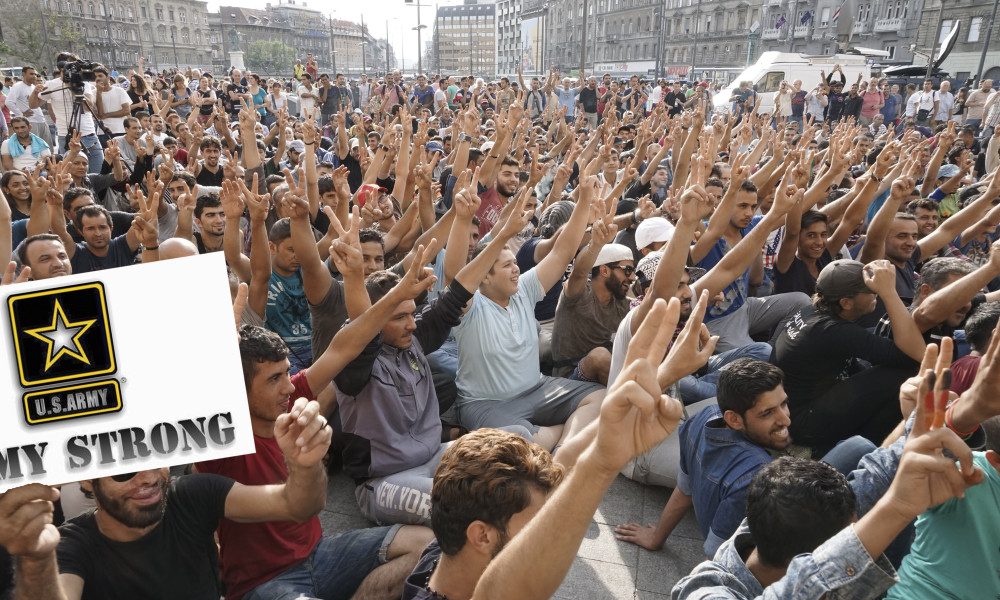
Syrian refugees strike in front of Budapest Keleti railway station. Refugee crisis. Budapest, Hungary, Central Europe, 3 September 2015.

Syrian refugees strike in front of Budapest Keleti railway station. Refugee crisis. Budapest, Hungary, Central Europe, 3 September 2015.

WASHINGTON — Early Wednesday, Pentagon officials announced that the Army will spend $2 billion this year to recruit 20,000 migrants currently fleeing Syria in an attempt to meet their retention goal for fiscal year 2015.

“We have tried everything so far but keep falling short,” said Maj. Gen. Thomas Semands, commander of Army Human Resources Command. “I’ve let in all the gays, transgendereds, and everyone in between. We’re even pretending we will let women serve in the infantry. I guess the next step is to let the deserters of other nations join, eh?”

When told that his microphone was live, Semands added, “What I really mean is, you know, diversity is our strength!”

While some countries in Europe have dedicated tents and funds set aside for incoming asylum-seekers, top Army officials will take it to the next level with barracks and “hot chow” upon their oath of enlistment, pointing out that Germany’s history of building camps is “not that great.”

“We are going to win their hearts and minds whether they like it or not,” said a drill sergeant driving a van picking up refugees in Tampa to bus them to Fort Jackson. “I’m hoping to get to train some of those Muslim cuties over there in the burqas, preferably the one with the pretty eyes.”

“Many of these new recruits have mentioned that they have college degrees. Of course, asking for documentation would be rude given the circumstances,” Semands said. “Needless to say, we are looking forward to adding our newest wave of second lieutenants.”


The Drone Papers

October 18, 2015

The Drone Papers  ( Of Topic )

Source: The Drone Papers

The Drone Papers ( Click on the blue links for sub articles )

The Intercept has obtained a cache of secret documents detailing the inner workings of the U.S. military’s assassination program in Afghanistan, Yemen, and Somalia. The documents, provided by a whistleblower, offer an unprecedented glimpse into Obama’s drone wars.˅

Illustration by The Intercept
  1. 01.

    The Assassination Complex

    Jeremy Scahill

    The whistleblower who leaked the drone papers believes the public is entitled to know how people are placed on kill lists and assassinated on orders from the president.

  2. 02.

    A Visual Glossary

    Josh Begley

    Decoding the language of covert warfare.

  3. 03.

    The Kill Chain

    Cora Currier

    New details about the secret criteria for drone strikes and how the White House approves targets.

  4. 04.

    Find, Fix, Finish

    Jeremy Scahill

    The tip of the spear in the Obama administration’s ramped up wars in Somalia and Yemen was a special operations task force called TF 48-4.

  5. 05.

    Manhunting in the Hindu Kush

    Ryan Devereaux

    Leaked documents detailing a multi-year U.S. military campaign in Afghanistan reveal the strategic limits and startling human costs of drone warfare.

  6. 06.

    Firing Blind

    Cora Currier, Peter Maass

    A secret Pentagon study highlights the chronic flaws in intelligence used for drone strikes in Yemen and Somalia.

  7. 07.

    The Life and Death of Objective Peckham

    Ryan Gallagher

    For years Bilal el-Berjawi traveled freely from the U.K. to Somalia under the watchful eyes of intelligence services. Then the U.S. killed him with a drone strike.

  8. 08.

    Target Africa

    Nick Turse

    To reduce the “tyranny of distance,” drones fly from bases in Djibouti, Ethiopia, Kenya, and Navy ships.

  9. 09.

    Glossary

    The Alphabet of Assassination

    A guide to the acronyms, abbreviations, and initialisms used in The Drone Papers.

  10. 10.

    Documents

    Small Footprint Operations 2/13

    Small Footprint Operations 5/13

    Operation Haymaker

    Geolocation Watchlist

Editor-in-Chief: Betsy Reed. Series Editor: Roger Hodge. Rubina Madan Fillion, Charlotte Greensit, Andrea Jones, Peter Maass. Research: Alleen Brown, John Thomason, Margot Williams, Spencer Woodman. Art Direction: Stephane Elbaz and Philipp Hubert. Development: Tom Conroy and Raby Yuson.

Islamic State grows in Afghanistan, encroaches on Kabul as U.S. remains ‘passive observer’

October 12, 2015

Islamic State grows in Afghanistan, encroaches on Kabul as U.S. remains ‘passive observer’ Washington TimesRowan Scarborough, October 11, 2015

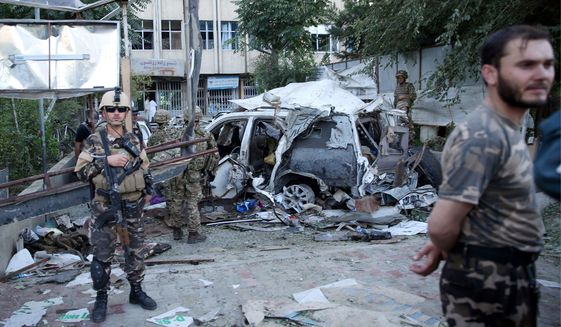
10112015_afghan8201_c0-275-5060-3224_s561x327Photo by: Massoud Hossaini  Afghan security forces and British soldiers inspect the site of a suicide attack in the heart of Kabul, Afghanistan. Loyalists of the Islamic State group are making inroads into Afghanistan, with homegrown militants claiming allegiance to the Islamic State as it controls territory in some parts of the country. (Associated Press)

Afghanistan’s 3,000-member ISIL army is about one-tenth the size of the Afghan Taliban’s forces. But NATO says the Islamic State has reached the next stage of being an emerging threat. If its growth in other regions, such as North Africa, is a gauge, its Afghan component will only expand further as young Muslims are drawn by social media to its ultraviolent ways and Sunni orthodoxy.

************************

The Islamic State is growing at an alarming rate in Afghanistan, within striking distance of the capital, and there does not seem to be a concerted U.S. effort to strike the terrorist army as there is in the Syria-Iraq war theater.

An independent think tank has concluded that the allies are “reacting disjointedly and ineffectively” to the group in Afghanistan and other places outside those two countries.

The Islamic State’s numbers now may reach as high as 3,000 in Afghanistan, mostly in Nangarhar province, less than 50 miles east of Kabul. The emergence presents the NATO-backed elected government there with a fifth deadly enemy in addition to the Taliban, al Qaeda, the Haqqani network and elements of the Pakistani intelligence service.

Globally, the Islamic State, also called ISIL and ISIS, has affiliates in nearly 20 countries.

“It’s like a metastasizing cancer spreading throughout certain parts of the Islamic world,” said James Russell, a former Pentagon official and an instructor at the Naval Postgraduate School in Monterey, California. “We have to hope that the antibodies in these societies can ward off the death, misery and destruction that will come raining down upon them if ISIS takes hold in their communities.”

ISIS_s220x241

Afghanistan’s 3,000-member ISIL army is about one-tenth the size of the Afghan Taliban’s forces. But NATO says the Islamic State has reached the next stage of being an emerging threat. If its growth in other regions, such as North Africa, is a gauge, its Afghan component will only expand further as young Muslims are drawn by social media to its ultraviolent ways and Sunni orthodoxy.

Yet unlike in Syria and Iraq, where a U.S.-led coalition conducts a series of daily airstrikes against the Islamic State, there appears to be no such strategy in Afghanistan, where Afghan government forces now have the lead in all combat operations and request NATO air power on an ad hoc basis.

“What concerns me most is the fact that the United States has become a passive observer rather than the driver of the policy,” said Larry Johnson, a former counterterrorism official at the State Department, commenting on the overall U.S. effort against the Islamic State.

U.S. military spokesmen had no immediate comment on the question of American policy toward the Afghan Islamic State. Army Gen. John Campbell, the allied commander in-country, was asked at congressional hearings last week what triggers action against Islamic State. He answered that the criterion is “force protection.”

After the Syria-Iraq war theater, Islamic State’s emergence near Kabul could be the most troublesome for the U.S., whose troop levels have dropped to less than 10,000, and only a small portion of those forces are dedicated to assist in counterterrorism. The Islamic State has shown it can execute brutal attacks and deploy vehicle bombs to take territory and hold it.

Gen. Campbell said Afghanistan’s security forces lack the leadership and troop numbers to respond to every trouble spot.

Meanwhile, the Islamic State is beginning to flex its terrorism muscle in Afghanistan.

Islamic militant competition

The Institute for the Study of War (ISW) in Washington is tracking the Islamic State’s violent ways in Afghanistan and other countries. It said the Islamic State launched attacks in mid-September against a UNICEF convoy, Afghan government forces, the Afghan Taliban and Shiite civilians. In late September the Islamic State “launched coordinated attacks on multiple Afghan security positions” in Nangarhar, the think tank said.

“The group reportedly also shut down several schools in eastern Afghanistan amid other efforts to assert social control,” the institute said. “ISIS has established robust ground campaigns in Libya, Egypt and Afghanistan.”

The ISW said in the special report “ISIS Global Strategy: A Wargame,” written by counterterrorism analyst Harleen Gambhir, that the Islamic State’s expansion stems from its ability to attract local jihadis.

“The coalition is focused on Iraq and Syria, and it is reacting disjointedly and ineffectively to ISIS’s activities in Libya, Egypt, Afghanistan, and other places,” Ms. Gambhir writes. “ISW’s war game demonstrated how this failure enables ISIS to strategically outpace the U.S. and its allies.”

U.S. intelligence agencies are still trying to digest the meaning of Islamic State setting up shop in South Asia.

Nicholas Rasmussen, director of the National Counterterrorism Center, speaks of an “increasing competition between extremist actors” in the Afghanistan-Pakistan region involving al Qaeda, the Taliban and the Islamic State.

“So that’s an additional factor that we’re still trying to understand,” Mr. Rasmussen told the Combating Terrorism Center at West Point in remarks published last month. He characterized the burgeoning competition as an “interesting feature of the South Asia landscape.”

Gen. Campbell, the U.S. commander closest to Islamic State terrorism in Afghanistan, said foreign fighters are arriving to join the Islamic State as they “try to bring in some sort of funding stream to build a place in Nangarhar.”

He said the emergence of Islamic State “has further complicated the theater landscape and potentially expanded the conflict.”

Mr. Johnson, the former counterterrorism official, said the leaders of Middle East and South Asia countries “concede that the U.S. has no appetite for being engaged, especially militarily in the region.”

The struggle between two radical Sunni groups, the Taliban and the Islamic State, may be sparked in part by the Taliban’s willingness to do business with Iran, a Shiite Islamic country.

“The Taliban have always been far more pragmatic in dealing with Iran, and the religious difference is not a critical factor,” Mr. Johnson said. “Not so with the ISIS crowd. For them, theology takes precedence, and Iran is an apostate state that must be destroyed.”

Judge Jeanine: New world order emerging thanks to Obama

October 6, 2015

Judge Jeanine: New world order emerging thanks to Obama, Fox News via You Tube, October 4, 2015


Cartoons of the day

October 6, 2015

H/t Townhall

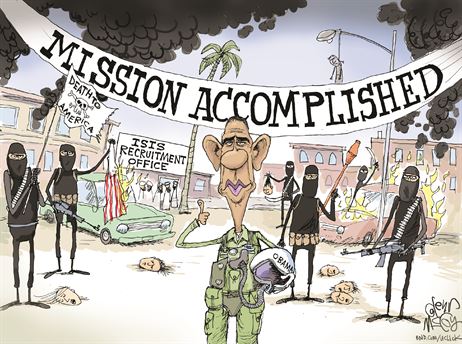
Mission accomplished

H/t Vermont Loon Watch

toys

No moral outrage in the military

October 6, 2015

No moral outrage in the military, Washington Times, James A. Lyons, October 5, 2015

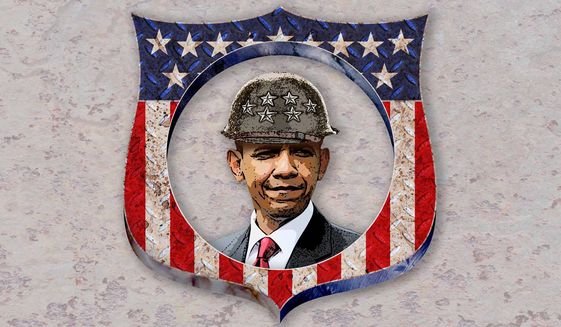
105_2015_b3-lyon-obama-shiel8201_c0-0-2933-1710_s561x327Obama Decimates the U.S. Military Illustration by Greg Groesch/The Washington Times

[T]he degradation of our military’s core principles must be viewed in a much broader perspective. Actually, it is a key element in President Obama’s declaration to fundamentally transform America. When you want to take down a country, the first thing you do is weaken its military.

***************************

Recent articles highlighting horrifying child abuse atrocities inflicted on defenseless children by our Afghan military and police partners are but the latest examples of how President Obama is destroying U.S. military forces.

Our military leadership’s response to these blatant acts of pedophilia by our so-called Afghan partners has been shocking. In short, the guidance provided to our Army and Marine Corps personnel was to just ignore these Muslim and Afghan seventh-century customs and traditions. They have been instructed to not interfere, even when such horrific acts are being committed on our own bases.

Those U.S. military personnel. whose moral outrage will not let them ignore these atrocities and instead act to stop these unconscionable acts against children, are either disciplined or forced to leave the service. In other words, even if you find a young boy chained to a bed so that a local police commander can sodomize him every night and you hear the screams, you are told to look the other way. This is not only un-American but an act against humanity.

Even the Taliban outlawed such practices and freed a number of children, thereby earning the gratitude of village elders. Does the Taliban with its seventh-century mentality have a higher moral code than the U.S. military leadership? It should be clear to any thinking person that when our honorable military personnel are forced to ignore these crimes against humanity, they are viewed as being complicit.

To those who have followed our involvement in Afghanistan, the current policy to ignore acts of pedophilia should come as no surprise. When “green on blue” attacks gained national attention, our military leadership tried to explain it away by claiming the friction that developed between the two forces was because our military personnel were not sensitive enough to Afghan culture and traditions. In other words, if our Afghan partners conduct violence or kill U.S. military personnel, it is our fault. What nonsense.

Other Afghan cultural idiosyncrasies our military personnel are forced to accept without reservation include wife-beating, rape, drug use, thievery, dog torture, desertion and collusion with the enemy, the Taliban. Furthermore, under no circumstances can our military discuss Islam in any form. The genesis for this goes back to the purging of all our training manuals and instructors who presented Islam in an unfavorable light or linked it to terrorism. It is totally against our core principles and everything we stand for as Americans. It clearly has an adverse impact on individual and unit morale, which affects the ultimate goal of the “will to win.” The bottom line is that we are forcing our great military to submit to Islam and its governing Shariah law, or possibly die.

This is exactly the choice offered to infidels who have been vanquished by Islamic jihad. Our military’s silence and acquiescence, particularly by the leadership, is the humiliating price for our coexistence with our Afghan partners. This is unacceptable.

However, the degradation of our military’s core principles must be viewed in a much broader perspective. Actually, it is a key element in President Obama’s declaration to fundamentally transform America. When you want to take down a country, the first thing you do is weaken its military. We cannot ignore the fact that with or without sequestration, the Obama administration has unilaterally disarmed our military forces and, consequently, our capabilities. Further, the social engineering imposed on our military forces — to include the acceptance of gay, lesbian and soon transgender personnel — further undermines the moral fiber of our military and constitutes a further degradation of our military effectiveness. Forcing women into combat roles only further degrades the situation. The restricted rules of engagement imposed on our forces has reduced our military’s effectiveness and caused unnecessary loss of life and debilitating injuries.

Likewise, the pin-prick attacks on the Islamic State cast a shadow over what a dedicated air campaign could accomplish. It projects an image of weakness and ineffectiveness of our true capabilities. It has taken the “awe” of our invincibility and overwhelming force capabilities out of the equation. The net result is that our enemies no longer fear us, and our allies can no longer trust us.

The imposed limit on the application and capability our military force is not limited to the Middle East. For example, in the Western Pacific, to challenge China’s illegal actions in the South China Sea, the Obama administration has restricted the U.S. Navy from enforcing its freedom of seas concept that has been a fundamental principle of the U.S. Navy for more than 238 years. Our Asian allies in the Western Pacific watch carefully how we respond to China’s aggressive actions. Our directed restraint clearly will not raise their confidence level.

Our national security is being deliberately jeopardized. President Obama’s bloviating to Vladimir Putin at the recent U.N. session that he leads the most powerful military in the world was only true on the day he took office. Since then, Obama has systematically degraded our capabilities. The chairmen of the House and Senate Armed Services Committee must take forceful action now to prevent further emasculation of our military capabilities.

Persia, Putin and the Pansy

October 3, 2015

Persia, Putin and the Pansy, Times of Israel, Irwin G. Blank, October 3, 2015

(Guess the name of the Pansy. But please see, The Moscow-Washington-Tehran Axis of Evil. — DM)

Putin, a product of the Soviet Communist system is well acquainted with the dictum of the father of the Bolshevik revolution that gave birth to the regime that he so faithfully served. V. I. Lenin’s famous quote-” Probe with a bayonet. If you meet steel, stop. If you meet mush, then push.”

***************************

In ancient times there was no greater empire than that of Persia. This imperial power stretched from the mountains of Afghanistan all the way to the islands of Greece and the deserts of North Africa and the Middle East. Against the Greeks of Alexander the Great, it could field armies of millions of troops arrayed with the most modern weapons of war at the time. Until the rise of the Roman Empire, no power on Earth, made nations tremble as did the rulers of Persia.

Today the fanatic Ayatollahs in Teheran, with a megalomaniacal apocalyptic dream of Islamist imperialism and world conquest under their banner of jihad are hell bent on the recreation of their ancient empire and the destruction of all they see as infidels and unbelievers. Their conception of faith is a political and social fanaticism that goes even further than the hysterical rantings and horrendous nightmare that Nazi Germany once attempted to foist on mankind. Indeed, the very Nazi terminology for its origin, the word “Aryan” is associated with the nation whose name is a derivative of that racist term-Iran.

However, other than employing proxy allies in Lebanon, Syria and Yemen, the mad mullahs knew that their military, for all its goose stepping soldiers and bombast that they would require the tools necessary to fulfill their wicked aims. Firstly, it was able to build up a nuclear industry with the aim of developing the most lethal weapons of mass destruction. Through deception, deliberate obfuscation and diligent denial, it succeeded in the implantation of this atomic framework under the blindness of the international agency whose responsibility is to curtail the spread of nuclear weapons.

Furthermore, when its nefarious production methods and its open evidence of ballistic missile technology became apparent, Iran successfully parried the efforts to curtail its march toward nuclear weaponry by undertaking a Potemkin village of diplomacy whereby even the most seemingly astute diplomatically experienced national leaders, succumbed to the meanderings and sweetheart deal that Iranian negotiators engineered. The secrets of the Ayatollahs were swept under a Persian rug.

However, in the meantime, the Persian imperialist war mongers still were in great need of the assistance of a powerful ally in order to accomplish their more conventional aims in their desire to continue their conquest throughout the Middle East. What better place to seek this help than to another former empire builder than a nation which was chomping on the bit to return to an area of the globe from which it had been so unceremoniously evicted.

The former Soviet Union, now the Russian Federation, has had dreams of installing its imperial presence in the Mediterranean Sea since the days of the Czars. Until 1972 when the late Egyptian president, Anwar Sadat, evicted ( for the most part as a political move, not a military one) most of the Soviet personnel from his country, the USSR had been ensconced throughout Egypt and the Arab world. Indeed, it was the humiliating defeat of the Egyptian and Syrian forces by the Israel Defense Forces during the Yom Kippur War that demonstrated at that time, the weakness of the Soviet response to American supported Israel which was demonstrating the vapidness of the Soviet promise to come to the aid of its Arab allies. The US response to Soviet threats to directly intervene on behalf of its Egyptian and Syrian clients, by moving the US Navy’s Sixth Fleet towards the Syrian coast and the declaration of a higher war footing by all US forces, made the Soviets back down.

The political and military supported victory of American arms and diplomacy demonstrated the resolve of that world power to face down the threat of Soviet dominance in such a strategic region of Western interests. Not only did the diplomacy of Henry Kissinger and the Nixon White House make a shambles of the massive Soviet involvement in the Arab world, but it brought about the first true demarche of Soviet (Russian) imperial chicanery since the Berlin blockade of 1948 and the Cuban Missile Crisis of 1962.

But the Russian Federation today is led by a president whose demonstration of the old Russian imperial nightmare is alive and well. Vladimir Putin, a former high official of the dreaded KGB,( Soviet Secret Service) has no qualms about restoring the dreams of the Czars and the re-entrenchment of his nation’s appearance in the Middle East. As a significant power player on the world scene and a massive supplier of sophisticated arms to anyone who opposes Western influence anywhere on the planet, the situation in the Levant and the hysterical anti-American paranoia in Teheran led the Ayatollahs to the road towards Moscow.

Sending one of their highest ranking military official to Moscow was a masterstroke of diplomatic skullduggery in presenting Putin with a challenge and an opportunity he could not ignore, For here, he was presented with a silver platter with which to serve up a poisonous dish to his arch-rivals, America and NATO. After witnessing their weakness to confront his military in the Ukraine and the Crimea, as well as his bloody campaign in Chechnya, all Putin had to do was experience orgasmic delight in sending his sea and air forces into a disintegrating Syria and pour weapons by the shipload onto the docks of Bandar Abbas in Iran. In full sight of Western intelligence and American spy satellites, crate after crate of Soviet munitions were soon trundling off the piers of the Syrian port of Latakia.

Iran was facing a significant threat to its allies in that disintegrating country and witnessing the probable demise of its Syrian puppet, Bashar al-Assad. The forces of ISIS (an Iranian rival for control of the Islamic world)  were on the march and its debilitating of the Syrian military as well as its capture of large swaths of Alawite controlled territory would put an end to the mullah’s plans for conquest. The entire northern tier of the Middle East would collapse and the Persian dream of conquering all the Sunni dominated lands of the region would go up in smoke. Iran had invested heavily in its subterfuge of the regimes of Iraq, Yemen and its military adventures in those countries. It required a strong ally and it looked to its northern neighbor with which its shares a common enmity for the West, and Putin, licked his chops and dove onto the plate presented to him.

Not only have Russian military forces seized control of the vital Syrian port of Latakia on the Mediterranean, but it has constructed revetments for air forces and ground personnel unseen in this region since the 1970s. His air forces have conducted bombing raids, not on ISIS, which was a planned political prevarication, but on US backed components of the anti-Assad coalition. Of course, Putin has no conflict with conducting airstrikes on civilians. After all, the West has been all but silent on the massive slaughter of approximately 300,000 civilians by the butcher of Damascus. Even when presented with irrefutable evidence of the use of internationally banned chemical weapons on his own countrymen, the US and NATO have been reticent (cowardly) in confronting this evil practice. Why not? The current leader of Syria’s father dropped poison gas on his own people in Homs when they revolted against his tyrannical rule and the world stood silent.

When the president of the United States declared that the Assad administration’s use of chemical weapons would cross a “red line” and force his hand – well, the red line turned into a yellow streak. The insipid and relatively weak assistance that this erstwhile leader of the world’s greatest superpower has shown to be the denigration and degradation of a once trusted and worthy ally. America’s allies no longer trust her and her enemies no longer fear her. It is not the American people who have lost their courage, it is their incompetently dangerous president and his minions that are responsible.

Not only for the rise of Russian/Iranian imperialism, but for its effect as daily demonstrated by the thousands, if not future hundreds of thousands, of men, women and children, fleeing from the murderous genocide of the Assad aided and abetted by this new Axis of evil-Islamic radicalism and Russian imperialism.

Iran seeks to conquer the Middle East and destroy the Sunni dominated Arab states of the region. With Russian assistance it will expand its imperial power behind Russian bayonets and the threat of its own nuclear umbrella to come. It is biding its time while innocents are being slaughtered and the threats against Israel, Jordan and Lebanon are unrelenting through public declarations and political oratory.

Putin, a product of the Soviet Communist system is well acquainted with the dictum of the father of the Bolshevik revolution that gave birth to the regime that he so faithfully served. V. I. Lenin’s famous quote-” Probe with a bayonet. If you meet steel, stop. If you meet mush, then push.”

The American president, who through Constitutional authority commands the most expansive and well trained military in the history of the world, who purports to be the defender of international human rights, has proven himself to be, in the face of wanton aggression and slaughter, in the abrogation of his country’s duty to defend its most vital and established interests, in his tepid response to evil and his recalcitrance to even identify the greatest threat to Western civilization since the rise of Nazi Germany, has without a doubt, at least in this writer’s estimate, become akin to an ostrich-a bird that buries its head in the sand and presents its foes with an irresistible target.

The Dictionary of American Slang has a word for such a person-a weakling and a wimp-the word is “pansy.” The pansy of the United States will bring the most terrible war upon us all-including by beloved tiny Jewish country.

The Iran Nuclear Deal: What the Next President Should Do

October 2, 2015

The Iran Nuclear Deal: What the Next President Should Do, Heritage Foundation, October 2, 2015

(But please see, The Elephant In The Room. — DM)

The failure of Congress to halt the implementation of the Obama Administration’s nuclear agreement with Tehran means that the U.S. is stuck with a bad deal on Iran’s nuclear program at least for now. Iran’s radical Islamist regime will now benefit from the suspension of international sanctions without dismantling its nuclear infrastructure, which will remain basically intact. Iran’s path to a nuclear weapon is unlikely to be blocked by the Administration’s flawed deal, any more than North Korea was blocked by the Clinton Administration’s 1994 Agreed Framework.

The next President should not passively accept Obama’s risky deal with Tehran as a fait accompli. Instead, he or she should immediately cite any violations of the agreement by Iran, its continued support for terrorism, or other hostile policies as reason to abrogate the agreement. The Bush Administration, faced with bad deals negotiated by the Clinton Administration, eventually withdrew from both the Agreed Framework and the Kyoto Protocol.

Rather than endorsing a dangerous agreement that bolsters Iran’s economy, facilitates its military buildup, and paves the way for an eventual Iranian nuclear breakout, the next Administration must accelerate efforts to deter, contain, and roll back the influence of Iran’s theocratic dictatorship, which continues to call for “death to America.”

How the Next President Should Deal with Iran

Upon entering office, the next Administration should immediately review Iran’s compliance with the existing deal, as well as its behavior in sponsoring terrorism, subverting nearby governments, and attacking U.S. allies. Any evidence that Iran is cheating on the agreement (which is likely given Iran’s past behavior) or continuing hostile acts against the U.S. and its allies should be used to justify nullification of the agreement.

Regrettably, Tehran already will have pocketed up to $100 billion in sanctions relief by the time the next Administration comes to office because of the frontloading of sanctions relief in the early months of the misconceived deal. Continuing to fork over billions of dollars that Tehran can use to finance further terrorism, subversion, and military and nuclear expansion will only worsen the situation.

In place of the flawed nuclear agreement, which would boost Iran’s long-term military and nuclear threat potential, strengthen Iran’s regional influence, strain ties with U.S. allies, and diminish U.S. influence in the region, the new Administration should:

1. Expand sanctions on Iran. The new Administration should immediately reinstate all U.S. sanctions on Iran suspended under the Vienna Agreement and work with Congress to expand sanctions, focusing on Iran’s nuclear program; support of terrorism; ballistic missile program; interventions in Syria, Iraq, and Yemen; human rights violations; and holding of four American hostages (Washington Post reporter Jason Rezaian, Christian pastor Saeed Abedini, former U.S. Marine Amir Hekmati, and former FBI agent Robert Levinson, who has been covertly held hostage by Iran since 2007).

The new Administration should designate Iran’s Islamic Revolutionary Guard Corps (IRGC) as a foreign terrorist organization and apply sanctions to any non-Iranian companies that do business with the IRGC’s extensive economic empire. This measure would help reduce the IRGC’s ability to exploit sanctions relief for its own hostile purposes.

Washington should also cite Iranian violations of the accord as reason for reimposing U.N. sanctions on Iran, thus enhancing international pressure on Tehran and discouraging foreign investment and trade that could boost Iran’s military and nuclear programs. It is critical that U.S. allies and Iran’s trading partners understand that investing or trading with Iran will subject them to U.S. sanctions even if some countries refuse to enforce U.N. sanctions.

2. Strengthen U.S. military forces to provide greater deterrence against an Iranian nuclear breakout.Ultimately, no piece of paper will block an Iranian nuclear breakout. The chief deterrent to Iran’s attaining a nuclear capability is the prospect of a U.S. preventive military attack. It is no coincidence that Iran halted many aspects of its nuclear weapons program in 2003 after the U.S. invasion of and overthrow of hostile regimes in Afghanistan and Iraq. Libyan dictator Muammar Qadhafi, motivated by a similar apprehension about the Bush Administration, also chose to give up his chemical and nuclear weapons programs.
To strengthen this deterrence, it is necessary to rebuild U.S. military strength, which has been sapped in recent years by devastating budget cuts. The Obama Administration’s failure to provide for the national defense will shortly result in the absence of U.S. aircraft carriers from the Persian Gulf region for the first time since 2007. Such signs of declining U.S. military capabilities will exacerbate the risks posed by the nuclear deal.

3. Strengthen U.S. alliances, especially with Israel. The nuclear agreement has had a corrosive effect on bilateral relationships with important U.S. allies in the Middle East, particularly those countries that are most threatened by Iran, such as Israel and Saudi Arabia. Rather than sacrificing the interests of allies in a rush to embrace Iran as the Obama Administration has done, the next Administration should give priority to safeguarding the vital security interests of the U.S. and its allies by maintaining a favorable balance of power in the region to deter and contain Iran. Washington should help rebuild security ties by boosting arms sales to Israel, Saudi Arabia, and other members of the Gulf Cooperation Council (GCC) that are threatened by Tehran, taking care that arms sales to Arab states do not threaten Israel’s qualitative military edge in the event of a flare-up in Arab–Israeli fighting.

To enhance deterrence against an Iranian nuclear breakout, Washington also should transfer to Israel capabilities that could be used to destroy hardened targets such as the Fordow uranium enrichment facility, which is built hundreds of feet beneath a mountain. The only non-nuclear weapon capable of destroying such a target is the Massive Ordnance Penetrator (MOP), a precision-guided, 30,000-pound “bunker buster” bomb. Giving Israel these weapons and the aircraft to deliver them would make Tehran think twice about risking a nuclear breakout.

The U.S. and its European allies also should strengthen military, intelligence, and security cooperation with Israel and the members of the GCC, an alliance of Bahrain, Kuwait, Oman, Qatar, Saudi Arabia, and the United Arab Emirates, founded in 1981 to provide collective security for Arab states threatened by Iran. Such a coalition could help both to contain the expansion of Iranian power and to facilitate military action (if necessary) against Iran.

4. Put a high priority on missile defense. Iran’s ballistic missile force, the largest in the Middle East, poses a growing threat to its neighbors. Washington should help Israel to strengthen its missile defenses and help the GCC countries to build an integrated and layered missile defense architecture to blunt the Iranian missile threat. The U.S. Navy should be prepared to deploy warships equipped with Aegis ballistic missile defense systems to appropriate locations to help defend Israel and the GCC allies against potential Iranian missile attacks as circumstances demand. This will require coordinating missile defense activities among the various U.S. and allied missile defense systems through a joint communications system. The U.S. should also field missile defense interceptors in space for intercepting Iranian missiles in the boost phase, which would add a valuable additional layer to missile defenses.

5. Deter nuclear proliferation. For more than five decades, Washington has opposed the spread of sensitive nuclear technologies such as uranium enrichment, even for its allies. By unwisely making an exception for Iran, the Obama Administration in effect conceded the acceptability of an illicit uranium enrichment program in a rogue state. In fact, the Administration granted Iran’s Islamist dictatorship better terms on uranium enrichment than the Ford and Carter Administrations offered to the Shah of Iran, a U.S. ally back in the 1970s.

The Obama Administration’s shortsighted deal with Iran is likely to spur a cascade of nuclear proliferation among threatened states such as Saudi Arabia, Turkey, Egypt, and the United Arab Emirates. Such a multipolar nuclear Middle East, on hair-trigger alert because of the lack of a survivable second-strike capability, would introduce a new level of instability into an already volatile region. To prevent such an outcome, the next Administration must reassure these countries that it will take military action to prevent Iran from gaining a nuclear capability as well as to deter Iranian military threats to their interests.

6. Expand domestic oil and gas production and lift the ban on U.S. oil exports to put downward pressure on world prices. In addition to sanctions, Iran’s economy has been hurt by falling world oil prices. Its oil export earnings, which constitute more than 80 percent of the regime’s revenue, have been significantly reduced. By removing unnecessary restrictions on oil exploration and drilling in potentially rich offshore and Alaskan oil regions, Washington could help to maximize downward pressure on long-term global oil prices. Lifting the ban on U.S. oil exports, an obsolete legacy of the 1973–1974 energy crisis spawned by the Arab oil embargo, would amplify the benefits of increased oil and gas production. Permitting U.S. oil exports not only would benefit the U.S. economy and balance of trade, but also would marginally lower world oil prices and Iranian oil export revenues, thereby reducing the regime’s ability to finance terrorism, subversion, and military expansion.

7. Negotiate a better deal with Iran. The Obama Administration played a strong hand weakly in its negotiations with Iran. It made it clear that it wanted a nuclear agreement more than Tehran appeared to want one. That gave the Iranians bargaining leverage that they used shrewdly. The Administration made a bad situation worse by downplaying the military option and front-loading sanctions relief early in the interim agreement, which reduced Iran’s incentives to make concessions.

The next Administration should seek an agreement that would permanently bar Iran from acquiring nuclear weapons. At a minimum, this would require:

  • Banning Iran from uranium enrichment activities;
  • Dismantling substantial portions of Iran’s nuclear infrastructure, particularly the Fordow and Natanz uranium enrichment facilities and Arak heavy water reactor;
  • Performing robust inspections on an “anytime anywhere” basis and real-time monitoring of Iranian nuclear facilities;
  • Linking sanctions relief to Iranian compliance;
  • Ensuring that Iran comes clean on its past weaponization efforts; and
  • Determining a clear and rapid process for reimposing all sanctions if Iran is caught cheating.

The Bottom Line

The nuclear deal already has weakened relationships between the U.S. and important allies, undermined the perceived reliability of the U.S. as an ally, and helped Iran to reinvigorate its economy and expand its regional influence. After oil sanctions are lifted, Iran will gain enhanced resources to finance escalating threats to the U.S. and its allies. The next Administration must help put Iran’s nuclear genie back in the bottle by taking a much tougher and more realistic approach to deterring and preventing an Iranian nuclear breakout.