Last Week’s House Judiciary Committee discussion of a bill requesting the State Department evaluate classifying the Muslim Brotherhood as a terrorist organization showcased the confirmation bias of the bill’s Democratic opponents on the panel.
Numerous examples of ties between the international Muslim Brotherhood and terrorist groups like Hamas and al-Qaida peppered the original draft of the bill introduced by Rep. Mario Diaz-Balart, R-Fla.
However, Ranking Member Rep. John Conyers, D-Mich., made the oft-repeated assertion the organization had sworn off violence.
Conyers asserted that the Brotherhood had become a “non-violent religious and social service organization” and that Diaz-Balart’s bill promotes so-called “Islamophobia.”
“Before rushing to conclusions that can lead to unknown and unintended consequences, our committee should consider the facts that pertain to this complex organization,” Conyers said.
He pointed to testimony given in a 2011hearing but much of what was said there undermines Conyers’ premise the Brotherhood is “non-violent.”
For example, Washington Institute Executive Director Robert Sotloff testified that the Muslim Brotherhood is far from “an Egyptian version of the March of Dimes,” whose orientation was fundamentally humanitarian.
“Should the Brotherhood achieve political power, it will almost certainly use that power to transform Egypt into a very different place … A more realistic situation would see deeper and more systemic Islamization of society, including the potential for a frightening growth of sectarianism between Muslims and Copts and even deepening intra-Muslim conflict between Salafis and Sufis,” Sotloff said, accurately predicting the divisive nature of the Brotherhood’s rule before it was ousted in July 2013.
Similarly, another person who testified before the subcommittee cautioned against falling victim to the Brotherhood’s semantics when it comes to terrorism.
“Just because the MB opposes al-Qaeda does not mean that they agree with us on the definition of terrorism,” Tarek Masoud of Harvard’s John F. Kennedy School of Government told the committee. “For example, they view both Hamas and Hezbollah as freedom fighters whose acts of violence are legitimate forms of resistance against what they see as Israeli occupation. In August 2006, former Muslim Brotherhood leader Mahdi Akef even declared that he was ready to send 10,000 (ten thousand) Brothers to fight alongside Hezbollah in its war against Israel. He didn’t, of course. But the sentiment reveals the gulf between us and the Brotherhood on this issue.”
The House bill also includes the 2011 assessment from then-FBI Director Robert Mueller: “I can say at the outset of that elements of the Muslim Brotherhood both here and overseas have supported terrorism.”
Conyers’ effort to characterize the Brotherhood as a “a predominately non-violent religious political and social service organization” ignores the repeated involvement of Brotherhood-linked charities in terrorism financing, ranging from the Union of Good to the Holy Land Foundation. The Holy Land Trial exposed a Hamas-support network in the United States created by the Muslim Brotherhood which included the Council on American Islamic Relations (CAIR) as a branch.
Conyers ignores statements by the Brotherhood in the past year, including a Jan. 27 call for a “long, uncompromising jihad” against the Egyptian government, as noted in Diaz-Balart’s bill.
Groups calling themselves “Revolutionary Punishment” and “Popular Resistance” have carried out attacks against Egyptian police stations and businesses with support from Brotherhood-connected social media accounts. These accounts have been promoted by U.S. based pro-Brotherhood activists.
The legislation included other numerous specific examples of Brotherhood support for funding or engaging in violent jihad since its founding in 1928 by Egyptian schoolteacher Hasan al-Banna.
“…Jihad in its literal significance means to put forth one’s maximal effort in word and deed,” Al-Banna said in an undated speech. “[I]in the Sacred Law it is the slaying of the unbelievers, and related connotations, such as beating them, plundering their wealth, destroying their shrines, and smashing their idols … it is obligatory on us to begin fighting with them after transmitting the invitation [to embrace Islam], even if they do not fight against us.”
Al-Banna also stated that the “people of the Book” should be fought until they pay jizyah, a tax mandated by the Quran paid by Christians and Jews to an Islamic state in exchange for keeping their lives and not embracing Islam.
It notes that the U.S. government previously listed Hamas, the Brotherhood’s Palestinian branch, and Lajnat al-Daawa, the social wing of Kuwait’s branch of the Brotherhood, as terrorist entities.
Lajnat al-Daawa’s reported involvement in terrorism financing on behalf of Osama bin Laden underscores the hollowness of the Brotherhood’s condemnation of al-Qaida. Ramzi Yousef, planner of the 1993 World Trade Center bombing, and Khalid Sheikh Muhammad, architect of 9/11, each worked for Lajnat al-Daawa.
Numerous individual Brotherhood members with ties to al-Qaida who were previously sanctioned by the U.S. government as terrorists are mentioned in the bill. Among them; Osama bin Laden’s brother-in-law, Mohammad Jamal Khalifa, served a senior member of the Lebanese branch of the Muslim Brotherhood. Khalifa ran charitable offices on al-Qaida’s behalf in the Philippines, including an office for the Saudi-controlled International Islamic Relief Organization. He also established a charity called the International Relations and Information Center in the Philippines, which was the primary funding mechanism for Khaled Sheikh Mohammed and Ramzi Yousef’s 1995 “Bojinka” plot to blow up American airliners over the Pacific.
Diaz-Balart’s bill additionally points out that the Libyan Muslim Brotherhood’s militias joined forces with Ansar al-Sharia, the al-Qaida linked militia responsible for the Sept. 11, 2012 attack on the U.S. Consulate in Benghazi.
In opposing the bill, Conyers said it unfairly paints all Brotherhood members as terrorists. He dismissed the measure as “Islamophobia [which] may be good politics … but it certainly is not good policy.” Classifying the Muslim Brotherhood as a terrorist organization had more to do with fear than keeping Americans safe, he said.
But existing groups on the State Department’s terror list. such as Hizballah and the Revolutionary Armed Forces of Colombia (FARC), also actively engage in social services or serve in parliament.
Hizballah’s social services give it strong support among poor Shiites in Lebanon. It also has 14 seats in Lebanon’s parliament and considerable political clout. Likewise, FARC has a significant social-service component.
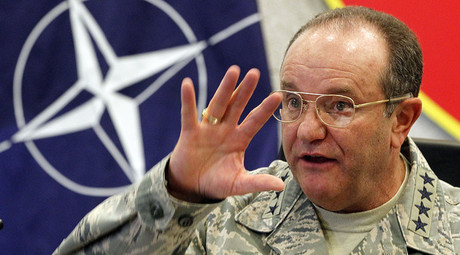
Moscow was amused by the top NATO General’s claims that it is using the refugee crisis as a “weapon” against the West, with the Defense Ministry’s spokesman saying such rhetoric reaffirms concerns of Breedlove’s apparent dislocation of memory.
In front of the Senate Armed Services Committee this week, top NATO General Philip Breedlove accused Moscow of siding with the Syrian President and deliberately fueling the displacement of Syrians.
“Together, Russia and the Assad regime are deliberately weaponizing migration in an attempt to overwhelm European structures and break European resolve,” Breedlove told the committee.
Insisting that the influx of migrants to Europe benefited Moscow, Breedlove noted that foreign militants who have been fighting in Syria are now returning back home, where they might use their battlefield skills.
Breedlove added that the alleged strategy was used by both Russian and Syrian presidents to create a distraction for the western countries that have been busy tackling the crisis and did not notice its root cause: “Indiscriminate weapons used by both Bashar al-Assad, and the non-precision use of weapons by the Russian forces.”
Russian Ministry of Defense spokesman Igor Konashenkov called the latest allegations a “recurrence” of the NATO general’s traditional rhetoric which only reaffirms concerns about Breedlove’s “memory dislocation.”
“Taking into account that such recurrence of the ‘sunshine of the spotless mind’ appeared right before the scheduled meeting of the Armed Services Committee, there is no wonder that a decision has been made by the US congressmen to replace him on his post of the Commander-in-Chief of the NATO Joint Force in Europe,” Konashenkov said.
Konashenkov once again pointed out that Moscow could not have possibly been the reason for the refugee crisis, which began long before Russia launched its anti-terror operations in Syria. And unlike the anti-ISIS coalition, Russia’s operations in Syria have alleviated the refugee crisis in the country and led to the first step of the establishment of a peace-making process, Konashenkov added.
“Essential is the fact that as a results of the Russian operation, the UN is registering the reduction of refugee flows from Syria and a process of reconciliation has been initiated, which is something the Western so-called “anti-ISIS coalition” has been unable to achieve over the previous three years of their “fight” against terrorism,” Konashenkov stated.
Responding to the “indiscriminate” and “non-precision” bombing claims, Konashenkov reminded the NATO general that precision of airstrike depends not only on smart weapons, but also on proper intelligence, pilot’s skills and aiming systems of the aircraft.
“Sole reliance on ‘supersmart’ or ‘superprecision’ weapons leads American hawks to tragic mistakes with fatal consequences, as it was repeatedly observed in Afghanistan, Iraq, and since recently – in Syria,” Konashenkov said.
President Barack Obama has announced in a rare statement that he will not follow newly passed measures aimed at boosting the Israeli economy and strengthening ties between the United States and the Jewish state, according to a statement issued by the president.
Obama stated that while he would sign the new trade resolution, portions of which focus on combatting economic boycotts of Israel, he would not enforce certain pro-Israel provisions that order the United States to stop partnering with countries that support the Boycott, Divestment, and Sanctions movement, or BDS, which aims to isolate Israel.
The president’s rejection of these provisions comes two weeks after the White House issued a separate statement expressing support for every provision of the trade bill except for those focusing on strengthening the U.S.-Israel relationship.
The Obama administration has repeatedly opposed efforts to fight the BDS movement over the past several months, with several senior officials expressing support for European efforts to explicitly label Jewish-made products produced in disputed areas of Israel.
Obama claimed in the statement that his administration does not back the BDS movement. However, he will not uphold parts of the new trade legislation that seek to combat the BDS-backed labeling of Jewish goods, which the Israeli government has described as anti-Semitic.
“Certain provisions of this Act, by conflating Israel and ‘Israeli-controlled territories,’ are contrary to longstanding bipartisan United States policy, including with regard to the treatment of settlements,” Obama said in the statement.
“Moreover, consistent with longstanding constitutional practice, my administration will interpret and implement the provisions in the Act … in a manner that does not interfere with my constitutional authority to conduct diplomacy,” Obama said, making clear he will not enforce any part of the law that he views as legitimizing Israeli settlements.
Rep. Peter Roskam (R., Ill.), who authored the pro-Israel language along with Rep. Juan Vargas (D., Calif.), criticized the administration for not upholding the will of Congress and the American people.
“This law—including the anti-BDS provisions I was proud to author—passed with overwhelming bipartisan support in both the House and the Senate,” Roskam said in a statement. “Incredibly, President Obama has already announced his intention to prioritize his misguided notions of legacy over the law of the land.”
“We did not provide a statutory menu from which President Obama can pick and choose provisions to enforce,” the lawmaker added. “The president has signed this bill into law—it is now his responsibility to fully and faithfully execute it in its entirety.”
Roskam expressed dismay that “fighting efforts to delegitimize Israel interferes with his diplomacy, but rest assured that I intend to use my authority as chairman of the Ways and Means Subcommittee.”
Congress has undertaken a series of efforts to boost the U.S.-Israel relationship following a contested debate over the Iran nuclear deal that strained relations between the two countries.
Senate lawmakers, led by Sen. Mark Kirk (R., Ill.), recently filed legislation that would help state and local governments divest taxpayer funds from companies that back the BDS movement.
The bill comes as more than 20 state governments pursue efforts to combat the BDS movement and divest from anyone who supports it.
Following a briefing requested by Russia, the UN Security Council has urged Ankara to comply with international law in Syria. The closed-door meeting was called to discuss recent Turkish shelling of Kurdish YPG militia targets in Syria’s north.
“UN Security Council members are concerned with the Turkish attacks on a number of Syrian regions,” Venezuelan Ambassador Rafael Ramirez, who now chairs the UNSC, said after the meeting, as cited by TASS.
The UN Security Council received a letter from the Syrian government in which Damascus condemned Turkey’s attacks in the north of Syria, Ramirez explained, noting that the entire council expressed “concern” about these violations.
“All members of the Security Council … agreed to ask for Turkey to comply with international law,” he added.
The UNSC also reiterated its commitment to the Munich agreement, expecting that all parties involved in the discussions will work toward a ceasefire to “allow humanitarian access for every place in the Syrian territory.”
When asked if the UNSC discussed the shelling of the hospitals and schools in Northern Syria on Monday which left close to 50 people dead, Ramirez said the Council indeed discussed the issue, but reached “no agreement” or “consensus” because of “different sources” of information on the incidents.
“Everybody is concerned about air strikes over humanitarian installations,” said Ramirez, stressing that the UNSC is trying to get “more information.”
The UNSC president highlighted the need to have Kurds represented in the Syrian peace process, and for Ankara not to escalate the situation even further.
“One of the issues expressed by some countries, including Venezuela, is that the Kurdish people have to be included in the discussion. Now that is the principle concern of Turkey,” Ramirez said during the briefing.
“Something that is important – the Kurds are fighting against the terrorist groups on the ground and this is an important factor for everybody,” Ramirez emphasized.
Turkish artillery units have been shelling targets in Syria for the fourth day in a row, as Ankara maintains its commitment to stopping the Kurdish Democratic Union Party (PYD) from claiming more territory in the north of the country. According to the Russian Ministry of Defense, both government and opposition-held towns over the border from Turkey have fallen under Ankara’s shelling.
While the Kurdish forces remain one of Washington’s main allies on the ground in Syria, Turkey being a NATO member is also a key partner in the US-led anti-ISIS coalition. The US State Department on Tuesday urged all sides to avoid escalation of tensions on the Syria-Turkey border.
“I am aware of the reports… that they [Turkish forces] have struck the YPG affiliated forces,” State Department spokesperson Mark Toner said. “We have urged the YPG to avoid moves that will heighten tensions with Turkey. But at the same time we have also urged Turkey to cease any artillery… its artillery fire across the border.”
“Russian and Syrian forces intensified their campaign on rebel-held areas around Aleppo that are still home to around 350,000 people and aid workers have said the city – Syria’s largest before the war – could soon fall.”
Can you spot what’s wrong with that quote, from a Reuters piece out today? Here’s the problem: “could soon fall” implies that Aleppo is on the verge of succumbing to enemy forces. It’s not. It’s already in enemy hands and has been for quite some time. What Reuters should have said is this: “…could soon be liberated.”
While we’ll be the first to admit that Bashar al-Assad isn’t exactly the most benevolent leader in the history of statecraft, you can bet most Syrians wish this war had never started and if you were to ask those stranded in Aleppo what their quality of life is like now, versus what it was like in 2009, we’re fairly certain you’ll discover that residents aren’t particularly enamored with life under the mishmash of rebels that now control the city.
In any event, Russia and Iran have encircled Aleppo and once it “falls” (to quote Reuters) that’s pretty much it for the opposition. Or at least for the “moderate” opposition. And the Saudis and Turks know it.
So does John Kerry, who is desperate to restart stalled peace negotiations in Geneva. The problem for the US and its regional allies is simple: if Russia and Iran wipe out the opposition on the battlefield, there’s no need for peace talks. The Assad government will have been restored and that will be that. ISIS will still be operating in the east, but that’s a problem Moscow and Tehran will solve in short order once the country’s major urban centers are secured.
As we noted on Saturday, Riyadh and Ankara are extremely concerned that the five-year-old effort to oust Assad is about to collapse and indeed, the ground troop trial balloons have already been floated both in Saudi Arabia and in Turkey. For their part, the Russians and the Iranians have indicated their willingness to discuss a ceasefire but according to John Kerry himself, the opposition is now unwilling to come to the table.
“Don’t blame me – go and blame your opposition,’” an exasperated Kerry told aid workers on the sidelines of the Syria donor conference in London this week.
America’s top diplomat also said that the country should expect another three months of bombing that would “decimate” the opposition, according to Middle East Eye who also says that Kerry left the aid workers with “the distinct impression” that the US is abandoning efforts to support rebel fighters.
In other words, Washington has come to terms with the fact that there’s only one way out of this now. It’s either go to war with Russia and Iran or admit that this particular effort to bring about regime change in the Mid-East simply isn’t salvageable.
“He said that basically, it was the opposition that didn’t want to negotiate and didn’t want a ceasefire, and they walked away,” a second aid worker told MEE.
“‘What do you want me to do? Go to war with Russia? Is that what you want?’” the aid worker said Kerry told her.
MEE also says the US has completely abandoned the idea that Assad should step down. Now, apparently, Washington just wants Assad to stop using barrel bombs so the US can “sell the story to the public.” “A third source who claims to have served as a liaison between the Syrian and American governments over the past six months said Kerry had passed the message on to Syrian President Bashar al-Assad in October that the US did not want him to be removed,” MEE says. “The source claimed that Kerry said if Assad stopped the barrel bombs, Kerry could ‘sell the story’ to the public, the source said.”
Of course Kerry won’t be able to “sell” that story to the Saudis and the Turks, or to Qatar all of whom are now weighing their oppositions as the US throws in the towel. “Kerry’s mixed messages after the collapse of the Geneva process have put more pressure on Turkey and Saudi Arabia,” MEE concludes. “Both feel extreme unease at the potential collapse of the opposition US-recognised Free Syrian Army.”
And so, as we said earlier this week, it’s do or die time for Riyadh, Ankara, and Doha. Either this proxy war morphs into a real world war in the next two weeks, or Aleppo “falls” to Assad marking a truly humiliating defeat for US foreign policy and, more importantly, for the Saudis’ goal of establishing Sunni hegemony in the Arabian Peninsula.
The only other option is for John Kerry to face the Russians in battle. As is evident from the sources quoted above, Washington clearly does not have the nerve for that.
The EU-Turkey agreement of 25 November, which provided Turkey with 3 billion euros over two years in order to stop the flow of refugees to Europe, has not achieved that goal. Speaking privately, EU officials complain that Turkey has not taken any concrete measures to reduce the flow of refugees. In our assessment, Turkey will continue to prevaricate on steps to stem the flow of refugees as pressure on the EU to give more concessions.
During the coming year there will certainly be further terrorist attacks that will push European public opinion further to the right.
We assess that Iran will continue in indirect channels with a parallel nuclear program, realized long before the 10-year target of the JCPOA.
The demand for unification of Kurdistan — Iraqi and Syrian — will also begin to be heard. It is highly likely that Russia will take advantage of the trend and support the Kurds, effectively turning an American ally into a Russian one.
The announcement by the IAEA that Iran has fulfilled its obligations according to the Joint Comprehensive Plan of Action (JCPOA) has triggered “Implementation Day” and the removal of the nuclear-related sanctions on Iran. The JCPOA, however, did not deal with Iran’s ballistic missile program, and the sanctions related to it are still nominally in force. These sanctions are minor and will not have any real effect on the Iranian missile program. The missile program will mature during this period and will include Ghadr missiles with ranges of 1,650-1,950 km, which may be capable of carrying nuclear warheads.
The question now is: whither the Iranian nuclear program? After the lifting of sanctions, and taking into account the impracticality of “snap-back” of sanctions, we assess that Iran will now initiate a parallel nuclear program. This will, of course, be far slower than the program that was dismantled by the JCPOA, but it will be realized long before the 10-year target of the JCPOA. One possibility for Iran to continue its nuclear program is through North Korea. The wording of the JCPOA is ambiguous on nuclear Iranian nuclear cooperation with other countries that are not a party to the agreement. North Korea could produce the whole chain of nuclear weapons and put it at Iran’s disposal in return for Iranian funding. North Korea would certainly profit economically from such collaboration and would not risk further sanctions. Such cooperation would be difficult to detect, and even if detected, may not reach the threshold of a material breach of the JCPOA.
The most immediate reward that Iran will receive is the release of frozen Iranian funds ($100-$150 billion). In addition, Iran may now market oil stored offshore in tankers (about 50 billion barrels) and is preparing to increase its production by 500 thousand bpd (from 2.8 million bpd). It is doubtful that Iran can truly increase its production as planned. Even if it does, the addition of Iranian oil is likely to drive prices down even further, counter-balancing much of the potential profit. Sanctions relief also is not a quick fix for the Iranian economy. While it removes legal impediments for investment and business in Iran, the risks that Western companies will face due to residual non-nuclear sanctions (that may be enhanced and enforced by a future American administration), lack of government protection, corruption, and the weakness of the Iranian market cannot be removed by decree. Therefore, European banks and investors may not hurry to invest in Iran at the levels needed to jump-start the Iranian economy after years of sanctions.
The Iranian regime’s goal is not only to block the path to the reformists or reformist-minded, but also to the extremists on the right to Supreme Leader Ali Khamenei. Such a balance could help the Iranian system maintain its “centrist” orientation and guarantee the continuity in the event of Khamenei’s death and the appointment of a new successor (or a triumvirate of several potential leaders). It will also facilitate the eventual takeover of the regime by the Islamic Revolutionary Guards Corps (IRGC) after the demise of Khamenei. The backing that the Guardian Council received from the Supreme Leader for the results of its vetting process, in the face of Rouhani’s condemnation of the disapproval of almost all reformists, is also indicative of the balance of power in the regime.
The Iranian seizure of two US Navy patrol boats on January 12 and the publication of drone pictures of a US Navy aircraft carrier underlined the sense of immunity that Iran has achieved. These actions should be seen in the context of Iran’s attempt to change the rules of the game in the Persian Gulf, while testing the waters of American tolerance and sending to Saudi Arabia and the Gulf States an indirect message that Iran is ready and willing to risk conflict with the US and that the US is a paper tiger that cannot be relied upon in a confrontation between the Gulf States and Iran. In our assessment, Iran will continue with shows of force such as seizing of naval vessels of Saudi Arabia and the Gulf States, stop and search operations of commercial vessels en route to the Gulf States, naval exercises — including missile tests close to Gulf sea-lanes and to the territorial waters of the Gulf States — in international waterways that implicitly interrupt and threaten shipping in the Gulf, “spooking” of Gulf aircraft and even false flag operations of mining, piracy or attacks by proxies in the Gulf and the Red Sea along the Yemeni coast. We may expect as a result possible frontier skirmishes on the shared littoral borders of Iran and Saudi Arabia, gas fields and disputed islands and in the international waters of the Gulf.
The Iranian seizure of two US Navy patrol boats on January 12 underlined the sense of immunity that Iran has achieved.
Saudi Arabia is drawing up its own map of interests and areas of influence that it is projecting as “no-go zones” for Iran — a Saudi “Monroe Doctrine” for the region. The most critical of these are: Yemen (due to the potential for threatening the Bab al-Mandeb Straits), subversion in the Gulf States (primarily Bahrain), the Strait of Hormuz and the international waters of the Gulf. To this list one must add the obvious: any Iranian-inspired or -planned attack on the Saudi homeland itself — government facilities, oil installations etc. — would be perceived as crossing a red line. While neither Saudi Arabia nor Iran is interested in direct conflict, and both would prefer to continue to work through proxies and in areas outside their respective sovereign territories, the dynamic nature of the situation can easily lend itself to misreading of such red lines and such miscalculation may lead to direct confrontation between them. While all-out direct war between Iran and Saudi Arabia remains a low probability, this assessment should be revisited again in the near future.
In Syria, American positions have undergone a strategic shift that reflects the new balance of power created by the Russian intervention. On the military side, the Russian presence imposes a heavy constraint on the American activities, and U.S. officials caution that the success of the Ramadi operation will not be followed by a concerted effort to roll back the “Islamic State” in the Syrian theater. In regards to a political solution, the US has accepted the Russian-Iranian four-point-plan that envisages Bashar al-Assad remaining in office during a transition period and being allowed to run for President in “internationally supervised elections”. In our assessment, the Syrian opposition and their Arab supporters cannot accept any blueprint that would leave any doubt regarding Bashar al-Assad relinquishing power before any process begins. These developments will only feed the sense of the Sunni Arabs that the United States has turned its back on them and is supporting Iranian-Russian hegemony in the region. On this background, the prospects that the Syrian “peace talks” in Geneva will achieve any progress towards resolution or even mitigation of the civil war are close to nil.
Last month’s visit by Chinese President Xi Jin Ping to Saudi Arabia, Egypt and Iran was the first such visit of a Chinese President in the region since 2002, and the first foreign head of state to visit Iran since the announcement of “Implementation Day” of the JCPOA. The Chinese emphasis in all the visits was on economic cooperation, development and stability, but above all — in an implicit stab at the US and Russia — emphasizing that China does not seek proxies, to fill a power vacuum or hegemony in the region. The leitmotif of the visit was the integration of the Middle Eastern partners (i.e. the Arabs in general and Iran) into China’s “Belt and Road Initiative.” In spite of the inclusion of Iran in the visit, President Xi took care not to offend the Arabs. The agreements with Saudi Arabia included nuclear cooperation in a scope far greater than that which was offered to Iran, and the joint statement reflected the Saudi position on Yemen, stating, “both sides stressed support for the legitimate regime of Yemen.”
The “Arab Policy Paper” published on the eve of the visit stresses China’s commitment to “non-intervention and opposition to interference in the affairs of other countries”. This is seen by the Arab policy communities as a sign of implicit Chinese support for their position vis-à-vis Iran’s activities in the region, though they would have welcomed more explicit statements of support. There is no expectation in the region that China is going to play the “Big Power” card in the region. Taking sides in this conflict would be out of character for China. Saudi Arabia and the other Arab states will attempt to convince China to refrain from demonstrations of rapprochement with Iran and to support the Arab positions vis-à-vis Iranian provocations in the Gulf, Syria and Yemen. While China may show a slight implicit leaning towards the Arab position on these issues, it is not likely to take a clear anti-Iranian/pro-Arab position in the near future.
The European Union-Turkey agreement of 25 November, which provided Turkey with 3 billion euros over two years in order to stop the flow of refugees to Europe, has not achieved that goal. Speaking privately, EU officials complain that Turkey has not taken any concrete measures to reduce the flow of refugees. In our assessment, Turkey will continue to prevaricate on steps to stem the flow of refugees as pressure on the EU to give more concessions. Turkey has already signaled that the sum will not suffice for the task of maintaining the refugees inside Turkey alone, and certainly not for other security measures such as blocking the border with Turkey to prevent passage to and fro of “Islamic State” foreign fighters.
Aside from the 3 billion euros, the EU commitments will also not be easily implemented; visa waivers for Turkish citizens in general will encounter massive opposition within the EU. The road to Turkish accession to the EU must also go through complex negotiations on various aspects of compatibility of Turkey to the standards of the EU. All these discussions will encounter a veto by Cyprus, pending a peace deal with Turkish-occupied Northern Cyprus. This veto may be resolved if a referendum on unification of Cyprus takes place and supports re-unification later this year. However, the real obstacle towards Turkish accession is not technical or due to the Cyprus question; it revolves around the shift in European public opinion towards absorption of immigrants from Muslim countries. During the coming year, there will certainly be further terrorist attacks that will push European public opinion further to the right. Under these circumstances, Turkish accession or even visa waiver will be very unlikely.
In our assessment, the trend towards Kurdish independence will eventually lead to an independent Iraqi Kurdistan. The events in Syrian Kurdistan will also affect the pace and direction of the independence movement in Iraq’s Kurdistan Regional Government (KRG). Unification of the parts of Syrian Kurdistan in the face of Turkish opposition and under Russian protection will give impetus to the demand to create a political fait accompli of independence in Iraqi Kurdistan. As the principle of Kurdish independence in Iraq gains more and more support and becomes a reality, the irredentist demand for unification of Kurdistan — Iraqi and Syrian — will also begin to be heard. This is the fulfillment of the Kurdish nightmare that Turkey has always feared. With the deterioration of relations between the AKP government and the Turkish Kurds inside Turkey, such a political reality of independent Kurdistan will add fire to the flames of the Kurdish rebellion in southern Turkey. It is highly likely that Russia will take advantage of the trend and support the Kurds, effectively turning an American ally into a Russian one. If this happens, the US will have lost an important potential ally in the new map of the Middle East.
The large number of players on the ground that may take a part in the campaign for Mosul will only complicate the campaign further and — if the city or part of it is retaken, will increase the chances of internal fighting between the components of the ad-hoc alliance of Iraqi government forces, Shiite militias, Sunni militias, Kurdish Peshmarga, Turks and American forces.
On this background, the Syrian “Peace Talks” in Geneva started (29 January) as “proximity talks” in which the UN representatives shuttle between the rooms of the opposing parties. The Saudi supported High Negotiations Committee (HNC) of the Syrian opposition ceded their original conditions — cessation of the attacks on civilians — though they refuse to meet with the regime representatives while the latter refuse to meet with “terrorists”. The Syrian regime representation is low-level as an indication that there is no intention to hold real negotiations. Furthermore, the Kurdish Democratic Union Party (PYD), whose military wing, the YPG, is the most effective fighting force on the ground against the “Islamic State,” were not included in the opposition delegation because of the Turkish threat to boycott the Geneva negotiations if it participates. Under these conditions, the prospects that the talks will achieve any progress towards resolution or even mitigation of the civil war are close to nil.
Dr. Shmuel Bar is a senior research fellow at Israel’s Institute for Policy and Strategy at the Interdisciplinary Center Herzliya in Israel and a veteran of Israel’s intelligence community.
MOSCOW, February 4. /TASS/. Russian Foreign Minister Sergey Lavrov and his US counterpart John Kerry in a phone conversation on Thursday confirmed plans to hold a meeting of the International Syria Support Group (ISSG) in Munich on February 11, Russia’s Foreign Ministry has said.
“The agreement was also confirmed on holding another ministerial meeting of the International Syria Support Group in Munich on February 11,” the ministry said. The sides will consider “all the aspects of the Syrian settlement in line with the UN Security Council resolution 2254.” Lavrov and Kerry also agreed to take steps to minimize the pause in the intra-Syrian talks.
The talks in Switzerland’s Geneva were suspended on Wednesday until February 25, UN special envoy for Syria Staffan de Mistura said. “While expressing common regret over the fact that the UN-brokered intra-Syrian dialogue has been temporarily suspended, Lavrov and Kerry agreed to make necessary efforts to ensure that this pause is as short as possible,” the ministry said. Read also Moscow regrets Syria talks paused, but no one expected everything to be smooth — Kremlin Syrian internal opposition says it has legitimate right to take part in talks Russia hopes Syrian Support Group will put no obstacles to intra-Syrian talks — FM Deputy UN envoy: Syria peace talks suspended until 25 February
The Russian side has voiced concerns as some representatives of the Syrian opposition set unacceptable preconditions to establish sustained negotiations with the government of Syria. Moscow also called on the United States and its allies to remain committed to the provisions of the UN Security Council resolution 2254 adopted on December 18 that endorsed a road map for peace process in Syria. Lavrov and Kerry “stated the need for urgent steps both of the Syrian government and the opposition in order to ensure humanitarian access under the UN auspices to the areas of the country blocked both by the government forces and the armed opposition units,” the ministry said.
The Russian and US top diplomats agreed on “possible coordinated actions on delivering humanitarian aid to the certain areas of Syria by air with the use of means of military-transport aviation,” it said.
(The views expressed in this post are mine and do not necessarily reflect those of Warsclerotic or any of its other editors. — DM)
President Obama claimed to be the most open and transparent president ever but did not follow through. During her term as Secretary of State, Hillary Clinton showed her persistent openness and transparency to friend and foe alike.
Right.
Hillary demonstrated her openness and transparency to the entire world — friend and foe alike — through her use of an unsecured home-brew server for e-mails containing classified national security information. As of late December, more than 1,200 e-mails found on Hillary’s server had been deemed classified. More continued to be found.
That indicates a level of classification beyond even “top secret,” the label previously given to two emails found on her server, and brings even more scrutiny to the presidential candidate’s handling of the government’s closely held secrets.
As of January 29th, at least twenty-two of the most recently discovered e-mails were top secret and contained such damaging information that not even redacted copies can be released to members of the Congress.
With such undiscriminating openness to our enemies, Hillary demonstrated unprecedented impartiality. By doing so, she helped to dispel vicious rumors that America helps only its few remaining friends. The State Department, now under the direction of John Kerry, was unwilling to extend the same courtesy to the Congress, doubtless a greater enemy than any foreign nation. This may have been hard for him to do. But then, sometimes it’s hard to be John Kerry.
Hillary’s principal opponent in the race for the Democrat presidential nomination, Bernie Sanders, merely says that to be true socialists we must share everything. Hillary does more than talk; she shares.
A vote for Hillary is a vote for openness. Due to her exceptional devotion to non-discriminatory transparency, our enemies will love us even more, perhaps even until death do us part.
Among the many way one can get a waiver is an exception for individuals who traveled to Iran “for legitimate business-related purposes” after the nuclear deal was signed.
So the new restrictions made Kerry’s new best pals in Iran angry, and they strong-armed us, and the administration gave them what they wanted. Great.
************************
Less than two months after the terror attacks in San Bernardino, which involved one terrorist who was here on a visa waiver, President Obama has made it easier to travel to the United States from terror hotspots around the globe.
The revised requirements announced Thursday pertain to changes passed by Congress in the Visa Waiver Program.
Lawmakers had sought new restrictions to tighten up the program – which allows visa-free travel for residents of eligible countries — in order to prevent Europeans who have joined ISIS from entering the United States. Under the newly passed Visa Waiver Improvement and Terrorist Travel Prevention Act of 2015, nationals of Iraq, Iran, Syria and Sudan as well as other travelers who have visited those countries since Mar. 1, 2011 now must apply for a visa in order to travel to the U.S.
The administration implemented those changes Thursday — but with some changes of its own.
The changes are that they are making it easier to get waivers. Waiver meaning you won’t need a new visa to enter this country, even if you came by way of ISIS zones, as long as you meet certain criteria.
Among the many way one can get a waiver is an exception for individuals who traveled to Iran “for legitimate business-related purposes” after the nuclear deal was signed.
House Judiciary Committee Chair Bob Goodlatte decried the move, saying “The Obama Administration is essentially rewriting the law by blowing wide open a small window of discretion that Congress gave it for law enforcement and national security reasons,” according to Fox News.
ISIS and other terror groups rely heavily on their unconventional and diffuse pool of resources and recruits. This is why the “lone wolf” definition of terror is sorely in need of update. That they will take advantage of this easing of the rules is hardly speculative. Nor would it be difficult. It’s another example of the Obama administration playing politics with American security.
Which politics?
The new restrictions had previously been criticized by the Iranian government which suggested the U.S. might be violating the nuclear deal by penalizing legitimate business travel to the country.
So the new restrictions made Kerry’s new best pals in Iran angry, and they strong-armed us, and the administration gave them what they wanted. Great.
(The views expressed in this article are mine and do not necessarily reflect those of Warsclerotic or its other editors. — DM)
Obama keeps telling us what America isnot. What does He think she is? Does He think that Obama’s America is America, or that His supporters are what America is? Does He think they make America great? Will America become acceptable to Obama, and hence “who we are,” only after He or His successor finishes her fundamental transformation?
By virtue of the now-implemented Iran nuke “deal,” Iran’s possession of an atomic and/or hydrogen bomb will be delayed for a few years unless she cheats (as in the past), reneges on the “deal” or out-sources nuke development to her long term partner, North Korea.
The Islamic Republic of Iran is now reaping the benefits of more than $100 billion in immediate sanctions relief plus a settlement of Iranian claims amounting to $1.7 billion.
Secretary of State John Kerry said today that the settlement is $400 million debt and $1.3 billion in interest dating back to the Islamic revolution. That’s separate from the sanctions windfall Iran will receive.
Iran will also benefit on a long-term basis from trade with countries formerly prohibited by sanctions.
Back in June 2015, Supreme Leader of the Islamic Revolution Ayatollah Seyed Ali Khamenei had outlined the general policies of the country’s 6th quinquennial development plan.
On defense and security, the proclamation necessitated an increase in Iran’s defense capabilities at the level of a regional power in order to fulfill the national interests by allocating at least 5 percent of the national budget to boosting the defense power. [Emphasis added.]
With increased funding, Iran will be able to increase its already substantial support for Shiite terrorism throughout the Middle East; it will likely do so.
Iranians continue to experience Islamic human rights. Here’s a link to an article titled The Real War on Women in a Nightmarish Islamic Stateby Dr. Majid Rafizadeh. An Iranian-American political scientist and scholar, he is the president of the International American Council and serves on the board of the Harvard International Review at Harvard University.
When it comes to executions, girls are systematically more vulnerable due to the Islamist penal code of Sharia law.
Let’s take a look at the Islamist state of Iran, which creates its laws from the legal codes of Sharia and Quran. The first type of discrimination is related to age: girls are held criminally accountable at the maturity age of 9 Lunar years. (This will automatically put girls at a higher risk of execution by the court.)
Iranian ruling politicians hold the highest record when it comes to the most executions per capita in the world. Intriguingly, in the last two years that the so-called moderate, Hassan Rouhani, has been in office, there have been more than 2000 executions conducted in Iran. That is nearly 3-4 executions a day.
More importantly, Iranian leaders are also the largest executioner of women and female juveniles. Some of these executions were carried out on the mullahs’ charge of ‘Moharebeh’ (enmity with Allah), or waging war against Allah, ifsad-i Fil Arz (Sowing Corruption on Earth), or Sab-i Nabi (Insulting the Prophet). [Emphasis added.]
There are three methods of execution for women and female juveniles: 1. Stoning 2. Public hanging 3. Shooting. Some women are also beaten so severely in the prison that they die before reaching the execution. Shooting, which is the fastest method of the three for execution, has not been used since 2008. Instead, the most common method to execute women is public hanging or stoning. Some of these women are flogged right before they are hanged. Public hanging not only imposes fears in the society but also aims at dehumanizing and controlling women as second-class citizens. According to the Islamist penal code of Iran, women offenses are classified as: Hadd, Diyyih, Ta`zir, and Qisas. [Emphasis added.]
Please read the entire article. Isn’t it heartwarming that “we” are giving even more than a mere $100 billion to Iran? Perhaps some of the new money can be used to buy sharper stones and new devices for hangings. How about some new torture devices?
Islam, The Muslim Brotherhood and its affiliates
The Muslim Brotherhood and Hamas-affiliated Council of American-Islamic Relations (CAIR) claims to represent Muslims in America. They do represent those who favor terrorism and despise human rights (in the name of which they ironically claim to act).
[T]he Council on American-Islamic Relations, is a prominent Islamic group, but which has a long history of involvement with extremist and terrorist causes. In 2009, during the Holy Land Foundation terror financing trial, U.S. District Court Judge Jorge Solis concluded that, “The government has produced ample evidence to establish the associations of CAIR… with the Islamic Association for Palestine, and with Hamas.” [Emphasis added.]
During the trial, CAIR was designated an “unindicted co-conspirator.” As a result of CAIR’s apparent links to a terrorist movement, the Justice Department in 2009 announced a ban on working with CAIR. The FBI also severed relations.
[F]or the past seven years, the Obama White House has opened its doors to the entire spectrum of radical Islamist groups, just like CAIR. These groups have rationalized the actions of Islamic terrorist groups that have killed Americans, warned American Muslims against cooperating with law enforcement, smeared genuine Muslim moderates like Zuhdi Jasser and Asra Nomani as traitors and accused anyone who dared to utter the term “radical Islam” as “Islamophobic.” These are the groups that the White House should have marginalized. The fact that Obama legitimized radical Islamist groups will be his real legacy. [Emphasis added.]
Very few American Muslims, however, seem to feel that CAIR is a legitimate ambassador for American Islam. According to a 2011 Gallup poll, about 88% of American Muslims said that CAIR does not represent them. Muslims all over the world, in fact, apparently do not think CAIR is a moderate or legitimate Muslim group: in 2014, the United Arab Emirates, a pious Muslim state, designated CAIR a terrorist organization, along with dozens of other Muslim Brotherhood organizations.
In reality, American Muslims are extremely diverse, and no single group can claim to speak on their collective behalf. American Islam comprises dozens of different religious sects and political movements, many of which advocate distinctly different ideas. But for Islamist bodies such as CAIR, it suits their agenda if American Muslims are portrayed as a monolithic community. If American Muslims can be seen as homogenous, then a group such as CAIR has a better claim to represent their interests.
Even CAIR’s own research, however, undermines their claim to speak on behalf of American Muslims. A 2011 report reveals that a majority of American mosques are not affiliated with any American Islamic body.
Addressing a conference in 2000, Sheikh Abdul Hadi Palazzi, a Muslim cleric and secretary general of the Italian Muslim Assembly, explained that, “[CAIR] is a Muslim Brotherhood front organization. It works in the United States as a lobby against radio, television and print media journalists who dare to produce anything about Islam that is at variance with their fundamental agenda. CAIR opposes diversity in Islam.”
In truth, CAIR only speaks on behalf of a small extremist ideology that, as discovered by federal prosecutors, emerged across the United States during the 1990s out of the Muslim Brotherhood and Hamas. Although CAIR does not represent American Muslims, it managed, before the Holy Land Foundation terror trial in 2008, to persuade a great many people that it did. Enough time has passed that CAIR seems to believe it can try this move once again.
state that Congress believes the Muslim Brotherhood fits the State Department’s criteria of a Foreign Terrorist Organization. The Secretary of State would be required to designate the Brotherhood within 60 days or to provide a detailed report explaining why it does not. Three U.S.-based Brotherhood entities named in the bill are CAIR, the Islamic Society of North America (ISNA) and the North American Islamic Trust (NAIT). [Emphasis added.]
The House version of the bill (HR3892) was introduced by Rep. Mario Diaz-Balart (R-FL) with Reps. Louie Gohmert (R-TX), Randy K. Weber (R-TX), Diane Black (R-TN) and Mike Pompeo (R-KS) as original cosponsors. They are now joined by Reps. Steve King (R-IA); Steven Palazzo (R-MS); Kay Granger (R-TX); Jim Jordan (R-OH); Steve Stivers (R-OH); Dana Rohrabacher (R-CA); Ilena Ros-Lehtinen (R-FL); Charles W. Dent (R-PA); Bill Johnson (R-OH) and David A. Trott (R-MI).
HR3892 was referred to the Judiciary Committee’s Subcommittee on Immigration and Border Security on December 4, 2015. Two cosponsors, Rep. Gohmert and Rep. Trott, sit on that subcommittee.
The Senate version of the bill (S2230) was introduced by presidential candidate Senator Ted Cruz (R-TX) and later cosponsored by Senator Orrin Hatch (R-UT). It was referred to the Senate Foreign Relations Committee on November 3. Two of Senator Cruz’s presidential rivals, Senator Marco Rubio (R-FL) and Senator Rand Paul (R-KY) sit on that committee and have not taken a position on the bill.
Although the bill has yet to earn bi-partisan support at this early stage, it is supported by members of Congress from different spectrums of the Republican Party. It includes endorsers of the presidential campaigns of Marco Rubio, Jeb Bush and John Kasich and not only supporters of Ted Cruz.
If enacted by the Congress, Obama will almost certainly veto it. If He signs it, He will ignore or bypass it as He often does.
Britain recently declared the Muslim Brotherhood a terrorist organization. Here are thirteen quotes from the British Government’s review and Prime Minister Cameron’s official statement:
1. “The Muslim Brotherhood’s foundational texts call for the progressive moral purification of individuals and Muslim societies and their eventual political unification in a Caliphate under Sharia law. To this day the Muslim Brotherhood characterizes Western societies and liberal Muslims as decadent and immoral. It can be seen primarily as a political project.”
2. “Aspects of Muslim Brotherhood ideology and tactics, in this country and overseas, are contrary to our values and have been contrary to our national interests and our national security.”
3. “From its foundation the Muslim Brotherhood organized itself into a secretive ‘cell’ structure, with an elaborate induction and education program for new members…This clandestine, centralized and hierarchical structure persists to this day.”
4. “The Hamas founding charter claims that they are the Palestinian branch of the Muslim Brotherhood and the Muslim Brotherhood treat them as such. In the past ten years support for Hamas (including in particular funding) has been an important priority for the MB in Egypt and the MB international network.”
5. “From at least the 1950s the Egyptian Muslim Brotherhood also developed an international network, within and beyond the Islamic world. Europe became an important base for the growing Muslim Brotherhood global network.”
6. “The wider international network of the Muslim Brotherhood now performs a range of functions. It promotes Muslim Brotherhood ideology (including through communications platforms), raises and invests funds, and provides a haven for members of the Brotherhood who have left their country of origin to continue promoting Brotherhood activity.”
7. “[F]or the most part, the Muslim Brotherhood have preferred non violent incremental change on the grounds of expediency, often on the basis that political opposition will disappear when the process of Islamization is complete. But they are prepared to countenance violence—including, from time to time, terrorism—where gradualism is ineffective.”
8. “Muslim Brotherhood organizations and associated in the UK have neither openly nor consistently refuted the literature of Brotherhood member Sayyid Qutb which is known to have inspired people (including in this country) to engage in terrorism.”
9. “[The review] concluded that it was not possible to reconcile these [MB] views with the claim made by the Egyptian Muslim Brotherhood in their evidence to the review that ‘the Muslim Brotherhood has consistently adhered to peaceful means of opposition, renouncing all forms of violence throughout its existence.’”
10. “In the 1990s the Muslim Brotherhood and their associates established public facing and apparently national organizations in the UK to promote their views. None were openly identified with the Muslim Brotherhood and membership of the Muslim Brotherhood remained (and still remains) a secret.”
11. “[MB fronts] became politically active, notably in connection with Palestine and Iraq, and promoted candidates in national and local elections…sought and obtained a dialogue with Government….were active members in a security dialogue with the police.”
12. “The Muslim Brotherhood have been publicly committed to political engagement in this country. Engagement with Government has at times been facilitated by what appeared to be a common agenda against al Qaida and (at least in the UK) militant Salafism. But this engagement did not take into account of Muslim Brotherhood support for a proscribed terrorist group and its views about terrorism which, in reality, are quite different from our own.”
13. “Senior Muslim Brotherhood figures and associated have justified attacks against coalition forces in Iraq and Afghanistan.”
The linked article goes on to note that
The U.S. government, without even conducting any kind of review of its own, issued a statement to the Investigative Project on Terrorism rejecting any ban or even any “de-legitimizing” of the Brotherhood at all. [Emphasis added.]
Do the Muslim Brotherhood and its affiliates represent Obama? Are they or Obama “what we are?” I don’t think so and hope not.
Ayaan Hirsi Ali and reformation of Islam
In Heretic (which I reviewed here), Ayaan Hirsi Ali wrote,
For years, we have spent trillions on waging wars against “terror” and “extremism” that would have been much better spent protecting Muslim dissidents and giving them the necessary platforms and resources to counter that vast network of Islamic centers, madrassas, and mosques which has been largely responsible for spreading the most noxious forms of Islamic fundamentalism. For years, we have treated the people financing that vast network — the Saudis, the Qataris, and the now repentant Emiratis — as our allies. In the midst of all our efforts at policing, surveillance, and even military action, we in the West have not bothered to develop an effective counternarrative because from the outset we have denied that Islamic extremism is in any way related to Islam. We persist in focusing on the violence and not on the ideas that give rise to it. [Emphasis added.]
Here is a video of which Hirsi Ali was the executive producer. It features Muslim and former-Muslim women discussing Islam and the Islam-mandated male domination of women.
Here’s Part II of Honor Diaries:
Here’s a video characterizing Hirsi Ali as an “Islamophobe.”
Along with the Council on American-Islamic Relations (CAIR), Azeezah Kanji — the featured speaker in the above video — has been very active in disparaging Hirsi Ali and Honor Diaries. Like CAIR, she has ties to the Obama White House and was named a “Champion of Change” by the White House in 2011. What changes in Islam does Ms. Kanji champion? None, apparently, of those intrinsic to it.
Ibrahim Hooper, a spokesman for the CAIR, condemned Hirsi Ali as “one of the worst of the worst of the Islam haters in America, not only in America but worldwide.”
On becoming a U.S. Citizen
Who better represents American values? Hirsi Ali, once a refugee from Somalia and a proud citizen of the United States since April 25, 2013, or President Obama? In the immediately linked Wall Street Journal article, she offers suggestions on American immigration with which I plan to deal in a subsequent post. In the meantime, here is her 2014 address at the William F. Buckley Program at Yale University on the clash of civilizations. If you have not yet watched it, please do so. If you have watched it, please do so again. I just did. Every time I watch it, there is something I had not previously considered.
Conclusions
To Obama and His acolytes, Islam is the religion of peace and tolerance; the Islamic State, its equally non-peaceful and intolerant franchisees and other comparable terrorist organizations are “not Islamic.” If “not Islamic,” what are they?
Despite Obama’s many statements and gestures, He has yet to convince any Islamic terrorist group that it is not Islamic. He has convinced them only that He is ignorant of Islam, a liar or both. Perhaps He needs a better joke writer.
was very striking for the one-sidedness and disproportion of the president’s concern for religious suffering.
President Obama worried that “politicians insult Muslims, whether abroad or fellow citizens.”
But he couldn’t bring himself to worry aloud about the Christians being driven from Middle Eastern countries, the churches being burned from Nigeria to Malaysia, or the 22 Coptic Christians who were beheaded on video on a beach in Libya by Islamic supremacists.
Will our next president at least make a concerted effort to un-transform Obama’s America? Will he name and fight our enemies, foreign and domestic? Or will he simply “go with the flow” and do none of the above. Much depends on who it is and on the composition of the Congress.
During the Democrat Party debate on January 17th, Hillary Clinton “linked herself to the president again and again. And again.” An Obama clone to continue Obama’s fundamental transformation of America is the opposite of what we need. Nor will merely “fixing” broken parts of the governmental apparatus with duct tape and bailing wire be satisfactory. As I wrote last September, To bring America back we need to break some stuff.
In later posts in this series, I hope to deal with immigration, race relations, the ways in which Obama is distorting the Constitution, the decline of education and Obama’s very foreign foreign policy.




 The Iranian seizure of two US Navy patrol boats on January 12 underlined the sense of immunity that Iran has achieved.






 anneinpt
 artaxes
 danmillerinpanama
 davidking1530
 Peter Hofman
 Joseph Wouk
 Peter
Peter Louisiana Steve
 WarSclerotic

Recent Comments