Posted tagged ‘Trump and refugees’
10 Points You Won’t Hear About Trump’s Revised Travel Restrictions
March 7, 201710 Points You Won’t Hear About Trump’s Revised Travel Restrictions, Clarion Project, RYAN MAURO, March 7, 2017
(Please see also, Unsatisfied Critics of Trump Immigration Order: This is ‘Muslim Ban 2.0’ for a catalog of the groups opposing the new executive order and the alleged bases for their opposition. The text of the executive order is available here.– DM)
 Syrian refugees arrive in the U.S. after spending five years in a refugee camp in Turkey (Illustrative Photo: Scott Olson/Getty Images)
President Trump has issued an executive order modifying his controversial travel restrictions which have been incorrectly derided as a “Muslim ban.”
Of course, despite major changes, groups like the Council on American-Islamic Relations (CAIR) are still calling it a “Muslim ban” and are committed to retaining the issue’s divisiveness so they can endlessly bash Trump as a bigot and raise their own profile in the process.
“This executive order, like the last order, is at its core a Muslim ban, which is discriminatory and unconstitutional,” said the executive-director of CAIR, Nihad Awad, who nonetheless touted the revisions as a “partial victory.”
Below are 10 points about the revised executive order that you’re unlikely to hear from media outlets and politically-driven organizations who have are dependent upon continued controversy:
1. As previously, it is not a “Muslim ban.”
As explained by Clarion Project advisory board member and leader of the Council for Muslims Facing Tomorrow in this video (see below), the restrictions are based on an intersection of geography and security risks. They are limited to 6 of 50 Muslim-majority countries and impact non-Muslims as well. And, just as before, the restrictions are a pause rather than a ban.
The order is for between 90 to 120 days, depending on whether the person is a visitor or a refugee. As we’ll discuss, the exceptions are so wide that even describing this order as a “pause” is a bit of an overstatement.
2. Iraq is removed from the list, bringing the list of impacted countries down to 5.
Including Iraq (and especially the autonomous Iraqi Kurdistan) was a mistake from the beginning. That is now fixed. The executive order implies that this change is due to the fact that the Iraqi government agreed to improved intelligence-gathering and security measures.
Those conversations with the Iraqis obviously took place after the initial executive order, which shows the Trump Administration can be influenced by constructive criticism.
3. The executive order justifies the inclusion of the other five countries.
The order explains why the president chose these five countries, which is a scaling back of Trump’s campaign pledge to ban immigration from all terror-prone countries (which in itself is a scaling back of his initial pledge to ban all Muslim immigration).
Iran, Syria and Sudan are designated as State Sponsors of Terrorism and the former two are explicit enemies of the U.S. Libya and Yemen are failed states with inadequate counter-terrorism abilities and so much chaos that the U.S. doesn’t even have operating embassies in these locations. Somalia is similarly unstable and contains a major Al-Qaeda foothold. In addition, the Somali community in the U.S. is known for its high rate of radicalism.
4. The five countries were chosen based on the Obama Administration’s determination.
The executive order explains that these five countries were selected based on the Obama Administration considering them to be “countries of particular concern” that could not participate in the visa waiver program.
It was the Obama Administration that stated that persons coming to the U.S. from these countries pose a greater security risk than those from other countries. Everyone who argues that there’s no reason to treat these countries as unique risks is arguing with Trump and Obama. Where were the condemnations of President Obama’s “Islamophobia” for identifying these Muslim-majority countries as posing a special danger?
5. Three hundred refugees are currently under FBI investigation.
It is true that refugees undergo a lengthy screening process, unlike typical visa applicants. Opponents of the travel restrictions point to how only a small percentage of refugees have been convicted of terrorism-related offenses. The Senate Judiciary Committee said only about 40 had been convicted, representing about 7 percent of the total of 580 since the 9/11 attacks.
The executive order points out that 300 people who were admitted into the U.S. as refugees are now under FBI counter-terrorism investigations; a much higher number than the previous figures used for gauging the risk.
However, in fairness, a Department of Homeland Security report says most refugees who become terrorists are radicalized years after arriving in the U.S., so we don’t know if this figure necessarily proves there’s a major gap in the refugee vetting process. We also don’t know how many of the 300 refugees are from the five affected countries.
6. There is a 10-day advance notice.
The previous executive order went into effect immediately, catching airlines and governments off-guard. This one goes into effect in 10 days, giving time for preparation.
7. The new executive order explicitly does not apply to current visa and green card holders.
Permanent residents and current visa-holders are not affected this time. The original executive order’s unclear language has been fixed.
8. Syrian refugees are no longer singled out.
The original executive order suspended refugee admission for 120 days but singled out Syrian refugees for indefinite exclusion “until such time” that the government determines that they can be safely admitted. The singling out was unnecessary, as that’s the same standard for allowing refugees from other places, but the original language emphasized that Trump was delivering on a campaign promise to reject Syrian refugees.
That language is no longer. A refugee of Syrian nationality is not viewed as inherently more objectionable than a refugee of another nationality.
9. There are very wide exceptions.
This executive order uses clearer language to allow for major exceptions even within the 120-day refugee pause and the 90-day pause on visitors from the five countries.
Far from a wholesale treatment, it emphasizes that each applicant will be handled on a “case-by-case basis” in case they qualify for a waiver. There are waivers for when the applicant’s entry into the U.S. is in our “national interest” or rejection of the person would cause them “undue hardship.”
The order gives various examples of what qualifies as “undue hardship,” for example people who have worked in the U.S. and are seeking re-entry; those coming to reside with a family member; those with a significant network of contacts in the U.S.; those with business or professional obligations here; children; those in need of medical attention; those previously or currently employed by the U.S. government, and other situations where rejection would cause an “undue hardship.”
These are the reasons most people from these countries are coming to the U.S. How many other situations are left where a waiver isn’t suitable?
Of course, some biased critics aren’t paying attention to these very important facts. Right after the executive order was released, Grace Meng of Human Rights Watch was uncritically quoted in an article on Politico as saying that the new executive order is “going to harm people fleeing gender-based violence” like women trying to escape rapists.
Actually, such women would obviously qualify for the “undue hardship” exception. But readers of that article wouldn’t know that because Politico unquestionably posted her quote.
10. The type of vetting that is being proposed is in alignment with the Founding Fathers’ opinions on immigration.
Joshua Charles, an expert on the Founding Fathers, collected some of the founders’ most insightful quotes on immigration in an article he wrote in January. They explained the U.S. is more than a piece of land with opportunities for wealth. Rather, it is a country held together by foundational beliefs that are unique and not inherently understood and embraced by all persons upon birth.
The executive orders emphasize improving the overall vetting process to screen for hostile ideologies. It’s not just about discovering covert terrorists and criminals; it’s about separating those who support the U.S.’ secular-democratic values from those views are incompatible with that, such as (but not limited to) Islamist extremists.
Opponents of Trump and this policy have a choice to make: They can emphasize (or lie about) the parts they continue to disagree with, elongating a cycle of divisiveness, or they pair their criticism with positive reinforcement that acknowledges the improvements that have been made.
Decreasing the sound of the alarm is not in the best interest of hyper-partisan commentators or Islamist activists like CAIR who are enjoying the limelight and seeking increased donations, but it is in the best interest of the country.
Trump signs new travel ban that excludes Iraqis, legal residents and visa holders
March 6, 2017(The full text of the executive order is provided following the article linked above. — DM)
President Trump on Monday signed a revised version of his executive order on travel that excludes Iraqi citizens, legal permanent residents and existing visa holders from a list of foreign nationals who will be prohibited from entering the U.S. for the next 90 days beginning on March 16.
According to administration officials, the newest version of Trump’s controversial travel ban still places a hold on refugee admissions for 120 days and halts immigration from Sudan, Syria, Libya, Yemen, Iran and Somalia. All six countries were previously identified as “countries of concern” with respect to terrorism by Congress and the Obama administration, something the Justice Department has mentioned repeatedly while arguing the merits of the original order.
The new order comes nearly one month after the administration hurried its rollout of a travel ban that included these six countries plus Iraq and suspended the Syrian refugee program indefinitely. In the first 20 days after the order goes into effect, Homeland Security officials have been asked to conduct a country-by-country review of the criteria and information that each country uses and provides to the U.S. when determining who might be eligible for a visa or other immigration benefits. DHS officials will submit requests to all six countries upon conclusion of their reviews, giving each foreign government 50 days to comply.
Together with the Director of National Intelligence and Justice Department officials, DHS will be tasked with developing more rigorous screening measures that all prospective immigrants will be subject to before they are granted entry into the U.S. The order leaves the door open for the State Department and DHS to admit certain individuals from the six countries affected, or refugees, on a case-by-case basis.
In response to critics who claim the administration has been reluctant to provide details on its immigration policies, the new order sets a requirement that DHS make information available every 180 days regarding the number of foreign nationals who have been linked to terrorism-related crimes while residing in the U.S. or removed from the country for terrorism-related activity.
White House spokesman Sean Spicer told reporters last week that the administration will continue to argue the legality of its initial executive order on immigration, which was blocked from being implemented by a three-judge appellate court panel in San Francisco last month.
March 6, 2017
EXECUTIVE ORDER
– – – – – – –
PROTECTING THE NATION FROM FOREIGN TERRORIST ENTRY INTO THE UNITED STATES
By the authority vested in me as President by the Constitution and the laws of the United States of America, including the Immigration and Nationality Act (INA), 8 U.S.C. 1101 et seq., and section 301 of title 3, United States Code, and to protect the Nation from terrorist activities by foreign nationals admitted to the United States, it is hereby ordered as follows:
Section 1. Policy and Purpose. (a) It is the policy of the United States to protect its citizens from terrorist attacks, including those committed by foreign nationals. The screening and vetting protocols and procedures associated with the visa-issuance process and the United States Refugee Admissions Program (USRAP) play a crucial role in detecting foreign nationals who may commit, aid, or support acts of terrorism and in preventing those individuals from entering the United States. It is therefore the policy of the United States to improve the screening and vetting protocols and procedures associated with the visa-issuance process and the USRAP.
(b) On January 27, 2017, to implement this policy, I issued Executive Order 13769 (Protecting the Nation from Foreign Terrorist Entry into the United States).
(i) Among other actions, Executive Order 13769 suspended for 90 days the entry of certain aliens from seven countries: Iran, Iraq, Libya, Somalia, Sudan, Syria, and Yemen. These are countries that had already been identified as presenting heightened concerns about terrorism and travel to the United States. Specifically, the suspension applied to countries referred to in, or designated under, section 217(a)(12) of the INA, 8 U.S.C. 1187(a)(12), in which Congress restricted use of the Visa Waiver Program for nationals of, and aliens recently present in, (A) Iraq or Syria, (B) any country designated by the Secretary of State as a state sponsor of terrorism (currently Iran, Syria, and Sudan), and (C) any other country designated as a country of concern by the Secretary of Homeland Security, in consultation with the Secretary of State and the Director of National Intelligence. In 2016, the Secretary of Homeland Security designated Libya, Somalia, and Yemen as additional countries of concern for travel purposes, based on consideration of three statutory factors related to terrorism and national security: “(I) whether the presence of an alien in the country or area increases the likelihood that the alien is a credible threat to the national security of the United States; (II) whether a foreign terrorist organization has a significant presence in the country or area; and (III) whether the country or area is a safe haven for terrorists.” 8 U.S.C. 1187(a)(12)(D)(ii). Additionally, Members of Congress have expressed concerns about screening and vetting procedures following recent terrorist attacks in this country and in Europe.
(ii) In ordering the temporary suspension of entry described in subsection (b)(i) of this section, I exercised my authority under Article II of the Constitution and under section 212(f) of the INA, which provides in relevant part: “Whenever the President finds that the entry of any aliens or of any class of aliens into the United States would be detrimental to the interests of the United States, he may by proclamation, and for such period as he shall deem necessary, suspend the entry of all aliens or any class of aliens as immigrants or nonimmigrants, or impose on the entry of aliens any restrictions he may deem to be appropriate.” 8 U.S.C. 1182(f). Under these authorities, I determined that, for a brief period of 90 days, while existing screening and vetting procedures were under review, the entry into the United States of certain aliens from the seven identified countries — each afflicted by terrorism in a manner that compromised the ability of the United States to rely on normal decision-making procedures about travel to the United States — would be detrimental to the interests of the United States. Nonetheless, I permitted the Secretary of State and the Secretary of Homeland Security to grant case-by-case waivers when they determined that it was in the national interest to do so.
(iii) Executive Order 13769 also suspended the USRAP for 120 days. Terrorist groups have sought to infiltrate several nations through refugee programs. Accordingly, I temporarily suspended the USRAP pending a review of our procedures for screening and vetting refugees. Nonetheless, I permitted the Secretary of State and the Secretary of Homeland Security to jointly grant case-by-case waivers when they determined that it was in the national interest to do so.
(iv) Executive Order 13769 did not provide a basis for discriminating for or against members of any particular religion. While that order allowed for prioritization of refugee claims from members of persecuted religious minority groups, that priority applied to refugees from every nation, including those in which Islam is a minority religion, and it applied to minority sects within a religion. That order was not motivated by animus toward any religion, but was instead intended to protect the ability of religious minorities — whoever they are and wherever they reside — to avail themselves of the USRAP in light of their particular challenges and circumstances.
(c) The implementation of Executive Order 13769 has been delayed by litigation. Most significantly, enforcement of critical provisions of that order has been temporarily halted by court orders that apply nationwide and extend even to foreign nationals with no prior or substantial connection to the United States. On February 9, 2017, the United States Court of Appeals for the Ninth Circuit declined to stay or narrow one such order pending the outcome of further judicial proceedings, while noting that the “political branches are far better equipped to make appropriate distinctions” about who should be covered by a suspension of entry or of refugee admissions.
(d) Nationals from the countries previously identified under section 217(a)(12) of the INA warrant additional scrutiny in connection with our immigration policies because the conditions in these countries present heightened threats. Each of these countries is a state sponsor of terrorism, has been significantly compromised by terrorist organizations, or contains active conflict zones. Any of these circumstances diminishes the foreign government’s willingness or ability to share or validate important information about individuals seeking to travel to the United States. Moreover, the significant presence in each of these countries of terrorist organizations, their members, and others exposed to those organizations increases the chance that conditions will be exploited to enable terrorist operatives or sympathizers to travel to the United States. Finally, once foreign nationals from these countries are admitted to the United States, it is often difficult to remove them, because many of these countries typically delay issuing, or refuse to issue, travel documents.
(e) The following are brief descriptions, taken in part from the Department of State’s Country Reports on Terrorism 2015 (June 2016), of some of the conditions in six of the previously designated countries that demonstrate why their nationals continue to present heightened risks to the security of the United States:
(i) Iran. Iran has been designated as a state sponsor of terrorism since 1984 and continues to support various terrorist groups, including Hizballah, Hamas, and terrorist groups in Iraq. Iran has also been linked to support for al-Qa’ida and has permitted al-Qa’ida to transport funds and fighters through Iran to Syria and South Asia. Iran does not cooperate with the United States in counterterrorism efforts.
(ii) Libya. Libya is an active combat zone, with hostilities between the internationally recognized government and its rivals. In many parts of the country, security and law enforcement functions are provided by armed militias rather than state institutions. Violent extremist groups, including the Islamic State of Iraq and Syria (ISIS), have exploited these conditions to expand their presence in the country. The Libyan government provides some cooperation with the United States’ counterterrorism efforts, but it is unable to secure thousands of miles of its land and maritime borders, enabling the illicit flow of weapons, migrants, and foreign terrorist fighters. The United States Embassy in Libya suspended its operations in 2014.
(iii) Somalia. Portions of Somalia have been terrorist safe havens. Al-Shabaab, an al-Qa’ida-affiliated terrorist group, has operated in the country for years and continues to plan and mount operations within Somalia and in neighboring countries. Somalia has porous borders, and most countries do not recognize Somali identity documents. The Somali government cooperates with the United States in some counterterrorism operations but does not have the capacity to sustain military pressure on or to investigate suspected terrorists.
(iv) Sudan. Sudan has been designated as a state sponsor of terrorism since 1993 because of its support for international terrorist groups, including Hizballah and Hamas. Historically, Sudan provided safe havens for al-Qa’ida and other terrorist groups to meet and train. Although Sudan’s support to al-Qa’ida has ceased and it provides some cooperation with the United States’ counterterrorism efforts, elements of core al-Qa’ida and ISIS-linked terrorist groups remain active in the country.
(v) Syria. Syria has been designated as a state sponsor of terrorism since 1979. The Syrian government is engaged in an ongoing military conflict against ISIS and others for control of portions of the country. At the same time, Syria continues to support other terrorist groups. It has allowed or encouraged extremists to pass through its territory to enter Iraq. ISIS continues to attract foreign fighters to Syria and to use its base in Syria to plot or encourage attacks around the globe, including in the United States. The United States Embassy in Syria suspended its operations in 2012. Syria does not cooperate with the United States’ counterterrorism efforts.
(vi) Yemen. Yemen is the site of an ongoing conflict between the incumbent government and the Houthi-led opposition. Both ISIS and a second group, al-Qa’ida in the Arabian Peninsula (AQAP), have exploited this conflict to expand their presence in Yemen and to carry out hundreds of attacks. Weapons and other materials smuggled across Yemen’s porous borders are used to finance AQAP and other terrorist activities. In 2015, the United States Embassy in Yemen suspended its operations, and embassy staff were relocated out of the country. Yemen has been supportive of, but has not been able to cooperate fully with, the United States in counterterrorism efforts.
(f) In light of the conditions in these six countries, until the assessment of current screening and vetting procedures required by section 2 of this order is completed, the risk of erroneously permitting entry of a national of one of these countries who intends to commit terrorist acts or otherwise harm the national security of the United States is unacceptably high. Accordingly, while that assessment is ongoing, I am imposing a temporary pause on the entry of nationals from Iran, Libya, Somalia, Sudan, Syria, and Yemen, subject to categorical exceptions and case-by-case waivers, as described in section 3 of this order.
(g) Iraq presents a special case. Portions of Iraq remain active combat zones. Since 2014, ISIS has had dominant influence over significant territory in northern and central Iraq. Although that influence has been significantly reduced due to the efforts and sacrifices of the Iraqi government and armed forces, working along with a United States-led coalition, the ongoing conflict has impacted the Iraqi government’s capacity to secure its borders and to identify fraudulent travel documents. Nevertheless, the close cooperative relationship between the United States and the democratically elected Iraqi government, the strong United States diplomatic presence in Iraq, the significant presence of United States forces in Iraq, and Iraq’s commitment to combat ISIS justify different treatment for Iraq. In particular, those Iraqi government forces that have fought to regain more than half of the territory previously dominated by ISIS have shown steadfast determination and earned enduring respect as they battle an armed group that is the common enemy of Iraq and the United States. In addition, since Executive Order 13769 was issued, the Iraqi government has expressly undertaken steps to enhance travel documentation, information sharing, and the return of Iraqi nationals subject to final orders of removal. Decisions about issuance of visas or granting admission to Iraqi nationals should be subjected to additional scrutiny to determine if applicants have connections with ISIS or other terrorist organizations, or otherwise pose a risk to either national security or public safety.
(h) Recent history shows that some of those who have entered the United States through our immigration system have proved to be threats to our national security. Since 2001, hundreds of persons born abroad have been convicted of terrorism-related crimes in the United States. They have included not just persons who came here legally on visas but also individuals who first entered the country as refugees. For example, in January 2013, two Iraqi nationals admitted to the United States as refugees in 2009 were sentenced to 40 years and to life in prison, respectively, for multiple terrorism-related offenses. And in October 2014, a native of Somalia who had been brought to the United States as a child refugee and later became a naturalized United States citizen was sentenced to 30 years in prison for attempting to use a weapon of mass destruction as part of a plot to detonate a bomb at a crowded Christmas-tree-lighting ceremony in Portland, Oregon. The Attorney General has reported to me that more than 300 persons who entered the United States as refugees are currently the subjects of counterterrorism investigations by the Federal Bureau of Investigation.
(i) Given the foregoing, the entry into the United States of foreign nationals who may commit, aid, or support acts of terrorism remains a matter of grave concern. In light of the Ninth Circuit’s observation that the political branches are better suited to determine the appropriate scope of any suspensions than are the courts, and in order to avoid spending additional time pursuing litigation, I am revoking Executive Order 13769 and replacing it with this order, which expressly excludes from the suspensions categories of aliens that have prompted judicial concerns and which clarifies or refines the approach to certain other issues or categories of affected aliens.
Sec. 2. Temporary Suspension of Entry for Nationals of Countries of Particular Concern During Review Period. (a) The Secretary of Homeland Security, in consultation with the Secretary of State and the Director of National Intelligence, shall conduct a worldwide review to identify whether, and if so what, additional information will be needed from each foreign country to adjudicate an application by a national of that country for a visa, admission, or other benefit under the INA (adjudications) in order to determine that the individual is not a security or public-safety threat. The Secretary of Homeland Security may conclude that certain information is needed from particular countries even if it is not needed from every country.
(b) The Secretary of Homeland Security, in consultation with the Secretary of State and the Director of National Intelligence, shall submit to the President a report on the results of the worldwide review described in subsection (a) of this section, including the Secretary of Homeland Security’s determination of the information needed from each country for adjudications and a list of countries that do not provide adequate information, within 20 days of the effective date of this order. The Secretary of Homeland Security shall provide a copy of the report to the Secretary of State, the Attorney General, and the Director of National Intelligence.
(c) To temporarily reduce investigative burdens on relevant agencies during the review period described in subsection (a) of this section, to ensure the proper review and maximum utilization of available resources for the screening and vetting of foreign nationals, to ensure that adequate standards are established to prevent infiltration by foreign terrorists, and in light of the national security concerns referenced in section 1 of this order, I hereby proclaim, pursuant to sections 212(f) and 215(a) of the INA, 8 U.S.C. 1182(f) and 1185(a), that the unrestricted entry into the United States of nationals of Iran, Libya, Somalia, Sudan, Syria, and Yemen would be detrimental to the interests of the United States. I therefore direct that the entry into the United States of nationals of those six countries be suspended for 90 days from the effective date of this order, subject to the limitations, waivers, and exceptions set forth in sections 3 and 12 of this order.
(d) Upon submission of the report described in subsection (b) of this section regarding the information needed from each country for adjudications, the Secretary of State shall request that all foreign governments that do not supply such information regarding their nationals begin providing it within 50 days of notification.
(e) After the period described in subsection (d) of this section expires, the Secretary of Homeland Security, in consultation with the Secretary of State and the Attorney General, shall submit to the President a list of countries recommended for inclusion in a Presidential proclamation that would prohibit the entry of appropriate categories of foreign nationals of countries that have not provided the information requested until they do so or until the Secretary of Homeland Security certifies that the country has an adequate plan to do so, or has adequately shared information through other means. The Secretary of State, the Attorney General, or the Secretary of Homeland Security may also submit to the President the names of additional countries for which any of them recommends other lawful restrictions or limitations deemed necessary for the security or welfare of the United States.
(f) At any point after the submission of the list described in subsection (e) of this section, the Secretary of Homeland Security, in consultation with the Secretary of State and the Attorney General, may submit to the President the names of any additional countries recommended for similar treatment, as well as the names of any countries that they recommend should be removed from the scope of a proclamation described in subsection (e) of this section.
(g) The Secretary of State and the Secretary of Homeland Security shall submit to the President a joint report on the progress in implementing this order within 60 days of the effective date of this order, a second report within 90 days of the effective date of this order, a third report within 120 days of the effective date of this order, and a fourth report within 150 days of the effective date of this order.
Sec. 3. Scope and Implementation of Suspension.
(a) Scope. Subject to the exceptions set forth in subsection (b) of this section and any waiver under subsection (c) of this section, the suspension of entry pursuant to section 2 of this order shall apply only to foreign nationals of the designated countries who:
(i) are outside the United States on the effective date of this order;
(ii) did not have a valid visa at 5:00 p.m., eastern standard time on January 27, 2017; and
(iii) do not have a valid visa on the effective date of this order.
(b) Exceptions. The suspension of entry pursuant to section 2 of this order shall not apply to:
(i) any lawful permanent resident of the United States;
(ii) any foreign national who is admitted to or paroled into the United States on or after the effective date of this order;
(iii) any foreign national who has a document other than a visa, valid on the effective date of this order or issued on any date thereafter, that permits him or her to travel to the United States and seek entry or admission, such as an advance parole document;
(iv) any dual national of a country designated under section 2 of this order when the individual is traveling on a passport issued by a non-designated country;
(v) any foreign national traveling on a diplomatic or diplomatic-type visa, North Atlantic Treaty Organization visa, C-2 visa for travel to the United Nations, or G-1, G-2, G-3, or G-4 visa; or
(vi) any foreign national who has been granted asylum; any refugee who has already been admitted to the United States; or any individual who has been granted withholding of removal, advance parole, or protection under the Convention Against Torture.
(c) Waivers. Notwithstanding the suspension of entry pursuant to section 2 of this order, a consular officer, or, as appropriate, the Commissioner, U.S. Customs and Border Protection (CBP), or the Commissioner’s delegee, may, in the consular officer’s or the CBP official’s discretion, decide on a case-by-case basis to authorize the issuance of a visa to, or to permit the entry of, a foreign national for whom entry is otherwise suspended if the foreign national has demonstrated to the officer’s satisfaction that denying entry during the suspension period would cause undue hardship, and that his or her entry would not pose a threat to national security and would be in the national interest. Unless otherwise specified by the Secretary of Homeland Security, any waiver issued by a consular officer as part of the visa issuance process will be effective both for the issuance of a visa and any subsequent entry on that visa, but will leave all other requirements for admission or entry unchanged. Case-by-case waivers could be appropriate in circumstances such as the following:
(i) the foreign national has previously been admitted to the United States for a continuous period of work, study, or other long-term activity, is outside the United States on the effective date of this order, seeks to reenter the United States to resume that activity, and the denial of reentry during the suspension period would impair that activity;
(ii) the foreign national has previously established significant contacts with the United States but is outside the United States on the effective date of this order for work, study, or other lawful activity;
(iii) the foreign national seeks to enter the United States for significant business or professional obligations and the denial of entry during the suspension period would impair those obligations;
(iv) the foreign national seeks to enter the United States to visit or reside with a close family member (e.g., a spouse, child, or parent) who is a United States citizen, lawful permanent resident, or alien lawfully admitted on a valid nonimmigrant visa, and the denial of entry during the suspension period would cause undue hardship;
(v) the foreign national is an infant, a young child or adoptee, an individual needing urgent medical care, or someone whose entry is otherwise justified by the special circumstances of the case;
(vi) the foreign national has been employed by, or on behalf of, the United States Government (or is an eligible dependent of such an employee) and the employee can document that he or she has provided faithful and valuable service to the United States Government;
(vii) the foreign national is traveling for purposes related to an international organization designated under the International Organizations Immunities Act (IOIA), 22 U.S.C. 288 et seq., traveling for purposes of conducting meetings or business with the United States Government, or traveling to conduct business on behalf of an international organization not designated under the IOIA;
(viii) the foreign national is a landed Canadian immigrant who applies for a visa at a location within Canada; or
(ix) the foreign national is traveling as a United States Government-sponsored exchange visitor.
Sec. 4. Additional Inquiries Related to Nationals of Iraq. An application by any Iraqi national for a visa, admission, or other immigration benefit should be subjected to thorough review, including, as appropriate, consultation with a designee of the Secretary of Defense and use of the additional information that has been obtained in the context of the close U.S.-Iraqi security partnership, since Executive Order 13769 was issued,concerning individuals suspected of ties to ISIS or other terrorist organizations and individuals coming from territories controlled or formerly controlled by ISIS. Such review shall include consideration of whether the applicant has connections with ISIS or other terrorist organizations or with territory that is or has been under the dominant influence of ISIS, as well as any other information bearing on whether the applicant may be a threat to commit acts of terrorism or otherwise threaten the national security or public safety of the United States.
Sec. 5. Implementing Uniform Screening and Vetting Standards for All Immigration Programs. (a) The Secretary of State, the Attorney General, the Secretary of Homeland Security, and the Director of National Intelligence shall implement a program, as part of the process for adjudications, to identify individuals who seek to enter the United States on a fraudulent basis, who support terrorism, violent extremism, acts of violence toward any group or class of people within the United States, or who present a risk of causing harm subsequent to their entry. This program shall include the development of a uniform baseline for screening and vetting standards and procedures, such as in-person interviews; a database of identity documents proffered by applicants to ensure that duplicate documents are not used by multiple applicants; amended application forms that include questions aimed at identifying fraudulent answers and malicious intent; a mechanism to ensure that applicants are who they claim to be; a mechanism to assess whether applicants may commit, aid, or support any kind of violent, criminal, or terrorist acts after entering the United States; and any other appropriate means for ensuring the proper collection of all information necessary for a rigorous evaluation of all grounds of inadmissibility or grounds for the denial of other immigration benefits.
(b) The Secretary of Homeland Security, in conjunction with the Secretary of State, the Attorney General, and the Director of National Intelligence, shall submit to the President an initial report on the progress of the program described in subsection (a) of this section within 60 days of the effective date of this order, a second report within 100 days of the effective date of this order, and a third report within 200 days of the effective date of this order.
Sec. 6. Realignment of the U.S. Refugee Admissions Program for Fiscal Year 2017. (a) The Secretary of State shall suspend travel of refugees into the United States under the USRAP, and the Secretary of Homeland Security shall suspend decisions on applications for refugee status, for 120 days after the effective date of this order, subject to waivers pursuant to subsection (c) of this section. During the 120-day period, the Secretary of State, in conjunction with the Secretary of Homeland Security and in consultation with the Director of National Intelligence, shall review the USRAP application and adjudication processes to determine what additional procedures should be used to ensure that individuals seeking admission as refugees do not pose a threat to the security and welfare of the United States, and shall implement such additional procedures. The suspension described in this subsection shall not apply to refugee applicants who, before the effective date of this order, have been formally scheduled for transit by the Department of State. The Secretary of State shall resume travel of refugees into the United States under the USRAP 120 days after the effective date of this order, and the Secretary of Homeland Security shall resume making decisions on applications for refugee status only for stateless persons and nationals of countries for which the Secretary of State, the Secretary of Homeland Security, and the Director of National Intelligence have jointly determined that the additional procedures implemented pursuant to this subsection are adequate to ensure the security and welfare of the United States.
(b) Pursuant to section 212(f) of the INA, I hereby proclaim that the entry of more than 50,000 refugees in fiscal year 2017 would be detrimental to the interests of the United States, and thus suspend any entries in excess of that number until such time as I determine that additional entries would be in the national interest.
(c) Notwithstanding the temporary suspension imposed pursuant to subsection (a) of this section, the Secretary of State and the Secretary of Homeland Security may jointly determine to admit individuals to the United States as refugees on a case-by-case basis, in their discretion, but only so long as they determine that the entry of such individuals as refugees is in the national interest and does not pose a threat to the security or welfare of the United States, including in circumstances such as the following: the individual’s entry would enable the United States to conform its conduct to a preexisting international agreement or arrangement, or the denial of entry would cause undue hardship.
(d) It is the policy of the executive branch that, to the extent permitted by law and as practicable, State and local jurisdictions be granted a role in the process of determining the placement or settlement in their jurisdictions of aliens eligible to be admitted to the United States as refugees. To that end, the Secretary of State shall examine existing law to determine the extent to which, consistent with applicable law, State and local jurisdictions may have greater involvement in the process of determining the placement or resettlement of refugees in their jurisdictions, and shall devise a proposal to lawfully promote such involvement.
Sec. 7. Rescission of Exercise of Authority Relating to the Terrorism Grounds of Inadmissibility. The Secretary of State and the Secretary of Homeland Security shall, in consultation with the Attorney General, consider rescinding the exercises of authority permitted by section 212(d)(3)(B) of the INA, 8 U.S.C. 1182(d)(3)(B), relating to the terrorism grounds of inadmissibility, as well as any related implementing directives or guidance.
Sec. 8. Expedited Completion of the Biometric Entry-Exit Tracking System. (a) The Secretary of Homeland Security shall expedite the completion and implementation of a biometric entry-exit tracking system for in-scope travelers to the United States, as recommended by the National Commission on Terrorist Attacks Upon the United States.
(b) The Secretary of Homeland Security shall submit to the President periodic reports on the progress of the directive set forth in subsection (a) of this section. The initial report shall be submitted within 100 days of the effective date of this order, a second report shall be submitted within 200 days of the effective date of this order, and a third report shall be submitted within 365 days of the effective date of this order. The Secretary of Homeland Security shall submit further reports every 180 days thereafter until the system is fully deployed and operational.
Sec. 9. Visa Interview Security. (a) The Secretary of State shall immediately suspend the Visa Interview Waiver Program and ensure compliance with section 222 of the INA, 8 U.S.C. 1202, which requires that all individuals seeking a nonimmigrant visa undergo an in-person interview, subject to specific statutory exceptions. This suspension shall not apply to any foreign national traveling on a diplomatic or diplomatic-type visa, North Atlantic Treaty Organization visa, C-2 visa for travel to the United Nations, or G-1, G-2, G-3, or G-4 visa; traveling for purposes related to an international organization designated under the IOIA; or traveling for purposes of conducting meetings or business with the United States Government.
(b) To the extent permitted by law and subject to the availability of appropriations, the Secretary of State shall immediately expand the Consular Fellows Program, including by substantially increasing the number of Fellows, lengthening or making permanent the period of service, and making language training at the Foreign Service Institute available to Fellows for assignment to posts outside of their area of core linguistic ability, to ensure that nonimmigrant visa-interview wait times are not unduly affected.
Sec. 10. Visa Validity Reciprocity. The Secretary of State shall review all nonimmigrant visa reciprocity agreements and arrangements to ensure that they are, with respect to each visa classification, truly reciprocal insofar as practicable with respect to validity period and fees, as required by sections 221(c) and 281 of the INA, 8 U.S.C. 1201(c) and 1351, and other treatment. If another country does not treat United States nationals seeking nonimmigrant visas in a truly reciprocal manner, the Secretary of State shall adjust the visa validity period, fee schedule, or other treatment to match the treatment of United States nationals by that foreign country, to the extent practicable.
Sec. 11. Transparency and Data Collection. (a) To be more transparent with the American people and to implement more effectively policies and practices that serve the national interest, the Secretary of Homeland Security, in consultation with the Attorney General, shall, consistent with applicable law and national security, collect and make publicly available the following information.
(i) information regarding the number of foreign nationals in the United States who have been charged with terrorism-related offenses while in the United States; convicted of terrorism-related offenses while in the United States; or removed from the United States based on terrorism-related activity, affiliation with or provision of material support to a terrorism-related organization, or any other national-security-related reasons;
(ii) information regarding the number of foreign nationals in the United States who have been radicalized after entry into the United States and who have engaged in terrorism-related acts, or who have provided material support to terrorism-related organizations in countries that pose a threat to the United States;
(iii) information regarding the number and types of acts of gender-based violence against women, including so-called “honor killings,” in the United States by foreign nationals; and
(iv) any other information relevant to public safety and security as determined by the Secretary of Homeland Security or the Attorney General, including information on the immigration status of foreign nationals charged with major offenses.
(b) The Secretary of Homeland Security shall release the initial report under subsection (a) of this section within 180 days of the effective date of this order and shall include information for the period from September 11, 2001, until the date of the initial report. Subsequent reports shall be issued every 180 days thereafter and reflect the period since the previous report.
Sec. 12. Enforcement. (a) The Secretary of State and the Secretary of Homeland Security shall consult with appropriate domestic and international partners, including countries and organizations, to ensure efficient, effective, and appropriate implementation of the actions directed in this order.
(b) In implementing this order, the Secretary of State and the Secretary of Homeland Security shall comply with all applicable laws and regulations, including, as appropriate, those providing an opportunity for individuals to claim a fear of persecution or torture, such as the credible fear determination for aliens covered by section 235(b)(1)(A) of the INA, 8 U.S.C. 1225(b)(1)(A).
(c) No immigrant or nonimmigrant visa issued before the effective date of this order shall be revoked pursuant to this order.
(d) Any individual whose visa was marked revoked or marked canceled as a result of Executive Order 13769 shall be entitled to a travel document confirming that the individual is permitted to travel to the United States and seek entry. Any prior cancellation or revocation of a visa that was solely pursuant to Executive Order 13769 shall not be the basis of inadmissibility for any future determination about entry or admissibility.
(e) This order shall not apply to an individual who has been granted asylum, to a refugee who has already been admitted to the United States, or to an individual granted withholding of removal or protection under the Convention Against Torture. Nothing in this order shall be construed to limit the ability of an individual to seek asylum, withholding of removal, or protection under the Convention Against Torture, consistent with the laws of the United States.
Sec. 13. Revocation. Executive Order 13769 of January 27, 2017, is revoked as of the effective date of this order.
Sec. 14. Effective Date. This order is effective at 12:01 a.m., eastern daylight time on March 16, 2017.
Sec. 15. Severability. (a) If any provision of this order, or the application of any provision to any person or circumstance, is held to be invalid, the remainder of this order and the application of its other provisions to any other persons or circumstances shall not be affected thereby.
(b) If any provision of this order, or the application of any provision to any person or circumstance, is held to be invalid because of the lack of certain procedural requirements, the relevant executive branch officials shall implement those procedural requirements.
Sec. 16. General Provisions. (a) Nothing in this order shall be construed to impair or otherwise affect:
(i) the authority granted by law to an executive department or agency, or the head thereof; or
(ii) the functions of the Director of the Office of Management and Budget relating to budgetary, administrative, or legislative proposals.
(b) This order shall be implemented consistent with applicable law and subject to the availability of appropriations.
(c) This order is not intended to, and does not, create any right or benefit, substantive or procedural, enforceable at law or in equity by any party against the United States, its departments, agencies, or entities, its officers, employees, or agents, or any other person.
DONALD J. TRUMP
THE WHITE HOUSE,
March 6, 2017.
Dr. Jasser joins Politics & Profits discussing the Trump admin & radical Islam 02.15.2017
February 17, 2017Trump admin drops fight against travel ban ruling, plans to replace with new executive order
February 16, 2017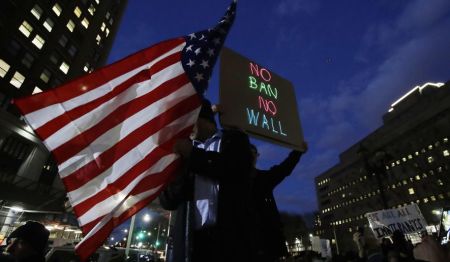 FILE – In this Feb. 2, 2017 file photo, protestors gather at Brooklyn Borough Hall to pray before a rally in protest of President Donald Trump
President Trump plans to rescind his executive order banning travel from seven predominantly Muslim countries and replace it with a revised order “in the near future,” according to documents filed by the Justice Department in an ongoing legal battle over the order.
Mr. Trump confirmed at a press conference Thursday that a new order is in the works and will likely be introduced early next week. Providing scant details about the new order, he said it “is being tailored to the decision that we got down from the court.”
The Justice Department on meanwhile asked the 9th U.S. Circuit Court of Appeals not to conduct an en banc review of a ruling that is currently barring enforcement of Mr. Trump’s order on travel and refugees, noting the new draft order in the works.
“Rather than continuing this litigation, the President intends in the near future to rescind the Order and replace it with a new, substantially revised Executive Order to eliminate what the panel erroneously thought were constitutional concerns,” DOJ lawyers wrote in a brief filed in court Thursday.
The government lawyers instead asked the court to “hold its consideration of the case until a new Order is issued and respectfully requests that the panel opinion be vacated at that time.”
On Jan. 27, Mr. Trump signed the executive order to block most travel from seven predominantly Muslim nations — Syria, Iraq, Somalia, Iran, Sudan, Libya and Yemen — until stronger vetting could be implemented, indefinitely halt the resettlement of Syrian refugees in the U.S. and block other refugees for 120 days. Three days later, a Seattle-based federal judge issued a ruling that temporarily halted enforcement of the order across the country.
A panel of three judges from the 9th Circuit last week upheld the lower court’s temporary restraining order, but a larger panel from the 9th Circuit could reconsider that decision through an en banc rehearing.
Neither the Justice Department nor Washington state Attorney General Bob Ferguson, who successfully challenged Mr. Trump’s executive order, want the broader 9th Circuit review. But an unidentified judge on the 9th Circuit last week requested that the court’s 25 judges vote on whether to send the case to a panel of 11 judges from the circuit for the en banc reconsideration.
“The panel created no conflict with precedent of this Court or the Supreme Court; rather, the panel’s opinion is firmly grounded in precedent,” Washington state attorneys wrote in Thursday’s filings. “There is thus no basis for en banc review, especially given the interlocutory nature of Defendants’ motion and the cautious approach of the panel’s opinion.”
Granting such a hearing “would simply delay the merits of the preliminary injunction appeal to no substantive purpose,” Washington state attorneys wrote.
The DOJ has also asked to put off any briefings before District Judge James L. Robart, who originally issued the stay upheld by the appellate court, until after the entire 9th Circuit decides whether or not to take up the case.
On Thursday, Mr. Trump defended his order despite its clunky rollout.
“We are saving American lives every single day. The court system has not made it easy for us,” Mr. Trump said. “We’ve taken decisive action to keep radical Islamic terrorists out of our country. Though parts of our necessary and constitutional actions were blocked by judges, in my opinion [in an] incorrect and unsafe ruling, our administration is working night and day to keep you safe.”
Is This The Coup the Left Wanted?
February 15, 2017Is This The Coup the Left Wanted?, The Resurgent, Erick Erickson, February 15, 2017
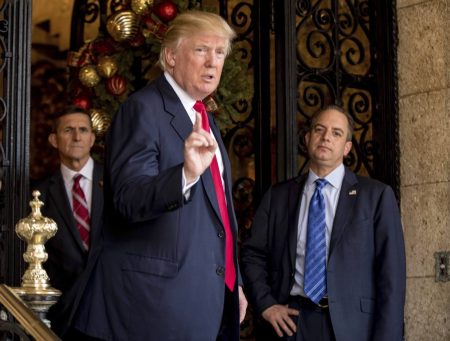
There is no evidence that Donald Trump’s campaign and Russian intelligence cooperated to steal the election from Hillary Clinton. But the New York Times waits for the third paragraph of this sensational story to tell you. First, they want you to know intelligence sources say Trump campaign staffers had multiple, repeated contacts with the Russians.
What we are seeing is an intelligence community trying to sabotage the President of the United States. We should all be concerned even if we have our own concerns about the President and Russia.
It is more and more apparent that, while Mike Flynn misled Vice President Pence and should have been fired, we only know this because members of the intelligence community engaged in an opposition research dump on Flynn with the media. They engaged as a separate and distinct branch of government, and that is a dangerous situation.
The left is cheering on the outcomes, as are some on the right, but they are all ignoring the process. When the intelligence community ceases to serve the Commander-in-Chief and instead tries to sabotage him because they do not like the direction he is taking the country, they are putting their interests ahead of the voters and the electoral process.
The same problem exists with the Ninth Circuit Court of Appeals and its decision on the immigration order. In large part, the court based its decision on Donald Trump’s campaign statements that he wanted a Muslim ban. At first blush, that may seem legit to people but consider Barack Obama and Obamacare.
Chief Justice John Roberts upheld Obamacare’s constitutionality because he said it fell under the taxation powers of the constitution. But Barack Obama had campaigned on Obamacare saying that it was not a tax. Had the Supreme Court used President Obama’s campaign statements against him, they would have thrown out Obamacare.
While one may cheer on the outcome from the Ninth Circuit, they should not cheer the process and flawed legal reasoning.
Both the intelligence and court situation raise troubling issues. By cheering outcomes based on deeply problematic processes, people are rapidly moving towards “ends justify the means” reasoning. That will bring about the very creeping authoritarianism the left fears from Donald Trump.
They cheer this on now because it is working to their advantage as rogue leakers try to undermine a President they do not like. But it will eventually happen to them. By then they will have surrendered any and all moral high ground to cry foul.
The intelligence community serves at the pleasure of the President, not the other way around. The President must be able to depend on the intelligence community’s assessments. Right now, the intelligence community is causing a breakdown in trust with the Trump Administration through leaks designed to undermine his authority.
If a terrorist attack on our soil happens because the President felt he could no longer trust the intelligence community’s assessments, that will be on them. This behavior, in a democratic republic, must be considered unacceptable.
It is possible to be happy Mike Flynn is gone and also be deeply bothered by the means through the intelligence community designed his ouster. People on all sides should be speaking up loudly that the behavior of the intelligence community in damaging leaks is unacceptable.
Finally, we know that Mike Flynn intended to reform the intelligence community and expose side deals made with Iran to secure a diplomatic agreement. President Trump should commit to replacing Mike Flynn with someone as hell-bent on reform and exposure of the Iran deal as Mike Flynn was. The intelligence community cannot be rewarded for bad behavior that undermines the democratic processes of this nation, even if some of us are happy Mike Flynn is gone.
Fake News: Media Reports That Muslim Olympian Was Detained Because of Trump’s Travel Ban
February 14, 2017Fake News: Media Reports That Muslim Olympian Was Detained Because of Trump’s Travel Ban, PJ Media, Debra Heine, February 13, 2017
 Ibtihaj Muhammad attends ESPN: The Party 2017 held on Friday, Feb. 3, 2017, in Houston, Texas. (Photo by John Salangsang/Invision/AP)
Nothing triggers liberal mainstream media types more than being accused of being purveyors of “fake news.” But stunningly enough, that hasn’t stopped them from…well…being purveyors of fake news.
The latest example features Ibtihaj Muhammad, the New Jersey native who recently became the first female Muslim-American to win an Olympic medal for the United States. Muhammad, a vocal Trump critic, answered a journalist’s question with so much ambiguity it seemed designed to be deceptive. Regardless, several major media outlets jumped on her story without verifying it and now have egg all over their faces.
Muhammad, a lifelong American citizen, claimed in an interview Tuesday that she was detained “just a few weeks ago” by U.S. Customs and Border Protection agents. She said she was held for a few hours without explanation.
It’s important to recognize from the get-go that Muhammad didn’t put a hard date on when the alleged detaining occurred (this will come up later). It’s also probably worth noting that she is an outspoken Trump critic, and that she is extremely displeased with his executive order temporarily barring immigration from seven Middle Eastern countries.
Here’s a transcript of what Muhammad told Popsugar’s Lindsay Miller on Feb. 7 about the alleged incident with customs agents [emphases added]:
Popsugar: Do you know anyone who was directly impacted by Trump’s travel ban?
Ibtihaj Muhammad: Well, I personally was held at Customs for two hours just a few weeks ago. I don’t know why. I can’t tell you why it happened to me, but I know that I’m Muslim. I have an Arabic name. And even though I represent Team USA and I have that Olympic hardware, it doesn’t change how you look and how people perceive you.
Unfortunately, I know that people talk about this having a lot to do with these seven countries in particular, but I think the net is cast a little bit wider than we know. And I’m included in that as a Muslim woman who wears a hijab.
A rule of thumb for responsible journalists is, “if your mother tells you she loves you, check it out.” So wouldn’t a responsible journalist want to be even more skeptical of an obvious partisan? You would think so, right? Well, you would be wrong. Journalists were so eager to virtue signal their outrage and despair over this supposed injustice that Time, the UK’s Independent, the Daily Mail, the New York Daily News, The Hill, and of course Sports Illustrated and ESPN all spread the story far and wide before verifying it. Specifically, they should have double-checked whether she was detained after Trump’s travel ban went into place, after Trump was inaugurated, or perhaps while Obama was still president.
As it happens, according to Muhammad herself, her purported “detention” took place in December while Obama was still president.
Muhammad clarified several days after her Feb. 7 interview that she meant December 2016 when she said, “just a few weeks ago.”
“Thanks to all who reached out regarding the December incident at customs. I will continue be a voice for all impacted by profiling & bigotry,” she said in a tweet on Feb. 11.
Thanks to all who reached out regarding the December incident at customs. I will continue be a voice for all impacted by profiling & bigotry

A spokesperson for the U.S. Customs and Border Protection agency has not yet responded to the Washington Examiner’s request for comment, so it’s not certain that she was even detained.
As the Examiner notes, “Muhammad isn’t blameless in all of this.”
A less-than-charitable person would suspect her of being purposefully vague and imprecise. She was asked a simple “yes or no” question about the president’s immigration order. Instead of giving a simple answer, she provided an anecdote involving the very misleading use of “just a few weeks ago.”
A less-than-charitable person might also suspect that MSM types who share these kinds of fake stories don’t even care if they get it wrong at first because they know another ironclad rule of journalism: The initial, mistaken information will be retweeted much, much more than any subsequent correction.
And to a liberal, agenda-driven news media, the “narrative” is all that matters.
Islamic Terror and the U.S. Temporary Stay on Immigration
February 13, 2017Islamic Terror and the U.S. Temporary Stay on Immigration, Gatestone Institute, Uzay Bulut, February 13, 2017
It is short-sighted and reckless to blame President Trump for trying to protect his country and keep his country safe — as any good leader is supposed to do. It would be much wiser to direct our anger where it belongs — at Muslim extremists and Muslim terrorists.
To many people, it must be easier to go after the U.S. president than after ISIS terrorists. That way, critics of the president can also pose as “heroes” while ignoring the real threats to all of humanity.
Critics of Muslim extremists get numerous death threats from some people in the West because they courageously oppose the grave human rights violations — forced marriages, honor killings, child rape, murdering homosexuals and female genital mutilation (FGM), among others.
Why do we even call criticism of such horrific practices “courageous”? It should have been the most normal and ordinary act to criticize beheadings, mutilations and other crimes committed by radical Muslims. But it is not.
On the contrary, the temporary ban aims to protect genuine refugees such as Bennetta Bet-Badal, who was murdered in San Bernardino. It would be much wiser to direct our anger where it belongs — at Muslim extremists and Muslim terrorists.
In San Bernardino on December 2, 2015, 14 people were murdered and 22 others seriously wounded in a terrorist attack. The perpetrators were Syed Rizwan Farook and Tashfeen Malik, a married couple. Farook was an American-born U.S. citizen of Pakistani descent, who worked as a health department employee. Malik was a Pakistani-born lawful permanent resident of the United States.
Among the victims of the terror attack was Bennetta Bet-Badal, an Assyrian Christian woman born in Iran in 1969. She fled to the U.S. at age 18 to escape Islamic extremism and the persecution of Christians that followed the Iranian revolution.
“This attack,” stated the Near East Center for Strategic Engagement (NEC-SE), “showcases how Assyrians fled tyranny, oppression, and persecution for freedom and liberty, only to live in a country that is also beginning to be subject to an ever-increasing threat by the same forms of oppressors.”
“NEC-SE would like to take this opportunity to once again urge action to directly arming the Assyrians and Yezidis and other minorities in their indigenous homeland, so that they can defend themselves against terrorism and oppression. This tragedy is evidence that the only way to effectively counter terrorism is not solely here in the US, but abroad and at its root.”
Members of the Islamic State (ISIS) have declared several times that they target “kafirs” (infidels) in the West.
In 2014, Syrian-born Abu Muhammad al-Adnani, the official spokesperson and a senior leader of the Islamic State, declared that supporters of the Islamic State from all over the world should attack citizens of Western states, including the US, France and UK:
“If you can kill a disbelieving American or European – especially the spiteful and filthy French – or an Australian, or a Canadian, or any other disbeliever from the disbelievers waging war, including the citizens of the countries that entered into a coalition against the Islamic State, then rely upon Allah, and kill him in any manner or way, however it may be.
“Smash his head with a rock, or slaughter him with a knife, or run him over with your car, or throw him down from a high place, or choke him, or poison him.”
It is this barbarity that the new U.S. administration is trying to stop.
FBI Director James Comey also warned in July of last year that hundreds of terrorists will fan out to infiltrate western Europe and the U.S. to carry out attacks on a wider scale, as Islamic State is defeated in Syria. “At some point there’s going to be a terrorist diaspora out of Syria like we’ve never seen before. We saw the future of this threat in Brussels and Paris,” said Comey, adding that future attacks will be on “an order of magnitude greater.”
How many ISIS operatives are there in the U.S.? Are ISIS sleeper cells likely in American cities? The people who are trying to create hysteria over the new steps taken by the Trump Administration should focus on investigating these issues more broadly, but they do not. To them, it must be easier to go after the U.S. president than after ISIS terrorists. This way, they can also pose as “heroes” while ignoring the real threat to all of humanity.
It is not only Islamic terrorists that pose a threat. It is also the ideology of the Muslim Brotherhood, the font of all the modern extremist Muslim ideologies.
The crimes committed by radical Muslims are beyond horrific, but it is getting harder to expose and criticize them. Many critics of Islam in Western countries — including those of Muslim origin — have received countless death deaths and have been exposed to various forms of intimidation.
Some were murdered, such as the Dutch film director, Theo van Gogh. His “crime” was to produce the short film Submission (2004) about the treatment of women under Islam. He was assassinated the same year by Mohammed Bouyeri, a Moroccan-Dutch Muslim.
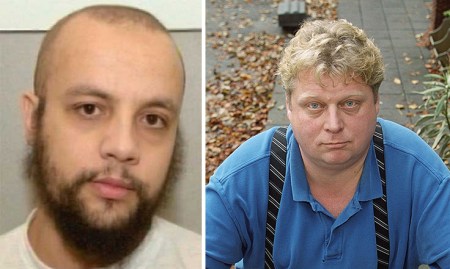 In 2004, Moroccan-Dutch terrorist Mohammed Bouyeri (left), shot the filmmaker Theo van Gogh (right) to death, then stabbed him and slit his throat.
Some have had to go into hiding. American cartoonist Molly Norris, who promoted an “Everybody Draw Mohammed Day”, had to go into hiding in 2010 after her life was threatened by Islamic extremists. She also changed her name and stopped producing work for the Seattle Weekly, the New York Times reported.
Who are these people hiding from? From the most radical and devoted followers of the “religion of peace”.
Why should people living in free Western countries be forced to live in fear because they rightfully criticize a destructive and murderous ideology?
They get numerous death threats from some people in the West because they courageously oppose grave human rights violations — forced marriages, honor killings, child rape, murdering homosexuals and female genital mutilation (FGM), among others.
Why do we even call criticism of such horrific practices “courageous”? It should have been the most normal and ordinary act to criticize beheadings, mutilations and other crimes committed by radical Muslims. But it is not. It does require tremendous courage to criticize these acts committed in the name of a religion. For everybody knows that the critics of Islam are risking their lives and security.
In the meantime, “an Islamic State follower posted a message on the Telegram app that said President Trump was wasting his time by blocking refugees from Syria,” reported the journalist Rowan Scarborough.
“‘Trump is preventing the entrance of the citizens of [seven] countries to protect America from terrorism,’ said the message captured by the Middle East Media Research Institute. “Your decision will not do anything to prevent the attacks; They will come from inside America, from Americans born in America, whose fathers were born in America and whose grandparents were born in America.”
President Trump’s executive order is not a ban on Muslims. Individuals of all religious backgrounds of these seven countries have been affected. Nor is it a ban on refugees. On the contrary, the ban aims to protect genuine refugees such as Bennetta Bet-Badal, who was murdered in San Bernardino.
It is short-sighted and reckless to blame President Trump for trying to protect his country and keep it safe — as any good leader is supposed to do. It would be much wiser to direct our anger where it belongs — at Muslim extremists and Muslim terrorists.
For the Media, the Only Jihad Is Against Trump
February 13, 2017For the Media, the Only Jihad Is Against Trump, PJ Media, Roger L Simon, February 12, 2017
In their zeal to “Jump on Trump,” is our media — not to mention their 9th Circuit cohorts — doing an immense disservice to the American public by obfuscating, effectively censoring, serious discussion of Islamic immigration and what to do about it?
It’s a global problem, surely, and we have a lot to learn from the mistakes of the Europeans who — according to the latest polls — are expressing serious regrets about their open-border immigration policies.
Several countries are beginning to return their migrants, sometimes offering economic incentives. And you can see why, reading last Friday’s report from the Gatestone Institute:
Several young gang-rapists started laughing in a Belgian court while yelling:
“women should not complain, they should listen to men.”
The seven ‘men’ were seen in a video where they are standing around an unconscious girl who is lying on a bed, then seen pulling down her pants and raping her. Also in the video, they are dancing around the victim and singing songs in Arabic.
I imagine they’ll be getting some “extreme vetting.” Let’s hope so anyway. But does this “extreme vetting” go far enough? In America’s case, it’s complicated by the fact that Trump’s original seven countries in his travel ban are rather circumscribed and arbitrarily limited, despite having been the seven singled out by Obama. As we have seen on multiple occasions, second-generation jihadists come from all over Western Europe, like two of the above un-magnificent seven, not to mention North Africa and the obvious omissions of Saudi Arabia and Pakistan. They come from Russia and the Far East as well. Shouldn’t they all be on the list? Yes, I realize the seven countries were chosen because at least some keep no verifiable records of who’s coming and going. But I’m not sure that matters. These days identities are more easily forged than ever. The Daily Beast reports you can buy an undetectable UK passport from the Neapolitan Camorra.
So can “extreme vetting” finally do the job it’s supposed to do? What is the real extent of its capability?
Marine/contractor Steven Gern’s video from Iraq (before being asked to leave) is viral for a reason. Gern has an authenticity and seems to be telling the truth, two truths actually, and those truths are, to say the least, uncomfortable. One is that many Iraqis (I would assume most Middle Easterners) hate Americans despite all we may have tried to do for them and would kill us if they had any opportunity. The second is that they are master dissemblers (remember taqiyya?) and are willing to wait years, all the while seeming perfectly pleasant, before acting on their hatred. This does not augur well for immigration, to put it mildly.
Given this dissembling/taqiyya that Gern speaks of, we do have some serious”extreme vetting” to do. It’s almost impossible to see how it can be done without the most detailed attention. Obama, Hillary and Kerry did less than zero to improve the situation. They either exacerbated or ignored it, mostly the former.
Trump asked for a 120-day travel ban, a tiny length of time under the circumstances, to try, in his words, to figure out what’s happening. But his rapacious opponents in the media (and the judiciary), slavering like a pack of morally narcissistic wolves, would have none of it. He was not to get one day.
Did they have another suggestion? No, of course not. Their suggestion comes down to this: anything but Trump. Forget reason. Forget what’s left of their own thoughtfulness. Forget the safety of the American people and the world. The Orange Man must pay. He’s too vulgar… or something. Maybe one of his daughter’s shoes gave someone a blister. Or Stephen Miller was too rude to one of his high school teachers. Something significant like that.
Meanwhile, the media in its fact-finding mission does nothing to help us because it finds no facts, other than scurrilous gossip about Trump. That’s all they seem to look for. Their myriad liberal and progressive pundits make no suggestions either, contribute no fresh ideas (have you noticed?) to the fight, as if the status quo were just fine with them. (This is true of many conservative pundits too — no thoughts on what to do about radical Islam.) It’s a mixture of selfishness and envy from which we all lose. Let our children or our children’s children deal with it. (And they will.) There may be a jihad in the big world, people being raped and having their throats cut, bombs going off, trucks driving into crowds of innocent tourists, but to our media, the only jihad worth fighting against is against Trump.




 anneinpt
 artaxes
 danmillerinpanama
 davidking1530
 Peter Hofman
 Joseph Wouk
 Peter
Peter Louisiana Steve
 WarSclerotic
Recent Comments