Posted tagged ‘P5+1’

Iran Openly Declares That It Intends To Violate UNSCR 2231 That Endorses The JCPOA

September 23, 2015

Iran Openly Declares That It Intends To Violate UNSCR 2231 That Endorses The JCPOA, Middle East Media Research Institute, September 22, 2015

(Please see also, Iran wants to renegotiate parts of the nuke “deal.” That may be good. Iran’s declaration that it intends to violate UNSCR 2231, dealing with missile development and related sanctions, should further prompt the U.S. Congress to repudiate the “deal.”– DM)

When the Americans moved the sanctions on the missile program to UNSCR 2231, Iran did not object, as, according to their statements above, they can violate Security Council resolutions, as they have done in the past, and this will not be regarded as a violation of the JCPOA.

**************************

In statements, three Iranian leaders – President Hassan Rohani, Foreign Minister Zarif, and Deputy Foreign Minister and senior negotiator Abbas Araghchi – emphasized that Iran has no intention of abiding by UNSRC 2231, which includes the JCPOA and another element; rather, that they will abide only by the original JCPOA.

The Iran nuclear deal consists of the following:

A.   A set of understandings between Iran and the P5+1 powers (as well as the remaining disagreements) all in a single package called the JCPOA. It is not a contract between Iran and the P5+1 countries as a group or any single one of them, and hence no document was signed.

B.   This set of mutual understandings (as well as disagreements) packaged in the JCPOA was transferred, following the conclusion of negotiations in Vienna on July 14, 2015, to the UN Security Council, for endorsement as a UN Security Council resolution. The resolution, UNSCR 2231, was passed on July 25, 2015 and it includes, in addition to the JCPOA, another element (Annex B) with further stipulations regarding Iran. For example, it addresses the sanctions on Iran’s missile development project.

To understand why UNSCR 2231 is structured in this way, we can look at statements by top Iranian negotiators about the process that led up to it:

In a July 20, 2015 interview on Iranian Channel 2, Iranian Deputy Foreign Minister and senior negotiator Abbas Araghchi said that there had been tough bargaining between the Iranian and American delegations over the issue of the arms embargo on Iran and the sanctions related to Iran’s missile development project. “The Americans sought their inclusion in the JCPOA, claiming that otherwise they could not face criticism from Arab countries in the region. When they said that they could not lift the sanctions altogether, we told them explicitly that in that case there is no agreement. We told them that the national security issues are non-negotiable and that we will not accept an agreement which continues the embargo on weapons and the sanctions on missile development. In the end, the Americans said, We will put the issue of the embargo and the missiles in the UN Security Council Resolution separate from the agreement.”

In the same interview, Araghchi was asked whether Iran could refrain from carrying out UNSCR 2231; he replied: “Yes we can; just as we refrained from complying with UN Security Council resolutions, we can do so with regards to 2231.”

Araghchi also referred to the Iranian Foreign Ministry statement issued following the passage of UNSCR 2231: “The Iranian Foreign Ministry statement explicitly noted that Iran does not attach legitimacy to any restriction and any threat. If UNSCR 2231 will be violated by Iran, it will be a violation of the Security Council resolution and not of the JCPOA, similar to what happened 10 years ago when we violated Security Council resolutions and nothing happened. The text of the JCPOA notes the fact that the content of the JCPOA and of the UN Security Council resolution are two separate things.”[1]

Foreign Minister Zarif, in an August 9, 2015 media interview, reiterated the Iranian position regarding the difference between the JCPOA and UNSCR 2231, with a focus on the consequences of possible violation of the two by Iran. He said: “There is a difference between the JCPOA and UNSCR 2231. Violating the JCPOA has consequences, while violating UNSCR 2231 has no consequences.”[2]

Indeed, the restrictions regarding missiles are mentioned only in UNSCR 2231, and not in the JCPOA.

On August 29, 2015, Iranian President Hassan Rohani said: “There is nothing about the topic of missiles, defense, and weapons in the JCPOA.  Whatever we have about it is in Resolution [UNSCR] 2231… Moreover, we have formally announced that we are not committed to all the sections that appear in the resolution [2231], and we specified in the JCPOA that violation of the resolution [2231] does not mean violation of the JCPOA…[3]

The meaning of all this is that in everything related to the issue of missile development, Iran will disregard UNSCR 2231. Already during the negotiations, it insisted on no imposition of sanctions on Iran regarding its missile development (and no sanctions at all). When the Americans moved the sanctions on the missile program to UNSCR 2231, Iran did not object, as, according to their statements above, they can violate Security Council resolutions, as they have done in the past, and this will not be regarded as a violation of the JCPOA.

Endnotes:

[1] ISNA.ir/fa/news/94042915462/%D9%85%D9%85%D9%86%D9%88%D8%B9%DB%8C%D8%AA-%D9%87%D8%A7%DB%8C-%D8%AA%D8%B3%D9%84%DB%8C%D8%AD%D8%A7%D8%AA%DB%8C-%D9%88-%D9%85%D9%88%D8%B4%DA%A9%DB%8C-%D8%A8%D9%87- .

[2] Foreign Minister Javad Zarif said this at an August 9, 2015 conference sponsored by the Iranian daily Ittil’atwith other senior negotiators in attendance. See text in Farsi here.

[3] President.ir/fa/89047, August 30, 2015.

Iran wants to renegotiate parts of the nuke “deal.” That may be good.

September 22, 2015

Iran wants to renegotiate parts of the nuke “deal.” That may be good. Dan Miller’s Blog, September 22, 2015

(The views expressed in this article are mine and do not necessarily reflect those of Warsclerotic or those of its other editors. — DM)


Iran wants sanctions relief to be lifted, immediately, and not merely suspended. Iran should not get that. If it doesn’t, it may well terminate the “deal” unilaterally. If Iran gets what it wants, the Senate should review the “deal” as a treaty and reject it. Either outcome would be a substantial improvement over the current “deal” and the morass in which it is embedded.

This post is based on a September 21st article at Middle East Media Research Institute (MEMRI) titled “Expected September 28 NY Meeting Between P5+1 Foreign Ministers And Iran Could Signify Reopening Of Nuclear Negotiations To Address Khamenei’s September 3 Threat That If Sanctions Are Not Lifted, But Merely Suspended, There Will Be No Agreement.”

The MEMRI article cites statements by Supreme Leader Khamenei and one of his senior advisers, Ali Akbar Velayat. The latter said, on September 19th,  “the nuclear negotiations are not over yet.” Khamenei has said much the same thing.

Khamenei said, in a September 3, 2015 speech to the Assembly of Experts, that he did not accept the terms of the agreement and demanded that the sanctions be immediately lifted rather than merely suspended; otherwise, he said, there would either be no agreement, or Iran too would merely suspend its execution of its obligations under the JCPOA.

. . . .

“Freezing or suspension [of the sanctions] is unacceptable to me… If they suspend [the sanctions], we too will suspend [what is incumbent upon us]. If we are to implement what [is required of us], the sanctions must be [actually] cancelled.

Iran has thus made clear that it will not abide by the nuke “deal” as written; unless it gets the changes it now demands, it will either terminate the deal or violate it. If, as seems likely for the reasons cited in the MEMRI article, the September 28th meeting involves discussion of the deal, it will either be renegotiated or it won’t be.

If the “deal” is not renegotiated, or is renegotiated and Iran does not get what it demands, it may very well terminate the deal. Iran has already received substantial sanctions relief, is already open for business and is already doing lots of it with many more nations than previously. Termination would be a rebuff to the “Great Satan,” would not damage Iran much economically and it could proceed with its “peaceful” nuke program without even farcical nuke self-inspections.

If The Obama administration and others cave and Iran gets what it demands or enough to satisfy it, the “deal” will be very different from what was previously presented to the Congress under the Corker legislation. That legislation purported to eliminate the constitutional requirement of approval of the “deal” by a two-thirds Senate majority before going into effect and permitted it to go into effect unless rejected by half of the membership of both houses; Obama promised to veto such a rejection and put the “deal” into effect. The House has disapproved the “deal” but the Senate has not acted because of Democrat fillibusters, urged by the White House. Under the new “deal,” the ability of the United States to “snap back” sanctions would be vitiated; a possible but very difficult if not impossible to accomplish, “snap back” had been among the reasons cited by many of those who favored the “deal” (often despite its many other flaws) for supporting it.

If a deal eliminating the “snap back” is struck, Obama, et al, may well claim that it’s none of the business of the Congress since, by virtue of the Corker legislation, it has already eliminated its constitutional authority to deal with the JCPOA as a treaty, regardless of any “minor” change.

I hope, but am less than confident, that both houses of the Congress will reject this contention vigorously and repeal the Corker legislation. Whatever benefits or other legitimacy the Corker legislation may once have been thought to have it no longer has. Repeal will probably require use of the “nuclear option” to invoke cloture to end a Democrat filibuster in the Senate. If — as seems likely — Obama vetoes the rejection, the Congress should state that it no longer considers itself bound by the Corker legislation. Next, the Senate should treat the renegotiated “deal” as a treaty, regardless of whether Obama agrees to send it to the Senate, and reject it. It should do so even if, as also seems likely, that requires use of the “nuclear option” to invoke cloture.

Obama has precipitated what may well become a constitutional crisis. If the Congress does its job, Obama will be the loser and America will be the winner — even if it becomes necessary to take out Iran’s nukes militarily.

Iran appears to wants changes in the JCPOA

September 22, 2015

Expected September 28 NY Meeting Between P5+1 Foreign Ministers And Iran Could Signify Reopening Of Nuclear Negotiations To Address Khamenei’s September 3 Threat That If Sanctions Are Not Lifted, But Merely Suspended, There Will Be No Agreement, MEMRI, September 21, 2015

(If the JCPOA is renegotiated, in any respect, will Congress get another opportunity to challenge it? If so, will a way be found to deal with it as a treaty? The answer to both questions should be yes. — DM)

The expected meeting between the P5+1 foreign ministers and Iranian Foreign Minister Zarif may be evidence of a shift in the White House position and also evidence that it intends to discuss the Iranian demand for further concessions from the superpowers.

****************

Recent reports indicate that the foreign ministers of the P5+1 are set to meet with Iranian Foreign Minister Javad Zarif in New York on September 28, 2015, on the margins of the UN General Assembly, to “examine the recent developments of the JCPOA.”[1]

On September 20, 2015, U.S. Secretary of State John Kerry said, at a joint press conference in Berlin with his German counterpart Frank-Walter Steinmeier, that he would meet Zarif in New York to discuss “Iran and other matters.”[2]

Additionally, Ali Akbar Velayati, a senior advisor to Iranian Supreme Leader Ali Khamenei and the head of Iran’s Center for Strategic Research, said on September 19, 2015 that “the nuclear negotiations are not over yet.”[3]

As will be recalled, Khamenei said, in a September 3, 2015 speech to the Assembly of Experts, that he did not accept the terms of the agreement and demanded that the sanctions be immediately lifted rather than merely suspended; otherwise, he said, there would either be no agreement, or Iran too would merely suspend its execution of its obligations under the JCPOA. He said: “We negotiated [with the Americans] in order to have the sanctions lifted, and the sanctions will be lifted. Now, if we are supposed to uphold this framework… this completely contradicts the reason for Iran’s participation in the talks to begin with. Otherwise, what was the point of our participation in the talks? We would have continued to do what we were doing [prior to the talks]… The fact that we sat down and held talks and made concessions on certain issues was mainly in order to have the sanctions lifted. If the sanctions are not going to be lifted, there will be no agreement… [Our] officials [i.e. Rohani’s government and his Ministry of Foreign Affairs] should make this clear…

“Freezing or suspension [of the sanctions] is unacceptable to me… If they suspend [the sanctions], we too will suspend [what is incumbent upon us]. If we are to implement what [is required of us], the sanctions must be [actually] cancelled. True, the other side says that some of the sanctions are not [up to them entirely] to be lifted. We say in response that [with regard to those sanctions] we will use our legal rights to freeze them. But regarding [the sanctions that are] in the hands of the American and European governments – those must be totally lifted.”[4]

The apparent meaning of all the above is that the nuclear negotiations, which Iran considers unfinished, will be reopened, with the aim of achieving the complete lifting of sanctions – instead of a mere suspension of them as was agreed in the JCPOA and adopted in UN Security Council Resolution 2231.

It will also be recalled that following Khamenei’s September 3 demands, on September 4 the White House responded; spokesman Josh Earnest said that Iran was charged with meeting its obligations under the JCPOA: “What we have indicated all along is that once an agreement was reached, as it was back in mid-July, that we would be focused on Iran’s actions and not their words, and that we will be able to tell if Iran follows through on the commitments that they made in the context of these negotiations. And that is what will determine our path forward here.

“We’ve been crystal clear about the fact that Iran will have to take a variety of serious steps to significantly roll back their nuclear program before any sanctions relief is offered – and this is everything from reducing their nuclear uranium stockpile by 98 percent, disconnecting thousands of centrifuges, essentially gutting the core of their heavy-water reactor at Arak, giving the IAEA the information and access they need in order to complete their report about the potential military dimensions of Iran’s nuclear program. And then we need to see Iran begin to comply with the inspections regime that the IAEA will put in place to verify their compliance with the agreement.

“And only after those steps and several others have been effectively completed, will Iran begin to receive sanctions relief.  The good news is all of this is codified in the agreement that was reached between Iran and the rest of the international community. And that’s what we will be focused on, is their compliance with the agreement.”[5]

The expected meeting between the P5+1 foreign ministers and Iranian Foreign Minister Zarif may be evidence of a shift in the White House position and also evidence that it intends to discuss the Iranian demand for further concessions from the superpowers.

It should be clarified that agreement on the part of the U.S. to lifting the sanctions would constitute a fundamental change to the JCPOA. This is because lifting the sanctions, rather than suspending them, will render impossible a snapback in case of Iranian violations, and the guarantee of a snapback is one of the central justifications for the JCPOA, according to President Obama and Secretary of State Kerry.

Endnotes:

[1] Fars (Iran), September 21, 2015.

[2] State.gov, September 20, 2015.

[3] Fars (Iran), September 19, 2015. It should be mentioned that Majlis member Hamid Rasaei said that the language of the agreement signed by Abbas Araghchi that was delivered to Majlis committees was “a partial document with many translating errors and omissions.” He added that the government must present the agreement to the Majlis in the form of a draft law and that a Majlis committee is currently “examining a version that is neither a proposal nor a draft law.” Tasnim (Iran), September 20, 2015.

[5] Whitehouse.gov, September 4, 2015.

Have the media become selectively “Islamophobic?”

September 20, 2015

Have the media become selectively “Islamophobic?” Dan Miller’s Blog, September 20, 2015

(The views expressed in this article are mine and do not necessarily reflect those of Warsclerotic or its other editors. — DM)


Although claiming repeatedly that Islam is the religion of peace, tolerance, otherwise good and therefore welcome in America, the media are horrified that Donald Trump failed to “correct” the “highly offensive” claim by a member of the audience at a New Hampshire rally that Obama is a Muslim. 

The media and others also seem to be offended by the parallel claim that Obama is not a Christian. However, Islam and Christianity have very different theological foundations and share very few beliefs. Hence, if Obama is a Muslim, He cannot also be a Christian.

True, Obama has occasionally claimed to be a Christian; if He is instead a Muslim He has lied about being a Christian. He has also lied about many other things, including Obamacare and, more recently, the nuke “deal” with Iran.

Barack Mitsvah

The claim that Obama is a Muslim seems to have produced significantly more media outrage than claims that He lied about Obamacare, the nuke “deal” and other topics. Perhaps in Obama’s America presidents are expected to lie as a matter of routine. Had Trump’s questioner merely claimed that Obama is not a Christian, without also claiming that He is a Muslim, would the outrage have been less? It seems to me that the major problem is that Trump’s questioner claimed that Obama is a Muslim.

If what we read in the press and hear on television is true (and I don’t think it is), being a Muslim is per se good. According to Obama, Islam helps to make His America great. Is it among the very few aspects of American exceptionalism of which He is proud?

https://www.youtube.com/watch?v=5Yx-gMcXCy4

Muslims don’t generally live in flyover regions (except in some jihad training compounds), clinging to their guns and bibles. Would Obama think better of Christians in flyover regions if they were to cling instead to their beheading implements and Qurans? What if they dealt with homosexuals (and political dissidents of all types) as do Iran (the peace partner featured in Obama’s nuke “deal”) and other Islamic countries?

Clerks of court in Iran don’t refuse to issue marriage licenses to homosexuals; torturing and hanging them (along with other regime opponents) must be politically correct and, therefore, acceptable.

Islamic reality, on which Obama and the media are generally silent aside, why should Trump be disparaged for failing to come to Obama’s defense by denying that He is a Muslim? What sort of defense would that be? Hasn’t Obama told us that Christians (unlike Muslims) are warlike and bad (please see the next to last video at the end of this post.)

Is being called a Muslim worse than being called a sexual predator?

Sometimes, presidents are accused of doing very bad things. President Clinton was accused of being a sexual predator. In western countries, sexual predation of any sort is often considered undesirable — although less so when the predators are Muslims who believe that Mohamed had the right ideas about sex.

https://www.youtube.com/watch?v=OTeAB4l0KCM

Please see also Ayan Hirsi Ali’s autobiography, Infidel. Much of it is about sex in the Muslim world where women are born to be submissive to men, who own them.

Hillary immediately came to her husband’s defense and blamed the accusations of sexual predation on a vast right wing conspiracy.

For some, former President Clinton remains a highly respected Democrat.

Are claims that Obama is a Muslim also part of a vast right-wing conspiracy, which all right-thinking people, Republicans as well as Democrats, should publicly reject, admonish and silence? Jeb Bush and several other RINOs seem to think so.

https://www.youtube.com/watch?v=4zvg08FJbHE

Is Obama a Muslim?

I don’t know whether Obama is a Muslim. I do understand that He appears to have substantially more affinity for that religion than for any other and is far more likely to defend Islam than to defend Christianity, Judaism or any other religion.

Is many Islamic countries, Christians, Muslims and the few remaining Jews are being persecuted in the most vicious ways conceivable by Muslims. Why are the asylum and immigration policies of Obama’s America so different for Christians, Jews and Muslims?

Might the differences be on account of Obama’s destructively great affinity for Islam? Does He agree with this preacher that Muslim males who migrate to previously non-Islamic countries should help to make them Islamic by breeding with local women to produce Muslim children? Wouldn’t that make Obama even more proud of His America?

https://www.youtube.com/watch?v=cdHg9TADZyA

I guess we can’t permit Obama to be insulted. Right? Wrong!

Iran nuclear deal adoption to take place October 18

September 19, 2015

Iran nuclear deal adoption to take place October 18 Controversial accord to be implemented next month; US says Tehran must take steps to satisfy IAEA before punitive measures removed By JTA September 18, 2015, 4:50 am

Source: Iran nuclear deal adoption to take place October 18 | The Times of Israel


WASHINGTON (JTA) — The formal adoption of the Iran nuclear deal will be Oct. 18, but it is not yet clear how long it will take for Iran to satisfy conditions to relieve sanctions, top US officials said.

The senior administration officials, speaking Thursday afternoon in a conference call with reporters, outlined the steps Iran must take before inspectors with the International Atomic Energy Agency, the UN nuclear watchdog, confirm that Iran is in compliance with the nuclear deal reached in July between Iran and six major powers.

The call to reporters came the same day that the Obama administration announced that Stephen Mull, the outgoing ambassador to Poland, would be the point person for ensuring Iranian compliance with the deal.

Among other measures, Iran must remove thousands of centrifuges from its Natanz reactor, ship overseas all but 300 kilograms of 12,000 kilograms of enriched uranium and remove the center of its plutonium reactor, the officials said.

Because of how involved the measures are, the officials would not estimate how long it would take to get to “implementation day,” when the IAEA confirms compliance and sanctions are lifted. Reports have indicated that Iran is likely to comply with conditions in from between six months to a year from adoption of the deal.

“All of this will take a lot of effort and probably a fair amount of time,” said an official. “The ball is in Iran’s court — it’s hard to predict how long it will be before sanctions relief is implemented.”

The officials spoke on condition of anonymity.

One condition the Iranians must complete prior to Oct. 18, or “adoption day,” is to report to the IAEA on the possible military dimensions of its past nuclear activity. Iran has instead its nuclear research is for civilian purposes only. The deadline for Iran’s report to the IAEA is Oct. 15.

The Obama administration on Thursday said the way was clear to launch the deal now that Congress has reached the deadline to pass a bill that would kill the deal. Senate Democrats used parliamentary procedures to block votes last week, on Tuesday and then on Thursday.

Republicans oppose the deal. The Obama administration and opponents of the deal, include Israeli Prime Minister Benjamin Netanyahu, and the American Israel Public Affairs Committee for the last two months fiercely battled to influence Democrats and also the US Jewish community on the deal.

Opponents said the deal leaves Iran a nuclear threshold state, while the Obama administration argued that it was the best means of keeping Iran from acquiring a nuclear weapon.

Director of Treasury Department's Office of Foreign Assets Control Adam Szubin. (screen capture: Youtube)


The ‘Iran Deal’ Was Not Signed by Iran or Anyone Else

September 19, 2015

Neither Iran nor any other party has signed the ‘Iran Deal.’ That means there is no formal agreement. That means nothing bars Iran’s race to nuclear weapons. By: Lori Lowenthal Marcus Published: September 19th, 2015

Source: The Jewish Press » » The ‘Iran Deal’ Was Not Signed by Iran or Anyone Else

Rep. Mike Pompeo (R-KS-04)

Rep. Mike Pompeo (R-KS-04)
Photo Credit: Wikimedia


The Nuclear Iran Deal that is at the epicenter of a Congressional battle and the focus of so much attention for months is not actually any deal at all, as not one of the parties, including any representative of the Islamic Republic of Iran, has signed the Agreement.

This morning, Sept. 18, Cong. Mike Pompeo (R-KS-04) sent a letter to Secretary of State John Kerry. In that letter Pompeo informed the Secretary that while reviewing the Joint Comprehensive Plan of Action (Nuclear Iran Deal), he noted that there are no signatures on the so-called final Agreement.

Without signatures, there can be no legally binding contract.

There apparently is no “Iran Deal.”

Pompeo asked Kerry to provide a copy of the JCPOA with signatures and signing authority, so that members of Congress and the rest of the American people know that the parties to the agreement have “confirm[ed] each country’s commitment to the agreement” and that “makes clear precisely who the parties to the agreement are and the authority under which that nation entered into the agreement.”

International affairs scholar and Iran expert Michael Ledeen pointed out more than two months ago that Iran’s Ayatollah Khameini would not allow his country to sign the JCPOA. Ledeen’s point then, and today, is that the desperation exhibited by the Obama administration made clear to the Iranian leader that “there is no reason for him to approve a hated deal with the devil. It’s much better to keep talking until all the sanctions are gone, and Iran’s ‘right’ to pursue its nuclear projects is fully recognized.”

It appears that Ledeen’s prediction was dead-on. If there is no signed agreement, even the feeble conditions placed on Iran by Team Kerry’s negotiators are unenforceable.

When asked what then, is the current status of the JCPOA, assuming the administration did not just, oh, forget to distribute to Congress the signed version, Ledeen told the JewishPress.com: “It’s a verbal agreement. It means the diplomats meeting in Vienna thought it was a good agreement, but that is all. It is not enforceable.”

Ledeen said he could not think of any other major international agreement, certainly not any of the portentous nature of the Iran Deal, where lawmakers moved forward to begin implementation without having a signed agreement in place.

“Anyone who has read in the media that the ‘Iran Deal’ was signed has to now know they were lied to, it has not happened.”

So what next?

Congress could, conceivably, pass a law forbidding the lifting of sanctions. That’s been tried, you say? True, but will the same members of Congress who support the deal, the same ones who never read significant portions of the deal, and who had those portions explained to them by people who themselves never read the deal are willing to once again vote against or even bar a vote on a stay on the lifting of sanctions when they know there is nothing preventing Tehran from violating any of the purportedly agreed-to conditions? Will they really?

Cong. Pompeo’s letter to Secretary Kerry follows:

Dear Secretary Kerry:


I have reviewed the Joint Comprehensive Plan of Action (JCPOA) between the P5+1 and Islamic Republic of Iran – or at least the parts of the agreement that were provided to Congress by the administration.  As you know, pursuant to H. Res. 411, the House of Representatives considers the documents transmitted on July 19, 2015 incomplete in light of the fact that the secret side deals between the International Atomic Energy Agency (IAEA) and the Islamic Republic of Iran were not provided to Congress.  I look forward to seeing the entire agreement – including the two secret side deals that are part of the JCPOA – so that Congress may continue to evaluate the JCPOA and, depending on the outcome of the vote under the relevant provisions of the Iran Nuclear Agreement Review Act, potentially end the current and continuing prohibition of the lifting of sanctions on Iran.

During that review, I found that the copies provided to Congress of the JCPOA are not signed by any of the P5+1 members nor by Iran.  Having never seen an international agreement of this magnitude not signed by the parties or an agent of the parties, I assume this is simply an oversight or an administrative error.  That is, Congress must not have the final version of the agreement that would necessarily be signed.  I request that you provide us with copies of a final, executed copy of the JCPOA.  In the event that the JCPOA has not yet been signed by the parties, please inform us (a) when signatures will be placed on the agreement, (b) what parties will be signing, and (c) which person you anticipate will sign on behalf of each of those parties, including on behalf of the United States.

I am confident that you intended for the JCPOA to be signed by each of the P5+1 participants.  I can find no international agreement of this “historic” nature that was not signed by the parties.  Each of the past five major nuclear agreements to which the U.S. is a party – SALT I, SALT II, START I, START II and the 1994 Agreed Framework between the United States and the Democratic People’s Republic of Korea – were signed by representatives of each nation that was party to the agreement.  This is not a mere formality.  Those signatures represent the commitment of the signatory and the country on whose behalf he or she is signing.

A signature also serves to make clear precisely who the parties to the agreement are and the authority under which that nation entered into the agreement.  In short, just as with any legal instrument, signing matters.

This is particularly important with respect to JCPOA.  Iranian President Hassan Rouhani has made clear that he does not believe that JCPOA is legally binding on his nation, saying, “If the Joint Comprehensive Plan of Action is sent to (and passed by) parliament, it will create an obligation for the government.  It will mean the president, who has not signed it so far, will have to sign it.  Why should we place an unnecessary legal restriction on the Iranian people?”

Given the many benefits that will accrue to the ayatollahs, the Iranian Revolutionary Guard Corps, and other unsavory elements of the Iranian regime, I believe that Iran should, at the very least, bind itself to the few requirements placed on it under the JCPOA by signing the agreement.  I also believe that the United States and its P5+1 partners on the JCPOA should execute the agreement on behalf of their countries.  I look forward to your response.

We all do.

What Iran Is Permitted To Do Under The JCPOA

September 18, 2015

What Iran Is Permitted To Do Under The JCPOA, Middle East Media Research Institute, Yigal Carmon, September 17, 2015

Support or opposition to the nuclear deal should be predicated on the text of the JCPOA.

Here are a few examples of what Iran can do under the JCPOA. These actions – permitted under the JCPOA – clearly contradict statements and arguments raised recently by administration officials.

Iran Can Pursue The Development Of A Nuclear Device And Key Nuclear Technologies

Under the JCPOA, Iran can conduct activities “which could  contribute  to  the  design  and  development of a nuclear explosive device” if these activities are “approved by the Joint Commission for non-nuclear purposes and subject to monitoring.”[1]  If anything should have been totally and absolutely banned by this agreement it is activity suitable for the development of a nuclear device. President Obama’s declared rationale for the agreement is to distance Iran from a nuclear device. The JCPOA, under certain conditions allows even that.

Also nowhere in the JCPOA does Iran promise to refrain from development of key technologies that would be necessary to develop a nuclear device. To the contrary, Ali Akbar Salehi head of the Atomic Energy Organization of Iran stated that: “We are building nuclear fusion now, which is the technology for the next 50 years.”[2]

Iran Can Prevent The Inspection Of Military Sites

Under the JCPOA the IAEA cannot go wherever the evidence leads. The JCPOA allows Iran to reject a priori any request to visit a military facility. This exclusion was included in the JCPOA by introducing a limitation under which a request that “aims at interfering with military or other national security activities” is not admissible. [3]

The ban on visits to military sites has been enunciated by all regime figures from Supreme Leader Khamenei downwards. Supreme Leader Khamenei specified: “(The foreigners) shouldn’t be allowed at all to penetrate into the country’s security and defensive boundaries under the pretext of inspection, and the country’s military officials are not permitted at all to allow the foreigners to cross these boundaries or stop the country’s defensive development under the pretext of supervision and inspection.” [4]

Iranian Foreign Minister Javad Zarif said that such visits crossed a red line and were successfully rejected by Iran during the negotiations.[5] Supreme Leader Khamenei’s top adviser for international affairs Ali Akbar Velayati stated: “The access of inspectors from the IAEA or from any other body to Iran’s military centers is forbidden.”[6]

Administration spokespersons persist in claiming that military facilities will also come under inspection in total contradiction to the language of the JCPOA and the Iranian position.

There Will Be No Snap Back Of Sanctions

Under the JCPOA snap back is not automatic but will be dependent on UN Security Council approval.

Additionally, a declaration has been introduced into the JCPOA and thus became an integral part of the agreement, namely that “Iran has stated that it will treat such a re-introduction or re-imposition of the sanctions specified in Annex II, or such an imposition of new nuclear-related sanctions, as grounds to cease performing its commitments under this JCPOA in whole or in part.”[7] The inclusion of this clause in the agreement makes the reimposition of sanctions in the optimal case, the subject of litigation, when Iran can contend that the other side is in violation of the agreement.

Sanctions Duration On The Issue Of Missile Development Can Be Shortened To Less Than Eight Years

Under the JCPOA the sanctions on missile development need not remain in place for eight years but can be lifted earlier, namely whenever “the IAEA has reached the Broader Conclusion that all nuclear material in Iran remains in peaceful activities.”[8]

Arak Will Remain A Heavy Water And Hence A Plutonium Capable Facility; Iran’s Plutonium Pathway Was Not Totally Blocked

Arak houses Iran’s heavy water facility. Despite the vague wording in the JCPOA, (i.e. Iran will “redesign” and “modernize” the reactor),[9] it will also continue to operate partially as a heavy water facility a key element needed in plutonium production.

_______________________

[1] http://apps.washingtonpost.com/g/documents/world/full-text-of-the-iran-nuclear-deal/1651/

[2] Farsnews.com, August 9, 2015.

[3] JCPOA, Annex I, Q.74.

[4]  Ibid.

[5] Latimes.com, July 22, 2015

[7] JCPOA, Section I, Article C, Paragraph 26. See footnote 1 for link to text.

[8] JCPOA, Annex V, D.19. See footnote 1 for link to text.

[9] JCPOA, I.B.8. See footnote 1 for link to text.

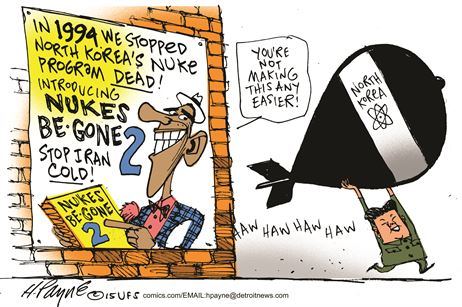
Cartoons of the day

September 18, 2015

H/t Freedom is just another word


begone
invited

Democrats Explain the Iran Deal | SUPERcuts! #237

September 17, 2015


These Democrats all voted for the Iran deal, and even they know it’s terrible.

The nuclear option to stop the nuclear Iran?

September 16, 2015

The nuclear option to stop the nuclear Iran? Power LineSteven Hayward, September 16, 2015

No, I’m not talking about using nuclear weapons to stop Iran from getting nuclear weapons, though I have several times over the last few years heard from very knowledgeable and well-placed people in the defense and foreign policy community that if it comes down to Israel having to defend itself alone against the imminent deployment of Iranian nukes they might have to resort to using their nuclear capacities to stop it, because they lack our conventional capacity to penetrate Iran’s hardened nuclear facilities. It would be an awful moment for the world as well as Israel itself, but it serves as a prompt to ponder the consequences of Obama’s obvious decision to take U.S. military action off the table.

Rather, I’m speaking of using the so-called “nuclear option” in the Senate to abolish the filibuster for a vote on the disapproval of this terrible agreement, which right now Senate Democrats will block with a filibuster so they don’t have to go on record with a vote, and so Obama won’t have to cast an unpopular veto. With polls showing that public support for the Iran agreement is as low as 21 percent, Senate Republicans can quote Harry Reid’s arguments for invoking the “nuclear option” for confirming judges last session: surely having the Senate cast a vote on this treaty is way more important than confirming judges? Make Obama veto the bill disapproving the deal, and make Senate Democrats vote against overriding the veto.

If the Senate GOP took this step, it would go a long way toward showing the conservative grassroots that they can indeed stand up to Obama and the Democrats on the Hill. Plus they’d be reasserting their constitutional duty to render “advice and consent” on treaties, even if Obama has evaded this constitutional requirement by calling it an “executive agreement.”