Posted tagged ‘P5+1’

Iran Deal: Europe’s Chief Negotiator Sympathized with Iran

July 21, 2015

Iran Deal: Europe’s Chief Negotiator Sympathized with Iran, Gatestone InstituteGeorge Igler, July 21, 2015

  • “Islam belongs in Europe… I am not afraid to say that political Islam should be part of the picture.” — Federica Mogherini.
  • Under the treaties establishing the EU, there are no democratic checks on figures such as Mogherini or on the enormous power they wield.
  • “It was Hamas’s strategy, not illegal Israeli action — as this report shamefully alleges without a shred of evidence — that was the reason why over 1,000 civilians died in Gaza.” — Col. Richard Kemp.
  • As a result of the border policies imposed by Mogherini, ISIS’s scheme to augment such a migrant flow with jihadists is now being accomplished.
  • Mogherini, the official responsible for the EU’s borders represents a sheltered elite, convinced that the solution to problems in the Middle East and North Africa is importing their populations into Europe.

Given the capitulation to Iran’s geopolitical ambitions represented by the agreement reached in Vienna on July 14, a spotlight is likely to fall on the pivotal role played by Europe’s chief diplomat.

Few guessed that while stating the “security of the world” was at stake during negotiations with the Islamic Republic of Iran, Federica Mogherini also felt “political Islam” should be a part of Europe’s future.
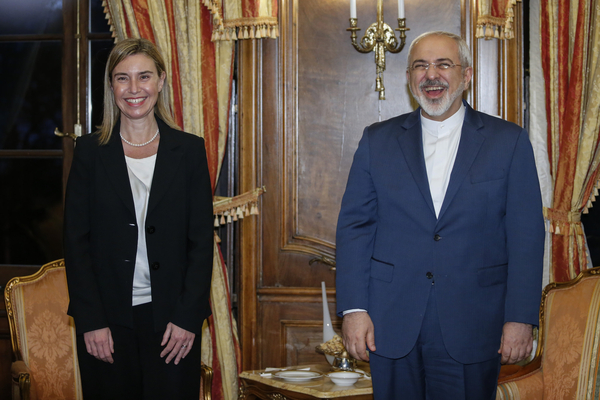
1163Not funny. Federica Mogherini (left) represented the European Union in nuclear negotiations with the Islamic Republic of Iran, a millenarian Shi’ite theocracy that calls for the annihilation of America and Israel. At right, Iran’s foreign minister, Javad Zarif. (Image source: European Union)

The European Union’s unelected High Representative for Foreign Affairs and Security Policy made her pro-Islamist remarks in a speech delivered last month in Brussels.

While heading up Europe’s combined delegation in the Austrian capital, and purportedly tasked with staving off Iran’s nuclear capabilities, Mogherini, a former member of the Italian Communist Youth Federation, also took to tweeting in Arabic.

The assertions made by Mogherini to the Islam in Europe conference, before she left for Vienna, reveal the thinking of a key figure behind the dangerous concessions given to Iran as a result of its continued intransigence and the West’s continued surrender to it.

It should therefore surprise no one that Syria’s President Assad has congratulated Ayatollah Ali Khamenei on his “great victory” in negotiations from which the Jewish state — which had the most to lose based on Iran’s constant threats to obliterate it — was excluded.

As talks progressed, the Supreme Leader of Iran was pictured trampling on an Israeli flag, with the accompanying caption on Khamenei’s official website reading: “The Zionist regime is condemned to vanish.”

Mogherini first gained notoriety after her statement to the United Nations Security Council on May 11, during which she dismissed pushbacks against the flood of migrants illegally crossing the Mediterranean.

As a consequence of the border policies of the European Commission, of which Mogherini is also Vice-President, the number of immigrants pouring into Europe by land has now exceeded those crossing by sea.

Local authorities in Hungary are struggling to cope with refugee camps filled with rioting migrants shouting “Allahu Akbar!” (Arabic for “Allah is Greater!”).

There seems no recognition of the generosity of a nation that is exhausting its resources to give Muslims asylum from conflict.

The speech given by Mogherini in Brussels on June 24 demonstrates why she believes that the growing migration crisis her actions have orchestrated should be welcomed:

“Islam holds a place in our Western societies. Islam belongs in Europe. It holds a place in Europe’s history, in our culture, in our food and — what matters most — in Europe’s present and future. Like it or not, this is the reality.”

She continued:

“We need to show some humble respect for diversity. Diversity is the core feature of our European history, and it is our strength. … We need to understand diversity, understand complexity. … For this reason I am not afraid to say that political Islam should be part of the picture.”

Under the treaties establishing the EU, there are no democratic checks on figures such as Mogherini or on the enormous power they wield. Only representatives elected to the European Parliament can quiz members of the European Commission.

There is also no democratic way for MEPs to repeal any of the laws applied across the EU, authored by the commission’s bureaucrats, or to fire any of its officials.

Regrettably, Mogherini’s speech chose not to delve into which aspects of the “diversity” represented by “political Islam” Europe should embrace: The subhuman status afforded to non-Muslims such as Christians and Jews, perhaps; or the death sentence faced by Muslims who seek to leave Islam or reform it? Or maybe the codified inferiority of females, or the view that democracy, made by man and not Allah is illegitimate, or that it is permissible to counter free speech with violence?

Mogherini’s speech in Brussels — added to the July 3 vote at the UN Human Rights Council (UNHRC) of several European nations in favor of a resolution condemning Israel for war crimes — also highlight a grim reality when viewed in the context of the West’s concessions to Iran.

While political leaders in Europe seek to placate their Muslim populations, Israel is faced with even fewer reliable allies on the world stage as the prospect of a nuclear Iran looms larger.

The UNHRC’s resolution targeting Israel had been prompted by a UNHRC report into last year’s Gaza conflict, during which the Israeli Defense Force had sought to protect the country’s population against constant and indiscriminate rocket attacks.

In an address on June 29, Britain’s Col. Richard Kemp urged the UNHRC to deal with the reality of events in Gaza last summer:

“Hamas sought to cause large numbers of casualties among their own people, in order to bring international condemnation against Israel, especially from the United Nations. … It was Hamas’s strategy, not illegal Israeli action as this report shamefully alleges without a shred of evidence, that was the reason why over 1,000 civilians died in Gaza.”

With only the US voting against the resulting “anti-Israeli manifesto” it was nevertheless endorsed by European nations including France, Germany, the UK, Ireland, and the Netherlands.

As a consequence of several international treaties, these countries and 23 others have unified executive authority on issues of foreign policy into the institutions of the European Union.

To those arguing with the EU’s head of security policy that, “more Muslims in Europe will be the end of Europe,” Mogherini has a curt answer:

“These people are not just mistaken about Muslims: these people are mistaken about Europe – that is my core message – they have no clue what Europe and the European identity are.”

Claiming that “Islam is a victim,” Mogherini went on to stress that the “caliphate” declared last year by ISIS under the name of the Islamic State, represents “an unprecedented attempt to pervert Islam.”

Led by “caliph” Abu Bakr al-Baghdadi, in February ISIS announced its intention to export 500,000 migrants to Europe to create chaos. As his nom de guerre suggests, the PhD in Islamic Studies possessed by Dr. Ibrahim al-Badri comes from the city where the Koran was compiled.

Federica Mogherini’s claim to have a better grasp of political Islam stems from an undergraduate paper she once authored on the subject.

As a result of the border policies imposed by Mogherini, the president of the EU’s judicial cooperation agency, Michèle Coninsx, confirmed on July 6 that ISIS’s scheme to augment such a migrant flow with jihadists is now being accomplished.

It is hard not to conclude that the official responsible for the EU’s borders represents a sheltered elite, convinced that the solution to problems in the Middle East and North Africa is importing their populations into Europe.

Using an Arabic euphemism to describe the Islamic State, Mogherini’s speech concluded:

“Western media like to refer to Da’esh with the word ‘medieval’. This does not help much to understand the real nature of the threat we are facing. Da’esh is something completely new.”

The EU’s chief representative to the talks in Vienna could have done with visiting the museum located on the city’s Karlsplatz. There can be found the following demand for surrender, issued against the Viennese, which post-dates the medieval period by two centuries:

“We order you to wait for us at your residences in the city so we can decapitate you. It will be a pleasure for me to publicly establish my religion and to pursue your crucified god. I will put your sacred priests to the plough and rape your nuns. Forsake your religion or else I will give the order to consume you with fire.”

It was authored by the Muslim caliph reigning in 1683.

When it comes to political Islam, Federica Mogherini is evidently incapable of differentiating between behaviors that are “completely new,” and those that form an established pattern.

That failure makes the diplomatic surrender to the Islamic Republic of Iran, being portrayed by President Obama as a path to a “more hopeful world,” easier to comprehend.

The West’s negotiations were conducted with a millenarian Shi’ite theocracy that calls for the annihilation of America and Israel.

Speaking of the Iran deal (4)

July 21, 2015

Speaking of the Iran deal (4), Power LineScott Johnson, July 21, 2015

Omri Ceren writes to draw attention to Bill Gertz’s Free Beacon article on the ludicrous inspections regime established under the deal with Iran. Omni writes:

Last April – in the immediate days after the Lausanne framework was announced – Obama administration officials assured reporters that it was a good deal because the verification regime would include anytime/anywhere inspections [a][b][c]. Then there was a range of hearings and forums held in early June – which was the lead-up to Vienna – at which IAEA veterans, nuclear experts, and top US intelligence officials confirmed that indeed anytime/anywhere access to suspicious sites was a minimum prerequisite to verifying a deal with Iran [d][e][f][g]).

Then the Vienna talks began and it became clear that the administration would cave to Iranian intransigence on verification. White House validators started trying to convince reporters that technology could be a substitute for robust access [h][i].

Then the talks ended and it was confirmed that Iran will be allowed to block IAEA inspectors for 24 days at a time. The administration is doubling down on the technology talking point and making it mostly about “environmental sampling.” White House communications staffers have begun using the phrase as their two-word answer to any questions about the collapse on inspections. Energy Secretary Moniz repeated it over and over again on last weekend’s Sunday talk shows [j]. White House validators got the hint and have begun invoking it as well yesterday [k]. The argument is that the IAEA’s technology is so good that – even though they have almost a month to destroy evidence – the Iranians could never “sanitize” a site so well that the IAEA couldn’t detect nuclear activity.

There are a couple of reasons why that argument doesn’t hold up.

(1) Diplomatic – Even if the IAEA could detect that *some* kind of nuclear activity had occurred in a sanitized site, the Iranians will have destroyed enough evidence to prevent the agency from determining *what* kind of activity occurred. The goal of verification is not just detection but detection to a sufficient degree that a diplomatic response can be justified. No country is going to be confident enough to blow up the deal without the IAEA being certain that significant cheating had occurred, and being able to explain what it was.

(2) Scientific – It’s just not true. The IAEA’s technology is not good enough. A month isn’t enough time for the Iranians to dismantle a big site like Natanz, but that’s not where they’ll cheat. They’ll cheat in smaller facilities that can be easily dismantled and scrubbed in a couple of weeks. Olli Heinonen – who is the former Deputy Director General of the IAEA, and who worked at the agency for 27 years, and who sat atop its verification shop as head of the Department of Safeguards – explained to reporters today that the Iranians could assemble all the parts they needed for a nuclear bomb in a building that’s just 239 square yards [full article linked above]. And unlike a facility like Natanz, small buildings can in fact be sanitized in 24 days:

Much of this equipment is very easy to move… So you can take it out over the night… and then there is this dispute settlement time which is 24 days – you will use that to sanitize the place, make new floors, new tiles on the wall, paint the ceiling and take out the ventilation… This [nuclear] equipment can be taken out in one or two nights. How long will it take for you to renovate your home? It doesn’t take three weeks… Secretary Kerry has said if there is big installation, 24 days is enough… But there are certain activities where unfortunately in my view, it’s not enough.

This isn’t a theoretical debate. In 2003 the Iranians delayed access to the Kalaye Electric Company for two weeks and completely scrubbed it. They pulled the same trick with the Lashkar Abad laser uranium enrichment plant.

It’s just not true that they can’t dismantle a covert facility in 24 days, and even if it was true they could still dismantle enough to ensure that no country would be confident enough to call them out for cheating.

[a] https://youtu.be/ObV5motay7E?t=1m18s
[b] http://www.timesofisrael.com/top-obama-adviser-dismisses-idea-that-better-iran-deal-is-possible/
[c] http://www.bloomberg.com/politics/articles/2015-04-20/inspectors-need-full-access-in-any-iran-nuclear-deal-moniz-says
[d] http://www.foreign.senate.gov/imo/media/doc/062515_Albright_Testimony.pdf
[e] http://www.foreign.senate.gov/imo/media/doc/062515_Albright_Testimony.pdf
[f] http://taskforceoniran.org/transcripts/Looming_Deadline_Event.pdf
[g] http://docs.house.gov/meetings/FA/FA13/20150610/103582/HHRG-114-FA13-Wstate-FlynnM-20150610.pdf
[h] http://www.nytimes.com/2015/07/07/world/middleeast/nuclear-inspectors-await-chance-to-use-modern-tools-in-iran.html
[i] http://www.thedailybeast.com/articles/2015/07/06/the-spy-tech-that-will-keep-iran-in-line.html
[j] http://www.powerlineblog.com/archives/2015/07/speaking-of-the-iran-deal-2.php
[k] http://www.msnbc.com/msnbc/qa-hans-blix-iran-deal-remarkably-far-reaching

Iran Scoffs at ‘Non-Binding’ Ban on Ballistic Missiles

July 21, 2015

Missiles

Zarif says Iran can continue making ballistic missiles because the agreement’s ban is “non-binding.”

By: Tzvi Ben-Gedalyahu

Published: July 21st, 2015

via The Jewish Press » » Iran Scoffs at ‘Non-Binding’ Ban on Ballistic Missiles.


Iranian long-range Shahab-1 missiles.
Photo Credit: Press TV

Iran’s Foreign Minister buried the Obama administration’s claim that the nuclear agreement will curtail Iran’s ballistic missile production and maintained that the prohibition is in a non-binding appendix of “ObamaDeal.”

Foreign Minister Javad Zarif was quoted by the state-controlled Fars News Agency as saying:

Using ballistic missiles doesn’t violate the Joint Comprehensive Plan of Action (JCPOA); it is a violation of a paragraph in the annex of the (UN Security Council) Resolution (2231) which is non-binding

This paragraph (of the annex) speaks about missiles with nuclear warheads capability and since we don’t design any of our missiles for carrying nuclear weapons, therefore, this paragraph is not related to us at all.

That is pretty fancy mouth-work, even better than President Barack Obama’s.

Zarif is laughing all the way to the nuclear bank. He admits that the nuclear agreement prohibits ballistic missiles but since it is non-binding, so what?

And it doesn’t make any difference because the missiles are not meant for carrying nukes.

If anyone wants to inspect the military sites to make sure he is telling the truth, he can’t because military sites are off-limits. The Islamic Republic’s international affairs adviser to the regime stressed on Tuesday that Iran will not allow international inspectors visit our military centers and interfere in decisions about the type of Iran’s defensive weapons.”

Velayati added:

Missiles like Shahab, Sejjil and the like, have never been used for carrying nuclear warheads, and therefore, are not subject to the paragraphs of the Vienna draft agreement.

Just take his word for it.

Zarif’s Foreign Ministry reassured everyone who still is listening that “Iran will continue its pioneering role in campaign against terrorism and violent extremism.”

For the record, just in case Congressional Democrats are awake, Joint Chiefs Chairman Gen. Martin Dempsey told a Senate committee just before ObamaDeal was concluded:

We should under no circumstances relieve pressure on Iran relative to ballistic missile capabilities and arms trafficking.

Secretary of Defense Secretary Ash Carter, who is in Israel to go through the motions that ObamaDeal is good for Israel, told the Senate Armed Services Committee:

We want them [Iran] to continue to be isolated as a military and limited in terms of the kinds of equipment and material they are able to procure.

That is what he wants. That is not what he – and Israel – is going to get.

Kerry doesn’t know how to “interpret” Iran’s vow to fund terrorists

July 21, 2015

Kerry doesn’t know how to “interpret” Iran’s vow to fund terrorists, Front Page Magazine, Daniel Greenfield, July 21, 2015

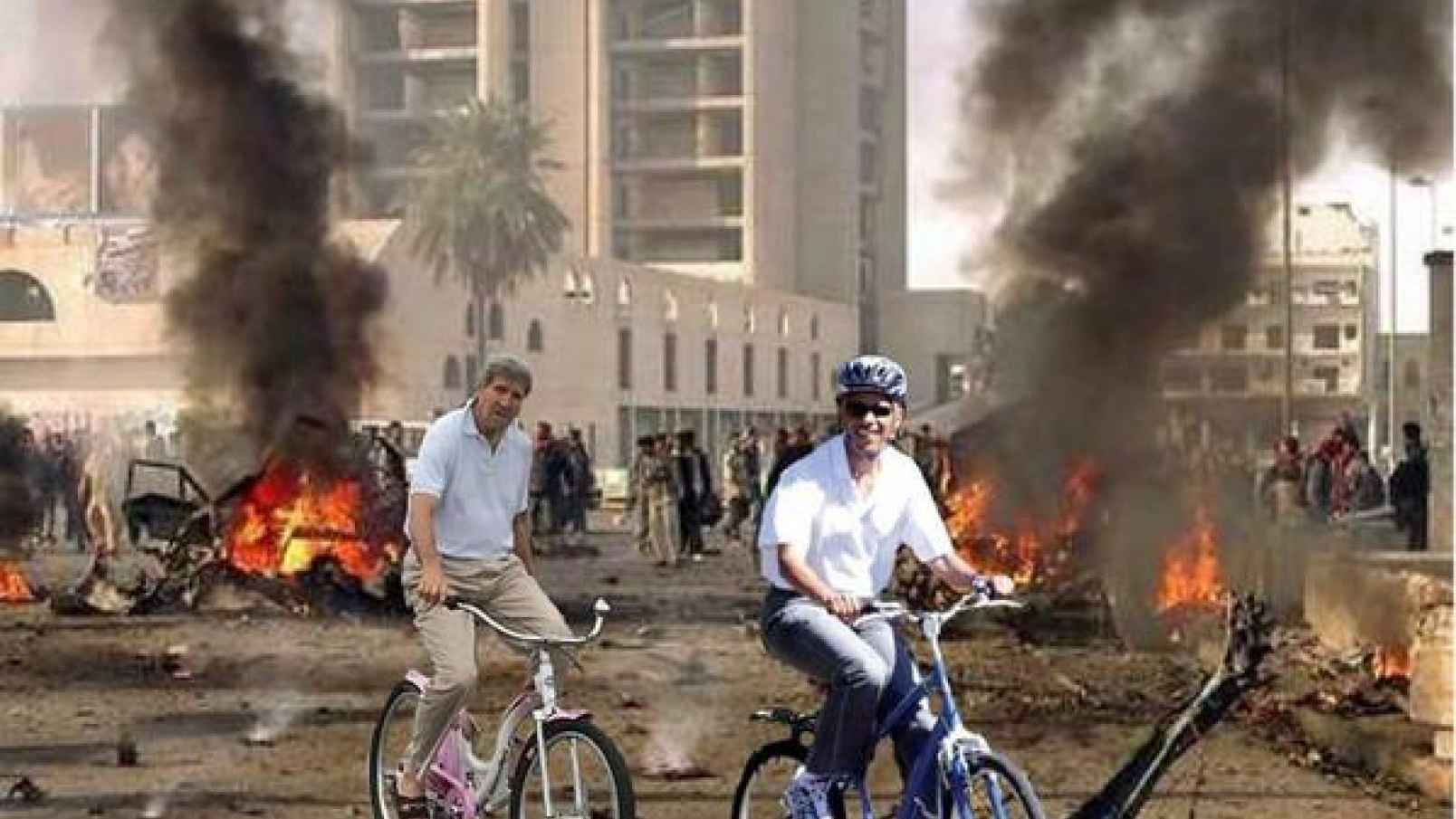
obama_kerry_bikes

John is going to have to go courting another terror state. North Korea has preemptively turned him down, but maybe Kerry can windsurf his way into North Korea and promise lots and lots of money if its dictator will pose for some photos in Vienna with America’s dumbest traitor.

*********************

Only liberals seem to need an interpretation of “Death to America”. John Kerry meanwhile wanders around the Middle East trying to interpret what Iran means when it vows to fund terrorists and fight America.

US Secretary of State John Kerry has acknowledged that Iranian Supreme Leader Ayatollah Ali Khamenei’s continued vows to defy the US are “very disturbing.”

“I don’t know how to interpret it at this point in time, except to take it at face value, that that’s his policy,” Kerry told Saudi-owned television station Al-Arabiya Tuesday. “But I do know that often comments are made publicly and things can evolve that are different. If it is the policy, it’s very disturbing, it’s very troubling.”

Don’t worry, given a little time, Kerry will find a way to interpret these comments not at “face value”.

Iran’s Supreme Leader Khamenei gave a particularly inflammatory speech just days after the deal, stating that the Islamic Republic’s policies toward the US have not changed.

“We will never stop supporting our friends in the region and the people of Palestine, Yemen, Syria, Iraq, Bahrain and Lebanon,” he continued, referring to the Iranian terror axis in the Middle East. “Even after this deal our policy towards the arrogant US will not change.”

Go and interpret a vow to keep funding Hezbollah, Hamas, the Houthis and Assad while fighting the US in the most positive way possible. If you’re good enough at it, you can get a gig at the State Department.

But you have to feel sorry for John Kerry, who pushed the Iran deal claiming that it would lead to a new era of diplomacy with Iran. Now John has been jilted once again. The Supreme Leader doesn’t seem to want to be his friend after all. Soon the Foreign Minister of Iran will stop returning his phone calls as soon as Iran gets $150 billion in sanctions relief.

And John is going to have to go courting another terror state. North Korea has preemptively turned him down, but maybe Kerry can windsurf his way into North Korea and promise lots and lots of money if its dictator will pose for some photos in Vienna with America’s dumbest traitor.

A Historic Catastrophe

July 21, 2015

A Historic Catastrophe, Rasmussen Reports, Thomas Sowell, July 21, 2015

[H]e has maneuvered the Republican-controlled Congress into a position where they will need a two-thirds majority in both Houses to prevent his unilaterally negotiated agreement from going into effect — just by not calling it a treaty. 

If he is that savvy at home, why is he so apparently incompetent abroad? Answering that question may indeed require us to “think the unthinkable,” that we have elected a man for whom America’s best interests are not his top priority.

********************

Distinguished scientist Freeman Dyson has called the 1433 decision of the emperor of China to discontinue his country’s exploration of the outside world the “worst political blunder in the history of civilization.”

The United States seems at this moment about to break the record for the worst political blunder of all time, with its Obama administration deal that will make a nuclear Iran virtually inevitable.

Already the years-long negotiations, with their numerous “deadlines” that have been extended again and again, have reduced the chances that Israel can destroy the Iranian nuclear facilities, which have been multiplied and placed in scattered underground sites during the years when all this was going on.

Israel is the only country even likely to try to destroy those facilities, since Iran has explicitly and repeatedly declared its intention to wipe Israel off the face of the earth.

How did we get to this point — and what, if anything, can we do now? Tragically, these are questions that few Americans seem to be asking. We are too preoccupied with our electronic devices, the antics of celebrities and politics as usual.

During the years when we confronted a nuclear-armed Soviet Union, we at least realized that we had to “think the unthinkable,” as intellectual giant Herman Kahn put it. Today it seems almost as if we don’t want to think about it at all.

Our politicians have kicked the can down the road — and it is the biggest, most annihilating explosive can of all, that will be left for our children and grandchildren to try to cope with.

Back in the days of our nuclear standoff with the Soviet Union, some of the more weak-kneed intelligentsia posed the choice as whether we wanted to be “red or dead.” Fortunately, there were others, especially President Ronald Reagan, who saw it differently. He persevered in a course that critics said would lead to nuclear war. But instead it led to the peaceful conclusion of the Cold War.

President Barack Obama has been following opposite policies, and they are likely to lead to opposite results. The choices left after Iran gets nuclear bombs — and intercontinental missiles that can deliver them far beyond Israel — may be worse than being red or dead.

Bad as life was under the communists, it can be worse under nuclear-armed fanatics, who have already demonstrated their willingness to die — and their utter barbarism toward those who fall under their power.

Americans today who say that the only alternative to the Obama administration’s pretense of controlling Iran’s continued movement toward nuclear bombs is war ignore the fact that Israel bombed Saddam Hussein’s nuclear facilities, and Iraq did not declare war. To do so would have risked annihilation.

Early on, that same situation would have faced Iran. But Obama’s years-long negotiations with Iran allowed the Iranian leaders time to multiply, disperse and fortify their nuclear facilities.

The Obama administration’s leaking of Israel’s secret agreement with Azerbaijan to allow Israeli warplanes to refuel there, during attacks on Iran’s nuclear facilities, was a painfully clear sabotage of any Israeli attempt to destroy those Iranian facilities.

But the media’s usual practice to hear no evil, see no evil and speak no evil in the Obama administration buried this news, and allowed Obama to continue to pose as Israel’s friend, just as he continued to assure Americans that, if they liked their doctor they could keep their doctor.

Some commentators have attributed Barack Obama’s many foreign policy disasters to incompetence. But he has been politically savvy enough to repeatedly outmaneuver his opponents in America. For example, the Constitution makes it necessary for the President to get a two-thirds majority in the Senate to make any treaty valid. Yet he has maneuvered the Republican-controlled Congress into a position where they will need a two-thirds majority in both Houses to prevent his unilaterally negotiated agreement from going into effect — just by not calling it a treaty.

If he is that savvy at home, why is he so apparently incompetent abroad? Answering that question may indeed require us to “think the unthinkable,” that we have elected a man for whom America’s best interests are not his top priority.


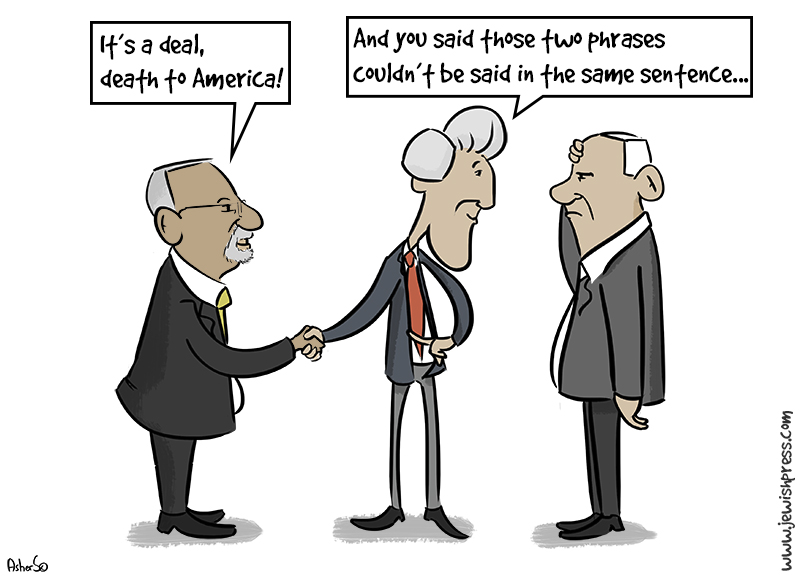
Cartoon of the day

July 21, 2015

H/t The Jewish Press


two-phrases

The Iranian Nuke Deal Depends on This One Myth

July 21, 2015

The Iranian Nuke Deal Depends on This One Myth

Iran just wants a lower electricity bill.

July 21, 2015

Daniel Greenfield

via The Iranian Nuke Deal Depends on This One Myth | Frontpage Mag.

Last year Iran was selling gasoline for less than 50 cents a gallon. This year a desperate regime hiked prices up to over a dollar. Meanwhile, Iranians pay about a tenth of what Americans do for electricity.

Unlike Japan, Iran does not need nuclear power. It is already sitting on a mountain of gas and oil.

Iran blew between $100 billion to $500 billion on its nuclear program. The Bushehr reactor alone cost somewhere in the neighborhood of $11 billion making it one of the most expensive in the world.

This wasn’t done to cut power bills. Iran didn’t take its economy to the edge for a peaceful nuclear program. It built the Fordow fortified underground nuclear reactor that even Obama admitted was not part of a peaceful nuclear program, it built the underground Natanz enrichment facility whose construction at one point consumed all the cement in the country, because the nuclear program mattered more than anything else as a fulfillment of the Islamic Revolution’s purpose.

Iran did not do all this so that its citizens could pay 0.003 cents less for a kilowatt hour of electricity.

It built its nuclear program on the words of the Ayatollah Khomeini, “Islam makes it incumbent on all adult males, provided they are not disabled or incapacitated, to prepare themselves for the conquest of [other] countries so that the writ of Islam is obeyed in every country in the world.”

Iran’s constitution states that its military is an “ideological army” built to fulfill “the ideological mission of jihad in Allah’s way; that is, extending the sovereignty of Allah’s law throughout the world.”

It quotes the Koranic verse urging Muslims to “strike terror into (the hearts of) the enemies, of Allah”.

Article 3 of Iran’s Constitution calls for a foreign policy based on “unsparing support” to terrorists around the world.  Article 11, the ISIS clause, demands the political unity of the Islamic world.

Iran is not just a country. It is the Islamic Revolution, the Shiite ISIS, a perpetual revolution to destroy the non-Muslim world and unite the Muslim world. Over half of Iran’s urban population lives below the poverty line and its regime sacrificed 100,000 child soldiers as human shields in the Iran-Iraq War.

Iran did not spend all that money just to build a peaceful civilian nuclear program to benefit its people. And yet the nuclear deal depends on the myth that its nuclear program is peaceful.

Obama insisted, “This deal is not contingent on Iran changing its behavior.” But if Iran isn’t changing its behavior, if it isn’t changing its priorities or its values, then there is no deal.

If Iran hasn’t changed its behavior, then the nuclear deal is just another way for it to get the bomb.

If Iran were really serious about abandoning a drive for nuclear weapons, it would have shut down its nuclear program. Not because America or Europe demanded it, but because it made no economic sense. For a fraction of the money it spent on its nuclear ambitions, it could have overhauled its decaying electrical grid and actually cut costs. But this isn’t about electricity, it’s about nuclear bombs.

The peaceful nuclear program is a hoax. The deal accepts the hoax. It assumes that Iran wants a peaceful nuclear program. It even undertakes to improve and protect Iran’s “peaceful” nuclear technology.

The reasoning behind the nuclear deal is false. It’s so blatantly false that the falseness has been written into the deal. The agreement punts on the military dimensions of Iran’s nuclear program and creates a complicated and easily subverted mechanism for inspecting suspicious programs in Iranian military sites.

It builds in so many loopholes and delays, separate agreements and distractions, because it doesn’t really want to know. The inspections were built to help Iran cheat and give Obama plausible deniability.

With or without the agreement, Iran is on the road to a nuclear bomb. Sanctions closed some doors and opened others. The agreement opens some doors and closes others. It’s a tactical difference that moves the crisis from one stalemate to another. Nothing has been resolved. The underlying strategy is Iran’s.

Iran decided that the best way to conduct this stage of its nuclear weapons program was by getting technical assistance and sanctions relief from the West. This agreement doesn’t even pretend to resolve the problem of Iran’s nuclear weapons. Instead its best case scenario assumes that years from now Iran won’t want a nuclear bomb. So that’s why we’ll be helping Iran move along the path to building one.

It’s like teaching a terrorist to use TNT for mining purposes if he promises not to kill anyone.

But this agreement exists because the West refuses to come to terms with what Islam is. Successful negotiations depend on understanding what the other side wants. Celebratory media coverage talks about finding “common ground” with Iran. But what common ground is there with a regime that believes that America is the “Great Satan” and its number one enemy?

What common ground can there be with people who literally believe that you are the devil?

When Iranian leaders chant, “Death to America”, we are told that they are pandering to the hardliners. The possibility that they really believe it can’t be discussed because then the nuclear deal falls apart.

For Europe, the nuclear agreement is about ending an unprofitable standoff and doing business with Iran. For Obama, it’s about rewriting history by befriending another enemy of the United States. But for Iran’s Supreme Leader, it’s about pursuing a holy war against the enemies of his flavor of Islam.

The Supreme Leader of Iran already made it clear that the war will continue until America is destroyed. That may be the only common ground he has with Obama. Both America and Iran are governed by fanatics who believe that America is the source of all evil. Both believe that it needs to be destroyed.

Carter made the Islamic Revolution possible. Obama is enabling its nuclear revolution.

Today Tehran and Washington D.C. are united by a deep distrust of America, distaste for the West and a violent hatred of Israel. This deal is the product of that mutually incomprehensible unity. It is not meant to stop Iran from getting a nuclear bomb. It is meant to stop America and Israel from stopping it.

Both Obama and the Supreme Leader of Iran have a compelling vision of the world as it should be and don’t care about the consequences because they are convinced that the absolute good of their ideology makes a bad outcome inconceivable.

“O Allah, for your satisfaction, we sacrificed the offspring of Islam and the revolution,” a despairing Ayatollah Khomeini wrote after the disastrous Iran-Iraq War cost the lives of three-quarters of a million Iranians. The letter quoted the need for “atomic weapons” and evicting America from the Persian Gulf.

Four years earlier, its current Supreme Leader had told officials that Khomeini had reactivated Iran’s nuclear program, vowing that it would prepare “for the emergence of Imam Mehdi.”

The Islamic Revolution’s nuclear program was never peaceful. It was a murderous fanatic’s vision for destroying the enemies of his ideology, rooted in war, restarted in a conflict in which he used children to detonate land mines, and meant for mass murder on a terrible scale.

The nuclear agreement has holes big enough to drive trucks through, but its biggest hole is the refusal of its supporters to acknowledge the history, ideology and agenda of Iran’s murderous tyrants. Like so many previous efforts at appeasement, the agreement assumes that Islam is a religion of peace.

The ideology and history of Iran’s Islamic Revolution tells us that it is an empire of blood.

The agreement asks us to choose between two possibilities. Either Iran has spent a huge fortune and nearly gone to war to slightly lower its already low electricity rates or it wants a nuclear bomb.

The deal assumes that Iran wants lower electricity rates. Iran’s constitution tells us that it wants Jihad. And unlike Obama, Iran’s leaders can be trusted to live up to their Constitution.

Iranian President Rouhani Describes Nuclear Deal, Says: The Superpowers Have Officially Recognized A Nuclear Iran

July 21, 2015

Iranian President Rouhani Describes Nuclear Deal, Says: The Superpowers Have Officially Recognized A Nuclear Iran

ByPamela Geller on July 20, 2015

via Iranian President Rouhani Describes Nuclear Deal, Says: The Superpowers Have Officially Recognized A Nuclear Iran | Pamela Geller.

ihadis with nukes, that’s Obama’s legacy. And remember, he was desperate for this surrender. He usurped Congress, the American people, and our allies — his name will go down in history as one of the most notorious enemies of freedom.
“Iranian President Rouhani Describes Nuclear Deal, Says: The Superpowers Have Officially Recognized a Nuclear Iran,” MEMRI TV, July 20, 2015

On July 14, Iranian President Hassan Rouhani delivered a speech detailing the accomplishments of the new nuclear deal. President Rouhani declared that prayers of the Iranian nation had been answered and described the deal as a “win-win,” adding that Iran was not seeking a nuclear bomb.
Following are excerpts:

Screen Shot 2015-07-20 at 8.21.53 PM

Rouhani: “I hereby declare to the great Iranian people that their prayers have been answered. Today, we are at an important stage in the history of our state and of our [Islamic] Revolution, and in the history of conditions in the region – conditions that, I must say, have continued for the past 12 years, and which were accompanied by illusions on the part of the superpowers, which spread them throughout society and throughout public opinion. The page has been turned over, and a new page has begun.

[…]

“In order to resolve the nuclear issue, we had to take necessary steps in various areas. With regard to politics, we had to prepare the necessary preliminary political steps. With regard to [Iranian] public opinion, [we had to make] them realize that the negotiations were not a recitation of statements, but a give and take. Negotiations mean paying money and buying the desired house. We did not seek charity or to get something for free. We sought negotiations, and sought to advance a fair and just give and take, based on national interests. We have always stressed the point that these negotiations would not be a ‘win-lose’ situation, because such talks are not viable. If negotiations are ‘win-lose,’ they will not be lasting. Negotiations and agreements will be durable and lasting when they are win-win situations for both parties. We explained this to our society, and our negotiation team began the talks on this basis 23 months ago.

[…]

“From the day that I was sworn in [as president], I said that the West would be able to engage in talks with us if it abandons the path of threats and humiliation and embarks upon a path of respect. What was achieved today under the title of the Joint Comprehensive Plan of Action is rooted in dialogue on the part of Iran and respect on the part of the P5+1. Without these two components, we would not have achieved a thing.

[…]

Capture07203.JPG

“In the negotiations we sought to achieve four goals. The first goal was to continue the nuclear capabilities, the nuclear technology, and even the nuclear activity within Iran. The second goal was to lift the mistaken, oppressive, and inhumane sanctions. The third goal was to remove all the UN Security Council Resolutions that we view as illegal. The fourth goal was to remove the Iranian nuclear dossier from Chapter VII of the UN Charter and from the Security Council in general. In today’s agreement, in the Joint Comprehensive Plan of Action, all four goals have been achieved.

Capture07208.JPG

“At the beginning of negotiations, the other side used to tell us that during the period of restrictions – which today is set at eight years – Iran would be able to have only 100 centrifuges. After many deliberations, they have reached the figure of 1,000 centrifuges. Following much opposition on our part, they said: ‘4,000 centrifuges, and that’s final.’ Today, the agreement specifies that Iran will retain over 6,000 centrifuges, of which 5,000 will be at Natanz and over 1,000 at Fordo. All the centrifuges at Natanz will continue to enrich [uranium].

Capture07204.JPG

“They said: ‘The period of your restrictions will be 20 years, in addition to 25 years.’ Later they said: ’20 years and 10 years.’ Then they said: ‘Our last word is 20 years, and we will not capitulate any further.’ In the final days of the negotiations, these 20 years shrank to eight years.

“On the issue of research and development, they used to say that Iran would be allowed only [first-generation] IR-1 [centrifuges]. This was ridiculous and unrealistic. Research and development under such conditions is meaningless. Then they said: ‘IR-2 at most.’ Eventually they said: ‘IR-8 is impossible.’ What Iran sought was IR-6 and IR-8 centrifuges. We wanted an agreement in which we would begin, on the very day of its implementations, to inject UF-6 gas into [advanced] IR-8 centrifuges. That is exactly the agreement that we achieved today.

“On the issue of Arak, they used to say: ‘The reactor can remain, but not as a heavy water facility. This is an absolute red line for us.’ Today, according to the terms agreed upon, the joint agreement explicitly mentions the Arak heavy water reactor. This reactor will be completed with the same heavy water nature, and with the characteristics specified in the agreement.

“On the issue of Fordo, they used to say: ‘It is hard to pronounce the name Fordo, even harder to hear it, so you will not say it and we will not hear it.’ Then they said: ‘At Fordo there should not be a single centrifuge, and it will be a center for isotope research.’ After months of bargaining they said: ‘Only one cascade of 164 centrifuges will remain at Fordo.’ Let me say, in a nutshell, that today, over 1,000 centrifuges will be installed at Fordo, and that part of Fordo will be used for research and development of stable isotopes.

Capture07205.JPG

“On the issue of sanctions they used to say: ‘The lifting of all the sanctions all at once – never. As for the gradual lifting of the sanctions, first you need to gain our trust over the course of months, and even then, the sanctions will be gradually frozen, not lifted. Do not use the term “lift the sanctions.” We will freeze them.’ [They further said]: ‘In the years to come, if the IAEA issues a positive report and you gain our trust, the sanctions will be gradually lifted.’ Today I declare before the honorable Iranian nation that according to the agreement, on the day of its implementation, all the sanctions – even the embargo on weapons, missiles, and [dual-use technology] proliferation – will be lifted, as is stated in a [Security Council] resolution. All the financial sanctions, all the banking sanctions, and all the sanctions pertaining to insurance, transportation, petrochemical [industries], and precious metals, and all the economic sanctions will be completely lifted, and not frozen. Even the arms embargo will be stopped. There will be a kind of restriction [on arms] for five years, after which it will be lifted. With regard to proliferation [of dual-use technology], a committee will examine goods with a dual use. With regard to the revocation of the UN [Security Council] resolutions, they used to say: ‘You have not implemented any resolution, so how can we revoke the resolution? At the very least implement it for six months.’

[…]

“According to today’s agreement, which will be approved in the coming days by the UN Security Council, all six previous resolutions [against Iran] will be revoked. With regard to the permanent removal of the Iranian nuclear dossier from the Security Council, they used to say: ‘The IAEA must report for 20 years,’ then ‘for 15 years.’ In today’s [agreement], regardless of the IAEA, after 10 years of implementation of the agreement, the nuclear dossier will be completely removed from the Security Council.

[…]

“This agreement is, of course, reciprocal.

[…]

“Today, [we are talking about] the implementation of a reciprocal agreement. If they adhere to this agreement, we will too. Throughout history, the Iranian nation has always stood behind the treaties to which it committed itself. We will stand firmly behind the current treaty, provided the other side also strictly adheres to it.

[…]

Capture07207.JPG

“This is the most important day in the past 12 years. Historically, this is the day on which all the large countries and the superpowers in the world have officially recognized Iran’s nuclear activities.

[…]

Screen Shot 2015-07-20 at 8.22.23 PM

Cartoon of the day

July 20, 2015

H/t Joopklepzeiker

DAG071515

Islam, Imam Obama, Sir John of Kerry and a great deal for Iran | Part II

July 20, 2015

(The views expressed in this post are mine, and do not necessarily reflect those of Warsclerotic or its other editors. — DM)
Oh what a tangled web we weave, when first we practice to deceive.

Dealing from the Bottom

The current “deal” is based on a long-standing scam

Part I of this series, published on July 14, 2015, pointed out what should be a glaring consistency in the “Joint Comprehensive Plan of Action,” first made available on that date, and the November 24, 2013 Joint Plan of Actionneither provides for any “anytime -anywhere” inspections of Iran’s nuclear weaponization or missile sites. That consistency has been little remarked upon elsewhere.

Secretary Kerry now acknowledges that he never sought such inspections.

Leaving aside the twenty-four day lag between an IAEA request to inspect suspect facilities — which Kerry says is just fine — he claims that we now have a “unique ability” to get the U.N. Security Council to force inspections and reinstate sanctions. However, any effort to do so would almost certainly be vetoed by one or more Security Council members. The permanent members are China, France, Russia, the United Kingdom, and the United States — five of the members of P5+1 which approved the “deal.”

On July 16th, US Under Secretary of State Wendy Sherman said,

“I think this is one of those circumstances where we have all been rhetorical from time to time,” Sherman said in a conference call with Israeli diplomatic reporters. “That phrase, anytime, anywhere, is something that became popular rhetoric, but I think people understood that if the IAEA felt it had to have access, and had a justification for that access, that it would be guaranteed, and that is what happened.” [Emphasis added.]

Kerry also claimed that the massive financial boost for Iran resulting from the lifting of sanctions will not enhance Iran’s support for terrorism.

Speaking to the BBC after the nuclear agreement between Iran and six world powers was reached, Kerry said that the more than $100 billion that Iran is set to receive “is going to make all the difference in the world is just – it’s not true.”

Acknowledging Iran is an international player in wreaking terror across the globe, Kerry said, “What Iran has done for years with Hezbollah does not depend on money.” He similarly stated Iran’s support of the Houthi rebels against the government in Yemen has not “depended on money.” [Emphasis added.]

. . . .

In its most recent report, the State Department wrote, “Iran has provided hundreds of millions of dollars in support of Lebanese Hezbollah in Lebanon and has trained thousands of its fighters at camps in Iran.”

In 2010 alone, State reported “Iran provides roughly $100-$200 million per year in funding to support Hezbollah.”

Secretary Kerry is almost certainly wrong, on that as on other aspects of the “deal.”.

Here’s Megan Kelly’s wrap up.


Iran may reject the “deal.”

There are at least glimmers of hope that Iran may reject the “deal,” unanimously endorsed by the UN Security council today.

A UN Security Council resolution endorsing Iran’s nuclear deal that passed on Monday is unacceptable, the country’s Islamic Revolutionary Guards Corps commander Mohammed Ali Jafari was quoted as saying by the semi-official Tasnim News Agency.

“Some parts of the draft have clearly crossed the Islamic republic’s red lines, especially in Iran’s military capabilities. We will never accept it,” he was quoted as saying shortly before the resolution was passed in New York. [Emphasis added.]

The Iranian Parliament also has problems with the “deal.”

On Saturday, the Fars News Agency reported that the Majlis threatened to reject the agreement’s provision on ballistic missiles, which call for an international embargo on missile technology to be extended for eight years–a significant, last-minute concession by the U.S.

Iran wants unrestricted ballsitic missile development and access to conventional arms dealers abroad.

“The parliament will reject any limitations on the country’s access to conventional weapons, specially ballistic missiles,” said Tehran MP Seyed Mehdi Hashemi.

. . . .

In addition, the nuclear deal says that the Majlis will ratify the Additional Protocol (AP) to the Non-Proliferation Treaty–but it does not say when.

The AP is the key to long-term monitoring of Iranian nuclear research and development by the International Atomic Energy Agency (IAEA). Without approval of the AP, Iran may hide key information about its nuclear activity, and may accelerate advanced centrifuge research immediately when the nuclear deal expires, among other hazards. (Even then, its commitments under the AP will be somewhat voluntary.) [Emphasis added.]

. . . .

[W]hile the interim agreement of Nov. 2013 provided that Iran would ratify the AP within one year, there is no such deadline in the final Iran deal. The AP is merely to be applied “provisionally,” while the Majlis decides whether to accept it or not.

Meanwhile, if the Obama administration has its way, the U.S. Congress will have no opportunity to amend the deal–and will have to accept the lifting of international sanctions regardless of whether legislators accept or reject the agreement. [Emphasis added.]

Iranian leadership’s opposition to the “deal” appears to have come from Iran’s Supreme leader and the Iranian Parliament has the authority to reject the “deal.”

As expected, Ayatollah Ali Khamenei’s reaction to the nuclear deal was utterly different from that of President Hassan Rouhani. Right after the agreement was announced on July 14, Rouhani appeared on state television and praised the outcome. Yet when he and other officials visited Khamenei’s home a few hours later, the Supreme Leader did not say anything about the deal apart from a few lines thanking the negotiators. This reticence signaled to hardliners that they should increase their attacks on the agreement. [Emphasis added.]

America’s Supreme Leader, on the other hand, has been pushing vigorously to force the U.S. Congress to approve it, with no way to change it.


The “deal,” and Obama’s foreign policy in general, are rooted in His affinity for Islam

Obama may or may not be a Muslim. However, He thinks very highly of Islam and deems it the “religion of peace.” It would be ironic were Obama’s Iran “deal” to be rejected by Iran.

As observed in a Jerusalem Post article, with the thrust of which I agree, His affinity for Islam is at the root of His “deal.”

Obama is the first US president who genuinely conceives of Islam as not inherently opposed to American values or interests.

. . . .

It is through this Islamo-philic prism that the Obama administration’s attitude to, and execution of, its foreign policy must be evaluated – including its otherwise incomprehensible capitulation this week on Iran’s nuclear program. [Emphasis added.]

. . . .

The inspection mechanism provided for in the nascent deal make a mockery of Obama’s contention (July 14): “… this deal is not built on trust; it is built on verification,” and, “Because of this deal, inspectors will also be able to access any suspicious location… [They] will have access where necessary, when necessary.”

One can hardly imagine a more grossly misleading representation of the deal – so much so that it is difficult not to find it strongly reminiscent of the Muslim tactic of taqiya (the religiously sanctioned deception of non-Muslims). [Emphasis added.]

Indeed, immediately following the announcement of the agreement, Ben Rhodes, Obama’s deputy national security adviser, made a stunning admission to CNN’s Erin Burnett. Starkly contradicting the president’s contention of “access where necessary, when necessary,” Rhodes conceded, “We never sought in this negotiation the capacity for so-called anytime, anywhere,” which is diametrically opposed to the impression he conveyed in April this year when queried on this issue. [Emphasis added.]

In His capacity as America’s Imam in Chief, Obama has consistently claimed that the “religion of peace” has nothing to do with the Islamic State or with Islamic terrorism (of which he claims there is none) — such as the recent murder of four members of the U.S. Marines and one member of the U.S. Navy — committed in the name of Allah. The Daily Beast has posted some of the terrorist’s writings. They include these statements:

“I would imagine that any sane person would devote their time to mastering the information on the study guide and stay patient with their studies, only giving time for the other things around to keep themselves focused on passing the exam,” Abdulazeez wrote. “They would do this because they know and have been told that they will be rewarded with pleasures that they have never seen.”

This life is that test, he wrote, “designed to separate the inhabitants of Paradise from the inhabitants of Hellfire.”

. . . .

“We ask Allah to make us follow their path,” Abdulazeez wrote. “To give us a complete understanding of the message of Islam, and the strength the live by this knowledge, and to know what role we need to play to establish Islam in the world.” [Emphasis added.]

Obama apparently considers the Islamic Republic of Iran to be Islamic — and therefore peaceful — despite its widespread support for its terrorist proxies. That may explain the credence He gives to Supreme Leader Khamenei’s alleged fatwa preventing Iran from obtaining nukes. Obama and Khamenei have frequently referred to it in support of that proposition, although no text been produced. According to a Washington Post article dated November 27, 2013,

Oddly, the Iranian Web site does not provide the text of the original fatwa — and then mostly cites Western news reports as evidence that Khamenei has reiterated it on several occasions. The fatwa does not appear to be written, but in the Shiite tradition equal weight is given to oral and written opinions.

. . . .

Just about every Alfred Hitchcock thriller had what he called a “MacGuffin” — a plot device that gets the action going but is unimportant to the overall story. The Iranian fatwa thus appears to be a diplomatic MacGuffin — something that gives the Americans a reason to begin to trust the Iranians and the Iranians a reason to make a deal. No one knows how this story will end, but just as in the movies, the fatwa likely will not be critical to the outcome. [Emphasis added.]

Even if one believes the fatwa exists — and will not later be reversed — it clearly appears to have evolved over time. U.S. officials should be careful about saying the fatwa prohibits the development of nuclear weapons, as that is not especially clear anymore. The administration’s statements at this point do not quite rise to the level of  earning Pinocchios, but we will keep an eye on this issue. [Emphasis added.]

An April 6, 2015 article at the Middle East Media Research Institute provides additional information.

In March of this year Obama presented a Nowruz message to the people of Iran citing Khamenei’s alleged fatwa. Here’s a video from the White House.

Here are a few interesting excerpts:

“Our negotiations have made progress, but gaps remain,” he said. “And there are people, in both our countries and beyond, who oppose a diplomatic resolution. My message to you—the people of Iran—is that, together, we have to speak up for the future we seek. [Emphasis added.]

“As I have said many times before, I believe that our countries should be able to resolve this issue peacefully, with diplomacy,” Obama said. “Iran’s Supreme Leader Ayatollah Khamenei has issued a fatwa against the development of nuclear weapons, and President Rouhani has said that Iran would never develop a nuclear weapon. [Emphasis added.]

Isn’t that special! Why, in light of the alleged fatwa, does Iranian television broadcast simulations of nuclear attacks on Israel?

A short animated film being aired across Iran, shows the nuclear destruction of Israel and opens with the word ‘Holocaust’ appearing on the screen, underneath which a Star of David is shown, Israel’s Channel 2 reported on Tuesday.

Khamenei’s Death to America rants are considered an excellent reason to have a “deal.”

Similarly, the Reverend Jeremiah Wright was fond of saying “God Damn America.”

Obama apparently understood Khamenei’s words, but perhaps He didn’t understand Jeremiah’s words.


Conclusions

Elected on a platform of Hope and Change, Obama has brought us many changes; very few, if any, of those changes provide a basis for hope, at least until He has left office. Some will be difficult, if not impossible, even then to ameliorate. During His remaining time in office, He will continue to do His worst to eliminate any vestigial hope we may have. The “deal” with Iran is only one of the many changes for the worse that He has wrought.