[W]e learned that no Americans are allowed on the inspection teams and that Iran will do its own soil sampling,” Rubin added. “Now the Iranians claim that all IAEA inspectors have to be vetted by Iranian intelligence? It really can’t get any worse than this.”
**********************
A senior Iranian official declared on Monday that international nuclear inspectors would only be permitted into the country once they receive approval from the Islamic Republic’s Intelligence Ministry, putting another roadblock between the International Atomic Energy Agency (IAEA) and Iran’s contested nuclear sites.
Sayyed Abbas Araqchi, Iran’s deputy foreign minister and one of the top negotiators in talks that led to the recently inked nuclear deal, told the country’s state-controlled press that Iran’s intelligence apparatus must approve of any inspector who is issued a visa to enter Iran.
This requirement could complicate efforts to prove to the world that Iran is being fully transparent and that nuclear inspectors inside the country are neutral.
Iran has already stated that no American inspector would be permitted into the country under the deal. The accord also grants Iran a 24-day notice period before inspectors enter any site suspected of being used for nuclear weapons work.
“Any individual, out of IAEA’s Inspection group, who is not approved by the Islamic Republic of Iran cannot enter the country as the agency’s inspector,” Araqchi was quoted as telling the Islamic Consultative Assembly News Agency (ICANA), a government news outlet, according to a translation performed by the CIA’s Open Source Center (OSC).
This type of screening is fully permitted under the nuclear accord, Araqchi said.
The deal “has been set within the framework of the additional protocol and all limitations and supervisions are within the protocol and not beyond that,” he said.
Michael Rubin, a former Pentagon adviser and expert on rogue regimes, said that Obama administration’s promise of strict inspections is a fallacy.
“Administration claims that this was the best possible agreement are pathetic. First Kerry abandoned anytime, anywhere inspections,” Rubin said. “Then Obama claimed this was the most rigorous counter-proliferation regime ever, never mind that it failed to rise to the Libya and South Africa precedents.”
“Then we learned that no Americans are allowed on the inspection teams and that Iran will do its own soil sampling,” Rubin added. “Now the Iranians claim that all IAEA inspectors have to be vetted by Iranian intelligence? It really can’t get any worse than this.”
Iranian Supreme Leader Ali Khamenei also affirmed on Monday that there is no way for the United States to “infiltrate” Iran under the deal.
The “Americans seek to make an excuse to infiltrate Iran through a [nuclear] deal whose fate and whether it will be rejected or approved is not yet certain either in Iran or the U.S.,” Khamenei was quoted as saying on Monday.
“With all our strong capabilities, we will not allow Americans’ economic, political or cultural infiltration or political presence in Iran,” he added.
While Obama administration officials have touted the agreement as a first step toward moderating Iran’s rogue behavior, Khamenei insisted that “Tehran’s policy toward the U.S. will remain unchanged regardless of the ultimate fate of the” nuclear deal, according to Iran’s Tasnim news agency.
Iran also will continue to back any country that seeks Israel’s destruction.
“Iran fully defends the [axis of anti-Israeli] resistance in the region, including the Palestinian resistance, and will support anyone who confronts Israel and hammers the Zionist regime,” the Supreme Leader said.
Meanwhile, further details of secret talks between the Obama administration and Iran in 2012 have come to light.
The White House purportedly made overtures to Iran, guaranteeing its right to enrich uranium, in 2012, while President Barack Obama was locked in an election with Republican challenger Mitt Romney, according to Iranian Vice President Akbar Salehi, who was a senior member of the negotiating team.
This message from the U.S. leadership was then brought to then-President Mahmoud Ahmadinejad, according to Salehi, whose remarks were translated by the Middle East Media Research Institute (MEMRI).
The Iranian official disclosed the U.S. Energy Secretary Ernest Moniz was appointed to the U.S. team per a request by Salahi, who knew him from his time as a doctoral student at MIT.
“Salehi added that Khamenei agreed to open a direct channel of negotiations between Iran and the U.S. on the condition that the talks would yield results from the start and would not deal with any other issue, especially not with U.S.-Iran relations,” according to MEMRI. “Following this, Salehi demanded, via the Omani mediator Sultan Qaboos, that the U.S. recognize Iran’s right to enrich uranium, and received a letter from Qaboos expressing such American recognition, which he relayed to Ahmadinejad.”
Rubin said Congress should carefully consider the new details emerging about the deal and its ability to reign in Iran’s nuclear program
“There really is only one question before Congress now: Is Obama’s legacy and Kerry’s single-minded desire for a Nobel Prize worth sacrificing U.S. security and enabling Iran to maintain an industrial-strength nuclear program?” he asked. “Because this agreement is not about stopping Iran’s nuclear program or security; it is about ego and naiveté. “
JP: Who do you perceive to be a greater security threat, ISIS or the Islamic Republic of Iran?
HL: An Iran with nuclear weapons or a pathway to obtain them is a far more dangerous threat than ISIS.
HL: Iran should not have nuclear weapons, period. Any deal that allows for Iran to enrich uranium is a violation of the NPT (Non-Proliferation Treaty). That the U.S. and global powers have agreed to an arrangement that offers Iran a bridge to nuclear weapons is wrong and dangerous. It will set a notion nuclear proliferation in the region, thereby making the Middle East a tinderbox for explosion.
JP: Should Israel consider a preemptive strike on Iran’s nuclear facilities?
HL: A preemptive strike against Iran by Israel is fraught with complications, but an Iran with nuclear weapons, a delivery capacity and a motivation to destroy Israel leaves the Israeli government with very few alternatives. The choice is indeed existential. An attack will have consequences; blow back with many lives put in jeopardy. Hoping for the best, however, is not a policy since the very survival of Israel is at stake. Hence, I believe Israeli leaders must act to defend the state and its people which means it must make the difficult decision of attack. As Norman Podhoretz so eloquently put it, “fight a conventional war now or a nuclear war later.”
******************
Of the many speakers at the “Stop Iran Rally” on July 22, 2015 in New York’s Times Square, the comments of Dr. Herbert London aroused the most enthusiastic response. His large frame encompasses a magnetic personality, and an incredible gift as a speaker. However, on a personal encounter, he reveals his gentle demeanor.
The 6’5” London played basketball for the Columbia University team, and was drafted by the Syracuse Nationals. He recorded several pop songs, achieving a hit record in 1959 with “Sorry, We’re Not Going Steady.” Herb has been primarily an intellectual steeped in academic life. He was listed among the “outstanding intellectuals of the 21st Century.” Yet, he became a force to be reckoned with far beyond the Ivory Towers of academia.
Dr. Herbert London is currently the president of the London Center for Policy Research, and senior fellow at the Manhattan Institute. He is the former president of the Hudson Institute. Herb is also professor emeritus and the former John M. Olin Professor of Humanities at New York University. He is responsible for creating the Gallatin School of Individualized Study in 1972, and was its dean until 1992. The school promotes the study of “great books and classic texts.”
Herb London graduated from Columbia University in 1960, and received his Ph.D. from New York University in 1966. London is also chairman of the National Association of Scholars and a member of the Council on Foreign Relations.
London believes in a better world for ordinary Americans. That is why he became a nominee of the Conservative party for Mayor of New York City and Governor of New York State. He is an author of a number of books, the latest being The BDS War against Israel.
Given Herb London’s global connections, and his involvement in framing foreign policy, this reporter addressed the following questions to him.
Joseph Puder (JP): Please tell us about the mission of the London Center for Policy Research. What are its goals, and how does it operate?
Herb London (HL): The London Center was organized to promote an independent, non-partisan analysis of “hot spots” on the globe and how to think strategically about them. In the areas where possible mitigation exits, the LCPR offers a variety of recommendations. Because of contacts cultivated in Washington, DC, the LCPR has established a regular seminar series on the Hill for staffers and elected officials, all designed to influence policy and future legislation.
JP: Millions of people from the Third World (mostly Muslims) will be flooding the West, especially Europe. What impact do you think this will have on the current Western democracies?
HL: Europe does not have a tradition of assimilation like the United States. As a consequence, minorities are generally not integrated into these societies. Separate communities, with separate conditions, and even separate laws within a host society is a recipe for tension and violence. Evidence for this can be found in every European nation. Malmo in Sweden, for example, the country’s third largest city, is organized as a Middle East Muslim community with imams determining who enters. Demographically, it is obvious a European population with a replacement level, on average of 1.5 and a Muslim replacement rate of 2.7 will result in significant political and attitudinal shifts in the next two decades rendering the continent an extension of Islamic positions to be.
JP: Who do you perceive to be a greater security threat, ISIS or the Islamic Republic of Iran?
HL: An Iran with nuclear weapons or a pathway to obtain them is a far more dangerous threat than ISIS. Moreover, Iran has created an empire of sorts with capitals in Damascus, Sanna, Bagdad, and Beirut. Should Iran obtain $150 billion with the lifting of sanctions, that money could be used to bolster its interests with Hezbollah, Hamas, and the Houthis. Using surrogates, the Iranians will likely extend their interests throughout the region with the prize being Saudi oil fields in the eastern part of the country which has a regional majority of Shia residents. Should Iran control Saudi and Iraqi oil along with its own deposits, it will control two-thirds of the world’s oil supply and be in a position to dictate oil prices.
ISIS is a relatively minor threat that has morphed into a formidable threat due to inaction and a hopelessly incompetent Iraqi military force. Using barbarism as a tactic, it has carved out a swath of territory in Iraq and Syria. If the U.S. were serious about launching a genuine attack against ISIS, it could be eliminated in a relatively short period.
JP: What alternatives to the nuclear deal with Iran would you propose?
HL: Iran should not have nuclear weapons, period. Any deal that allows for Iran to enrich uranium is a violation of the NPT (Non-Proliferation Treaty). That the U.S. and global powers have agreed to an arrangement that offers Iran a bridge to nuclear weapons is wrong and dangerous. It will set a notion nuclear proliferation in the region, thereby making the Middle East a tinderbox for explosion.
JP: Should Israel consider a preemptive strike on Iran’s nuclear facilities?
HL: A preemptive strike against Iran by Israel is fraught with complications, but an Iran with nuclear weapons, a delivery capacity and a motivation to destroy Israel leaves the Israeli government with very few alternatives. The choice is indeed existential. An attack will have consequences; blow back with many lives put in jeopardy. Hoping for the best, however, is not a policy since the very survival of Israel is at stake. Hence, I believe Israeli leaders must act to defend the state and its people which means it must make the difficult decision of attack. As Norman Podhoretz so eloquently put it, “fight a conventional war now or a nuclear war later.”
JP: How do you assess the performance of the Obama administration in the realm of foreign policy?
HL: From the outset of his presidency, Barak Obama made it clear that U.S. involvement in foreign activity leads inexorably to chaos. With that as the overarching assumption, the president engaged in a precipitous withdrawal from Iraq and a hasty departure from Afghanistan. He claims he ended both wars, but the fact is he extricated the U.S. from the wars, but the wars continue.
Since U.S. foreign policy is regarded as “undesirable,” he wants less of it. That explains his belief that American international positions should be channeled through the United Nations. It also explains why he submitted the P5+1 proposal with Iran to the Security Council before it was given to the Congress.
Although it is often foolhardy to attempt to read minds, the president has seemingly developed his own skewed version of the Iraq war and the role of President Bush and his advisers. As a consequence, all his foreign policy initiatives are based on the experience of the recent past, most specifically his understanding of it. Therefore, the military has been hollowed out and troop deployments abroad have been shrinking. Presumably, this will lead to a more peaceful world. However, empirical evidence suggests the opposite. The U.S. may not want to be the world’s policeman, but a world without a policeman is fraught with tension and potential war.
Articulate and deep thinking, Herb London is a voice worth hearing, and unlike other intellectuals who hide behind the ivory towers of academia to express nefarious ideas, Herb London never sought shelter from the real world.
The U.S. has provided approximately $5 billion to the Palestinians in bilateral aid since the mid-1990s and about $540 million this year. The EU added more than €500 million ($558 million), making it the largest single-year donor. Why should Palestinian Authority (PA) not have to pay the bill for its own savage behavior? And why is the U.S. so determined to protect it?
According to the deputy head of UNRWA, the organization needs $101 million in order to open schools on time. Why does the Hamas government not pay for its own children to go to school? And why does the Hamas government not pay for the repair of its own people’s houses? UNRWA and the U.S. government seem to believe that the PA and Hamas cannot be expected to spend their own funds — or donated funds — on the needs of their own people. Hamas can therefore use all its funds to make war.
As long as Hamas and the PA are permitted both to spend sponsors’ money on terrorism and warfare while escaping responsibility for the needs of their people, and as long as Iran is a key donor — with all the temptations, means and opportunity to “wipe Israel,” as it repeatedly threatens to do — the idea of a U.S.-led “peace process” is fantasy.
The Obama Administration has made it clear that it will not pursue Israeli-Palestinian “peace talks” while the Iran deal remains fluid. But as the President heads into his last year in office, the “two state solution” apparently remains an important political aspiration. The Iran deal and the “peace process” are linked by concerns over Iranian behavior on the non-nuclear front, and concerns about American willingness to remain the sort of ally Israel has found it to be in the past.
The following stories — all involving money and how it is spent — should be understood together:
U.S. requests lower bond for Palestinian appeal of terror case
Infant mortality in Gaza
Schools in Gaza may not open
Iranian assistance to Hamas
First, the U.S. Department of Justice this week asked a judge to “carefully consider” the size of the bond he requires from the Palestinian Authority (PA) as it appeals the award of damages to the victims of six terrorist attacks that killed and injured Americans in Israel. Concerned about the possible bankruptcy of the PA, Deputy Secretary of State Antony J. Blinken added a statement to the Justice Department filing, saying, “A P.A. insolvency and collapse would harm current and future U.S.-led efforts to achieve a two-state solution to the Israeli-Palestinian conflict.”
The Palestinian Authority was proven in a U.S. court to have organized and paid for terrorist attacks that killed Americans and Israelis. The U.S. has provided approximately $5 billion to the Palestinians in bilateral aid since the mid-1990s and about $540 million this year. The EU added more than €500 million ($558 million), making it the largest single-year donor. Why should PA not have to pay the bill for its own savage behavior?
And why is the U.S. so determined to protect it?
Second, UNRWA (United Nations Relief and Works Agency for Palestine Refugees in the Near East), which maintains camps for Palestinians in Gaza, Lebanon, Syria and parts of the West Bank, released a broadside last week entitled, “Infant Mortality Rises in Gaza for the First Time in 50 Years.” Subhead: “UNRWA’s Health Director says the [Israeli and Egyptian] blockade may be contributing to the trend.”
Such a rise would be a terrible thing, and Israeli culpability would be terrible also. But is it true? It takes only a few clicks of the computer keys to find out.
Palestinian infant mortality in the West Bank and Gaza has been on a straight downward slope since 1968. Using CIA Factbook figures, infant mortality was 158 per 1000 from 1950-55; 87 per 1000 in 1968 (using an Israeli government publication); 25 per 1000 in 1985-90; and is at 14 per 1000 today in Gaza. Where is the rising trend? The UNRWA release came from an article entitled “Increasing Neonatal Mortality among Palestine Refugees in the Gaza Strip,” published by PLOS ONE, an “open access” online journal.
The study itself notes, “These estimates are based on small numbers of deaths, and the confidence intervals are wide, so the infant mortality rate could in fact be stable or continuing to decline” (emphasis added). Yet its conclusion reads, “In conclusion, we have estimated that, for the first time in five decades, the mortality rate has increased among Palestine refugee newborns in Gaza, and this may reflect inadequate neo-natal care in hospitals.”
An Israeli website that evaluated the entire study caught the inherent contradiction. “They didn’t have enough data to reach the conclusion they did… Those two statements have no place in a serious scientific paper and would merit its immediate rejection.”
Third, having dispensed with scare mongering about infant mortality, let us turn to the other UNRWA broadside of the week: “Without New Cash, UNRWA Schools Won’t Open.” According to the deputy head of the organization, UNRWA needs $101 million in order to open schools on time.
Why does the Hamas government not pay for its own children to go to school?
This is similar to a story last January, in which UNRWA suspended the repair of Palestinian houses in Gaza because of a shortage of international donor money, and it raises the question: Why does the Hamas government not pay for the repair of its own peoples’ houses?
It is UNRWA’s belief — like that of the U.S. government, apparently — that Palestinian governments, including the one on the U.S. list of sponsors of terrorism, have to be protected from the consequences of their own war-making, support for terrorism, and thievery. UNRWA and the U.S. government seem to believe that the Palestinian Authority and Hamas cannot be expected to spend their own funds — or donated funds — on the needs of their own people.
Which brings us to Iran; the only country working assiduously to ensure that its client, Hamas in Gaza, gets the assistance it needs to meet its goals, and then meets those goals.
According to Israeli government sources, Iran’s most recent assistance includes “cash, military training for Hamas fighters, weaponry, and electronics equipment including for use against Israeli drones… Hamas has also been training fighters in the use of anti-tank and anti-aircraft missiles, and is training recruits to fly paragliders across the border.”
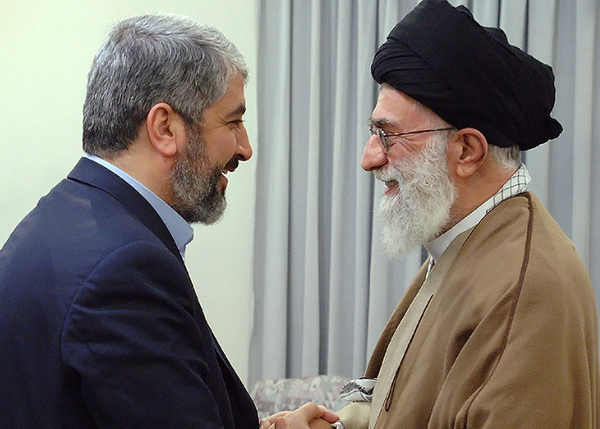
Bridging the Sunni-Shia divide, for the goal of genocide: Hamas leader Khaled Mashaal (left) confers with Iranian Supreme Leader Ali Khamenei, in 2010. (Image source: Office of the Supreme Leader)
UNRWA and Iran, with a supporting role played by the United States, have long made it possible for Hamas and the PA to spend other people’s money building more tunnels, arming multiplemilitias, paying “salaries” to convicted terrorists in Israeli jails, and improving the quality of their rockets and missiles. They know — and Israel knows — that between the Israeli government and the international aid agencies including, but not limited to, UNRWA, no Palestinians will starve, no one will go without medical care, no one will go homeless (except those homeless because Hamas confiscated about 20% of the cement and steel meant to restore Gaza houses damaged in last year’s war). Hamas can therefore use all its funds to make war.
As long as Hamas and the PA are permitted both to spend sponsors’ money on terrorism and warfare while escaping responsibility for the needs of their people, and as long as Iran is a key donor — with all the temptations, means and opportunity to “wipe Israel,” as it repeatedly threatens to do — the idea of a U.S.-led “peace process” is fantasy.
[W]ith majorities in both houses of Congress opposed to the deal, the Associated Press tells us it can still proceed as an executive agreement. Of course it can. And the next president, who will probably be a Republican, can revoke it; and this Congress, or a subsequent one, can pass legislation inconsistent with it. That’s what happens when you don’t have the votes to ratify a treaty.
*****************
This Associated Press story, headlined “Obama can do Iran nuclear deal even if Congress disapproves,” is getting a lot of attention:
The September vote on the Iran nuclear deal is billed as a titanic standoff between President Barack Obama and Congress. Yet even if U.S. lawmakers reject the agreement, it’s not game-over for the White House.
A congressional vote of disapproval would not prevent Obama from acting on his own to start putting the accord in place. …
Obama doesn’t need a congressional OK to give Iran most of the billions of dollars in relief from economic sanctions that it would get under the agreement, as long as Tehran honors its commitments to curb its nuclear program.
“A resolution to disapprove the Iran agreement may have substantial political reverberations, but limited practical impact,” says Robert Satloff of the Washington Institute for Near East Policy. “It would not override President Obama’s authority to enter into the agreement.”
That is correct. The president has the constitutional authority to enter into an executive agreement. Which is where debate over the Iran deal began, with an open letter to Iran’s leaders that was signed by 47 Republican senators and posted on Senator Tom Cotton’s web site. The letter explained that the Iran agreement was not being submitted to the Senate for ratification as a treaty. Therefore, as a mere executive agreement, it could be canceled with a stroke of the pen by America’s next president:
First, under our Constitution, while the president negotiates international agreements, Congress plays the significant role of ratifying them. In the case of a treaty, the Senate must ratify it by a two-thirds vote. A so-called congressional-executive agreement requires a majority vote in both the House and the Senate (which, because of procedural rules, effectively means a three-fifths vote in the Senate). Anything not approved by Congress is a mere executive agreement. …
What these two constitutional provisions mean is that we will consider any agreement regarding your nuclear-weapons program that is not approved by the Congress as nothing more than an executive agreement between President Obama and Ayatollah Khamenei. The next president could revoke such an executive agreement with the stroke of a pen and future Congresses could modify the terms of the agreement at any time.
Tom Cotton’s letter was viciously attacked by liberals, but what it said was obviously correct. Now, with majorities in both houses of Congress opposed to the deal, the Associated Press tells us it can still proceed as an executive agreement. Of course it can. And the next president, who will probably be a Republican, can revoke it; and this Congress, or a subsequent one, can pass legislation inconsistent with it. That’s what happens when you don’t have the votes to ratify a treaty.
The views expressed in this article are those of my fictitious guest author and do not necessarily reflect mine, those of Warsclerotic or its other editors. — DM)
Editor’s note: This is a guest post by Kim Wu-hu, the highly respected director of North Korea’s Ministry of Everlasting Truth. She is variously believed to be Kim Jong-un’s sister or illegitimate daughter.
Kim Jong-un (also known as Kim Chi-un), the universally beloved Dear Leader of the Democratic Peoples’ Republic of Korea, today announced a bold new plan for peace with the illegitimate regime known as the Republic of Korea. It was met with tremendous joy and relief worldwide. Millions gathered in Pyongyang to celebrate, as even the leader of the rogue regime known as Obama’s America held a televised press briefing to praise Kim’s brilliant plan.
Dear Leader Kim’s plan is radical only in its overwhelming simplicity and has just two parts:
1. The illegitimate criminal regime known as the Republic of Korea (“ROK”), which unlawfuly occupies a southern province of the Democratic Peoples Republic of Korea (“DPRK”), will disarm immediately and turn over all of its weapons to the DPRK for safekeeping. Neutral international inspectors from the DPRK and Iran will travel to the ROK in one week to verify the ROK’s compliance. Should the ROK be found not to have complied, the DPRK and its ally Iran will make merciless war on it to force its voluntary compliance.
2. At least seventy-five percent of all males over the age of ten years living in the DPRK’s southern province under the rogue ROK regime will adopt Kim’s hairstyle and, within one month, present themselves to international inspectors who will determine whether they have complied in a satisfactory manner. The DPRK will provide suitable antiaircraft equipment to deal humanely with any who have not.
Many nations, even those which — for unknown and inexplicable reasons — have previously considered the DPRK less than trustworthy, responded enthusiastically. Even Obama, leader of the illegitimate regime known as Obama’s America, promptly held a televised press briefing. He announced that, in a show of solidarity with the DPRK, He will promptly (a) adopt Dear Leader Kim’s hairstyle, (b) issue executive decrees requiring all U.S. and allied military personnel to do the same and (c) seek to disarm His own rogue regime under terms similar to those graciously offered to the ROK. Suitable terms of American surrender to Russia, China and Iran will also be sought.
Obama expressed sincere regret that Republican warmongers will oppose His historic peace efforts for partisan purposes. He also noted that they are racists (as all opposition to Him clearly shows) and are therefore alligned with the apartheid Jewish regime that still occupies Palestine despite His vigorous efforts to impose a two state solution. He stated that their treasonous opposition will not matter, because He will accomplish everything He desires through Executive Decrees.
Here is a photo of Obama showing off His new hairstyle. (A wig was needed because His hair will take time to grow to the necessary length.)
During the press conference Obama also announced the immediate withdrawl of all U.S. military forces from the ROK and termination of planned joint military exercises there to prevent brutal attacks by the DPRK on the ROK and, indeed, on His own illegitimate province. He proudly proclaimed, again, that peace and negotiation are always better than war and stated that His Secretary of State, John Kerry, had already left for Pyongyang, Tehran, Moscow and Beijing to meet with his counterparts.
Kerry begins his journey
Immediately following Obama’s press briefing, and in lieu of a question and answer period, the reporters broke out spontaneously in song to praise Obama.
Kerry, fresh from his Herculean successes in negotiating the surrender of Obama’s America (as well as the rogue Jewish regime occupying Palestine) to Iran, expects to face difficulties in negotiating the terms of surrender to the DPRK, China and Russia. Iran will not be a problem, Kerry stated proudly but humbly, because his diplomatic skills are well known there and he is highly respected because of them.
The science is settled and can no longer be disputed. A brave new world awaits. We have only our chains to lose and true world peace and prosperity to gain. We must thrust ever onward and upward together until we finally achieve all of the changes we have been waiting for!
*************
Editor’s comment
Due to limits on North Korea’s internet, Kim Wu-hu was unable to provide suitable graphics. I provided them for her.
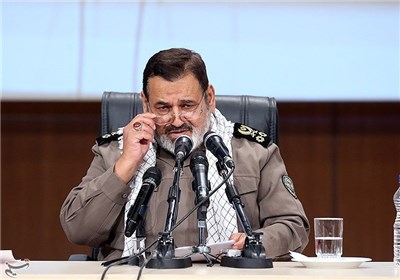
TEHRAN (Tasnim) – Chief of Staff of the Iranian Armed Forces Major General Hassan Firouzabadi underlined that there are not any obstacles to the country’s missile program.
“The Islamic Republic of Iran’s missile activities, as planned inside the country, will not face any obstacles,” the senior officer stressed on Sunday.
The general also reiterated that Iran’s missile tests are going to be carried out in a timely manner according to the plans endorsed by Supreme Leader of the Islamic Revolution Ayatollah Seyed Ali Khamenei.
For any missile test, Firouzabadi noted, a “policy making board” convenes to study the case, and the results are submitted to the Supreme Leader for the final authorization.
Back on Wednesday, the general had announced that Iran’s missile tests will be carried out on schedule.
He had made the comments in response to a statement by some Iranian lawmakers, requesting that the Armed Forces resume conducting missile tests.
In their statement, the MPs had called for the resumption of missile tests in reaction to the US officials’ brazen rhetoric of war against Iran.
While Iran and the Group 5+1 (Russia, China, the US, Britain, France and Germany) could finalize the text of a lasting deal on Tehran’s nuclear program on July 14, US officials have not stopped making provocative comments about military action against Iran.
Back in May, Ayatollah Khamenei reaffirmed that the Iranian nation will not let any possible act of aggression against the country go unanswered.
The Leader said he has already made it clear, even in the tenure of former US president, that “the era of hit and run has ended”, and that the Iranian nation will chase aggressors.
(The views expressed in this article are mine and do not necessarily reflect those of Warsclerotic or its other editors. — DM)
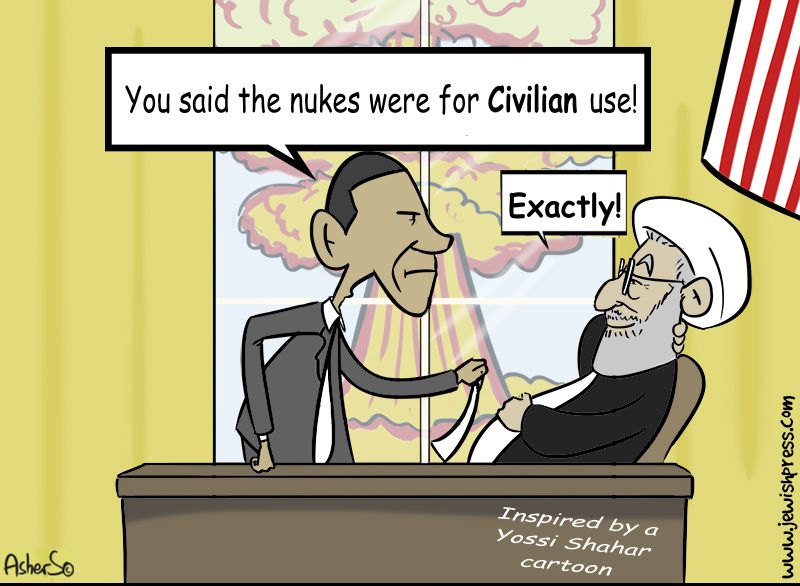
Courtesy of Obama, Iran’s mushroom clouds will be produced by detonating atomic bombs. Obama’s mushroom clouds, with help from His friends, have already been and continue to be detonated. They thrive in the absence of light and contain copious quantities of bovine fecal matter.
This limerick, if applied to Obama, makes sense:
Last night I saw upon the stair A little man who wasn’t there. He wasn’t there again today. Oh how I wish he’d go away!
I. Obama gave Iran its mushroom cloud
Several conservative media recently focused on Obama’s claim, made in His August 5, 2015 address praising His “deal,” that Iran had agreed to negotiate only after President Rouhani replaced Mahmoud Ahmadinejad on August 3, 2013:
it was diplomacy, hard, painstaking diplomacy, not saber rattling, not tough talk, that ratcheted up the pressure on Iran. With the world now unified beside us, Iran’s economy contracted severely, and remains about 20 percent smaller today than it would have otherwise been. No doubt this hardship played a role in Iran’s 2013 elections, when the Iranian people elected a new government, that promised to improve the economy through engagement to the world. [Emphasis added.]
A window had cracked open. Iran came back to the nuclear talks.
Obama did not mention that Rouhani could neither have run for office nor been elected without the backing of Iran’s Supreme Leader Khamenei. As far as I have been able to determine, neither Obama nor Kerry has said anything denying, acknowledging or explaining Senator Kerry’s “negotiations” with Iran which, as I noted here on August 13th, had begun in 2011, long before Ahmadinejad left office in 2013.
During those early “negotiations,” Kerry had already conceded Iran’s right to enrich Uranium, that the nuclear dossier would be closed and that the Possible Military Dimensions (“PMDs”) of Iran’s nuclear program would be ignored resolved.
Although Obama has claimed otherwise, the timing of P5+1 negotiations vis a vis Rouhani’s arrival in office makes little sense. Rouhani sought and got — courtesy of Kerry’s earlier concessions — at least as many concessions from the Obama-led P5+1 farce as Ahmadinejad could have got. Perhaps he got more, due to erroneous perceptions that Rouhani was a moderate and that Iran had changed course for the better. Such perceived changes also led to hopes that Iran would become a helpful U.S. Middle East ally.
In 2013, Hassan Rouhani was, for lack of a better word, “elected” president of Iran replacing the noxious Mahmoud Ahmadinejad. Rouhani, a grandfatherly-like figure with an affable smile, appeared to be, at least outwardly, more moderate than his predecessor, but in reality expressed the same rancid, xenophobic views. He was quoted as saying that “the beautiful cry of ‘Death to America’ unites our nation,” and referred to Israel as a “wound,” “a festering tumor” and the “great Zionist Satan,” among numerous other reprehensible pejoratives.
Israel’s Prime Minister Benjamin Netanyahu, in an address to the United Nations, dryly noted that while Ahmadinejad was a wolf in wolf’s clothing, Rouhani was a wolf in sheep’s clothing, but both were wolves nonetheless. What’s more, real power in Iran vests not with the nation’s president, but with its Supreme Leader, Ali Hosseini Khamenei, a pernicious man who seems incapable of addressing crowds without inserting at least one “death to America” reference somewhere in the speech. Indeed, just four days after signing the Joint Comprehensive Plan of Action (JCPOA) he addressed a large crowd and repeated the tired banalities of “death to America” and “death to Israel.” Khamenei is also solely responsible for vetting and approving presidential candidates which means that he found Rouhani to be an acceptable contender and that speaks volumes about what kind of character Rouhani is. [Emphasis added.]
. . . .
Despite the given realities about the Islamic Republic and its malevolent nature, Obama attempted to sell the American public on the nonsensical notion that the election of Rouhani ushered in a new period of Iranian enlightenment and moderation and afforded the U.S. an opportunity for meaningful engagement with the mullahs on their nuclear program. On that premise, he led the American public to believe that it was only after the election of the “moderate” Rouhani that the U.S. chose to engage Iran. [Emphasis added.]
Kerry had representatives of The Sultanate of Oman deliver a letter he had written to Iranian officials recognizing Iran’s Uranium enrichment rights and suggesting secret negotiations. Omani officials discussed the letter with Iranian officials and, when the Iranians appeared skeptical, the Omani official suggested,
Go tell them that these are our demands. Deliver [the note] during your next visit to Oman.’ On a piece of paper I wrote down four clearly-stated points, one of which was [the demand for] official recognition of the right to enrich uranium. I thought that, if the Americans were sincere in their proposal, they had to accept these four demands of ours. Mr. Souri delivered this short letter to the mediator, stressing that this was the list of Iran’s demands, [and that], if the Americans wanted to resolve the issue, they were welcome to do so [on our terms], otherwise addressing the White House proposals to Iran would be pointless and unjustified. [Emphasis added.]
“All the demands presented in this letter were related to the nuclear challenge. [They were] issues we had always come up against, like the closing of the nuclear dossier, official recognition of [the right to] enrichment, and resolving the issue of Iran’s past activities under the PMD [possible military dimensions] heading. After receiving the letter, the Americans said, ‘We are definitely and sincerely willing, and we can resolve the issues that Iran mentioned.’” [Emphasis added.]
a full accounting of Iran’s possible past atomic weapons research is not necessarily critical to reaching a nuclear deal with Tehran. His comments came amid concerns the Obama administration is backing down on demands that Iran resolve concerns about previous work as part of an agreement that would curb its nuclear program in exchange for sanctions relief. [Emphasis added.]
. . . .
“We know what they did,” Kerry said. “We have no doubt. We have absolute knowledge with respect to certain military activities they were engaged in. What we’re concerned about is going forward. It’s critical to us to know that going forward, those activities have been stopped and that we can account for that in a legitimate way.” [Emphasis added.]
Without knowing what Iran had been doing where, there is no viable way to know what it continues to do. Reliable information of that nature will not be available. Under the apparent terms of its secret deals with Iran, Iranians, not members of the IAEA, will inspect and take samples at military sites used by Iran for nuke weaponization. “Details” of the inspections will not be disclosed.
Kerry also claims to know “exactly” what the secret IAEA – Iran deals say, even though he has neither read nor seen them. In the video provided below, Kerry acknowledges just that beginning at about 10:00.
What aspect(s) of Iran’s nuke weaponization does Kerry have “absolute knowledge” about and how did he get it? The IAEA appears to have accumulated far less information than Kerry claimed to have on June 16th concerning Iran’s nuke militarization. Continuing to quote from the New York Times article linked above,
Much of Iran’s alleged work on warheads, delivery systems and detonators predates 2003, when Iran’s nuclear activity first came to light. But Western intelligence agencies say they don’t know the extent of Iran’s activities or if Iran persisted in covert efforts. An International Atomic Energy Agency investigation has been foiled for more than a decade by Iranian refusals to allow monitors to visit suspicious sites or interview individuals allegedly involved in secret weapons development. [Emphasis added.]
The November 14, 2013 Joint Plan of Action recognized Iran’s right to enrich Uranium for “peaceful purposes” — the reason asserted by Iran for enrichment. Iran’s need to enrich Uranium was mainly premised on its need to generate electricity. However earlier this month, Iran’s Deputy Foreign Minister and senior nuclear negotiator called Iran’s nukes for electricity program “a big loss” economically but necessary to defend the country’s honor.
In a leaked off-the-record meeting with journalists Saturday, Abbas Araqchi stressed that “if we want to calculate the expenses of the production materials, we cannot even think about it.” But, he said, “we paid this price so we protect our honor, independence and progress, and do not surrender to others’ bullying.”
Yet, he explained, “If we value our nuclear program based only on the economic calculations, it is a big loss.” [Emphasis added.]
. . . .
Due to the pressure from above, . . . the original report was removed by the national broadcasting service, which stated that the publication of Araqchi’s statements was a “misunderstanding.”
The November 13, 2013 Joint Plan of Action left open only where, how and how much Uranium Iran could enrich. It substantially ignored the nuclear dossier (i.e., nuke weaponization), Iran’s principal but denied reason for enrichment. It should, therefore, have come as no surprise that the 2015 “deal,” in conjunction with the secret deals between Iran and the International Atomic Energy Agency (IAEA), did the same, eliminating any chance that the IAEA might learn what Iran had been doing and whether it continues to do it.
Even before he became president, Barack Obama was imagining the possibilities of a diplomatic breakthrough with Iran. His willingness to reverse decades of official U.S. hostility was one of the things that set Obama apart on the campaign trail.
. . . .
Limited though it may be, the administration’s negotiation with Iran has shaken traditional allies such as Israel and Saudi Arabia. Meanwhile, through its action and inaction elsewhere in the Middle East, the U.S. has left both friends and enemies uncertain about what it will do next.
. . . .
The White House insists a nuclear deal with Iran would defuse the biggest threat to the region.
The Wilson Center’s Miller agreed a negotiated deal that stops or even stalls Iran’s nuclear program is preferable to the likely alternative of military action. But he dismisses as wishful thinking any expectation that Iran’s diplomatic rehabilitation will produce a new, more stable Middle East.
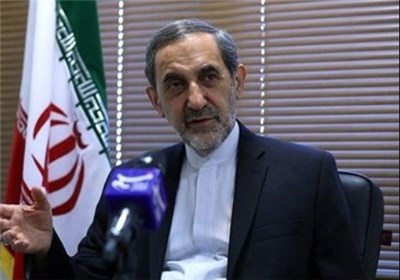
Iran’s Secretary-General of World Assembly of Islamic Awakening Ali Akbar Velayati praised the recent conclusion of nuclear talks between Iran and six world powers, saying that with the deal, Tehran has more strength to support its friends in the Middle East region. [Emphasis added.]
. . . .
Velayati, who is also the head of the Strategic Research Center of Iran’s Expediency Council, stressed the need for the consolidation of the anti-Israeli Resistance Front in the region. [Emphasis added.]
This is the Iranian mushroom cloud provided by Obama and Kerry:
III. Obama’s own mushroom cloud
Here is a photo of Obama’s mushroom cloud with one of His supporters standing contentedly in front of it:
Obama’s mushroom cloud, made of bovine fecal matter which Obama et al have asked us to swallow, has grown like Topsy. It’s full of many more lies than merely that He waited until Rouhani became Iran’s president to being nuke negotiations. His other lies, and those of His friends, are even less digestible. Here are just a few from Washington Free Beacon Supercuts to serve as aperitifs.
IV. Conclusions
The mushroom cloud detonated by Obama and Friends (“OAFs”) likely means that the “deal” with Iran will soon go into full effect. It will enable Iran to present us with its own nuclear mushroom cloud. It will also be of substantial assistance in furthering Iran’s hegemonic efforts to destabilize the Middle East.
Some mushrooms are good to eat. Obama’s cloud is full of toxic mushrooms. Perhaps they have made Obama, Iran and His other friends drunk with power; they are deadly for the rest of us.
(Great! More jobs for jihadists. Obama should like that. — DM)
TEHRAN (Tasnim) – Secretary-General of World Assembly of Islamic Awakening Ali Akbar Velayati praised the recent conclusion of nuclear talks between Iran and six world powers, saying that with the deal, Tehran has more strength to support its friends in the Middle East region.
Speaking at the opening ceremony of the 6th gathering of General Assembly of Ahl-ul-Bayt World Assembly here in Tehran on Saturday morning, Velayati, who is also the head of the Strategic Research Center of Iran’s Expediency Council, stressed the need for the consolidation of the anti-Israeli Resistance Front in the region.
“The Islamic Republic of Iran will always support the current (Resistance Front) and of course, with the nuclear agreement, it will have more power to side with its friends in the region,” he noted.
Iran and the Group 5+1 (Russia, China, the US, Britain, France and Germany) on July 14 reached a conclusion on a lasting nuclear agreement that would terminate all sanctions imposed on Tehran over its nuclear energy program after coming into force.
The Iranian official further pointed to the most important reasons behind regional crises, saying that despite the claims made by certain countries, the crises do not have religious or sectarian nature.
Velayati added that the regional problems has its roots in the plots hatched by Islam’s enemies, who are seeking to misuse some religious differences and portray a violent image of Muslims.
The 6th General Assembly of Ahl-ul-Bayt World Assembly was inaugurated with a speech by Iranian President Hassan Rouhani.
About1.800 foreign guests from 130 countries along with senior Iranian political and cultural figures have participated in the four-day event.
(What would happen to the Iran “deal” if Rouhani’s “moderates” were impeached? — DM)
Iranian President Hassan Rouhani smiles during a meeting with German Economy and Energy Minister Sigmar Gabriel (not pictured) in Tehran, July 20, 2015. (photo by Getty Images/Atta Kenare)
The Hassan Rouhani administration took office two years ago and has undoubtedly primarily focused its energy and political clout on the nuclear talks with the five permanent members of the UN Security Council. But domestically, Iran’s conservative-dominated parliament has been more active than ever in pushing back the administration and targeting its ministers through summoning them to parliament, issuing yellow warning cards and using threats of impeachment.
The front pages of two Iranian newspapers, Ebtekar and Aftab-e Yazd, wrote Aug. 13 about this active parliament in targeting Rouhani’s ministers.
Ebtekar published an article titled “A new season of political impeachments,” which read, “The Rouhani administration has reached the halfway point and already the record for most questions by members of parliament put to ministers has been broken. [Parliament] has asked approximately 2,000 questions of the Cabinet.”
The article said that while questioning ministers is part of the parliament’s function, “many believe that in the last two years another goal was used for this function.” The article states that with the exception of a handful of ministers, ministers “have felt the shadow of impeachment above their heads.” The article’s reasons for record number of summons and questions range from personal issues to having an eye on the 2016 parliamentary elections.
Arash Bahmani has written for Al-Monitor about the troubles facing Minister of Culture and Islamic Guidance Ali Jannati, who Supreme Leader Ayatollah Ali Khamenei has reportedly reprimanded. As Alireza Ramezani wrote in Al-Monitor, “As the parliamentary elections approach, conservatives will try to find alternative solutions to drive the administration back and compensate for their loss in the battle over the nuclear deal.”
The newest target has been Alireza Teyebnia, Iran’s minister of economics and finance, who received his third yellow card from parliament Aug. 9, setting into motion the process for his impeachment. The minister, who received the highest number of approval votes during his hearing in August 2013, was summoned to parliament by conservative Iranian member of parliament Mehrdad Bazrpash to answer questions about the increase on taxes of guilds and legislation involving opening lines of credit to Iranian banks.
According to Eghtesad online, the two questions that Teyebnia was summoned for had little to do with his office. Taxes on guilds are set by parliament and Teyebnia’s position only gives him discretion to implement legislation passed by parliament, something Teyebnia explained during the parliament session. Also, the issue of a line of credit to banks has more to do with the Central Bank than the Ministry of Economics and Finance.
Aftab-e Yazd, in an article titled “Teyebnia deserves praise, not the injustice of MPs,” interviewed Ebrahim Nekoo, a member of parliament’s economic committee. While Nekoo defended the right of parliament members to summon ministers, he called Teyebnia’s treatment by parliament members as “unfair.” When asked about the possible impeachment of Teyebnia, Nekoo said, “This type of impeachment is not even logical.” He added, “Given the upcoming parliamentary elections, the possibility of finding a new minister with a better performance than Teyebnia is weak.”
Teyebnia added that given the post-sanctions environment and expectations that the lifting of sanctions will improve Iran’s economic situation, the administration’s economic team is in a sensitive position and must manage this transition. He said, “No one is more proficient in the affairs of the Economics Ministry than Teyebnia.”
 Abbas Araqchi / AP











 anneinpt
 artaxes
 danmillerinpanama
 davidking1530
 Peter Hofman
 Joseph Wouk
 Peter
Peter Louisiana Steve
 WarSclerotic
Recent Comments