(The views expressed in this article are those of my imaginary guest author, Senator Ima Librul, and do not necessarily reflect mine, those of Warsclerotic or any of its other editors. — DM)
In an exclusive interview with the FARtz News Agency, President Obama today voiced firm support for any deal bewteen Iran and the International Atomic Energy Agency permitting Iran to know for sure what it hasn’t been doing at its alleged military sites.
Editor’s note: This is a guest post by my (imaginary) colleague, the Very Honorable Ima Librul, Senator from the great State of Confusion Utopia. He is a founding member of CCCEB (Climate Change Causes Everything Bad), a charter member of President Obama’s Go For it Team, a senior member of the Senate Foreign Relations Committee and Chairman of the Meretricious Relations Subcommittee. He is also justly proud of his expertise in the care and breeding of green unicorns, for which his Save the Unicorns Foundation has received substantial Federal grants. We are honored to have a post of this caliber by a quintessential Librul such as the Senator.
********************
During His FARtz interview President Obama stated,
Secretary Kerry and I are both delighted with any deal between the International Atomic Energy Agency and Iranian officials which helps Iran to become more introspective. Introspection is good for the soul and I Myself engage in it often to help Me understand the very few instances in which I may have made mistakes and to atone for them. Almost always, I discover that I was right in the first place and wrong in even considering the possibility that I might have been wrong.
If in the past Iran mistakenly declared that it had never attempted research and development of nuclear weapons, its own inspection of Parchin and other alleged military sites should be instrumental in discovering its mistake and advising the World. For example, many years ago Iranianian scientists may have rubbed two pieces of Uranium ore together and, upon discovering that they did not explode, given up all hope of ever trying to develop nuclear weapons. My administration and Iran’s other friends need to know. Then we can put aside any and all lingering doubts about Iran’s exclusively peaceful nuclear program.
World reaction to Obama’s remarks was swift and almost entirely favorable.
Iran’s Tasnim News Agency praised His enlightened understanding of the possibility of human error and, indeed, even His own. “Talking with President Obama is a humiliating humbling experience!” The often unfairly critical New York Times Editorial Board offered similar praise for Obama’s charming candor and His recognition that even Iran’s allegedly Mad Mullahs are as reasonable as He Himself is. It suggested that Obama follow up on His interview by issuing an Executive Decree pursuant to which
a committee selected by Iran’s Supreme Leader shall have sole authority to determine which, if any, remaining sanctions will be lifted, when, and whether any possibility of their reimposition — or the reimposition of previously removed sanctions — will be permitted.
Obama’s deputy under secretary for press relations stated that Obama had immediately set to work crafting such a decree.
Only one Israeli newspaper, an infrequently read far right-wing scandal sheet favored by Prime Minister Netanyahu’s wife, had an adverse and therefor obviously racist headline: “IT’S A DARK DAY FOR AMERICA!” Less blatantly right wing Israeli media, such as Haaretz, immediately condemned the story in an article headlined “AS ALWAYS, OBAMA DOES THE RIGHT THING AGAIN.”
Tratorious Republicans, who are trying to kill Obama’s wonderful deal with peace-loving Iran to starve innocent Iranian children, took a position comparable to that of the far right-wing Israeli scandal sheet. For example, Tod Krutz, junior senator from a smelly coal mining village in West Virginia, argued
Whether Iran knows what it’s not been doing is less important than the U.S. Congress knowing what it has been doing. I therefore demand that House Speaker Boehner go immediately to Iran to investigate the Parchin military facility and stay there until he finds out what’s been happening. [Emphasis added.]
Speaker Boehner declined the invitation, lamenting that his miniscule budget does not permit him to acquire any possibly necessary anti-radiation clothing. He did, however, offer tearful thinks to Senator Krutz for the confidence he had placed in his ability and scientific knowledge.
Conclusion
It is indeed a sad day for America when even a right-wing Israeli paper such as Haaretz is less critical of our Dear President than some tratorious, racist Republicans such as Senator Krutz. President Obama, a very sensitive and loving person, needs our unstinting help. In this, His time of need, we must all stand behind Him as He battles the forces of oppression, ignorance and racism sadly still rampant in the U.S. Congress.
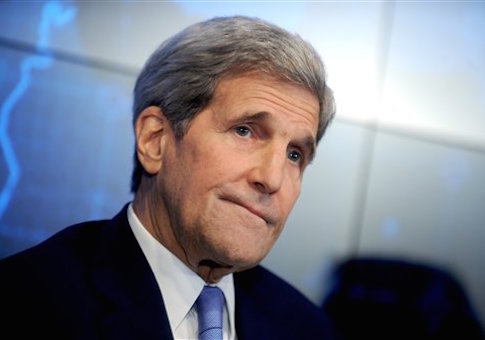
Photo by: Dennis Van Tine/STAR MAX/IPx 8/11/15 John Kerry participates at a discussion on Iran.(NYC)
Two leading U.S. senators are calling on the Obama administration to release secret letters to foreign governments assuring them that they will not be legally penalized for doing business with the Iranian government, according to a copy of a letter sent Wednesday to the State Department and obtained by the Washington Free Beacon.
Sens. Mark Kirk (R., Ill.) and Marco Rubio (R., Fla.) disclosed in the letter to the State Department that U.S. lawmakers have been shown copies of several letters sent by the Obama administration to the Chinese, German, French, and British governments assuring them that companies doing business with Iran will not come under penalty.
The Obama administration is purportedly promising the foreign governments that if Iran violates the parameters of a recently inked nuclear accord, European companies will not be penalized, according to the secret letters.
Congress became aware of these promises during closed-door briefings with the Obama administration and through documents filed by the administration under a law requiring full disclosure of all information pertaining to the accord.
The issue of sanctions on Iran has become a major issue on Capitol Hill in the weeks since the Obama administration agreed to a deal that permits Iran to enter the international community in exchange for temporarily constraining its nuclear program.
Iran will receive more than $150 billion in sanctions relief as part of the deal and many of its military branches will be removed from international sanctions designations.
“The documents submitted by the Administration to Congress include non-public letters that you sent to the French, British, German, and Chinese governments on the consequences of sanctions snap-back,” Kirk and Rubio wrote to Secretary of State John Kerry.
“These letters appear to reassure these foreign governments that their companies may not be impacted if sanctions are re-imposed in response to Iranian violations of the agreement,” they claim. “While Administration officials have claimed that this is not the case, we think it is important for the American public to be able to read your assurances to foreign governments for themselves as their elected representatives review this deal in the coming weeks.”
Kirk and Rubio are demanding that the Obama administration release these letters to the public so that the full nature of the White House’s backroom dealings are made known.
“We therefore request the Administration to publicly release these letters, which are not classified, so that the full extent of the Administration’s non-public assurances to European and Chinese governments can be discussed openly by Congress and analyzed by impartial outside experts,” they write.
“Given the conflicting interpretations hinted at by the deal’s various stakeholders, it would also ease congressional review of the deal if you were to receive assurances from the other members of the P5+1 about the guidance they will provide to companies about the inherent risks of investing in Iran due to Iran’s ongoing support for terrorism and use of its financial system for illicit activities and the potential for sanctions to snap back if Iran violates the nuclear agreement,” the letter states.
As Iranian companies and government entities are removed from sanctions lists, they will be permitted to do business on the open market. A number of governments, including the Russia and Italy, have already expressed interest in partnering with Iran.
U.S. lawmakers remain concerned that if Iran violates the nuclear accord, sanctions will not be reimposed in a meaningful way.
“The conditions under which foreign investment in Iran would proceed under the nuclear agreement remain unclear,” Kirk and Rubio wrote. “On July 23, 2015, Secretary of the Treasury Jack Lew told the Senate Foreign Relations Committee that companies that have invested in Iran would ‘not be able to continue doing things that are in violation of the sanctions’ if sanctions snap back.”
“Foreign investment in Iran will involve long-term contracts in many cases, however, and some interpretations of the Iran agreement indicate these contracts might be protected from the snap-back of sanctions by a so-called ‘grandfather clause,’” they write.
Under the terms of the agreement, sanctions on Iran’s Revolutionary Guard Corps (IRGC), a paramilitary force known to commit acts of terrorism across the globe, will be lifted.
A multi-billion dollars financial empire belonging to Iranian Supreme Leader Ali Khamenei also will be removed from sanctions lists, according to the parameters of the deal.
Khamenei depends on the U.S. Congress to save his regime. Congressional members may want to think about that long and hard before voting on this disastrous deal next month.
**********************
For those who have only experienced either democracy or dictatorship, it is difficult to grasp the complexities of Iran’s political system, which is an autocracy that has adopted some democratic features. A careful reading of the Iranian constitution, however, clarifies for the reader that the Supreme Leader is the one and only person who wields ultimate power in that system, including appointment power for a vast number of positions.
Hossein Shariatmadari, editor-in-chief of Kayhan, the most important Iranian daily widely viewed as the regime outlet for the Supreme Leader’s ideas and policies, is one of those appointed to his job directly by Ayatollah Ali Khamenei. Thus, it was no surprise that Shariatmadari’s 15 August 2015 editorial, claiming that Khamenei opposes the nuclear deal, drew immediate attention. Obviously, Shariatmadari would not have written that without Khamenei’s consent. The confusing part, however, is that Hamid Reza Moghadam Far, top advisor to MG Mohammed Ali Jafari, Islamic Revolutionary Guards Corps (IRGC) commander, then harshly criticized Shariatmadari and warned him not to ascribe to the Supreme Leader his own ideas and understandings.
Given that Jafari is directly appointed by the Supreme Leader (just like Shariatmadari), and that there’s little history of this Iranian regime sending out such mixed messages from its own top ranks, the only conclusion possible is that sowing confusion is a calculated move at this time, intended to serve a regime objective.
For over three decades, the Islamic regime of Iran has made implacable enmity toward the U.S. and Israel the foundation of its official foreign policy, reflecting its leaders’ ideological dedication and fervor. Generations of young people have been indoctrinated to Islamic beliefs and recruited to the IRGC, Qods Force, and Basij on the basis of commitment to these beliefs. A blood-soaked litany of terror attacks instigated by this mullahs’ regime stretches from the ruins of the Marine Corps barracks in Beirut through Khobar Towers, the East Africa Embassy bombings, the USS Cole attack, 9/11 and hundreds of American troops killed and maimed by Iranian and Hizballah explosives in Iraq and Afghanistan. Tehran’s support for Islamic terror groups has left a global trail of murder and mayhem. “Resistance” is what the Ayatollahs call it. “Death to America” and “Death to Israel” are the slogans, chanted in endless repetition. America is the “Great Satan” and Israel the “Little Satan.” Never did the Supreme Leader imagine negotiating, much less reaching an actual agreement, with such hated enemies.
But the sanctions took their toll and financial collapse had to be avoided, even if it meant coming to the table to negotiate with the world’s superpowers, however noxious that was for Khamenei personally. Getting the West to believe Iran was desperate enough to obtain relief from sanctions that it would agree to limit its nuclear weapons program was only a clever ruse, of course, but it worked. The first step was allowing Hassan Rouhani, an old regime hand who’d served as negotiator in earlier talks, to become president. Khamenei needed Rouhani’s smiling demeanor to smooth international impressions of the Islamic Republic. The years-long cultivation of Secretary John Kerry by Foreign Minister Javad Zarif also would pay off big time. The clincher was bringing in Energy Secretary Ernest Moniz, an old friend of Iran’s Atomic Energy Organization (AEO) chief, Ali Akbar Salehi, to push through to the final agreement. Intelligence services like Iran’s are willing to invest lots of time and effort with targets at this level.
The American collapse on every single key issue—from enrichment (a stipulation demanded—and obtained—even before the first secret talks began in Oman in 2011) to centrifuges, the Arak plutonium-producing reactor, off-limits facilities, Iran’s Intercontinental Ballistic Missiles (ICBMs), sanctions relief, and P5+1 technical assistance with nuclear development and site protection—surprised and delighted the Iranians. Contrary to Shariatmadari’s claims, the Supreme Leader is in fact quite satisfied with the nuclear deal; but, he cannot show that publicly, for two key reasons. If the U.S. Congress should vote against the deal, potentially leaving in place even some sanctions that President Obama could neither waive nor lift, Khamenei would find himself the public supporter of a failed deal. The powerful IRGC and Basij militia might hold him responsible for compromising the blood of martyrs and values of the Islamic Revolution for which the Iranian people sacrificed their economy and lives. And that would spell the end of the regime.
What to do? Khamenei wants the benefits of this deal without any of the possible liabilities. So, even as his trusted Iran Lobby pulls out the stops to make sure the deal goes through, he tries to find a way to support it without disappointing the guns that keep him in power. Solution: in public, Khamenei has spoken in general, nebulous phrases that convey no certain position. But in private, to certain audiences among the IRGC, Qods Force, and Basij, he pretends to oppose the deal. To others, he expresses support. Each group is allowed to go out and express its understanding of the Supreme Leader’s position with the media. Meanwhile, Khamenei plays the game safely and waits to see which way the deal will go.
If something goes wrong with the deal, Khamenei will be the one who warned Rouhani’s negotiating team not to trust the Americans. Publicly, then, he can discredit Shariatmadari and claim the media misstated his position (even though everyone knows that without Khamenei’s prior permission, neither Jafari nor Kayhan’s editor-in-chief would even discuss the subject). The regime is trapped in a web of its own making. It has radiated hatred toward Israel and the West for so long and so insistently that it cannot now just stop chanting “Death to America” or calling for Israel to be wiped off the face of the map. Nor can it abandon its terror proxies across the region. Disappointing the IRGC and Basij that are the backbone of this regime would shake the very foundation of the Islamic Republic of Iran: unthinkable.
Khamenei depends on the U.S. Congress to save his regime. Congressional members may want to think about that long and hard before voting on this disastrous deal next month.
This piece was co-written by Daniel Akbari, a lawyer certified to practice before the Supreme Court of Iran, holds a master’s degree from Texas State University and a graduate certificate in homeland security from the Bush School of Government and Public service.
(The views expressed in this post — which for the most part consists of links to and quotations from recent articles posted at Warsclerotic — are mine and do not necessarily reflect those of Warsclerotic or its other editors. — DM)
Over the past few days, Iranian officials have confirmed that international inspections of its nuke sites will be severely limited if permitted at all. This post provides excerpts from recent articles quoting them.
Iran’s nuke sites
The restrictions noted in this post are in addition to previously disclosed prohibitions on access by International Atomic Energy Agency (IAEA) inspectors to military sites, which Iran itself will inspect instead. Even The Daily Beast has mentioned this problem in reliance on an Associated Press article which states,
All IAEA member countries must give the agency some insight into their nuclear programs. Some are required to do no more than give a yearly accounting of the nuclear material they possess. But nations— like Iran — suspected of possible proliferation are under greater scrutiny that can include stringent inspections. [Emphasis added.]
The agreement in question diverges from normal procedures by allowing Tehran to employ its own experts and equipment in the search for evidence of activities it has consistently denied — trying to develop nuclear weapons. [Emphasis added.]
Olli Heinonen, who was in charge of the Iran probe as deputy IAEA director general from 2005 to 2010, said he could think of no similar concession with any other country.
A senior Iranian official declared on Monday that international nuclear inspectors would only be permitted into the country once they receive approval from the Islamic Republic’s Intelligence Ministry, putting another roadblock between the International Atomic Energy Agency (IAEA) and Iran’s contested nuclear sites.
Sayyed Abbas Araqchi, Iran’s deputy foreign minister and one of the top negotiators in talks that led to the recently inked nuclear deal, told the country’s state-controlled press that Iran’s intelligence apparatus must approve of any inspector who is issued a visa to enter Iran. [Emphasis added.]
International nuclear inspectors will only be permitted into the country after offering proofs of suspicious activity at the sites to be inspected, Iran’s Defense Minister Brig. Gen Hossein Dehqan said Tuesday. DEBKAfile: This condition is not contained either in the nuclear deal Iran signed with the six world powers last month or in its contract with the IAEA. How will the international watchdog obtain proofs if it is denied visits for inspections? [Emphasis added.]
Iranian leaders prevented a top International Atomic Energy Agency (IAEA) official from disclosing to U.S. officials the nature of secret side deals with the Islamic Republic by threatening harm to him, according to regional reports. [Emphasis added.]
Yukiya Amano, IAEA director general, purportedly remained silent about the nature of certain side deals during briefings with top U.S. officials because he feared such disclosures would lead to retaliation by Iran, according to the spokesman for Iran’s Atomic Energy Organization (AEOI).
Amano was in Washington recently to brief members of Congress and others about the recently inked nuclear accord. However, he did not discuss the nature of side deals with Iran that the United States is not permitted to know about.
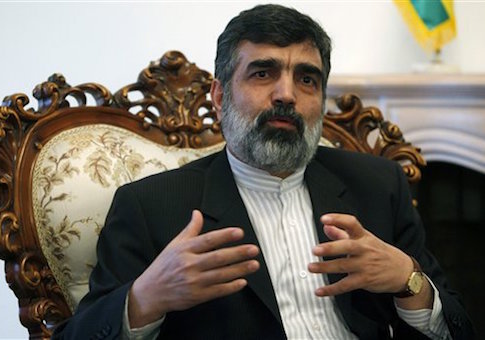
Iran apparently threatened Amano in a letter meant to ensure he did not reveal specific information about the nature of nuclear inspections going forward, according to Iranian AEOI spokesman Behrouz Kamalvandi.
“In a letter to Yukiya Amano, we underlined that if the secrets of the agreement (roadmap between Iran and the IAEA) are revealed, we will lose our trust in the Agency; and despite the US Congress’s pressures, he didn’t give any information to them,” Kamalvandi was quoted as saying Monday during a meeting with Iranian lawmakers, according to Tehran’s state-controlled Fars News Agency.
“Had he done so, he himself would have been harmed,” the official added. [Emphasis added.]
If these analyses are correct, and they appear to be, there will be no meaningful “anytime anywhere” international inspections of Iranian military sites. Although Obama has repeatedly said that the current nuke “deal” is not based on trust, that appears to its only basis, an absurd one.
Shortly before US Secretary of State John Kerry was due in Qatar Monday, Aug. 3, Iran’s highest authorities led by supreme leader Ayatollah Ali Khamenei Sunday launched a public campaign to support Tehran’s noncompliance with the Vienna nuclear accord and UN Security Council Resolution 2231 of July 20, on its ballistic missile program. The campaign was designed by a team from Khamenei’s office, high-ranking ayatollahs and the top echelons of the Revolutionary Guards, including its chief, Gen. Ali Jafari. [Emphasis added.]
. . . .
The Security Council Resolution, which unanimously endorsed the Joint Comprehensive Plan of Action (Vienna nuclear accord) signed by Iran’s Foreign Minister Mohammed Javad Zarif, called on Iran “not to undertake any activity related to ballistic missiles designed to be capable of delivering nuclear weapons, including launches using such ballistic technology until the date eight years after the JCPOA Adoption Day.” [Emphasis added.]
Tehran retorted that none of its ballistic missiles were designed to deliver nuclear weapons, and so this provision was void. Shortly after its passage, the foreign ministry in Tehran issued an assurance that “…the country’s ballistic missile program and capability is untouched and unrestricted by Resolution 2231.”
On July 30, Ali Akbar Velayati, Khamenei’s senior adviser on international affairs and member of the Expediency Council, told reporters, “The recent UNSC Resolution on Iran’s defensive capabilities, specially (sic) its missiles, is unacceptable to Iran.”
TEHRAN (Tasnim) – Chief of Staff of the Iranian Armed Forces Major General Hassan Firouzabadi underlined that there are not any obstacles to the country’s missile program. [Emphasis added.]
“The Islamic Republic of Iran’s missile activities, as planned inside the country, will not face any obstacles,” the senior officer stressed on Sunday.
The general also reiterated that Iran’s missile tests are going to be carried out in a timely manner according to the plans endorsed by Supreme Leader of the Islamic Revolution Ayatollah Seyed Ali Khamenei.
Iran – North Korea nuke nexis
Nuke cooperation between Iran and North Korea was not considered during the P5+1 “negotiations.” The text of the current “deal” is silent on the subject. Kerry’s State Department has limited media contact with Douglas Frantz, his Assistant Secretary in charge of the Bureau of Public Affairs, to avoid releasing information on the Iran – North Korea nuke nexus. Mr. Frantz, formerly a highly respected journalist, had written extensively on North Korea’s nuclear program.
An honest accounting would quite likely reveal something that many press reports have alleged, but U.S. administration officials have never publicly confirmed: A history of nuclear weapons collaboration between Iran and nuclear-proliferating North Korea.
. . . .
Drawing on “previously secret reports, international officials, independent experts, Iranian exiles and intelligence sources in Europe and the Middle East,” Frantz wrote that “North Korean military scientists recently were monitored entering Iranian nuclear facilities. They are assisting in the design of a nuclear warhead, according to people inside Iran and foreign intelligence officials.”
. . . .
Perhaps Frantz should recycle that article to Secretary of State John Kerry, who while testifying to a congressional panel last month was asked about its allegations by Rep. Christopher Smith, and ducked the question.
. . . .
[I]t appears that as a State Department advocate of a free and well-informed press, Frantz himself is not free to answer questions from the press about his own reporting on North Korea’s help to Iran in designing a nuclear warhead. The State Department has refused my repeated requests to interview Frantz on this subject. Last year, an official at State’s Bureau of Public Affairs responded to my request with an email saying, “Unfortunately Assistant Secretary Frantz is not available to discuss issues related to Iran’s nuclear program.” [Emphasis added.]
. . . .
Of course, the real problem for the Obama administration is that an officially confirmed story of Iran-North Korea collaboration on nuclear warheads could spell further trouble for winning congressional approval of this nuclear deal.
Conclusions
Assuming (a highly dubious assumption) that Kerry and Obama’s other P5+1 “negotiators” wanted to limit Iran’s Uranium enrichment to peaceful purposes, to terminate its nuke weaponization and to restrict its missile development and use they failed. It might have been entertaining to have watched Obama instruct Kerry on how to negotiate for magic carpets in a Persian market. The Persians saw Obama’s P5+1 “negotiators” as suckers and took all of their cash. They then took whatever honor they may once have had.
With international inspections permitted, if at all, only at Iran’s whim, and international sanctions “snap back” a fantasy, Iran has been given a bright green light to do whatever it pleases. What pleases Iran should not please even Obama, who envisions a new era of Middle East stability as a major fruit of His victory in getting the July 2015 “deal.”
Iran plans to “stabilize” Israel first. Israel is the only free and democratic nation in the Middle East; America was once her most reliable ally. No longer, but perhaps one fine day she will be again.
A conference of religious scholars features speaker after speaker calling Israel’s annihilation inevitable and promising that a “new phase” in that effort is about to begin. [Emphasis added]
While some in the United States and among its Western allies may hope that a nuclear weapons deal with Iran might steer the Islamic Republic in a new, more responsible direction, hardliners draw new lines and issue new threats.
On Monday, Iranian Supreme Leader Ali Khamenei took to social media to attack the United States and Israel. “We spare no opportunity to support anyone #FightingTheZionists,” wrote the ayatollah, whose regime supplies Hizballah and Hamas with rockets and other weapons of terror.
Here’s a recent video from Iranian television showing how Iran plans to eliminate Israel.
The July 2015 “deal” remains a mystery shrouded in secrecy and deception. Obama has tried to mislead the the American public and the Congress. He has threatened members who have voiced opposition and characterized them as disloyal. Congress should kill the “deal.” Those members whose ultimate loyalty is to America rather than to Obama will vote to do so and then to override his veto.
To appreciate the key paragraph in Senator Bob Corker’s Washington Post op-ed opposing the Iran deal, you need to review his extemporaneous remarks at the August 5 hearing of the Senate Banking Committee – addressed to both the witness, Under Secretary Wendy Sherman, and to his Democratic colleagues. Corker was one of the few Republican senators who did not sign Senator Tom Cotton’s letter to Iran, and he worked across the aisle to craft the Congressional review of the deal. On August 5, he spoke first to the Democratic senators sitting there: “I want to say that I think Senator Donnelly, Senator Heitkamp, Senator Warner, Senator Tester, Senator Schumer, Senator Menendez all know that I have been very open to supporting an agreement.” Then he recounted a Saturday phone conversation he had had the previous month with Secretary of State Kerry, when “I actually thought he was listening to what I was saying.”
I was standing in my driveway, and I emphasized the importance of these last pieces [of negotiations]. And I’m talking about the inspections. I’m talking about the … possible military dimensions [PMD]. We all know they’re involved militarily. And how important that was, not just from the standpoint of what it said, but the indication to us — that we were really going to apply these things, that we were really going to be tough and make this agreement stand.
And when I got the documents – and I’ve been through all of them extensively – I have to say my temperature rose very heavily. And then when I saw that we were lifting the conventional ban in five years, the missile ban in eight years, and on the front end, lifting the missile test ban on top of what these agreements said, I was very troubled. …
I was very discouraged with the final round … But I worked with Senator Cardin, my friend – I began with Senator Menendez – over an excruciating period of time to make sure that the way this agreement, the Iran Review Act, we got the documents, and we got them in a way that was acceptable to y’all. We spent all weekend with you, the White House, and others on this Iran Review Act, and we were to get all agreements, including the side agreements. Now, the very entity that we’re counting on to do the inspection – we can’t even get a copy of the side agreement that lays out how we’re gonna deal with Parchin. And I would say to everyone here, if you haven’t been down to the Intel area you ought to see what Iran is doing today, while we’re sitting here, in Parchin. …
We can’t even see the agreement that relates to how we’re gonna deal with the PMD. By the way, all sanctions relief occurs regardless of what they do with the PMD. All the IAEA has to write is a report. But if they “D-Minus” it, meaning they don’t tell us much … sanctions relief still occurs. … [T]hese issues that we have been so concerned about, we saw they were just punted on, negotiated away, issues that we, with great sincerity, talked with the administration about, and yet they were just punted on.
At that time, Senator Corker had not yet met privately with IAEA Director General Amano, or in executive session with Under Secretary Sherman, where he was promised oral explanations – but no documents – regarding the IAEA agreements with Iran. Corker’s statement today contains a revealing conclusion about what senators learned from those sessions:
[T]he inspections process is deeply flawed. Through verbal presentations regarding possible military dimensions, many in Congress are aware of the unorthodox arrangements agreed to by the International Atomic Energy Agency, the administration and our negotiating partners to keep from upsetting Ayatollah Ali Khamenei. Those actual agreements remain secret, but we know that at best they are most unusual and speak to the P5+1’s low commitment to holding Iran’s feet to the fire.
At the same hearing, Senator Cotton questioned Under Secretary Sherman about why the documents are classified: “This is not a U.S. government document, it’s not a covert action, it’s not subject to sensitive collection methods of our intelligence community, Iran knows what they agreed to, you know what’s in [them] … [and] U.S. law that was in fact signed in the middle of these negotiations required Congress to receive the text of all agreements, to include agreements to which the United States was not a party.” Sherman emphasized how important it is to safeguard confidential IAEA agreements with all countries. But the real reason may have been revealed in this colloquy:
COTTON: How long are these documents?
SHERMAN: Very short.
COTTON: Like the Roadmap itself?
SHERMAN: I’d have to stop and think back, but it’s very short.
Perhaps what is most noteworthy about the side agreements is not the allegedly confidential nature of them, but the fact that they are scandalously short. At the Senate Foreign Relations Committee hearing on August 4 regarding the Iran deal, there was this colloquy between Ambassador Robert Joseph, who headed the negotiations with Libya in 2003 that dismantled Libya’s nuclear program, and Senator Corker:
JOSEPH: [I]n terms of what may or may not be in these secret agreements, my sense is that if these agreements did provide for a real way forward on PMD and on Parchin you’d see them.
CORKER: They’d be on the table.
JOSEPH: You’d see them. Why, you know, after four years of stonewalling on these issues by Iran, we for whatever reason could think that these are going to be resolved by a couple of side agreements and they’re going to be resolved by mid-December? My view is that’s just sheer fantasy.
Sheer fantasy, but under the Roadmap the fantasy will play out until the IAEA issues its report on December 15 – two months after Congress must vote on the deal.
(Three additional videos are available at the linked site. — DM)
A video shows the Revolutionary Guard Corps massing on a hill overlooking Jerusalem.
A conference of religious scholars features speaker after speaker calling Israel’s annihilation inevitable and promising that a “new phase” in that effort is about to begin.
While some in the United States and among its Western allies may hope that a nuclear weapons deal with Iran might steer the Islamic Republic in a new, more responsible direction, hardliners draw new lines and issue new threats.
On Monday, Iranian Supreme Leader Ali Khamenei took to social media to attack the United States and Israel. “We spare no opportunity to support anyone #FightingTheZionists,” wrote the ayatollah, whose regime supplies Hizballah and Hamas with rockets and other weapons of terror.
Perhaps more chilling is an animated video from the Islamic Revolution Design House, a media outfit associated with Iranian hardliners. It shows a soldier preparing for battle. He puts on a Revolutionary Guard patch, and then a Qassam Brigades headband, followed by a ski mask and a Palestinian scarf around his neck, while arming himself with a machine gun and a pistol. As he puts on a helmet, we see him looking over Jerusalem’s Temple Mount, home of the Dome of the Rock and Al Aqsa mosque. The image pulls back, showing the soldier amid a sea of conquering troops.
A concluding message invokes Ayatollah Khomeini’s threat that Israel must be wiped off the map and promises that day is coming soon.
A conference held in Beirut late last month reinforced that message over and over again. The General Assembly of Islamic Resistance Ulema (Scholars) held its first gathering under the banner “Unity for Palestine.” The weekend meeting included fiery rhetoric from an Iranian ayatollah and Hizballah’s leader Hassan Nasrallah.
“Annihilation of the Zionist regime is a sure thing and Quranic pledge,” Ayatollah Mohsen Araki told the assembly. Araki is secretary general of the World Forum for Proximity of Islamic Schools of Thought, emphasizing the importance of unifying “Muslims in countering the regime of Zionism and the arrogant World.”
Many of the speeches were uploaded to YouTube and translated by the Investigative Project on Terrorism.
Nasrallah called Israel a “cancerous tumor” and said “It is only a matter of time” before it is defeated.
“We believe with certainty that Israel, this cancerous tumor, is headed for extinction, and that Palestine and Jerusalem will be returned to their people. It is only a matter of time and [this outcome] is linked to the will, action, jihad, and sacrifices of the Ummah, according to the principle: If you achieve victory for Allah, Allah will lead you to achieve victory.” Nasrallah said it was Allah’s will for Muslims to achieve “final victory over the Zionist scheme” and urged the assembly not to waste the opportunity.
“The day in which we will all pray in Jerusalem, Inshallah (God willing) is inevitably coming Inshallah. All of these calamities, conspiracies, and crises are merely trials to strengthen and make fit all those who believe in this project and in this path to enable them to be worthy of the coming victory. Some people may gain victory but then waste it.
Allah Almighty wants our Ummah (nation) in its final victory over the Zionist project and in restoring Palestine and Jerusalem to be worthy of this huge historic victory and to be worthy of preserving this victory and not to lose it as many victories have been lost.”
Muhammad Hasan Zamani, a former Iranian cultural counselor in Egypt who runs the Department of International Islamic Madrasas for the General Assembly of Islamic Resistance Ulema, maintained the theme, insisting there is no peaceful resolution that would end in Iran’s acceptance of a Jewish state.
“Israel must be erased from the map of the world. These are the golden words Imam Khomeini (may God have mercy on him) uttered. Why do we assert the obligation of erasing Israel from the world, and not speak of erasing America and other unjust countries from the world? We in Iran say slogans in marches, Death to Israel, Death to America, Death to the English, and so forth and so on.”
Iran considers America the “greater Satan,” Zamani went on to say, but the Islamic Republic respects other governments which were chosen by their people. By contrast, he claimed Israel is not legitimate: “I say that the example of the rule of the Zionists is the example of thieves who attack a house and occupy the house and the people of the house defend their house.”
Sheikh Abdel Halim Qadhi, a professor at Zahidan University, explained that the conflict is inherently about religion. “[T]he Holy Quran makes it know that Jews are the enemies of Islam and the Muslims, and their holy places and rites,” he said.
“Jihad is the most powerful and only way to liberate Palestine and defend Jerusalem,” he added, saying “God loves those who fight in his way.”
In a final statement from conference attendees, the group emphasized “the first and most important obligation is to unite the Umma to liberate the holy Al-Aqsa Mosque” in Jerusalem, reported Al-Manar, a Lebanese news outlet considered close to Iran’s proxy Hizballah. The group also said “resistance” was the way “to achieve victory in Lebanon and Palestine, despite the unlimited support received by the Zionist enemy and continuing inaction of the countries in the region.”
Meanwhile, Iran’s supreme leader, Ayatollah Khamenei, published a 416-page book earlier this month outlining the destruction of Israel, referring to the Jewish state as an ally of “The American Great Satan.”
The book features a long-term strategy that entails terrorizing Israel in a war of attrition that would lead to Jews leaving Israel for other countries.
Supporters of the nuclear deal say it’s a fantasy to expect a better outcome should Congress override President Obama’s expected veto of a vote to defeat the agreement. The combined statements of Iran and its supporting clerics makes clear, however, that the true fantasy is any expectation Iran will turn away from terror as a result of its engagement with world powers.
Thanks to President Obama, radical Islam is the winner of the nuclear deal and the US emerges as the biggest loser when it comes to its national, economic, geopolitical and strategic interests. In addition, except for Israel and the United States, almost every country in the world (as well as Shiite militia groups) appear to be benefiting from the nuclear deal – economically, strategically, and geopolitically — as a result of rekindling relationships with the Islamic Republic. Not only does this deal damage the US and Israel’s national and economic interests, but it also strengthens the same forces and axis which have repeatedly sworn war and violence against Americans.
A strong argument can be made that one of the major birthplaces of fundamentalist Islamism, which at its core aims at opposing and fighting the United States, is the Islamic Republic of Iran.
The mission of anti-Americanism and anti-Semitism began heavily when the ruling mullahs of Iran, with the leadership of Ayatollah Rooh Allah Khamenei, came to power. This mission remains and will continue to remain the major pillar of the Islamic Republic as well as the keystone of the mullah’s political and ideological establishments.
Since then, the Islamic Republic, with IRGC and its proxies, has been attacking and slaughtering Americans. They also attempt to scuttle US foreign policy. The United States is not their sole target. They also interfere with the national and economic interest of several countries in the Middle East and beyond including Iraq, Lebanon, Syria, Yemen, etc.
Without a doubt, this is a regime that breeds anti-Americanism and hatred towards Jewish and Christian people. So, what is President Obama’s solution to offset such a threat? Surrender — while continuing to give bonuses and gifts to the Iranian regime.
After Russia and China, Switzerland was the first European country to officially lift economic and political sanctions against the Islamic Republic citing the nuclear deal which was reached between the Islamic Republic and six world powers. The sanctions included restrictions on trade in precious metals, petrochemical products, petroleum products as well as the transport of Iranian crude oil. Switzerland issued a statement pointing out that the “Federal Council (government) wishes today’s steps to be seen as a sign of its support for the implementation of the nuclear agreement and its interest in deepening bilateral relations with Iran.” It also added that it will seek to “promote a broad political and economic exchange with Iran.”
Other European countries are going to follow as well. What is going to happen next? Billions off dollars are going to flow into a government whose primary objective is to fight with the United States.
Russia, China, and other rivals will benefit economically, politically, strategically, and ideologically from the nuclear deal. It is the United States which not only is not gaining anything (economically, geopolitically, security-wise, or strategically) from this deal, but also is significantly empowering its rivals.
In the next phase, the nuclear deal will significantly tip the balance of power in favor of US rivals and the anti-American axis. China, Russia and the Iran-Assad-Hezbollah-Haman’s alliance will be considerably strengthened.
What does President Obama think that a political regime — that has been fighting the United States tooth and nail and that is responsible for the killing of many Americans in the Middle East — is going to use the billions of dollars it earns to promote? It certainly will not be pro-American or pro-Israel ideology, democratization, social justice, rule of law, human rights, or freedom of speech, press, and assembly.
Mr. Obama recently delivered a speech at American University pointing out that “just because Iranian hardliners chant ‘Death to America’ does not mean that that’s what all Iranians believe.” He added, “In fact, it’s those hardliners … chanting ‘Death to America’ who’ve been most opposed to the deal. They’re finding common cause with the Republican Caucus.”
There are several fallacies in his statements. First of all, he is implying the Republicans are similar to those Iranian politicians who are anti-American. Republicans are attempting to preserve the national and economic interest of their country when it comes to the Islamic Republic, but Iranian politicians are sworn to fight American interests and wipe out Israel.
Secondly, President Obama argues that Iranian hardliners are against the nuclear deal. This is absolutely inaccurate. It was because of the approval of Iran’s Supreme autocrat, Ayatollah Ali Khamenei, that the deal was signed. The hardliners are the ones who will gain the most from this deal.
Third, it is true that not all Iranian people believe in “Death to America,” but Mr. Obama is dodging the major point. When it comes to international politics and the mission of fighting America, it honestly does not matter what Iranian people believe or do not believe. What matters is the political establishment of the Islamic Republic and the government which has the hard power (weapons, military, financial means, oil, etc) to fight with the US.
Finally, it is not only the hardliners that chant “Death to America,” but the entire group of ruling clerics and leaders of the Islamic Republic that believe this with a passion. We should not forget that a major slogan of President Rouhani (the so-called “moderate”) is: “Saying ‘Death to America’ is easy. We need to express ‘Death to America’ with action.” Or, as the other supposed “moderate” and “pragmatist,” Rafsanjani pointed out, “If a day comes when the world of Islam is duly equipped with the arms Israel has in possession, the strategy of colonialism would face a stalemate because application of an atomic bomb would not leave anything in Israel[.]”
United Nations and European Union sanctions on some of Iranian war criminals will also be lifted as part of the nuclear pact. One of these figures is General Qassem Suleimani, the head of Iran’s Islamic Revolutionary Guard Corps—Qods Force, who is the mastermind behind creating Shiite militia groups and terrorists across the region. He oversaw the training, financing, and arming of these militia groups. These groups are directly or indirectly fighting the United States and American soldiers as well.
As Lt. Gen. (ret.) Michael Barbero stated Sunday in The Weekly Standard, the lifting of international sanctions against Gen. Soleimani is a “shameful betrayal” of the “the American families of Suleimani’s casualties, and …those of us who lost friends and comrades.”
What if the Iranian leaders circumvent the guidelines put into place by the deal down the road? Then, too bad. If the Iranian leaders, as predicted, are caught deceiving their way towards obtaining a nuclear bomb, it will be too late to do anything. The economic and political sanctions will have been lifted, leaving the Iranian government with a surplus of funds. The US, which was in a stronger position when sanctions were imposed on the Islamic Republic, will become the weaker player. Russia and China will block any re-imposition of sanctions on the Islamic Republic. At that point, unfortunately, it will be the US in the desperate position, not the Islamic Republic. Radical Islam will exponentially spread against the US, as well as democratic and Western values around the globe.
Attesting to the seriousness of Iran’s intent, Jmail Majdalani, PLO executive committee member and personal representative of Mahmoud Abbas, chairman of the Palestinian Authority on the West Bank, has arrived in Tehran. He is there to arrange his boss’s first visit in many years to the Iranian capital.
*********************
Al Qods commander Gen. Qassem Soleimani, acting on the orders of Iran’s supreme leader Ayatollah Ali Khamenei, this week set up a new Iranian command to fight Israel, DEBKAfile reports exclusively from its military and intelligence sources.
It has been dubbed the Eastern Command of the Iranian Revolutionary Guards.The Al Qods Brigades, which are the external terrorist arm of the Guards, are organized according to sectors, with commands for Hizballah, the Palestinians, Syria, Iraq and the Gulf.
Their newest sector is the Eastern Command which, our sources report has been assigned as its first task to start handing out weapons, including missiles, to any Palestinian West Bank group willing to receive them. Tehran’s object is to transform the West Bank into a territory hostile to Israel on the model of southern Lebanon which is ruled by the armed Hizballah and the Gaza Strip under the Hamas and Islamic Jihad terrorists.
In the first week of August, Tehran published a book of 416 pages written by Ali Khamenei entitled “Palestine.” The cover image was labeled “The flagbearer of Jihad to liberate Jerusalem.”
The volume was released to Western sources, who reported that the most constantly recurring phrases in the text in relation to Israel are “nabudi” – meaning annihilation; imha – meaning disappearing or fading out; and “zaval” meaning effacement.
Khamenei asserts that Israel must be destroyed because it captured Islam’s third most sacred city and is the foremost ally of “Big Satan” – America.
The Iranian leader goes into detail about exactly how Israel should be annihilated – not by “classical wars” or “massacres of the Jews” but by means of a “long period of low-intensity warfare designed to make life impossible for a majority of Israeli Jews.”
When he visited Beirut on Aug. 12, Iran’s Foreign Minister Mohammed Zavad Zarif said it was necessary after the nuclear deal, to “confront the challenges of the region, the most important of which is the Zionist and extremist regime.”
Members of the Obama administration wave away these disclosures of Iranian intent as no more than letting off steam to pacify the hard-line opponents of the nuclear deal – US Secretary of State John Kerry said on July 24: “I also told them that their chants of Death to American and so forth are neither helpful and they’re pretty stupid.”
But in Iran, the supreme leader’s words are treated as decrees demanding obedience. Indeed, at the first conference of the new Eastern Command, Gen. Soleimani read out passages from Khamenei’s book and told the officers that they were under orders to carry those decrees out to the letter.
Attesting to the seriousness of Iran’s intent, Jmail Majdalani, PLO executive committee member and personal representative of Mahmoud Abbas, chairman of the Palestinian Authority on the West Bank, has arrived in Tehran. He is there to arrange his boss’s first visit in many years to the Iranian capital.
Iran also has gained additional leverage over the IAEA by refusing to sign a document known as the Additional Protocol, which forces Iran to disclose certain details of its nuclear program to the IAEA so that it can confirm that Tehran is not operating a clandestine weapons program.
“The IAEA desperately wanted the Iranians to ratify the Additional Protocol as part of the deal to lock them into formal obligations that would actually be permanent,” the source explained. “The Obama administration failed to win the concessions, and instead Iran got to promise to ascend eight years from now.”
“So for the next eight years the Iranians get to hold the threat over the IAEA: Don’t push your luck or we’ll refuse to accede in eight years,” the source said.
********************
Iranian leaders prevented a top International Atomic Energy Agency (IAEA) official from disclosing to U.S. officials the nature of secret side deals with the Islamic Republic by threatening harm to him, according to regional reports.
Yukiya Amano, IAEA director general, purportedly remained silent about the nature of certain side deals during briefings with top U.S. officials because he feared such disclosures would lead to retaliation by Iran, according to the spokesman for Iran’s Atomic Energy Organization (AEOI).
Amano was in Washington recently to brief members of Congress and others about the recently inked nuclear accord. However, he did not discuss the nature of side deals with Iran that the United States is not permitted to know about.
Iran apparently threatened Amano in a letter meant to ensure he did not reveal specific information about the nature of nuclear inspections going forward, according to Iranian AEOI spokesman Behrouz Kamalvandi.
This disclosure has only boosted suspicions among some that the Iranians are willing and able to intimidate the top nuclear watchdog and potentially undermine the verification regime that Obama administration officials have dubbed a key component of the nuclear accord.
“In a letter to Yukiya Amano, we underlined that if the secrets of the agreement (roadmap between Iran and the IAEA) are revealed, we will lose our trust in the Agency; and despite the US Congress’s pressures, he didn’t give any information to them,” Kamalvandi was quoted as saying Monday during a meeting with Iranian lawmakers, according to Tehran’s state-controlled Fars News Agency.
“Had he done so, he himself would have been harmed,” the official added.
Iran revealed in recent weeks that the United States is banned from knowing the details of its nuclear inspections agreement with the IAEA, a disclosure that prompted anger in many circles on Capitol Hill.
Iran also has gained additional leverage over the IAEA by refusing to sign a document known as the Additional Protocol, which forces Iran to disclose certain details of its nuclear program to the IAEA so that it can confirm that Tehran is not operating a clandestine weapons program.
Even supporters of the deal have noted that this gives Iran greater “leverage” over the IAEA going forward.
One source close to the Iran fight on Capitol Hill explained that Iran’s refusal to sign the document gives it up to eight more years to threaten the IAEA.
“The IAEA desperately wanted the Iranians to ratify the Additional Protocol as part of the deal to lock them into formal obligations that would actually be permanent,” the source explained. “The Obama administration failed to win the concessions, and instead Iran got to promise to ascend eight years from now.”
“So for the next eight years the Iranians get to hold the threat over the IAEA: Don’t push your luck or we’ll refuse to accede in eight years,” the source said.
Mark Dubowitz, executive director of the Foundation for Defense of Democracies (FDD), expressed concern that Iran could obstruct future inspections.
“Iranian leverage over the IAEA could impede a proper resolution of issues relating to Tehran’s past and possibly continuing weaponization activities,” Dubowitz said. “It may also prevent the agency from ever getting necessary physical access into suspicious sites including military facilities and prevent detection of Iranian clandestine nuclear activities.”
Further complicating the future inspections regime is the expiration of Amano’s term at the IAEA in 2017. The official could be replaced then.
Meanwhile, Iranian officials disclosed on Monday that any nuclear inspector entering Iran on behalf of the IAEA would first have to be screened by Iran’s Intelligence Ministry.
Iran additionally will be given 24 days notice before inspectors enter any site suspected of being used to build a nuclear weapon. U.S. inspectors also will be banned from entering suspicious sites under the deal.







 anneinpt
 artaxes
 danmillerinpanama
 davidking1530
 Peter Hofman
 Joseph Wouk
 Peter
Peter Louisiana Steve
 WarSclerotic
Recent Comments