H/t The Jewish Press

H/t The Jewish Press
Contentions — Cementing the Bad Deal, Commentary Magazine, Noah Rothman, July 6, 2015
The following is a dispatch from The Israel Project’s Omri Ceren regarding the state of nuclear negotiations with Iran:
Happy Monday from Vienna. The EU’s foreign affairs chief Federica Mogherini arrived yesterday and told reporters: “As you know I have decided to reconvene the ministers. They will be arriving tonight and tomorrow. It is the third time in exactly one week. That’s the end, the last part of this long marathon.” Secretary of State John Kerry and Iranian Foreign Minister Javad Zarif already held an impromptu meeting this morning. The overarching consensus – which is almost certainly correct – is that whatever gets announced will be announced no later than tomorrow afternoon. It might very well happen tonight.
As to what that announcement might be, there are a few options. In order of increasing probability:
0% chance: Kerry might make good on the comments that he made yesterday to reporters, and walks away from a bad deal.
Very low probability: the parties might come to a full-blown agreement ready to be implemented immediately. This scenario was never likely by June 30, and became functionally impossible after Supreme Leader Ayatollah Ali Khamenei set out a range of new red lines a few weeks ago. Also, the Iranians gave a background briefing earlier today in Vienna where they provided their interpretation of an emerging final deal. Among other things they have some interesting views on what military-related restrictions will be lifted, which are in tension with how the Americans have been describing the deal. Those differences will have to be overcome, and they won’t be in the next few days.
Low-probability: the gaps might still be too significant to even colorfully announce a deal, and the parties would extend the interim agreement all the way through the summer. The option would be more attractive to the Obama administration than taking another 2 or 3 weeks. If the administration sends Congress a deal after July 9 then the Corker clock – how long a deal sits in front of Congress – goes from 30 days to 60 days. But if they get all the way through the summer, it goes back down to 30 days. The administration has obvious reasons to prefer that.
Most likely: there will be a non-agreement agreement. The parties will announce they’ve resolved all outstanding issues but they still have to fill in some details. Then the P5+1 and Iran would move in parallel to implement various commitments, and the Iranians would in particular have to work with the IAEA on its unresolved concerns regarding Iran’s weapons program (PMDs). In the winter the IAEA would provide a face-saving way for the parties to declare Iran is cooperating – IAEA head Amano said earlier this week that the agency could wrap up by the end of the year if Iran cooperates – and then a deal would officially begin. The option is attractive to the administration because it puts off granting Iran all of its anticipated sanctions relief until the IAEA makes some noises about the Iranians cooperating. The alternative would be poison on the Hill. This way the administration can tell Congress that of course PMDs will be resolved before any sanctions relief is granted; and after Congress votes, if the Iranians jam up the IAEA but demand relief anyway, lawmakers will have no leverage to stop the administration from caving.
The focus will then shift to Congress, where the debate on approving or disapproving of the deal will take place over the next month. Some of the questions will get technical and tangled – the breakout time debate is going to be mind-numbing – but lawmakers will also use a very simple metric: Is the deal the same one the President promised he’d bring home twenty months ago? Back then the administration was very clear about what constituted a good deal and emphatic that U.S. negotiators had sufficient leverage to secure those terms. The U.S. subsequently collapsed on almost all of those conditions, and lawmakers will want to know how the deal can still count as a good one.
In line with those questions, here is a roundup from the Foreign Policy Initiative on where the administration started and how dramatically it has moved backwards. From the overview of the analysis:
Over the past three years, the Obama administration has delineated the criteria that any final nuclear agreement between the P5+1 and Iran must meet. In speeches, congressional testimony, press conferences, and media interviews, administration officials have also articulated their expectations from Tehran with repeated declarations: “No deal is better than a bad deal.” This FPI Analysis… compiles many of the administration’s own statements on nuclear negotiations with Iran over the past three years, and compares them with current U.S. positions. It also examines U.S. statements on a range of other issues related to U.S. policy toward Tehran, and assesses whether subsequent events have validated them.
The web version has embedded links for each of the statements, so if you need them just click through on the url at the top. You might just want to do that anyway, because the web version is more readable.
The U.S. Must Help Egyptian President Sisi, American Thinker, Michael Curtis, July 6, 2015
(Not much chance of that. General al-Sisi supported the large masses of Egyptians who wanted then President Morsi deposed. He was later elected President of Egypt. Morsi and his Muslim Brotherhood — which uses terrorism to gain and keep power — is an Obama favorite. Besides, al-Sisi’s efforts to reform Islam run counter to Obama’s delusion that Islam, as it is and has long been, is a wonderful religion of peace. — DM)
The silence was truly deafening. Not a sound from Archbishop Desmond Tutu or Alice Walker or the eager boycotters of Israel or the United Nations Human Rights Council about the brutal massacre of more than 70, perhaps 100, Egyptian soldiers and civilians by Islamist terrorists in the northern Sinai peninsula.
Since Israel, after the 1979 Egyptian-Israeli peace treaty, withdrew all its forces and all settlements — including Yamit — by 1982, the Sinai peninsula has been plagued by terrorist attacks, especially against tourists, by kidnappings, and by violence. After the 2011 Egyptian revolution and consequent uprisings, a major terrorist group emerged and became even more belligerent after the coup that deposed President Mohammed Morsi on July 3, 2013. This was Ansar Bayt al-Maqdis (ABM) that has claimed responsibility for numerous attacks against both Israeli interests and Egyptian personnel.
These assaults included an attack in July 2012 against a Sinai pipeline, a rocket strike in August 2012 on Eilat in south Israel, suicide bombings in el Tor in southern Sinai in May 2014, downing an Egyptian military helicopter in a missile attack, car bombings and hand grenades in Cairo, assassinations and attempted assassinations of Egyptian officials, beheading of four individuals in October 2014, an attack on a security checkpoint, and the June 29, 2015 murder in Cairo of Hisham Barakat, the Egyptian Prosecutor General, who in only two years in office had detained hundreds of members of the Muslim Brotherhood. He was the most senior Egyptian government official murdered.
In November 2014, ABM declared its allegiance to the Islamic State of Iraq and Syria (IS) and accepted the new self-appointed Caliph. It appears to have several hundred trained operatives and collaborators. There are different opinions about the actions of the Sinai Bedouin population, especially that of the largest of the 10 major tribes, the Tarabin tribe in northern Sinai, a tribe that is notorious for drug dealing, weapons smuggling, and human trafficking in prostitutes and African labor workers. Tarabin is said to have called for unification of all the tribes against the terrorists, but rumors of clashes appear to be untrue, and some even allege collaboration with the terrorists. What is true is that local Bedouin tribesmen, alleging discrimination by the state against them, have launched attacks against government forces in Sinai.
Over the last two years ABM, now regarding itself as a dedicated affiliate of IS, has tried to undermine the rule of Egyptian President Abdel Fattah al-Sisi. It has attacked Egyptian army posts, and security centers, and also the UN Multilateral Force in northern Sinai, that oversees the terms of the peace treaty between Egypt and Israel, and tried as well to infiltrate Israeli territory.
There had already been terrorist attacks on October 2014 and January 2015 when more than 30 were killed on each occasion in northeast Sinai. The most dramatic deed of ABM, which now seems to have changed its name to Province of Sinai, (POS) was the series of simultaneous coordinated attacks on July 1, 2015 on fifteen army centers of security forces and checkpoints in northern Sinai. The attacks, including three suicide bombers, killed at least 70 soldiers and civilians.
Evidently POS, imitating its mentor IS that has taken and now rules cities in Iraq and Syria, wanted to take over the city of Sheikh Zuweid, close to Israel, and cut off Rafah from al-Arish.
The danger to all of the democratic countries is immediate for a number of reasons. The first is that the success of the terrorists in their daring ambushes, control of the roads, taking police officers hostage, and planting mines in the streets, indicates not only their disciplined activity but also the influence of IS operatives directly and indirectly through training. IS in Iraq and Syria has operated in just this aggressive and disciplined fashion. All authorities responsible for security in the United States should be conscious of and take account of this highly organized success and of the threat of future similar attacks in the U.S. itself.
The second reason is that Hamas in Gaza is providing support to POS with weapons and logistical support, and even with Hamas terrorists taking part in operations. These have come from Hamas commanders in the Izz ad-Din al-Qassam Brigades that have been prominent for anti-Israeli attacks, including suicide bombings against civilians inside Israel. One particular active commander is Wael Faraj, who has smuggled wounded fighters from Sinai into Gaza.
A third problem is the obvious attempt to undermine and aim at the overthrow of President Sisi, a voice of sanity in the Muslim world. He has courageously criticized the extremists of his religion. In his remarkable speech at al-Azhar University in Cairo on January 22, 2015, he said that fellow Muslims needed to change the religious discourse and remove from it things that have led to violence and extremism. The Muslim religion, he said to imams, is in need of religious reform.
Since he assumed power on June 8, 2014, Sisi has attempted to stem the tide of terrorism by reinforcing the Sinai, restricting traffic, imposing curfews in the area, and demolishing homes of suspected terrorists in Rafah. He sought to create a buffer zone along the border with Gaza, and to destroy the tunnels built by Hamas. But clearly Sisi needs help to survive. It is imperative for the U.S. together with Israel to provide that help to the overwhelmed Egyptian army and intelligence services.
Israel is acutely aware of the danger. POS captured armored vehicles on July 1, 2015 that it can now use to penetrate the border fence between Sinai and Israel. That fence is unlikely to deter a trained terrorist group that now has combat experience. Israel responded by closing roads and two border crossings as a precautionary measure. But all the democratic countries, especially the United States, and also the United Nations because of its Multilateral Force, are now aware that the Islamist terror is at their doors as well as at the outskirts of Israel, and should act accordingly.
Obama: Muslim, Napoleon Bonaparte redux or worse, Dan Miller’s Blog, July 5, 2015
(The views expressed in this post are mine and do not necessarily reflect those of Warsclerotic or its other editors. — DM)
Napoleon sometimes claimed to be a Muslim. Obama often claims to be a Christian. Napoleon sought, and Obama seeks, power and glory through pretense.

Napoleon Bonaparte
Napoleon’s life and history are summarized at Wikipedia. He supported the French Revolution and was appointed General of the Army of Italy at the age of twenty-five. Three years later, he commanded an expedition against Egypt. This post compares his and Obama’s religious and political efforts to gain the confidence of Muslims. The lengthy quotations provided in this section of the post are from Worlds at War – the 2,500 year struggle between East and West, 2008, by Anthony Pagden.
While en route to conquer Egypt, Napoleon had his “Orientalists” compose a “Proclamation to the Egyptians.”
It is worth taking a closer look at this document for it summarizes not only the French hopes for the ‘Orient’, but also the ultimate failure of both sides to come to any approximate understanding of each other. It began with a familiar Muslim invocation: ‘In the name of God, the Merciful, the Compassionate. There is no God but God. He has no son nor has he any associate in His Dominion’, which was intended to indicate clearly that the French were not Christians. It then went on to assure the Egyptian people that Napoleon Bonaparte, commander of the French army, and ‘on behalf of the French Republic which is based upon the foundations of Liberty and Equality’, had not come to Egypt, as the Mamluks had put it about, ‘like the Crusaders’ in order to destroy the power of Islam. Nothing, Napoleon assured his readers, could be further from the truth. Tell the slanderers that I have not come to you except for the purpose of restoring to you your rights from the oppressors, that I, more than the Mam-luks, serve God— may He be praised and Exalted— and revere his prophet Muhammad and the glorious Qur’an … And tell them also that all people are equal in the eyes of God and that the circumstances which distinguish one from another are reason, virtue and knowledge. 578 Having thus done his best to conflate the principle of human rights— in a language in which there exists no obvious translation for the word ‘right’ 579— with what the Orientalists had persuaded him were the basic tenets of Islam, the man whom Victor Hugo would later describe as the ‘Muhammad of the West’ continued,
O ye Qadis [judges], Shaykhs and Imams; O ye Sharbajiyya [cavalry officers] and men of circumstance tell the nation that the French are also faithful Muslims and in confirmation of this they invaded Rome and destroyed there the Holy See, which was always exhorting the Christians to make war on Islam. And then they went to the island of Malta from where they expelled the knights who claimed that God the Exalted required them to fight the Muslims. 580 [Emphasis added.]
It is hard to say how much Napoleon believed in all this. One of his generals later told a friend in Toulouse that ‘we tricked the Egyptians with our feigned love of their religion, in which Bonaparte and we no more believe in than we do in that of the late pope’. 582 But Napoleon’s personal beliefs were largely beside the point. The point was policy. Napoleon had always practised religious toleration because he knew that religious faiths could make deadly enemies. Toleration, however, was one thing; credence, even respect, was another. It is indeed highly unlikely that Napoleon had read much of the Qur’an he claimed to venerate. As he told Madame de Rémusant, the only holy book which would have been of any interest to him would have been one he had written himself. [Pagden, pp 326 – 327] [Emphasis added.]
Egyptians did not appreciate Napoleon’s Proclamation.
Just as most Muslims today have failed to be persuaded that Western social values can be made compatible with the Holy Law, the Shari’a, so too were the Egyptians who confronted Napoleon. We know something of how they reacted to Napoleon’s profession of love for Islam from the account of the first seven months of the occupation written by a member of the diwan— or Imperial Council— of Cairo named Abd-al Rahman al-Jabarti. Al-Jabarti was a well-read perceptive man who was not unimpressed by French skills and technology (he was particularly taken by the wheelbarrow) and ungrudgingly admired French courage and discipline on the battlefield, which he compared, glowingly, to that of the mujahedin, the Muslim warriors of the jihad. 585 But for all that he was a firm Muslim who could conceive of no good, no truth which did not emanate from the word of God as conveyed by the Prophet. He excoriated Napoleon’s declaration for its language, for its poor style, for the grammatical errors, and the ‘incoherent words and vulgar constructions’ with which it was strewn, and which often made nonsense out of what Napoleon had intended to convey— all of which was no tribute to the skills of Venture de Paradis or those of the French Arabists in the expedition. But al-Jabarti reserved his most searing criticism for what he repeatedly describes as French hypocrisy. The opening phrase of the declaration suggested to him not, as Napoleon had meant it to, a preference on the part of a tolerant nation for Islam; but rather that the French gave equal credence to all three religions— Islam, Christianity, and Judaism— which in effect meant that they had no belief in any. Toleration for a Muslim such as al-Jabarti was as meaningless as it would have been for any sincere believer. It was merely a way of condoning error. The years when some kind of rapprochement between Judaism and its two major heresies might have been possible were long since past. There could now be only one true faith, and any number of false ones. Napoleon could not claim to ‘revere’ the Prophet without also believing in his message. The same applied to the Qur’ an. You could not merely ‘respect’ the literal word of God. You had to accept it as the only law, not one among many. ‘This is a lie,’ thundered al-Jabarti; ‘To respect the Qur’an means to glorify it, and one glorifies only by believing in what it contains.’
Napoleon was clearly a liar. Worse he was also the agent of a society which was obviously committed to the elimination, not only of Islam, but of all belief, all religion. The invocation of the ‘Republic’, al-Jabarti explained to his Muslim readers, was a reference to the godless state which the French had set up for themselves after they had betrayed and then murdered their ‘Sultan’. By killing Louis XVI, the French had turned against the man they had taken, wrongly because their understanding of God was erroneous, but sincerely nevertheless, to be God’s representative on earth. In his place they had raised an abstraction, this ‘Republic’ in whose name Napoleon, who had come not in peace as he claimed but at the head of a conquering army, now professed to speak. Since for a Muslim there could be no secular state, no law which is not also God’s law, the French insistence that it was only ‘reason, virtue and knowledge’ which separated one man from another was clearly an absurdity. For ‘God’, declared al-Jabarti, ‘has made some superior to others as is testified by the dwellers in the Heavens and on the Earth.’ There are few things a believer, especially a believer in the fundamental sacredness of a script, dislikes more than a non-believer. To al-Jabarti the French seemed to be not would-be Muslims, but atheists. [Emphasis added.] [Id. at 329].
Obama
Napoleon, in his mix of religious and political doctrine, was a power-grubbing scoundrel and liar. How about Obama?
Obama has not claimed to be a Muslim and I don’t know what He is. To claim to be a Muslim would be politically inexpedient. However, He has proclaimed His respect and even reverence for Islam and for the “Holy” Qur’an.
In Obama’s June 4, 2009 Cairo address, He stated that Islam and (His) America,
overlap, and share common principles — principles of justice and progress; tolerance and the dignity of all human beings.
Islam has a proud tradition of tolerance. . . . People in every country should be free to choose and live their faith based upon the persuasion of the mind and the heart and the soul. This tolerance is essential for religion to thrive, but it’s being challenged in many different ways. [Emphasis added.]
“Tolerance? Egyptian President al-Sisi is remarkable among Muslim leaders for his efforts to promote religious tolerance. Obama appears to despise him for supporting massive public protests against President Morsi and eventually becoming president. Morsi was a Muslim Brotherhood supporter and Obama appears to cherish the Muslim Brotherhood terrorist organization.
Islam is not part of the problem in combating violent extremism — it is an important part of promoting peace.
And, as Obama tells us, the Islamic State and other such groups are not Islamic.
That sort of stuff didn’t work out well for Napoleon. Are Islamists more dedicated to religious tolerance now than in the days of Napoleon? It does not seem that they are. See, e.g., Iran, Saudi Arabia, Pakistan and other Islamic nations.
Shortly after the attack on the U.S. consular annex in Benghazi, Libya — where four Americans were murdered by Islamists — Obama told the United Nations General Assembly,
The future must not belong to those who slander the prophet of Islam. But to be credible, those who condemn that slander must also condemn the hate we see in the images of Jesus Christ that are desecrated, or churches that are destroyed, or the Holocaust that is denied.
He sought power and glory by opposing those who offend “slander” Islam, including the maker of the You Tube video on which He and others in His administration blamed “spontaneous” September 11, 2011 “demonstrations” at the U.S. Benghazi annex.
I have made it clear that the United States government had nothing to do with this video, and I believe its message must be rejected by all who respect our common humanity. It is an insult not only to Muslims, but to America as well — for as the city outside these walls makes clear, we are a country that has welcomed people of every race and every faith. We are home to Muslims who worship across our country. We not only respect the freedom of religion, we have laws that protect individuals from being harmed because of how they look or what they believe. We understand why people take offense to this video because millions of our citizens are among them.
I know there are some who ask why we don’t just ban such a video. And the answer is enshrined in our laws: Our Constitution protects the right to practice free speech.
The Obama Administration promptly had the video removed from You Tube and jailed its maker on unrelated charges (see excerpts from Daniel Greenfield’s Barack Obama’s Unholy Alliance: A Romance With Islamism below.)
Obama, who claims to want a peaceful “two state solution” for the Israelis and Palestinians, has said little if anything about the propensity of Israel’s “peace partner,” the Palestinian Authority, to slander Israel and Judaism on a daily basis while honoring those who murder Jews.
Obama’s romance with Islam
Daniel Greenfield recently wrote a Front Page Magazine article titled Barack Obama’s Unholy Alliance: A Romance With Islamism. Please read the whole thing; it’s long but well worth the time. Mr. Greenfield notes, in connection with the Benghazi attack,
When the killing in Benghazi was done, the Jihadists left behind the slogan “Allahu Akbar” or “Allah is Greater” scrawled on the walls of the American compound.[6] These were the same words that Obama had recited “with a first-rate accent” for the New York Times’ Nicholas Kristof. Obama had called it [the Islamic call to prayer] “one of the prettiest sounds on Earth.”[7] On that too, the murderers of four Americans agreed with him.
Those who disagreed and were to be denied a future included Mark Basseley Youssef, a Coptic Christian, whose YouTube trailer for a movie critical of Islam was blamed by the administration for the attacks.
Two days after Obama’s UN speech, Youssef was arrested and held without bail. The order for his arrest came from the top. Secretary of State Hillary Clinton had told Charles Woods, the father of murdered SEAL Tyrone Woods, “We’re going to have that person arrested and prosecuted that did the video.”
The ACLU, which had developed deep Islamist connections,[9] sent a letter to Hillary Clinton thanking her for her support of freedom of speech.[10]
The Supreme Court’s “Miracle Decision”[11] had thrown out a blasphemy ban for movies, but Obama’s new unofficial blasphemy ban targeted only those movies that offended Islam. The government had joined the terrorists in seeking to deny such movies and their creators a future.
At the United Nations, Obama had compared the filmmaker to the terrorists. He had used a Gandhi quote to assert that, “Intolerance is itself a form of violence.”[12] Americans who criticized Islam’s violent tendencies could be considered as bad as Muslim terrorists and if intolerance of Islam was a form of violence, then it could be criminalized and suppressed. That became the administration’s priority.
. . . .
At the National Prayer Breakfast, Obama attacked Christianity for the Crusades in the presence of the foreign minister of Sudan, a genocidal government whose Muslim Brotherhood leader had massacred so many Christians and others that he had been indicted by the International Criminal Court for crimes against humanity.[20] [21] And he told Christians that they were obligated to condemn insults to Islam.[22]
Women’s rights? Obama supports those that don’t offend Islam. Continuing with Mr Greenfield’s linked article,
In August 2013, Al-Wafd, a paper linked to one of Egypt’s more liberal parties which supports equal rights for women and Christians, accused Obama of having close ties to the Muslim Brotherhood. [60]
A year earlier, Rose El-Youssef magazine, founded by an early Egyptian feminist, had compiled a list of six Muslim Brotherhood operatives in the administration.[61][62]
Beyond Huma Abedin, Hillary’s close confidante and aide, the list included; Arif Alikhan, Assistant Secretary of Homeland Security for Policy Development; Mohammed Elibiary, a member of the Homeland Security Advisory Council; Rashad Hussain, formerly the U.S. Special Envoy to the Organization of the Islamic Conference and currently the Coordinator for Strategic Counterterrorism Communications; Salam al-Marayati, co-founder of the Muslim Public Affairs Council (MPAC); Imam Mohamed Magid, president of the Islamic Society of North America (ISNA) and Eboo Patel, a member of President Obama’s Advisory Council on Faith-Based Neighborhood Partnerships.
These were the types of accusations that the media tended to dismissively associate with the right, but both Egyptian publications were on the other side of the spectrum.
Egyptian liberals were the ones brandishing placards of a bearded Kerry in Taliban clothes or a photoshopped Obama with a Salafist beard. The protesters Obama had supposedly sought to support by calling for Mubarak to step down were crowding the streets accusing him of backing terrorists.
What made the Egyptian liberals who had seen America as their ally in pursuing reform come to view it as an enemy? The angry Egyptian protesters were accusing Obama of supporting a dictator; the original sin of American foreign policy that his Cairo Speech and the Arab Spring had been built on rejecting.
The progressive critiques of American foreign policy insisted that we were hated for supporting dictators. Now their own man was actually hated for supporting a Muslim Brotherhood dictator.
By 2014, 85% of Egyptians disliked America. Only 10% still rated America favorably.[63] It was a shift from the heady days of the Arab Spring when America had slid into positive numbers for the first time.[64]
Obama had run for office promising to repair our image abroad. As a candidate, he had claimed that other countries believed that “America is part of what has gone wrong in our world.” And yet the true wrongness was present in that same speech when he urged, “a new dawn in the Middle East.”[65]
That dawn came with the light of burning churches at the hands of Muslim Brotherhood supporters. Under Obama, America really did become part of what had gone wrong by supporting the Muslim Brotherhood. It is a crime that Obama will not admit to and that the media will not report on.
The Muslim Brotherhood was born out of Egypt and yet Egyptian views of it are dismissed by the media. Despite the Egyptian Muslim Brotherhood’s final orgy of brutality as President Mohammed Morsi clung to power, despite the burning churches and tortured protesters, it is still described as “moderate.”
Morsi, who had called on Egyptians to nurse their children on hatred of the Jews,[66] was a moderate. Sheikh Rachid al-Ghannouchi, the leader of Ennahda, the Tunisian flavor of the Muslim Brotherhood, who had called for the extermination of the Jews “male, female and children,”[67] was also a “moderate.” Sheikh Yusuf Al-Qaradawi, the spiritual guide of the Muslim Brotherhood, went one better with a fatwa approving even the murder of unborn Jews.[68] Qaradawi was another moderate.[69] [Emphasis added.]
. . . .
Obama sits at the center of a web of intertwined progressive organizations. This web has infiltrated the government and it in turn has been infiltrated by the Muslim Brotherhood.
Consider the case of Faiz Shakir, who went from the Harvard Islamic Society where he helped fundraise for a Muslim Brotherhood front group funneling money to Hamas, the local Muslim Brotherhood franchise, to Editor-in-Chief and Vice President at the Center for American Progress, heading up the nerve center of the left’s messaging apparatus, to a Senior Adviser to House Democratic Leader Nancy Pelosi and then Senate Minority Leader Harry Reid.[73] The next step after that is the White House.
Time magazine described the Center for American Progress as Obama’s idea factory, crediting it with forming his talking points and his government.[74] In an administration powered by leftist activists, the integration between the Muslim Brotherhood and the left resulted in a pro-Brotherhood policy.
Egyptian liberals had expected that the administration’s withdrawal of support for Mubarak would benefit them, but the American left had become far closer to the Muslim Brotherhood than to them. Instead of aiding the left, it aided the Brotherhood. The Egyptian liberals were a world away while the Brotherhood’s activists sat in the left’s offices and spoke in the name of all the Muslims in America.
The [American] left had made common cause with the worst elements in the Muslim world. It formed alliances with Muslim Brotherhood groups, accepting them as the only valid representatives of Muslim communities while denouncing their critics, both Muslim and non-Muslim, as Islamophobes. [Emphasis added.]
. . . .
When Obama declared to the UN that the future must not belong to those who criticize Islam’s brutality, bigotry and abuse of women, he was also defining whom it must belong to. If the future must not belong to those who slander Mohammed, it will instead belong to his followers and those who respect his moral authority enough to view him as being above criticism in image, video or word. [Emphasis added.]
With these words, Obama betrayed America’s heritage of freedom and announced the theft of its future. The treason of his unholy alliance with Islam not only betrays the Americans of the present, but deprives their descendants of the freedom to speak, write and believe according to their conscience.
Obama has placed the full weight of the government’s resources behind Islam. He has suppressed domestic dissent against Islamists like the Muslim Brotherhood while aiding their international goals.
Is Osama Obama worse than Napoleon?
Napoleon represented a nation which, during the French Revolution, had become largely secular. Obama’s America, under His “leadership,” is becoming largely secular. Napoleon sought, and Obama seeks, each in his own way, to promote himself as deserving the approbation of Islam. Napoleon sought power and glory by lying. Obama does much the same, but He most often lies to the denizens of His America.
In the years immediately following the French Revolution, France was considered a great nation. When Obama took office, America was as well. Although some still celebrate America’s freedoms from tyranny on Independence Day, during the Reign of Obama she has become less free and large numbers of “His people” have become increasingly dependent. It’s time to put America back the way she was.
Oh well. Please see also, Pulling down the slaver flags of Islam and Africa.
Postscript: I have read of no reported Independence Day incidents of workplace violence random violence Islamic terror attacks on Obama’s America. Might it be possible that Obama has convinced the (non-Islamic) Islamic State, et al, that, so long as He remains in power, terror attacks would interfere with His plans to promote Islam and otherwise to destroy the nation.
H/t Freedom is just another word
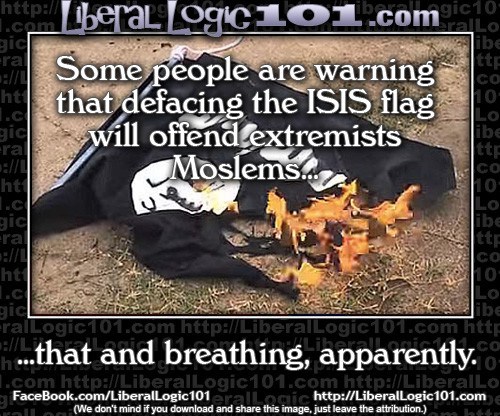
(Some also fear that referring to the Islamic State is offensive. Please see UK: Politicians Urge Ban on the Term “Islamic State” and Leftist and Islamic Policymakers Outlaw the Truth.
Leftist and Islamic Policymakers Outlaw the Truth, American Thinker, Sonia Bailley, July 4, 2015
No need to worry, the recent Ramadan triple slaughter fest in Tunisia, France and Kuwait has nothing to do with Islam. There is no linkage between Islam and terrorism, and the word Islamic need not be used to describe the terrorists because their murderous and barbaric ideology has nothing to do with Islam. Islam is, after all, a religion of peace that is being hijacked, perverted and distorted by only a small percentage of savage extremists.
Welcome to the false narrative that Western leaders, mainstream media outlets, and academic elites are enforcing on civil society to help shape the public’s perception of Islam so that it is always presented in a positive light. Any form of expression that reflects badly on Islam is in violation of Islamic law, which forbids any criticism of Islam, even what that criticism expresses the truth. Stories that are reported according to this narrative need not have anything to do with factual accuracy or truth. Both the 2009 Fort Hood massacre in Texas and the beheading in Vaughan Foods in Oklahoma last September were reported as workplace violence and not Islamic terrorism.
With the aid of leftist and Islamic policymakers shaping the course of international relations and security policies, that false narrative is finding its way into international policy to destroy the West’s hard-won, cherished core values. Realities and facts that might tarnish Islam’s name are deemed hate speech and becoming lost through censorship. The 57-state Organization for Security and Co-operation in Europe (OSCE), which is the world’s largest security-oriented intergovernmental organization that happens to be rooted in communism, and the 57-state Organization of the Islamic Cooperation (OIC), which is the most influential and largest Muslim organization in the world pushing to criminalize any criticism of Islam, are two such policymakers who are influencing world leaders and the news media.
Most Western world leaders are bleating the same empty platitudes about the recent Ramadan terrorist attacks in Tunisia, France and Kuwait, carefully avoiding the word “Islam.” UK Prime Minister David Cameron explained to the media that Islam is a religion of peace, and that the terrorists who “do these things…do it in the name of a twisted and perverted ideology.” When asked if it’s right to say that the recent Ramadan attacks have nothing to do with Islam, UK Home Secretary Theresa May responded to BBC’s Andrew Marr in the positive, “that it has nothing to do with Islam. Islam is a peaceful religion,” and that the terror attacks are “about a perversion of Islam.”
Instead of issuing travel warnings not to vacation in Islamic countries especially during Ramadan, the Islamic “sacred” month of feasting — a month rife with bloodshed and battle since Islam’s inception, when armed raids on Meccan trade caravans and bloody battles were waged by Mohammed and his followers (including the 1973 Yom Kippur War on the 10th of Ramadan), not to mention the ISIS Ramadan message that jihad is 10 times more obligatory during Ramadan, and that those who die will be rewarded by Allah ten times more than during the rest of the year — Western leaders like Cameron continue to nourish the official politically correct narrative of Islam being a religion of peace not linked to terrorism.
The twisted and perverted ideology to which both Cameron and May refer, pervades pages and pages of the Koran and other Islamic doctrine, inspiring jihadists and religious Muslims to “do these things,” including operating child sex slave grooming gangs throughout Europe, especially in the UK, to rape, pimp, torture and sometimes kill non-Muslim underage schoolgirls. The Koran itself contains over 100 verses promoting violence against non-Muslims who, to this very day, remain victims of the verse.
What lies at the heart of Islam is an antipathy towards non-Muslims, as well as a deeply-entrenched duty and commandment from Allah to wage Jihad and eventually subjugate non-Muslims worldwide to Islamic rule in the name of Allah. Massive street prayer is one form of subjugation conducted only to intimidate and Islamize Western society, to remind non-Muslims who’s really in control. Similarly, forcing non-Muslims in their own countries, in the UK for example, to eat halal slaughtered meat — an utterly inhumane and barbaric Islamic practice, not to mention a multi-billion dollar industry controlled by Muslim Brotherhood organizations that fund jihad worldwide — when only a mere 5% of the UK population is Muslim, and when the Koran specifically exempts its followers from eating halal if it’s not available, is another way to subjugate non-Muslims.
People are becoming sitting duck targets for Islamic terrorists in Western countries and abroad because of the little-known but powerful world policymakers like the OSCE and OIC who influence world leaders to kowtow to Islamic interests. Western leaders fail to convey an accurate picture and understanding of what is really going on in the world because it might reflect badly on Islam, and they don’t want to appear “Islamophobic” for fear of more terrorist attacks. By failing to report the truth, they are denying citizens the opportunity to take appropriate action that could save their lives when faced with something that could be considered a threat, such as a beach vacation in an Islamic country over Ramadan.
The dead European tourists in Tunisia might still be here today had there been an undistorted flow of information to warn them that warfare and killing in the name of Islam are encouraged during the month of Ramadan. Furthermore, people might choose to avoid Islamic countries at all times if they were aware that these countries rely upon the most non-liberal draconian and barbaric Islamic or sharia-based corporal punishments imaginable.
The anti-blasphemy narrative pushed by the highly influential but little-known OIC, ehich speaks on behalf of over 1.5 billion Muslims worldwide, not only silences any expression considered to be offensive and insulting to Islam, but punishes the offenders, as Mohammed did to his dissenters and insulters. They were either condemned to hell or killed. Because Muslims consider Mohammed as the ideal model for mankind to follow, many Islamic countries such as Pakistan, Saudi Arabia and Iran, have also made blasphemy subject to the death penalty with their anti-blasphemy laws.
It is this anti-blasphemy law that the OIC is striving to legally enforce on the world in order to curtail speech and expression when it comes to Islam — not so much for religious compliance as for the global subjugation of non-Muslims to Islam. Since 2005, the OIC has been pushing relentlessly for a UN blasphemy resolution (Resolution 16/18 passed in 2011) to silence so-called Islamophobia — a term deliberately coined and marketed in the 1990s by the International Institute of Islamic Thought, one of the thousands of Muslim Brotherhood front groups worldwide, to drive public discourse and policy. However, the OIC’s top priority is to globally criminalize any criticism of Islam, and is working with the Muslim Brotherhood to accomplish this. Ten years later, in 2015, telling the truth about Islam has become a crime in some European countries.
The highly influential yet little-known OSCE that is rooted in communism, is supposed to protect and promote civil liberties. Instead, it is negotiating them away by capitulating to the OIC narrative of the Muslim Brotherhood, whose stated goal from the 1990s is to destroy Western civilization from within. Its goal of global domination is to be accomplished not through violence, at least not yet, but rather through the slow infiltration of Western government, military, judicial and academic institutions.
So far, there has been practically no opposition from any Western administration in power, only cooperation from world leaders, government officials, and leftist policymakers. In fact, the cooperation from Western leaders with OSCE and OIC policymakers has been so great, that the U.S. co-sponsored Resolution 16/18 with Pakistan, and helped usher it through in 2011, despite this resolution being a direct assault on the First Amendment of the U.S. Constitution.
At an OSCE May session in Vienna (on how the media can help prevent violent radicalization that leads to terrorism), OSCE panelist Leila Ghandi, producer and TV show host on the most popular Moroccan TV channel (2MTV) that is over 60% government-owned, maintained that the truth or facts about “a community” can sometimes constitute hate speech when those facts are offensive and therefore should not be said. The panelist’s words echo those of the new OIC Secretary General, Iyad Amin Madani, who tweeted earlier this year following the Charlie Hebdo terrorist attack in Paris, that “freedom of speech must not become a hate speech and must not offend others.” In other words, truth about Islam is designated as hate speech.
Furthermore, OSCE panelist Victor Khroul, correspondent for Rossiya Segodnya, a Russian state-owned international news agency, questions why the mainstream media throughout the world still refer to the “self-proclaimed self-established state in the Middle East” as the Islamic State. His words echo those of Madani, who proclaimed last year that the Islamic State has no connection with Islam. Khroul claims it’s a mistake for these people to be called Muslim and their state Islamic, which only “confuses the audience with this correlation with Islam.” He maintains that it’s still possible “to find other words to describe this so-called state and its activity,” discounting the facts that Islamic State is what ISIS named itself and its state, and that ISIS clearly credits its motivation to Islam and its acts to Allah. The name Islamic State does not have to be rectified because it accurately reflects reality, defines the organization in question, and is therefore a correct term that would sit well in the world of Confucius and his doctrine on rectifying names.
Major Stephen Coughlin, an attorney, former U.S. Army intelligence officer, and the Pentagon’s leading expert on Islamic law and jihad (until he was dismissed in 2008 for linking Islam with terrorism with his Red Pill Briefings), stresses the urgency of defining the enemy as he defines himself: “you cannot target what you will not define…if I can’t use the concepts of Jihad that Al-Qaeda say they rely on, then I can’t understand what they are going to do.”
Author of Catastrophic Failure: Blindfolding America in the Face of Jihad, Coughlin attended the OSCE May session and responded to the OSCE jargon as follows:
“Once you decide that facts on the ground as they present themselves, can be considered hate speech, this is no longer about truth…you are subordinating facts that the public has a right to know when they formulate their decisions, and replacing them with narratives to keep them from coming to the understanding of events that can be articulated and verified. That can never be considered hate speech. We’re not talking about speech at all. We’re talking about brazen disinformation.”
Rather than disseminate vital information to the public that can save lives, Western world leaders are betraying their citizens by submitting to the OSCE and OIC narrative of outlawing any criticism of Islam and rendering truth illegal. Reassuring citizens that Islam is a religion of peace merely renders them incapacitated from exercising sound judgment, crippling their ability to make the right decision in the face of potential harm.
While global institutions and national security policies are being shaped, and compromised, by highly influential but ill-known world organizations such as the OSCE and OIC, it’s critical that citizens get to know who those policymakers really are, and become more engaged in public affairs and the political process in order to arrest the Islamization process of the West…before it’s too late to reverse.
Zarif on getting to yes, Power Line, Scott Johnson, July 3, 2015
(Javad Zarif — “Mr. Moderation.” — DM)
In the annals of murderous deceit and provocative audacity, the video of Iranian foreign minister Javad Zarif takes the cake. The video aims at zarif’s American counterparts and a wider American audience. The video is posted here with full text of Zarif’s message on YouTube. [Here’s the video, with text in a box beneath it. — DM)
Mr. Zarif advises: “Getting to yes requires the courage to compromise, the self-confidence to be flexible, the maturity to be reasonable, the wisdom to set aside illusions, and the audacity to break old habits.” Do check out the whole sickening production. It virtually defies belief. Mr. Zarif, where can I get the soundtrack?
Mr. Zarif, of course, speaks with a forked tongue about the qualities conducive to this particular agreement. He must be in some doubt on this point, but I’m confident that our own Supreme Leader has all the qualities necessary to enter into the deal in process with Iran.
Researcher: ISIS Could Exist Without Islam Because There Is Christianity & Judaism, Truth Revolt, Trey Sanchez, July 3, 2015

“Dalia Mogahed may be the most influential person guiding the Obama Administration’s Middle East outreach.” For years she has been a frequent spokesperson in league with the most prominent Muslim Brotherhood front groups in America: CAIR, ISNA, ICNA, MAS, and MPAC.
******************
Dala Mogahed, a research director for the Institute for Social Policy and Understanding, said that ISIS could exist without Islam because extremist groups simply use “the local social currency” to carry out their terror and that could just as easily be Christianity or Judaism.
Mogahed is not merely some policy wonk for an obscure institute. As Hudson Institute fellow Lee Smith, author of The Strong Horse: Power, Politics, and the Clash of Arab, put it: “Dalia Mogahed may be the most influential person guiding the Obama Administration’s Middle East outreach.” For years she has been a frequent spokesperson in league with the most prominent Muslim Brotherhood front groups in America: CAIR, ISNA, ICNA, MAS, and MPAC. Check out her extensive profile here at the Freedom Center’s Discover the Networks resources site.
Speaking at a global terrorism forum at the Aspen Ideas Festival, Mogahed said, “[A] world without Islam would still have a group like ISIS — they would just be called something else that may be less catchy.” She added, “That is sometimes Christianity. That is sometimes Judaism. That is sometimes Buddhism. And it is sometimes secular ideologies.”
As The Atlantic points out, Mogahed is suggesting that the Qur’an is not the driving force behind ISIS’s violence but simply their desire for violence to begin with. “We start at the violence we want to conduct, and we convince ourselves that this is the correct way to interpret the texts,” Mogahed said.
Or she could just read from the Muslim holy book:
I will cast terror into the hearts of those who disbelieve. Therefore strike off their heads and strike off every fingertip of them.” — Qur’an (8:12)
Deadlines, red lines, Israel Hayom, Ruthie Blum, July 3, 2015
(Please see also, Iran’s Nuclear Negotiators Emboldened by Islamic Ideology: Cleric at (Iranian) Tashim News Agency. — DM)
The regime in Tehran has made its position clear. So has the White House. It will take a miracle — or a military strike — to prevent Iran from building nuclear bombs.
**********************
The deadline for a nuclear deal between the P5+1 powers and Iran was extended on Tuesday, when too many bones of contention remained unresolved on June 30. The new date set by the parties to finalize the “framework for an agreement” reached in Lausanne three months ago is July 7.
This means that there are four days to go before the current talks in Vienna bear fruit in the form of an official document. If such a piece of paper is signed, two leaders will feel particularly vindicated: U.S. President Barack Obama and Iranian President Hassan Rouhani — the former for playing out his fantasy of peace through diplomacy and the latter for delivering the goods to his boss, Ayatollah Ali Khamenei.
The rest of the world, however, will be in mortal peril. And Israel will be forced to act fast.
The only sliver of a silver lining in this otherwise black cloud is that Islamists sometimes play their cards wrong. Buoyed by the weakness of the West in the face of their fanaticism, they often take their visions of grandeur to heights that even American and European appeasers cannot accept. So by next week, it is possible that the Iranian negotiators will overstep their counterparts’ bounds, and everyone will return to the country from whence they came with nothing but another date and venue to show for their efforts.
But because the stakes are nuclear weapons in the hands of a mullah-led regime bent on global hegemony — and working toward it through proxy terrorist organizations — one cannot count on the above scenario.
A number of recent statements are cause for concern.
On Thursday, Iranian Foreign Minister Mohammad Javad Zarif told reporters: “The negotiations are moving forward and we should be hopeful. Today is a good day.”
This was an abbreviated version of what his deputy, Abbas Araqchi, said the day before in a TV interview: “A positive atmosphere is ruling the negotiations, and the spirit for going forward exists in all delegations, but this doesn’t mean that all delegations, including us, are ready to reach an agreement at any price.”
Araqchi also defined a “good deal” as one that would honor Khamenei’s “red lines.”
These were spelled out in a June 23 speech by Khamenei (and included in a June 30 Middle East Media Research Institute report): “In contrast to what the Americans are insisting on, we do not accept long-term restrictions for 10 to 12 years.
“Research, development and construction will continue. … They say, ‘Don’t do anything for 12 years,’ but these are particularly violent words, and a gross mistake.
“The economic, financial and banking sanctions — whether related to the Security Council or the American Congress and administration — must be lifted immediately with the signing of the agreement. The remainder of the sanctions will also be lifted within a reasonable time frame. The Americans are presenting a complex, convoluted, bizarre, and stupefying formula for [removing the] sanctions, and it is unclear what will emerge from it, but we are clearly stating our demands.
“The lifting of the sanctions must not depend on Iran carrying out its obligations. Don’t say, ‘You carry out your obligations and then the IAEA will approve the lifting of the sanctions.’ We vehemently reject this. The lifting of the sanctions must take place simultaneously with Iran’s meeting of its obligations. We oppose the delay of the implementation of the opposite side’s obligations until the [release of] the IAEA report [verifying that Iran has met its obligations], because the IAEA has proven repeatedly that it is neither independent nor fair, and therefore we are pessimistic regarding it.
“They say, ‘The IAEA should receive guarantees.’ What an unreasonable statement. They will be secure only if they inspect every inch of Iran. We vehemently reject special inspections [that are not customary for any country except Iran], questioning of Iranian personnel, and inspection of military facilities.
“Everyone in Iran — including myself, the government, the Majlis [parliament], the judiciary, the security apparatuses, and the military, and all institutions — want a good nuclear agreement … that is in accordance with Iran’s interests.
“Although we wish the sanctions lifted, we see them as [having brought us] a particular kind of opportunity, because they made us pay more attention to domestic forces and domestic potential.”
A few days later, on June 29, Obama’s deputy national security adviser, Ben Rhodes, gave an interview to The Atlantic’s Jeffrey Goldberg at the Aspen Ideas Festival.
When asked whether Obama believes a deal will exact change in Iran’s behavior, Rhodes replied: “We believe that an agreement is necessary … even if Iran doesn’t change. … That said, we believe that a world in which there is a deal with Iran is much more likely to produce an evolution in Iranian behavior than a world in which there is no deal. In fact … if the notion is that Iran has been engaged in these destabilizing activities under the last several years when they’ve been under the pressure of sanctions, clearly sanctions are not acting as some deterrent against them doing destabilizing activities in the region. … [T]he point is … in a world of a deal, there is a greater possibility that you will see Iran evolve in a direction in which they are more engaged with the international community and less dependent upon the types of activities that they’ve been engaged in.”
The regime in Tehran has made its position clear. So has the White House. It will take a miracle — or a military strike — to prevent Iran from building nuclear bombs.
Iran Violates Past Nuclear Promises on Eve of Deal, Washington Free Beacon,
(As the scorpion said to the frog, “that’s just what scorpions do.” Like the frog, Obama and Kerry are anxious to give the scorpion a ride, but on our backs.– DM)
 John Kerry outside the hotel where the Iranian nuclear talks are being held / AP
Wednesday’s disclosure by the IAEA sent the State Department rushing to downplay the Iranian violation.
Obama administration officials insisted that despite Iran’s failure to meet its obligations, negotiations were still on track and that Tehran would face no repercussions.
********************
VIENNA—Senior Obama administration officials are defending Iranian nuclear violations in the aftermath of a bombshell report published Wednesday by the United Nations indicating that Iran has failed to live up to its nuclear-related obligations, according to sources apprised of the situation.
The International Atomic Energy Agency (IAEA) disclosed yesterday that Iran has failed to meet its commitments under the interim Joint Plan of Action to convert recently enriched uranium gas to powder.
While Iran has reduced the amount of enriched uranium gas in its stockpiles, it has failed to dispose of these materials in a way that satisfies the requirements of the nuclear accord struck with the United States and other powers in 2013.
Secretary of State John Kerry declared last summer that Iran would be forced to comply with such restrictions, and State Department officials were assuring reporters as recently as last month that the Iranians would meet their obligations.
Wednesday’s disclosure by the IAEA sent the State Department rushing to downplay the Iranian violation.
Obama administration officials insisted that despite Iran’s failure to meet its obligations, negotiations were still on track and that Tehran would face no repercussions.
One U.S. official who spoke with the Associated Press on Wednesday said that instead of converting its uranium gas into uranium dioxide powder as required, Iran had transformed it into another substance. The IAEA found that Iran had converted just 9 percent of the relevant stockpile into uranium dioxide.
The official went on to downplay concerns about Iran’s violation, claiming that Tehran was only having some “technical problems.”
The “technical problems by Iran had slowed the process but the United States was satisfied that Iran had met its commitments,” the AP reported the official as saying.
“Violations by Iran would complicate the Obama administration’s battle to persuade congressional opponents and other skeptics,” the AP continued.
David Albright, a nuclear expert and founder of the Institute for Science and International Security (ISIS), warned that the United States is weakening its requirements on Tehran as a final deal gets closer.
“The choosing of a weaker condition that must be met is not a good precedent for interpreting more important provisions in a final deal,” Albright wrote in an analysis published late Wednesday.
While Iran was not in compliance with the oxidation requirement, the IAEA found that it did get rid of uranium gas that surpassed a self-imposed benchmark of 7,650 kg.
The IAEA’s disclosures are in contrast to comments made by Kerry last summer when he assured observers that Iran would live up to the interim agreement.
“Iran has committed to take further nuclear-related steps in the next four months” and “these include a continued cap on the amount of 5 percent enriched uranium hexafluoride and a commitment to convert any material over that amount into oxide,” Kerry said.
The Israel Project (TIP), which has sent officials to Vienna to track the deal, wrote in an email to reporters that the administration looked like it was “playing Tehran’s lawyer” in a bid to defuse potential fallout from the IAEA’s report.
This is not the first time that Iran has been caught by the IAEA cheating on past nuclear arrangements.
As negotiations between the sides slip past their June 30 deadline and stretch into July, Iranian officials have become more insistent that the United States consent to demands on a range of sticking points.
President Hassan Rouhani also threatened to fully restart Iran’s nuclear program if negotiators fail to live up to any final agreement.
One Western source present in Vienna said the administration is scrambling to ensure that nothing interferes with a final deal.
“Once again, the White House will go to any length needed to preserve the Obama-Iran deal, even if it means covering up Iran’s failure to convert all of the nuclear material as promised,” said the source.
“If they had admitted Iran failed to live up to the letter of the JPOA—as is the case—this one-week extension period of the JPOA would be totally invalidated and the talks would be over,” the source added. “Like they have for months, the administration continues to hide violations and is acting more like Iran’s advocate than the honest broker the American people deserve. “




 anneinpt
 artaxes
 danmillerinpanama
 davidking1530
 Peter Hofman
 Joseph Wouk
 Peter
Peter Louisiana Steve
 WarSclerotic
Recent Comments