Posted tagged ‘North Korean nukes’

When North Korea Tests a Nuke, Assume It’s Iran’s as Well

January 13, 2016

When North Korea Tests a Nuke, Assume It’s Iran’s as Well, Clarion ProjectRyan Mauro, January 13, 2016

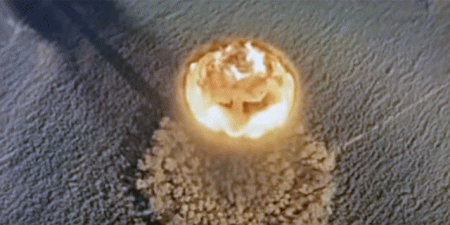
North-Korean-Nuclear-Test-HPA previous nuclear Test made by North Korea (Photo: Video screenshot)

Given the spotty record of U.S. intelligence assessments (to say the least), the West must operate under the assumption that there isn’t an Iranian WMD problem and a North Korean WMD problem, but an Iranian-North Korean WMD problem.

********************************

North Korea briefly reclaimed the global press’ attention again by claiming to have tested a hydrogen bomb. While coverage focused on whether that was an exaggeration, the press missed a much more important question: Was this test only for Kim Jong-Un or was it also for the Iranian regime?

The North Korean and Iranian nuclear and ballistic missile programs should be seen as a single entity, as should be their shared cyber warfare programs. The advance of one is an advance of the other. Differences in their activity should be seen as a common-sense division of labor. Gordon Chang, a prominent expert on Asian affairs, has written about the likelihood that this is the case.

Last May, an Iranian opposition group that has accurately identified hidden nuclear sites in the past reported that it had specific intelligence about North Korean nuclear and missile experts secretly visiting Iran. Intelligence analyst Ilana Freedman said in January 2014 that her sources said a relocation of major parts of Iran’s nuclear program to North Korea began as early as December 2012.

For Iran, it is best to let the North Koreans put the finishing touches on the most provocative nuclear and missile work. Whereas the Iranian regime does suffer from sanctions and must always keep the 2009 Green Revolution in the back of its mind, North Korea thrives off isolation and international provocation.

North Korea has nothing to lose and can only gain by such an arrangement. Kim Jong-Un’s regime has already crossed the nuclear pariah threshold, so it might as well let its Iranian allies take the lucrative deal offered by the West. It has been content to spend $1.1-$3.2 billion each year on it. Plus, the deal puts Iran in a more advantageous position  and its economic improvements can help it invest more in North Korea’s activity.

The good news is that this latest test—North Korea’s fourth— does not appear to be more powerful than its last one, indicating no significant advance in technology. RAND Corporation analyst Bruce Bennett says North Korea is still working on the “basics” of a nuclear fission bomb.

It is hard for some to accept that an Islamist theocracy like that in Iran would work with a cultish communist dictatorship like North Korea, but there is nothing in either one’s ideology that would prevent such cooperation. In fact, North Korea’s success in building a nuclear arsenal actually encourages Iran to see nuclear weapons as a key lesson for the Islamic Revolution.

“The entire world may well consider North Korea a failed state, but from the view point of [Iran], North Korea is a success story and a role model: A state which remains true to its revolutionary beliefs and defies the Global Arrogance,” Ali Alfoneh, an expert on the Iranian regime, told the Washington Free Beacon.

Given the spotty record of U.S. intelligence assessments (to say the least), the West must operate under the assumption that there isn’t an Iranian WMD problem and a North Korean WMD problem, but an Iranian-North Korean WMD problem.

After Bomb Test, North Korea, Iran Continue Illicit Nuke Cooperation

January 8, 2016

After Bomb Test, North Korea, Iran Continue Illicit Nuke Cooperation, Washington Free Beacon, January 7, 2016

(Please see also, North Korea and Iran: The Nuclear Duo. — DM)

Iranian President Hasan Rouhani, right, shakes hands with a top North Korean leader, Kim Yong Nam, at the start of a meeting in Tehran, Iran, Saturday, Aug. 3, 2013. Iran's supreme leader formally endorsed Hasan Rouhani as president Saturday, allowing the moderate cleric to take charge of a country weakened by economic sanctions over its nuclear program. Kim Yong Nam is in Tehran to attend a ceremony when Rouhani will take the oath of office in parliament Sunday. (AP Photo/Ebrahim Noroozi)

Iranian President Hasan Rouhani, right, shakes hands with a top North Korean leader, Kim Yong Nam, at the start of a meeting in Tehran, Iran, Saturday, Aug. 3, 2013.

Iran won’t even need to make any progress on its domestic nuclear program—once it perfects its ballistic missiles it could purchase a weapon from North Korea and all of the conditions and monitoring in the [nuclear deal] would be ineffective in detecting or stopping that. . . .

****************************

One day after North Korea claimed to have successfully tested a miniaturized hydrogen bomb, lawmakers and regional experts are warning that Pyongyang and Tehran are continuing an illicit clandestine partnership enabling the rogue nations to master nuclear technology.

Loopholes in the nuclear pact recently reached between Iran and the international community have allowed the Islamic Republic and North Korea to boost their nuclear cooperation, which includes the exchange of information and technology, according to material provided to Congress over the past year.

Iran is believed to be housing some of its key nuclear weapons-related technology in North Korea in order to avoid detection by international inspectors. Iranian dissidents once tied to the regime have disclosed that both countries have consulted on a nuclear warhead.

Following the test, however, the White House publicly denied that Iran and North Korea are working together, according to multiple statements issued by the administration on Wednesday.

Still, the Iranian-North Korean nuclear axis is coming under renewed scrutiny by lawmakers in light of Pyongyang’s most recent detonation, which is the fourth of its kind in recent years.

Congressional critics now warn that the Obama administration cannot be trusted to clamp down on North Korea given its recent efforts to appease Iran by dropping a new set of sanctions that were meant to target its illicit ballistic weapons program.

Iran, on the other hand, thinks that the bomb test will give it “media breathing space” by drawing attention away from its own nuclear pursuits, according to Persian-language reports carried by state-controlled media outlets closely aligned with the country’s Revolutionary Guards Corps.

“The entire world may well consider North Korea a failed state, but from the view point of the [Iranian Revolutionary Guard Corps], North Korea is a success story and a role model: A state which remains true to its revolutionary beliefs and defies the Global Arrogance,” said Ali Alfoneh, an expert on the inner workings of the Iranian regime.

Prominent members of Congress are now warning that North Korea’s latest nuclear test is a sign of what could come from Iran, which they claim is closely following the North Korean nuclear playbook.

Rep. Ileana Ros Lehtinen (R, Fla.), chair of House’s foreign relations subcommittee on the Middle East and North Africa, described North Korea’s latest test as “a precursor to what we can expect from Iran in a few years.”

Iran, Ros-Lehtinen told the Washington Free Beacon, “is following the North Korea playbook” and “stands to be the main beneficiary of Pyongyang’s continued nuclear progress.”

“Iran and North Korea have a history of collaboration on military programs and have long been suspected of collaborating on nuclear related programs,” she said, noting that the Iran deal provides the Islamic Republic with the cash necessary to purchase advanced nuclear technology.

“Iran won’t even need to make any progress on its domestic nuclear program—once it perfects its ballistic missiles it could purchase a weapon from North Korea and all of the conditions and monitoring in the [nuclear deal] would be ineffective in detecting or stopping that,” she said.

“Let’s not forget, Iranians have reportedly been present at each of North Korea’s previous nuclear tests,” Sen. David Perdue (R., Ga.), a member of the Senate Foreign Relations Committee, said in a statement. “We cannot turn a blind eye to ongoing ties between North Korea and Iran. President Obama must act now to stop these rogue nations from supporting each other’s nuclear weapons efforts aimed at harming America and our allies.”

Rep. Patrick Meehan (R., Pa.) expressed concern that Iran is following in North Korea’s footsteps, and that the nuclear deal will collapse just as  Bill Clinton’s agreement with North Korea did in the mid-1990s.

“This test is just the latest sign that North Korea is a regime hell-bent on building and developing a sophisticated nuclear program,” Meehan said. “The passage of the 1995 nuclear deal with [North Korea] came with it promises from the Clinton administration of accountability and transparency for Kim’s regime.”

“Those same sort of assurances are echoed today by the Obama White House as it seeks to assure us that its own deal with Iran will be more successful,” Meehan said. “The Iran deal and the North Korean deal were sold with the same promises, the same assurances, to the American people, sometimes even word-for-word.”

“When you put the rhetoric of the 90’s and the North next to the rhetoric of today and Iran, it’s hard to tell the difference,” he added.

Sen. Mark Kirk (R., Ill.), a chief advocate for increased economic sanctions on Iran, highlighted what he called North Korea’s “alarming record” of “cooperating on missile development with Iran.”

With Iran set to receive billions of dollars in sanctions relief later this month, regional experts have informed Congress that the nuclear deal “creates conditions and incentives that are highly likely to result in the expansion” of Iran and North Korea’s illicit nuclear exchange, according to testimony submitted last year by Claudia Rossett, an expert at the Foundation for Defense of Democracies.

The deal fails to “cut off the pathways between Iran and nuclear-proliferating North Korea” and even has made “it safer for Iran to cheat,” according to Rossett’s testimony.

Additionally, sanctions relief gives Iran a chance to “go shopping in North Korea,” she said.

The Obama administration denied the ties between Iran and North Korea, telling reporters on Wednesday that “they’re entirely two different issues altogether.”

“We consider the Iran deal as a completely separate issue handled in a completely different manner than were the—than was the Agreed Framework with North Korea,” said John Kirby, a State Department spokesman, echoing similar remarks issued by the White House.

The administration’s hesitance to link the two nuclear issues has angered some critics of the Iran deal.

“This is exactly the kind of dishonest incoherence that the Iran nuclear deal forces its advocates to defend,” said Omri Ceren, the managing director of press and strategy at The Israel Project, a D.C.-based organization that works with journalists on Middle East issues.

“The Obama administration can’t admit that the [deal] provided the Iranians with hundreds of billions of dollars, some of which they’re going to invest in nuclear research beyond their borders, allowing them to get sanctions relief while advancing their program anyway,” Ceren said. “So instead they have to deny that there are links between Iran and North Korea’s nuclear program, even though that’s laughable.”

North Korea and Iran: The Nuclear Duo

January 8, 2016

North Korea and Iran: The Nuclear Duo, Front Page MagazineJoseph Klein, January 8, 2016

(With the Iran Scam’s sanctions relief, Iran will soon have lots more money to outsource development of nuclear weapons to North Korea. North Korea desperately needs foreign currency and will be delighted to help, as it has done in the past and, apparently, continues to do. — DM)

pl (1)

There is no reason to believe that, as a result of the deal Iran is already sidestepping, Iran will suddenly stop all dealings with North Korea with regard to both countries’ nuclear programs. The Obama administration and the United Nations upon which it relies ignore the close relationship between the two rogue nations at the world’s peril.

********************************

North Korea conducted its fourth nuclear test on January 6th, which it claimed was a hydrogen bomb. Despite some skepticism as to North Korea’s claim that it had actually tested a hydrogen bomb, the Obama administration acknowledged that North Korea had indeed tested some sort of nuclear device. The administration condemned North Korea’s latest testing as a violation of a series of past United Nations Security Council resolutions.

“We do not and will not accept North Korea as a nuclear armed state, and actions such as this latest test only strengthen our resolve,” declared Secretary of State John Kerry.

Mr. Kerry is a bit late with his declaration. North Korea has had an active nuclear arms program for nearly a decade and has conducted three of its four nuclear tests during President Obama’s time in office. None of the sanctions contained in the Security Council resolutions have stopped North Korea from thumbing its nose at the so-called “international community” and conducting as many nuclear and missile tests as it wishes. Kerry’s declaration begs the question – “resolve” to do what? Pass yet another Security Council resolution with a few more symbolic sanctions and some additional travel restrictions on senior North Korean officials?

The Obama administration’s claim of “resolve” in dealing effectively with nuclear threats rings hollow. Its idea of what “resolve” means was demonstrated by the loophole-ridden nuclear deal with Iran, which contains no safeguards against Iran’s cooperation with North Korea on nuclear technology and development. No doubt the administration would offer North Korea a similar deal if its leader Kim Jong-un were as crafty as Iranian President Hassan Rouhani in lulling President Obama and Kerry into a false sense of security.

Moreover, rather than work closely with China to maximize its leverage in defusing North Korea’s nuclear threat, the administration chose to prioritize climate change in its relationship with China above all other issues.

The administration’s solution to the North Korea problem is to double down on its failed strategy of relying principally on the UN for concerted “international” action. It joined Japan, a non-permanent member of the Security Council, in calling for the December 6th emergency session. After about two hours of closed door consultations, the Security Council issued a press statement condemning the test and vowing further unspecified measures in response:

“The members of the Security Council strongly condemned this test, which is a clear violation of Security Council resolutions1718 (2006), 1874 (2009), 2087 (2013), and 2094 (2013) and of the non-proliferation regime, and therefore a clear threat to international peace and security continues to exist. The members of the Security Council also recalled that they have previously expressed their determination to take ‘further significant measures’ in the event of another DPRK nuclear test, and in line with this commitment and the gravity of this violation, the members of the Security Council will begin to work immediately on such measures in a new Security Council resolution.”

Even if Russia and China were to come around and support another resolution under the enforcement provisions of Chapter 7 of the UN Charter, it is hard to believe that it will make any difference. Before the emergency Security Council meeting even began, Russian UN Ambassador Churkin was already lowering expectations, saying softly to reporters: “Cool heads, cool heads” and “proportionate response.”

North Korea regards the UN Security Council, and the Obama administration for that matter, with about as much contempt as Iran does. Indeed, all North Korea’s leaders have had to do is look at how Iran has been treated when it behaves badly. Iran was rewarded with a deal that merely postpones its nuclear arms program in return for the lifting of sanctions and unfreezing of many billions of dollars. Moreover, Iran suffered no consequences to speak of from its recent violations of the Security Council resolutions prohibiting it from developing or testing ballistic missiles capable of carrying nuclear weapons. The Security Council held meetings but did nothing. As U.S. ambassador to the United Nations Samantha Power told the Senate Foreign Relations Committee last December, “Beyond having Security Council discussions on the matter there’s been no follow-on action. Discussions are a form of U.N. action.”

For its part, the Obama administration put off the imposition of any separate U.S. sanctions it had been considering in response to Iran’s missile launchings as soon as the Iranians claimed that any such sanctions would violate President Obama’s “holy grail” nuclear deal.

The United Nations Security Council, as well as the Obama administration, tend to compartmentalize flashpoints erupting in different regions of the world. They refuse to acknowledge that Iran and North Korea have long been joined at the hip when it comes to the development of nuclear material for bombs and ballistic missiles capable of delivering them.

The Security Council holds separate meetings on Iran and North Korea, as if their respective nuclear activities have been completely unrelated to each other. And, as demonstrated by the following exchange between a correspondent and White House Press Secretary Josh Earnest at the January 6th daily press briefing, the Obama administration is turning a blind eye to the dangerous risk of continuing cooperation between Iran and North Korea:

“Q: You mentioned Iran earlier, and I’m wondering if there’s a bit of sleight of hand there from the Iranians’ perspective — meaning they’re trying to, on the one hand, work with the international community to have sanctions relief, but on the other hand, it’s been widely reported that they’ve been working with the North Koreans, perhaps even using them as a proxy to continue development of their own nuclear ambition. Does the White House understand that view?

MR. EARNEST:  I can’t speak to the veracity of those claims.

Iran and North Korea have been cooperating for decades on nuclear technology. As Ilan Berman, a leading expert on the Middle East and Iran, wrote last August in the National Journal, “over the past three decades, Iran and the Stalinist regime of the Kim dynasty in North Korea have erected a formidable alliance—the centerpiece of which is cooperation on nuclear and ballistic-missile capabilities.”

Secretary of Defense Ashton Carter stated during an April 2015 interview that North Korea and Iran could still be cooperating to develop a nuclear weapon. Moreover, according to an assessment of “Iran-North Korea-Syria Ballistic Missile and Nuclear Cooperation” published by the Congressional Research Service last May, “U.S. intelligence officials have expressed concern that North Korea might export its nuclear technology or fissile material.”

Iran “may still rely on Pyongyang for certain materials for producing Iranian ballistic missiles, Iran’s claims to the contrary notwithstanding,” the Congressional Research Service report added.

North Korea has also conducted several tests involving nuclear explosive devices, a technology in which Iran has reportedly shown interest and would be in a position to procure from North Korea.

In short, rebutting the claims by the Obama administration that its nuclear deal with Iran cuts off all its pathways to the achievement of a nuclear weapon capability, the title of Mr. Berman’s National Journal article says it all – “North Korea: Iran’s Pathway to a Nuclear Weapon.”

There is no reason to believe that, as a result of the deal Iran is already sidestepping, Iran will suddenly stop all dealings with North Korea with regard to both countries’ nuclear programs. The Obama administration and the United Nations upon which it relies ignore the close relationship between the two rogue nations at the world’s peril.

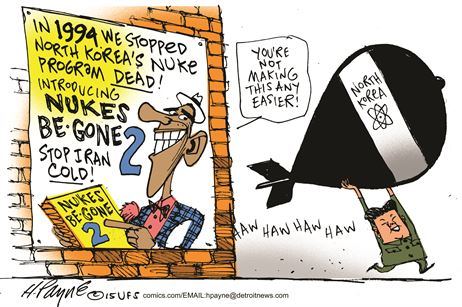
Cartoons of the day

September 18, 2015

H/t Freedom is just another word


begone
invited

Satire but not funny|Kim Jong-un has replaced John Boehner as Speaker of the House

September 11, 2015

Kim Jong-un has replaced John Boehner as Speaker of the House, Dan Miller’s Blog, September 11, 2015

(The views expressed in this article are mine and do not necessarily reflect those of Warsclerotic or its other editors. — DM)

We have met the enemy and it is us: we have become too tired to be effective and hence are becoming indifferent. The charade on Capitol Hill continues, and not only about the nuke “deal” with Iran. Will the carnival end before it’s too late, or will Obama continue to win?

The House speaker is elected by all House members, not just those of the majority party. He need not be a member of the House. Boehner having resigned because a serious medical condition often reduces him to tears, one group of Democrats nominated Debbie Wasserman-Schultz to replace him. However, due to her support for Hillary Clinton, she fell out of favor with the White House so another group of Democrats nominated Kim Jong-un at Obama’s request. To avoid the appearance of confrontation, Republicans offered no candidates. Kim won by seventeen votes, becoming the first non-US citizen to hold the office thus far this month.

tearsofboehnerDebby


Reporting for duty!

REPORTING FOR DUTY!

The current upset was precipitated by Republican members’ disagreements with Boehner and other party leaders about how best to deal with the catastrophic Iran nuke “deal” without unnecessarily offending the President. Kim Jong-un is expected to substitute his own brand of leadership for Boehner’s leadership through ambivalence.

A majority also deemed Kim the best qualified to negotiate with Dear Leader Obama on behalf of the House because, as the undisputed leader of a rogue nuclear nation himself, he should be able to pull not only Obama’s strings but also those of the Supreme Leader of the Islamic Rogue Republic of Iran.

White House Press Secretary Josh Earnest declined comment on the situation beyond refusing to comment on whether Obama met privately with Kim to congratulate him. However, Obama is generally thought to have confirmed that He fully supports Kim’s way of governing his own Democratic Peoples’ Republic and — subject to the few pesky restraints still imposed by an antiquated Constitution that He has not yet found ways to sneak around — He does His best to emulate him. In that connection, Obama asked Kim for recommendations on antiaircraft guns to deal humanely with Jews and other traitors who oppose Him (Please see also, New York Times Launches Congress ‘Jew Tracker’ – Washington Free Beacon.)

Desiring to gain Obama’s total good will, Kim promised to have derogatory cartoons of Donald Trump and Hillary Clinton painted on all future North Korean nukes and missiles just before they explode. In return, Obama promised to issue executive orders granting North Korea the permanent right to declassify any and all U.S. documents it sees fit pertaining to the security of the United States and to obtain copies, gratis, from the Government Printing Office.

House Speaker Kim Jong-un will next meet with Supreme Leader Khamenei in Tehran to make two common sense proposals, with which Khamenei is certain to agree:

First, Kim will propose that a group of highly regarded North Korean nuclear experts — under his personal guidance and supervision — conduct all nuke inspections in Iran and draw all conclusions concerning any past or present Iranian nuclear program based on them exclusively. Those conclusions will be drawn on behalf of, and in lieu of any conclusions drawn by, the International Atomic Energy Agency (IAEA). The head of the IAEA, Yukiya Amano, immediately endorsed this plan as “splendid and totally consistent with any and all IAEA – Iran “secret deals.”

Second, Kim will propose that Khamenei promise not to nuke anyone until all sanctions have been permanently eliminated, unless he really wants to.

Obama is thought to have agreed with every aspect of the Kim plan and to have directed Secretary Kerry to tell Khamenei that if he agrees all sanctions will be eliminated permanently, via executive decree, and hence even more expeditiously than previously expected. Due to a successful Senate filibuster yesterday, Obama can issue the executive decree very soon; Today — Friday, September 11th — is being considered seriously due to the obvious symbolism of the date.

H/t Freedom is just another word

arming

The inevitable success of Kim’s mission will result in a win-win situation for nearly everyone, particularly the financially strapped IAEA, and the true Peace of Obama will prevail throughout all parts of the world that He considers worth saving. Remember — it’s all for the Children!

veto (1)Mushroom cloud


Addendum

하원 의장 김정은 의 문 사랑하는 북미 친구 , 그것은 오바마 대통령 아래에서 당신의 인생 이 곧 Amerika 민주주의 인민 공화국 이 될 것입니다 무엇 에 미래의 삶을 위해 잘 준비 것을 진심으로 희망 합니다. 배리 와 나는 제출 된 것을 기쁘게 사람들을 위해 가능한 한 오랫동안 지배 구조 의 우리의 양식 에 서서히 적응 을 하기 때문에 전환이 원활 하게 하기 위해 함께 열심히하고 고통 일했다 .

Translation:

Statement of House Speaker Kim Jong-un

My dear North American friends, it is my sincere hope that your life under President Obama has prepared you well for your future life in what will soon become the Democratic People’s Republic of Amerika. Barry [a.k.a. Barack] and I have worked long and hard together to acclimate you gradually to our transformed and transformational form of governance and hence to make the transition as smooth and painless as possible for those pleased to submit. Now, we will accelerate the progress.

Conclusions

It does not have to be that way. Here, in closing, are a few words from Daniel Greenfield.

We don’t have to give in to despair. If we do, we are lost. Lost the way that the left is lost. Lost the way that the Muslim world is lost.

We are not savages and feral children. We are the inheritors of a great civilization. It is still ours to lose. It is ours to keep if we understand its truths. [Emphasis added.]

We are not alone. A sense of isolation has been imposed on us as part of a culture war. The task of reconstructing our civilization and ending that isolation begins with our communication. We are the successors of revolutions of ideas. We need to do more than keep them alive. We must refresh them and renew them. And, most importantly, we must practice them.

We are not this culture. We are not our media. We are not our politicians. We are better than that.

We must win, but we must also remember what it is we hope to win. If we forget that, we lose. If we forget that, we will embrace dead end policies that cannot restore hope or bring victory.

What we have now is not a movement because we have not defined what it is we hope to win. We have built reactive movements to stave off despair. We must do better than that. We must not settle for striving to restore some idealized lost world. Instead we must dream big. We must think of the nation we want and of the civilization we want to live in and what it will take to build it.

Our enemies have set out big goals. We must set out bigger ones. We must become more than conservatives. If we remain conservatives, then all we will have is the America we live in now. And even if our children and grandchildren become conservatives, that is the culture and nation they will fight to conserve. We must become revolutionaries.

We must think in terms of the world we want. Not the world we have lost.

This is the America we live in now. But it doesn’t have to be.

It can be up to us, not to those who hate America and all for which she once stood.

Our World: The Republican fall guys

September 9, 2015

Our World: The Republican fall guys, Jerusalem Post, Caroline Glick, September 8, 2015

Whenever the Iranians leave, they can be depended on to blame US for their decision to vacate their signature. And the Democrats in turn will blame the Republicans for pushing the Iranians over the edge.

***********************

The ayatollahs will ride their nuclear pact with the Great Satan all the way to a nuclear arsenal and regional hegemony, repeating the cycles of brinksmanship, extortion, respite and brinksmanship that they learned from their North Korean teachers.

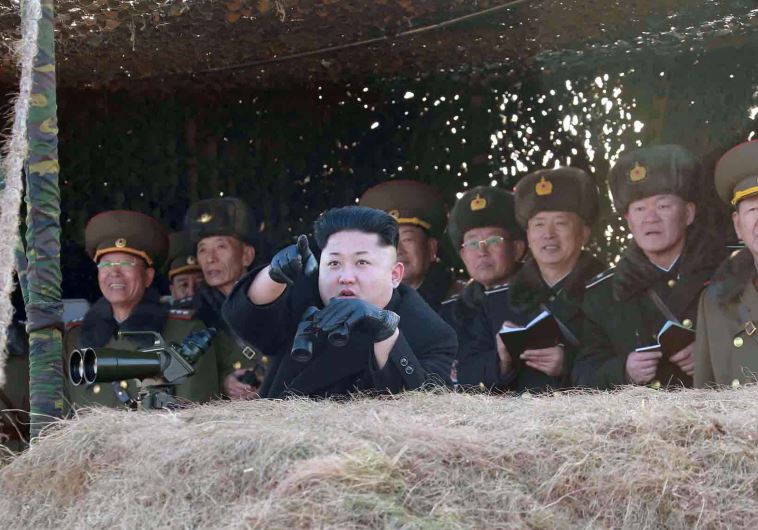
ShowImage (11)Kim Jong-un, North Korea leader. (photo credit:KNS / KCNA / AFP)

The Iran nuclear deal is presented as an international agreement between the major powers and Iran. But the fact is that there are really only two parties to the agreement – President Barack Obama and his Democratic Party on the one hand, and the Iranian regime on the other.

Over the past week or so, more and more Democrats have fallen into line behind Obama. At the same time, word is getting out about what Iran is doing now that it has its deal. Together, the actions of both sides have revealed the role the nuclear pact plays in each side’s overall strategies for success.

On the Iranian side, last Wednesday the National Committee of Resistance of Iran revealed that North Korean nuclear experts are in Iran working with the Revolutionary Guards to help the Iranians prevent the UN’s nuclear inspectors from discovering the scope of their nuclear activities.

The NCRI is the same opposition group that in 2003 exposed Iran’s until then secret uranium enrichment installation in Natanz and its heavy water plutonium facility in Arak.

According to the report, the North Koreans “have expertise in ballistic missile and nuclear work areas, particularly in the field of warheads and missile guidance.”

“Over the past two years the North Korean teams have been sharing their experiences and tactics necessary for preventing access to military nuclear sites,” NCRI added.

Although, as The Washington Times reports, NCRI’s finding have yet to be verified, it is unwise to doubt them.

North Korea has been assisting Iran’s nuclear program for nearly 20 years. The US began applying sanctions on North Korea for its ballistic missile proliferation activities in Iran 15 years ago. Iran’s Shahab and Ghadr ballistic missiles are modeled on North Korea’s Nodong missiles.

The Syrian nuclear installation that Israel reportedly destroyed in 2007 was a duplicate of the Yangbyon heavy water reactor in North Korea. The Deir al-Zour reactor was reportedly built by North Korean nuclear personnel and paid for by Tehran.

North Korea’s heavy involvement in Iran’s nuclear weapons program tells us everything we need to know about how Iran views the nuclear deal it signed with the Obama administration and its international partners.

For the past 22 years, the North Koreans have been playing the US and the international community for fools. Ever since February 1993, when inspectors from the International Atomic Energy Agency first discovered that North Korea was conducting illicit nuclear activities, Pyongyang has been using its nuclear program to blackmail the US.

The pattern repeats itself with maddening regularity.

First, the US discovers that North Korea is engaging in illicit nuclear activities. Over the years, these activities have gone from illicit development of plutonium-based nuclear bombs to expelling UN inspectors, to testing long-range ballistic missiles, to threatening nuclear war, to testing nuclear bombs and threatening to supply the bomb to terrorist groups.

Second, the US announces it is applying sanctions to North Korean entities.

Third, North Korea responds with more threats.

The sides then agree to sit down and negotiate the scaling back of North Korea’s nuclear activities. In exchange for Pyongyang’s agreement to talk, the US provides the hermit slave state with whatever it demands. US concessions run the gamut from sanctions relief, to cash payments, provision of fuel, assistance in developing “peaceful” nuclear sites at which the North Koreans expand their nuclear expertise, removal of North Korea from the State Department’s list of state sponsors of terrorism, the provision of formal US commitments not to use force to block North Korea’s nuclear progress, to more cash payments and sanctions relief.

The North then formally agrees to scale back its nuclear program and everyone is happy.

Until the next time it is caught cheating and proliferating.

And then the cycle starts again.

In each go around, the US expresses surprise at the scope of North Korea’s illicit nuclear and missile activities. In every cycle, US intelligence failed to discover what North Korea was doing until after the missiles and bombs were tested and UN inspectors were thrown out of the country.

Despite North Korean brinksmanship and ballistic missile warhead development, the US prohibits its ally South Korea from developing its own nuclear deterrent or even taking steps in that direction.

For their part, while negotiating with the Americans, the North Koreans have proliferated their nuclear technologies and ballistic missiles to Iran, Syria, Pakistan and Libya.

Given North Korea’s clear strategy of using nuclear blackmail to develop its nuclear arsenal and maintain the regime’s grip on power, you don’t need to be a master spy to understand what the presence of North Korean experts in Teheran tells us about Iran’s strategy for nuclear empowerment.

The ayatollahs will ride their nuclear pact with the Great Satan all the way to a nuclear arsenal and regional hegemony, repeating the cycles of brinksmanship, extortion, respite and brinksmanship that they learned from their North Korean teachers.

Given how well the strategy has worked for the psychotic North Koreans who have no economy, no allies and no proxies, it is clear that Iran, with its gas and oil deposits, imperial aspirations, terrorist proxies and educated population believes that this is the strategy that will launch it to world-power status.

This then brings us to the Democrats.

Depending on their pro-Israel protestations, the Democratic position in support of the deal ranges from optimism to pessimistic minimalism. On the side of the optimists, we have the Obama administration.

Obama, Secretary of State John Kerry and their advisors insist that the deal is fantastic. It blocks Iran’s path to the bomb. It opens the possibility of Iran becoming a positive actor on the world stage.

On the other end of the Democratic spectrum are the pessimists like New Jersey Senator Cory Booker and Congresswoman Debbie Wasserman-Schultz.

As they see it, the deal is horrible. It empowers and enriches Iran and legitimizes its nuclear program.

But still, they claim, the deal keeps Iran’s nuclear ambitions at bay for a few years by forcing Iran to submit to the much touted UN inspections regime.

So it is a good deal and they will vote in favor of it and then vote to sustain a presidential veto of a congressional decision to oppose it.

Obviously, the presence of North Korean nuclear experts in Tehran makes a mockery of the notion that Iran has any intention of exercising good faith with UN inspectors. But that isn’t the point.

The point is that the Democrats have no intention of doing anything to prevent Iran from becoming a nuclear power. They just don’t want to be blamed for Iran becoming a nuclear power. They want the Republicans to shoulder the blame. The purpose of the deal from their perspective to set the Republicans up to be blamed.

Obama and his Democratic followers insist that if Iran doesn’t act in good faith, the US will reimpose sanctions. Worse comes to worst, they insist, the US can just walk away from the deal.

This of course is utter nonsense.

Obama won’t walk away from his signature foreign policy. He will devote his energies in his remaining time in office to covering up for Iran. That is why he is breaking the law he signed and refusing to hand over the side deals regarding the farcical nature of UN inspections of Iran’s nuclear sites to Congress.

Moreover, after insisting that the deal is the best way to prevent a holocaust or that it is the only way a Jewish mother can protect the homeland of her people, Democratic lawmakers are not going to rush to acknowledge that they are lying. Now that they’ve signed onto the deal, they own it.

Of course, the Iranians are another story. While the Democrats will not abandon the deal no matter what, the Iranians signed the deal in order to abandon it the minute it outlives its usefulness. And that works just fine for the Democrats.

The Democrats know that the Iranians will use any step the Republicans take to try to enforce the deal’s verification regime or condition sanctions relief on Iranian abidance by the deal’s restrictions on its nuclear activities as an excuse to walk away from the deal. They also know the Iranians will remain in the deal as long as it is useful to them.

Since the Iranians intend to hide their nuclear activities, the Democrats assume Tehran will stay in until it is financially and militarily ready to escalate its nuclear activities.

The Democrats believe that timetable will extend well beyond the lifespan of the Obama administration.

Whenever the Iranians leave, they can be depended on to blame US for their decision to vacate their signature. And the Democrats in turn will blame the Republicans for pushing the Iranians over the edge.

You have to give credit to the administration and its Iranian chums. At least they are consistent. They have constructed an agreement that gives them both what they care about most. Iran, as always, wants to dominate the region and develop the means to destroy Israel and its Arab adversaries at will. The administration, as always, wants to blame the Republicans.

Israel and the Arabs understand the game that is being played. It is time for the Republicans to get wise to it.

Nuclear Fiascoes: From Diplomatic Failure With North Korea To Debacle With Iran

September 1, 2015

Nuclear Fiascoes: From Diplomatic Failure With North Korea To Debacle With Iran, Forbes, Claudia Rosett, August 31, 2015

(An excellent comparison of the machinations that led to the nuke “deal” with North Korea and those now leading to the “deal” with the Islamic Republic of Iran. — DM)

[B]oth Clinton and Bush purchased the transient gains of North Korean nuclear deals at the cost of bolstering a North Korean regime that has become vastly more dangerous. . . . Kim Jong Un bestrides a growing arsenal of weapons of mass murder, including chemical and biological, as well as nuclear, plus a growing cyber warfare capability. This is the legacy not least of North Korea’s skill at exploiting the feckless nuclear deals offered by U.S. presidents whose real achievements on this front were to hand off a monstrous and rising threat to the next administration.

Now comes the Iran nuclear deal, which President Obama has described as a perhaps once-in-a-lifetime “historic chance to pursue a safer and more secure world.” And from Israel’s Prime Minister Netanyahu, leader of America’s closest ally and Iran’s prime target in the Middle East, comes the warning that this deal is a “stunning historic mistake,” configured not to block Iran’s path to the bomb, but to pave the way.

Like the North Korea Agreed Framework, the Iran nuclear deal pivots narrowly on nuclear issues, as if ballistic missiles, terrorism, arms smuggling, gross violations of human rights, blatant declarations of destructive intent and the malign character of the regime itself were irrelevant to the promised “exclusively peaceful” nuclear program.

[I]f this Iran deal goes through, is that we are about to see the mistakes made with North Korea amplified on a scale that augurs not security in the 21st century, but a soaring risk of nuclear war.
************************

With Congress due to vote by Sept. 17 on the Iran nuclear deal, there’s a warning worth revisiting. It goes like this: The president is pushing a historic nuclear agreement, saying it will stop a terror-sponsoring tyranny from getting nuclear weapons. And up pipes the democratically elected leader of one of America’s closest allies, to say this nuclear deal is mortal folly. He warns that it is filled with concessions more likely to sustain and embolden the nuclear-weapons-seeking despotism than to disarm it.

This critic has more incentive than most to weigh the full implications of the deal, because his country is most immediately in harm’s way — though it has not been included in the nuclear talks. He notes that the nuclear negotiators have sidelined such glaring issues as human rights, and warns that Washington is naive, and the U.S. is allowing itself to be manipulated by a ruthless dictatorship.

No, the critic I’m referring to is not Israel’s Prime Minister Benjamin Netanyahu, though he has warned of precisely such dangers in the Iran nuclear deal. I am citing the warnings voiced 21 years ago by the then-President of South Korea, Kim Young Sam, as the Clinton administration bargained its way toward the 1994 nuclear deal with North Korea known as the Agreed Framework.

As it turned out, Kim Young Sam’s misgivings were right on target. The 1994 Agreed Framework did not stop North Korea’s pursuit of the bomb. Instead, it became a pit stop on North Korea’s road to the nuclear arsenal it is amassing today.

For all the differences between North Korea and Iran, there are parallels enough to suggest that the failed 1994 nuclear bargain with North Korea is an excellent guide to the future trajectory with Iran, if the U.S. goes ahead with the nuclear deal — the Joint Comprehensive Plan of Action — announced by the U.S., France, Britain, Germany, Russia, China and Iran on July 14 in Vienna.

Recall that in 1994, faced with the threat of North Korea producing plutonium for nuclear weapons, the U.S. sought a diplomatic solution. Taking a cue from an exploratory trip to Pyongyang by former President Jimmy Carter, the Clinton administration wooed North Korea with an offer of lightwater nuclear reactors to be used exclusively for the peaceful production of electricity. All Pyongyang had to do was give up its nuclear bomb program.

As this agreement was taking shape, South Korea’s Kim Young Sam laid out his concerns in an hourlong interview with the New York Times. In the resulting article, dated Oct. 8, 1994, the Times reported: “After weeks of watching in silent frustration as the United States tries to negotiate a halt to North Korea’s nuclear program, President Kim Young Sam of South Korea lashed out at the Clinton administration today in an interview for what he characterized as a lack of knowledge and an overeagerness to compromise.”

The Times article described Kim’s concerns that “compromises might prolong the life of the North Korean government and would send the wrong signal to its leaders.” Kim was quoted as denouncing the deal then in the making as a “half-baked compromise” which would lead to “more danger and peril.”

President Clinton rolled right past that warning. On Oct. 21, 1994, less than two weeks after Kim’s concerns hit the headlines, the U.S. signed the Agreed Framework with North Korea. Clinton praised the deal as “good for the United States, good for our allies, and good for the safety of the entire world.” Promising that the Agreed Framework would reduce the threat of nuclear proliferation, Clinton further lauded the deal as “a crucial step for drawing North Korea into the global community.”

South Koreans and their leaders, in the main, disagreed. But with South Korea dependent on the U.S. superpower for defense against North Korea, Kim Young Sam had little choice but to follow Clinton’s lead. Seoul damned the deal with faint praise. The Associated Press reported: “South Korean Foreign Minister Han Sung-joo said that even though the deal fell short of expectations, it met South Korea’s minimum policy goals.”

History now shows that the chief policy goals served by the Agreed Framework were those of Pyongyang, which racked up a highly successful exercise in nuclear extortion, and carried on, first secretly, then overtly, with its nuclear weapons program. As South Korea’s president had predicted, the Agreed Framework helped fortify Pyongyang’s totalitarian regime, rather than transforming it.

Some of the negotiators involved in that 1994 deal have since argued that while the North Korean agreement eventually collapsed, it did at least delay Pyongyang’s progress toward nuclear weapons. What they tend to omit from that select slice of history is that the Agreed Framework helped rescue a North Korean regime which in 1994 was on the ropes. Just three years earlier, North Korea’s chief patron of decades past, the Soviet Union, had collapsed. The longtime Soviet subsidies to Pyongyang had vanished. China did not yet have the wealth to easily step in. And just three months before the nuclear deal was struck, North Korea’s founding tyrant, Kim Il Sung, died. His son and heir, Kim Jong Il, faced the challenge of consolidating power during a period of famine at home and American superpower ascendancy abroad.

But in the game of nuclear chicken, it was America that blinked. In exchange for North Korea’s promise to freeze and eventually dismantle its nuclear weapons program, the U.S. agreed to lead a $4.6 billion consortium to build two lightwater reactors for North Korea, and provide shipments of free heavy fuel oil for heating and electricity production while the new reactors were being built. This was augmented by U.S. security guarantees, easing of sanctions and promises to move toward normalizing diplomatic relations, with generous food aid thrown in.

By the late 1990s, just a few years into the deal, North Korea had become the largest recipient of U.S. aid in East Asia. That did not curb Kim Jong Il’s hostile ways. The Pyongyang regime put the interests of its military and its weapons programs before the needs of its starving population. In 1998, North Korea launched a long-range missile over Japan, a test for which it was hard to discern any purpose other than developing a vehicle to carry nuclear weapons. By that time, as a number of former Clinton administration officials have since confirmed, the U.S. was seeing signs that North Korea was cheating on the nuclear deal by pursuing a secret program for uranium enrichment.

Instead of confronting North Korea, Clinton during his last two years in office tried to double down on his crumbling nuclear deal by pursuing a missile deal with Pyongyang. In 2000, that led to an exchange of high-ranking officials, in which the Clinton administration dignified North Korea with the unprecedented move of welcoming one of its top-ranking military officials, Vice Marshal Jo Myong Rok, to a 45-minute sitdown with Clinton at the White House. Clinton then dispatched Secretary of State Madeleine Albright, together with the administration’s special advisor for North Korea policy, Wendy Sherman, to Pyongyang (yes, the same Wendy Sherman recently employed by Obama as chief negotiator of the Iran nuclear deal). Sherman and Albright brought North Korea’s Kim Jong Il a basketball signed by star player Michael Jordan; Kim entertained them with a stadium flip-card depiction of a long-range missile launch. There was no missile deal.

North Korea continued raking in U.S. largesse until late 2002, when the Bush administration finally confronted Pyongyang over its nuclear cheating. North Korea then walked away from the 1994 deal (on which it had by then been cheating for years), withdrew from the Non-Proliferation Treaty (on which it had also been cheating) and began reprocessing plutonium from the spent fuel rods which despite the 1994 deal had never been removed from its Yongbyon nuclear complex. President Bush then made his own stab at nuclear diplomacy, via the Six-Party Talks. North Korea punctuated that process in Oct. 2006 with its first nuclear test. In 2007, the Bush administration led the way to a Six-Party denuclearization deal with North Korea, bull-dozing ahead even after it became clear that North Korea had been helping Syria build a secret copy of North Korea’s plutonium-producing Yongbyon reactor (destroyed in Sept. 2007 by an Israeli air strike). Once again, North Korea took the concessions, cheated on the deal and in late 2008 walked away.

Since Obama took office, North Korea has carried out its second and third nuclear tests, in 2009 and 2013; restarted its plutonium-producing reactor at Yongbyon; and in 2010 unveiled a uranium enrichment plant, which appears to have since at least doubled in size. Having equipped itself with both uranium and plutonium pathways to the bomb, North Korea is now making nuclear weapons, and developing increasingly sophisticated missiles — including long-range — to deliver them.

In sum, both Clinton and Bush purchased the transient gains of North Korean nuclear deals at the cost of bolstering a North Korean regime that has become vastly more dangerous. When Kim Jong Il died in late 2011, North Korea’s regime managed a second transition of power, to third-generation Kim family tyrant Kim Jong Un — who was described last year by the commander of U.S. Forces in Korea, General Curtis Scaparrotti, as “overconfident and unpredictable.” Kim Jong Un bestrides a growing arsenal of weapons of mass murder, including chemical and biological, as well as nuclear, plus a growing cyber warfare capability. This is the legacy not least of North Korea’s skill at exploiting the feckless nuclear deals offered by U.S. presidents whose real achievements on this front were to hand off a monstrous and rising threat to the next administration.

Now comes the Iran nuclear deal, which President Obama has described as a perhaps once-in-a-lifetime “historic chance to pursue a safer and more secure world.” And from Israel’s Prime Minister Netanyahu, leader of America’s closest ally and Iran’s prime target in the Middle East, comes the warning that this deal is a “stunning historic mistake,” configured not to block Iran’s path to the bomb, but to pave the way.

There are surely dissertations to be written on the intricate differences between the North Korea Agreed Framework and the Iran nuclear deal now before Congress. But important and alarming similarities abound.

Like the North Korea deal, the Iran deal dignifies a despotic, murderous regime, and provides its worst elements with relief from economic distress, via a flood of rejuvenating resources. In North Korea’s case, the main help arrived in the form of aid. In oil-rich Iran’s case, it comes in the far more lucrative form of sanctions relief, including access to an estimated $55 billion or more (by some estimates, two or three times that amount) in currently frozen funds held abroad.

Like the North Korea Agreed Framework, the Iran nuclear deal pivots narrowly on nuclear issues, as if ballistic missiles, terrorism, arms smuggling, gross violations of human rights, blatant declarations of destructive intent and the malign character of the regime itself were irrelevant to the promised “exclusively peaceful” nuclear program.

Like the North Korea deal, the Iran deal comes loaded with incentives for the U.S. administration to protect its own diplomatic claims of success by ignoring signs of cheating. Monitoring of nuclear facilities is shunted to the secretive International Atomic Energy Agency, which has no power of enforcement, and will have to haggle with Iran for access to suspect sites.

Like Clinton with North Korea, Obama chose to frame the Iran deal not as a treaty, but as an executive agreement, performing an end-run around vigorous dissent within Congress by submitting the deal pronto for approval by the United Nations Security Council. In the North Korean case, the Security Council gave its unanimous blessing in the form of a presidential statement. In the Iran case, the Obama administration drafted a resolution which the Security Council unanimously approved. Having hustled the deal directly to the U.N., despite legislation meant to ensure Congress a voice, Obama administration officials are now pressuring Congress to defer to the U.N.

To be sure, there are two highly significant differences between the 1994 North Korea deal and the 2015 Iran deal. Iran, with its oil wealth, location in the heart of the Middle East, messianic Islamic theocracy and global terror networks, is even more dangerous to the world than North Korea. And, bad as the North Korea deal was, the Iran deal is much worse. Along with its secret side agreements and its promises to lift the arms embargo on Iran in five years and the missile embargo in eight, this deal lets Iran preserve its large illicitly built nuclear infrastructure and carry on enriching uranium, subject to constraints that will be problematic to enforce, and are themselves limited by sunset clauses that even North Korea never managed to obtain at the bargaining table.

When Israel’s Netanyahu spoke this past March to a joint meeting of Congress, warning that the Iran nuclear deal would lead to “a much more dangerous Iran, a Middle East littered with nuclear bombs and a countdown to a potential nuclear nightmare,” Obama dismissed that speech as “nothing new.” That’s true, in the sense that we have heard similar warnings before. What’s new, if this Iran deal goes through, is that we are about to see the mistakes made with North Korea amplified on a scale that augurs not security in the 21st century, but a soaring risk of nuclear war.

International inspections of Iran’s nuke sites are a sick joke

August 20, 2015

International inspections of Iran’s nuke sites are a sick joke, Dan Miller’s Blog, August 19, 2015

(The views expressed in this post — which for the most part consists of links to and quotations from recent articles posted at Warsclerotic — are mine and do not necessarily reflect those of Warsclerotic or its other editors. — DM)


Over the past few days, Iranian officials have confirmed that international inspections of its nuke sites will be severely limited if permitted at all. This post provides excerpts from recent articles quoting them. 

Iran’s nuke sites

The restrictions noted in this post are in addition to previously disclosed prohibitions on access by International Atomic Energy Agency (IAEA) inspectors to military sites, which Iran itself will inspect instead. Even The Daily Beast has mentioned this problem in reliance on an Associated Press article which states,

All IAEA member countries must give the agency some insight into their nuclear programs. Some are required to do no more than give a yearly accounting of the nuclear material they possess. But nations— like Iran — suspected of possible proliferation are under greater scrutiny that can include stringent inspections. [Emphasis added.]

The agreement in question diverges from normal procedures by allowing Tehran to employ its own experts and equipment in the search for evidence of activities it has consistently denied — trying to develop nuclear weapons. [Emphasis added.]

Olli Heinonen, who was in charge of the Iran probe as deputy IAEA director general from 2005 to 2010, said he could think of no similar concession with any other country.

Recent disclosures

According to an article by Adam Kredo at Washington Free BeaconNo international inspectors will be admitted to Iran unless approved by Iranian intelligence officials.

A senior Iranian official declared on Monday that international nuclear inspectors would only be permitted into the country once they receive approval from the Islamic Republic’s Intelligence Ministry, putting another roadblock between the International Atomic Energy Agency (IAEA) and Iran’s contested nuclear sites.

Sayyed Abbas Araqchi, Iran’s deputy foreign minister and one of the top negotiators in talks that led to the recently inked nuclear deal, told the country’s state-controlled press that Iran’s intelligence apparatus must approve of any inspector who is issued a visa to enter Iran. [Emphasis added.]

Acording to an article at DEBKAfileNo international inspectors will be given access to military sites unless they first submit acceptable evidence of prohibited nuke activities there.

International nuclear inspectors will only be permitted into the country after offering proofs of suspicious activity at the sites to be inspected, Iran’s Defense Minister Brig. Gen Hossein Dehqan said Tuesday. DEBKAfile: This condition is not contained either in the nuclear deal Iran signed with the six world powers last month or in its contract with the IAEA. How will the international watchdog obtain proofs if it is denied visits for inspections? [Emphasis added.]

According to another article by Adam Kredo at Washington Free Beaconthe head of the International Atomic Energy Agency (IAEA) was threatened with “harm” should he tell U.S. officials about the Iran – IAEA secret deal(s)

Iranian leaders prevented a top International Atomic Energy Agency (IAEA) official from disclosing to U.S. officials the nature of secret side deals with the Islamic Republic by threatening harm to him, according to regional reports. [Emphasis added.]

Yukiya Amano, IAEA director general, purportedly remained silent about the nature of certain side deals during briefings with top U.S. officials because he feared such disclosures would lead to retaliation by Iran, according to the spokesman for Iran’s Atomic Energy Organization (AEOI).

Amano was in Washington recently to brief members of Congress and others about the recently inked nuclear accord. However, he did not discuss the nature of side deals with Iran that the United States is not permitted to know about.

Iran apparently threatened Amano in a letter meant to ensure he did not reveal specific information about the nature of nuclear inspections going forward, according to Iranian AEOI spokesman Behrouz Kamalvandi.

“In a letter to Yukiya Amano, we underlined that if the secrets of the agreement (roadmap between Iran and the IAEA) are revealed, we will lose our trust in the Agency; and despite the US Congress’s pressures, he didn’t give any information to them,” Kamalvandi was quoted as saying Monday during a meeting with Iranian lawmakers, according to Tehran’s state-controlled Fars News Agency.

“Had he done so, he himself would have been harmed,” the official added. [Emphasis added.]

If these analyses are correct, and they appear to be, there will be no meaningful “anytime anywhere” international inspections of Iranian military sites. Although Obama has repeatedly said that the current nuke “deal” is not based on trust, that appears to its only basis, an absurd one.

Iran’s missiles

Acording to another DEBKAfile article, Iran’s missile research and development are continuing despite (or perhaps because of) the August 2015 “deal.”

Shortly before US Secretary of State John Kerry was due in Qatar Monday, Aug. 3, Iran’s highest authorities led by supreme leader Ayatollah Ali Khamenei Sunday launched a public campaign to support Tehran’s noncompliance with the Vienna nuclear accord and UN Security Council Resolution 2231 of July 20, on its ballistic missile program. The campaign was designed by a team from Khamenei’s office, high-ranking ayatollahs and the top echelons of the Revolutionary Guards, including its chief, Gen. Ali Jafari. [Emphasis added.]

. . . .

The Security Council Resolution, which unanimously endorsed the Joint Comprehensive Plan of Action (Vienna nuclear accord) signed by Iran’s Foreign Minister Mohammed Javad Zarif, called on Iran not to undertake any activity related to ballistic missiles designed to be capable of delivering nuclear weapons, including launches using such ballistic technology until the date eight years after the JCPOA Adoption Day.” [Emphasis added.]

Tehran retorted that none of its ballistic missiles were designed to deliver nuclear weapons, and so this provision was void. Shortly after its passage, the foreign ministry in Tehran issued an assurance that “…the country’s ballistic missile program and capability is untouched and unrestricted by Resolution 2231.”

On July 30, Ali Akbar Velayati, Khamenei’s senior adviser on international affairs and member of the Expediency Council, told reporters, “The recent UNSC Resolution on Iran’s defensive capabilities, specially (sic) its missiles, is unacceptable to Iran.”

According to an August 16th article at the Iranian media site Tasnim, there is no impediment to continuation of Iran’s missile program.

TEHRAN (Tasnim) – Chief of Staff of the Iranian Armed Forces Major General Hassan Firouzabadi underlined that there are not any obstacles to the country’s missile program. [Emphasis added.]

“The Islamic Republic of Iran’s missile activities, as planned inside the country, will not face any obstacles,” the senior officer stressed on Sunday.

The general also reiterated that Iran’s missile tests are going to be carried out in a timely manner according to the plans endorsed by Supreme Leader of the Islamic Revolution Ayatollah Seyed Ali Khamenei.

Iran – North Korea nuke nexis

Nuke cooperation between Iran and North Korea was not considered during the P5+1 “negotiations.” The text of the current “deal” is silent on the subject. Kerry’s State Department has limited media contact with Douglas Frantz, his Assistant Secretary in charge of the Bureau of Public Affairs, to avoid releasing information on the Iran – North Korea nuke nexus. Mr. Frantz, formerly a highly respected journalist, had written extensively on North Korea’s nuclear program.

An honest accounting would quite likely reveal something that many press reports have alleged, but U.S. administration officials have never publicly confirmed: A history of nuclear weapons collaboration between Iran and nuclear-proliferating North Korea.

. . . .

Drawing on “previously secret reports, international officials, independent experts, Iranian exiles and intelligence sources in Europe and the Middle East,” Frantz wrote that “North Korean military scientists recently were monitored entering Iranian nuclear facilities. They are assisting in the design of a nuclear warhead, according to people inside Iran and foreign intelligence officials.”

. . . .

Perhaps Frantz should recycle that article to Secretary of State John Kerry, who while testifying to a congressional panel last month was asked about its allegations by Rep. Christopher Smith, and ducked the question.

. . . .

[I]t appears that as a State Department advocate of a free and well-informed press, Frantz himself is not free to answer questions from the press about his own reporting on North Korea’s help to Iran in designing a nuclear warhead. The State Department has refused my repeated requests to interview Frantz on this subject. Last year, an official at State’s Bureau of Public Affairs responded to my request with an email saying, “Unfortunately Assistant Secretary Frantz is not available to discuss issues related to Iran’s nuclear program.” [Emphasis added.]

. . . .

Of course, the real problem for the Obama administration is that an officially confirmed story of Iran-North Korea collaboration on nuclear warheads could spell further trouble for winning congressional approval of this nuclear deal.

Conclusions

Assuming (a highly dubious assumption) that Kerry and Obama’s other P5+1 “negotiators” wanted to limit Iran’s Uranium enrichment to peaceful purposes, to terminate its nuke weaponization and to restrict its missile development and use they failed. It might have been entertaining to have watched Obama instruct Kerry on how to negotiate for magic carpets in a Persian market. The Persians saw Obama’s P5+1 “negotiators” as suckers and took all of their cash. They then took whatever honor they may once have had.

With international inspections permitted, if at all, only at Iran’s whim, and international sanctions “snap back” a fantasy, Iran has been given a bright green light to do whatever it pleases. What pleases Iran should not please even Obama, who envisions a new era of Middle East stability as a major fruit of His victory in getting the July 2015 “deal.”

Iran plans to “stabilize” Israel first. Israel is the only free and democratic nation in the Middle East; America was once her most reliable ally. No longer, but perhaps one fine day she will be again.

A conference of religious scholars features speaker after speaker calling Israel’s annihilation inevitable and promising that a “new phase” in that effort is about to begin. [Emphasis added]

While some in the United States and among its Western allies may hope that a nuclear weapons deal with Iran might steer the Islamic Republic in a new, more responsible direction, hardliners draw new lines and issue new threats.

On Monday, Iranian Supreme Leader Ali Khamenei took to social media to attack the United States and Israel. “We spare no opportunity to support anyone #FightingTheZionists,” wrote the ayatollah, whose regime supplies Hizballah and Hamas with rockets and other weapons of terror.

Here’s a recent video from Iranian television showing how Iran plans to eliminate Israel.

The July 2015 “deal” remains a mystery shrouded in secrecy and deception. Obama has tried to mislead the the American public and the Congress. He has threatened members who have voiced opposition and characterized them as disloyal. Congress should kill the “deal.” Those members whose ultimate loyalty is to America rather than to Obama will vote to do so and then to override his veto.

Recent Iranian disclosures highlight the perversity of the Iran “deal”

August 13, 2015

Recent Iranian disclosures highlight the perversity of the Iran “deal,” Dan Miller’s Blog, August 13, 2015

(The views expressed in this article are mine and do not necessarily reflect those of Warsclerotic or its other editors. — DM)

In 2011, well before the multilateral P5+1 “negotiations” with Iran began in February of 2013, Obama put Senator John Kerry in charge of  “secret bilateral negotiations on the [Iranian] nuclear dossier.” Kerry then advised Iranian officials that “we are definitely and sincerely willing, and we can resolve the issues” — including Uranium enrichment and the Possible Military Dimensions (PMDs) of Iran’s nuclear program. Iran’s nuclear weaponization and missile development programs have been substantially ignored ever since.

Ernest Moniz, who was to become Kerry’s technical adviser, was brought into the P5+1 negotiations at the specific request of the Iranian official — Moniz’ former MIT classmate — who was to be his counterpart. 

The Iran – North Korea nuclear axis, through which the rogue nations cooperate on nuke and missile development, continues to be ignored.

In earlier articles, beginning shortly after the Joint Plan of Action was published in November of 2013, I attempted to show that the focus was on pretending to curtail Iran’s Uranium enrichment programs as they expanded and then granting sanctions relief, while substantially ignoring the program’s “possible military dimensions” (PMDs). Followup articles are here, here and elsewhere. The PMDs have yet to be explored seriously and evidently will not be under the current “comprehensive” joint plan and the secret side deals between the International Atomic Energy Agency (IAEA) and Iran.

Any pretense that the IAEA will have “any time, anywhere” access to Iran’s military sites was mere rhetoric, as acknowledged by US Under Secretary of State Wendy Sherman on July 16th

“I think this is one of those circumstances where we have all been rhetorical from time to time,” Sherman said in a conference call with Israeli diplomatic reporters. “That phrase, anytime, anywhere, is something that became popular rhetoric, but I think people understood that if the IAEA felt it had to have access, and had a justification for that access, that it would be guaranteed, and that is what happened.” [Emphasis added.]

Ms. Sherman was right about the rhetorical nature of administration assertions, but wrong about IAEA access, of which there will apparently be little or none pursuant to the secret deals between Iran and the IAEA.

I. Here’s some background on Kerry

Reporting for duty

Reporting for duty with Iran

During his 2004 campaign for president, Kerry said if he were the president he would

have “offered the opportunity to provide the nuclear fuel” to Iran, to “test them, see whether or not they were actually looking for it for peaceful purposes.” Mr. Kerry’s words brought comfort to Tehran’s top mullahs, who have been seeking to buy time from the international community for the past two years while they continue perfecting their nuclear weapons capabilities. [Emphasis added.]

. . . .

Top among the pro-regime fund-raisers who have contributed to the Kerry campaign is a recent Iranian immigrant in California named Susan Akbarpour.

. . . .

The Kerry campaign credits Miss Akbarpour and her new husband, Faraj Aalaie, with each raising $50,000 to $100,000 for the presidential campaign. Mr. Aalaie is president of Centillium Communications, a Nasdaq-listed software firm.

These contributions continue . . . even though Miss Akbarpour was not a permanent U.S. resident when she made her initial contribution to Mr. Kerry on June 17, 2002, as this reporter first revealed in March. (To be legal, campaign cash must come from U.S. citizens or permanent residents).

On August 10th of this year, the Middle East Media Research Institute (MEMRI) published a lengthy article quoting Iranian officials on their dealings with Senator Kerry. Obama had put Senator John Kerry in charge of “secret bilateral negotiations on the [Iranian] nuclear dossier” well before the multilateral P5+1 “negotiations” with Iran began in February of 2013.

The MEMRI article states that Kerry had representatives of The Sultanate of Oman deliver a letter he had written to Iranian officials recognizing Iran’s Uranium enrichment rights and suggesting secret negotiations. Omani officials discussed the letter with Iranian officials and, when the Iranians appeared skeptical, the Omani official suggested,

Go tell them that these are our demands. Deliver [the note] during your next visit to Oman.’ On a piece of paper I wrote down four clearly-stated points, one of which was [the demand for] official recognition of the right to enrich uranium. I thought that, if the Americans were sincere in their proposal, they had to accept these four demands of ours. Mr. Souri delivered this short letter to the mediator, stressing that this was the list of Iran’s demands, [and that], if the Americans wanted to resolve the issue, they were welcome to do so [on our terms], otherwise addressing the White House proposals to Iran would be pointless and unjustified. [Emphasis added.]

“All the demands presented in this letter were related to the nuclear challenge. [They were] issues we had always come up against, like the closing of the nuclear dossier, official recognition of [the right to] enrichment, and resolving the issue of Iran’s past activities under the PMD [possible military dimensions] heading. After receiving the letter, the Americans said, ‘We are definitely and sincerely willing, and we can resolve the issues that Iran mentioned.’” [Emphasis added.]

The texts of the November, 2013 Joint Plan of Action, as well as the July 14, 2015 “deal,” could easily have been predicted based on Kerry’s 2011 response to the Iranians.

“After Rohani’s government began working [in August 2013] – this was during Obama’s second term in office – a new [round of] negotiations between Iran and the P5+1 was launched. By this time, Kerry was no longer a senator but had been appointed secretary of state. [But even] before this, when he was still senator, he had already been appointed by Obama to handle the nuclear dossier [vis-à-vis Iran] and later [in December 2012] he was appointed secretary of state. Before this, the Omani mediator, who was in close touch with Kerry, told us that Kerry would soon be appointed secretary of state. In the period of the secret negotiations with the Americans in Oman, there was a more convenient atmosphere for obtaining concessions from the Americans.  After the advent of the Rohani government and the American administration [i.e., after the start of Obama’s second term in office], and with Kerry as secretary of state, the Americans expressed a more forceful position. They no longer displayed the same eagerness to advance the negotiations. Their position became more rigid and the threshold of their demands higher. But the situation on the Iranian side changed too, since a very professional team was placed in charge of the negotiations with the P5+1…”

Perhaps Kerry had found it more congenial, and certainly more consistent with his and Obama’s own intentions, to be eager to help Iran during secret negotiations and to appear modestly resistant during the P5+1 sessions; they were at least slightly more in public view. Even so, according to Amir Hossein Motagh, a former aide to President Rouhani,

The US negotiating team are mainly [in Lausanne] to speak on Iran’s behalf with other members of the 5+1 countries and convince them of a deal. [Emphasis added.]

. . . .

French Foreign Minister Laurent Fabius, for example, has long been insisting that Iran come clean on its previous military activities, something we are now told that the American delegation, led by Secretary Kerry, wants to leave out of the negotiation. Why? Because the Iranians have said they will not come clean. [Emphasis added.]

That was too much even for the normally pro-Democrat Washington Post, which wrote in a column attributed to its Editorial Board last Friday that the deal was “a reward for Iran’s noncompliance.”

According to the article linked above,

Some Iranian-Americans believe that Secretary Kerry should have recused himself from the negotiations at the very outset because of his long-standing relationship to his Iranian counter-part, Mohammad Javad Zarif.

The two first met over a decade ago at a dinner party hosted by George Soros at his Manhattan penthouse, according to a 2012 book by Hooman Majd, who frequently translates for Iranian officials.

Iranian-American sources in Los Angeles tell me that Javad Zarif’s son was the best man at the 2009 wedding between Kerry’s daughter Vanessa and Behrouz Vala Nahed, an Iranian-American medical doctor.

The newlyweds went to Iran shortly after their wedding to met Nahed’s family. Kerry ultimately revealed his daughter’s marriage to an Iranian-American once he had taken over as Secretary of State. But the subject never came up in his Senate confirmation hearing, either because Kerry never disclosed it, or because his former colleagues were too polite to bring it up.

Why did Obama designate Kerry to deal with Iran in 2011? Andrew C. McCarthy, writing at The Center for Security Policy, offers this:

Clearly, there are two reasons: Obama needed someone outside the administration, and Kerry’s status and track record made him a natural.

Remember, Obama was running for reelection in 2011–12. Public opposition to Iran’s acquisition of nuclear weapons and, therefore, to Iran’s enrichment of uranium was very strong — and, indeed, remains so. Consequently, Obama pretended on the campaign trail that he would vigorously oppose Iran’s uranium-enrichment efforts . . . even as he was covertly signaling to the jihadist regime that he was open to recognizing Iran as a nuclear power. [Emphasis added.]

As my friend Fred Fleitz of the Center for Security Policy has noted, Obama asserted in the lead-up to the 2008 election that “the world must work to stop Iran’s uranium-enrichment program.” So too, in the run-up to the 2012 election, did Obama continue assuring voters that Iran “needs to give up its nuclear program and abide by the U.N. resolutions that have been in place.” Those U.N. resolutions prohibit Iran’s enrichment activities. Thus did the president proclaim, in seeking reelection, that the only deal he would accept would be one in which the Iranians “end their nuclear program. It’s very straightforward.” [Emphasis added.]

With Obama out feigning opposition to Iran’s enrichment activities, it would not do to have a conflicting message communicated to Iran by his own administration. What if Iran, to embarrass Obama, were to go public about an administration entreaty that directly addressed enrichment? It would have been hugely problematic for the president’s campaign. Obama thus needed an alternative: someone outside the administration whom Obama could trust but disavow if anything went wrong; someone the Iranian regime would regard as authoritative. [Emphasis added.]

John Kerry was the perfect choice.

I agree, but Mr. McCarthy does not address this exchange, quoted above but worth repeating here:

“All the demands presented in this letter were related to the nuclear challenge. [They were] issues we had always come up against, like the closing of the nuclear dossier, official recognition of [the right to] enrichment, and resolving the issue of Iran’s past activities under the PMD [possible military dimensions] heading. After receiving the letter, the Americans said, ‘We are definitely and sincerely willing, and we can resolve the issues that Iran mentioned.’” [Emphasis added.]

II. Ernest Moniz

Moniz, the U.S. Energy Secretary, was asked to join the P5+1 technical discussions at the request of Ali Akbar Salehi, head of Iran’s Atomic Energy Organization.

Salehi said that he was asked to join the nuclear talks when the discussions on the Natanz enrichment facility reached a dead end. Salehi said he would only join the talks if Moniz, his American counterpart, did as well. According to Salehi, this was approved by Undersecretary Wendy Sherman and Deputy Foreign Minister Abbas Araghchi, which he described as “the communications link between America and Iran.” [Emphasis added.]

Salehi said he and Moniz did not know each other well when they were at MIT, but when they first met during the talks, “there was a feeling that he has known me for years.” Salehi added, “A number of my classmates are now Mr. Moniz’s experts.”  [Emphasis added.]

According to Salehi, Moniz entering the talks was important because Salehi expressed that he had been sent with “full authority” to sign off on all technical issues in the nuclear negotiations and Moniz had told him that he had the same authority. He added, “If the negotiations did not take place with the Americans, the reality is that it would not have reached a conclusion. No [other] country was ready to sit with us and negotiate for 16 days with their foreign minister and all of its experts.”

Salehi said that one of the more difficult times negotiating with Moniz was after they reached an agreement on a particular issue. Moniz would take it to the other members of P5+1, who would then make their own requests.

Moniz was likely as forthcoming with the non-US members of P5+1 as he was with members of the U.S. Congress; not at all.

North Korea and Iran, partners in crime

This is a drum I have been beating for years. Recent articles are available here and here. The Obama Administration persists in covering up what it knows on the subject and the current “deal” with Iran is silent on the matter. So, of course, was the November 2013 Joint Plan of Action.

Forbes published an article by Claudia Rosett today (August 13th) on the subject and, beyond noting that Douglas Frantz is Kerry’s Assistant Secretary in charge of the Bureau of Public Affairs, she observes that in his former capacity as a journalist for the Washington Post and New York Times, he wrote about the nature and perils of the axis.

Frantz’ duties under Kerry include

engaging “domestic and international media to communicate timely and accurate information with the goal of furthering U.S. foreign policy and national security interests as well as broadening understanding of American values.”

But it appears that as a State Department advocate of a free and well-informed press, Frantz himself is not free to answer questions from the press about his own reporting on North Korea’s help to Iran in designing a nuclear warhead. The State Department has refused my repeated requests to interview Frantz on this subject. Last year, an official at State’s Bureau of Public Affairs responded to my request with an email saying, “Unfortunately Assistant Secretary Frantz is not available to discuss issues related to Iran’s nuclear program.” This June I asked again, and received the emailed reply: “This is indeed an important topic for Doug, but he feels that speaking about his past work would no longer be appropriate, since he is no longer a journalist.”

The real issue, of course, is not the career timeline of Douglas Frantz, but the likelihood, past and future, of nuclear collaboration between Iran and North Korea. Frantz may no longer be a journalist, but it’s hard to see why that should constrain him, or his boss, Secretary Kerry, from speaking publicly about important details of Iran’s illicit nuclear endeavors — information which Frantz in his incarnation as a star journalist judged credible enough to publish in a major newspaper.

. . . .

President Obama has been telling Congress and the American public that the Iran nuclear deal — the Joint Comprehensive Plan of Action — “cuts off all Iran’s pathways to the bomb.” That’s not true. One of the most dangerous aspects of this deal is that it does not sever the longtime alliance between Tehran and Pyongyang. If there has indeed been cooperation between these two regimes on nuclear weapons, it’s time not only for Iran to come clean, but for the Obama administration to stop covering up. [Emphasis added.]

Although that’s not the only dangerous aspect which the Obama Administration has covered up and lied about cutting off “all [of] Iran’s pathways to the bomb” it is an important one. Meanwhile, it has been reported that

Fresh satellite images suggest North Korea is expanding its uranium extraction capacity, possibly with a view to increasing its stockpile of nuclear weapons.

The images taken in Pyongyang show Kim Jong-un has begun to refurbish a major mill that turns uranium ore into yellowcake – a first step towards producing enriched uranium.

A recent report by U.S. researchers warned that Kim was poised to expand his nuclear programme over the next five years and, in a worst-case scenario, could possess 100 atomic weapons by 2020. 

Conclusions

“Negotiations” involving hostile foreign nations such as Iran are easier when led by friendly “negotiators” with compatible interests. At least since his failed 2004 campaign for the presidency, Kerry has been on Iran’s side and has favored it over the United States. While pretending for political purposes to be against Iran’s nuclear program, Obama was and remains in favor of it, pretenses to the contrary notwithstanding.

Obama, Kerry and Moniz got the deal they wanted. They, along with their P5+1 partners, richly deserve their resultant legacy of empowering Iran as an anti-American, anti-Israel, anti-Western civilization, Islamist hegemonic nuclear power with a disgraceful human rights record comparable to that of its partner, North Korea.

The Iran – North Korea nuclear axis has helped both rogue nations to develop and create nuclear bombs and the means to deliver them, with very little in the way of “adult supervision.” The failure to deal with even tangentially, or even to mention, the axis will likely become a significant part of Obama’s legacy. Ours as well.

https://www.youtube.com/watch?v=94a3236AcUQ

Bringing Obama’s vision of stability to the Middle East, Allah willing.

This video is from August 2010. Now it may well be too late to stop Iran.

The Iran-North Korea Axis of Atomic Weapons?

August 13, 2015

The Iran-North Korea Axis of Atomic Weapons? Forbes OpinionClaudia Rosett, August 13, 2015

(I have been beating this drum for years and this is among the best articles on the subject I have read. It is clearly past time for the Obama Administration to “come clean” on what it knows about the Iran – North Korea axis. Congress should reject the current “deal” with Iran if it does not do so, fully and promptly. — DM)

President Obama has been telling Congress and the American public that the Iran nuclear deal — the Joint Comprehensive Plan of Action — “cuts off all Iran’s pathways to the bomb.” That’s not true. One of the most dangerous aspects of this deal is that it does not sever the longtime alliance between Tehran and Pyongyang. If there has indeed been cooperation between these two regimes on nuclear weapons, it’s time not only for Iran to come clean, but for the Obama administration to stop covering up.

******************

As U.S. lawmakers debate the Iran nuclear deal, they are rightly concerned about Iran’s refusal to disclose its past work on nuclear weapons. Not only does this refusal deprive inspectors of a baseline for monitoring Iran’s compliance; it also deprives Congress of information about the networks that Iran’s regime might most readily employ should it choose to secretly continue its quest for  the nuclear bomb.

On that note, it should also concern Congress that Tehran is not alone in hiding information on Iran’s history of developing nuclear weapons. Whatever President Obama and his negotiating team might know about such matters, they have been — to put it mildly — less than diligent about informing the American public.

An honest accounting would quite likely reveal something that many press reports have alleged, but U.S. administration officials have never publicly confirmed: A history of nuclear weapons collaboration between Iran and nuclear-proliferating North Korea.

Don’t take my word for it. Let us turn instead to an in-depth article published on August 4, 2003 by a staff writer of the Los Angeles Times under the headline “Iran Closes In on Ability to Build a Nuclear Bomb.” The reporter was no junior correspondent. The article was the product of a three-month international investigation by a veteran investigative reporter, previously a member of a Pulitzer-Prize winning team at the New York Times, Douglas Frantz.

Drawing on “previously secret reports, international officials, independent experts, Iranian exiles and intelligence sources in Europe and the Middle East,” Frantz wrote that “North Korean military scientists recently were monitored entering Iranian nuclear facilities. They are assisting in the design of a nuclear warhead, according to people inside Iran and foreign intelligence officials.”

Frantz added: “So many North Koreans are working on nuclear and missile projects in Iran that a resort on the Caspian coast is set aside for their exclusive use.”

Perhaps Frantz should recycle that article to Secretary of State John Kerry, who while testifying to a congressional panel last month was asked about its allegations by Rep. Christopher Smith, and ducked the question.

Frantz might have a better chance of getting Kerry’s attention; Frantz now works for Kerry. In 2009, then-Senator Kerry hired Frantz as deputy staff director and chief investigator of the Senate Foreign Relations Committee. Frantz returned briefly to newspaper work in 2012, as national security editor of The Washington Post. Frantz was then hired once again to work under Kerry, this time at the State Department, where Frantz has worked since 2013 as Assistant Secretary in charge of the Bureau of Public Affairs.

At State, Frantz’s portfolio includes engaging “domestic and international media to communicate timely and accurate information with the goal of furthering U.S. foreign policy and national security interests as well as broadening understanding of American values.”

But it appears that as a State Department advocate of a free and well-informed press, Frantz himself is not free to answer questions from the press about his own reporting on North Korea’s help to Iran in designing a nuclear warhead. The State Department has refused my repeated requests to interview Frantz on this subject. Last year, an official at State’s Bureau of Public Affairs responded to my request with an email saying, “Unfortunately Assistant Secretary Frantz is not available to discuss issues related to Iran’s nuclear program.” This June I asked again, and received the emailed reply: “This is indeed an important topic for Doug, but he feels that speaking about his past work would no longer be appropriate, since he is no longer a journalist.”

The real issue, of course, is not the career timeline of Douglas Frantz, but the likelihood, past and future, of nuclear collaboration between Iran and North Korea. Frantz may no longer be a journalist, but it’s hard to see why that should constrain him, or his boss, Secretary Kerry, from speaking publicly about important details of Iran’s illicit nuclear endeavors — information which Frantz in his incarnation as a star journalist judged credible enough to publish in a major newspaper.

If Frantz needs to protect his sources, by all means let him do so. He need not name his contacts inside Iran, or the “foreign intelligence officials” who gave him his scoop. If Frantz’s story was accurate, then presumably the administration has its own sources for such information. Recall that in June, with reference to Iran’s past work on nuclear weapons — the “possible military dimensions” of its nuclear program — Kerry told reporters “We know what they did. We have no doubt. We have absolute knowledge with respect to the certain military activities they were engaged in.”

So, what precisely were those activities, and Congress might want to ask Frantz, or his boss, Secretary of State Kerry, if information available to the U.S. administration supports Frantz’s story of North Korean-Iran collaboration on nuclear warheads. If so, then surely it’s time for the administration to lift the classified veil and share the blockbuster details not only with Congress, but with American voters — who deserve to know a lot more of the history that might yet shape the future of this “historic” Iran nuclear deal.

Of course, the real problem for the Obama administration is that an officially confirmed story of Iran-North Korea collaboration on nuclear warheads could spell further trouble for winning congressional approval of this nuclear deal. North Korea is a rogue state which despite sanctions has long served as a munitions back shop for Iran. If that business has included tutorials on nuclear warhead design, that is very bad news. North Korea has already conducted three nuclear tests, has been threatening a fourth, and appears to be producing bomb fuel — both plutonium and highly enriched uranium — for a nuclear arsenal which by the estimates of various experts could within a few years include dozens of warheads. Under the Iran nuclear deal, Iran would emerge with a lot more money to browse such wares.

According to public statements this year by a number of senior U.S. military officials, North Korea has also acquired the ability –untested, but dangerous — to mount miniaturized nuclear warheads on ballistic missiles. In other words, North Korea is becoming a full service shop for nuclear weapons, including the materials and technology to make them and the means to deliver them.

North Korea has a long record of peddling its weapons and related technology abroad, from conventional arms to missiles to the notorious caper in which North Korea helped Iran’s client state, Syria, build an entire clandestine nuclear reactor for no apparent use except to produce plutonium for nuclear weapons (that reactor was nearing completion when it was destroyed in 2007 by an Israeli air strike). Iran and North Korea are longtime allies, veteran smugglers and since the early days of Iran’s 1979 Islamic revolution have been prolific partners in weapons traffic.

Nor has Frantz been the only journalist to report that Iran and North Korea have worked together on nuclear weapons. For years, there have been reports in the media of Iranian officials attending North Korean nuclear tests, and North Koreans turning up at nuclear weapons research facilities in Iran. In testimony July 28th at a joint subcommittee hearing of the House Committee on Foreign Affairs, a former Congressional Research Service specialist on Asia, Larry Niksch, provided a list of respected news services that have published stories on Iran-North Korea nuclear cooperation. Among them were Reuters, Germany’s Der Spiegel and Suddeutsche Zeitung, Japan’s Kyodo News and Sankei Shimbun. and Australia’s Sydney Morning Herald. Broadly, these stories have cited sources such as foreign intelligence agencies and Iranian defectors.

The staple element missing from this picture is any official U.S. confirmation that Iran and North Korea have worked together on nuclear matters. The Obama administration has confirmed dealings between Iran and North Korea in conventional arms and missiles. But, as Niksch stated, “On nuclear collaboration there has been a virtual blackout of public information.”

When asked about allegations of Iran-North Korea nuclear ties, Obama administration officials either retreat behind the classified veil, or deflect the question. A standard response is that they take such allegations “seriously” and will look into them. From that process, to date, no significant public information has emerged.

The likely reason for this cone of silence is that for more than two decades, American presidents have tried to defang first North Korea’s nuclear program, and now Iran’s, by concocting nuclear deals that don’t hold up. In the process, Presidents Clinton, Bush (in his second term) and now President Obama, have each in turn tried to minimize disclosures that could derail their various nuclear deals. The unfortunate result is that instead of stopping nuclear proliferation, they have collectively run cover for some of the most virulent ties between Iran and North Korea. In doing so, they have deprived the American public of information important to assessing any nuclear deal with either North Korea or Iran.

Some secrecy may be necessary to protect intelligence sources and methods. That should not excuse any American president or his team from failure to alert the public to the extent of the Iran-North Korea connection, or refusal to comment in any meaningful way on allegations of nuclear weapons cooperation between Tehran and Pyongyang.

President Obama has been telling Congress and the American public that the Iran nuclear deal — the Joint Comprehensive Plan of Action — “cuts off all Iran’s pathways to the bomb.” That’s not true. One of the most dangerous aspects of this deal is that it does not sever the longtime alliance between Tehran and Pyongyang. If there has indeed been cooperation between these two regimes on nuclear weapons, it’s time not only for Iran to come clean, but for the Obama administration to stop covering up.