Posted tagged ‘Muslim Brotherhood’

Hamas Wants Quiet As It Prepares For Next Assault on Israel

April 27, 2017

Hamas Wants Quiet As It Prepares For Next Assault on Israel, Investigative Project on Terrorism, Yaakov Lappin, April 27, 2017
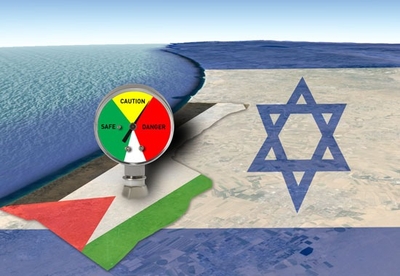
In the long run, Sinwar and his regime plan to continue to prepare for the ‘grand’ destiny they have chosen for Gaza. So long as Hamas rules Gaza, it will be the base of unending jihad against Israel, buffered by tactical ceasefires, until conditions are ripe for a new assault.

**************************

Strategically, Hamas remains as committed as ever to its objective of destroying Israel and toppling the Fatah-run Palestinian Authority in the process. Tactically, however, Hamas exhibits pragmatism and won’t rush into wars with Israel when conditions are ill suited.

Hamas looks at the long run, and remains convinced that it can eradicate Israel, even if it takes decades or centuries. Yet it would prefer to bide its time, and build up its force until the next clash while working to decrease its acute regional isolation. For this to happen, Hamas needs to avoid plunging Gaza into a new war any time soon. Yet it remains far from clear that it will be able to do this.

Should a war erupt in the near future, it likely will be triggered by unplanned dynamics of escalation.

Gaza’s woeful living standards and infrastructure are among those factors. Crises such as the ongoing electricity supply problem plaguing the Strip could facilitate an early conflict, as Hamas may try to distract the population’s frustrations from its failings, and divert them to Israel.

The Palestinian Authority (PA) is threatening to make matters worse by cutting off cash for Gaza’s power plant. It’s part of the ongoing feud between the Fatah-run PA in Ramallah and Hamas in Gaza. Gazans now receive electricity only four to six hours a day due to this feud. In January, Gazans took the unprecedented step of protesting power cuts, making Hamas extremely nervous.

In addition to tensions over the electricity crisis, a Hamas-run terror cell could spark conflict if it carries out a mass casualty attack that spawns Israeli retaliation.

The sheer scope of such plots that Israel thwarts every year is enormous.

Last year, 184 shooting attacks, 16 suicide bombings, and 16 kidnapping plots were foiled, Shin Bet chief Nadav Argaman testified last month before the Knesset’s Foreign Affairs and Defense Committee. Hamas had “significantly increased” efforts to pull off attacks in the West Bank and in Israel, he said, adding that Israeli security forces arrested more than 1,000 Hamas members in the West Bank last year and broke up 114 cells.

These are risks Hamas is prepared to take, since the day that it ceases all attempts to carry out jihadist terrorism against Israel is the day that it stops being Hamas.

Yet Hamas is also a government now, and it must consider the Gazans it rules. Hamas is keenly aware of Palestinian sentiment. Its leaders grew up in Gaza’s refugee camps and always have their finger on the pulse of Gazan society.

Hamas leaders seem to understand that the public opposes a new damaging war with Israel. They recognize that the Palestinian public cannot stomach a war with Israel every two years. The reconstruction program in Gaza following the 2014 conflict is far from complete. There are still Gazans whose homes haven’t been repaired from the damage inflicted in 2014.

The general population, despite being exposed to Hamas’s daily propaganda diet of jihadist rhetoric, would likely be reluctant to be again be used as human shields by the military wing, barely three years since the end of the last clash.

The price of Hamas’s policy of embedding its rocket launchers and fighters in Gaza’s civilian areas also is not alluring to many Gazans.

On the flip side, one of Hamas’s worst fears is of being perceived as weak. After one of its senior operatives was mysteriously killed recently, it executed three people it accused of collaborating with Israel.

Hamas also responded to Mazen Fuqaha’s murder by sending threatening messages to Israel promising vengeance. Hamas videos suggest it will target senior Israeli security officials for assassination.

Fuqaha was a key figure in the Izzadin Al-Qassam Brigades, and reportedly in charge of setting up multiple terrorist cells in the West Bank. His bullet-ridden body was found last month outside of his Gazan apartment building.

The Israeli defense establishment takes these Hamas threats seriously. Despite the noise, however, Hamas has not rushed to respond just yet – underlining the fact that Hamas is aware of the restraints factors that it is under.

Since the end of the 2014 war with Israel, the Islamist regime has shied away from escalating the security situation with Israel.

Hamas’s leadership sees unfavorable regional conditions. They lack any powerful regional backer following the 2013 downfall of Muhammad Morsi, the Muslim Brotherhood president in neighboring Egypt, in whom Hamas staked so many of its hopes.

In the past, Hamas enjoyed many partnerships, enjoying arms support and funding from the Shi’ite axis (Iran and Hizballah) – and forming relationships with Sunni powers.

But the Middle Eastern regional upheaval, which pits Sunnis against Shiites, and Islamists against non-Islamists, forced Hamas to make choices. It could no longer be on the same side of both Shi’ite Iran and Sunni Saudi Arabia, who are locked in a transnational proxy war. In the same vein, Hamas cannot be on the same side as both the Assad regime and the Sunni rebels fighting to remove him.

Worst of all from Hamas’s perspective, Morsi’s departure means it cannot rely on its primordial impulse to attach itself to a Sunni Muslim Brotherhood-led backer.

Five years ago, there were initial signs of a regional wave of Muslim Brotherhood successes. The Brothers rose to power in Egypt, Turkey, Tunisia, and had Qatari backing. Morsi’s 2013 fall changed Hamas’s fortunes for the worse. The rise of Egyptian President Abdel Fattah El-Sisi, a leader who identifies Hamas as a Gazan branch of his domestic arch-enemy, the Egyptian Muslim Brotherhood, guaranteed Hamas’s isolation.

Relations with Cairo remain rocky despite recent Hamas attempts to improve ties. Egypt may open its Rafah border crossing a few days a week, but this does not change its core view of Hamas as a true enemy, to be held at bay, weakened, and deterred.

Hamas has also fallen out with Saudi Arabia. And Hamas and Iran do not get along very well either, despite Iran continuing to be the chief sponsor of the military wing, paying it $50-$60 million a year, according to various estimates.

This leaves Hamas with just two stalwart friends: Qatar and Turkey, neither of which can back them substantially. Turkey is not an Arab state, meaning that its role in the Arab world is limited, and its desire to lead the Arab world will always be met with suspicion. A failure by Turkey to infiltrate the region means that it can only do so much to assist Gaza. Qatar, though wealthy, is politically weak, and geographically distant.

New Hamas leader Yihyeh Sinwar, despite his fundamentalist inclinations, must consider these constraints and see that his Islamist-run enclave has little real backing.

To compound its problems, Hamas also has serious financial issues. It has three main sources of income: Donations from states, donations from private individuals, and Hamas’s network of investments.

Hamas gets far less money than it used to from its donors, according to Israeli assessments. Only Qatar and Turkey donate on a regular basis, while Iran continues to finance the military wing, but not the entire movement.

Hamas is a large organization, with operations in the West Bank, Qatar, and Turkey in addition to Gaza. In the Strip, it needs to pay salaries, and prepare for its next clash with Israel. Hamas also seeks to export terrorism to the West Bank and build up political support among West Bank Palestinians. All of this costs money. It is has offices and headquarters in multiple states overseas that require annual budgets.

Private Gulf State donors are drying up. Wealthy Saudis are more interested in supporting Syrian rebels. Hamas’s cause has moved to the back of the line.

Its investments, meant to be saved for a rainy day, now must be tapped.

So what can Hamas do? First and foremost, it continues its domestic military build-up, mass producing rockets, mortar shells, variants of shoulder-fired missiles, drones, and digging tunnels – all at the expense of the welfare of the 2 million Palestinians it rules.

That’s because Hamas drew many operational lessons from its last conflict with Israel, and is keen on rebuilding its terrorist-guerrilla army without interruptions.

One lesson was to focus on a perceived Israeli vulnerability through short-range strikes. To that end, it is building new rockets that carry 200 kilogram warheads – significantly larger than past rockets made in Gaza.

These projectiles are not accurate, but would cause enormous damage if they slammed into a southern Israeli town or village.

Hamas weapons factories produce simple RPGs as well.

Second, Hamas is trying to becoming more ‘acceptable’ to the region and to the world. It is about to unveil a new charter which will be an attempt to obfuscate its jihadist ideological leanings and ties with the Muslim Brotherhood, and present itself as being merely a national “resistance” organization.

In the long run, Sinwar and his regime plan to continue to prepare for the ‘grand’ destiny they have chosen for Gaza. So long as Hamas rules Gaza, it will be the base of unending jihad against Israel, buffered by tactical ceasefires, until conditions are ripe for a new assault.

Yaakov Lappin is a military and strategic affairs correspondent. He also conducts research and analysis for defense think tanks, and is the Israel correspondent for IHS Jane’s Defense Weekly. His book, The Virtual Caliphate, explores the online jihadist presence.

The Pope’s Pilgrimage to Al-Azhar

April 27, 2017

The Pope’s Pilgrimage to Al-Azhar, Gatestone InstituteLawrence A. Franklin, April 27, 2017

“They cannot take the texts of the seventh century literally as they are in the Quran. He [the Pope] does not dare to say something like that because he doesn’t know the Quran well enough, and so on. So I understand his position, but it would be better to have a clearer and more frank discussion — with openness, but also with some realism.”

******************************

During a meeting between the former Papal Nuncio to Cairo, Archbishop Jean-Paul Gobel, and Grand Imam Sheikh Ahmed el-Tayeb, the Grand Imam warned Gobel that “speaking about Islam in a negative manner was a ‘red line’ that must not be crossed.” If there are any condemnations of violence against the Coptic Christians, they are likely to be articulated only by the Grand Imam and the Egyptian President.

If the Pope’s humble bearing is excessive, however, it might be interpreted even by peaceable Muslims as a submission. If Francis is asked by the Grand Imam to pray at al-Azhar’s mosque, that is a piety that el-Tayeb would not likely reciprocate in a Coptic Church in Egypt.

Facilitating the establishment of an Islamic-Christian relationship that excludes Judaism can only serve the Islamist goal of isolating Jews and Israel. Although relations between the Vatican and al-Azhar will improve in the near future, the honeymoon will not. The Grand Imam will doubtless protect his own theological power base and keep his distance from both the Vatican and the Egyptian regime.

The twin Palm Sunday bombings at Coptic Christian Churches by Islamic terrorists in Egypt, which killed 44 worshipers, draws attention to what is probably the principal reason for the upcoming visit of Pope Francis to Cairo on April 28-29. The Pontiff will likely seek the assistance of Egypt’s Muslim hierarchy to help protect Egypt’s Coptic Christians, the indigenous inhabitants of the country who now number about 9 million and constitute at least 10% of the population.

During his stay, Francis will meet with the Grand Imam of Cairo’s al-Azhar Mosque, Sheikh Ahmed el-Tayeb. Al-Azhar’s theological complex, which houses Islam’s oldest university, is considered the most influential center of Sunni Islam.

The Pope possibly hopes that the meeting with el-Tayeb will fully repair relations between the Vatican and al-Azhar. These were restored as a result of a letter sent by Pope Francis to the Grand Imam last year. The Papal letter was followed up by a visit to the Holy See by el-Tayeb in May 2016. Relations between the Holy See and al-Azhar had been severed in 2011 by el-Tayeb after he took offense at comments made by the previous Pope, Benedict XVI, on the persecution of Christians in Muslim countries.

Grand Imam el-Tayeb now appears more disposed towards normalizing relations with the Vatican, especially since his amicable visit to the Holy See in May 2016. Al-Azhar’s Grand Imam is likely to be more agreeable toward Francis than he was toward Benedict. This show of flexibility might possibly also be an effort by el-Tayeb to get in line with President Abdel Fatah al-Sisi’s own call for reform within Islam. However, Al-Azhar, determined to maintain its authority over theological matters, has initiated no substantive, doctrinal reforms in response to President Sisi’s declaration. In fact, Al-Azhar has pushed back against attempts by some Muslim reformists who have suggested a more liberal policy concerning women’s rights, including the ability to divorce.

El-Tayeb, even if he accepted responsibility for protecting the Copts, may prove unable to prevent Islamic terrorist groups from targeting Egypt’s minority Christian population. The alleged cooperation between the Islamic State and the Muslim Brotherhood makes it especially difficult for Cairo to prevent terrorist acts. Islamic terrorist cells in Alexandria and the Sinai Peninsula, where many of the attacks on Copts have occurred, act independently of Egypt’s political and religious leaders. The targeting of Christians by these groups may also be part of a larger objective to destabilize the regime of al-Sisi, who has promised security to Egyptians, particularly Coptic Christians. Radical Islamists such as the Muslim Brotherhood and ISIS view the Copts as their enemies; many members of this Christian sect support the Sisi government.

It was, in any event, al-Sisi who invited Pope Francis to visit Egypt during the Egyptian president’s visit to the Vatican in November 2014. Anti-regime elements might well attempt to stage a spectacular terrorist incident during the Pontiff’s visit, particularly targeting Francis himself.

The Pope’s upcoming visit is being organized by French Cardinal Jean-Louis Tauron, who chairs the Pontifical Council of Inter-Religious Dialogue. Cardinal Tauron is, no doubt, cognizant of the “red line” laid down by the Grand Imam if the Vatican wishes to have amicable relations with the Muslim leadership. During a meeting between the former Papal Nuncio to Cairo, Archbishop Jean-Paul Gobel, and el-Tayeb, the Grand Imam warned him that “speaking about Islam in a negative manner was a ‘red line’ that must not be crossed.” However, given the Pope’s past reluctance to condemn radical Islamic concepts, it is unlikely that, during his visit to Egypt, he will depart from this cautious public posture. Comments, if any, by Pope Francis on Muslim violence against Christians will, no doubt, be diplomatic and muted. If there are any condemnations of violence against the Coptic Christians, they are likely to be articulated only by the Grand Imam and the Egyptian President.

Nevertheless, Pope Francis will, it appears, publicly demonstrate his solidarity with fellow Christians by championing the Coptic Pope Tawadros II during memorial services for the recently martyred Copts. Francis, who is known to be fond of Tawadros, might express his deep personal concern for the welfare of the Coptic Pope — who was celebrating Mass inside St. Mark’s Cathedral when the bomber detonated his explosives just outside.

Francis is apparently most anxious to bring Copts and Catholics closer together, in the hope that the Egyptian Church will ultimately formally reunite with the Holy See. The Coptic Church first split from Rome in 451 A.D. However, the Vatican maintains deep respect for the Egyptian Church, which was established by one of the four authors of the Gospels, St. Mark, in Alexandria as early as 42 A.D.[1]

Catholic Pope Francis greets Egyptian Coptic Pope Tawadros II at the Vatican, on May 10, 2013. (Image source: News.va Official Vatican Network)

If the Pope’s humble bearing is excessive, however, it might be interpreted even by peaceable Muslims as submission. If Francis is asked by the Grand Imam to pray at al-Azhar’s mosque, that is a piety that el-Tayeb would not likely reciprocate in a Coptic Church in Egypt.

The public stance of the Vatican concerning Islam has been routinely cautious. The most recent example of the Pontiff’s less-than-direct criticism of Islamist violence is his April 22 statement at a prayer service paying tribute to 21st Century Christian Martyrs in Rome:

Francis said the legacy of modern-day martyrs “teaches us that with the strength of love, meekness, one can combat arrogance, violence, war, and with patience, achieve peace.”

A professor of Islamic Studies at the Pontifical Institute in Rome, Father Samir Khalil Samir, also an Egyptian, characterizes the Pope’s diplomatic approach to Muslims, “who are the second-most important group in the world, to have a dialogue and understanding.” Khalil adds:

“I think it’s important to say things with charity, with friendship, but to say things as they are: that it cannot continue like this; we have to rethink Islam. This is my vision. They cannot take the texts of the seventh century literally as they are in the Quran. He [the Pope] does not dare to say something like that because he doesn’t know the Quran well enough, and so on. So I understand his position, but it would be better to have a clearer and more frank discussion — with openness, but also with some realism.”

This clearly modulated posture was apparent during a session of the Geneva Center of Human Rights Advancement and Dialogue. The theme of the Geneva sessions was “Islam and Christianity: The Great Convergence.” The March 15 Conference, attended by Muslim and Christian delegates, studiously avoided key issues of doctrinal divergence, and stressed instead alleged areas of common interest. The key sponsors of the conference were Algeria, Pakistan, and Lebanon, all of which are Muslim majority countries. The only non-Muslim state sponsor of the Conference was Malta. One of the oft-repeated themes of the sessions in Geneva was the ‘feel-good’ concept of the ‘common Abrahamic root’ of Islam, Christianity and Judaism — although no representatives of the Jewish faith were invited to the conference. Statements by representatives of Christian churches seemed overly optimistic about the prospects of developing positive relationships with Islamic societies.

The failure to invite Jewish or Israeli representation by conference organizers was presumably not an oversight. This omission would be consistent with the UN Arab bloc’s objective of isolating Israel in an apparent effort to destroy and replace it. That campaign includes efforts by Arab states to marshal support at the United Nations for suffocating Israel through diplomatic subversion as well as through economic strangulation. Facilitating the establishment of an Islamic-Christian relationship that excludes Judaism can only serve the Islamist goal of isolating Jews and Israel.

After the visit of Pope Francis to Egypt, mass murders of Egyptian Copts are likely to continue. Although relations between the Vatican and al-Azhar will improve in the near future, the honeymoon will not. The Grand Imam will doubtless protect his own theological power base and keep his distance from both the Vatican and the Egyptian regime.

Dr. Lawrence A. Franklin was the Iran Desk Officer for Secretary of Defense Rumsfeld. He also served on active duty with the U.S. Army and as a Colonel in the Air Force Reserve, where he was a Military Attaché at the U.S. Embassy in Israel.


[1] Tradition has it that Mark founded the Church in Alexandria as early as 42 A.D. but some Coptic documents assert that Mark came to Alexandria for the first time in 61 A.D. after several missionary trips with St. Paul and St. Barnabas.

Threat Assessment in the Domestic War

April 26, 2017

Threat Assessment in the Domestic War, Understanding the Threat, April 24, 2017

(Please see also, PC Pentagon Caves to CAIR, Agrees to ‘Review Anti-Terror Training Program. –DM)

Our federal intelligence and law enforcement officials have little understanding of the jihadi movement, key players, intent, modus operandi, and Islamic doctrine (sharia) driving the movement.  The lack of basic knowledge of this information is staggering.  Local and state officials have relied on DHS and the FBI for their understanding of the threat which is why there is little understanding at the local level as well.

***************************

An objective review of the activities of the Islamic Movement in the United States, the response from US law enforcement and intelligence agencies, and the actions of local, state and federal leaders reveals the U.S. is closer to losing the war domestically than at any point in time since 9/11/2001.

Enemy Forces

The leading Muslim Brotherhood organization in the United States and the “mother ship” of their jihadi Movement – the US Council of Muslim Organizations (USCMO) – hosted their second annual “Advocacy Day” on Capitol Hill on April 18, 2017 continuing it’s overwhelming information operation against the U.S. perpetrating the lie that Islam is here to peacefully coexist with our Constitutional Republic.  This hostile effort continues to produce elected officials willing to help promote the enemy’s agenda instead of doing their legal duty of identifying enemies and defending the Constitution against them.

The Diyanet Center of America, a massive Islamic Center/Mosque complex in Maryland, operates as a base for the Turkish Muslim Brotherhood’s operations with the support of local and state officials there.  The Turkish MB’s influence in the US rivals the Palestinian MB’s (Hamas) presence here.

The Diyanet Turkish Islamic Center of America in Maryland

The Turkish MB is continuing its info op on state legislators by paying for trips to Turkey to show the lawmakers it is a moderate” nation.  Groups like “The Holy Dove Foundation” and the “Turquoise Foundation” propagate this dangerous operation.

The most prominent Islamic organizations in the United States are a part of the Muslim Brotherhood’s network whose stated objective is to wage “civilization jihad” to establish an Islamic state under sharia (Islamic law).  Many of these organizations currently work with the U.S. government, including the USCMO, Islamic Society of North America (ISNA), Muslim American Society (MAS), Muslim Public Affairs Council (MPAC), Islamic Circle of North America (ICNA), Muslim Legal Fund of America (MFLA), Muslim Advocates, Muslim Students Association (MSA), Hamas (doing business as CAIR), and many others.  The Muslim Brotherhood’s logistics and support network here is significant and they have penetrated all national agencies, have a broad plan and activities inside key U.S. infrastructure nodes, and control the U.S. national security decision-making process as it relates to Islamic jihad.

Anti-American hate groups like the Southern Poverty Law Center (SPLC), American Civil Liberties Union (ACLU), and much of the media provide direct and aggressive support for these jihadi (“terrorist”) organizations.  Much of the media has demonstrated no interest in doing investigative journalism on these matters, and simply regurgitates whatever information the suit-wearing jihadi groups give them.

Preparations for War:  The USCMO is over-seeing the national coalescing of Islamic forces from individual mosques through regional councils to the USCMO leadership.  The USCMO is solidifying communications and logistics coordination as well as assisting in preparations for confrontation.  Mosques/Islamic Centers are organizing for armed confrontation with law enforcement, shoring up physical defenses where they see likely confrontation and increasing their pre-attack surveillances of churches and other targets.

Funding:  Nearly 16 years after 9/11, the U.S. government still views the government of Saudi Arabia as an ally in the war, despite the fact it has been implicated time and again in funding the global jihad against the West and, specifically, the United States.  Massive funding for Hamas and Hizbollah – both of which have a heavy presence in the U.S. – comes from Iran, and intelligence officials now believe the leader of Al Qaeda, Ayman al Zawahiri, is being shielded by the Pakistani government in Karachi.  Pakistan is another U.S. “ally.”

Our leaders still believe they can use “moderate” muslim leaders to help America find it’s way to victory – a foolish and increasingly dangerous path.

“Friendly” Forces

The impact of the enemy’s information campaign (propaganda) is significant.  The recent jihadi incident in Sioux Falls, South Dakota sums up this entire war.

A sharia adherent jihadi – Ehab Jaber – went to a Christian event, filmed it live on Facebook, brandished weapons on video saying the crowd should be “terrified” and posted a number of other videos clearly indicating he had intent and desire to do harm to those who conflict with Islam.  Law enforcement officials and prosecutors refused to take any action and even publicly said the perpetrator broke no laws.  According to one state legislator, the Attorney General of South Dakota refused to push for a prosecution in this matter.

When massive public pressure came after the story gained international prominence last week, a SWAT team from Siuox Falls arrested Jaber last Friday (April 21).  The South Dakota Attorney General is now taking credit for this effort.

Updates on the Sioux Falls story can be followed HERE.

Our federal intelligence and law enforcement officials have little understanding of the jihadi movement, key players, intent, modus operandi, and Islamic doctrine (sharia) driving the movement.  The lack of basic knowledge of this information is staggering.  Local and state officials have relied on DHS and the FBI for their understanding of the threat which is why there is little understanding at the local level as well.

A Solution

UTT’s experience is that none of the law enforcement professionals, military, and intelligence analysts UTT trains have ever heard the information laid out in UTT’s 3-day “Understanding and Investigating the Jihadi Network” program, yet all of them state the information is “critical” to protecting their communities.

The enemy situation represents an insurgency in the United States.  Doctrinally, the response must be a counter-insurgency strategy.  In a counter-insurgency, the focus of effort is at the local level.  This is why the strategy for victory must be local police and citizens who understand the threat and have the courage to engage and defeat it.

This requires police be trained to understand and investigate the threat, and citizens be given the knowledge to support their police in aggressively taking care of the enemy in their communities.

UTT remains the only organization in America providing the training to do this and provide law enforcement with the tools they need to proactively find jihadis (“terrorists”), map out the jihadi network, and develop aggressive and innovative counter-strategies at the local and state level.

Citizens must move to get the attention of their sheriffs and pastors and organize to defend their communities.

Some content on this page was disabled on April 24, 2020 as a result of a DMCA takedown notice from Hassan Haji. You can learn more about the DMCA here:

https://wordpress.com/support/copyright-and-the-dmca/

Double Bombing Hits Egypt on Palm Sunday

April 9, 2017

Double Bombing Hits Egypt on Palm Sunday, Clarion ProjectElliot Friedland, April 9, 2017

At least 37 people were killed and more than 100 injured in two separate bombing attacks that struck churches in Egypt. The blasts ripped through services for Palm Sunday on April 9.

The Islamic State terrorist group claimed responsibility for the attacks.

A bomb placed under a seat in the main prayer hall of St. George’s Coptic Church in Tanta, northern Egypt, ripped the hall apart, killing at least 26 and wounded 60 others.

“Everything is destroyed inside the church,” eyewitness Peter Kamel told media outlets after the attack.

A suicide bombing hit Saint Mark’s Coptic Orthodox Cathedral in Alexandria a few hours later. According to state TV reports, police officers prevented the suicide bomber from entering the Church, and he detonated his device outside.

At least 11 people were killed and 35 others wounded in that attack. Pope Tawadros II, the head of the Coptic Church in Egypt, had just lead mass for Palm Sunday but is unharmed as he reportedly had just left the building.

Grand Sheikh Ahmed el-Tayeb, The head of Egypt’s Al-Azhar University, the most prestigious institution of learning in Sunni Islam, condemned the attack, calling it a “despicable terrorist bombing that targeted the lives of innocents.”

The Coptic community in Egypt has long faced discrimination, but that has worsened since the 2011 revolution that overthrew longtime dictator Hosni Mubarak and replaced him first with the Islamist Muslim Brotherhood’s president Mohammed Morsi and then with former general, President Abdefattah el-Sisi.

Breakaway Muslim Brotherhood factions and ISIS affiliates have been targeting Coptic Christians in an effort to destabilize the state and cleanse Egypt of non-Muslims.

In February, ISIS released a propaganda video featuring a terrorist who carried out a previous attack on St Mark’s Cathedral in Alexandria, threatening to eliminate Egypt’s Christians and “liberate Cairo.”

Should the Muslim Brotherhood Debate Include Another Rogue Islamist Party?

April 8, 2017

Should the Muslim Brotherhood Debate Include Another Rogue Islamist Party? Investigative Project on Terrorism, Abha Shankar, April 7, 2017

A leading Islamist party recently demanded punishment for bloggers who “insult” Islam and condemned the execution of the murderer of a prominent politician who spoke up against his country’s rigid blasphemy laws. The Islamist party also blamed the U.S.-led war on terror for the rise in global jihadism and the destruction of Islamic civilization.

For those of you wondering, the Islamist party in question is not the Ikhwan al-Muslimeen, or Muslim Brotherhood (MB), whose designation as a terrorist organization is currently a hot topic of debate in Washington. Rather, it is the Jamaat-e-Islami (JI), a South Asian Sunni revivalist movement that has an active network in North America and the West.

The Islamist movement often defends terrorists and rationalizes attacks against Western targets, in addition to working to advance a rigid interpretation of Islam in the U.S. and other secularly-governed nations. The debate over political action against Islamist parties, therefore, does not stop with the Muslim Brotherhood.

JI’s recent blasphemy push provides an example of that thinking in action.

In a press release, Sirajul Haq, the leader of JI’s Pakistan affiliate, condemned the execution of Mumtaz Qadri, who had killed former Punjab governor Salman Taseer, a fierce opponent of Pakistan’s blasphemy laws. Haq also called on Pakistan’s political leadership “not to link terrorism with Islam…to please colonial powers,” and alleged “that the enemy was trying to destroy the Islamic civilization and values and to promote its obscener [sic] and nude culture.”

Haq had earlier described Qadri’s hanging as the “darkest moment in the country’s history” and said that by executing him, the Pakistani government “had proved itself a slave of US President Obama and not a slave of the Holy Prophet.” He added that “the government had executed one Mumtaz Qadri but now every youth and [sic] grown up in the country would turn into Mumtaz Qadri.”

JI’s Ideological Similarities with the MB

The JI was founded in 1941 in Lahore, Pakistan (then part of British India) by Islamist scholar Maulana Syed Abdul Ala Maududi. Maududi is a leading pioneer of Islamic revivalism in South Asia who was inspired by the Brotherhood ideology. Maududi also had a profound influence on Sayyid Qutb, a leading Muslim Brotherhood ideologue who has been described as the “father of modern Islamist fundamentalism.” Qutb is believed to have also inspired al-Qaida leader Osama bin Laden.

Soon after the Arab Spring protests led to the ouster of the Hosni Mubarak regime in Egypt, top Brotherhood and JI leaders met in Cairo to “strengthen the relations between the Islamic movements in different countries ” and “promote Islam.”

JI’s primary objective in Pakistan “is to implement Sharia” and “make Pakistan an Islamic welfare state” based on the “model of the state of Madina,” the multi-religious Islamic state established by the Islamic prophet Muhammad in the 7th century.

Although the MB has a deeper foundation and wider network in North America, the front groups of the JI—Islamic Circle of North America (ICNA) and its charitable arm ICNA Relief—also have an active and long-term presence.

ICNA and ICNA Relief collaborate extensively with MB front groups in the U.S. and Canada. For example, ICNA annually partners with the Muslim American Society (MAS) to host its national conventions that feature radical speakers who advocate jihad and call for the elimination of Israel. MAS was created in 1993 as the Brotherhood’s arm in the U.S.

Both ICNA and ICNA Relief are listed as members of the U.S. Council of Muslim Organizations (USCMO), an umbrella group featuring several groups tied to the American Muslim Brotherhood. It was launched in March 2014 to lobby Congress to enforce an Islamist agenda on U.S. counterterrorism efforts, as well as on issues concerning American Muslims and the larger Muslim ummah (community).

ICNA’s educational programs feature staunch Islamist ideologues, and Maududi’s books have been promoted on the website of ICNA’s youth division, “Young Muslims.”

After trying him in absentia, a Bangladeshi war crimes tribunal sentenced to death ICNA’s former vice president and leader of its New York chapter Ashrafuzzman Khan on charges connected to the kidnapping and murder of several intellectuals during the country’s 1971 war of independence from Pakistan. The tribunal claimed Khan was the “chief executor” of the killing squad, Al-Badr, a militant offshoot of the Jamaat-e-Islami. Following accusations of alleged war crimes against Khan, ICNA scrubbed the names of executive board members, including Khan, from its web page.

Khan still is believed to be in New York. But others convicted by the tribunal have been executed, drawing criticism from ICNA as a “shameful act of judicial killing which is part of the ongoing brutal persecution of political opponents” in Bangladesh.

The Muslim Brotherhood also condemned the executions and called on the global community to “reject and condemn these unjust and unfair trials that violate all international norms and conventions….”

The Brotherhood’s website described JI leader Mir Quasem, who was executed in September after being convicted of running the lethal Al-Badr militia, as an “icon of freedom and resistance against tyranny.”

Quasem’s “martyrdom” was compared to that of MB ideologue Sayyid Qutb in 1966: “When the Egyptian regime executed Sayyid Qutb in 1966, they thought they killed his ideas and ideology; but—as tyrants do in every era and place—they unintentionally immortalized him, inadvertently spread his ideas, and unwittingly introduced the people to his call—his ideology.”

JI Leaders Featured As Speakers at ICNA Events

Yusuf Islahi, a leader of JI’s Indian affiliate (JI Hind), is scheduled to speak at the upcoming MAS-ICNA convention in Baltimore. Islahi, a chief patron of ICNA’s dawah or proselytizing project, WhyIslam, has spoken at past MAS-ICNA conferences. In a 2009 interview, Islahi criticized the Western interest-based economic system: “A society where interest is accepted and becomes widespread is disliked to such an extent that both Allah and His Prophet, peace and blessings be upon him, are at war with them.”

At a 2001 JI Hind event hosted in the Indian city of Aligarh, Islahi reportedly blamed Jews for the 9/11 attacks, which he described as a fitting response to American arrogance: “[T]he September 11 event is a well-planned conspiracy to defame Islam. Muslims are being blamed for it without any evidence. Everyone knows who is the real culprit, Jews …. The United States has unjustly and arrogantly ruled the world for too long. Allah has destroyed that arrogance on September 11. God willing, this will also inaugurate the age of Islam the world over.”

ICNA’s invitations to JI leaders to speak at its events goes back a long way. Former JI leader Qazi Hussein Ahmed, for example, was a featured speaker at ICNA’s 1999 convention in Baltimore. In an interview the same year with ICNA’s newsmagazine Message International, Ahmad spoke about the role Islamist movements such as the JI and MB play in creating an Islamic state: “The Islamic movements through out [sic] the world under the guidance of Maulana Syed Abdul A’la Maudoodi (r) and Shaheed Hasan al-Banna (r) and many other prominent Muslim leaders and scholars and Mujahideen have adopted the same attitude and the same process which was evolved by the Prophet of Allah. Call the people towards Allah and to train and purify them, organize them into Jama’ah and work for the service of mankind. In this process we will create an Islamic society, an Islamic government and an Islamic state.”

The late Ghulam Azam, a former leader of JI’s Bangladesh chapter, also spoke at the 1999 convention. Azam was sentenced to 90 years in prison for committing war crimes during Bangladesh’s 1971 war of independence. Hamas leader Sheikh Muhammad Siyam also was part of the 1999 convention.

JI’s Support for Terror

JI affiliates in Bangladesh and Pakistan criticize the United States, openly voice support for terrorist groups and praise their leaders. For example, people like Osama bin Laden never die, former JI Pakistan leader Syed Munawar Hasan said in a 2014 video. They continue to live in the people’s hearts people and give voice to their people, he said. Hasan described Taliban leader Hakimullah Mehsud’s killing of in a U.S. drone strike as “martyrdom.” He called the U.S. an enemy of Pakistan: “America was our enemy yesterday, it is so today, and tomorrow too it will not refrain from enmity against us.”

The JI has provided an ideological platform and recruiting base for terrorist groups in South Asia. One example is the Hizb-ul Mujahideen (HuM), a Kashmiri jihadist group that emerged in 1989 as JI’s militant wing.

The U.S. designated HuM as a foreign terrorist organization in 2004. In a recent video, HuM commander Zakir Rashid Bhat noted that the Kashmiri people’s struggle for independence was “nationalistic” and was “haraam” (“not permissible”) in Islam. “Nationalism and democracy are not permissible in Islam,” he said. HuM has been behind several terrorist attacks in Kashmir. In 2013, HuM claimed responsibility for an attack on an Indian police camp in Kashmir that killed five security personnel.

JI’s former student wing in India, the Student Islamic Movement of India or SIMI has been implicated in some of the deadliest terror attacks in the country. The group has been banned in India and is alleged to have links to terrorist groups such as the Indian Mujahideen (IM) and the Pakistan-based Lashkar-e-Taiba (LeT) and Jaish-e-Mohammed (JeM).

Nurul Islam Marzan, one of the masterminds behind the July terror attack on a Dhaka café that killed 17 foreigners, helped lead a group with alleged ties to the banned Jama’atul Mujahideen Bangladesh (JMB) and was active in JI’s student wing Islami Chhatra Shibir (ICS) at Chittagong University. Suspects in the 2013 murder of blogger and activist Ahmed Rajib Haider reportedly acted on orders from an ICS leader.

The Jamaat-e-Islami global network’s support for a totalitarian Islamist ideology provides an environment conducive to the radicalization of future terrorists. The Islamist movement’s active presence in the U.S. and the West, its defense of terrorists, condemnation of U.S. foreign policy, justification of terror attacks against the U.S. and its allies, and rejection of Western democratic values and ideals make it relevant in the debate about designating the Muslim Brotherhood as a terrorist group. The Islamist threat is not isolated to one source.

Middle East: A Shift from Revolution to Evolution

April 8, 2017

Middle East: A Shift from Revolution to Evolution, Gatestone InstituteNajat AlSaied, April 8, 2017

The lesson the Trump administration might learn from the disastrous mistakes of its predecessor is that the main sources of terrorism in the region are political Islam and all its related religious groups. All these radical groups, including ISIS, Al-Qaeda, Jabhat Al-Nusra and Hamas have been spawned by a political Islam driven by the ideology of the Muslim Brotherhood.

The fight, therefore, should not be against Islam, but against political Islam. Islam needs to be practiced the way other religions are, as a private personal faith that should be kept separate from public life and politics, and whose expression should be confined to worship only.

Mosques, whether in the Arab and Muslim world or in the West, should be places of worship only and must not transformed to centers for polarizing society or for recruitment by political religious groups.

After each Islamist terrorist attack in the West, the public is divided into two camps: one angry and one indifferent. The problem with defeating Islamist terrorism seems to be that either it is attacked by conservatives who call Islam an evil cult or it is forgiven entirely by liberal apologists. What, then, is the answer?

One of the main failures in Western analyses of the origins of terrorism in the Middle East and North Africa is that the West attributes them to a lack of democracy and a lack of respect for human rights. This is, indeed, part of the cause, but the root of the problem is a lack of development and modernity. U.S. President Donald Trump did not exaggerate when he said that the Obama administration’s foreign policy was disastrous. It was catastrophic mainly for two reasons. One was the knee-jerk support for the “Arab Spring” and for extremist Islamic political groups such as the Muslim Brotherhood. The second was the alliances the Obama administration built with unreliable countries such as Qatar, which supports radical political groups such as the Muslim Brotherhood. In addition, Obama made the mistake of continuing to try to appease Iran’s theocratic regime.

The Arab Spring’s uncalculated, hasty attempt to establish so-called democracy only generated more turmoil and chaos in the region. Certain radical political groups simply exploited the elections to serve their own political and sectarian agendas; that swoop for power only resulted in more authoritarian and dictatorial regimes, as have played out, for instance, in Egypt, where we have witnessed the murder of civilians and police officers by the Muslim Brotherhood. In other countries, the situation is even worse; attempts to install democracy have totally destroyed the state and facilitated the spread of terrorist militias, as in Libya.

It is ironic that Western countries and their advocates stress the need to apply democratic practices in Arab countries, but evidently do not recall that development and secularism preceded democracy in Western Europe. The United Kingdom, which has the oldest democratic system, did not become fully democratic until 1930. France became fully democratic only in 1945, 150 years after the French Revolution.

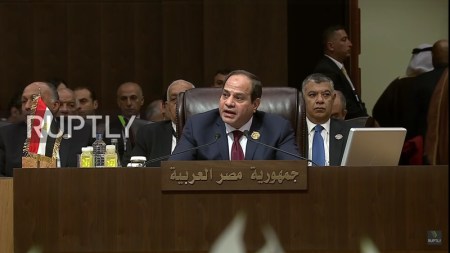
The Emir of Qatar, Sheikh Tamim bin Hamad Al-Thani, at the Arab Summit in Jordan on March 28, 2017 delivered a speech in which he indicated his continuous support for the Muslim Brotherhood:

“If we are serious about focusing our efforts on armed terrorist organizations, is it fair to consider any political party we disagree with as terrorist? Is our goal to increase the number of terrorists?”

Many Arab leaders were infuriated by his speech; at the forefront was President Abdel Fattah el-Sisi of Egypt, who left the Arab Summit Hall during the speech to meet King Salman of Saudi Arabia.

Most Arab leaders and analysts, in fact, are enraged by Qatar’s continuous support for Islamist political groups such as the Muslim Brotherhood, because these groups are a threat to their national security.

President Abdel Fattah el-Sisi of Egypt speaks at the Arab Summit, on March 29. The previous day, Sisi walked out of a speech by the Emir of Qatar, Sheikh Tamim bin Hamad Al-Thani. Sisi was infuriated by Al-Thani’s declaration of support for the Muslim Brotherhood. (Image source: Ruptly video screenshot)

Another consequence of Obama’s foreign policy — in particular attempts to get close to Iran’s hostile regime — has been a fraying of relationships with old Arab allies of the United States. Some of Obama’s advisors thought that replacing Saudi Arabia with Iran was somehow “better” for the United States, if Iran “is beginning to evolve into a very civilized and historically important country” — an analysis that can be described as completely short-sighted.

The Saudi regime, with all its flaws, is a monarchy run by princes; the Iranian regime is a theocracy run by clerics. The Saudi regime is not a theocratic regime but a hybrid structure, which is neither wholly secular nor wholly religious. As such, the religious class functions under the authority of the ruling class. Princes are driven by self-interest; clerics are driven by ideology. In terms of extremism, the Iranian regime is pushing for hegemony, whilst Saudi Arabia has been taking only a defensive, rather than an expansionist, position.

The motivation of Saudi Arabia in exporting mosques world-wide and installing radical Saudi imams is defensive, not expansionist as in Iran. Saudi Arabia’s impetus is to confront Iran’s hegemony and the spread of its hostile ideology. It is this strategy, which Saudi Arabia has practiced since 1979 to balance Iran’s power and to combat its rebellious ideology, that must change.

That Iran’s Khomeini regime sought to embarrass Saudi Arabia — a country that is home to Islam’s two holiest mosques, in Mecca and Medina — by portraying it as not sufficiently Islamic, meant that the foundational Islamic Wahhabism of the Saudi Kingdom was aggressively reinforced. This emphasis resulted in even more constraints being put in place in Iran: especially on entertainment. Since the Khomeini revolution in 1979, all plays, fashion shows, international events, and cinemas have been banned. As for women, the Commission for the Promotion of Virtue and Prevention of Vice has increasingly harassed them. As for minorities, especially Shia challenging the Iranian Shia regime and its support for Shia militias — particularly the dominant Revolutionary Guards — books were published attacking the Shia:

More books appeared, attacking the Shias and especially Khomeini’s views. These books – like the arguments of Khomeini’s followers – rejected modern thinking as an “intellectual invasion.” Saudi Arabia, considered the guardian of Sunni Islam, spent billions of dollars on challenging the Khomeini-backed Shiites.

This religious one-upmanship — a competition over which body can be the “most religious” — must stop. Saudi Arabia would do well to understand that in order to confront the hegemony of the Iranian theocratic regime, the answer is not to radicalize Saudi society but to return to the way it was before 1979.

The best way to defeat the rebel hostile regime in Iran might be through creating an inclusive and tolerant society in Saudi Arabia. Saudi Arabia needs to change its approach towards Iran because the current strategy has not worked. The current strategy has done nothing except to strengthen the Iranian regime’s dominance; distort, globally, the image of Saudi Arabia and accelerate terrorism.

The lesson the Trump administration might learn from the disastrous mistakes of its predecessor is that the main source of terrorism in the region are political Islam and all its related religious groups. All these radical groups including ISIS, Al-Qaeda, Jabhat Al-Nusra and Hamas have been spawned by a political Islam driven by the ideology of the Muslim Brotherhood. Extremist jihadists such as Osama bin Laden, Abdullah Azzam and Ayman al-Zawahiri were all taught by the Muslim Brotherhood.

Political Islam practiced by the Iranian theocratic regime has been comfortably generating Shia radical militias, including the terrorist group, Hezbollah. The fight, therefore, should not be against Islam, but against political Islam. Islam needs to be practiced the way other religions are, as a private personal faith that should be kept separate from public life and politics, and whose expression should be confined to worship only. Mosques, whether in the Arab and Muslim world or in the West, should be places of worship only and must not transformed to centers for polarizing society or for recruitment by political religious groups. Unfortunately, Western countries have turned a blind eye to the political activities inside these mosques.

The danger of these religious political groups is that they do not believe in democracy or human rights; they just use elections to grasp power in order to impose a system of “Islamic Caliphate” as their only form of government. Most of these groups use religion as an ideology to oppose governments other than their own, and when they are criticized or attacked, they play the role of the oppressed.

The Trump administration needs to take advantage of the fact that the majority of people in the Middle East and North Africa have lost faith in religious political groups, especially since the failure of the Muslim Brotherhood in Egypt and Tunisia.

Before the Arab Spring, support for these groups was huge; now it stands at less than 10% of the population. This study was conducted in the Arab world, not including Turkey. The Muslims who support Turkish President Recep Tayyip Erdogan are the Muslim Brotherhood.

Most recent polls indicate that the majority of people in Arab and Muslim countries prefer religion to be kept separate from politics.

The country that is working the most systematically to fight these religious political groups in the region is the United Arab Emirates (UAE). There are several institutes and think tanks researching how to combat these groups. Dr. Jamal Sanad Al-Suwaidi, Director General of the Emirates Center for Strategic Studies and Research (ECSSR), has given a robust analysis of these groups and how to combat them in his book, The Mirage. In it, he cites a study on public opinion on political religious groups: A survey of the UAE population, on how these groups are able to influence the public by taking advantage of certain flaws in the system: 53.9% because of corruption; 47.9% because of poverty and 29.1% because of an absence of civil society groups that confront these opportunists.

The Middle East-North Africa region will undoubtedly have to go through several stages before it can successfully establish democracy. An evolutionary developmental approach will definitely be better than the failed revolutionary democratic one pursued by the Obama administration.

Secularization is also crucial in the fight against terrorism. Trying to build a democracy before going through the stages of secularism and political reformation — which includes rectifying existing flaws, such as corruption; modernization which means the liberation of the region from extremist totalitarian religious dogma and all other forms of backwardness in order to kick-start a renaissance; and scientific development — will not only be inadequate but will actually generate more terrorism by helping radicals to keep gaining power. It would be like a farmer who wants to plant roses in arid desert soil full of thorns.

Restore the U.S.-Egyptian Strategic Alliance, Designate the Muslim Brothers as Terrorists

April 3, 2017

Restore the U.S.-Egyptian Strategic Alliance, Designate the Muslim Brothers as Terrorists, Center for Security Policy

(Please see also, Leftist Media Narrative Surfaces in Advance of al-Sisi’s White House Visit…  It’s a very long, and excellent, article on President al-Sisi’s impact on Egypt, the Muslim Brotherhood and efforts to reform Islam.– DM)

Donald Trump will do something today that his predecessor refused to do. He will meet with the elected leader of Egypt, Abdel Fatteh el-Sisi.

President Obama made no secret of his enmity for his Egyptian counterpart. After all, as his country’s senior military officer in 2013, then-General el-Sisi fulfilled the demands of many millions of Egyptians by ending the misrule of the Muslim Brotherhood government – a regime Mr. Obama helped bring to power.

The Brothers were banished in part because they sought to impose their totalitarian Sharia code on Egypt, a goal they seek world-wide. President Obama embraced the Muslim Brothers. Donald Trump came to office rejecting their agenda and the “radical Islamic terrorism” it spawns.

President Trump can prove the vital U.S.-Egyptian alliance is restored by joining President el-Sisi in designating the Muslim Brotherhood what it is: a terrorist organization.

The Muslim Brotherhood Swoops into Sweden

April 2, 2017

The Muslim Brotherhood Swoops into Sweden, Gatestone InstituteJudith Bergman, April 2, 2017

“Sweden needs to be a safe space for refugees… It is time to realize that the new Swedes will claim their space. And bring their culture, language and habits. It is time to see this as a positive force… Something new — The New Country”. — Video advertisement; last sentence spoken by a young woman in a hijab.

Formal membership with a card and yearly subscription would probably not be the modus operandi of an organization working fundamentally to undermine societies in order to remake them in the image of Islam.

The Muslim Brotherhood is an organization the goal of which is to obtain an Islamic state, a caliphate, ruled by sharia — and to bring about that state — if necessary, by jihad.

It is an organization the Egyptian branch of which called for jihad as recently as 2015, thus belying claims that the Muslim Brotherhood is ‘peaceful’. As the murderous actions of Hamas, a Muslim Brotherhood organization, clearly show, it is not.

A recent report has revealed that the Muslim Brotherhood (MB) is well established in Sweden. The report — written at the behest of the Swedish Civil Contingencies Agency and commissioned precisely because of a lack of research on the MB in Sweden — caused an outcry against the authors. Twenty Swedish academics, who specialize in Islam and Muslims, protested the report[1]. They called it “substandard work”, which did not take account of “the extensive research available about Islam and Muslims in Sweden”.

According to the report, the MB has been operating in Sweden since the late 1970s in the guise of a number of Muslim-Swedish organizations, all centered around the Islamic Association in Sweden (IFIS), which itself was established in the mid-1990s as an organizational front for the MB.

IFIS has founded other organizations in Sweden, among which are Islamic Relief, Ibn Rush, and Sweden Young Muslims (SUM). These have not only given the MB a dominant position within so-called ‘Muslim civil society’ in Sweden, but also enabled it to amass considerable Swedish taxpayer funds that have helped consolidate its position.

The authors of the report conclude that the MB’s activists are “building a parallel social structure, which poses a long-term challenge in terms of Sweden’s future social cohesion”. The authors are being most diplomatic.

According to the report, the Muslim Brotherhood in Sweden promotes:

“…a system of ‘cultural pluralism’, where every minority group is on the same level as the majority group… The ideal is… that Sweden should be organized in different ‘groups’, each group having the right to practice its particular values. The Swedish population should, even though it is in the majority, be a group among other groups: all groups should have the same status”.

The prevalent idea of multiculturalism, and the accompanying identity politics, thus play directly into the hands of the MB. A video ad from a charity backed by the Swedish government constitutes a particularly blunt example of this kind of thinking. In it, Swedes are told,

“Sweden will never be what it once was. Sweden needs to be a safe space for refugees… It is time to realize that the New Swedes will claim their space. And bring their culture, language and habits. It is time to see this as a positive force… It is time to create a country together that is proud, inclusive and sustainable. Something new — The New Country”.

The last sentence is spoken by a young woman in a hijab.

There seems no reason for the hysterics among Swedish academics that the report appears to have provoked. In fact, they could easily fact-check the report simply by checking the website of the primary group mentioned in the report, the Islamic Association in Sweden (IFSI), which clearly states (at the bottom of the linked page) that it is a member of the Federation of Islamic Organisations in Europe (FIOE), generally acknowledged as an umbrella organization for local Muslim Brotherhood organizations from all over Europe.

In an interview with the Wall Street Journal in 2005, then-president of FIOE, Ahmet al-Rawi, said, when asked about ties with the MB, “We are interlinked with them with a common point of view. We have a good close relationship.”

If Swedish academics purporting to study Islam actually followed news from the Middle East, they would also know that Egypt’s former president, Mohamed Morsi, of the Muslim Brotherhood’s Freedom and Justice Party, when he became president of Egypt in 2012, included secretary general of the FIOE, Ayman Ali, on his presidential advisory board.

Not even Swedish academics should need further ’empirical’ proof to see that the Islamic Association in Sweden’s membership of FIOE constitutes de facto allegiance to the Muslim Brotherhood. What Swedish academics are evidently ignorant of, however, is that the MB deliberately operates in a secretive manner. The UK government’s experts, in their own review of the MB, published in December 2015, wrote that “from its foundation the Muslim Brotherhood organised itself into a secretive ‘cell’ structure…This clandestine, centralised and hierarchical structure persists to this day”.

That deliberately opaque and secretive way of operating appears intended to create precisely the confusion and ignorance on the topic, evidently enfolding those academics who ought to know most about this topic. The obfuscation also makes it hard for authorities to crack down on the MB. As Mohammed Akif, the former General Guide and supreme leader of the Muslim Brotherhood, and a former head of its Islamic Center of Munich, explained about the MB in an interview in 2005:

“We do not have an international organization; we have an organization through our perception of things. We are present in every country. Everywhere there are people who believe in the message of the Muslim Brothers. In France, the Union of Islamic Organizations of France (UOIF) does not belong to the organization of the Brothers. They follow their own laws and rules. There are many organizations that do not belong to the Muslim Brothers. For example, Shaykh al-Qaradawi. He is not a Muslim Brother, but he was formed according to the doctrine of the Brothers”.

Formal membership with a card and a yearly subscription, Swedish-style, would probably not be the modus operandi of an organization working fundamentally to undermine societies in order to remake them in the image of Islam — as tidy as that would ’empirically’ make matters for Swedish academics.

The Swedish mainstream society would be wise to take this preliminary report extremely seriously, and not discard it. The Muslim Brotherhood is an organization the goal of which is to obtain an Islamic state, a caliphate, ruled by sharia — and to bring about that state — if necessary, by jihad. It is an organization the Egyptian branch of which called for jihad as recently as 2015, thus belying claims that the Muslim Brotherhood is ‘peaceful’. As the murderous actions of Hamas, a Muslim Brotherhood organization, clearly show, it is not.

Historically, the Muslim Brotherhood has spawned other terrorist organizations, such as Al Qaeda — which, in turn, has spawned ISIS.

The Swedish headlines in March have been filled with news about the return of 150 ISIS fighters to Sweden. A Swedish minister has already said that they should be “integrated back into society”.

The Swedes would do well to pay attention to the influence of extremist groups, such as the Muslim Brotherhood, or the long-term result might not be what many Swedes would like.

______________________

[1] The report was commissioned by the Swedish Civil Contingencies Agency, a state authority, as a preliminary feasibility study, gauging the Muslim Brotherhood’s influence in Sweden before engaging in further study and research.

Georgetown University and Radical Islamists: It’s a Family Affair

March 28, 2017

Georgetown University and Radical Islamists: It’s a Family Affair, Investigative Project on Terrorism, March 28, 2017

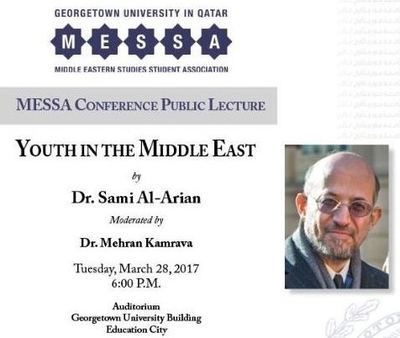
Georgetown University’s Qatar campus is set to host Sami Al-Arian for a lecture tonight in Doha. According to a news release from the school’s Middle Eastern Studies Student Association, Al-Arian is a “civil rights activist” who hopes to challenge students to “make it a better, and more equitable and peaceful world.”

Those are charitable descriptions for Al-Arian, a documented member of the Palestinian Islamic Jihad’s Majlis Shura, or board of directors. According to the Islamic Jihad’s bylaws, which law enforcement agents found during searches of Al-Arian’s home and offices, there can be “No Peace without Islam.” The group’s objective is to create “a state of terror, instability and panic in the souls of Zionists and especially the groups of settlers, and force them to leave their houses.”

It’s an agenda Al-Arian took to heart. Following a double suicide bombing in 1995 that killed 19 Israelis, Al-Arian solicited money from a Kuwaiti legislator. “The latest operation, carried out by the two mujahideen who were martyred for the sake of God, is the best guide and witness to what they believing few can do in the face of Arab and Islamic collapse at the heels of the Zionist enemy…” he wrote.

“I call upon you to try to extend true support of the jihad effort in Palestine so that operations such as these can continue, so that the people do not lose faith in Islam and its representatives…” he wrote. Four years earlier, he spoke at a fundraiser in Cleveland, introduced as the head of the “active arm of the Islamic Jihad Movement in Palestine.”

Why, then, is a Jesuit university, albeit at a campus in Qatar, hosting a leader of a designated terrorist group’s “active arm”?

There’s a family bond between Georgetown University and the Al-Arians. Son Abdullah is an assistant professor at Georgetown’s Qatar campus, teaching history in its School of Foreign Service. He earned his Ph.D. at Georgetown, writing his dissertation about the Egyptian Muslim Brotherhood during the 1970s, a time his father acknowledges being part of the global Islamist movement.

Jonathan Brown, Al-Arian’s son-in-law, also works at Georgetown, as the [Saudi] Prince Alwaleed Bin Talal Chair of Islamic Civilization. Brown recently drew criticism for a lecture in which he argued that slavery isn’t inherently “morally evil” if the slave is treated well. He also minimized sexual consent as a recent social more, arguing no one is really free enough to grant consent anyway.

Property records show Brown and his wife Laila Al-Arian bought a modest house just outside Tampa in 2015. Brown also owns a $1.1 million house in Mclean, Va.

Brown’s boss, Georgetown University Professor John Esposito, has been a staunch Al-Arian defender. Al-Arian is “an extraordinarily bright, articulate scholar and intellectual-activist, a man of conscience with a strong commitment to peace and social justice,” Esposito wrote in a letter to a federal judge.

Brown’s slavery and sexual consent lecture was hosted by the International Institute of Islamic Thought (IIIT) in Herndon, Va. The IIIT was a prime financial supporter of a think tank Al-Arian founded in Tampa called the World and Islam Studies Enterprise (WISE). It provided cover for at least three other members of the Palestinian Islamic Jihad’s Shura Council, including his brother-in-law Mazen Al-Najjar, an academic named Basheer Nafi and Ramadan Abdullah Shallah – the Islamic Jihad’s secretary general since late 1995.

Federal prosecutors wanted Al-Arian to tell a grand jury what he knew about the IIIT’s financial support for terrorists. He refused. Al-Arian was charged with criminal contempt after maintaining that stance even after a judge granted him immunity for his truthful testimony.

The case never went to trial. Al-Arian was deported to Turkey in 2015, pursuant to terms in his 2006 guilty plea connected to his Palestinian Islamic Jihad support. He now works as “director of the Center for Regional Politics at Istanbul Sabahattin Zaim University,” the Georgetown Middle East students group’s news release said.

Al-Arian is a computer scientist.

Sabahattin Zaim opened in 2010 and claims to have about 1,100 undergraduate students.

While the Georgetown University program is organized by a student group, promotional material lists Mehran Kamrava as moderator. Kamrava directs the Georgetown School of Foreign Service’s Center for International and Regional Studies.

His presence adds the university’s imprimatur to the Al-Arian event. In addition, the School of Foreign Service posted the news release promoting Al-Arian’s lecture.

Qatar has supported Hamas, the Islamic Jihad’s rival Palestinian terrorist group, providing money and refuge for Hamas leaders. In that light, Al-Arian’s invitation doesn’t seem out of place. But it is still an event hosted by a Georgetown University campus, moderated by one of its prominent faculty.

While Al-Arian has tried to deny his Islamic Jihad activities, or at least minimize them, his work to advance the group’s bloody ambitions is undeniable. He self-identified as the Shura Council’s secretary. In his plea agreement, he admits lying about Shallah’s prominent role in the Islamic Jihad.

During his 1991 remarks in Cleveland after his “active arm” introduction, Al-Arian urged donations for jihad. “Your brothers in Palestine are struggling with their beings,” he said, “so let us struggle here with our money.”

“This is the way of giving,” he said earlier. “This is the way of struggle. This is the way of battle. This is the way of jihad. This is the way of martyrdom. Thus is the way of blood, because this is the path to heaven.”

The student association’s news release failed to mention this background as a convicted felon, describing the former University of South Florida professor as a “civil rights advocate.” It fails to mention Al-Arian’s guilty plea, and whitewashes his resulting deportation to Turkey by saying “Al-Arian relocated.”

The federal judge who saw all the evidence against Al-Arian, who watched him lie about his true identity and violent ambitions, called him a “master manipulator.” Old habits die hard, apparently. The question in this case is whether Georgetown and its student groups are being duped or are witting accomplices in whitewashing a terrorist into a “human rights advocate.”

U.S. Muslim Brotherhood and Saul Alinsky: A Match Made in America

March 28, 2017

U.S. Muslim Brotherhood and Saul Alinsky: A Match Made in America, Center for Security Policy, March 28, 2017

(Please see also Trump backs off Muslim Brotherhood’s designation as terrorist organization. — DM)

In September 2015, the Center for Security Policy (CSP) published Star Spangled Shariah: The Rise of America’s First Muslim Brotherhood Party. Warnings issued then have since been confirmed, specifically, that the United States Council of Muslim Organizations (USCMO), while deceptively cloaked in red, white, and blue, is simply the leading edge of the Islamic Movement in this country. In pursuit of Civilization Jihad, the Muslim Brotherhood’s information operations – including many tactics learned directly from the KGB – have enabled this organization to insinuate itself gradually into a position from which it can assault the pillars of our society. These include: academia, the U.S. judicial system, faith groups, all levels of government, the media, intelligence and security agencies, and our refugee resettlement and other immigration processes. As will be shown here, a development not new but recently uncovered reveals that USCMO Secretary General Ousamma Jammal is directly connected to Saul Alinsky’s Industrial Areas Foundation (IAF), a Marxist-Leninist organization dedicated to revolution in America.

In his Brotherhood/USCMO leadership role, Jammal has a well-established track record of political activism and success at developing strategic relationships for the benefit of the Muslim Brotherhood including with members of the U.S. government. In the ‘About Us’ section on the USCMO website, the third prong of the USCMO Mission Statement declares the necessity “to create and sustain an urgent, collective sense of direction that well-serves the American Muslim community toward the betterment and guidance of our nation.” What the USCMO fails to share with the American people is the USCMO’s commitment to the establishment of Islamic Law (shariah) in place of the U.S. Constitution.

It’s long been known that the USCMO is openly allied with far-left racist and revolutionary movements like Black Lives Matter. Recall that, in March 2016, the Center released a videowhich highlighted the statements of Muslim Brotherhood leaders that should be chilling to Americans who cherish the Constitution and oppose the expansion of shariah. That video showed top USCMO leadership figure, Nihad Awad (also the Executive Director of HAMAS USA dba the Council on American Islamic Relations or CAIR), explicitly aligning the U.S. Muslim Brotherhood with the Black Lives Matter movement. The Muslim Brotherhood alignment with the overall Red-Green Axis demonstrates the genuine aims of jihadis in suits: undermining the U.S. Constitution and national security through the global Islamic Movement.

In CSP’s Civilization Jihad Reader series publication, The Red-Green Axis: Refugees, Immigration, and the Agenda to Erase America, author James Simpson provides several crucial data points that hint at the Brotherhood’s other, Marxist-Leninist, affiliations.

  • The Catholic Campaign for Human Development (CCHD) is the grant making vehicle of the USCCB. It was founded in Chicago in 1969 with the help of radical organizer Saul Alinsky specifically to fund Alinsky’s Industrial Areas Foundation (IAF).
  • CCHD has been a radical leftist funding vehicle ever since, giving millions to ACORN, the radical training school, Midwest Academy and others. IAF receives the largest percentage of CCHD grants of any CCHD grantee.

In a Metro Industrial Areas Foundation action memo dated 20 November 2016 and published by member organization ‘Dupage United’ on 9 December 2016, USCMO Secretary General Oussama Jammal is listed among the leadership. The …And Take Counsel section on the USCMO website states, “When we speak with one clear, communal voice, our advice can help true the direction of American society toward justice.” It must be understood, however that within Islam, the word ‘justice’ means ‘shariah’ and only shariah. Thus, the Muslim Brotherhood version of social justice is not intended as benevolence towards non-Muslims; quite to the contrary. Rather, in true Saul Alinsky form, the aim of the Red-Green Axis is anarchy intended to collapse the U.S. system of Constitutional law and order.

Jammal is fully cognizant that the Muslim Brotherhood’s manipulation of progressive leftist social justice entities aligned with the Red-Green Axis is strategic for the advancement of the settlement process. The Muslim Brotherhood has both co-opted the interfaith religious dialogue movement and mastered the operational mechanics of the political process in the U.S. to advance Islam’s shariah objectives. That Jammal works so closely with IAF leadership should be a red flag warning and belies what the USCMO shares with non-Muslims when it says: “Our well-deliberated and sincerely expressed words for the benefit of the nation can fortify attitudes that propagate harmony between people and institutionalize policies that spread prosperity to all.”

This revelation, that the U.S. Muslim Brotherhood works directly with the Marxist-Leninist Alinsky-founded IAF at the highest levels, lends yet additional substance to the overall Red-Green Axis, whose seemingly disparate elements nevertheless have been collaborating to bring down this Republic for some time. Forthcoming CSP publications will delve even further into the Brotherhood-IAF connection.