Posted tagged ‘Merkel’

Op-Ed: Merkel submits to Erdogan on freedom of expression

April 15, 2016

Op-Ed: Merkel submits to Erdogan on freedom of expression, Israel National News, Giulio Meotti, April 15, 2016

Germany has not tested its freedom of expression so deeply since the saga of Mozart’s Idomeneo in 2006 when the Deutsche Oper Company canceled the opera because there was the severed head of Muhammad in it and that could offend the largest Islamic community in Europe. The director, Hans Neuenfels, then asked: “Where will it all end if we allow ourselves to be artistically blackmailed?”.

The answer came this week with the case of Jan Böhmermann, the famous comedian who mocked Turkish president Recep Erdogan. “What I’m going to read is not allowed” said Böhmermann on ZDF, the German public network. His poetry routine suggests that Erdogan watches child porn movies while he enjoys “repressing minorities and beating up Christians”.

The prosecutor of Mainz, in the Rhineland-Palatinate, received more than twenty complaints from private citizens which forced him to open a case against Böhmermann under paragraph 103 of the Penal Code, which provides three years of imprisonment for insulting a foreign head of state. Chancellor Angela Merkel has condemned the poem, calling it a “deliberate insult” and wanted to phone Turkey’s Prime Minister Ahmet Davutoglu to appease the wrath of Ankara.

Then came Erdogan’s personal complaint against Böhmermann who, according to Deputy Prime Minister Numan Kurtulmus, committed a “grave crime against humanity” and “offended 78 million Turks”, no less. The case could go to the Constitutional Court in Karlsruhe. Not satisfied with imprisoning Turkish journalists, President Erdogan wants to imprison Germans as well.

Three weeks ago, another German video sparked Turkish protests. Meanwhile, the ZDF removed the video of Jan Böhmermann, even before the Turkish protests. If Merkel has sided with the Turks, the German press is united around Böhmermann.

Mathias Döpfner, the editor of the Springer publishing giant, defended the comedian and criticized Merkel, although Döpfner is her supporter: “As written by Michel Houellebecq in his masterpiece on the self-sacrifice of the West: Submission.” Demonstrations were held under the offices of the ZDF in Turkey. Former Finance Minister of Greece, Yanis Varoufakis, commented: “Europe first lost its soul, then lost its sense of humor”.

“Böhmermann is not very brave and this story is bigger than he is” said Henryk Broder, born in 1946 in Katowice, Poland, and today one of the most popular writers of Germany who writes for Die Welt and Bild Zeitung, in an interview with me. “He didn’t show up to withdraw the Grimm Award. I would have been there to say these people: ‘F*** you’”. The German Max Mauff actor was presented at the ceremony with a picture of Böhmermann and the word “missing”.

“Böhmermann behaved like a dhimmi, but we must show solidarity” – continues Broder – “This is a case of governmental interference in the freedom of expression. We face the contradictory policy of Angela Merkel, who said is said in favor of freedom of expression but then takes action against it.

“When the book by Thilo Sarrazin ‘Germany abolishes itself’ appeared in 2010, it was disqualified by Merkel as ‘defamatory’ and ‘not useful’. There is no such thing as ‘good’ and ‘bad’ satire. In communist East Germany it was the party who was left to decide what should be published and this is in Merkel’s DNA, she is a daughter of Eastern Germany.  At that time they called it ‘socialization’. Merkel wants Erdogan to do the dirty work for her on migrants, so she doesn’t want a comedian to spoil relations with Turkey”.

In Turkey, Article 299 of the Criminal Code provides four years in prison for those who insult the President (Can Dündar and Erdem Gül, director and editor in chief of Cumhuriyet, now face a trial). Yesterday Deutsche Welle explained that there are 2,000 pending legal cases involving defamation of Erdogan. The defendants are artists, journalists, academics and cartoonists. The same punishment is now evoked in Germany against a comedian.

The cultural-geographical border of Europe has always been drawn on the Bosphorus and not on the Turkish border. Böhmermann’s case moved that border nearer to Ankara.

Germany Moves To Remove Anti-Erdogan Poem And Merkel Calls Turkey To Apologize

April 5, 2016

Germany Moves To Remove Anti-Erdogan Poem And Merkel Calls Turkey To Apologize, Jonathan Turley’s Blog, Jonathan Turley, April 5, 2016

220px-recep_tayyip_erdogan
220px-angela_merkel_2008

The enabling of an authoritarian like Erdogan is a new low for the Western nations. Not only is Erdogan destroying free speech and the free media in Turkey, but he has now found a way to enlist Western governments like Germany to embrace the same anti-free speech principles.

********************

We recently discussed how Turkish President Recep Tayyip Erdogan has turned his suppression of critics to other countries and was demanding action from governments against his critics. At the time, I was relieved to report that Germany had held the line on free speech. My relief of premature. German ZDF public television said Monday it had deleted a poem recited by presenter Jan Böhmermann from last Thursday’s edition of “Neo Magazin Royal” after pressure from the German government. Böhmermann’s poem, containing numerous sexual innuendos, accuses Erdogan of repressing minorities, including Kurds and Christians. German government spokesman Steffen Seibert said Chancellor Angela Merkel in a telephone call on Sunday evening with Turkish Prime Minister Ahmet Davutoglu had agreed that Böhmermann had recited a “deliberately abusive text.” Merkel has done precisely what civil libertarians feared: feeding Erdogan’s desire to suppress speech and affirming that he can indeed silence critics abroad.

What is truly maddening is that the spokesman insisted that none of this takes away from the “high value” the German government placed on freedoms of the press and public opinion. Unbelievable. Merkel silences Germans to appease a rising dictator while insisting that she remains committed otherwise to free speech.

Böhmermann mocked Merkel and said “Limits, at last. I think we have spectacularly shown, jointly with ZDF, where the limits of satire lie by us in Germany. At last!”

Merkel is not the only one who should be condemned in this matter. ZDF Program director Norbert Himmler insisted that there were limits to irony and satire.

“In this case, they were clearly exceeded . . . As a result, in consultation with Jan Böhmermann, we have decided to take the passage out of the broadcast. That relates to the video in the Mediathek, clips on YouTube, and re-runs.”

As we discussed, Erdogan flew into a rage over a satirical song entitled “Erdowie, Erdowo, Erdogan,” that ridiculed Erdogan’s alleged extravagance and a crackdown on civil liberties. Here is the video:

https://www.youtube.com/watch?v=7x85wo62z-0

The video is a parody of a 1980s song by the German pop star Nena, “Irgendwie, Irgendwo, Irgendwann,” (“Anyway, Anywhere, Anytime”) which is changed to “Erdowie, Erdowo, Erdogan.” The facts that it reports however are not satirical but actual. The video details Erdogan crackdown on democracy and basic freedoms as well as his infamous intolerance for any criticism. Merkel has now added fuel to the meglomania of Erdogan in saying that certain criticism will not be tolerated in Germany. That is likely far more than the Turks ever dreamed of . . . to have a major Western nation embrace censorship.

We have previously discussed the alarming rollback on free speech rights in the West, particularly in France (here and here and here and here and here and here) and England (here and here and here and here and here and here and here and here and here and here). Much of this trend is tied to the expansion of hate speech and non-discrimination laws. We have seen comedians targeted with such court orders under this expanding and worrisome trend. (here and here). In Germany, Merkel government has crackdown on anti-immigration speech as the government expands its list of permitted and prohibited speech.

The enabling of an authoritarian like Erdogan is a new low for the Western nations. Not only is Erdogan destroying free speech and the free media in Turkey, but he has now found a way to enlist Western governments like Germany to embrace the same anti-free speech principles.

Op-Ed: After Brussels, is it time to deport Merkel?

March 23, 2016

Op-Ed: After Brussels, is it time to deport Merkel? Israel National News, Jack Engelhard, March 23, 2016

Authorities need look no further than Angela Merkel as the prime suspect for the latest carnage in Brussels.

More than anyone, it was Merkel who opened the floodgates to the migrants — armies of men without women posing as refugees from Iraq, Syria and Afghanistan found trampling throughout Europe. When they are caught misbehaving, they smirk and say, “I am here as a guest of Angela Merkel,” and they are correct and nearly untouchable.

Merkel stands by her open borders policy, the safety of her people be damned.

Over the past 12 months, more then a million of them have already crossed into Germany alone; 300,000 have been given asylum.

Of Brussels at this hour, all Western Europe leadership is guilty with Merkel sharing the largest part of the blame. These are her pets.

“Don’t go out unless you have to” is the hot new message circulating throughout Europe now that the “refugees” have arrived. You could get raped.

You could also get killed, and that’s what happened when the citizens of Brussels dared to go out Tuesday morning during rush hour. Scores were slain and wounded from yet another Islamic terror attack and people all over want to know how to make this stop.

Stop the influx. How’s that for an idea that needs no Einstein? Deport them instead. Maybe starting with Merkel, who invited the stampede.

The Saudis and the princes from the other Gulf States have it neatly figured out.

(So does Trump who wants to stop it and saw it coming as did this must-read thriller.)

Those titled Arabs don’t want that crowd within 100 miles even though they are fellow Muslims. But they do not want that type entering their borders, bringing with them their license to rape, their rivalries and tribal feuds, hell no, so why not Europe, and Europe says, sure, why not? Bring them on!

How clueless!

This is how. Only a few days ago, there they sat around a big table in Brussels, the smooth rulers of the EU, congratulating themselves on the capture of the final “mastermind” behind the November attack in Paris that killed 130. The French president was there, the Belgium prime minister was there and all the rest together expressed joy to the world that Salah Abdeslam had been caught.

Merkel sent in her gratitude for the superb police work.

At the moment they were hi-fiving the one success, 10,000 more “refugees” streamed in, plenty of them likewise “masterminds.”

Can no one do the math?

We pass the point of absurdity when “open borders” imperils us all throughout the world. There is no stopping the mad dash across continents.

Nor can we stop the madness that afflicts the world’s leaders.

Merkel and the rest of you clueless rulers of Europe, your misguided liberal sympathies and migrant leniencies are killing us.

Hence, Obama has chimed in his condolences for the pain in Brussels. “The entire world must unite,” he said. Yeah, sure, thanks. Will do.

Now back to the game, Mr. President.

Employing European wisdom, he wants to bring more of them into the United States. Thanks again.

Likewise Hillary and Trudeau. First the condolences followed by “we must resist Islamophobia” and keep the influx coming.

Hillary demands that we bring in 65,000 of them. Trudeau is ahead of her. He’s already got them in Canada.

It takes no prophet to know what’s coming for Canada and what’s next for the United States.

Don’t blame the terrorists, only. They are murderers but they know what they are doing.

The same cannot be said for the men and women who run our world.

Germany’s Merkel to Voters: “No Change to Migration Policy”

March 18, 2016

Germany’s Merkel to Voters: “No Change to Migration Policy” Gatestone InstituteSoeren Kern, March 18, 2016

♦ Chancellor Angela Merkel ‘s migration policy is causing security mayhem in Germany, where mostly Muslim migts are raping and assaulting women and children with virtual impunity.

♦ Merkel’s party was defeated in two out of the three federal states voting in March 13 regional elections. By contrast, the Alternative for Germany (AfD) — an upstart anti-establishment party campaigning against Merkel’s liberal migration policy — surged to double-digit results in all three states.

♦ Political and media elites are ramping up a months-long campaign to delegitimize AfD voters as agitators, arsonists, far-right extremists, fascists, Nazis, populists and xenophobes.

♦ Vice Chancellor Sigmar Gabriel has called on German intelligence to begin monitoring the AfD, presumably in an effort to silence critics of the government’s migration policy. Gabriel has called for Germany to take in even more migrants by airlifting them into the country directly from the Middle East.

German Chancellor Angela Merkel has vowed to continue her open-door migration policy — despite heavy losses in regional elections that were widely regarded as a referendum on that very policy.

Merkel’s Christian Democratic Union (CDU) was defeated in two out of the three federal states voting on March 13. By contrast, the Alternative for Germany (AfD) — an upstart anti-establishment party campaigning against Merkel’s liberal migration policy — surged to double-digit results in all three states: Baden-Württemberg, Rhineland-Palatinate and Saxony-Anhalt.

In a press conference after the election results were in, Merkel remained defiant. She reprimanded German voters for questioning her handling of the migration crisis: “There are people who did not listen to us at all and simply cast protest votes. We need to solve this [migrant] problem, not through theoretical debates, but by finding a [European] solution to the problem.”

The elections were the most important in Germany since Merkel allowed more than one million migrants from Africa, Asia and the Middle East to enter the country in 2015. Merkel’s migration policy is causing security mayhem in Germany, where mostly Muslim migrants are raping and assaulting women and children with virtual impunity.

With immigration now the dominant issue in German politics, Merkel’s refusal to reverse her open-door migration policy has alienated many of her traditional supporters, scores of whom are flocking to the AfD to protest Germany’s pro-immigration, pro-EU political establishment.

The AfD was founded as a Eurosceptic party in 2013 by German economists advocating the abolition of the European single currency, the euro, and opposing financial bailouts of profligate eurozone countries such as Greece, Italy, Portugal and Spain.

At the time, the AfD was widely ridiculed by Germany’s mainstream media. In July 2013, for example, the Rheinische Post published an “analysis” which referred to the AfD as the “unlucky professor’s party” that “does not have many chances” as a political party. Nevertheless, in 2014 and 2015, the AfD secured seats in five of Germany’s 16 regional parliaments, and seven seats in the European Parliament.

After an internal power struggle, Frauke Petry — a 40-year-old chemist, entrepreneur and mother of four who hails from the former East Germany — assumed leadership of the AfD in July 2015. Since then, Petry has broadened the party’s initial focus on economics to immigration.

The AfD — now the third-largest party in Germany — poses a significant challenge to the political status quo in Germany. If its momentum holds, the AfD is on track to cross the 5% threshold in general elections in 2017 to qualify for seats in the national legislature, the Bundestag.

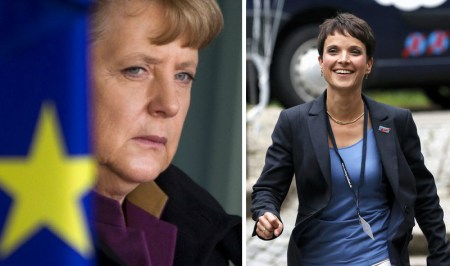
1515In recent regional elections, the CDU party of German Chancellor Angela Merkel (left) suffered heavy losses to the upstart anti-establishment party Alternative for Germany, led by Frauke Petry (right).

The left-leaning German newsmagazine, Der Spiegel, long hostile toward the AfD, acknowledged that the party has achieved a “breakthrough” and called the election result “Black Sunday” for Merkel:

“For a long time she had hoped, despite considerable popular opposition to her refugee policy, to win two chancelleries in the southwest of the country. This has come to nothing. Merkel will now have to live with the accusation that she has allowed the AfD finally to establish itself [as a democratic alternative] to the right of the CDU.”

The leader of the AfD, Frauke Petry, said the fact that her party won big in two states in western Germany — Baden-Württemberg and Rhineland-Palatinate — showed that “the AFD is an all-German party and that citizens in all regions of Germany want a change of politics.” In a Facebook post, she added:

“Yesterday we made a first important step in the right direction to break the cartels of consensus parties. Already, it has been indicated that they [mainstream parties] will not accept the will of the people. We will probably see the most colorful combination of political coalitions, just so they can continue to stay in power and further marginalize voters of the AfD.”

Petry was referring to Merkel’s spokesman, Steffen Seibert, who said that despite her electoral drubbing, Merkel will not reverse course on migration:

“The Federal Government will continue to pursue its refugee policy, with full determination, at home and abroad. At home, we will ease the path to integrate those people who have sought and found protection here. At European level, the goal must be a common, sustainable European solution that leads to a reduction in the number of refugees in all member states of the European Union.”

The CDU’s general secretary, Peter Tauber, echoed the view that there is no alternative to Merkel’s migration policy: “Considering what we have already achieved, I recommend that we continue on the path we are on.”

Some German commentators have tried to downplay the AfD’s gains by arguing that although Merkel lost the election, she actually won the election because the majority of Germans voted for mainstream parties. Bernd Ulrich, editor of Die Zeit, wrote:

“These three elections, which were in fact a plebiscite on the refugee policy, sent an encouraging message of approval. On average, two-thirds of voters cast ballots for parties that support the relatively liberal refugee policies of Angela Merkel.”

Writing in Der Spiegel, columnist Jakob Augstein argued:

“On Sunday Angela Merkel achieved an unlikely feat: her party was trounced, but her refugee policy was confirmed and strengthened… How did the chancellor do on Election Day? In truth, she has been strengthened. The fact is: a large majority of voters support the chancellor.”

According to Augstein, Merkel is “the right woman in the wrong party” because she has moved the center-right CDU to the left on so many issues, including migration policy, that the party is now virtually indistinguishable from its coalition partner, the center-left Social Democratic Party (SPD). What Augstein failed to mention is that Merkel’s move to the left is responsible for creating a political vacuum to the right of the CDU — a vacuum that is now being filled by the AfD.

Other political and media elites are ramping up a months-long campaign to delegitimize AfD voters as agitators, arsonists, far-right extremists, fascists, Nazis, populists and xenophobes.

German media are also churning out stories — many of which are based on hearsay — aimed at discrediting the AfD. The magazine, Stern, published this headline: “Reports of Nazi Songs at AfD-Election Party.” The Berliner Kurier: “Former Teacher Calls AfD Leader Frauke Petry a Liar.”Die Welt: “AfD Candidate Accused of Running Escort Service.” Berliner Morgenpost: “After AfD Coup, Saxony-Anhalt’s Hoteliers Are Anxious.” Stern: “AfD and Donald Trump: Hate is the Main Issue.” Die Zeit: “AfD Principles: Not So Important.”

On Election Day, Die Zeit ridiculed the AfD’s 70-point political platform by using the following bullet points:

“More popular referendums, more monitoring of citizens, stiffer penalties for criminals, dissolve the EU, shrink the state, lower taxes, cut social spending, put women back in the kitchen, ban employment quotas for women, make it harder to file for divorce, abolish abortion, close borders, harass Muslims, ruin the climate, expand nuclear power, expand the military, more private weapons, etc.”

Taxpayer-funded ZDF public television broadcast an interview with Thomas Kliche, a German psychologist, who compared AfD voters to “children who are stubborn and unreasonable.” The only way to deal with such people, he said, is “just have patience, ignore the stupidity, and confront it with rationalism.”

According to Kliche, AfD voters are suffering from “macro-social stress” induced by globalization (i.e., mass migration):

“People react with various forms of shock management. This begins with retrograde, regressive, childish fantasies that everything can be as it was before. Some believe that by shouting ‘We are the People!’ [the main slogan of anti-government demonstrators in East Germany in 1989-1990, reminding their leaders that Germany should be ruled by the people, not by an undemocratic party claiming to represent them], the migrants will disappear…. They have no solutions, just fantasies. Building a fence — this is a fantasy. Separate yourself from the world — that is a fantasy.”

Meanwhile, Vice Chancellor Sigmar Gabriel has called on German intelligence to begin monitoring the AfD, presumably in an effort to silence critics of the government’s migration policy. Gabriel — who leads the SPD, which also suffered significant losses on March 13 — has called the AfD a party of “right-wing extremists” who “use the language of the Nazis.” At the same time, Gabriel has called for Germany to take in even more migrants by airlifting them into the country directly from the Middle East.

By contrast, Horst Seehofer, the head of the Christian Socialist Union (CSU), the CDU’s sister party in Bavaria, said the rise of the AfD amounts to a “tectonic shift in the political landscape of Germany.” He warned that tectonic shifts trigger earthquakes that cause irreversible changes. Seehofer demanded that Merkel reverse course: “It cannot be that after such an election result, the answer to the electorate is: everything will go on as before.”

CSU politician Hans-Peter Uhl summed it up this way: “I expect the chancellor clearly to admit: ‘Yes, we have understood. We are going to return to the voters. Politics must move toward the voter, not the other way around. This is called democracy.'”

Merkel has not said if she plans to run for a fourth term in 2017.

Palestinians: The Right Time to Take Big Steps?

March 4, 2016

Palestinians: The Right Time to Take Big Steps? Gatestone InstituteBassam Tawil, March 4, 2016

♦ Despite the “official” surveys taken among Palestinians, which show support for Hamas, the residents of the West Bank are terrified that Hamas will gain control and destroy our lives and property, the way they did in the Gaza Strip.

♦ The BDS organizations are trying to boycott products made in the West Bank, which only throws masses of Palestinians out of good jobs in an effort to force Israel into a hasty withdrawal that has no chance of taking place. The Israelis and everyone else remember all too well that the last Israeli withdrawals — from southern Lebanon and the Gaza Strip — led to the terrorist takeover of the vacuums created.

♦ Ikrima Sabri, the former Mufti of Jerusalem, often said that Palestinians were better off with the Jews in charge of Al-Aqsa mosque and Jerusalem, because in the future they could be removed and killed off, but if the Crusaders returned to Jerusalem — such as an international commission headed by the French — it would be harder to get rid of them.

During a visit to Berlin, German Chancellor Angela Merkel told Israel’s Prime Minister Benyamin Netanyahu that now is not time to move forward with the “two-state solution” and the establishment of a Palestinian state.

Merkel, evidently seeing Israel as a dam protecting Europe from Islamist extremists, told Netanyahu that while the Germans recognized the terrorist threat faced by Israel, and that a peace process had to be advanced based on two states for two peoples, now was not the right time to take big steps.

1494Agreed: It’s not a good time to establish a Palestinian state. Pictured: Israeli Prime Minister Benjamin Netanyahu and German Chancellor Angela Merkel address a press conference in Berlin, Germany, on February 16, 2016. (Image source: Israel Government Press Office)

The Palestinians living in the Gaza Strip are well aware that they are hostages of the terrorist organizations, in particular Hamas. Jibril Rajoub, a senior official in the Palestinian Authority (PA), told Al-Jazeera TV the same thing just last week.

The Palestinians in the West Bank, regardless of public declarations, also secretly support security collaboration with Israel, which protects us from radical Islamist terrorism. Therefore, despite the “official” surveys taken among Palestinians, which show support for Hamas, the residents of the West Bank are terrified that Hamas will gain control and destroy our lives and property the way they did in the Gaza Strip. We do want a Palestinian state, but one that will preserve the lifestyle and accomplishments we have built over the years — not a state that will have them fall to the horrors of Hamas and ISIS.

In light of the quiet, passive public support for the regime of Mahmoud Abbas, Hamas is inciting Palestinians against it. Hamas, in an attempt to overthrow the Palestinian Authority, is portraying Abbas’s security forces as traitors who transmit information to Israel.

Like Germany — and unlike Sweden and France — Britain has recently instituted a more balanced policy. The UK has begun to fight the anti-Israel BDS (Boycott, Divestment and Sanctions) organizations. Matthew Hancock, Britain’s Minister for the Cabinet Office, who coordinates activities between various government ministries, is advancing protocols to prevent the ongoing boycotts by the British establishment.

These BDS organizations are trying to boycott products made in the West Bank, but the boycott only throws masses of Palestinians out of good jobs and great benefits in an effort to force Israel into a hasty withdrawal that has no chance of taking place. The Israelis and everyone else remember all too well that the last Israeli withdrawals — from southern Lebanon and the Gaza Strip — were nothing more than case-studies for the terrorist takeover of the vacuums created, exactly the same way as the U.S. withdrawal from Iraq made room for the Islamic State (ISIS).

As Palestinians we know that the BDS may or may not harm Israel, but it does untold damage to the Palestinians who support their families by working in the settlement factories and would otherwise be unemployed and then, as a scarcity of jobs will have been created, hired by various terrorists. When the SodaStream factory moved out of the West Bank, 500 Palestinians lost their well-paid jobs.

In view of the current U.S. helplessness in dealing with the Russians, Iranians and Syrians, the Obama administration has now chosen to bare its fangs at Israel. Despite what are apparently his predictable personal objections, U.S. President Barack Obama is expected to sign into law the Trade Facilitation and Trade Enforcement Act, which includes anti-BDS provisions. It introduces new policy language by including all “Israeli-controlled territories” as part of Israel. Meanwhile, the American customs authority is still continuing to enforce a 20-year-old law, marking products made in the West Bank and hurting Palestinians. Labeling products hurts the Palestinians, who then are driven look for work in the eager arms of the terrorist organizations radicalizing the region.

The French, as usual, slither and shift. A number of months ago, they tried to build up steam for an international commission of inquiry into the Al-Aqsa mosque. Both the Israelis and the Palestinians objected.

Ikrima Sabri, the former Mufti of Jerusalem, often said that Palestinians were better off with the Jews in charge of Al-Aqsa mosque and Jerusalem, because in the future they could be removed and killed off, but if the Crusaders returned to Jerusalem through the back door — such as an international commission headed by the French — it would be harder to get rid of them.

The French, fearing for their lives at the hands of their own local Islamist enclaves, are in dire straits and doggedly try one maneuver after another to appease them. In desperation, they have proposed peace negotiations for the Palestinians and Israel “with international mediation.” They even brazenly suggested that if the negotiations failed, they would recognize the Palestinian state. The outcome is written on the wall: the Palestinians, who will have no reason to negotiate, will fall over themselves rushing to the conference, then automatically veto every proposal or possible compromise, and then receive the promised recognition of Palestine.

The French are masters of diplomatic flimflam: on the one hand, they will do anything to appease their own Islamists at the expense of Israel, and on the other, they know full well neither Israel nor any other Western country will accept their self-serving suggestion. The French keep revealing their duplicity again and again. They refuse to designate Iranian-backed Hezbollah as a terrorist organization; they instead call it a “political party,” despite its full participation in slaughtering Sunni Muslims in Syria. Hezbollah is also one of the main actors pushing the countless asylum-seekers (and occasional ISIS operative) flooding Europe, Turkey and Jordan.

The atrocities committed today in the Middle East are the direct result of the refusal of Europe (including France) and the United States to intervene, and the stunning silence of the Arab states. Unwilling to fight ISIS, they are more than willing to condemn, slander and criticize Israel, while the Middle East slips into anarchy.

The result for us Palestinians will be bloodletting, either in the Hamas-Fatah rivalry, or as collateral damage in the Israelis’ war against Islamist terrorism, or, when the Palestinian Authority falls, at the hands of ISIS and Al-Qaeda and the Al-Nusra Front as they sweep through the Jordan Valley on their way to attack Israel.

Al-Jazeera TV is also trying to serve its master, Qatar, radicalize the Palestinians by saying that the Palestinian Authority’s security coordination with Israel, which benefits everyone here by keeping out Islamic terrorists, is betraying the Palestinian cause. In addition, Israeli intelligence, by saying that a seaport for Hamas should be built is, for some mysterious reason, trying to kill off the Palestinian Authority by strengthening Hamas. Both the Egyptians and we Palestinians — and even the Israelis — do not need Hamas strengthened at our expense. Hamas and the many other extremist organizations that have infiltrated the Gaza Strip, including ISIS, are what enable Israelis to justify their security concerns as well as those regarding peace negotiations with the Palestinians, and that prevent a withdrawal from the West Bank. Given the current situation in the Middle East, Angela Merkel was correct. It is not the right time now to take big steps.

The Women-Hunt in Germany

March 3, 2016

The Women-Hunt in Germany, Front Page MagazineStephen Brown, March 3, 2016

germany-cologne-train-station-1000-arab-mobs-molest-rape-sexual-assault-women-illustration1

“If a woman gets raped walking in public alone, then she, herself, is at fault. She is only seducing men by her presence. She should have stayed home like a Muslim woman.” – Dr. Abd Al-Aziz Fawzan Al-Fawzan, Professor of Islamic Law, Saudi Arabia.

Many Germans welcomed with open arms the million, mostly male and Muslim, migrants Federal Chancellor Angela Merkel invited into Germany last September. At train stations, they handed out water bottles to the newcomers, while holding signs stating: “Willkommen!” At first, everything was, as the Germans say, “Friede, Freude, Eierkuchen” (“peace, joy and happiness”).

But the good feeling these greeters created, especially among themselves, has somewhat dissipated, primarily due to the increasing number of reported sexual assaults by migrants against women and children. The best known incident was the sexual molestation of hundreds of women in Cologne on New Year’s Eve by about 1,000, mostly North African men that included migrants.

The latest such multicultural enriching incident to create similar outrage occurred last Thursday in Kiel, a northern German city in Schleswig-Holstein, a state bordering Denmark. Three teenage girls, aged 15, 16 and 17, were visiting a central shopping mall, the Sophienhof, in “broad daylight” when two young Afghan asylum seekers, aged 19 and 26, began to follow and film them with their cell phones.

“Evidently, the criminals then posted these films on their social networks with the result that more and more men came to a restaurant area of the Sophienhof in order to persecute, sneer at them and to frighten them,” reported the newspaper, Die Welt.

Like the women in Cologne and those participating in the anti-Morsi demonstrations on Tahrir Square in Egypt in 2013, the three Kiel teenagers were at first probably unaware they were being hunted, and that a pack of hyenas was slowly surrounding them.

In total, between 20 and 30 men of “migration background,” as German papers described them, were involved. Police report there were no acts of sexual violence, but papers state the teenagers were “very hard pressed.”

But if no sexual molestation did occur, it is probably only because it was in the middle of the day, in the middle of a shopping mall. Outside and at night, this story most likely would have had a much sadder and more tragic outcome. As it was, it was reported the girls received psychological counselling after their ordeal.

The teenagers’ torment finally ended when passersby noticed their plight and notified security, who in turn notified police. Police then took four men, including the two Afghans, into custody, but not without difficulties.

“As a consequence (of their arrest), the suspects fought fiercely, also at the police station,” Die Welt reported. “The talk is of massive insults, threats and bodily injuries. At the suspects’ medical examination, the police doctor was also threatened and insulted.”

However, thanks to Germany’s “cuddly” justice system, as law-and-order Germans derisively call it, all suspects were released by the following day. Police are currently evaluating mall security videos to lay charges.

Perhaps the most surprising aspect surrounding this awful incident is that Germans are so surprised.

But why, one wonders, are they so astonished when such occurrences as this one and the mass sexual assault of women in Cologne have been going on around them for years in Sweden, France and England?

In England, Muslim men associated with the rape of hundreds of girls in Rotherham, were recently given heavy prison sentences. And Muslim rape gangs in Sweden have contributed to giving that country the second highest rape rate per capita in the world. Only one African country, Lesotho, has a higher rate.

The whole world also witnessed this tactic of surrounding women by large numbers of men in order to sexually molest and/or rape them in 2011 on Tahrir Square in Egypt during Arab Spring demonstrations. CBS’s Lara Logan was its most famous victim. Part and parcel of the culture, it even has a name: “taharrush gamea.” So if some Muslim men behave like this in their own countries, why wouldn’t they do so in other countries, especially in ones full of infidel women?

The Cologne police chief called “taharrush gamea,” a completely “new phenomenon,” one never encountered before. Besides terrorizing women, since the Cologne event it is responsible for turning many against Merkel’s migrant policy.

Also unsurprisingly, after the Kiel incident became known in the city, the local newspaper, Kieler Nachrichten, reported more women came forward to state they had had “similar experiences” at the Sophienhof. A police spokesman said this is “quite typical for this kind of crime marked by shame.”

The Nachrichten states, however, that the hunting of girls is “just the tip of the iceberg.”

“Business people in Sophienhof report an increasing number of thefts,” the paper reports. “Again and again customers are bothered.”

A mall worker, who emigrated to Germany “decades ago” from the Arab world, said young migrants are at the mall practically every evening and that he can tell by their accent that “they are almost all Syrians.”

“What they do here is not right,” he complained to the Kieler Nachtrichten. “As soon as they see a young woman wearing a skirt or some way or other open clothing, they believe they have a free pass.”

At a neighbouring department store, the situation is perhaps even worse. A store clerk there states they have been “experiencing difficult situations here since the end of last year.”

“Sometimes, young foreigners jostle old people,” she said. “They bother young women…, grab them, smack their behinds. They have also shouted abuse at people and spit at them. When they appear in a group, they display a disrespectful approach to others.”

Due to their understandable fear, many women in Germany have changed their behaviour since last September. Some do not go out alone, or only in a group with female friends, in the evening any more. The risk of harassment, or worse, by migrant “street terrorists,” as they are called in Holland, is deemed too great.

However, when women disappear more and more from public, this will have the negative effect of gradually giving Germany the appearance of an Islamic society. In some Muslim countries, women can only venture outside properly covered and with a male relative. Which could be Germany’s future, if the current trend is not reversed.

And with women becoming more hesitant to venture evenings from their homes because of fear, more and more German public space, also like in Islamic countries, will be left to men. In this case, Muslim men. All of which represents a further Islamisation of German society and another step downwards toward dhimmitude status.

After the tormenting of the three teenaged girls, a female journalist reported that last summer in Kiel people “smiled mildly” at several young, male migrants who were standing at a tennis court near their refugee hostel, watching the girls training there. This was just something new to them, they thought.

“However, there were larger numbers every day,” she related. “They filmed them (the girls) with their cell phones.”

After last week’s incident at the Sophienhof, it is doubtful anyone is smiling any more.

Turkey wants secure line made 10 km within Syria, including Azaz, Deputy PM says

February 17, 2016

Turkey wants secure line made 10 km within Syria, including Azaz, Deputy PM says

DAILY SABAH WITH REUTERS

Source: Turkey wants secure line made 10 km within Syria, including Azaz, Deputy PM says – Daily Sabah

Displaced Syrians fleeing areas in the northern embattled province of Aleppo, walk past tents at the Bab al-Salama camp, set up outside the Syrian city of Azaz on Syrias northern border with Turkey  (AFP Photo)
Displaced Syrians fleeing areas in the northern embattled province of Aleppo, walk past tents at the Bab al-Salama camp, set up outside the Syrian city of Azaz on Syria’s northern border with Turkey (AFP Photo)

Turkey wants a secure strip of territory 10 km (6.2 miles) deep on the Syrian side of its border, including the town of Azaz, to prevent attempts to “change the demographic structure” of the area and for humanitarian purposes, Deputy Prime Minister Yalçın Akdoğan said on Wednesday.

Assad forces backed by Russian air strikes have advanced towards the Turkish border in a major offensive in recent weeks. YPG fighters, regarded by Ankara as terrorists, have taken advantage of the violence to seize territory from Syrian rebels.

Turkey has accused the YPG of pursuing “demographic change” in northern Syria by forcibly displacing Turkmen and Arab communities.

“There is a game being played with the aim of changing the demographic structure. Turkey should not be part of this game,” Akdoğan said in an interview on the AHaber television station.

“What we want is to create a secure strip, including Azaz, 10 km deep inside Syria and this zone should be free from clashes,” he said.

Azaz is the last rebel stronghold before the border with Turkey north of the Syrian city of Aleppo, part of what was, before the Assad offensive, a supply route from Turkey to the rebels fighting Assad.

It has come under heavy assault in recent days, but Turkey has said it will not let the town fall into the hands of the Kurdish YPG militia.

German Chancellor Angela Merkel had also said that she supports Ankara’s proposal for a no-fly zone in northern Syria.

Ankara has been requesting that the U.N. establish “safe zones” in Syria since 2012 but could not find the necessary international support.

Turkey, home to more than 2.6 million Syrian refugees, has long pushed for the creation of a safe zone in northern Syria to protect displaced civilians, avoiding the need to bring them into Turkey.

But the proposal has so far gained little traction with Washington or NATO allies who fear it would require an internationally patrolled no-fly zone which could put them in direct confrontation with Assad and his allies.

Akdoğan said another 600,000 people could flee to the Turkish border if Aleppo falls to the Syrian army.

Spring could bring a fresh surge of refugees. But Europe isn’t ready for them.

February 16, 2016

Spring could bring a fresh surge of refugees. But Europe isn’t ready for them. Washington PostGriff Witte and Anthony Faiola, February 16, 2016

LONDON — After an unparalleled tide of asylum seekers washed onto European shores last summer and fall, the continent’s leaders vowed to use the relative calm of winter to bring order to a process marked by chaos.

But with only weeks to go before more favorable spring currents are expected to trigger a fresh surge of arrivals, the continent is no better prepared. And in critical respects, the situation is even worse.

Ideas that were touted as answers to the crisis last year have failed or remain stuck in limbo. Continental unity lies in tatters, with countries striking out to forge their own solutions — often involving a razor-wire fence. And even the nations that have been the most welcoming toward refugees say they are desperately close to their breaking point or already well past it.

The result, analysts say, is a continent fundamentally unequipped to handle the predictable resurgence of a crisis that is greater than any Europe has faced in its post-Cold War history.

“It’s a very dangerous situation,” said Kris Pollet, senior policy officer at the European Council on Refugees and Exiles. “Anything can happen.”

On Thursday, European leaders will have one last opportunity to reckon with the crisis before the pace of new arrivals inevitably begins to climb again in the spring. But few have any expectations that this week’s summit will succeed where countless others before it have failed.

“Europe can deal with this if it wants to. But there needs to be a political breakthrough. And I’m not optimistic,” Pollet said.

Without one, he said, “it’s going to be chaos. That’s clear.”

The scale of disorder and political disruption could be even greater than what Europe faced in 2015.

The numbers themselves are already of an entirely new magnitude: Although arrivals are down from the height of the crisis last fall, the number of people who crossed the sea to reach Europe in the first six weeks of the year — around 75,000 — is 25 times what it was during the same period last year. More than 400 have drowned along the way.

On the Greek islands, the most common European landing spot for people fleeing war and oppression in the Middle East, South Asia and North Africa, thousands have arrived even on days when the rough winter seas have been churned by gale-force winds.

But once the asylum seekers have landed in Europe, the continent still has no coherent system for managing the flows. Just three out of an intended 11 “hot spots” — locations in Italy and Greece where those deemed likely to receive asylum will be separated from those expected to be denied — were up and running at the start of the week. A quota system that was intended to evenly distribute 160,000 refugees across the continent has similarly foundered: Fewer than 500 people have taken part. Countries in eastern and central Europe, meanwhile, have boycotted the program.

With countries improvising their own responses to the mass migration, the most basic tenet of Europe’s post-Cold War identity — that national leaders should act collaboratively to reach continent-wide solutions to common problems — is being called into question as never before.

At most immediate risk is Europe’s decades-old system for borderless travel, the Schengen zone. European leaders have warned that it could come crashing down within months, and it has already been riddled by an array of new fences, military patrols and identification checks where once there was free movement.

Greece could be the first casualty of Schengen’s decline, with the rest of the European Union threatening to kick the cash-starved nation out of the free-movement club unless authorities in Athens can get better control of the nation’s sea border with Turkey. Last week, the E.U. gave Greece a three-month deadline to do so.

But some do not want to wait that long. Eastern European countries including Poland and Hungary are attempting to form an anti-refugee front ahead of this week’s Brussels summit, seeking to combine forces on a plan that would effectively trap refugees in Greece and allow them to travel no farther into Europe.

Hungarian Prime Minister Viktor Orban, who on Monday called Europe “defenseless and weak” in stopping what he regards as an Islamic invasion, has called for the construction of razor-wire fences along Greece’s northern borders with Bulgaria and Macedonia.

Such a barrier is already going up on the Greek-Macedonian border, a major transit point for those heading farther north. Even governments regarded as reasonably pro-refugee say that border will soon need to be sealed.

On a visit to the Macedonian capital Friday, Austrian Foreign Minister Sebastian Kurz said that his country is rapidly nearing the limit it has set for asylum seekers this year — less than half the total of last year — and that Macedonia should be ready to “completely stop” the flow of migrants in the coming months.

On Tuesday, Austria announced a plan to limit new arrivals, part of what is now being called a “domino effect” of measures from Greece through the Balkans and into Western Europe meant to deter migrant flows. In a news conference, Interior Minister Johanna Mikl-Leitner said Austria was preparing to set up 12 new checkpoints along its southern border and impose a daily, perhaps even hourly, quota on migrant flows. Austria will also follow Sweden in denying entry to anyone without a valid travel document.

“If fences are necessary, additional fences will be built as well,” Mikl-Leitner said.

Those comments only add to the pressure on German Chancellor Angela Merkel, whose nation has taken more asylum seekers than any other in Europe but who faces growing demands to live up to her pledge to dramatically reduce the flows.

She heads to Brussels this week with an urgent need to break the political gridlock. One possibility would be to form what some are calling a new “coalition of the willing” — or a list of nations, probably in northern Europe, willing to take in asylum seekers who qualify for resettlement directly from Greece and Turkey.

She is also putting stock in a new NATO effort to combat people-smugglers in the Aegean Sea, while pushing Greece to more rapidly ramp up its hot spots for registering and processing asylum seekers. Meanwhile, she is continuing to press Turkish leaders to live up to their end of a bargain in which the E.U. agreed to pay Ankara 3 billion euros ($3.34 billion) in exchange for Turkish cooperation in cracking down on smuggler networks.

But with arrivals already far outpacing those in the same period last year, Germans are running out of patience with Merkel. At home, she faces a falling approval rating and a conservative backlash against her steadfast refusal to close Germany’s borders, even after it took in more than 1 million people last year.

The refugee crisis “is a Gordian knot Merkel has to cut. But she tied her political future to it, and there’s no way back for her,” said David Kipp, an associate at the German Institute for International and Security Affairs.

If Merkel fails in her attempts to cajole European leaders into cooperating, refugee advocates say there could be grave consequences — not only for the continent but also for the millions of people seeking an escape from the wars that have consumed Syria, Iraq, Afghanistan and other conflict zones.

“Our fear is that there will be a domino effect where countries say, ‘We’ve had enough,’ ” said William Spindler, a spokesman for the Office of the U.N. High Commissioner for Refugees. “Refugee flows are a reality. As long as you have conflict, you will have people fleeing for their lives.”

And at the moment, more people are doing so globally than at any time since World War II — some 60 million. The number trying to enter Europe is a relatively small fraction.

Heaven Crawley, who chairs the study of international migration at Britain’s Coventry University, said Europe should be able to handle the number of people reaching its shores. Syria’s neighbors, she noted, have coped with much higher proportional totals.

But, she said, the continent has been plagued by internal division, as well as a focus on keeping people out — rather than honestly reckoning with what should happen once refugees arrive.

“It’s a crisis of Europe’s own making,” she said. “If Lebanon and Jordan can manage it, why can’t the richest region in the world? It’s politics.”

Merkel calls for ‘no-fly zone’ in Syria

February 16, 2016

Merkel calls for ‘no-fly zone’ in Syria

Published time: 16 Feb, 2016 04:53 Edited time: 16 Feb, 2016 10:34

Source: Merkel calls for ‘no-fly zone’ in Syria — RT News

 Russian Sukhoi Su-24 frontline bomber takes off from the Hemeimeem airbase in the Latakia province, Syria. © Dmitriy Vinogradov
German Chancellor Angela Merkel has backed the controversial idea of imposing a no-fly zone over northern Syria to alleviate the refugee crisis as the country plays along with Ankara’s demands for the creation of a “buffer area” along its border.

“In the current situation it would be helpful, if there could be such an area, where none of the parties are allowed to launch aerial attacks, that is to say, a kind of no-fly zone,” Merkel told the daily Stuttgarter Zeitung, when asked by the publication about opening up areas to host refugees.

Read more

Turkey's President Recep Tayyip Erdogan. © Adem Altan

Echoing a long-standing call from Turkey to establish a no-fly zone over parts of Syria, Merkel stressed that while it is impossible to negotiate with terrorists from Islamic State (IS, formerly ISIS/ISIL), she said it would be helpful if the “anti-Assad coalition and the Assad-supporters … come to an agreement.”

Berlin’s rhetoric, which has been aimed at appeasing Turkey for months, goes against NATO policy. The body turned down the no-fly zone proposal as late as last week.

The Alliance’s Secretary General, Jens Stoltenberg stressed that NATO will leave the issue of enforcing a potential no-fly zone over Syria to the US anti-IS coalition. Stoltenberg’s reaction last Thursday came after Turkey’s president, Recep Tayyip Erdogan, renewed calls for the establishment of a secure zone in Syria, arguing it was the only way to deal with the influx of migrants and refugees.

Russia, which is leading an effective air campaign against terrorists in Syria, has on numerous occasions warned that creating such a zone will aid only terrorists and divide the war-torn country. While a no-fly zone would ensure that aircraft are not allowed to enter the protected air space, it would not, however, prevent the continuation of hostilities on the ground.

READ MORE: ‘Huge step forward’: Russia’s FM spox Zakharova on Syria peace commitments and challenges

On Monday, Russia’s Deputy Foreign Minister Gennady Gatilov insisted that his country will continue striking jihadist positions.

“Airstrikes on terrorist groups’ facilities will be continued in any case, even if the Syrian ceasefire agreement is reached. Because the point is that this ceasefire should apply to those who are really interested in the beginning of the negotiating process, and not to the terrorists,” Gatilov said in an interview with the German magazine Der Spiegel.

Yet Merkel continues to side with Ankara, believing that Erdogan’s proposed solution is the only way out of the refugee crisis.

“I can totally understand Turkish politicians reproaching us Europeans for not being able to explain not taking refugees in Europe while at the same time urging them to keep their Turkish borders open for further needy Syrian refugees,” she said.

Merkel’s call for the creation of the no-fly zone is supported by German military and political heavyweights, journalist Michael Opperskalski told RT. Yet, the journalist noted, Merkel faces tough opposition in Berlin.

“She is supported by Foreign Minister Steinmeier, the German foreign intelligence service – BND, and other high ranking government responsible forces,” Opperskalski noted, stressing that some see it as part of the “anti-Russian campaign.”

Read more

FILE PHOTO © Mahmoud Hassano

He explained that Merkel and her government are “pressured” by Turkey to advocate the no-fly zone, “to follow the Turkish regime interest due to the refugee crisis.” The second reason behind Merkel’s rhetoric he says is Berlin’s “open agenda” for a “regime change by all means in Syria.”

The call for the buffer zone also stems from the massive Syrian army advances in Northern Syria against terrorist groups, aided by the Russian air campaign, which makes both Germany and Turkey “very nervous,” the journalist says.

“They are not interested in peace, but they want to stop the advance by the forces on the ground,” Opperskalski believes.

Calling Berlin’s move a “big and very dirty game,” the German journalist noted that the military establishment in the country is being split on the matter, with some being “very much against” the creation of a no-fly zone.

Forces who argue against the move say “it will not be useful as fight against ISIS,” with some arguing, as Opperskalski notes, that “Russian intervention is the real force opening the peace perspective for Syria.”

“The government and the institutions are getting more and more divided on the course of the direction of the activity, and especially when it comes to possible confrontation on political and other levels with Russia, and on perspective of the regime change in Syria,” Opperskalski told RT.

Germany’s Migrant Crisis: January 2016

February 12, 2016

Germany’s Migrant Crisis: January 2016, Gatestone Institute, Soeren Kern, February 12, 2016

♦ Despite snow, ice and freezing temperatures across much of Europe, a total of 91,671 migrants entered Germany during January 2016.

♦ German taxpayers could end up paying 450 billion euros ($500 billion) for the upkeep of the million migrants who arrived in Germany in 2015. This would presumably double to nearly one trillion euros if another million migrants arrive in 2016.

♦ A 19-year-old migrant from Afghanistan sexually assaulted four girls between the ages of 11 and 13 at a swimming pool in Dresden. The migrant was arrested but then set free.

♦ Three teenage migrants from North Africa tried to stone to death two transsexuals in Dortmund after they were seen walking around in women’s clothing. The victims were saved by police.

♦ Bild reported that politicians in Kiel had ordered the police to overlook crimes perpetrated by migrants.

♦ “The topics we cover are determined by the government. … We must report in such a way that serves Europe and the common good, as it pleases Mrs. Merkel. … today we are not allowed to say anything negative about the refugees. This is government journalism.” – Wolfgang Herles, retired public media personality.

♦ The European Commission called for the “rejection of false associations between certain criminal acts, such as the attacks on women in Cologne on New Year’s Eve, and the mass influx of refugees.”

In January 2016, the German public appeared finally to wake up to the implications of their government’s decision to allow 1.1 million — mostly male — migrants from Africa, Asia and the Middle East to enter the country during 2015.

After more than a thousand Muslim migrants sexually assaulted hundreds of women in cities across Germany on New Year’s Eve, Chancellor Angela Merkel began to face a rising voter backlash to her open-door migration policy.

Merkel’s government has responded to the criticism by: 1) attempting to silence critics of the open-door migration policy; 2) trying to “export” the migrant problem to other countries in the European Union; and 3) announcing a series of measures — branded as unrealistic by critics — to deport migrants accused of committing crimes in Germany.

What Merkel has steadfastly refused to do, however, is reduce the number of migrants entering the country. Despite snow, ice and freezing temperatures across much of Europe, a total of 91,671 migrants — an average of around 3,000 migrants each day — entered Germany during the month of January 2016.

The following is a review of some of the more notable stories about the migration crisis in Germany during January 2016.

January 1. More than a thousand migrants sexually assaulted hundreds of German women in the cities of Cologne, Hamburg and Stuttgart. The government and the mainstream media were accused of trying to cover up the crimes, apparently to avoid fueling anti-immigration sentiment.

January 1. As Muslim migrants were causing mayhem on German streets, the Minister President of Baden-Württemberg, Winfried Kretschmann, said he could not understand public concerns about the “alleged Islamization” of Germany. In an interview with Die Welt, he said: “If you look at the facts, this fear is unfounded. We have a stable democracy and a free society. State and religion are separated. How should Muslims, who represent a minority, Islamize our society?” When asked why Germans are afraid, Kretschmann replied: “People are afraid of strangers they do not know.”

January 1. The International Monetary Fund (IMF) estimated that 1.3 million asylum seekers would enter the European Union annually during 2016 and 2017.

January 2. A fight between children as young as 11 at a refugee shelter in Stockach near Konstanz turned into a mass brawl after parents of the children joined in the fighting. Police were deployed to restore order. Seven people were injured.

January 3. A 16-year-old Moroccan migrant went on a rampage after a judge in Bremen ordered him to be jailed for stealing a man’s laptop at knife-point. On the way from the courthouse to the jail, the Moroccan seriously injured a police officer by kicking him in the face. Once inside the jail cell, the migrant ripped a toilet from the floor and smashed it against a wall.

The chairman of the Bremen Police Union, Jochen Kopelke, said that migrants were attacking city police with increasing frequency: “The tone has become extremely aggressive; sometimes the police must apply massive force to get a situation under control.” According to Bremen Senator Ulrich Mäurer, “the excesses of violence against police officers show that these people have no respect for our constitutional order and its representatives.”

January 3. More than 50 migrants were involved in a mass brawl at a refugee shelter inEllwangen near Stuttgart. Police said migrants attacked each other with fire extinguishers, metal pipes, rocks and stones. According to local media, mass brawls have become commonplace at migrant shelters in the area.

January 3. Hans-Werner Sinn, one of the best-known economists in Germany, cited estimates that German taxpayers could end up paying 450 billion euros ($500 billion) for the upkeep of the million migrants who arrived in Germany in 2015. This estimate would presumably double to nearly one trillion euros if another million migrants arrive in Germany in 2016.

January 4. An internal report written by a senior federal police officer revealed chaos “beyond description” in Cologne on New Year’s Eve. The report, which was leaked to the news magazineDer Spiegel and published in full by the newspaper Bild, said that women were forced to “run a gauntlet” of drunken men of a “migrant background” to enter or depart the main train station. “Even the appearance of the police officers and their initial measures did not stop the masses from their actions.” One migrant told a police officer: “I am Syrian; you have to treat me kindly! Mrs. Merkel has invited me.”

January 5. Cologne Mayor Henriette Reker said: “There is no reason to believe that those involved in the sexual assaults in Cologne were refugees.” Cologne Police Chief Wolfgang Alberssaid: “At this time we have no information about the offenders.”

January 6. Former Interior Minister Hans-Peter Friedrich said it was “scandalous that it took the mainstream media several days” to report on the sexual assaults in Cologne. He said public media was a “cartel of silence” exercising censorship to protect migrants from accusations of wrongdoing.

January 7. A charity called Refugees Welcome Bonn, which organized a Rhine River cruise as welcoming party for migrants in Bonn, apologized after it emerged that migrants groped and sexually harassed some female guests during the event.

January 8. The Interior Ministry revealed that of the 32 suspects identified in the Cologne assaults, 22 were asylum seekers. Cologne Police Chief Wolfgang Albers was fired for withholding information about the assaults from the public.

January 9. A vigilante group began patrolling the streets of Düsseldorf to “make the city safer for our women.” Similar groups emerged in Cologne and Stuttgart.

January 10. Three teenage migrants from North Africa tried to stone to death two transsexuals inDortmund after they were seen walking around in women’s clothing. The victims were saved by police, who happened to pass by in a car. One of the victims said: “I never could have imagined that something like this could happen in Germany.”

January 11. A 35-year-old migrant from Pakistan sexually assaulted a three-year-old girl at a refugee shelter in Kamen.

January 12. In an interview with Bild, Frank Oesterhelweg, a politician with the center-right Christian Democrats (CDU), caused a scandal when he said that police should be authorized to use deadly force to prevent migrants from raping German women:

“These criminals deserve no tolerance, they have to be stopped by the police. By force if necessary, and, yes, you read correctly, even with firearms. An armed police officer has a duty to help a desperate woman. One must, if necessary, protect the victims by means of force: With truncheons, water cannons or firearms.”

Police union leader Dietmar Schilff was irate: “These statements are outrageous and do not help the police at all. There are clear rules for using the service weapon. What would have happened in Cologne if the police had used clubs and guns?” According to Bild, many German police officers are afraid of using lethal force “because of the legal consequences.”

January 12. A YouGov poll showed that 62% of Germans believe the number of asylum seekers is too high, up from 53% in November. According to the poll, the growing resistance to immigration was being driven by the hardening of attitudes by German women.

January 13. An Interior Ministry report leaked to Bild warned that jihadist attacks like those in Paris could take place in Germany “at any time.” The report said that attacks would likely be spread over several days and against “various target categories.”

January 13. A 20-year-old migrant from Somalia was sentenced to four years in prison for raping an 88-year-old woman in Herford. His defense attorneys argued for leniency because, according to them, the man was traumatized by his flight from Somalia. In Gelsenkirchen, four migrantsattacked a 45-year-old man after he tried to prevent them from raping a 13-year-old girl.

January 14. The Bundestag, the lower house of the German parliament, approved a plan to provide all refugees with identity cards that will contain information such as fingerprints and country of origin. The cards will be linked to a centralized refugee data system. The plan may be too late: the German government has lost track of the whereabouts of hundreds of thousands of migrants who entered the country in 2015.

January 14. Prosecutors in Cologne said they were offering a reward of 10,000 euros ($11,000) for information leading to the arrest or identification of those who committed the sexual assaults and robberies on New Year’s Eve.

January 14. A Bavarian politician sent a bus carrying 31 refugees on a seven-hour journey to Chancellor Angela Merkel’s office in Berlin to protest her open-door refugee policy. Merkel sentthe migrants back to Bavaria.

January 14. City officials in Rheinberg cancelled this year’s carnival celebrations. Local police said that in wake of the sexual assaults in Cologne on New Year’s Eve, they were unable to guarantee the safety of female revelers.

January 15. A 36-year-old migrant sexually assaulted an eight-year-old girl at a public park in Hilden near Solingen. A 31-year-old migrant from Tunisia was arrested for attempting to rape a 30-year-old woman in Chemnitz. A 31-year-old migrant from Morocco appeared in court for raping a 31-year-old woman in Dresden. A migrant sexually assaulted a 42-year-old woman in Mainz. A migrant sexually assaulted a 32-year-old woman in Münchfeld. An African migrant sexually assaulted a 55-year-old woman in Mannheim.

January 15. Male migrants were banned from a public swimming pool in Bornheim, near Bonn, after they were accused of assaulting female patrons at the facility.
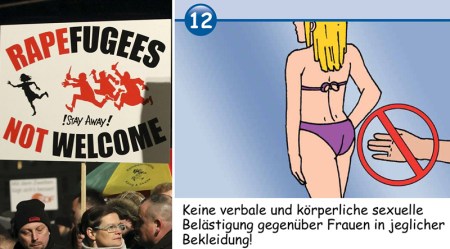
1470In January, there were thousands of cases of migrants sexually assaulting women in Germany, including many that took place in public pools. The government began to face a rising voter backlash to the open-door migration policy, including public protests (left). In some areas, authorities have distributed cartoon guides, to “educate” migrants that sexual assault is not acceptable (right).

January 15. Finance Minister Wolfgang Schäuble, in an interview with the Süddeutsche Zeitung, signaled his determination to export Germany’s migrant problem by calling for a Europe-wide gas tax to help pay for the cost of hosting millions of migrants. He said:

“If the funds in national budgets and the European budget are not enough, then let us agree, for example, to raise a levy on every liter of gasoline at a certain level. If a country refuses to pay, I am still prepared to do it. Then we will build a coalition of the willing.”

January 16. Norbert Röttgen, chairman of the foreign affairs committee in the German Bundestag and a lawmaker in Angela Merkel’s Christian Democratic Union (CDU), called upon the government to create a Ministry for Migration, Integration and Refugees. He said the migrant crisis had developed into a “primary and permanent task for the state” and is of “decisive importance for the future of our country and Europe.”

January 16. A 19-year-old migrant from Afghanistan sexually assaulted four girls between the ages of 11 and 13 at an indoor swimming pool in Dresden. The migrant was arrested but then set free. A migrant from Syria sexually assaulted a 12-year-old girl in Mudersbach. A 36-year-old migrant sexually assaulted an eight-year-old girl in Mettmann.

January 16. A group of between six and eight African migrants ambushed three people leaving a discotheque in Offenburg. The migrants were ejected from the discotheque after female clients complained that the men were sexually harassing them. After they left, at around 4AM, the migrants attacked them with metal rods, street signs and garbage bins.

January 17. In an interview with Bild am Sonntag, the president of the federal criminal police, Holger Münch, said that the number of crimes in refugee shelters had increased “significantly” since 2015, when the migrant influx began. He said that the migrants mostly responsible were from the Balkans and North Africa, especially Algerians, Tunisians and Moroccans. He added that half the offenses at the refugee shelters were physical assaults, but that there was also a growing number of homicides and sexual crimes.

January 17. In an interview with the Süddeutsche Zeitung, former Bavarian Prime Minister Edmund Stoiber warned that Chancellor Angela Merkel will “destroy Europe” if she refuses to reduce the number of migrants entering Germany.

January 17. Berlin clergyman Gottfried Martens accused German politicians and church leaders of ignoring the persecution of Christians by Muslims in German refugee shelters. He said that the Christians were facing “verbal threats, threats with knives, blows to the face, ripped crucifixes, torn bibles, insults of being an infidel, and denial of access to the kitchen because of uncleanness.”

January 18. A 26-year-old Algerian man was the first person to be arrested in connection with a string of sexual assaults during New Year’s celebrations in Cologne. He was apprehended at a refugee shelter in the nearby town of Kerpen. Cologne’s chief prosecutor, Ulrich Bremer, said that nearly 500 women had come forward with allegations of sexual assault, including three cases of rape.

January 18. A 24-year-old migrant from Sudan was released after being held for questioning at a police station in Hanover. After crossing the street, the man, who receives 300 euros ($335) a month in social welfare benefits, dropped his pants and exposed himself in public and shouted, “Who are you? You cannot do anything to me. Whatever I cannot get from the state, I will steal.”

January 19. Addressing the European Parliament in Strasbourg, European Council President Donald Tusk warned that the European Union had “no more than two months” to get control over the migration crisis or face the collapse of the Schengen passport-free travel zone.

January 19. A poll published by Bild showed that support for Chancellor Angela Merkel’s conservative bloc was down 2.5 points at 32.5%, its lowest result since the 2013 election. The poll showed that support for the anti-immigration Alternative for Germany (AfD) was up 1 point at 12.5%; support for the Social Democrats was up 1 point at 22.5%.

January 19. A 28-year-old migrant from Iran pushed a 20-year-old woman onto the tracks of an oncoming train in Berlin. She later died.

January 20. Bild reported that migrants invaded female changing rooms and showers at two public swimming pools in Leipzig. Migrants, dressed in their street clothes and underwear, also jumped into the swimming pools. According to Bild, the city hall had tried to keep the incidents quiet, but details were leaked to the media.

January 21. More than 200 migrants have sued the German government for delays in processing their asylum applications.

January 22. Facing political pressure over the migrant crisis, Chancellor Angela Merkel met in Berlin with Turkish Prime Minister Ahmet Davutoglu to discuss ways to stem the flow of Syrian and other refugees from Turkish shores. She renewed a pledge to provide Turkey with financial support. In November 2015, EU leaders pledged 3 billion euros ($3.4 billion) to Ankara to help care for an estimated 2.5 million Syrian refugees in Turkey; the deal has been delayed by a dispute among EU member states over who will pay.

January 22. A report by municipal authorities in Zwickau that was leaked to Bild revealed that migrants were defecating in public swimming pools. Security cameras also filmed migrants harassing women in the public sauna and attempting to storm the female dressing room.

January 22. Police in Hanover investigated four nightclub bouncers for allegedly beating an 18-year-old Algerian migrant after he tried to steal the purses of two teenage girls. Two days before the incident, the migrant had been sentenced to one year in juvenile detention for robbery, but he was free to roam the streets until his sentence began.

January 22. A migrant attempted to rape a 16-year-old girl in Feuerbach district of Stuttgart, and in downtown Stuttgart, four migrants sexually assaulted a 23-year-old woman.

January 23. The Süddeutsche Zeitung reported that migrants had attacked women in 12 of Germany’s 16 states on New Year’s Eve. In addition to the attacks Cologne, 195 women filed complaints in Hamburg; 31 in Hesse; 27 in Bavaria; 25 in Baden-Württemberg; 11 in Bremen; and six in Berlin.

January 23. Two migrants sexually assaulted an 18-year-old woman in Wiesbaden, and a 35-year-old migrant sexually assaulted a woman in a restroom on a train in Düsseldorf.

January 23. The Stuttgarter Nachrichten reported that dental work for migrants could end up costing German taxpayers billions of euros.

January 24. An official police report leaked to The Huffington Post showed that Interior Minister Thomas de Maizière was not being truthful when he said that between 100 and 200 migrants are being denied entry into Germany each day. The report stated that since September 14, border police had prevented 7,185 migrants from entering the country — or only about 60 migrants turned away each day.

January 25. A 30-year-old migrant from North African exposed himself to a 19-year-old woman on a public bus in Marburg, and then to passersby at the main train station.

January 26. In an interview with the German public radio, Deutschlandfunk, retired public media personality Wolfgang Herles admitted that public broadcasters receive “instructions from above” when it comes to reporting the news:

“We have the problem that we are too close to the government. The topics we cover are determined by the government. But many of the topics the government wants to prevent us from reporting about are more important than the topics they want us to cover…

“We must report in such a way that serves Europe [the European Union] and the common good, as it pleases Mrs. Merkel. There are written instructions … today we are not allowed to say anything negative about the refugees. This is government journalism, and this leads to a situation in which the public loses their trust in us. This is scandalous.”

Previously, Claudia Zimmermann, a reporter with the public television broadcaster WDR, said that public media outlets in Germany “have been warned to report the news from a pro-government perspective.”

January 26. A 24-year-old man on an evening stroll with his three-month-old baby daughter in the Eißendorf district of Hamburg was approached by two migrants who demanded his wallet and cellphone. When he said he was not carrying any valuables, the migrants attacked him with a knife. Fleeing for his life, the man ran onto a frozen pond and broke through the ice. A passerby heard the man calling for help. The baby, under water for an extended period, was revived by paramedics called to the scene. The baby remains in intensive care; the migrants remain at large.

January 26. A 28-year-old migrant from Algeria applied for asylum in Wesel. Authorities became suspicious because of his proficiency in German. They later determined that he had arrived in Germany in November 2014, rather than, as he claimed, in October 2015. It emerged that he had outstanding warrants for theft, but evaded police by using six different identities.

January 26. The Kieler Nachrichten reported that the proliferation of sexual assaults by migrants has women in the northern city of Kiel afraid to be out at night because the city is too dark. In an effort to save electricity, municipal officials decided to convert all of the city’s street lights to LED bulbs, but they do not provide sufficient light to keep the streets illuminated at night.

January 26. The mayor of Freiburg, Dieter Salomon, ordered police to take a hard line against migrants accused of snatching purses and assaulting women in the city’s discotheques. According to club owners, migrants have been robbing women on the dance floor and raping them in the restrooms. Many of the offenders are allegedly underage migrants from North Africa. Club owners say that the migrants are not afraid of authority: “They know that nothing will happen to them here.”

January 27. A 39-year-old migrant from Afghanistan tried to enter Germany at Simbach, a town on the border of Austria. A background check determined that in May 2000, a German court had sentenced the man to an eight-year prison term for rape. He had been deported to Afghanistan in 2006 with orders never to return.

January 27. The public radio and television channel, Mitteldeutscher Rundfunk, reported that German taxi drivers are profiting from the migrant crisis by taking migrants to doctors’ appointments and asylum interviews. The cab fares are being paid for by German taxpayers. MDR reported on a taxi company in Leipzig that had billed the government for 800 taxi fares for taking migrants to run errands. One taxi driver, for example, drove a migrant family on an 80 km (50 mile) journey for an appointment with migration authorities. The meter was left running while the driver waited for the migrants to return from their meeting. The fare was 309 euros ($344).

January 28. Bild reported that politicians in Kiel had ordered the police to overlook crimes perpetrated by migrants. According to the paper, the police in North Rhine-Westphalia and Lower Saxony have also been instructed to be lenient to criminal migrants.

January 28. A migrant from Sudan sexually assaulted a female police officer in Hanover as she was attempting to arrest him for theft. Public prosecutor Thomas Klinge confirmed the incident. “Such brazen behavior towards a police officer has been unheard of until now,” he said.

January 28. Berlin’s Tempelhof airport, the iconic site of the Berlin Airlift in 1948-49, is set to become the biggest refugee shelter in Germany. In a controversial move to alter the airport’s zoning regulations, Berlin’s municipal government — run by a coalition between the Christian Democratic Union and the Social Democratic Party — voted to build five massive structures to house 7,000 migrants there. Opposition politicians said the government was creating an “immigrant ghetto” in the heart of Berlin.

January 28. Police in Berlin said that a volunteer with the charity group Moabit Hilft hadfabricated a story about a 24-year-old migrant said to have died while waiting for days outside an asylum registration office. The story was allegedly faked in an effort to embarrass the government for its slow response to the migrant crisis.

January 29. The European Commission, the powerful administrative arm of the European Union, said that the sexual assaults in Cologne had nothing to do with the migrant crisis and were simply a matter of public order. A confidential memo leaked to The Telegraph stressed the importance of the Commission’s “continuing role in sounding the voice of reason to defuse tensions and counter populist rhetoric.” The Commission called for “the unconditional rejection of false associations between certain criminal acts, such as the attacks on women in Cologne on New Year’s Eve, and the mass influx of refugees.”

January 29. A public vocational school in the Wilhelmsburg district of Hamburg cancelled plans to host classes for refugees after male migrants sexually harassed dozens of female students at the school.

January 29. The German news magazine Focus published the results of a poll showing that 40% of Germans want Chancellor Angela Merkel to resign because of her migrant policies.

January 30. A gang of migrants on a Munich subway train were filmed attacking two elderly men who tried to stop them from groping a woman. Images show the migrants grabbing two men by the arms and neck and shouting abuse at them. It later emerged that the migrants were from Afghanistan; although they had been denied asylum in Germany four years ago, the German government refused to deport them because Afghanistan is “too dangerous.”

January 31. The Interior Minister of Saxony-Anhalt, Holger Stahlknecht, of the Christian Democrats, announced that he would delay releasing the 2015 crime statistics until March 29, two-and-half weeks after regional elections. The statistics are normally released in February or early March. Rüdiger Erben of the Social Democrats said: “The late release date reinforces my suspicion that the statistics are horrific.”

January 31. ISIS sympathizers defaced more than 40 gravestones at a cemetery in Konstanzwith slogans such as, “Germans out of Syria,” “Christ is Dead” and “Islamic State.”

January 31. A 30-year-old German, originally from Turkmenistan, raped a seven-year-old girl in Kiel. The man kidnapped the girl from a school playground at 11AM, took her to his apartment and, after abusing her, set her free. It later emerged that the man, who is the father of two children, had been accused of sexually assaulting a five-year-old girl at another kindergarten in Kiel on January 18, but the public prosecutors failed to pursue the case due to insufficient evidence. “In hindsight, we regret that decision,” the prosecutors said.

January 31. In an underhanded effort to silence critics of the government’s open door migration policy, Vice Chancellor Sigmar Gabriel called on German intelligence to begin monitoring the Alternative for Germany (AfD), the third-largest party in Germany. The AfD is surging in popularity because of its anti-immigration platform.