Posted tagged ‘Khamenei’

The Shady Family Behind America’s Iran Lobby

September 15, 2015

The Shady Family Behind America’s Iran Lobby, Daily Beast, Alex Shirazi, September 15, 2015

(The National Iranian American Council is the voice of the Iranian regime. It found great favor with the Obama administration while becoming a significant part of it. — DM)

How one enterprising Iranian expat family and its allies successfully pushed for U.S.-Iran rapprochement—and now stands to make a fortune from sanctions relief.

When the world’s major powers struck a deal over Iran’s nuclear program in Vienna in July, it represented a victory not just for the Islamic Republic, which has now been granted international legitimacy as a nuclear threshold state, but also for a small but increasingly influential lobby in America, one which has long sought rapprochement between Washington and Tehran and now seeks to leverage a successfully concluded nuclear deal as a means to that end.

This Iran lobby, publicly represented by the National Iranian American Council (NIAC), has become a staunch institutional ally of the White House selling the Joint Comprehensive Plan of Action, as the nuclear deal is known. But while NIAC has done the heavy-lifting—the ad-buying, the leafleting, and Congressional meet-and-greets, all designed to sell lawmakers on the Iran deal—its political efforts also underwrite the economic interests of one very well connected but low-profile Iranian family, the Namazis, who played a key role as intellectual architects of NIAC.

Little known to the American press, the Namazis have rarely acted as spokespersons for their own cause. In fact, attempts to reach various members of the family for comment on this story were met with increasing levels of hostility and threats of legal action. Yet in many ways, the Namazi clan is the perfect embodiment of Iranian power politics, at least as it has played out among the Iranian diaspora. Those close to the Namazis say that they are savvy financial operators rather than ideologues, eager to do business with the West and enjoy all of its political freedoms and perquisites, and yet ever mindful that they’re straddling the delicate fault-line between cashing in with a theocratic dictatorship and being frozen out entirely. They have stayed on the right side of international law if not always on the right side of prevailing political interests in the Islamic Republic.

Nor did they begin their rise to prominence as supporters of the Islamic Revolution. Mohammad Bagher Namazi, also known as Baquer Namazi, is the patriarch of the family and formerly the governor under the Shah of the oil-rich Iranian province of Khuzestan. Despite his relationship with the ancien régime, Baquer Namazi was not persecuted by the Khomeinists after they seized power in 1979, and he and his family were allowed to emigrate in 1983 to the United States. There he raised two well-educated and Americanized sons, Babak and Siamak, while his niece, Pari Namazi, married Bijan Khajehpour, another Iranian expatriate.

The 1980s were the years of the fiery-eyed Ayatollah Khomeini and Iran’s ferocious war with Saddam Hussein’s Iraq. Iranian-backed terrorism in Lebanon included the bombing of the U.S. embassy and the Marine barracks there, while Iranian “hit teams” hunted down and murdered opponents of the regime in exile. Iran’s Hezbollah clients kidnapped Europeans and Americans, and in the Irangate scandal the Reagan administration was exposed trading weapons systems for hostages. Afterward it effectively went to war against Iran on the waters of the Gulf, and in the process blew an Iranian civilian airliner out of the sky. There seemed no possibility of improved relations between Washington and the theocracy in Tehran. But after the Iran-Iraq war ended in 1988 and Khomeini died in 1989, new possibilities for rapprochement—and huge deals for international companies—started to emerge.

***

Doing serious business in Iran has always required some measure of political protection. The Islamic Republic is a web of rival economic interests. Broadly speaking, the three largest are those tied through various semi-clandestine fronts to  Khomeini’s successor as “supreme leader,” Ayatollah Ali Khamenei; those linked to the regime’s praetorian Islamic Revolutionary Guards Corps (IRGC); and those associated with Iran’s president, who may hold the most conspicuous position in the country’s political life, but whose official powers are limited. Typically, to get things moving in the mire of Iran’s notorious bureaucracy, businesses have to have connections in one or more of these groups.

From 1989 to 1997, the president of Iran was Akbar Hashemi Rafsanjani, known as “the Shark,” an Iranian reference to a beardless man. He was also famous for getting rid of his rivals and political competitors one by one, like a great white shark. In addition, Rafsanjani had a reputation for corruption and taking advantage of power.

In this environment of increased willingness to do business with the West, the stage was set for a return of the Namazis. In 1993, Pari Namazi and her husband Bijan Khajehpour founded a company in Tehran called Atieh Bahar Consulting (AB). It offered a range of legal and industrial services to foreign enterprises, most importantly the access it provided to the regime, and the advice it dispensed on how best to navigate the vagaries of the regime’s entrenched factions and competitive interests.

At the time, it looked like Iran might even be opening up to big American-based oil companies, then unencumbered by any sanctions regime on the Islamic Republic. But after an announcement in 1995 that Iran had given Conoco a contract to develop an offshore gas field, and an uproar in the U.S.  Congress, the Clinton administration imposed unilateral sanctions and barred U.S. companies from doing business there.

Eventually Siamak Namazi, who had worked from 1994 to 1996 at Iran’s Ministry of Housing and Urban Planning, also joined AB. So did his brother Babak, a lawyer. And the AB client list just kept growing. Plenty of companies based outside the U.S. were more than happy to do business in Iran once they had the right connections. As Siamak eventually told Lebanon’s Daily Star newspaper, “If oil companies want to operate in the Iranian market they need to link up with a local partner, and this is where we step in and help them to find the right partner.”

With the surprise election of the “reformist” presidential candidate Mohammad Khatami in 1997, political and economic enthusiasm for better Iranian relations with the West grew dramatically. Meanwhile the “pragmatist” Rafsanjani took other powerful positions in the regime. In those optimistic times, AB’s non-American clients—free from any sanctions regime—included the German engineering giant Siemens; major oil companies BP, Statoil, and Shell; car companies Toyota, BMW, Daimler, Chrysler, and Honda; telecom giants MTN, Nokia, Alcatel; and international banks such as HSBC.

But the political winds were shifting. A nuclear cloud darkened the horizon, and the United States, slowly but surely, found ways to broaden the sanctions against Iran, forcing many international companies to dial back on their investments there or pull out altogether.

The Namazis, of course, had every reason to want to bring them back.

***

Atieh Bahar Consultancy had aligned itself with Rafsanjani’s faction early on by forging an especially close relationship with Rafsanjani’s influential son, Mehdi.

From 1993 to 2005, Mehdi Hashemi was employed at the National Iranian Oil Company (NIOC), the state-owned entity that controls almost all oil and gas production in a country that has the world’s largest gas reserves and third-largest oil reserves.

But Mehdi Hashemi brought some serious problems to the relationship. In 2004, Norway’s Statoil was caught paying bribes to a prominent Iranian official using the company Horton Investment, an entity run by a close Mehdi Hashemi confidant as intermediary. Hashemi would later be imprisoned for his complicity in the bribery, along with two other charges, and ordered to pay a total of $10.4 million; $5.2 million of the bribe money, plus an additional $5.2 million in fines. Abbas Yazdanpanah Yazdi, meanwhile, was allegedly kidnapped in the UAE in 2013 and has since “disappeared.”

The scandal came just as the elder Rafsanjani was plotting a presidential comeback in the 2005 elections, and it gave substance to the rumors of corruption that always swirled around him and his son. (Mehdi Hashemi denied the Statoil bribery allegation and said it was designed to hurt his father’s reputation.) He managed to make it into the second and final round, but finally lost to Mahmoud Ahmadinejad, who staked out a position as a “clean” populist who would give money to the poor and who didn’t give a damn about foreign business interests.

After Ahmadinejad came into office, the nuclear cloud grew much darker.

In 2003, the United States had led the invasion and occupation of neighboring Iraq, eliminating Iran’s old enemy Saddam Hussein in order to be sure that he had no weapons of mass destruction. And, as it turned out, by then he did not. A few months earlier in 2002, however, Israeli intelligence turned up evidence that Iran, a signatory of the Nuclear Non-Proliferation Treaty, had developed a secret uranium enrichment operation at a site called Natanz. (The first public airing of this intelligence came from a militant Iranian dissident group that had been nurtured by Saddam Hussein.)

This did not distract from the march to war with Iraq, but a few months later Iran was declared in material breach of the Treaty on the Non-Proliferation of Nuclear Weapons (NPT), and, under threat of heightened sanctions, a process of negotiations began between Iran and the European Union to limit the nascent enrichment program. At the time Iran had only 160 of the centrifuges needed to enrich uranium, and thousands would be required to get it to the point where it could produce fissile material for a bomb. U.S. intelligence estimates eventually concluded “with high confidence” that the Iranians also had a secret nuclear weapons program, in addition to enrichment, but shut it down in the fall of 2003.

When Ahmadinejad took over in 2005, he ditched all pretense of willingness to compromise over Iran’s “peaceful” nuclear program, an intransigence that led Western countries to tighten sanctions, making foreign investment ever more difficult. And what was worse for AB and the Namazis, Ahmadinejad went after his political rivals, particularly the Rafsanjani faction, with a vengeance. Mehdi Hashemi, naturally, was a prominent target. Ahmadinejad barred him from conducting any business in relation to Iran’s oil and gas sector. Ten years later, the courts actually sentenced him to a collective 25 years—and 50 lashes—in Tehran’s notorious Evin prison for all three charges against him including the Statoil corruption case. In reality, he will only serve 10 years.

AB needed to shore up some new alliances, and bide its time. Co-founder Bijan Khajehpour, worked for a leading Iranian politician named Hassan Rouhani who had served under the Khatami government as Iran’s nuclear negotiator. Rouhani also was the president of a think tank called the Center for Strategic Research (CSR). But relations with Iran in the middle of the last decade were almost as bleak as they had been after the 1979 hostage crisis and the grim terror and counter-terror campaigns of the 1980s.

By 2006, Iran, was in effect at war with the U.S. in Iraq. The Revolutionary Guards’ expeditionary Quds Force led by Qasem Soleimani had been training, financing, and arming Shia militias killing U.S. soldiers.

Moreover, the West was growing more alarmed about Iran’s nuclear program, which it seemed powerless to stop. Ahmadinejad had declared the resumption of uranium enrichment “irreversible” just as the country’s nuclear scientists had mastered the fuel cycle. He’d appointed conservative Ali Larijani as chief negotiator with the European Union (before Iran withdrew from talks altogether), and he said he’d “wipe [his] nose” on international sanctions.

A war with Iran, most likely started by Israel with the United States drawn in, began to seem possible, then probable, and almost inevitable. The International Atomic Energy Agency referred Iran to the UN Security Council for action forcing it to curtail its nuclear activities.

Out of this dark morass, the Namazis struggled to keep alive hopes of rapprochement and trade, while avoiding a war at all costs. And by then they had in place the architecture for convincing a war-weary U.S. policy establishment that not only was avoiding a military confrontation with Iran possible, but the Islamic Republic was really just a friend America had yet to make.

***

In November 1999, when Khatami was still president and, Siamak Namazi got together with a Swedish-Iranian expat named Trita Parsi at a conference in Cyprus. The conference, titled, “Dialogue and Action Between the People of Iran and America,” was convened jointly by the Centre for World Dialogue, a Cypriot non-governmental organization, and by Hamyaran, an Iranian non-governmental resource center for other NGOs, which was chaired by Mohammad Bagher Namazi, the family patriarch. Namazi fils and Parsi there presented an influential white paper (PDF), “Iran-Americans: The bridge between two nations,” which called for three steps to ameliorate U.S.-Iranian relations in advance of reconciliation:

1. Hold “seminars in lobbying for Iranian-American youth and intern opportunities in Washington DC.”

2. Increase “awareness amongst Iranian-Americans and Americans about the effects of sanctions, both at home and in Iran.”

3. End “the taboo of working for a new approach on Iran”—i.e., end the then two-decade-old U.S. policy of containment.

Namazi and Parsi wrote that “the fear of coming across as a lackey of the Iranian regime is still prohibiting many Iranian Americans from fully engaging in the debate on the future of Iran-U.S. relations.” The way around this, they submitted, was to mobilize the Iranian-American community and enlist “Americans of non-Iranian background” to lessen the adversarial posture of both nations.

The white paper led to the creation two years later, in 2001, of NIAC, a Washington, D.C.-based organization which Parsi founded and currently heads. During the formative period preceding NIAC’s launch, Parsi had sought advice and guidance from numerous sources, including and especially Mohammad Bagher, as was disclosed in documents (PDF) obtained during a defamation law suit brought by NIAC and Parsi against one of their most outspoken critics.

Parsi was extremely well-placed to front the Iran lobby. He had obtained a doctorate at Johns Hopkins on a subject intimately tied to the lobby’s central thesis—the relationship between Israel and Iran and how the former hindered the latter’s acceptance in the U.S. He even studied under Francis Fukuyama, a onetime neoconservative policy intellectual who abandoned his ideological comrades when the Iraq war went south. Finally, Parsi had gained valuable political experience on the Hill by working for Republican Congressman Bob Ney, a connection he has not included in his curriculum vitae and official website. (Ney went to jail in 2007 for accepting bribes from mega-lobbyist Jack Abramoff’s Native American casino clients.)

While serving as president of NIAC, Parsi also wrote intelligence briefings as an “affiliate analyst in Washington, D.C.” for AB, focusing on such topics as whether or not the American Israel Public Affairs Committee (AIPAC) would revive its anti-Iran campaigning on the eve of the Iraq war, or on efforts by the Mujahideen-e Khalq (MeK), the militant Iranian opposition group that exposed Natanz in 2002 would get itself de-listed as a terrorist entity by the U.S. State Department. Parsi was paid for his work for the consultancy, as disclosed by an email sent from Bijan Khajehpour to him, dated Sept. 22, 2002, an employment that Parsi did not mention when fulsomely praising Khajehpour in the Huffington Post as an ideal Iranian businessman.

Although it has only 5,000 dues-paying members, a mere one percent of the estimated 470,000 Iranian-Americans, NIAC’s network of activists and event attendees is said to extend into the tens of thousands. In June of this year, as the Iran deal looked likely, NIAC inaugurated an official “lobbying” arm called NIAC Action registered with the Internal Revenue Service as a 501(c)(4) organization, but for years, internally, the group has described its activities (PDF) as lobbying. NIAC Action is explicitly meant to counter the influence of AIPAC, which has spent millions to block the Iran deal’s passage in Congress by securing a veto-proof bipartisan majority of senators opposed to it—an effort that now appears close to failure.

Since its founding, NIAC has also proved a useful finishing school for rapprochement-minded Iranian-Americans, many of whom have either come from positions in U.S. government or graduated into them. Its current research director, for instance, is Reza Marashi, an Iranian-American dual national, who worked for Atieh Bahar until 2006 when he landed a  job at the U.S. government’s Institute for National Strategic Studies at the National Defense University, which acts as a research center for the Pentagon. Marashi then went to work for the Office of Iranian Affairs at the U.S. State Department as a desk officer overseeing Iran democracy and human rights programs.

Marashi is very outspoken on social media against any critics of NIAC’s agenda. Along with the rest of his organization’s staff, he has accused Jewish opponents of the Iran deal of being dual loyalists. “Shame on Chuck Schumer for putting #Israel’s interests ahead of America’s interests,” he tweeted after the New York senator’s decision to come out as the senior-most Democrat against the deal.

Given the obvious connection between NIAC and the Namazi family, Marashi makes no mention of his job at AB in his biography on NIAC’s official website. Nor did he respond to The Daily Beast’s repeated requests for comment on this story.

Perhaps NIAC’s most accomplished alum is Sahar Nowrouzzadeh, who is now National Security Council Director for Iran in the Obama administration and therefore the top U.S. official for Iran policy, bringing together the various departments of government working on U.S. strategy toward the country. She is also, after the White House principals, one of the leading advisors to President Obama on Iran. No doubt owing to the sensitivity (and influence) of her government role, Nowrouzzadeh has maintained a low profile, but her work at NIAC is publicly available. She drafted one of the organization’s annual reports for 2002-2003 (PDF) and was referred to by Dokhi Fassihian, then executive director, as a “staff member” (DOC). The Obama administration insists that Nowrouzzadeh was only ever an intern with NIAC, and Nowrouzzadeh does not seem eager to play-up her affiliation with the group. According to her LinkedIn profile, she has worked at the State Department and the Department of Defense. The profile doesn’t mention NIAC at all.

Such inconspicuousness stands in notable contrast to how other Obama administration officials who emerged NIAC’s nemesis—the pro-Israel lobbying establishment—tend to invoke their past credentials as a means of establishing their diplomatic bona fides.

But then, Israel is a longtime and “sacrosanct” American ally, as Obama has stated. Iran, on the other hand, has been a pariah state where crowds are encouraged to chant “Death to America.”

On NIAC’s website, in its mailings and in media interviews, NIAC rarely criticizes the IRGC or the Quds Force, a U.S.-designated terrorist entity. Parsi characterizes the Iranian regime, of which the Quds Force is the main military enforcer, as a U.S. ally in the war against the so-called Islamic State, or ISIS.  But neither he nor NIAC has discussed the Quds Force’s military role in Syria where it plays a key role in targeting U.S.-backed rebels deemed the best bulwark against both Assad and the so-called Islamic State widely known as ISIS and, more broadly, organizing the savage defense of the Assad dynasty, for which several of the Quds Force’s personnel have been sanctioned by the U.S. government.

NIAC publicly opposes designating the IRGC as a whole as a terrorist entity because doing so would only conform to part of a pattern of failed sanctions, “further entrenching U.S.-Iran relations in a paradigm of enmity.”

Instead, campaigning against any U.S. sanctions on Iran has been the mainstay of NIAC’s endeavors, and this held even when the Obama administration thought sanctions the most effective way to bring the Iranians back to the negotiating table. NIAC has maintained (PDF) that sanctions have cost the U.S. economy billions of dollars and hundreds of thousands of job opportunities.

Parsi’s activism won him praise from the Iranian regime during the very dark days a decade ago. Former ambassador to the United Nations Javad Zarif, who is now the heavily spotlighted foreign minister, wrote to Parsi in 2006, “Your help is always welcome,” and, after catching part of a Parsi interview on the BBC the same year, Zarif called his performance “Great.”

In March 2006 (at the height of the covert Iranian war with the U.S. in Iraq), Parsi told a colleague not to worry about a trip to Tehran, “NIAC has a good name in Iran and your association with it will not harm you.” When the colleague was briefly questioned by the regime, then released, he reported back (PDF) to Parsi that he’d been told the reason he was let go was “that they knew NIAC had never done anything seriously bad against the Islamic Republic.”

***

In 2009, Sen. Mark Kirk called NIAC Iranian “Regime Sympathizers” (PDF), stating “they came to Capitol Hill urging members of Congress to cut off U.S. funding for democracy programs in Iran.” NIAC had sought to eliminate the Bush administration’s “Democracy Fund” for programs in Iran, which it saw as nothing more than a vehicle for attempted regime change. NIAC responded to Kirk by calling the $75 million fund a “brainchild” of the Bush administration’s “disastrous Middle East policy,” which aimed to finance Iranian NGOs seeking overthrow the government of Iran.

And NIAC does some name-calling of its own, calling organizations it doesn’t like (i.e., those too critical of the Islamic Republic) “neocon puppets,” and warmongers. Indeed, it has also tried to define the parameters of acceptable Iranian civil society groups (i.e., ones that never really undermined the regime) by partnership with Hamyaran, described by NIAC as an “NGO umbrella organization” (PDF). In reality, however, it was conceived as more of a governmental non-governmental organization and launched by those close to Iranian President Mohammad Khatami—its board member was Hossein Malek Afzali, a deputy minister in Khatami’s government). By NIAC’s own admission, the organizatiom (PDF) “operates independently, but with the implicit permission of the Iranian government.” (Emphasis added.) Hamyaran’s board of directors was also once chaired by Namazi paterfamilias Mohammed Bagher.

Hamyaran obtained support from the congressionally funded National Endowment for Democracy—as did NIAC, which received Endowment funding in 2002, 2005, and 2006 in the collective amount of close to $200,000. NIACdescribed Hamyaran to the Endowment in 2004 as its “main partner in Iran.” Perhaps unsurprisingly, among those civil society groups selected for NIAC and Hamyaran’s “Digital Film Production Workshop Report,” a training program for Iranian activists to learn how to use digital media, were those described as having been “contracted by the Iranian government” or “worked closely with the Iranian government.”

As for NIAC, Carl Gershman, the president of the National Endowment for Democracy, told The Daily Beast, “We’re not supporting NIAC now and we have nothing to do with them.”

“Back then there were people arguing, ‘Try to get into Iran’ and we thought this was a way forward,” Gershman said. “We weren’t aware when these grants were made that NIAC were presenting themselves as a lobby. We didn’t know that. Our effort was to work with emerging space in Iran. We were trying something that might be a way to help people on the inside. But that quickly became unworkable; the grant didn’t work. Then NIAC showed itself as a lobby organization, so we have nothing to do with them anymore. Not every grant works out the way you want it to.” Asked if that meant that NED regretted working with NIAC , Gershman answered: “Yes, I think that’s true.”

At the same time it was taking U.S. taxpayer money, NIAC wanted to end U.S. government support for NGOs which categorically opposed the Islamic Republic. In April 2007, NIAC held a strategy meeting with international human rights groups including Amnesty International and Human Rights Watch (HRW). The HRW representative was himself a former NIAC board member, Hadi Ghaemi, who had (PDF) worked for NIAC in Iran, and then served HRW from 2004 to 2008. During the meeting, according to an email sent by Parsi afterward, Ghaemi “noted that certain groups being funded by the state dept [sic] are covers for regime change and that we need to be careful. Many groups misrepresent themselves as wanting to improve human rights and democracy in Iran.” Ghaemi did not specify which groups. When The Daily Beast contacted Ghaemi via email, he replied that he could not confirm the meeting in question. He was unavailable for further comment after The Daily Beast showed him Parsi’s email asking if that refreshed his memory.

***

In 2008, NIAC made a strategic mistake, waging a not-so-quiet campaign against the Voice of America’s Persian service, a U.S. government-funded broadcast medium. Both NIAC and the Namazis were aggravated by the frequent appearances of Hassan Dai, an Arizona-based Iranian exile, who lambasted NIAC as a regime mouthpiece.

Siamak Namazi (PDF) called for Dai to be banned from VOA in February 2007. NIAC chief lobbyist Emily Blout petitioned (PDF) Congress in September 2007 for an “independent review” of VOA Persian. After Dai appeared again on VOA in 2009, Parsi (PDF) remarked that its hosting of a NIAC critic “won’t change until the VOA leadership changes.” He was right. Today the editor-in-chief of VOA Persian is Mohammad Manzarpour, a former employee of Atieh Bahar Consultancy.

But serious damage to NIAC’s reputation was done, and much of it was self-inflicted. In 2008, Parsi and NIAC had brought a defamation suit against Hassan Dai, alleging that he had made “numerous false and defamatory statements that characterize plaintiffs as agents of the Iranian government.” Parsi and NIAC lost the case in 2012, with the judge rejecting their self-portrayal as critics of Tehran. “That Parsi occasionally made statements reflecting a balanced, shared blame approach is not inconsistent with the idea that he was first and foremost an advocate for the regime,” U.S. District Court Judge John D. Bates (PDF) wrote in his judgment. “After all, any moderately intelligent agent for the Iranian regime would not want to be seen as unremittingly pro-regime, given the regime’s reputation in the United States.”

Nor did NIAC do itself any favors in during the trial and on appeal. Three circuit judges of the U.S. Court of Appeals found its behavior (PDF) “dilatory, dishonest, and intransigent” and accused it of engaging in a “disturbing pattern of delay and intransigence. Seemingly at every turn, NIAC and Parsi deferred producing relevant documents, withheld them, or denied their existence altogether. Even worse, the Appellants also misrepresented to the District Court that they did not possess key documents [Dai] sought. Most troublingly, they flouted multiple court orders… A court without the authority to sanction conduct that so plainly abuses the judicial process cannot function.”

Unsurprisingly, then, NIAC and Parsi lost their appeal and were ordered to pay $183,480.09 in monetary sanctions in February 2015.

“NIAC and Parsi filed the lawsuit to break me under the financial burdens and silence other critics but they totally failed,” Dai told The Daily Beast. “The lawsuit, which lasted nearly seven years, showed the deceptive character of an organization that lobbies in favor of the mullahs’ theocratic regime but represents itself as a defender of peace.”

***

The fortunes of the entire Namazi clan waned after 2009, when a popular uprising against Ahmadinejad’s fraudulent re-election was met with murder, mass arrests, and torture.

Bijan Khajehpour was imprisoned because of the struggle raging in the regime between the Supreme Leader and the IRGC on one side, and the Rafsanjani camp on the other. And while praising the Obama administration for not speaking up on behalf of those who resisted the stealing of the 2009 election, the so-called Green Movement, on the grounds that doing so would have only given the regime an excuse to murder and torture more people, Parsi rushed to the defense of his friend and former employer Khajehpour, “who neither participated in the protests nor had any involvement with the opposition” but was instead a “self-made man” and “top-notch consultant drawing the attention of multinational and local firms to investment opportunities in the country.”

In The Huffington Post Parsi wrote as an acquaintance or friend of Khajehpour, nowhere disclosing his past business relationship writing reports for Atieh Bahar Consulting.

Khajehpour subsequently was released from prison and he and his wife, Pari Namazi, moved to Vienna.

Siamak Namazi also faced harassment after the 2009 election and the subsequent unrest. He left Iran for the United Arab Emirates and is currently the head of Strategic Planning at the UAE-based Crescent Petroleum, an oil and gas company based in Abu Dhabi.

Business in Iran was drying up. Ahmadinejad may have held onto power after he broke the Green Movement, but his drive toward nuclear “self-sufficiency” raised so many alarms that the Obama administration was able to persuade the four other members of the UN Security Council to impose draconian sanctions on the regime. Hundreds of billions of dollars worth of assets were frozen, and international commerce ground toward a halt.

Then, in 2013, Khajehpour’s former employer Hassan Rouhani, the former nuclear negotiator, the Rafsanjani-style “pragmatist,” was elected Iran’s new president. The ever affable-seeming former UN ambassador, Javad Zarif, was appointed foreign minister. Suddenly the door looked like it was open wide to a new relationship with the West of just the sort the Iran Lobby had worked for so hard and for so long. Rouhani was avuncular, good-humored, and had made it his goal to open Iran for business, if only the nuclear issue could be dealt with.

By the time serious talks with Washington were opened, Ahmadinejad’s nuclear program had built almost 14,000 centrifuges, and Iran was within a year, by some estimates within months, of producing enough fissile material to build a bomb, at least in theory.

Although there was talk in Washington about compelling Iran to dismantle the whole program, there was never really any question of that, and the deal as finally signed merely buys time—pushing Iran’s possibility of producing a potential nuclear weapon back from months to as many as 15 years.

As these pieces fell into place in the age of Obama, Parsi and NIAC found themselves in the unlikely position of power brokers. One prominent faction of the Iranian regime—Rafsanjani’s—sees them as convenient conduits for disseminating a pro-Iranian line in U.S. politics, while the “hardline” Iranian security services have classified their activities as benign to the interests of the Islamic Republic.

The U.S. government, meanwhile, has adopted many of NIAC’s talking points. Both Parsi and Atieh International, one of the companies in the Atieh Group, were fixtures on the sidelines of the Geneva and Vienna negotiations between the P5+1 and Iran. In fact, Atieh International held a joint briefing with NIAC at the Marriott in Vienna on June 29 to discuss a most pressing topic—renewed economic possibilities for the West once a deal was inked. The speakers were Bijan Khajehpour and Trita Parsi.

The Namazis’ alignment with Rafsanjani and Rouhani can now pay off. Because they were attacked so often and sometimes so viciously by “hard liners”—the very Iranian officials the Obama White House claims constitutes the only Iranian opposition to the nuclear deal—the Namazis and NIAC, the think tank and lobby they helped create, have gained great renewed credibility in the West, even promoting the idea that they can liberalize what remains by and large a fanatical theocracy and a fiercely competitive kleptocracy. At the same time, they can present themselves in today’s Iran as the best go-betweens with, well, with the not-so-Great Satan, who loves to listen to their advice.

— Alex Shirazi is a pseudonym for a well-known Iranian dissident who requested that The Daily Beast keep his identity concealed for fear of what might happen to his family in Iran in retaliation for this article.

John Kerry sings “Stand by Iran” (Capitol Steps Satire)

September 10, 2015

John Kerry sings “Stand by Iran” (Capitol Steps Satire) via You Tube, December 10, 2013


(It’s nearly two years old but worth watching again. — DM)


https://www.youtube.com/watch?v=7M6YvDXQcgQ

Khamenei: Israel won’t survive next 25 years

September 9, 2015

Khamenei: Israel won’t survive next 25 years Taking to Twitter, Iranian leader says Zionists won’t find serenity until destruction, calls US ‘Great Satan’ and rejects any talks with Washington beyond nuke deal By Times of Israel staff September 9, 2015, 12:20 pm

Source: Khamenei: Israel won’t survive next 25 years | The Times of Israel

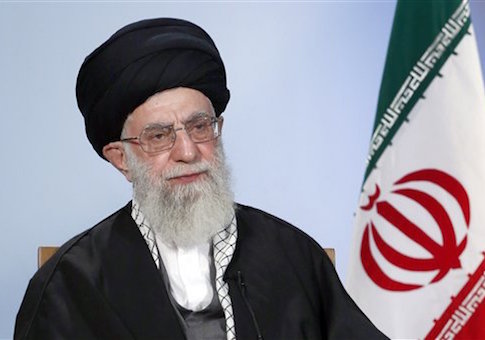
In this picture released by official website of Ayatollah Ali Khamenei's office on Thursday, Sept. 3, 2015, he is seen speaking in a meeting with members of Iran's Experts Assembly in Tehran, Iran. (Office of the Iranian Supreme Leader via AP)

In this picture released by official website of Ayatollah Ali Khamenei’s office on Thursday, Sept. 3, 2015, he is seen speaking in a meeting with members of Iran’s Experts Assembly in Tehran, Iran. (Office of the Iranian Supreme Leader via AP)

Israel will not survive the next 25 years, Iran’s Supreme Leader Ayatollah Ali Khamenei said Wednesday, making a series of threatening remarks published online.

In a quote posted to Twitter by Khamenei’s official account, Khamenei addresses Israel, saying, “You will not see next 25 years,” and adds that the Jewish state will be hounded until it is destroyed.

The quote comes against a backdrop of a photograph showing the Iranian leader walking on an Israeli flag painted on a sidewalk.

“After negotiations, in Zionist regime they said they had no more concern about Iran for next 25 years; I’d say: Firstly, you will not see next 25 years; God willing, there will be nothing as Zionist regime by next 25 years. Secondly, until then, struggling, heroic and jihadi morale will leave no moment of serenity for Zionists,” the quote from Iran’s top leader reads in broken English.

The quote was apparently taken from a speech given earlier in the day.

The remarks came as US lawmakers began to debate supporting a recent nuclear agreement between Tehran and six world powers. Critics of the deal have pointed to fiery anti-US and anti-Zionist rhetoric as proof that the regime should not be trusted.

The White House and other deal boosters argue that the pact, meant to keep Iran from acquiring a nuclear weapon, is based on verification, not trust.

Khamenei’s statements also reaffirmed his view that the US is a “Great Satan” and that there would be no detente with Washington beyond the nuclear talks.

“We approved talks with the United States about [the] nuclear issue specifically. We have not allowed talks with the US in other fields and we [do] not negotiate with them,” Khamenei said in statements published on his website.

Khamenei is quoted as saying any other talks would be “a tool for penetration and imposing their demands.”

On Twitter, Khamenei said talks with the US were a “means of infiltration and imposition of their wills.”

Quoting the founder of the Islamic Republic and his predecessor as Supreme Leader Ayatollah Ruhollah Khomeini, Khamenei tweeted: “@IRKhomeini stated “US is the Great Satan,” some insist on depicting this Great Satan as an angel.”

The Twitter handle @IRKhomeini is an Iranian government account dedicated to Khomeini’s statements.

Some have pointed to the nuclear deal as an opening for Iran to repair long-frayed ties with the West.

Several senior European officials have traveled to Iran since the nuclear deal was reached to boost economic and diplomatic ties, including Austrian President Heinz Fischer, who on Monday became the first European leader to visit Tehran in over a decade.

On Tuesday, Iranian President Hassan Rouhani signaled that Iran is ready to hold talks with world powers on ways to resolve Syria’s civil war — provided such negotiations could secure peace and democracy in the conflict-torn country, he said.

Iran, together with Russia, backs the embattled regime of Bashar Assad, who is opposed by much of the West.

Nuclear Jihad

September 7, 2015

Nuclear Jihad, Gatestone InstituteDenis MacEoin, September 7, 2015

    • In the year 628, Muhammad, now ruling in Medina, signed the ten-year Treaty of Hudaybiyyah with his long-time enemies, the tribal confederacy of Quraysh, who ruled Mecca. Twenty-two months later, under the pretext that a clan from a tribe allied with the Quraysh had squabbled with a tribe allied to the Muslims, Muhammad broke the treaty and attacked Mecca, conquering it. It is as certain as day follows night, that the Iranian regime will find a pretext to break the deal. Already, on September 3, the Supreme Leader Ayatollah Khamene’i made it clear that he would back out of the deal if sanctions were not completely removed at once.
    • The Iranian regime not only despises democracy; it considers all Western law, including international law, invalid.
    • The Shi’a consider themselves underdogs, who are willing to sacrifice all to establish the rights of their imams and their successors. That was what the 1979 revolution was all about, and it is what present the Iranian regime still insists on as the justification for its opposition to Western intrusion, democracy, women’s rights and all the rest, which are deemed by Iran’s leadership as part of a plot to undermine and control the expansion of the Shi’i faith on the global stage. These are not Anglican vicars.
    • The Iranian Army and the Islamic Revolutionary Guard Corps “have responsibility… for a religious mission, which is Holy War (Jihad) in the path of God and the struggle to extend the supremacy of God’s law in the world.” — Iran’s Constitution, Article “The Religious Army”.
    • A Third World War is already taking place. The Iran deal strengthens the hands of a regime that is the world’s terrorist state, a state that furthers jihad in many places because its clerical hierarchy considers itself uniquely empowered to order and promote holy war.
    • Obama’s trust in Khamene’i’s presumed fatwa of 2013, forbidding nuclear weapons, rests on the assumption that it even exists. It does not. Even if it did,fatwas are not permanent.
    • Why, then, is this deal going ahead at all? Why is one of the world’s most tyrannical regimes being rewarded for its intransigence, and especially for repeatedly violating the Non-Proliferation Treaty?

“[Some] analysts,” writes the historian and former Israeli Ambassador to the United States, Michael Oren, “claimed the president [Barack Obama] regarded Iran as an ascendant and logical power — unlike the feckless, disunited Arabs and those troublemaking Israelis — that could assist in resolving other regional conflicts. I first heard this theory at Georgetown back in 2008, in conversation with think tankers and former State Department officials. They also believed Iran’s radical Islam was merely an expression of interests and fears that the United States could with sufficient goodwill, meet and allay. … Iran, according to Obama was a pragmatic player with addressable interest. For Netanyahu, Iran was irrational, messianic, and genocidal – ‘worse,’ he said, ‘than fifty North Koreas.'”[1]

Since the signing of the deal at the UN, hot-tempered criticisms and defences have gone into overdrive in the political, journalistic, and diplomatic spheres. Acres have been written and are still being written about the deal, making it the hottest political potato of recent years. Expert analysts such as Omri Ceren and, more recently, Joel Rosenberg have cut through the deliberate obfuscation to show the extent of the dangers the deal presents to the Middle East, the United States, Israel, and the world.

The deal’s supporters insist that it will bring peace and calm to the region, while a host of denigrators — chief among them Israeli Prime Minister Binyamin Netanyahu — have exposed the enormous risks it entails. Already, a vast majority of American citizens are opposed to the deal.

Within the U.S. Congress, bipartisan opposition to the deal is high and mounting. Yet, on September 2, President Obama succeeded in winning over a 34th senator, enough that ultimate passage of the deal is a foregone conclusion. That does not, however, mean that the debate will end. In all likelihood, it will grow fiercer as time passes and true consequences become clearer to the public and politicians alike.

Recent revelations that the International Atomic Energy Agency (IAEA), which oversees nuclear developments worldwide, has agreed that only Iranians will be allowed to inspect the most controversial of Iran’s nuclear sites, have raised anxieties about proper monitoring of the deal. The military complex of Parchin, where Iran is suspected of work on nuclear weapons, will be closed to outside inspection, making it certain that, if Iran decides to cheat (something it has done before), it will be able to do so with impunity. Sanctions will not be re-imposed. And, as we shall see, cheating on the deal can be justified by the Iranians who could always refer to the practice of the prophet Muhammad with the Quraysh tribe in Mecca.

Obama, his Secretary of State John Kerry, and the entire US administration are not merely behind the deal, but almost fanatically so. Many argue that Obama is more interested in securing his “legacy” as the world’s greatest peacemaker (or war-creator, as the case may well turn out to be), the statesman par excellence who alone could bring the theocratic regime of Iran in from the cold and shower the Middle East with true balance in its troubled affairs.

To bring this about, Obama has had to diminish, if not leave totally open to obliteration, American support for Israel, the single country in the world most clearly exposed to a possible genocide should the Iran’s Islamic regime choose to exterminate it, as it has so often threatened to do.

Mahmoud Ahmadinejad’s words mellal-e Eslami bayad Esra’il-ra qal’ o qam’ kard – “the Islamic nations must exterminate Israel” — have been given renewed vigour now that it is highly likely that Iran, evading serious inspections by the IAEA, will soon possess the weapons to do just that.

Even if the treaty is a done deal, it is time to show yet another massive hole in the administration’s strategy. Already, Obama, Kerry and the tightly knit administration have shown themselves remarkably obdurate in turning a blind eye to the many concerns that surround the deal. At the end of the “sunset period,” if not sooner, Iran gets to have, legitimately, as many bombs as it likes. Other problems include breakout times; centrifuge production; centrifuge concealment; uranium enrichment by stealth; refusal to allow the IAEA to inspect military sites; the acquisition of intercontinental ballistic missiles — presumably to be used intercontinentally at guess who. It is no secret that the hardliners in Iran still speak of America as “The Great Satan” and consider it their enemy. That does not even include the implications of lifting sanctions on, and paying billions of dollars to, the world’s main sponsor of terrorism.

As Michael Oren has shown, however, the American president presumably thinks he is doing a deal with a logical and pragmatic regime. Barack Obama, an intelligent, well-read man of Muslim origin, knows almost nothing about Islam; that is the greatest flaw in the Iran deal he has fought so hard to inflict on the human race. With access to platoons of experts, to some of the greatest libraries with holdings in Islamic doctrines and history, and with the Mullahs and Iran’s public still daily promising to destroy America, Obama apparently still believes Islam is a religion of peace and that a theocratic, terror-supporting, medieval regime should have the power to make nuclear bombs. The obverse is that he might like, perhaps not wittingly, to see America, Israel and the West brought to their knees.

This author has previously exposed one aspect of Iran’s serious lack of logic, rationality, or pragmatism — namely the extent to which apocalyptic thinking, messianic prophecy, and dreams of Islamic transcendence through universal conflict pervade the clerical elite, a high percentage of the masses, and even the Islamic Revolutionary Guard Corps. One might assume that this would be especially true when they are flush with cash and nuclear weapons, and the risk to their own survival is substantially lower.

On August 17, just over a month after the signing of the nuclear deal, Iran’s Supreme Leader, ‘Ali Khamene’i, addressed a religious conference, where he expressed his undying hatred for the United States. He said, for example:

We must combat the plans of the arrogance [i.e. the West, led by the U.S.] with jihad for the sake of Allah. … jihad for the sake of God does not only mean military conflict, but also means cultural, economic, and political struggle. The clearest essence of jihad for the sake of God today is to identify the plots of the arrogance in the Islamic region, especially the sensitive and strategic West Asian region. The planning for the struggle against them should include both defense and offense.

The deal has done nothing whatever to stop military threats to Israel, an ally of the United States (though treated with disrespect by America’s president). Speaking on 2 September, the Islamic Revolutionary Guard Corp’s top commander in Tehran province, Brigadier General Mohsen Kazemayni, stated that, “… they [the US and the Zionists] should know that the Islamic Revolution will continue enhancing its preparedness until it overthrows Israel and liberates Palestine.”

There is a simple word for this: warmongering.

Why is the U.S. President insisting on a bad deal with a warmongering regime?

When a military force at its strongest fantasizes about the coming of a Messiah (the Twelfth Imam) to lead them to victory over all infidels, talk of logic, rationality and pragmatism seems acutely out of touch with reality.

Obama’s assumption that there is something solid about the Iranian regime that makes it suitable as a recipient for such largesse and the chance to enrich uranium until kingdom come seems to be based on false consciousness. The regime has been in place for almost forty years, quite a respectable time for a dictatorship. In part, that has been because it has mastered the art of suppression, giving its people a degree of freedom that is missing in several other Islamic countries, such as Saudi Arabia, Sudan, or Afghanistan. These partial freedoms, especially for young people, lull the population into risk-averseness, possibly helped along by the memory in 2009 of pleas for more freedom, which the United States ignored and the mullahs savaged.

Obama, in his ongoing attempt to portray Islam as benign — and a dictatorial regime as a sold basis for peace and understanding in the Middle East — ignores the religious element of the theocracy, as well as the sadistic repression, and in doing so misses a lot.

First of all, Shi’ite Islam is different from its Sunni big brother. It is deeply imbued with features largely absent from Sunni Islam. The most important Shi’i denomination is that of the Twelvers (Ithna’ ‘Ashariyya), who, from the beginning of Islam, have believed themselves to be not only the true version of the faith, but the group destined by God to rule in its name. Beginning with ‘Ali, the son-in-law of the Prophet and the fourth Caliph of the Sunnis, the Shi’a began as his supporters. (Please see the Appendix that follows this article: it contains material that even Barack Obama and his advisors need to know; without it, they simply will not “get” what the ayatollahs are about. It comes to an important conclusion that has considerable bearing on today’s events — and not the one you may expect.)

Beneath the smiles and banter lie the unsmiling masks and the taqiyya-flavoured lies. Beneath the wheeling and dealing and the refusals to compromise lies a sense of destiny for the regime, a belief that it stands on the brink of the realization of the centuries-old Shi’ite dream: that God will finally set his people on the pinnacle of the world and usher in the never-ending reign of the Imam Mahdi, with all injustice gone, the martyrs in paradise, the ayatollahs and mujtahids andmaraji’ in glory, and all the infidels in hell.

It is precisely because Barack Obama and his aides have never got down and dirty to take in hard information that they have remained utterly out of touch with the real springs and cogs of Iranian Shi’ite thinking.

Obama has, when all is said and done, let himself be deluded by the charm offensive of Hassan Rouhani and his henchman Javad Zarif. Obama may not believe in the mystical land of Hurqalyaor the white steed on which the Twelfth Imam will ride to the world’s last battle any more than you or I do. But the clerical elite of Iran, and those who follow them blindly — men and women brought up from birth on these tales, and who travel in the thousands every day to send a message to the Imam at the Jamkaran Mosque near Qom — believe these things with absolute devotion, and that is why this story matters, because it has political consequences.

Shi’i Muslim law enshrines jihad, holy war, as fully as does Sunni law. For Sunnis, jihad has always been possible under the authority of a Caliph, whether fought under his orders or led by kings and governors under his broad aegis.

The Shi’a, however, do not recognize the Caliphate and have often been the victims of Sunni jihads. They may feel impelled to fight a holy war, but under what authority could they do so?

The power of the clergy had waned under the anti-clerical reign of Iran’s Pahlavi dynasty (1925-1979), only to burst out more strongly than ever in the Islamic Revolution, which placed all authority in a new system of government: rule by a religious jurist, a faqih.[2] Overnight, a jihad state was brought into existence; a jihad state with vast oil reserves, modern military equipment, and, at first, the support of almost the entire Iranian population. The clerical hierarchy under Ayatollah Ruhollah Khomeini did not just intend to prepare the way for the coming of the Mahdi. They were now his earthly deputies, in whose hands lay life and death for millions.

The new Shi’ism allowed the clergy to take on powers they had never imagined. More and more economic and legal power came to be concentrated in the hands of a narrow body of scholars, and sometimes a single man could be the source of religious and legal authority for the entire Shi’i world — in Iran, Afghanistan, eastern Arabia, Bahrain, and so on. Thus were the foundations laid for the revolutionary rank of Supreme Leader, taken by the Ayatollahs Khomeini and Khamene’i.

Look for a moment at the preamble to the Constitution of the Islamic Republic of Iran.[3] You will see quickly that this does not read like any other constitution you have seen. The preamble sets the tone. Here, in an account of the circumstances leading to the revolution we read of the clergy as the ruhaniyyat-e mobarez, “the militant or fighting clergy.” These are not Anglican vicars at their prayers or rabbis studying Talmud. A mobarez is a warrior, a champion, a fighter. Not far down the preamble, one encounters a description of their struggle as “The Great Holy War,”jihad-e bozorg. We are not in Obama’s world of logical and pragmatic striving for political and diplomatic coherence. This is made even clearer in one of the constitution’s earlier articles, “The Religious Army.” Here, we read that the Iranian Army and the Islamic Revolutionary Guard Corps “have responsibility… for a religious mission, which is Holy War (Jihad) in the path of God, and the struggle to extend the supremacy of God’s law in the world.”

How do you reach a compromise and a pragmatic deal with a regime that thinks in this way? Are the U.S. administration and the P5+1 blind to something the Iranians have never even bothered to conceal? Do they really take everything in the talks at face value? Perhaps they think references to jihad and fighting clergy are nothing more than pious talk “for domestic consumption,” as they tried to explain — as real and everyday as the myths and legends of other faiths. If they do, then they have far less excuse for their blindness, for the Iranian regime is already at war and is already fighting its jihad.

In Iraq, for example, a country with a majority Twelver Shi’i population, Iranian-backed militias have been at war for many years, first against the Americans, then the Sunnis, and now the hordes of Islamic State. In June 2014, Grand Ayatollah al-Sayyid ‘Ali al-Husayni al-Sistani issued a fatwa calling on Iraqis to fight against Islamic State, justifying their fight as jihad wajib kafa’i: a Jihad that is compulsory for those who choose it, but not for the entire population. The ruling calls for a struggle against ISIS’s irhab – their “terrorism.” Jihad is a religious and legal duty, and even though ISIS may call its fighting jihad, it is here condemned as terror.

Hezbollah, created and backed by Iran, is by far the largest terrorist group in the region. Hezbollah is considered a state within a state, with forces and infrastructure inside Lebanon and Syria. It has used the name “Islamic Jihad Organization” to cover its attacks on Israeli forces in Lebanon. In its 1988 Open Letter (Risala maftuha), it describes its followers as “Combatants of the Holy War” and goes on — in terms similar to those in the Hamas Covenant — “our struggle will end only when this entity [Israel] is obliterated. We recognize no treaty with it, no cease fire, and no peace agreements, whether separate or consolidated.”

Hezbollah and its creator, the Iranian Islamic regime, have a curious link to the Palestinian terror movement, Hamas, despite Hamas being exclusively Sunni. By financing, arming, and defending Hamas, Iran is fighting a strange proxy jihad that serves its own purposes of defying the West, achieving regional hegemony, and winning praise from all Muslims in the world for its own war against Israel. It also furthers the goals of the Muslim Brotherhood (of which Hamas is the Palestinian branch) in the same struggle.

I have dragged you through the briars and mud because it is important here to see another culture through its own eyes. If we insist in pretending that Shi’i Muslims think like Sunni Muslims or, worse still, like Jews or Christians — if we brush all that history and all those doctrines under the carpet of “any deal is better than no deal ” — we will go on making the same mistakes. We will believe that a purely political and diplomatic enterprise to bring Iran in from the cold and create a new trading alliance will transform an evil regime into a land of sweetness and light.

Members of the U.S. Congress must wake up and examine, in however cursory a fashion, these views that motivate the Iranian leadership, and must stop pretending that they are as logical and pragmatic as would be convenient for the wishes of the West.

Not that Obama and Kerry have ever sounded logical or pragmatic in how they have approached this debate and this deal-making process. In an act of supreme folly, the White House has dismissed Ayatollah Khamene’i’s recent call for “Death to America;” they pretend it is just empty rhetoric for the Iranian people.

1169Left: Senior Iranian cleric Ayatollah Mohammad Ali Movahedi Kermani, speaking on July 17 in Tehran, behind a banner reading “We Will Trample Upon America” and “We defeat the United States.” Right: Iran’s Supreme Leader, Ali Khamenei, proclaims “Death to America” on March 2

We are walking with a blindfold toward sure disaster. Forget the dreams of a Messiah if you will, but do not for one moment let yourself be lulled into thinking that only ISIS is serious about waging a jihad.

Despite their oft-expressed delusion that “Islam is a religion of peace,” President Obama, Secretary John Kerry and other leaders are, like it or not, already engaged in a war against jihad. They have already fought it in Afghanistan, Iraq, Libya and elsewhere. However much Obama wants to stand off from involvement in the jihad struggles of the Middle East, he cannot: Western states are fighting jihad, sometimes abroad, increasingly at home.

A Third World War is already taking place, a war the Islamists and Islamic states understand, but which many in the West still refuse to grasp. They are not even willing to respect the true motivations of the enemies against whom they fight. The Iran deal strengthens the hands of a regime that is the world’s terrorist state, a state that furthers jihad in many places because its clerical hierarchy considers itself uniquely empowered to order and promote holy war.

Let us for the moment ignore the nuclear aspect of this deal and look instead on what it offers the world’s leading jihad state. The removal of sanctions coupled with the business deals Europeans and others are rushing to secure, the delivery of perhaps $150 billion to Tehran, and the turning of many blind eyes to both Iran’s internal repression and its jihad wars in Iraq, Syria, Yemen, Gaza, and Lebanon leave the ayatollahs poised to dominate much of the Middle East.

And that is not all. Obama’s belief in the stability of the Iranian regime seems to rest on its endurance since 1979. His trust in Khamene’i’s presumed fatwa of 2013, forbidding nuclear weapons rests on the assumption that it even exists. It does not. No one has ever seen it. Even if the fatwa did exist, fatwas are not permanent. They are always regarded as temporary rulings with Twelver Shi’ism. This is a crucial technical point that the White House seems incapable of — or ill-disposed to — grasping.

Further, Obama’s faith in Iranian President Hassan Rouhani as a reformer and moderate flies in the face of Rouhani’s devotion to the hardline clerical leadership of which he is a part. Here are a few facts:

  • ‘Ali Khamene’i is 76 years old, but his health is poor and he may not live much longer. Already, factions within the hierarchy will be jostling for the Supreme Leadership.
  • In the Usuli Twelver version of Shi’ism, once a Mujtahid dies, his fatwas are no longer valid. A new Mujtahid or, in this case, a new Supreme Leader, has to issue fatwas of his own. A new fatwa may confirm an old one or radically differ from it.
  • A new Supreme Leader is an unpredictable personality.
  • The Iranian nuclear program is already up and running.
  • The breakout time for weapons grade materials may be as short as three months.
  • Iran already has and is acquiring ballistic missiles with an intercontinental range.
  • Jihad is hard-wired into the regime’s philosophy.
  • Iran is already conducting a series of jihad wars abroad.
  • Mahmoud Ahmadinejad has expressed a hope to return to the presidency in 2017. Ahmadinejad and his clique are bent on apocalyptic outcomes and actions to bring the Hidden Imam back to this world.

We only have to get this wrong once. Chants of “Death to America” and “Death to Israel” are not narcotic iterations of slogans but sincerely felt expressions of intent.

Khamene’i last month praised the Iranian people for calling for the deaths of the USA and Israel, and said that he hoped God would answer their prayers because in at most ten years, the Iranian mullahs and their IRGC will possess the power to exterminate Israel, if they and their God so wish.

Why, then, is this deal going ahead at all?

Why are sanctions against the world’s leading exporter of jihadi terrorism being lifted, not strengthened?

Why is one of the world’s most tyrannical regimes being rewarded for its intransigence, and especially for repeatedly violating the Non-Proliferation Treaty?

Why has Israel’s Prime Minister been vilified and sidelined simply for drawing attention to the weaknesses of a deal that could lead to the death of all of his people?

Why have the P5+1 never taken seriously the Shi’ite rule that it is permitted to lie to infidels and conceal one’s own true intentions?

Why are secrets being kept — such as the contents of the two side-deals?

Why is the U.S. Congress being asked to vote without the benefit of full disclosure?

Why is the IAEA banned from spontaneously inspecting only declared Iranian nuclear sites, and why are military sites completely off-limits?

The questions are so many and so critical that we remain in the dark about where this will lead mankind. No one who has ever done a financial or political deal would ever sign on the dotted line until they had answers to all their questions. Far more hangs on this deal than perhaps any deal in history. Yet those who want to make it enforceable under international law are uninformed about the most basic contents of the deal, as well as the beliefs and historical roots of their enemy.

Such folly is almost without precedence, except possibly in the process of appeasement that endeavoured to placate the Third Reich and treat Adolf Hitler as the best friend of democracy.

The Iranian regime not only despises democracy, it considers all Western law — including international law — invalid. This view has several deep roots. For both Sunni and Shi’i Muslims, only rule under God is valid, under a Caliph or a clerical theocracy under a Supreme Ruler. Human beings have no right to interfere. Democracy leads to the making of human laws that may contradict shari’a law, and such effrontery is considered arrogant and presumptuous. The democratic elements in Iran are tightly controlled, and supremacy rests in all areas beneath clerical authority. The same principle applies to international law, UN resolutions, treaties and so forth.

Iran has openly genocidal intent, as well as a devotion to holy war that goes to the very deepest level.

Before we leave the subject of jihad, there is one other factor that everyone has overlooked. It is the Treaty of Hudaybiyyah, the most important agreement in early Islamic history. In the year 628, Muhammad, now ruling in Medina, signed the ten-year Treaty of Hudaybiyyah with his long-time enemies, the tribal confederacy of Quraysh, who ruled Mecca. Twenty-two months later, under the pretext that a clan from a tribe allied with the Quraysh had squabbled with a tribe allied to the Muslims, Muhammad broke the treaty and attacked Mecca, conquering it.

What is important about this is that Muhammad had made the treaty while he was still relatively weak. But in the months after signing it, his alliances and growing conversions meant that he now possessed superior military strength — and that was when he pounced.

In 1994, the treaty became crucial to the issue of peace between Israel and the Palestinians.[4]In September 1993, Palestinian leader Yassir Arafat signed the Oslo Accords along with Israeli Prime Minister Yitzhak Rabin, and the following year the two leaders were awarded the Nobel Peace Prize.

However, even as he awaited that prize, Arafat spoke at a mosque in Johannesburg alluded to the Treaty of Hudaybiyyah and referred to “a jihad to liberate Jerusalem”: “I see this agreement,” he said, “as being no more than the agreement signed between our Prophet Muhammad and the Quraysh in Mecca.”

Non-Muslims may well have misunderstood this as a reference to some early Muslim peace-making. But Arafat made his meaning clear: “We now accept the peace agreement, but [only in order] to continue on the road to Jerusalem.”[5]

The nuclear deal that President Obama and his supporters have imposed will strengthen Iran considerably, removing sanctions and delivering perhaps $150 billion to the country. It is as certain as day follows night, that the Iranian regime will find a pretext to break the deal. Already, on September 3, the Supreme Leader Ayatollah Khamene’i made it clear that he would back out of the deal if sanctions were not completely removed at once.

Whatever happens in the days ahead, the U.S. Congress, backed by a majority of the American public, needs to strike this madcap deal down before it wreaks a storm of tribulations on everyone.

Denis MacEoin has a PhD (Cambridge 1979) in Persian Studies and has written widely on Iran and its religious beliefs.

Appendix

‘Ali became the first in a line of twelve imams, all deemed the true leaders of Islam, but all denied their right to rule and all but one assassinated (or so it is claimed) by the Sunni Caliphs. From this comes the Shi’i sense of suffering, injustice, oppression by despots, neglect and rights — all of which played an important part in the 1979 revolution and continue to play out across society.

The Shi’a are the underdogs who are willing to sacrifice all to establish the rights of their imams and their successors. That was what the 1979 evolution was all about, and it is what present the regime still insists on as the justification for its opposition to Western intrusion, democracy, women’s rights and all the rest, which are deemed by Iran’s leadership as part of a plot to undermine and control the expansion of the Shi’i faith on the global stage.

The twelfth imam, according to Shi’ite legend, was a young boy, Muhammad al-Mahdi, the son of the murdered eleventh imam. Born in 869 in the Iraqi city of Samarra during the reign of the Sunni Abbasid Caliphate, his father, Hasan al-‘Askari, died when Muhammad was born.

It is said that young Muhammad, in order to avoid his enemies, went into something called Occultation (ghayba). Even if this originally was physical, he was never seen alive again and is supposed to have entered the celestial realm of Hurqalya, from which he will one day return as the promised Saviour, the Qa’im bi’l-Sayf, the One Who will Arise with the Sword to do battle with injustice and infidelity.

This belief is what waters modern Shi’i apocalypticism, something promoted intensely by former president Mahmoud Ahmadinejad. This expectation has considerable significance for Iran’s drive to nuclear power. But that is not why I raise the issue here. There is another, more mundane, aspect to the Imam’s disappearance and continued Occultation, and it may be even more relevant to the matters at hand.

The answer to what authority they could fight under was that only the Imam in each generation could order or lead jihad. But when the twelfth Imam vanished from human sight, was jihad to remain in abeyance until his return or could it be fought under another authority? The answer was not at first simple, but one thing started to happen: the Shi’a began to consider their religious scholars to be the intermediaries with the Imam, and this laid the basis for the possibility that they might have the right to order jihad. For some time, this was just conjectural, for the Shi’a had little worldly power.

In 1501, a new dynasty, the Safavids, came to power in Iran, forced most of the population to convert to Shi’ism, and created a line of kings under whom the clerical class became more and more powerful. The Shah could still lead jihad, but the clergy were needed to give permission. The Safavid dynasty lasted till 1722, and an interregnum was followed by the emergence of a new line of Shahs, the Qajars, who ruled from 1796 to 1925.

Under the Qajars, the Shi’i clerical hierarchy underwent deep and lasting changes, producing today’s version of Twelver Islam, the Usulis.

The newly powerful ‘ulama of the 19th century took on the mantle of deputies for the Hidden Imam and ordered jihads in 1809 and 1826 (against Russia), 1836, 1843, and 1856-7 (against the British). In 1914, when the British occupied Iraq at the start of World War I, the Shi’i clergy in the shrine centres there declared jihad to reinforce the call for Holy War by the Ottoman empire.

__________________________________

[1] Ally by Michael Oren

[2] As in Khomeini’s theory and book, Velayat-e Faqih, the Custodianship of the Jurisprudent.

[3] Here in English, here in Persian.

[4] For a detailed discussion of the treaty and its implications for making peace with Muslims, see Daniel Pipes, “Lessons from the Prophet Muhammad’s Diplomacy,” The Middle East Quarterly, September 1999, pp. 65-72.

[5] Natasha Singer, “Arafat Text Raises Ire,” Forward, May 27, 1994.

The nuclear chess game begins: Iran plays for sanctions relief before compliance with deal

September 4, 2015

The nuclear chess game begins: Iran plays for sanctions relief before compliance with deal, DEBKAfile, September 4, 2015

Leadership_9.15A long way to go for Iranian approval of nuclear accord

The crowing this week over Barack Obama’s success in gaining congressional support for his Iranian nuclear deal against Binyamin Netanyahu’s defeat was premature. The July 14 Vienna deal between Iran and six world powers was just the first round of the game. Decisive rounds are still to come, before either of the two can be said to have won or lost.

The biggest outstanding hurdle in the path of the accord is Iran’s supreme leader Ayatollah Ali Khamenei and his silence on where he stands on the deal whether by a yea or a nay.

Without his nod, nothing goes forward in the revolutionary republic. So the nuclear accord is not yet home and dry either in Tehran or even in Washington.

While Obama gathered congressional support in Washington for the accord to pass, Khamenei made three quiet yet deadly remarks:

1. “Sanctions against Tehran must be lifted completely rather than suspended. If the framework of sanctions is to be maintained, then why did we negotiate?”

White House spokesman Josh Earnest answered him: “Iran will only see sanctions relief if it complies with the nuclear deal.”

There lies the rub. For the Obama administration, it is clear that Iran must first comply with the accord before sanctions are eased, whereas Tehran deems the accord moot until sanctions are lifted – regardless of its approval by the US Congress.

Here is the first stalemate, and not the last. DEBKAfile’s Iranian sources foresee long, exhausting rounds ahead that could drag on longer even than the protracted negotiations, which Secretary of State John Kerry and Foreign Minister Mohammed Javad Zarif brought to a close in Vienna.

2. Khamenei next took the step of referring the accord to the Majlis (parliament) for approval, pretending that to be legally in force, the accord requires a majority vote by the parliament in Tehran. He put it this way, “I believe… that it is not in the interest of the majlis to be sidelined.”

This step was in fact designed to sideline President Hassan Rouhani, on whom Obama and Kerry counted to get the nuclear deal through, and snatch from him the authority for signing it – or even determining which body had this competence.

It had been the intention of Rouhani and Zarif to put the accord before the 12-member Council of Guardians for their formal endorsement. But Khamenei pulled this rug out from under their feet and kept the decision out of the hands of the accord’s proponents.

3. His next step was to declare with a straight face: “I have no recommendation for the majlis on how to examine it. It is up to the representatives of the nation to decide whether to reject or ratify it.”

This step in the nuclear chess game was meant to show American democracy up in a poor light compared to that of the Revolutionary Republic (sic). While Obama worked hard to bring his influence to bear on Congress he, Khamenei, refrained from leaning on the lawmakers, who were freed to vote fair and square on the deal’s merits.

This of course is a charade. Our Iranian sources point out that the ayatollah exercises dictatorial control over the majlis through his minion, Speaker Ali Larijani. He has absolute trust in the lawmakers never reaching any decision on the nuclear deal, or anything else, without his say-so.

Congressional approval in Washington of the nuclear accord may give President Obama a fine boost but will be an empty gesture for winning endorsement in Tehran. It might even be counter-productive if American lawmakers carry out their intention of hedging the nuclear deal round with stipulations binding Iran to full compliance with the commitments it undertook in Vienna, or also continue to live with existing sanctions or even face new ones.

Netanyahu and the Israeli lobby AIPAC, far from experiencing defeat in their campaign to prevent a nuclear-armed Iran, are well fired up for the next round: the fight for sanctions.

Iranian Regime Celebrates Its Victory In The Nuclear Agreement

September 4, 2015

Iranian Regime Celebrates Its Victory In The Nuclear Agreement, MEMRI, September 4, 2015

After Iran and the P5+1 announced the JCPOA on July 14, 2015, top Iranian officials, headed by Supreme Leader Ali Khamenei, said that the country was a superpower with standing equal to that of the U.S., and that this status would become even stronger because of the agreement. They boasted of Iran’s might and said that it had forced the superpowers to surrender to it and its demands.

Following are highlights from these statements:

Iranian Defense Minister: The Superpowers Surrendered To Iran And “Obeyed The Iranian Rights”

At an armed forces general command ceremony on August 30, 2015, Iranian Defense Minister Hossein Dehghan said: “Today, Iran has attained such status that the superpowers have surrendered to it, because of its majesty, its steadfastness, its resistance, and its unity. Despite their great pride, the regime of the arrogance [the West, led by the U.S.] sat humbly behind the negotiating table and obeyed the rights of the Iranian nation.”[1]

Leader Khamenei: “Those Who Levelled Sanctions Against Us Yesterday Are Dying Today – Because Iran Has Become The Region’s Foremost Military Power”

On August 24, 2015, the website of Iranian Supreme Leader Ali Khamenei published a poster titled “The Iron Fist,” symbolizing Iran’s might following the agreement. The text on the poster states: “Those who levelled sanctions against us yesterday are dying today, because Iran has become the region’s foremost military power. The Islamic Republic of Iran has proven that it works diligently to defend itself. The entire nation unites as a solid fist, standing fast against the aggressors who lack all reason.” The poster features a fist adorned with Iranian flags breaking through clouds; the fist is made up of military equipment, including missiles, jets, ships, tanks, and so on.[2]

24758

IRGC Website Javan: “Iran Is Becoming A Power… Equal To America In The World”

On July 15, 2015 the Javan website, which is affiliated with Iran’s Islamic Revolutionary Guard Corps (IRGC), claimed that Iran has become a superpower with standing equal to that of the U.S., and that this is why the U.S. agreed to conduct a dialogue with Iran in nuclear talks: “In his speech following the agreement between Iran and the P5+1, Obama stated: ‘This deal is also in line with a tradition of American leadership. It’s now more than 50 years since President Kennedy stood before the American people and said, “Let us never negotiate out of fear, but let us never fear to negotiate.” He was speaking then about the need for discussions between the United States and the Soviet Union.’[3]

“This speech clearly shows the sunset of American power and that [the U.S.] has been downgraded from a superpower to an ordinary power. First, Obama considers diplomacy and negotiations to be America’s leadership tradition, while its record indicates that since it emerged in the international arena during World War I, it has chosen no path but military force. The wars in Korea, Vietnam, Iraq, and Afghanistan, the bombing of Hiroshima and Nagasaki, and the dozens of other crimes in Latin America show that America’s leadership tradition has never been diplomacy. Superpowers see themselves as too big to waste their time in negotiations and diplomacy with third-world or smaller countries. They are used to determining how others should behave by waving their finger, and fulfilling their interests by way of military assault. America’s diplomatic record includes several rounds of talks with the former Soviet Union. Therefore, we can say that from World War II to 1990, America’s leadership tradition championed diplomacy or negotiations only vis-à-vis powers of equal standing…

“Obama’s statements defending negotiating with Iran can lead to one of two conclusions: Either America views Iran and its deterrence as equal to those of the former Soviet Union… or America does not have the status it once did…

“What has happened now is that the U.S. Secretary of State [John Kerry] has abandoned all his duties and his life to negotiate with Iran – to haggle, to capitulate, to call on the Europeans to help in the talks, and he does not consider Iran to be like Vietnam, Korea, Afghanistan, and Iraq. So what really happened here?

“In his televised speech on April 5, 2015, following the Lausanne agreement, Obama said that of the three options – attack, sanctions, and negotiations – he saw no other option but negotiations, and even before that he said, ‘If I could have, I would have dismantled Iran’s entire nuclear [project].’ The other side of the ‘if I could have’ coin is ‘I can’t.’ How can we understand this ‘I can’t?’ After all, America has a military presence in 50 places around the globe, including in the Persian Gulf…

“America’s conduct in the absence of the Soviet Union shows that Iran is becoming a power that is second to, or even equal to America in the world. [Therefore,] America does not have the courage to attack it militarily or even to conduct bilateral talks [with it], so it is being helped by three European countries [France, Britain, and Germany].

“It is not unreasonable that America believes that our military capabilities do not surpass its own, but it fears [Iran’s] soft power, which is stronger than military bombardment… This soft power has two main avenues: an covenant between the nation and the Imam [Ayatollah Ruhollah Khomeini]… and an alliance with the countries of the region [that is based on] emotion and faith. The Iraqi nation is an example of this alliance; there, America sacrificed 4,400 troops and ousted Saddam [Hussein], but the friends of the Islamic Revolution [of Iran] sat on Saddam’s throne and did not in any way allow [the Americans] to seize power there. This soft power cannot carry out a military assault, which is why the Islamic Revolution’s increasing might has caused America to transform itself, due to fear, from a stupid enemy into a relatively clever one.”[4]

Senior Khamenei Advisor In IRGC: Nuclear Agreement Will Improve Iran’s Status And Might

Yadollah Javani, senior advisor to Khamenei in the IRGC, wrote in the July 27, 2015 editorial of the IRGC weeklySobh-e Sadeq: “Will war break out between Iran and America? This cannot be decisively answered with a yes or no. But we can prove that in past years, the U.S. was incapable of carrying out, and could not work up the courage to carry out, a military assault on Iran. In the past decade, the Americans and Zionists have repeatedly threatened to attack Iran, but due to their deep concerns regarding the implications of a possible war against [Iran], they have not followed through with their threats… Therefore, American officials announced that Iran’s nuclear dossier would only be resolved by diplomatic means.

“After the [April 2, 2015] Lausanne statement, U.S. President Obama announced that war or increased sanctions would not subdue Iran or destroy its nuclear industry. Throughout all these years the Americans threatened to attack Iran militarily, but both they and others, including the Iranian nation, knew full well that this threat was mainly psychological warfare, and that America could not start another war in West Asia.

“With its record of empty military threats, the Americans once again began to boast about the issue of a military assault on Iran, after the conclusion of the Vienna talks and the signs of an emerging nuclear agreement between Iran and the P5+1. The military threat has come from Obama, U.S. Secretary of State John Kerry, Defense Secretary Ashton Carter, and other American officials in recent days; they have all stressed the option of military force against Iran in the future…

“So far the Americans have not attacked, because of Iran’s deterrence, which is steadily increasing. A decade ago, the Americans were stronger than they are today, and the Islamic Republic of Iran was weaker. In the past decade, the power of America and its allies in the region has eroded, while the power of the Islamic Republic and its allies has only increased. Therefore, the regional upheavals during the past decade have worked in Iran’s favor, and to the detriment of the U.S.. Thanks to the nuclear agreement, this process will not take a turn for the worse for Iran, but could only add special might to it.

“This is precisely the cause of the concern regarding the nuclear agreement that has been expressed by officials of the Zionist regime and of America’s other allies in the region, such as the Al-Saud regime. Therefore, the boasting by America, following the acknowledgement of a nuclear Iran by the agreement between Iran and the P5+1, comes from necessity, and reflects America’s attempt to maintain the façade of its status as a world superpower.

“However, the truth is that the time of this superpower has passed, and America must accept the facts of the new world. The world’s balance of power is shifting, and a new international political order is being shaped. [This new world order] includes the acknowledgement of a nuclear-fuel-cycle-Iran with decisive deterrent capabilities in the region by the world’s six main powers…”[5]

__________________

Endnotes:

[1] Tasnimnews.com (Iran), August 30, 2015.

[2] Farsi.khamenei.ir, August 24, 2015.

[3] Whitehouse.gov, July 14, 2015.

[4] Javan (Iran), July 15, 2015.

[5] Sobh-e Sadeq (Iran), July 27, 2015.

Iran’s supreme leader: No nuclear deal unless sanctions fully lifted

September 4, 2015

Iran’s supreme leader: No nuclear deal unless sanctions fully lifted, Israel Hayom, Erez Linn, Shlomo Cesana, Yoni Hersch, Associated Press and Israel Hayom Staff, September 4, 2015

144135927674638061a_bSupreme Leader Ayatollah Ali Khamenei speaks in a meeting with members of Iran’s Experts Assembly in Tehran | Photo credit: AP

If Khamenei decides to make good on his word and demand the lifting of sanctions entirely, it will not be possible to implement the snapback mechanism and reimpose sanctions should Iran violate its obligations under the deal.

******************

Iran’s supreme leader said Thursday that “there will be no deal” if world powers insist on suspending rather than lifting sanctions as part of a landmark nuclear agreement and said it is up to Iran’s parliament, and not him, to approve or reject it.

His remarks, read aloud by a state TV anchorman, mark the first official comment on the deal since U.S. President Barack Obama secured enough support to prevent the Republican-led Congress from blocking it.

Ayatollah Ali Khamenei has yet to express a clear opinion on the deal, clinched in July, which would curb Iran’s nuclear activities in exchange for relief from crippling sanctions.

Khamenei said some U.S. officials have spoken of the “suspension” of sanctions, which he said was unacceptable. “If the sanctions are going to be suspended, then we will also fulfil our obligations on the ground at the level of suspension and not in a fundamental way,” he said.

In response, White House press secretary Josh Earnest reiterated the Obama administration’s stance that it would focus on Tehran’s actions and not its words.

Washington has been “crystal clear about the fact that Iran will have to take a variety of serious steps to significantly roll back their nuclear program before any sanction relief is offered,” he said.

However, the snapback plan (reimposing economic sanctions on Iran if it violates the deal), which Iran agreed to as part of the deal, could lose its validation as it is based on the suspension of the sanctions rather than a full removal.

If Khamenei decides to make good on his word and demand the lifting of sanctions entirely, it will not be possible to implement the snapback mechanism and reimpose sanctions should Iran violate its obligations under the deal.

Iran’s supreme leader has traditionally had the final say on all important matters in the country, but on Thursday Khamenei said that Iran’s parliament, the Majlis, known to oppose the agreement, should decide on the deal.

“It is the representatives of the people who should decide. I have no advice regarding the method of review, approval or rejection,” he said.

Either way, according to a Revolutionary Guard senior official, the deal does not detract one bit from the Iranian regime’s rancor toward Israel. “The Islamic revolution will continue to enhance its abilities until it will destroy Israel and liberate Palestine,” he said.

Meanwhile on Thursday, Prime Minister Benjamin Netanyahu told Foreign Ministry officials that most Americans agreed with Israel over dangers posed by Iran. In remarks at a Rosh Hashanah reception at the Foreign Ministry, Netanyahu made no direct mention of President Barack Obama’s victory on Wednesday in securing enough Senate votes to protect the agreement in Congress.

Speaking of a need to preserve Israel’s traditionally close ties with Washington despite what he called “differences of opinion,” Netanyahu told diplomatic staffers: “I must say, however, that the overwhelming majority of the American public sees eye to eye with us on the danger emanating from Iran.”

Israel’s message to ordinary Americans, Netanyahu said, would continue to be that “Iran is the enemy of the United States — it declares that openly — and Israel is a U.S. ally.”

Netanyahu explained that the “ratio of people who oppose the deal to people who support the deal in the U.S. is two to one.”

Ensuring the U.S. public understands that point will have “important ramifications for our security down the line,” Netanyahu said, according to an official statement.

Foreign Ministry Director General Dore Gold, meanwhile, revealed that Iran was transferring advanced weapons from arms depots in Syria to Hezbollah.

Speaking to Israel Hayom, Gold explained that the Iranians want to provide the Shiite terrorist organization with cruise missiles, Yakhont missiles and S2 land-based strategic missile.

Hezbollah’s activity, backed by Iran, has reached Kuwait and is evident in the Golan Heights, as seen in their attempts to launch another battle front with Israel.”

Gold also touched on Iran’s Parchin nuclear facility, saying that the Iranians had paved the floor of the facility with asphalt. He explained that the purpose of the move was to prevent International Atomic Energy Agency inspectors from testing the soil for dangerous substances.

Meanwhile, tensions are running high surrounding the approaching vote in the U.S. Congress. The Wall Street Journal published on Thursday a caustic article, warning the Democratic Party that if the nuclear deal fails, it will be their fault. “Politically, Obama’s victory in Congress makes Democrats hostage to Iran’s behavior. This means that if a nuclear arms race breaks out in the Middle East, democrats are accountable,” the article said.

Iran Promises to ‘Set Fire’ to U.S. Interests

September 3, 2015

Iran Promises to ‘Set Fire’ to U.S. Interests, Washington Free Beacon, September 3, 2015

(Despite a the “deal” that favors Iran on every point, Obama’s Iranian friends keep saying “death to America.” He does not seem to mind. Who are his real friends and enemies?

Obama's enemies

— DM)

(AP Photo/Office of the Supreme Leader)

A senior Iranian military official has vowed to “set fire” to all U.S. interests in the region and maintained that the Islamic Republic welcomes war with America, according to regional reports demonstrating that Tehran is still committed to fighting the United States in the wake of a recently inked nuclear accord.

“In threatening remarks,” a top Iranian commander of the Revolutionary Guard Corps (IRGC) stated that Iran is prepared to “annihilate” U.S. and Israeli war forces should they “take the slightest military move against Iran,” according to Iran’s state-controlled Fars News Agency.

“We monitor their acts day and night and will take every opportunity to set fire to all their economic and political interests if they do a wrong deed,” Brigadier General Hossein Salami, the IRGC’s lieutenant commander, was quoted as saying in Tehran on Thursday.

In a direct threat to both the United States and Israel, Salami promised to “cut off enemies’ hands and fingers will then send its dust to the air,” according to the report.

These Iranian military officials were responding to multiple claims by U.S. officials that a military option against Tehran still remains on the table, despite the recently inked accord, which aims to constrain the Islamic Republic’s contested nuclear program.

In May, Salami said that Iran desires a war with the United States.

“We have prepared ourselves for the most dangerous scenarios and this is no big deal and is simple to digest for U.S.; we welcome war with the U.S. as we do believe that it will be the scene for our success to display the real potentials of our power,” he said at the time.

The comments came on the say day that the Iranian military unveiled a new missile defense system to track enemy threats.

“The system can detect and trace targets, take decisions for the operation of the missile systems, decide about the type of weapon systems needed, assess and foresee hostile targets, and field commanders can easily take a final decision with the data provided by the command and control system,” according to Fars.

Meanwhile, Iranian Supreme Leader Ali Khamenei on Thursday said that Iran is not open to negotiate with the United States on any other issue outside of the nuclear portfolio.

Khamenei “reiterated the complete ban on any negotiation between the Iranian officials and the Americans on other issues, and said there won’t be any other talks with the White House, except for the nuclear issue,” according to Fars.

“The U.S. positions are fully against the stances of the Islamic Republic,” Khamenei was quoted as saying in a wide-ranging speech.

Khamenei also called on the country’s leaders to attack U.S. critics of the deal.

“In the nuclear talks with are negotiating with the 5+1, but the U.S. administration is, in fact, the main party; but the U.S. officials speak very badly and a decision needs to be taken about the manner they speak,” Khamenei told the country’s powerful Assembly of Experts.

“Don’t say that the Americans are uttering these words to convince their internal rivals; of course, I believe that the internal disputes in the U.S. are real and they have differences and the reason for such a difference is clear to us, but what is officially said needs a response and if no response is given to them, the other side’s remarks will be entrenched,” Khamenei said.

Khamenei: U.S.Is The Enemy’; ‘We Must Combat The Plans Of The Arrogance With Jihad For The Sake Of Allah

September 1, 2015

Khamenei: U.S.Is The Enemy’; ‘We Must Combat The Plans Of The Arrogance With Jihad , MEMRI, September 1, 2015

(Does Iran’s Supreme Leader refer to Obama’s America or to the United States? There’s a difference. — DM)

On August 17, 2015, just over a month after the announcement of the JCPOA in Vienna, Iranian Supreme Leader Ali Khamenei said in a speech at a conference held by the Iranian Shi’ite Ahl Al-Bayt organization that the U.S. is the embodiment of the enemy of the Islamic peoples and of Iran. It must be fought with military, cultural, economic, and political jihad, he said, adding that Islamic Iran is not interested in reconciling with it. He further claimed that the U.S. is attempting to divide the Islamic world into Shi’ite and Sunni camps that will wage a religious war against each other, and in this way gain it will be able to gain control over the peoples of the region.[1]

Iran, he stressed, stands behind the resistance axis, opposes the division of Syria and Iraq, and will continue to support anyone who fights Israel.

Following are excerpts from a report on the speech that was posted on Khamenei’s website (Leader.ir):

“[Khamenei said:] ‘We must combat the plans of the arrogance [i.e. the West, led by the U.S.] with jihad for the sake of Allah.’ The Leader pointed to ‘America’s efforts to exploit the results of the nuclear talks and exert economic, political, and cultural influence in Iran’ and to the plots of the power-hungry order aimed at sowing conflict and gaining influence in the region. The Leader called for ‘adopting the correct plans in order to wisely and consistently fight this plot, in an offense against it and a defense against it.’

“[Khamenei said:] ‘Jihad for the sake of God does not only mean military conflict, but also means cultural, economic, and political struggle. The clearest essence of jihad for the sake of God today is to identify the plots of the arrogance in the Islamic region, especially the sensitive and strategic West Asian region. The planning for the struggle against them should include both defense and offense.

“[He continued:] ‘The plots of the arrogance in the region have continued for a century, but [its] pressure and plotting increased after Iran’s Islamic Revolution [1979], in order to prevent [this Revolution] from spreading to other countries. For 35 years, the regime in Iran has been subjected to threats, sanctions, security pressure, and various political plots. The Iranian nation has grown accustomed to this pressure. After the Islamic awakening movement blossomed in recent years in North Africa [i.e. the Arab Spring], the enemy greatly stepped up its plots in the West Asian region because of its panic.

“‘The enemies thought that they could suppress the Islamic awakening movement, but it cannot be suppressed. It continues, and sooner or later it will prove itself as reality.

“‘The power-hungry order led by the United States of America is the perfectly clear embodiment of “the concept of the enemy.” America has no human morality. It carries out evil crimes under the guise of flowery statements and smiles. The enemy’s plot is two pronged: creating conflict and [exerting] influence. [The enemy sows conflict] among governments, and, worse, among the nations. At this stage, they are using the Shi’a and the Sunna to create conflict among the nations. Britain is an expert in sowing conflict; the Americans are its apprentices.

“‘Establishing violent despicable criminal takfiri circles, which the Americans have acknowledged establishing, is the main means of sowing conflict, ostensibly religious conflict, among [the Muslim] nations. Sadly, some innocent and ignorant Muslims have been fooled by this plot, and have been tricked by the enemy and fallen into its trap. Syria is an obvious example of this. When Tunisia and Egypt, with Islamic slogans, ousted their infidel governments, the Americans and Zionists decided to use this formula to eliminate the countries of the resistance, turning their attention to Syria. After the events in Syria began, some ignorant Muslims were tricked by the enemy and dragged Syria to its current situation. What is happening today in Iraq, Syria, Yemen, and other countries, which some people insist on calling “a religious war,” is in no way a war of religion [i.e. Sunni vs. Shi’ite], but a political war. The most important duty today is to remove these conflicts.

“‘I have explicitly stated that Iran reaches out in friendship to all the Islamic governments in the region, and that we have no problem with Muslim governments. Iran has friendly relations with most of its neighbors. Some still have conflicts with us; they are stubborn, and carry out nefarious acts, but Iran aspires to good relations with its neighbors and with the Islamic governments, especially with the governments in the region. The basis for Iran’s conduct comprises the principles laid out by Imam Khomeini, which he used to bring about victory for the Islamic Revolution, and he led it to a phase of stability.

“‘One of the principles of the [Islamic] regime [in Iran] is to be “forceful against the disbelievers, merciful amongst themselves [Koran 48:29].” On the basis of Imam Khomeini’s lesson, we do not wish to reconcile with the arrogance, but we aspire to friendship with our Muslim brothers. When we support [any of] the oppressed, we ignore the religious element; we provide the same aid to our Shi’ite brothers in Lebanon and to our Sunni brothers in Gaza. We see the Palestinian issue as the chief issue of the Islamic world.

“‘There must be no exacerbation of the conflict in the Islamic world. I oppose any conduct, even by Shi’ite circles, that creates conflict. I condemn the insults against the sanctities of the Sunna.

“‘The U.S. has aspired for decades to infiltrate the region and regain its lost reputation. The Americans wish to infiltrate Iran with the [JCPOA] agreement, whose fate in Iran and in the U.S. is still unknown. But we have decisively blocked this path, and we will do anything to keep them from infiltrating Iran economically, politically, and culturally.

“‘Iran’s regional policy is the opposite of America’s. While [America] seeks to divide the countries of the region and to create statelets that obey it, this will not happen. Some were amazed by statements I made in the past about America’s attempt to divide Iraq, but today the Americans themselves honestly acknowledge this. The Americans’ clear goal is to divide Iraq, and, if they can, Syria as well. But the territorial integrity of the countries of the region – Iraq and Syria – is very important to Iran.

“‘Iran supports the resistance in the region, including the Palestinian resistance, and we will support anyone who struggles against Israel and strikes at the Zionist regime. Iran’s chief policy is a struggle against America’s policy of division and its sowing of conflict. We do not recognize the Shi’a that is based in London and works in the service of the arrogance.

“‘In contrast to unfounded claims, Iran is not interfering in Bahrain and Yemen, but will continue to support the oppressed. The massacre of oppressed Yemenis and the destruction of that country must be strictly condemned. Promoting some [Saudi] political goals via foolish methods results in ongoing crimes against the Yemeni people.

“‘There are also painful events in Pakistan and Afghanistan. Muslims must be wise and vigilant, and thus they will solve these problems.

“‘The Islamic Radio and Television Union [organization in Iran] is an important center in the struggle against the dangerous empire of the sophisticated American-Zionist media mafia. We must strengthen and grow this movement…

“‘The future of the region belongs to the Muslim nations. Islam’s might is clear and will be maintained because of the presence of the fighting men and women.'”[2]

_________________

Endnotes:

[1] It should be noted that in the main Friday sermon in Tehran on August 28, 2015, prayer leader Ayatollah Kazem Seddiqi advised the officials in the government of Iranian President Hassan Rohani not to be misled by the West and the U.S. following the JCPOA, because they are “cannibals, liver-eaters, and anti-religion.” Fars, Iran, August 29, 2015.

[2] Leader.ir, August 18, 2015.

Iran: Nuclear Deal Will Enable Support for Terrorism

August 26, 2015

Iran: Nuclear Deal Will Enable Support for Terrorism, Washington Free Beacon, August 25, 2015

Iranian Foreign Minister Mohammad Javad Zarif speaks at the New York University (NYU) Center on International Cooperation in New York April 29, 2015. REUTERS/Lucas Jackson Iranian Foreign Minister Mohammad Javad Zarif speaks at the New York University (NYU) Center on International Cooperation in New York April 29, 2015. REUTERS/Lucas Jackson

Multiple senior officials in recent days have said that the Iranian nuclear deal will help the Islamic Republic fund its global terrorist operations, including the financial backing of Hamas and other regional groups, according to a briefing by an Israeli intelligence group.

Iranian officials, speaking at multiple forums in recent days, stressed that the nuclear deal will embolden Iran’s support for its “regional allies” and that weapons and military support would continue to be delivered on the “resistance front,” according to a recent brief by the Meir Amit Intelligence and Terrorism Information Center.

The officials outlined Iran’s plan to bolster its global terrorism operation and stated that the recent nuclear deal between Tehran and global powers will do nothing to deter Iran’s pursuit of regional dominance.

Ali-Akbar Velayati, Supreme Leader Ali Khamenei’s adviser for international affairs, stated at a recent conference in Tehran that support for the “resistance front” is a top foreign policy objective.

The nuclear agreement, Velayati said, “would make it possible to increase Iran’s support for its regional allies,” according to recent comments noted in the brief. The official went on to say that “the situation of the resistance front had improved.”

Other senior Iranian officials have echoed these remarks.

Foreign Minister Javad Zarif, who led nuclear negotiations with the United States, recently travelled to Syria and Lebanon to announce Iran’s renewed support for Hezbollah and the embattled regime of President Bashar al-Assad in Syria, according to the brief.

Iran will “continue providing weapons to support the Middle Eastern countries fighting terrorism,” Zarif is quoted as saying by Iran’s state-controlled press.

In light of the nuclear deal, Iran will “preserve its defensive capabilities and send weapons to its regional allies,” according to Zarif, who stressed that “without Iran and the weapons it provided to the countries fighting terrorism, the capital cities of the Middle East would have been occupied by” the Islamic State (IS, also known as ISIS or ISIL).

Iran also intends to boost its support for fighters in Yemen and Palestinian terrorist groups.

More than 70 members of the Iranian parliament, for instance, recently petitioned President Hassan Rouhani to increase “Iranian support for the regional resistance front after the nuclear agreement,” according to the report.

“They called on the president to use the ministries of defense and foreign affairs to send aid to the Palestinians in accordance with instructions from the Supreme Leader to arm the Palestinians in the West Bank,” the report notes.

Another senior Iranian national security official, Javad Karimi Qoddousi, demanded this month that “all the senior Iranian officials … support aid for the Palestinian people and the resistance front so that the nuclear agreement [is not] exploited to strengthen Israel’s security,” according to the brief.

These remarks have been accompanied by aggressive military moves by Iran, which has conducted multiple war drills in recent weeks and announced the upcoming launch of missiles, a move that could violate current United Nations Security Council resolutions barring such activity.

Iran appears to be attempting “to impress its allies with its commitment to continue supporting them even after the nuclear agreement with the West,” the Meir Amit center concluded in its brief. “The speeches of senior officials also reflected Iran’s approach to the rise and strengthening of ISIS and radical Sunni Islam.”

Iran also has committed itself to preventing the United States from gaining a foothold in the Middle East.

Iran will “not allow the United States to again extend its political influence in the region,” Velayati said in another recent interview. “Middle Eastern countries and people, led by Iran, had awakened and were standing firm” against America.

Senior Hamas officials have also disclosed in recent days that a delegation would soon be visiting Tehran.

Since the nuclear deal was secured, “relations between Hamas and Iran [have been] good,” according to these officials.