Dr. Jasser joins Bob Harden discussing the need for reform within Islam 02.20.2017, AIFD via YouTube
Maryland Mosque Memorializes Islamist Assassin, Clarion Project, February 16, 2017
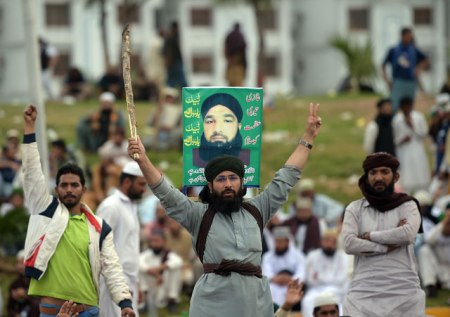 Pakistani supporters of Mumtaz Qadri (Photo: © AAMIR QURESHI/AFP/Getty)
Baltimore-based Imam Ijaz Hussain, stated, “Mumtaz Qadri was not a terrorist and whoever says, “We are with you O Prophet” cannot be a terrorist.”
****************************
A mosque in Maryland held a celebration in honor of an Islamist assassin who killed a governor in Pakistan for speaking about against the country’s heinous blasphemy laws.
As reported by Rabwah Times, the Gulzar E. Madina Mosque in Pikesville, Maryland, hosted an Urs celebration, a traditional commemoration reserved for saints and holy people, for Mumtaz Qadri who killed the governor of Punjab province Salman Taseer in 2011.
Qadri was Taseer’s bodyguard and was incensed that Taseer called for the reform of Pakistan’s controversial blasphemy laws. Taseer had also expressed support for Asia Bibi, a Christian woman framed for blasphemy, arrested and sentenced to death in Pakistan.
Blasphemy laws in Pakistan, which carry the death penalty, are often used to exact revenge against Pakistan’s mistreated minority populations. Often, just the hint of a blasphemy accusation will spark mob violence resulting in death for the person charged.
After Qadri shot Taseer to death, he was lauded as a national hero. More than 100,000 people attended his funeral and riots ensued for weeks after he was arrested, tried and hanged for his crime. He is viewed as a saint by a large sector of the population and a shrine is being built in Pakistan to memorialize him.
The Urs event at the Maryland mosque was advertised in the Urdu Times, the largest Urdu newspaper in the U.S. Rabwah Times reported a robust turnout, with participants including young children and teenagers.
The speakers included Syed Saad Ali, an Islamic scholar based in New Jersey, who chastised the crowd, saying:
“Warrior Mumtaz Qadri kissed the noose in love for Prophet Mohammed When Qadri was in jail for five years. What did we do? What effort did we make (for his release? Why did we not go where he was being held? Qadri did everything for us and for the love of Islam and we could not even stand by him? People say Islam teaches peace…..I say Islam teaches us ghairat (honor). Who will now stand up?”
Ali also praised another killer, Tanveer Ahmad, a British-Pakistani man who stabbed to death Asad Shah, another British-Pakistani in Scotland. Shah, from the Ahmadi sect, made posts on social media that Ahmad deemed blasphemous.
Speaking about Ahmad, Ali said,
“Our warrior Tanveer, who is sitting in a jail in Scotland, I don’t know if someone knows or not, when that Mirzai (Ahmadi) spoke his ‘sacrilegious rubbish,’ he went there and stabbed him 27 times, and the police arrested him and right now he is in a jail in Scotland. So if we just take a step forward, angels will automatically come for our help. But what Mumtaz Qadri has done is something amazing, he has surpassed all these warriors.”
Another speaker, Baltimore-based Imam Ijaz Hussain, stated, “Mumtaz Qadri was not a terrorist and whoever says, “We are with you O Prophet” cannot be a terrorist.”
Hussain praised the American system of free speech, saying it allowed events such as these to be held:
“We have some freedoms here (in the U.S.) which we do not even have in other Muslim countries. This is the beauty of this country. There are some countries where we can’t even praise the prophet, we can’t celebrate the Day of Imam Hussain. This country has freedom of religion, and this is the beauty of this country.”
The Muslim Brotherhood: Wellspring of Terrorism, Gatestone Institute, Judith Bergman, February 15, 2017
The Trump administration is considering designating the Muslim Brotherhood (MB) a foreign terrorist organization, and Human Rights Watch is outraged.
*********************************
The Muslim Brotherhood (MB) in Egypt released an official statement calling on its supporters to “prepare” for “jihad”, in January 2015.
“The Muslim Brotherhood at all levels have repeatedly defended Hamas attacks… including the use of suicide bombers and the killing of civilians.” — UK government expert review of the Muslim Brotherhood, December 2015.
The Muslim Brotherhood not only funds one of the most virulent terrorist groups, Hamas, but there is barely any daylight between the various leaderships of the Muslim Brotherhood in Egypt, Jordan and Hamas.
Most of the terrorists who later founded al Qaeda were rooted in the MB. Osama bin Laden was apparently recruited as a young man to the MB, whereas Ayman al Zawahiri joined the MB at the age of 14 and went on to found the Egyptian Islamic Jihad (EIJ),”an organization that…. holds many of the same beliefs as the MB but simply refuses to renounce violence inside Egypt” — Foundation for Defense of Democracies.
The Muslim Brotherhood believes today what it has always believed: that a caliphate, where sharia law will rule, must be established through jihad. Refusing to designate the Muslim Brotherhood a foreign terrorist organization would be a grave mistake, playing straight into the strategy of the Brotherhood and, once more, revealing to the world the extreme gullibility of the West.
The Trump administration is considering designating the Muslim Brotherhood (MB) a foreign terrorist organization, and Human Rights Watch is outraged.
“Designating the Muslim Brotherhood a ‘foreign terrorist organization’ would wrongly equate it with violent extremist groups like Al-Qaeda and the Islamic State and make their otherwise lawful activities illegal,” said Human Rights Watch. The press release went on to repeat the old claim that “…the Muslim Brotherhood in Egypt officially renounced violence in the 1970s and sought to promote its ideas through social and political activities”.
Adding its voice to the Muslim Brotherhood’s apologists, the New York Times wrote:
“A political and social organization with millions of followers, the Brotherhood officially renounced violence decades ago and won elections in Egypt after the fall of President Hosni Mubarak in 2011. Affiliated groups have joined the political systems in places like Tunisia and Turkey, and President Barack Obama long resisted pressure to declare it a terrorist organization.”
For decades, the Muslim Brotherhood has pushed a specific public narrative, intended exclusively for Western consumption. Just how extremely effective the MB has been was demonstrated in 2011, when then Director of National Intelligence James Clapper, unbelievably, claimed that the MB was “… largely secular… has eschewed violence and has decried Al Qaeda as a perversion of Islam…They have pursued social ends, a betterment of the political order in Egypt…there is no overarching agenda, particularly in pursuit of violence”.
Nothing could be farther from the truth.
The founder of the Muslim Brotherhood, Hassan Al-Banna made jihadist violence a focal point of his movement. He wrote, “Death is art” and “Fighting the unbelievers involves all possible efforts that are necessary to dismantle the power of the enemies of Islam.” The MB inducts members into its deliberatively secretive and opaque network with the pledge that “Jihad is our way” and “Dying in the way of Allah is our highest hope.”
It is, in fact, difficult to overstate the importance of the MB in promoting and spreading jihad in the 20th century and onwards[1]. As the UK government’s expert review of the MB, published in December 2015, concluded:
“[The Muslim Brotherhood’s] public narrative — notably in the West — emphasized engagement not violence. But there have been significant differences between Muslim Brotherhood communications in English and Arabic; there is little evidence that the experience of power in Egypt has caused a rethinking in the Muslim Brotherhood of its ideology or conduct. UK official engagement with the Egyptian Muslim Brotherhood produced no discernible change in their thinking. Indeed even by mid-2014 statements from Egyptian Muslim Brotherhood-linked media platforms seem to have deliberately incited violence”.
The UK review goes on to say:
“The Muslim Brotherhood at all levels have repeatedly defended Hamas attacks against Israel, including the use of suicide bombers and the killing of civilians. The Muslim Brotherhood facilitate funding for Hamas. The leadership of the Egyptian Muslim Brotherhood, its Jordanian counterpart and Hamas are closely connected. There are wider links with Muslim Brotherhood affiliates throughout the region and senior Muslim Brotherhood figures and associates have justified attacks against coalition forces in Iraq and Afghanistan”.
In other words, the Muslim Brotherhood not only funds one of the most virulent terrorist groups, Hamas, but there is barely any daylight between the various leaderships of the Muslim Brotherhood in Egypt, Jordan and Hamas. (According to article two of the Hamas Charter, “The Islamic Resistance Movement [Hamas] is one of the wings of Moslem Brotherhood in Palestine. Moslem Brotherhood Movement is a universal organization which constitutes the largest Islamic movement in modern times”).
The indictment could not be more damning.
Another terrorist group rooted in the Muslim Brotherhood is Egyptian terrorist group Jamaat al-Islamiyya. This group came into existence, conveniently, when it broke away from the Muslim Brotherhood, after the latter denounced the use of violence in the 1970s. Creating a new terrorist organization was a brilliant strategy, which allowed for the Muslim Brotherhood to polish its image as a peaceful organization, leaving the dirty terrorist work to so-called “offshoots” or proxies. Indeed, Jamaat al-Islamiyya used the writings of the Muslim Brotherhood’s chief ideologue, Sayyid Qutb, as an ideological basis. Sheikh Omar Abdel Rahman, who was convicted and jailed in the United States as the perpetrator of the 1993 attack on the World Trade Center, was the spiritual leader of Jamaat al-Islamiyya.
The New York Times itself featured a lengthy article called “The Philosopher of Islamic Terror” about Sayyid Qutb in its magazine in March 2003, stating that he was “…the intellectual hero of every one of the groups that eventually went into Al Qaeda, their Karl Marx… their guide”. Most of the terrorists who later founded al Qaeda were rooted in the Muslim Brotherhood. Osama bin Laden was apparently recruited as a young man to the MB, whereas Ayman al-Zawahiri joined the MB at the age of 14 and went on to found the Egyptian Islamic Jihad, “an organization that holds many of the same beliefs as the MB but simply refuses to renounce violence inside Egypt”, according to The Foundation for Defense of Democracies (FDD). It subsequently merged with bin Laden’s organization. The lead hijacker of 9/11, Mohammed Atta, was also a member of the MB. The list goes on.
 “The objective, then, is to strike terror into the hearts of God’s enemies, who are also the enemies of the advocates of Islam…” — Sayyid Qutb, chief ideologue of the Muslim Brotherhood in the 1950s and 1960s.
In January 2015, the Muslim Brotherhood in Egypt released an official statement calling on its supporters to “prepare” for jihad:
“It is incumbent upon everyone to be aware that we are in the process of a new phase, where we summon what is latent in our strength, where we recall the meanings of jihad and prepare ourselves, our wives, our sons, our daughters, and whoever marched on our path to a long, uncompromising jihad, and during this stage we ask for martyrdom.”
The statement also quotes at length the founder of the Muslim Brotherhood, disproving the claim that the Muslim Brotherhood has broken with its violent past:
“Imam al-Bana prepared the jihad brigades that he sent to Palestine to kill the Zionist usurpers and the second [Supreme] Guide Hassan al-Hudaybi reconstructed the ‘secret apparatus’ to bleed the British occupiers.”
After the official statement was released, Eric Trager, a fellow at the Washington Institute for Near East Policy (WINEP), stated:
“Muslim Brothers have been committing violent acts for a very long time. Under [Egypt’s former president, Mohamed] Morsi, Muslim Brothers tortured protesters outside the presidential palace. After Morsi’s ouster, they have frequently attacked security forces and state property… But until now, the official line from the Brotherhood was to support this implicitly by justifying its causes, without justifying the acts themselves. So the Brotherhood’s open call to jihad doesn’t necessarily mean a tactical shift, but a rhetorical one.”
Terrorism expert and national security reporter Patrick Poole added:
“It [the call for jihad] invokes the Muslim Brotherhood’s terrorist past, specifically mentioning the ‘special apparatus’ that waged terror in the 1940s and 1950s until the Nasser government cracked down on the group, as well as the troops sent by founder Hassan al-Banna to fight against Israel in 1948. It concludes saying that the Brotherhood has entered a new stage, warns of a long jihad ahead, and to prepare for martyrdom… What remains to be seen is how this announcement will be received inside the Beltway, where the vast majority of the ‘experts’ have repeatedly said that the Brotherhood had abandoned its terrorist past, which it is now clearly reviving, and had renounced violence,”
There is nothing peaceful, lawful or democratic about the Muslim Brotherhood. It believes today what it has always believed and openly stated: that a caliphate, where sharia law will rule, must be established through jihad. Refusing to designate the Muslim Brotherhood a foreign terrorist organization would be a grave mistake, playing straight into the strategy of the Brotherhood and, once more, revealing to the world the extreme gullibility of the West and its boundless willingness to believe anything the Muslim Brotherhood throws its way.
________________
[1] As Fereydoun Hoveyda writes in his book, The Broken Crescent: The “Threat” of Militant Islamic Fundamentalism:
“…aspiring terrorists from all over the world poured into Egypt… to learn from al-Banna’s men the art of eliminating the enemies of Islam. While training terrorists and directing murders, Sheikh Hassan denied involvement in the assassinations and attacks, using what Shiite clerics called ketman (holy dissimulation). Indeed, deceiving infidels was admitted by all Muslims, and Shiites even extended the dissimulation to other Muslims when the security of their ’cause’ was at stake”.
Four Muslim Groups Reject US Counter-Terror Funding, Clarion Project, Ryan Mauro, February 13, 2017
(Good! Now perhaps some of the funding will go to anti-Islamist groups, likely to use the money to discourage rather than to encourage radicalization. — DM)
 Four Minnesota youth from the Somali community who were convicted of terrorism-related offenses.
The good news is that there are plenty of non-profits, including Muslim ones with an unequivocal stand against Islamism that deserve the grant money. These organizations generally lack financial support from which to build a network, provide services, etc.
If certain Muslim nonprofits choose to put politics and ego above fighting extremism, then there are plenty of other options for these grants.
***********************************
In a revealing trend, four nonprofits groups involved with the Muslim-American community have rejected federal funding for countering violent extremism. For these groups, their image — as well as making a political point – is a higher priority than fighting radical Islam and helping their communities.
The four Muslim groups had been privileged to receive Homeland Security grants to support their efforts to “counter violent extremism,” a generic and politically-correct term that the Obama Administration used to avoid verbiage related to Islam.
Now, these groups are willing to sacrifice that funding and cut their programs just to stick it to President Trump. Their form of protest is not to use their voices, but to try to show how bad President Trump is by increasing the suffering and danger for their constituents and country more broadly.
An organization for Somali youth in Minnesota named Ka Joog is rejecting $500,000 that was supposed to promote education, prevent radicalization, drug use and other harmful activities. Whether you agree with the premise that radicalization is caused by those problems or not, the fact is that Ka Joog chose to deny help to Somali youth in need.
Apparently unaware of how ridiculous his sentence sounded, executive director Mohamed Farah said the decision was made because President Trump is “promoting a cancerous ideology.” Yes, he actually said he’d decline an opportunity to fight the cancerous ideology of radical Islam because he is offended by the so-called “cancerous ideology” of President Trump.
One local Somali activist with a record of standing against radical Islam, Omar Jamal, said he disagrees with President Trump but “the community desperately needs the money” and it’s better to work with the government as best you can, regardless of politics.
A group in Michigan, Leaders Advancing and Helping Communities, won’t take $500,000 because it believes President Trump’s counter-extremism programs involve spying on Muslims. The group provided no evidence that accepting the money would actually require them to do that.
The organization’s programs involve public health, human services, youth development and education. They will suffer because of a hypothetical requirement that hasn’t happened yet or even been proposed by the Trump Administration.
The third group to join in, Unity Productions Foundation of Virginia, was offered $400,000 to develop films featuring Islamic scholars condemning terrorism and Muslim-Americans contributing to society.
Muslim-American leadership regularly complains that Islamic condemnations of terrorism do not get adequate attention and the public doesn’t seeing how Muslim-Americans are a positive part of the country.
This group was given a whopping $400,000 to do just that—but instead, it is responding to President Trump’s alleged anti-Muslim sentiment by rejecting money from his administration to combat anti-Muslim sentiment.
That makes absolutely no sense.
The Bayan Claremont Islamic school in California is the latest to join the trend, turning down $800,000 that was to be given to “improve interreligious cooperation, civic engagement and social justice.” About $250,000 of that would have been transferred to a dozen other nonprofits doing work for the Muslim-American community.
The school’s faculty includes some controversial Islamic leaders accused of spreading radicalism and ties to the Muslim Brotherhood. The staff includes Imam Suhaib Webb, Omid Safi and Ihsan Bagby.
Its president, Jihad Turk, said it was partially a response to reported plans by the Trump Administration to rename the Countering Violent Extremism programs to a title identifying radical Islam as the focus.
Keep in mind, Trump’s controversial plans—the travel pause (derided as a “Muslim ban”) designed to identify threats of radical Islam—don’t alter these services. These policies do not stop these groups from combating extremism on their own or from providing charity to those in need. You don’t have to agree with your president to help others and work to protect your country to the best of your ability.
By this logic, schools that dislike Education Secretary Betsy DeVos should punish their students by turning away federal funding.
Another element is at play here: Pressure from Islamists and their allies.
Fox News reports that two of the nonprofits “said they were rejecting grants they had already been awarded under the program because of concerns that it could damage their credibility or come with uncomfortable strings attached.”
Such attacks can make the Trump Administration lose Muslim partners, enabling Islamists to rally the community together like a single political party under their helm. An added bonus is that any danger and controversy that arises from the severed relationships can be blamed on Trump’s policies that these Muslim groups sabotaged.
The good news is that there are plenty of non-profits, including Muslim ones with an unequivocal stand against Islamism that deserve the grant money. These organizations generally lack financial support from which to build a network, provide services, etc.
If certain Muslim nonprofits choose to put politics and ego above fighting extremism, then there are plenty of other options for these grants.
On Defining Religion, Gatestone Institute, Nonie Darwish, February 12, 2017
(Please see also, Georgetown Professor Condones Rape And Slavery Under Sharia. Does the First Amendment “free exercise” clause prohibit Federal or state intervention against enforcement of the dictates of Sharia law? If members of a religious cult from Latin America moved to the United States and required families to turn over their young virgin daughters for sacrifice to their Volcano God, would the “free exercise” clause prohibit Federal or state intervention? — DM)
What the West does not understand is that Islam admits that government control is central to Islam and that Muslims must, sooner or later, demand to live under an Islamic government.
The majority of the world does not understand that much of the American media is in a propaganda war against the Trump administration simply because he names Islamic jihad and would prefer to see a strong and prosperous America as a world leader rather than to see a dictatorship — secular or theocratic — as a world leader.
Islam claims to be an Abrahamic religion, but in fact Islam came to the world 600 years after Christ, not to affirm the Bible but to discredit it; not to co-exist with “the people of the book” — Jews and Christians — but to replace them, after accusing them of intentionally falsifying the Bible.
Islam was created as a rebellion against the Bible and its values, and it relies on government enforcement to do so.
Political and legal (sharia) Islam is much more than a religion. Is the First Amendment a suicide pact?
Rep. Keith Ellison (D-Minn.) said that President Donald Trump’s 90-day ban on immigration from seven predominantly Muslim countries is “a religiously based ban,” and “if they can ban Muslims, why can’t they ban Mormons.” This has become the position of the Democratic Party and the mainstream media, which has influenced not only the American public but has convinced the majority of the world that America is “bad.” How can we blame the world, and even a good segment of American citizens, for hating America when such disingenuous and misleading claims are aired to the world from US officials and broadcast by American television channels?
The majority of the world does not understand that much of the American media is in a propaganda war against the Trump Administration simply because he names Islamic jihad and would prefer to see a strong and prosperous America as a world leader, rather than to see a dictatorship — secular or theocratic — as a world leader. He ran as a Republican; meanwhile, Democrats and the mainstream media refuse to engage in respectful and legitimate debate on the most vital threat to Western civilization in the twenty-first century: Islam. Truth has become irrelevant; people seem to prefer a political game of tug-of-war to sway public opinion against the Trump Administration, and, presumably, to elect Democrats forever. That is how the system is set up.
Political discussions on television have become extremely frustrating; they have turned into shouting matches and name-calling at the least informative levels. Television hosts often become instigators and participants in the shouting matches. The thinking is apparently that the louder they get, the more attractive the program will be. Meanwhile everyone is talking at once; the viewer cannot hear anyone, so the program could not be more boring.
Under the US Constitution, freedom of religion is protected. and Islam has been welcomed inside the West on that basis as one of the three Abrahamic religions. According to Western values and the Western understanding of the word, “religion” is supposed to be a personal relationship with God, where free will is of utmost importance; the believer has authority only over himself or herself when it comes to religious laws or punishing sins (such as leaving the religion or committing adultery) — quite different from criminal laws intended to protect society. Western values also allow followers of a religion the freedom to proselytize, but never by resorting to government enforcement.
Bottom line, the Western definition of religion is in harmony with the Biblical values of the human rights to life, liberty and the pursuit of happiness, and that all human beings are created equal under the law. It is considered a basic Western value to view God, family and country as a top priority.
Now let us compare these values to Islamic values:
The tenets above are just a few of the differences in values between Islam, the Bible and the Western concept of religion. What the West does not understand is that Islam admits that government control is central to Islam, and Muslims must demand to live under an Islamic government sooner or later. That might explain the reason for the eternal violence in nearly all Muslim countries, between government being in the hands of a religious theocracy or of the military. Islam, as it is practiced today, has violated all Western definitions of religion and values.
Political and legal (sharia) Islam is much more than a religion. Is the First Amendment a suicide pact?
 (Image source: Brent Payne/Flickr)
What Is the Muslim Brotherhood? Gatestone Institute, Thomas Quiggin, February 8, 2017
Islamists are those who have the desire to “impose any interpretation of Islam over society by law.” A variety of groups ascribe to the Islamist objective of imposing their politicized beliefs on others. Included in these are ISIS, al-Qaeda and Hizb ut-Tahrir. However, the largest and best organized of all the Islamist groups is the Muslim Brotherhood. They are the well-spring from which the Islamist ideology flows.
***************************
A variety of groups ascribe to the Islamist objective of imposing their politicized beliefs on others. Included in these are ISIS, al-Qaeda and Hizb ut-Tahrir. However, the largest and best organized of all the Islamist groups is the Muslim Brotherhood. It is the well-spring from which the Islamist ideology flows.
The founder of the Muslim Brotherhood, Hassan al-Banna, stated that “It is in the nature of Islam to dominate, not to be dominated, to impose its law on all nations and to extend its power to the entire planet.”
A bill, introduced by Senator Ted Cruz, to have the Muslim Brotherhood designated as a terrorist group would have far-reaching impact, and be the single greatest blow stuck against Islamist extremism in the USA.
The Muslim Brotherhood operating in the U.S. made it clear that “their work in America is a kind of grand jihad in eliminating and destroying the Western civilization from within and ‘sabotaging’ its miserable house by their hands and the hands of the believers so that it is eliminated and God’s religion is made victorious over all other religions.”
The North Atlantic Islamic Trust, according to former FBI Agent Robert Stauffer, “served as a financial holding company for Muslim Brotherhood-related groups.” This money was wired into the U.S. from countries such as Saudi Arabia, Kuwait, Afghanistan, Egypt, Malaysia and Libya.
Muslims living in the United States likely have little to fear from the Trump Administration and the 115th Congress. By contrast, Islamists living in the United States have grounds to be worried.
A bill introduced by Senator Ted Cruz to have the Muslim Brotherhood designated as a terrorist group could have far-reaching implications, many of which have received little public attention. The bill, if acted upon, would be the single greatest blow stuck against Islamist extremism in the USA. It would also have far reaching impact in Canada and elsewhere.
Islamists are those who have the desire to “impose any interpretation of Islam over society by law.” A variety of groups ascribe to the Islamist objective of imposing their politicized beliefs on others. Included in these are ISIS, al-Qaeda and Hizb ut-Tahrir. However, the largest and best organized of all the Islamist groups is the Muslim Brotherhood. They are the well-spring from which the Islamist ideology flows. The founder of the Muslim Brotherhood, Hassan al-Banna, stated that “It is in the nature of Islam to dominate, not to be dominated, to impose its law on all nations and to extend its power to the entire planet.”
 The emblem of the Muslim Brotherhood, and its founder, Hassan al-Banna.
The Muslim Brotherhood operating in the United States made it clear that:
“their work in America is a kind of grand jihad in eliminating and destroying the Western civilization from within and ‘sabotaging’ its miserable house by their hands and the hands of the believers so that it is eliminated and God’s religion is made victorious over all other religions.”
The producer of the memorandum from which this statement is derived was Mohamed Akram (A.K.A. Mohammad Akram Al-Adlouni). He is now the Secretary General of al-Quds International, the international think tank of the Muslim Brotherhood.
Today, according to a 2015 report, Mohammed Akram Adlouni is the General Secretary of the Al Quds International Foundation, a Special Designated Global Terrorist entity, accused by the U.S. Treasury Department of financing Hamas. The Treasury Department notes:
“Hamas’s leadership runs all of the foundation’s affairs through Hamas members who serve on the Board of Trustees, the Board of Directors, and other administrative committees. All documents, plans, budgets, and projects of Al-Quds are drafted by Hamas officials. Several senior Hamas officials, including Specially Designated Global Terrorists Musa Abu-Marzuq and Usama Hamdan, served on Al-Quds’ Board of Trustees. Representatives at an Al-Quds conference were told to consider themselves unofficial ambassadors for Hamas in their respective countries.”
The chairman of the board of trustees of the Al Quds International Foundation is identified as Qatar-based Yusuf al-Qaradawi, the spiritual leadership figure of the Muslim Brotherhood. Qaradawi is the subject of an Interpol Red Notice.
Senate Bill S.68, would not only have the effect of designating the Muslim Brotherhood as a terrorist entity, but it would also list three Muslim Brotherhood front groups: The Council for American Islamic Relations (CAIR), the Islamic Society of North America (ISNA) and the North American Islamic Trust (NAIT).
CAIR has already been identified as a Muslim Brotherhood front organization, founded to advance the cause of Hamas, and it was listed as a terrorist entity by the United Arab Emirates in 2014. CAIR functions as the public relations and legal arm of the Muslim Brotherhood and it regularly launches lawsuits against those who speak out against extremist Islam. Its designation as a terrorist group would severely damage the interests of the Muslim Brotherhood and Hamas.
ISNA was the first of the major Muslim Brotherhood groups formed out of the Muslim Student Association (MSA), itself formed by Muslim Brotherhood adherents. Its loss would undermine the Muslim Brotherhood on multiple levels.
The most important issue in Bill S.68 may be the inclusion of the NAIT – the North American Islamic Trust. Formed in 1973, it can fairly described as a waqf, which is the Islamic finance equal to a trust or endowment fund.
The property and cash holdings of the NAIT have never been made completely clear. CAIR itself stated that the NAIT holds the title of some 27% of the 1200 mosques in the USA. The NAIT website states that it “holds the title of approximately 300 properties.” This means that the Muslim Brotherhood controls a large number of mosques and other properties in the U.S. where the message of the Brotherhood is spread.
Former FBI Agent Robert Stauffer led a 1980s investigation into the NAIT, including its role in the ideological takeover of moderate mosques. At that time, he assessed that the ISNA received millions of dollars from the NAIT, which he says “served as a financial holding company for Muslim Brotherhood-related groups.” This money was wired into the U.S. from countries such as Saudi Arabia, Kuwait, Afghanistan, Egypt, Malaysia and Libya.
Like CAIR and ISNA, NAIT would have its assets frozen if it is designated as a terrorist group. This would include property such as real estate, as well as cash and other assets held in bank accounts. The responsibility for this would mainly fall to the Department of the Treasury, the Justice Department and the integrated inter-agency strategy known as National Money Laundering Strategy (NMLS).
In addition to stripping the Muslim Brotherhood of its assets, Bill S.68 would also have the effect of silencing the extremist voice of the Muslim Brotherhood in the U.S., along with its extensive network of collaborators. The financial inflow from other countries would be stopped (think Saudi Arabia, Qatar and Turkey), while funding to Muslim Brotherhood front groups in other countries would be halted as well (think Canada).
This bill would be a most helpful first step in countering what seems to be on the part of many a purposeful global jihad.
Muslim Brotherhood Front Organizations, U.S. and Canada, Gatestone Institute, Thomas Quiggin, January 31, 2017
(Islamophobia alert: As any fool knows, Islam is the religion of peace and all Muslims are peaceful. Besides, brotherhood should be encouraged, not criminalized. –DM)
It appears possible that a Trump Administration will crack down on Islamist extremist groups in the USA. It also appears probable that this will have a spill-over effect into Canada and Europe through greater attention to border security and issues of funding terrorism. These groups, which have already drawn attention to themselves, may start feeling the heat sooner rather than later.
The 2008 Holy Land Relief terrorism funding criminal trial resulted in multiple convictions and was touted as the one of the largest terrorism financing trials in American history. Expectations were high that the 2008 trial would be followed by further trials involving the listed unindicted co-conspirators such as CAIR USA and the Islamic Society of North America.
However, with the appointment of Eric Holder as the U.S. Attorney General in 2009, all further actions on this file appear to have been frozen. Holder would later speak at a conference supporting one of the unindicted co-conspirators.
It is not clear if the ongoing criminal investigation focuses only on those individuals leading IRFAN at the time of its delisting as a charity and listing as a terrorism entity, or if the investigation also includes those who helped found IRFAN. This may be an important distinction, as the Canada Revenue Agency stated that IRFAN was deliberately created and designed to circumvent Canadian terrorism-funding rules.
It appears possible that the Trump Administration will crack down on Islamist extremist groups in the USA. This would likely have a spill-over effect into Canada and Europe, though greater attention to border security and issues of funding terrorism.
U.S. Senator Ted Cruz last week submitted legislation to designated the Muslim Brotherhood as a Terrorist Organization.
Cruz (R-TX) earlier had a bill in the Senate which would not only ban the Muslim Brotherhood in the U.S. but also three of its front groups: Council for American Islamic Relations (CAIR) USA, Islamic Society of North America (ISNA) and the North American Islamic Trust (NAIT). These American-based front groups have corresponding chapters or organizations in Canada as well.
Muslim Brotherhood front organizations and their members have an ongoing problem with criminal activity, terrorism-funding activities and overall negative relations with legal authorities. These problems range from being listed as terrorist groups, being charged for weapons possession and an even an arrest for alleged sexual charges involving a 12-year-old girl. Several of the charges are consistent with the extremist nature of the Muslim Brotherhood itself, given its commitment to violent political change. Both criminal investigations and terrorism listings in North America, for instance, have been directly related to terrorism funding for Hamas, itself a branch of the Muslim Brotherhood.
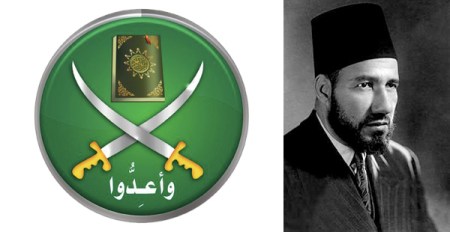 The emblem of the Muslim Brotherhood, and its founder, Hassan al-Banna.
The future is also uncertain for a variety of groups and individuals related to the criminal trials surrounding the Holy Land Foundation for Relief and Development, formerly known as the Occupied Land Fund. The 2008 criminal trial resulted in multiple convictions and was touted as the one of the largest terrorism financing trials in American history. Expectations were high that the 2008 trial would be followed by further trials involving the listed unindicted co-conspirators such as CAIR USA and the Islamic Society of North America. However, with the appointment of Eric Holder as the Attorney General of the United States in 2009, all further actions on this file appear to have been frozen. Holder would later speak at a conference supporting one of the unindicted co-conspirators. It is not yet clear if the next U.S. Attorney General will direct that the files be re-activated.
CAIR USA has been repeatedly identified as a Muslim Brotherhood front organization. It was listed as a Muslim Brotherhood front organization and as a terrorism entity by the United Arab Emirates in 2014. CAIR USA employees and former employees have a rather dubious history of criminal activity. Among those CAIR USA employees charged with criminal offences or deported have been Randall Ismail Royer (weapons and explosive charges), Bassam Khafagi (bank and visa fraud), Ghassan Elashi (terrorism financing of Hamas), and Nabil Sadoun (deported for ties to terrorist groups). Other members and fund-raisers for CAIR USA have also been charged.
In Canada, the Royal Canadian Mounted Police investigation (Project Sapphire) into the International Relief Fund for the Afflicted and Needy (IRFAN) continues. IRFAN was one of four Muslim Brotherhood front groups identified during testimony to the Canadian Senate in 2015. The others were Islamic Relief Canada, the Muslim Association of Canada and the National Council of Canadian Muslims, formerly known as CAIR CAN. CAIR CAN, according to the U.S. State Department and a multiplicity of other sources, is the Canadian chapter of CAIR USA.
IRFAN had its charitable status revoked for funding terrorism in 2011 and was subsequently listed as a terrorism entity by the Government of Canada in 2014. It is not clear if the ongoing criminal investigation focuses only on those individuals leading IRFAN at the time of its delisting as a charity and listing as a terrorism entity, or if the investigation also includes those who helped found IRFAN. This may be an important distinction, as the Canada Revenue Agency stated that IRFAN was deliberately created and designed to circumvent Canadian terrorism-funding rules.
Another of the four front groups, the Muslim Association of Canada (MAC), also made the news in 2015. At that point, it was alleged that IRFAN continued to received funding from the Muslim Association of Canada even after IRFAN had its charitable status revoked for funding terrorism in 2011. This information came from an RCMP search warrant that was used to raid IRFAN premises in Mississauga and Montreal. In addition to funding issues, the MAC and IRFAN are connected to each other through common board members and their association to Hamas. IRFAN was funding Hamas and the MAC is one of only two organizations outside of Egypt that openly states it is a Muslim Brotherhood adherent group.
The Islamic Society of North America (Canadian Chapter) has also had its problems. Along with a variety of internal fraud issues, the ISNA Development Fund had the charitable status of its “Development Fund” revoked for terrorism funding. The terrorism-funding money in question was sent to the Relief Organization for Kashmiri Muslims (ROKM) with the ultimate aim of supporting Jamaat-e-Islami, widely known as the Muslim Brotherhood’s sister group in south Asia.
Another group, the Muslim Student Association (MSA) of the United States and Canada was established in January 1963 by members of the Muslim Brotherhood (MB) at the University of Illinois, Urbana-Champaign campus. Its creation was the result of Saudi-backed efforts to create a network of international Islamic organizations in order to spread its Wahhabist ideology. It was essentially “an arm of the Saudi-funded, Muslim Brotherhood-controlled Muslim World League.”
The following individuals have all been identified as members of the MSA at a variety universities in Canada. They have all been either charged with terrorism offences or died as suicide bombers at the behest of ISIS:
In December 2012, Chiheb Battikh of Montreal attempted to kidnap the son of a billionaire and hold him for ransom. The Tunisian-Canadian was identified by the Tunis Tribune as being “close to Ennahda” or the Muslim Brotherhood. The French language Journal de Montréal did a five-page story on him following his conviction. Among the issues raised by the paper was Battikh’s long time position on the board of directors for the Muslim Association of Canada as well as his position as the director of education for them. The issue of whether the kidnapping was intended to help fund the new Canadian Institute of Islamic Civilization was raised as well. Battikh had been in charge of that fundraising effort and the project had been in trouble.
Some of President-elect Donald J. Trump’s advisors have strong views on the Muslim Brotherhood. Included among these are Walid Phares, who favors banning the Muslim Brotherhood in the U.S. Other advisors include Frank Gaffney, and Pieter “Pete” Hoekstra, both of whom are well acquainted with Muslim Brotherhood activities
A variety of Muslim Brotherhood front groups have drawn attention to themselves through terrorism funding and other forms of alleged criminal behavior. CAIR USA (and others) have also been involved in lawfare — suing critics to silence them. Altogether, this activity and their own allegedly criminal actions have drawn greater attention to them and increased, rather than decreased, the amount of research done on them. With the rising, often Islamist-inspired, violence in Europe, the Middle East and South East Asia, more attention will be drawn to the sources of the extremism that are producing and funding terrorism.
It appears possible that a Trump Administration will crack down on Islamist extremist groups in the USA. It also appears probable that this will have a spill-over effect into Canada and Europe though greater attention to border security and issues of funding terrorism. These groups, which have already drawn attention to themselves, may start feeling the heat sooner rather than later.
Smoking Out Islamists via Extreme Vetting, Middle East Forum, Daniel Pipes, January 28, 2017(?)
(Please see also, A Muslim Reformer Speaks Out About His Battle Against Islamism And PC. — DM)
On January 27, President Donald Trump signed an executive order to implement his proposed “extreme vetting” of those applying for entry visas into the United States. This article by Middle East Forum President Daniel Pipes, who has written extensively on the practicality and enforceability of screening for Islamists, is an advance release from the forthcoming Spring 2017 issue of Middle East Quarterly.
 Smoking Them Out (1906), Charles M. Russell.
Donald Trump issued an executive order on Jan. 27 establishing radically new procedures to deal with foreigners who apply to enter the United States.
Building on his earlier notion of “extreme vetting,” the order explains that
to protect Americans, the United States must ensure that those admitted to this country do not bear hostile attitudes toward it and its founding principles. The United States cannot, and should not, admit those who do not support the Constitution, or those who would place violent ideologies over American law. In addition, the United States should not admit those who engage in acts of bigotry or hatred (including “honor” killings, other forms of violence against women, or the persecution of those who practice religions different from their own) or those who would oppress Americans of any race, gender, or sexual orientation.
This passage raises several questions of translating extreme vetting in practice: How does one distinguish foreigners who “do not bear hostile attitudes toward it and its founding principles” from those who do? How do government officials figure out “those who would place violent ideologies over American law”? More specifically, given that the new procedures almost exclusively concern the fear of allowing more Islamists into the country, how does one identify them?
I shall argue these are doable tasks and the executive order provides the basis to achieve them. At the same time, they are expensive and time-consuming, demanding great skill. Keeping out Islamists can be done, but not easily.
By Islamists (as opposed to moderate Muslims), I mean those approximately 10-15 percent of Muslims who seek to apply Islamic law (the Shari’a) in its entirety. They want to implement a medieval code that calls (among much else) for restricting women, subjugating non-Muslims, violent jihad, and establishing a caliphate to rule the world.
For many non-Muslims, the rise of Islamism over the past forty years has made Islam synonymous with extremism, turmoil, aggression, and violence. But Islamists, not all Muslims, are the problem; they, not all Muslims, must urgently be excluded from the United States and other Western countries. Not just that, but anti-Islamist Muslims are the key to ending the Islamist surge, as they alone can offer a humane and modern alternative to Islamist obscurantism.
Identifying Islamists is no easy matter, however, as no simple litmus test exists. Clothing can be misleading, as some women wearing hijabs are anti-Islamists, while practicing Muslims can be Zionists; nor does one’s occupation indicate much, as some high-tech engineers are violent Islamists. Likewise, beards, teetotalism, five-times-a-day prayers, and polygyny do not tell about a Muslim’s political outlook. To make matters more confusing, Islamists often dissimulate and pretend to be moderates, while some believers change their views over time.
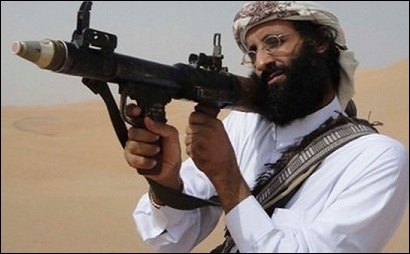 In 2001, the Pentagon invited Anwar al-Awlaki to lunch. In 2011, it killed him by a drone strike.
Finally, shades of gray further confuse the issue. As noted by Robert Satloff of The Washington Institute, a 2007 book from the Gallup press, Who Speaks for Islam? What a Billion Muslims Really Think, based on a poll of over 50,000 Muslims in 10 countries, found that 7 percent of Muslims deem the 9/11 attacks “completely justified,” 13.5 percent consider the attacks completely or “largely justified,” and 36.6 percent consider the attacks completely, largely, or “somewhat justified.” Which of these groups does one define as Islamist and which not?
Faced with these intellectual challenges, American bureaucrats are unsurprisingly incompetent, as I demonstrate in a long blog titled “The U.S. Government’s Poor Record on Islamists.” Islamists have fooled the White House, the departments of Defense, Justice, State, and Treasury, the Congress, many law enforcement agencies and a plethora of municipalities. A few examples:
Fake-moderates have fooled even me, despite all the attention I devote to this topic. In 2000, I praised a book by Tariq Ramadan; four years later, I argued for his exclusion from the United States. In 2003, I condemned a Republican operative named Kamal Nawash; two years later, I endorsed him. Did they evolve or did my understanding of them change? More than a decade later, I am still unsure.
Returning to immigration, this state of confusion points to the need for learning much more about would-be visitors and immigrants. Fortunately, Trump’s executive order, “Protecting the Nation from Foreign Terrorist Entry into the United States,” signed on Jan. 27, 2017, requires just this. It calls for “Uniform Screening Standards” with the goal of preventing individuals from entering the United States “on a fraudulent basis with the intent to cause harm, or who are at risk of causing harm subsequent to their admission.” The order requires that the uniform screening standard and procedure include such elements as (bolding is mine):
Elements 1, 3, 5, and 6 permit and demand the procedure outlined in the following analysis. It contains two main components, in-depth research and intensive interviews.
When a person applies for a security clearance, the background checks should involve finding out about his family, friends, associations, employment, memberships, and activities. Agents must probe these for questionable statements, relationships, and actions, as well as anomalies and gaps. When they find something dubious, they must look further into it, always with an eye for trouble. Is access to government secrets more important than access to the country? The immigration process should start with an inquiry into the prospective immigrant and, just as with security clearances, the border services should look for problems.
 Most everyone with strong views at some point vents them on social media.
Also, as with security clearance, this process should have a political dimension: Does the person in question have an outlook consistent with that of the Constitution? Not long ago, only public figures such as intellectuals, activists, and religious figures put their views on the record; but now, thanks to the Internet and its open invitation to everyone to comment in writing or on video in a permanent, public manner, and especially to social media (Facebook, Twitter, etc.), most everyone with strong views at some point vents them. Such data provides valuably unfiltered views on many critical topics, such as Islam, non-Muslims, women, and violence as a tactic. (Exploiting this resource may seem self-evident but U.S. immigration authorities do not do so, thereby imposing a self-restraint roughly equivalent to the Belgian police choosing not to conduct raids between 9 p.m. and 5 a.m.)
In the case of virulent, overt, outspoken jihadis, this research usually suffices to provide evidence to exclude them. Even some non-violent Islamists proudly announce their immoderation. But many Islamists adopt a milder and subtler tone, their goal being to appear moderate so they can enter the country and then impose Shari’a through lawful means. As suggested by some of the examples above, such as Abou El Fadl or CAIR, research often proves inadequate in these instances because cautious Islamists hide their goals and glibly dissimulate. Which brings us to entrance interviews.
Assuming that lawful Islamists routinely hide their true views, an interview is needed before letting them enter the country. Of course, it is voluntary, for no one is forced to apply for immigration, but it also must be very thorough. It should be:
Recorded: With the explicit permission of the person being questioned (“You understand and accept that this interview is being recorded, right?”), the exchange should be visibly videotaped so the proceedings are unambiguously on the record. This makes available the interviewee’s words, tone, speech patterns, facial expressions, and body language for further study. Form as well as substance matters: does the interviewee smile, fidget, blink, make eye contact, repeat, sweat, tremble, tire, need frequent toilet breaks, or otherwise express himself in non-verbal ways?
Polygraph: Even if a lie detector machine does not, in fact, provide useful information, attaching the interviewee to it might induce greater truth-telling.
Under oath: Knowing that falsehoods will be punished, possibly with jail time, is a strong inducement to come clean.
Public: If the candidate knows that his answers to abstract questions (as opposed to personal ones about his life) will be made public, this reduces the chances of deception. For example, asked about belief for the full application of Islamic laws, an Islamist will be less likely to answer falsely in the negative if he knows that his reply will be available for others to watch.
 Look for inconsistency by asking the same thing in different ways. An example: “May a woman show her face in public?” and “Is a male guardian responsible for making sure his women-folk don’t leave the house with faces uncovered?
Multiple: No single question can evince a reply that establishes an Islamist disposition; effective interviewing requires a battery of queries on many topics, from homosexuality to the caliphate. The answers need to be assessed in their totality.
Specific: Vague inquiries along the lines of “Is Islam a religion of peace?”, “Do you condemn terrorism?” “How do you respond to the murder of innocents,” depend too much on one’s definition of words such as peace, terrorism, and innocents to help determine a person’s outlook, and so should be avoided. Instead, questions must be focused and exact: “May Muslims convert out of Islam, whether to join another faith or to become atheists?” “Does a Muslim have the right to renounce Islam?”
Variety in phrasing: For the questions to ferret out the truth means looking for divergence and inconsistency by asking the same question with different words and variant emphases. A sampling: “May a woman show her face in public?” “What punishment do you favor for females who reveal their faces to men not related to them by family?” “Is it the responsibility of the male guardian to make sure his women-folk do not leave the house with faces uncovered?” “Should the government insist on women covering their faces?” “Is society better ordered when women cover their faces?” Any one of the questions can be asked in different ways and expanded with follows-up about the respondent’s line of reasoning or depth of feeling.
Repeated: Questions should be asked again and again over a period of weeks, months, and even longer. This is crucial: lies being much more difficult to remember than truths, the chances of a respondent changing his answers increases with both the volume of questions asked and the time lapse between questionings. Once inconsistencies occur, the questioner can zero in and explore their nature, extent, and import.
Guidelines in place, what specific questions might extract useful information?
 Zuhdi Jasser (L) with the author as teammates at a 2012 Intelligence Squared debate in New York City.
The following questions, offered as suggestions to build on, are those of this author but also derive from a number of analysts devoting years of thinking to the topic. Naser Khader, the-then Danish parliamentarian of Syrian Muslim origins, offered an early set of questions in 2002. A year later, this author published a list covering seven subject areas.
Others followed, including the liberal Egyptian Muslim Tarek Heggy, the liberal American Muslims Tashbih Sayyed and Zuhdi Jasser, the ex-Muslim who goes by “Sam Solomon,” a RAND Corporation group, and the analyst Robert Spencer. Of special interest are the queries posed by the German state of Baden-Württemberg dated September 2005 because it is an official document (intended for citizenship, not immigration, but with similar purposes).
Islamic doctrine:
1. May Muslims reinterpret the Koran in light of changes in modern times?
2. May Muslims convert out of Islam, either to join another faith or to be without religion?
3. May banks charge reasonable interest (say 3 percent over inflation) on money?
4. Is taqiya (dissimulation in the name of Islam) legitimate?
Islamic pluralism:
5. May Muslims pick and choose which Islamic regulations to abide by (e.g., drink alcohol but avoid pork)?
6. Is takfir (declaring a Muslim to be an infidel) acceptable?
7. [Asked of Sunnis only:] Are Sufis, Ibadis, and Shi’ites Muslims?
8. Are Muslims who disagree with your practice of Islam infidels (kuffar)?
The state and Islam:
9. What do you think of disestablishing religion, that is, separating mosque and state?
10. When Islamic customs conflict with secular laws (e.g., covering the face for female drivers’ license pictures), which gets priority?
11. Should the state compel prayer?
12. Should the state ban food consumption during Ramadan and penalize transgressors?
13. Should the state punish Muslims who eat pork, drink alcohol, and gamble?
14. Should the state punish adultery?
15. How about homosexuality?
16. Do you favor a mutawwa’ (religious police) as exist in Saudi Arabia?
17. Should the state enforce the criminal punishments of the Shari’a?
18. Should the state be lenient when someone is killed for the sake of family honor?
19. Should governments forbid Muslims from leaving Islam?
Marriage and divorce:
20. Does a husband have the right to hit his wife if she is disobedient?
21. Is it a good idea for men to shut their wives and daughters at home?
22. Do parents have the right to determine whom their children marry?
23. How would you react if a daughter married a non-Muslim man?
24. Is polygyny acceptable?
25. Should a husband have to get a first wife’s approval to marry a second wife? A third? A fourth?
26. Should a wife have equal rights with her husband to initiate a divorce?
27. In the case of divorce, does a wife have rights to child custody?
Female rights:
28. Should Muslim women have equal rights with men (for example, in inheritance shares or court testimony)?
29. Does a woman have the right to dress as she pleases, including showing her hair, arms and legs, so long as her genitalia and breasts are covered?
30. May Muslim women come and go or travel as they please?
31. Do Muslim women have a right to work outside the home or must the wali approve of this??
32. May Muslim women marry non-Muslim men?
33. Should males and females be separated in schools, at work, and socially?
34. Should certain professions be reserved for men or women only? If so, which ones?
35. Do you accept women occupying high governmental offices?
36. In an emergency, would you let yourself be treated by or operated on by a doctor of the opposite gender?
Sexual activity:
37. Does a husband have the right to force his wife to have sex?
38. Is female circumcision part of the Islamic religion?
39. Is stoning a justified punishment for adultery?
40. Do members of a family have the right to kill a woman if they believe she has dishonored them?
41. How would you respond to a child of yours who declares him- or herself a homosexual?
Schools:
42. Should your child learn the history of non-Muslims?
43. Should students be taught that Shari’a is a personal code or that governmental law must be based on it?
44. May your daughter take part in the sports activities, especially swimming lessons, offered by her school?
45. Would you permit your child to take part in school trips, including overnight ones?
46. What would you do if a daughter insisted on going to university?
Criticism of Muslims:
 Denying the Islamic nature of ISIS reveals much about a Muslim.
47. Did Islam spread only through peaceful means?
48. Do you accept the legitimacy of scholarly inquiry into the origins of Islam, even if it casts doubt on the received history?
49. Do you accept that Muslims were responsible for the 9/11 attacks?
50. Is the Islamic State/ISIS/ISIL/Daesh Islamic in nature?
Fighting Islamism:
51. Do you accept enhanced security measures to fight Islamism, even if this might mean extra scrutiny of yourself (for example, at airline security)?
52. When institutions credibly accused of funding jihad are shut down, is this a symptom of anti-Muslim bias?
53. Should Muslims living in the West cooperate with law enforcement?
54. Should they join the military?
55. Is the “war on terror” a war on Islam?
Non-Muslims (in general):
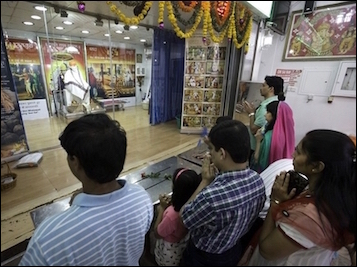 Praying at the Hindu Temple in Dubai, founded 1958.
56. Do all humans, regardless of gender, ethnicity, sexual orientation or religious beliefs, deserve equal rights?
57. Should non-Muslims enjoy completely equal civil rights with Muslims?
58. Do you accept the validity of other monotheistic religions?
59. Of polytheistic religions (such as Hinduism)?
60. Are Muslims superior to non-Muslims?
61. Should non-Muslims be subject to Islamic law?
62. Do Muslims have anything to learn from non-Muslims?
63. Can non-Muslims go to paradise?
64. Do you welcome non-Muslims to your house and go to their residences?
Non-Muslims (in Dar al-Islam):
65. May Muslims compel “Peoples of the Book” (i.e., Jews and Christians) to pay extra taxes?
66. May other monotheists build and operate institutions of their faith in Muslim-majority countries?
67. How about polytheists?
68. Should the Saudi government maintain the historic ban on non-Muslims in Mecca and Medina?
69. Should it allow churches to be built for Christian expatriates?
70. Should it stop requiring that all its subjects be Muslim?
Non-Muslims (in Dar al-Harb):
71. Should Muslims fight Jews and Christians until these “feel themselves subdued” (Koran 9:29).
72. Is the enslavement of non-Muslims acceptable?
73. Is it acceptable to arrest individuals who curse the prophet of Islam or burn the Koran?
74. If the state does not act against such deeds, may individual Muslims act?
75. Can one live a fully Muslim life in a country with a mostly non-Muslim government?
76. Should a Muslim accept a legitimate majority non-Muslim government and its laws or work to make Islam supreme?
77. Can a majority non-Muslim government unreservedly win your allegiance?
78. Should Muslims who burn churches or vandalize synagogues be punished?
79. Do you support jihad to spread Islam?
Violence:
80. Do you endorse corporal punishments (mutilation, dismemberment, crucifixion) of criminals?
81. Is beheading an acceptable form of punishment?
82. Is jihad, meaning warfare to expand Muslim rule, acceptable in today’s world?
83. What does it mean when Muslims yell “Allahu Akbar” as they attack?
84. Do you condemn violent organizations such as Boko Haram, Hamas, Hezbollah, Islamic Jihad, the Islamic State, Al-Qaeda, Shabaab, and the Taliban?
Western countries:
85. Are non-Islamic institutions immoral and decadent or can they be moral and virtuous?
86. Do you agree with studies that show non-Muslim countries such as New Zealand to be better living up to the ideals of Islam than Muslim-majority countries?
87. Is Western-style freedom an accomplishment or a form of moral corruption? Why?
88. Do you accept that Western countries are majority-Christian or do you seek to transform them into majority-Muslim countries?
89. Do you accept living in Western countries that are secular or do you seek to have Islamic law rule them?
90. What do you think of Shari’a-police patrolling Muslim-majority neighborhoods in Western countries to enforce Islamic morals?
91. Would you like to see the U.S. Constitution (or its equivalents in other countries) replaced by the Koran?
This interview:
92. In an immigration interview like this, if deceiving the questioner helps Islam, would lying be justified?
93. Why should I trust that you have answered these questions truthfully?
Beyond helping to decide whom to allow into the country, these questions can also help in other contexts as well, for example in police interrogations or interviews for sensitive employment positions. (The list of Islamists who have penetrated Western security services is a long and painful one.)
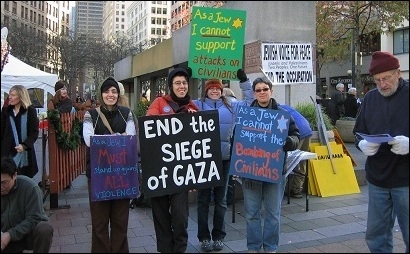 Islamists are hardly the only ones who condemn Israel. Here Jewish Voice for Peace activists protest.
Note the absence of questions about highly charged current issues. That is because Islamist views overlap with non-Islamist outlooks; plenty of non-Islamists agree with Islamists on these topics. Although Leil Leibowitz in contrast sees Israel as “moderate Islam’s real litmus test,” Islamists are hardly the only ones who demand Israel’s elimination and accept Hamas and Hezbollah as legitimate political actors – or believe the Bush administration carried out the 9/11 attacks or hate the United States. Why introduce these ambiguous issues when so many Islam-specific questions (e.g., “Is the enslavement of non-Muslim acceptable?”) have the virtue of far greater clarity?
The interviewing protocol outlined above is extensive, asking many specific questions over a substantial period using different formulations, probing for truth and inconsistencies. It is not quick, easy, or cheap, but requires case officers knowledgeable about the persons being interviewed, the societies they come from, and the Islamic religion; they are somewhat like a police questioner who knows both the accused person and the crime. This is not a casual process. There are no shortcuts.
This procedure raises two criticisms: it is less reliable than Trump’s no-Muslim policy and it is too burdensome for governments to undertake. Both are readily disposed of.
Less reliable: The no-Muslim policy sounds simple to implement but figuring out who is Muslim is a problem in itself (are Ahmadis Muslims?). Further, with such a policy in place, what will stop Muslims from pretending to renounce their religion or to convert to another religion, notably Christianity? These actions would require the same in-depth research and intensive interviews as described above. If anything, because a convert can hide behind his ignorance of his alleged new religion, distinguishing a real convert to Christianity from a fake one is even more difficult than differentiating an Islamist from a moderate Muslim.
Too burdensome: True, the procedure is expensive, slow, and requires skilled practitioners. But this also has the benefit of slowing a process that many, myself included, consider out of control, with too many immigrants entering the country too quickly. Immigrants numbered 5 percent of the population in 1965, 14 percent in 2015, and are projected to make up 18 percent in 2065. This is far too large a number to assimilate into the values of the United States, especially when so many come from outside the West; the above mechanism offers a way to slow it down.
As for those who argue that this sort of inquiry and screening for visa purposes is unlawful; prior legislation for naturalization, for example, required that an applicant be “attached to the principles of the Constitution” and it was repeatedly found to be legal.
Finally, today’s moderate Muslim could become tomorrow’s raging Islamist; or his infant daughter might two decades later become a jihadi. While any immigrant can turn hostile, such changes happen far more often among born Muslims. There is no way to guarantee this from happening but extensive research and interrogations reduce the odds.
Truly to protect the country from Islamists requires a major commitment of talent, resources, and time. But, properly handled, these questions offer a mechanism to separate enemy from friend among Muslims. They also have the benefit of slowing down immigration. Even before Trump became president, if one is to believe CAIR, the U.S. Customs and Border Protection Agency (CBP) asked questions along the lines of those advocated here (What do you think of the USA? What are your views about jihad? See the appendix for a full listing). With Trump’s endorsement, let us hope this effective “no-Islamists” policy is on its way to becoming systematic.
On January 18, 2017, just hours before Donald Trump became president of the United States, the Florida office of the Council on American-Islamic Relations (CAIR) filed ten complaints with the Customs and Border Protection Agency (CBP) for questioning Muslim citizens about their religious and political views. Among the questions allegedly asked were:
1. Are you a devout Muslim?
2. Are you Sunni or Shia?
3. What school of thought do you follow?
4. Which Muslim scholars do you follow?
5. What current Muslim scholars do you listen to?
6. Do you pray five times a day?
7. Why do you have a prayer mat in your luggage?
8. Why do you have a Qur’an in your luggage?
9. Have you visited Saudi Arabia?
10. Will you every visit Saudi or Israel?
11. What do you know about the Tableeghi-Jamat?
12. What do you think of the USA?
13. What are your views about Jihad?
14. What mosque do you attend?
15. Do any individuals in your mosque have any extreme/radical views?
16. Does your Imam express extremist views?
17. What are the views of other imams or other community members that give the Friday sermon at your mosque?
18. Do they have extremist views?
19. Have you ever delivered the Friday Prayer? What did you discuss with your community?
20. What are your views regarding [various terrorist organizations]?
21. What social media accounts do you use?
22. What is your Facebook account username?
23. What is your Twitter account username?
24. What is your Instagram account username?
25. What are the names and telephone numbers of parents, relatives, friends?
CAIR also claims a Canadian Muslim was asked by CBP the following questions and then denied entry:
1. Are you Sunni or Shia?
2. Do you think we should allow someone like you to enter our country?
3. How often do you pray?
4. Why did you shave your beard?
5. Which school of thought do you follow?
6. What do you think of America’s foreign policy towards the Muslim world?
7. What do you think of killing non-Muslims?
8. What do you think of [various terrorist groups]?
Finally, CAIR indicates that those questioned “were held between 2 to 8 hours by CBP.”
A Muslim Reformer Speaks Out About His Battle Against Islamism And PC, The Federalist, Steve Postal, January 30, 2017
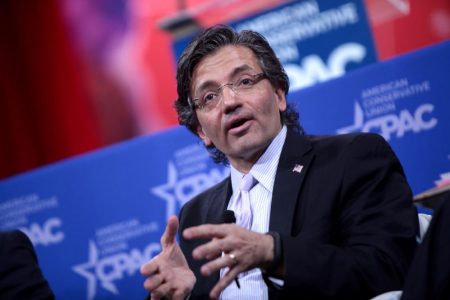
Dr. M. Zuhdi Jasser stands at the forefront of the Muslim Reform Movement (MRM), which celebrated its first anniversary on December 4, 2016. He and representatives from fourteen other Muslim reform groups formed the MRM, which held its inaugural press conference on December 5, 2015.
There, they announced their two-page declaration of principles that discusses counterterrorism, human rights, and secular governance. In a nod to Martin Luther nailing his 99 theses to the door of the All Saint’s Church in Wittenberg, Germany in 1517, several MRM members then taped their principles to the door of the Islamic Center of Washington DC.
The following is an interview with Dr. M. Zuhdi Jasser, CEO of the American Islamic Forum for Democracy (AIFD) and co-founder of the MRM. Jasser is a physician and former U.S. Navy officer whose parents fled Syria. Jasser agreed to reflect on the MRM’s one-year anniversary, the current battle between reformists and Islamists, and the Syrian Civil War.
Q (Postal): What is the MRM, and what are its main objectives?
A (Jasser): The Muslim Reform Movement is a coalition of diverse Muslim organizations and leaders. We wanted to articulate the versions of Islam that we knew and loved, and that were compatible with modernity. We determined that the clearest way to define ourselves was to create a simple “declaration” of principles and goals. The declaration is a firewall of principles that we as Westerners and “modern Muslims” who believe in freedom, liberty, and universal human rights would not compromise.
Whether it is the rejection of any Islamic state and its identity, any caliphate (a global unification of many Islamic states), or the institutionalization of sharia (Islamic jurisprudence as interpreted by Islamic jurists), our Muslim Reform Movement felt that the only way to truly counter-radicalize Muslims is through an unapologetic defense of the Universal Declaration of Human Rights (UDHR) and modern society. Our principles stand in stark contrast to the Cairo Declaration of Human Rights (of 1991) which was based in the interpretations of sharia of the Organization of Islamic Cooperation (OIC).
Q: What events spurred the creation of the MRM?
A: While each of us began separate journeys against Islamism after 9/11 (and some even before), it was the Arab Awakening that brought us all together. So-called “secular” military dictatorships across the Muslim majority world have been profoundly suffocating critical inquiry. (I say “so-called” because these dictatorships essentially govern with sharia.)
I would, for example, put Egypt, Jordan, Qatar, Saudi Arabia, and Syria in this category, though Turkey is a waning democracy cum Islamist dictatorship and Iran is an outright theocracy. Muslims cannot reform their interpretations of Islam under the boots of regimes that manifest interpretations of Islam through blasphemy, apostasy, and treason laws.
The Arab Awakening signaled to Muslims across the world that there was an opportunity for renewed critical thought by the people against the religious establishment and its tyrannical regimes. Unfortunately, since 2011, and perhaps even in the last 1,000 years, the Islamists were far better funded and organized. These opportunities gave way to large-scale violence, war, and chaos rather than heralding reform and modern institutions. Tunisia is thus far perhaps the one exception.
We reformists observed the rise of radical Islam’s attacks against the West since 9/11, and realized that we have a responsibility as Americans, patriotic Westerners, free thinkers, Muslims, and parents to counter and defeat the ideological underpinnings of Islamism.
Q: What accomplishments of the MRM have you seen in the past year? What are its goals?
A: Our greatest accomplishment to date is our declaration. While we are disappointed in the relative silence from most Muslim leaders, we recognize that their avoidance and inability to critique it has also demonstrated that it is on target. Our declaration has also withstood scrutiny from those who have been skeptical of the capacity of Muslims to have modern interpretations of Islam.
Given that we seek to counter a global theo-political establishment, our growth has certainly not been as rapid as we would like, but we are proud of how far we have come in a year.
Our successes as a coalition are highlighted by the successes of each of our respective organizations and leaders. I encourage readers of this interview to look into the works of each of these leaders, and help them make them known. Raheel Raza, Sohail Raza, and Hasan Mahmud with Muslims Facing Tomorrow in Toronto; Imam Usama Hasan with Quilliam Foundation in London; Asra Nomani, journalist and author; Farahnaz Ispahani, former member of Pakistan’s parliament, in Washington DC; Naser Khader in Denmark; myself, Courtney Lonergan, and Arif Humayun with our AIFD in Phoenix; Salma Siddiqui with the Coalition of Progressive Canadian Muslim Organizations in Canada; Tahir Gora, author, journalist, activist, in Toronto, Canada; Tawfik Hamid, Islamic thinker and reformer, Oakton, Virginia, to name a few, have all continued to grow in their programmatic reach.
We had our second annual retreat in Phoenix in October 2016 and expanded our strategic plan for the next few years. In 2017, we hope to see government, academia, media, and the interfaith establishment begin to give reformist Muslims from the MRM an equal seat at the table of any public conversations regarding Muslims and Islam.
On the government front, domestic and foreign policies should be directed by a “liberty doctrine” which engages Muslims positively on the principles embodied in our declaration and refutes those who reject any part or all of the declaration. Homeland security and foreign policy needs to focus more on “countering violent Islamism” rather than the nebulous “countering violent extremism.”
Q: In the MRM’s inaugural press conference, you said American mosques that reject the MRM’s declaration of principles are part of the problem, while those that accept the principles are part of the solution. How many mosques did the MRM approach? Did most of these mosques accept or reject these principles?
A: We spent significant resources on this outreach over a period of ten months. We reached out through snail mail, e-mail, and telephone to over 3,000 mosques and over 500 known public American Muslims. We received only 40-plus rather dismissive responses from our outreach, and sadly less than ten of them were positive. In fact, one mosque in South Carolina left us a vicious voice mail threatening our staff if we contacted them again.
We will continue to persevere with our outreach. On the one hand, we see the open hypocrisy of American Islamist groups effectively working together to sign documents, such as the recent “Open Letter to Donald Trump.” But to get their attention as reformists against Islamism, we face an uphill battle. If it’s grievances against Americans, people quickly sign on to almost anything. But getting people to sign on to an internal honest declaration of reform is like pulling teeth.
I can guess why we had shortcomings in outreach. If we had more funding, we could study this more scientifically. “Muslim” and “Islamic” institutions are often Islamist and thus unlikely to sign on to our declaration. Some estimate that 70-80 percent of Muslim organizations and mosques in the U.S. are die-hard Islamist. However, this needs to be put into an appropriate context. American Muslims, especially Sunni, are not tied to any clergy or organized “mosque” for faith practice or membership so the majority (60-70 percent) of American Muslims do not regularly participate in mosques or established Muslim institutions.
No one knows truly how that majority of Muslims feels about Islamist ideologies. National security is in desperate need of helping us study that. Our MRM is dedicated to creating new Western Muslim institutions outside the mosques and outside the “establishment” Islamist leadership to appeal to Muslims estranged from Islamist political tribalism. We have not been able to effectively reach out to the majority of Muslims because of resources and the absence of effective platforms.
Q: What are the key differences between Muslim reformers and Muslim Islamists?
A: Reformers reject any Islamic state and its legal apparatus empowered through sharia. Reformers believe that individual Muslims have a right to publicly criticize Muslim thought leaders and their legal interpretations. Islamists believe that democracy is majoritocracy and thus in countries where Muslims are a majority, the national identity should be “Islamic” or “Muslim” and sharia should govern the legal system. Islamists believe that the rights of all citizens come from Islam and the state’s legal system and public discourse should be based upon Islamic precepts and exegesis. They view the mosque and its pulpit as the center of that political movement.
Reformers, however, believe that the rights of all citizens come from God and thus all citizens, Muslim and non-Muslim, are created equal and the legal system and public discourse should be based in reason. Reformers believe rights belong to human beings, not to ideas, while Islamists believe that the legal system should protect certain ideas (like Islam) from public defamation. Islamists believe in some form of a theo-political system domestically, and ultimately globally in some form of caliphate. Reformers believe in secular governance, and reject any and all forms of the Islamic state and the global caliphate.
We at AIFD are currently working on a formal response to the “Letter to Baghdadi” signed by Western Islamists. While it admonishes the head of ISIS, Sheikh Abu Bakr Al-Baghdadi for illegitimacy in declaring jihad, establishing an Islamic state and a caliphate among other interpretations of Islamic law by al-Baghdadi, it is also a full-throated defense of an Islamic state, a caliphate, armed jihad, and other Islamist fundamentals that stand in stark contrast to Western secular liberal ideals and universal human rights.
Q: Do you believe the MRM is seeking to reform Islam itself, or Muslim interpretation of Islam? Does such reform require a change in the way Muslims interpret doctrine, or does it require Muslims to adopt humanist values apart from Islam?
A: Your question is the very reason we called this movement the Muslim Reform Movement rather than Islamic reform. If you define Islam as Wahhabi Islam or Salafi Islam, then yes we are reforming that. However if you define Islam as the Islam of the God of Abraham then we believe we are simply modernizing the interpretation to one commensurate with twenty-first century universal principles of human rights.
We understand that many may feel that Islam at its core or at its founding was problematic. But what should matter to the free world is not the origins of Islam but how Muslims are interpreting Islam in the twenty-first century.
We reformists are Muslims who are reforming the interpretation of Islam away from an Islam tied to the political construct of an Islamic state and sharia. Like the Founding Fathers of America, who sought to render unto Caesar what is Caesar’s and unto God what is God’s by preventing the establishment of religion by government, we too seek to interpret Islam in a way that separates mosque and state. Just as Muslims can embrace medical, natural, and computer science, we can embrace political science beyond the constructs of the seventh century.
Q: In the last 30 years, Saudi Arabia has spent more than an estimated $100 billion to fund the spread of Wahhabism worldwide (in contrast to the $7 billion the USSR spent spreading communism from 1921 through 1991). How does the MRM hope to compete with these vast Saudi expenditures?
A: That’s the elephant in the room. The West needs a major information program to advance ideas of liberty. The hope is that the free world will take the side of liberty, and theocracies and quasi-theocracies will fall.
Q: You and other members of the MRM have criticized the Council on American-Islamic Relations (CAIR) in the past. CAIR’s vision, mission, and core principles at first glance appear to be liberal and tolerant. What are the MRM’s concerns with CAIR?
A: The MRM believes, of course, that civil rights—chiefly, freedom of speech and religious expression—are cornerstones of our democracy, and we absolutely support efforts to protect these. CAIR can, to the untrained eye, seem to be in support of these principles as well.
However, this Hamas offshoot is hardly a true champion of civil rights. They silence dissidents, and initiate and actively support campaigns targeting LGBT Muslims, ex-Muslims, and more generally all anti-Islamists. Any cursory review of their practices reveals that they are not the progressive element they claim to be. On the contrary, they represent the very worst elements within our community.
They are, in essence, one of the centerpieces of the DC lobby of the Organization of the Islamic Cooperation (OIC). The OIC is today’s “neo-caliphate” and it seeks to keep the West on constant ideological defense apologizing for its so-called “Islamophobia.” That defensiveness then prevents us in the West from dealing with the deep ideological cancer of the Islamic state (sharia state) identity movements.
Q: You and other members of the MRM have also criticized the Muslim Brotherhood. There are currently bills in both the House (H.R. 377) and Senate (S. 68) that, if passed, would designate the Muslim Brotherhood as a terrorist organization. Do you support that legislation, and why or why not?
A: Personally, I support the designation of the Egyptian branch of the Muslim Brotherhood as a terrorist organization. This is a group that has been responsible for the targeting of Christians, Jews, and dissidents, the persecution of minority Muslims, and the abuse, torture, and murder of women, gay people, and other marginalized groups. It has also made significant efforts to export its hateful ideology internationally.
I think we have to be strategic with regards to the global “Ikhawni” or Brotherhood movement. I would compare it in the Cold War to fighting the militant version of communism as embodied in the Soviet threat, versus other versions of communism. Odds are there are links between communist parties and global Soviet sympathies but outlawing “communist parties” would have made counter-ideology and monitoring far more difficult.
Similarly with the Ikhwan, Turkey’s AKP, Tunisia’s Ennahda, and so many other Islamist parties are part of the “Ikhwani” movement. We will never defeat all of their common Islamism by declaring them terror groups. Authoritarian regimes in the Middle East have proven that such designations often serve as arson to the Islamist fire.
Q: What are your thoughts on branding any criticism of Islam as “Islamophobia?” Does such branding have any impact on your reform efforts?
A: I have spoken about this for well over a decade, and invite your readers to look at my and my organization’s discussions of this. While some anti-Muslim bigotry is real, “Islamophobia” is a word often thrown around by Islamists to silence any critical discussion of Islam, Muslims, and—most significantly—the common pathways of radicalization from Islamism.
The obsession some have with “Islamophobia” means that these conversations are censored if not entirely shut down, and reformers like me are maligned, harassed, and threatened not just from within our community, but from those outside of it as well.
Non-Muslims in particular need to learn that it is not bigotry to discuss radicalization. It is bigotry to hate people based on their religion, appearance, gender, sexual orientation, or race. It is not bigotry to want to combat a force—Islamism—that in fact promotes bigotry and violence against all marginalized peoples.
Q: As an American of Syrian descent, whose parents fled Syria for the United States in the mid 1960s, what if anything do you think the United States should do to resolve the Syrian refugee crisis?
A: America must remain a refuge for the downtrodden and oppressed who share our values. But in order to remain so, we must also remain the safest country in the world, committed to our principles and to promoting them in the world. We are and will always be “the last best hope” for freedom and that “city on a Hill” for those who seek liberty.
I have advocated at great length for a robust vetting system against any and all Islamists, whether violent or nonviolent. I have also advocated for comprehensive integration programs that help new arrivals integrate their Muslim and Arab identities with their identities as American residents and perhaps future citizens.
Q: Are you concerned that the Muslim Brotherhood will rise to power in Syria currently, or in any post-Assad Syria?
A: There is always the concern that an Islamist force will replace a dictatorship, but this question is also often used to advocate for inaction against brutal dictatorships. Further, it is not even the primary question on the table right now, as far as I’m concerned.
Several years ago, this question was used to allow Assad to remain in power. Today, over half a million people are dead, including many of the very reformers and lovers of liberty that could have saved my parents’ homeland from the twin evils of Islamist theocracy and secular fascism.
Make no mistake, Assadists and their Iranian benefactors are the Shia jihadist side of the Islamist coin opposite the Sunni Islamists of ISIS and the Muslim Brotherhood. The truth is that whatever emerges first from this genocide may be intensely problematic, and we will have to address that as well. Most revolutions often need multiple iterations before there is ever a chance for liberal democracy. But first, we must address the ongoing genocide.
Q: How do you see the Syrian civil war ending?
A: First, I don’t call this a “civil war.” It is not. It is a conflict wherein the people rose against a dictatorial regime, and that regime responded with genocidal mass rape, torture, and murder, aided by the Russians, Iranians, and global inaction. In the end, Syria could become a more formalized Iranian or Russian proxy, or it could be taken over by radical elements that are anti-Assad, anti-Ba’ath, and anti-Khomeinist. Remember, the Sunni Islamists are fueled and radicalized by their Saudi, Qatari, and Turkish Islamist benefactors.
The only solution to this Shia-Sunni Islamist stalemate is to build a third pathway of secular liberalism and civil society away from all forms of Islamist tyranny. As in the Cold War, the West needs to slowly work with those groups who share our values with a long-term vision rather than futile and ineffective short-term whack-a-mole programs.
The author would like to thank Dr. M. Zuhdi Jasser for participating in this interview.




 anneinpt
 artaxes
 danmillerinpanama
 davidking1530
 Peter Hofman
 Joseph Wouk
 Peter
Peter Louisiana Steve
 WarSclerotic
Recent Comments