Posted tagged ‘Islamism’

Gingrich Calls For Declaration Of Worldwide War On Islamic Terror – America’s Newsroom

December 11, 2015

Gingrich Calls For Declaration Of Worldwide War On Islamic Terror – America’s Newsroom via You Tube, December 11, 2015

(What would be the utility of a congressional declaration of war against Islamic Terror while Obama — who would disparage and otherwise ignore it — remains the Commander in Chief? Please see also, ‘By the Numbers’: Watch Clarion’s New Short Film. — DM)


‘By the Numbers’: Watch Clarion’s New Short Film

December 11, 2015

‘By the Numbers’: Watch Clarion’s New Short Film, Clarion Project, December 11, 2015

“By the Numbers” is an honest and open discussion about Muslim opinions and demographics. Narrated by Raheel Raza, president of Muslims Facing Tomorrow, this short film is about the acceptance that radical Islam is a bigger problem than most politically correct governments and individuals are ready to admit.

The film addresses the questions: Is ISIS, the Islamic State, trying to penetrate the US with the refugee influx? Are Muslims radicalised on U.S. soil? Are organizations such as CAIR, who purport to represent American Muslims, accepting and liberal or radicalized with links to terror organizations?


Why Has the Church Abandoned the Christians of the Middle East?

December 10, 2015

Why Has the Church Abandoned the Christians of the Middle East? The Gatestone InstituteJudith Bergman, December 10, 2015

(Why have nations which, thus far, have majority Christian populations done the same? — DM)

  • Why is the Archbishop of Canterbury, who is the symbolic head of 85 million Christians worldwide, expressing shock at yet another terrorist attack perpetrated by the Islamic State?
  • Had he paid more than just fleeting attention to his fellow Christians in Iraq and Syria, he would know that the Islamic State has been slaughtering Christians in the Middle East since 2006. How much more time did he need?
  • Without referring by name to the Islamic State, and speaking as if some invisible force of nature were at play here, Pope Francis I deplored “thousands of people, including many Christians, driven from their homes in a brutal manner; children dying of thirst and hunger in their flight; women kidnapped; people massacred; violence of every kind.”

The Archbishop of Canterbury, Justin Welby, was interviewed recently about the Paris attacks and asked about his reaction. “Like everyone else – first shock and horror and then a profound sadness…” he replied. “Saturday morning, I was out and as I was walking I was praying and saying: ‘God, why — why is this happening?'”

Welby is the principal head of the Anglican Church and the symbolic head of the Anglican Communion, which stands at around 85 million members worldwide and is the third largest communion in the world — after the Roman Catholic Church and the Eastern Orthodox Church. This is a man with an extremely high public profile, and millions of Christians looking to him for spiritual guidance.

But why is a man who is the symbolic head of 85 million Christians worldwide expressing shock at yet another terrorist attack perpetrated by the Islamic State? Had the Archbishop of Canterbury paid more than just fleeting attention to his fellow Christians in Iraq and Syria, he would know that the Islamic State has been slaughtering Christians in the Middle East since 2006. Between 2004 and 2006, before the Islamic State evolved out of Al Qaeda in Iraq, it hardly showed less zeal to root out Christianity even then.

The Archbishop had eleven years to get used to the idea of people being made homeless, exiled, tortured, raped, enslaved, beheaded and murdered for not being Muslims. How much more time did he need?

The Archbishop of Canterbury had more wisdom to offer in the interview. “The perversion of faith is one of the most desperate aspects of our world today,” he said, explaining that Islamic State terrorists have distorted their faith to the extent that they believe they are glorifying their God. But it is unclear how he is as qualified an expert in Islam as Islamic State “Caliph ” Abu Bakr al Baghdadi, who possesses a PhD in Islamic Studies from the University of Baghdad.

Christians, Yazidis and persecuted Muslims in the Middle East can probably point to aspects of the world more desperate than “the perversion of faith,” but then again, the Archbishop does not seem too preoccupied with the situation on the ground.

Fortunately, others are. In a piece for The Atlantic, “What ISIS Really Wants,” Graeme Wood spent time researching the Islamic State and its ideology in depth. He spoke to members of the Islamic State and Islamic State recruiters; his conclusions were the following:

“The reality is that the Islamic State is Islamic. Very Islamic. Yes, it has attracted psychopaths and adventure seekers, drawn largely from the disaffected populations of the Middle East and Europe. But the religion preached by its most ardent followers derives from coherent and even learned interpretations of Islam.

“Virtually every major decision and law promulgated by the Islamic State adheres to what it calls, in its press and pronouncements, and on its billboards, license plates, stationery, and coins, “the Prophetic methodology,” which means following the prophecy and example of Muhammad, in punctilious detail. Muslims can reject the Islamic State; nearly all do. But pretending that it isn’t actually a religious, millenarian group, with theology that must be understood to be combatted, has already led the United States to underestimate it and back foolish schemes to counter it.”

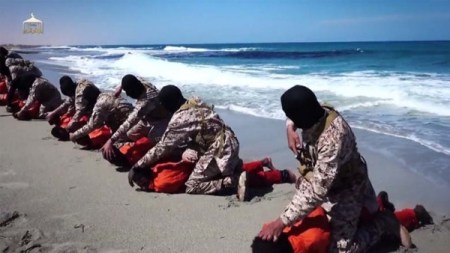
1383Members of the Islamic State are shown on the Libyan coast, preparing to behead a group of Ethiopian Christians. (From a video released in April 2015)

The West nevertheless continues to pretend that the Islamic State has nothing to do with Islam, and the Archbishop of Canterbury is apparently no different. It is noteworthy, however, that the Archbishop has no misgivings when it comes to Christians. “I cannot say that Christians who resort to violence are not Christians.,” he said to the Muslim Council of Wales two months ago. “At Srebrenica the perpetrators claimed Christian faith. I cannot deny their purported Christianity, but must acknowledge that event as yet another in the long history of Christian violence, and I must repudiate that what they did was in any way following the life and teaching of Jesus.”

During a debate in the House of Lords earlier this year, he also had no qualms in stating that “the church’s sporadic record of compelling obedience to its teachings through violence and coercion is a cause for humility and shame.”

If the Archbishop of Canterbury cannot deny the Christianity of Christian perpetrators who claim the Christian faith, how can he — not a Muslim scholar — deny the Islamic nature of Muslim perpetrators who claim the Muslim faith?

Just as mind-boggling is the refusal of Pope Francis I to speak the name of the perpetrators. In August 2014, when the Islamic State conquered the northern Iraqi city of Sinjar and began brutally to round up and murder Yazidis, and up to 100,000 Christians fled for their lives, Pope Francis could not make himself utter the name of the Islamic State. In his traditional Sunday blessing, he said the news from Iraq had left him “in dismay and disbelief.” As if every atrocity had happened for the first time! Christian Iraqis had at that point been persecuted by Al Qaeda in Iraq and the Islamic State for a full decade. Without referring by name to the Islamic State, and speaking as if some invisible force of nature were at play, the pope deplored “thousands of people, including many Christians, driven from their homes in a brutal manner; children dying of thirst and hunger in their flight; women kidnapped; people massacred; violence of every kind.”

A year later, in July 2015, he called the onslaught on Christians in the Middle East “a form of genocide,” but still without mentioning who exactly was committing it.

It is tragic that the Church has done so little to help its flock in the Middle East. Where, during the past decade, have the Archbishop of Canterbury and his colleagues from the Roman Catholic Church and Eastern Orthodox Church been? Where now is their vocal and public outrage at the near extinction of this ancient Christian culture? Where are their forceful appeals to political leaders and military decision-makers to intervene on behalf of their suffering brethren?

The Pope, however, did find time last May to write a 180-page encyclical about climate change, and he has spoken passionately about the bizarre concept of the “rights of the environment.” In front of the UN and a joint session of the U.S. Congress, he again spoke of the persecution of Christians, as if it were a metaphysical event:

“He expressed deep concern for the persecution of Christians in the Middle East, where they and other religious groups, have been ‘forced to witness the destruction of their places of worship, their cultural and religious heritage’ and been forced to flee or face death or enslavement.”

Christians in the Middle East are suffering and dying, and the world hardly pays attention. The post-Christian West evidently has no moment of charity for the plight of people with whom it might feel at least a slight solidarity. But in 2016, Europe will be receiving another three million migrants, according to the European Union. So far, most of those who have arrived are Muslims, and there is little reason to expect that those who will arrive next year will be persecuted Christians. Most of the refugees come from refugee camps near Syria; Christians stay away from the refugee camps because they experience persecution in them too. It is no different with the Syrian refugees coming to the US.

The Christians in the Middle East are thus still left fending for themselves.

Litmus Test: Reaction to Obama’s Request to Root Out Extremism

December 10, 2015

Litmus Test: Reaction to Obama’s Request to Root Out Extremism, The Clarion Project, Meora Svorslu, December 10, 2015

(Please see also, The Muslim reform movement plays fantasy Islam. — DM)

San-Bernardino-Attackers-IPThe San Bernardino attackers Tashfeen Malik and Syed Rizwan Farook (Photo: U.S. Customs and Border Protection)

In his speech to the nation following the San Bernardino terror attack, U.S. President Barack Obama made a rightful plea to Muslims: “If we’re to succeed in defeating terrorism, we must enlist Muslim communities.” Making his case, Obama again rightly stated that “extremist ideology has spread within some Muslim communities” and “it’s a real problem that Muslims must confront without excuse.”

The president then insisted that Muslim leaders in American as well as around the world work with the U.S. to “root out” the problem, reject violence and ideological supremacism and promote “mutual respect and human dignity.”

It is telling in the fight against Islamist extremism who is rallying with the president on these points and who is fighting against him.

Linda Sarsour, executive director of the taxpayer-funded Arab American Association and co-founder of the Muslim Democratic Club of New York, had this to say about Obama’s request: “We would never ask any other faith community to stand up and condemn acts of violence committed by people within their groups.”

Really? If Christians worldwide were committing terrorist rampages across the globe citing sources that it is sanctioned or even required by their religion, we wouldn’t ask for American Christians to condemn them and make sure their children did not get swayed by them?

Sarsour and her fellow apologists understand this well. What Sarsour’s remarks are meant to accomplish is a complete sidestep of the entire issue, ironically facilitated by Obama himself. Obama’s refusal to tie “extremist ideology” to Islam makes it is possible for Sarsour and those who share her sentiments to claim “Islamophobia” and call it a day.

Further commenting on Obama’s request, Sarsour said, “The fact that this is only directed at the Muslim community is something that I personally can’t accept.”

(It could be that Sarsour doesn’t feel the same way about violence as does the president. One of her recent tweets featured a Palestinian child with a rock in each of his hands approaching Israeli soldiers. Sarsour wrote underneath: “The definition of courage.”)

Muslims who are truly interested in rooting out the extremism in their midst would not bristle at Obama’s request. Indeed, many are already active in the fight against those who they believe are perverting their religion. They acknowledge the problem and don’t think it’s “Islamophobic” to talk about it.

“What we need to do now — rather than giving a forum to self-appointed spokespeople like CAIR who have not led the fight against extremism — is listen to those who have actually been taking on this very struggle the president referenced,” says Karima Bennoune, a University of Davis law professor, author of Your Fatwa Does Not Apply Here: Untold Stories from the Fight Against Muslim Fundamentalism. “Our conversation should be why and what is it in our theology that has been so bastardized to give people permission to kill? Until we honestly root this out, we will by default be blamed,” she said.

Nidal Alsayyed, an imam who heads the Islamic Center of Triplex of Beaumont, Texas went one step further, saying that he agrees with presidential candidate Donald Trump’s proposal to halt Muslim immigration into the U.S. until the country’s “representatives can figure out what is going on.”

“I certainly see it to be wise (to) stop temporarily accepting any new Muslim immigrants (refugees and non-refugees) into the United States,” said Alsayyed. “We American Muslims need to be sincere in our religion and to the country we are living in. Peace comes before religion. We need to be truthful and transparent when we express a viewpoint or feedback. It does not matter whether Trump said it or anyone else,” he added.

Democratic president candidate Hillary Clinton has refused to use the words “radical Islam,” saying, “It doesn’t do justice to the vast number of Muslims in our country and around the world who are peaceful people.”

On the contrary. “Not saying it, when it represents a reality, is much worse,” says Bennoune. And certainly, not saying it will not make the problem go away.

Germany: Salafist “Aid Workers” Recruiting Refugees

December 9, 2015

Germany: Salafist “Aid Workers” Recruiting Refugees, The Gatestone InstituteSoeren Kern, December 9, 2015

  • Salafists disguised as aid workers are canvassing German refugee shelters in search of new recruits from among the nearly one million asylum seekers who have arrived this year from Africa, Asia and the Middle East. Some Salafists are offering gifts of money and clothing. Others are offering translation services and inviting migrants to their homes for tea.
  • “The absolutist nature of Salafism contradicts significant parts of the German constitutional order. Specifically, Salafism rejects the democratic principles of separation of state and religion, popular sovereignty, religious and sexual self-determination, gender equality and the fundamental right to physical integrity… The movement also has an affinity for violence.” — Germany’s domestic intelligence agency.
  • “Come to us. We will show you Paradise.” — Salafist literature distributed in Schleswig-Holstein.
  • Many young Muslims in Germany “believe in conspiracy theories, cherish anti-Semitic thoughts and do not think democratically.” For these people, “Islam is their only identity.” — Ahmad Mansour, former Muslim Brotherhood member, author and expert on Islam.
  • The main Muslim groups in Germany all adhere to fundamentalist interpretations of Islam and are anti-Western in outlook. — Ansgar Mönter, editor, Neue Westfälische.

The number of radical Salafists in Germany has more than doubled over the past five years, according to a new estimate by German intelligence officials.

Salafists disguised as aid workers are also canvassing German refugee shelters in search of new recruits from among the nearly one million asylum seekers who have arrived in Germany this year from Africa, Asia and the Middle East.

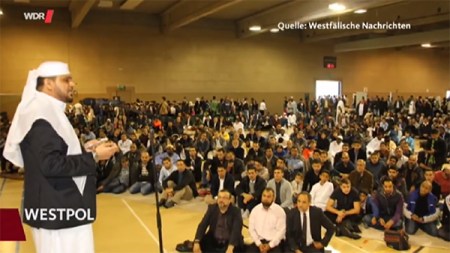
1381 (1)A local preacher addresses Muslim refugees in Münster, Germany. Local authorities later cut off contact with the preacher’s organization due to suspicions of radical Islamism. (Image source: Westfälische Nachrichten video screenshot)

The revelations by Hans-Georg Maassen, the director of the Germany’s domestic intelligence agency, the Bundesamt für Verfassungsschutz (BfV), come amid growing fears that jihadists linked to the Islamic State have infiltrated Germany by posing as refugees.

In a December 3 interview with the Berlin newspaper, Der Tagesspiegel, Maassen said that the number of Salafists in Germany has now risen to 7,900. This is up from 7,000 in 2014, 5,500 in 2013, 4,500 in 2012, and 3,800 in 2011.

Although Salafists make up only a small fraction of the estimated six million Muslims living in Germany today, intelligence officials say that most of those attracted to Salafi ideology are impressionable young Muslims, male and female alike, who are willing to carry out terrorist acts in the name of Islam at a moment’s notice.

Salafists — who follow what they say was the original Islam practiced in the 7th and 8th centuries — openly state that they want to replace democracy in Germany (and the rest of the world) with an Islamic government based on Sharia law.

In its annual report for 2014, released in June 2015, the BfV said that Salafism is the “most dynamic Islamist movement in Germany.” It added:

“The Salafist scene constitutes a considerable recruitment field for jihad. Salafist ideology purports to be based exclusively on the principles of the Koran, and the example of the Prophet Mohammed and the first three generations of Muslims. The movement also has an affinity for violence. Almost without exception, all of the people with links to Germany who have joined the jihad [Islamic State] had prior contacts with Salafist structures. Also in 2014, Salafists tried to draw attention to themselves with rallies and provocations, including the READ! campaign and the Sharia Police.”

The BfV was referring to an effort by Salafists to enforce Sharia law on the streets of Wuppertal, a city in North Rhine-Westphalia, the state with the largest Muslim population in Germany. Salafists have also organized a mass proselytization and recruitment campaign — Project READ! — aimed at placing a German translation of the Koran in every household in Germany, free of charge.

A previous BfV report stated:

“The absolutist nature of Salafism contradicts significant parts of the German constitutional order. Specifically, Salafism rejects the democratic principles of separation of state and religion, popular sovereignty, religious and sexual self-determination, gender equality and the fundamental right to physical integrity.”

Speaking to Der Tagesspiegel, Maassen also defended himself against accusations that his agency has failed adequately to vet incoming refugees to ensure that jihadists are not infiltrating Germany. He said:

“My agency has repeatedly pointed to this possibility. Looking at the overall situation, I am advocating a differentiated approach. It would be wrong to see all asylum seekers as a terrorist threat. It would also be shortsighted to act as if the flow of refugees will not have any impact on our security. Salafists are trying to win new followers in the vicinity of refugee camps.”

Critics say that Maassen is downplaying the migrant-jihadist threat to Germany to protect German Chancellor Angela Merkel and her open-door migration policy.

The editor of Tagesspiegel’s editorial page, Malte Lehming, has accused Maassen of trying to “influence the political discourse for the benefit of the government.” In a scathing editorial, entitled, “German Intelligence Has Been Discredited,” Lehming wrote that three of the jihadists who carried out the November terrorist attacks in Paris entered the European Union posing as refugees and holding false passports.

According to Lehming, this development is “highly inconvenient” for German intelligence, which has been “disgraced to the core.” This is because up until the Paris attacks, Maassen had insisted that the possibility that terrorists could enter the country by posing as refugees was, at best, an “abstract danger.”

Lehming continued:

“The assessment of the German secret services has been discredited ever since the Paris attacks. The question remains, why did they lean so far out on this point?

“Possibility One: They really did not know. This would be appalling. Hundreds of thousands of refugees have entered Germany unchecked. If the security services have no idea who has come here, this country will have a massive problem.

“Possibility Two: The secret services know more than they are publicly saying, but they do not want to stir up panic among the general public that Islamists could be among the refugees.”

Some are attributing the fact that Germany has not suffered a major jihadist attack to sheer luck.

According to Ahmad Mansour, an Israeli-Arab expert on Islam who has lived in Germany for more than a decade, the German government is not doing nearly enough to combat Islamism.

Mansour, the author of “Generation Allah,” a new book about the radicalization of young German Muslims, says that the number of Islamic radicals in Germany is likely to grow to such an extent that German authorities will no longer be able to keep track of them.

In an interview with Die Welt, Mansour — a member of the Muslim Brotherhood for more than a decade until he abandoned Islamism in the late 1990s — said that many young Muslims in Germany “believe in conspiracy theories, cherish anti-Semitic thoughts and do not think democratically.” For these people, “Islam is their only identity.”

Mansour said the German government “lacks a plan” to deal with the problem. He added that much of the blame lies with “highly problematic” Islam teachers who are radicalizing German youth. Commenting on the question of why jihadists have not yet carried out a major attack in Germany, Mansour said: “So far Germany has been lucky.”

This assessment has also been voiced by German Interior Minister Thomas de Maizière, who has conceded: “So far we have been lucky. Unfortunately, this may not always be the case.”

A poll published on December 3 by the newsmagazine Stern found that 61% of Germans believe jihadists will attack their country in the near future. The poll shows that 58% think the German military should be attacking the Islamic State, although 63% believe this would lead to retaliation in the form of terrorist attacks in Germany. Overall, nearly 75% of Germans believe the government needs to do more to prevent terrorism in the country.

The head of the Federal Criminal Police Agency (Bundeskriminalamt, BKA), Holger Münch, hasacknowledged that German intelligence lacks the human resources necessary to track all of the most dangerous Islamists in the country. “Given the number of potential attackers, we must prioritize,” he said.

According to the newspaper Bild, at least 60 police officers are necessary to monitor just one German jihadist around the clock.

Meanwhile, some German Salafists are posing as aid workers and are offering gifts of money and clothing in efforts to recruit asylum seekers. Others are offering translation services and inviting migrants to their homes for tea. Still others are handing out leaflets with information about local Salafist mosques. In an interview with the Rheinische Post, BfV Chief Maassen said:

“Many of the asylum seekers have a Sunni religious background. In Germany there is a Salafist scene that sees this as a breeding ground. We are observing that Salafists are appearing at the shelters disguised as volunteers and helpers, deliberately seeking contact with refugees to invite them to their mosques to recruit them to their cause.”

In the northern German state of Schleswig-Holstein, Salafists are distributing literature with the message: “Come to us. We will show you Paradise.”

In Frankfurt, city officials are now sending teams of police, translators and social workers to refugee shelters to warn asylum seekers of the dangers of Islamic radicalism. The teams are also educating migrants about the German legal system, religious freedom and the equal rights for men and women.

In Bielefeld, a city in North Rhine-Westphalia, Salafists are infiltrating refugee centers by bringing toys, fruits and vegetables for the migrants.

According to the editor of the newspaper Neue Westfälische, Ansgar Mönter, “naïve” politicians are contributing to the radicalization of refugees by inviting Muslim umbrella groups to reach out to the migrants.

Mönter points out that the main Muslim groups in Germany all adhere to fundamentalist interpretations of Islam and are anti-Western in outlook. Some groups have ties to the Muslim Brotherhood, while others want to implement Sharia law in Germany. According to Mönter, politicians should not be encouraging these groups to establish contact with the new migrants.

What do they have in common?

December 9, 2015

What do they have in common? inthebullpen via You Tube, March 4, 2007

(It’s a very difficult question, to which even Obama doesn’t have an answer. But be of good cheer. Perhaps some fine day, when we have enough Muslims to evaluate in Obama’s America, we will learn the answer. — DM)


Dispelling the ‘Few Extremists’ Myth – the Muslim World Is Overcome with Hate

December 8, 2015

Dispelling the ‘Few Extremists’ Myth – the Muslim World Is Overcome with Hate, National Review, David French, December 7, 2015

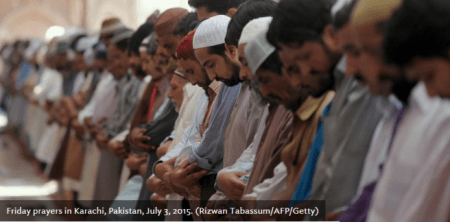
friday-prayersFriday prayers in Karachi, Pakistan, July 3, 2015. (Rizwan Tabassum/AFP/Getty)

It is simply false to declare that jihadists represent the “tiny few extremists” who sully the reputation of an otherwise peace-loving and tolerant Muslim faith. In reality, the truth is far more troubling — that jihadists represent the natural and inevitable outgrowth of a faith that is given over to hate on a massive scale, with hundreds of millions of believers holding views that Americans would rightly find revolting. Not all Muslims are hateful, of course, but so many are that it’s not remotely surprising that the world is wracked by wave after wave of jihadist violence.

To understand the Muslim edifice of hate, imagine it as a pyramid — with broadly-shared bigotry at the bottom, followed by stair steps of escalating radicalism — culminating in jihadist armies that in some instances represent a greater share of their respective populations than does the active-duty military in the United States.

The base of the pyramid, the most broadly held hatred in the Islamic world, is anti-Semitism, with staggering numbers of Muslims expressing anti-Jewish views. In 2014, the Anti-Defamation League released the results of polling 53,100 people in 102 countries for evidence of anti-Semitic attitudes and beliefs. The numbers from the majority-Muslim world are difficult to believe for those steeped in politically correct rhetoric about Islam. A full 74 percent of North African and Middle Eastern residents registered anti-Semitic beliefs, including 92 percent of Iraqis, a whopping 69 percent of relatively secular Turks, and 74 percent of Saudis.

The trend toward Muslim anti-Semitism continues even when Muslim nations are far removed from the Arab–Israeli conflict. A solid majority — 61 percent — of majority-Muslim Malays harbor anti-Semitic attitudes, while only 13 percent of neighboring majority-Buddhist Thais are anti-Jewish.

The next level of the pyramid is Muslim commitment to deadly Islamic supremacy. In multiple Muslim nations, overwhelming majorities of Muslims support the death penalty for apostasy or blasphemy. Collectively, this means that hundreds of millions of men and women support capital punishment for the exercise of the basic human rights of freedom of expression and free exercise of religion:

death-penalty-for-leaving-islam

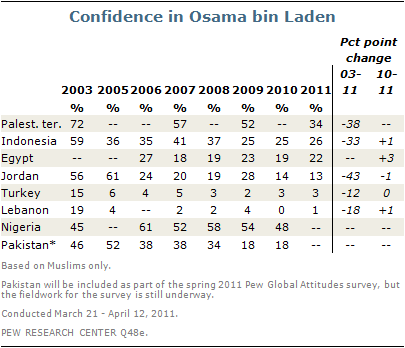
Moving beyond Islamic supremacy to the next step of the pyramid, enormous numbers of Muslims are terrorist sympathizers. It is still stunning to see how popular Osama bin Laden was early last decade, and even as his popularity plunged (as he grew weaker and more isolated), his public approval remained disturbingly high:

confidence-in-osama-bin-laden

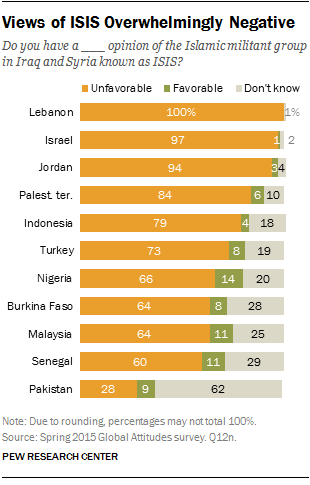
But what about ISIS — the world’s most savage and deadly terror organization? The latest polling data show that while a majority of Muslims reject ISIS, extrapolating from the populations of polled countries alone shows that roughly 50 million people express sympathy for a terrorist army that burns prisoners alive, throws gay men from buildings, and beheads political opponents. In Pakistan a horrifying 72 percent couldn’t bring themselves to express an unfavorable view of ISIS:

views-of-isis-overhelmingly-negative

But sympathy for terror is different from active support, and here’s where the numbers are difficult to pin down. I know of no reliable database that shows how many Muslims give to jihadist charities, spread jihadist propaganda on social media, support radical preachers, or otherwise take concrete actions to advance the terrorists’ cause. We do know, for example, that anti-Israel terrorism is so popular in Saudi Arabia that a telethon once raised $100 million to support the 2002 intifada. Shows of support included this charming scene:

A 6-year-old boy, with a plastic gun slung over his shoulder and fake explosives strapped around his waist, walked into a donation center and made a symbolic donation of plastic explosives, according to Al Watan daily.

It is from this fertile soil that jihadists grow. And here the numbers decisively belie the “few extremists” rhetoric. In Iran alone, the Revolutionary Guard represents a proportionate share of the population similar to the combined strength of the active-duty Army and Marines here in the United States. Between Boko Haram, the Al-Nusra front, ISIS, Hezbollah, Hamas, al-Qaeda, the Taliban, Yemeni militias, Libyan militias, and many others, the number of active jihadists numbers in the hundreds of thousands; some estimates indicate that 100,000 are fighting in Syria alone.

Paradigms lost: The EU

December 1, 2015

Paradigms lost: The EU, Front Page MagazineBruce Thornton, December 1, 2015

rt_3

Historian of science Thomas Kuhn famously argued that scientific progress comes not from an incremental, stepwise accumulation of knowledge, but rather from a “paradigm shift,” the relatively sudden collapse of an old paradigm under the weight of new evidence and new insights. Kuhn’s idea has implications beyond scientific research. Historical changes as well often reflect an abrupt shift, as the old received wisdom is no longer adequate for understanding new events.

For example, the collapse of the Soviet Union was anticipated by at most a handful of analysts and historians. Indeed, in 1984 esteemed economist J.K. Galbraith claimed, “The Russian system succeeds because, in contrast to the Western industrial economies, it makes full use of its manpower.” Yet in a few years looming economic collapse swept away the communist superpower that for half a century threatened liberal democracy. In an instant, the seemingly permanent Cold War geostrategical paradigm disappeared, taking with it the whole academic discipline of Sovietology.

Perhaps today we are witnessing the beginning of a similar paradigm shift: the end of the notion that universal progress driven by scientific and technological innovations will eventually improve human life and political order to the point where the tragic constants of human existence––conflict, violence, oppression, brutal autocracy, and violations of basic human rights––will disappear. Considering the current failures of the West both domestically and abroad, this faith seems on shaky ground.

In Europe, the EU has been the institutional manifestation of this optimistic paradigm. Ethnic particularism, nationalist loyalties, parochial religious beliefs were remnants of the unenlightened past. A transnational organization of technocrats would be better placed to manage the economy, promote social justice, tend to the disadvantaged through redistributionist welfare transfers, and establish non-violent institutions of conflict resolution that would make collective violence a thing of the past. In practice, this meant diminishing national identity and the Christian faith, embracing a multiculturalism predicated on Western guilt and sentimental Third-Worldism, and inviting non-Western immigrants into Europe. These immigrants theoretically would do the work Europeans scorned, compensating for the decline in birthrates that attended increasing affluence and secularist values.

This paradigm today is wobbly. The EU still hasn’t recovered from the 2008 economic crisis, nor repaired the fissures in the EU laid bare by the still-looming Grexit (the departure of Greece from the common currency), the sluggish economic growth, the high levels of unemployment, the high taxes, debt, and deficits, and the burdensome regulatory regime. The EU faith in technocratic expertise and powers of control has been exposed as hubristic, a failure to acknowledge the “irreducible complexity” of human behavior and social relations, and the reality of conflicting economic interests among 500 million people spread over 28 countries with different languages, customs, histories, and religions. The nasty feud between Germany and Greece over the latter’s threatened default on its debt reminded us that Germans are still Germans and Greeks are still Greeks.

The on-going immigration crisis has further split the EU. The Eurocrats and other elites enjoyed their freer travel and “citizen of the world” identity, but millions of others lacking those opportunities remain French or Italian or Hungarian or Greek. Yet for all their differences, Europeans still live in a civilization created by Athens, Rome, and Jerusalem, a civilization embracing freedom, equal rights, separation of church and state, and numerous other ideals.

For many Europeans even if that tradition has been weakened by secularism, their political and social institutions are very different from those of the Muslims they invited into their countries, making assimilation difficult. Thus rather than workers, many immigrants, especially the young, became part of a permanent underclass living on the dole, alienated from the host country’s culture, and shut out from labor markets by onerous employment regulations.  Long before the Syrian refugee crisis and the terror attacks in London, Madrid, and Paris, these Muslim “youths,” as they’re delicately called, have been underemployed and overrepresented in prisons, committing crimes, particularly vandalism, assault, and rape, at a much higher rate than their proportion of the population. They crowd the welfare rolls, clustering in shabby neighborhoods beyond the reach of police control and ripe for recruitment into jihadist outfits. Meanwhile many Muslims practice the illiberal tenets of their faith––sex segregation, honor killings, stealth polygamy, aggressive public practice of their faith, intolerance of infidels, and waging or supporting violent jihad––contrary to the liberal democratic principles of their new homes.

Yet despite this long record of hostility and contempt towards the host countries, despite the recent massacre in Paris and disrupted plots in Belgium, Western European nations continue to profess their intent to let in as many as a million “refugees” from Syria. Most of them are seeking jobs and welfare, not fleeing persecution, from which they could find refuge in the neighboring Sunni nations of Turkey, Lebanon and Jordan. Worse, despite the fact that the ringleader of the Paris attack came from Syria, EU president Jean-Claude Juncker, fretting over the travails of the Syrian migrants, said, “There is no need for an overall review of the European policy on refugees.” Such a sentiment ignores, of course, the decades-long failure of Europe to assimilate the Muslims already there. Increasing their number likely means expanding the number of jihad-incubating Muslim ghettos, segregated from the culture and mores of the host countries and filled with obscene graffiti and the hulks of burned-out cars.

Elected national leaders and political parties across the EU, however, are increasingly more voluble in disagreeing with the EU president and Angela Merkel’s claim that “Islam belongs in Germany.” Hungarian president Viktor Orban has taken a hard line on the immigrants, building a steel fence on his country’s border, and frankly acknowledging the cultural differences between European and Islamic culture: “I think we have a right to decide that we do not want a large number of Muslim people in our country . . . We do not like the consequences,” he added, alluding to the Ottoman Muslim occupation of his country for 150 years. Slovenia, a victim of continual Ottoman raids in the 16th century, like Hungary has built a wall and imposed border controls. After the Paris attacks, other countries tightened their border controls as well, revising the 1985 Schengen agreement that opened up travel between EU states. The Dutch, meanwhile, have proposed creating a new Schengen-like confederation comprising the more ethnically homogenous Netherlands, Belgium, Luxembourg, Germany, and Austria.

More significant is the increasing popularity of nationalist Euroskeptic parties. The more hawkish reaction, so far at least, in France to the Paris attacks on the part of President Hollande suggests that the old multiculturalist orthodoxy that demonized national pride might be weakening, as does the influx of people enlisting in the French Army, at a rate five times greater than before the attacks. These developments might portend an opening for nationalist parties that Europhiles scorn as “right-wing extremist,” “far right,” or even “neo-fascist.”

While a few show such tendencies, most are more accurately defined as populist or nationalist, calling for a return of pride in and loyalty to their unique national identities, customs, heritage, and mores that the EU establishment dismisses as quaint relics from the benighted past. In France, Marine le Pen’s National Front could dominate upcoming regional elections, according to recent polls, and could become France’s next president. Le Pen has called for an “immediate halt” to further immigration. Elsewhere, the Swedish Democrats, the Dutch Party of Freedom, and the German Alternative for Germany are increasing in popularity. And Viktor Orban, leader of the Fidesz-Hungarian Civic Alliance, whom many EU leaders and commentators have reviled as xenophobic neo-fascist, is gaining credibility and respect among those who recognize the suicidal self-abasement of EU immigration policies.

Are these developments the harbingers of a larger paradigm shift away from the transnational, technocratic, undemocratic institutions of the EU? We should be cautious, for a real reformation would require a widespread return to patriotic allegiance, something a peaceful Europe, its security guaranteed and subsidized by the U.S., hasn’t felt a need for. Even more terrorist attacks might not be enough to awaken Europe from its multicultural slumbers. As we saw in London and Madrid ten years ago, initial bravado like the signs in Paris shops claiming “You don’t scare me” lasts as long as the public memorials and collective mourning. Likewise, protests against immigration have energized nationalist political parties before. In 1999 Austria’s Jörge Haider’s nationalist Freedom Party won 27% of the vote. By 2002 that support had shrunk to around 7%. On the other hand, the reaction against the EU caused by increasing economic failure and terrorist violence could take more sinister and violent forms as genuinely extremist groups find opportunity for growth.

Finally, the decline of faith in Europe has undercut the Judeo-Christian tradition upon which the civilization of Europe was founded, and which will have to provide the unifying principles, virtues, and beliefs necessary for correcting the dysfunctions of the EU and putting steel into Europeans’ resolve to destroy jihadism. But what today can replace “the accumulated capital of [Europe’s] Christian past,” as Christopher Dawson called it, “from which it drew the moral and social idealism that inspired the humanitarian and liberal and democratic movement of the last two centuries”? That “capital” has been dwindling for decades. Before the paradigm can shift, Europeans will have to rediscover what they are willing to kill and die for, especially in the face of an enemy filled with passionate intensity and fierce certainty in their knowledge of what their god commands them to kill and die for. That is the question the Eurocrats in Brussels and Strasburg are incapable of answering.
The Accomplices Have Their Backs Against the Wall

November 29, 2015

The Accomplices Have Their Backs Against the Wall NATO knows its Turkish member’s ties to ISIS will be revealed if Russia succeeds in Syria

German Economic News

Source: The Accomplices Have Their Backs Against the Wall

Originally Appeared at German Economic News; Translated by Susan Neumann

NATO is extremely nervous, because it knows that the truth about the relationship of NATO-member Turkey to the Islamist terror group (IS) will come to light if there is a Russian victory in Syria. If the refugees are able to return, Erdogan won’t have them as a pawn to extort money [from the EU]. It’s clear who’s interested in an escalation of the conflict.

The reaction of the Western alliance on the shooting down of a Russian bomber show that NATO is very nervous. It’s on the verge of losing control of Russia in Syria. The great Turkish ride out, which was most likely planned by the secret services, looks more like a desperate symbolic act than a carefully considered commando operation. The Russian Ambassador to NATO, Alexander Grushko, called it shadow theatre.

The reason why NATO is looking for shady place to hide is the fact that Putin named those who shot down the Russian aircraft accomplices of the terrorists. Turkey is a NATO country. The alliance is confronted with the official accusation of terrorism for the first time. Until now, NATO has been the only one to slap others with the terrorist label. The real reason for their nervousness is tangibly rooted in the military.

The hopes of NATO and their secret services are being dashed on the rocks. US President Barack Obama has been running a different political course than that which NATO and their secret services would want. Obama wants to get out of the Syria war. He’s admitted that the mission has failed — and the idea of “regime change” has taken a heavy beating, to say the least. Obama has arranged it with Russian President Vladimir Putin that the Russians take over the IS-project. This has been devastatingly humiliating for the neocons, NATO, and the secret services.

After that, Russia began fighting terrorists who were allies of the US military. From the very beginning, Putin has stood in the way of the western military’s desire to cover up their manipulations Syria. The Islamic State and the military advisers of both Turkey and the Pentagon are now facing defeat in Syria.

US President Obama knows this as well. His message to Putin is therefore remarkably diplomatic. After a meeting at the White House with French President Francois Hollande, President Barack Obama said that if Moscow had a “change of strategy,” there would be “great potential” for cooperation. “Russia is welcome to be a part of our broad coalition.” It’s Obama’s half-hearted attempt to make it appear to NATO that they can bring Russia under control.

Why indeed, should Russia change its strategy, above all now? The Russians have kept repeating that the reason they’ve involved themselves militarily in Syria is because NATO has failed. One can believe that, because the Russians know that a fight to uncover terrorist cells is anything but easy. In order not to end up like the Americans in no man’s land, the Russians have made skillful alliances with Iran, Iraq, and China; and have even allowed Israel to have access to their information.

The military successes of the past few weeks have put the Western mercenary troops in dire straits. Obama’s added invitation for the Russians to join in is the real reason why NATO is so nervous. Obama says Moscow should work in close military cooperation and target their air strikes on the IS rather than the moderate rebels. They should also support political change in Damascus.

Russia has supported the change in Damascus for weeks. Moscow has repeatedly said that it doesn’t insist on Assad being president in the long run. The Russians do say, however, that it must be the decision of the Syrian people. This position is also shared by Iran. Russia has also submitted a transition plan of Syria, post-war. Within 18 months a new constitution could be drafted and new elections could be held. If anybody needed to make a strategic change, it would be the Western alliance. They have presented no political concept other than the battle cry, “Assad must go!”

The main worry of NATO, and Turkey in particular, lies in the risk that a Russian victory could uncover all the goings-on, of how the West and especially the Turkish government cooperated with the terrorists in the region. [If the Russians are victorious,] it will show the refugee debate in a completely different light, and it will become clear how the Turkish President Recep Tayyip Erdogan cynically abused the refugees as bartering chips for his ambitions. It will also show that Erdogan’s war against the PKK is a completely disproportionate war, one in which the Kurdish civilian population was brutally attacked. One will also recognize that the West only has the Turkish government and Saudi Arabia as its allies, in a region with two Islamist governments.

Erdogan can still blackmail the totally incompetent EU and the German chancellor, who is totally over her head — by demanding billions of euros in protection money for the refugees. If the Russians truly succeed, however, in bringing peace to Syria — and in such a way that a majority of the refugees can return to their homeland — then Erdogan suddenly has a bad poker hand. Turkey is of course totally unsuitable to be included in the EU under Erdogan. Everybody in Brussels knows it. The visa-free travel is also a grotesque idea. Every day there are new incidents of how business can be conducted with fake Turkish passports — especially in Turkey. Then there’s the three billion euros that Erdogan demands from European taxpayers for the refugees. What’s going to happen with the money? Integration of refugees in Turkey? Better accommodation in the camps? No corruption, complete transparency?

This whole outlook makes Erdogan’s government and its intelligence agencies feel justified in shooting down a Russian fighter jet. They need an escalation of the situation, because they have their backs to the wall. That also makes Erdogan unpredictable in this conflict. He has a lot to lose.

For documentation purposes, we’ve published the report by the Germany Press Agency on NATO’s statement about the shoot-down. It proves that military units were not invented to think.

Erdogan: Downing of Turkish jet with S-400 missile would mean aggression

November 27, 2015

Erdogan: Downing of Turkish jet with S-400 missile would mean aggression

27 November 2015 / 11:19

Source: APA – Erdogan: Downing of Turkish jet with S-400 missile would mean aggression

Baku. Malahat Najafova – APA. In case a Turkish jet gets shot down by the Russian S-400 surface-to-air missile system in Syrian airspace, Ankara will regard it as an aggression.

Turkish President Recep Tayyip Erdogan made the remarks in a statement to CNN International of the possibility of the Russian S-400 surface-to-air missile system targeting Turkish warplanes in case they enter Syrian airspace.

Erdogan did not rule out the possibility of such an incident.

“In this case Turkey will be forced to take measures that will certainly not be discussed. And of course it would be an aggression against our rights of sovereignty and it’s the natural right of the state to protect those rights. We do not want to see any escalation of the situation in the region. We do not want to become a party to that. But those who side with Syria and escalate the tension, I think, are the responsible parties to this,” the Turkish president stressed.

Asked whether he saw the moving of the Russian S-400s into western Syria as a threat to Turkey and other coalition members who may be flying sorties in this region, the Turkish president said Russia has been providing military support to Syria since long ago – since the rain of Bashar Al-Assad’s father.

“Russia has sold or given this kind of systems to Syria. It’s impossible to say that this is something new and did not take place last year,” said Erdogan.

Share