Posted tagged ‘Iranian nukes’

Congress Investigating Obama Spy Ops on Congress

January 5, 2016

Congress Seeks Investigation Into Obama Spy Ops on Congress, Israel Lawmakers demand Obama administration disclose how it used private communications

BY:
January 4, 2016 5:00 pm

Source: Congress Investigating Obama Spy Ops on Congress

Lawmakers are demanding that the Obama administration disclose how it used private communications that were intercepted during a massive spy operation on Israel that included private conversations with members of Congress, according to letters sent to the National Security Agency and White House.

Rep. Ron DeSantis (R., Fla.) petitioned President Barack Obama late Monday afternoon, demanding the administration reveal how it used information obtained during secret surveillance of Israeli leaders, according to a copy of the letter obtained by the Washington Free Beacon.

Reports emerged last week that the NSA’s spy operation picked up private communications between Israeli officials, members of Congress, and U.S. Jewish community leaders. The information reportedly centered on Israeli efforts to halt the nuclear negotiations. The White House reportedly did not take steps to ensure that these political conversations were omitted.

DeSantis, who along with several other lawmakers has already requested that the NSA provide Congress with details of the operation, informed the Obama administration late Monday that he is seeking to learn if the information gleaned from these private conversations was used by the White House to sway the national debate over the Iran nuclear agreement.

“I am concerned that the vague guidelines and policies used by the NSA for intelligence collection and sharing, in conjunction with elusive direction from the Administration, have led to intelligence being collected on sitting members of Congress for political purposes, specifically relating to the Joint Comprehensive Plan of Action (JCPOA) that was being negotiated at the time this information was collected,” DeSantis wrote.

The lawmaker is further requesting that the White House reveal if this information was shared with any other country, particularly other members of the international negotiating team that struck the nuclear accord with Iran last year.

“Did the White House receive any communications between Israeli officials and members of Congress regarding the nuclear negotiations and agreement with Iran?” Desantis asks.

“How was this information used by the Administration in the course of the JCPOA negotiations?” he follows up.

The White House also should disclose whether the information collected was “used by White House officials during the political debate in the United States about the Iran deal,” according to the letter.

DeSantis and three other lawmakers requested last week that the NSA turn over all information pertaining to how the program was run and how the information collected could be used.

Congress must continue to investigate the spy program to determine if the Obama administration violated laws pertaining to the separation of powers, DeSantis said in a statement.

While the Obama Administration was negotiating a nuclear deal with the world’s leading state sponsor of terrorism, they were simultaneously spying on and trying to undermine our closest ally in the region, Israel,” he said. “This spying may very well have swept up the communications of members of Congress, which represents an affront to the separation of powers.”

“Congress needs to investigate how the Obama administration used this information and determine whether it shared information gleaned from this spying with Iran,” according to DeSantis.

Cartoon of the Day

January 5, 2016

H/t The Jewish Press

Obama-gun-control-in-America

Iran Executes Three Iranians Every Day; The West Rewards It.

December 30, 2015

Iran Executes Three Iranians Every Day; The West Rewards It. Gatestone InstituteJudith Bergman, December 30, 2015

♦ “Death sentences in Iran are particularly disturbing because they are invariably imposed by courts that are completely lacking in independence and impartiality. They are imposed either for vaguely worded or overly broad offences, or for acts that should not be criminalized at all, let alone attract the death penalty. Trials in Iran are deeply flawed, detainees are often denied access to lawyers in the investigative stage, and there are inadequate procedures for appeal, pardon and commutation” — From a July 2015 Amnesty International report.

♦ How ironic that Europeans have no problem stuffing themselves with syrupy Iranian dates exported by this regime, knowing full well that there are thousands of prisoners are being tortured in Iran while awaiting their executions.

♦ Amnesty International reports that in the fall of 2015, cartoonist Atena Farghadani was forced to undergo a “virginity and pregnancy test” prior to her trial. The charge? “Illegitimate sexual relations,” for having shaken hands with her lawyer.

♦ Iran nevertheless won a top seat on the U.N.’s Commission on the Status of Women in April 2014. Not a single UN member, not even the US, objected.

On the UN’s Human Rights Day, observed December 10, an Iranian woman was sentenced to death by stoning in the Islamic Republic of Iran.

Since the Islamic Revolution in 1979, Iran is believed to have imposed death by stoning on at least 150 people, according to the International Committees against Execution and Stoning.

“Stoning,” Iranian human rights activist Shabnam Assadollahi said, “is an act of torture. There are 15 countries in which stoning is either practiced and authorized by law or tolerated. One of those 15 countries is Iran. The last known execution by stoning was in 2009. In Iran under the Islamic law, stonings, hangings, and executions are legal torture.

“In Islam under Sharia law, the stoning (Rajm) is commonly used as a form of capital punishment, called Hudud,” Assadollahi explained.

“Under the Islamic Law, it is the ordained penalty in cases of adultery committed by a married man or married woman with others who are not her/his legal partner. Stoning is carried out by a crowd of Muslims who follow the Sharia law by throwing stones (small and large) at a convicted person until she or he is killed. The international community must pressure Iran, Afghanistan, Saudi Arabia, Yemen, Sudan, Somalia, Pakistan, and other countries where stoning is legally carried or tolerated. Why cannot the public loudly cry out and advocate for women oppressed by those regimes?”

Instead of cries of outrage, the West, in the wake of the nuclear “deal” Iran has not even signed, has been scrambling to ingratiate itself with the Iranian regime. Countries such as France, Germany, Austria and Switzerland have barely been able to contain themselves at the prospect of doing business with them. It has been years since the Europeans could legally engage in trade with the murderous regime of the mullahs, who still cry, “Death to Israel, Death to America” — the “Little Satan” and the “Great Satan’ — and they have not been wasting time.

In fact, the P5+1 negotiators (the five permanent members of the UN Security Council plus Germany) had just finished signing the “deal” with themselves, when Germany’s Vice Chancellor, Sigmar Gabriel, hurried himself and a group of representatives from German companies and industry groups onto a plane for a visit to Iran.

The French Foreign Minister, Laurent Fabius, who usually knows better, likewise, found it “… completely normal that after this historic deal was signed, France and Iran should restart normal relations.”

1407French Foreign Minister Laurent Fabius said that it is “completely normal that after this historic [nuclear] deal was signed, France and Iran should restart normal relations.” Left, Iranian Foreign Minister Javad Zarif hugs Fabius at the close of nuclear talks in Geneva, Nov. 23, 2014. Right: A public execution in Iran.

Before the sanctions took effect in 2011, French companies such as Renault and Peugeot were making billions of euros from their involvement with Iran’s auto industry. Similarly, the French company Total was heavily involved in the oil sector. France was evidently not going to miss a beat in bringing this lucrative trade back to la République.

How ironic that the country of “liberté, egalité and fraternité” finds it “completely normal” to have normal diplomatic and trade relations with a country that treats its own citizens, especially women, worse than the mud under the mullah’s feet; that executes whoever disagrees with the regime, and that hangs homosexuals from cranes. How ironic that Europeans have no problem stuffing themselves with syrupy Iranian dates exported by this smiling regime, knowing full well that there are thousands of Iranian prisoners being tortured in Iranian prisons while awaiting their execution day.

Iranian authorities are believed to have executed 694 people between January 1 and July 15, 2015 — an average of three executions a day. Since the election of the “moderate” President Hassan Rouhani in 2013, the number of executions has markedly gone up. According to a July 2015 Amnesty International report:

“Death sentences in Iran are particularly disturbing because they are invariably imposed by courts that are completely lacking in independence and impartiality. They are imposed either for vaguely worded or overly broad offences, or for acts that should not be criminalized at all, let alone attract the death penalty. Trials in Iran are deeply flawed, detainees are often denied access to lawyers in the investigative stage, and there are inadequate procedures for appeal, pardon and commutation.”

The report goes on to state that the majority of those put to death in 2015 were people from disadvantaged backgrounds, who were convicted on drug charges. “This is in direct breach of international law, which restricts the use of the death penalty to only the ‘most serious crimes’ – those involving intentional killing. Drug-related offences do not meet this threshold.”

Among those executed in Iran this year are members of ethnic and religious minorities convicted of “enmity against God” and “corruption on earth.” These include Kurdish political prisoners and Sunni Muslims. On August 26, 2015, Behrouz Alkhani, a 30-year-old man from Iran’s Kurdish minority, was executed despite awaiting the outcome of a Supreme Court appeal.

Iran is the second most prolific executioner in the world after China, according to Amnesty International’s latest global death penalty report.

Iran also tops the global list statistically for executioners of juvenile offenders, even though it is a state party to the Convention on the Rights of the Child and the International Covenant on Civil and Political Rights, both of which prohibit the imposition of the death penalty against persons who were below 18 years of age at the time of the crime, without exception. (Of course Iran was also a signatory to the nuclear Non-Proliferation Treaty, which it also violated repeatedly.) Iran continues to impose the death penalty against juvenile offenders, frequently deferring the execution until after they pass the age of 18. In 2015, at least four juvenile offenders are believed to have been executed: Javad Saberi, Vazir Amroddin, Samad Zahabi and Fatemeh Salbehi.

Iran is scheduled to be reviewed by the Committee on the Rights of the Child on January 11-12, 2016. The Committee has already expressed deep concerns about the use of death penalty against juvenile offenders and asked Iran to provide information on the progress and outcome of the cases of juvenile offenders undergoing re-trial.

Despite all the atrocities that Iran commits towards its citizens, women hold a special place of denigration and humiliation in Iranian society. Young women are reported brutally arrested by the thousand every week for not wearing a “proper hijab.” A woman in Iran is de facto first her father’s property, then after marriage, her husband’s property. According to the UN Secretary General’s February 2015 Report on the Situation of Human Rights in Iran, child marriage is prevalent. The legal age of marriage for girls is 13; some as young as 9 may be married by permission of the court. In 2011, about 48,580 girls between the age of 10 and 14 were married; in 2012, there were at least 1,537 girls under the age of 10 who were reportedly married. Pedophilia is thereby widespread and legal.

Married women may not work, attend sporting events or leave the country without their husband’s permission. When arrested, they suffer unspeakable torture in prison. Rape is commonly used as torture in prison against both women and men.

Forced “virginity testing” is also commonly used in prison, a serious violation of international law. It violates women’s and girls’ human rights to physical integrity, dignity, privacy and right to be free from torture and cruel and inhuman and degrading treatment. According to Amnesty International, satirical cartoonist Atena Farghadani, held in prison since January 2015, was sentenced in June 2015 to twelve years and nine months in prison for her peaceful activism, including meeting with families of political prisoners, and for drawing a satirical cartoon depicting legislators as monkeys, cows, and other animals. The cartoon was to protest a bill that sought to criminalize voluntary sterilization and restrict access to contraception and family planning services.

In December 2014, when Farghadani was out on bail, she released a video message on YouTube, detailing how female prison guards at Evin prison had beaten her, verbally abused her and forced her to strip naked for body searches. She was rearrested in January 2015, and in the fall of 2015 she was forced to undergo a “virginity and pregnancy test” prior to her trial. The charge? “Illegitimate sexual relations” for having shaken hands with her lawyer.

Iran nevertheless won a top seat on the U.N.’s Commission on the Status of Women in April 2014. Not a single UN member, not even the US, objected, to that election.

An exhaustive account of the atrocities that the Iranian regime continues to commit against its own people would require volumes. Nevertheless, the West, seems to remain unfazed in furthering its lucrative relations with the murderous regime.

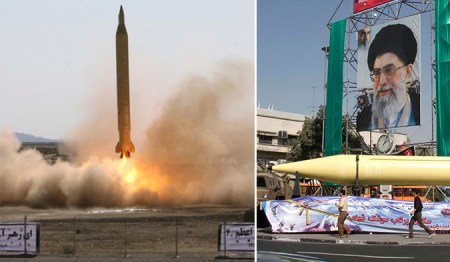
Those politicians and executives scrambling to do business with the mullahs should realize that Iran’s intercontinental ballistic missiles can tomorrow be aimed at them. Those who comfort themselves with the thought that Iran only wants to annihilate Israel might do well to think again. Iran has tested a two-stage solid-fuel missile, the Sejjil-2, with a range of more than 2,000 km, allowing it to target southeastern Europe. In addition, Iran recently unveiled the Soumar cruise missile, reportedly a reverse-engineered version of the Russia’s Raduga Kh-55 — which was designed as a nuclear delivery system. It has a claimed range of 2,500-3,000 km.

Nevertheless, the International Atomic Energy Agency (IAEA) has acceded to Iran’s demands toclose its 12-year investigation into whether Iran had a secret nuclear weapons program. The IAEA produced a report earlier this month that strongly suggested Iran did have a nuclear weapons program for the years up until 2003.

The West clearly not only fails to care about the plight of the Iranians — it does not even care about its own populations being within Iranian missile range.

Will The West Ease The Sanctions Even Though Iran Is Not Meeting Its JCPOA Obligations?

December 18, 2015

Will The West Ease The Sanctions Even Though Iran Is Not Meeting Its JCPOA Obligations? MEMRI, A. Savyon and Y. Carmon* December 17, 2015

26096

According to various reports, Iran is holding contacts with the U.S. vis-à-vis implementation of the JCPOA. On November 29, 2015, Iranian Foreign Minister Javad Zarif announced that the U.S. must do its part, that is, lift the sanctions, even before Iran meets its obligations – expressly contradicting the JCPOA.

*********************

Introduction

With the International Atomic Energy Agency (IAEA) Board of Governors’ closure, on December 15, 2015, of Iran’s PMD (Possible Military Dimensions) dossier, the JCPOA is now back on track for the implementation that began on Adoption Day, October 18, 2015.

It is now Iran’s turn to meet its JCPOA obligations, which include removing nine tons of low-level enriched uranium from the country, dismantling centrifuges so that only 6,000 active ones remain, pouring concrete into the core of the nuclear reactor at Arak in a way that will prevent it from being used for producing plutonium, adopting the Additional Protocol of the Nuclear Non-Proliferation Treaty, and more.

Once the IAEA confirms that Iran has done this, Implementation Day will be declared; under it, the lifting of some of the sanctions on Iran and the suspension of others will take place, as promised by the U.S. and European countries on October 19, 2015.

However, at this point, Iran is providing only a show of making progress in its implementation of its obligations. Inactive centrifuges are being transferred from site to site, and not a single active centrifuge has yet been dismantled. Iran has reached agreements with Russia to store its enriched uranium, and documents have been signed with the superpowers for changing the designation of the Arak reactor. But so far Iran has actually met none of its obligations.[1]

Holding back Iran’s implementation is the October 21, 2015 letter from Iranian Supreme Leader Ali Khamenei to Iranian President Hassan Rohani setting nine new conditions that must be met first.

According to various reports, Iran is holding contacts with the U.S. vis-à-vis implementation of the JCPOA. On November 29, 2015, Iranian Foreign Minister Javad Zarif announced that the U.S. must do its part, that is, lift the sanctions, even before Iran meets its obligations – expressly contradicting the JCPOA.[2] Zarif also announced, upon his arrival in New York on December 17, 2015, that there is a possibility that he will meet with U.S. Secretary of State John Kerry “for discussions on the implementation of the JCPOA.”[3]

Could The U.S. And Europe Ease Or Lift Sanctions Even If Iran Does Not Meet Its JCPOA Obligations?

U.S. representatives have given no indication that the sanctions will be eased or lifted if Iran does not meet its obligations under the JCPOA. However, in his December 15, 2015 statements, when he presented his PMD report to the IAEA Board of Governors, IAEA secretary-general Yukiya Amano hinted at such a possibility. He said: “First, Iran needs to complete the necessary preparatory steps to start implementing its nuclear-related commitments under the Joint Comprehensive Plan of Action agreed with the E3/EU+3 countries. JCPOA Implementation Day will occur when the Agency has verified that Iran has implemented measures specified in that agreement. I will inform the Board promptly when the Agency has verified that the preparatory steps have been completed [emphasis MEMRI’s].”[4]

The term “preparatory steps” does not appear in the JCPOA. It is not reasonable to suppose that the West would be satisfied with mere “preparatory steps” on Iran’s part instead of full implementation of its obligations before sanctions are eased.

It should also be noted that Amano said on the same occasion: “All parties must fully implement their commitments under the JCPOA.”[5]

At this stage, it is unclear whether Amano’s use of the words “preparatory steps” instead of the words “fully implement… commitments under the JCPOA” represents intentions on the part of the U.S. administration; it could be nothing more than a general statement. This will become clear in the near future.

In the meantime, in his December 16, 2015 address to the nation, Iranian President Rohani effusively praised the JCPOA and Iran’s gains under it, and stated that in “January” the sanctions on Iran would be lifted.[6]

However, “January” is not a reasonable time frame. Iran would not succeed in completing all its tasks in such a short time, and IAEA would certainly not be able to submit a report verifying it had done so by then.


*A. Savyon is Director of the MEMRI Iran Media Project; Y. Carmon is President of MEMRI.


Endnotes:

[1] MEMRI Inquiry & Analysis No. 1209, Power Struggle Between Iranian Supreme Leader Khamenei’s Ideological Camp And Rafsanjani’s Pragmatic Camp Intensifies – Part I: Khamenei Blocks Iran’s Implementation Of The JCPOA, December 11, 2015.

[2] See Zarif’s statements in MEMRI Inquiry & Analysis No. 1209, Power Struggle Between Iranian Supreme Leader Khamenei’s Ideological Camp And Rafsanjani’s Pragmatic Camp Intensifies – Part I: Khamenei Blocks Iran’s Implementation Of The JCPOA, December 11, 2015.

[3] ISNA (Iran), December 17, 2015. It was also reported that secret talks were held in Oman in November 2014 between U.S. Energy Secretary Ernest Moniz and Atomic Energy Agency of Iran (AEAO) director Ali Akbar Salehi, on the possibility that Kazakhstan would be the country to which Iran would sent its enriched uranium, instead of Russia. The Wall Street Journal, December 8, 2015.

[4] Iaea.org/newscenter/statements/introductory-statement-board-governors-67, December 15, 2015.

[5] Iaea.org/newscenter/statements/introductory-statement-board-governors-67, December 15, 2015.

[6] President Rohani said: “I announce to the Iranian people that in January the sanctions will be lifted; thus, one of the 11th government’s election promises to the people will be kept, the sanctions will be lifted from the feet of the Iranian economy, and the way will be opened for more cooperation with the world.” President.ir (Iran), December 16, 2015.

Nuke watchdog approves Iran for sanctions relief

December 15, 2015

Nuke watchdog approves Iran for sanctions relief, Washington ExaminerDavid Brown, December 15, 2015

(The watchdog’s teeth were extracted and its glasses taken away by the “side deals.” — DM)

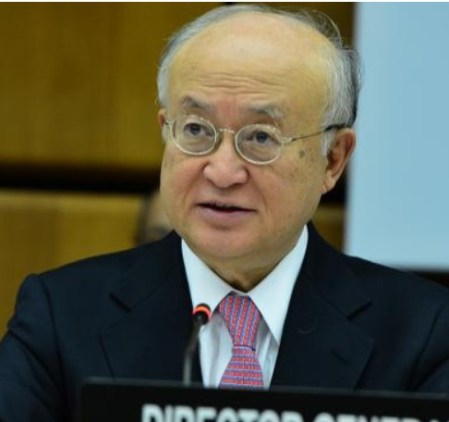
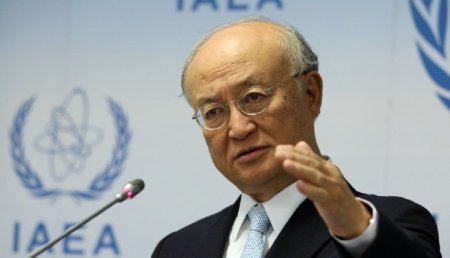
730x420-79ad08c54362ad0f598ff795dd9dc307Director General of the IAEA Yukiya Amano said, “the agency has no credible indications of activities in Iran relevant to the development of a nuclear explosive device after 2009.” (AP Photo/Ronald Zak, File)

The board of the nuclear watchdog group agreed to close the file on Iran’s past nuclear work on Tuesday, clearing the way for Tehran to receive billions in relief from international sanctions, according to news reports.

The board’s decision, according to diplomats quoted by Agence France-Presse, followed the recommendation of International Atomic Energy Agency Director General Yukiya Amano, who earlier on Tuesday said “the agency has no credible indications of activities in Iran relevant to the development of a nuclear explosive device after 2009.”

“Nor has the agency found any credible indications of the diversion of nuclear material in connection with the possible military dimensions to Iran’s nuclear program,” he said.

“Significant progress has been made on the Iran nuclear issue, but now is not the time to relax. This issue has a long and complex history, and the legacy of mistrust between Iran and the international community must be overcome,” he said. “Much work lies ahead of us. All parties must fully implement their commitments under the JCPOA. Considerable effort was required in order to reach this agreement. A similar and sustained effort will be required to implement it.”

What About Iran’s “JCPOA”?

December 15, 2015

What About Iran’s “JCPOA”? Gatestone InstituteLawrence A. Franklin, December 15, 2015

(The article mentions, but otherwise provides little of substance concerning, Iran’s interpretation of the Joint Cooperative Plan of Action (JCPOA).  This analysis by the Middle East Media Institute is about Supreme Leader Khamenei’s “guidelines” for its interpretation and implementation. They suggest something quite different from the document presented to the U.S. Congress.– DM)

  • The self-appointed P5+1, elected by no one but themselves, should be embarrassed to find that they have made a deal with no one but themselves.
  • The media’s emphasis on the JCPOA has sadly neglected any in-depth coverage of Iran’s own comprehensive plan of action, which seems to consist of developing nuclear weapons, ballistic missiles and related systems to deliver them.
  • The IAEA cannot even confirm with certainty that Iran does not already possess a nuclear bomb, and yet is not expected to challenge Tehran’s assertion that it ceased nuclear weapons development more than a decade ago.
  • Although the U.S. also cannot be certain of Iran’s intentions, it would be advisable to assume that Iran means what it says: “Death to America” and “Death to Israel.”

Iran is cheating already — or is it? Iran has not signed anything, so presumably it cannot be cheating on something it never agreed to – as predicted on these pages half a year ago. The self-appointed P5+1 (the five permanent members of the UN Security Council plus Germany), elected by no one but themselves, should be embarrassed to find that they have made a deal with no one but themselves.

The lavishly touted and lavishly dangerous “Iran Deal” not only paves the way for Iran to have nuclear weapons, as it was planning, anyway; it also rewards Iran’s repeated violations of the Non-Proliferation Treaty — which it did sign — with up to $150 billion. With a punishment like that, we should all start violating commitments.

Iran’s recent missile tests have, been undermining the rationale of the Joint Comprehensive Plan of Action (JCPOA), which the P5+1 signed with itself. If Iran is concerned that its missile tests might have violated multiple UN Resolutions, a paltry detail such as that clearly has not bothered anyone before, so why should it bother anyone now?

The media’s emphasis on the JCPOA has sadly neglected any in-depth coverage of Iran’s own comprehensive plan of action, which seems to consist of developing nuclear weapons, ballistic missiles and related systems to deliver them.

While Western diplomats were congratulating themselves on their JCPOA arrangement, Iran sent a “slap-in-the-face” signal to the Free World by launching an Emad [“Pillar”] ballistic missile on October 10. On December 8, State Department spokesperson John Kirby indirectly acknowledged the launch of a second ballistic missile, fired on November 21. Kirby was quick to point out that test was not a violation of the JCPOA.

The launches are violations, however, of UN Security Council Resolution #2231, which bans ballistic missile tests by Iran. Although these tests do not defy the letter of the JCPOA, they do defy the spirit of it. Even though the initial missile test was denounced by the U.S. and allied UN representatives, no action has so far been taken against Iran. The U.S. Ambassador to the United Nations, Samantha Power, did condemn the October test and probably will also condemn the second test. But if this is outrage, that may be the extent of it.

What seems clear is that Iran’s Islamic Revolution Guard Corps (IRGC), which controls the ballistic missile program, is attempting to goad the West into additional punitive action against the Islamic Republic. Such response would serve to strengthen the hardline opposition to the JCPOA in Iran. Further, if the United States does nothing but issue condemnatory rhetoric, it will be interpreted by the regime as additional confirmation that the U.S. desires a nuclear agreement at virtually any cost.

1388

The International Atomic Energy Association (IAEA), after its investigation into the Possible Military Dimensions (PMD) of Iran’s past nuclear weapons development activities, was forced, thanks to Tehran’s lack of cooperation and transparency to deliver an inconclusive initial report on December 2[1].

The Iranian regime’s officials, such as Deputy Foreign Minister Sayed Abbas Araghchi, have demanded the immediate lifting of the 12 UN Resolutions against Iran when the IAEA Board of Governors votes on the final PMD report on December 15.

The IAEA cannot therefore confirm with certainty that Iran does not already possess a nuclear bomb, or whether or not Tehran is presumably still pursuing one. The IAEA Board of Governors is, nevertheless, not expected to challenge Tehran’s assertion that it ceased any such activities more than a decade ago.

Iran currently has several types of ballistic missiles in varying stages of development. The range of these missiles extends from the regional to the intercontinental — with a version of one missile capable of reaching the continental United States. The most touted operational system is the Shahab (“Meteor”) program, with several follow-on versions. The Shahab system has benefited by seemingly close cooperation with North Korea’s ballistic missile program, Russian nuclear weapons engineers who were unemployed after the Soviet Union imploded, and China’s direct and indirect technical assistance.

The principal threat to regional states, particularly to Israel, is that one does not know what one does not know — in this instance, the stage of Iran’s nuclear weapons programs.

Action by the U.S. Congress to inquire why the public disclosure of Iranian ballistic missile tests is being disseminated in dribs and drabs is long overdue, especially as America’s technical intelligence collection methods provide immediate and certain knowledge of such tests.

Although the U.S. also cannot be certain of Iran’s intentions, it would be advisable to assume that Iran means what it says: “Death to America” and “Death to Israel.” If one assumes that these statements, made by a regime that stones women to death, are not mere propaganda, but ideological commitments, the time to demonstrate the Free World’s resolve by way of strategic military exercises on Iran’s borders is long overdue.

______________________________
[1] Initial PMD Report summary observations are that Iran had a coordinated program to develop a nuclear explosive device up through 2003 but the program appears not to have advanced beyond scientific testing which did permit Iran to acquire certain competencies and capabilities. However, some aspects of the program continued until 2009.

Power Struggle Between Iranian Supreme Leader Khamenei’s Ideological Camp And Rafsanjani’s Pragmatic Camp Intensifies – Part I: Khamenei Blocks Iran’s Implementation Of The JCPOA

December 11, 2015

Power Struggle Between Iranian Supreme Leader Khamenei’s Ideological Camp And Rafsanjani’s Pragmatic Camp Intensifies – Part I: Khamenei Blocks Iran’s Implementation Of The JCPOA, MEMRI, A. Savyon and Y. Carmon*, December 11, 2015

Introduction

In advance of the February 2016 elections in Iran for both the Majlis and the Assembly of Experts, and in light of Hashemi Rafsanjani’s November 25, 2015 announcement that he will run for the Assembly of Experts, the power struggle between the pragmatic camp, which Rafsanjani leads, and the ideological camp, led by Supreme Leader Ali Khamenei, has intensified. It now centers on two main focal points:

  1. Khamenei’s blocking of Iran’s implementation of the JCPOA. After Khamenei halted the implementation of the JCPOA in his October 21, 2015 letter to Iranian President Hassan Rohani,[1] all the representatives of the regime announced their support for Khamenei’s instructions; even President Rohani and Foreign Minister Javad Zarif were compelled to do so. The only one to speak out against this was Rafsanjani, who called on the regime to carry out its obligations under the JCPOA.[2]
  2. The Iranian regime’s circling the wagons against both the “American enemy” and against the “new fitna” within Iran – that is, the Rafsanjani camp which is calling for openness vis-à-vis the U.S. and for Iran to implement the JCPOA.[3] The regime activity against the U.S. and the “new fitna” gives the ideological camp leverage over the pragmatic camp. The ideological camp is playing this up in advance of the elections and hinting that the outcome of the last presidential election, in 2013, was a grave failure that must not be allowed to happen again. The Khamenei-affiliated daily Kayhan is even preparing for the possibility that Rafsanjani’s pragmatic camp will again triumph in the elections, and stated that such a development would be counter to the Islamic Revolution and its values, and must be prevented.

This first report in a two-part series on the aspects of this power struggle will focus on Supreme Leader Ali Khamenei’s blocking of Iran’s implementation of the JCPOA. The forthcoming report will focus on the Iranian regime’s promotion of its anti-U.S. stance and its stance against the “new fitna” within Iran.

MEMRI has published nearly two dozen reports on the power struggle between the Khamenei and Rafsanjani camps.   

Khamenei Blocks Iran’s Implementation Of The JCPOA

On October 21, 2015, Supreme Leader Ali Khamenei issued nine conditions countermanding the original language of the JCPOA as it was presented on July 14, 2015.[4] All regime officials, including pragmatic camp members such as President Rohani and Foreign Minister Zarif, immediately announced their acceptance of Khamenei’s new conditions – except for Hashemi Rafsanjani, who was the only one to speak out against Khamenei and called on Iran to implement its obligations under the JCPOA.[5]

Elements connected to the negotiating team and the Rafsanjani camp, among them Atomic Energy Organization of Iran (AEOI) director Ali Akbar Salehi and Expediency Council secretary Ali Shamkhani, attempted to create the impression of first steps to implement the JCPOA by transferring older-generation centrifuges that were already inactive from one site to another.

However, they were stopped immediately by Majlis members and others from the ideological camp.[6]Negotiating team members from Rafsanjani’s pragmatic camp were forced to state that thus far, no active centrifuges had been dismantled. On November 25, 2015, nuclear negotiating team member and Deputy Foreign Minister Abbas Araghchi told Iranian TV of the measures Iran had taken to meet its JCPOA commitments, saying that “none of Iran’s steps on this matter so far contradict the Leader’s letter… As far as I know, we are still in the phase of dismantling the inactive centrifuges.”[7]

On November 14, 2015, AEOI director Ali Akbar Salehi told Iranian Channel 3 TV: “The centrifuges that were dismantled were not active and did not enrich uranium… Now, we are dealing with the dismantling of centrifuges, and we began this two weeks ago, according to the orders from the Office of the President that we have undertaken and to the timetable. At Fordo, there are a few centrifuges, that is, 1,000-2,000; at the last minute, we will collect some 1,000 centrifuges from Fordo. So far, no centrifuges from Fordo have been dismantled; we have merely prepared the ground for dismantling [centrifuges]. What has been dismantled so far were inactive centrifuges at Natanz.”[8]

On November 3, 2015, AEOI spokesman Behrouz Kamalvandi said: “We will advance the work in a way that will be in accordance with the principles and guidelines of the Leader… Not a single centrifuge has been dismantled yet; at this point, we are at the preparatory stage.”[9] Several days later, he said that Iran would begin to dismantle active centrifuges immediately after the Iranian PMD (Possible Military Dimensions) dossier is closed by the IAEA Board of Governors,[10] explaining: “Now we are dismantling the inactive centrifuges; there are more of them than there are active centrifuges.” He noted that there are now only about 3,000 active  centrifuges and about 10,000 that have not been active for several years, and added: “The [active] centrifuges will be dismantled at the same time as [Iran carries out the steps to which it is obligated under the JCPOA at] the Arak reactor and as our enriched uranium is replaced with yellowcake.[11]

Iranian Foreign Minister Zarif: The Superpowers Must Meet All Their Obligations Before Iran Implements Its Own

At a November 29, 2015 joint press conference with his Greek counterpart, Foreign Minister Zarif stated that Iran’s implementation of the JCPOA could begin only after the IAEA Board of Governors closes Iran’s PMD dossier.[12] He then added a completely new demand: that the P5+1 carry out at least some of its obligations under the JCPOA even before Iran carries out its own. Zarif added that the Iranians were currently conducting talks with U.S. Secretary of State John Kerry and other American officials on this matter.

Iran’s presentation of this demand is an essential violation of the language of the agreed version of the JCPOA, which states that Iran must first implement its part in order to reach Implementation Day, and that only then, and concurrently with IAEA verification that Iran has indeed met its obligations, will the P5+1 begin carrying out its obligations with regard to the sanctions.

The following are the main points of Zarif’s statements:

Asked what progress has been made with regard to Khamenei’s demand, in his letter to President Rohani, for a direct letter from Europe and the U.S. to Iran on the issue of the removal of the sanctions, he replied: “Europe and the U.S. are obligated to remove the sanctions the day the JCPOA is implemented – that is, the U.S. must carry out steps on the day of the decision – i.e. [by Implementation Day] the U.S. and the E.U. must carry out these steps in certain ways.

“The process of implementation by the oversight team has already begun. This does not mean that the action taken by the U.S. and the E.U., and which should yield results by Implementation Day, are sufficient. We believe that the U.S. must continue to implement steps until Implementation Day. The U.S. president has ordered the energy secretary, secretary of state, and commerce secretary to carry out their obligations, and that they take all steps necessary to implement the U.S.’s obligations. The President of the United States ordered them to carry out their obligations and that prior to Implementation Day [of the JCPOA] these obligations must be implemented. On this matter, we are holding talks with the American secretary of state and other American elements [emphasis added].”[13]

*A. Savyon is Director of the MEMRI Iran Media Project; Y. Carmon is President of MEMRI.

Endnotes:

[1] See MEMRI Inquiry & Analysis No. 1196, Iranian Supreme Leader Khamenei’s Letter Of Guidelines To President Rohani On JCPOA Sets Nine Conditions Nullifying Original Agreement Announced July 14, 2015, October 22, 2015.

[2] See MEMRI Inquiry & Analysis No.1204, Breaking Report: Challenging Khamenei, Rafsanjani Demands That Iran Fulfill Its Obligations Under The JCPOA, And Reveals: We Had Nuclear Option In Iran-Iraq War, October 28, 2015.

[3] This fitna and its members were described clearly by Majlis National Security and Foreign Policy committee member Ahmad Bakhshayesh: “The Leader speaks of [American] infiltration and warns the officials. The Leader’s [warning] was addressed mainly to elements of the regime wishing to create ties with the U.S…. In our country there are two lines of thought: One is resistance to the arrogance [meaning the U.S.], championed by the Leader; and the second is ties with the U.S. like with any other country without fear of infiltration, which is championed by Hashemi Rafsanjani and President Rohani.” Fars (Iran), November 15, 2015.

[4] See MEMRI Inquiry & Analysis No. 1196, Iranian Supreme Leader Khamenei’s Letter Of Guidelines To President Rohani On JCPOA Sets Nine Conditions Nullifying Original Agreement Announced July 14, 2015, October 22, 2015.

[5] For Rafsanjani’s statements, see MEMRI Inquiry & Analysis Report No. 1204, Breaking Report: Challenging Khamenei, Rafsanjani Demands That Iran Fulfill Its Obligations Under The JCPOA, And Reveals: We Had Nuclear Option In Iran-Iraq War, October 28, 2015. For Iran’s commitments, as outlined by the Arms Control Association, see MEMRI Daily Brief No. 65, MEMRI: ‘The Emperor Has No Clothes’, October 30, 2015.

[6] See, for example, the statement by Alizera Zakani, head of the Majlis special committee to examine the JCPOA, who said that reducing the number of centrifuges at nuclear sites violated the first condition of Khamenei’s letter. According to him, this improper step triggered a warning, and subsequently the action was halted, at least at Fordo. Mehr (Iran), November 8, 2015.

[7] ISNA (Iran), November 25, 2015.

[8] IRNA (Iran), November 14, 2015.

[9] ISNA (Iran), November 3, 2015.

[10] See MEMRI Inquiry & Analysis No. 1207, The Prospects For JCPOA Implementation Following The Release Of IAEA Sec-Gen Amano’s Report On The PMD Of Iran’s Nuclear Program, December 8, 2015; and MEMRI Special Dispatch No. 6229, Statements By Iranian Deputy Foreign Minister Abbas Araghchi Indicate: IAEA’s PMD Report Is Being Written In Negotiation With Iran, Not Independently, November 27, 2015.

[11] Kayhan (Iran), November 11, 2015.

[12] See MEMRI Inquiry & Analysis No. 1207, The Prospects For JCPOA Implementation Following The Release Of IAEA Sec-Gen Amano’s Report On The PMD Of Iran’s Nuclear Program, December 8, 2015; and MEMRI Special Dispatch No. 6229, Statements By Iranian Deputy Foreign Minister Abbas Araghchi Indicate: IAEA’s PMD Report Is Being Written In Negotiation With Iran, Not Independently, November 27, 2015.

[13] ISNA (Iran), November 29, 2015.

The Prospects For JCPOA Implementation Following The Release Of IAEA Sec-Gen Amano’s Report On The PMD Of Iran’s Nuclear Program

December 8, 2015

The Prospects For JCPOA Implementation Following The Release Of IAEA Sec-Gen Amano’s Report On The PMD Of Iran’s Nuclear Program, MEMRI, A. Savyon, Y. Carmon, and U. Kafash, December 8, 2015

Introduction

On December 2, 2015, International Atomic Energy Agency (IAEA) secretary-general Yukiya Amano released his report on the Possible Military Dimensions (PMD) of Iran’s nuclear program.[1]

The report’s findings, whatever they turned out to be, were not supposed to impact the continued implementation of the Joint Comprehensive Plan of Action (JCPOA) in any way – even if they were completely negative regarding Iran. From the outset, it was agreed that all that Iran was obligated to do was to cooperate with the IAEA investigation of its PMD, and nothing more.

The next milestone date for the continued implementation of the JCPOA is December 15, 2015, when Amano’s PMD report will be presented to the IAEA Board of Governors and the latter will resolve whether to close Iran’s PMD dossier in the IAEA. This resolution is meant to be adopted by the UN Security Council.

The implementation process is meant to be continued by Iran – that is, Iran must meet its obligations under the JCPOA. These consist primarily of the removal of nine tons of low-grade enriched uranium from the country, the dismantling of centrifuges so that only 6,000 active ones remain, the pouring of concrete into the core of the Arak nuclear reactor such that it will not be able to be used to manufacture plutonium, the adoption of the Additional Protocol, and more.

After that, the IAEA will check to verify that Iran has carried these out; when it announces that it has, the next milestone date, Implementation Day, will come into force. At that time, Europe and the U.S. will carry out their promise, made October 19, 2015, to lift and suspend their sanctions on Iran.

It was Iran itself that made Amano’s PMD report a problematic issue, and, essentially, a condition for its continued implementation of the JCPOA. Iran demanded that the IAEA Board of Governors close its PMD dossier, and, according to some Iranian spokesmen, it should do so in a way that completely exonerates Iran of accusations against it regarding development of a military nuclear program. That is, Iran will not be satisfied with a closure of the dossier that is merely formal if Amano’s report does not completely exonerate it.

To this end, in the days leading up to the release of the report, Iran pressured the IAEA and the P5+1, with the aim of ensuring that the report would completely clear Iran of suspicions regarding PMD.[2]

In addition to its direct pressure on Amano, Iran also implemented political pressure on the P5+1, warning that if the dossier remained open, Iran would not implement its obligations under the JCPOA, and that the West had to choose between the PMD, that is, accusing Iran of developing a military nuclear program, and implementing the JCPOA.[3]

The Findings Of Amano’s PMD Report

Iran’s pressure netted only partial success. Prior to the report’s release, Amano stated: “What I can now say is that this is an issue that cannot be answered by ‘yes’ and ‘no.'”[4] The report included aspects that were both positive and negative for Iran.

On the one hand, it stated: “The Agency has not found indications of an undeclared nuclear fuel cycle in Iran, beyond those activities declared retrospectively by Iran. The Agency has found no indications of Iran having conducted activities which can be directly traced to the ‘uranium metal document’ or to design information for a nuclear explosive device from the clandestine nuclear supply network.”

However, it also said: “The Agency assesses that explosive bridgewire (EBW) detonators developed by Iran have characteristics relevant to a nuclear explosive device.”

With regard to the Parchin facility, Amano’s PMD report stated that “[t]he information available to the Agency… does not support Iran’s statements on the purpose of the building.” Furthermore, the report stated that “the Agency assesses that the extensive activities undertaken by Iran since February 2012 at the particular location of interest to the Agency seriously undermined the Agency’s ability to conduct effective verification.” It continued:

“The Agency assesses that Iran conducted computer modelling of a nuclear explosive device prior to 2004 and between 2005 and 2009. The Agency notes, however, the incomplete and fragmented nature of those calculations… The Agency assesses that, before the end of 2003, an organizational structure was in place in Iran suitable for the coordination of a range of activities relevant to the development of a nuclear explosive device. Although some activities took place after 2003, they were not part of a coordinated effort. The Agency’s overall assessment is that a range of activities relevant to the development of a nuclear explosive device were conducted in Iran prior to the end of 2003 as a coordinated effort, and some activities took place after 2003. The Agency also assesses that these activities did not advance beyond feasibility and scientific studies, and the acquisition of certain relevant technical competences and capabilities. The Agency has no credible indications of activities in Iran relevant to the development of a nuclear explosive device after 2009.”[5]

Iran’s Future Moves Vis-à-vis The PMD Dossier In The IAEA Board Of Governors

Assuming that the IAEA Board of Governors follows the Iran-U.S. dictates and closes Iran’s PMD dossier[6] in spite of the findings mentioned above, it is not clear that a formal closure of the dossier by the Board of Governors would satisfy Iranian Supreme Leader Ali Khamenei, or whether he would block Iran’s implementation of the JCPOA because the Amano report’s findings do not exonerate Iran.

The Iranian reactions to the report have been mixed, in accordance with the speakers’ affiliation with either the pragmatic camp of President Rohani and Foreign Minister Zarif, or the ideological camp. While the former is willing to settle for a formal closure of the PMD dossier without Iran’s complete exoneration,[7] the latter stresses that the reports’ findings determine that Iran conducted military nuclear development prior to 2009, and see this as a reason to stop the entire JCPOA process. 

The Appendix below presents statements by Deputy Foreign Minister and negotiator Abbas Aragchi, representing the pragmatic camp, and by Hossein Shariatmadari, editor of the Iranian daily Kayhan, which is affiliated with Supreme Leader Khamenei, representing the ideological camp.

It cannot be known whether Khamenei and ideological camp spokesmen will accept the Board of Governors’ resolution as sufficient. Furthermore, even if Khamenei decides to accept a closure of the PMD dossier by the Board of Governors as sufficient, his nine new conditions for Iran’s implementation of the JCPOA, as set out on October 21, 2015, remain an obstacle to Iran’s implementation of the JCPOA.[8]

Appendix

Statements By Deputy Foreign Minister Araghchi Immediately After The Release Of Amano’s PMD Report

On December 2, 2015, Iranian Deputy Foreign Minister Abbas Araghchi told Iranian Channel 1: “In the matter of the [Final Assessment] on Past and Present Outstanding Issues [Regarding Iran’s Nuclear Program], the Amano report states explicitly that all the claims about PMD [refer] strictly to scientific studies [and not to military development]. This is the most salient point in the Amano report. The general view of the IAEA vis-à-vis Past and Present Outstanding Issues in Iran’s nuclear program counters the claims made against Iran in the past decade.

“The IAEA assessment is that prior to 2003, research activity was carried out in Iran, not by it. Likewise, there is no sign that nuclear material was diverted to any initiatives that are not for peaceful purposes.

“The claims in the IAEA report about science and research activity are unacceptable to us, and we will inform the IAEA of our opinion on this matter within the allotted time, even though previously Amano said that his report was not black or white, but in my opinion it leans more towards the white side, particularly when the conclusion of the report explicitly rejects [the claim] that there is in Iran a military program, and it is preparing the ground for the Board of Governors to close the issue of the PMD dossier.

“The report states that there is no sign of nuclear material in matters that are not for peaceful purposes, and also that there is no sign of an undeclared nuclear fuel cycle in Iran. In the matter of equipment [for] dual use, the IAEA says that in the past Iran worked on detonators, but the report declares that these detonators had uses for both peaceful and non-peaceful purposes, and that the IAEA could not make a determination in this matter…

“Likewise, Iran’s procurements [activities] are not against [the law] and there is no organization in Iran that was established to produce an atomic bomb and nuclear weapons. The IAEA pointed out that in the past there was an organizational structure for this purpose [i.e. to create a nuclear weapon] and that in Iran’s view this, this organization could have been used for conventional weapons.

“Nowhere in the IAEA report does it say that Iran conducted dual use activity, except it is written that dual use activity was carried out in Iran; nowhere in the report does it accuse the Iranian government of operating in this direction.

“An additional positive point is that nowhere in the IAEA report is the term PMD used, since we have never officially recognized this matter and have not allowed the use of it in official documents or discussions. The JCPOA and the [IAEA] Road-map likewise do not use this term. In this report, there is use of [the term] ‘[Final Assessment] on Past and Present Outstanding Issues [Regarding Iran’s Nuclear Program] and there is no use at all of the term Possible Military Dimensions.

“The IAEA’s claim that in the past there was research concerning military nuclear activity could be a negative issue. I believe that if the IAEA had sought the truth, it would not have said such a thing. Additionally, the IAEA claimed that an explosives firing chamber was constructed at Parchin, that now does not exist. According to photos from 2000 that we have shown the IAEA, and on which the IAEA is basing its claims, there was never any such chamber at such a location. Further, the IAEA visited Parchin twice, in 2004 and 2005, and saw no such thing. We do not confirm this claim, and we did not want such a summary to appear in the IAEA report.

“All in all, when all the IAEA’s previous claims are placed next to the [Amano report’s] findings, it appears that the report’s fairness leans in Iran’s favor. The Board of Governors has no excuse to leave this dossier open…

“Although the IAEA took samples from the Parchin site, it is not declaring that it found nothing to justify its claims. We expected the IAEA to act fairly and realistically and not to present these things in the report…

“Amano is not in a position to close the PMD dossier. Amano is a [strictly] technical element that must report on his assessment according to reality, facts on the ground, and research that was carried out. The Board of Governors must resolve whether to close the PMD dossier. In my opinion, with regard to the report that Amano published, this procedure should be ended, because there is no proof that Iran’s nuclear program is military, or [was so] even in the past…

“According to the JCPOA, the P5+1 must submit to the Board of Governors a draft resolution with the aim of closing the PMD dossier. It does not appear that the board will decide otherwise in the matter, because the [political] will is to close [the dossier], and the Amano report provides a reason to do so.

“Another positive point in the Amano report is its pointing out that the Road-map was carried out perfectly by Iran. According to it, Iran met all its obligations.

“Still, the absolute Iranian position is that if this dossier is not closed, and if even the smallest window remains open [that will allow] a return to this issue, the JCPOA will not be implemented. We have conveyed this message, in a serious manner, to the other side, that if the PMD dossier is not closed [as noted above], we will not carry out our main steps in the JCPOA. The P5+1 and the Board of Governors must choose one or the other: the PMD or the JCPOA.

“The IAEA report mentions a prohibition on the use of dual equipment in illegal matters, particularly nuclear weapons, but there is no prohibition on the use of dual equipment in ways that are for peaceful purposes or for conventional weapons. The IAEA has said that EBW [Exploding-Bridgewire Detonator] and MPI [Multipoint Initiation] are equipment that has a use in nuclear weapons, Iran has manufactured them and used them. The IAEA says explicitly that it cannot determine [which] use Iran has made of them. We have presented the IAEA with documents that show the use of this equipment in the oil industry and Amano mentioned that Iran has used dual equipment in matters of peaceful purposes…”[9]

Hossein Shariatmadari In Kayhan Editorial, December 5, 2015

In Kayhan’s December 5, 2015 editorial, Shariatmadari wrote: “On Wednesday, December 2, the IAEA released its final report on the PMD. In this report, without presenting any evidence or proof, the IAEA rejects the opinion of Iran, which Iran has stated many times, and writes that up until 2009 Iran engaged in a series of activities connected to the production of nuclear weapons. This is despite the fact that in the past 12 years Iran has absolutely rejected any deviation [in a military direction] in its civilian nuclear activity.

“In spite of the extensive and comprehensive visits by IAEA inspectors, there is no finding to this claim. Several minutes after it was released, the report was welcomed by the media in the U.S. and in the Zionist regime. It was said that this report confirms their previous statements against Iran’s nuclear program, and Iran was accused of lying and cheating for several years.

“It may be that the IAEA report will have dangerous ramifications, that should be stated:

“1.   It was told [to us] that in the nuclear talks it was agreed that the IAEA report would be grey, but that the Board of Governors will close [the matter of the] claim [regarding] the PMD by means of its final resolution. About this, it must be said that:

“a.    If this is a matter of an official agreement, where is this mentioned in the JCPOA? The answer is: Nowhere.

“b.   And if this was an oral agreement, how can the oral agreements of the rival be trusted when it has violated and continues to violate its formal obligations?!

“c.    It was told [to us] that the IAEA report would be grey – that is, with black and white points, positive and negative. Contrary to the opinion of our dear brother Dr. Araghchi, not only does this report not lean more towards white, but most of its sections are black. Additionally, the white points that the members [of the negotiating team] mention have only a white exterior, and their essence is completely black; we will address this later on.

“2.   The report states that up to 2009, Iran engaged in research and development connected to [nuclear] weapons – that is, the part of the report that addresses Iran’s nuclear challenge, which has continued for 12 years, is decided in favor of the rival. This is because in the past 12 years, the U.S. and its allies, and after that the P5+1, accused Iran of deviating in its nuclear program in the direction of nuclear weapons… Ultimately, the IAEA carried out more extensive oversight activity than [that required] in the Additional Protocol, and found no document attesting that Iran’s nuclear activity was not civilian. [Our] technical and judicial expectation was that the report would reject the claims that Iran had deviated in its nuclear program or at the very least that it would be stated [in it] that it had found no sign of such a deviation. But the report confirms the groundless and evidence-free claim of the U.S. and its allies.

“3.   Our friends [on the negotiating team] say that the general view of the report shows that its conclusion contradicts all the claims and talk against Iran’s nuclear program in the past 12 years… For 12 years [the U.S. and its allies] have claimed that Iran’s nuclear program is not civilian and is advancing in the direction of nuclear weapons. The IAEA report justifies this claim. How, then, can it be said that ‘the report contradicts the claims [against Iran] in the past 12 years!?’

“4.   The U.S. and its allies accused Iran, without presenting any proof, that up until 2009 it made efforts to obtain nuclear weapons. Now, the report justifies the claims and accuses Iran of lying, cheating, concealing, breaking the law, and more. Those responsible for the nuclear negotiations must be asked: Was this the intention of the ‘acquisition of international confidence for Iran’ that you talked so much about? Take a quick look at the statements by American, European, and Zionist elements, and at the commentary and analysis by the foreign media, that were published immediately after the report was released: U.S. Secretary of State John Kerry says proudly that everything we [the U.S.] said about Iran’s nuclear program was true.[10] He stresses that we [the U.S.] had never had any doubts that Iran had striven to attain nuclear weapons.[11] Reuters rejected Iran’s statements that we had never wanted nuclear weapons, and wrote, with a large headline: ‘Iran had ‘coordinated effort’ relevant to atom bombs – IAEA.’ USA Today accuses Iran of lying about its non-civilian nuclear activity up to 2009. The Times of Israel spoke respectfully of the opinion of Israeli experts that from the outset, they had said that Iran was making efforts to create nuclear weapons, and more.

“5.   The first article of the [IAEA] report states that it is ‘based on information available to the IAEA… [The points in the original report] include information obtained by the IAEA from Iran in the Framework for Cooperation, including the Road-map and the JCPOA.’ This article says, or at least can be interpreted as saying, that even the elements in Iran (as the IAEA supposes) agreed that up to 2009 Iran engaged in non-civilian [nuclear] activity. Now, tell me: What is white in this report [as Araghchi said], and what in it arouses pride?!

“6.   The IAEA report on the PMD is a final report, and the IAEA saw no need to continue to investigate. Perhaps there will be those who will see this as a white point, and as a point in [Iran’s] favor. But in effect, the IAEA is stating absolutely that Iran made efforts to attain nuclear weapons, and that there is no need to reexamine this. That is, the ground has been prepared for future exploitation [of this claim against Iran].

“7.   The report justifies the suspicion of the U.S. and its allies regarding Iran’s nuclear activity and their perception of it non-civilian. Therefore, this justifies grave restrictions on Iran’s nuclear activity, as well as unprecedented oversight on it. If we accept this report, we will destroy [with our own hands] all our achievements gained through great effort and sacrifices in blood.

“8.    The IAEA report could be more dangerous than the JCPOA, because it is an international document that proves that the opinions and proof that Iran submitted concerning its non-civilian nuclear program are unrealistic and unreliable. Therefore, the U.S. can extend the implementation of the JCPOA from 15 years to 25 years, or even for eternity, on the pretext that the IAEA report shows that you [i.e. Iran] have lied  for 12 years about your nuclear program and there is guarantee that you will not want to produce nuclear weapons under your civilian program.  

“9.    If Iran accepts the IAEA report, as unfortunately is becoming clear from statements by certain elements, the document will gain international [validity], and even if the Board of Governors closes the PMD dossier, this document [i.e. the report] is sufficient in order to permanently restrict our nuclear program and to leave Iran’s nuclear activity in the laboratory and as pilot [project]. That is, on the level of ‘nothing.’ Not for nothing have the rival’s media published the report enthusiastically and applauded the IAEA and its secretary-general.

“10. With regard to the U.S.’s long list of broken promises and deception in the past 12 years of [Iran’s] nuclear challenge, it can be said fervently that even if we assume that the Board of Governors closes the PMD dossier, as the friends [in the negotiating team] say it has promised, the IAEA’s final report can serve as a good basis for future extortion and excessive demands on the part of the U.S…

“11. In conclusion, the defense of [Iran’s] national and scientific interests requires that the elements connected to the nuclear [issue] in Iran show strength and might and explicitly oppose the report and [demand that it be considered] an illegal report and not a technical report [that is, that it be considered a political report] lacking all findings and proof.”[12]


Endnotes:

[1] Final Assessment on Past and Present Outstanding Issues regarding Iran’s Nuclear Programme, Isis-online.org/uploads/isis-reports/documents/IAEA_PMD_Assessment_2Dec2015.pdf.

[2] Iranian Deputy Foreign Minister Abbas Araghchi said: “In the coming days, our experts will be in touch with IAEA experts, and if necessary, they will raise further points. It is even possible that I will meet with Amano again… According to what we were told, there are some weak points in the IAEA report, on which I have commented. I am optimistic that they will be amended. I have provided necessary comments to the Americans and Europeans.” ISNA (Iran), November 25, 2015. On November 29, 2015, he said: “We expect [IAEA secretary-general] Amano to present the Board of Governors with a realistic and moderate report. It is true that it is not possible to determine absolutely what happened 10-15 years ago, and there are various possibilities. We do not expect that Amano will present an absolute report… In any event,  the resolution [about closing the PMD dossier]  lies with the Board of Governors [and not with Amano]. Our criterion is the closure of the PMD dossier in the Board of Governors. We are waiting for its resolution.” Mehr. Iran, November 29, 2015. Also see MEMRI Special Dispatch No. 6229, Statements By Iranian Deputy Foreign Minister Abbas Araghchi Indicate: IAEA’s PMD Report Is Being Written In Negotiation With Iran, Not Independently, November 27, 2015.

[3] Aragchi said on November 29, 2015: “We are now in consultation on the content of the draft resolution that the P5+1 is meant to present to the Board of Governors. In the content [of the draft resolution], they must use terms that mean closure and conclusion of the PMD dossier in the Board of Governors. If this dossier is not closed, our position is absolutely clear – this dossier must be closed, so that we implement the JCPOA. If not, we will not implement our obligations, that according to the JCPOA Iran must implement after the closure of the PMD dossier. That is, the JCPOA will not be implemented fully. Mehr (Iran), November 29, 2015. Araghchi added, “If Yukiya Amano or the Board of Governors present their report in such a way that it does not meet the obligations that were given, Iran too will stop [implementing] the JCPOA.” Press TV, Iran, November 26, 2015. Also, at a November 26, 2015 press conference, Foreign Minister Zarif said: “The Amano report, in the coming days, will help close the dossier permanently. If the report is realistic enough, Iran will move in the direction envisioned for it in the past [that is, it will implement the JCPOA].”The PMD is encapsulated, though we believe undeservedly, as ‘concerns past and present’ in the text of the JCPOA; we hope Amano’s report within upcoming days will help close the case forever. If the report is realistic enough, Iran will move in the direction predicted for it before.” Mehr (Iran), November 26, 2015. Also see similar statements by Supreme National Security Council secretary Ali Shamkhani, ISNA, Iran, November 29, 2015. Additionally, on December 1, 2015, the daily Etemaad, which is affiliated with pragmatic camp leader Hashemi Rafsanjani, stated that the negotiating team had said clearly that the West must choose between the PMD and the JCPOA.

[4] Reuters, November 26, 2015.

[5] Final Assessment on Past and Present Outstanding Issues regarding Iran’s Nuclear Programme. Isis-online.org/uploads/isis-reports/documents/IAEA_PMD_Assessment_2Dec2015.pdf.

[6] A hint at this could be found in the December 5, 2015 editorial of the Iranian daily Kayhan, in which the paper’s editor, Hossein Shariatmadari, wrote: “It was told [to us] that in the nuclear talks it was agreed that the IAEA report would be grey, but that the Board of Governors will close [the matter of the] claim [regarding] the PMD by means of its final resolution” (see Appendix for the full editorial). Also, Araghchi’s November 26, 2015 statements to Iran’s Press TV hinted at commitments to Iran in this vein: “If Yukiya Amano or the Board of Governors present their report in such a way that it does not meet the obligations that were given, Iran too will stop [implementing] the JCPOA.”

[7] Although the members of the negotiating team also claimed that the Amano report contains statements that are unacceptable. Following the report’s release, Araghchi said in a December 2, 2015 television interview: “The claims in the IAEA report about science and research activity are unacceptable to us, and we will inform the IAEA of our opinion on this matter within the allotted time… The IAEA’s claim that in the past there was research concerning military nuclear activity could be a negative issue. I believe that if the IAEA had sought the truth, it would not have said such a thing. Additionally, the IAEA claimed that an explosives firing chamber was constructed at Parchin, that now does not exist. According to photos from 2000 that we have shown the IAEA, and on which the IAEA is basing its claims, there was never any such chamber at such a location. Further, the IAEA visited Parchin twice, in 2004 and 2005, and saw no such thing. We do not confirm this claim, and we did not want such a summary to appear in the IAEA report” (for the full statements, see Appendix). ISNA, Iran, December 2, 2015. See also statements by Atomic Energy Organization of Iran director Ali Akbar Salehi: “Based on the Amano report, there remains no way to leave the PMD dossier open… Based on this [report], and on my extensive experience in the IAEA, the PMD dossier will be closed for certain, because they have not succeeded in presenting any document. Therefore, this false dossier that has entangled us for many years will be closed permanently.” Nasimonline, Iran, December 3, 2015.

[8] See MEMRI Inquiry & Analysis Series Report No. 1196, Iranian Supreme Leader Khamenei’s Letter Of Guidelines To President Rohani On JCPOA Sets Nine Conditions Nullifying Original Agreement Announced July 14, 2015, October 22, 2015.

[9] ISNA (Iran), December 2, 2015.

[10] MEMRI did not find Kerry’s exact words in this regard.

[11] Kerry said at a December 4, 2015 press conference that “nobody has had any doubts whatsoever about Iran’s past military endeavors.” State.gov/secretary/remarks/2015/12/250362.htm.

[12] Kayhan (Iran), December 5, 2015.

Iran threatens to walk away from nuke deal

November 26, 2015

Iran threatens to walk away from nuke deal, Washington ExaminerPete Kasperowicz, November 26, 2015

A top Iranian official warned Thursday that Iran would stop its efforts to comply with the Iran nuclear agreement unless international inspectors stop their investigation into Iran’s past work on its nuclear program.

Under the deal, inspectors were instructed to examine the “possible military dimensions” of Iran’s nuclear program, or PMDs.

International Atomic Energy Agency chief Yukiya Amano is expected to release a new report on Iran’s nuclear program on Dec. 1. Iran’s deputy foreign minister, Seyyed Abbas Araqchi, warned that if the Dec. 1 report doesn’t close the file on PMDs, Iran will walk away.

“In case Yukiya Amano or the Board of Governors presents their report in such a way that it does not meet the stipulated commitments, the Islamic Republic of Iran will also stop [the implementation of] the JCPOA,” he said, according to PressTV, Iran’s state-owned news service.

The JCPOA is the Joint Comprehensive Plan of Action, informally known as the Iran deal.

Iran’s new threat could be a significant problem for the implementation of the deal. On the same day Araqchi spoke, Amano delivered remarks in Vienna in which he said it’s still not clear how much undeclared nuclear material might exist in Iran.

“As my latest report on safeguards implementation in Iran shows, the agency continues to verify the non-diversion of nuclear material declared by Iran under its Safeguards Agreement,” IAEA Director General Yukiya Amano said in a prepared statement in Vienna, Austria.

“But we are not in a position to provide credible assurance about the absence of undeclared nuclear material and activities in Iran, and therefore to conclude that all nuclear material in Iran is in peaceful activities,” he added.

Amano has made similar remarks all year, and it’s a strong sign that Iran has yet to fully cooperate with inspectors under the Iran nuclear agreement.

Western leaders ignore ‘apocalyptic Islam’ at their peril

November 15, 2015

Western leaders ignore ‘apocalyptic Islam’ at their peril, Israel National News, Ari Soffer, November 15, 2015

img634813Bataclan concert hall following terror attackReuters

[G]laringly absent from the discussions [of the Paris attack] are any serious attempts to understand the ideological motivations of the Muslim extremists, several of them French citizens, who carried out the worse terror attacks in France in a generation – including the first-ever suicide bombings on French soil.

**************************

Despite years of warnings by intelligence agencies that radicalized Muslims would eventually emerge from the battlefields of Syria and Iraq to launch bloody attacks in the West, Europe has been blindsided by one of the most brutal terrorist atrocities in recent memory.

The coordinated attacks by three teams of ISIS terrorists in Paris on Friday sent shockwaves far beyond France, with the massacre of at least 129 people reigniting the debate around immigration after it was revealed that at least two of the attackers entered Europe posing as “refugees.”

The attacks also fueled debate over how to end the Syrian civil war, as well as over ongoing efforts to defeat ISIS on the battlefields of Syria and Iraq, the latter of which has seen several successes over the past few weeks.

But glaringly absent from the discussions are any serious attempts to understand the ideological motivations of the Muslim extremists, several of them French citizens, who carried out the worse terror attacks in France in a generation – including the first-ever suicide bombings on French soil.

That, says best-selling author Joel Rosenberg, is the reason such acts of terror are bound to repeat themselves.

Joel spoke to me prior to the attacks at the recent Jerusalem Leaders Policy Summit, and voiced concern that by failing to grapple with the apocalyptic ideology behind actors such as ISIS, Western states would never be able to decisively defeat them.

Watch: Author Joel Rosenberg speaks in Jerusalem:

https://www.youtube.com/watch?v=whj0gmLLgOY

A jovial, somewhat self-deprecating character, Rosenberg – who worked for Binyamin Netanyahu during his failed prime ministerial bid in 1999, as well as Natan Sharansky – describes himself as “a failed political consultant,” but boasts a rather more successful career as writer, selling millions of novels highlighting the threat of radical Islam.

Today he lives in Netanya in northern Israel with his family, having made aliyah from the US last August at the height of Operation Protective Edge (though a practicing Christian his father was Jewish, making him eligible for aliyah under the Right of Return). From there, he has continued his efforts to explain “the threats we mutually face as Israelis and Americans from radical Islam” – a threat he says he only fully appreciated after working with Netanyahu.

“Misunderstanding the nature of the threat… of evil, is to risk being blindsided by it,” he said, citing Peal Harbor and 9/11 as examples. “And we’re going to be blindsided by a nuclear Iran, just like we’re being blindsided by ISIS.”

“At the core of it, American leaders are refusing to deal with the theology and eschatology of our enemy,” he said. “Not every Muslim is a terrorist, not every Muslim is a threat, not every Muslim is a problem – in fact the vast majority are not.

“The question is, the ones who are – what do they want? What do they say they want? What motivates them?”

The current US administration is particularly hesitant to label the threat as it is.

“Obama refuses to even acknowledge radical Islam. Come on – really? At this stage in the 21st century you’re not even ready to acknowledge the ideology that is motivating these folks? That’s a problem.”

Days later, as the attacks in Paris unfolded, some criticized the US president for once again failing to mention radical Islam at all in his speech reacting to the massacre.

Watch: Obama delivers response to Paris attacks:

https://www.youtube.com/watch?v=B8Kx8652EFo

But beyond the relatively wide umbrella of “radical Islam” Rosenberg warns of a far deadlier threat.

“Radical Islam encompasses a wide range of groups… Hamas, the Muslim Brotherhood, Hezbollah, the Taliban, Al Qaeda – all of these are serious threats,” he noted. “But apocalyptic Islam is now the biggest threat. this is the Iranian leadership, this is ISIS.”

He argues that the hyper-messianic ideologies shared by both sides of the Shia-Sunni jihadist coin are unprecedented in the history of modern western civilization.

“Apocalyptic Islam is motivated by the idea that the end of days has come, that the Mahdi [Muslim messiah – ed.] is coming at any moment to establish a global Islamic kingdom or Caliphate, and that the way to hasten his coming is to annihilate two countries: Israel the ‘Little Satan,’ and America the ‘Big Satan,'” he explained, describing the messianic beliefs shared by both ISIS and the “Twelver Shia” sect which figures prominently among Iran’s leadership.

“But the western political class doesn’t want to even deal with the theological ideas that are driving the radical Islamists – let alone to explain the end of times theologies of two ‘nation states’,” he continued, referring to Iran and ISIS’s self-declared “Islamic State,” which encompasses huge swathes of territory in Iraq and Syria.

“Never in history have we had one, much less than two states, whose leaders are trying to force the end of the world,” Rosenberg noted.

While Jews and Christians also have their own beliefs in the “end of times” or the messianic age, the difference is that “we don’t believe we have to commit a genocide to bring about the end of times.”

While some strategic and doctrinal differences do clearly exist between Iran and ISIS – who are themselves mortal enemies – Rosenberg emphasized that the fundamental threat was essentially the same.

“Shia apocalypticism and Sunni apocalypticism are similar. Both believe the messiah is coming soon, that his kingdom is coming, they need to change their behavior to accelerate his coming… but the eschatology and strategies are different.

“ISIS’s strategy is to commit genocide today, because the goal is to build the caliphate, to force the hand of the messiah to come.

“Iran is not trying to build a caliphate today. They’re building the infrastructure to build nuclear weapons. Why? Because while ISIS wants to commit genocide today Iran wants to commit genocide tomorrow. The point is: don’t launch until you’re ready. Rather than kill thousands in one day, Iran wants to eventually kill millions.”

He disagreed with assessments shared by some experts that the Iranian regime, while extreme, ultimately functions as a rational actor, insisting their words, beliefs and actions only led to one conclusion.

“When you look a the messages of annihilation they are saying… when you look at the infrastructure they’re building and when you look at the eschatology, these roads converge.

“They’re not interested in negotiating something together with us – they’re taking a gift,” he said of the nuclear deal Tehran signed with world powers. “You’re giving us two paths to a nuclear bomb: if we cheat, or if we don’t cheat? OK we’ll take it!”

In the shorter term Iran might they use its nuclear capabilities for more limited political goals such as “blackmail or to give a cover for terror,” he said.

But in the long term its goals were just as bloodthirsty as ISIS. In facing down both threats, the West must recognize it is facing a zero-sum game.

“For these guys killing is at the center of what they’re doing. When you bear that in mind making concessions isn’t just a mistake or misguided – it’s insane.”