Posted tagged ‘Iranian missiles’

Iran has stopped dismantling nuclear centrifuges: senior official

November 11, 2015

Iran has stopped dismantling nuclear centrifuges: senior official

DUBAI

Tue Nov 10, 2015 2:37pm EST

Source: Iran has stopped dismantling nuclear centrifuges: senior official | Reuters

Iran has stopped dismantling centrifuges in two uranium enrichment plants, state media reported on Tuesday, days after conservative lawmakers complained to President Hassan Rouhani that the process was too rushed.

Last week, Iran announced it had begun shutting down inactive centrifuges at the Natanz and Fordow plants under the terms of a deal struck with world powers in July that limits its nuclear program in exchange for easing sanctions.

Iran’s hardliners continue to resist and undermine the nuclear deal, which was forged by moderates they oppose and which they see as a capitulation to the West.

“The (dismantling) process stopped with a warning,” Ali Shamkhani, Secretary of the National Security Council, was quoted as saying by the ISNA student news agency.

Only decommissioned centrifuges were being dismantled to begin with, of which there were about 10,000 at Natanz and Fordow, the Atomic Energy Organisation of Iran has said.

Shamkhani did not specify what he meant by “warning”, but the head of parliament’s nuclear deal commission, Alireza Zakani, told Mehr news agency that the dismantling had stopped in Fordow because of the lawmakers’ letter to Rouhani.

Zakani, who was not one of the signatories of the letter, did not mention activities at Natanz.

A group of 20 hardline parliamentarians wrote to the president last week complaining that the deactivation of centrifuges contradicted the directives of Supreme Leader Ayatollah Ali Khamenei.

Khamenei has said that the deal should only be implemented once allegations of past military dimensions (PMD) of Iran’s nuclear program had been settled.

The International Atomic Energy Agency is expected to announce its conclusions on PMD by Dec. 15.

Centrifuges spin at supersonic speed to increase the ratio of the fissile isotope in uranium. Low-enriched uranium is used to fuel nuclear power plants, Iran’s stated goal, but can also provide material for bombs if refined much further.

Iran denied Western suspicions it was aiming to build a nuclear bomb.

(Reporting by Bozorgmehr Sharafedin; Editing by Yara Bayoumy and Raissa Kasolowsky)


Cartoon of the day

October 17, 2015

H/t Power Line

Obama-Missile-copy

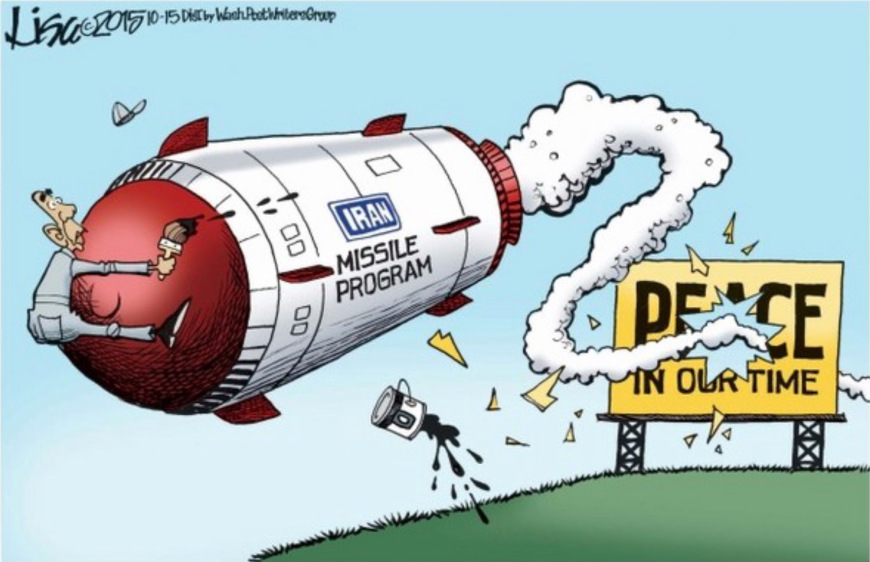
US confirms Iran tested nuclear-capable ballistic missile

October 16, 2015

US confirms Iran tested nuclear-capable ballistic missile

Source: US confirms Iran tested nuclear-capable ballistic missile – Middle East – Jerusalem Post


The United States has confirmed that Iran tested a medium-range missile capable of delivering a nuclear weapon in “clear violation” of a United Nations Security Council ban on ballistic missile tests, a senior US official said on Friday.

“The United States is deeply concerned about Iran’s recent ballistic missile launch,” US Ambassador to the United Nations Samantha Power said in a statement.

“After reviewing the available information, we can confirm that Iran launched on Oct. 10 a medium-range ballistic missile inherently capable of delivering a nuclear weapon,” she said. “This was a clear violation of UN Security Council Resolution 1929.”

WATCH: Iranian Revolutionary Guard reveals underground missile base

October 14, 2015

WATCH: Iranian Revolutionary Guard reveals underground missile base

Source: WATCH: Iranian Revolutionary Guard reveals underground missile base – Middle East – Jerusalem Post

http://tinyurl.com/pwrxzv4

Iran’s Revolutionary Guard on Wednesday revealed an underground bunker in which it stores long-range ballistic missiles, Iran’s semi-official Fars News Agency reported.

Footage of the underground missile bunker was aired on Iranian state television. According to Fars, a number of ballistic missiles were shown in the underground tunnel including a model with a range of 2,000 kilometers.

Fars quoted Amir Ali Hajizadeh, head of the Revolutionary Guard’s aerospace branch, as saying that the missiles represented the next generation of Iranian long-range missile technology.

The missile bunker shown is one of many that are buried as deep as “500 meters below the high mountains,” Fars reported.

Iran state television showed on Sunday what it said was a successful launch of the new Iranian missile, named Emad, which appears to be Tehran’s first precision-guided weapon with the range to strike its regional enemy Israel.

A total of 220 of Iran’s 290 lawmakers praised the missile test on Wednesday, announcing their full support of measures that “strengthen Iran’s defense capabilities.”

The US State Department said that the missile test was an apparent violation of a UN Security Council resolution and Washington will raise it at the United Nations.

“We’ll obviously raise this at the UNSC as we have done in previous launches,” State Department spokesman Mark Toner told reporters, noting the test appeared to be a violation of U.N. Security resolution 1929.

He and White House spokesman Josh Earnest both said the issue was separate from a deal Iran struck in July with six world powers, which seeks to curb Tehran’s atomic program in return for having sanctions against it eased.

Ballistic missile tests by Iran are banned under Security Council resolution 1929, which dates from 2010 and remains valid until the July 14 nuclear deal goes into effect.

Once the deal takes effect, Iran will still be “called upon” not to undertake any ballistic missiles work designed to deliver nuclear weapons for a period of up to eight years, according to a Security Council resolution adopted in July.

The resolution says that when the deal is in effect countries will be allowed to transfer missile technology and heavy weapons to Iran on a case-by-case basis with council approval.

However, at the time the resolution was drafted, a U.S. official called this provision meaningless and said the United States would veto any suggested transfer of missile technology to Iran.

Speaking on Tuesday, White House spokesman Earnest made clear countries could more to stop the flow of ballistic missile technology to Iran.

“That is work that requires international cooperation,” he said, adding that Washington was ready to work with Gulf allies to counter Iran’s ballistic missile program.

Iran Parliament passes bill approving nuclear deal

October 13, 2015

Iran Parliament passes bill approving nuclear deal

Published time: 13 Oct, 2015 05:50

Edited time: 13 Oct, 2015 06:37

Source: Iran Parliament passes bill approving nuclear deal — RT News

© Behrouz Mehri
The Iranian parliament has voted in favor of the nuclear deal with world powers, yet preconditioned that international inspectors will only have limited access to Tehran’s military facilities, reports IRNA news agency.

“The bill to implement the JCPOA … was passed in a public session on Tuesday with 161 votes in favor,” Reuters cited IRNA as saying, which referred to the Joint Comprehensive Plan of Action reached in July.

The parliament has also agreed on counter-measures in case the deal is not approved by other parties.

Now that the deal has been approved by the Majlis, the lower house, it needs endorsement by the Guardian Council of the Constitution consisting of clerics. Once the council approves the bill, it will come into law.

Once in force, the bill on the 6+1 nuclear agreement will enable Iranian government to implement the deal.

The agreement has a strong opposition from the Republican Party in the US, which attempted to prevent the deal from being approved by the Senate, but the Obama administration has so far been effective in finding right arguments to expect the deal get be agreed upon.

READ MORE: Senate fails to sink Iran nuclear deal by tying it to Israel

An Israeli lobby in the US has been fiercely opposing the nuclear agreement with Iran and put much effort to disrupt it.

The Israeli government has been vocally opposed to the deal, with the American-Israel Public Affairs Committee (AIPAC) spending up to $40 million on a public relations campaign criticizing the agreement, according to National Public Radio.

READ MORE: UN nuclear watchdog chief visits Parchin military facility in Iran

The historic agreement between Iran and six world powers was reached on July 14, putting an end to years of complex negotiations regarding the fate of the Iranian nuclear program. The deal is contingent on the adoption of a set of measures, the completion of which will lift all sanctions imposed on Tehran by the UN Security Council, the US and the EU.

The Iran Nuclear Deal: What the Next President Should Do

October 2, 2015

The Iran Nuclear Deal: What the Next President Should Do, Heritage Foundation, October 2, 2015

(But please see, The Elephant In The Room. — DM)

The failure of Congress to halt the implementation of the Obama Administration’s nuclear agreement with Tehran means that the U.S. is stuck with a bad deal on Iran’s nuclear program at least for now. Iran’s radical Islamist regime will now benefit from the suspension of international sanctions without dismantling its nuclear infrastructure, which will remain basically intact. Iran’s path to a nuclear weapon is unlikely to be blocked by the Administration’s flawed deal, any more than North Korea was blocked by the Clinton Administration’s 1994 Agreed Framework.

The next President should not passively accept Obama’s risky deal with Tehran as a fait accompli. Instead, he or she should immediately cite any violations of the agreement by Iran, its continued support for terrorism, or other hostile policies as reason to abrogate the agreement. The Bush Administration, faced with bad deals negotiated by the Clinton Administration, eventually withdrew from both the Agreed Framework and the Kyoto Protocol.

Rather than endorsing a dangerous agreement that bolsters Iran’s economy, facilitates its military buildup, and paves the way for an eventual Iranian nuclear breakout, the next Administration must accelerate efforts to deter, contain, and roll back the influence of Iran’s theocratic dictatorship, which continues to call for “death to America.”

How the Next President Should Deal with Iran

Upon entering office, the next Administration should immediately review Iran’s compliance with the existing deal, as well as its behavior in sponsoring terrorism, subverting nearby governments, and attacking U.S. allies. Any evidence that Iran is cheating on the agreement (which is likely given Iran’s past behavior) or continuing hostile acts against the U.S. and its allies should be used to justify nullification of the agreement.

Regrettably, Tehran already will have pocketed up to $100 billion in sanctions relief by the time the next Administration comes to office because of the frontloading of sanctions relief in the early months of the misconceived deal. Continuing to fork over billions of dollars that Tehran can use to finance further terrorism, subversion, and military and nuclear expansion will only worsen the situation.

In place of the flawed nuclear agreement, which would boost Iran’s long-term military and nuclear threat potential, strengthen Iran’s regional influence, strain ties with U.S. allies, and diminish U.S. influence in the region, the new Administration should:

1. Expand sanctions on Iran. The new Administration should immediately reinstate all U.S. sanctions on Iran suspended under the Vienna Agreement and work with Congress to expand sanctions, focusing on Iran’s nuclear program; support of terrorism; ballistic missile program; interventions in Syria, Iraq, and Yemen; human rights violations; and holding of four American hostages (Washington Post reporter Jason Rezaian, Christian pastor Saeed Abedini, former U.S. Marine Amir Hekmati, and former FBI agent Robert Levinson, who has been covertly held hostage by Iran since 2007).

The new Administration should designate Iran’s Islamic Revolutionary Guard Corps (IRGC) as a foreign terrorist organization and apply sanctions to any non-Iranian companies that do business with the IRGC’s extensive economic empire. This measure would help reduce the IRGC’s ability to exploit sanctions relief for its own hostile purposes.

Washington should also cite Iranian violations of the accord as reason for reimposing U.N. sanctions on Iran, thus enhancing international pressure on Tehran and discouraging foreign investment and trade that could boost Iran’s military and nuclear programs. It is critical that U.S. allies and Iran’s trading partners understand that investing or trading with Iran will subject them to U.S. sanctions even if some countries refuse to enforce U.N. sanctions.

2. Strengthen U.S. military forces to provide greater deterrence against an Iranian nuclear breakout.Ultimately, no piece of paper will block an Iranian nuclear breakout. The chief deterrent to Iran’s attaining a nuclear capability is the prospect of a U.S. preventive military attack. It is no coincidence that Iran halted many aspects of its nuclear weapons program in 2003 after the U.S. invasion of and overthrow of hostile regimes in Afghanistan and Iraq. Libyan dictator Muammar Qadhafi, motivated by a similar apprehension about the Bush Administration, also chose to give up his chemical and nuclear weapons programs.

To strengthen this deterrence, it is necessary to rebuild U.S. military strength, which has been sapped in recent years by devastating budget cuts. The Obama Administration’s failure to provide for the national defense will shortly result in the absence of U.S. aircraft carriers from the Persian Gulf region for the first time since 2007. Such signs of declining U.S. military capabilities will exacerbate the risks posed by the nuclear deal.

3. Strengthen U.S. alliances, especially with Israel. The nuclear agreement has had a corrosive effect on bilateral relationships with important U.S. allies in the Middle East, particularly those countries that are most threatened by Iran, such as Israel and Saudi Arabia. Rather than sacrificing the interests of allies in a rush to embrace Iran as the Obama Administration has done, the next Administration should give priority to safeguarding the vital security interests of the U.S. and its allies by maintaining a favorable balance of power in the region to deter and contain Iran. Washington should help rebuild security ties by boosting arms sales to Israel, Saudi Arabia, and other members of the Gulf Cooperation Council (GCC) that are threatened by Tehran, taking care that arms sales to Arab states do not threaten Israel’s qualitative military edge in the event of a flare-up in Arab–Israeli fighting.

To enhance deterrence against an Iranian nuclear breakout, Washington also should transfer to Israel capabilities that could be used to destroy hardened targets such as the Fordow uranium enrichment facility, which is built hundreds of feet beneath a mountain. The only non-nuclear weapon capable of destroying such a target is the Massive Ordnance Penetrator (MOP), a precision-guided, 30,000-pound “bunker buster” bomb. Giving Israel these weapons and the aircraft to deliver them would make Tehran think twice about risking a nuclear breakout.

The U.S. and its European allies also should strengthen military, intelligence, and security cooperation with Israel and the members of the GCC, an alliance of Bahrain, Kuwait, Oman, Qatar, Saudi Arabia, and the United Arab Emirates, founded in 1981 to provide collective security for Arab states threatened by Iran. Such a coalition could help both to contain the expansion of Iranian power and to facilitate military action (if necessary) against Iran.

4. Put a high priority on missile defense. Iran’s ballistic missile force, the largest in the Middle East, poses a growing threat to its neighbors. Washington should help Israel to strengthen its missile defenses and help the GCC countries to build an integrated and layered missile defense architecture to blunt the Iranian missile threat. The U.S. Navy should be prepared to deploy warships equipped with Aegis ballistic missile defense systems to appropriate locations to help defend Israel and the GCC allies against potential Iranian missile attacks as circumstances demand. This will require coordinating missile defense activities among the various U.S. and allied missile defense systems through a joint communications system. The U.S. should also field missile defense interceptors in space for intercepting Iranian missiles in the boost phase, which would add a valuable additional layer to missile defenses.

5. Deter nuclear proliferation. For more than five decades, Washington has opposed the spread of sensitive nuclear technologies such as uranium enrichment, even for its allies. By unwisely making an exception for Iran, the Obama Administration in effect conceded the acceptability of an illicit uranium enrichment program in a rogue state. In fact, the Administration granted Iran’s Islamist dictatorship better terms on uranium enrichment than the Ford and Carter Administrations offered to the Shah of Iran, a U.S. ally back in the 1970s.

The Obama Administration’s shortsighted deal with Iran is likely to spur a cascade of nuclear proliferation among threatened states such as Saudi Arabia, Turkey, Egypt, and the United Arab Emirates. Such a multipolar nuclear Middle East, on hair-trigger alert because of the lack of a survivable second-strike capability, would introduce a new level of instability into an already volatile region. To prevent such an outcome, the next Administration must reassure these countries that it will take military action to prevent Iran from gaining a nuclear capability as well as to deter Iranian military threats to their interests.

6. Expand domestic oil and gas production and lift the ban on U.S. oil exports to put downward pressure on world prices. In addition to sanctions, Iran’s economy has been hurt by falling world oil prices. Its oil export earnings, which constitute more than 80 percent of the regime’s revenue, have been significantly reduced. By removing unnecessary restrictions on oil exploration and drilling in potentially rich offshore and Alaskan oil regions, Washington could help to maximize downward pressure on long-term global oil prices. Lifting the ban on U.S. oil exports, an obsolete legacy of the 1973–1974 energy crisis spawned by the Arab oil embargo, would amplify the benefits of increased oil and gas production. Permitting U.S. oil exports not only would benefit the U.S. economy and balance of trade, but also would marginally lower world oil prices and Iranian oil export revenues, thereby reducing the regime’s ability to finance terrorism, subversion, and military expansion.

7. Negotiate a better deal with Iran. The Obama Administration played a strong hand weakly in its negotiations with Iran. It made it clear that it wanted a nuclear agreement more than Tehran appeared to want one. That gave the Iranians bargaining leverage that they used shrewdly. The Administration made a bad situation worse by downplaying the military option and front-loading sanctions relief early in the interim agreement, which reduced Iran’s incentives to make concessions.

The next Administration should seek an agreement that would permanently bar Iran from acquiring nuclear weapons. At a minimum, this would require:

  • Banning Iran from uranium enrichment activities;
  • Dismantling substantial portions of Iran’s nuclear infrastructure, particularly the Fordow and Natanz uranium enrichment facilities and Arak heavy water reactor;
  • Performing robust inspections on an “anytime anywhere” basis and real-time monitoring of Iranian nuclear facilities;
  • Linking sanctions relief to Iranian compliance;
  • Ensuring that Iran comes clean on its past weaponization efforts; and
  • Determining a clear and rapid process for reimposing all sanctions if Iran is caught cheating.

The Bottom Line

The nuclear deal already has weakened relationships between the U.S. and important allies, undermined the perceived reliability of the U.S. as an ally, and helped Iran to reinvigorate its economy and expand its regional influence. After oil sanctions are lifted, Iran will gain enhanced resources to finance escalating threats to the U.S. and its allies. The next Administration must help put Iran’s nuclear genie back in the bottle by taking a much tougher and more realistic approach to deterring and preventing an Iranian nuclear breakout.
Iran Openly Declares That It Intends To Violate UNSCR 2231 That Endorses The JCPOA

September 23, 2015

Iran Openly Declares That It Intends To Violate UNSCR 2231 That Endorses The JCPOA, Middle East Media Research Institute, September 22, 2015

(Please see also, Iran wants to renegotiate parts of the nuke “deal.” That may be good. Iran’s declaration that it intends to violate UNSCR 2231, dealing with missile development and related sanctions, should further prompt the U.S. Congress to repudiate the “deal.”– DM)

When the Americans moved the sanctions on the missile program to UNSCR 2231, Iran did not object, as, according to their statements above, they can violate Security Council resolutions, as they have done in the past, and this will not be regarded as a violation of the JCPOA.

**************************

In statements, three Iranian leaders – President Hassan Rohani, Foreign Minister Zarif, and Deputy Foreign Minister and senior negotiator Abbas Araghchi – emphasized that Iran has no intention of abiding by UNSRC 2231, which includes the JCPOA and another element; rather, that they will abide only by the original JCPOA.

The Iran nuclear deal consists of the following:

A.   A set of understandings between Iran and the P5+1 powers (as well as the remaining disagreements) all in a single package called the JCPOA. It is not a contract between Iran and the P5+1 countries as a group or any single one of them, and hence no document was signed.

B.   This set of mutual understandings (as well as disagreements) packaged in the JCPOA was transferred, following the conclusion of negotiations in Vienna on July 14, 2015, to the UN Security Council, for endorsement as a UN Security Council resolution. The resolution, UNSCR 2231, was passed on July 25, 2015 and it includes, in addition to the JCPOA, another element (Annex B) with further stipulations regarding Iran. For example, it addresses the sanctions on Iran’s missile development project.

To understand why UNSCR 2231 is structured in this way, we can look at statements by top Iranian negotiators about the process that led up to it:

In a July 20, 2015 interview on Iranian Channel 2, Iranian Deputy Foreign Minister and senior negotiator Abbas Araghchi said that there had been tough bargaining between the Iranian and American delegations over the issue of the arms embargo on Iran and the sanctions related to Iran’s missile development project. “The Americans sought their inclusion in the JCPOA, claiming that otherwise they could not face criticism from Arab countries in the region. When they said that they could not lift the sanctions altogether, we told them explicitly that in that case there is no agreement. We told them that the national security issues are non-negotiable and that we will not accept an agreement which continues the embargo on weapons and the sanctions on missile development. In the end, the Americans said, We will put the issue of the embargo and the missiles in the UN Security Council Resolution separate from the agreement.”

In the same interview, Araghchi was asked whether Iran could refrain from carrying out UNSCR 2231; he replied: “Yes we can; just as we refrained from complying with UN Security Council resolutions, we can do so with regards to 2231.”

Araghchi also referred to the Iranian Foreign Ministry statement issued following the passage of UNSCR 2231: “The Iranian Foreign Ministry statement explicitly noted that Iran does not attach legitimacy to any restriction and any threat. If UNSCR 2231 will be violated by Iran, it will be a violation of the Security Council resolution and not of the JCPOA, similar to what happened 10 years ago when we violated Security Council resolutions and nothing happened. The text of the JCPOA notes the fact that the content of the JCPOA and of the UN Security Council resolution are two separate things.”[1]

Foreign Minister Zarif, in an August 9, 2015 media interview, reiterated the Iranian position regarding the difference between the JCPOA and UNSCR 2231, with a focus on the consequences of possible violation of the two by Iran. He said: “There is a difference between the JCPOA and UNSCR 2231. Violating the JCPOA has consequences, while violating UNSCR 2231 has no consequences.”[2]

Indeed, the restrictions regarding missiles are mentioned only in UNSCR 2231, and not in the JCPOA.

On August 29, 2015, Iranian President Hassan Rohani said: “There is nothing about the topic of missiles, defense, and weapons in the JCPOA.  Whatever we have about it is in Resolution [UNSCR] 2231… Moreover, we have formally announced that we are not committed to all the sections that appear in the resolution [2231], and we specified in the JCPOA that violation of the resolution [2231] does not mean violation of the JCPOA…[3]

The meaning of all this is that in everything related to the issue of missile development, Iran will disregard UNSCR 2231. Already during the negotiations, it insisted on no imposition of sanctions on Iran regarding its missile development (and no sanctions at all). When the Americans moved the sanctions on the missile program to UNSCR 2231, Iran did not object, as, according to their statements above, they can violate Security Council resolutions, as they have done in the past, and this will not be regarded as a violation of the JCPOA.

Endnotes:

[1] ISNA.ir/fa/news/94042915462/%D9%85%D9%85%D9%86%D9%88%D8%B9%DB%8C%D8%AA-%D9%87%D8%A7%DB%8C-%D8%AA%D8%B3%D9%84%DB%8C%D8%AD%D8%A7%D8%AA%DB%8C-%D9%88-%D9%85%D9%88%D8%B4%DA%A9%DB%8C-%D8%A8%D9%87- .

[2] Foreign Minister Javad Zarif said this at an August 9, 2015 conference sponsored by the Iranian daily Ittil’atwith other senior negotiators in attendance. See text in Farsi here.

[3] President.ir/fa/89047, August 30, 2015.

Have the media become selectively “Islamophobic?”

September 20, 2015

Have the media become selectively “Islamophobic?” Dan Miller’s Blog, September 20, 2015

(The views expressed in this article are mine and do not necessarily reflect those of Warsclerotic or its other editors. — DM)


Although claiming repeatedly that Islam is the religion of peace, tolerance, otherwise good and therefore welcome in America, the media are horrified that Donald Trump failed to “correct” the “highly offensive” claim by a member of the audience at a New Hampshire rally that Obama is a Muslim. 

The media and others also seem to be offended by the parallel claim that Obama is not a Christian. However, Islam and Christianity have very different theological foundations and share very few beliefs. Hence, if Obama is a Muslim, He cannot also be a Christian.

True, Obama has occasionally claimed to be a Christian; if He is instead a Muslim He has lied about being a Christian. He has also lied about many other things, including Obamacare and, more recently, the nuke “deal” with Iran.

Barack Mitsvah

The claim that Obama is a Muslim seems to have produced significantly more media outrage than claims that He lied about Obamacare, the nuke “deal” and other topics. Perhaps in Obama’s America presidents are expected to lie as a matter of routine. Had Trump’s questioner merely claimed that Obama is not a Christian, without also claiming that He is a Muslim, would the outrage have been less? It seems to me that the major problem is that Trump’s questioner claimed that Obama is a Muslim.

If what we read in the press and hear on television is true (and I don’t think it is), being a Muslim is per se good. According to Obama, Islam helps to make His America great. Is it among the very few aspects of American exceptionalism of which He is proud?

Muslims don’t generally live in flyover regions (except in some jihad training compounds), clinging to their guns and bibles. Would Obama think better of Christians in flyover regions if they were to cling instead to their beheading implements and Qurans? What if they dealt with homosexuals (and political dissidents of all types) as do Iran (the peace partner featured in Obama’s nuke “deal”) and other Islamic countries?

Clerks of court in Iran don’t refuse to issue marriage licenses to homosexuals; torturing and hanging them (along with other regime opponents) must be politically correct and, therefore, acceptable.

Islamic reality, on which Obama and the media are generally silent aside, why should Trump be disparaged for failing to come to Obama’s defense by denying that He is a Muslim? What sort of defense would that be? Hasn’t Obama told us that Christians (unlike Muslims) are warlike and bad (please see the next to last video at the end of this post.)

Is being called a Muslim worse than being called a sexual predator?

Sometimes, presidents are accused of doing very bad things. President Clinton was accused of being a sexual predator. In western countries, sexual predation of any sort is often considered undesirable — although less so when the predators are Muslims who believe that Mohamed had the right ideas about sex.

Please see also Ayan Hirsi Ali’s autobiography, Infidel. Much of it is about sex in the Muslim world where women are born to be submissive to men, who own them.

Hillary immediately came to her husband’s defense and blamed the accusations of sexual predation on a vast right wing conspiracy.

For some, former President Clinton remains a highly respected Democrat.

Are claims that Obama is a Muslim also part of a vast right-wing conspiracy, which all right-thinking people, Republicans as well as Democrats, should publicly reject, admonish and silence? Jeb Bush and several other RINOs seem to think so.

Is Obama a Muslim?

I don’t know whether Obama is a Muslim. I do understand that He appears to have substantially more affinity for that religion than for any other and is far more likely to defend Islam than to defend Christianity, Judaism or any other religion.

Is many Islamic countries, Christians, Muslims and the few remaining Jews are being persecuted in the most vicious ways conceivable by Muslims. Why are the asylum and immigration policies of Obama’s America so different for Christians, Jews and Muslims?

Might the differences be on account of Obama’s destructively great affinity for Islam? Does He agree with this preacher that Muslim males who migrate to previously non-Islamic countries should help to make them Islamic by breeding with local women to produce Muslim children? Wouldn’t that make Obama even more proud of His America?

I guess we can’t permit Obama to be insulted. Right? Wrong!

What Iran Is Permitted To Do Under The JCPOA

September 18, 2015

What Iran Is Permitted To Do Under The JCPOA, Middle East Media Research Institute, Yigal Carmon, September 17, 2015

Support or opposition to the nuclear deal should be predicated on the text of the JCPOA.

Here are a few examples of what Iran can do under the JCPOA. These actions – permitted under the JCPOA – clearly contradict statements and arguments raised recently by administration officials.

Iran Can Pursue The Development Of A Nuclear Device And Key Nuclear Technologies

Under the JCPOA, Iran can conduct activities “which could  contribute  to  the  design  and  development of a nuclear explosive device” if these activities are “approved by the Joint Commission for non-nuclear purposes and subject to monitoring.”[1]  If anything should have been totally and absolutely banned by this agreement it is activity suitable for the development of a nuclear device. President Obama’s declared rationale for the agreement is to distance Iran from a nuclear device. The JCPOA, under certain conditions allows even that.

Also nowhere in the JCPOA does Iran promise to refrain from development of key technologies that would be necessary to develop a nuclear device. To the contrary, Ali Akbar Salehi head of the Atomic Energy Organization of Iran stated that: “We are building nuclear fusion now, which is the technology for the next 50 years.”[2]

Iran Can Prevent The Inspection Of Military Sites

Under the JCPOA the IAEA cannot go wherever the evidence leads. The JCPOA allows Iran to reject a priori any request to visit a military facility. This exclusion was included in the JCPOA by introducing a limitation under which a request that “aims at interfering with military or other national security activities” is not admissible. [3]

The ban on visits to military sites has been enunciated by all regime figures from Supreme Leader Khamenei downwards. Supreme Leader Khamenei specified: “(The foreigners) shouldn’t be allowed at all to penetrate into the country’s security and defensive boundaries under the pretext of inspection, and the country’s military officials are not permitted at all to allow the foreigners to cross these boundaries or stop the country’s defensive development under the pretext of supervision and inspection.” [4]

Iranian Foreign Minister Javad Zarif said that such visits crossed a red line and were successfully rejected by Iran during the negotiations.[5] Supreme Leader Khamenei’s top adviser for international affairs Ali Akbar Velayati stated: “The access of inspectors from the IAEA or from any other body to Iran’s military centers is forbidden.”[6]

Administration spokespersons persist in claiming that military facilities will also come under inspection in total contradiction to the language of the JCPOA and the Iranian position.

There Will Be No Snap Back Of Sanctions

Under the JCPOA snap back is not automatic but will be dependent on UN Security Council approval.

Additionally, a declaration has been introduced into the JCPOA and thus became an integral part of the agreement, namely that “Iran has stated that it will treat such a re-introduction or re-imposition of the sanctions specified in Annex II, or such an imposition of new nuclear-related sanctions, as grounds to cease performing its commitments under this JCPOA in whole or in part.”[7] The inclusion of this clause in the agreement makes the reimposition of sanctions in the optimal case, the subject of litigation, when Iran can contend that the other side is in violation of the agreement.

Sanctions Duration On The Issue Of Missile Development Can Be Shortened To Less Than Eight Years

Under the JCPOA the sanctions on missile development need not remain in place for eight years but can be lifted earlier, namely whenever “the IAEA has reached the Broader Conclusion that all nuclear material in Iran remains in peaceful activities.”[8]

Arak Will Remain A Heavy Water And Hence A Plutonium Capable Facility; Iran’s Plutonium Pathway Was Not Totally Blocked

Arak houses Iran’s heavy water facility. Despite the vague wording in the JCPOA, (i.e. Iran will “redesign” and “modernize” the reactor),[9] it will also continue to operate partially as a heavy water facility a key element needed in plutonium production.

_______________________

[1] http://apps.washingtonpost.com/g/documents/world/full-text-of-the-iran-nuclear-deal/1651/

[2] Farsnews.com, August 9, 2015.

[3] JCPOA, Annex I, Q.74.

[4]  Ibid.

[5] Latimes.com, July 22, 2015

[7] JCPOA, Section I, Article C, Paragraph 26. See footnote 1 for link to text.

[8] JCPOA, Annex V, D.19. See footnote 1 for link to text.

[9] JCPOA, I.B.8. See footnote 1 for link to text.

Obama’s victory was won by a politician, not a statesman

September 13, 2015

Obama’s victory was won by a politician, not a statesman, Israel Hayom, Boaz Bismuth, September 13, 2015

144213644746070861a_bU.S. President Barack Obama | Photo credit: AP

For once, however, Obama is right: Global warming is a burning issue that must be addressed, preferably starting in the Middle East, where the flames are unusually high.

*****************************

The U.S. House of Representatives voted Friday against the nuclear agreement with Iran, with a majority of 269 against, including 25 Democrats, and 162 in favor. This vote followed the expressed objections of 58 Senators, including four Democrats, who could not vote against the deal over a procedural win in the Senate on Thursday. It also followed a recent Pew Research Center survey showing that 49% of Americans oppose the deal, and only 21% support it.

Friday’s vote, albeit symbolic, proves that it is not the American people or their elected officials who want this deal — it is U.S. President Barack Obama who wants it, and what Obama wants, Obama gets.

The truth is, the U.S. does not believe Iran will adhere to the deal, but Obama, who since taking office has undermined the very foundations of the Middle East (and beyond), remains a savvy politician who knows exactly what needs to be done to push the nuclear deal through, despite the opposition it garners — opposition Obama is well aware of — so as to secure his legacy. Nevertheless, the nuclear deal is a victory won by a politician, not a statesman.

While Obama may have won the battle over the Iran nuclear deal, it was a procedural victory. History has taught us that the Senate rarely rejects a presidential foreign policy initiative.

The Iran nuclear deal would have been voted down if not for Obama’s considerable efforts. He understood the crucial need to present the Iran deal as an agreement, not as a treaty, which would have required he secure a two-thirds majority in the Senate, which he would not have been able to do. He also applied pressure on Democrats up for re-election, the majority of whom admitted the deal was far less than perfect.

According to American media, now that Obama has secured support for the Iran deal, he is turning his attention to global warming. For once, he is right — temperatures in the Middle East are scorching hot, and Obama had a hand in turning them up.

The recent sandstorm to cloud Israel was something of an ominous sign. The world has suddenly woken up to overt Russian presence in the Middle East. The Americans seem to have fallen asleep at the wheel, allowing Russian President Vladimir Putin to dictate a new reality on the ground, as he did in Ukraine. Could it be that Washington needed Moscow’s support for the Iran deal so badly it willingly dropped the ball?

The buildup of Russian forces in Syria has vast regional and international ramifications, which cannot be ignored. The West and Israel can no longer operate in Syria under the auspices of alleged “open skies,” and just in case that point was lost on anyone, Russia warned the U.S. against any “unintended incidents” on Syrian soil.

Russia has introduced its presence in the Middle East in a time when it could be seen as favorable. The international community wants to see the Islamic State group defeated, as do the Russians. Unlike in Ukraine, this time the Russians are on the same side as the good guys.

The Russians, however, are not alone: They have returned with the Iranians on their side, which is actually a gift from the U.S. — something that has irked the Saudis to no end, as they now have to find alternative avenues of dealing with both Moscow and Tehran.

For once, however, Obama is right: Global warming is a burning issue that must be addressed, preferably starting in the Middle East, where the flames are unusually high.