MOSCOW, November 27. /TASS/. Russia is ready to coordinate practical steps to block the Turkish-Syrian border in cooperation with Damascus, Russian Foreign Minister Sergey Lavrov said Friday after talks with Syrian Foreign Minister Walid Muallem.
Lavrov recalled that French President Francois Hollande earlier voiced the proposal to adopt specific measures to block the Turkish-Syrian border.
“We actively support that. We are open for coordination of practical steps, certainly, in interaction with the Syrian government,” he said. “We are convinced that by blocking the border we will in many respects solve the tasks to eradicate terrorism on Syrian soil.”
“We hope that initiative by President Hollande will be implemented within the framework of our joint work, including in the Group of Support for Syria,” the minister said.
Russia has questions about Ankara’s commitment to anti-terror efforts
Lavrov pointed out that Russia has question about Ankara’s real plans, including those on counter-terrorist efforts.
“The hotbed of terrorist treat is concentrated in vast territories of Syria and Iraq,” he said. “It is the so-called Islamic State of Iraq and the Levant, and we have a common opinion that it can be exterminated only without any double standards. Special responsibility in terms of denouncing such double standards and acting in a united front against terrorism rests on Syria’s neighbor countries.”
“We think it highly cynical when some of the countries speak about their commitment to the corresponding United Nations Security Council resolutions and declare themselves members of anti-terrorist coalitions but in reality are playing a game where terrorists are allocated the role of secret allies,” Lavrov stressed. “We have more and more questions about Ankara’s real plans and the degree of its readiness to exterminate terrorism, in particular in Syria, and its commitment to the normalization of the situation in Syria.”
The Russian top diplomat drew attention to the statement by Russian President Vladimir Putin, who stressed that terrorist threat could be countered through the efforts of the entire world community, with due respect to the norms of international law and the United Nations Security Council’s central role.
“We are ready to take due account of these or those concerns and interests of the countries committed to anti-terrorist efforts and are ready for such formats of coalition, cooperation and coordination that would cause no discomfort to anyone,” he said. “Now it is up to our partners, including those who are members of the coalition formed last year by the United States, which has yielded no visible results as of yet.”
While all of the 2016 candidates declare their strategies for victory against ISIS, President Obama’s leading from behind has now entered the Middle East and the West into a free-for-all that cannot end any way but poorly.
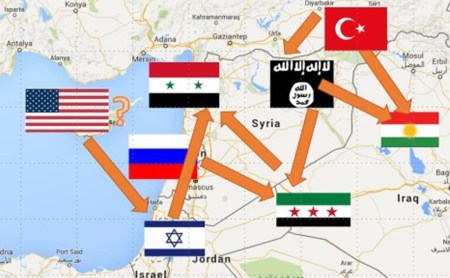
The best way to understand the situation in Syria is to look at the situation and motivation of the various players. All of them have varying agendas; all of them have different preferred outcomes. Few of them are on anything approaching the same page. And Barack Obama’s failure of leadership means that there is no global power around which to center.
ISIS. ISIS has gained tremendous strength since Barack Obama’s entry to power and pullout from Iraq. They currently control northern Syria, bordering Turkey, as well as large portions of northern Iraq. Their goal: to consolidate their territorial stranglehold, and to demonstrate to their followers that they, and not other competing terrorist groups like Al Qaeda, represent the new Islamic wave. They have little interest in toppling Syrian dictator Bashar Assad for the moment. They do serve as a regional counterweight to the increasingly powerful Iranians – increasingly powerful because of President Obama’s big nuclear deal, as well as his complete abdication of responsibility in Iraq.
Iran. Iran wants to maximize its regional power. The rise of ISIS has allowed it to masquerade as a benevolent force in Iraq and Syria, even as it supports Assad’s now-routine use of chemical weapons against his adversaries, including the remnants of the Free Syrian Army (FSA). Iran has already expanded its horizons beyond Iraq and Syria and Lebanon; now it wants to make moves into heretofore non-friendly regions like Afghanistan. Their goal in Syria: keep Bashar Assad in power. Their goal in Iraq: pushing ISIS out of any resource-rich territories, but not finishing ISIS off, because that would then get rid of the global villain against which they fight.
Assad. The growth of ISIS has allowed Assad to play the wronged victim. While the FSA could provide a possible replacement for him, ISIS can’t credibly do so on the international stage. Assad knows that, and thus has little interest in completely ousting them. His main interest is in continuing to devastate the remaining FSA while pretending to fight ISIS.
Egypt/Saudi Arabia/Jordan. As you can see, ISIS, Iran, and Assad all have one shared interest: the continued existence of ISIS. The same is not true with regard to Egypt, Saudi Arabia, and Jordan, all of whom fear the rise of radical Sunni terrorist groups in their home countries. They are stuck between a rock and a hard place, however, because openly destroying ISIS on behalf of Alaouite Assad, they embolden the Shia, their enemies. Egypt, Saudi Arabia, and Jordan would all join an anti-ISIS coalition in the same way they did against Saddam Hussein in 1991, but just like Hussein in 1991, they won’t do it if there are no Sunni alternatives available. Tunisia, Saudi Arabia, and Jordan are the top three sources of foreign fighters for ISIS.
Turkey. The Turks have several goals: to stop the Syrian exodus across their borders, to prevent the rise of the Iranians, and to stop the rise of the Kurds. None of these goals involves the destruction of ISIS. Turkey is Sunni; so is ISIS. ISIS provides a regional counterweight against Iran, so long as it remains viable. It also keeps the Kurds occupied in northern Iraq, preventing any threat of Kurdish consolidation across the Iraq-Turkey border. They will accept Syrian refugees so long as those other two goals remain primary – and they’ll certainly do it if they can ship a hefty portion of those refugees into Europe and off their hands.
Russia. Russia wants to consolidate its power in the Middle East. It has done so by wooing all the players to fight against one another. Russia’s involvement in the Middle East now looks a good deal like American involvement circa the Iran-Iraq War: they’re playing both sides. Russia is building nuclear reactors in Egypt, Jordan, Turkey and Iran. They’re Bashar Assad’s air force against both the FSA and ISIS. Russia’s Vladimir Putin doesn’t have a problem with destroying ISIS so long as doing so achieves his other goal: putting everyone else in his debt. He has a secondary goal he thought he could chiefly pursue in Eastern Europe, and attempted with Ukraine: he wants to split apart the North Atlantic Treaty Organization, which he rightly sees as a counterbalance to check Russian aggression. Thanks to today’s Turkish attack on a Russian plane, and thanks to the West’s hands-off policy with regard to the conflict, Putin could theoretically use his war against ISIS as cover to bombard Turkish military targets, daring the West to get involved against him. Were he to do so, he’d set the precedent that NATO is no longer functional. Two birds, one war.
Israel. Israel’s position is the same it has always been: Israel is surrounded by radical Islamic enemies on every side. Whether Iranian-backed Hezbollah or Sunni Hamas and ISIS, Israel is the focus of hate for all of these groups. Ironically, the rise of Iran has unified Israel with its neighbors in Jordan, Egypt, and Saudi Arabia. All three of those countries, however, can’t stand firmly against ISIS.
All of which means that the only country capable of filling the vacuum would be the United States. Just as in 1991, a major Sunni power is on the move against American interests – but unlike in 1991, no viable option existed for leaving the current regime in power. And the US’ insistence upon the help of ground allies is far too vague. Who should those allies be, occupying ISIS-free ISISland?
The Kurds have no interest in a Syrian incursion. Turkish troops movements into ISIS-land will prompt Iranian intervention. Iranian intervention into ISIS-land would prompt higher levels of support for Sunni resistance. ISIS-land without ISIS is like Iraq without Saddam Hussein: in the absence of solidifying force, chaos breaks out. From that chaos, the most organized force takes power. Russia hopes that should it destroy ISIS, Assad will simply retain power; that may be the simplest solution, although it certainly will not end the war within the country. There are no good answers.
Barack Obama’s dithering for years led to this. Had he lent his support in any strong way to one side, a solution might be possible. Now, it’s not.
(The views expressed in this article are mine and do not necessarily reflect those of Warsclerotic or its other editors. — DM
In largely secular western societies, Islam and its history are viewed by many non-Muslims as substantially irrelevant to how devout Muslims behave. Perhaps the view that religion is of little importance to devout Muslims is based on the role, minor if any, that religion and religious history play in their own secular lives. However, both Islamic teachings and history give devout Muslims their grounding in Islam and teach them that Islam is the religion of war, not peace: Islam must become the world’s only religion by extirpating all others.
Islam was founded by Mohamed ( c. 570 CE – 8 June 632 CE) in the sixth century. Mohamed
Islam considers the words of Mohamed, as transcribed in the “Holy” Quran and Hadith, to be the words of Allah. “Restoring” other monotheistic religions means changing them to comport with Islam as dictated to Mohamed by Allah; unaltered, those other religions cannot continue to exist; it is the duty of Muslims to force them to change or to exterminate them.
Islam provides the basis for Sunni and Shiite (principal branches of Islam) efforts to govern world civilization according to Islamic principles as voiced by Allah through his prophet, Mohamed. Since Islamic principles tolerate no religious or political freedoms (let alone contemporary gender equality or homosexuality notions), such western ideas must be extirpated — as they have been in Saudi Arabia (now the head of the UN Human Rights Council) and Iran. Islamic principles are also manifested by the hopes and efforts of the Islamic State (Sunni, like Saudi Arabia) and the Islamic Republic of Iran (Shiite) to achieve their own caliphates.
Sheikh Muhammad Abdullah Nasr is a scholar of Islamic law and a graduate of Egypt’s Al Azhar University — regularly touted as the world’s most prestigious Islamic university. Al Azhar University co-hosted Obama’s 2009 “New Beginnings” address in Cairo, to which Obama insisted that at least ten members of the Muslim Brotherhood be invited. According to an article at Jihad Watch,
It can’t [condemn the Islamic State as un-Islamic]. The Islamic State is a byproduct of Al Azhar’s programs. So can Al Azhar denounce itself as un-Islamic? Al Azhar says there must be a caliphate and that it is an obligation for the Muslim world [to establish it]. Al Azhar teaches the law of apostasy and killing the apostate. Al Azhar is hostile towards religious minorities, and teaches things like not building churches, etc. Al Azhar upholds the institution of jizya [extracting tribute from religious minorities]. Al Azhar teaches stoning people. So can Al Azhar denounce itself as un-Islamic? [Emphasis added.]
Nasr joins a growing chorus of critics of Al Azhar. Last September, while discussing how the Islamic State burns some of its victims alive—most notoriously, a Jordanian pilot—Egyptian journalist Yusuf al-Husayni remarked on his satellite program that “The Islamic State is only doing what Al Azhar teaches… and the simplest example is Ibn Kathir’s Beginning and End.”
Since the world’s preeminent Islamic university teaches Islam as proclaimed by the Islamic State, how can non-Muslims claim that the Islamic State is not Islamic? Why do many, even conservatives, refer to the Islamic State and its allied Islamic terror groups as “radical” or “extremist?”
Martin Luther was “radical” and “extreme” because he tried to reform aspects of Roman Catholicism which he deemed malign.
Unlike Martin Luther’s eventually successful efforts to reform aspects of Roman Catholicism, the efforts of Egyptian President Sisi and other moderate Muslims to reform Islam have thus far gained little traction. Obama appears to support President Sisi’s principal opponent in Egypt, the Muslim Brotherhood and its affiliate, the Council on American-Islamic Relations (CAIR). Sisi and other moderates — rather than the Islamic State and Islamic nations such as Iran and Saudi Arabia — should be characterized as “radical” or “extreme” because they dispute the teachings of Allah as relayed through his prophet, Mohamed. The proponents of Islam as it now exists are “mainstream,” and therefore neither “radical” nor “extreme.” We should support “radicals” like President Sisi.
All Islamic terrorists — not only the Islamic State group and al-Qaida — systematically and deliberately target civilians, stabbing their Muslim and “infidel” host countries in the back, abusing their hospitality to advance 14 centuries of megalomaniac aspirations to rule the globe in general, and to reclaim the “waqf” (Allah-ordained) regions of Europe in particular.
Emboldened by Western indifference, these destabilizing and terror-intensifying aspirations have been bolstered by the Islamic educational systems in Europe, the U.S. and other Western countries. These proclaim a supposedly irrevocable Islamic title over the eighth-century Islamic conquests of Lyon, Nice and much of France, as well as all of Spain; the ninth-century subjugation of parts of Italy; and the ninth- and 10th-century occupations of western Switzerland, including Geneva. [Emphasis added.]
Europe has underestimated the critical significance of this long anti-Western history in shaping contemporary Islamic education, culture, politics, peace, war, and the overall Islamic attitude toward Europe, North America, Australia, and other “arrogant infidels.” “Infidel” France has been the prime European target for Islamic terrorists, with 11 reported attacks in 2015, despite France’s systematic criticism of Israel and support for the Palestinian Authority — dispelling conventional “wisdom” that Islamic terrorism is Israeli or Palestinian-driven.
Europe has ignored the significant impact the crucial milestones in the life of the Prophet Muhammad have had on contemporary Islamic geostrategy, such as his seventh-century Hijrah, when Muhammad, along with his loyalists, emigrated or fled from Mecca to Yathrib (Medina), not to be integrated and blend into Medina’s social, economic or political environment, but to advance and spread Islam through conversion, subversion and terrorism, if necessary. Asserting himself over his hosts and rivals in Medina, Muhammad gathered a critical mass of military might to conquer Mecca and launch Islam’s drive to dominate the world. [Emphasis added.]
Our political leaders have been restricting the definition of this problem to whichever jihadist group is causing them the biggest headache at the present time, while ignoring the fact that they are all borne of the same Islamist ideology. Before ISIS emerged, the U.S. State Department strangely took to naming the problem “al Qaeda-inspired extremism,” even though it was not al Qaeda that inspired the radicalism. Rather, Islamist extremism inspired al Qaeda. And in turn, ISIS did not radicalize those 6,000 European Muslims who have traveled to join them, nor the thousands of supporters the French now say they are monitoring. [Emphasis added.]
This did not happened overnight and could not have emerged from a vacuum. ISIS propaganda is good, but not that good. No, decades of Islamist propaganda in communities had already primed these young Muslims to yearn for a theocratic caliphate. When surveyed, 33 percent of British Muslims expressed a desire to resurrect a caliphate. ISIS simply plucked the low-hanging fruit, which had been seeded long ago by various Islamist groups, and it will now require decades of community resilience to push back. But we cannot even begin to do so until we recognize the problem for what it is. Welcome to the full-blown global jihadist insurgency. [Emphasis added.]
The author of that article claims that Islamism (often referred to as “political Islam“) is not Islam:
I speak as a former Liberal Democrat candidate in the U.K.’s last general election and as someone who became a political prisoner in Egypt due to my former belief in Islamism. I speak, therefore, from a place of concern and familiarity, not enmity and hostility to Islam and Muslims. In a televised discussion with CNN’s Fareed Zakaria on the issue, I have argued that of course ISIS is not Islam. Nor am I. Nor is anyone, really. Because Islam is what Muslims make it. But it is as disingenuous to argue that ISIS has “nothing to do with Islam” as it is to argue that “they are Islam.” ISIS has something to do with Islam. Not nothing, not everything, but something. . . . [Emphasis added.]
It is important to define here what I mean by Islamism: Islam is a religion, and like any other it is internally diverse. But Islamism is the desire to impose a very particular version of Islam on society. Hence, Islamism is Muslim theocracy. [Emphasis added.]
Islamism has been rising in the UK for decades. Over the years, in survey after survey, attitudes have reflected a worrying trend. A quarter of British Muslimssympathised with the Charlie Hebdo shootings. 0% have expressed tolerance for homosexuality. A third have claimed that killing for religion can be justified, while 36%have thought apostates should be killed. 40% have wanted the introduction of sharia as law in the UK and 33% have expressed a desire to see the return of a worldwide theocratic Caliphate. Is it any wonder then, that from this milieu up to 1,000 British Muslims have joined ISIS, which is more than joined the Army reserves.
I wish Mr. Nawaz well and hope that his efforts to change Islam succeed. However, in drawing distinctions between Islam and Islamism, he seems to have forgotten, or perhaps to have chosen to ignore, the teachings of Allah as relayed by his messenger and Islam’s founder, Mohamed, referenced at the beginning of this article. Mohamed (and presumably Allah himself) would be surprised by and even horrified at such notions as “Islam is what Muslims make it” and that Islam does not contemplate a Muslim theocracy. So, in all probability, would be many of the clerics at Egypt’s Al Azhar University.
Here are a few videos of Islamic clerics spreading their messages of Islamic peace, love and tolerance. The last of the bunch is about one of Obama’s favorite Muslims.
To close on a somewhat lighter note, here are a few observations by Jonah Goldberg taken from his Goldberg file (November 20, 2015 e-mail),
If you Google “Christian terrorism,” you’re probably a jackass to begin with. But if you do — bidden not by your own drive to jackassery but by the natural curiosity inspired by this “news” letter — you’ll find lots of left-wingtrollery about how the worst terrorist attacks on American soil have been committed by Christians. Much of it is tendentious, question-begging twaddle. But I really don’t want to waste a lot of time on whether Tim McVeigh was a Christian or not (he really wasn’t).
What I find interesting is that many of the same people who clutch their pearls at the mere suggestion that Islamic terrorism has anything to do with — oh, what’s the word again? — oh right: Islam, seem to have no problem making the case that “Christian terrorism” is like a real thing. Remember how so many liberals loved — loved — Obama’s sophomoric and insidious tirade about not getting on our “high horses” about ISIS’s atrocities in the here and now because medieval Christians did bad things a thousand years ago? They never seem to think that argument through. Leaving out the ass-aching stupidity of the comparison, it actually concedes the very point Obama never wants to concede. By laying the barbaric sins of Christians a thousand years ago at the feet of Christians today, he implicitly tags Muslims with the barbarism committed in their name today. [Emphasis added.]
Now, I see no need to wade too deeply into the theology here, but I think I am on very solid ground when I say that Islamic terrorism draws more easily and deeply from the Koran than Tim McVeigh drew from the Christian Bible. Of course, you’re free to disagree. In a free society, everybody has the right to be wrong in their opinions. (But don’t tell anyone at Yale that.)
. . . .
But it is simply a lie — an obvious, glaring, indisputable, trout-in-the-milk lie — that Muslims have nothing whatsoever to do with terrorism.
Simply put, this is nonsense. . . . The jihadists say they are motivated by Islam. They shout “Allahu akbar!” whenever they kill people. “Moderate Muslims” in Saudi Arabia and elsewhere have been funding Islamic radicals around the world for nearly a century. This morning in Mali, terrorist gunmen reportedly released those hostages who could quote the Koran. The leader of ISIS has a Ph.D. in Islamic Studies and openly talks about restoring the Caliphate. [Emphasis added.]
Despite all of this, don’t be distracted from the greatest threat to our security; or perhaps we should be:
French President François Hollande is to call for the US to review its strategy in fighting terrorist group Islamic State, arguing that Europe cannot wait for America’s long war of attrition with the jihadists to work, the Guardian reports.
Hollande is to meet US President Barack Obama on Tuesday next week before going to Russia for a visit. The French leader intends to make Obama aware of the extent of damage done to Europe by the developing refugee crisis and the rising threat of terrorist attacks, a European diplomat told the British newspaper.
“The message that we want to send to the Americans is simply that the crisis is destabilizing Europe,”said the diplomat, who did not wish to be named. “The problem is that the attacks in Paris and the refugee crisis show that we don’t have time. There is an emergency.”
The source said that’s the reason why the French president will visit Washington on Tuesday before flying to Moscow.
According to the diplomat, Paris’ position is that the Europeans cannot afford to wait for years for the war of attrition that the US-led coalition is waging on Islamic State (IS, formerly ISIS/ISIL) in Iraq and Syria, to take effect. There is an impression in Europe that the US doesn’t fully comprehend the urgency of the issue because it doesn’t have to take the bulk of the refugees fleeting Middle East and pouring into Europe in the biggest movement of people since World War II.
Hollande earlier called on the US and Russia, both of which lead a separate effort to eradicate IS, to join forces. Moscow said a broad coalition was needed to defeat the terrorists, but Washington said it would only agree if Russia shared its goals in Syria.
The White House insists that the Syrian conflict can only be resolved if President Bashar Assad steps down.
“Bottom line is, I do not foresee a situation in which we can end the civil war in Syria while Assad remains in power,” Barack Obama told reporters in Manila on the sidelines of the annual Asia-Pacific Economic Cooperation (APEC) summit.
The Kremlin sees the Syrian government as the most viable force in the country that can provide ground troops to battle terrorist groups. Russia says Assad’s political future should be decided by the Syrian people, but the US insists he should not be part of a political settlement.
The Pentagon on its part wants to rely on “moderate rebel forces” and Kurdish militias to attack terrorists on the ground in Syria. So far the strategy wasn’t effective. Kurds fought IS militants when they attacked Kurd-controlled territories, but are reluctant to go on offensive. The empowerment of Kurdish forces in Iraq and Syria also puts the US-led coalition at odds with NATO member Turkey, which has been fighting Kurdish insurgency for decades.
As for the program to train and arm moderate rebels, it proved to be a failure with the Pentagon reporting in September just a handful of US-prepared soldiers actually fighting IS.
IS strategy has become one of the major campaign issues for the upcoming presidential election in the US. Republican candidates like Jeb Bush and Donald Trump have been criticizing the Obama administration for being too soft on terrorists.
Voices calling for the Obama administration to reconsider its ‘Assad must go’ mantra are coming from intelligence professionals as well.
“I think it’s now crystal clear to us that our strategy, our policy vis-à-vis ISIS is not working and it’s time to look at something else,” former CIA deputy director Michael Morell told CBS. “The question of whether President Assad needs to go or whether he is part of the solution – we must look at it again. Clearly he is part of the problem but he may also be part of the solution. An agreement, where he stays for a while and the Syrian army supported by the coalition takes on ISIS may be give us the best result.”
US officials are confident they understand the situation on the ground in Syria. (Duffel Blog photo.)
WASHINGTON, D.C. — Pentagon spokesperson Col. Steve Warren announced US aircraft participating in Operation Inherent Resolve, the code name for the campaign against the Islamic State of Iraq and al-Sham (ISIS), struck targets in Tel Aviv today.
When asked why US warplanes would attack a long-standing ally, Warren explained, “Look, guys, this all makes perfect sense,” pointing to a nebulous PowerPoint slide.
“This was all supposed to be a campaign to topple Bashar al-Asad in Syria, starting with the Arab Spring in 2011. Which, in turn, allowed us to get back at Iran and Russia, both of whom support Syria,” said Warren. “So the CIA considered arming the rebels in Syria, which kind of backfired, and now we have ISIS, a group we thought we had already defeated back when they were al-Qaeda in Iraq.”
Secretary of Defense Ashton Carter further explained, “Sure, we were a little worried when ISIS started running around the Middle East, chopping everyone’s heads off. But fortunately, Iran came to our rescue. Well, in Iraq, that is. We’re still fighting Iran in Yemen.”
Chairman of the Joint Chiefs General Joe Dunford stressed the contributions of America’s coalition partners.
Dunford explained how the US tried to empower allies among the Gulf States to take on ISIS, “which in turn sort of helps us get back at Iran.”
“Unfortunately, most of those states also covertly support ISIS, even though they’re nominally our long-standing allies. Whoops,” said Dunford.
“That’s not to say we don’t have some powerful allies in the region, though,” Dunford explained. “The Kurds have proven to be our greatest allies there, and the Turks are one of our longest-standing NATO allies. Unfortunately, they spend more time fighting each other than ISIS. That old saying, ‘nothing brings people together like a common enemy’ is completely useless here.”
Dunford concluded, “So, you see, ISIS is supported by Arabs, who are opposed by Iranians, who are both opposed and allied with the US, who is sort of allied with Turkey and the Kurds, who are opposed to each other. Since the enemy of my friend is now my enemy, it made sense for the US to bomb Israel, Iran’s bitter adversary.”
Events grew even more complicated in the wake of the deadly terrorist attacks in Paris last Friday. The attacks were reportedly the work of ISIS, who also claimed credit for the bombing of a Russian airliner earlier this month.
“France and Russia have formed an alliance, though in doing so, they automatically caused Germany, Austria-Hungary, and the Ottoman Empire to declare war in return,” said Pentagon Press Secretary Peter Cook. “And, let’s face it, this whole thing really is the fault of the Ottomans when you think about it.”
The briefing then shifted to issues surrounding Afghanistan and Pakistan.
“There, the situation is much more simple,” Cook continued. “The US is fighting the Taliban by providing billions of dollars in military aid to Pakistan, which is supporting the Taliban. Basically, it’s like that scene in The Empire Strikes Back where Luke Skywalker thinks he’s fighting Darth Vader, only to find his own face in Darth Vader’s helmet. That’s pretty much what we’ve gotten ourselves into.”
Daniel Greenfield, a Shillman Journalism Fellow at the Freedom Center, is a New York writer focusing on radical Islam.
Last year at a NATO summit, Obama explicitly disavowed the idea of containing ISIS. “You can’t contain an organization that is running roughshod through that much territory, causing that much havoc, displacing that many people, killing that many innocents, enslaving that many women,” he said.
Instead he argued, “The goal has to be to dismantle them.”
Just before the Paris massacre, Obama shifted back to containment. “From the start, our goal has been first to contain them, and we have contained them,” he said.
Pay no attention to what he said last year. There’s a new message now. Last year Obama was vowing to destroy ISIS. Now he had settled for containing them. And he couldn’t even manage that.
ISIS has expanded into Libya and Yemen. It struck deep into the heart of Europe as one of its refugee suicide bombers appeared to have targeted the President of France and the Foreign Minister of Germany. That’s the opposite of a terrorist organization that had been successfully contained.
Obama has been playing tactical word games over ISIS all along. He would “degrade and ultimately destroy” ISIS. Or perhaps dismantle the Islamic State. Or maybe just contain it.
Containment is closest to the truth. Obama has no plan for defeating ISIS. Nor is he planning to get one any time soon. There will be talk of multilateral coalitions. Drone strikes will take out key figures. And then when this impressive war theater has died down, ISIS will suddenly pull off another attack.
And everyone will be baffled at how the “defeated” terrorist group is still on the march.
The White House version of reality says that ISIS attacked Paris because it’s losing. Obama also claimed that Putin’s growing strength in Syria is a sign of weakness. Never mind that Putin has all but succeeded in getting countries that were determined to overthrow Assad to agree to let him stay.
Weakness is strength. Strength is weakness.
Obama’s failed wars occupy a space of unreality that most Americans associate with Baghdad Bob bellowing that there are no American soldiers in Iraq. (There are, according to the White House, still no American ground forces in Iraq. Only American forces in firefights on the ground in Iraq.)
There’s nothing new about any of this. Obama doesn’t win wars. He lies about them.
The botched campaign against ISIS is a replay of the disaster in Afghanistan complete with ridiculous rules of engagement, blatant administration lies and no plan for victory. But there can’t be a plan for victory because when Obama gets past the buzzwords, he begins talking about addressing root causes.
And you don’t win wars by addressing root causes. That’s just a euphemism for appeasement.
Addressing root causes means blaming Islamic terrorism on everything from colonialism to global warming. It doesn’t mean defeating it, but finding new ways to blame it on the West.
Obama and his political allies believe that crime can’t be fought with cops and wars can’t be won with soldiers. The only answer lies in addressing the root causes which, after all the prattling about climate change and colonialism, really come down to the Marxist explanation of inequality.
When reporters ask Obama how he plans to win the war, he smirks tiredly at them and launches into another condescending explanation about how the situation is far too complicated for anything as simple as bombs to work. Underneath that explanation is the belief that wars are unwinnable.
Obama knows that Americans won’t accept “war just doesn’t work” as an answer to Islamic terrorism. So he demonstrates to them that wars don’t work by fighting wars that are meant to fail.
In Afghanistan, he bled American soldiers as hard as possible with vicious rules of engagement that favored the Taliban to destroy support for a war that most of the country had formerly backed. By blowing the war, Obama was not only sabotaging the specific implementation of a policy he opposed, but the general idea behind it. His failed wars are meant to teach Americans that war doesn’t work.
The unspoken idea that informs his strategy is that American power is the root cause of the problems in the region. Destroying ISIS would solve nothing. Containing American power is the real answer.
Obama does not have a strategy for defeating ISIS. He has a strategy for defeating America.
Whatever rhetoric he tosses out, his actual strategy is to respond to public pressure by doing the least he can possibly do. He will carry out drone strikes, not because they’re effective, but because they inflict the fewest casualties on the enemy.
He may try to contain the enemy, not because he cares about ISIS, but because he wants to prevent Americans from “overreacting” and demanding harsher measures against the Islamic State. Instead of fighting to win wars, he seeks to deescalate them. If public pressure forces him to go beyond drones, he will authorize the fewest air strikes possible. If he is forced to send in ground troops, he will see to it that they have the least protection and the greatest vulnerability to ISIS attacks.
Just like in Afghanistan.
Obama would like ISIS to go away. Not because they engage in the ethnic cleansing, mass murder and mass rape of non-Muslims, but because they wake the sleeping giant of the United States.
And so his idea of war is fighting an informational conflict against Americans. When Muslim terrorists commit an atrocity to horrifying that public pressure forces him to respond, he lies to Americans. Each time his Baghdad Bob act is shattered by another Islamic terrorist attack, he piles on even more lies.
Any strategy that Obama offers against ISIS will consist of more of the same lies and word games. His apologists will now debate the meaning of “containment” and whether he succeeded in defining it so narrowly on his own terms that he can claim to have accomplished it. But it really doesn’t matter what his meaning of “containment” or “is” is. Failure by any other name smells just as terrible.
Obama responded to ISIS by denying it’s a threat. Once that stopped being a viable strategy, he began to stall for time. And he’s still stalling for time, not to beat ISIS, but to wait until ISIS falls out of the headlines. That has been his approach to all his scandals from ObamaCare to the IRS to the VA.
Lie like crazy and wait for people to forget about it and turn their attention to something else.
This is a containment strategy, but not for ISIS. It’s a containment strategy for America. Obama isn’t trying to bottle up ISIS except as a means of bottling up America. He doesn’t see the Caliph of the Islamic State as the real threat, but the average American who watches the latest beheading on the news and wonders why his government doesn’t do something about it. To the left it isn’t the Caliph of ISIS who starts the wars we ought to worry about, but Joe in Tennessee, Bill in California or Pete in Minnesota.
That is why Obama sounds bored when talking about beating ISIS, but heats up when the conversation turns to fighting Republicans. It’s why Hillary Clinton named Republicans, not ISIS, as her enemy.
The left is not interested in making war on ISIS. It is too busy making war on America.
When Islamist leaders condemned Friday night’s Paris attacks, which left more than 132 people dead and hundreds of others critically wounded, you just had to laugh through your tears.
Terror masters in Iran, Turkey, Syria and the Palestinian Authority actually had the gall to talk as if they themselves are not responsible for the ongoing murder of innocent people.
But hypocrisy, mendacity and lying as a matter of course are not the only reasons for their public expressions of solidarity with France during this frightful hour. In fact, what really bothers them is the fear that a rival group may be beating them at their own game. And hell hath no fury like a scorned, power-hungry radical Muslim with hegemonic aims and weapons with which to achieve them.
Such monsters, some in suits and ties to throw you off, are able to get away with playing the West for fools — particularly when the so-called leader of the free world keeps kowtowing to them, while espousing denial as a policy. Indeed, in the immediate aftermath of the bloodbath in Paris, U.S. President Barack Obama made a statement that put a smug smile on the faces of jihadists everywhere.
In the first place, he called the carnage “an attack on all of humanity and the universal values that we share.” This is an amazing assertion, since I don’t even share Obama’s values, let alone those of a great portion of “humanity” inside and out of Washington, D.C. You know, like the multimillions of anti-Semites, Christian-killers, women-subjugators and child-abusers who are trying to win the war over the world’s character and soul.
Secondly, the president said he didn’t “want to speculate at this point in terms of who was responsible for this.”
Right, responded radical Muslims in the privacy of their bunkers and bomb factories, for all Obama knew, the shootings and explosions in a theater, restaurants and at a soccer stadium could have been carried out by disgruntled Buddhists.
By the time he arrived in Antalya to attend the G-20 economic summit less than 48 hours later, even the U.S. president could no longer plead ignorance. So he had to address the issue of Islamic State tentacles spreading every which way, in spite of his having announced a few days earlier that its threat had been “contained.”
Even members of the left-leaning media were challenging his claim that the way he’s been fighting the al-Qaida spin-off is still the right one. And this, while sidling up to Turkish President Recep Tayyip Erdogan, whose recent landslide re-election was a dark day for people with those ostensibly “universal” values Obama had mentioned.
The good news here is also the bad.
Effectively combating Islamic State is actually irrelevant in the wider context, as counterterrorism expert Sebastian Gorka has been trying to explain for years.
That Friday night’s multiple attacks in Paris were carried out by terrorists affiliated with ISIS is “wholly irrelevant,” Gorka — national security editor at Breitbart and military affairs fellow at the Foundation for the Defense of Democracies — told me this weekend. “All members of the global jihadist movement, be they Sunni or Shia, Arab, Persian or converts, are driven by the same desire: the need to kill the kuffar [infidels] for the glory of Allah. All attacks, be they 9/11, 7/7, Mumbai, Amman, Paris or the recent stabbings in Israel, are tied together by the connective tissue of jihadist ideology.”
He stressed, “It is time for us to realize — and demand of our leaders that they act accordingly — that we face an existential threat, which, over the long term, could be as dangerous as Hitler’s Third Reich. This is a war between good and evil. And only one side will prevail in the end.”
I still harbor hope that the former will emerge victorious. But this cannot happen unless certain conditions are met. These include: getting the nuclear-deal-obsessive Democrats out of the White House; making Europe understand that it should be labeling undesirable Islamists, not Israeli products; and raising children in the West to grasp that the blessed ability to live in a free society means being prepared to die defending it against its detractors and destroyers.
“It should be our common aim to coordinate our actions against Daesh and for sure the cooperation between the United States and Russia is a crucial one,” Donald Tusk said
BELEK, Turkey – The United States and Russia must cooperate in fighting Islamic State in Syria, the president of the European Council said on Sunday, stressing Russia should focus its military actions there on the radical Islamists and not the Syrian opposition.
At a news conference on the sidelines of a summit of world leaders in the Turkish coastal province of Antalya, Donald Tusk said that Russian bombing of President Bashar al-Assad’s opponents was only increasing the wave of refugees to Europe.
“It should be our common aim to coordinate our actions against Daesh and for sure the cooperation between the United States and Russia is a crucial one,” Tusk said, referring to the Arabic acronym for Islamic State.
“But we need not only more cooperation, but also more good will, especially from Russian action on the ground in Syria. It must be focussed more on Islamic State and not – because we cannot accept it – against the moderate Syrian opposition,” Tusk said.
Europe is facing an inflow of 1 million refugees from the Middle East and Africa this year alone as a result of the Syrian conflict, which pits the forces of Islamic State, Assad and the Syrian opposition against each other.
Russia joined the conflict a month and a half ago with air strikes in Syria, but has been targeting mainly areas controlled by forces opposed to its long-term ally Assad, rather than by Islamic State.
“We have no doubt that from actions against the Syrian opposition the only result will be a new wave of refugees and we have started seeing that, in fact it has started,” Tusk said.
“This is why the cooperation between Russia and other countries, especially the United States, is so important also in this context of the refugee crisis,” he said.
Russia, the United States and powers from Europe and the Middle East outlined a plan on Saturday for a political process in Syria leading to elections within two years, a day after gunmen and suicide bombers from Islamic State went on a rampage through Paris, killing 129 people.
Tusk said that after attacks in Paris, the G20 had to step up efforts to cut off financing to terrorists.
“Terror networks cannot plan or operate without the money that moves through the financial systems of many countries. Only if we fully cooperate on exchange of information about suspicious transactions, will we be able to stop this threat effectively,” Tusk said.
’ Sunday, he repeated what he said February that he will “redouble” efforts to wipe out ISIS. Santorum: ‘People are dying because this President refuses to face the truth.”
ISIS murderers threatening Obama in a YouTube video. Photo Credit: YouTube, translation by MEMRI.org
President Barack Obama said Sunday that he will “redouble” efforts to eliminate the Islamic State (ISIS), the same word he uttered last February.
His latest vow comes three days after the President declared in a television interview that he has “contained” ISIS. President Obama was referring to “containing” ISIS in Iraq and Syria, but the massive ISIS attacks in Paris the following days have come back to haunt him.
A senior administration official tried to fend off complaints that President Obama was talking through his hat, and told news sources:
We, including the President, have said from beginning the fight against ISIL would be long and have both good and bad days.
Friday was not a bad day; it was catastrophic.
The day before, President Obama told George Stephanopoulos on “Good Morning America:
We’ve always understood that our goal has to be militarily constraining ISIL’s capabilities, cutting off their supply lines, cutting off their financing.’
Stephanopolous politely but bluntly tried to tell the President hat ISIS actually is gaining strength, but the Commander-in-Chief rejected the idea and insisted:
I don’t think they’re gaining strength. From the start, our goal has been first to contain and we have contained them. They have not gained ground in Iraq, and in Syria they’ll come in, they’ll leave. But you don’t see this systemic march by ISIL across the terrain.
Friday’s coordinated terrorist attacks in Paris proved that ISIS, or ISIL as President Obama likes to call the Islamic State, has marched right into the terrain of Europe.
The White House bragged about U.S.-led airstrikes freeing an Iraqi city from ISIS rule and possibly having killed “Jihadi John.” but the real impact of ISIS is its terrorist infrastructure that obviously is entrenched in Europe and which has reached the United States.
President Obama came bouncing back Sunday at a meeting with Turkish President Recep Erdoğan and vowed to “redouble” efforts to eliminate ISIS. After exceptionally poetic rhetoric, even for him, that the skies have been darkened” by the Paris attacks, the president stated:
We will redouble our efforts working with other members of the coalition to bring about a peaceful transition in Syria and to eliminate Daesh as a force that can create so much pain and suffering for people in Paris and Ankara and other parts of the globe.
Sound familiar? It should.
Here is what President Obama had to say last February, after ISIS posted a video showing a captured Jordanian pilot being burned alive:
Should in fact this video be authentic…it, I think, will redouble the vigilance and determination on the part of a global coalition to make sure they are degraded and ultimately defeated.
It also just indicates the degree to which whatever ideology they’re operate off of is bankrupt.
Polls have shown that American voters are increasingly placing the threat of ISIS attacks near the top of their list of worries.
The Republican party is having a field day harping on President Obama’s empty claim that “we have restrained ISIS.”
Presidential hopeful Rick Santorum directly blamed President Obama for the attacks in Paris and told reporters in Florida on Saturday:
This President doesn’t plan. … This President has completely abandoned ship.
This is delusional. That’s the only way I can put it. … And people are dying because this President refuses to face the truth.
I would say to a war-weary country that if we do not begin to take back ground back from ISIS, we will see war visit us here more dramatically and repeatedly….
The public relations value that the President gives ISIS every day by engaging in a war that he has no intention of winning is what you saw in France yesterday.
Stratfor, a global intelligence analysis service, issued a report Saturday contending France may send its “expeditionary force” to Syria to retaliate against ISIS.
The report, titled “After Paris, France Contemplates a Reckoning,” suggests the French response to the Paris attacks is markedly different from that of the Spanish Government following the March 2004 Madrid train bombings. Instead of pulling back from the global coalition working against radical Islamists, “it appears that the French will renew and perhaps expand their efforts to pursue revenge for the most recent assault.”
According to Stratfor, “France has numerous options for retaliation at its disposal.”
First, France has to establish that the attackers were, in fact, members of ISIS. Then:
France will likely ramp up its Syrian air operations. The skies over Syria, however, are already congested with coalition and Russian aircraft. With this in mind, the French may choose to retaliate by focusing instead on the Islamic State in Iraq, or perhaps even other Islamic State provinces in places such as Libya.
Another option would be to increase French programs to train and support anti-Islamic State forces in Iraq and Syria, or even to conduct commando strikes against key leadership nodes.
Finally, says the report, “France also has the option of deploying an expeditionary force like it did in the Sahel, although that would probably require outside airlift capacity from NATO allies, especially the United States.”
One area that is already undergoing a radical change is passage through Europe’s borders, which this weekend are being sealed by many EU members. Bavarian Prime Minister Horst Seehofer said the Paris attack showed border controls are more necessary than ever.
Seehofer, who is critical of the German government’s handling of the refugee crisis, demands permanent border controls and swift repatriation of asylum seekers. It doesn’t appear that Chancellor Angela Merkel will find many allies supporting her soft, pro-refugee stance in light of the Paris bombings.
The anti-Schengen camp, seeking to revoke the agreement making it possible for virtually every European citizen to go anywhere in Europe unheeded, received yet another vindication last week, according to Stratfor, when a Montenegro citizen was arrested on his way to Paris with a stack of weapons.
It isn’t clear whether he was on his way to joining the Friday attacks in Paris, but it’s possible—and frightening. And so the Paris attacks will raise the clout of anti-immigration parties across Europe, chipping away at the Schengen agreement. As of this weekend, France, Germany, Sweden, Slovenia and Hungary have already re-established strict border controls. It is expected that the remaining EU governments will follow suit this week.








 anneinpt
 artaxes
 danmillerinpanama
 davidking1530
 Peter Hofman
 Joseph Wouk
 Peter
Peter Louisiana Steve
 WarSclerotic
Recent Comments