Posted tagged ‘Iran’

Israel and the Four Powers

January 9, 2016

Israel and the Four Powers, Algemeiner, Ben Cohen via JNS Org., January 8, 2016

download-4

JNS.org The rulers of the Arab Gulf states are, it seems, increasingly attentive to what Israel has to say about the balance of power in the region. As a rising Shi’a Iran faces off against a Sunni coalition led by Saudi Arabia, the core shared interest between Israel’s democracy and these conservative theocracies — countering Iran’s bid to become the dominant power and influence in the Islamic world — has rarely been as apparent.

Hence the interview given by a senior IDF officer to a Saudi weekly, Elaph, which laid out how Israel analyzes the present wretched state of the Middle East. In the Israeli view, there are, the officer said, four powers that have coalesced in the region. The first power centers on Iran and its allies and proxies, such as the Bashar al-Assad dictatorship in Syria, Shi’a rebels in Yemen and Iraq, and most pertinently for Israel, Hezbollah in Lebanon. The second power contains what the officer called “moderate” states with whom Israel has “a common language” — Egypt, Jordan and the Gulf countries. The third power, one that is obviously waning, is represented in the form of the Muslim Brotherhood, now vanquished in its Egyptian heartland but still reigning in Hamas-controlled Gaza. Finally, the fourth power is another non-state actor, the combined forces of jihadi barbarism like Al-Qaeda and Islamic State.

Israel’s goal in this situation is a modest one. As the IDF officer put it, “There is a danger that the strife will reach us as well if the instability in the region continues for a long time. Therefore, we need to take advantage of the opportunity and work together with the moderate states to renew quiet in the region.”

The key phrase here, it seems to me, is “renew quiet.” Foremost for the Israelis, that means counteracting Iran and especially its Lebanese proxy Hezbollah, and then minimizing the potential for jihadi terrorists to operate on or near Israeli-controlled territory. A broader strategic vision can also be detected here: Ultimately, both Israel and the conservative Arab states share the common interests of neutralizing Iran and eliminating the jihadi groups.

The partnership between Israel and these states is already in operation, at the levels of intelligence sharing and — not for the first time — cautious exploration of trade relations. That there is a strong military dimension as well to all this is entirely conceivable. And for the time being, it seems that neither side wants to expand or contract on their public ties with each other; Israel has long had embassies in Cairo and Amman, but that doesn’t mean there’ll be an Israeli ambassador in Riyadh anytime soon, much less a film festival or trade expo.

There’s another factor that has accelerated the formation of this undeclared, look-the-other-way alliance: the shift in American Middle East policy under President Barack Obama. Some readers will remember that back in 1991, the first Bush administration pointedly left Israel out of the coalition to expel Saddam Hussein from Kuwait, so as not to antagonize the Gulf states. Now, frustration with Obama has compelled these very same states to recognize that they have an existential interest in cooperating with Israel.

You might say that the president deserves credit for bringing about a situation, in the wake of the nuclear deal with Iran, which has compelled the Gulf states to grasp the reality and permanence of Israel as never before. Still, the visions and prophecies of a Middle Eastern equivalent of the European Union, much indulged during the Oslo Accords years in the late 1990s, are not now in evidence, and that’s welcome. For their own reasons, neither Israel nor the Arab states feel obliged to articulate a sense of what their region should look like in the event that the Iranian threat is overcome.

Indeed, there’s a case that doing so would be counterproductive — it would impose political pressures upon a discreet yet strategically vital relationship that above all requires, in the parlance of the IDF officer, the “moderate” states to remain as moderate states. With the reorientation of American policy towards a rapprochement with Tehran, along with Russia’s active involvement in the Tehran-Damascus axis, Israel is the nearest reliable, not to say formidable, power that these countries can turn to.

In the present Middle Eastern context, then, the realism and discretion which has always underwritten Israeli foreign policy continues to prevail. That realism presumably extends to recognizing that regimes like Saudi Arabia and Bahrain might eventually succumb to their internal instabilities, already exacerbated by the further collapse of the price of oil.

When you consider the alternatives, the region’s architecture could be much worse for Israel than it is currently. Long an anomaly as the only open society in the region, the target of Arab military and economic warfare throughout the latter half of the last century, Israel in this century is now a partner in a regional bloc. To be sure, this is a bloc based upon interests, not common values, and is therefore necessarily limited in scope. But in the present storm, and amidst the appalling human suffering generated by the clash of these rival interests in Syria, it’s the closest thing we have to progress.

Iraq Offers To Mediate Fight Raging Between Saudi Arabia and Iran

January 7, 2016

Iraq Offers To Mediate Fight Raging Between Saudi Arabia & Iran, Fox News via You Tube, January 7, 2017

(How about a plague on both their houses? — DM)


A Strategy to Defeat Islamic Theo-fascism

January 7, 2016

A Strategy to Defeat Islamic Theo-fascism, American ThinkerG. Murphy Donovan, January 7, 2016

Surely, whatever passed for American foreign or military policy in the past three decades is not working. Just as clearly, in case anyone keeps score these days, the dark side of Islam is ascendant at home and abroad. What follows here is a catalogue of policy initiatives that might halt the spread of Islamic fascism and encourage religious reform in the Ummah.

Some observers believe that the Muslim problem is a matter of life and death. Be assured that the need for Islamic reform is much more important than either. The choices for Islam are the same as they are for Palestine Arabs; behave or be humbled. Europe may still have a Quisling North and a Vichy South; but Russia, China, and even America, at heart, are still grounded by national survival instincts – and Samuel Colt.

Call a spade a spade

The threat is Islam, both kinetic and passive aggressive factions. If “moderate” Islam is real, then that community needs to step up and assume responsibility for barbaric terror lunatics and immigrants/refugees alike. Neither America nor Europe has solutions to the Islamic dystopia; civic incompetence, strategic illiteracy, migrants, poverty, religious schisms, or galloping irredentism. The UN and NATO have no remedies either. Islamism is an Ummah, Arab League, OIC problem to solve. Absent moral or civic conscience, unreformed Islam deserves no better consideration than any other criminal cult.

Western Intelligence agencies must stop cooking the books too. The West is at war and the enemy is clearly the adherents of a pernicious ideology. A global war against imperial Islam might be declared, just as angry Islam has declared war on civilization.  A modus vivendi might be negotiated only after the Ummah erects a universal barrier between church and state globally. Islam, as we know it, is incompatible with democracy, civility, peace, stability, and adult beverages.

Oxymoronic “Islamic” states need to be relegated to the dustbin of history. If the Muslim world cannot or will not mend itself, Islamism, like the secular fascism of the 20th Century, must be defeated, humbled in detail. Sooner is better.

Answer the Ayatollahs

Recent allied concessions to Tehran may prove to be a bridge too far. If the Persian priests do not abide by their nuclear commitments, two red lines might be drawn around Israel. Firstly, the ayatollahs should be put on notice, publicly, that any attack against Israel would be considered an attack against America — and met with massive Yankee retaliation. Secondly, any future cooperation with NATO or America should be predicated on an immediate cessation of clerical hate speech and so-called fatwas, those arbitrary death sentences.

Clerical threats to “wipe Israel off the face of the earth” and “death to America” injunctions are designed to stimulate jihad and terror globally. The only difference between a Shia ayatollah and a Sunni imam in this regard these days seems to be the torque in their head threads.

Ostracize the Puppeteers

Strategic peril does not emanate from Sunni tacticians like Osama bin Laden, Mullah Omar, or Abu Bakr al-Baghadadi. Nor does the real threat begin with or end with al Qaeda, the Taliban, Hezb’allah, Hamas, or the Islamic State. Lethal threat comes, instead, on four winds: toxic culture, religious politics, fanatic fighters, and furtive finance, all of which originate with Muslim state sponsors. The most prominent of these are Saudi Arabia, the Emirates, Turkey, Iran, and Pakistan.

Put aside for a moment the Saudi team that brought down the Twin Towers in New York. Consider instead, the House of Saud as the most egregious exporter of Salifism (aka Wahabbism) doctrine, clerics, imams, and mosques from which ultra-irredentist ideologies are spread. The Saudis are at once the custodians of Islam’s sacredshrines and at the same time the world’s most decadent, corrupt, and duplicitous hypocrites. Imam Baghdadi is correct about two things: the venality of elites in Washington and Riyadh. The House of Saud, an absolutist tribal monarchy, does not have the moral standing to administer “holy” sites of any description — Mecca, Medina, or Disneyland.

The cozy relationship between Europe, the European Union, and Arabia can be summarized with a few words; oil, money, arms sales, and base rights. This near-sighted blend of Mideast obscenities has reached its sell-by date. The “white man’s burden” should have expired when Edward Said vacated New York for paradise.

Jettison Turkey and Pakistan

What Saudi Arabia is to toxic ideology in North Africa, Turkey and Pakistan are to perfidy in the Levant and South Asia. Turkey and Pakistan are Islam’s most obvious and persistent grifters. Turkey supports the Islamic State and other Sunni terror groups with a black market oil racket. Pakistan supports the Taliban, al Qaeda, and ISIS with sanctuary and tolerance of the world’s largest opium garden. Oil and drug monies from Arabia, Turkey, and South Asia are financing the global jihad. Turkey also facilitates the migration of Muslims west to Europe while sending Islamist fighters and weapons south to Syria and Iraq.

With the advent of Erdogan and his Islamist AKP, Turkey has morphed into NATO’s Achilles Heel, potentially a fatal flaw.  Turkey needs to be drummed out of NATO until secular comity returns to Ankara. Pakistan needs to be restrained, too, with sanctions until it ceases to provide refuge for terrorists. Pakistani troops harassing India could be more prudently redeployed to exterminate jihadists.

Sanctions against Russia and Israel are a study in moral and political fatuity whilst Arabs and Muslims are appeased midst a cultural sewer of geo-political crime and human rights abuses. If NATO’s eastern flank needs to be anchored in trust and dependability, Russia, Kurdistan, or both, would make better allies than Turkey. Ignoring Turkish perfidy to protect ephemeral base rights confuses tactical necessity with strategic sufficiency.

Recognize Kurdistan

Aside from Israel, Kurdistan might be the most enlightened culture in the Mideast. The Kurds are also the largest ethnic group in the world not recognized as a state. While largely Muslim, the Kurds, unlike most of the Ummah, appreciate the virtues of religious diversity and women’s rights. Indeed, Kurdish women fight alongside their men against Turkish chauvinism and Sunni misogyny with equal aplomb. For too long, the Kurds have been patronized by Brussels and Washington.

While Kurdish fighters engage ISIS and attempt to control the Turkish oil black market, Ankara uses American manufactured NATO F-16s to bomb Kurds in Turkey and Syria. Turkish ground forces now occupy parts of Iraq too. In eastern Turkey, Ergdogan’s NATO legions use ISIS as an excuse for bookend genocide, a cleansing of Kurds that might rival the Armenian Christian genocide (1915-1917).

195876_5_Kurdish angel of death

All the while, American strategic amateurs argue for a “no-fly” zone in contested areas south of Turkey. Creating a no-fly zone is the kind of operational vacuity we have come to expect from American politicians and generals. Such a stratagem would foil Kurdish efforts to flank ISIS and allow the Erdogan jihad, arms, and oil rackets to flourish. A no-fly zone is a dangerous ploy designed to provoke Russia, not protect Muslim “moderates.”

Putin, Lavrov, and the Russians have it right this time; Turkish and Erdogan family subterfuges are lethal liabilities, not assets.

Washington and European allies have been redrawing the map in Eastern Europe, North Africa, South Asia, and the Mideast since the end of WWII. The time has come to put Kurdistan on the map too. Kurdistan is a unique and exemplary case of reformed or enlightened Islam; indeed, a nation that could serve as a model for the Muslim world.  If base rights are a consideration, Kurdistan would be an infinitely more dependable ally than Turkey or any corrupt tribal autocracy in Arabia. America has a little in common with desert dictators — and fewer genuine friends there either. Indeed, at the moment America is allied with the worst of Islam.

Create New Alliances

NATO, like the European Union, has become a parody of itself. Absent a threat like the Soviet Union or the Warsaw Pact, Brussels has taken to justifying itself by meddling in East Europe and resuscitating a Cold War with the Kremlin. Indeed, having divided Yugoslavia, NATO now expands to the new Russian border with reckless abandon; in fact, fanning anti-Russian flames now with neo-Nazi cohorts in former Yugoslavia, Georgia, and Ukraine.

NATO support for the Muslims of one-time Yugoslavia is of a piece with support for Islamic troublemakers in Chechnya and China too. Throughout, we are led to believe that jihad Uighurs and caliphate Chechens are freedom fighters. Beslan, Boston, Paris, and now San Bernardino put the lie to any notion that Islamists are “victims” (or heroes). Indeed, the Boston Marathon bombing might have been prevented had Washington a better relationship with Moscow.

Truth is, America has more in common with Russia and China these days than we do with any number of traditional European Quislings. Indeed, it seems that Europe and America can’t take yes for an answer.

The Cold War ideological or philosophical argument has been won. Moscow and Beijing have succumbed to market capitalism. Islamism, in stark contrast, is now a menace to Russian, Chinese, and American secular polities alike. The logic of a cooperative or unified approach to a common enemy seems self-evident. America, China, and Russia, at least on issues like toxic Islam, is a match made in Mecca.

The late great contest with Marxist Russia and China was indeed a revolution without guns. Now the parties to that epic Cold War struggle may have to join forces to suppress a theo-fascist movement that, like its Nazi predecessor, will not be defeated without guns. The West is at war again, albeit in slow motion. Withal, questions of war are not rhetorical. Saying that you are not at war does not make it so. Once declared, by one party or the other, the only relevant question about war is who wins and who loses. Losers do not make the future.

If America and Europe were as committed to Judeo/Christian secular values as Islamists are committed to a sick religious culture, then the war against pernicious Islam would have been won decades ago. Or as Jack Kennedy once put it: “Domestic policy can only defeat us; foreign policy can kill us.

Trump Footnote

Donald Trump made several policy suggestions on the Islamism issue, one on immigration, the other on Mideast oil. On the former, he suggests a hiatus on Muslim immigration until America develops a plan or reliable programs to vet migrants. On Arab oil, he suggests, given the lives and treasure spent liberating Kuwait and Iraqi oil fields, America should have held those resources in trust and use oil revenues to finance the war against jihad, however long that takes. The problem with both Trump ideas is that they come perilously close to common sense, an American instinct in short supply these days.
 

Congress Investigating Obama Spy Ops on Congress

January 5, 2016

Congress Seeks Investigation Into Obama Spy Ops on Congress, Israel Lawmakers demand Obama administration disclose how it used private communications

BY:
January 4, 2016 5:00 pm

Source: Congress Investigating Obama Spy Ops on Congress

Lawmakers are demanding that the Obama administration disclose how it used private communications that were intercepted during a massive spy operation on Israel that included private conversations with members of Congress, according to letters sent to the National Security Agency and White House.

Rep. Ron DeSantis (R., Fla.) petitioned President Barack Obama late Monday afternoon, demanding the administration reveal how it used information obtained during secret surveillance of Israeli leaders, according to a copy of the letter obtained by the Washington Free Beacon.

Reports emerged last week that the NSA’s spy operation picked up private communications between Israeli officials, members of Congress, and U.S. Jewish community leaders. The information reportedly centered on Israeli efforts to halt the nuclear negotiations. The White House reportedly did not take steps to ensure that these political conversations were omitted.

DeSantis, who along with several other lawmakers has already requested that the NSA provide Congress with details of the operation, informed the Obama administration late Monday that he is seeking to learn if the information gleaned from these private conversations was used by the White House to sway the national debate over the Iran nuclear agreement.

“I am concerned that the vague guidelines and policies used by the NSA for intelligence collection and sharing, in conjunction with elusive direction from the Administration, have led to intelligence being collected on sitting members of Congress for political purposes, specifically relating to the Joint Comprehensive Plan of Action (JCPOA) that was being negotiated at the time this information was collected,” DeSantis wrote.

The lawmaker is further requesting that the White House reveal if this information was shared with any other country, particularly other members of the international negotiating team that struck the nuclear accord with Iran last year.

“Did the White House receive any communications between Israeli officials and members of Congress regarding the nuclear negotiations and agreement with Iran?” Desantis asks.

“How was this information used by the Administration in the course of the JCPOA negotiations?” he follows up.

The White House also should disclose whether the information collected was “used by White House officials during the political debate in the United States about the Iran deal,” according to the letter.

DeSantis and three other lawmakers requested last week that the NSA turn over all information pertaining to how the program was run and how the information collected could be used.

Congress must continue to investigate the spy program to determine if the Obama administration violated laws pertaining to the separation of powers, DeSantis said in a statement.

While the Obama Administration was negotiating a nuclear deal with the world’s leading state sponsor of terrorism, they were simultaneously spying on and trying to undermine our closest ally in the region, Israel,” he said. “This spying may very well have swept up the communications of members of Congress, which represents an affront to the separation of powers.”

“Congress needs to investigate how the Obama administration used this information and determine whether it shared information gleaned from this spying with Iran,” according to DeSantis.

Saudi Arabia stews in policy hell

January 4, 2016

Saudi Arabia stews in policy hell, Asia Times, January 3, 2016

Last week’s mass executions in Saudi Arabia suggest panic at the highest level of the monarchy. The action is without precedent, even by the grim standards of Saudi repression. In 1980 Riyadh killed 63 jihadists who had attacked the Grand Mosque of Mecca, but that was fresh after the event. Most of the 47 prisoners shot and beheaded on Jan. 2 had sat in Saudi jails for a decade. The decision to kill the prominent Shia cleric Nimr al-Nimr, the most prominent spokesman for restive Saudi Shia Muslims in Eastern Province, betrays fear of subversion with Iranian sponsorship.

Saudi-beheading22-300x183Official Saudi beheading

Why kill them all now? It is very hard to evaluate the scale of internal threats to the Saudi monarchy, but the broader context for its concern is clear: Saudi Arabia finds itself isolated, abandoned by its longstanding American ally, at odds with China, and pressured by Russia’s sudden preeminence in the region. The Saudi-backed Army of Conquest in Syria seems to be crumbling under Russian attack. The Saudi intervention in Yemen against Iran-backed Houthi rebels has gone poorly. And its Turkish ally-of-convenience is consumed by a low-level civil war. Nothing has gone right for Riyadh.

Worst of all, the collapse of Saudi oil revenues threatens to exhaust the kingdom’s $700 billion in financial reserves within five years, according to an October estimate by the International Monetary Fund (as I discussed here). The House of Saud relies on subsidies to buy the loyalty of the vast majority of its subjects, and its reduced spending power is the biggest threat to its rule. Last week Riyadh cut subsidies for water, electricity and gasoline. The timing of the executions may be more than coincidence: the royal family’s capacity to buy popular support is eroding just as its regional security policy has fallen apart.

For decades, Riyadh has presented itself as an ally of the West and a force for stability in the region, while providing financial support for Wahhabi fundamentalism around the world. China has been the kingdom’s largest customer as well as a provider of sophisticated weapons, including surface-to-surface missiles. But China also has lost patience with the monarchy’s support for Wahhabi Islamists in China and bordering countries.

According to a senior Chinese analyst, the Saudis are the main source of funding for Islamist madrassas in Western China, where the “East Turkistan Independence Movement” has launched several large-scale terror attacks. Although the Saudi government has reassured Beijing that it does not support the homegrown terrorists, it either can’t or won’t stop some members of the royal family from channeling funds to the local jihadis through informal financial channels. “Our biggest worry in the Middle East isn’t oil—it’s Saudi Arabia,” the analyst said.

China’s Muslims—mainly Uyghurs in Western China who speak a Turkish dialect—are Sunni rather than Shia.  Like Russia, China does not have to worry about Iranian agitation among Shia jihadis, and tends to prefer Iran to the Sunni powers. As a matter of form, Beijing wants to appear even-handed in its dealings with Iran and Saudi Arabia, for example in recent contacts between their respective navies. Chinese analysts emphasize that Beijing has sold weapons to both—more in absolute to terms to Iran but more sophisticated weapons to the Saudis.

More pertinent than public diplomacy, though, is where China is buying its oil.

Nonetheless, China’s oil import data show a significant shift away from Saudi Arabia towards Russia and Oman (which China considers part of the Iranian sphere of influence). Russia’s oil exports to China have grown fourfold since 2010 while Saudi exports have stagnated. Given the world oil glut, China can pick and choose its suppliers, and it is hard to avoid the inference that Beijing is buying more from Russia for strategic reasons.  According to Russian sources, China also has allowed Russian oil companies to delay physical delivery of oil due under existing contracts, permitting Russia to sell the oil on the open market for cash—the equivalent of a cash loan to Russia.

saudioil1-768x558

China’s interests in Syria coincide with Russia’s. Both have reason to fear the growth of ISIS as a magnet for their own jihadis.  Thousands of Chinese Uyghurs make their way into Southeast Asia via the porous southern border of Yunnan province, with financial assistance from Saudi supporters and logistical support—including passports—from local Turkish consulates. Chinese Uyghurs were implicated in the bombing of Bangkok’s Erawan Temple last August, and have linked up with ISIS supporters as far south as Indonesia. Turkey reported last month that most jihadists crossing its border into Syria to join ISIS are Chinese Muslims.

With Kurdish and allied forces gaining control of Syria’s border with Turkey, aided by Russian air support, Chinese Uyghurs may lose access to Syria. Late in December Kurdish forces crossed to the western bank of the Euphrates River and are in position to link up with Kurdish militias in northwestern Syria, eliminating Turkish hopes of a “safe zone” controlled by Turkey on the southern side of the Syrian border.  For its part, Turkey risks paralysis from a low-intensity civil war with its Kurdish population. The Kurdish-majority southeast of the country is under siege and fighting has spread to Turkey’s western provinces.

It’s an ill wind that blows nobody good, and China seems hopeful that it has contained its jihadist problem. On New Year’s Day, the Communist Party leader in China’s Xinjiang province declared that “the atmosphere for religious extremism has weakened markedly.”

China is extremely reluctant to commit military forces to overseas conflicts, and its military is ill-prepared to do so even if Beijing were to change its mind. The People’s Liberation Army lacks ground attack aircraft like the two squadrons of Russian Su-24 and Su-25 deployed in Syria. Nonetheless, Beijing is happy that Russia is reducing ISIS forces in Syria as well as Saudi- and Turkish-backed Sunni Islamists like the Army of Conquest.

It will be hard to evaluate the success of Russian bombing in Syria until the dust settles, but there is a great deal of dust in the air. According to Israeli sources, Russia is dumping vast amounts of its Cold War inventory of dumb bombs on Syrian Sunnis with devastating effect. The Russian bombing campaign makes up in volume what it lacks in sophistication, killing far more civilians than Western militaries would tolerate, but changing the situation on the ground. That explains Russian President Vladimir Putin’s newfound popularity among world leaders. He is doing their dirty work.

Saudi Arabia’s proxies in Syria are in trouble. Early in 2015, the Army of Conquest (Jaish al-Fateh), a coalition of al-Qaida and other Sunni Islamists backed by the Saudis, Turks and Qataris, had driven the Syrian army out of several key positions in Northwest Syria, threatening the Assad regime’s core Alawite heartland. The coalition began breaking up in November, however, and the Syrian Army recently retook several villages it had lost to the Army of Conquest. One of the Army of Conquest’s constituent militias, Failaq al-Sham, announced Jan. 3 that it was leaving the coalition to defend Aleppo against regime forces reinforced by Russia.

Everything seems to have gone wrong at once for Riyadh. The only consolation the monarchy has under the circumstances is that its nemesis Iran also is suffering from the collapse of oil revenues and the attrition of war. Iran began withdrawing its Revolutionary Guard forces from Syria in December, largely due to high casualties. The high cost of maintaining the war effort as Iran’s finances implode also may have been a factor. Iran’s Lebanese Shia proxy, Hezbollah, has suffered extremely high casualties, virtually neutralizing its whole first echelon of combat troops. And Russia has shown no interest in interfering with Israeli air strikes against Hezbollah.

The oil price collapse turns the competition between Saudi Arabia and Iran into a race to the bottom. But the monarchy’s panicked response to its many setbacks of the past several months raises a difficult question. In the past, the West did what it could to prop up the Saudi royal family as a pillar of stability in the region, despite the Saudis’ support for jihadi terrorism. Soon the West may not be able to keep the House of Saud in power whether it wants to or not.

Iran-Saudi crisis spurs Hizballah strike on Israel

January 4, 2016

Iran-Saudi crisis spurs Hizballah strike on Israel, DEBKAfile, January 3, 2016

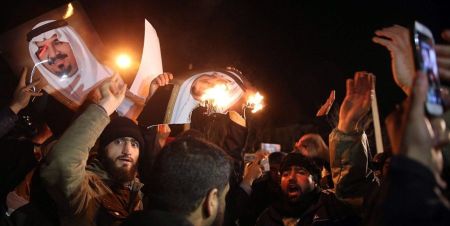
Iranian_protesters_set_fire_to_pictures_of_the_Saudi_royal_family_3.1.16

The heated verbal battle between Tehran and Riyadh over Saudi Arabia’s execution of a Shiite cleric escalated Sunday night, Jan 3, with the severance of diplomatic relations. On the broader front, the repercussions from the quarrel between the two leaders of the Muslim world’s Shia-Sunni split are widely seen in Middle East military and intelligence circles as spurring a fast-track Hizballah attack on Israel.

Among the 47 people executed by Saudi Arabia Saturday on terrorism charges was Sheikh Nimr al-Nimr, Saudi Shiite leader and a prominent Shiite cleric in the region. Put to death with him were several Saudi Shiite and Sunni activists, which enraged Iran’s supreme leader Ayatollah Ali Khamenei to the point of threatening the Saudi royal family with “divine revenge.”

From Iran’s perspective, the Saudis committed the unpardonable act of executing Shiites together with Sunni Al Qaeda and ISIS terrorists. This made the House of Saud the first ruling power ever to treat Shiite and Sunni terrorists alike. This, more than anything, incensed Iran and its Lebanese proxy Hizballah, who are deep in a bloody war against the Sunni Islamic State and the Nusra Front terrorists in Syria. Iran’s Revolutionary Guards are additionally locked in a bitter conflict with ISIS in Iraq.

The Iranian war effort is backed by the US in Iraq and by Russia in Syria.

By the mass executions of both classes of terrorist at the same time, Riyadh issued four messages:

1. Washington and Moscow are wrong. The Iranians and the forces they back in the Persian Gulf, Syria and Iraq are just as much terrorists as ISIS and Al Qaeda.

2. The House of Saud is determined to fight both with equal resolve and severity

3. Riyadh has already taken Tehran on in Yemen, and indirectly in Syria, and is now ready to take the fight against Tehran all the way to the war on terror.

4. Taking off the diplomatic gloves, Saudi Foreign Minister Adel al-Jubeir Monday night severed relations with Iran and ordered all Iranian diplomats to leave the kingdom within 48 hours. The foreign ministry said that by condemning the Nimr execution, Iran was supporting terrorism.

Saudi diplomats were already gone after protesters in Tehran torched and ransacked the Saudi embassy Saturday.

Amid all the sound and fury, Tehran’s attention was drawn to comments made by Israeli Prime Minister Binyamin Netanyahu in the light of a major terrorist attack in Tel Aviv. He pointed out that, in addition to the Palestinians, Israel is threatened by two streams of radical Islam, the Shiites and the Sunnis.

He was clearly referring to Iran and its terrorist arm, Hizballah, on the one hand, and ISIS and Al Qaeda, on the other, inspired less by the Tel Aviv outrage than by the gathering clouds of terror darkening the region, which place the Saudi royal family and Israel on the same side, sharing a similar perception of the two foes facing both countries.

Policymakers in Jerusalem noted the odd statement by Turkish President Tayyip Erdogan to reporters on Saturday, January 1 on the way home from a visit to Riyadh. After years of reviling the Jewish state, he said, “Israel is in need of a country like Turkey in the region. We have to admit that we also need Israel.”

He sounded as though he was urging the resumption of the old political and military alliance binding the two countries years ago.

DEBKAfile’s Middle Eastern sources point out that, since his comment came directly after his talks with Saudi King Salman in Riyadh, it appeared to open a path toward the possible creation of a new Middle East bloc consisting of Turkey, Saudi Arabia, perhaps Egypt, and Israel, bound by the same enemies. This grouping could serve as a counterweight against the Sunni-Shiite bloc of Iran, Iraq, Syria and Hizballah, which has the backing of the US and Russia on one hand, and fights ISIS on the other.

Iran’s leaders may curse the House of Saud without restraint, but they are canny enough not to go from words to deeds, knowing they would be on their own if they attacked the oil kingdom and earn no backing from either Washington or Moscow.

However, it might be easier for Tehran to take advantage of Netanyahu’s tough predicament in his war on terror, by sending Hizballah to strike Israel and, meanwhile, pre-empt the formation of a new anti-Tehran alliance. Speeding up Hassan Nasrallah’s promised revenge for the assassination of its master terrorist Samir Quntar would serve this purpose.

This possibility has prompted the IDF to keep artillery units pounding areas bordering on Israel during the past few days. The IDF says this action is necessary to stop Hizballah exploiting the stormy, snowy winter weather to attack Israel. Its military chiefs appear to be acting on information received of an approaching Hizballah operation as its leader has threatened.

Ayaan Hirsi Ali on the Challenge of Radical Islam

January 3, 2016

Ayaan Hirsi Ali on the Challenge of Radical Islam, You Tube, January 3, 2015

(It’s an hour and six minutes long but well worth watching. — DM)


Tehran biennial to grant $50,000 cash prize to best cartoon on Holocaust

December 17, 2015

Tehran biennial to grant $50,000 cash prize to best cartoon on Holocaust, Tehran Times, December 17, 2015

[A] contest focusing on the portrait of Israel’s Prime Minister Benjamin Netanyahu, has been arranged on the sidelines of the competition.

**********************

TEHRAN – Organizers of the 11th Tehran International Cartoon Biennial has allocated a cash prize of $50,000 for the best cartoon on the Holocaust, the organizers announced on Wednesday.

Three other cartoonists will also receive cash prizes of 12,000, 8,000 and 5,000 dollars respectively, the secretary of the biennial, Masud Shojai-Tabatabai, told the Persian service of MNA.

He added that the competition will be held in June 2016 in Mashhad with cartoonists participating from 50 countries.

“We do not mean to approve or deny the Holocaust, however, the main question is that why is there no permission to talk about the Holocaust despite their (the West) belief in freedom of speech.

“Moreover, why should the oppressed people of Palestine pay the price for the Holocaust? We are also worried about the contemporary holocausts in which a great number of women and children are being killed in Iraq, Yemen and Syria,” he added.

Shojai-Tabatabai also said that a contest focusing on the portrait of Israel’s Prime Minister Benjamin Netanyahu, has been arranged on the sidelines of the competition.

The Palestine Museum of Contemporary Art will be hosting an exhibition of the works at the time of the competition.

Interfaith dialogue is more urgent today than any time: professor

December 8, 2015

Interfaith dialogue is more urgent today than any time: professor, Tehran Times, Javad Heirannia, December 8, 2015

(Did Nader Entessar  ghost write parts of Obama’s December 6th address to the nation? — DM)

TEHRAN – Regarding Ayatollah Ali Khamenei’s second letter to the Western youth in which he called terrorism “our common enemy”, Professor Nader Entessar says it is necessary to counter “Islamophobia no matter where it emanates”.

In part of his letter issued on November 29, the Leader of Islamic Revolution said: Anyone who has benefited from affection and humanity is affected and disturbed by witnessing these [terrorist] scenes- whether it occurs in France or in Palestine or Iraq or Lebanon or Syria.

Entessar, professor and chair of political science at South Alabama University, tells the Tehran Times that “interfaith dialogue is more urgent today than any time in the past fifty or sixty years.”

Following is the text of the interview:

Q: Ayatollah Khamenei in his second letter to the Western youth has talked about terrorism and its roots. What is the importance of this issue?

A: Terrorism has been a major global scourge for some time now. Although the term “terrorism” is used extensively by journalists, pundits and politicians, there is no universal agreement on what terrorism is. There is certainly a need for a dispassionate treatment of this phenomenon and its root causes if one is serious about confronting the threat of terrorism in today’s world.

Q: Ayatollah Khamenei has emphasized in his message that Islam is the religion of friendship, however why do some try to equate Islam with violence?

A: In the West, Islam has become a political buzzword for politicians and political parties of differing ideological stripes to advance their personal agenda. In many ways, the term “Islam” has replaced communism as a rallying cry against which many politicians in the West can coalesce and advance their electoral agendas. For example, the Republican Party in the United States has incorporated Islamophobia as an essential part of its 2016 presidential campaign. In addition, the same trend can be witnessed at state and local elections as well where running against “Islam” has become a badge of honor for many U.S. politicians.

Q: Why do some try to associate Islam with terrorism whenever a terrorist act happens?

A: The emergence of such violent groups as al-Qaeda and Daesh in recent years and their terrorist campaigns under the guise of “Islam” has given a field day to the Islamophobes to advance their message. Unfortunately, the thrust of Islamophobia is not limited to extremist groups in the West. Several liberal groups and personalities have also jumped on the anti-Islam bandwagon in many Western countries. Again, as I previously indicated, it pays political dividends to adopt an anti-Islam posture in the West. Being an anti-Muslim bigot is relatively cost-free but may bring political advantages to a politician or would-be politician in several Western countries.

Q: What is the importance of Ayatollah Khamenei’s letter at this juncture of time?

A: It is very important to confront Islamophobia no matter where it emanates. Interfaith dialogue is more urgent today than any time in the past fifty or sixty years. Therefore, leaders of religious faith groups have a special responsibility to try to reach to other faith communities and highlight what unites the human race in order to promote the common good.

*********

[highlight]

“In the West, Islam has become a political buzzword for politicians and political parties of differing ideological stripes to advance their personal agenda,” Entessar says in an interview with the Tehran Times.

General Wesley Clark: ISIS Serves Interests Of US Allies Turkey And Saudi Arabia

December 4, 2015

General Wesley Clark: ISIS Serves Interests Of US Allies Turkey And Saudi Arabia Tyler Durden’s picture Submitted

by Tyler Durden on 12/03/2015 23:15 -0500

Source: General Wesley Clark: ISIS Serves Interests Of US Allies Turkey And Saudi Arabia | Zero Hedge

Submitted by Claire Bernish via TheAntiMedia.org,

“Let’s be very clear: ISIS is not just a terrorist organization; it is a Sunni terrorist organization. That means it blocks and targets Shi’a. And that means it’s serving the interests of Turkey and Saudi Arabia – even as it poses a threat to them.” – Retired Gen. Wesley Clark

Former NATO Supreme Allied Commander General and retired U.S. General Wesley Clark revealed in an interview with CNN that the Islamic State (Daesh, ISIS) remains geostrategically imperative to Sunni nations, Turkey and Saudi Arabia, as they clamor for strategic power over Shi’a nations, Syria, Iraq, and Iran. He explained that “neither Turkey nor Saudi Arabia want an Iran-Iraq-Syria-Lebanon ‘bridge’ that isolates Turkey, and cuts Saudi Arabia off.”

When asked by the CNN host if Russian President Vladimir Putin’s suggestion that Turkey was “aiding ISIS” had any validity, he responded:

 “All along there’s always been the idea that Turkey was supporting ISIS in some way. We know they’ve funneled people going through Turkey to ISIS. Someone’s buying that oil that ISIS is selling; it’s going through somewhere – it looks to me like it’s probably going through Turkey – but the Turks haven’t acknowledged that.”

After explaining this virtual gateway for the Islamic State’s oil, Clark was quick to emphasize that Putin’s allegations about Turkey’s support for terrorist organization, ISIS, aren’t without their own hypocrisy. Russia, of course, has been upholding President Bashar al-Assad’s administration in Syria against rebel groups backed by the U.S. — despite continuing denials by U.S. officials that that particular theater is its primary interest in the region.

He said, “Putin would like to dirty Turkey by saying it’s supporting terrorists, but the truth is that he’s supporting terrorists. I mean, the tactics used by the Assad regime have been terror tactics. They’re dropping barrel bombs on innocent civilians.”

Clark concludes the interview with a statement that encapsulates growing sentiment of many Westerners who’ve grown war-weary with such geopolitical wrangling overseas:

 “There’s no good guy in this – this is a power struggle for the future of the Middle East.”