Posted tagged ‘Iran Scam’

Iran Openly Declares That It Intends To Violate UNSCR 2231 That Endorses The JCPOA

September 23, 2015

Iran Openly Declares That It Intends To Violate UNSCR 2231 That Endorses The JCPOA, Middle East Media Research Institute, September 22, 2015

(Please see also, Iran wants to renegotiate parts of the nuke “deal.” That may be good. Iran’s declaration that it intends to violate UNSCR 2231, dealing with missile development and related sanctions, should further prompt the U.S. Congress to repudiate the “deal.”– DM)

When the Americans moved the sanctions on the missile program to UNSCR 2231, Iran did not object, as, according to their statements above, they can violate Security Council resolutions, as they have done in the past, and this will not be regarded as a violation of the JCPOA.

**************************

In statements, three Iranian leaders – President Hassan Rohani, Foreign Minister Zarif, and Deputy Foreign Minister and senior negotiator Abbas Araghchi – emphasized that Iran has no intention of abiding by UNSRC 2231, which includes the JCPOA and another element; rather, that they will abide only by the original JCPOA.

The Iran nuclear deal consists of the following:

A.   A set of understandings between Iran and the P5+1 powers (as well as the remaining disagreements) all in a single package called the JCPOA. It is not a contract between Iran and the P5+1 countries as a group or any single one of them, and hence no document was signed.

B.   This set of mutual understandings (as well as disagreements) packaged in the JCPOA was transferred, following the conclusion of negotiations in Vienna on July 14, 2015, to the UN Security Council, for endorsement as a UN Security Council resolution. The resolution, UNSCR 2231, was passed on July 25, 2015 and it includes, in addition to the JCPOA, another element (Annex B) with further stipulations regarding Iran. For example, it addresses the sanctions on Iran’s missile development project.

To understand why UNSCR 2231 is structured in this way, we can look at statements by top Iranian negotiators about the process that led up to it:

In a July 20, 2015 interview on Iranian Channel 2, Iranian Deputy Foreign Minister and senior negotiator Abbas Araghchi said that there had been tough bargaining between the Iranian and American delegations over the issue of the arms embargo on Iran and the sanctions related to Iran’s missile development project. “The Americans sought their inclusion in the JCPOA, claiming that otherwise they could not face criticism from Arab countries in the region. When they said that they could not lift the sanctions altogether, we told them explicitly that in that case there is no agreement. We told them that the national security issues are non-negotiable and that we will not accept an agreement which continues the embargo on weapons and the sanctions on missile development. In the end, the Americans said, We will put the issue of the embargo and the missiles in the UN Security Council Resolution separate from the agreement.”

In the same interview, Araghchi was asked whether Iran could refrain from carrying out UNSCR 2231; he replied: “Yes we can; just as we refrained from complying with UN Security Council resolutions, we can do so with regards to 2231.”

Araghchi also referred to the Iranian Foreign Ministry statement issued following the passage of UNSCR 2231: “The Iranian Foreign Ministry statement explicitly noted that Iran does not attach legitimacy to any restriction and any threat. If UNSCR 2231 will be violated by Iran, it will be a violation of the Security Council resolution and not of the JCPOA, similar to what happened 10 years ago when we violated Security Council resolutions and nothing happened. The text of the JCPOA notes the fact that the content of the JCPOA and of the UN Security Council resolution are two separate things.”[1]

Foreign Minister Zarif, in an August 9, 2015 media interview, reiterated the Iranian position regarding the difference between the JCPOA and UNSCR 2231, with a focus on the consequences of possible violation of the two by Iran. He said: “There is a difference between the JCPOA and UNSCR 2231. Violating the JCPOA has consequences, while violating UNSCR 2231 has no consequences.”[2]

Indeed, the restrictions regarding missiles are mentioned only in UNSCR 2231, and not in the JCPOA.

On August 29, 2015, Iranian President Hassan Rohani said: “There is nothing about the topic of missiles, defense, and weapons in the JCPOA.  Whatever we have about it is in Resolution [UNSCR] 2231… Moreover, we have formally announced that we are not committed to all the sections that appear in the resolution [2231], and we specified in the JCPOA that violation of the resolution [2231] does not mean violation of the JCPOA…[3]

The meaning of all this is that in everything related to the issue of missile development, Iran will disregard UNSCR 2231. Already during the negotiations, it insisted on no imposition of sanctions on Iran regarding its missile development (and no sanctions at all). When the Americans moved the sanctions on the missile program to UNSCR 2231, Iran did not object, as, according to their statements above, they can violate Security Council resolutions, as they have done in the past, and this will not be regarded as a violation of the JCPOA.

Endnotes:

[1] ISNA.ir/fa/news/94042915462/%D9%85%D9%85%D9%86%D9%88%D8%B9%DB%8C%D8%AA-%D9%87%D8%A7%DB%8C-%D8%AA%D8%B3%D9%84%DB%8C%D8%AD%D8%A7%D8%AA%DB%8C-%D9%88-%D9%85%D9%88%D8%B4%DA%A9%DB%8C-%D8%A8%D9%87- .

[2] Foreign Minister Javad Zarif said this at an August 9, 2015 conference sponsored by the Iranian daily Ittil’atwith other senior negotiators in attendance. See text in Farsi here.

[3] President.ir/fa/89047, August 30, 2015.

Petraeus: Fight Against Islamic State ‘Inadequate’

September 22, 2015

Petraeus: Fight Against Islamic State ‘Inadequate’

BY:
September 22, 2015 2:37 pm

Source: Petraeus: Fight Against Islamic State ‘Inadequate’

Retired Gen. and ex-CIA Director David Petraeus testified Tuesday that U.S. progress against the Islamic State (IS, also known as ISIS) terrorist group has been “inadequate.”

“It has been more than a year since the U.S. commenced military action against the Islamic State in Iraq and Syria,” Petraeus said to the Senate Armed Services Committee. “While there have been significant accomplishments, the progress achieved thus far has been inadequate.

The U.S. has carried out thousands of air strikes against IS as part of Operation Inherent Resolve, but the terrorist group shows no signs of retreating.

“In Iraq we have halted and reversed ISIS’s momentum in some areas, but we have seen gains by ISIS in others such as Ramadi,” Petraeus said.

Petraeus said that “some elements of the right strategy” to defeat IS are being utilized by the U.S., but that “several are under-resourced while others are missing.”

Petraeus recommended ramping up U.S. military support for its allies in the area, notably the Iraqi Security Forces and Kurdish Peshmerga. He also recommended embedding U.S. advisors behind the front lines in Iraqi brigades, coordinating airstrikes more closely with Iraqi coalition partners, and broadening the rules of engagement to carry out airstrikes against IS targets.

Petraeus stopped short of recommending the deployment of U.S. troops for combat roles before a “viable” force of Iraqi partners was available to hold onto the areas taken back from IS.

Petraeus’s testimony can be added to a litany of bad news about U.S. progress against IS, although the White House had until recently characterized the fight as successful.

Retired Marine Gen. John Allen, who created the anti-IS coalition, will step down in November after struggling with the White House for control of the war, Bloomberg reported Tuesday.

Last week, Gen. Lloyd Austin, the U.S.’s top commander of Middle East operations, admitted the failure of a program to train and equip moderate rebels to fight IS in Syria.

Hanging over these revelations are serious allegations that senior U.S. officials manipulated intelligence on IS to hide its strength, lending credence to the White House’s narrative that Inherent Resolve was working.

Iran wants to renegotiate parts of the nuke “deal.” That may be good.

September 22, 2015

Iran wants to renegotiate parts of the nuke “deal.” That may be good. Dan Miller’s Blog, September 22, 2015

(The views expressed in this article are mine and do not necessarily reflect those of Warsclerotic or those of its other editors. — DM)


Iran wants sanctions relief to be lifted, immediately, and not merely suspended. Iran should not get that. If it doesn’t, it may well terminate the “deal” unilaterally. If Iran gets what it wants, the Senate should review the “deal” as a treaty and reject it. Either outcome would be a substantial improvement over the current “deal” and the morass in which it is embedded.

This post is based on a September 21st article at Middle East Media Research Institute (MEMRI) titled “Expected September 28 NY Meeting Between P5+1 Foreign Ministers And Iran Could Signify Reopening Of Nuclear Negotiations To Address Khamenei’s September 3 Threat That If Sanctions Are Not Lifted, But Merely Suspended, There Will Be No Agreement.”

The MEMRI article cites statements by Supreme Leader Khamenei and one of his senior advisers, Ali Akbar Velayat. The latter said, on September 19th,  “the nuclear negotiations are not over yet.” Khamenei has said much the same thing.

Khamenei said, in a September 3, 2015 speech to the Assembly of Experts, that he did not accept the terms of the agreement and demanded that the sanctions be immediately lifted rather than merely suspended; otherwise, he said, there would either be no agreement, or Iran too would merely suspend its execution of its obligations under the JCPOA.

. . . .

“Freezing or suspension [of the sanctions] is unacceptable to me… If they suspend [the sanctions], we too will suspend [what is incumbent upon us]. If we are to implement what [is required of us], the sanctions must be [actually] cancelled.

Iran has thus made clear that it will not abide by the nuke “deal” as written; unless it gets the changes it now demands, it will either terminate the deal or violate it. If, as seems likely for the reasons cited in the MEMRI article, the September 28th meeting involves discussion of the deal, it will either be renegotiated or it won’t be.

If the “deal” is not renegotiated, or is renegotiated and Iran does not get what it demands, it may very well terminate the deal. Iran has already received substantial sanctions relief, is already open for business and is already doing lots of it with many more nations than previously. Termination would be a rebuff to the “Great Satan,” would not damage Iran much economically and it could proceed with its “peaceful” nuke program without even farcical nuke self-inspections.

If The Obama administration and others cave and Iran gets what it demands or enough to satisfy it, the “deal” will be very different from what was previously presented to the Congress under the Corker legislation. That legislation purported to eliminate the constitutional requirement of approval of the “deal” by a two-thirds Senate majority before going into effect and permitted it to go into effect unless rejected by half of the membership of both houses; Obama promised to veto such a rejection and put the “deal” into effect. The House has disapproved the “deal” but the Senate has not acted because of Democrat fillibusters, urged by the White House. Under the new “deal,” the ability of the United States to “snap back” sanctions would be vitiated; a possible but very difficult if not impossible to accomplish, “snap back” had been among the reasons cited by many of those who favored the “deal” (often despite its many other flaws) for supporting it.

If a deal eliminating the “snap back” is struck, Obama, et al, may well claim that it’s none of the business of the Congress since, by virtue of the Corker legislation, it has already eliminated its constitutional authority to deal with the JCPOA as a treaty, regardless of any “minor” change.

I hope, but am less than confident, that both houses of the Congress will reject this contention vigorously and repeal the Corker legislation. Whatever benefits or other legitimacy the Corker legislation may once have been thought to have it no longer has. Repeal will probably require use of the “nuclear option” to invoke cloture to end a Democrat filibuster in the Senate. If — as seems likely — Obama vetoes the rejection, the Congress should state that it no longer considers itself bound by the Corker legislation. Next, the Senate should treat the renegotiated “deal” as a treaty, regardless of whether Obama agrees to send it to the Senate, and reject it. It should do so even if, as also seems likely, that requires use of the “nuclear option” to invoke cloture.

Obama has precipitated what may well become a constitutional crisis. If the Congress does its job, Obama will be the loser and America will be the winner — even if it becomes necessary to take out Iran’s nukes militarily.

Iran appears to wants changes in the JCPOA

September 22, 2015

Expected September 28 NY Meeting Between P5+1 Foreign Ministers And Iran Could Signify Reopening Of Nuclear Negotiations To Address Khamenei’s September 3 Threat That If Sanctions Are Not Lifted, But Merely Suspended, There Will Be No Agreement, MEMRI, September 21, 2015

(If the JCPOA is renegotiated, in any respect, will Congress get another opportunity to challenge it? If so, will a way be found to deal with it as a treaty? The answer to both questions should be yes. — DM)

The expected meeting between the P5+1 foreign ministers and Iranian Foreign Minister Zarif may be evidence of a shift in the White House position and also evidence that it intends to discuss the Iranian demand for further concessions from the superpowers.

****************

Recent reports indicate that the foreign ministers of the P5+1 are set to meet with Iranian Foreign Minister Javad Zarif in New York on September 28, 2015, on the margins of the UN General Assembly, to “examine the recent developments of the JCPOA.”[1]

On September 20, 2015, U.S. Secretary of State John Kerry said, at a joint press conference in Berlin with his German counterpart Frank-Walter Steinmeier, that he would meet Zarif in New York to discuss “Iran and other matters.”[2]

Additionally, Ali Akbar Velayati, a senior advisor to Iranian Supreme Leader Ali Khamenei and the head of Iran’s Center for Strategic Research, said on September 19, 2015 that “the nuclear negotiations are not over yet.”[3]

As will be recalled, Khamenei said, in a September 3, 2015 speech to the Assembly of Experts, that he did not accept the terms of the agreement and demanded that the sanctions be immediately lifted rather than merely suspended; otherwise, he said, there would either be no agreement, or Iran too would merely suspend its execution of its obligations under the JCPOA. He said: “We negotiated [with the Americans] in order to have the sanctions lifted, and the sanctions will be lifted. Now, if we are supposed to uphold this framework… this completely contradicts the reason for Iran’s participation in the talks to begin with. Otherwise, what was the point of our participation in the talks? We would have continued to do what we were doing [prior to the talks]… The fact that we sat down and held talks and made concessions on certain issues was mainly in order to have the sanctions lifted. If the sanctions are not going to be lifted, there will be no agreement… [Our] officials [i.e. Rohani’s government and his Ministry of Foreign Affairs] should make this clear…

“Freezing or suspension [of the sanctions] is unacceptable to me… If they suspend [the sanctions], we too will suspend [what is incumbent upon us]. If we are to implement what [is required of us], the sanctions must be [actually] cancelled. True, the other side says that some of the sanctions are not [up to them entirely] to be lifted. We say in response that [with regard to those sanctions] we will use our legal rights to freeze them. But regarding [the sanctions that are] in the hands of the American and European governments – those must be totally lifted.”[4]

The apparent meaning of all the above is that the nuclear negotiations, which Iran considers unfinished, will be reopened, with the aim of achieving the complete lifting of sanctions – instead of a mere suspension of them as was agreed in the JCPOA and adopted in UN Security Council Resolution 2231.

It will also be recalled that following Khamenei’s September 3 demands, on September 4 the White House responded; spokesman Josh Earnest said that Iran was charged with meeting its obligations under the JCPOA: “What we have indicated all along is that once an agreement was reached, as it was back in mid-July, that we would be focused on Iran’s actions and not their words, and that we will be able to tell if Iran follows through on the commitments that they made in the context of these negotiations. And that is what will determine our path forward here.

“We’ve been crystal clear about the fact that Iran will have to take a variety of serious steps to significantly roll back their nuclear program before any sanctions relief is offered – and this is everything from reducing their nuclear uranium stockpile by 98 percent, disconnecting thousands of centrifuges, essentially gutting the core of their heavy-water reactor at Arak, giving the IAEA the information and access they need in order to complete their report about the potential military dimensions of Iran’s nuclear program. And then we need to see Iran begin to comply with the inspections regime that the IAEA will put in place to verify their compliance with the agreement.

“And only after those steps and several others have been effectively completed, will Iran begin to receive sanctions relief.  The good news is all of this is codified in the agreement that was reached between Iran and the rest of the international community. And that’s what we will be focused on, is their compliance with the agreement.”[5]

The expected meeting between the P5+1 foreign ministers and Iranian Foreign Minister Zarif may be evidence of a shift in the White House position and also evidence that it intends to discuss the Iranian demand for further concessions from the superpowers.

It should be clarified that agreement on the part of the U.S. to lifting the sanctions would constitute a fundamental change to the JCPOA. This is because lifting the sanctions, rather than suspending them, will render impossible a snapback in case of Iranian violations, and the guarantee of a snapback is one of the central justifications for the JCPOA, according to President Obama and Secretary of State Kerry.

Endnotes:

[1] Fars (Iran), September 21, 2015.

[2] State.gov, September 20, 2015.

[3] Fars (Iran), September 19, 2015. It should be mentioned that Majlis member Hamid Rasaei said that the language of the agreement signed by Abbas Araghchi that was delivered to Majlis committees was “a partial document with many translating errors and omissions.” He added that the government must present the agreement to the Majlis in the form of a draft law and that a Majlis committee is currently “examining a version that is neither a proposal nor a draft law.” Tasnim (Iran), September 20, 2015.

[5] Whitehouse.gov, September 4, 2015.

U.S. Military Trained Top ISIS Commander

September 22, 2015

U.S. Military Trained Top ISIS Commander Written

by Alex Newman

Thursday, 17 September 2015

Source: U.S. Military Trained Top ISIS Commander

U.S. Military Trained Top ISIS Commander


One of the Islamic State’s top military commanders was actually trained by U.S. Special Forces in the nation of Georgia before taking up arms for ISIS in Syria, according to a variety of sources quoted in an explosive new report by the McClatchy news agency. Another member of the Obama administration’s supposed “anti-ISIS” coalition, the Wahhabi-Islamic dictatorship in Saudi Arabia, played a key role radicalizing the jihadist leader through a hard-core Islamist mosque it funded near his village. In other words, without the direct assistance of key “anti-ISIS” governments — including Washington, D.C. — the man said to be ISIS’ most fearsome and skilled military leader would almost certainly never have arrived in Syria to wage ruthless war on infidels in the first place. But ISIS commander Tarkhan Batirashvili (shown), who now calls himself Abu Omar al Shishani, is hardly the only one.

As explosive evidence and news reports continue to emerge highlighting the trend, it is becoming increasingly difficult to tell where ISIS begins and the globalist establishment ends. Among other revelations, Vice President Joe Biden, speaking at Harvard, admitted that Obama’s “anti-ISIS” coalition had funded and armed various terrorist groups in Syria that went on to become ISIS. Later, U.S. Joint Chiefs of Staff Chairman Martin Dempsey revealed in Senate testimony that Sunni Arab dictators in Obama’s “anti-ISIS” coalition were not just supporting ISIS — they were funding it. Next, a 2012 U.S. Defense Intelligence Agency report released under the Freedom of Information Act exposed the fact that Western powers and their Islamic dictator allies were supporting Islamic terrorists and wanted to see a fundamentalist Islamic State created in Eastern Syria. And finally, the former chief of DIA went on TV and spilled the beans on Obama’s “willful” support to Islamic terrorists while distancing himself from the deadly policies.

The McClatchy report, then, is only the latest shoe to drop in a long train of revelations directly linking the U.S. government and its allies to ISIS and jihad more broadly. Headlined “U.S. training helped mold top Islamic State military commander,” the September 15 article by special correspondent Mitchell Prothero contains a treasure trove of information about the U.S.-trained terrorist gathered from interviews with a wide range of sources, including many close to the ongoing Syrian war. In essence, the report paints a troubling picture of Batirashvili’s background, and offers much insight into how he became a leading ISIS commander responsible for a number of critical victories secured by the terrorist group. From his U.S. military training in Georgia to his radicalization in a Saudi-funded mosque, the piece provides still more evidence about the utter failure — or outright insanity, perhaps even criminality — surrounding what Washington, D.C., likes to characterize as “foreign policy.”

According to the McClatchy report, the 30-year-old Batirashvili (a.k.a. Abu Omar) is a “key figure” in ISIS, reportedly serving on the ISIS “governing council” in addition to being the terror group’s “supreme military leader in northern Syria and Aleppo.” The report, citing his military prowess obtained from U.S. training and a number of critical military victories he led over Syrian dictator Bashar al-Assad’s forces, also refers to him as “perhaps the group’s most fearsome ground commander.” And there is a good reason for that: your tax dollars. “We trained him well, and we had lots of help from America,” an unidentified former Georgian defense official told the news agency, asking not to be named because of the sensitivity of the terrorist’s role in ISIS. “In fact, the only reason he didn’t go to Iraq to fight alongside America was that we needed his skills here in Georgia.”

Batirashvili’s former comrades in the Georgian military echoed the praise for the terrorist’s military abilities and told McClatchy that he was “immediately” recruited into Georgia’s U.S.-trained special forces upon enlistment. Again, your tax dollars — and your sons serving in the U.S. military — played a crucial role in transforming Batirashvili from an impoverished Muslim Chechen villager into a brutal and well-trained commander whose forces are now busily decapitating Christians and selling children into sex slavery to fund jihad. “He was a perfect soldier from his first days, and everyone knew he was a star,” explained a former military comrade of Batirashvili, who also requested anonymity because he was violating orders by speaking to the press about the issue. “We were well trained by American special forces units, and he was the star pupil.”

Of course, the U.S. government training for Batirashvili and other soldiers in Georgia did not take place with the explicit goal of producing future military leaders for a group of savages styling themselves the Islamic State. Instead, similar in many ways to what happened with Osama bin Laden and al-Qaeda in Afghanistan, the U.S. government plan, supposedly at least, was to help the government of Georgia defend itself against potential aggression from the Kremlin. And indeed, according to sources interviewed for the McClatchy report, Batirashvili fought well against Russian strongman Vladimir Putin’s forces, first as a Chechen rebel, and later as a U.S.-trained Georgian Special Forces officer.

While Batirashvili came from an isolated Islamic enclave in the largely Christian nation, Batirashvili and others from his region had traditionally followed a moderate strain of Islam, so-called Sufi Islam. But Sufi Muslims are often considered heretics by their more radical coreligionists in places such as Saudi Arabia and Afghanistan. Eventually, thanks to generous funding from the U.S.-allied Saudi dictatorship, hardcore Wahhabi Islam would soon make its mark on the Chechen enclave in Georgia — and on Batirashvili in particular. The same phenomenon has happened around the world.

According to McClatchy, the moderate version of Islam followed by locals from Batirashvili’s region came under pressure in the year 2000, when the Saudi regime financed the construction of a new mosque for the handful of ethnic Chechen villages in the Georgian valley. A local community leader quoted in the article explained that this new mosque “preached a kind of alien Wahhabi-style Islam” — the same radical Islam that the Saudi monarchy, a key member of Obama’s “anti-ISIS” coalition, has for generations been trying to propagate around the world with lavish funding from its oil revenues. “It told our people that it was wrong to pray at graves of saints and ancestors, as our people have done for hundreds of years, and even to share our religious rites with our Christian brothers,” the community leader said. Other residents told the news agency that by the mid-2000s, the new Saudi-backed mosque had split the local Muslim community in two, with older Muslims sticking to their traditional faith while younger villagers became radicalized in the new mosque.

Then, the globalist-engineered civil war broke out in Syria after years of U.S. taxpayer funding for Syrian opposition groups exposed in official U.S. diplomatic cables. At that point, the radicalized young Muslim villagers in Georgia affiliated with the Saudi mosque — prepared for violent jihad through years of Saudi-funded radical teachings — began an exodus to go wage holy war in Syria. “They all started leaving for Syria,” the community elder told McClatchy. “Things are safer here now because all the radicals — our children — have gone to Syria.” The report also notes that the radicalized Batirashvili served as an excellent recruiting tool for ISIS, attracting jihadists from across central Asia to join the jihad on the “apostate” dictator of Syria.

It is impossible to know how many other ISIS fighters from around the world were also radicalized in mosques funded by members of the “anti-ISIS” coalition, or how many of those fighters received training from the U.S. military under various guises. But without a doubt, there are many. In fact, Obama’s alleged plan to fight ISIS — training and equipping so-called moderate jihadists to fight more radical jihadists — was exposed as a monumental failure this week. Testifying before the U.S. Senate Armed Services Committee on September 16, General Lloyd Austin, the top U.S. military commander for the Middle East, admitted that just “four or five” of Obama’s U.S.-trained jihadists were actually fighting against ISIS in Syria. On the other hand, as The New American and others have documented extensively, far more than that are currently fighting with ISIS, al-Qaeda, and other terrorist groups across Syria — often with heavy U.S. weapons. Indeed, entire brigades of U.S.-trained rebels have joined terror groups or signed agreements with them to fight Assad.

As a direct consequence of the Obama administration’s lawless so-called “foreign policy” machinations, hundreds of thousands are dying, millions are fleeing their homes, refugees are swamping Europe, Middle Eastern Christians are facing genocide, and the national security threat to the United States is growing stronger by the day. Now, all those crises are being exploited by the same globalists who created them to push more of the same insanity.

It is time for Congress to shut down this farce and hold everyone responsible for it accountable.

Photo of  Abu Omar al Shishani, taken from a video: AP Images

Alex Newman, a foreign correspondent for The New American, is normally based in Europe. Follow him on Twitter @ALEXNEWMAN_JOU. He can be reached at anewman@thenewamerican.com.

Related articles:

U.S. Intel: Obama Coalition Supported Islamic State in Syria

ISIS: The Best Terror Threat U.S. Tax Money Can Buy

U.S. Defense Intel Chief: Obama Gave “Willful” Aid to Al-Qaeda

Globalists Who Created Refugee Crisis Now Exploiting It

Globalists Using Muslim Terrorists as Pawns  

Globalists Exploit ISIS Threat to Empower UN

Obama and Co. Middle East Policies Aiding Genocide of Christians

Anti-ISIS Coalition Built ISIS (Video) 

Christian Massacres: A Result of U.S. Foreign Policy

ISIS Origins Traced to U.S. Prison in Iraq

U.S.-backed Syrian Opposition Linked to Bilderberg, CFR, Goldman Sachs & George Soros

Bin Laden & Al-Qaeda: U.S. Govt. Creations

Have the media become selectively “Islamophobic?”

September 20, 2015

Have the media become selectively “Islamophobic?” Dan Miller’s Blog, September 20, 2015

(The views expressed in this article are mine and do not necessarily reflect those of Warsclerotic or its other editors. — DM)


Although claiming repeatedly that Islam is the religion of peace, tolerance, otherwise good and therefore welcome in America, the media are horrified that Donald Trump failed to “correct” the “highly offensive” claim by a member of the audience at a New Hampshire rally that Obama is a Muslim. 

The media and others also seem to be offended by the parallel claim that Obama is not a Christian. However, Islam and Christianity have very different theological foundations and share very few beliefs. Hence, if Obama is a Muslim, He cannot also be a Christian.

True, Obama has occasionally claimed to be a Christian; if He is instead a Muslim He has lied about being a Christian. He has also lied about many other things, including Obamacare and, more recently, the nuke “deal” with Iran.

Barack Mitsvah

The claim that Obama is a Muslim seems to have produced significantly more media outrage than claims that He lied about Obamacare, the nuke “deal” and other topics. Perhaps in Obama’s America presidents are expected to lie as a matter of routine. Had Trump’s questioner merely claimed that Obama is not a Christian, without also claiming that He is a Muslim, would the outrage have been less? It seems to me that the major problem is that Trump’s questioner claimed that Obama is a Muslim.

If what we read in the press and hear on television is true (and I don’t think it is), being a Muslim is per se good. According to Obama, Islam helps to make His America great. Is it among the very few aspects of American exceptionalism of which He is proud?

Muslims don’t generally live in flyover regions (except in some jihad training compounds), clinging to their guns and bibles. Would Obama think better of Christians in flyover regions if they were to cling instead to their beheading implements and Qurans? What if they dealt with homosexuals (and political dissidents of all types) as do Iran (the peace partner featured in Obama’s nuke “deal”) and other Islamic countries?

Clerks of court in Iran don’t refuse to issue marriage licenses to homosexuals; torturing and hanging them (along with other regime opponents) must be politically correct and, therefore, acceptable.

Islamic reality, on which Obama and the media are generally silent aside, why should Trump be disparaged for failing to come to Obama’s defense by denying that He is a Muslim? What sort of defense would that be? Hasn’t Obama told us that Christians (unlike Muslims) are warlike and bad (please see the next to last video at the end of this post.)

Is being called a Muslim worse than being called a sexual predator?

Sometimes, presidents are accused of doing very bad things. President Clinton was accused of being a sexual predator. In western countries, sexual predation of any sort is often considered undesirable — although less so when the predators are Muslims who believe that Mohamed had the right ideas about sex.

Please see also Ayan Hirsi Ali’s autobiography, Infidel. Much of it is about sex in the Muslim world where women are born to be submissive to men, who own them.

Hillary immediately came to her husband’s defense and blamed the accusations of sexual predation on a vast right wing conspiracy.

For some, former President Clinton remains a highly respected Democrat.

Are claims that Obama is a Muslim also part of a vast right-wing conspiracy, which all right-thinking people, Republicans as well as Democrats, should publicly reject, admonish and silence? Jeb Bush and several other RINOs seem to think so.

Is Obama a Muslim?

I don’t know whether Obama is a Muslim. I do understand that He appears to have substantially more affinity for that religion than for any other and is far more likely to defend Islam than to defend Christianity, Judaism or any other religion.

Is many Islamic countries, Christians, Muslims and the few remaining Jews are being persecuted in the most vicious ways conceivable by Muslims. Why are the asylum and immigration policies of Obama’s America so different for Christians, Jews and Muslims?

Might the differences be on account of Obama’s destructively great affinity for Islam? Does He agree with this preacher that Muslim males who migrate to previously non-Islamic countries should help to make them Islamic by breeding with local women to produce Muslim children? Wouldn’t that make Obama even more proud of His America?

I guess we can’t permit Obama to be insulted. Right? Wrong!

What Iran Is Permitted To Do Under The JCPOA

September 18, 2015

What Iran Is Permitted To Do Under The JCPOA, Middle East Media Research Institute, Yigal Carmon, September 17, 2015

Support or opposition to the nuclear deal should be predicated on the text of the JCPOA.

Here are a few examples of what Iran can do under the JCPOA. These actions – permitted under the JCPOA – clearly contradict statements and arguments raised recently by administration officials.

Iran Can Pursue The Development Of A Nuclear Device And Key Nuclear Technologies

Under the JCPOA, Iran can conduct activities “which could  contribute  to  the  design  and  development of a nuclear explosive device” if these activities are “approved by the Joint Commission for non-nuclear purposes and subject to monitoring.”[1]  If anything should have been totally and absolutely banned by this agreement it is activity suitable for the development of a nuclear device. President Obama’s declared rationale for the agreement is to distance Iran from a nuclear device. The JCPOA, under certain conditions allows even that.

Also nowhere in the JCPOA does Iran promise to refrain from development of key technologies that would be necessary to develop a nuclear device. To the contrary, Ali Akbar Salehi head of the Atomic Energy Organization of Iran stated that: “We are building nuclear fusion now, which is the technology for the next 50 years.”[2]

Iran Can Prevent The Inspection Of Military Sites

Under the JCPOA the IAEA cannot go wherever the evidence leads. The JCPOA allows Iran to reject a priori any request to visit a military facility. This exclusion was included in the JCPOA by introducing a limitation under which a request that “aims at interfering with military or other national security activities” is not admissible. [3]

The ban on visits to military sites has been enunciated by all regime figures from Supreme Leader Khamenei downwards. Supreme Leader Khamenei specified: “(The foreigners) shouldn’t be allowed at all to penetrate into the country’s security and defensive boundaries under the pretext of inspection, and the country’s military officials are not permitted at all to allow the foreigners to cross these boundaries or stop the country’s defensive development under the pretext of supervision and inspection.” [4]

Iranian Foreign Minister Javad Zarif said that such visits crossed a red line and were successfully rejected by Iran during the negotiations.[5] Supreme Leader Khamenei’s top adviser for international affairs Ali Akbar Velayati stated: “The access of inspectors from the IAEA or from any other body to Iran’s military centers is forbidden.”[6]

Administration spokespersons persist in claiming that military facilities will also come under inspection in total contradiction to the language of the JCPOA and the Iranian position.

There Will Be No Snap Back Of Sanctions

Under the JCPOA snap back is not automatic but will be dependent on UN Security Council approval.

Additionally, a declaration has been introduced into the JCPOA and thus became an integral part of the agreement, namely that “Iran has stated that it will treat such a re-introduction or re-imposition of the sanctions specified in Annex II, or such an imposition of new nuclear-related sanctions, as grounds to cease performing its commitments under this JCPOA in whole or in part.”[7] The inclusion of this clause in the agreement makes the reimposition of sanctions in the optimal case, the subject of litigation, when Iran can contend that the other side is in violation of the agreement.

Sanctions Duration On The Issue Of Missile Development Can Be Shortened To Less Than Eight Years

Under the JCPOA the sanctions on missile development need not remain in place for eight years but can be lifted earlier, namely whenever “the IAEA has reached the Broader Conclusion that all nuclear material in Iran remains in peaceful activities.”[8]

Arak Will Remain A Heavy Water And Hence A Plutonium Capable Facility; Iran’s Plutonium Pathway Was Not Totally Blocked

Arak houses Iran’s heavy water facility. Despite the vague wording in the JCPOA, (i.e. Iran will “redesign” and “modernize” the reactor),[9] it will also continue to operate partially as a heavy water facility a key element needed in plutonium production.

_______________________

[1] http://apps.washingtonpost.com/g/documents/world/full-text-of-the-iran-nuclear-deal/1651/

[2] Farsnews.com, August 9, 2015.

[3] JCPOA, Annex I, Q.74.

[4]  Ibid.

[5] Latimes.com, July 22, 2015

[7] JCPOA, Section I, Article C, Paragraph 26. See footnote 1 for link to text.

[8] JCPOA, Annex V, D.19. See footnote 1 for link to text.

[9] JCPOA, I.B.8. See footnote 1 for link to text.

Obama talks tough on Chinese Islands, then runs away

September 18, 2015

Obama talks tough on Chinese Islands, then runs away, Front Page Magazine, Daniel Greenfield, September 18, 2015

obama_bow_china_2

[W]hile Obama makes empty noises about China seizing land, and empty noises about Russia seizing land and empty noises about Iran’s nuclear program, he has conceded all three. Everything else is just empty talk about all the “options” we have, once that smart diplomacy has gotten through appeasing the enemy.

**************************

In public, Obama Inc. sounds tough and determined that China’s artificial islands don’t represent a legitimate territorial claim.

Also Wednesday, Defense Secretary Ashton Carter talked tough on China, referring to its increasingly aggressive military posture in the Pacific region.

In a reference to China’s construction of islands in the South China Sea, for which it then asserts air and sea rights, Carter continued: “There should be an immediate and lasting halt to land reclamation by all claimants. We also oppose any further militarization of disputed features.”

Like Obama, he warned China that the U.S. would not back down and would project its authority.

“There should be no mistake: The United States will fly, sail and operate wherever international law allows, as U.S. forces do all over the world,” Carter said. “America, alongside its allies and partners in the regional architecture, will not be deterred from exercising these rights.

“After all, turning an underwater rock into an airfield simply does not afford the rights of sovereignty or permit restrictions on international air or maritime transit,” he added.

In Obamaville though, all this is hot air and empty noise. Obama is a coward who bullies Americans, but cringes and bows whenever an enemy of the United States pushes him around. That was the empty rhetoric meant to fool the few Americans who still believe in Obama.

Here’s the pathetic reality.

 The Obama administration has restricted the U.S. Pacific Command from sending ships and aircraft within 12 miles of disputed Chinese-built islands in the South China Sea, bolstering Beijing’s illegal claims over the vital seaway, Pentagon leaders revealed to Congress on Thursday.

“The administration has continued to restrict our Navy ships from operating within 12 nautical miles of China’s reclaimed islands,” Senate Armed Services Committee Chairman Sen. John McCain (R., Ariz.) said in opening remarks criticizing the failure to guarantee safe passage for international commercial ships in Asia.

“This is a dangerous mistake that grants de facto recognition of China’s man-made sovereignty claims,” he said.

McCain, however, noted that the U.S. restrictions on close-in island military flights and ship visits were continuing despite the provocative dispatch of five Chinese warships in an unprecedented deployment to waters within 12 miles of Alaska’s Aleutian Islands—at the same time President Obama was concluding a recent visit to the state earlier this month.

A visibly angered McCain told Shear the best way to assert that international waters around the islands do not belong to China would be for American ships to make 12-mile passages by the disputed islands. “And we haven’t done that since 2012. I don’t find that acceptable, Mr. Secretary,” he said.

Adm. Harry Harris, commander of the U.S. Pacific Command, was asked if he is authorized to order ships to travel within 12 miles of any of the man-made islands and answered, no. Harris also said no U.S. surveillance aircraft have flown directly over any of the islands.

Brave Obama ran away. When danger reared its ugly head, he bravely turned his tail and fled and gallantly he chickened out. Bravely taking to his feet, He beat a very brave retreat.

So while Obama makes empty noises about China seizing land, and empty noises about Russia seizing land and empty noises about Iran’s nuclear program, he has conceded all three. Everything else is just empty talk about all the “options” we have, once that smart diplomacy has gotten through appeasing the enemy.

Bravest of the brave, Barack.

Cartoons of the day

September 18, 2015

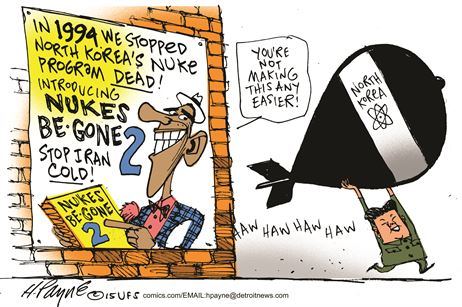
H/t Freedom is just another word


begone
invited

Democrats Explain the Iran Deal | SUPERcuts! #237

September 17, 2015


These Democrats all voted for the Iran deal, and even they know it’s terrible.