Like it or not, the Iran nuclear deal is done. In much of the Middle East, defense officials in many states believe that a sizeable proportion of thesoon-to-be released $100 billion Iranian windfall will be directed toward funding proxy armies of the Islamic Republic, for whom the Jewish state remains the prime target. Israel’s focus is now, more than ever, on defense and surveillance.
In the north, Hizballah, Iran’s proxy Lebanese army, remains a massive threat to regional stability, siding with Syria’s disgraced President Bashar Assad and his saviors from Russia. In Gaza, it is no secret that a previous rift between Iran and Hamas has been smoothed over to further mutual objectives and that another, and possibly more brutal round of hostilities between Israel and Hamas may not be far away.
“The sanctions relief and the nuclear deal with Iran represent a strategic shift that the IDF will have to tackle over the next decade,” Israel Defense Forces (IDF) Chief of Staff Gadi Eizenkot said Monday in a speech at the INSS conference in Tel Aviv. “We also see [Iran’s] attempt to influence Arab Israelis and those in the Gaza Strip, and the estimation is that as Iran’s economic situation improves, over the next one-to-two years, it will divert considerably more resources into opposing Israel, via the Iranian military industry.”
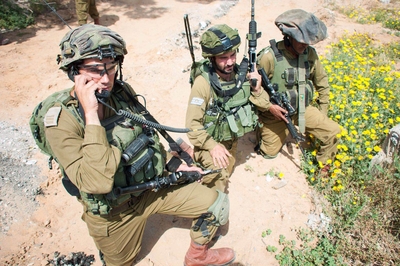
Last week, the Investigative Project on Terrorism (IPT) saw first-hand the situation on Israel’s south-western border, meeting with a senior IDF source who cannot be identified for security reasons. Close to the Kerem Shalom border crossing, where Israel oversees the transfer of many hundreds of tons of goods and supplies every day into Gaza, we scrambled up a sizeable sand dune that offered a panoramic view of the situation on the ground toward the closed Rafah crossing from Egypt into Gaza.
“We hear the explosions and the fighting [against the Islamists] on the Egyptian side. The Egyptian army is taking it seriously,” the senior IDF source explained as we looked across the triangular border junction and heard distant noises, apparently explosions. “We hear this every day. Terrorists continue to try to cross from Egypt into Gaza.”
Minutes later, a text message announced that the Keren Shalom crossing suddenly had been closed. It turned out that the Egyptian army reportedly engaged and killed 13 jihadists just a couple of miles away. Two days earlier, an attempt to breach the Israel-Gaza border fence and plant an IED resulted in an Israeli airstrike reportedly eliminating a member of the Al Aqsa Martyrs Brigade.
Meanwhile, Hamas continues to test fire rockets into the sea, and in recent months other Islamic militants in Gaza sporadically lob rockets toward Israel. On the other side of the border triangle, Egypt is doing its best to keep a lid on ISIS and other Islamist forces in the Sinai Peninsula.
It’s clear that relations between the Israeli and Egyptian militaries are good, a dangerous common enemy helping to focus minds. Under President Abdel Fattah el-Sisi, Egypt (despite a lack of support from the United States), has taken the fight to the terror organizations, often at a significant cost in Egyptian military lives. The horrific October downing of the Russian passenger jet out of Sharm el-Sheikh brought the scale of the task facing Egypt into focus. Israel remains alert for the jihadists turning their attention and firepower from Sinai, but for now believes that Gazan-based terror poses its most immediate threat.
“It’s been quite quiet with Hamas [since the 2014 Protective Edge war], but they don’t keep quiet for long,” the IDF source said. “We’re not looking for a fight – we have an interest that there will be quiet here – but if we have to deal with Hamas, this time we’ll deal with them properly.”
Many Israelis were dismayed when Israel unilaterally pulled out of Gaza in 2014 without a ceasefire, some criticism coming notably from members of the left-wing opposition and media for allowing Hamas off the hook when many believed it was in utter disarray. Now, despite ongoing attempts to stem the flow of weapons, reports suggest Hamas is rebuilding fast and may have some surprises in store for Israel if there’s another round of fighting.
“Look, we’re quite certain they are still building tunnels,” the official said, planting his heel in the sand and showing how easy it is to dig. “And yes, I’m sure they have new weapons – anti-tank, anti-aircraft etc. Like us, they will want to be better next time, but we understand more. The reality is different. We’re learning all the time what is going in Gaza. The army is always preparing for the war to come and [Hamas] won’t meet the same thing as in [Protective Edge].”
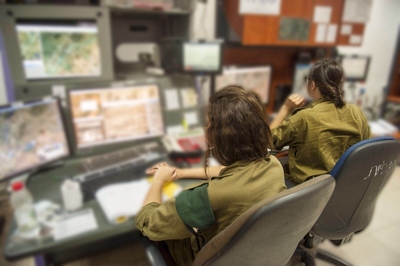
While Israeli soldiers and advanced technology such as its Guardium unmanned patrol vehicles are the first line of defense – the IDF indicated last year that the development of underground tunnel detection systems is also a priority project – the eyes of the military are actually in special units of female soldiers, known as the tazpitanyot. They monitor all movements, looking for suspicious activity, known terror operatives, and attempts to breach the border.
They work in a series of non-descript trailers and shipping containers belying the fact that inside are massed banks of video screens and radar images, and the ability to combine pictures filmed from aerial blimps with other cameras – both day and night vision. This arrangement allows operatives to zoom in and see Gazans as far as a mile from the border fence.
When anything, or anyone suspicious pops up, there are pictures of ‘Wanted’ terror suspects close to the screens. They instruct the on-the-ground forces to investigate. Never averting their gaze from the screen during a four-hour shift, each soldier has been trained to identify every landmark, tree, or rock within her specific area of surveillance. “If there’s even a single branch missing from a tree, they’ll spot it” the women’s commanding officer said. They also have remote control of the machine guns sited on border watch towers.
No security system is 100 percent foolproof, and during the first two weeks of the last round of fighting, four terror tunnels emerged on the Israeli side, only being detected at the last moment. In two cases, the IDF fought gun-battles leaving at least 10 terrorists and six Israeli soldiers dead. Hamas had hoped to kill civilians before luring Israeli soldiers back through the tunnels then kidnapping them or causing mass casualties.
Methods and practices of surveillance are being continually reviewed, but no-one in the Israeli military doubts the tatzpitanyot’s crucial front-line role in its border security, both north and south.
Iranian military leaders also have revealed that at least 200,000 troops have been stationed in Iraq, Syria, and Libya and will work to combat U.S. forces in the region.
************************
The leader of Iran’s Basij military organization claimed on Wednesday that the United States released $1.7 billion in cash assets to Iran “in a bid to buy [the] freedom of its spies held by Tehran,” according to the country’s state-controlled press.
Mohammad Reza Naqdi, the Basij commander, said that the $1.7 billion release, which purportedly includes the repayment by the United States of a $400 million debt and $1.3 billion in interest, was awarded to Iran in order to secure the release of five Americans who were freed by Iran over the weekend.
“The annulment of sanctions against Iran’s Bank Sepah and reclaiming of $1.7mln of Iran’s frozen assets after 36 years showed that the US doesn’t understand anything but the language of force,” Naqdi was quoted as saying on Wednesday during a speech before the Basic forces in Tehran.
This particular cash release was not formally part of the nuclear deal, Naqdi claimed.
“This money was returned for the freedom of the US spy and it was not related to the [nuclear] negotiations,” he said.
In exchange for the release of the five prisoners, the United States pardoned or dropped sanctions on 21 Iranian accused of breaching sanctions by aiding the Islamic Republic’s illicit nuclear program.
Meanwhile, Iranian Supreme Leader Ali Khamenei praised the country’s military on Wednesday for the temporary detainment of 10 U.S. sailors early last week.
“They displayed Iran’s identity and power against the enemy aggression,” Ayatollah Khamenei was quoted as saying to Iranian officials on Wednesday. “The Iranian officials should also show similar actions in all other fields and show powerful reaction wherever the enemy violates Iran’s national interests.”
Iranian military leaders also have revealed that at least 200,000 troops have been stationed in Iraq, Syria, and Libya and will work to combat U.S. forces in the region.
“A massive numberless popular force similar to Basij [volunteer forces] has been formed in Iraq, Syria and Libya against internal and foreign plots which is necessary for the survival of resistance,” Mohammad Ali Jafari, commander of Iran’s Revolutionary Guard Corps, was said during a speech in Tehran on Wednesday.
“And over-200,000-strong organized popular force has been formed in these countries and it is the same force that no army even of the US and Israel can confront it,” Jafari said.
A new Iranian-backed terror group is making inroads in the Gaza Strip and West Bank, where it operates underground with the potential capacity to deliver devastating attacks to Israel, according to regional experts who have been investigating the organization’s rise.
The group, which goes by the name Harakat al-Sabireen, was established around May 2014 but has begun in recent months to boost its public profile on social media and brag about its plots to wage jihad against Israel, according to information gathered by regional analysts and provided to the Washington Free Beacon.
Al-Sabireen is believed to receive $10 million a year from Iran via funds that are smuggled through a large network of tunnels built by terrorists to facilitate illicit travel beneath the Gaza Strip, according to estimates disseminated in the Arab language press.
Like Hezbollah, the Iranian-funded terror group that controls territory along Israel’s northern border, al-Sabireen is being used by the Islamic Republic to indirectly wage war on the Jewish state and foster unrest in the Palestinian territories, according to experts, who view the group’s rise as a sign that Iran is not interested in scaling down its global terror network following the recent implementation of the nuclear agreement.
A State Department official who was not authorized to speak on record said that officials are aware of al-Sabireen and its activities. However, the group has not been officially designated as a foreign terrorist organization, though it is possible this could occur in the future.
Al-Sabireen says it has established an armed wing with militants in Jerusalem and the West Bank, according to a recent interview with the Palestinian news agency Ma’an.
“Given the tense relationship between Tehran and Hamas the past few years, it makes sense that Iran would look to form another proxy in Gaza,” Grant Rumley, a Middle East analyst at the Foundation for Defense of Democracies, said. “However, Sabireen’s entire model of expansion hinges on its ability to present itself as a Palestinian, non-sectarian movement.”
Like Hezbollah, al-Sabireen’s official logo closely resembles that of the Iranian Revolutionary Guard Corps, which is responsible for giving orders to these types of terror groups.
The group’s charter condones violent jihad and promotes attacks on “the racist Zionist body” and “America the great Satan,” according to a copy published by the group on its official Arabic-language website.
Al-Sabireen has taken to its website and Facebook page in recent months to praise operatives who have been killed while conducting reconnaissance missions on the group’s behalf.
In one posting from late October, the group celebrated the death of one operative who was killed “after direct targeting from the Zionist forces while he was leading a monitoring and reconnaissance team.”
Mourners raised flags during a funeral ceremony for this individual from a variety of Palestinian political groups, including Fatah, which is largely viewed by Western governments as a moderate voice, according to photographs posted by al-Sabireen on its Facebook page.
It also has been plucking recruits from rival terrorist groups, according to Rumley.
“It’s unclear exactly what Sabireen’s operational capabilities are right now, but we know that they’ve pulled recruits from a more established terror group, Palestinian Islamic Jihad, and that they’ve lost at least two fighters in two separate Israeli strikes, so they’re on Israel’s radar,” Rumley said.
Al-Sabireen has been present at pro-Hezbollah rallies in Gaza that were also attended by leading Hamas officials.
While not much is known about the group’s composition, it appears to have two main leaders, one an operational leader and another who provides intellectual guidance.
Hisham Salem, the terror group’s top leader, formerly served as a member of Palestinian Islamic Jihad, a State Department-designated terror organization, according to information provided by regional analysts. Salem, who is in his early 50s, was raised in the Gaza Strip and began referring to himself as al-Sabireen’s leader in 2014.
Salem claimed in a recent interview with the Palestinian press that armed members of the group are currently in the West Bank and Jerusalem.
“We have an armed branch whose goal it is to wage war on the Israeli occupation everywhere,” Salem was quoted as saying. “Within this framework we have members in the West Bank and Jerusalem who will soon receive financial and military support from us.”
A recent propaganda video produced by the organization and posted to YouTube shows soldiers marching through Gaza with AK-47s.
Al-Sabireen’s second in command, Mohammad Abu Nadi, frequently writes on al-Sabireen’s official website and praises Palestine as integral to the Arab world.
Al-Sabireen has taken a hardline stance against the United States, claiming in September on its Facebook page that the United States is responsible for “producing terrorists.”
The group’s Facebook page remains active with near-daily postings despite attempts by Facebook to shut it down.
While al-Sabireen has faced difficulty in expanding its base in Gaza, where the Hamas-controlled government cracks down on rival terror groups, it has been able to gain a foothold in the West Bank, where it can directly challenge both Israel and the Palestinian Authority.
(The views expressed in this article are mine and do not necessarily reflect those of Warsclerotic or its other editors. — DM)
Obama keeps telling us what America isnot. What does He think she is? Does He think that Obama’s America is America, or that His supporters are what America is? Does He think they make America great? Will America become acceptable to Obama, and hence “who we are,” only after He or His successor finishes her fundamental transformation?
By virtue of the now-implemented Iran nuke “deal,” Iran’s possession of an atomic and/or hydrogen bomb will be delayed for a few years unless she cheats (as in the past), reneges on the “deal” or out-sources nuke development to her long term partner, North Korea.
The Islamic Republic of Iran is now reaping the benefits of more than $100 billion in immediate sanctions relief plus a settlement of Iranian claims amounting to $1.7 billion.
Secretary of State John Kerry said today that the settlement is $400 million debt and $1.3 billion in interest dating back to the Islamic revolution. That’s separate from the sanctions windfall Iran will receive.
Iran will also benefit on a long-term basis from trade with countries formerly prohibited by sanctions.
Back in June 2015, Supreme Leader of the Islamic Revolution Ayatollah Seyed Ali Khamenei had outlined the general policies of the country’s 6th quinquennial development plan.
On defense and security, the proclamation necessitated an increase in Iran’s defense capabilities at the level of a regional power in order to fulfill the national interests by allocating at least 5 percent of the national budget to boosting the defense power. [Emphasis added.]
With increased funding, Iran will be able to increase its already substantial support for Shiite terrorism throughout the Middle East; it will likely do so.
Iranians continue to experience Islamic human rights. Here’s a link to an article titled The Real War on Women in a Nightmarish Islamic Stateby Dr. Majid Rafizadeh. An Iranian-American political scientist and scholar, he is the president of the International American Council and serves on the board of the Harvard International Review at Harvard University.
When it comes to executions, girls are systematically more vulnerable due to the Islamist penal code of Sharia law.
Let’s take a look at the Islamist state of Iran, which creates its laws from the legal codes of Sharia and Quran. The first type of discrimination is related to age: girls are held criminally accountable at the maturity age of 9 Lunar years. (This will automatically put girls at a higher risk of execution by the court.)
Iranian ruling politicians hold the highest record when it comes to the most executions per capita in the world. Intriguingly, in the last two years that the so-called moderate, Hassan Rouhani, has been in office, there have been more than 2000 executions conducted in Iran. That is nearly 3-4 executions a day.
More importantly, Iranian leaders are also the largest executioner of women and female juveniles. Some of these executions were carried out on the mullahs’ charge of ‘Moharebeh’ (enmity with Allah), or waging war against Allah, ifsad-i Fil Arz (Sowing Corruption on Earth), or Sab-i Nabi (Insulting the Prophet). [Emphasis added.]
There are three methods of execution for women and female juveniles: 1. Stoning 2. Public hanging 3. Shooting. Some women are also beaten so severely in the prison that they die before reaching the execution. Shooting, which is the fastest method of the three for execution, has not been used since 2008. Instead, the most common method to execute women is public hanging or stoning. Some of these women are flogged right before they are hanged. Public hanging not only imposes fears in the society but also aims at dehumanizing and controlling women as second-class citizens. According to the Islamist penal code of Iran, women offenses are classified as: Hadd, Diyyih, Ta`zir, and Qisas. [Emphasis added.]
Please read the entire article. Isn’t it heartwarming that “we” are giving even more than a mere $100 billion to Iran? Perhaps some of the new money can be used to buy sharper stones and new devices for hangings. How about some new torture devices?
Islam, The Muslim Brotherhood and its affiliates
The Muslim Brotherhood and Hamas-affiliated Council of American-Islamic Relations (CAIR) claims to represent Muslims in America. They do represent those who favor terrorism and despise human rights (in the name of which they ironically claim to act).
[T]he Council on American-Islamic Relations, is a prominent Islamic group, but which has a long history of involvement with extremist and terrorist causes. In 2009, during the Holy Land Foundation terror financing trial, U.S. District Court Judge Jorge Solis concluded that, “The government has produced ample evidence to establish the associations of CAIR… with the Islamic Association for Palestine, and with Hamas.” [Emphasis added.]
During the trial, CAIR was designated an “unindicted co-conspirator.” As a result of CAIR’s apparent links to a terrorist movement, the Justice Department in 2009 announced a ban on working with CAIR. The FBI also severed relations.
[F]or the past seven years, the Obama White House has opened its doors to the entire spectrum of radical Islamist groups, just like CAIR. These groups have rationalized the actions of Islamic terrorist groups that have killed Americans, warned American Muslims against cooperating with law enforcement, smeared genuine Muslim moderates like Zuhdi Jasser and Asra Nomani as traitors and accused anyone who dared to utter the term “radical Islam” as “Islamophobic.” These are the groups that the White House should have marginalized. The fact that Obama legitimized radical Islamist groups will be his real legacy. [Emphasis added.]
Very few American Muslims, however, seem to feel that CAIR is a legitimate ambassador for American Islam. According to a 2011 Gallup poll, about 88% of American Muslims said that CAIR does not represent them. Muslims all over the world, in fact, apparently do not think CAIR is a moderate or legitimate Muslim group: in 2014, the United Arab Emirates, a pious Muslim state, designated CAIR a terrorist organization, along with dozens of other Muslim Brotherhood organizations.
In reality, American Muslims are extremely diverse, and no single group can claim to speak on their collective behalf. American Islam comprises dozens of different religious sects and political movements, many of which advocate distinctly different ideas. But for Islamist bodies such as CAIR, it suits their agenda if American Muslims are portrayed as a monolithic community. If American Muslims can be seen as homogenous, then a group such as CAIR has a better claim to represent their interests.
Even CAIR’s own research, however, undermines their claim to speak on behalf of American Muslims. A 2011 report reveals that a majority of American mosques are not affiliated with any American Islamic body.
Addressing a conference in 2000, Sheikh Abdul Hadi Palazzi, a Muslim cleric and secretary general of the Italian Muslim Assembly, explained that, “[CAIR] is a Muslim Brotherhood front organization. It works in the United States as a lobby against radio, television and print media journalists who dare to produce anything about Islam that is at variance with their fundamental agenda. CAIR opposes diversity in Islam.”
In truth, CAIR only speaks on behalf of a small extremist ideology that, as discovered by federal prosecutors, emerged across the United States during the 1990s out of the Muslim Brotherhood and Hamas. Although CAIR does not represent American Muslims, it managed, before the Holy Land Foundation terror trial in 2008, to persuade a great many people that it did. Enough time has passed that CAIR seems to believe it can try this move once again.
state that Congress believes the Muslim Brotherhood fits the State Department’s criteria of a Foreign Terrorist Organization. The Secretary of State would be required to designate the Brotherhood within 60 days or to provide a detailed report explaining why it does not. Three U.S.-based Brotherhood entities named in the bill are CAIR, the Islamic Society of North America (ISNA) and the North American Islamic Trust (NAIT). [Emphasis added.]
The House version of the bill (HR3892) was introduced by Rep. Mario Diaz-Balart (R-FL) with Reps. Louie Gohmert (R-TX), Randy K. Weber (R-TX), Diane Black (R-TN) and Mike Pompeo (R-KS) as original cosponsors. They are now joined by Reps. Steve King (R-IA); Steven Palazzo (R-MS); Kay Granger (R-TX); Jim Jordan (R-OH); Steve Stivers (R-OH); Dana Rohrabacher (R-CA); Ilena Ros-Lehtinen (R-FL); Charles W. Dent (R-PA); Bill Johnson (R-OH) and David A. Trott (R-MI).
HR3892 was referred to the Judiciary Committee’s Subcommittee on Immigration and Border Security on December 4, 2015. Two cosponsors, Rep. Gohmert and Rep. Trott, sit on that subcommittee.
The Senate version of the bill (S2230) was introduced by presidential candidate Senator Ted Cruz (R-TX) and later cosponsored by Senator Orrin Hatch (R-UT). It was referred to the Senate Foreign Relations Committee on November 3. Two of Senator Cruz’s presidential rivals, Senator Marco Rubio (R-FL) and Senator Rand Paul (R-KY) sit on that committee and have not taken a position on the bill.
Although the bill has yet to earn bi-partisan support at this early stage, it is supported by members of Congress from different spectrums of the Republican Party. It includes endorsers of the presidential campaigns of Marco Rubio, Jeb Bush and John Kasich and not only supporters of Ted Cruz.
If enacted by the Congress, Obama will almost certainly veto it. If He signs it, He will ignore or bypass it as He often does.
Britain recently declared the Muslim Brotherhood a terrorist organization. Here are thirteen quotes from the British Government’s review and Prime Minister Cameron’s official statement:
1. “The Muslim Brotherhood’s foundational texts call for the progressive moral purification of individuals and Muslim societies and their eventual political unification in a Caliphate under Sharia law. To this day the Muslim Brotherhood characterizes Western societies and liberal Muslims as decadent and immoral. It can be seen primarily as a political project.”
2. “Aspects of Muslim Brotherhood ideology and tactics, in this country and overseas, are contrary to our values and have been contrary to our national interests and our national security.”
3. “From its foundation the Muslim Brotherhood organized itself into a secretive ‘cell’ structure, with an elaborate induction and education program for new members…This clandestine, centralized and hierarchical structure persists to this day.”
4. “The Hamas founding charter claims that they are the Palestinian branch of the Muslim Brotherhood and the Muslim Brotherhood treat them as such. In the past ten years support for Hamas (including in particular funding) has been an important priority for the MB in Egypt and the MB international network.”
5. “From at least the 1950s the Egyptian Muslim Brotherhood also developed an international network, within and beyond the Islamic world. Europe became an important base for the growing Muslim Brotherhood global network.”
6. “The wider international network of the Muslim Brotherhood now performs a range of functions. It promotes Muslim Brotherhood ideology (including through communications platforms), raises and invests funds, and provides a haven for members of the Brotherhood who have left their country of origin to continue promoting Brotherhood activity.”
7. “[F]or the most part, the Muslim Brotherhood have preferred non violent incremental change on the grounds of expediency, often on the basis that political opposition will disappear when the process of Islamization is complete. But they are prepared to countenance violence—including, from time to time, terrorism—where gradualism is ineffective.”
8. “Muslim Brotherhood organizations and associated in the UK have neither openly nor consistently refuted the literature of Brotherhood member Sayyid Qutb which is known to have inspired people (including in this country) to engage in terrorism.”
9. “[The review] concluded that it was not possible to reconcile these [MB] views with the claim made by the Egyptian Muslim Brotherhood in their evidence to the review that ‘the Muslim Brotherhood has consistently adhered to peaceful means of opposition, renouncing all forms of violence throughout its existence.’”
10. “In the 1990s the Muslim Brotherhood and their associates established public facing and apparently national organizations in the UK to promote their views. None were openly identified with the Muslim Brotherhood and membership of the Muslim Brotherhood remained (and still remains) a secret.”
11. “[MB fronts] became politically active, notably in connection with Palestine and Iraq, and promoted candidates in national and local elections…sought and obtained a dialogue with Government….were active members in a security dialogue with the police.”
12. “The Muslim Brotherhood have been publicly committed to political engagement in this country. Engagement with Government has at times been facilitated by what appeared to be a common agenda against al Qaida and (at least in the UK) militant Salafism. But this engagement did not take into account of Muslim Brotherhood support for a proscribed terrorist group and its views about terrorism which, in reality, are quite different from our own.”
13. “Senior Muslim Brotherhood figures and associated have justified attacks against coalition forces in Iraq and Afghanistan.”
The linked article goes on to note that
The U.S. government, without even conducting any kind of review of its own, issued a statement to the Investigative Project on Terrorism rejecting any ban or even any “de-legitimizing” of the Brotherhood at all. [Emphasis added.]
Do the Muslim Brotherhood and its affiliates represent Obama? Are they or Obama “what we are?” I don’t think so and hope not.
Ayaan Hirsi Ali and reformation of Islam
In Heretic (which I reviewed here), Ayaan Hirsi Ali wrote,
For years, we have spent trillions on waging wars against “terror” and “extremism” that would have been much better spent protecting Muslim dissidents and giving them the necessary platforms and resources to counter that vast network of Islamic centers, madrassas, and mosques which has been largely responsible for spreading the most noxious forms of Islamic fundamentalism. For years, we have treated the people financing that vast network — the Saudis, the Qataris, and the now repentant Emiratis — as our allies. In the midst of all our efforts at policing, surveillance, and even military action, we in the West have not bothered to develop an effective counternarrative because from the outset we have denied that Islamic extremism is in any way related to Islam. We persist in focusing on the violence and not on the ideas that give rise to it. [Emphasis added.]
Here is a video of which Hirsi Ali was the executive producer. It features Muslim and former-Muslim women discussing Islam and the Islam-mandated male domination of women.
Here’s Part II of Honor Diaries:
Here’s a video characterizing Hirsi Ali as an “Islamophobe.”
Along with the Council on American-Islamic Relations (CAIR), Azeezah Kanji — the featured speaker in the above video — has been very active in disparaging Hirsi Ali and Honor Diaries. Like CAIR, she has ties to the Obama White House and was named a “Champion of Change” by the White House in 2011. What changes in Islam does Ms. Kanji champion? None, apparently, of those intrinsic to it.
Ibrahim Hooper, a spokesman for the CAIR, condemned Hirsi Ali as “one of the worst of the worst of the Islam haters in America, not only in America but worldwide.”
On becoming a U.S. Citizen
Who better represents American values? Hirsi Ali, once a refugee from Somalia and a proud citizen of the United States since April 25, 2013, or President Obama? In the immediately linked Wall Street Journal article, she offers suggestions on American immigration with which I plan to deal in a subsequent post. In the meantime, here is her 2014 address at the William F. Buckley Program at Yale University on the clash of civilizations. If you have not yet watched it, please do so. If you have watched it, please do so again. I just did. Every time I watch it, there is something I had not previously considered.
Conclusions
To Obama and His acolytes, Islam is the religion of peace and tolerance; the Islamic State, its equally non-peaceful and intolerant franchisees and other comparable terrorist organizations are “not Islamic.” If “not Islamic,” what are they?
Despite Obama’s many statements and gestures, He has yet to convince any Islamic terrorist group that it is not Islamic. He has convinced them only that He is ignorant of Islam, a liar or both. Perhaps He needs a better joke writer.
was very striking for the one-sidedness and disproportion of the president’s concern for religious suffering.
President Obama worried that “politicians insult Muslims, whether abroad or fellow citizens.”
But he couldn’t bring himself to worry aloud about the Christians being driven from Middle Eastern countries, the churches being burned from Nigeria to Malaysia, or the 22 Coptic Christians who were beheaded on video on a beach in Libya by Islamic supremacists.
Will our next president at least make a concerted effort to un-transform Obama’s America? Will he name and fight our enemies, foreign and domestic? Or will he simply “go with the flow” and do none of the above. Much depends on who it is and on the composition of the Congress.
During the Democrat Party debate on January 17th, Hillary Clinton “linked herself to the president again and again. And again.” An Obama clone to continue Obama’s fundamental transformation of America is the opposite of what we need. Nor will merely “fixing” broken parts of the governmental apparatus with duct tape and bailing wire be satisfactory. As I wrote last September, To bring America back we need to break some stuff.
In later posts in this series, I hope to deal with immigration, race relations, the ways in which Obama is distorting the Constitution, the decline of education and Obama’s very foreign foreign policy.
Obama and his team are celebrating as if they were FBI agents who successfully conducted a cash for hostages exchange while the criminals went free.
The “diplomacy” that they’re celebrating is one in which Iran gets what it wants and occasionally frees hostages. But since Iran can take more hostages at any time, and since it now has more motivation than ever to do so, there’s nothing to celebrate.
With animals, there’s sometimes a question of who is training whom. Is the owner training the dog to do tricks in exchange for treats. Or is the dog training the owner to give treats in exchange for not making a mess on the floor.
This is the essential question in power relationships.
What Obama has going on with Iran isn’t mutual. It’s a relationship in which Iran’s “moderates” show that Western governments can be trained to give them what they want or they’ll make a mess on the floor by taking hostages or blatantly violating nuclear protocols.
Part of this training program involves deliberate messes so that the number of treats and the owner’s anxiety is redoubled.
Iran creates a crisis. Obama rushes treats and then claims it’s a diplomatic success.
Kerry and co. claim that Iran is being trained to negotiate problems diplomatically. But Iran knows how to do that already. As the nuke negotiations showed, it’s much better at it than Obama and Kerry are. Iran knows how to use diplomacy, but its intentions are not diplomatic. So instead it’s using diplomacy to train Obama and his European allies to dispense more treats even as it continues to pursue a nuclear weapons program.
And the most pathetic part of this is that Obama and the Europeans have been trained to treat every payout like a victory.
The nuclear accord implementation by Iran and the lifting of sanctions may not survive the radical opposition in Tehran – not least, because Iran exports will further depress oil prices.
The nuclear watchdog confirmed Saturday night, Jan. 16, that Iran had fulfilled its side of the nuclear deal with the six world powers and that sanctions could be lifted, after US Secretary of State John Kerry, EU’s Federica Mogherini and Iran’s Foreign Minister Mohammad Javad Zarif had been kept hanging about for the IAEA’s from early morning for a verdict worth some $100-150 billion to Tehran. The wording did not explicitly confirm that Iran had met all the terms of the nuclear deal or that it had mothballed most of its uranium-enrichment centrifuges.
From the start, the deal was viewed with deep suspicion by Israel, Saudi Arabia and US lawmakers. Even the White House spokesman Josh Earnest was moved to comment Friday that “the United States wants to make sure that Iran doesn’t cut any corners.”
DEBKAfile’s intelligence and Iranian sources account for the delay in publishing the nuclear watchdog’s report by the “corners” Iran was still trying to cut. According to our sources, Iran had managed to dodge compliance with key terms of the nuclear deal. Nine tons of enriched uranium were indeed shipped to Russia, but most expert watchers are dubious about three other commitments:
1. Washington and Tehran have claimed that the Iranians fulfilled their commitment to pour concrete into the core of the Arak reactor to disable its capacity for producing plutonium. Two days ago, on Thursday, Iranian officials denied this had been done: Only a token operation may have taken place, if any.
Officials associated with Iran’s radical Revolutionary Guards, which fought tooth and nail against the nuclear accord, commented that instead of pouring concrete into the Arak reactor, it should be poured into the hearts of President Hassan Rouhani and Foreign Minister Zarif, for negotiating the accord with the six powers.
Such comments rarely reach the Western media. They are important because they mirror the fierce power struggle ongoing in Tehran, which is heavily fueled by infighting over the nuclear deal and sanctions.
2. That deal provided for the number of centrifuges enriching uranium at the Natanz center to be reduced from 19,500 to 5,050. Our sources report that 9,000 are still in operation.
3. There is no confirmation that the number of centrifuges operating at the underground facility of Fordo was cut down to one thousand, as agreed.
On top of these deviations, the Obama administration admitted last week that the dispute over Iran’s nuclear-capable ballistic missiles, which were tested last month, is still open, in defiance of UN Security Council resolutions. This makes Tehran liable to a fresh set of sanctions, as US officials too have indicated.
The capture of two US patrol boats by the Revolutionary Guards speedboats last Tuesday, with the 10 American sailors aboard forced to surrender before they were released, was clearly a last-ditch attempt by Iran’s radicals to derail the nuclear accord before the Saturday deadline was reached.
That will not be the last such episode: Iran’s radicals may embark on more such actions to counteract the nuclear deal by striking more American targets and looking for trouble with Saudi Arabi and its Gulf allies.
The fact is that the hard-line factions in Tehran don’t want the sanctions lifted, because they see them as net profit for President Rouhani and his moderate conservatives and his leading backer, former president Hashem Rafsanjani, head of the powerful Assembly of Experts.
Iran’s Finance Minister Ali Tayyebnia gave the radicals fodder when he said last week that even $100 billion in cancelled sanctions would not haul the Iranian economy our [sic] of crisis or balance the state budget, because the country’s indebtedness is far in excess of that huge amount.
The Iranian-Saudi row is another factor that could upset the nuclear deal, although paradoxically, since oil prices sank below $30, the Guards and Riyadh have a common interest in its collapse.
Iran’s expected return to an already glutted market – through the removal of sanctions – will drive prices down further. This, neither the Revolutionary Guards Corps, which control Iran’s oil sector, nor the Saudis want to see.
The spiral of hostility launched with the Saudi execution of the prominent Shiite cleric Nimr al-Nimr, followed by the mob attack on the Saudi embassy in Tehran and consulate in Meshaad, and the multiple severance of diplomatic and commercial ties between the Gulf emirates and Tehran, may have the effect of reversing the downward trend of oil prices with a sudden spurt.
Therefore, the rosy prospect the Obama administration paints of a successful landmark deal for curbing Iran’s nuclear capabilities is a far cry from being realized.
Therefore, the rosy prospect the Obama administration paints of a successful landmark deal for curbing Iran’s nuclear capabilities is a far cry from being realized.
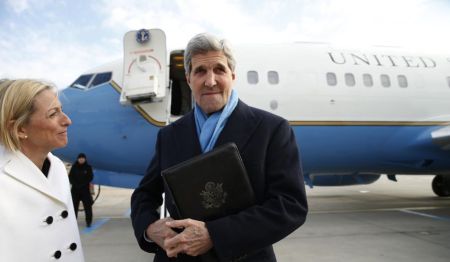
U.S. Secretary of State, John Kerry, is greeted by the U.S. Ambassador to Austria, Alexa Wesner, left, as he steps from his plane Saturday, Jan. 16, 2016, upon his arrival in Vienna, Austria on what is expected to be “implementation day,” the day the International Atomic Energy Agency (IAEA) verifies that Iran has met all conditions under the nuclear deal. (Kevin Lamarque/Pool Photo via AP)
Completing a major diplomatic effort over the objections of many in Congress, President Obama lifted economic sanctions against Iran Saturday after the U.N. atomic watchdog agency determined that Tehran has complied with the deal to curb its nuclear program in exchange for sanctions relief.
In a statement, Secretary of State John F. Kerry said the sanctions termination provisions of Iran’s landmark nuclear agreement are now in effect.
Mr. Obama signed the orders Saturday afternoon, saying Iran’s compliance with the deal “marks a fundamental shift in circumstances with respect to Iran’s nuclear program.”
The U.S. and Iran also carried out a prisoner swap Saturday, with Iran releasing an American pastor, a Washington Post reporter and three other Americans who had been held.
Removing the sanctions is part of the international agreement reached last year among Iran, the U.S. and five other world powers when Iran agreed to curbs on its nuclear program in exchange for sanctions relief.
Certification by the International Atomic Energy Agency will allow Iran to immediately recoup some $100 billion in assets frozen overseas. Iran will also see huge benefits from new oil, trade and financial opportunities after Western sanctions against it are lifted.
IAEA director general Yukiya Amano said Saturday this means “relations between Iran and the IAEA now enter a new phase. It is an important day for the international community. I congratulate all those who helped make it a reality.”
In Congress, Speaker Paul D. Ryan, Wisconsin Republican, said the administration was lifting sanctions “on the world’s leading state sponsor of terrorism.”
“As the president himself has acknowledged, Iran is likely to use this cash infusion — more than $100 billion in total — to finance terrorists,” Mr. Ryan said. “This comes just weeks after Tehran’s most recent illegal ballistic missile test, and just days after [Iranian forces] detained 10 American sailors. A bipartisan majority in the House voted to reject this deal in the first place, and we will continue to do everything possible to prevent a nuclear Iran.”
House Foreign Affairs Committee Chairman Ed Royce, California Republican, said the “flawed” deal is allowing Iran to keep much of its nuclear infrastructure.
“The ayatollah won’t even have to cheat to be just steps away from a nuclear weapon,” Mr. Royce said. “Meanwhile, tens of billions of dollars in sanctions relief will now start flowing to Iran’s Islamic Revolutionary Guard Corps. Since the nuclear deal was signed, Iran has twice violated U.N. resolutions to test ballistic missiles, fired rockets within 1,500 yards of the U.S.S. Truman, and seized 10 American sailors — all while propping up the murderous Assad regime in Syria. Iran will use this deal to become more militarily aggressive and dominate the region.”
At the same time, the administration engaged in a high-profile prisoner swap with Tehran. Iran agreed Saturday to release four detained Americans in exchange for seven Iranians held or charged in the U.S., while a fifth American detained in Iran, a student, was also released in an unrelated move.
The wife of an Idaho pastor who is among four detained Americans being released from Iran says the news is “a huge burden lifted off.”
Naghmeh Abedini told The Associated Press on Saturday that after she learned that Iran was going to release Pastor Saeed Abedini, she woke her kids up and told them, “Daddy was coming home.”
She said in a telephone interview from Boise that “they were just excited. They couldn’t believe it.”
The Boise man was detained for compromising national security, presumably because of Christian proselytizing, in September 2012. He was sentenced in 2013 to eight years in prison.
Republican presidential candidates Sens. Ted Cruz of Texas and Rand Paul of Kentucky welcomed the release of Mr. Abedini, and Democratic presidential candidate Sen. Bernie Sanders of Vermont said the exchange shows “diplomacy can work even in this volatile region of the world.”
Republican presidential hopeful Sen. Marco Rubio of Florida and other Republicans say Americans should never have been captured in the first place, and Mr. Rubio blamed the administration’s willingness to do prisoner swaps in the past.
In Iowa, Mr. Rubio said that governments were taking Americans hostage because they believe they can gain concessions from the Obama administration. He mentioned the June 2014 swap in which the United States exchanged Army Sgt. Bowe Bergdahl, who had been held by the Taliban for five years, for five top Taliban commanders at Guantanamo Bay, Cuba.
The publisher of The Washington Post says he “couldn’t be happier” to hear that the paper’s reporter, Jason Rezaian, had been released from Iran’s Evin Prison on Saturday.
In a statement, publisher Frederick J. Ryan Jr. also says more information will be available once he has more details and can confirm Mr. Rezaian has safely left Iran.
Mr. Rezaian had been held more than 543 days on espionage and related charges. He is among four detained Americans released Saturday in exchange for seven Iranians held or charged in the U.S.
Among the seven Iranians affected by the U.S.-Iranian prisoner swap is Bahram Mechanic, who has been jailed since his indictment last April on charges of illegally exporting microelectronic technology to Iran.
Defense lawyer Joel Androphy said his client was “elated” to be pardoned Saturday but says Mechanic has “been incarcerated for nine months for a crime that he’s just accused of but did not commit.”
Two other defendants in the case, Khosrow Afghahi and Tooraj Faridi, are also among those being offered clemency.
Mr. Androphy said the products his client was accused of providing to Iran were essentially surge protectors but the Justice Department “blew it up into some sort of national security terrorism threat.” He says Mechanic is “basically a victim of the trade issues between the United States and Iran.”
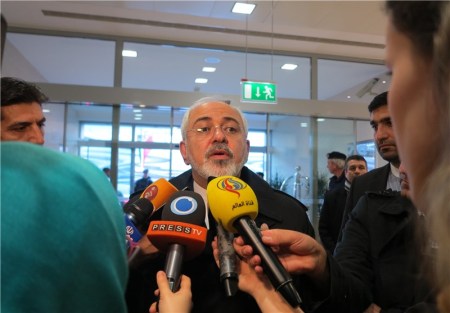
VIENNA (Tasnim) – Iranian Foreign Minister announced that the nuclear deal finalized by Tehran and world powers in July 2015 will be implemented today and anti-Iran sanctions will be removed after the release of IAEA report verifying that Iran has fulfilled its commitments as per the deal.
According to Tasnim dispatches, Mohammad Javad Zarif told reporters upon his arrival in the Austrian capital of Vienna on Saturday that the Director-General of International Atomic Energy Agency Yukiya Amano will release the verification report, and the nuclear deal (dubbed as JCPOA) will be implemented accordingly.
A joint statement will then be issued, which will announce the implementation of the Joint Comprehensive Plan of Action (the text of the nuclear deal), he added.
As regards his Saturday agenda, Zarif said he is scheduled to meet with Amano, announce the implementation of the nuclear deal, and hold bilateral meetings with European Union’s Foreign Policy Chief Federica Mogherini and possibly with other foreign ministers of the Group 5+1 (Russia, China, the US, Britain, France, and Germany) including US Secretary of State John Kerry.
The meetings are aimed at ensuring the correct implementation of JCPOA, the Iranian minister declared, noting that a meeting with his US counterpart is especially important considering “the extensive measures the Americans have declared to have taken.”
Implementation of the JCPOA is a good opportunity for the Iranian nation to see not only the termination of all cruel resolutions passed by the United Nations Security Council and the IAEA Board of Governors against Iran, but also the removal of all cruel sanctions imposed on the country due to its nuclear energy program, Zarif stressed.
This is a good day for the Iranian people, but it is also a very good day for the region, because the Middle East is now freed from an unnecessary conflict, which could cause concern for the region, the Iranian top diplomat noted.
“This day proves that we can resolve the world’s important problems through diplomacy. Problems are settled through dialog, not through threat of pressure and sanction,” he added.
Zarif arrived in the European capital along with a number of other Iranian officials including Deputy Foreign Minister Seyed Abbas Araqchi, Head of Atomic Energy Organization of Iran (AEOI) Ali Akbar Salehi, AEOI Spokesman Behrouz Kamalvandi, and Foreign Ministry Spokesman Hossein Jaberi Ansari.
Iran and the Group 5+1 (also known as E3+3 and P5+1) on July 14, 2015, reached a conclusion on a 159-page nuclear agreement that would terminate all sanctions imposed on Tehran over its nuclear energy program after coming into force.
Afterwards, the 15-memebr United Nations Security Council passed a resolution that endorsed the JCPOA.
According to the UNSC Resolution 2231, all previous UNSC sanctions imposed on Iran over its nuclear program will be terminated when the JCPOA takes effect.
The official media narrative is that Obama’s great relationship with Iran enabled the release of the American sailors captured at gunpoint by Iran’s terrorist IRGC. The media is full of praise for Obama for letting ten American sailors be taken hostage… and then released.
Iran’s army chief said on Wednesday the seizure of two US navy boats and their 10 sailors should be a lesson to members the US Congress trying to impose new sanctions on Tehran.
“This incident in the Persian Gulf, which probably will not be the American forces’ last mistake in the region, should be a lesson to troublemakers in the US Congress,” Major General Hassan Firouzabadi, head of Iran’s armed forces, was quoted as saying by Tasnim news agency.
Iran isn’t even bothering to threaten Obama. It just slaps him around. Instead it uses his weakness to threaten Congress which it now considers stronger than Obama.
 Photos courtesy of IDF Spokesperson.








 anneinpt
 artaxes
 danmillerinpanama
 davidking1530
 Peter Hofman
 Joseph Wouk
 Peter
Peter Louisiana Steve
 WarSclerotic

Recent Comments