Side Effects – From David Zucker via You Tube, September 10, 2015
Kim Jong-un has replaced John Boehner as Speaker of the House, Dan Miller’s Blog, September 11, 2015
(The views expressed in this article are mine and do not necessarily reflect those of Warsclerotic or its other editors. — DM)
We have met the enemy and it is us: we have become too tired to be effective and hence are becoming indifferent. The charade on Capitol Hill continues, and not only about the nuke “deal” with Iran. Will the carnival end before it’s too late, or will Obama continue to win?
The House speaker is elected by all House members, not just those of the majority party. He need not be a member of the House. Boehner having resigned because a serious medical condition often reduces him to tears, one group of Democrats nominated Debbie Wasserman-Schultz to replace him. However, due to her support for Hillary Clinton, she fell out of favor with the White House so another group of Democrats nominated Kim Jong-un at Obama’s request. To avoid the appearance of confrontation, Republicans offered no candidates. Kim won by seventeen votes, becoming the first non-US citizen to hold the office thus far this month.


REPORTING FOR DUTY!
The current upset was precipitated by Republican members’ disagreements with Boehner and other party leaders about how best to deal with the catastrophic Iran nuke “deal” without unnecessarily offending the President. Kim Jong-un is expected to substitute his own brand of leadership for Boehner’s leadership through ambivalence.
A majority also deemed Kim the best qualified to negotiate with Dear Leader Obama on behalf of the House because, as the undisputed leader of a rogue nuclear nation himself, he should be able to pull not only Obama’s strings but also those of the Supreme Leader of the Islamic Rogue Republic of Iran.
White House Press Secretary Josh Earnest declined comment on the situation beyond refusing to comment on whether Obama met privately with Kim to congratulate him. However, Obama is generally thought to have confirmed that He fully supports Kim’s way of governing his own Democratic Peoples’ Republic and — subject to the few pesky restraints still imposed by an antiquated Constitution that He has not yet found ways to sneak around — He does His best to emulate him. In that connection, Obama asked Kim for recommendations on antiaircraft guns to deal humanely with Jews and other traitors who oppose Him (Please see also, New York Times Launches Congress ‘Jew Tracker’ – Washington Free Beacon.)
Desiring to gain Obama’s total good will, Kim promised to have derogatory cartoons of Donald Trump and Hillary Clinton painted on all future North Korean nukes and missiles just before they explode. In return, Obama promised to issue executive orders granting North Korea the permanent right to declassify any and all U.S. documents it sees fit pertaining to the security of the United States and to obtain copies, gratis, from the Government Printing Office.
House Speaker Kim Jong-un will next meet with Supreme Leader Khamenei in Tehran to make two common sense proposals, with which Khamenei is certain to agree:
First, Kim will propose that a group of highly regarded North Korean nuclear experts — under his personal guidance and supervision — conduct all nuke inspections in Iran and draw all conclusions concerning any past or present Iranian nuclear program based on them exclusively. Those conclusions will be drawn on behalf of, and in lieu of any conclusions drawn by, the International Atomic Energy Agency (IAEA). The head of the IAEA, Yukiya Amano, immediately endorsed this plan as “splendid and totally consistent with any and all IAEA – Iran “secret deals.”
Second, Kim will propose that Khamenei promise not to nuke anyone until all sanctions have been permanently eliminated, unless he really wants to.
Obama is thought to have agreed with every aspect of the Kim plan and to have directed Secretary Kerry to tell Khamenei that if he agrees all sanctions will be eliminated permanently, via executive decree, and hence even more expeditiously than previously expected. Due to a successful Senate filibuster yesterday, Obama can issue the executive decree very soon; Today — Friday, September 11th — is being considered seriously due to the obvious symbolism of the date.
H/t Freedom is just another word

The inevitable success of Kim’s mission will result in a win-win situation for nearly everyone, particularly the financially strapped IAEA, and the true Peace of Obama will prevail throughout all parts of the world that He considers worth saving. Remember — it’s all for the Children!


Addendum
하원 의장 김정은 의 문 사랑하는 북미 친구 , 그것은 오바마 대통령 아래에서 당신의 인생 이 곧 Amerika 민주주의 인민 공화국 이 될 것입니다 무엇 에 미래의 삶을 위해 잘 준비 것을 진심으로 희망 합니다. 배리 와 나는 제출 된 것을 기쁘게 사람들을 위해 가능한 한 오랫동안 지배 구조 의 우리의 양식 에 서서히 적응 을 하기 때문에 전환이 원활 하게 하기 위해 함께 열심히하고 고통 일했다 .
Translation:
Statement of House Speaker Kim Jong-un
My dear North American friends, it is my sincere hope that your life under President Obama has prepared you well for your future life in what will soon become the Democratic People’s Republic of Amerika. Barry [a.k.a. Barack] and I have worked long and hard together to acclimate you gradually to our transformed and transformational form of governance and hence to make the transition as smooth and painless as possible for those pleased to submit. Now, we will accelerate the progress.
Conclusions
It does not have to be that way. Here, in closing, are a few words from Daniel Greenfield.
We don’t have to give in to despair. If we do, we are lost. Lost the way that the left is lost. Lost the way that the Muslim world is lost.
We are not savages and feral children. We are the inheritors of a great civilization. It is still ours to lose. It is ours to keep if we understand its truths. [Emphasis added.]
We are not alone. A sense of isolation has been imposed on us as part of a culture war. The task of reconstructing our civilization and ending that isolation begins with our communication. We are the successors of revolutions of ideas. We need to do more than keep them alive. We must refresh them and renew them. And, most importantly, we must practice them.
We are not this culture. We are not our media. We are not our politicians. We are better than that.
We must win, but we must also remember what it is we hope to win. If we forget that, we lose. If we forget that, we will embrace dead end policies that cannot restore hope or bring victory.
What we have now is not a movement because we have not defined what it is we hope to win. We have built reactive movements to stave off despair. We must do better than that. We must not settle for striving to restore some idealized lost world. Instead we must dream big. We must think of the nation we want and of the civilization we want to live in and what it will take to build it.
Our enemies have set out big goals. We must set out bigger ones. We must become more than conservatives. If we remain conservatives, then all we will have is the America we live in now. And even if our children and grandchildren become conservatives, that is the culture and nation they will fight to conserve. We must become revolutionaries.
We must think in terms of the world we want. Not the world we have lost.
This is the America we live in now. But it doesn’t have to be.
It can be up to us, not to those who hate America and all for which she once stood.
Our World: The Republican fall guys, Jerusalem Post, Caroline Glick, September 8, 2015
Whenever the Iranians leave, they can be depended on to blame US for their decision to vacate their signature. And the Democrats in turn will blame the Republicans for pushing the Iranians over the edge.
***********************
The ayatollahs will ride their nuclear pact with the Great Satan all the way to a nuclear arsenal and regional hegemony, repeating the cycles of brinksmanship, extortion, respite and brinksmanship that they learned from their North Korean teachers.
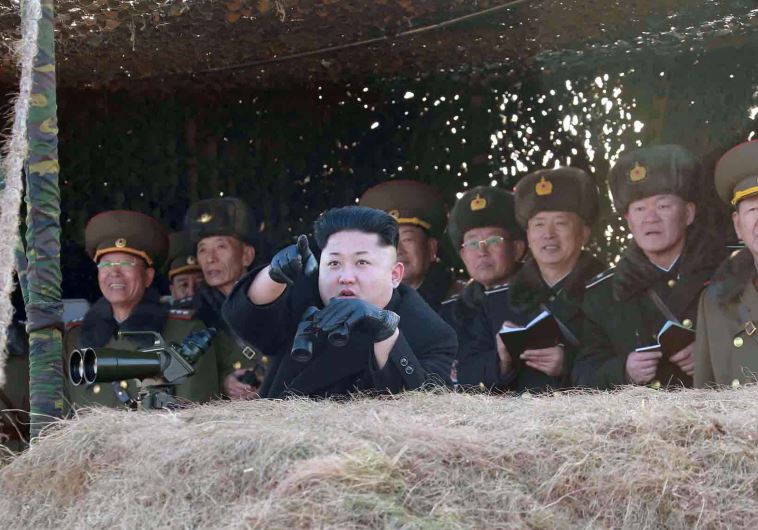 Kim Jong-un, North Korea leader. (photo credit:KNS / KCNA / AFP)
The Iran nuclear deal is presented as an international agreement between the major powers and Iran. But the fact is that there are really only two parties to the agreement – President Barack Obama and his Democratic Party on the one hand, and the Iranian regime on the other.
Over the past week or so, more and more Democrats have fallen into line behind Obama. At the same time, word is getting out about what Iran is doing now that it has its deal. Together, the actions of both sides have revealed the role the nuclear pact plays in each side’s overall strategies for success.
On the Iranian side, last Wednesday the National Committee of Resistance of Iran revealed that North Korean nuclear experts are in Iran working with the Revolutionary Guards to help the Iranians prevent the UN’s nuclear inspectors from discovering the scope of their nuclear activities.
The NCRI is the same opposition group that in 2003 exposed Iran’s until then secret uranium enrichment installation in Natanz and its heavy water plutonium facility in Arak.
According to the report, the North Koreans “have expertise in ballistic missile and nuclear work areas, particularly in the field of warheads and missile guidance.”
“Over the past two years the North Korean teams have been sharing their experiences and tactics necessary for preventing access to military nuclear sites,” NCRI added.
Although, as The Washington Times reports, NCRI’s finding have yet to be verified, it is unwise to doubt them.
North Korea has been assisting Iran’s nuclear program for nearly 20 years. The US began applying sanctions on North Korea for its ballistic missile proliferation activities in Iran 15 years ago. Iran’s Shahab and Ghadr ballistic missiles are modeled on North Korea’s Nodong missiles.
The Syrian nuclear installation that Israel reportedly destroyed in 2007 was a duplicate of the Yangbyon heavy water reactor in North Korea. The Deir al-Zour reactor was reportedly built by North Korean nuclear personnel and paid for by Tehran.
North Korea’s heavy involvement in Iran’s nuclear weapons program tells us everything we need to know about how Iran views the nuclear deal it signed with the Obama administration and its international partners.
For the past 22 years, the North Koreans have been playing the US and the international community for fools. Ever since February 1993, when inspectors from the International Atomic Energy Agency first discovered that North Korea was conducting illicit nuclear activities, Pyongyang has been using its nuclear program to blackmail the US.
The pattern repeats itself with maddening regularity.
First, the US discovers that North Korea is engaging in illicit nuclear activities. Over the years, these activities have gone from illicit development of plutonium-based nuclear bombs to expelling UN inspectors, to testing long-range ballistic missiles, to threatening nuclear war, to testing nuclear bombs and threatening to supply the bomb to terrorist groups.
Second, the US announces it is applying sanctions to North Korean entities.
Third, North Korea responds with more threats.
The sides then agree to sit down and negotiate the scaling back of North Korea’s nuclear activities. In exchange for Pyongyang’s agreement to talk, the US provides the hermit slave state with whatever it demands. US concessions run the gamut from sanctions relief, to cash payments, provision of fuel, assistance in developing “peaceful” nuclear sites at which the North Koreans expand their nuclear expertise, removal of North Korea from the State Department’s list of state sponsors of terrorism, the provision of formal US commitments not to use force to block North Korea’s nuclear progress, to more cash payments and sanctions relief.
The North then formally agrees to scale back its nuclear program and everyone is happy.
Until the next time it is caught cheating and proliferating.
And then the cycle starts again.
In each go around, the US expresses surprise at the scope of North Korea’s illicit nuclear and missile activities. In every cycle, US intelligence failed to discover what North Korea was doing until after the missiles and bombs were tested and UN inspectors were thrown out of the country.
Despite North Korean brinksmanship and ballistic missile warhead development, the US prohibits its ally South Korea from developing its own nuclear deterrent or even taking steps in that direction.
For their part, while negotiating with the Americans, the North Koreans have proliferated their nuclear technologies and ballistic missiles to Iran, Syria, Pakistan and Libya.
Given North Korea’s clear strategy of using nuclear blackmail to develop its nuclear arsenal and maintain the regime’s grip on power, you don’t need to be a master spy to understand what the presence of North Korean experts in Teheran tells us about Iran’s strategy for nuclear empowerment.
The ayatollahs will ride their nuclear pact with the Great Satan all the way to a nuclear arsenal and regional hegemony, repeating the cycles of brinksmanship, extortion, respite and brinksmanship that they learned from their North Korean teachers.
Given how well the strategy has worked for the psychotic North Koreans who have no economy, no allies and no proxies, it is clear that Iran, with its gas and oil deposits, imperial aspirations, terrorist proxies and educated population believes that this is the strategy that will launch it to world-power status.
This then brings us to the Democrats.
Depending on their pro-Israel protestations, the Democratic position in support of the deal ranges from optimism to pessimistic minimalism. On the side of the optimists, we have the Obama administration.
Obama, Secretary of State John Kerry and their advisors insist that the deal is fantastic. It blocks Iran’s path to the bomb. It opens the possibility of Iran becoming a positive actor on the world stage.
On the other end of the Democratic spectrum are the pessimists like New Jersey Senator Cory Booker and Congresswoman Debbie Wasserman-Schultz.
As they see it, the deal is horrible. It empowers and enriches Iran and legitimizes its nuclear program.
But still, they claim, the deal keeps Iran’s nuclear ambitions at bay for a few years by forcing Iran to submit to the much touted UN inspections regime.
So it is a good deal and they will vote in favor of it and then vote to sustain a presidential veto of a congressional decision to oppose it.
Obviously, the presence of North Korean nuclear experts in Tehran makes a mockery of the notion that Iran has any intention of exercising good faith with UN inspectors. But that isn’t the point.
The point is that the Democrats have no intention of doing anything to prevent Iran from becoming a nuclear power. They just don’t want to be blamed for Iran becoming a nuclear power. They want the Republicans to shoulder the blame. The purpose of the deal from their perspective to set the Republicans up to be blamed.
Obama and his Democratic followers insist that if Iran doesn’t act in good faith, the US will reimpose sanctions. Worse comes to worst, they insist, the US can just walk away from the deal.
This of course is utter nonsense.
Obama won’t walk away from his signature foreign policy. He will devote his energies in his remaining time in office to covering up for Iran. That is why he is breaking the law he signed and refusing to hand over the side deals regarding the farcical nature of UN inspections of Iran’s nuclear sites to Congress.
Moreover, after insisting that the deal is the best way to prevent a holocaust or that it is the only way a Jewish mother can protect the homeland of her people, Democratic lawmakers are not going to rush to acknowledge that they are lying. Now that they’ve signed onto the deal, they own it.
Of course, the Iranians are another story. While the Democrats will not abandon the deal no matter what, the Iranians signed the deal in order to abandon it the minute it outlives its usefulness. And that works just fine for the Democrats.
The Democrats know that the Iranians will use any step the Republicans take to try to enforce the deal’s verification regime or condition sanctions relief on Iranian abidance by the deal’s restrictions on its nuclear activities as an excuse to walk away from the deal. They also know the Iranians will remain in the deal as long as it is useful to them.
Since the Iranians intend to hide their nuclear activities, the Democrats assume Tehran will stay in until it is financially and militarily ready to escalate its nuclear activities.
The Democrats believe that timetable will extend well beyond the lifespan of the Obama administration.
Whenever the Iranians leave, they can be depended on to blame US for their decision to vacate their signature. And the Democrats in turn will blame the Republicans for pushing the Iranians over the edge.
You have to give credit to the administration and its Iranian chums. At least they are consistent. They have constructed an agreement that gives them both what they care about most. Iran, as always, wants to dominate the region and develop the means to destroy Israel and its Arab adversaries at will. The administration, as always, wants to blame the Republicans.
Israel and the Arabs understand the game that is being played. It is time for the Republicans to get wise to it.
What is to be done? (2), Power Line,
The first resolution the House should consider when it returns [today] should be one stating that Congress has not been provided the material it needs, that the Iran deal has not been properly submitted to Congress, and therefore that the president has no authority to waive or suspend sanctions on Iran.
********************
Yesterday I noted that the Obama administration has failed to comply with the condition precedent to Congress’s review of the deal with Iran (and the president’s authority to waive sanctions). I asked what is to be done.
I asked, Bill Kristol answered. Bill wears many hats, one of which is Chairman of the Emergency Committee for Israel. In this capacity he released the following statement addressing the question yesterday:
The Obama Administration has not complied with the legal requirement that it provide Congress “any additional materials” related to the Iran deal, including “side agreements, implementing materials, documents, and guidance, technical or other understandings, and any related agreements, whether entered into or implemented prior to the agreement or to be entered into or implemented in the future.” The Administration has not given Congress a key side agreement between Iran and the International Atomic Energy Agency, one which describes how key questions about the possible military dimensions of Iran’s nuclear program will be resolved, as well as how the verification regime will work.
Congress should not accept this evasion of the law by the Obama Administration. Congress should insist on the text of this and any other side agreements. Lacking this, Congress can and should take the position that the Iran deal has not been properly submitted to Congress to review, and therefore that the president has no authority to waive or suspend sanctions.
We understand the temptation of leadership to get to a vote on a resolution of disapproval and then to move on to other votes. But the Iran deal isn’t just another legislative issue where some corner-cutting by the Administration is to be accepted with a brief expression of discontent followed by a weary sigh of resignation.
The Iran deal is the most important foreign policy issue this Congress will have before it. Congress should rise to the occasion and insist on its prerogative — and the American people’s prerogative — to see the whole deal. The first resolution the House should consider when it returns [today] should be one stating that Congress has not been provided the material it needs, that the Iran deal has not been properly submitted to Congress, and therefore that the president has no authority to waive or suspend sanctions on Iran.
I think this is the correct direction and congressional leadership should follow it.
What is to be done? Power Line,
(In this context, the refusal of Obama — a rogue president — to comply with U.S. law jeopardizes our national security. He will probably continue to get away with it until he leaves office. — DM)
President Obama has failed to comply with the conditions of the Iran Nuclear Agreement Review Act (the Corker-Cardin bill) that he himself signed into law. By its express terms the law required Obama to transmit to Congress “the agreement. . . . including all related materials and annexes.” He was obligated to do this “not later than five days after reaching the agreement.”
Obama has not done so. The administration has failed or refused to submit the IAEA side deal with Iran regarding the possible military dimensions of Iran’s research at the Parchin military facility to Congress.
Indeed, the administration claim not even to have seen the IAEA side deal. Rather, administration officials claim only to have been briefed by the IAEA on the terms of the side deal. They claim it is cloaked in secrecy that prevents its disclosure. The side deal is nevertheless an integral part of the JCPOA and its disclosure expressly required by the act.
Whether or not the side deal is “confidential” matters not one iota under the terms of the Corker-Cardin bill. It should be noted, however, that the administration appears to have constructed an elaborate pretense regarding the side deal. Fred Fleitz has advanced a highly plausible case that administration officials themselves drafted one or more side deals including this one for the IAEA including the Parchin side deal. He calls the arrangement “a national security fraud.”
Obama’s noncompliance with the act is more than problematic. It precludes (or should) the president’s authority to waive sanctions. It prevents (or should) the JCPOA itself from coming to a vote in Congress. Yet little notice has been taken of any of the serious issues that Obama has created in the service of his Iranian fantasies. As always, Obama acts by the executive equivalent of main force and trusts others to fall into line.
Rep. Mike Pompeo and attorney David Rivkin take note in a brief Washington Post column. They write:
Congress must now confront the grave issues of constitutional law prompted by the president’s failure to comply with his obligations under the act. This is not the first time this administration has disregarded clear statutory requirements, encroaching in the process upon Congress’s legislative and budgetary prerogatives. The fact that this has happened again in the context of a national security agreement vital to the United States and its allies makes the situation all the more serious.
For Congress to vote on the merits of the agreement without the opportunity to review all of its aspects would both effectively sanction the president’s unconstitutional conduct and be a major policy mistake. Instead, both houses should vote to register their view that the president has not complied with his obligations under the act by not providing Congress with a copy of an agreement between the IAEA and Iran, and that, as a result, the president remains unable to lift statutory sanctions against Iran. Then, if the president ignores this legal limit on his authority, Congress can and should take its case to court.
At the least, the congressional leaders should refuse to call up the JCPOA for a vote of approval and “register their view” as Pompeo and Rivkin suggest. Congress should force the issue in other ways within the scope of their powers. I don’t know about the proposed judicial remedy; it seems like weak tea. I don’t have the answer, but Congress should not proceed as though the conditions precedent to a vote of approval and the waiver of sanctions have occurred as required under the Corker-Cardin bill; they have not.
Nuclear Jihad, Gatestone Institute, Denis MacEoin, September 7, 2015
“[Some] analysts,” writes the historian and former Israeli Ambassador to the United States, Michael Oren, “claimed the president [Barack Obama] regarded Iran as an ascendant and logical power — unlike the feckless, disunited Arabs and those troublemaking Israelis — that could assist in resolving other regional conflicts. I first heard this theory at Georgetown back in 2008, in conversation with think tankers and former State Department officials. They also believed Iran’s radical Islam was merely an expression of interests and fears that the United States could with sufficient goodwill, meet and allay. … Iran, according to Obama was a pragmatic player with addressable interest. For Netanyahu, Iran was irrational, messianic, and genocidal – ‘worse,’ he said, ‘than fifty North Koreas.'”[1]
Since the signing of the deal at the UN, hot-tempered criticisms and defences have gone into overdrive in the political, journalistic, and diplomatic spheres. Acres have been written and are still being written about the deal, making it the hottest political potato of recent years. Expert analysts such as Omri Ceren and, more recently, Joel Rosenberg have cut through the deliberate obfuscation to show the extent of the dangers the deal presents to the Middle East, the United States, Israel, and the world.
The deal’s supporters insist that it will bring peace and calm to the region, while a host of denigrators — chief among them Israeli Prime Minister Binyamin Netanyahu — have exposed the enormous risks it entails. Already, a vast majority of American citizens are opposed to the deal.
Within the U.S. Congress, bipartisan opposition to the deal is high and mounting. Yet, on September 2, President Obama succeeded in winning over a 34th senator, enough that ultimate passage of the deal is a foregone conclusion. That does not, however, mean that the debate will end. In all likelihood, it will grow fiercer as time passes and true consequences become clearer to the public and politicians alike.
Recent revelations that the International Atomic Energy Agency (IAEA), which oversees nuclear developments worldwide, has agreed that only Iranians will be allowed to inspect the most controversial of Iran’s nuclear sites, have raised anxieties about proper monitoring of the deal. The military complex of Parchin, where Iran is suspected of work on nuclear weapons, will be closed to outside inspection, making it certain that, if Iran decides to cheat (something it has done before), it will be able to do so with impunity. Sanctions will not be re-imposed. And, as we shall see, cheating on the deal can be justified by the Iranians who could always refer to the practice of the prophet Muhammad with the Quraysh tribe in Mecca.
Obama, his Secretary of State John Kerry, and the entire US administration are not merely behind the deal, but almost fanatically so. Many argue that Obama is more interested in securing his “legacy” as the world’s greatest peacemaker (or war-creator, as the case may well turn out to be), the statesman par excellence who alone could bring the theocratic regime of Iran in from the cold and shower the Middle East with true balance in its troubled affairs.
To bring this about, Obama has had to diminish, if not leave totally open to obliteration, American support for Israel, the single country in the world most clearly exposed to a possible genocide should the Iran’s Islamic regime choose to exterminate it, as it has so often threatened to do.
Mahmoud Ahmadinejad’s words mellal-e Eslami bayad Esra’il-ra qal’ o qam’ kard – “the Islamic nations must exterminate Israel” — have been given renewed vigour now that it is highly likely that Iran, evading serious inspections by the IAEA, will soon possess the weapons to do just that.
Even if the treaty is a done deal, it is time to show yet another massive hole in the administration’s strategy. Already, Obama, Kerry and the tightly knit administration have shown themselves remarkably obdurate in turning a blind eye to the many concerns that surround the deal. At the end of the “sunset period,” if not sooner, Iran gets to have, legitimately, as many bombs as it likes. Other problems include breakout times; centrifuge production; centrifuge concealment; uranium enrichment by stealth; refusal to allow the IAEA to inspect military sites; the acquisition of intercontinental ballistic missiles — presumably to be used intercontinentally at guess who. It is no secret that the hardliners in Iran still speak of America as “The Great Satan” and consider it their enemy. That does not even include the implications of lifting sanctions on, and paying billions of dollars to, the world’s main sponsor of terrorism.
As Michael Oren has shown, however, the American president presumably thinks he is doing a deal with a logical and pragmatic regime. Barack Obama, an intelligent, well-read man of Muslim origin, knows almost nothing about Islam; that is the greatest flaw in the Iran deal he has fought so hard to inflict on the human race. With access to platoons of experts, to some of the greatest libraries with holdings in Islamic doctrines and history, and with the Mullahs and Iran’s public still daily promising to destroy America, Obama apparently still believes Islam is a religion of peace and that a theocratic, terror-supporting, medieval regime should have the power to make nuclear bombs. The obverse is that he might like, perhaps not wittingly, to see America, Israel and the West brought to their knees.
This author has previously exposed one aspect of Iran’s serious lack of logic, rationality, or pragmatism — namely the extent to which apocalyptic thinking, messianic prophecy, and dreams of Islamic transcendence through universal conflict pervade the clerical elite, a high percentage of the masses, and even the Islamic Revolutionary Guard Corps. One might assume that this would be especially true when they are flush with cash and nuclear weapons, and the risk to their own survival is substantially lower.
On August 17, just over a month after the signing of the nuclear deal, Iran’s Supreme Leader, ‘Ali Khamene’i, addressed a religious conference, where he expressed his undying hatred for the United States. He said, for example:
We must combat the plans of the arrogance [i.e. the West, led by the U.S.] with jihad for the sake of Allah. … jihad for the sake of God does not only mean military conflict, but also means cultural, economic, and political struggle. The clearest essence of jihad for the sake of God today is to identify the plots of the arrogance in the Islamic region, especially the sensitive and strategic West Asian region. The planning for the struggle against them should include both defense and offense.
The deal has done nothing whatever to stop military threats to Israel, an ally of the United States (though treated with disrespect by America’s president). Speaking on 2 September, the Islamic Revolutionary Guard Corp’s top commander in Tehran province, Brigadier General Mohsen Kazemayni, stated that, “… they [the US and the Zionists] should know that the Islamic Revolution will continue enhancing its preparedness until it overthrows Israel and liberates Palestine.”
There is a simple word for this: warmongering.
Why is the U.S. President insisting on a bad deal with a warmongering regime?
When a military force at its strongest fantasizes about the coming of a Messiah (the Twelfth Imam) to lead them to victory over all infidels, talk of logic, rationality and pragmatism seems acutely out of touch with reality.
Obama’s assumption that there is something solid about the Iranian regime that makes it suitable as a recipient for such largesse and the chance to enrich uranium until kingdom come seems to be based on false consciousness. The regime has been in place for almost forty years, quite a respectable time for a dictatorship. In part, that has been because it has mastered the art of suppression, giving its people a degree of freedom that is missing in several other Islamic countries, such as Saudi Arabia, Sudan, or Afghanistan. These partial freedoms, especially for young people, lull the population into risk-averseness, possibly helped along by the memory in 2009 of pleas for more freedom, which the United States ignored and the mullahs savaged.
Obama, in his ongoing attempt to portray Islam as benign — and a dictatorial regime as a sold basis for peace and understanding in the Middle East — ignores the religious element of the theocracy, as well as the sadistic repression, and in doing so misses a lot.
First of all, Shi’ite Islam is different from its Sunni big brother. It is deeply imbued with features largely absent from Sunni Islam. The most important Shi’i denomination is that of the Twelvers (Ithna’ ‘Ashariyya), who, from the beginning of Islam, have believed themselves to be not only the true version of the faith, but the group destined by God to rule in its name. Beginning with ‘Ali, the son-in-law of the Prophet and the fourth Caliph of the Sunnis, the Shi’a began as his supporters. (Please see the Appendix that follows this article: it contains material that even Barack Obama and his advisors need to know; without it, they simply will not “get” what the ayatollahs are about. It comes to an important conclusion that has considerable bearing on today’s events — and not the one you may expect.)
Beneath the smiles and banter lie the unsmiling masks and the taqiyya-flavoured lies. Beneath the wheeling and dealing and the refusals to compromise lies a sense of destiny for the regime, a belief that it stands on the brink of the realization of the centuries-old Shi’ite dream: that God will finally set his people on the pinnacle of the world and usher in the never-ending reign of the Imam Mahdi, with all injustice gone, the martyrs in paradise, the ayatollahs and mujtahids andmaraji’ in glory, and all the infidels in hell.
It is precisely because Barack Obama and his aides have never got down and dirty to take in hard information that they have remained utterly out of touch with the real springs and cogs of Iranian Shi’ite thinking.
Obama has, when all is said and done, let himself be deluded by the charm offensive of Hassan Rouhani and his henchman Javad Zarif. Obama may not believe in the mystical land of Hurqalyaor the white steed on which the Twelfth Imam will ride to the world’s last battle any more than you or I do. But the clerical elite of Iran, and those who follow them blindly — men and women brought up from birth on these tales, and who travel in the thousands every day to send a message to the Imam at the Jamkaran Mosque near Qom — believe these things with absolute devotion, and that is why this story matters, because it has political consequences.
Shi’i Muslim law enshrines jihad, holy war, as fully as does Sunni law. For Sunnis, jihad has always been possible under the authority of a Caliph, whether fought under his orders or led by kings and governors under his broad aegis.
The Shi’a, however, do not recognize the Caliphate and have often been the victims of Sunni jihads. They may feel impelled to fight a holy war, but under what authority could they do so?
The power of the clergy had waned under the anti-clerical reign of Iran’s Pahlavi dynasty (1925-1979), only to burst out more strongly than ever in the Islamic Revolution, which placed all authority in a new system of government: rule by a religious jurist, a faqih.[2] Overnight, a jihad state was brought into existence; a jihad state with vast oil reserves, modern military equipment, and, at first, the support of almost the entire Iranian population. The clerical hierarchy under Ayatollah Ruhollah Khomeini did not just intend to prepare the way for the coming of the Mahdi. They were now his earthly deputies, in whose hands lay life and death for millions.
The new Shi’ism allowed the clergy to take on powers they had never imagined. More and more economic and legal power came to be concentrated in the hands of a narrow body of scholars, and sometimes a single man could be the source of religious and legal authority for the entire Shi’i world — in Iran, Afghanistan, eastern Arabia, Bahrain, and so on. Thus were the foundations laid for the revolutionary rank of Supreme Leader, taken by the Ayatollahs Khomeini and Khamene’i.
Look for a moment at the preamble to the Constitution of the Islamic Republic of Iran.[3] You will see quickly that this does not read like any other constitution you have seen. The preamble sets the tone. Here, in an account of the circumstances leading to the revolution we read of the clergy as the ruhaniyyat-e mobarez, “the militant or fighting clergy.” These are not Anglican vicars at their prayers or rabbis studying Talmud. A mobarez is a warrior, a champion, a fighter. Not far down the preamble, one encounters a description of their struggle as “The Great Holy War,”jihad-e bozorg. We are not in Obama’s world of logical and pragmatic striving for political and diplomatic coherence. This is made even clearer in one of the constitution’s earlier articles, “The Religious Army.” Here, we read that the Iranian Army and the Islamic Revolutionary Guard Corps “have responsibility… for a religious mission, which is Holy War (Jihad) in the path of God, and the struggle to extend the supremacy of God’s law in the world.”
How do you reach a compromise and a pragmatic deal with a regime that thinks in this way? Are the U.S. administration and the P5+1 blind to something the Iranians have never even bothered to conceal? Do they really take everything in the talks at face value? Perhaps they think references to jihad and fighting clergy are nothing more than pious talk “for domestic consumption,” as they tried to explain — as real and everyday as the myths and legends of other faiths. If they do, then they have far less excuse for their blindness, for the Iranian regime is already at war and is already fighting its jihad.
In Iraq, for example, a country with a majority Twelver Shi’i population, Iranian-backed militias have been at war for many years, first against the Americans, then the Sunnis, and now the hordes of Islamic State. In June 2014, Grand Ayatollah al-Sayyid ‘Ali al-Husayni al-Sistani issued a fatwa calling on Iraqis to fight against Islamic State, justifying their fight as jihad wajib kafa’i: a Jihad that is compulsory for those who choose it, but not for the entire population. The ruling calls for a struggle against ISIS’s irhab – their “terrorism.” Jihad is a religious and legal duty, and even though ISIS may call its fighting jihad, it is here condemned as terror.
Hezbollah, created and backed by Iran, is by far the largest terrorist group in the region. Hezbollah is considered a state within a state, with forces and infrastructure inside Lebanon and Syria. It has used the name “Islamic Jihad Organization” to cover its attacks on Israeli forces in Lebanon. In its 1988 Open Letter (Risala maftuha), it describes its followers as “Combatants of the Holy War” and goes on — in terms similar to those in the Hamas Covenant — “our struggle will end only when this entity [Israel] is obliterated. We recognize no treaty with it, no cease fire, and no peace agreements, whether separate or consolidated.”
Hezbollah and its creator, the Iranian Islamic regime, have a curious link to the Palestinian terror movement, Hamas, despite Hamas being exclusively Sunni. By financing, arming, and defending Hamas, Iran is fighting a strange proxy jihad that serves its own purposes of defying the West, achieving regional hegemony, and winning praise from all Muslims in the world for its own war against Israel. It also furthers the goals of the Muslim Brotherhood (of which Hamas is the Palestinian branch) in the same struggle.
I have dragged you through the briars and mud because it is important here to see another culture through its own eyes. If we insist in pretending that Shi’i Muslims think like Sunni Muslims or, worse still, like Jews or Christians — if we brush all that history and all those doctrines under the carpet of “any deal is better than no deal ” — we will go on making the same mistakes. We will believe that a purely political and diplomatic enterprise to bring Iran in from the cold and create a new trading alliance will transform an evil regime into a land of sweetness and light.
Members of the U.S. Congress must wake up and examine, in however cursory a fashion, these views that motivate the Iranian leadership, and must stop pretending that they are as logical and pragmatic as would be convenient for the wishes of the West.
Not that Obama and Kerry have ever sounded logical or pragmatic in how they have approached this debate and this deal-making process. In an act of supreme folly, the White House has dismissed Ayatollah Khamene’i’s recent call for “Death to America;” they pretend it is just empty rhetoric for the Iranian people.
 Left: Senior Iranian cleric Ayatollah Mohammad Ali Movahedi Kermani, speaking on July 17 in Tehran, behind a banner reading “We Will Trample Upon America” and “We defeat the United States.” Right: Iran’s Supreme Leader, Ali Khamenei, proclaims “Death to America” on March 2
We are walking with a blindfold toward sure disaster. Forget the dreams of a Messiah if you will, but do not for one moment let yourself be lulled into thinking that only ISIS is serious about waging a jihad.
Despite their oft-expressed delusion that “Islam is a religion of peace,” President Obama, Secretary John Kerry and other leaders are, like it or not, already engaged in a war against jihad. They have already fought it in Afghanistan, Iraq, Libya and elsewhere. However much Obama wants to stand off from involvement in the jihad struggles of the Middle East, he cannot: Western states are fighting jihad, sometimes abroad, increasingly at home.
A Third World War is already taking place, a war the Islamists and Islamic states understand, but which many in the West still refuse to grasp. They are not even willing to respect the true motivations of the enemies against whom they fight. The Iran deal strengthens the hands of a regime that is the world’s terrorist state, a state that furthers jihad in many places because its clerical hierarchy considers itself uniquely empowered to order and promote holy war.
Let us for the moment ignore the nuclear aspect of this deal and look instead on what it offers the world’s leading jihad state. The removal of sanctions coupled with the business deals Europeans and others are rushing to secure, the delivery of perhaps $150 billion to Tehran, and the turning of many blind eyes to both Iran’s internal repression and its jihad wars in Iraq, Syria, Yemen, Gaza, and Lebanon leave the ayatollahs poised to dominate much of the Middle East.
And that is not all. Obama’s belief in the stability of the Iranian regime seems to rest on its endurance since 1979. His trust in Khamene’i’s presumed fatwa of 2013, forbidding nuclear weapons rests on the assumption that it even exists. It does not. No one has ever seen it. Even if the fatwa did exist, fatwas are not permanent. They are always regarded as temporary rulings with Twelver Shi’ism. This is a crucial technical point that the White House seems incapable of — or ill-disposed to — grasping.
Further, Obama’s faith in Iranian President Hassan Rouhani as a reformer and moderate flies in the face of Rouhani’s devotion to the hardline clerical leadership of which he is a part. Here are a few facts:
We only have to get this wrong once. Chants of “Death to America” and “Death to Israel” are not narcotic iterations of slogans but sincerely felt expressions of intent.
Khamene’i last month praised the Iranian people for calling for the deaths of the USA and Israel, and said that he hoped God would answer their prayers because in at most ten years, the Iranian mullahs and their IRGC will possess the power to exterminate Israel, if they and their God so wish.
Why, then, is this deal going ahead at all?
Why are sanctions against the world’s leading exporter of jihadi terrorism being lifted, not strengthened?
Why is one of the world’s most tyrannical regimes being rewarded for its intransigence, and especially for repeatedly violating the Non-Proliferation Treaty?
Why has Israel’s Prime Minister been vilified and sidelined simply for drawing attention to the weaknesses of a deal that could lead to the death of all of his people?
Why have the P5+1 never taken seriously the Shi’ite rule that it is permitted to lie to infidels and conceal one’s own true intentions?
Why are secrets being kept — such as the contents of the two side-deals?
Why is the U.S. Congress being asked to vote without the benefit of full disclosure?
Why is the IAEA banned from spontaneously inspecting only declared Iranian nuclear sites, and why are military sites completely off-limits?
The questions are so many and so critical that we remain in the dark about where this will lead mankind. No one who has ever done a financial or political deal would ever sign on the dotted line until they had answers to all their questions. Far more hangs on this deal than perhaps any deal in history. Yet those who want to make it enforceable under international law are uninformed about the most basic contents of the deal, as well as the beliefs and historical roots of their enemy.
Such folly is almost without precedence, except possibly in the process of appeasement that endeavoured to placate the Third Reich and treat Adolf Hitler as the best friend of democracy.
The Iranian regime not only despises democracy, it considers all Western law — including international law — invalid. This view has several deep roots. For both Sunni and Shi’i Muslims, only rule under God is valid, under a Caliph or a clerical theocracy under a Supreme Ruler. Human beings have no right to interfere. Democracy leads to the making of human laws that may contradict shari’a law, and such effrontery is considered arrogant and presumptuous. The democratic elements in Iran are tightly controlled, and supremacy rests in all areas beneath clerical authority. The same principle applies to international law, UN resolutions, treaties and so forth.
Iran has openly genocidal intent, as well as a devotion to holy war that goes to the very deepest level.
Before we leave the subject of jihad, there is one other factor that everyone has overlooked. It is the Treaty of Hudaybiyyah, the most important agreement in early Islamic history. In the year 628, Muhammad, now ruling in Medina, signed the ten-year Treaty of Hudaybiyyah with his long-time enemies, the tribal confederacy of Quraysh, who ruled Mecca. Twenty-two months later, under the pretext that a clan from a tribe allied with the Quraysh had squabbled with a tribe allied to the Muslims, Muhammad broke the treaty and attacked Mecca, conquering it.
What is important about this is that Muhammad had made the treaty while he was still relatively weak. But in the months after signing it, his alliances and growing conversions meant that he now possessed superior military strength — and that was when he pounced.
In 1994, the treaty became crucial to the issue of peace between Israel and the Palestinians.[4]In September 1993, Palestinian leader Yassir Arafat signed the Oslo Accords along with Israeli Prime Minister Yitzhak Rabin, and the following year the two leaders were awarded the Nobel Peace Prize.
However, even as he awaited that prize, Arafat spoke at a mosque in Johannesburg alluded to the Treaty of Hudaybiyyah and referred to “a jihad to liberate Jerusalem”: “I see this agreement,” he said, “as being no more than the agreement signed between our Prophet Muhammad and the Quraysh in Mecca.”
Non-Muslims may well have misunderstood this as a reference to some early Muslim peace-making. But Arafat made his meaning clear: “We now accept the peace agreement, but [only in order] to continue on the road to Jerusalem.”[5]
The nuclear deal that President Obama and his supporters have imposed will strengthen Iran considerably, removing sanctions and delivering perhaps $150 billion to the country. It is as certain as day follows night, that the Iranian regime will find a pretext to break the deal. Already, on September 3, the Supreme Leader Ayatollah Khamene’i made it clear that he would back out of the deal if sanctions were not completely removed at once.
Whatever happens in the days ahead, the U.S. Congress, backed by a majority of the American public, needs to strike this madcap deal down before it wreaks a storm of tribulations on everyone.
Denis MacEoin has a PhD (Cambridge 1979) in Persian Studies and has written widely on Iran and its religious beliefs.
‘Ali became the first in a line of twelve imams, all deemed the true leaders of Islam, but all denied their right to rule and all but one assassinated (or so it is claimed) by the Sunni Caliphs. From this comes the Shi’i sense of suffering, injustice, oppression by despots, neglect and rights — all of which played an important part in the 1979 revolution and continue to play out across society.
The Shi’a are the underdogs who are willing to sacrifice all to establish the rights of their imams and their successors. That was what the 1979 evolution was all about, and it is what present the regime still insists on as the justification for its opposition to Western intrusion, democracy, women’s rights and all the rest, which are deemed by Iran’s leadership as part of a plot to undermine and control the expansion of the Shi’i faith on the global stage.
The twelfth imam, according to Shi’ite legend, was a young boy, Muhammad al-Mahdi, the son of the murdered eleventh imam. Born in 869 in the Iraqi city of Samarra during the reign of the Sunni Abbasid Caliphate, his father, Hasan al-‘Askari, died when Muhammad was born.
It is said that young Muhammad, in order to avoid his enemies, went into something called Occultation (ghayba). Even if this originally was physical, he was never seen alive again and is supposed to have entered the celestial realm of Hurqalya, from which he will one day return as the promised Saviour, the Qa’im bi’l-Sayf, the One Who will Arise with the Sword to do battle with injustice and infidelity.
This belief is what waters modern Shi’i apocalypticism, something promoted intensely by former president Mahmoud Ahmadinejad. This expectation has considerable significance for Iran’s drive to nuclear power. But that is not why I raise the issue here. There is another, more mundane, aspect to the Imam’s disappearance and continued Occultation, and it may be even more relevant to the matters at hand.
The answer to what authority they could fight under was that only the Imam in each generation could order or lead jihad. But when the twelfth Imam vanished from human sight, was jihad to remain in abeyance until his return or could it be fought under another authority? The answer was not at first simple, but one thing started to happen: the Shi’a began to consider their religious scholars to be the intermediaries with the Imam, and this laid the basis for the possibility that they might have the right to order jihad. For some time, this was just conjectural, for the Shi’a had little worldly power.
In 1501, a new dynasty, the Safavids, came to power in Iran, forced most of the population to convert to Shi’ism, and created a line of kings under whom the clerical class became more and more powerful. The Shah could still lead jihad, but the clergy were needed to give permission. The Safavid dynasty lasted till 1722, and an interregnum was followed by the emergence of a new line of Shahs, the Qajars, who ruled from 1796 to 1925.
Under the Qajars, the Shi’i clerical hierarchy underwent deep and lasting changes, producing today’s version of Twelver Islam, the Usulis.
The newly powerful ‘ulama of the 19th century took on the mantle of deputies for the Hidden Imam and ordered jihads in 1809 and 1826 (against Russia), 1836, 1843, and 1856-7 (against the British). In 1914, when the British occupied Iraq at the start of World War I, the Shi’i clergy in the shrine centres there declared jihad to reinforce the call for Holy War by the Ottoman empire.
__________________________________
[2] As in Khomeini’s theory and book, Velayat-e Faqih, the Custodianship of the Jurisprudent.
[3] Here in English, here in Persian.
[4] For a detailed discussion of the treaty and its implications for making peace with Muslims, see Daniel Pipes, “Lessons from the Prophet Muhammad’s Diplomacy,” The Middle East Quarterly, September 1999, pp. 65-72.
[5] Natasha Singer, “Arafat Text Raises Ire,” Forward, May 27, 1994.
Iran’s supreme leader: No nuclear deal unless sanctions fully lifted, Israel Hayom, Erez Linn, Shlomo Cesana, Yoni Hersch, Associated Press and Israel Hayom Staff, September 4, 2015
 Supreme Leader Ayatollah Ali Khamenei speaks in a meeting with members of Iran’s Experts Assembly in Tehran | Photo credit: AP
If Khamenei decides to make good on his word and demand the lifting of sanctions entirely, it will not be possible to implement the snapback mechanism and reimpose sanctions should Iran violate its obligations under the deal.
******************
Iran’s supreme leader said Thursday that “there will be no deal” if world powers insist on suspending rather than lifting sanctions as part of a landmark nuclear agreement and said it is up to Iran’s parliament, and not him, to approve or reject it.
His remarks, read aloud by a state TV anchorman, mark the first official comment on the deal since U.S. President Barack Obama secured enough support to prevent the Republican-led Congress from blocking it.
Ayatollah Ali Khamenei has yet to express a clear opinion on the deal, clinched in July, which would curb Iran’s nuclear activities in exchange for relief from crippling sanctions.
Khamenei said some U.S. officials have spoken of the “suspension” of sanctions, which he said was unacceptable. “If the sanctions are going to be suspended, then we will also fulfil our obligations on the ground at the level of suspension and not in a fundamental way,” he said.
In response, White House press secretary Josh Earnest reiterated the Obama administration’s stance that it would focus on Tehran’s actions and not its words.
Washington has been “crystal clear about the fact that Iran will have to take a variety of serious steps to significantly roll back their nuclear program before any sanction relief is offered,” he said.
However, the snapback plan (reimposing economic sanctions on Iran if it violates the deal), which Iran agreed to as part of the deal, could lose its validation as it is based on the suspension of the sanctions rather than a full removal.
If Khamenei decides to make good on his word and demand the lifting of sanctions entirely, it will not be possible to implement the snapback mechanism and reimpose sanctions should Iran violate its obligations under the deal.
Iran’s supreme leader has traditionally had the final say on all important matters in the country, but on Thursday Khamenei said that Iran’s parliament, the Majlis, known to oppose the agreement, should decide on the deal.
“It is the representatives of the people who should decide. I have no advice regarding the method of review, approval or rejection,” he said.
Either way, according to a Revolutionary Guard senior official, the deal does not detract one bit from the Iranian regime’s rancor toward Israel. “The Islamic revolution will continue to enhance its abilities until it will destroy Israel and liberate Palestine,” he said.
Meanwhile on Thursday, Prime Minister Benjamin Netanyahu told Foreign Ministry officials that most Americans agreed with Israel over dangers posed by Iran. In remarks at a Rosh Hashanah reception at the Foreign Ministry, Netanyahu made no direct mention of President Barack Obama’s victory on Wednesday in securing enough Senate votes to protect the agreement in Congress.
Speaking of a need to preserve Israel’s traditionally close ties with Washington despite what he called “differences of opinion,” Netanyahu told diplomatic staffers: “I must say, however, that the overwhelming majority of the American public sees eye to eye with us on the danger emanating from Iran.”
Israel’s message to ordinary Americans, Netanyahu said, would continue to be that “Iran is the enemy of the United States — it declares that openly — and Israel is a U.S. ally.”
Netanyahu explained that the “ratio of people who oppose the deal to people who support the deal in the U.S. is two to one.”
Ensuring the U.S. public understands that point will have “important ramifications for our security down the line,” Netanyahu said, according to an official statement.
Foreign Ministry Director General Dore Gold, meanwhile, revealed that Iran was transferring advanced weapons from arms depots in Syria to Hezbollah.
Speaking to Israel Hayom, Gold explained that the Iranians want to provide the Shiite terrorist organization with cruise missiles, Yakhont missiles and S2 land-based strategic missile.
Hezbollah’s activity, backed by Iran, has reached Kuwait and is evident in the Golan Heights, as seen in their attempts to launch another battle front with Israel.”
Gold also touched on Iran’s Parchin nuclear facility, saying that the Iranians had paved the floor of the facility with asphalt. He explained that the purpose of the move was to prevent International Atomic Energy Agency inspectors from testing the soil for dangerous substances.
Meanwhile, tensions are running high surrounding the approaching vote in the U.S. Congress. The Wall Street Journal published on Thursday a caustic article, warning the Democratic Party that if the nuclear deal fails, it will be their fault. “Politically, Obama’s victory in Congress makes Democrats hostage to Iran’s behavior. This means that if a nuclear arms race breaks out in the Middle East, democrats are accountable,” the article said.
Saudi king wants Obama to tackle Iranian ‘mischief,’ Al-Monitor, August 31, 2015
 U.S. Defense Secretary Ash Carter meets with Saudi Arabia’s King Salman bin Abdul Aziz (R) at Al-Salam Palace in Jeddah, Saudi Arabia, Wednesday, July 22, 2015.
King Salman bin Abdul-Aziz Al Saud’s three-day visit, strategically scheduled just days before Congress votes on the agreement, offers the Saudi leader a powerful platform to insist that the United States help combat Iranian “mischief.” The king is seeking assurances in the fight against Iran’s proxies across the region, as well as with elements of the nuclear deal itself.
The visit “underscores the importance of the strategic partnership between the United States and Saudi Arabia,” White House spokesman Josh Earnest said Aug. 27.
“The president and the king will discuss a range of issues and focus on ways to further strengthen the bilateral relationship, including our joint security and counterterrorism efforts,” Earnest said. “They will also discuss regional topics, including the conflicts in Yemen and Syria, and steps to counter Iran’s destabilizing activities in the region.”
Despite deep reservations about the deal, sources close to the Saudi government say that unlike Israel, the kingdom quickly concluded that it could not be defeated in Congress and that no better alternatives were likely to emerge.
Riyadh, however, has repeatedly made clear that its support is conditioned on a tough inspection regime and snapback sanctions. Salman may seek further assurances on those aspects of the deal in light of recent reports that allege that Iran will be allowed an unusual amount of autonomy with regard to inspections of its military installation at Parchin.
“The agreement must include a specific, strict and sustainable inspection regime of all Iranian sites, including military sites, as well as a mechanism to swiftly re-impose effective sanctions in the event that Iran violates the agreement,” the Saudi Embassy in Washington said after the deal was announced.
Most of the discussion is expected to center on non-nuclear issues, however.
Salman and President Barack Obama, who will meet Sept. 4 at the White House, are expected to further flesh out Washington’s promise of increased military support for the Gulf Cooperation Council countries — including a potential missile defense shield — as discussed during the US-GCC Camp David summit in May. That meeting, which was skipped by four of the top six regional leaders — including Salman — aimed to reassure the Gulf nations of America’s commitment to their security amid the perceived rapprochement with Iran.
“This is an opportunity to reset this relationship when there are some pretty considerable concerns on both sides,” said David Weinberg, a Gulf analyst with the Foundation for Defense of Democracies. “It comes in the context of the United States trying to reassure the Gulf states about the Iran deal, as well as to focus on this Camp David agenda in terms of concrete US security assistance. It’s reasonable to assume that that’s going to be a big focus of the trip as well.”
Much of the conversation is expected to focus on military hardware: The Saudis are seeking upgrades to their F-15s along with other advanced weaponry, but Israel is said to have raised concerns during Defense Secretary Ashton Carter’s recent visit to the region. Congress may object to such sales if lawmakers deem that they would undermine Israel’s so-called qualitative military edge.
The Saudis will be interested “in how much the White House will invest itself so that it can get the technology that it wants,” former Obama National Security Council Middle East adviser Prem Kumar told Al-Monitor. They will want to see if the White House “will spend some political capital on the Hill.”
Another topic of interest is the proposed creation of a GCC-wide “rapid reaction force” to take on external threats. The White House paid lip service to the idea in its joint statement from the Camp David summit, but the idea has failed to gain traction among concerns by Qatar and Oman that it would be dominated by the Saudis.
“In terms of GCC-wide reassurance, the Saudis are interested to hear what the US is prepared to do to support the GCC rapid reaction force, the joint Arab defense force, if that is going to materialize,” Kumar said.
Beyond military requests, Salman is likely to seek US backing for his more muscular approach to foreign policy compared with his predecessor. That includes beefed-up US support for his campaign against the Houthis in Yemen and a renewed focus on getting rid of President Bashar al-Assad in Syria.
For Riyadh, said former Saudi Embassy political analyst Fahad Nazer, a nuclear Iran “is more of a long-term issue. They’re concerned about the here-and-now.”
“The Saudis at this point have kind of parted ways with their traditional behind-the-scenes diplomacy and trying to mediate between warring factions,” Nazer said. “[They’ve realized] it’s time for them to take the helm of ensuring their own interests.”
In Yemen, “The Saudis want the US to get more involved, beyond intelligence and logistical support to the Saudi-led coalition,” said Kumar, now vice president with the Albright Stonebridge Group. Already, the Pentagon in recent weeks has more than doubled its advisers on the ground providing targeting intelligence for airstrikes and helping the Saudis roll back the Houthis, according to the Los Angeles Times.
Those battlefield successes have led some Saudi cheerleaders to argue that the intervention in Yemen offers a “template” for similarly emboldened leadership in Syria. While Nazer and others doubt Riyadh will go that far, the Saudis have recently announced their own proposal to withdraw support for Sunni rebels if Iran removes its forces and Hezbollah fighters with a view to parliamentary and presidential elections under UN supervision.
“I think there are a couple concrete things” on the Saudi wish list, Kumar said. “First is to increase support for the Syrian opposition, in some form or other. Safe zones, maybe direct pressure on the [Assad] regime, that would not necessarily undercut diplomatic initiatives.”
The king’s visit isn’t just about politics, however. He will be accompanied by a large entourage of ministers and business executives, and some of them are expected to stay on after the royal visit.
The US-Saudi Arabian Business Council has announced a daylong investment forum with the ministers of finance as well as commerce and industry.
The Senate Must Sue Obama to Block the Iran Treaty, American Thinker, Robert B. Sklaroff and Lee S. Bender, August 31, 2015
(I assume that suit would be filed in a Federal District Court, most likely the one sitting in Washington, D.C., followed by appeals to the D.C. Circuit and thence to the Supreme Court. The process would likely take years, with the outcome currently difficult to assess. An assessment would have to take into account that the Supreme Court has become increasingly “pragmatic” in recent years and tends to favor the Executive Branch.
Such a suit is not a bad idea, but the Congress should also note Obama’s failure to disclose key information necessary to evaluate the “deal” and disapprove it. Obama will veto its disapproval and the Congress is unlikely to override his veto. That will leave the “deal” a mere executive agreement and, therefore, subject to being overturned by the next president. That would likely happen well before rendition of a final adjudication on the suggested suit.
Interestingly, Iranian President Rouhani has asked the Iranian Parliament not to approve the “deal” because it would then become legally binding on Iran. — DM)
When Congress returns from recess after Labor Day, one of the most pressing issues on the agenda is the Joint Comprehensive Plan of Action (JCPOA), known commonly as “the Iran deal.” Much has been discovered since the Corker-Cardin-Menendez bill was enacted, including the White House’s and State Department’s deceit which influenced the Senate to abandon its constitutionally-provided role regarding treaties.
Now it might take a lawsuit spearheaded by Senate Majority Leader Mitch McConnell (R-KY) to reverse not only the damage to the Constitution but also potential damage to America and our allies as a result of the provisions of the Iran nuclear-deal.
Senate Majority Leader Mitch McConnell has overwhelming justification to sue President Obama over the JCPOA which constitutes a treaty and thereby must be ratified by a 2/3-vote of those present prior to implementation.
Such a suit could ultimately prompt the Supreme Court to disclaim Obama’s portrayal of this document as an Executive Agreement. It could also sustain the overwhelming will of the American people–according to polling data—to trash this “legacy” effort, for reasons that have been exhaustively detailed.
Blocking implementation of the Iran nuclear-deal would thereby necessitate the legislative branch triggering a confrontation between the judicial and the executive branches.
Two essays {authored by RBS} published in The Hill explored the legalities of this initiative, focused on its “treaty” [July 29] and “rule-of-law” [August 25] components.
In the interim [USA Today, August 5], Professor Alan Dershowitz recognized that a Supreme Court opinion challenged the president’s power to enter into long-term deals with foreign powers without the consent of Congress. He is cannot avoid congressional oversight by simply declaring an important deal with foreign powers to be an executive agreement rather than a treaty [Gibbons v. Ogden]: “[G]eneral and permanent commercial regulations with foreign powers must be made by treaty, but…the particular and temporary regulations of commerce may be made by an agreement of a state with another, or with a foreign power, by the consent of Congress.”
Two other authors, legal-authority Andrew C. McCarthy [National Review Online, July 17] and accomplished-author Caroline B. Glick [Jerusalem Post, July 21] also claimed the deal is a treaty, but none of these columnists proposed a remedy that would force a clash with this out-of-control Obama Administration. Jerry Gordon has detailed, comprehensively, “How Best to Overturn the Iran Nuclear Pact” [New English Review, August].
The drip-drip-drip of news about details of the deal as well as “secret” side arrangements that has emerged this summer congeals into two major rationales for such litigation, addressing both specifics and lack of transparency. Specifically, multiple side-deals between Iran and the IAEA satirize the concept of “anytime, anywhere surveillance” but, perhaps more important, Obama and his cabinet-members “inexplicably” failed to reveal this information to Congress as secrets. Moreover, the Administration also misled Congress and the American public about the nature of the deal and the resulting preservation of Iran’s nuclear infrastructure and right to continue advanced research that will provide it with a bomb when the pact expires in a mere decade to 15 years.
The “legislative intent” of the Corker-Cardin Bill (Iran Nuclear Agreement Review Act of 2015) was focused exclusively on Iran’s nuclear program, contrasting with the final pact the Administration concluded that was expanded to allow lifting of conventional-weapon sanctions. Iran sought—and was granted—this specific concession at the very end of the negotiations. This was outside what the Administration had originally advised Congress about the parameters of this deal, focused on nuclear-weapons capability and not conventional weapons (or ICBMs). Thus, the final version of the Iran nuclear-deal encompassed issues, such as weaponization, that the Administration did not disclose to Congress before it debated and passed the Corker-Cardin Bill.
(Other facets of the negotiation were also misrepresented by the Obama Administration prior to when Kerry inked the deal. For example, although release of American prisoners was not ultimately achieved, Deputy Secretary of State Antony Blinken testified before the Senate Foreign Relations Committee on January 21, 2015 that the Administration’s negotiators “continue to insist” that Americans held in detention be released.)
This pattern of deception started before the Corker-Cardin Bill was passed in May. It was even maintained by Iran when the Tasnim News agency reported [June 15] “Secretary of Iran’s Supreme National Security Council (SNSC) Ali Shamkhani reiterated that negotiations between Tehran and six major world powers solely focus on nuclear topics, dismissing any talk of military subjects in the talks.” And, reflecting the persistence of the deception, it was manifest one week prior to when the deal was signed [July 14] during a Senate Armed Services Committee hearing via testimony from Defense Secretary Carter and Chairman of the Joint Chiefs of Staff Dempsey that the arms embargo, pursuant to Security Council Resolution 1929, was not to be lifted [July 7].
Thus, overall, absent the ability to review all relevant data, the Senate (1)—cannot render an informed judgment, consistent with its “advise/consent” role, and (2)—cannot be viewed to be facing a 60-day deadline, for the Corker-Cardin Bill mandates that this “clock” start “ticking” only after the database has been completed.
Refusal to provide copies of side-agreements to Congress continues unabated, as per testimony on August 5 by chief-negotiator Wendy Sherman and IAEA Director General Yukiya Amano. We now know why normally-sedate Senator Corker exploded (“We cannot get him to even confirm that we will have physical access inside of Parchin”) because such inspections have been serially outsourced by Obama to the IAEA and then, we learned more recently, by the IAEA to Iran.
The “toughest inspections-regime in history” forces America (and the world) to allow Iran to provide proof that Iran is not making nukes in Iran.
Perhaps more ominous is the dismissive posture adopted by Secretary of State Kerry [July 28] when confronted by Rep. Brad Sherman (D-CA) during a House Foreign Affairs Committee hearing. The innocent hypothetical was unambiguous: Would he “follow the law” governing existing congressional sanctions if Congress voted to override a veto? The elitist reply challenged rule-of-law: “I can’t begin to answer that at this point without consulting with the President and determining what the circumstances are.”
Could BHO go rogue?
The ability of the Supreme Court to exercise “judicial review” is rooted in the Supremacy Clause, was affirmed in 1803 [Marbury v. Madison], and has never been tested again to this day.
But, because the Supreme Court does not command any enforcement-military, the remedy for potential lawlessness is unclear. Indeed, this concern would extend to any nullification effort by the President related to the prospect that the Supreme Court would declare the Iran-Nuclear Deal to be a “treaty” rather than the “executive agreement” the President has potentially improperly considered it to be, to skirt congressional oversight and approval.
These concerns were predicted [May 7] and corroborated [July 23] in essays that presage the current crisis [by RBS, both published in The American Thinker]. They were confirmed in an e-mail exchange by noted constitutional scholar, Dr. John C. Eastman [the Henry Salvatori Professor of Law & Community Service at the Dale E. Fowler School of Law at Chapman University and Founding Director of The Claremont Institute’s Center for Constitutional Jurisprudence]: “First, because only a ‘treaty’ is the Supreme law of the land, a mere executive agreement could not overturn statutorily-imposed sanctions.” Eastman continued in an e-mail, “And neither, in my view, could a change in the constitutionally-mandated default rule for adopting a treaty. Second, if that is true, then members of the Senate who, collectively, had the votes to prevent ratification of a treaty would have standing to challenge the process that negated their vote. That’s the Coleman v. Miller case on all fours.” This 1939 landmark decision ensured that Congress was empowered to specify a deadline by which an external entity was to affirm proposed legislation, such as a Constitutional amendment.
The Ottoman-Islamic defeat at the “Gates of Vienna” in 1683 is on the verge of being reversed by Obama/Kerry and their P5+1 partners, again in Vienna; the irony is that the West is validating Iranian-Islamic supremacism. It seems only the U.S. Senate can rescue (Judeo-Christian) Western Civilization from the Administration’s collaboration and perfidy.
The Senate must definitively impose a limit to the President’s executive lawlessness before a constitutional crisis erupts. Resolution by the courts may be the most effective way to check and to balance the scales that Obama has usurped.
Poof goes the Big Enchilada, Israel Hayom, David M. Weinberg, August 28, 2015
Just in case there was any doubt as to what U.S. President Barack Obama is up to, Professor Andrew Bacevich of Boston University has laid it out for us in a series of recent articles.
Obama’s nuclear deal with Iran is meant to reboot and redirect the entire vector of American Middle East policy: to retreat from Pax Americana and allow Iran to take its rightful place as a major regional power.
For decades, two tenets have informed U.S. policy in the Middle East. The first is that U.S. interests there are best served by the position of unquestioned American pre-eminence. The second is that military might holds the key to maintaining that dominant position. (In this context, Israel has been an important U.S. regional ally).
This approach is what Bacevich calls the “Big Enchilada” — the America-as-top-dog approach that Obama is seeking to overturn.
Obama rejects this notion, since he essentially views America’s preponderance in world affairs as arrogant and sinful. He feels that American “bullying” has brought about disastrous results.
Most telling was Obama’s infamous lament in 2010 about America as “a dominant military superpower, whether we like it or not.” In other words, he really doesn’t like it at all. No statement could be more revealing of Obama’s disgust for American global leadership.
In the context of the current deal with Iran, Obama has been equally clear as to how he expects this play out. If successfully implemented, the agreement that slows Iran’s nuclear program will also end Iran’s isolation. This will allow Tehran, over time, to become a “legitimate” and “extremely successful regional power” and a “powerhouse in the region.” These are Obama’s own words.
All this leads, of course, to American retreat — blessed retreat from Obama’s perspective — from the projection of power in the region. Replacing America will be a revanchist, greatly emboldened, anti-Semitic and genocidal (toward Israel), Islamic Republic of Iran. Poof goes the Big Enchilada.
Obama has been mostly dismissive of Iran’s “bad behavior,” as he flippantly calls it. He says that he “hopes to have conversations” with Iranian leadership that might lead someday to their “abiding by international norms and rules”; that he “hopes and believes” that Iranian “moderates” will leverage their country’s reintegration into the global economy as an opportunity to drive kinder, gentler and less revolutionary foreign policies.
Whether Obama himself believes such nonsense is moot. The rub is that Obama doesn’t view American behavior in the region over past decades as any more moral or legitimate than Iran’s behavior. Consequently, the main thing for him is the humbling and retreat of America.
What happens after that? Well, that will be some other president’s problem, and Israel can lump it.
It is against the backdrop of such unfounded expectations and dangerous strategic vision that Prime Minister Netanyahu is leading the fight against the Joint Comprehensive Plan of Action with Iran, otherwise known as the nuclear agreement.
Netanyahu understands that the nuclear agreement isn’t just about Iran’s nuclear program. It’s about American detente with Iran and a perilous rejigging of America’s global strategic posture. As such, Netanyahu’s main goal is to prevent American retreat from the region, to thwart any intensification of American rapprochement with Iran and to avert the inevitable corollary of this: the further downgrading of U.S.-Israel ties.
To do so, the Iran deal must be kept strategically disputed and politically fragile. Even if (or when) Obama steamrolls over Congress, the deal must remain controversial and questionable. It needs to become politically toxic.
American and European companies must know that investing in Iran is still a risky business. Iran must know that it is under extraordinary scrutiny, and that American opponents of the deal will jump at every opportunity to scuttle it if red lines are crossed. Space must be cleared for the rescinding or cancellation of the accord in the face of Iranian “bad behavior.” Obama’s successor should be under pressure to vigorously oppose Iranian hegemony in the region and to act more forthrightly than Obama to block Tehran’s nuclear program.
In fact, a climate must be created that will encourage the next U.S. administration to backtrack from the deal, to reassert and reinvigorate America’s traditional foreign policy approach, and to revitalize the U.S.-Israel relationship.
This explains why Netanyahu has rebuffed all attempts by dozens of well-meaning mediators to scale down his opposition to the deal and cut a compensatory deal with Obama. Aside from the fact that Obama never rewards his “friends” and has little to offer Israel of meaningful counterweight to this terrible deal, Netanyahu understands that far more is at stake. It’s the big enchilada.
In this regard, it’s worth considering the status of Obama’s “comprehensive plan of action” with Iran. It is not a formal treaty between the U.S. and Iran; it is not even a signed agreement with the P5+1. Rather, it is a set of multilateral “understandings.” Such understandings can and should be considered short-lived.
The Iran “agreement” should be thought of as no more authoritative or binding for future U.S. administrations than, say, the “Bush letter” to Prime Minister Ariel Sharon, in which President George W. Bush suggested recognition of settlement blocks. Obama has tossed this letter right out the window.
The Iran “agreement” should be thought of as no more authoritative or binding for future U.S. or Israeli administrations than, say, the “Clinton parameters” for Israeli-Palestinian peace that were outlined during President Bill Clinton’s final days in office. Netanyahu is correct to have dismissed these parameters as no longer relevant.
The Iran “agreement” should be thought of as no more authoritative or binding for future U.S. administrations than, say, the apparently ridiculous, secretive “side agreements” on inspections which the International Atomic Energy Agency has reached with Iran, with or without Obama administration review.
Presidential promises, letters, memos, agreements and understandings — especially when declared or imposed unilaterally — are transient things. They are valid and binding only for as long as the principal holds political power. In Obama’s case, that is another 510 days, and no longer.
Then, hopefully, America can snap back to solid, assertive foreign policy principles, and claw back to a position of responsible leadership against truly dangerous actors in the Middle East.




 anneinpt
 artaxes
 danmillerinpanama
 davidking1530
 Peter Hofman
 Joseph Wouk
 Peter
Peter Louisiana Steve
 WarSclerotic
Recent Comments