Posted tagged ‘Germany’

Brexit Contagion: Germany Fears 5 More “Leaves” –

June 25, 2016

Brexit Contagion: Germany Fears 5 More “Leaves”

June 25, 2016

by TNO Staff

Source: Brexit Contagion: Germany Fears 5 More “Leaves” –


The German government has admitted in a secret briefing paper leaked to Die Welt newspaper that another five countries—France, Austria, Finland, the Netherlands, and Hungary—might follow Britain’s example and leave the European Union.

The document warns that a prolonged and messy British exit process can have a “crucial” impact in boosting the Eurosceptic movements in all five nations.

The document, titled “Task Force: Proposed referendum on United Kingdom membership of the European Union” was developed by the German Finance Ministry for what it describes as “difficult divorce proceedings.”

The document says it was to offer the UK “constructive outlet negotiations” which will end up in Britain becoming an “associate partner country” of the EU.

The exit process—governed by Article 50 of the Lisbon Treaty—allows for a two-year withdrawal process. “This creates time and the basis for negotiations,” the document says, adding that if necessary, this time period could be extended.

The paper also says it was to “grant the UK no large benefits”—specifically that there must be no “automatic access to the EU’s single market,” because, it continues, “otherwise other EU states will follow the UK’s path.”

This danger is highlighted by the fact that there are “imitation tendencies” in other European nations, the paper says, specifically listing France, Austria, Finland, the Netherlands, and Hungary.

Die Welt said in its commentary that the German Finance Minister is therefore “trying to walk a middle ground in the fundamental question of whether the EU should make an example of the UK in order to prevent other countries from quitting, or whether it should try and bind the island [Britain] closer to the EU and try and limit the economic damage with the hope of later convincing Britain of the idea of a united Europe.”

READ  Hamburg: Police Called out 1,000 Times

Die Welt adds that the former attitude currently prevails: that Britain should not be granted any special terms and be “treated like any other country outside the EU,” otherwise other member states could also “demand special conditions for themselves through the threat of referendums. And that would be the end of the EU.”

On the other hand, Die Welt says, some know exactly how much is at stake, economically speaking. With Brexit, the EU is going to lose “almost 20 percent of its economic power,” and, more importantly, in a “tough divorce,” unforeseen political consequences may emerge.

* Meanwhile, France’s Front National leader, Marine Le Pen, has pledged to hold a French referendum if she emerges victorious in next year’s presidential elections.

In the Netherlands, a Nexit has also been postulated after Dutch voters earlier this year rejected a Ukraine-European Union treaty, and populist politician Gert Wilders—currently leading in the opinion polls—has already called for a UK-style vote.

Finally, the German taxpayers are not going to be pleased with the news that they are going to be forced to pay £2.44 billion ($3.3 billion) a year to the annual EU budget once Britain has left.

Germany’s Turkish-Muslim Integration Problem

June 24, 2016

Germany’s Turkish-Muslim Integration Problem, Gatestone Institute, Soeren Kern, June 24, 2016

♦ Seven percent of respondents agreed that “violence is justified to spread Islam.” Although these numbers may seem innocuous, 7% of the three million Turks living in Germany amounts to 210,000 people who believe that jihad is an acceptable method to propagate Islam.

♦ The survey also found that labor migration is no longer the main reason why Turks immigrate to Germany: the most important reason is to marry a partner who lives there.

♦ A new statistical survey of Germany — Datenreport 2016: Social Report for the Federal Republic of Germany — shows that ethnic Turks are economically and educationally less successful than other immigrant groups, and that more than one-third (36%) of ethnic Turks live below the poverty line, compared to 25% of migrants from the Balkans and southwestern Europe.

♦ “In our large study we asked Muslims how strongly they feel discriminated against, and we searched for correlations to the development of a fundamentalist worldview. But there are none. Muslim hatred of non-Muslims is not a special phenomenon of Muslim immigration, but is actually worse in the countries of origin. Radicalization is not first produced here in Europe, rather it comes from the Muslim world.” — Ruud Koopmans, sociologist.

Nearly half of the three million ethnic Turks living in Germany believe it is more important to follow Islamic Sharia law than German law if the two are in conflict, according to a new study.

One-third of those surveyed also yearn for German society to “return” to the way it was during the time of Mohammed, the founder of Islam, in the Arabia of the early seventh century.

The survey — which involves Turks who have been living in Germany for many years, often decades — refutes claims by German authorities that Muslims are well integrated into German society.

The 22-page study, “Integration and Religion from the Viewpoint of Ethnic Turks in Germany” (Integration und Religion aus der Sicht von Türkeistämmigen in Deutschland), was produced by the Religion and Politics department of the University of Münster. Key findings include:

  • 47% of respondents agreed with the statement that “following the tenets of my religion is more important to me than the laws of the land in which I live.” This view is held by 57% of first generation Turkish immigrants and 36% of second and third generation Turks. (The study defines first generation Turks as those who arrived in Germany as adults; second and third generation Turks are those who were born in Germany or who arrived in the country as children.)
  • 32% of respondents agreed that “Muslims should strive to return to a societal order like that in the time of Mohammed.” This view is held by 36% of the first generation and 27% of the second and third generation.
  • 50% of respondents agreed that “there is only one true religion.” This view is held by 54% of the first generation and 46% of the second and third generation.
  • 36% of respondents agreed that “only Islam is able to solve the problems of our times.” This view is held by 40% of the first generation and 33% of the second and third generation.
  • 20% of respondents agreed that “the threat which the West poses to Islam justifies violence.” This view is held by 25% of the first generation and 15% of the second and third generation.
  • 7% of respondents agreed that “violence is justified to spread Islam.” This view is held by 7% of the first generation and 6% of the second and third generation. Although these numbers may seem innocuous, 7% of the three million Turks living in Germany amounts to 210,000 people who believe that jihad is an acceptable method to propagate Islam.
  • 23% of respondents agreed that “Muslims should not shake the hand of a member of the opposite sex.” This view is held by 27% of the first generation and 18% of the second and third generation.
  • 33% of respondents agreed that “Muslim women should wear a veil.” This view is held by 39% of the first generation and 27% of the second and third generation.
  • 31% of female respondents said that they wear a veil in public. This includes 41% of the first generation and 21% of the second and third generation.
  • 73% of respondents agreed that “books and movies that attack religion and offend the feelings of deeply religious people should be banned by law.”
  • 83% of respondents agreed that “I get angry when Muslims are the first to be blamed whenever there is a terrorist attack.”
  • 61% of respondents agreed that “Islam fits perfectly in the Western world.”
  • 51% of respondents agreed that “as an ethnic Turk, I feel like a second class citizen.”
  • 54% of respondents agreed that “regardless of how hard I try, I am not accepted as a member of German society.”

The study also found that Turks and native Germans hold radically different perceptions about Islam:

  • While 57% of Turkish Germans associate Islam with human rights, only 6% of Germans do.
  • While 56% of Turkish Germans associate Islam with tolerance, only 5% of Germans do.
  • While 65% of Turkish Germans associate Islam with peace, only 7% of Germans do.

Based on the answers provided, the authors of the survey concluded that 13% of respondents are “religious fundamentalists” (18% of the first generation and 9% of the second and third generation). Although these numbers may appear insignificant, 13% of the three million Turks in Germany amounts to nearly 400,000 Islamic fundamentalists, many of whom believe that violence is an acceptable means to spread Islam.

The survey’s findings mirror those of other studies, which show that Turkish migrants are poorly integrated into German society.

In 2012, the 103-page study, “German-Turkish Life and Values” (Deutsch-Türkische Lebens- und Wertewelten), found that only 15% of ethnic Turks living in Germany consider the country to be their home. Other key findings include:

  • Nearly half (46%) of Turks agreed with the statement, “I hope that in the future there will be more Muslims than Christians living in Germany”; more than half (55%) said that Germany should build more mosques.
  • 72% of respondents said that Islam is the only true religion; 18% said that Jews are inferior to Muslims and 10% said that Christians are inferior.
  • 63% of Turks between the ages of 15 and 29 said they approve of a Salafist campaign to distribute a Koran to every household in Germany; 36% said they would be willing to support the campaign financially.
  • 95% of respondents said it is absolutely necessary for them to preserve their Turkish identity; 87% said they believe that Germans should make a greater effort to be considerate of Turkish customs and traditions.
  • 62% of respondents said they would rather be around Turks than Germans; only 39% of Turks said that Germans were trustworthy.

The survey also found that labor migration is no longer the main reason why Turks immigrate to Germany: the most important reason is to marry a partner who lives there.

Meanwhile, a new statistical survey of Germany — Datenreport 2016: Social Report for the Federal Republic of Germany (Datenreport 2016: Sozial-bericht für die Bundesrepublik Deutschland) — shows that ethnic Turks are economically and educationally less successful than other immigrant groups.

The report, produced by Germany’s official statistics agency, Destatis, in cooperation with several German think tanks, shows that more than one-third (36%) of ethnic Turks are living below the poverty line, compared to 25% of migrants from the Balkans and southwestern Europe (Spain and Portugal). The average income of ethnic Turkish households is €1,242 ($1,400) per month, compared to €1,486 ($1,700) for non-Turkish migrants and €1,730 ($1,950) for German households.

Only 5% of ethnic Turks earn more than 150% of the average German income, compared to 21% of migrants from Eastern Europe, 18% of those from southwestern Europe and 11% of those from the Balkans.

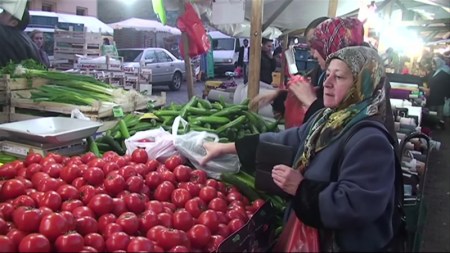
1662An open-air market in the heavily-Turkish Kreuzberg district of Berlin. (Image source: The Berlin Project video screenshot)

The report also shows that Turks have a lower educational attainment than other migrant groups in Germany. Only 60% of ethnic Turks complete secondary school (Hauptschulabschluss), compared to 85% of migrants from Eastern Europe. Moreover, only 8% of ethnic Turks between the ages of 17 and 45 earn a Bachelor’s degree, compared to 30% of migrants in the same demographic from Eastern Europe. Education is a determinative factor for successful integration, according to the report.

German multiculturalists often blame the lack of Turkish integration on the Germans themselves. Writing for Die Welt, economist Thomas Straubhaar argues that most Germans view Turks as guests, not as fellow citizens, an attitude which discourages Turks from integrating:

“Ethnic Turks are essentially treated as guests — hence the controversy over whether their faith belongs to Germany or not. Their immigration is seen as temporary. Their contribution to German culture is seen in a negative light.

“Those who treat migrants as guests should not be surprised when they behave as such. Guests are not expected to have any emotional devotion to the host, nor does the host feel any obligation to show irrevocable loyalty to the guest.

“Guests will not be willing to put all their cards on the table of the host country and take full responsibility for successful integration. Guests assume that sooner or later they must return home again. In everything they do, they will always consider their guest status and be only halfheartedly engaged. This applies to investments in language, culture, friendships, social contacts and professional career.”

Others counter that those who act like strangers should not be surprised if they are treated as strangers. Sociologist Ruud Koopmans argues that one of the most determinative factors in successful integration involves the cultural gap between host and guest. The greater the distance, the greater the integration challenge.

In a recent interview with WirtschaftsWoche, Koopmans criticized multiculturalists who for normative reasons insist that culture and religion should not be factored into the debate on integration:

“In all European countries, Muslim immigrants lag behind all other immigrant groups in almost every aspect of integration. This applies to the labor market, but also to educational achievement, inter-ethnic contacts, i.e., contacts with the local population, and identification with the country of residence.

“Three decisive factors determine cultural distance: language skills, inter-ethnic contacts — especially those involving marriage — and values about the role of women. They all have something to do with religion. This of course applies especially for ideas about the role of women, which are derived directly from the Islamic religion. The greater the cultural distance between groups — especially when there are cultural taboos — the more complicated inter-ethnic marriages become. Such taboos make it virtually impossible for a Muslim, and especially Muslim women, to marry a non-Muslim. Statistics from various European countries show that less than ten percent of Muslim marriages are inter-ethnic.”

Detlef Pollack, the author of the University of Münster study cited above, blames the lack of Turkish integration on discrimination: “The message to the majority German population is that we should be more sensitive to the problems encountered by those of Turkish origin,” he told Deutsche Welle. “It is our view that the feeling of not being accepted is expressed in the vehement defense of Islam.”

Koopmans rejects the link between discrimination and radicalization:

“This is a common assertion. But it is wrong. In our large study we asked Muslims how strongly they feel discriminated against, and we searched for correlations to the development of a fundamentalist worldview. But there are none. Muslim hatred of non-Muslims is not a special phenomenon of Muslim immigration, but is actually worse in the countries of origin. Radicalization is not first produced here in Europe, rather it comes from the Muslim world.”

German Architect: Demolish Churches, Build Mosques

June 23, 2016

German Architect: Demolish Churches, Build Mosques, Clarion Project, June 23, 2016

Germany-Mosque-Hamburg-HPThe call to prayer at a mosque in Hamburg (Photo: Video screenshot)

Breitbart notes that Reinig remarks come “after a report this month revealed that half of Turks in Germany regard Islamic law supreme over German laws and that young people are the most devout.”

************************

A prominent German architect has argued that the key to integration of Muslim immigrants in Germany is to build mosques, while at the same time demolishing churches.

Joaquim Reinig’s remarks were published in an interview with Die Tageszeitung and reported in English by Breitbart.

Reinig said that essential to integration is that immigrants should “have no fear” that their new country is asking them “to lose their identity in this society.”

The building of mosques, particularly the “visible minaret,” he says, sends this “message to the migrants.”

Reinig believes that the mosques are a positive influence on migrants, taking on the vital role of community workers.

Speaking about the previous influx of Turkish immigrants, who came to Germany as temporary workers, Reinig said that when they came, they were “relatively secular,” but when they decided to stay, they “remembered “their religion.

“The desire to become a German citizen and the activation of their faith ran parallel,” he said.

Breitbart notes that Reinig remarks come “after a report this month revealed that half of Turks in Germany regard Islamic law supreme over German laws and that young people are the most devout.”

Although Reinig says there is plenty of room for mosques in Hamburg – “theoretically 50 locations – he recommends demolishing churches rather than converting them.

Breitbart reports that Reinig “noted that around three per cent of Christians in Germany, 23,000 people, attend church in the region compared to the 17,000 Muslims who currently attend mosques in Hamburg.”

Reinig said he does not anticipate that other faiths will have a problem with his proposals.

“Jews, Christians and Muslims, as members of Abrahamic religions, are theologically brothers and sisters,” he said. “They have many similarities so should have no fear.”

A Month of Islam in Germany: May 2016

June 18, 2016

A Month of Islam in Germany: May 2016, Gatestone InstituteSoeren Kern, June 18, 2016

♦ During an investigation into the mass sexual assaults in Cologne on New Year’s Eve, a chief superintendent from the Cologne police department revealed that he was ordered to remove the term “rape” from an internal police report about the assaults.

♦ The Federal Office for Migration and Refugees, says it will process more than one million asylum requests in 2016.

♦ Thousands of Christians in German refugee shelters are being persecuted by Muslims, sometimes even by their security guards. — Open Doors, German branch.

♦ “German security officials have indications that and of organizations are being smuggled in with refugees in a targeted, organized way in order to launch attacks in Germany.” — German Federal Police.

♦ Muhterem Aras was elected as the female first Muslim speaker of the state parliament in Baden-Württemberg. Aras has been a proponent of allowing migrants without German citizenship to vote in local elections.

♦ A 26-year-old migrant from Afghanistan was sentenced to two-and-a-half years in prison for raping a woman who had offered him accommodation in her home in Cologne by means of a website, “Refugees Welcome.”

May 1. The anti-immigration Alternative for Germany (AfD), now the third-most popular political party in Germany, adopted a manifesto calling for curbs to migration and restrictions on Islam. The document calls for a ban on minarets, Muslim calls to prayer and full-face veils.

May 2. Hans-Georg Maaßen, the head of Germany’s domestic intelligence agency, revealed that around 90 “predominately Arabic-speaking” mosques in Germany are under surveillance. He said they involve mostly “backyard mosques” where “self-proclaimed imams and self-proclaimed emirs” are “inciting their followers to jihad.” He called on moderate Muslims to work with the government to fight extremism and defend the constitutional order. Maaßen was speaking ahead of a security conference in Berlin at which he said that his agency we receiving on average four terror alerts every day: “The Islamic State is committed to attacking Germany and German interests.”

May 2. During an investigation into the mass sexual assaults in Cologne on New Year’s Eve, a chief superintendent from the Cologne police department revealed that he was ordered to remove the term “rape” from an internal police report about the assaults. The superintendent, identified only as Jürgen H., said that he received a telephone call on January 1 from an official at the interior ministry in North-Rhine Westphalia, who told him in an angry tone: “This is not rape. Remove this term from your report. Submit a new report.” The revelation adds to suspicions that there was a political cover-up to avoid fueling anti-immigration sentiments.

May 3. A 20-year-old migrant from Afghanistan sexually assaulted a six-year-old boy in the changing room of a sports hall in Munich. Police said the same migrant had sexually assaulted an 11-year-old girl at a public swimming pool in 2013.

May 3. A high court in Düsseldorf ruled that a group of eight German Islamists who dressed up in orange vests with the words “SHARIA POLICE” and who attempted to enforce Islamic law on the streets of Wuppertal in 2014 would face trial. The ruling overturned a lower court decision in December 2015 that the men would not face trial. The upper court said that the men had violated a law banning the wearing of uniforms at public rallies. The law, which prohibits uniforms that express common political views, was originally designed to ban neo-Nazi groups from parading in public. If convicted, the Islamists face up to two years in prison.
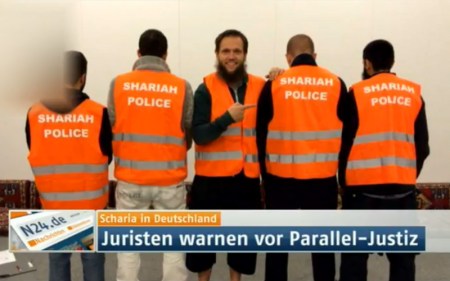
1653A high court in Düsseldorf, Germany ruled that a group of eight Islamists who dressed up in orange vests with the words “SHARIA POLICE” and who attempted to enforce Islamic law on the streets of Wuppertal in 2014 would face trial. They are charged under a law that prohibits the wearing of uniforms at public rallies — a law originally designed to ban neo-Nazi groups from parading in public.

May 5. A new INSA poll found that 60% of the Germans surveyed believe that Islam does not belong to Germany. By contrast, only 22% said they believe Islam is an integral part of German society. Nearly half (46%) of those surveyed said they are worried about the “Islamization” of Germany. In a similar poll conducted in January 2015, 37% of respondents said Islam belongs to Germany, 15% more than now. The results indicate that German attitudes toward Islam are changing after the decision by Chancellor Angela Merkel to allow more than 1.1 million mostly Muslim migrants to enter the country in 2015.

May 6. A YouGov poll found that 62% of the Germans surveyed do not have any Muslims among their close personal friends. Around 60% of those surveyed also said that in their daily life they had noticed an increased number of Muslims in the country. German multiculturalists blamed Germans for their lack of openness to diversity. Others said the poll proved that Muslims in Germany are isolating themselves from the larger society.

May 7. A gourmet hamburger restaurant in Cologne closed after receiving threats over its “Erdogan Burger.” In April, Jörg Tiemann, the manager of “Urban Burgery,” added to his menu a burger with goat cheese and named it the Erdogan Burger. He was responding to Turkish President Recep Tayyip Erdogan’s effort to prosecute the German comedian Jan Böhmermann for a poem mocking the Turkish leader. In a Facebook post, Tiemann wrote:

“Urban Burgery is forced to close until further notice. Because of concrete threats, we can no longer guarantee the safety of our employees. But one thing is certain: We will not be muzzled by the enemies of democracy, rule of law and civil liberties.”

May 9. Frank-Jürgen Weise, the director of Federal Office for Migration and Refugees (Bundesamt für Migration und Flüchtlinge, BAMF), said that his agency will process more than one million asylum requests in 2016. This number includes 430,000 applications from 2015 that are currently being processed; another 300,000 applications from migrants who arrived in Germany in 2015 but have not yet filed claims; and 500,000 applications from migrants who will arrive in Germany in 2016.

May 9. The German branch of Open Doors, a non-governmental organization supporting persecuted Christians, reported that thousands of Christians in German refugee shelters are being persecuted by Muslims, sometimes even by their security guards. The report, which asserts that in most cases German authorities have done nothing to protect the victims, alleges that German authorities and police have deliberately downplayed and even covered up the “taboo issue” of Muslim attacks on Christian refugees, apparently to avoid fueling anti-immigration sentiments.

May 10. A German man shouting “Allahu Akbar” (“Allah is the Greatest”) and “infidels must die”stabbed one person to death and slashed three others in an early morning attack at a train station near Munich. Police said the suspect, a 27-year-old unemployed carpenter identified only as Paul H., was mentally ill and did not appear to have any ties to Islamist groups.

May 11. The Federal Police (Bundeskriminalamt, BKA) revealed that federal and state authorities are investigating 40 cases in which Islamic militants entered Germany while posing as refugees. “German security officials have indications that members and supporters of terrorist organizations are being smuggled in with refugees in a targeted, organized way in order to launch attacks in Germany,” according to a BKA spokeswoman.

May 11. The first Muslim woman was elected as speaker of the state parliament in Baden-Württemberg. Muhterem Aras, 50, was born in Turkey and moved to Stuttgart at the age of 12. She is a tax accountant and financial affairs spokeswoman for the Green party. Her election has been widely hailed as a Muslim integration success story. “We wrote history today,” Aras said, adding that Baden-Württemberg had sent “a message of openness, tolerance, and successful integration.” Aras has been a proponent of allowing migrants without German citizenship to vote in local elections.

May 12. In an interview with Deutsche Welle, Germany’s most prominent feminist, Alice Schwarzer, talked about her new book on the sexual assaults in Cologne on December 31. She said that although more than 600 women have filed complaints, she does not expect any of the perpetrators to be convicted:

“For one, because of the method they used: from a huge group of over a thousand men, small groups split off, surrounded and mistreated the women, only to disappear in the large mass again. It was difficult for the victims to identify the perpetrators. Also, what is trivialized as ‘sexual harassment’ in German penal law isn’t punishable to this very day.”

May 12. Protestant, Catholic and Orthodox leaders issued a joint statement calling on Christians in Germany to welcome Muslim migrants with “openness, with the spirit of charity.” The letter — which does not distinguish between legitimate asylum seekers and hundreds of thousands of economic migrants posing as refugees — said:

“The right to asylum, which is laid down in the Basic Law, and the obligations arising from the Geneva Convention, requires our country to grant anyone who seeks refuge with us access to an individual, fair and impartial procedure, regardless of how many people are currently in need of protection and irrespective of the country of origin.

“Refugees are people with individual stories; they expose us to new experiences, hopes and ideas. We are convinced: The more people we meet, the less space remains for prejudice, hatred and rejection.”

May 14. The newsmagazine Der Spiegel reported the contents of a leaked document from the Finance Ministry which revealed that the migrant crisis would end up costing German taxpayers €93.6 billion ($105 billion) between now and 2020. About €25.7 billion would be for social spending, especially unemployment benefits and housing support. About €5.7 billion would be destined for language courses and €4.6 billion for integrating refugees into the workforce.

May 15. Nearly a dozen women between the ages of 16 and 48 reported being sexually assaulted by groups of male migrants at a music festival in the Kreuzberg district of Berlin. The attacks at the Carnival of Cultures, where groups of men encircled the women and assaulted and robbed them, were similar to those in Cologne on New Year’s Eve.

May 16. In an interview with Die Welt, Beatrix von Storch, the deputy leader of the anti-immigration Alternative for Germany (AfD) party, called on Germany’s main Islamic associations to “explicitly distance” themselves from Islamic sharia law, something they so far refused to do. She said the AfD had nothing against individual Muslims, but it opposed political Islam, which she said contradicts the German constitution.

May 17. A court in Hamburg ruled that the author of a poem lampooning Turkish President Recep Tayyip Erdogan was prohibited from publicly reciting passages of his work. The court said that comedian Jan Böhmermann was allowed to recite only six of the 24 lines of his poem, thereby handing Erdogan a legal victory in a case that prompted a debate in Germany over freedom of speech. Chancellor Angela Merkel personally authorized criminal proceedings against the comic. She was accused of pandering to Erdogan’s autocratic government.

May 18. The Berliner Morgenpost reported that a Turkish-born Salafist had been given access to the secure areas of both of the Tegel and Schönefeld airports in Berlin for nearly a year after authorities discovered his ties to fundamentalist Islam. The 24-year-old man, identified only as Recep Ü., was fired after he attempted to smuggle brass knuckles into the secure area of the Schönefeld airport. Wisag Airport Service Berlin, the company that directly hired the man, said that neither German police nor German intelligence had passed on information that the man was an active member of Germany’s Salafist scene.

May 18. The Berliner Morgenpost reported that large groups of male migrants have been gathering at the Boulevard Berlin shopping mall in the Steglitz district of the capital, where they have been sexually assaulting female passersby. At least 35 teenage migrants have been loitering at the mall for several weeks, in part because there is free access to the Internet. When security guards asked them to leave the premises, the youths called for back-up and soon dozens more teenage migrants arrived to taunt and harass the guards, who were required to use pepper spray to defend themselves.

May 22. A doctor in Cologne is being sued for discrimination after he declined to treat a Muslim woman who refused to shake his hand. The woman said she could not shake the doctor’s hand on religious grounds, but the doctor noted that the Koran does not prohibit handshakes. After the woman became confrontational, the doctor declined to treat her on the grounds that there was no basis of trust between doctor and patient. The woman’s husband is now suing the doctor for religious discrimination. The doctor faces a fine of €2,000 ($2,250).

May 23. A 23-year-old asylum seeker from Iraq who was wearing a T-shirt saying “I’m Muslim Don’t Panic” was assaulted by fellow refugees for offending Islam. After ripping his T-shirt to shreds, a 27-year-old Syrian and a 33-year-old Lebanese beat the man so badly that he was hospitalized. The two men were arrested and charged with causing grievous bodily harm.

May 23. Bavarian Interior Minister Joachim Herrmann announced a new plan to recruit migrants to the police force regardless of whether they have acquired German citizenship. He said he hoped the initiative would create a “more direct line” to people with an immigrant background by hiring those who speak their language and understand their mentality. Herrmann said the plan was motivated not by the threat of Islamic terrorism, but by a series of xenophobic murders committed between 2000 and 2007 by a now defunct neo-Nazi group called the National Socialist Underground (Nationalsozialistischer Untergrund, NSU).

May 24. Police arrested a 26-year-old migrant from Pakistan suspected of murdering a 70-year-old woman in her home near Heilbronn. The man, who was living in an asylum shelter in Öhringen, had left documents in Arabic and English “of an overwhelmingly religious nature” at the scene of the crime.

May 25. Germany’s coalition government agreed on a new “Integration Law” aimed at regulating the rights and responsibilities of asylum seekers in Germany. The main focus of the law is to encourage refugees to learn enough German to be able to find a job and help pay for their living expenses. Critics say the new law is a largely symbolic measure directed at reassuring German voters and blunting the rise of the anti-immigration Alternative for Germany party. They say the new law is inadequate to deal with Germany’s integration problems, in part because it applies only to legitimate asylum seekers, not to the hundreds of thousands of economic migrants who have entered Germany illegally by posing as asylum seekers.

May 25. A 19-year-old migrant from Iraq was sentenced to two years in prison for raping a 21-year-old woman at the train station in Bad Schwartau, a town in northern Germany. The man —who admitted to dragging the woman into the men’s restroom and raping her — received the minimum possible sentence according to Section 177 of Germany’s criminal code.

May 26. A 26-year-old migrant from Afghanistan was sentenced to two-and-a-half years in prison for raping a woman who had offered him accommodation in her home in Cologne. The woman had offered the room by means of a website called “Refugees Welcome” (Flüchtlinge Willkommen), which “supports decentralized housing solutions for refugees.” According to the website: “Through our work, we aspire to contribute to nurturing an open society based on principles of solidarity and equality of all. One of our core principles as an organization is that no one is illegal.”

May 26. The news magazine Focus reported that increasing numbers of Germans are relocating to Hungary because of Chancellor Angela Merkel’s open door migration policy. A real estate agent in a town near Lake Balaton, a popular tourist destination in western Hungary, said that eight out of ten Germans who want to relocate there cite Germany’s migration crisis as the reason for their desire to leave the country.

May 27. The head of the Protestant Church in Germany, Heinrich Bedford-Strohm, called for Islam to be taught in all German public schools as a way to distance young Muslims from radical ideologies. In an interview with the Heilbronner Stimme, Bedford-Strohm said that teaching Islam in schools nationwide would give Muslim students the opportunity to take a critical approach to their own religion: “Tolerance, freedom of religion and freedom of conscience should apply to all religions. These principles can be best taught if religion is part of the state’s educational mission.” Bedford-Strohm said German Islamic associations — many of which have ties to foreign governments, including Turkey and Saudi Arabia — should be responsible for developing and teaching these courses.

May 27. A Protestant church in Hamburg held a funeral service for a convert to Islam who was killed fighting for the Islamic State in Syria. The controversial funeral at the St. Pauli church was for a teenager named Florent, who was born in Cameroon and raised as a Christian in Hamburg. When he was 14, Florent converted to Islam and changed his name to Bilal. He quickly became radicalized and joined the German Salafist movement. He left for Syria on a false passport in May 2015 and was killed three months later. Pastor Sieghard Wilm, who organized the “interfaith” funeral, was criticized for “idealizing” the life of the terrorist. He responded by saying that the church should be a “place of learning for the respect of other religions.”

May 29. Green party politician Stefanie von Berg called for new mosques to be built in every district of Hamburg so that the city’s burgeoning Muslim population has enough space to pray. She said the construction of visible new mosques is essential for integrating the Muslim community. The Heinrich Böll Foundation, a think tank linked to the Green party, estimates that there are more than 150,000 Muslims in Hamburg, the second-largest city in Germany, but less than 50 mosques.

May 31. Groups of male migrants sexually assaulted at least 18 women at an outdoor festival in Darmstadt. The attacks at the Schlossgrabenfest, in which large numbers of men surrounded women and sexually assault them, were similar to those that occurred in Cologne on New Year’s Eve and the Carnival of Cultures in Berlin on May 15. The phenomenon whereby women are encircled by groups of men and sexually harassed, assaulted, groped and raped is known in Arabic as “taharrush” (al-taharrush al-jinsi, Arabic for “sexual harassment”).

May 31. In an interview with the Frankfurter Allgemeine Zeitung, the Dalai Lama said that Germany has accepted “too many” migrants and that they should eventually be returned to help rebuild their home countries. “Germany cannot become an Arab country,” he said. “Germany is Germany.”

Lebanese expat describes Islamification of Germany

June 12, 2016

Vlad Tepesblog

Published on Jun 6, 2016

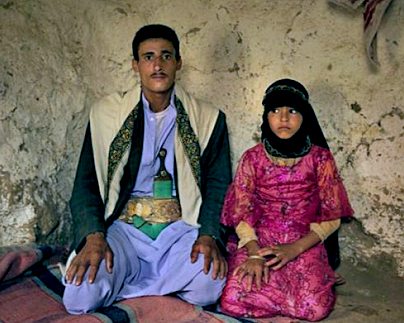
German Court Applies Sharia to Child Marriage

June 11, 2016

German Court Applies Sharia to Child Marriage, Gates of Vienna, , June 11, 2016

childbride2

The following report from the German website Einwanderungskritik (Immigration Criticism) is all but unbelievable: a district court has cited sharia law to validate a Syrian immigrant’s marriage to a 14-year-old girl. An act that would land a native German man in prison for child molestation is being sanctioned by the court as a valid “marriage”, simply because it as recognized as such by Islamic law.

Many thanks to Nash Montana for the translation:

Scandalous judgment: Islamic pedophile-marriages are valid in Germany

“A marriage that has been performed according to Syrian law in Syria with a 14 year old bride and a man of legal age, has to be recognized as valid if the husband belongs to the Sunni religion and the marriage has already been executed.”

by Robin Classen

With mass immigration, not only terrorism in Paris and Brussels and the sex crimes on New Year’s eve came to Europe, but also very different social and moral values. For instance, Islam allows men to marry multiple women.

Extremely problematic: Mohammed married his “favorite woman” Aisha when she was just six years old. That is not an unusual Islamic opinion; this is widely uncontested knowledge in Sunni as well as in Shiite Islam. In Germany however, as part of sanctioned lying to advance the cause of Islam (taqiyya), those who ask critical questions are often told: Aisha was after all already 14 years old when she married the 50-year-old Mohammed. Even more common is the lie that around the year 700 children were a lot more sexually mature. That one cannot compare the nine-year-old Aisha therefore with a nine-year-old of today, that she was a complete woman. That all the focus on cleanliness and coddling in the modern world is what delays a girl’s menstruation more and more.

The opposite has been scientifically proven: In Germany in 1860 girls got their first period at the age of 16.6 years old. In 1920 they began to menstruate at 14.6 years old, in 1980 at 12.5 years old, and today even sooner yet. And all this of course completely independent of the fact that a first menstruation is only one step on the way to become an adult woman and it does not signify the ultimate end of childhood.

Forced marriage of children is completely okay in Islam

Since Mohammed was deemed to be an exemplary ideal and virtuous man, this moral assessment applies as well to his marriage with multiple women and the child Aisha, which is why forced marriages of children in Shiite as well as in Sunni Islam are entirely normal. Often children die on their wedding night due to fatal internal bleeding caused by their Muslim husbands. This behavior is now entering Germany.

Here’s the case of a 22-year-old Syrian man and his 14-year-old wife — probably a more benign example — a couple who came to Bavaria at the end of 2015. They are also cousins — since marriages among relatives, too, is a custom that is accepted in Islam, which has for centuries harmed the gene pool of the Islamic peoples. According to one BBC study 55 % of the Pakistanis living in Great Britain are married to relatives. And worldwide, half of all Muslims are living in incestuous marriages. The consequences are an average IQ that is 10 points lower, and a significantly higher risk for psychological and physical illnesses.

Youth welfare service unsuccessfully tried to protect the child from German justice

The two youths were separated immediately after their arrival in Germany: The Youth welfare office took the child into custody. The man then submitted a lawsuit — in all likelihood at taxpayer’s expense — and verified through a Syrian marriage certificate that he was effectively married to the child he according to Syrian law. The district court then reinterpreted the lawsuit which demanded that the child be handed over to the husband, and granted visitation rights to the “couple” so they could meet alone on the weekends. But the youth welfare office lodged an appeal, arguing that the “wife” is a child and acts like a child. That she is not in a position to lead an autonomous, self-determined life as a “wife”, and that there is the danger that the two have sexual intercourse on the weekends, which according to German law constitutes sexual abuse of a minor.

The subsequent decision of the OLG Bamberg (regional appeals court Bamberg) is simply mind-blowing: The OLG decided that international privacy rights have to be applied to the Syrian couple. During the trial the court had received a “crash course in Syrian marriage law” and had decided that the couple were effectively married. That even the German “Ordre Public”, the public policy doctrine, cannot stand in the way of this. If anyone would like to know what is possible concerning the Islamization of German law, they should read the resolution from May 5, 2015, file reference 2 UF 58/16 of the Regional Appeals Court of Bamberg.

OLG is exclusively applying Sharia law

One paragraph after another the judge cites openly and absent of all critique sharia law, which they then apply one-to-one. For the Bavarian judges, according to their own statements, it is therefore only important “whether the marriage of a Muslima with a non-Muslim is void”, since Islamic law prohibits such. In other words, if there were two refugees with a Syrian marriage certificate, and then it emerged that one of the two was a Christian, a German court would void the marriage, since a Muslim Herrenmensch (overlord) cannot be married to a Christian Untermensch (subhuman).

According to Syrian-Islamic marriage right there is a minimum marriage age of 13 years, but it is invalid if the wedding has already been performed. So therefore, there really is no law for a minimum age, but this seems to pose no problem for Bavarian judges. It seems more important to the court in Bamberg that the dowry was paid by the parents:

Apart from that, Article 51, section 2 of the PSG (strengthening of the care-giving act) on defective marriage contracts after cohabitation, decides, among other things, the obligation of paying the dowry, the obstacle of in-law relationship to marrying, and the obligation of observing the legal waiting period in cases of dissolution of marriage either by divorce or death. Therefore, Articles 47 to 52 PSG cannot be interpreted as a regulation to the effect that a defective marriage contract after cohabitation leads to a void marriage.

The child has to endure abuse so that “integration” is successful

After all this, the court came out with the real tear-jerker: The “husband and wife” had endured so much together already during their “flight”! Additionally, a recognition of their marriage for the purpose of integration is vital. The two had already rejected participation in integration courses long before their marriage was validated, the German judges seriously lamented.

The youth welfare office and parents do not play a role anymore for the court: The child is legally married and, according to Syrian law, parental responsibility has thereby lapsed. Punishability according to § 182 III StGB is swept under the rug by the OLG Bamberg: That counts as “a matter of interpretation”. The bottom line is that the higher regional court, as the second most highest civil rights entity, has applied sharia law, which thus with one swipe suspends German family law, and especially criminal law, and has therefore deprived a 14-year-old girl of all protection given to her by the youth welfare services, and instead has exposed her to her “husband” defenselessly.

____________________________

The legal court documents about the case:

OLG Bamberg, Beschluss v. 12.05.2016 — 2 UF 58/16 — Bügerservice

German diaspora to Hungary

May 30, 2016

German diaspora to Hungary, YouTube, May 29, 2016

As the short blurb beneath the video states,

This despicable leftist media hit piece still shows, despite itself, how bad it is in Germany if nice, had working Germans are ready to leave everything familiar and move to Hungary.

Germany’s New “Integration Law”

May 29, 2016

Germany’s New “Integration Law” Gatestone InstituteSoeren Kern, May 29, 2016

♦ The new law applies only to legitimate asylum seekers, not to the hundreds of thousands of economic migrants from Africa, Asia and the Middle East who have entered Germany illegally by posing as asylum seekers.

♦ Of the more than 1.1 million migrants who arrived in Germany in 2015, only 476,649 have applied for asylum. Many of the rest have gone underground and are sustaining themselves through petty crime and drug dealing.

♦ Nearly half (49%) of the migrants in Germany whose asylum applications were rejected during the past two years have not left the country, according to leaked government data.

♦ “Regaining control of our borders is an existential issue for our culture and the survival of our society.” — Thilo Sarrazin, renowned German central banker and a former member of the Social Democrats.

After months of haggling, Germany’s coalition government has agreed on a new “Integration Law” aimed at regulating the rights and responsibilities of asylum seekers in Germany.

The main focus of the law is to encourage refugees to learn enough German to be able to find a job and help pay for their living expenses.

Chancellor Angela Merkel has hailed the new law as a “milestone,” and Vice Chancellor Sigmar Gabriel says it represents a “true paradigm shift in Germany.”

Critics counter that the new law is a largely symbolic measure directed at reassuring German voters and blunting the rise of the anti-immigration Alternative for Germany party.

Details of the Integration Law were announced on May 25 after a two-day government summit in Schloss Meseberg, a castle north of Berlin. Based on the motto “Support and Demand” (Fördern und Fordern), the new law makes the government an active participant in the integration process. Key components of the law include:

  • Integration Courses. Courses on German culture, society and values will be expanded from 60 hours to 100 hours. The number of available slots will be increased from 20,000 to 200,000 nationwide. The courses will be obligatory for all asylum seekers; those who refuse to attend will have their social welfare benefits cut.
  • Language Courses. Asylum seekers will now be allowed to apply for language courses six weeks after arriving in Germany (compared to three months before) and regardless of whether their asylum applications have been processed. All refugees seeking permanent residency must be proficient in German.
  • Work Programs. The government will create 100,000 low-wage jobs paying around one euro an hour. Refugees who refuse to work will have their benefits cut.
  • Labor Laws. Existing labor laws will be relaxed to encourage German companies to hire refugees, even if better qualified German or EU citizens are available for an advertised position.
  • Preventing Ghettoes. The new law will authorize regional governments to determine where refugees will live, either by allocating or banning them from certain areas, for the next three years. The objective is to prevent refugees from settling in migrant ghettoes.
  • Permanent Residency. Refugees who are proficient in German and can provide for their own upkeep in Germany can apply for permanent residency after five years; those with exceptional German skills can do so after three years.

The law has been accompanied by the so-called Meseberger Declaration on Integration, a statement of principles summarizing the government’s new integration policy.

Addressing the proliferation of migrant sex crimes in Germany, the document states: “We will not accept assaults on women, children and others in need of protection, whether such attacks are directed against German citizens or against refugees.”

Critics say the new law, which must be approved by the German Parliament, which will debate the measure in July, is inadequate to deal with Germany’s integration problems.

For a start, the law applies only to legitimate asylum seekers, not to the hundreds of thousands of economic migrants from Africa, Asia and the Middle East who have entered Germany illegally by posing as asylum seekers.

Of the more than 1.1 million migrants who arrived in Germany in 2015, only 476,649 have applied for asylum, according to official statistics. Many of the rest have gone underground and are sustaining themselves through petty crime and drug dealing. The government has not said how it plans to “integrate” such migrants.

In addition, the government is already facing an acute shortage of instructors to teach the integration courses. It remains unclear where the government will find thousands of new instructors envisioned in the new law. Interior Minister Thomas de Maizière has admitted: “The bottleneck is not money but the lack of teachers.”

Also unclear is who will pay for implementing the new law. According to a recent estimate, the total cost of “integrating” refugees will reach 25 billion euros ($28 billion) in 2016 alone. Leaders of some of Germany’s 16 federal states are demanding that the central government assume responsibility for at least half this amount.

Moreover, some critics say the law lacks meaningful punitive measures. Although it does call for cutting welfare benefits to refugees who refuse to learn German, it does not threaten them with deportation. Of course, refugees fleeing warzones cannot be returned to their countries of origin, even if they refuse to learn German.

In any event, Germany is lenient when it comes to deportation. For example, nearly half (49%) of the migrants in Germany whose asylum applications were rejected during the past two years have not left the country, according to government data leaked to Die Welt.

Perhaps most importantly, the new law appears to be based on the assumption that the EU-Turkey migrant deal will hold. If Turkey reopens the floodgates to mass migration, and hundreds of thousands of additional migrants flow into Germany, integration efforts are likely to collapse.

Hans-Peter Uhl of the Christian Social Union (CSU), the Bavarian sister party to Merkel’s Christian Democrats (CDU), said the new law does not go far enough: “Integration is good and important, but placing limits on the number of refugees would be much better.”

Stephan Mayer, also of the CSU, added: “Whoever refuses deportation should be sent to a detention center and deported within four days.”

Vice Chancellor Sigmar Gabriel of the Social Democrats (SPD) says the Integration Law is actually the precursor to a full-fledged Immigration Law, a claim disputed by Angela Merkel. Gabriel — who has called for airlifting migrants directly from the Middle East to Germany — says he plans to introduce a draft immigration law this fall; critics of the measure say it would encourage yet more migration to Germany.

Thilo Sarrazin, a renowned German central banker and a former member of the Social Democrats (SPD), has been warning Germans for years about the consequences of mass migration. In 2010, he wrote the best-selling book, “Germany Does Away with Itself” (Deutschland schafft sich ab), which shattered Germany’s long-standing taboo on discussing the social changes transforming the country due to the presence millions of non-integrated Muslims.

In his latest book, “Wishful Thinking,” (Wunschdenken), Sarrazin accuses Merkel of “no longer being concerned about the interests of Germans and the future of their nation, the protection of their living environment (Lebensumfelds) and their cultural identity.” He concludes: “Regaining control of our borders is an existential issue for our culture and the survival of our society.”

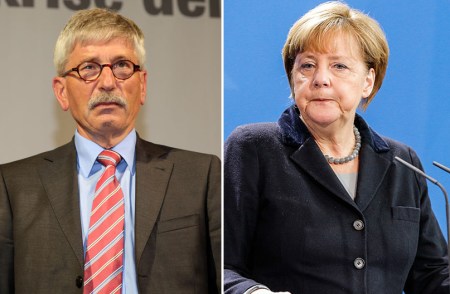
1628Thilo Sarrazin (left), a renowned German central banker and a former member of the Social Democrats (SPD), accuses Chancellor Angela Merkel (right) of “no longer being concerned about the interests of Germans and the future of their nation, the protection of their living environment and their cultural identity.” Sarrazin concludes: “Regaining control of our borders is an existential issue for our culture and the survival of our society.”<?address>


REPORT: Migrants Committing Disproportionately High Crime In Germany While Media And Govt Focus on ‘Far Right’ Thought Crimes

May 24, 2016

REPORT: Migrants Committing Disproportionately High Crime In Germany While Media And Govt Focus on ‘Far Right’ Thought Crimes, BreitbartRaheem Kassam and Chris Tomlinson, May 23, 2016

GettyImages-526912156-640x480

A massive, migrant crime wave is surging across Germany according to figures buried in a new report released by the country’s Interior Ministry. The data reveals that without migrants considered, crime rates in Germany would have remained roughly static since 2014. But, in fact, the country recorded an extra 402,741 crimes committed by migrants.

While much of this criminality concerned illegal border crossings, German authorities instead talked up a “record surge” in crimes by “right wing radicals”.

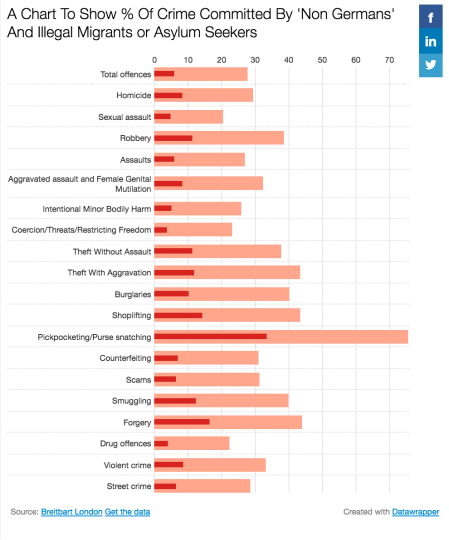
Concerning statistics from the 135-page report reveal that 70 per cent of pickpocketing, one of the crime types on the rise, was committed by non-Germans. Of this figure, 34 per cent was committed by recent asylum seekers, with the rest committed by “non-Germans”.

Foreign nationals are thought to account for around 11 or 12 per cent of the total population of Germany, but were over-represented in every area of crime.

Illegal immigrants and asylum seekers account for around 2.5 per cent of Germany’s population, but were also massively overrepresented.

Amongst total offences, non-Germans accounted for 27.6 percent while illegal immigrants and asylum seekers accounted for 5.7 percent. Of homicides, the figures are 29.3%/8.2%, and of sexual assaults, the figures were 20.5%/4.8%.

In all of these cases as well as those indicated in the chart below, non-Germans and illegal migrants outstripped their proportions of crime to their representation in German society.

Non-Germans accounted for 38 per cent of all robberies, 38 per cent of thefts, and 43 per cent of thefts that involved a level of aggravation such as assault or force.

They accounted for 40.2 per cent of burglaries, 43.5 per cent of shoplifting, and a whopping 75.7 of pick pocketing or purse snatching.

In the chart below, non-Germans are in light red while asylum seekers and illegal migrants are in deep red.

Screen-Shot-2016-05-23-at-16.13.08

And of migrant crimes specifically, Syrians top the list of migrant crimes that are not related to border controls, with a total of 10,348 individual offences in 2015. They also led assault cases among migrants, with 3,186 offences in 2015.

Thefts were most committed by Albanians, with 6,689 offences and Algerians coming close with 5,611. Algerians almost tie with Serbians when it comes to fraud. Balkan nationals were accountable for 2,834 cases, barely above North Africans’ 2,774.

Algerians top the list for smuggling goods (2,449) and also top the list for drug selling offences (976).

Even when border control breaches are exempted from the data, the situation is still stark. Male crime is stagnant amongst Germans, but when migrants are added, male crime goes up 12 per cent, with female crime rising just 6 per cent. This reflects the fact that most migrants into Europe in 2015 were young men.

Crime rates amongst “non-Germans” outside the residence act are up 13 per cent, whereas crimes committed by Germans are down 5 per cent.

And the report shows that offences against the Residence Act, the Asylum Procedures Act, and the Freedom of Movement Act are up by 157.5 per cent, with shopliftings up by 7.1 per cent, pickpocketing up by 7.0 per cent, burglary up by 9.9 per cent, and drug offences up by 2.1 per cent.

Presenting the report to journalists however, Mr. de Maiziere insisted in focusing on “politically-motivated crimes by the far-right” which he said had risen 35 percent in 2015 to nearly 23,000.

“The sharp increase in politically motivated crime points to a dangerous development in society,” de Maiziere told reporters at a news conference. “We are witnessing a growing and increasingly pronounced readiness to use violence, both by right- and left-wing extremists.”

But while attacks on refugee centre rose to 1,031 compared to 199 in the prior year, most of the offences committed appear to be what could be called “thought crime”, or what police describe as “evidence that they aimed to eliminate certain constitutional principles”.

Of a total of 38,981 political crimes committed in 2015, some 29,681 (76.1 per cent) were classed under this category.

Of real incidents, 1,031 were attacks on asylum centres, but just 177 of these were thought to be “violent”, with most of the rest believed to be “propaganda” offences or vandalism.

And according to the statistics, identified left wingers have had more confrontations with police (3,507 incidents), according to the statistics, than right wingers have (1,203 incidents). Left-wing activists have confronted more right wingers (4,276 incidents) than vice versa (1,406 incidents). These incidents include public protests like those of the PEGIDA movement.

Nonetheless, the reporting from Western news agencies has focused on a “right wing” wave of violence.

Earlier this month, when Republican Party presumptive nominee Donald Trump alleged “[L]ook at Germany, it’s crime-riddled right now”, organisations like Politifact were quick to crow about how immigrants accounted for fewer crimes than native Germans.

But today’s statistics reveal that as a percentage of the population, non-Germans and illegal immigrants account for a massively disproportionate amount of crime in Germany.

Yazidis Ambushed by Muslim Migrants in Germany: Report

May 24, 2016

Yazidis Ambushed by Muslim Migrants in Germany: Report, Clarion Project, May 24, 2016

(Please see also, The Plight of the Yazidis, considered “devil worshipers” by Islamists. — DM)

Germany-Injured-Yazidis-HPYazidis injured in Germany after being reportedly attacked by Chechens (Photo: Twitter)

A group of Muslims migrants from Chechnya allegedly ambushed a group of Yazidi refugees in Germany, leaving many injured Yazidis, a number needing hospitalization. Although initial reports from Germany called the incident, which involved more than 100 people, a random fight, an organization named Yazidis International says that the fight was a setup, with the Chechens lying in wait for the Yazidis with knives and baseball bats.

Only Yazidis were injured. One Yazidi suffered a skull fracture, another a head injury and at least one other a serious stab wound.

Although there were threats of revenge, police kept the two groups apart and are considering ways to continue to do so in the future.

Reports out of Germany show that many non-Muslim refugees have been subjected to violence and other abuse from Muslim migrants.

In other news, a recent report from Germany’s investigative police agency showed a sharp increase in the number of potential violent Islamists being tracked by the agency.

The numbers rose from 270 in January of 2015 to 497 today.

In addition, the agency is also following 339 additional Islamists who the police feel are sympathetic to or capable of assisting terrorists.

In Austria, intelligence officials are also warning of a rise in suspected Islamists in the country, particularly with individuals associated with the Muslim Brotherhood.