It’s important to remember that the Cologne sexual assaults took place outside its cathedral.
In a crowd of 1,000 men, hundreds of Muslim refugees prowled, assaulting and robbing any woman they could find. A police officer described seeing crying women stumble toward him after midnight. He managed to rescue one woman whose clothes had been torn off her body from a group of her attackers, but could not save her friends because the mob had begun hurling fireworks at him.
The provost of the Cologne Cathedral had warned anti-Islamist protesters, “You’re supporting people you really don’t want to support.” But it was the provost and pro-refugee activists who had supported people they really didn’t want to support. There is no way to know whether any of the smiling young people holding, “I Love Immigration” banners had fallen victim to those refugees they loved so much.
Barbara Schock-Werner, who served as cathedral architect between 1999 and 2012, was present at the well-attended religious service along with several thousand other worshippers. Shock-Werner told the German newspaper, Frankfurter Allgemeine, that the cathedral experienced an unprecedented and massive rocket and ‘banger’ fireworks barrage that lasted the whole service.
“Again and again the north window of the cathedral was lit up red, because rocket after rocket flew against it,” she said. “And because of the ‘bangers’, it was very loud. The visitors to the service sitting on the north side had difficulties hearing. I feared at times that panic would break out.”
Cardinal Rainer Woelki, who presided at the New Year’s mass, also complained about the “massive disruptions.”
“During my sermon loud ‘bangers’ could be heard,” Woelki said in the paper, Die Welt. “I was already annoyed beforehand about the loud noises that were penetrating into the cathedral.”
Rainer Woelki posted a video where he ridiculed the right-wing party’s claim that Islam is incompatible with the German constitution. The archbishop’s intervention comes after the anti-immigration party said it would press for bans on minarets and burqas.
“Anyone who denigrates Muslims as the AfD leadership does should realise prayer rooms and mosques are equally protected by our constitution as our churches and chapels,” he said.
“Whoever says ‘yes’ to church towers must also say ‘yes’ to minarets.”
And then they have to say “yes” to sexual assaults and “no” to women walking the streets.
♦ Thousands of Christians in German refugee shelters are being persecuted by Muslims, sometimes even by their security guards, according to a new report by the NGO Open Doors.
♦ “A major obstacle to the survey was that many victims were afraid to participate. … Their concern was not only on the possible consequences for them personally and for their families in Germany, but also for their relatives who continue to live in the countries of origin.” — Open Doors report.
♦ “I came to Germany after fleeing my own country in the hope my life would be safer in the face of growing dangers. But in Germany I’ve been threatened more.” — Christian refugee in Germany.
♦ “Despite increased reports about this problem by the media, charities, human rights organizations, church leaders and Christian organizations, German authorities and politicians have hardly ever launched an investigation. Instead, we believe that incidents are deliberately downplayed and even covered up. … Even in police stations, religiously motivated attacks on Christian refugees are not documented as such.” — Open Doors report.
Thousands of Christians in German refugee shelters are being persecuted by Muslims, sometimes even by their security guards, according to a new report, which asserts that in most cases German authorities have done nothing to protect the victims.
The study alleges that German authorities and police have deliberately downplayed and even covered up the “taboo issue” of Muslim attacks on Christian refugees, apparently to avoid fueling anti-immigration sentiments.
The report, “Religiously Motivated Attacks on Christian Refugees in Germany” (Religiös motivierte Übergriffe gegen christliche Flüchtlinge in Deutschland), was produced by the German branch of Open Doors, a non-governmental organization supporting persecuted Christians, worldwide.
The study — which confirms a Gatestone Institute analysis about Muslim-Christian violence in German refugee shelters — documents more than 300 incidents in which Christian refugees in Germany have been physically and sexually assaulted, and even threatened with death, because of their faith.
The report is based on the interviews of 231 Christian refugees conducted between February and April 2016. More than 80% of those interviewed were male and more than half were younger than 30. Most of those questioned came from Iran, Afghanistan and Syria. Nine out of ten of those participating in the survey were Christians with a Muslim background. Of these, the majority had already converted to Christianity in their home countries.
Of those interviewed, 86 said they had been physically assaulted at the hands of Muslim refugees and shelter security staff, many of whom are also Muslim. More than 70 said they had received death threats, 92 had been insulted for their Christian faith and 62 had been subjected to “very loud religious music or prayer,” presumably of the Islamic variety. Others said they had been subjected to physical attacks in the form of punches, spitting, pushing and sexual abuse. Around 75% of those interviewed said that harassment from Muslims is a “frequent” problem.
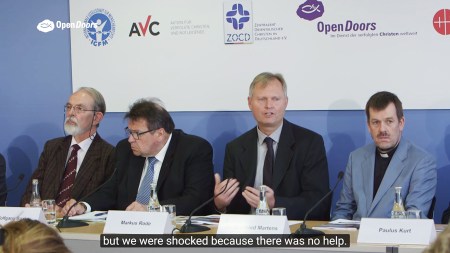
Representatives of the NGO Open Doors, along with other NGOs, hold a press conference to present the Open Doors report “Religiously Motivated Attacks on Christian Refugees in Germany,” in May 2016.
According to Open Doors, the report “only shows the tip of the iceberg” because “many Christian refugees are frightened of facing more difficulties if they report incidents.” Others fear that “the information could get into the wrong hands and cause danger for relatives still living in their home countries.” The report states:
“A major obstacle to the survey was that many victims were afraid to participate. They feared negative consequences in the event that their personal information were to fall into the wrong hands. Their concern was not only on the possible consequences for them personally and for their families in Germany, but also for their relatives who continue to live in the countries of origin.
“Another major obstacle was that many women are reluctant to report sexual assaults because of feelings of shame which are often more pronounced among Middle Eastern women than those in the West.
“To make matters worse, many refugees have had negative experiences with the authorities and police in their countries of origin because of their Christian faith. They are used to being treated as second-class citizens. Now they see that things are no different in many refugee shelters in Germany — a country with freedom of religion — and they not even once received help.
The report includes testimonies from Christian refugees who describe a “constant climate of fear and panic” in German shelters:
“I came to Germany after fleeing my own country in the hope my life would be safer in the face of growing dangers. But in Germany I’ve been threatened more.”
“At this point I must say that I really did not know that by coming Germany, and only because of my faith, that I would be harassed here as much as in Iran.”
“The Muslims paint crosses and underline them with an X to insult us. They throw their garbage in front of our door. They listen to the adhan (Muslim call to prayer) and the reading of the Koran at high volume. We had to abandon our last refugee shelter because of death threats.”
“In our refugee shelter, the security guards do not enforce the rules. Every morning at 5AM we are woken up to the sound of the adhan. The situation is getting worse. When you complain, they say this is the Muslims’ right. Also, they insult us with impunity. In our shelter, two of my friends have received death threats. Muslims tore a cross chain from his neck. None of us dares to wear a cross anymore.”
“When we collect our welfare stipend, we are pushed to the end of the line. Also in the kitchen, we are the last to eat. After midnight, when we are asleep, they knock on the window and we can no longer go back to sleep because of fear. And the next day during language classes we cannot learn well. Muslims call us mortad (apostates) and steal from the kitchen. They have stolen so much of our food that every room now has a refrigerator.”
“I was insulted and physically assaulted by Muslims in our shelter several times. Every time the police had to intervene. The memory of these incidents still weighs on me and I have serious psychological problems, I even attempted to commit suicide. Security guards have insulted our religion and attacked us. I testified as a witness to police. After receiving death threats, we went to police with our pastor and filed a complaint.”
The report includes an account from Gottfried Martens, a pastor in Berlin, who describes incidents of Muslim harassment that occurred in early May — incidents which the police have still not bothered to investigate:
“A Christian couple from Iran was increasingly being bullied by the Afghan leader of an asylum shelter in Berlin. As ‘infidels’ they were not given a bed and were forced to sleep on the floor for months. It finally got to the point that the Afghan devastated their sleeping area and personally destroyed their Christian objects (Easter candle, Bible, parish newsletter).
“Another Christian was harassed by Muslim refugees who chanted the Koran around the clock because of his conversion. Yesterday evening, he tried to kill himself with a razor blade. Fortunately, he was rescued in time.
“Two weeks ago we had to accommodate eight refugees from another shelter. They were threatened with death because they refused to participate in the Muslim ritual prayer in the gymnasium. When the security guards were called for help, they joined together in prayer with those who had threatened the Christians. When the Christians fled the hall as the Muslims were shouting ‘Allahu Akbar‘ [Allah is Greatest], the Muslim security guards banned them from the shelter on the grounds that the Christians had attacked the Muslims.”
According to Open Doors:
“It is alarming that Christian refugees and other religious minorities increasingly are facing the same persecution and discrimination as in their Muslim countries of origin, and not even in Germany can they get the expected protection.
“Despite increased reports about this problem by the media, charities, human rights organizations, church leaders and Christian organizations, German authorities and politicians have hardly ever launched an investigation. Instead, we believe that incidents are deliberately downplayed and even covered up. During confidential discussions with researchers from Open Doors, it has become known that even in police stations, religiously motivated attacks on Christian refugees are not documented as such.”
“As a result, many cases of sectarian violence are not statistically recognized and are not classified correctly in terms of their severity and frequency. This means that a large number of religious-related human rights violations against Christians and other religious minorities are treated as irrelevant.
The report concludes with a number of recommendations for the German government to help ease the burden on Christian refugees:
The religious affiliation all migrants should be recorded at the very beginning of the process of registering refugees and that data should be forwarded throughout the process of assigning refugees to accommodations.
Religious minorities should be pooled so that the percentage of Christians and other religious minorities in relation to Muslims in refugee shelters is approximately equal.
Christians and other religious minorities who are victims of persecution and discrimination should be separately accommodated.
The non-Muslim component within the ranks of the security personnel should be increased.
Employees and the security staff in refugee shelters should receive regular sensitivity training regarding the causes of religious conflict and the protection of religious minorities.
Persecuted Christians should be provided with a list of the names of other Christians to whom they can call upon for help.
Some institutions close to the German government openly dispute Open Doors’s assertions and have provided political cover for the authorities to do nothing to help persecuted Christians.
In March 2016, the Konrad Adenauer Stiftung (KAS), a center-right think tank that is independent of, but closely tied to Angela Merkel’s Christian Democrats, published an analysis entitled, “Christians under Pressure?” (Christen unter Druck?). The report argues that Muslim persecution of Christians in Germany and elsewhere in the world is being exaggerated and in any case cannot be proven:
“In the world context, as in Germany, reliable information on attacks against Christians is difficult to obtain. Reports are mostly subjective and empirically not seriously provable…
“There are probably a number of different reasons for the violence in the refugee shelters: A large number of people are living together for a long time in a confined space without privacy and in stressed conditions. Psychology may also be a contributing factor: worries about the future, language and cultural barriers and the processing of recent memories of flight from their home country. As if this were not already stressful enough, there are situations in which persecutors and persecuted in their countries of origin meet up again at refugee shelters in Germany.
“In addition to sectarian clashes, ethnically motivated conflict situations, for example, repeated clashes between Afghans and Iraqis. Striking is also the large numbers of conflicts involving converted Christian refugees. Only very little is known about hostility against Arab Christians who were already Christians in their country of origin.”
The KAS report advises against separating refugees according to their religious affiliation because it would “send the wrong signal” to newcomers regarding Germany’s commitment to religious liberty: “In Germany there are no cultural or religious exceptions to our understanding of civil liberties… Germany guarantees the freedom of religion… In Germany there is no reason for a person to feel they need to conceal their religious affiliation or that they are not able to convert to another religion.”
The KAS report does not offer any recommendations for eradicating the sectarian violence in German refugee shelters.
At a press conference marking the release of the Open Doors report, Volker Baumann, director of a group called Action for Persecuted Christians and the Needy (AVC), said that up 40,000 refugees in German shelters are being persecuted due to their religious beliefs.
According to Gottfried Martens, the pastor from Berlin, the German government has lost control over the situation. In an interview with Frankfurter Allgemeine Zeitung, he said that most Christians who are being persecuted in German shelters dare not file a formal complaint due to fears for their own safety. In those cases where complaints are filed, Muslims file counter-complaints. Moreover, it is hardly ever possible irrefutably to prove incidents of harassment. Thus the vast majority of refugees decide not to complain in order not to aggravate their situation.
Thomas Müller, an analyst with Open Doors Deutschland, concluded:
“Christian refugees from many different countries are trying and failing to find safety in Europe and it is likely that the report only shows the tip of the iceberg. It is clear that many Christian refugees — especially those who are converts to the Christian faith — live in fear of persecution from Muslim refugees who make up the majority of residents in the refugee hostels set up throughout Europe. It is sobering to hear persecuted Christians telling a Western country that they recognize the very same persecution patterns in operation as in their home countries.”
♦ “All imams need to be trained in Germany and share our core values. … It cannot be that we are importing different, partly extreme values from other countries. German must be the language of the mosques. Enlightened Europe must cultivate its own Islam.” – Andreas Scheuer, the General Secretary of the Christian Social Union party (CSU).
♦ The Turkish government has sent 970 clerics — most of whom do not speak German — to lead 900 mosques in Germany that are controlled by a branch of the Turkish government’s Directorate for Religious Affairs. Turkish clerics in Germany are effectively Turkish civil servants who do the bidding of the Turkish government.
♦ Erdogan has repeatedly warned Turkish immigrants not to assimilate into German society. During a trip to Berlin in November 2011, Erdogan declared: “Assimilation is a violation of human rights.”
A senior German politician has called for an “Islam law” that would limit the influence of foreign imams and prohibit the foreign financing of mosques in Germany.
The proposal — modelled on the Islam Law promulgated in Austria in February 2015 — is aimed at staving off extremism and promoting Muslim integration by developing a moderate “European Islam.”
The move comes amid revelations that the Turkish government is paying the salaries of nearly 1,000 conservative imams in Germany who are leading mosques across the country. In addition, Saudi Arabia recently pledged to finance the construction of 200 mosques in Germany to serve migrants there.
In an interview with the newspaper Die Welt, Andreas Scheuer, the General Secretary of the Christian Social Union (CSU), the Bavarian sister party to German Chancellor Angela Merkel’s Christian Democrats (CDU), said that Berlin should restrict Turkish financing of mosques in Germany and begin training and certifying its own imams. Otherwise, he argued, Muslim integration will be difficult or impossible to achieve. He said:
“We need to become more critical in our dealings with political Islam, because it hinders Muslim integration in our country. We need an Islam Law. The financing of mosques or Islamic kindergartens from abroad, e.g. from Turkey or Saudi Arabia, should be banned. All imams need to be trained in Germany and share our core values.
“It cannot be that we are importing different, partly extreme values from other countries. German must be the language of the mosques. Enlightened Europe must cultivate its own Islam.
“We are still at the beginning of our efforts. We must start now. We cannot on the one hand enact an Integration Law and on the other side close our eyes to what is being preached in mosques and by whom.”
Scheuer’s comments come amid reports that the Turkish government has sent 970 clerics — most of whom do not speak German — to lead 900 mosques in Germany that are controlled by the Turkish-Islamic Union for Religious Affairs (DITIB), a branch of the Turkish government’s Directorate for Religious Affairs, known in Turkish as Diyanet.
Successive German governments are responsible for this state of affairs. An essay in Der Tagesspiegelstates: “Over past decades, the federal government has welcomed the fact that the Turkish religious authority exercises a great influence on German mosques. Turkey was considered a secular state, and their influence was viewed as a shield against religious extremism.”
This was before Turkish President Recep Tayyip Erdogan embarked on a mission to turn the formerly secular nation an Islamic country.
According to Die Welt, Erdogan has increased the size, scope and power of the Diyanet, which now has a budget of 6.4 Turkish lira ($2.3 billion; €1.8 billion), which is more than the budgets of 12 Turkish government ministries, including the interior ministry and the foreign ministry. The Diyanet now has 120,000 employees, up from 72,000 in 2004.
The Turkish clerics in Germany are effectively Turkish civil servants who do the bidding of the Turkish government. Critics accuse Erdogan of using DITIB mosques to prevent Turkish migrants from integrating into German society.
German politician Cem Özdemir, co-chairman of the Green Party, said that DITIB is “nothing more than an extended arm of the Turkish state.” He added: “Rather than being a legitimate religious organization, the Turkish government has turned DITIB into a political front organization of Erdogan’s AKP party. Turkey must let go of the Muslims in Germany.”
Erdogan has repeatedly warned Turkish immigrants not to assimilate into German society.
During a trip to Berlin in November 2011, Erdogan declared: “Assimilation is a violation of human rights.” In February 2011, Erdogan told a crowd of more than 10,000 Turkish immigrants in Düsseldorf: “We are against assimilation. No one should be able to rip us away from our culture and civilization.” In February 2008, Erdogan told 16,000 Turkish immigrants in Cologne that “assimilation is a crime against humanity.”
For his part, Saudi Arabia’s King Salman recently announced a plan to finance the construction of 200 mosques in Germany to provide for the spiritual needs migrants and refugees who arrived there in 2015. The mosques would, presumably, adhere to Wahhabism, the official and dominant form of Sunni Islam in Saudi Arabia. Wahhabism is an austere form of Islam that insists on a literal interpretation of the Koran.
On April 11, Hans-Georg Maassen, the head of Germany’s domestic intelligence agency (BfV), expressed alarm at the growing number of radical Arab-language mosques in Germany. “Many mosques are dominated by fundamentalists and are being monitored because of their Salafist orientation,” Maassen said in an interview with Welt am Sonntag. He added that many of the mosques were being financed by donors in Saudi Arabia.
It remains uncertain, however, whether Merkel will back the “Islam Law,” which is certain to antagonize Erdogan, who effectively controls the floodgates of Muslim mass migration to Europe. If Merkel were openly to support a ban on foreign financing of mosques in Germany, Erdogan likely would threaten to pull out of the EU-Turkey deal on migrants, a deal Merkel desperately needs to stanch the flow of mass migration to Germany. It is yet another indication of the tremendous leverage Erdogan has gained over Merkel and German policymaking.
Germany’s coalition government has, however, reached a compromise deal on a new “Integration Law.”
On April 14, Merkel announced the broad outlines of the law, which will spell out the rights and responsibilities of migrants in Germany. Under the law, the text of which will be finalized by May 24, asylum seekers must attend German language classes and integration training or have their benefits cut.
The government pledged to make it easier for asylum seekers to gain access to the German labor market by promising to create 100,000 new “working opportunities.” The government will also suspend a law requiring employers to give preference to German or EU job applicants over asylum seekers.
In an effort to prevent the spread of migrant ghettoes in Germany, the new law, which is expected to enter into force this summer, will prohibit refugees from choosing where they live until they have secured asylum. Migrants who abandon state-assigned housing would face unspecified sanctions.
The new law also includes a counter-terrorism provision, which would allow German intelligence agencies to work more closely with their European, NATO and Israeli counterparts.
“We will have a German law on integration,” Merkel said. “This is the first time in post-war Germany that this has happened. It is an important, qualitative step.”
But critics say the proposed law does not go far enough because it does not threaten with deportation those migrants who refuse to integrate. In his interview with Die Welt, Scheuer insisted that Muslim immigrants must integrate or be deported:
“Anyone who fails to attend integration and language courses attests that they are not prepared to integrate and accept our values. Moreover, it is important that people who want to stay in Germany register with the Federal Employment Agency [Bundesagentur für Arbeit] and provide for their own livelihood. The message is clear: Those who are not integrated cannot stay here. We need to cease having romantic views of integration. Multiculturalism has failed. Those who are not integrated must count on deportation.”
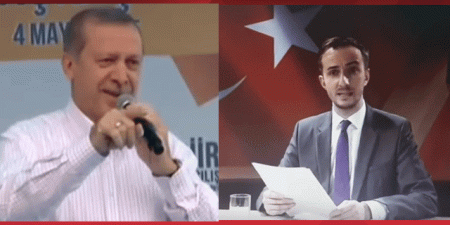
Turkish President Recep Tayyip Erdogan (left) reads a poem about violent jihad in May, 2015, at a public opening ceremony in the province of Siirt. The Turkish government has called a satirical poem about Erdogan by German comedian Jan Bohmermann (right) a ‘serious crime against humanity.’
On March 8, the Turkish Minister of Finance Naci Agbal read verses from a poem titled Amentu (“I believe”) by Ismet Ozel. The verses recall the Turkish -Greek war in 1920s in Anatolia and refer to the Greeks as kafirs (infidels).
“The adhan (call to prayer) is no longer heard. The cross has been erected on minibars (mosque pulpit),
The kafir Greek has flown his flag on mosques, on everywhere
Then come, my brother, join our hands altogether
Let’s explode the bombs and silence the [church] bells everywhere.”
While the finance minister of Turkey, a country that fancies itself as a candidate for EU membership, read these verses during his speech at Turkey’s parliament, the Turkish prime minister, Ahmet Davutoglu, met with his Greek colleague, Alexis Tsipras, in Izmir and told him, “Let’s remove the word ‘war’ from our relations.”
Apparently, the poem which openly calls for “exploding the bombs and silencing the [church] bells everywhere” is perfectly fine according to Turkish-Islamic standards. No state authority or prosecutor has demanded the minister be brought to account for reading it.
At the same time, the satirical, obscene poem read by the German comedian, Jan Bohmermann, which was critical of Turkish President Recep Tayyip Erdogan, however, put the Turkish government in an extreme state of rage.
On March 31, Bohmermann “offered to illustrate impermissible ‘abusive criticism,’ saying, ‘You’re not allowed to do this,’ and read the poem on German TV. Besides its crude sexual references, the piece accused Erdogan of repressing minorities and mistreating Kurds and Christians,” reported Reuters.
If there were a normal government in Turkey ruled by somewhat democratic people, the poem by the German artist would never be a matter of such a frantic debate.
Some people would just laugh at it, others would be disturbed. Some would think it was an intriguing example of artistic expression; others would think it was done in poor taste. Wise ones in Turkey would probably try to learn lessons from it: “Why is that artist criticizing or even mocking us like that? Maybe we are at fault and we should change our ways.” All in all, the poem would probably be in the news for a few days, and then be mostly forgotten.
But above all, the artist would never be exposed to any criminal prosecution for reading a poem that contained profanity but that did not call for violence in any way, shape or form.
The Turkish government authorities could have as well ignored the poem and focused on the real problems of the country – including why the perpetrators who sell Yazidi women in the southeastern province of Gaziantep, Turkey were recently acquitted of any crime.
In December, 2015, the German NDR and SWR TV channels produced footage documenting the slave trade being conducted by the Islamic State (ISIS) through a liaison office in the province of Gaziantep in Turkey, near the border with Syria.
On April 17, 2016, the Turkish newspaper Hurriyet reported that the Gaziantep police department had raided the said office and found $310,000, many foreign (non-Turkish) passports and 1,768 pages of Arabic receipts that demonstrate the transfer of millions of dollars between Turkey and Syria.
Six people were brought to court for their involvement in crimes including “being members of an armed terrorist organization.” But the complainant, the Gaziantep Bar Association, was not even invited to attend the hearings that lasted for only 16 days.
“We learnt the ruling accidentally. The court made the decision of acquittal without looking into the documents found by police,” said Bektas Sarkli, the head of the Gaziantep Bar Association, adding that they will go for an appeal.
Apparently, in Turkey, selling Yazidi women and children is not a very big deal. The real “crime,” according to the Turkish government, is the poem of Bohmermann.
Numan Kurtulmus, the deputy Prime Minister of Turkey, and the spokesperson of the government, called the poem a “serious crime against humanity.”
The comedian, who now stands accused of “insulting a foreign leader,” a crime in Germany, could face jail time for reciting a satirical poem on German television. The “sensitive” Turkish government prefers to prosecute those who recite “offensive” poems, but not the ISIS members who sell Yazidi women and children.
Erdogan, too, made a complaint against Bohmermann as a private person on charges of “being insulted by the poem.”
Ironically, in 1999, Erdogan, then mayor of Istanbul, spent four months in jail after a conviction for religious incitement through a poem he publicly read. The poem by the pan-Turkic author Ziya Gokalp (1876 – 1924) had an overtly violent message:
“The mosques are our barracks, the domes our helmets, the minarets our bayonets and the faithful our soldiers.”
In July, 2011, Erdogan, who was then prime minister, read the same verses at Turkey’s parliament.
In May, 2015, at a public opening ceremony in the province of Siirt, President Erdogan read the poem once more (see video below) – this time together with his supporters.
The poem openly called for jihad– but according to the Islamic ideology, if violence will bring about the Islamization of the victims or their descendants, it is not criminal.
Many Islamists do not see jihad as a crime. For their scriptures openly command them “to chop off heads and fingers and kill infidels wherever they may be hiding.”
Historically and today, the expansionist Islamist raids against non-Muslim peoples are accompanied by mass murders, mass rapes, sex slavery, forced conversions, looting, plundering, mass deportations and so on.
Hence, what the rest of the world would describe as “genocide,” “massacre,” “terrorism” or “ethnic cleansing,” many Islamists describe as “righteous” ways of spreading Islam and of liberating “infidel” lands as well as a good deed (halal) that will open the “doors of Heaven.”
The problem in general seems to be that according to the Islamist mindset, anything inside Islamic scriptures or sharia law such as beating, raping, throat-slitting, beheading, crucifying or selling women as sex slaves is acceptable and not a crime.
But anything outside sharia such as Christmas, a satirical poem, a cartoon of Mohammad and free speech is a crime and must be dealt with by the full force of the law.
The key point is to see the enormous differences between the Islamist ideology — which aims for supremacism, global caliphate and death to or subjugation of non-Muslims — and Western civilization, which protects and even encourages intellectual dissent, free expression and human freedom.
Under German law, prosecutions for insulting a foreign leader can only take place with the express permission of the German government. Although there are currently attempts to pass a bill to abolish the law before Bohmermann’s case can come to court, the Merkel government decided to allow the prosecution to take place.
Sadly, Germany chose to disregard this gigantic civilizational difference and has taken a noxious step to kneeling down to the stealthy threats of Islamists.
Erdogan (like Vladimir Putin) is the face of modern authoritarianism — promising prosperity in exchange for the dismantling of basic civil liberties. The question is whether the West will rally to the side of free speech in time to stop these leaders from returning the world to the age of criminalized speech and censorship.
***************************
As Western leaders like Angela Merkel cave into the authoritarian demands of Turkish President Recep Tayyip Erdogan in crushing free speech, journalists and cartoonists are fighting back. After a Dutch journalist was arrested in Turkey this weekend for allegedly insulting President Recep Tayyip Erdogan, the most-read newspaper in the Netherlands threw down the gauntlet and published a front-page editorial cartoon that shows Erdogan as an ape crushing Europe’s free speech. Since Erdogan demands the prosecution of journalists even outside of Turkey who insult him, the publication could force another confrontation with the aspiring dictator. In the meantime, the West (including the United States) continue to prop up Erdogan as he destroys secular government in Turkey, arrests journalists, and denies the most basic forms of free speech.
The cartoon, entitled “the long arm of Erdogan” was published by the populist daily De Telegraaf, has an ape with Erdogan’s face squashing a woman who appears to be Ebru Umar, the Dutch writer who was arrested in Turkey on Sunday. In the cartoon, the Turkish president is standing on a rock labeled “Apenrots” — a Dutch term meaning “monkey rocks” that is used to refer to the Dutch Foreign Ministry but can also refer to a place where one dominant individual holds power.
It will now to interesting to watch whether the government follows Merkel’s lead in profusely apologizing to Erdogan for the exercise of free speech and/or attempts to bring charges of some kind in the case. The problem for Western leaders who have been leading the rollback on free speech is that citizens are beginning to see the implications of the loss of this defining right for Western Civilization. We have previously discussed the alarming rollback on free speech rights in the West, particularly in France (here and here and here and here and here and here) and England ( here and here and here and here and here and here and here and here and here and here). Much of this trend is tied to the expansion of hate speech and non-discrimination laws. We have seen comedians targeted with such court orders under this expanding and worrisome trend. (here and here).
Erdogan (like Vladimir Putin) is the face of modern authoritarianism — promising prosperity in exchange for the dismantling of basic civil liberties. The question is whether the West will rally to the side of free speech in time to stop these leaders from returning the world to age of criminalized speech and censorship.
♦ The European Union now finds itself in a classic catch-22 situation. Large numbers of Muslim migrants will flow to Europe regardless of whether or not the EU approves the visa waiver for Turkey.
♦ “If visa requirements are lifted completely, each of these persons could buy a cheap plane ticket to any German airport, utter the word ‘asylum,’ and trigger a years-long judicial process with a good chance of ending in a residency permit.” — German analyst Andrew Hammel.
♦ In their haste to stanch the rush of migrants, European officials effectively allowed Turkey to conflate the two very separate issues of a) uncontrolled migration into Europe and b) an end to visa restrictions for Turkish nationals.
♦ “Why should a peaceful, stable, prosperous country like Germany import from some remote corner of some faraway land a violent ethnic conflict which has nothing whatsoever to do with Germany and which 98% Germans do not understand or care about?” — German analyst Andrew Hammel.
♦ “Democracy, freedom and the rule of law…. For us, these words have absolutely no value any longer.” — Turkish President Recep Tayyip Erdogan.
Turkey has threatened to renege on a landmark deal to curb illegal migration to the European Union if the bloc fails to grant visa-free travel to Europe for Turkey’s 78 million citizens by the end of June.
If Ankara follows through on its threat, it would reopen the floodgates and allow potentially millions of migrants from Africa, Asia and the Middle East to flow from Turkey into the European Union.
Under the terms of the EU-Turkey deal, which entered into effect on March 20, Turkey agreed to take back migrants and refugees who illegally cross the Aegean Sea from Turkey to Greece. In exchange, the European Union agreed to resettle up to 72,000 Syrian refugees living in Turkey, and pledged up to 6 billion euros ($6.8 billion) in aid to Turkey during the next four years.
European officials also promised to restart Turkey’s stalled EU membership talks by the end of July 2016, and to fast-track visa-free access for Turkish nationals to the Schengen (open-bordered) passport-free zone by June 30.
Turkish President Recep Tayyip Erdogan (left) has boasted that he is proud of blackmailing EU leaders, including European Commission President Jean-Claude Juncker (right), into granting Turkish citizens visa-free access to the EU and paying Turkey billions of euros.
To qualify for the visa waiver, Turkey has until April 30 to meet 72 conditions. These include: bringing the security features of Turkish passports up to EU standards; sharing information on forged and fraudulent documents used to travel to the EU and granting work permits to non-Syrian migrants in Turkey.
The European Commission, the administrative arm of the European Union, said it would issue a report on May 4 on whether Turkey adequately has met all of the conditions to qualify for visa liberalization.
During a hearing at the European Parliament on April 21, Marta Cygan, a director in the Commission’s migration and home affairs unit, revealed that to date Ankara has satisfied only 35 of the 72 conditions. This implies that Turkey is unlikely to meet the other 37 conditions by the April 30 deadline, a window of fewer than ten days.
According to Turkish officials, however, Turkey is fulfilling all of its obligations under the EU deal and the onus rests on the European Union to approve visa liberalization — or else.
Addressing the Council of Europe in Strasbourg on April 19, Turkish Prime Minister Ahmet Davutoglu said that Turkey has now reduced the flow of migrants to Greece to an average of 60 a day, compared to several thousand a day at the height of the migrant crisis in late 2015. Davutoglu went on to say that this proves that Turkey has fulfilled its end of the deal and that Ankara will no longer honor the EU-Turkey deal if the bloc fails to deliver visa-free travel by June 30.
European Commission President Jean-Claude Juncker has insisted that Turkey must meet all 72 conditions for visa-free travel and that the EU will not water down its criteria. But European officials — under intense pressure to keep the migrant deal with Turkey alive — will be tempted to cede to Turkish demands.
EU Migration Commissioner Dimitris Avramopoulos on April 20 conceded that for the EU it is not a question of the number of conditions, but rather “how quickly the process is going on.” He added: “I believe that at the end, if we continue working like this, most of the benchmarks will be met.”
European officials alone are to blame for allowing themselves to be blackmailed in this way. In their haste to stanch the rush of migrants to Europe, they effectively allowed Turkey to conflate the two very separate issues of a) uncontrolled migration into Europe and b) an end to visa restrictions for Turkish nationals.
The original criteria for the visa waiver were established in December 2013 — more than two years before the EU-Turkey deal — by means of the so-called Visa Liberalization Dialogue and the accompanying Readmission Agreement. In it, Turkey agrees to take back third-country nationals who, after having transiting through Turkey, have entered the EU illegally.
By declaring that the visa waiver conditions are no longer binding because the flow of migrants to Greece has been reduced, Turkish officials, negotiating like merchants in Istanbul’s Grand Bazaar, are running circles around the hapless European officials.
Or, as Turkish President Recep Tayyip Erdogan recently proclaimed: “The European Union needs Turkey more than Turkey needs the European Union.”
The European Union now finds itself in a classic Catch-22 situation. Large numbers of Muslim migrants will flow to Europe regardless of whether or not the EU approves the visa waiver.
Critics of visa liberalization fear that millions of Turkish nationals may end up migrating to Europe. Indeed, many analysts believe that President Erdogan views the visa waiver as an opportunity to “export” Turkey’s “Kurdish Problem” to Germany.
Bavarian Finance Minister Markus Söder, for example, worries that due to Erdogan’s persecution of Kurds in Turkey, millions may take advantage of the visa waver to flee to Germany. “We are importing an internal Turkish conflict,” he warned, adding: “In the end, fewer migrants may arrive by boat, but more will arrive by airplane.”
In an insightful essay, German analyst Andrew Hammel writes:
“Let’s do the math. There are currently 16 million Turkish citizens of Kurdish descent in Turkey. There is a long history of discrimination by Turkish governments against this ethnic minority, including torture, forced displacement, and other repressive measures. The current conservative-nationalist Turkish government is fighting an open war against various Kurdish rebel groups, both inside and outside Turkey.
“This means that under German law as it is currently being applied by the ruling coalition in the real world (not German law on the books), there are probably something like 5-8 million Turkish Kurds who might have a plausible claim for asylum or subsidiary protection. That’s just a guess, the real number could be higher, but probably not much lower.
“If visa requirements are lifted completely, each of these persons could buy a cheap plane ticket to any German airport, utter the word ‘asylum,’ and trigger a years-long judicial process with a good chance of ending in a residency permit.”
Hammel continues:
“There are already 800,000 Kurds living in Germany. As migration researchers know, existing kin networks in a destination country massively increase the likelihood and scope of migration…. As Turkish Kurds are likely to arrive speaking no German and with limited job skills, just like current migrants, where is the extra 60-70 billion euros/year [10 billion euros/year for every one million migrants] going to come from to provide them all with housing, food, welfare, medical care, education and German courses?
And finally, “the most important, most fundamental, most urgent question of all”:
“Why should a peaceful, stable, prosperous country like Germany import from some remote corner of some faraway land a violent ethnic conflict which has nothing whatsoever to do with Germany and which 98% Germans do not understand or care about?”
Turkish-Kurdish violence is now commonplace in Germany, which is home to around three million people of Turkish origin — roughly one in four of whom are Kurds. German intelligence officials estimate that about 14,000 of these Kurds are active supporters of the Kurdistan Workers’ Party (PKK), a militant group that has been fighting for Kurdish independence since 1974.
On April 10, hundreds of Kurds and Turks clashed in Munich and dozens fought in Cologne. Also on April 10, four people were injured when Kurds and Turks fought in Frankfurt. On March 27, nearly 40 people were arrested after Kurds attacked a demonstration of around 600 Turkish protesters in the Bavarian town of Aschaffenburg.
On September 11, 2015, dozens of Kurds and Turks clashed in Bielefeld. On September 10, more than a thousand Kurds and Turks fought in Berlin. Also on September 10, several hundred Kurds and Turks fought in Frankfurt.
On September 3, more than 100 Kurds and Turks clashed in Remscheid. On August 17, Kurds attacked a Turkish mosque in Berlin-Kreuzberg. In October 2014, hundreds of Kurds and Turks clashed at the main train station in Munich.
In an essay for the Financial Times titled “The EU Sells Its Soul to Strike a Deal with Turkey,” columnist Wolfgang Münchau wrote:
“The deal with Turkey is as sordid as anything I have ever seen in modern European politics. On the day that EU leaders signed the deal, Recep Tayyip Erdogan, the Turkish president, gave the game away: ‘Democracy, freedom and the rule of law…. For us, these words have absolutely no value any longer.’ At that point the European Council should have ended the conversation with Ahmet Davutoglu, the Turkish prime minister, and sent him home. But instead, they made a deal with him — money and a lot more in return for help with the refugee crisis.”
Hizballah activists continue to operate freely in Germany and serve as senior employees of a German government-funded theater project intended to aid refugees in the country, according to the Berliner Zeitung daily and reported by the Jerusalem Post.
Two directors of the Refugee Club Impulse (RCI), sisters Nadia and Maryam Grassman, were central organizers of the annual pro-Iran/pro-Hizballah al-Quds Day rally in 2015 featuring “anti-Semitic slogans” and calls for “the abolition of Israel.”
Video and photographic evidence showed Nadia chanting on a loudspeaker while Maryam disseminated fliers and posters and collected donations during the anti-Semitic rally. It is uncertain whether the donations were intended to fund Hizballah’s terrorist operations in Syria and against Israel.
The RCI is expected to receive €100,000 ($113,260 USD) from the German government for the refugee project. Public taxpayer money has been transferred to the organization for several years.
There are roughly 250 active Hizballah operatives in Berlin and a total of 950 Hizballah members throughout Germany, according to a 2014 Berlin intelligence report summarized by the Jerusalem Post. Though the number of Hizballah supporters is believed to be far higher in Germany than listed in the report.
Radical Islamists are “the greatest danger to Germany…Germany is on the spectrum of goals for Islamic terrorists,” said Hans-Georg Maassen, president of Germany’s domestic intelligence agency – the Federal Office for the Protection of the Constitution (BfV).
In 2014, Germany closed down the Lebanon Orphan Children Project for providing money to the al-Shahid (“The Martyr”) Association in Lebanon. Al-Shahid was “disguised as a humanitarian organization” and “promotes violence and terrorism in the Middle East using donations collected in Germany and elsewhere,” German security expert Alexander Ritzmann said in a 2009 European Foundation for Democracy report.
While the European Union, including Germany, designated Hizballah’s military wing as a terrorist entity, Germany allows Hizballah’s political wing to operate freely in the country. The U.S., Canada, and the Netherlands designate Hizballah as a terrorist organization entirely. Even senior Hizballah officials have noted the futility in distinguishing between its political and military wings, acknowledging that Hizballah is a hierarchical and bureaucratic organization with a clear chain of command. Therefore the organization’s terrorist and military wings answer to its senior leadership and political echelons, including its main benefactor – Iran.
(Another loss for western civilization and another win for the Islamists and the functional equivalent of Sharia law. — DM)
Chancellor Angela Merkel’s decision to first apologize to authoritarian Turkish President Recep Tayyip Erdoğan for a satirical poem and then approve the prosecution of the comedian is a shocking and chilling disgrace. Merkel, who hails from the former Communist East Germany, has never been a reliable ally to free speech but the crackdown on comedian Jan Boehmermann has shocked the West. Even with the recent rollback of free speech rights in Europe, Merkel’s actions (and the cringing response of ZDF television) has been wake up call for all civil libertarians.
Under German law, Chancellor Angela Merkel’s government had to approve a criminal inquiry. While she said that her government would move to repeal the controversial and little-used Article 103 of the penal code, which concerns insults against foreign heads of state, this would not happen until 2018. The provision (dating back to 1871) on defamation of organs and representatives of foreign states, states:
(1) Whosoever insults a foreign head of state, or, with respect to his position, a member of a foreign government who is in Germany in his official capacity, or a head of a foreign diplomatic mission who is accredited in the Federal territory shall be liable to imprisonment not exceeding three years or a fine, in case of a slanderous insult to imprisonment from three months to five years.
It is a ridiculous law that denies the very essence of free speech. Yet it was used successfully by Shah of Persia against a Cologne newspaper in 1964. It was also sued by hen-Swiss President, Micheline Calmy-Rey to prosecution a Swiss man living in Bavaria after he posted offensive comments Calmy-Rey, on the internet. Despite these outrageous cases, Germany has retained the law.
Moreover, Merkel’s fawning apology to Erdoğan, one of the world’s rising totalitarians, was widely viewed as the final capitulation of Western leaders to the calls for greater censorship and speech regulation.
Böhmermann will now have to prove that his poem was satire about free speech, rather than a deliberate insult — a bizarre standard since satire is often insulting and insults are part of free speech, particularly with regard to political leaders.
Despite her public apology and statement, Merkel insisted “The presumption of innocence applies” to Boehmermann.
For his part, Böhmermann used humor to respond to his own government’s persecution and told fans he planned to spend his break studying “freedom of the press and freedom of art in greater detail while traveling through North Korea.” He said that his decision to take a break was intended to allow “the public and the Internet can return to focusing on the important things in life, like the refugee crisis (and) cat videos.”
Merkel needs Turkey to take back refugees and has added $6 billion in aid to her sacrifice of free speech to keep Erdoğan happy.
It is important to note that Merkel is not alone in abandoning free speech. Despite its effort to spin the scandal, ZDF, the German network that airs Neo Magazine Royale, showed no courage or principle in taking the offending poem off the web. It then tried to maintain that it “respects” Böhmermann and will support him in any legal defense against the Turkish government.
We have previously discussed the alarming rollback on free speech rights in the West, particularly in France (here and here and here and here and here and here) and England (here and here and here and here and here and here and here and here and here and here). Much of this trend is tied to the expansion of hate speech and non-discrimination laws. We have seen comedians targeted with such court orders under this expanding and worrisome trend. (here and here).
Merkel has plunged Germany into this rising sea of censorship and criminalized speech. Fortunately, polls show Germans are opposed to her and this appeasement of Erdogan. Perhaps the case will serve to focus Germans and Europeans in general on the diminishing protections for free speech in the West. If nothing else, the attempt to imprison a comedian for insulting an authoritarian leader should capture the dire status of free speech in Europe.
The cost of under-age migrants is also much more expensive than an adult. On average, a young migrant can cost the German taxpayer between 40,000 to 60,000 euro per year. There has also been a rampant problem with young migrants using the hospitality of the German government to go on so-called ‘Grand Tours’ of Europe where they hop from asylum home to asylum home, committing crimes and terrorizing locals.
Breitbart Londonreported on one gang of North Africans in particular who posted their exploitsto social media bragging about the free money they were getting. They were able to live lavish lifestyles and do anything they wanted without consequence and it was all funded by the German taxpayer.
***************************
Germany has been flooded with over 70,000under-age migrants who cannot be deported even if their asylum application fails.
The number of unaccompanied minors coming to Germany as migrants has exploded over the past year, with over 70,000 under-age migrants arriving since the beginning of 2015. The rise has led to a huge strain on the German government, which is required to process and look after them all as they all require constant supervision, reportsDie Welt.
The system of Youth Services has seen delay after delay in finding adequate housing and has often had to resort to hostels and hotels, leaving the young migrants without the supervision of a social worker and at great expense to the German taxpayer. The social services have become so short staffed that they have had to rope in asylum lawyers to act as legal guardians for the children.
Many of these guardians can be looking out for 20 children, and some more than 100.
Tobias Klaus of the Federal Association of unaccompanied refugee minors said, “demands for guardians of our association have increased massively. Many of them are inexperienced,” and said that many of the under-age migrants in care had no idea if they should be applying for asylum or not.
The asylum process for adult migrants can take months but for minors it can take even longer. As a result of the wait there has been a huge clog in the processing of applications.
Of the 70,000 minors who came in the last year only around 14,439 were actually able to apply for asylum in Germany. Around 71 percent of all those who got to apply were above the age of 15.
The government in Germany is trying to fix the wait times by prioritizing children in a new initiative but the wait time could still be up to seven months.
Even if their asylum request fails it’s incredibly unlikely that any migrants who come to Germany as minors will ever be deported. The success rate for under-age migrants was 93 percent compared to adults where 61 percent were approved according to the German Federal Office for Migration and Refugees (BAMF).
Among the seven percent of those who failed the asylum process the German Federal government stated, “in 2015, 21 rejections, ten removals and no expulsions of unaccompanied minor foreign nationals were executed.” The 21 rejections refer to those who were denied at the border or at an airport and doesn’t exclusively cover migrants seeking asylum.
The cost of under-age migrants is also much more expensive than an adult. On average, a young migrant can cost the German taxpayer between 40,000 to 60,000 euro per year. There has also been a rampant problem with young migrants using the hospitality of the German government to go on so-called ‘Grand Tours’ of Europe where they hop from asylum home to asylum home, committing crimes and terrorizing locals.
Breitbart Londonreported on one gang of North Africans in particular who posted their exploits to social media bragging about the free money they were getting. They were able to live lavish lifestyles and do anything they wanted without consequence and it was all funded by the German taxpayer.
Germany has not tested its freedom of expression so deeply since the saga of Mozart’s Idomeneo in 2006 when the Deutsche Oper Company canceled the opera because there was the severed head of Muhammad in it and that could offend the largest Islamic community in Europe. The director, Hans Neuenfels, then asked: “Where will it all end if we allow ourselves to be artistically blackmailed?”.
The answer came this week with the case of Jan Böhmermann, the famous comedian who mocked Turkish president Recep Erdogan. “What I’m going to read is not allowed” said Böhmermann on ZDF, the German public network. His poetry routine suggests that Erdogan watches child porn movies while he enjoys “repressing minorities and beating up Christians”.
The prosecutor of Mainz, in the Rhineland-Palatinate, received more than twenty complaints from private citizens which forced him to open a case against Böhmermann under paragraph 103 of the Penal Code, which provides three years of imprisonment for insulting a foreign head of state. Chancellor Angela Merkel has condemned the poem, calling it a “deliberate insult” and wanted to phone Turkey’s Prime Minister Ahmet Davutoglu to appease the wrath of Ankara.
Then came Erdogan’s personal complaint against Böhmermann who, according to Deputy Prime Minister Numan Kurtulmus, committed a “grave crime against humanity” and “offended 78 million Turks”, no less. The case could go to the Constitutional Court in Karlsruhe. Not satisfied with imprisoning Turkish journalists, President Erdogan wants to imprison Germans as well.
Three weeks ago, another German video sparked Turkish protests. Meanwhile, the ZDF removed the video of Jan Böhmermann, even before the Turkish protests. If Merkel has sided with the Turks, the German press is united around Böhmermann.
Mathias Döpfner, the editor of the Springer publishing giant, defended the comedian and criticized Merkel, although Döpfner is her supporter: “As written by Michel Houellebecq in his masterpiece on the self-sacrifice of the West: Submission.” Demonstrations were held under the offices of the ZDF in Turkey. Former Finance Minister of Greece, Yanis Varoufakis, commented: “Europe first lost its soul, then lost its sense of humor”.
“Böhmermann is not very brave and this story is bigger than he is” said Henryk Broder, born in 1946 in Katowice, Poland, and today one of the most popular writers of Germany who writes for Die Welt and Bild Zeitung, in an interview with me. “He didn’t show up to withdraw the Grimm Award. I would have been there to say these people: ‘F*** you’”. The German Max Mauff actor was presented at the ceremony with a picture of Böhmermann and the word “missing”.
“Böhmermann behaved like a dhimmi, but we must show solidarity” – continues Broder – “This is a case of governmental interference in the freedom of expression. We face the contradictory policy of Angela Merkel, who said is said in favor of freedom of expression but then takes action against it.
“When the book by Thilo Sarrazin ‘Germany abolishes itself’ appeared in 2010, it was disqualified by Merkel as ‘defamatory’ and ‘not useful’. There is no such thing as ‘good’ and ‘bad’ satire. In communist East Germany it was the party who was left to decide what should be published and this is in Merkel’s DNA, she is a daughter of Eastern Germany. At that time they called it ‘socialization’. Merkel wants Erdogan to do the dirty work for her on migrants, so she doesn’t want a comedian to spoil relations with Turkey”.
In Turkey, Article 299 of the Criminal Code provides four years in prison for those who insult the President (Can Dündar and Erdem Gül, director and editor in chief of Cumhuriyet, now face a trial). Yesterday Deutsche Welle explained that there are 2,000 pending legal cases involving defamation of Erdogan. The defendants are artists, journalists, academics and cartoonists. The same punishment is now evoked in Germany against a comedian.
The cultural-geographical border of Europe has always been drawn on the Bosphorus and not on the Turkish border. Böhmermann’s case moved that border nearer to Ankara.








 anneinpt
 artaxes
 danmillerinpanama
 davidking1530
 Peter Hofman
 Joseph Wouk
 Peter
Peter Louisiana Steve

Recent Comments