Posted tagged ‘Free world’

Putin Plays Mideast Chess as Obama Looks On

October 1, 2015

Putin Plays Mideast Chess as Obama Looks On, American ThinkerJonathan F. Keiler, October 1, 2015

(Unfortunately, Obama was “in the game” which led to the nuke “deal” with Iran. There, he was not incompetent; he got what he sought. — DM)

Obama has made a lot of foreign policy mistakes in office, but his capitulation on the Iranian nuclear talks followed by Russia’s move into Syria is impossible to explain away as anything but a stupendous strategic fiasco.  Incompetence is too nice a word.  Obama was never even in the game.

*********************

It is sometimes said that in negotiations with foreigners, American leaders play checkers, while their wilier opponents play chess.   There is perhaps some truth to this, as American leaders sometimes chase short-term political results, a consequence of democratic governance and constantly changing leadership.  By contrast, despotic Persians are credited with inventing chess, and in modern times autocratic Russians have been its master, and so it is tempting to say of President Obama’s dealings with those two countries that the analogy holds.

But that is way too charitable.  As Vladimir Putin skillfully reasserts Russian power and influence in the Middle East with Islamic Persian Iran as a willing partner, a more apt analogy might be that while the Russians and Iranians move their chessmen, isolating and threatening opposing pieces, Obama is not even at the table, but rather childishly looking on, as he pushes diplomatic dirt around the Middle East sandbox.

For over 150 years, a primary objective of Western diplomatic and military strategy was to keep the Russians out of the Middle East and Southwest Asia.  In the 1850s, the British and French went to war in Crimea to protect the Ottomans from Russian predation and to preserve the balance of power.  Later, the so-called “Great Game” centered on similar British efforts to frustrate Russian domination of Iran and Afghanistan.  A century later, the United States took up the task, offsetting Russian influence in newly socialist Arab dictatorships by backing Israel and more traditional Arab monarchies in the Middle East, while openly and successfully opposing the Soviet incursion into Afghanistan.

Today, one can’t even say there remains any Western strategy regarding Russia.  Western Europe has mostly forfeited its military and political influence overseas to support decadent welfare states, even as it is being progressively and deliberately overwhelmed by millions of Islamist migrants.  Under Obama, who supports and admires Europe’s demise, the United States has increasingly joined in the decline.  The laughable Libyan campaign, “fought” by Europeans while the U.S. led from behind, set an example of pursuing a feckless, feel-good military campaign without regard for consequences or traditional strategic concerns.  Obama’s encouragement of the so-called Arab Spring and its Islamist provocateurs almost lost Egypt and did lose Syria, with catastrophic humanitarian and geopolitical results.

Putin is taking advantage of American weakness and inaction.  A half-century of successful American effort to keep the Russians out of the Middle East has been forfeit in a few months of breathtaking American diplomatic and military incompetence.  Obama’s capitulation in the Iran deal effectively completed the groundwork for the Russian move, Putin having carefully monitored America’s year-long and ineffectual air campaign against ISIS.  Putin now claims that Russia’s push into Syria is to redeem the campaign against ISIS with Russian troops fighting with Syria and Hezb’allah.  Embarrassed by Putin at the U.N., Obama gave up any pretense of strength, effectively welcoming the Russian “intervention” against ISIS.  Unexplained is why a large percentage of Russian anti-ISIS forces are heavily equipped with anti-aircraft weapons, something that even a flaccid NATO command cannot ignore, inasmuch as ISIS have an air force.  Those weapons are useful only against NATO or Israeli aircraft.

So lost was Obama before his meeting with Putin at the U.N. that his stated strategy for dealing with the Russian strongman was to ask him what he was doing.  From the stiff and awkward body language of the president following the meeting (a painful handshake and awkward smile) it is clear that Putin told Obama at least some of the story, whether Obama liked it or not.  Most particularly, his client Bashar Assad will remain in power with Russian backing, regardless of Obama’s view on the matter.  But likely Obama had known what he was in for, and just going through the motions.  The day before, Secretary of State of State John Kerry responded to a question about how long the U.S. could tolerate the survival of Assad, saying, “… it doesn’t have to be on day one or month one or whatever.”  Right, dude, whatever.  Between Obama and Kerry, it is now fair to assume that our much muddled and irresolute Syrian policy is “whatever,” which means we just don’t care.  We take our toys and go home.

If Obama was hoping, as he and his supporters implied, that the Iranian deal would produce a more moderate, cooperative Iran, Putin and the mullahs are doing all they can to demonstrate how wrong he was.  If he was hoping that “international pressure” and the conflict in Ukraine would moderate Putin’s aggressive strategies, he was wrong again.  And if he thinks that by quitting, he has left Putin an unwinnable game, the Russian leader aims to prove him wrong again.  And since Obama is almost always wrong when it comes to foreign policy, it’s a fool’s errand to bet against Putin.

In chess, before going for the opponent’s king, typical strategy calls for supporting one’s important pieces, while threatening and isolating opposing pieces.  The Russians and Iranians are now going about this with a vengeance, without the United States or the West making any noticeably effective counter-moves.  Russia is backing and protecting Assad and has closely allied itself with a newly empowered (thanks largely to Obama) Iran.  Meanwhile, traditional American allies in the region, Israel, Egypt, and the Arab monarchies are indeed increasingly threatened and isolated.  The stage is being set for a Russo-Iranian endgame that could prove disastrous to America’s traditional allies and the West in general.

Some of Obama’s liberal supporters dismiss such analysis as over the top, and insist that Putin’s moves have more to do with domestic politics than a long-term Middle Eastern power play.  They point out Putin’s problems at home, and the relative weakness of the Russian military.  However, relative Russian weakness means little when moving into a power vacuum created by Obama’s flight from international responsibilities and, to a large extent, reality.  And besides, this has been the basic way liberals have sought to excuse Obama whenever he is pushed around by a foreign leader (which is almost always).  Putin’s got problems, so he invades Ukraine, threatens the Baltic States, and moves into Syria.  The Chinese have problems, so they push naval vessels into American waters and fortify disputed Western Pacific archipelagos.  Korea’s got problems, Iran’s got problems, and none of their aggressive actions has anything to do with the dilettante in the White House.  It’s all about solving problems at home with international temper tantrums.

Obama has made a lot of foreign policy mistakes in office, but his capitulation on the Iranian nuclear talks followed by Russia’s move into Syria is impossible to explain away as anything but a stupendous strategic fiasco.  Incompetence is too nice a word.  Obama was never even in the game.


12 Hair-Raising Facts from Congressional Terror Report

September 30, 2015

12 Hair-Raising Facts from Congressional Terror Report, Clarion ProjectRyan Mauro, September 30, 2015

Islamic-State-Victory-Parade-HPAn Islamic State victory parade

Yesterday, the House Homeland Security Committee released the final report of its Task Force on Combating Terrorist and Foreign Fighter Travel and its conclusions weren’t pretty. The following are a dozen hair-raising facts from the bipartisan report:

“Today, we are witnessing the largest global convergence of jihadists in history.”

If you consider how the jihad in Afghanistan against the Soviets impacted the terrorist threat to the West, then we’re in for a heap of trouble due to the jihad in Syria, Iraq and elsewhere.

About 10,000 foreign fighters joined the jihad against the Soviets over roughly a 10-year period, with only 3-4,000 fighter joining at once. Today, over 25,000 foreign fighters are currently in Syria and the civil war is only four years old. When it started in 2011, the number of foreign fighters was a mere 1,000.

“We have largely failed to stop Americans from traveling overseas to join jihadists … Several dozen also managed to make it back into America.”

This stunning conclusion will add ammunition to efforts to revoke the passports of Americans who are believed to have joined jihadists overseas. Aside from constitutional objections, one rebuttal has been if the government has the evidence to show an American has joined terrorists, then it can simply arrest them if they try to re-enter. The report shows that these American traitors have been able to evade detection and come back home to potentially carry out attacks and/or radicalize others.

“The U.S. government lacks a national strategy for combating terrorist travel and has not produced one in nearly a decade.”

This statement, unfortunately, speaks for itself.

“The unprecedented speed at which Americans are being radicalized by violent extremists is straining federal law enforcement’s ability to monitor and intercept suspects.”

Over 250 Americans have joined or tried to join the jihadist groups in Iraq and Syria, including around 30 females. They come from 19 states, with 26% coming from Minnesota, 12% from California and 12% from New York/New Jersey.

“There have now been twice as many ISIS-inspired terror plots against the West in 2015 than there were in all of 2014.”

This conclusion is unsettling—and charitable. A review by terrorism expert Patrick Poole found that the number of Islamist terrorism cases in the U.S. this year was double that of the previous two years combined. And that was as of about four months ago.

“[ISIS] is believed to have inspired or directed nearly 60 terrorist plots or attacks against Western countries, including 15 in the United States.”

“Military officials estimate airstrikes have killed over 10,000 [ISIS] extremists, but new foreign fighters replace them almost as quickly as they are killed.”

This substantiates the admission that the U.S. fight with ISIS was at a “stalemate.” Our analysis of the numbers led to thesame conclusion back in May. If you look at ISIS’ membership and territorial expansion, the U.S. is barely making a dent.

Additionally, optimistic claims of success exempt ISIS’ growth outside of Iraq and Syria. The Committee mentions reports that there are “hundreds, if not thousands” of ISIS members in Afghanistan now and the Libyan government believes it is dealing with 5,000 of its own jihadist foreign fighters now.

“Gaping security weaknesses overseas—especially in Europe—are putting the U.S. homeland in danger…”

The report raises several warnings about European security procedures, a pressing issue considering that about 1,550 fighters from France, 700 from Germany and 700 from the United Kingdom have joined the jihad in Syria and Iraq. The Committee found that counter-terrorism checks at European borders and airports are insufficient.

One-third of the international community does not issue fraud-resistant E-Passports or utilize the INTERPOL databases that contain the names of terrorists.

“In short, information about foreign fighters is crossing borders less quickly than the extremists themselves.”

The report emphasizes that intelligence-sharing remains a severe problem. There isn’t even an international comprehensive database of foreign fighter names.

“The federal government has failed to develop clear early intervention strategies—or ‘off-ramps’- to radicalization—to prevent suspects already on law enforcement’s radar from leaving to join extremists.”

Someone who is actively trying to join a group like ISIS or Al-Qaeda is probably too far gone to be rescued, unless they get a brutal wakeup call when they see the caliphate first-hand. The report states that 80% of foreign fighters download extremist propaganda and/or engage a jihadist online. It is critical that we target the ideology that precedes the violent act.

“Few initiatives exist nationwide to raise community awareness about foreign fighter recruitment and to assist communities with spotting warning signs.”

The report says that 75% of foreign fighter arrests in the U.S. happen due to the involvement of a confidential informant who is close enough to the suspect to provide the critical evidence. Presumably, this would be a Muslim in most cases. This is why Islamist propaganda that demonizes the FBI and its informants must be rebutted, such as when the Council on American-Islamic Relations (CAIR) claims that the War on Terror is “made up” by the FBI and its informants are paid to frame innocent Muslims.

“The Administration has launched programs to counter-message terrorist propaganda abroad, but little is being done here at home.”

The report isn’t exactly kind to our ideological strategy abroad, either. It says the U.S. government has not exploited the opportunity presented by “jaded jihadists”— Islamist terrorists who join the caliphate, realize it wasn’t all it was cracked up to be and flee. For example, a State Department video featuring such testimonies had only 500 views over two months.


Germany segregating Christians as migrant violence escalates

September 28, 2015

Germany segregating Christians as migrant violence escalates, Breitbart, Liam Deacon, September 28, 2015

Screen-Shot-2015-09-28-at-12.58.45-640x480Sean Gallup/Getty

(Video at link.– DM)

Christian migrants in German asylum centres are living under persistent threat, with many fearing for their lives as the hardline Sunni majority within the migrant population attempts to enforce Sharia law in their new host nation. The situation is so bad that Christians claim they live like “prisoners” in Germany, and some have even returned to Middle East.

In the German state of Thuringia, Prime Minister Bodo Ramelow, one of the multiculturalists driving and celebrating the migrant crisis, has been forced to initiate a policy of separating and segregating different cultures as soon as they arrive in Europe.

“In Iran, the Revolutionary Guards have arrested my brother in a house church. I fled the Iranian intelligence, because I thought in Germany I can finally live freely according to my religion,” says Said, a Christian who fled persecution in his native country.

“But I can not openly admit that I am a Christian in my home for asylum seekers. I will be threatened,” he told Germany language paper Die Welt.

This year Germany prepares to absorb a million people in just twelve months – one per cent of its entire population – from numerous, diverse and alien cultures.

“We must rid ourselves of the illusion that all those who arrive here are human rights activists,” says Max Klingberg of the International Society for Human Rights (ISHR), who has worked with refugees for 15 years. “Among the new arrivals is not a small amount of religious intensity, it is at least at the level of the Muslim Brotherhood,” he said.

Said is living in an asylum centre in southern Brandenburg, near the border with Saxony. “They wake me before dawn during Ramadan and say I should eat before the sun comes up. If I refuse, they say I’m a kuffar, an unbeliever. They spit at me… They treat me like an animal. And threaten to kill me.”

“… They are also all Muslims,” he adds.

Gottfried Martens, a pastor of the Evangelical Lutheran Church Trinity in Berlin-Steglitz, has around 600 Afghanis and Iranians in his church, most of whom he baptised himself. “Almost all have big problems in their homes,” says Martens. “Devout Muslims teach their view, that here [in Germany] there is the Sharia, and then there is our law.”

He told Die Welt that the Christian refugees are often stopped from using kitchens to prepare food in asylum centres, and are constantly bullied for not praying five times a day to Mecca. Martens continues:

“And [the Christians] ask the question: What happens when the devout Muslim refugees leave the refugee center, must we continue hiding ourselves as Christians in the future in this country?”

Said’s fear is not unfounded. On the 14th of September German police in the town of Hemer revealed in a statement that an Eritrean Christian and his wife – who was eight months pregnant – had been hospitalised after being brutally attacked with a glass bottle by Algerian Muslims. The man had been wearing a wooden crucifix, which had “insulted” the Algerians.

In September, Syrian refugees rioted in the town of Suhl when an Afghan man tore a few pages out of the Koran. Last week during Ramadan, in Baden-Württemberg Ellwangen, there was a mass brawl between Christians, Yazidis and Muslims, and just this weekend migrant violence erupted as hundreds fought in the city of Kassel, leaving 14 injured.

A young Syrian from Erstaufnahmelager in Giessen, who has reported threats against him, said he is concerned that among the refugees are followers of the Islamic State (IS): “They shout Quranic verses. These are words that IS shouts before they cut off people’s heads. I cannot stay here. I am a Christian,” he said

Die Welt even reports a case of a Christian family from Iraq who was housed in a refugee camp in Bavarian Freising. The family lived like “prisoners” in Germany, they said, so returned to Mosul in Iraq. The father told a TV crew how Syrian Islamists had attacked them in Germany: “You have my wife yelled at and beaten. My child they say… We will kill you and drink your blood.”

Simon Jacob of the Central Council of the Eastern Christians said that stories like this no longer surprise him: “I know a lot of reports of Christian refugees who are under attack. But that’s just the tip of the iceberg.”

“The number of unreported cases is high. We must expect further conflicts that bring the refugees from their homeland to Germany. Between Christians and Muslims. Between Shiites and Sunnis. Between Kurds and extremists. Between Yazidis and extremists,” he said.

The Invasion of Europe

September 28, 2015

The Invasion of Europe, Pat Condell via You Tube, September 28, 2015


Iran Bolsters Itself with UN Resolution Condemning Sanctions

September 27, 2015

Iran Bolsters Itself with UN Resolution Condemning Sanctions, Legal Insurrection, September 26, 2015

(Please see also, Iran Openly Declares That It Intends To Violate UNSCR 2231 That Endorses The JCPOA — DM)

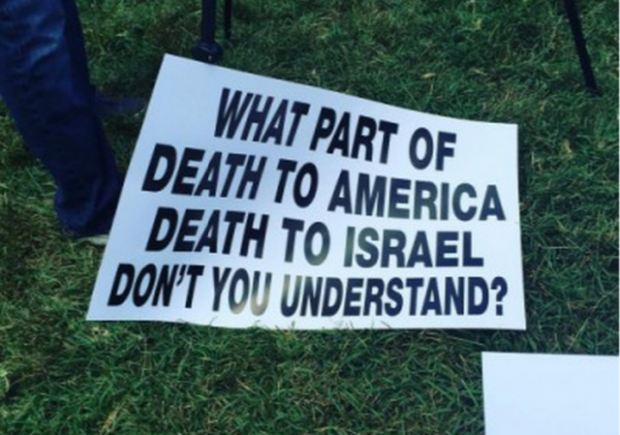
Protest-Sign-Against-Iran-Nuclear-Deal-Death-to-America-e1441978760141-620x435


I think we all know what Iran means when it speaks of political free will. In the wake of the adoption of the Iran nuclear deal, conversations about nightmare “what if” scenarios focused on America’s ability to “snap” sanctions against Iran back into place; now, Iran is trying to reframe the conversation about the use of sanctions by arguing that the use of sanctions at all will constitute a greater violation than what the sanctions are meant to punish.

***************************

This week, Iran used its considerable muscle to launch an attack on US efforts to tamper its nuclear program and otherwise belligerent conduct in the Middle East. These efforts took the form of a proposed resolution in the United Nations Human Rights Council (UNHRC) that condemns the use of sanctions against misbehaving nations as a violation of international law and fundamental human rights.

You won’t see the word “sanctions” more than three times in the resolution; instead, the drafters used the phrase “unilateral coercive measures.” From the proposed resolution:

Recognizing the universal, indivisible, interdependent and interrelated character of all human rights and, in this regard, reaffirming the right to development as a universal and inalienable right and an integral part of all human rights,

Expressing its grave concern at the negative impact of unilateral coercive measures on human rights, development, international relations, trade, investment and cooperation,

Reaffirming that no State may use or encourage the use of any type of measure, including but not limited to economic or political measures, to coerce another State in order to obtain from it the subordination of the exercise of its sovereign rights and to secure from it advantages of any kind,

Recognizing that unilateral coercive measures in the form of economic sanctions have far-reaching implications for the human rights of the general population of targeted States, disproportionately affecting the poor and the most vulnerable classes,

Recalling also article 1, paragraph 2, common to the International Covenant on Civil and Political Rights and the International Covenant on Economic, Social and Cultural Rights, which provides that, inter alia, in no case may a people be deprived of its own means of subsistence,

1. Calls upon all States to stop adopting, maintaining or implementing unilateral coercive measures not in accordance with international law, international humanitarian law, the Charter of the United Nations and the norms and principles governing peaceful relations among States, in particular those of a coercive nature with extraterritorial effects, which create obstacles to trade relations among States, thus impeding the full realization of the rights set forth in the Universal Declaration of Human Rights and other international human rights instruments, in particular the right of individuals and peoples to development;

The writing goes on to demand that member states ignore calls for sanctions, and condemns the use of such “as tools of political or economic pressure against any country, particularly against developing countries, with a view to preventing these countries from exercising their right to decide, of their own free will, their own political, economic and social systems.”

I think we all know what Iran means when it speaks of political free will. In the wake of the adoption of the Iran nuclear deal, conversations about nightmare “what if” scenarios focused on America’s ability to “snap” sanctions against Iran back into place; now, Iran is trying to reframe the conversation about the use of sanctions by arguing that the use of sanctions at all will constitute a greater violation than what the sanctions are meant to punish.

This isn’t a one-off finger-in-the-air from Iran to the US. The UNHRC is a dysfunctional land of multilingual politicking, and now the most dangerous players are using their influence with the greater UN body to bolster the worst violators at the expense of what should be common sense.

More from UN Watch [emphasis mine]:

Earlier this year, the UNHRC’s infamous Consultative Group, with Saudi Arabia’s Faisal Trad then serving merely as Vice-President, successfully picked Algerian hardliner Idriss Jazairy — famous for his efforts as a former diplomat to enact a UNHRC “code of conduct” to intimidate independent human rights experts — as the new “Special Rapporteur on the negative impact of the unilateral coercive measures.”

Jazairy has already accused the U.S. and Europe of being leading human rights violators due to their use of sanctions against countries like Iran and Zimbabwe.

Indeed, many of the resolutions adopted at each session of the UNHRC are sponsored by Cuba, Iran, Pakistan, Algeria, and other non-democracies, and are designed to demonize the West, free market economies, individual rights, or Israel, as part of a strategy to deflect attention from council members who are guilty of subjugating women, trampling religious freedom, persecuting gays, oppressing ethnic minorities and promoting relgious extremism.

This is clever, and part of a bigger strategy meant to counter American and Israeli efforts to speak out against the Iran nuclear deal. Even in the US, the media’s narrative has taken a subtle shift, away from the back and forth in Congress and toward an optic that frames the deal in terms of what it can do to encourage the advent of greater global cooperation. WaPo on Friday published an article needling the Republican Congress’ apparent rejection of “multilateralism”; meanwhile, the NYT editorial board executed a hard pivot away from the political theatre of the moment and toward What We Really Need to be Talking About© in terms of America’s participation in Gulf state politics.

The United Nations itself isn’t necessarily an important player in the American political conversation; international law is obscure, and multilateral relationships are [a] complication and confusing at best. However, if this resolution is adopted (and even if it isn’t) I can just about guarantee that the pro-Iran Deal crowd will use it as a weapon against anti-Deal candidates (primary season doesn’t go away just because we’re dealing with something happening in Geneva) currently warning their colleagues against the folly of attempting to deal with a nation that has proven itself more than adept at sidestepping the rules.

In this case, they’ve taken it upon themselves to rewrite them.

You can read the full proposed resolution here.

Israel’s biggest fears are materializing

September 27, 2015

Israel’s biggest fears are materializing, Israel Hayom, Boaz Bismuth, September 27, 2015

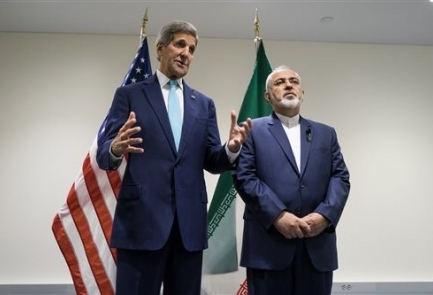
144334028328300476a_bThe Munich moment is upon us. U.S. Secretary of State John Kerry with Iranian Foreign Minister Mohammad Zarif at U.N. headquarters on Saturday | Photo credit: AP

Washington is reaching out to Russia, which is openly helping Syrian President Bashar Assad, who is working in conjunction with Iran, which in turn supports Hezbollah. Now Europe is prepared to talk to Assad, but what about us, for heaven’s sake?

Two years ago to the day, in September 2013, U.S. Secretary of State John Kerry compared Bashar Assad to Adolf Hitler, after the Syrian dictator once again used chemical weapons against his own people. “This is our Munich moment,” Kerry said at the time.

As far as the Americans were concerned, Assad had crossed a line. In those days (more like in those hours, actually), Washington briefly believed that a failure to respond to Assad’s actions would send a dangerous message to Iran regarding its nuclear ambitions.

“Will [Iran] remember that the Assad regime was stopped from those weapons’ current or future use, or will they remember that the world stood aside and created impunity?” Kerry asked at the time. History and retrospect have turned what may have been Kerry’s greatest speech into remarks entirely detached from reality.

The United States did not attack, Assad is still in power, and an ominous nuclear deal has been signed with Iran. It is no wonder that there is a new kind of atmosphere in the region, under American auspices. There are no more good guys and bad guys; everyone is a partner. And thanks to this new reality, Assad now has a renewed license to rule, after having received a license to kill.

Washington is reaching out to Russia, which is openly helping Assad in Syria, who is working in conjunction with Iran, which in turn supports Hezbollah. Europe (Angela Merkel), in the meantime, startled by its refugee crisis, is already prepared to talk with Assad; the same Assad who was compared to Hitler only two years ago. But what about us, for heaven’s sake?

Regretfully, Israel’s biggest fears are now materializing. Instead of being the architects and shaping a new reality in the Middle East, Washington is falling into line with the existing reality. Russia, Syria and Iran are enjoying the consequent vacuum. When the cat is away, the mice will play. Now, all of a sudden, even Hezbollah chief Hassan Nasrallah is letting himself go on television, beaming with joy. Aside from the 75 tanks Damascus is giving him, he now sees his two patrons (Damascus and Tehran) become partners with the West, without having to change one bit.

There is no diplomatic vacuum

The latest developments in Syria are not encouraging: Assad’s first target, with Russia’s help, is expected to be the Nusra Front rebel group, which not only threatens Assad but is also a bitter enemy of the Islamic State group. In other words, somewhat paradoxically, Islamic State could initially benefit from the Russian intervention in Syria.

And one final word about Iran’s rapprochement with the international community: We have been told repeatedly that this was only about the nuclear deal, but in reality we can see cooperation between the U.S. and Iran in Iraq and in the war against Islamic State. We can also see American-Iranian dialogue regarding Syria’s future, and on Saturday night we learned of a gigantic deal worth upwards of $21 billion between Iran and Russia. This time I am forced to agree with Secretary Kerry: This really does look like a Munich moment.

Germany: Migrants In, Germans Out – The Death of Property Rights

September 27, 2015

Germany: Migrants In, Germans Out – The Death of Property Rights, Gatestone InstituteSoeren Kern, September 27, 2015

  • Hamburg city officials say that owners of vacant real estate have refused to make their property available to the city on a voluntary basis, and thus the city should be given the right to take it by force.
  • “The proposed confiscation of private land and buildings is a massive attack on the property rights of the citizens of Hamburg. It amounts to an expropriation by the state [and a] “law of intimidation.” — André Trepoll, Christian Democratic Union.
  • “If a property is confiscated… a lawsuit to determine the legality of the confiscation can only be resolved after the fact. But the accommodation would succeed in any event.” — Tübingen Mayor Boris Palmer.
  • Officials in North Rhine-Westphalia seized a private resort in the town of Olpe to provide housing for up to 400 migrants
  • “I find it impossible to understand how the city can treat me like this. I have struggled through life with grief and sorrow and now I get an eviction notice. It is a like a kick in the stomach.” — Bettina Halbey, 51-year-old nurse, after being notified that she must vacate her apartment so that migrants can move in.
  • The landlord is being paid 552 euros ($617) for each migrant he takes in. By cramming as many migrants into his property as possible, he stands to receive payments of more than 2 million euros a year from government.
  • “Considering that migrants cannot afford to rent new properties… moves must be initiated in which higher income households purchase or build more expensive accommodations for themselves in order to free up the less expensive housing for migrants.” — The Berlin Institute for Urban Development, the Housing Industry and Loan Associations
  • “I saw an unbelievable situation: the elderly volunteer lifted the table halfway, looked at the migrant and moved his head asking the migrant to lend a hand. The migrant paused for a moment and then just walked away.” — Firsthand account, refugee shelter.

German authorities are applying heavy-handed tactics to find housing for the hundreds of thousands of migrants and refugees pouring into the country from Africa, Asia and the Middle East.

With existing shelters filled to capacity, federal, state and local authorities are now using legally and morally dubious measures — including the expropriation of private property and the eviction of German citizens from their homes — to make room for the newcomers.

German taxpayers are also being obliged to make colossal economic sacrifices to accommodate the influx of migrants, many of whom have no prospect of ever finding a job in the country. Sustaining the 800,000 migrants and refugees who are expected to arrive in Germany in 2015 will cost taxpayers at least at least 11 billion euros ($12 billion) a year for years to come.

As the migration crisis intensifies, and Germans are waking up to the sheer scale of the economic, financial and social costs they will [be] expected to bear in the years ahead, anger is brewing.

In Hamburg, the second-largest city in Germany, municipal officials on September 23 introduced an audacious bill in the local parliament (Hamburgische Bürgerschaft) that would allow the city to seize vacant commercial real estate (office buildings and land) and use it to house migrants.

City officials argue the measure is necessary because more than 400 new migrants are arriving in Hamburg each day and all the existing refugee shelters are full. They say that owners of vacant real estate have refused to make their property available to the city on a voluntary basis, and thus the city should be given the right to take it by force.

The measure, which will be voted upon in the Hamburg parliament within the next two weeks, is being applauded by those on the left of the political spectrum. “We are doing everything we can to ensure that the refugees are not homeless during the coming winter,” Senator Till Steffen of the Green Party said. “For this reason, we need to use vacant commercial properties.”

Others argue that efforts by the state to seize private property is autocratic and reeks of Communism. “The proposed confiscation of private land and buildings is a massive attack on the property rights of the citizens of Hamburg,” said André Trepoll of the center-right Christian Democratic Union (CDU). “It amounts to an expropriation by the state.” He said the proposed measure is a “law of intimidation” that amounts to a “political dam break with far-reaching implications.” He added: “The ends do not justify any and all means.”

The leader of the Free Democrats (FDP) in Hamburg, Katja Suding, said that the proposed law is an “unacceptable crossing of red lines… Such coercive measures will only fuel resentment against refugees.”

In Tübingen, a town in Baden-Württemberg, Mayor Boris Palmer (also of the Green Party), is making offers to rent or buy vacant properties to house migrants. But he is also threatening to confiscate the property of landlords who dare to reject his offer. In an interview with the newspaper Die Welt, Palmer said:

“In the written offers, I advise that the Police Law (Polizeigesetz) gives us the possibility, in cases of emergency, to confiscate homes for several months. The law provides for seizure in emergencies. I want to avoid this, but if there is no other way, I will make use of this law.”

When asked if he was afraid of lawsuits, Palmer said:

“No. The Police Law has clear rules. When the town is threatened with homelessness, empty homes may be confiscated. This emergency can happen when accommodations are overcrowded and we continue to receive 50 new migrants in Tübingen. If a property is confiscated, we would order immediate enforcement. That is to say, a lawsuit to determine the legality of the confiscation can only be resolved after the fact. But the accommodation would succeed in any event.”

In February 2015, officials in North Rhine-Westphalia (NRW) seized a private resort in the town of Olpe to provide housing for up to 400 migrants. The initial plan was for the town to purchase the resort from its Bavarian owners and rent it to NRW, but NRW officials decided to confiscate the property instead. According to NRW Interior Minister Ralf Jäger, properties may be seized whenever there is a “threat to public order and safety,” and the threat of mass homelessness among migrants fits the bill.

In Nieheim, another town in NRW, Mayor Rainer Vidal is using a legal maneuver called “right of repossession” (Eigenbedarf) to terminate the leases of German citizens living in state-owned apartment buildings so that migrants can move in.

On September 1, 51-year-old Bettina Halbey, who has been living in her apartment for more than 16 years, received a letter notifying her that she must vacate her apartment by May 2016 so that migrants can move in. Halbey was shell-shocked:

“I’m completely taken by surprise. I find it impossible to understand how the city can treat me like this. I cannot come to grips with this situation. I have struggled through life with grief and sorrow and now I get an eviction notice. It is a like a kick in the stomach.”

Halbey, a nurse, says that it will be difficult for her to find another place to live: “I have a dog and a cat. Many landlords will not even consider renting to me.”

1263Out with the old, in with the new… German authorities are using legally and morally dubious measures — including the eviction of German citizens from their homes — in an attempt to find housing for hundreds of thousands of migrants arriving this year.

In the same building, a single mother with two children has been given until August 2016 to move out of her apartment, also to make room for migrants. Initially, she had been ordered to vacate the property by November 2015, but her eviction was delayed to allow her daughter to finish the school year without interruption.

In an interview with the newspaper Westfalen-Blatt, Vidal, an independent who does not belong to any political party, said: “I know this is an unconventional measure. But as a community, we have an obligation to provide housing for migrants.” He said he wanted to turn the entire apartment building into housing for migrants. Vidal said it would not be financially viable to house them anywhere else.

In some cases, landlords are evicting long-time residents because the government is offering them more money to house migrants than they are receiving in rent from existing tenants.

In Braunsbedra, a small town in the state of Saxony-Anhalt, a landlord evicted dozens of residents from an apartment building to make way for migrants. According to local media, the landlord, Marcus Skowronek, is being paid 552 euros ($617) for each migrant he takes in. By cramming as many migrants into his property as possible, he stands to receive payments of more than 2 million euros a year from local and regional governments.

When reporters from public broadcaster Mitteldeutscher Rundfunk visited the property to interview Skowronek, he said:

“I am asking you to leave the premises. You are banned (Hausverbot) from entering the building. Please leave the property. I am sorry. Otherwise I will have to call the police. Please go.”

In Berlin, the Institute for Urban Development, the Housing Industry and Loan Associations (Berliner Institut für Städtebau, Wohnungswirtschaft und Bausparwesen, IFS) has warned that, given the influx of so many migrants, the demand for housing will outstrip supply for many years to come. Of the 285,000 building permits approved in 2014, only 56,000 were apartments in multi-unit buildings of the kind that are suitable for migrants.

The IFS is now calling for the initiation of a process in which Germans who are currently living in inexpensive housing, but who can afford more expensive accommodations, move out of their existing homes to make way for migrants. According to the IFS:

“Considering that migrants cannot afford to rent new properties, the vast majority can only afford cheaper housing, a chain reaction of moves (Umzugsketten) must be initiated in which higher income households purchase or build more expensive accommodations for themselves in order to free up the less expensive housing for migrants.”

The IFS does not explain why Germans who are living within their means should suddenly be expected to take on debt to purchase a more expensive home.

Germans are not only being evicted from their homes to make way for migrants, they are also being removed from their schools.

In Lübbecke, another town in NRW, teachers and students were given less than 24 hours to vacate the Jahn-Realschule, a secondary school for 150 students, so that the building can be used to house 300 migrants.

The school principal, Marion Bienen, said that municipal authorities notified her at 5:30 pm on Tuesday, September 15, that last day of classes at the school would be Wednesday, September 16. Students were ordered immediately to remove all of their belongings from the premises and to take a week off until alternative classrooms could be found. Bienen said:

“My students are also human beings. You cannot treat them this way. They were given 15 minutes to remove their belongings from the classroom. Then they had to get out. The evacuation was as during wartime…. There were no discussions. No one forewarned us.”

The Center for Economic Studies, a think tank based in Munich, has published a report warning that most of the migrants arriving in Germany lack the most basic qualifications to find work in the country. This implies that they will become long-term wards of the state and thus a drag on the German economy. The report advises lowering the minimum wage as a way to prevent a surge in the unemployment rate:

“To ensure that the refugee crisis does not lead to an ongoing financial overload for the German taxpayer, refugees must find paid employment as soon as possible, so that they can contribute to their own livelihoods. It is feared that many of them will not be able to find employment at the minimum wage of 8.50 euros because their productivity simply is too low. Therefore, the minimum wage should be lowered, so that the unemployment rate does not go up.”

Meanwhile, politicians are demanding that German citizens do more to ensure that the migrants feel at home. But a first-hand account of the goings-on in a refugee shelter articulates the frustration felt by many Germans that this is a one-way street:

“For about a week now, 500 migrants and refugees are being housed in the gym in our neighborhood. So I went over there because I wanted to see the conditions there with my own eyes. There were about ten vehicles belonging to the Red Cross and volunteers.

“Older men over 60 were unloading tables and benches from the trucks, cleaning them with a bucket of water and cloth, and then carrying them into the hall….

“What made me really angry was to see the incredible lethargy of the young men. All of them in their 20s and 30s, all sitting there, smoking and looking at their cell phones, while the 60-year-old volunteers where laboring away….

“While I was watching how the Red Cross volunteers were working and no one was helping them, I saw an unbelievable situation: an elderly gentleman was trying to carry a table into the hall when a refugee returned from the city center with a shopping bag. The elderly volunteer lifted the table halfway, looked at the migrant and moved his head asking the migrant to lend a hand. The migrant paused for a moment and then just walked away. I could hardly believe what I saw.”

Progressivism: Easing the Way to Mass Murder

September 26, 2015

Progressivism: Easing the Way to Mass Murder, American ThinkerKenneth Levin, September 26, 2015

The progressive creed as it relates to foreign policy, and as represented most notably by our Progressive-in-Chief, President Obama, holds that the impact of United States behavior in the world has largely been negative. It casts American foreign policy as a variation on European colonialism: exploitative, indifferent to the peoples subjected to American attention and intervention, and inexorably engendering anti-American sentiment among those peoples.

The translation of this comprehension of the world into a progressivism-informed foreign policy has had the effect of making the world safer for mass murder.

President Obama has offered apologies for past American policy to Europeans, to Arabs and the Muslim world more broadly, to the peoples of Central and South America. Various media outlets have noted that, according to a 2011 Wikileaks publication, only a negative response by the Japanese government prevented Mr. Obama from going to Hiroshima in September, 2009, and offering apologies for America’s atomic bomb attack on the city.

But whatever the President’s erstwhile intentions vis-a-vis Hiroshima, the broader focus of his apologetics has been on those nations and peoples that are hostile to America. His key foreign policy syllogism, and that of America’s progressive camp, is that anti-American sentiment is essentially a product of American abuses and that American self-reform and accommodation, a kinder, gentler United States, will bring an end to current hostility and engender a new comity between this nation and its long-time victims.

Most of the world’s nations offer their citizens at best very limited rights. Some authoritarian regimes have close relations with the United States; others are hostile to the United States. One might think that progressives would object to despots of whatever sort and aspire to the liberation of populations from such governments.

But that is not case. The progressivist pattern, rather, is to oppose despotic regimes with which this nation has had positive relations but to be sympathetic and accommodating towards those that have viewed us as the enemy — that view being congruent with progressive orthodoxy.

Moreover, the advocates of genuine democratic reform in closed societies of either sort, pro- or anti-American, are essentially given short shrift. Such advocates typically look to the United States as a model for their aspirations, and that is sufficient to alienate, and preclude any hoped for support from, the progressive camp. Within pro-American authoritarian regimes, American progressives reserve their sympathy primarily for anti-regime forces that likewise look to America as the source of their respective nations’ ills and seek to replace those in power with a despotism of their own, a despotism with an anti-American stamp.

In Latin America, a number of democracies have in recent decades been subverted by left-wing populists who gained power at the ballot box and then proceeded to dismantle their nations’ democratic institutions with, for example, measures against competing parties, a free media and an independent judiciary. The pattern was established by Hugo Chavez, who became president of Venezuela in 1998, and was followed by, among others, Evo Morales in Bolivia and Rafael Correa in Ecuador. The new despots commonly justified their anti-democratic measures as necessary to counter the supposed nefarious aims of parties domestic and foreign, among which the United States is commonly trotted out as key bogeyman.

Obama and his administration displayed a notable sympathy for Chavez and have likewise done so for his emulators. The victims — among media figures or political opponents — that suffered at the hands of the post-democratic strongmen have enjoyed no such sympathy. Amazingly, when President Manuel Zelaya of Honduras likewise sought to undo his nation’s democracy and consolidate his personal control of the country but had his subversion of Honduras’s constitution blocked by the nation’s parliament and courts, the Obama administration backed Zelaya, attacked the “coup” that pushed him from power, and sought his reinstatement.

All of these populist despots were supported, of course, by Castro’s Cuba, which remains the chief example of anti-democratic leftism in Latin America both in terms of its longevity and in terms of its record of thousands murdered and myriad more imprisoned among those who have dared to take issue with the island’s dictatorship. But here, too, the progressive camp, and the Obama administration, have chosen to look upon the regime’s anti-American cant sympathetically, to see the proper way forward as American reform and cultivation of the Castros, and to close their ears and eyes to the regime’s victims.

But this progressivist cultivating of despotic forces which have only their anti-Americanism to recommend them takes on an even more sinister hue — indeed, much more sinister, in terms of the slaughters perpetrated by such forces and essentially ignored by American progressives — in the arena of the Muslim Middle East.

Virtually from its inception, the Obama administration has demonstrated support for the Muslim Brotherhood. The Brotherhood, founded in 1928 and closely linked to the Nazis during World War II, has consistently promoted an anti-American, anti-Western and anti-Semitic agenda. Its offshoot, Hamas, openly declares its dedication not only to the murder of all Israel’s Jews but of all Jews worldwide. Yet the Obama administration has appointed American Muslims associated with the Muslim Brotherhood to government posts and even as liaisons with federal law enforcement and security agencies and the military, and Brotherhood associates have been frequent guests at the White House.

Obama intervened to provide Brotherhood leaders prominent audience placement for his 2009 Cairo speech in which he apologized for America’s past role in the Middle East and sought more generally to propitiate the Arab and broader Muslim world. The President subsequently undercut pro-American Egyptian strongman Hosni Mubarak when the so-called “Arab spring” exploded in Egypt. He helped force Mubarak from office, and, as in Latin America, rather than support moderate, democratically oriented, groups in Egyptian society in the shaping of an alternative to Mubarak (including groups that consisted of Muslims and Coptic Christians working together for a democratic Egypt), threw his support behind the Brotherhood. One expression of this was the administration’s pushing for quick elections, which provided less time for challengers to the Brotherhood — the best organized political group in Egypt — to mount effective campaigns.

The election in June 2012, did bring the Brotherhood to power, with Mohamed Morsi as president and with the White House’s blessing. In the ensuing months, which saw increased murderous Brotherhood assaults on Egypt’s Coptic Christians — more than ten percent of the population and the Middle East’s largest Christian community — as well as Brotherhood cultivation of its Hamas protégés, the Obama administration continued to offer its support. (The only high profile criticism of Morsi came in the wake of the rarest of events, a New York Times front page, above-the-fold piece on Muslim anti-Semitism, in this instance a newly revealed Morsi anti-Semitic diatribe recorded some years earlier. On this occasion, the White House finally felt obliged to break from its typical indulgence of the Brotherhood and its leaders by releasing some comment condemning Morsi’s remarks.)

The Brotherhood ultimately lost popular favor, in large part because of its failure to address Egypt’s economic ills. But Egyptians were also put off by Morsi’s pursuit of the Brotherhood’s Islamist agenda. As, for example, The Economist noted

“… [I]n power the Brotherhood began to abandon its previous caution regarding its foes. Mr Morsi appeared to dismiss secular opponents and minorities as politically negligible. Instead of enacting the deeper reforms that had been a focus of popular revolutionary demands, such as choosing provincial governors by election rather than presidential appointment, or punishing corrupt Mubarak-era officials, the Brothers simply inserted themselves in key positions…

“When nearly all the non-Islamist members of a body charged with drafting a new constitution resigned in November 2012, the Brothers brushed the problem aside. Mr Morsi issued a snap decree rendering him and his constitution-writers immune from court oversight. This was when his popularity started to slide…

“The Brothers pushed through a hastily drafted constitution to a national referendum despite angry criticism from all other parties, and the referendum went Mr Morsi’s way. But his high-handedness lost him a crucial part of the electorate…”

But, again, none of this seemed to dampen Obama’s enthusiasm for Morsi and the Brotherhood, and when the Egyptian army under Abdel Fattah al-Sisi deposed Morsi in July, 2013, with wide popular support, the White House condemned the coup and dismissed its popular backing and the transgressions of the Morsi regime that generated that support. For much of the subsequent two years, the administration has given the pro-American al-Sisi the cold shoulder. Its withholding of military grants and sales to Egypt — only recently softened to some degree — has pushed al-Sisi to renew Egypt’s long dormant military links with Russia.

Before its victory in Egypt, the country where the Muslim Brotherhood had been most successful in gaining power had been Sudan, where its members made up a large part of the government following the 1989 coup d’état by General Omar Hassan al-Bashir. Bashir, who still rules Sudan, led a genocidal campaign against the black and non-Muslim — Christian and animist — population of southern Sudan over many years, until that region successfully seceded and established its independence. He currently continues a campaign of mass murder and displacement of the Muslim — but, again, black rather than Arab — population of Darfur. Bashir is under indictment by the International Criminal Court for genocide in Darfur.

President Obama, during his 2008 campaign as well as in earlier speeches, promised to act against the Darfur genocide. But he has done nothing, even as the slaughter, displacement and suffering continue. On the contrary, the Obama administration has reached out to Bashir. In addition, consistent with the Sudan government’s wishes and despite the horrible consequences for the people of Darfur, the administration appears to be supporting the downsizing of the UN peacekeeping mission in Darfur. Once again, for President Obama, appeasing anti-American entities such as the Muslim Brotherhood, an appeasement consistent with progressive orthodoxy, trumps supporting the victims of those entities.

Obama’s favorite Middle East leader has long been, according to various sources, Turkey’s Recep Tayyip Erdogan. Turkey is, of course, a NATO member and remains so even under Erdogan’s Islamist regime. It is not openly anti-American. But Erdogan has clearly turned away from the West, has developed close ties with the Muslim Brotherhood and has sought to establish himself as the leading figure in a Middle East and broader Muslim world dominated by Islamist policies that emulate those of the Brotherhood.

Having notably described democracy as like a streetcar from which one exits upon reaching one’s destination, Erdogan has done much to undermine Turkish democracy. He has essentially dismantled the nation’s independent judiciary, closed down opposition media and arrested journalists — with Turkey having more journalists incarcerated than either China or Iran — and engineered his Islamist camp’s infiltrating and seizing control over other Turkish institutions, both public and private.

Erdogan was an enthusiastic supporter of the Muslim Brotherhood’s rise to power in Egypt, is reported to have cried over the downfall of Morsi and the Brotherhood, and some months ago declared that he still regards Morsi rather than al-Sisi as Egypt’s president. He remained silent over and apparently indifferent to the Brotherhood’s slaughter of Egyptian Christians both before and during its period in power.

Erdogan likewise supports the Brotherhood offshoot Hamas in its genocidal war against Israel and has, through statements by him and leaders of his party and through his party-controlled media, whipped up domestic anti-Israel and anti-Jewish sentiment. He has opened Turkey as a refuge for members of both Hamas and the Egyptian Brotherhood, and attacks on Israelis, such as the kidnapping and murder of three Israeli teenagers last year, have been orchestrated by senior Hamas agents in Turkey.

Yet none of this seems to have shaken President Obama’s enthusiasm for the Turkish leader. On the contrary, Erdogan’s turning from the West and embracing an agenda close to that of the Brotherhood has, once more consistent with the president’s progressive world view, rendered him worthy of the administration’s propitiation.

Obama’s reaching out to the Iranian mullahs virtually from the moment of his taking office in 2009 is likewise in line with his progressivist comprehension of foreign hostility to the United States as a response to past American transgressions. Following from this, his path to ending the hostility lay in breaking from that past, offering mea culpas for it, and cultivating new policies of understanding and comity.

More particularly, the CIA’s involvement in the overthrow of Iranian Prime Minister Mossadegh in 1953 (which in fact at the time had the support of Iran’s religious establishment) and America’s subsequent ongoing support for Shah Reza Pahlavi are construed as the source of Iranian enmity and the history for which the President seeks to apologize and atone.

The popular uprising that followed the disputed reelection of President Mahmoud Ahmadinejad in June, 2009, led to the regime’s killing of dozens of protesters and the arrest and reported torture and rape of thousands more. Protesters urged the outside world, particularly the United States and President Obama, to support them, but Obama refrained even from offering significant verbal support, apparently not wanting to do anything that might undermine his outreach to the mullahs.

In the ensuing years, torture, including rape, and murder of political prisoners, among them suspected student critics of the regime culled in raids on Iranian universities, have been an ongoing fact of life in Iran. So, too, have been the imprisonment and execution of homosexuals and individuals accused of religious crimes, and abuses targeting members of the embattled Baha’i community and elements of Iran’s ethnic minorities, who represent more than fifty percent of the nation’s population.

But on all of this the Obama administration has been essentially silent as it has pursued its policy of winning over the apocalyptic Iranian theocracy through accommodation and concessions. That policy culminated this summer in the agreement on the Iranian nuclear program, which provides Iran with a path to nuclear weapons and even offers American aid to Iran in defending its nuclear program against sabotage and attack.

Nor has the administration let Iran’s role in killing Americans in Lebanon, Saudi Arabia, Afghanistan and Iraq, and Iran’s assertions of never compromising in its enmity towards America, interfere with Obama’s agenda of pursuing its progressivist fantasies of peace with Iran through accommodation. Nor has the mullahs’ genocidal anti-Semitism, including their openly and repeatedly declared determination to destroy Israel, or their arming and training of Hezb’allah and Hamas to pursue Israel’s annihilation, led to the administration’s wavering from its course. On the contrary, the nuclear agreement appears to offer Iran protection against any Israeli attempt to derail the Islamo-fascist theocracy’s development of nuclear weapons. It also promises to soon provide the regime with tens of billions of dollars in previously embargoed funds, which has already translated into Iran’s embarking on a massive acquisition of advanced warplanes and other major weapons systems from China and Russia and its promising enhanced military aid to Hezb’allah and its other terrorist allies for use in pursuit of Israel’s destruction.

But the off-handedness regarding existential threats to Israel, and regarding as well myriad instances of wholesale human rights abuses, including mass slaughter by those the Obama administration has sought to propitiate, is apparently due to such matters being regarded as of no great consequence when measured against the central international dynamic as construed by progressivism. Administration indifference to the fact of some of those hostile regimes and non-state entities — the objects of American cultivation — having dismantled working democracies or having strangled incipient democratic movements derives from the same worldview. All their various crimes are mere epiphenomena, at most secondary, and potentially an unwelcome distraction, when measured against what is comprehended as the essential world-shaping dynamic: hostility towards America whose roots lie in past American abuses, and an end to hostility and creation of a more peaceful world through American contrition and accommodation.

In this way, Obama’s, and the progressive camp’s, comprehension of reality and playing out of that delusional “reality” on the world stage inexorably makes the world safer for the crimes, including mass murder, of the anti-American forces that are the object of progressivist propitiation.


Satire|Special Forces To Change ‘Free The Oppressed’ Motto After Complaints From Afghans Holding Sex Slaves

September 26, 2015

Special Forces To Change ‘Free The Oppressed’ Motto After Complaints From Afghans Holding Sex Slaves, Duffel Blog, Bombsquad, Jack S. McQuack, and Jay-B contributed, September 26, 2015

(This fits right in with Saudi Arabia’s new job in the UN Human Rights Council, except that’s not satire. — DM)

Special operations Soldiers listen to the complaints and stories of Afghan detainees at Farrah, Afghanistan May 27.

Special operations Soldiers listen to the complaints and stories of Afghan detainees at Farrah, Afghanistan May 27.

In addition to the change in motto, the Army band has also been directed to record a new version of the “Ballad of the Green Berets,” which was recorded during the Vietnam War. An initial draft of the lyrics include: “Silver wings upon their chest / These are men, America’s best / One hundred slaves get raped today / But all ignored by the Green Beret.”

**********************

FORT BRAGG, N.C. — Top Army leaders have ordered its elite Special Forces unit to change its motto from the Latin “De Opresso Liber” (To liberate the oppressed) to something that would be more culturally sensitive, after a large number of Afghans holding child sex slaves have complained.

“We want to make sure we are not offending our coalition partners and not judging them based on our own biases,” said Col. Dwight S. Barry, a Pentagon spokesperson. “At the end of the day, we just have to respect that raping young boys and mutilating female genitals is just a part of their culture.”

Started in 1952, Army Special Forces chose its Latin motto of “De Opresso Liber” at a time when the U.S. was heavily focused on freeing people around the world from the chains of Soviet Communism. Now decades later, Army leaders want operators to be more aware of cultural differences they may not understand in Iraq, Afghanistan, and Berkeley, California.

The move comes in the wake of numerous complaints from Afghan men, who have chided U.S. military officials over previous run-ins with Special Forces soldiers unaware of the ancient Afghan custom of “bacha bazi.” The practice, which literally translates to “boy play,” consists of chaining children to beds, taking off their clothes, and then sexually assaulting them until they scream “bingo.”

Anger over U.S. military insensitivity toward “bacha bazi” is not the only issue in which Afghans have raised concern. The use of Special Forces “night raids” on high value targets has aroused suspicion among many locals in the past, and U.S. troops expressing discomfort around opium-addicted Afghan policemen as they throw acid in the faces of young girls has strained coalition partnerships.

In one high-profile incident, two Special Forces soldiers beat up an American-backed militia commander after they had learned he had raped a young boy and beat up his mother, a practice which goes back centuries and is perfectly normal in Afghan society. Fortunately, one of the American soldiers decided to leave the Army after the incident, while the other is being kicked out.

“I thought we were all about liberating the oppressed?” said Bob Samuelson, a former weapons sergeant with Army Special Forces. “How is it right for the Army to kick someone out who was literally trying to do that, and free a young boy from assault?”

The Pentagon just recently learned the motto included a typo for decades, and the actual English translation is “to free the oppressors,” according to a senior defense official.

Officials are currently weighing a number of potential mottos as replacements, which include “Tolerate Iniustitia (Tolerate Injustice)” and “Ad Dissimulare (To Turn a Blind Eye).”

In addition to the change in motto, the Army band has also been directed to record a new version of the “Ballad of the Green Berets,” which was recorded during the Vietnam War. An initial draft of the lyrics include: “Silver wings upon their chest / These are men, America’s best / One hundred slaves get raped today / But all ignored by the Green Beret.”


Mandatory Muslim immigration in the EU

September 24, 2015

Mandatory Muslim immigration in the EU, Front Page MagazineArnold Ahlert, September 24, 2015

syria (1)

Third Worldism, in all its attendant dysfunction, is “breaking the door down on top of us,” even as our unconscionable leaders bemoan those who resist the cultural Armageddon it represents. Leaders whose ongoing love affair with multiculturalism is nothing more than an apology for the Western culture they disdain, even as millions of those Third Worlders are irresistibly drawn to its cornucopia of bounty and beneficence. Bounty and beneficence they will ultimately undermine with the blessings of the apologists who, despite this massive flow of humanity in only one direction, believe no culture is better than any other. It doesn’t get more ironic—or suicidal—than that.

**************************

On Tuesday, national sovereignty gave way to mandatory multiculturalism in the European Union. A plan to relocate an additional 120,000 Middle Eastern migrants was imposed by EU ministers over the objections four Eastern European countries adamantly opposed to the plan. Slovakia’s Robert Fico illuminated the resistance. “As long as I am prime minister, mandatory quotas will not be implemented on Slovak territory,” he declared in Bratislava.

Slovakia was joined by the Czech Republic, Romania and Hungary. Finland abstained from the vote. Yet despite the quartet’s disapproval, the Justice and Home Affairs Committee, led by France and Germany, pushed through the plan proposed by European Commission President Jean-Claude Juncker during his annual State of the Union address in Strasbourg earlier this month. The plan called for 160,000 migrants to be forcibly redistributed from Italy, Greece and Hungary to all other member states, save Britain, Ireland and Denmark, who remain exempt from EU treaties. In addition, Junker called for a review of the “Dublin system” that determines which EU nation is responsible for asylum claims.

In order to make the plan more politically palatable, 66,000 migrants are currently slated for relocation, joining 40,000 migrants approved for asylum in July. The remaining 54,000 had originally been allocated to Hungary where they are currently camped out. But Budapest refused to abide a plan it characterized as an invitation to economic migrants. Thus, those migrants will be reallocated in 2016, possibly among Greece, Italy, Croatia and Austria, bringing the overall total of relocated migrants to 160,000. The plan is ostensibly limited to Syrian, Iraqi and Eritrean asylum-seekers, but the details have yet to be worked out. All of those migrants are people who have purportedly crossed the Mediterranean Sea from Turkey and northern Africa, fleeing the unrelenting violence in Iraq and Syria.

Luxembourg minister and meeting chairman Jean Asselborn stated that ministers “would have preferred to have an agreement by consensus,” but nonetheless expected objectors to fall into line as required by the law. Germany has been the focus of resentment on the issue, no doubt due to German Chancellor Angela Merkel’s Sept. 7 announcement that her nation would take 800,000 refugees this year at a cost of $6.6 billion ,and 500,000 per year over the next few years. Less than a week later, German interior minister Thomas de Maizière announced Germany would be imposing border controls in the southern part of the nation for what Merkel called “urgent security reasons.” Austria and Slovakia followed Germany’s lead shortly thereafter as wishful thinking gave way to the inconvenient reality of as many as half a million migrants flooding into the EU.

The plan itself, whereby the tens of thousands of migrants landing in Italy and Greece will be involuntarily moved by their respective national police forces to other EU nations is the epitome of wishful thinking. Those police forces are already overwhelmed, and the plan to relocate migrants bore little resemblance to the reality expressed by United Nations High Commissioner for Refugees (UNHRC), which insists 120,000 people represents just six days’ worth of arrivals at the current influx rate. “A relocation programme alone, at this stage in the crisis, will not be enough to stabilise the situation,” insists UNHRC spokeswoman Melissa Fleming.

Fleming is correct. After Hungary closed it border, refugees headed west towards Croatia, and that nation allowed tens of thousands to cross into Europe. Now Croatia has blocked off part of its border with Serbia, because they can’t process migrants fast enough. It noted that 35,000 migrants crossed its border in the week following the Hungarian shutdown. In the Austrian town of Nickelsdorf, 8000 new arrivals filled the town square, as local officials insisted no accommodations were available because existing camps were full. And of the more than 4 million migrants that remain in countries near Syria, at least 270,000 Syrians have requested asylum in Europe.

Hungarian Prime Minister Viktor Orban expressed the sense of frustration felt by many in the EU. “They are overrunning us,” he told his nation’s Parliament. “They’re not just banging on the door, they’re breaking the door down on top of us. Our borders are in danger, our way of life built on respect for the law, Hungary and the whole of Europe is in danger. Europe hasn’t just left its door open but has sent open invitation… Europe is rich but weak, this is the worst combination, Europe needs to be stronger to defend its borders.” Hungary has passed a law allowing the army to use rubber bullets, tear gas and net guns to maintain control over migrants on its border.

Unsurprisingly Orban was criticized by European colleagues, such as Czech Foreign Minister Lubomir Zaoralek, who, prior to Tuesday’s meeting, declared Eastern European foreign ministers were “absolutely dedicated” to finding a solution with their EU partners. Since the Czech Republic was one of four nations utterly opposed to the agreement, such optimism was short-lived. “Soon we will find out that the emperor has no clothes,” he tweeted after the plan was announced. “Reason lost today.”

One suspects reason was never in play. As The Telegraph’s Janet Daley warned earlier this month, European elitists have used the now famous image of a dead child washed up on a Turkish beach “to support the notion of Western guilt,” even as Bashar Assad’s murderous regime gets a pass. “For some reason, the appalling photographs of the bodies of children who had been deliberately gassed by the Assad regime, laid out on a concrete floor in Syria two years ago, were not sufficiently moving to compel the world to take action,” she writes. “Are dead children only a moral outrage when they are on the beaches of Europe?”

Elitist outrage is more like it, as Daley notes Germany’s magnanimity, which they and other economically advanced EU nations can afford, stands in stark contrast to the economically struggling eastern bloc nations that must initially accommodate that high-mindedness. “Imagine if you were a poor householder, just managing to keep your financial head above water while you attempted to turn your circumstances around, and a very wealthy neighbour decided to throw open his doors to the needy – and one obvious way that those in need could reach that welcoming haven was by tramping through your house,” Daley explains. “Might you find yourself inclined to be unhelpful in the hopes of discouraging others from taking the same path?”

Millions of ordinary Americans are undoubtedly pondering the same question. In addition to the hordes of illegals embraced by our own ruling class, the Obama administration intends to “significantly increase” the number of “worldwide migrants” this nation takes in over the next two years, reaching a total of 100,000 by 2017. Apparently the reality that the legal and illegal immigrant population in the United States has reached a record-breaking 42.6 million, or about one-out-of-eight residents in the U.S.—more than double what it was in 1980—remains insufficient with regard to the “fundamental transformation of the United States” the American left desires. And while the similar elitist-driven multicultural force-feeding devolving the Europe ethos is much more immediate, make no mistake: both are equally inexorable should current trends on both sides of the Atlantic continue.

In Europe, the bill is coming due for a continent that largely relied on America to do the heavily lifting in response to Islamic terrorism, even as it remained largely contemptuous of the “vulgarities” associated with a military response to the problem. America is facing the twin deficits of a ruling class determined to shove illegal immigration down the throats of a recalcitrant public, and a feckless Obama administration whose foreign policy of phony red lines in Syria, leading from behind in Libya, untimely troop withdrawal in Iraq, and the apparent determination to manipulate intelligence regarding ISIS in the administration’s favor, has precipitated the largest refugee crisis since WWII.

It is a refugee crisis tailor made for ISIS and other Islamic terror groups to exploit with impunity. On both continents, Third Worldism, in all its attendant dysfunction, is “breaking the door down on top of us,” even as our unconscionable leaders bemoan those who resist the cultural Armageddon it represents. Leaders whose ongoing love affair with multiculturalism is nothing more than an apology for the Western culture they disdain, even as millions of those Third Worlders are irresistibly drawn to its cornucopia of bounty and beneficence. Bounty and beneficence they will ultimately undermine with the blessings of the apologists who, despite this massive flow of humanity in only one direction, believe no culture is better than any other. It doesn’t get more ironic—or suicidal—than that.