Posted tagged ‘France’

French PM Manuel Valls Warns Of Risk Of Chemical Attack

November 19, 2015

French PM Warns Of Risk Of Chemical And Biological Attack

by Nick Hallett

19 Nov 2015

Source: French PM Manuel Valls Warns Of Risk Of Chemical Attack

French Prime Minister Manuel Valls has warned that France is at risk of chemical and biological attacks from terrorists, in an address to the French parliament.

“We must not rule anything out,” Mr Valls said. “I say it with all the precautions needed. But we know and bear in mind that there is also a risk of chemical or bacteriological weapons.”

He said that “terrorism hit France, not because of what it is doing in Iraq and Syria… but for what it is.”

“What is new are the ways of operating; the ways of attacking and killing are evolving all the time,” he added.

“The macabre imagination of those giving the orders is unlimited. Assault rifles, beheadings, suicide bombers, knives or all of these at once.”

The BBC reports that Mr Valls also called on Europe to adopt new measures to share information about airline passengers. “More than ever, it’s time for Europe to adopt the text… to guarantee the traceability of movements, including within the union. It’s a condition of our collective security.”

Mr Valls’s comments come as it is reported US intelligence warned French authorities in May that Abdelhamid Abaaoud, the so-called “mastermind” behind the Paris attacks, was involved in plotting an attack.

AP reports that the Office of Intelligence and Analysis said that the plot “may indicate that the group has developed the capability to launch more complex operations in the West,” as opposed to “lone wolf” attacks.

The report identified Abaaoud as the leader of the Belgian plotters and claimed he directed operations from a safe-house in Athens.

It said that although the threat was primarily aimed at Europe, it cautioned that similar attacks could happen in the United States.

“We cannot discount the possibility for potential complex attacks here in the Homeland,” it said.

Hashtag for Paris: #LET’SJUSTCAPITULATE

November 19, 2015

Hashtag for Paris: #LET’SJUSTCAPITULATE, Front Page MagazineTibor Krausz, November 19, 2015

nov.-13-paris-attacks-memorial

Within hours of the slaughter came the usual fatuous memes. The peace sign with an Eiffel Tower in it. The French tricolor superimposed over Facebook profile images. The #prayforparis hashtag on Twitter. If fervent emoting was a viable anti-terrorism strategy, we would have Islamic terrorists on the run in nothing flat. As matters stand, however, the West is facing a massive civilizational challenge from radical Islam, which has been waging a global war on free societies for decades. And not only are most Europeans out of their depth intellectually about this threat; they seem both unable and unwilling to defend themselves from it in any meaningful manner. Most of them can’t even bring themselves to name the threat (radical Islam, which has gone mainstream globally) — as if doing so would unleash some sinister, occult force that would instantly destroy all the comforting illusions of the modern West’s collectivist religions: political correctness and multiculturalism. Then again, you also get labeled a racist instantly for doing so: those comforting illusions must be enforced at all cost.  

********************************

No sooner did Islamic militants massacre 132 concertgoers, partygoers, pedestrians and coffeehouse patrons in Paris last week than the world jumped collectively to its feet. “The world stands with Paris,” the Bloomberg news agency declared. “World stands by France,” USA Today stressed. “The world stands with France,” The Australian insisted. “World stands behind France,” The South China Morning Post in Hong Kong explained. “World stands in solidarity with Paris,” The National in Abu Dhabi, News World in India and CCTV Africa in Kenya all concurred.

Good to know. But we might as well sit down now. It’s not as if “the world” was going to do anything anyhow beyond just standing there and trotting out the usual platitudes that have become routine in the wake of daily atrocities by Islamic terrorists over the past weeks, months and years, from Kenya to Canada and from Thailand to Tunisia. And so there the world was, standing with Paris and by France, posting faux-lachrymose status updates on social media, projecting the colors of France’s national flag onto cultural landmarks, and attending candlelight vigils where someone inevitably led a soulful sing-along to John Lennon’s “Image” and “Give Peace a Chance.”

And the world had barely just started. Within hours of the slaughter came the usual fatuous memes. The peace sign with an Eiffel Tower in it. The French tricolor superimposed over Facebook profile images. The #prayforparis hashtag on Twitter. If fervent emoting was a viable anti-terrorism strategy, we would have Islamic terrorists on the run in nothing flat. As matters stand, however, the West is facing a massive civilizational challenge from radical Islam, which has been waging a global war on free societies for decades. And not only are most Europeans out of their depth intellectually about this threat; they seem both unable and unwilling to defend themselves from it in any meaningful manner. Most of them can’t even bring themselves to name the threat (radical Islam, which has gone mainstream globally) — as if doing so would unleash some sinister, occult force that would instantly destroy all the comforting illusions of the modern West’s collectivist religions: political correctness and multiculturalism. Then again, you also get labeled a racist instantly for doing so: those comforting illusions must be enforced at all cost.

In a video that has gone instantly viral on social media, a father and his young son are being interviewed, in French, by a television reporter at a memorial in Paris to the victims of the attacks. With people laying flowers and lighting candles in the background, the reporter asks the boy, who is around five, if he knows what happened. Yes, the boy answers, some bad people killed others. Why? “Because they’re very, very evil,” he explains solemnly. “They are not very nice. They are bad guys. You have to be very careful [with them]… They have guns and they can shoot us.” The father gently interrupts him. “Yes, but we have flowers,” he tells his son. “Look, everyone is laying flowers. That’s the way to fight guns.” The boy remains unconvinced. “But flowers don’t do anything,” he explains. But the father remains persistent. We need flowers and candles to fight evil, he reassures his son until the boy relents.

In other words, the young boy instinctively understood the world better than the adults around him. But we can’t have that, can we, so he, too, was cajoled into seeing things through the rose-tinted illusions of insipid banalities. Many Europeans’ solution to the ever-present threat of murderous Islamic fanaticism is to pretend that the only way to combat it is to bring flowers to a gun fight. If you can’t beat them, try to hug them. (Their suicide belts might get in the way, though.)

If we needed any more confirmation, the general reactions to the Paris attacks have provided it: Today’s Western European societies are in an advanced state of civilizational decline. Rather than rouse themselves from their stupor and face down the Islamic threat as earlier generations would doubtless have done, the continent’s policymakers and citizens alike prefer to look the other way and carry on insisting that all we need to do is to try and get along. If that takes curtailing our freedoms, giving in to yet more demands from Islamic radicals, and abjectly apologizing constantly for our forebears’ misdeeds in centuries past as if modern Europeans were collectively responsible for the Crusades, so be it. At the same time, the very idea of expecting “moderate” Muslims to take a robust public stance against the endless blood-soaked crimes their coreligionists commit is reflexively dismissed as intolerably racist. That is to say, intellectual coherence isn’t much of a virtue these days.

“France is at war,” French President Francois Hollande declared after the November 13 attacks in Paris, which featured militants from an enviably “multicultural” tableau that politically correct Europeans can be proud of: native-born Belgians, French nationals, recently arrived Syrian “refugees.” Hollande promised a “ruthless” response. Needless to say, his ephemeral impersonation of Charles de Gaulle didn’t last. “We are not committed to a war of civilizations because these assassins don’t represent any civilization,” he waffled. “We are in a war against terrorism, jihadism, which threatens the whole world.” In other words, what France is up against is the nebulous concept of “jihadism,” which is unrelated to any creed or culture or community.

But let’s not blame Monsieur Hollande for his weak-kneed obscurantism. It’s the default position of Western politicians and “intellectuals.” President Barack Obama has likewise opined that the Islamic State, which has claimed responsibility for the Paris attacks, “no more represent[s] Islam than any madman who kills in the name of Christianity or Judaism or Buddhism or Hinduism.” Leaving aside the logical fallacy in that garbled statement (are we to believe that any madman who kills in the name of those other faiths represents Islam just as much as the Islamic State?), what to make of his follow-up insight? “No religion is responsible for terrorism,” Obama added. “People are responsible for violence and terrorism.”

So long, common sense. Goodbye, logic. Farewell, reason.

France will retaliate by bombing ISIS targets in Syria and Iraq while simultaneously rounding up scores of Islamic militants on French soil. It will also boost security at popular venues at great cost to taxpayers. What France and most other European nations won’t do is even try and tackle the real root cause of the problem, which is an extensive homegrown infrastructure of Islamic radicalism. Schools and mosques will continue to indoctrinate impressionable young Muslims with a hatred of their host societies on the trumped-up charge that the West is waging a collective war of extermination against innocent Muslims worldwide. More Europeans will continue to die in brutal terror attacks as a result.

Even as France and other nations cut off one head of the hydra of Islamic radicalism by eliminating a militant cell or two, other ones will spawn instantly in their place. France prohibits polls based on the religious beliefs of respondents, but according to solid evidence at least 15 percent of French Muslims identify with the ideology and goals of the Islamic State. In nearby Britain a quarter of young Muslims said they approved of the Islamic terrorists who murdered almost the entire editorial staff of the French satirical magazine Charlie Hebdo in January. Such figures translate into millions of young Muslims, providing Islamic terrorists with a potentially limitless pool of new recruits.

The West is light-years ahead of the Muslim world when it comes to technological, industrial and military might, but it lacks the essential ingredient of long-term success: staunch belief in the justness of its cause and the superiority of its values. What’s the use of pounding away at targets thousands of miles away, in Syria and Iraq, when back home we’ve already capitulated?

The West and Islam

November 17, 2015

The West and Islam, Washington Times, Robert W. Merry, November 16, 2015

West and IslamIllustration on the clash of civilizations by Linas Garsys/The Washington Times

France’s 4.7 million Muslims now constitute about 7.5 percent of the country’s population, and that number is projected to hit nearly 7 million by 2030. Generally, these people have not assimilated well into French society and hence constitute a mass of political and cultural anger that can only intensify in coming years.

**********************

As the full magnitude of Friday’s Paris carnage became known, President Obama spoke to America people and the world about the horrific bloodshed in that great Western city. The president said this was not an attack simply on Paris or the French people. “It was an attack,” he said, “on all of humanity and the universal values that we share.”

This is dangerously wrongheaded. History is not about all of humanity struggling to preserve and protect universal values against benighted peoples here and there who operate outside the confines of those shared values. History is about distinct civilizations and cultures that struggle to define themselves and maintain their identities in the face of ongoing threats and challenges from other civilizations and cultures.

Compare the president’s gauzy notion to what the late Samuel P. Huntington, probably the greatest political scientist of his generation, had to say about the relationship between the West and Islam. “Some Westerners,” wrote Huntington, ” have argued that the West does not have problems with Islam but only with violent Islamist extremists. Fourteen hundred years of history demonstrate otherwise.”

This is not to say, of course, that all or even most Muslims are Islamist extremists or that Western values don’t inspire many within that civilization. But the Islamist fervor we see bubbling up within Middle Eastern Islam today emanates directly from the doctrines and history of Islam. Most Muslims of the Levant know in their hearts, in a way that most Westerners don’t recognize, that Islam and the West have been locked in a civilizational struggle for centuries — reflected in the Moors’ conquest of Spain and incursion into France in the 8th century; the centuries-long Spanish struggle to push the Moors south and finally expel them entirely from Iberia; the wars of the Crusades, inexplicable as anything but a civilizational clash; the Ottoman conquest of the Balkans and slow push up the Danube to Vienna; the two Ottoman sieges at Vienna; the long effort to push the decaying Ottoman forces back toward Istanbul (a highly civilized seat of Christianity before it fell to Islam in 1453); the European takeover of large segments of the Islamic Middle East after World War I; and the eventual pushback by angry and frustrated Muslims bent on protecting their civilization through whatever means they can devise.

That’s a lot of civilizational clash, and it belies the notion that the Paris slaughter reflects the forces of civilization struggling to preserve universal values against the forces of darkness bent on destroying those values. Huntington again: “The underlying problem for the West is not Islamic fundamentalism. It is Islam, a different civilization whose people are convinced of the superiority of their culture and are obsessed with the inferiority of their power. The problem for Islam is not the CIA or the U.S. Department of Defense. It is the West, a different civilization whose people are convinced of the universality of their culture and believe that their superior, if declining, power imposes on them the obligation to extend that culture throughout the world.”

If Huntington presents the more accurate depiction of the relationship between the West and Islam, then certain conclusions follow. First, expect the clash to intensify with Western military incursions into the lands of Islam. This isn’t conjecture. President George W. Bush played into the hands of Islamist extremists when he invaded Iraq, and Mr. Obama did the same when he expanded the Afghanistan mission to reshape political structures and behavior in the Afghan countryside. The threat to the West is greater today than it was before those actions were undertaken.

Second, Muslim immigration into the West inevitably will heighten prospects for bloodshed of the kind we saw in Paris on Friday. We learn from news reports that at least one of the Paris killers probably entered the country with the refugees now flooding into Europe. That should not surprise anyone, certainly not those who understand the true nature of the civilizational clash between the West and Islam.

France’s 4.7 million Muslims now constitute about 7.5 percent of the country’s population, and that number is projected to hit nearly 7 million by 2030. Generally, these people have not assimilated well into French society and hence constitute a mass of political and cultural anger that can only intensify in coming years.

And yet we see the Continent’s most influential leader, Germany’s Angela Merkel, beating the drums for ever greater infusions of Muslim refugees into Europe. And we see the editors of The Economist labeling her “the indispensable European.” This is what happens when humanitarian universalism supplants civilizational consciousness.

Europe is beginning to show some signs of civilizational consciousness, and that sentiment likely will intensify in the wake of the Paris bloodshed. But humanitarian universalism is powerfully embedded into the Western consciousness. Mrs. Merkel’s remarks after the Paris massacre showed little inclination to adjust her view of the world or of Europe’s future. Certainly the editors of The Economist and other like-minded liberals will never alter their gauzy notions. And news coverage of the Paris aftermath reflected the prevailing sentiment by habitually characterizing those who want to curtail Europe’s Muslim immigration as “xenophobic” and “radical.”

But the Muslim infusion represents an existential threat to Europe and the West. Maybe the people there will get rid of their current leaders now living in another world and install leaders who understand the true nature of the threat. Then again, maybe not.

France’s Politically Correct War on Islamic Terror

November 16, 2015

France’s Politically Correct War on Islamic Terror, The Gatestone InstituteSoeren Kern, November 16, 2015

(Please see also, Why Islam is a religion of war. — DM)

  • French leaders consistently act in ways that undermine their stated goal of eradicating Islamic terror.
  • Critics of the policy say “Daesh” is a politically correct linguistic device that allows Western leaders to claim that the Islamic State is not Islamic — and thus ignore the root cause of Islamic terror and militant jihad.
  • French leaders have also been consistently antagonistic toward Israel, a country facing Islamic terror on a daily basis. France is leading international diplomatic efforts to push for a UN resolution that would lead to the establishment of an independent Palestinian state within a period of two years. The move effectively whitewashes Palestinian terror.
  • French critics of Islam are routinely harassed with strategic lawsuits that seek to censor, intimidate and silence them. In a recent case, Sébastien Jallamion, a 43-year-old policeman from Lyon was suspended from his job and fined 5,000 euros after he condemned the death of Frenchman Hervé Gourdel, who was beheaded by jihadists in Algeria.
  • “Those who denounce the illegal behavior of fundamentalists are more likely to be sued than the fundamentalists who behave illegally.” — Marine Le Pen, leader of France’s Front National.

French President François Hollande has vowed to avenge the November 13 jihadist attacks in Paris that left more than 120 dead and 350 injured.

Speaking from the Élysée Palace, Hollande blamed the Islamic State for the attacks, which he called an “act of war.” He said the response from France would be “unforgiving” and “merciless.”

Despite the tough rhetoric, however, the question remains: Does Hollande understand the true nature of the war he faces?

Hollande pointedly referred to the Islamic State as “Daesh,” the acronym of the group’s full Arabic name, which in English translates as “Islamic State of Iraq and the Levant,” or “ISIL.”

The official policy of the French government is to avoid using the term “Islamic State” because, according to French Foreign Minister Laurent Fabius, it “blurs the lines between Islam, Muslims and Islamists.”

Critics of the policy say “Daesh” is a politically correct linguistic device that allows Western leaders to claim that the Islamic State is not Islamic — and thus ignore the root cause of Islamic terror and militant jihad.

Islamic ideology divides the world into two spheres: the House of Islam and the House of War. The House of War (the non-Muslim world) is subject to permanent jihad until it is made part of the House of Islam, where Sharia is the law of the land.

Jihad — the perpetual struggle to expand Muslim domination throughout the world with the ultimate aim of bringing all of humanity under submission to the will of Allah — is the primary objective of true Islam, as unambiguously outlined in its foundational documents.

Consequently, even if the Islamic State were to be bombed into oblivion, France and the rest of the non-Muslim world will continue to be the target of Islamic supremacists. The West cannot defeat Islamic terrorism by attempting to conceptually delink it from true Islam. But still they try.

After the January 2015 jihadist attacks on the Paris offices of the magazine Charlie Hebdo that left 12 people dead, President Hollande declared:

“We must reject facile thinking and eschew exaggeration. Those who committed these terrorist acts, those terrorists, those fanatics, have nothing to do with the Muslim religion.”

French Prime Minister Manuel Valls said: “We are in a war against terrorism. We are not in a war against religion, against a civilization.” Again, he said: “We are at war with terrorism, jihadism and radicalism. France is not at war against Islam and Muslims.”

At a June conference with more than 100 leaders of the French Muslim community, Valls denied there is any link between extremism and Islam. He also refused to raise the issue of radicalization because the topic was “too sensitive.” Instead, he said:

“Islam still provokes misunderstandings, prejudices and is rejected by some citizens. Yet Islam is here to stay in France. It is the second largest religious group in our country.

“We must say all of this is not Islam: The hate speech, anti-Semitism that hides behind anti-Zionism and hate for Israel, the self-proclaimed imams in our neighborhoods and our prisons who are promoting violence and terrorism.”
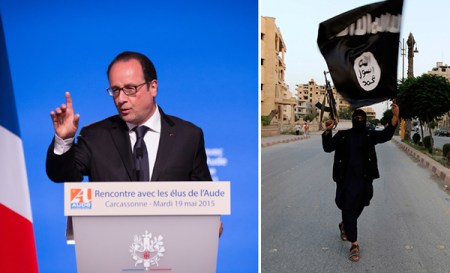
1348After the January 2015 jihadist attacks in Paris, France’s President François Hollande declared: “We must reject facile thinking and eschew exaggeration. Those who committed these terrorist acts, those terrorists, those fanatics, have nothing to do with the Muslim religion.”

France is home to around 6.5 million Muslims, or roughly 10% of the country’s total population of 66 million. Although most Muslims in France live peacefully, many are drawn to radical Islam. A CSA poll found that 22% of Muslims in the country consider themselves Muslim first and French second. Nearly one out of five (17%) Muslims in France believe that Sharia law should be fully applied in France, while 37% believe that parts of Sharia should be applied in the country.

France is also one of the largest European sources of so-called foreign fighters in Syria: More than 1,500 French Muslims have joined the Islamic State in Iraq and Syria, and many more are believed to be supporters of the group in France.

Since the Charlie Hebdo attacks, the French government has introduced a raft of new counter-terrorism measures — including sweeping surveillance powers to eavesdrop on the public — aimed at preventing further jihadist attacks.

French counter-terrorism operatives have foiled a number of jihadist plots, including a plan to attack a major navy base in Toulon, and an attempt to murder a Socialist MP in Paris.

As the latest attacks in Paris (as well as the failed attack on a high-speed train from Amsterdam to Paris in August) show, surveillance is not foolproof. Claude Moniquet, a former French intelligence operative, warns that European intelligence agencies are overwhelmed by the sheer number of people who may pose a threat. He writes:

“Some 6,000 Europeans are or were involved in the fighting in Syria (they went there, they were killed in action, they are still in IS camps, they are on their way there or their way back.)

“If you have 6,000 ‘active’ jihadists, this probably means that if you try to count those who were not identified, the logistics people who help them join up, their sympathizers and the most radical extremists who are not yet involved in violence but are on the verge of it, you have something between 10,000 and 20,000 ‘dangerous’ people in Europe.

“To carry out ‘normal’ surveillance on a suspect on a permanent basis, you need 20 to 30 agents and a dozen vehicles. And these are just the requirements for a ‘quiet’ target.

“If the suspect travels abroad, for instance, the figure could go up to 50 or 80 agents and necessitate co-operation between the services of various countries. Work it out: to keep watch on all the potential suspects, you’d need between 120,000 and 500,000 agents throughout Europe. Mission impossible!”

Meanwhile, French leaders consistently act in ways that undermine their stated goal of eradicating Islamic terror.

The French government has been one of the leading European proponents of the nuclear deal with Iran, the world’s biggest state sponsor of terrorism. Although Iran and its proxy, Hezbollah, are responsible for deaths of scores of French citizens, Fabius wasted no time in rushing to Tehran in search of business opportunities for French companies. In July, Fabius proclaimed:

“We are two great independent countries, two great civilizations. It is true that in recent years, for reasons that everyone knows, links have loosened, but now thanks to the nuclear deal, things are going to change.”

Fabius also extended an invitation for Iran’s President, Hassan Rouhani, to visit France in November. This trip — which has been mired in controversy, not over terrorism or nuclear proliferation, but over Iran’s demand that no wine be served during a formal dinner at the Élysée Palace — was postponed indefinitely after the Paris attacks. Hollande’s advisors apparently concluded that this is not the right moment for a photo-op with Rouhani, a career terrorist.

French leaders have also been consistently antagonistic toward Israel, a country facing Islamic terror on a daily basis.

After Israel launched a military offensive aimed at stopping Islamic terror groups in the Gaza Strip from launching missiles into the Jewish state, France led international calls for Israel to halt the operation. French Defense Minister Jean-Yves Le Drian said:

“France calls for an immediate ceasefire… to ensure that every side starts talking to each other to avoid an escalation that would be tragic for this part of the world.”

More recently, France has been a leading European advocate of a European Union policy that now requires Israel to label products “originating in Israeli settlements beyond Israel’s 1967 borders.” The move is widely seen as part of an international campaign to delegitimize the State of Israel. Israeli Prime Minister Benjamin Netanyahu slammed the move:

“The labelling of products of the Jewish state by the European Union brings back dark memories. Europe should be ashamed of itself. It took an immoral decision… this will not advance peace, it will certainly not advance truth and justice. It is wrong.”

France is also leading international diplomatic efforts to push for a United Nations resolution that would lead to the establishment of an independent Palestinian state within a period of two years. The move effectively whitewashes Palestinian terror. Netanyahu responded:

“The only way to reach an agreement is through bilateral negotiations, and we will forcibly reject any attempts to force upon us international dictates.

“In the international proposals that have been suggested to us — which they are actually trying to force upon us — there is no real reference to Israel’s security needs or our other national interests.

“They are simply trying to push us into indefensible borders while completely ignoring what will happen on the other side of the border.”

Meanwhile, after more than a year as a member of the US-led coalition against the Islamic State, French officials waited until late September to begin striking targets in Syria. But they refused to destroy the headquarters of the Islamic State in Raqqa — where the Paris attacks were reportedly planned.

Back in France, critics of Islam are routinely harassed with strategic lawsuits that seek to censor, intimidate and silence them.

In a recent case, Sébastien Jallamion, a 43-year-old policeman from Lyon, was suspended from his job and fined 5,000 euros after he condemned the death of Frenchman Hervé Gourdel, who was beheaded by jihadists in Algeria in September 2014. Jallamion explained:

“According to the administrative decree that was sent to me today, I am accused of having created an anonymous Facebook page in September 2014, showing several ‘provocative’ images and commentaries, ‘discriminatory and injurious,’ of a ‘xenophobic or anti-Muslim’ nature. As an example, there was that portrait of the Calif al-Baghdadi, head of the Islamic State, with a visor on his forehead. This publication was exhibited during my appearance before the discipline committee with the following accusation: ‘Are you not ashamed of stigmatizing an imam in this way?’ My lawyer can confirm this… It looks like a political punishment. I cannot see any other explanation.

“Our fundamental values, those for which many of our ancestors gave their life are deteriorating, and that it is time for us to become indignant over what our country is turning into. This is not France, land of Enlightenment that in its day shone over all of Europe and beyond. We must fight to preserve our values, it’s a matter of survival.”

Meanwhile, Marine Le Pen, the leader of France’s Front National (FN) and one of the most popular politicians in the country, went on trial in October 2015 for comparing Muslim street prayers to the wartime occupation of France. At a campaign rally in Lyon in 2010, she said:

“I’m sorry, but for those who really like to talk about World War II, if we’re talking about an occupation, we could talk about the [street prayers], because that is clearly an occupation of territory.

“It is an occupation of sections of the territory, of neighborhoods in which religious law applies — it is an occupation. There are no tanks, there are no soldiers, but it is an occupation nevertheless, and it weighs on people.”

Le Pen said she was a victim of “judicial persecution” and added:

“It is a scandal that a political leader can be sued for expressing her beliefs. Those who denounce the illegal behavior of fundamentalists are more likely to be sued than the fundamentalists who behave illegally.”

Responding to the jihadist attacks in Paris, Le Pen said:

“France and the French are no longer safe. It is my duty to tell you. Urgent action is needed.

“France must finally identify her allies and her enemies. Her enemies are those countries that have friendly relationships with radical Islam, and also those countries that have an ambiguous attitude toward terrorist enterprises.

“Regardless of what the European Union says, it is essential that France regain permanent control over its borders.

“France has been rendered vulnerable; it must rearm, because for too long it has undergone a programmed collapse of its defensive capabilities in the face of predictable and growing threats. It must restore its military resources, police, gendarmerie, intelligence and customs. The State must be able to ensure again its vital mission of protecting the French.

“Finally, Islamist fundamentalism must be annihilated. France must ban Islamist organizations, close radical mosques and expel foreigners who preach hatred in our country as well as illegal migrants who have nothing to do here. As for dual nationals who are participating in these Islamist movements, they must be stripped of their French nationality and deported.”

In the aftermath of the attacks, Le Pen, who has long been critical of President Hollande’s politically correct counter-terrorism policies, is certain to rise in public opinion polls. This will increase the political pressure on the government to take decisive action against the jihadists.

Faced with similar pressure after the Charlie Hebdo attacks in January, Hollande seemed reluctant to push too far, apparently fearful of the consequences of confronting the Muslim community in France. It remains to be seen whether the latest attacks in Paris, which some are describing as France’s September 11, mark a turning point.

Al-Baghdadi ordered attack on anti-ISIS coalition

November 16, 2015

Al-Baghdadi ordered attack on anti-ISIS coalition, Iraq warned France 1 day before Paris carnage

Published time: 16 Nov, 2015 13:24

Source: Al-Baghdadi ordered attack on anti-ISIS coalition, Iraq warned France 1 day before Paris carnage — RT News


Bullet impacts are seen in the window of a restaurant window the day after a series of deadly attacks in Paris , November 14, 2015. © Pascal Rossignol
A dispatch sent by Iraqi officials and obtained by AP shows that Baghdad warned members of the US-led coalition battling ISIS of imminent attacks by the group just one day before the Paris terror attacks killed 129 people and wounded 352 others.

Iraqi intelligence sent a dispatch saying that Islamic State (formerly ISIS/ISIL) leader Abu Bakr al-Baghdadi had ordered an attack on coalition countries fighting against the group in Iraq and Syria, as well as on Iran and Russia, through bombings or other attacks, according to the message.

“We have recovered information from our direct sources in the Islamic State terrorist organization about the orders issued by terrorist ‘Abu Bakr al-Baghdadi’ directing all members of the organization to implement an international attack that includes all coalition countries, in addition to Iran and the Russian Federation, through bombings or assassinations or hostage taking in the coming days. We do not have information on the date and place for implementing these terrorist operations at this time,” the dispatch read.

Speaking anonymously to AP, six senior Iraqi officials confirmed the information in the message, and four of those officials said they specifically warned France of a possible attack. Two officials told AP that France was warned beforehand of further details that the country’s authorities have not made public.

The officials said the Paris attacks appear to have been planned in Raqqa, Syria – ISIS’s de-facto capital – where the attackers planned specifically for the operation. After their training, the attackers traveled to France where they met with members of a sleeper cell who helped them carry out the deadly attacks. A total of 24 people were reportedly involved in the operation: 19 attackers and five others in charge of planning and logistics.

Iraqi Foreign Minister Ibrahim al-Jaafari also told journalists on Sunday that Iraqi intelligence agencies had obtained information that some countries, including France, the US, and Iran, would be targeted, and had shared intelligence with those countries.

But a French security official told AP that Paris receives such communication “all the time” and “every day.” He added that the head of French counterintelligence goes to bed every night asking, “Why not today?”

The French president’s office did not comment to the news agency.

Meanwhile, a senior US official said he was not aware of any threat information sent to Western governments that was specific enough to have protected against the Paris attacks. He said, however, that Western governments have expressed concern for months about ISIS-inspired attacks by militants who fought in Syria.

Baghdad has been sharing intelligence with coalition nations since they launched their airstrike campaign against ISIS last year. The US-led coalition is operating in Iraq and Syria, providing aerial support to allied ground forces in both countries, as well as arming and training Iraqi forces.

ISIS claimed responsibility Saturday for the Paris attacks, which included gun and bomb attacks on a stadium, a concert hall and cafes. Seven of the attackers blew themselves up, and French authorities have been searching for accomplices.

The assaults come 10 months after Islamic extremists attacked the offices of satirical newspaper Charlie Hebdo and a Jewish supermarket in Paris. France’s prime minister cited “failings” in intelligence at the time.

France’s President Lied, Frenchmen Died

November 16, 2015

France’s President Lied, Frenchmen Died It’s time to tell the truth about the migrant crisis.

November 16, 2015

Daniel Greenfield

Source: France’s President Lied, Frenchmen Died | Frontpage Mag

Last month, French President Francois Hollande ridiculed the idea that the massive numbers of Muslim migrants entering his country were any kind of threat.

“Those who argue that we are being invaded are manipulators and falsifiers, who do this only for political reasons, to scare,” the left-wing politician huffed.

And then the pudgy little Socialist had to be rapidly evacuated from France’s national soccer stadium after one of those refugees blew himself up trying to reach Monsieur le Président, and Merkel’s Foreign Minister, Frank-Walter Steinmeier.

Minister Steinmeier had urged rejecting “barriers, fences” when it came to the Muslim migrants, but it was a barrier and the security in front of it that kept one of his beloved refugees from reaching him.

The ordinary people who didn’t have and don’t have the security measures that protect Hollande and Steinemeier died in Paris, blown up and gunned down where they sat, lay and stood.

Before the man carrying a passport in the name of Ahmed Almohammad blew himself up at France’s national soccer stadium, he came on a boat from Turkey with hundreds of other refugees. He passed through Greece, Serbia and Croatia, along with countless other migrants, accompanied no doubt by journalists and human rights workers eager to document the plight of the “refugees”.

We may yet find him in the background of some news photo as the photographer focuses in for propaganda purposes on one of the few children among the horde of grim men of military age.

His passport may have been real. It may have been fake. No one was likely to notice. The name on his passport was not on an Interpol warrant. And so he was allowed into the heart of Europe.

In Greece, overburdened local authorities don’t care. New migrants are allowed to fill out their own paperwork and are handed letters of transit that allow them access to Europe. An employee at a local registration center was quoted as saying, “We just have to trust what they write down.”

In September, at a joint press conference with Secretary of State John Kerry, Foreign Minister Frank-Walter Steinmeier had called taking in migrants a “moral duty” and urged Americans to “increase the numbers you can take into your country”.

Now Germany is hunting for its own links to the Paris attacks. A few days earlier, Steinemeier had boasted that Germans were bending over backwards for the refugees and proving that, “Germany belongs not to the screamers and hatemongers.” But the man with all the guns and bombs in his car who has been taken into custody might disagree. So would the terror cells of Hamburg.

But don’t assume that Hollande or Steinmeier learned any lessons from the latest Muslim massacre.

In September, France’s President Hollande told the French that he had information that attacks against France had been planned from Syria and that planning for future air strikes against ISIS would begin.

In that same speech, he announced that France would be taking in 24,000 migrants.

Hollande knew ahead of time that this disaster was coming. He even prepared the response to it at the same time as he was welcoming some of the potential perpetrators into his country.

It wouldn’t be too surprising if he even had a speech pre-written and ready to go for just such an attack.

Even as Hollande was denouncing “manipulators and falsifiers” for trying to “scare” the French, he had a very good idea of just how much there was to be scared of.

The President of France had looked his nation in the eye and lied to them about the invasion.

Monsieur le Président probably didn’t expect to be this close to the killing when it happened. Neither did Foreign Minister Steinmeier. It’s the Jews and Poles in Marseille or the people in Calais who happen to be a little too close to the New Jungle camp that were meant to be the sacrifices of their compassion.

Unfortunately for Hollande and Steinmeier, the Islamic State didn’t get the memo. Unfortunately for us, their only real response to the crisis they caused will be to try to globalize it even further.

Back then Hollande and Merkel were demanding a “permanent mandatory system” for redistributing Muslim migrants across Europe. The G20 meeting features an alleged draft resolution calling it a global problem in an attempt to redistribute the migrants not just around Europe, but around the world.

Germany and France turned the Muslim migrant crisis into a European problem. Now they want to repeat the butchery in Paris around the world.

The man calling himself Ahmed Almohammad had been a hot potato that every country along the route was happy to pass on to the next. Greece, Croatia and Serbia just wanted the huge influx of invaders to move on. In Germany and France, the emphasis is not on security, but on resettlement.

No one is interested in security. And security is not a realistic option.

Greece doesn’t have the money, resources or infrastructure to screen the migrant horde. Frontex is undermanned and its employees, in European fashion, work until 4 PM, at which point the refugees just write whatever they want and get handed letters of transit by Greek officials that want them gone.

The Balkan countries are not any better equipped to manage the invasion than Greece. And the European countries that actually want the migrants aren’t interested in checking their papers, but in signing them up for as many social services as possible.

That’s not just true of Europe. It’s equally true of the United States.

Any talk of vetting is nothing more than plausible deniability. Unless a terrorist is already in our database, vetting him is a lost cause. Our system couldn’t handle the World Trade Center bombers or the 9/11 hijackers and they came from functioning countries that weren’t in the middle of a civil war.

We are not going to be able to vet tens of thousands of people who claim they come from Syria, who have fake passports or who plead that they lost their passports at sea, whose names can be rendered in enough ways to give even a linguist a headache and who will get access to the United States long enough for them to disappear even if we did eventually turn up something on them.

And we’re not supposed to vet them.

Despite the rhetoric, France and Germany are less interested in fighting ISIS than in getting the United States and the rest of the world to take more Muslim migrants. Instead of having ISIS in every city in Europe, they seem determined to make sure that it is in every city in the world instead.

ISIS may have carried out the brutal massacres in Paris, but Hollande, Merkel and the other friends of the refugees helped make it happen. And they want to help make it happen around the world.

The migrant crisis is an invasion. The bodies in Paris could just as easily have been stacked up in any country that was foolish and feckless enough to open the door to ISIS by taking in “refugees”.

If Obama and Kerry succeed in their plan to bring tens of thousands of Syrian migrants to America, the next brutal massacre might not happen in Paris. It might happen in one of our cities instead.

Hollande, Obama lack the troops and will for total war on ISIS. Mid East rulers are even more reluctant

November 16, 2015

Hollande, Obama lack the troops and will for total war on ISIS. Mid East rulers are even more reluctant, DEBKAfile, November 16, 2015

French_anti-terror_police_15.11.15French anti-terror police

When French President Francois Hollande declared war on ISIS and called the attack in Paris an “act of war,” he gave the terrorist organization’s leader Abu Bakr Al-Baghdadi an unexpected boost. He upgraded the Muslim caliphate to a fully-fledged state against which France is now at war. US President Barack Obama was more cautious, declaring at the G-20 summit in Antalya that his country and France would fight together against terror, without specifying how.

Obama has problems of his own. The attempt to portray the Kurdish conquest of the city of Sinjar in northern Iraq as an important achievement in the war against ISIS dissipated quickly after Peshmerga troops were shown on TV moving into a city that was empty and lying in ruins, after it was abandoned by Islamic State forces. There was no battle there either.

Also, the US and Kurdish claims that they had severed the main road link between the ISIS capitals in Iraq and Syria, Mosul and Raqqa, proved hollow as ISIS had stopped using that route months ago after it became vulnerable to American air strikes.

If that wasn’t enough, Obama ran into an obstacle in Antalya.

The summit’s host, Turkish President Tayyip Erdogan, who is consumed by an overriding aversion to an independent Kurdish state rising on his country’s border, demanded a declaration that all Kurdish forces, including the Peshmerga, the PKK and the YPG, on which the US depends heavily for fighting the war against ISIS, be classified as terrorists and targeted by the West just like ISIS.

Therefore, before broaching any decisions about intensifying the war on the Islamist terrorists, Western and Muslim countries were already at odds on targets.

It therefore makes no sense for President Hollande to try and invoke Article 5 of the NATO charter under which an act of war against one member of the alliance is tantamount to a war on all. Furthermore, making this a NATO operation would rule out a priori any collaboration with Russia in the campaign against ISIS, despite their common objective.  Vladimir Putin was already vexed over the feeble Western response to the bombing of a Russian airliner killing 224 people, compared to the global outcry over the Paris outrage.

In their responses and commentaries on what to do after the Paris assault, Western politicians and security experts seemed to agree that putting their own boots on the ground for finally getting to grips with ISIS was not on the cards – there would just be “more of the same,’ as one American security expert put it.

Others advised assigning the ground battle to the Egyptian, Jordanian, Kurdish, Iraqi, Saudi and other Gulf Arab states.

Who were they kidding? None of those Arab governments or armies is capable or willing to declare full-scale war on the Islamic State. The Kurds alone have stepped into the breach and are confronting the Islamists face to face, but they have sought in vain for the weapons they need, which the US refuses to supply.

Egypt, for instance, even after an ISIS network was able to breach its security system in Sharm El-Sheikh to plant a bomb on the Russian airliner on Oct. 31, has held back from a major military assault on the strongholds of the Ansar Beit Al-Maqdis, otherwise known as ISIS-Sinai. Egypt’s President Fattah Al-Sisi has not uttered a word on the Islamist threat since then.

French security and intelligence services demonstrated that they were unprepared for war on ISIS, and are pretty much in the same boat as other Western powers.

Since the outrage in Paris, French and Belgian security forces have conducted raid after raid to pick up Islamists, claiming to be rounding up the masterminds and confederates of the nine bombers and shooters who attacked Paris and murdered 132 people  In fact, they are acting more to calm a jittery public than in the expectation of achieving meaningful results in the war on terror. Till now, neither France nor any Western government knows exactly how many people were involved in the attack on Paris, or the numbers and locations of the Islamic Caliphate’s worldwide terror networks.

Op-Ed: PM Netanyahu urges France to ‘pursue peace’ and ‘practice restraint’

November 16, 2015

Op-Ed: PM Netanyahu urges France to ‘pursue peace’ and ‘practice restraint,’ Israel National News, David Wega, November 15, 2015

(I almost wish it weren’t satire. — DM)

Note: Except for the first two paragraphs, this is a satire.

Dear Citizens of France.

My heartfelt sympathies to you and the French people for the horrible and barbaric terrorist murder spree that left over a hundred of your compatriots dead and hundreds more wounded. .

That murderous terrorist rampage on Friday night is all too familiar to us. We have a deep understanding of how to deal with terrorism, and are more than ready to help you as we do all over the world when tragedies occur.

However, first we wish to share with you what we usually hear from the world in the aftermath of these “incidents” or “unrest” (I know you called it terrorism, but that is what the world calls it when it happens in Israel). Perhaps these pointers will help you cope and avoid future “incidents” – at least those who give us advice, including your heads of state, must think it will, or why would they give it?

As your government told us recently, the day following an “incident” in Israel, countries must “protect themselves from militants, but show restraint to not further fuel a highly sensitive situation in the region.”

With one’s friends there is no need to make peace. Peace is made between enemies, never mind if they don’t want it. There is no military solution to the problem of terrorism, and this is why you must seek a diplomatic solution.  End that cycle of violence. Show restraint.

You must understand the pain and needs of the angry Muslims shooting and setting off explosives, and not respond inappropriately so that there is no escalation of the cycle of violence.

You must negotiate even while under attack; conditioning negotiations on an end to violence is a no-win situation. It will simply extend the bloodshed.

The key is to build a New Europe, one that deals with reality on the ground.

To close your borders will only lead to further oppression and anger, so don’t do that.

If you strike at the perpetrators of the attack and their supporters, you will simply extend and enlarge the cycle of violence, so don’t do that.

Your bombs will no doubt injure some innocent children and civilians alongside any terrorist activists you strike, and that will simply make the victims seek revenge, so don’t retaliate at all.

Begin by declaring a unilateral ceasefire! Give peace a chance! Do not allow yourself to be drawn into the abyss of violence.  End that cycle of violence. Show restraint.

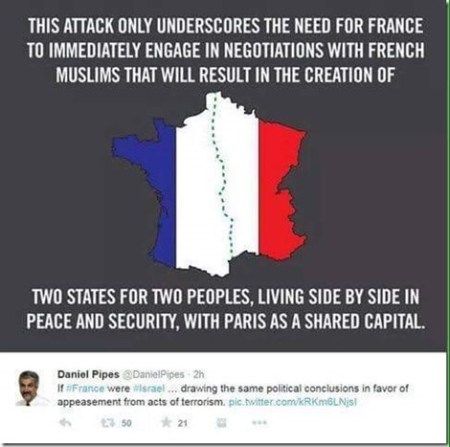
Best of all would be to divide France into two parts, and Paris into two cities for two peoples. No Frenchman dares go into a Muslim neighborhood in Paris and neither do the police anyway, so the city is already divided de facto. What’s the difference if it is your ancestral homeland?

See how Daniel Pipes has shown you the way to achieve tranquillity (that is, until the Muslims decide they want both states):

resizedimg84571.jpg


With sympathy,

 Israeli Prime Minister Benjamin Netanyahu

Report: France May Send Force to Fight ISIS on the Ground

November 15, 2015

A global intelligence service says that sending an expeditionary force is one of France’s options to try to defeat ISIS.

By: JNi.Media Published:

November 15th, 2015

Source: The Jewish Press » » Report: France May Send Force to Fight ISIS on the Ground

The picture shows the kepi blanc. the French Foreign Legion

French army soldiers soon may find themselves fighting ISIS terrorists.

French army soldiers soon may find themselves fighting ISIS terrorists.
Photo Credit: Archangel12 / https://www.flickr.com/photos/archangel12/

Stratfor, a global intelligence analysis service, issued a report Saturday contending France may send its “expeditionary force” to Syria to retaliate against ISIS.

The report, titled “After Paris, France Contemplates a Reckoning,” suggests the French response to the Paris attacks is markedly different from that of the Spanish Government following the March 2004 Madrid train bombings. Instead of pulling back from the global coalition working against radical Islamists, “it appears that the French will renew and perhaps expand their efforts to pursue revenge for the most recent assault.”

According to Stratfor, “France has numerous options for retaliation at its disposal.”

First, France has to establish that the attackers were, in fact, members of ISIS. Then:

France will likely ramp up its Syrian air operations. The skies over Syria, however, are already congested with coalition and Russian aircraft. With this in mind, the French may choose to retaliate by focusing instead on the Islamic State in Iraq, or perhaps even other Islamic State provinces in places such as Libya.

Another option would be to increase French programs to train and support anti-Islamic State forces in Iraq and Syria, or even to conduct commando strikes against key leadership nodes.

Finally, says the report, “France also has the option of deploying an expeditionary force like it did in the Sahel, although that would probably require outside airlift capacity from NATO allies, especially the United States.”

One area that is already undergoing a radical change is passage through Europe’s borders, which this weekend are being sealed by many EU members. Bavarian Prime Minister Horst Seehofer said the Paris attack showed border controls are more necessary than ever.

Seehofer, who is critical of the German government’s handling of the refugee crisis, demands permanent border controls and swift repatriation of asylum seekers. It doesn’t appear that Chancellor Angela Merkel will find many allies supporting her soft, pro-refugee stance in light of the Paris bombings.

The anti-Schengen camp, seeking to revoke the agreement making it possible for virtually every European citizen to go anywhere in Europe unheeded, received yet another vindication last week, according to Stratfor, when a Montenegro citizen was arrested on his way to Paris with a stack of weapons.

It isn’t clear whether he was on his way to joining the Friday attacks in Paris, but it’s possible—and frightening. And so the Paris attacks will raise the clout of anti-immigration parties across Europe, chipping away at the Schengen agreement. As of this weekend, France, Germany, Sweden, Slovenia and Hungary have already re-established strict border controls. It is expected that the remaining EU governments will follow suit this week.

Diplomacy: Looking for ways to douse the spark

October 23, 2015

Diplomacy: Looking for ways to douse the spark, Jerusalem PostHerb Keinon, October 23, 2015

(They “dance around in a ring and suppose, but the secret sits in the middle and knows,” with apologies to Robert Frost. — DM)

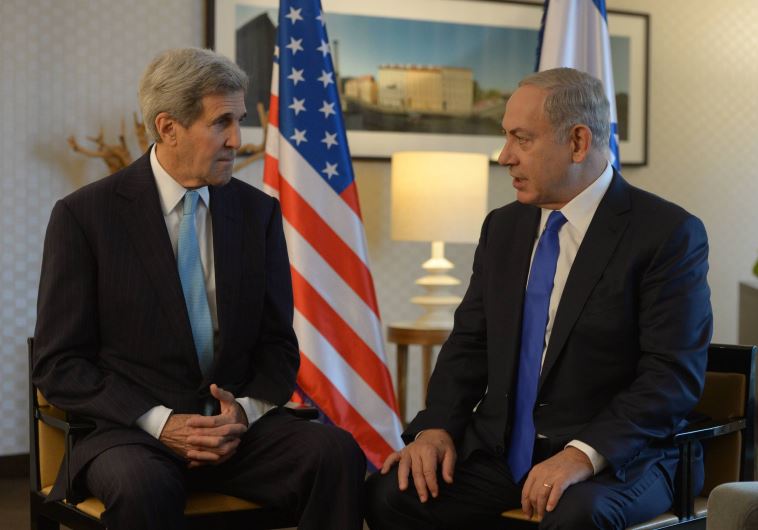
ShowImage (15)Netanyahu and Kerry meeting in Berlin. (photo credit:AMOS BEN-GERSHOM/GPO)

And now the diplomatic dance begins, again.

After three weeks of runaway terrorism on the streets, UN Secretary-General Ban Ki-moon arrived for a quick visit midweek; US Secretary of State John Kerry – after meeting with Prime Minister Benjamin Netanyahu on Thursday in Berlin – is expected to meet on Saturday with Palestinian Authority President Mahmoud Abbas in Amman, along with Jordan’s King Hussein; EU foreign policy chief Federica Mogherini is doing the same; and the French are floating various proposals to take to the UN Security Council.

All predictable, all the traditional steps taken in a time of Mideast crisis.

Ban did what Ban does in these situations – he comes, meets with both sides, issues platitudes about the need for both sides to show restraint, and declares how important it is to keep that light of hope burning.

The UN secretary-general dutifully fulfilled his role in the script. Netanyahu obliged by meeting politely with Ban, who then went on to meet politely with Abbas, to what appears to be absolutely no effect. It’s a dance whose steps – and way of ending – are known far in advance.

Jerusalem does not take Ban’s efforts overseriously, as the organization that he heads is seen as a big part of the problem rather than the solution.

Witness Wednesday’s one-sided resolution adopted by UNESCO, the UN’s cultural heritage agency, condemning “Israeli aggression” on the Temple Mount and declaring that the Jewish holy sites of Rachel’s Tomb and the Cave of the Patriarchs are an “integral part of Palestine.”

Similar disdain, to a certain extent, characterizes Israel’s view of the EU’s efforts. Netanyahu will listen to Mogherini, and lament both Abbas’s incitement and the EU’s acceptance of it, but will place little stock in the EU’s ability to play a constructive role in calming down the situation.

Brussels is not seen in Jerusalem as a particularly honest broker on all things Palestinian but, rather, as the institution that nurtures – perhaps more than any other – the hope among the Palestinians that if they press long enough and hard enough, the international community will deliver to them what they publicly say they want: a Palestinian state along the pre-1967 borders with east Jerusalem as its capital, and some kind of “fair and just” accommodation for the refugees.

The very skeptical Israeli view of the EU in any diplomatic process is reinforced by steps taken by France, which this week considered bringing a resolution to the UN Security Council to place international observers on the Temple Mount.

This idea, which Israel would never accept, and which even Jordan and the Palestinians have apparently rejected, is born of a burning French diplomatic desire to always do something, anything, in the Mideast – especially when there seems to be a stalemate or vacuum.

It is also the product of sour relations currently prevailing between Paris and Jerusalem, as well as a lingering French hope for the internationalization of Jerusalem – for the establishment of a corpus separatum in Jerusalem under a special international regime – which France hopes to be a part of.

So with the UN out, the EU out, and France out, that leaves the US.

But it is not as if Jerusalem is harboring any hopes that Kerry will be able to ride in and save the day.

From Jerusalem’s perspective the US track record in the region is not sterling, and though it appreciates Washington’s desire to help, there is little illusion that high-profile, high-level meetings will have any immediate effect on the ground.

And while Jerusalem is not waiting for Kerry with baited breath, it was clear from the beginning that he would get involved. An uptick in terrorism and violence leads to a well-worn pattern in Washington: condemnations of the terrorism, then statements that anger Israel about proportionality or settlements, followed by calls for restraint on both sides, and then meetings with the leaders.

But this current spurt of terrorism and violence is different from previous rounds, in that there is no identifiable organization – such as Hamas and Fatah’s Tanzim militia – to hold directly responsible for the bloodshed. This time it is more amorphous, individual terrorists incited by calls for Jewish blood on Facebook and from various leaders, going out to kill Jews.

The lack of a clear organizational structure behind the terrorism makes it more difficult for the security services to stop, because it is much more difficult to gather intelligence on an individual who grabs a knife and goes out to kill than on attacks directed by an organization.

Also, there is not one person seemingly in control who may be pressured to cease the violence.

It is not as if Kerry can talk to Abbas and convince him to issue a call to his people to “hold your horses,” and the horses will obediently be held. Abbas does not have anything near that type of control – many of the horses simply do not heed him.

This time around, thankfully, neither the State Department nor Kerry are inflating expectations; they are not talking about Kerry’s separate meeting with the leaders as a potential breakthrough for restarting the diplomatic talks and bringing a peace deal in a number of months.

Washington, it should be remembered, is still engaged in its own Mideast policy reassessment, a policy reassessment brought about after the breakdown of the Kerry-led peace talks in April 2014, and re-announced after Netanyahu’s preelection statement – which he later retracted – of less than full fealty to the notion of a two-state solution.

Rather, this time the bar has been set low, with the goals very limited.

State Department spokesman John Kirby said on Wednesday that the meetings would deal with “practical ways in which political breathing space can be had to help end the violence.”

No overreaching there, just looking for breathing space. The breathing space that Kirby mentioned but did not elaborate upon is likely to be an attempt – in discussions with Netanyahu, Abbas and especially Jordan’s King Abdullah – to come up with a clear set of procedures for governing the Temple Mount.

The Temple Mount has – like so many times over the last century – been the spark to violence against Jews. To douse the fire, there will be some need to deal with the spark, but this has to be done in a way where both Israel and the Palestinians can say that they have not given in.

In recent days Kerry has spoken about the need for clarity. Everyone talks about the status quo on the Temple Mount, but there is little understanding of what that entails.

“Israel understands the importance of the status quo and… our objective is to make sure that everyone understands what that means,” Kerry said at press conference on Monday in Madrid, adding that “we are not seeking a new change or outsiders to come in; I don’t think Israel or Jordan wants that, and we’re not proposing it. What we need is clarity.”

The new “clarity” is expected to involve enhanced coordination and cooperation with Jordan, possibly even more Jordanian representatives on the site, in such a way as to undercut the spurious charge that Israel is somehow threatening al-Aksa Mosque.

Former National Security Council head Yaakov Amidror said in an Israel Radio interview this week that he had little expectation regarding Kerry’s meeting with Netanyahu or Abbas, because the US has little impact on the Palestinians – which is true.

But the US does have leverage on Jordan, and this leverage may now be needed to get Abdullah to take a greater role in day-to- day administration and involvement at the site – if only as a way to suck the oxygen out of the lie propelling the current round of terrorism: that Israel is endangering al-Aksa.