Posted tagged ‘Foreign Policy’

France, Iran and the “Peace Process”

June 10, 2015

France, Iran and the “Peace Process,” The Gatestone InstituteShoshana Bryen, June 10, 2015

  • The French draft corresponds with President Obama’s own — strongly held — belief that Israel has to ascribe to the President’s view, despite just having elected a Prime Minster who disagrees.
  • The air is poisoned. The CEO of the French cell phone company Orange declared his desire to boycott Israel, while Orange rakes in money from its operation in the Republic of Congo, a major human rights violator.
  • Smash the two stories together and you get an American President supporting France in its efforts to be a major player in the Middle East in exchange for French support for the P5+1 deal with Iran.

Sometimes, if you smash two stories together, you end up with something interesting; sometimes you get something worrisome. This is one of the latter.

The first story is about France, a member of the P5+1 negotiating a deal with Iran on nuclear capabilities. The French government has expressed increasing concern that the emerging deal is flawed — perhaps fatally. Foreign Minister Laurent Fabius reportedly told the French Parliament, “France will not accept [a deal] if it is not clear that inspections can be done at all Iranian installations, including military sites.” He added, “Yes to an agreement, but not to an agreement that will enable Iran to have the atomic bomb. That is the position of France, which is independent and peaceful.”

The French Ambassador to the United States, Gerard Araud, told an American audience “the most worrying aspect of the agreement” is that Iran will become a “one-year breakout state.” He expressed concern that if Iran becomes a nuclear state, other countries in the region will also seek to become nuclear powers.

The French position creates a problem for President Obama because the deal has to be agreed on by the P5+1, not the “P4+1-with-one-vote-in-opposition.”

1101 (1)Is President Obama supporting France in its efforts to be a major player in the Middle East, in exchange for French support for the P5+1 deal with Iran? Above, Secretary of State John Kerry (left) is pictured meeting French Foreign Minister Laurent Fabius, on February 27, 2013. (Image source: U.S. State Dept.)

The second story is also about France. With historic ties to the Middle East, but extremely limited military capabilities there (or anywhere), France is trying to be a diplomatic power broker. Christian Makarian, deputy editor of L’Express, wrote recently that after Assad used chemical weapons against his people, France wanted to intervene in Syria but was dissuaded by President Obama. “Hollande and… Fabius frequently made reference to last year’s backtracking on military intervention in Syria, which they consider one of their greater policy failings.” This, he postulates, accounts for French willingness to support military action in Iraq.

Influence can come from arms sales, and here the French excel. From 2005-2010, France was the third largest supplier of arms to the Middle East/North Africa (MENA) region, after the U.S. and Russia. MENA now accounts for nearly half the orders from the French military. Saudi Arabia, Morocco, UAE, Qatar, Oman, Tunisia and Algeria are clients, and this year, 5.2 billion euros in orders from Egypt. It amounts to a 17.3 percent increase in total arms sales abroad for 2014 over 2013.

Influence also comes from diplomacy — and this is where the stories begin to collide.

France, Britain and Germany had drafted a UN Security Council Resolution late last year to set parameters for establishing a Palestinian State and “ending the conflict.” It was not submitted because of the impending Israeli election. France is prepared to try now with a draft that would “solve” the problem by using the 1949 Armistice Line as a reference point for a Palestinian state with a shared capital in Jerusalem, a “fair” solution for refugees, and possible land swaps. It would also require that the Palestinians recognize Israel as a “Jewish State.”

Fabius, speaking in New York, said, “these parameters have to be defined and recognized by the Security Council and that obviously the two parties have to discuss, but the discussion will be accompanied by an international effort.”

A French official called it a “backdoor” for negotiations, explaining in a press report that “all actors including the Americans now realize that all other ways have been explored, without success.”

The U.S. has historically opposed “internationalizing” the conflict. Giving the UN authority to establish requirements for the parties violates the Oslo Accords, something Israel opposes and the Palestinians support.

In early May, President Obama indicated that he intended to veto the French proposal, saying “a big overarching deal” is probably not “possible in the next year, given the makeup of the Netanyahu government, given the challenges I think that exist for President Abbas.” In the same interview, he suggested “confidence-building measures” that would have an impact on the economic and social lives of Palestinians and Israelis.

However, the President appears to have moved toward the French position. He recently told Israeli television:

If in fact, there’s no prospect of an actual peace process, if nobody believes there’s a peace process, then it becomes more difficult to argue with those who are concerned about settlement construction, those who are concerned about the current situation, it’s more difficult for me to say to them, ‘Be patient. Wait, because we have a process here.'”

His own expressed skepticism about the achievability of an Israeli-Palestinian agreement appears to have given way to the French notion that “all other ways have been explored,” and that it is time to let the UN determine parameters for a “big overarching deal.” And, as it happens, the French draft corresponds with the President Obama’s own — strongly held — belief that Israel has to ascribe to the President’s view, despite having just elected a Prime Minister who disagrees:

The most important thing, I think, that we can do right now in strengthening Israel’s position is to describe very clearly why I have believed that a two-state solution is the best security plan for Israel over the long term… but also, at the end of the day, to say to any Israeli prime minister that it will require some risks in order to achieve peace.

The “risks” sound ominously like Secretary of State Kerry’s 2013 “warning” that Israel might face a “third intifada” if it didn’t toe the then-American, now-French line. “I mean does Israel want a third Intifada?” he asked. “I’ve got news for you. Today’s status quo will not be tomorrow’s.”

In Washington this week, Ambassador Araud used extraordinarily tough language against Israel in a series of Twitter exchanges with American supporters of Israel, culminating in the “blocking” of one of them. Silly kids’ stuff, but the air is poisoned. The CEO of the French cell phone company Orange declared his desire to boycott Israel, while Orange rakes in money from its operation in the Democratic Republic of Congo, a major human rights violator.

Smash the two stories together, you get an American president supporting France in its efforts to be a major player in the Middle East in exchange for French support of the P5+1 deal with Iran.

In both cases, guess who pays the price: Israel.

US finds peeling back the Iran sanctions onion no easy task

June 10, 2015

US finds peeling back the Iran sanctions onion no easy task, Israel Hayom, June 10, 2915

(For Obama, principles are as flexible as words.

Humpty words

— DM)

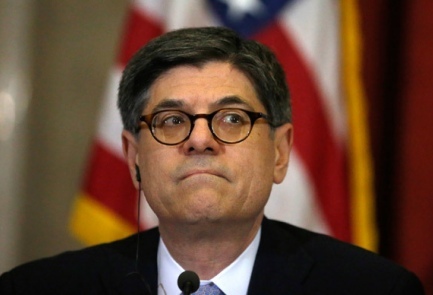
143393177342310791a_bU.S. Treasury Secretary Jacob Lew | Photo credit: Reuters

Under the sanctions developed over decades, hundreds of companies and individuals have been penalized not only for their roles in the country’s nuclear program but also for ballistic missile research, terrorism, human rights violations and money laundering.

Officials say the administration can meet its obligations because of how it interprets nuclear sanctions.

For example, they say measures designed to stop Iran from acquiring ballistic missiles are nuclear-related because they were imposed to push Iran into the negotiations. Also, they say sanctions that may appear non-nuclear are often undergirded by previous actions conceived as efforts to stop Iran’s nuclear program.

***********************

The Obama administration may have to backtrack on its promise that it will suspend only nuclear-related economic sanctions on Iran as part of an emerging nuclear agreement, officials and others involved in the process told The Associated Press Tuesday.

The problem derives from what was once a strong point of the broad U.S. sanctions effort that many credit with bringing Iran to the negotiating table in the first place.

Administration officials vehemently reject that any backtracking is taking place, but they are lumping sanctions together, differently from the way members of Congress and critics of the negotiations separate them.

Under the sanctions developed over decades, hundreds of companies and individuals have been penalized not only for their roles in the country’s nuclear program but also for ballistic missile research, terrorism, human rights violations and money laundering.

Now the administration is wending its way through that briar patch of interwoven economic sanctions.

The penalties are significant. Sanctioned foreign governments, companies or individuals are generally barred from doing business with U.S. citizens and businesses, or with foreign entities operating in the American financial system. The restrictions are usually accompanied by asset and property freezes as well as visa bans.

Negotiators hope to conclude a final nuclear deal by June 30. According to a framework reached in April, the U.S. will be required to lift sanctions that are related to Iran’s nuclear program but could leave others in place. President Barack Obama can suspend almost all U.S. measures against Iran, though only Congress can revoke them permanently.

“Iran knows that our array of sanctions focused on its efforts to support terrorism and destabilize the region will continue after any nuclear agreement,” Treasury Secretary Jack Lew told a gathering of American Jews in a weekend speech. U.S. officials will “aggressively target the finances of Iranian-backed terrorist groups and the Iranian entities that support them,” he said, including the Lebanese militant group Hezbollah and Iran’s Quds Force.

The Treasury Department’s sanctions point man, Adam Szubin, has been tasked with sorting out the mess, according to U.S. officials, though no clear plan has yet been finalized.

Officials say the administration can meet its obligations because of how it interprets nuclear sanctions.

For example, they say measures designed to stop Iran from acquiring ballistic missiles are nuclear-related because they were imposed to push Iran into the negotiations. Also, they say sanctions that may appear non-nuclear are often undergirded by previous actions conceived as efforts to stop Iran’s nuclear program.

The officials who provided information for this story spoke only on condition of anonymity because they were not authorized to speak publicly on the private discussions.

After years of negotiations, U.S. officials believe a deal is within reach that for a decade would keep Iran at least a year from being able to build a nuclear weapon.

In return, the U.S. would grant billions of dollars in relief from sanctions that have crippled Iran’s economy. But the whole package risks unraveling if the U.S. cannot provide the relief without scrapping sanctions unrelated to Iran’s nuclear program.

Administration officials say they are examining a range of options that include suspending both nuclear and some non-nuclear sanctions, a step that would face substantial opposition in Congress and elsewhere. Under one scenario, the U.S. could end non-nuclear restrictions on some entities, then slap them back on for another reason. But Iran could then plausibly accuse the U.S. of cheating on its commitments.

U.S. President Barack Obama has spoken about Iran potentially recouping up to $150 billion in assets trapped overseas. The process for how that would take place is still being worked through, said officials.

The Iranian Central Bank may prove the most glaring example of the administration’s dilemma, and officials acknowledge there is no way to give Iran the sanctions relief justified by its compliance without significantly easing restrictions on the institution.

The bank underpins Iran’s entire economy, and for years the U.S. avoided hitting it with sanctions, fearing such action would spread financial instability and raise oil prices. By late 2011, with Iran’s nuclear program advancing rapidly, Obama and Congress did order penalties, declaring the bank a “primary money laundering concern” and linking its activity to ballistic missile research, terror financing and support for Syrian President Bashar Assad.

The effects were far-reaching: Petroleum exports fell by 60%, Iran suffered runaway inflation, cash reserves dried up and industrial output in several sectors plummeted. And Iran agreed to talk about its nuclear program with the United States and five other world powers.

Now that the nuclear agreement is so close, Iran wants these sanctions lifted. The administration officials say all sanctions on the bank are nuclear-related.

Lew told the Jewish conference in New York that a nuclear accord would include the suspension of all “secondary” oil, trade and banking restrictions — those that apply to U.S. and non-U.S. banks, as well as foreign governments.

Many of these measures overlap with American sanctions tied to Iran’s nuclear program, and that has officials considering new sanctions to keep certain Iranian institutions under pressure.

Eliminating the secondary sanctions across the board could have wide-ranging implications, making it easier for Iran’s Revolutionary Guard Corps and its police, intelligence services and paramilitary groups to do business.

That possibility has Iran’s rivals in the region, including Israel and the Sunni monarchies of the Middle East, gravely worried.

“I share their concern,” Gen. Martin Dempsey, the Joint Chiefs of Staff chairman, said Tuesday in Jerusalem.

“If the deal is reached and results in sanctions relief, which results in more economic power and more purchasing power for the Iranian regime, it’s my expectation that it’s not all going to flow into the economy to improve the lot of the average Iranian citizen,” he said.

“I think they will invest in their surrogates. I think they will invest in additional military capability.”

Iran’s Revolutionary Guard is under U.S. sanctions because of its proliferation of weapons of mass destruction. But because the U.S. views the corps as so pernicious, the administration is considering new measures to help block it from meddling in the internal conflicts of Iraq, Lebanon, Syria and Yemen.

Of the 24 Iranian banks currently under U.S. sanctions, only one — Bank Saderat, cited for terrorism links — is subject to clear non-nuclear sanctions. The rest are designated because of nuclear and ballistic missile-related financing, while several are believed to be controlled by the Revolutionary Guard.

Will they be cleared for business with the world? U.S. officials still cannot say one way or another. Congress, too, has not received a list of banks and institutions that would be released from sanctions under the deal.

If the United States cannot deliver on its promises, it could take the blame for a collapse of the years-long negotiations toward a nuclear deal, putting the world — in the words of Obama and other U.S. officials — on a path toward military confrontation. At the same time, an Iran unburdened by sanctions could redouble efforts toward nuclear weapons capacity, while international unity and the global sanctions architecture on Tehran fray.

Turkey’s View of Israel

June 9, 2015

Turkey’s View of Israel, The Gatestone InstituteUzay Bulut, June 9, 2015

  • The media’s unethical coverage of the Israel/Palestine conflict seems to be the number one reason why people in Turkey have remained so misinformed and brainwashed about the issue. It is not just anti-Semitism, but also anti-Zionism, that is racist and hateful.
  • The houses and apartments Israelis built in their historic homeland are called “illegal settlements.” But there were no “settlements” before 1967. What, then were the Israelis supposedly “occupying” between 1948 and 1967? Why was the Palestine Liberation Organization (PLO) even then trying to destroy Israel? What did it think it was “liberating”?
  • This “occupation” myth seems, instead, to have a lot to do with the “Islamization” of history and geography. Since the creation of the world, it goes, there has been only one religion: Islam. All our religious teachers have taught us that earlier historical figures were prophets — Isa [Jesus], Musa [Moses], Davut [David] and so on — were Muslims and that the original religions they brought were Islamic. These prophets, we are told, preached the teachings of Allah, but their followers, who came later, distorted their messages, changed the writings in their holy books, and fabricated these fake, untrue religions called Judaism and Christianity. Then Islam came as the last, the perfect and the only true and unchanged eternal word of Allah, which led to Muhammad to this world as a “liberator.”
  • If someone says, “there is a place related to King David and it is a Jewish place,” then a Muslim would say, “Yes, but David was also a Muslim. So this place actually belongs to Muslims.” There is never Islamic invasion; there is only Islamic liberation. If these people truly cared about Palestinian Arabs, they would do their best to stop the incitement and help to achieve a sustainable peace where both Arabs and Jews would be safe.

A large number of the citizens of Turkey, a NATO member, see Israel and the United States as enemies.

A survey conducted recently in Turkey found that nearly half the country’s citizens (42.6%) see Israel as the biggest security threat, followed by the United States (35.5%), and only then Syria (22.1%).

How do they visualize Israel, a country with which they have made several military and trade agreements, as being a security threat? Do they think Israel would ever invade Turkey? Bomb Turkey? Nuke Turkey? This view seems to be based on either religion-induced paranoia caused by Islamic anti-Semitism, or else their understanding of reality has been distorted Nazi-style by Turkish leaders and the media.

The problem is that the false myth of Israel’s being an “occupier” and “troublemaker” has been indoctrinated into the minds of most Turkish children from their early years. Almost all of us — including myself — grew up with an extreme prejudice against Israel. The media’s unethical coverage of the Israel/Palestine conflict — including both the Islamist and Kemalist (secular nationalist) media — seems to be the number one reason why people in Turkey have remained so misinformed and brainwashed about the issue.

Only the intensity of the prejudice changes according to what newspaper or TV channel you follow or what family raises you. Islamic anti-Semitism, even if we might not be aware of it, has a lot to do with this kind of upbringing.

A short scanning of Turkish newspapers and TV channels would also clearly show their continual hateful propaganda against Israel.

No other state or organization has been demonized and delegitimized by the Turkish media to this extent.

Unfortunately, even the media that calls itself “progressive” has bought and reproduced the propaganda that Israel is the “invader” and the “oppressor.” One of their most popular slogans is, “We are not anti-Semitic, but just anti-Zionist.”

Zionism defends the concept that Jews — like any other people — have human rights, and are entitled to live their original Biblical homeland. Although forced out of their land many times, as by the Babylonians or the Romans, they never entirely left it.

If the demand of Jews for equality and independence disturbs anyone, it is due to his own racism — in whatever name he is trying to dress it up — and not to anything the Jews might have allegedly done. It is not just anti-Semitism, but also anti-Zionism, that is racist and hateful.

Every person who comes up with the genius idea of “not being anti-Semitic but just being anti-Zionist” should also offer their idea of what kind of a Jewish state they would like to see or whether they would like to see a Jewish state at all. If it is the political system of Israel they oppose, then they should clarify how their own alternative system would be better than the current one, and what they would do to convince Hamas and the Palestinian Authority to achieve peaceful coexistence with Israel.

They should also clarify why they are so obsessed with Israel, which has the most democratic political system in the Middle East, while autocratic, theocratic, despotic regimes abound in the region.

They might also please explain what makes the non-existent, imaginary “democratic Palestine” preferable to already existing, thriving and democratic Israel.

Mahmoud Abbas’s Fatah is essentially no better than Hamas; just sometimes less violent. The Palestinian Authority (PA), as stated in its charter and “phased plans,” says it prefers to displace Israel diplomatically, through the dictator-controlled United Nations and European governments, and economically through boycotts and sanctions, rather than with missiles.

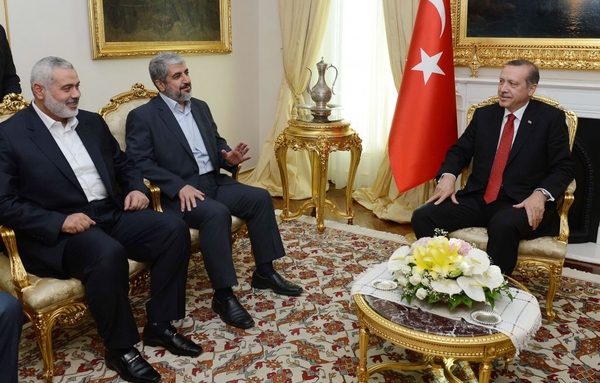
826Turkish President (then Prime Minister) Recep Tayyip Erdogan, right, meeting with Hamas leaders Khaled Mashaal (center) and Ismail Haniyeh on June 18, 2013, in Ankara, Turkey. (Image source: Turkey Prime Minister’s Press Office)

Now that so many Jews are all in one place, the progressives can pretend to themselves that it is “just Israel,” and not “the Jews,” who are the target of their hate. As the former Iranian president Akbar Hashemi Rafsanjani said, Israel, only slightly bigger than the city of Beijing, is a “one-bomb country.”

The progressive media’s representation of Israel as an “occupier” only caters to the genocidal desires of these anti-humanitarian regimes or groups. They never point to Turkey’s occupation of northern Cyprus, China’s occupation of Tibet, or Pakistan’s occupation of Kashmir — not to mention Russia’s recent flamboyant occupations.

For the past 2000 years, Jews have been exposed to unending persecution accompanied by expulsions, forced conversions, mob attacks, pogroms, property confiscations, massacres, and the 1938-45 Holocaust. Attacks against Jews in Europe continue today.

After Jews were forced from their Biblical home into the Diaspora, their lives were painful for centuries. When they were in exile in Europe, they were disposable. Now that they are back home in Israel, they are “occupiers;” again not wanted.

Under Nazi rule, Jews were “illegal,” slaughtered wholesale, tortured with fake “medical experiments” and not even considered fully human.

To end their history of 2000 years of suffering and to finally be free, Jews have returned to their home, Israel.

They have brought their light back to the land and presented gifts to the Middle Eastern peoples that no other nation there has experienced: democracy, tolerance, freedom of speech, human rights — as well as countless medical and technological innovations. This tiny country has produced some of the most brilliant minds in history, and has become the second most educated nation on earth.

What they have done is to build a truly open and productive society on sand dunes and deserts, where even the Muslim citizens, who make up 20% of Israel’s population, have the freedom to say the most horrendous things about anyone they wish, including the prime minister — and they do. In short, even the Muslims in Israel enjoy privileges that in any other country in the region would get them incarcerated.

Israel’s neighbors, however, have not shown much appreciation for these admirable traits — only more jealousy and hatred.

As thanks for the endless good the Israelis bring the region and the world, they are vilified by the anti-Semitic, anti-Zionist, Jew-hating, politically-driven blocs in the Arab countries, Turkey, Europe and the UN, which clearly want to destroy them, on one pretext or another.

The houses and apartments Israelis build in their historic homeland are called “illegal settlements.” But there were no “settlements” before 1967. What, then, were the Israelis supposedly “occupying” between 1948 and 1967? Why was the Palestine Liberation Organization (PLO) even then trying to destroy Israel? What did it think it was “liberating”?

This “occupation” myth seems, instead, to have a lot to do with the “Islamization” of history and geography.

According to Islamic ideology, all history is actually Islamic history and most of the major historical figures were actually Muslims. Islam does not recognize other religions as either genuine or original.

Since the creation of the world, it goes, there has been only one religion: Islam. Others are irrelevant, fabricated by those who came later but went astray. All our religion teachers have taught us that the earlier prophets — Issa [Jesus], Musa [Moses], Davut [David] and so on — were Muslims, and that the original religions they brought were Islamic. These prophets, we are told, preached the teachings of Allah, but their followers, who came later, distorted their messages, changed the writings in their holy books, and fabricated those fake, untrue religions called Judaism and Christianity. Then Islam came as the last, the perfect and the only true and unchanged eternal word of Allah, which led to the coming of Muhammad to this world as a “liberator.”

If someone says “there is a place related to King David and it is a Jewish place,” then a Muslim would say “Yes, but David was also a Muslim. So this place actually belongs to Muslims.”

The Islamization of history leads to the Islamization of geography. All those religious figures were Muslims, so the places in which they resided were also Muslim places. So Muslims never call their invasions “invasions.” They consider them all liberations of former Muslim places. There is never Islamic invasion; there is only Islamic liberation.

This view is the view behind the recent call of Turkey’s President, Recep Tayyip Erdogan, for “Liberating Jerusalem” from the Jews. “Conquest is Mecca,” said Erdogan in a speech in Istanbul on June 1, before millions who were celebrating the 562nd anniversary of the fall of Constantinople. “Conquest is Saladin,” he said, “It is to hoist the Islamic flag over Jerusalem again; conquest is the heritage of Mehmed II and conquest means forcing Turkey back on its feet.”

Erdogan is calling for an invasion of Jerusalem, which basically means a call for death and destruction. He was doing that just prior to the elections, because he knew that such anti-Semitic outbursts will most likely increase the votes of the AKP party.

The biggest problem is that this statement was made by the head of a NATO member.

Why would a Turk or a Muslim want to “liberate” Jerusalem? To turn it into another Muslim land where discrimination and persecution against minorities and all kinds of human rights violations run wild? Turkey does not even treat its own minorities with respect and discriminates against them daily, for instance by not giving the Kurds even the right to be educated in their native language. For what purpose, or based on what right, should Turkish authorities want to rule over Jerusalem?

Do they want to slaughter the Jews just as they slaughtered Christians in 1915, and still deny it even today? Do they want to ban the Hebrew language just as they ban the Kurdish language in Turkey? Do they want to rape Jewish women as they raped Kurdish and Greek Cypriot women during ethnic cleansing campaigns? Do they want to convert Israel’s synagogues and churches into stables as they did those in Turkey? Or do they want to turn Israel’s prisons into centers of torture just as they did in Turkey’s Kurdistan? What on earth could Turkish authorities give to Jerusalem if they could capture it?

These people need to understand and accept the fact that the Ottoman Empire is dead and that none of its former colonies wants it back.

This is not the first time that anti-Semitism is promoted by a Turkish state authority. Anti-Semitism has a very long history in Turkey. Some of the most horrible crimes committed against Turkey’s Jews happened during the 1934 pogrom, when about 15,000 Jews in Thrace were forcibly driven out of their homes. During the pogrom, Jews were boycotted and attacked, their property was looted and burned down, and Jewish women were raped.

Just prior to the outbreak of the 1934 pogrom, Ibrahim Tali Ongoren, the inspector general of Thrace (the highest state official in the region) made a four-week inspection tour of the province. According to Tali Ongoren’s report, “The Jew of Thrace is so morally corrupt and devoid of character that it strikes one immediately.” The Jew, he wrote, possessed a “fawning, deceitful character that hides its secret intentions, always applauds the powerful, worships gold and knows no love of the homeland.”

“The Jews represent a secret danger and possibly want to establish communist nuclei in our country through the workers’ club and it is therefore an indispensable necessity for Turkish life, the Turkish economy, Turkish security, the Turkish regime and the revolution in Thrace and for Turkish Thrace to be able to recover, to finally solve [the Jewish] problem in the most radical way.” [1]

According to the historian Corry Guttstadt, although the 90-page report Ongoren prepared for the government and for the ruling Republican People’s Party (CHP) contained a wide range of topics, he seemed to be, “outright obsessed with the ‘Jewish problem,’ which comes up in nearly every chapter.”

“Tali’s report” Guttstadt wrote, “is laced with the crudest of anti-Semitic stereotypes. This contradicts not only the government’s assertion that anti-Semitism in Turkey was only a fringe phenomenon [Tali was the highest ranking official of the Republic in this region] but must also be considered proof that the expulsion of the Jews from Thrace and from the Dardanelles was in keeping with the state’s objectives, just as foreign diplomats had reported.

“The rights of the non-Muslim minorities were protected by the international Treaty of Lausanne, at least on paper. To circumvent these legal obstacles, The Turkish authorities had apparently opted for the strategy of putting the Jews under such pressure with boycott activities and anonymous threats ‘from the population’ that they would leave the area ‘voluntarily’.

“The period that followed was characterized by further boycott attempts and intimidation in Edirne and even in Istanbul.”[2]

While these crimes against Jews were committed, there was no Jewish state in Israel. But Jew-hatred was clearly rampant.

The main offenders to be held responsible for anti-Semitism in Turkey are the Turkish state authorities. A state that is an EU candidate, as well as a NATO member, is supposed to be a true ally of the West. It is supposed to fight anti-Semitism and promote a peaceful, diverse and pro-Western culture. It is supposed to provide its schoolchildren with a kind of education in which the children will rid themselves off the traditional Jew-hatred and other racism, and embrace at least some humanitarian values that will help them recognize all peoples as equal and worthy of respect.

Sadly, Turkey has done none of that. It has made a record number of military and commercial deals with the state of Israel, but domestically it has systematically propagated anti-Semitism and racism, as well as Turkish-Islamic supremacy, through its institutions and media. As a result of this propaganda, a great number of Turkish people see Israel and the USA as the biggest security threats today.

In Turkey, being Westernized has been restricted to benefiting from the technical and material innovations of the West, but rejecting the social values of the West on grounds that those values would not fit into the Turkish culture. More perplexingly, being politically and socially pro-Western is almost associated with being a “traitor.”

“Israel wants peace. Period,” wrote the journalist Israel Kasnett. “The Jewish people have never held a desire to rule over others and this remains true today. Not only are we ohev shalom [‘lovers of peace’], but we are also rodef shalom [‘active pursuers of peace’].”

Is anyone listening? Are Turks listening? Many, apparently, are not.

Throughout much of the world are bloodbaths and persecution of human beings, but it is only Israel, the sole democracy in the Middle East, that is targeted and singled out for defending itself, and is accused of “occupation.”

To many of the people here in Turkey, the problem does not seem to be whether Israel wants peace, or whether Israel is a democracy, or whether Palestinian Arabs are really suffering, or why. If these people truly cared about Palestinian Arabs, they would do their best to stop the killings and incitement and to help achieve a sustainable peace where both Arabs and Jews would be safe.

But they do not really care about the Palestinians. They do not want peace. They do not want a “two-state solution.” They want to see Jews dead. And they could not care less about how many Arabs will lose their lives in the meantime.

But there is one thing they do not seem to be aware of: Their genocidal Jew-hatred can never strip Israel off its right to self-defense. It can only empower and further legitimize this right.

_______________
[1] Guttstadt, Corry (2013). Turkey, the Jews, and the Holocaust. Cambridge University Press. More slurs include: “Although (the Jews) underwent natural selection as a result of constant mixing with different blood in the last century and have almost entirely lost the physical characteristics specific to Jewry, they have completely retained the typically Jewish fawning, deceitful character that hides its secret intentions, always applauds the powerful, worships gold, and knows no love of the homeland, and have even developed these harmful traits so much further that they could inflict torment on humanity.

“In the Jewish value system, honor and dignity have no place. The Jews of Thrace owe their rise to the destructive effects of the wars on the Turkish population, that is how [the Jews] have become rich and enchanted their influence.

“The Jews of Thrace are intent on making Thrace the equivalent of Palestine. For the development of Thrace, it is of the utmost necessity that this element [the Jews], whose hands are grabbing for all the treasures of Thrace, not be allowed to continue to suck out the Turks’ blood. In the establishment of new military facilities… we must keep our administrative and military activities entirely secret from this element [the Jews].

“Above all, it is essential that this element [the Jews] be neutralized so completely that they cannot engage in spying…”

[2] Guttstadt, Corry (2013). Turkey, the Jews, and the Holocaust. Cambridge University Press.

“In the light of this, it hardly seems coincidental that Tali himself had travelled the entire region until a week before the events erupted and then remained in Ankara during the boycott activities and the threats. It seems that the operations then ‘got out of hand’ locally, with the nationalist mob putting itself in charge in some places and committing looting and acts of violence.

“After the reports of the riots reached the international public, the government was forced to condemn both the events and anti-Semitism in general. In the end, however, the episode achieved, for the most part, the intended goal and largely ‘solved’ the ‘Jewish problem’ in Thrace in the way favored by Tali.”

Rouhani: Saving environment starts with sanctions removal

June 9, 2015

Rouhani: Saving environment starts with sanctions removal, Al-MonitorArash Karami, June 8, 2015

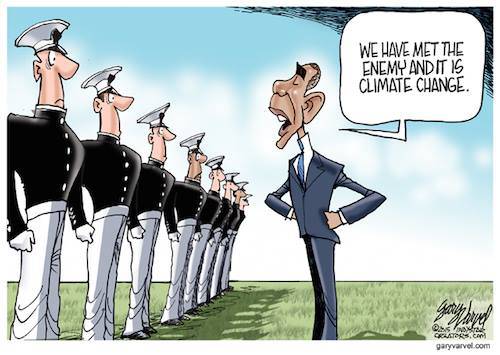
(Human rights, Iranian missiles, Iranian threats, Iranian proxies, theocratic dictatorship? Those are not relevant to the deal. But whatever may help the environment and therefore stop climate change is my top priority — Obama.

enemy

— H/t Freedom is just another word. — DM)

Rouhani’s comments linking the country’s various environmental problems and employment woes to the nuclear negotiations and sanctions relief have upset conservatives, who believe the administration is too eager to resolve the dispute and too optimistic about what the deal means for the country.

**********************

Iranian President Hassan Rouhani has been criticized for suggesting that once a comprehensive nuclear deal is made it will open the door to improving the country’s environmental problems. “The oppressive sanctions must be removed so that investment can come and the problems of the environment, employment, industry and drinkable water are resolved,” Rouhani said at a ceremony on June 7 commemorating Environment Week in Iran.

Rouhani described the sanctions as “a small fever … that at the beginning no attention was paid to this fever, but when the sick person fell ill and was not able to move anymore, we sought a remedy for the illness. Some did not know the reason of the sanctions but step by step, the problems became larger.”

Rouhani added that while “the oppressive sanctions must be removed,” this does not mean “that we must submit to the unreasonable wants of others.”

Iran and five permanent members of the UN Security Council plus Germany (P5+1) are working through the final details of a comprehensive deal that would see Iran reduce its nuclear activity in return for sanctions relief, particularly banking sanctions that have hurt the country’s ability to sell its oil and conduct trade and have prevented Western investment in the country.

But Rouhani’s comments linking the country’s various environmental problems and employment woes to the nuclear negotiations and sanctions relief have upset conservatives, who believe the administration is too eager to resolve the dispute and too optimistic about what the deal means for the country.

In an article titled, “The water, wind, soil and forests have also been tied to sanctions,” the conservative Javan newspaper criticized Rouhani’s latest comments. The article said, “Despite experts warning of not connecting domestic issues of the country to the nuclear issue and negotiations, at this ceremony Rouhani once again suggested that with the removal of sanctions not only will investment become fluid in Iran but the issues of the environment, youth employment, water and banking will be [resolved].”

The article continued that Rouhani’s comments “resulted in many experts becoming surprised and a few hours afterward many hostile Western networks and media … took this point and broadcast this to show [that] sanctions have brought Iran to its knees.”

In an article sarcastically titled, “Solving all the problems is tied to the negotiations, even drinking water,” the Kayhan newspaper also criticized Rouhani. Kayhan repeated Javan’s warning that analysts have warned of not tying the nuclear negotiations to domestic issues and cast doubt that so many problems could be resolved with the removal of sanctions. Kayhan wrote, “Stranger than anything else, Rouhani said the removal of sanctions would increase the water levels.”

Kayhan said, “The issue of sanctions is one the most important obstacles for the negotiators because the Americans do not want to remove sanctions, which is a tool to apply pressure on Iran.”

According to his previous statements, Iran’s Supreme Leader Ayatollah Ali Khamenei, who has final say on the nuclear program, has warned Iranian officials about being optimistic regarding the sanctions and has emphasized focusing on domestic capabilities instead.

On April 29, he said, “The key to solving economic issues is not in Lausanne, Geneva or New York,” three locations where the Iran and P5+1 nuclear talks have taken place under the Rouhani administration. “Without a doubt, sanctions and pressure cannot stop organized and planned efforts to increase domestic production.”


US Diplomats Reveal EU Sanctions Assault After Iran Deal

June 9, 2015

US Diplomats Reveal EU Sanctions Assault After Iran Deal, Israel National News, Ari Yashar, June 9, 2015

EU flagEU flag (illustration)Flash 90

Israel has been fighting the Iran nuclear deal due to the great danger it poses, but senior Western officials have revealed it is also doing so because once a deal is reached, the European Union (EU) and UN are planning a diplomatic offensive targeting the Jewish state.

The political assault is meant to force Israel into returning to yet more peace talks with the Palestinian Authority (PA) and making dangerous concessions in the process – and reportedly the EU already has a list of sanctions ready to force Israel to bend.

A senior Western diplomat told Ma’ariv in a report published Tuesday that “a diplomatic attack against Israel is expected soon that will surprise even the pessimists in Jerusalem.”

“In the (UN) Security Council, in western capitals and at EU headquarters, they are just waiting for the Iran deal to be signed and for it to be approved by the American Congress,” warned the diplomatic source.

It appears that the waiting period will likely expire in September, at which time a UN General Assembly will open in tandem with the first shots of the diplomatic barrage against Israel.

Diplomatic sources familiar with Western European positions vis-a-vis Israel said the EU already has a list ready, itemizing sanctions against Israel in the fields of trade, agriculture, science and culture.

That list is to be translated into an economic assault – unless Israel presents a new set of concessions it is willing to make for a new round of peace talks, after the last set of talks was torpedoed by the PA signing a unity deal with the Hamas terrorist organization.

“S‭enior officials in Jerusalem are aware of the existence of sanctions documents at EU headquarters, some of which have even fallen into their hands,” one diplomatic source revealed to Ma’ariv.

The source added that US President Barack Obama’s threat made in an Israeli interview this month, according to which he may cut US support for Israel at the UN, specifically was referring to “the sanctions file” against Israel which is currently biding its time at the EU headquarters.

The US is reportedly weighing its responses, as the current Israeli government does not appear to be likely to launch a new series of peace talks after the massive failure of the last round, and the PA’s unilateral moves in the international arena in breach of the 1993 Oslo Accords that founded it.

“The make-up of the government is such that no faction or minister will stand up to the lack of an initiative from Prime Minister (Binyamin) Netanyahu,” a diplomat from New York told Ma’ariv. “The coming months will be difficult for Israel. This time Israel will pay a heavy price for continued stagnation. This time, it is also uncertain if Uncle Sam will succeed in saving Israel, and maybe he won’t want to do so.”

Leaked Information: Khamenei’s Lies Exposed

June 9, 2015

Leaked Information: Khamenei’s Lies Exposed, Front Page Magazine, June 9, 2015

(?????????????????? — DM)

1.29.13-Ayatollah-Ali-Khamenei-431x350

[W]hat the ayatollah is announcing to the media — that basically the Islamic Republic does not desire to seal a final nuclear deal with the six world powers — is not the truth.  The leaked information (in Persian language) indicates that the Supreme Leader has already instructed the nuclear negotiating team and his advisors to ignore his public statements and seal the final nuclear deal.

******************

Iran’s paramount religious leader can be described as one of the longest-ruling dictators in the Middle East who still enjoys the throne. An ideologue and a Shiite Islamist, he is also a shrewd Machiavellian politician.

Although he attempts to project himself to the Muslim world as a united religious leader who pursues truth, faith, and honesty, his double-faced character can easily be detected in the discrepancies among his statements and policies.

When Khamenei came to power, he lacked the charisma of his predecessor, Ayatollah Ruhollah Khomeini. To rule, he continued the major policies of his predecessor, relying on hard power and hardliners to suppress domestic opposition, making different statements to the public than in private, and funding Shiite or non-Shiite extremists groups in the region such as Hezbollah and the Houthis.

In addition, he created the Office of the Supreme Leader, comprised of close advisors and excluding the presidential and other major offices in order to further consolidate his power and prevent the leaking of information. The Islamic Republic’s major domestic and foreign policy decisions are made in the small gilded circle of his office and he is the final decision-maker of the country.

To rule, the ayatollah began wielding power without being held accountable. In order to do so, his government pre-select a handful of candidates to become president. Presidents do not have any actual power, but would be held accountable, blamed for any gaffes such as economic mismanagements and failure in nuclear talks, among other things. This system has so far worked for the ayatollah.

His predecessor and founder of the Islamic Republic came to power by promising people that oil revenues will be distributed among the population and that people do not have to pay for major bills such as electricity or water (in a speech that he gave in Behesht e Zahra). The videos and audios of that speech were removed from public access. Now, one can even be punished or executed by the Islamic Republic if the government finds that particular speech in one’s possession.  Ayatollah Khamenei also continued this dual policy of deceiving the public.

Most recently, with regards to the marathon nuclear negotiations, Mr. Khamenei’s double standards have become more obvious due to leaked information.

In less than a month, the six world powers (known as the P5+1; the United States, China, Germany, United Kingdom, France, and Russia) and the Islamic Republic will be reaching the deadline for their marathon nuclear talks, marking one the lengthiest international negotiations of our generation.

The position and opinion of the Islamic Republic’s paramount leader, Ayatollah Ali Khamenei, on the nuclear negotiations and the terms of the final nuclear deal can be characterized as the most crucial factor in determining whether a final deal will be reached by the end of June or not.

Khamenei recently stated, “We will never yield to pressure… We will not accept unreasonable demands… Iran will not give access to its (nuclear) scientists,” he added, “They say we should let them interview our nuclear scientists. This means interrogation… I will not let foreigners talk to our scientists and to interrogate our dear children… who brought us this extensive (nuclear) knowledge… We will not allow the privacy of our nuclear scientists or any other important issue to be violated.”

Nevertheless, what the ayatollah is announcing to the media — that basically the Islamic Republic does not desire to seal a final nuclear deal with the six world powers — is not the truth.  The leaked information (in Persian language) indicates that the Supreme Leader has already instructed the nuclear negotiating team and his advisors to ignore his public statements and seal the final nuclear deal.

The Supreme Leader’s double-standards and the difference in what he states publicly and what he instructs behind the scenes, indicate that he indeed needs the final nuclear deal and he will be more likely willing to allow inspections in order to obtain the deal. Ayatollah Khamenei is cognizant of the fact that the final nuclear deal is geopolitically, economically, and ideologically a win for him. Iran’s nuclear infrastructure will not be dismantled, Iran’s break-time to become a nuclear state will shrink from one year to zero in the next few years, Iran’s economy will be strengthened, and the US will likely ignore Iran’s increasing influence and their proxy wars in the region because of the nuclear deal.

Khamenei is being disingenuous with the public and other nations for several reasons. First of all, The fact that Iran’s negotiating team are continuing with the talks, sitting at the same table with Obama administration’s diplomats, and the fact that there is contradiction between what the Supreme Leader and his advisors stated publicly and behind the scenes indicates that Khamenei is giving a green light to the nuclear team to get a nuclear agreement from the White House, the major player in the talks.  Secondly, by showing that Iran is not in need of such a deal, Khamenei is giving leverage to the Iranian negotiating team to obtain more concessions from the West.

Khamenei attempts to publicly show that he is a strong religious and nationalistic leader who is totally against foreign inspection and monitoring of his country. Finally, he desires to project the picture that he is not desperate for the final nuclear deal in order to get as many concessions as he can from the Obama’s administration. And so far, his tactics and dual policies have worked for him in further strengthening his throne and power.

Soup Sandwich: Obama and His National Security Team Has no Plan to Combat ISIS

June 9, 2015

Soup Sandwich: Obama and His National Security Team Has no Plan to Combat ISIS, ISIS Study Group, June 9, 2015

(This appeared in an e-mail this morning from Foreign Policy Strategy Report:

Wait, where is everybody? Several hundred U.S. soldiers and Marines at al Asad air base in Iraq are standing by, ready to train some Iraq soldiers. But those Iraqi troops have stopped showing up, leaving the Americans all alone at the sprawling base. FP’s John Hudson, Lara Jakes and Paul McLeary report that across Iraq, there seem to be more U.S. trainers than recruits, with only 2,600 Iraqi soldiers currently receiving training from about 3,000 U.S. military personnel.

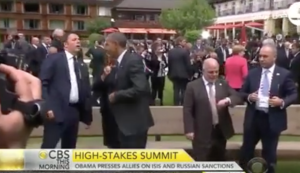
While the training has dried up, at the G-7 summit in Germany, President Barack Obama maintained that the United States and its allies must speed up the training of the Iraqi security forces….even, presumably, if they aren’t showing up.

— DM)

President Obama did some talking about the Islamic State (IS) after the G-7. Of note is that he admitted to not having an actual strategy in combatting IS and the threat it poses to the free world. In typical fashion he fails to hold himself accountable for his actions and points the finger at everybody but himself. He’s known about the threat of IS for since 2010 when Baghdadi’s guys initiated the “Breaking the Walls Campaign” in Iraq (which the Long War Journal did a great job of covering btw). This quote from our illustrious President was quite telling:

“I don’t want to put the cart before the horse. We don’t have a strategy yet,”

Obama: No ‘complete strategy’ yet on training Iraqis
http://www.cnn.com/2015/06/08/politics/obama-abadi-iraq-germany-g7/

And here’s President Obama’s press conference after the G-7 (we recommend fast-forwarding to the 18:00 mark to get to the good stuff):


The President comes off as well-versed in “saying the right things” when it comes to things like Greece, healthcare or raising minimum wage. However, he starts stumbling the minute someone asks about IS. At around the 19:00 mark of the aforementioned video he said that we’re making “progress” in pushing IS back, but then goes on to say that as we “secure” an area they move into other areas the Iraq Security Forces/Popular Mobilization Committee (ISF/PMC) left. This is the President’s definition of “winning” the fight against IS. We’re sorry if this offends his supporters (not really), but what’s happening on the ground in Syria, Iraq, Lebanon and Yemen isn’t the US “winning” this fight against IS, Iran or al-Qaida (AQ).

His “solution” to the problem being an acceleration of training up the ISF is smoke and mirrors, really. You can train the ISF up all you want and it won’t make any difference because at its core both the IA and Iraqi Police (IP) have been purged of their most capable commanders and replaced by incompetent officers. The fact that the IA is now 80% Shia further alienates itself from the Sunni Arab and Kurd communities. Even Secretary of Defense Ash Carter stated all the training in the world can’t help the IA due to the cowardice that’s endemic throughout the force. As much as the Iranian regime denied this and pushed back against Carter’s assessment, IRGC-Qods Force commander GEN Suleimani shares many his beliefs in the poor state of the IA – and that’s a big reason why Suleimani has been influencing the establishment of the Iraqi National Guard by working to ensure that the ranks are filled with Shia militia personnel. Oh, and btw, a lot of those “fresh troops” the President was referring to are already being put through the meat grinder in places like Bayji and Ramadi – and the results aren’t pretty.

Iranian Regime, GOI Take Issue With US SECDEF’s Assessment that IA are Cowards
http://isisstudygroup.com/?p=6707

ash-carter-300x169

SECDEF Ash Carter is the only guy in the Obama administration who seems to “get it” – too bad the powers that be forced him to walk back his accurate assessment on the cowardice seen throughout the IA
Source: Wall Street Journal

Again, none of this is surprising to our readers who’ve been with us since the beginning of our site. President Obama had a quasi-strategy of sorts that we covered in last summer’s “Obama’s ISIS Strategy: Failed Before it Started” that was followed up by “Another Reason Obama’s ISIS Strategy Has Already Failed.” To the uninitiated, the Obama strategy called for trainers and the arming of so-called “moderates” in Syria while supporting an Iraqi Army (IA) that has taken on sectarian characteristics. He’s banking on doing the bare minimum to basically run out the clock so that he can say he “didn’t deploy combat troops to Iraq.” In other words, he has a plan alrighHe’s been very untruthful because he’s dramatically increased the US military footprint in Iraq since last summer. Their situation is also much more dangerous now than it ever was during the OIF-era thanks to the restrictive ROE he slapped our brethren with prior to authorizing their deployment. Additionally, his term “no boots on the ground” is misleading because those “advisors/trainers” we’ve deployed are all ground troops – many of which are located in bases currently under siege such as al-Asad Airbase or Habbaniyah. If these aren’t American “combat troops,” then what are they, aid workers? Bystanders? The Obama administration may give the “trainer” label on our guys being deployed to Iraq, but the inconvenient truth of the matter is that they all have either “US ARMY” or “US MARINES” tags on their uniforms.

Obama’s ISIS Strategy: Failed Before it Started
http://isisstudygroup.com/?p=1730

Another Reason Obama’s ISIS Strategy Has Already Failed
http://isisstudygroup.com/?p=1757

US-Backed Syrian Group Disbands – But Were They Ever Truly “Moderate” to Begin With?
http://isisstudygroup.com/?p=5286

It was painful to watch President Obama – the alleged “leader” of the free world – have a hard time answering some pretty easy questions asked about US policy to combat IS. President Obama and his national security team had more than a few years to develop a strategy – but didn’t. Why is that? Its because President Obama doesn’t want his domestic agenda to get sidetracked by things like the foreign-policy arena. He just points the finger at everybody else saying “its their fault” while not formulating any real solution. He’s on his 7th year in office and still blames his predecessor for everything. Coming from military backgrounds ourselves, we were taught that a leader doesn’t make excuses. He makes things happen. A leader doesn’t keep rolling with a plan if it clearly isn’t working. A leader will adjust accordingly and inspire his subordinates to press on. That’s what a leader does. We’re not seeing that from this President. As we’ve stated earlier in this article, he’s just trying to “run out the clock” of his second term so that this will become the “next guy’s problem.” Unfortunately for him, it doesn’t work that way. His inaction and arrogance has directly led to the rise of IS, and his current policies have allowed the terror organization to expand into other locales such as Yemen, Libya, Egypt, Tunisia, Iraq, Afghanistan, Pakistan and the North Caucasus region. History won’t look so kindly on him as the current American media. The public will see this manifest itself in the next administration, when our country gets attacked on our home soil – again. Of course there’s the hope that the American people will finally realize this is what a “hope and change” foreign policy is all about before its too late. But we doubt it.

Screen-Shot-2015-06-08-at-2.21.59-PM-300x173

Oh yeah, President Obama knew PM Abadi was next to him and acted as if he wasn’t there – kinda like his approach to foreign policy
Source: CBS News

If you want additional details on the lead up to the rise of IS, then check out the history lesson we put together for President Obama’s counterpart Rand Paul, who is just as naive on foreign policy as he is:

Rand Paul Needs a History Lesson..
http://isisstudygroup.com/?p=6782

Links to Other Related Articles:

Defeating The Islamic State
http://isisstudygroup.com/?p=1708

Egypt Atmospherics
http://isisstudygroup.com/?p=614

Super Power Poker – Live From Iran

June 9, 2015

Super Power Poker – Live From Iran, Clarion Project via You Tube, June 9, 2015

The stakes are the highest they’ve ever been. Nuclear Iran. The US, Iran, Saudi Arabia and Israel play for the security of the world. This is the ultimate hold’em game. Who holds the aces, who will go all in, who is bluffing and who has a tell that will leave them with nothing but a mushroom cloud. No nukes for Iran.


Directive 11: Obama’s Secret Islamist Plan

June 8, 2015

Directive 11: Obama’s Secret Islamist Plan, Front Page Magazine, Daniel Greenfield, June 8, 2015

Obama-450x240

What little we know about the resulting classified 18-page report is that it used euphemisms to call for aiding Islamist takeovers in parts of the Middle East. Four countries were targeted. Of those four, we only know for certain that Egypt and Yemen were on the list. But we do know for certain the outcome.

Obama’s insistence that human rights be made a core national security interest paved the way for political and military interventions on behalf of Islamists. Obama had never been interested in human rights; his record of pandering to the world’s worst genocide plotters and perpetrators from Iran to Turkey to Sudan made that clear. When he said “human rights”, Obama really meant “Islamist power.”

********************

Behind the rise of ISIS, the Libyan Civil War, the unrest in Egypt, Yemen and across the region may be a single classified document.

That document is Presidential Study Directive 11.

You can download Presidential Study Directive 10 on “Preventing Mass Atrocities” from the White House website, but as of yet no one has been able to properly pry number 11 out of Obama Inc.

Presidential Study Directive 10, in which Obama asked for non-military options for stopping genocide, proved to be a miserable failure. The Atrocities Prevention Board’s only use was as a fig leaf for a policy that had caused the atrocities. And the cause of those atrocities is buried inside Directive 11.

With Obama’s typical use of technicalities to avoid transparency, Directive 11 was used to guide policy in the Middle East without being officially submitted. It is possible that it will never be submitted. And yet the Directive 11 group was described as “just finishing its work” when the Arab Spring began.

That is certainly one way of looking at it.

Directive 11 brought together activists and operatives at multiple agencies to come up with a “tailored” approach for regime change in each country. The goal was to “manage” the political transitions. It tossed aside American national security interests by insisting that Islamist regimes would be equally committed to fighting terrorism and cooperating with Israel. Its greatest gymnastic feat may have been arguing that the best way to achieve political stability in the region was through regime change.

What little we know about the resulting classified 18-page report is that it used euphemisms to call for aiding Islamist takeovers in parts of the Middle East. Four countries were targeted. Of those four, we only know for certain that Egypt and Yemen were on the list. But we do know for certain the outcome.

Egypt fell to the Muslim Brotherhood, which collaborated with Al Qaeda, Hamas and Iran, before being undone by a counterrevolution. Yemen is currently controlled by Iran’s Houthi terrorists and Al Qaeda.

According to a New York Times story, Obama’s Directive 11 agenda appeared to resemble Che or Castro as he “pressed his advisers to study popular uprisings in Latin America, Eastern Europe and Southeast Asia to determine which ones worked and which did not.”

The story also noted that he “is drawn to Indonesia, where he spent several years as a child, which ousted its longtime leader, Suharto, in 1998.”

The coup against Mubarak with its coordination of liberals, Islamists and the military did strongly resemble what happened in Indonesia. The most ominous similarity may be that the Muslim mobs in Indonesia targeted the Chinese, many of whom are Christians, while the Muslim mobs in Egypt targeted Coptic Christians.

Both were talented groups that were disproportionately successful because they lacked the traditional Islamic hostility to education, integrity and achievement. Islamist demagogues had succeeded in associating them with the regime and promoted attacks on them as part of the anti-regime protests.

Chinese stores were looted and thousands of Chinese women were raped by rampaging Muslims. Just as in Egypt, the protesters and their media allies spread the claim that these atrocities committed by Muslim protesters were the work of the regime’s secret police. That remains the official story today.

Suharto’s fall paved the way for the rise of the Prosperous Justice Party, which was founded a few months after his resignation and has become one of the largest parties in the Indonesian parliament. PJP was set up by the Muslim Brotherhood’s local arm in Indonesia.

His successor, Bacharuddin Jusuf Habibie, was more explicitly Islamist than Suharto and his Association of Muslim Intellectuals (ICMI) conducted a campaign against Christians, Hindus and Buddhists. It helped purge non-Muslims from government while Islamizing the government and Indonesia’s key institutions.

Habibie had been the Chairman of ICMI and ICMI’s Islamists played a key role in moving Suharto out and moving him in. It was obvious why Obama would have considered the Islamization of Indonesia and the purge of Christians under the guise of democratic political change to be a fine example for Egypt.

While we don’t know the full contents of Directive 11 and unless a new administration decides to open the vaults of the old regime, we may never know. But we do know a good deal about the results.

In its own way, PSD-10 tells us something about PSD-11.

Obama’s insistence that human rights be made a core national security interest paved the way for political and military interventions on behalf of Islamists. Obama had never been interested in human rights; his record of pandering to the world’s worst genocide plotters and perpetrators from Iran to Turkey to Sudan made that clear. When he said “human rights”, Obama really meant “Islamist power”.

That was why Obama refused to intervene when the Muslim Brotherhood conducted real genocide in Sudan, but did interfere in Libya on behalf of the Brotherhood using a phony claim of genocide.

Positioning Samantha Power in the Office of Multilateral Affairs and Human Rights at the National Security Council was part of the process that made over the NSC from national security to servicing a progressive wish list of Islamist terrorist groups that were to be transformed into national governments.

Power, along with Gayle Smith and Dennis Ross, led the Directive 11 project.

Secret proceedings were used to spawn regime change infrastructure. Some of these tools had official names, such as “The Office of The Special Coordinator For Middle East Transitions” which currently reports directly to former ambassador Anne Patterson who told Coptic Christians not to protest against Morsi. After being driven out of the country by angry mobs over her support for the Muslim Brotherhood tyranny, she was promoted to Assistant Secretary of State for Near Eastern Affairs.

“The Office” is still focused on “outreach to emergent political, economic and social forces in Egypt, Tunisia, and Libya” even though counterrevolutions have pushed out Islamists in Egypt and Tunisia, while Libya is in the middle of a bloody civil war in which an alliance of the Muslim Brotherhood and Al Qaeda controls the nation’s capital.

But even as Morsi’s abuses of power were driving outraged Egyptians into the streets, Gayle Smith, one of the three leaders of Directive 11, reached out to the “International Union of Muslim Scholars”, a Muslim Brotherhood group that supported terrorism against American soldiers in Iraq and which was now looking for American support for its Islamist terrorist brigades in the Syrian Civil War.

The men and women responsible for Directive 11 were making it clear that they had learned nothing.

Directive 11 ended up giving us the Islamic State through its Arab Spring. PSD-11’s twisted claim that regional stability could only be achieved through Islamist regime change tore apart the region and turned it into a playground for terrorists. ISIS is simply the biggest and toughest of the terror groups that were able to thrive in the environment of violent civil wars created by Obama’s Directive 11.

During the Arab Spring protests, Egyptian Foreign Minister Ahmed Aboul Gheit had told Hillary Clinton that his government could not hand over power to the Muslim Brotherhood. “My daughter gets to go out at night. And, God damn it, I’m not going to turn this country over to people who will turn back the clock on her rights.”

But that was exactly what Hillary Clinton and Obama were after. And they got it. Countless women were raped in Egypt. Beyond Egypt, Hillary and Obama’s policy saw Yazidi women actually sold into slavery.

Directive 11 codified the left’s dirty alliance with the Muslim Brotherhood into our foreign policy. Its support for Islamist takeovers paved the way for riots and civil wars culminating in the violence that birthed ISIS and covered the region in blood.

And it remains secret to this day.

Shoshana Bryen: The Kurds: A Guide for U.S. Policymakers

June 7, 2015

Shoshana Bryen: The Kurds: A Guide for U.S. Policymakerssecurefreedom via You Tube, June 5, 2015

Shoshana Bryen, Senior Director, Jewish Policy Center; Former Senior Director for Security Policy, Jewish Institute for National Security Affairs (JINSA):