Posted tagged ‘Europe’

Algeria Refused to Hear Rape Complaint Because Victim Wasn’t Muslim

May 21, 2016

Algeria Refused to Hear Rape Complaint Because Victim Wasn’t Muslim, Front Page Magazine, Daniel Greenfield, May 21, 2016

muslim-slave-trade

Muslims constantly complain how much they’re discriminated against in Europe. Here’s a reminder of how they treat non-Muslims in their own countries.

In October a Cameroonian woman was gang-raped in Oran by a group of men that threatened her with a dog. When she tried to file a complaint with the authorities, she was rejected on two main grounds: She had no papers, and she wasn’t a Muslim.

The Marie-Simone case became a cause célèbre, and the victim, with the support of some Algerians, eventually obtained justice. But it remains an exception.

The author points out that Muslims in Algeria treat non-Muslims as subhuman even while condemning Europe.

Many black migrants, including those who are not Muslim, are deploying symbols of Islam to appeal to Algerians’ sense of charity. Why? Because poverty helps decode culture better than reflection does, and migrants, lacking shelter and food, are quick to realize that in Algeria there often is no empathy between human beings, only empathy between people of the same religion…

In Europe, migrants can try to play on the humanitarianism and guilty consciences of their hosts, but in Algeria these days, the Other is visible only through the prism of faith…

On the one hand, there are virulent articles about racism in Europe describing the “Jungle,” a migrant detention center in Calais, France, as something of a concentration camp, or presenting fallacious analyses: “No Work in France if You’re Arab or African,” said one headline in an Islamist newspaper in February. On the other hand, there is no shortage of Ku Klux Klan-worthy arguments about the threat posed by blacks, their perceived lack of civic-mindedness and the crimes and diseases they purportedly bring with them…

On the occasion of a soccer match between Algeria and Mali in November 2014, the Islamist daily Echourouk published a photograph of some of the Malian club’s black fans under the caption, “No greetings, no welcome. AIDS behind you,Ebola ahead of you.” But the prejudices of fundamentalists lead them to a different conclusion, simple and monstrous: Either the Other is a Muslim, or he is not at all.

Religious conservatives, like the secular elites, see blacks as victims of injustices perpetrated by white colonizers, but for them redress can only come through Allah. Their propaganda often refers to a precedent from the mythology of Islam’s early days: Bilal, the black Abyssinian slave whose religious conversion led to his emancipation.

Except that for every Bilal there are millions of other blacks, including converts to Islam, who have stayed trapped in servitude for generations. The very subject of slavery in Arab societies is still taboo today, or it is eclipsed by condemnation of Western slavery.

The fact remains that for blacks, embracing Islam is no guarantee of safety…

But these are subjects that largely can’t be discussed. The Western left has embraced some mythological solidarity of “brown people” that doesn’t actually exist. But it has no interest in addressing subjects like the Arab slave trade or ongoing racism in the Muslim world.

Sweden’s Holy War on Children’s Books

May 21, 2016

Sweden’s Holy War on Children’s Books, Gatestone InstituteJudith Bergman, May 21, 2016

♦ Taken to its extremes, the urge to cleanse a culture of elements that do not live up to the politically correct orthodoxy currently in political vogue unsettlingly echoes the Taliban and ISIS credos of destroying everything that does not accord with their Quranic views. The desire “not to offend,” taken to its logical conclusion, is a totalitarian impulse, which threatens to destroy everything that disagrees with its doctrines. Crucially, who gets to decide what is offensive?

♦ The question arises: How much purging and expiation will be needed to render a country’s culture politically correct?

♦ “When we have days of carnivals and music the goal is that these days should be experienced as positive by everyone. The Swedish flag is not allowed as part of carnival dress. … Positive and bright feelings must be in focus. … School photos must obviously be free of national symbols.” — Swedish school in Halmstad.

♦ Rome covered up its classical nude statues for a visit from Iran’s president, Hassan Rouhani, in January 2016. A decade ago, who would have even imagined such sycophancy?

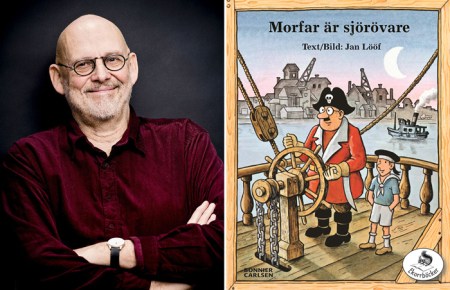
In 1966, one of Sweden’s most popular children’s writers, Jan Lööf, published Grandpa is a Pirate, an illustrated children’s book, which featured, among other characters, the wicked pirate Omar and the street peddler, Abdullah. The book has been a bestseller ever since, and has been translated into English (as My Grandpa is a Pirate), Spanish, French and other languages. Ten years ago, 100,000 copies of it were even distributed to the Swedish public with McDonald’s Happy Meals, as part of an initiative to support reading among children.

Ah, but those were the days of yesteryear! Now, fifty years later, the book is no longer tolerable. The now 76-year-old author told Swedish news outlets that his publisher recently said that unless he rewrites the book and changes the illustrations, it will be taken off the market. The publisher also threatened to withdraw another of his books unless it is redone: it features an illustration of a black jazz musician who sleeps with his sunglasses on.

Lööf’s publisher, the Swedish publishing giant Bonnier Carlsen, says that it has not yet made a final decision and that it only views the rewriting and re-illustrating of the books as “an option.” There is no doubt, however, that they consider the books in question extremely problematic.

“The books stereotype other cultures, something which is not strange, since all illustrations are created in a context, in their own time, and times change,” said Eva Dahlin, who heads Bonnier Carlsen’s literary department.

“But if you come from the Middle East, for instance, you can get tired from rarely being featured on the good side in literary depictions. Children’s books are special because they are read over a longer period of time and the norms of the past live on in them, unedited. As an adult, one may be wearing one’s nostalgic glasses and miss things that could be seen as problematic by others.”

Dahlin further explained that the publishing house spends a lot of time reviewing older publications, to check if such “problematic” passages occur. She added that the publishing house does not check for only culturally sensitive passages:

“There are many female editors, and therefore we have probably been more naturally aware of gender-biased depictions than these type of questions. But now we have better insights and a greater awareness of these issues.”

1612One of Sweden’s most popular children’s writers, Jan Lööf, was recently told by his publisher that unless he makes his bestselling 1966 book, Grandpa is a Pirate, more politically correct by rewriting it and changing the illustrations, it will be taken off the market

Sweden is no stranger to “literary revisions” of this kind, or other cultural revisions in the name of political correctness. Both Pippi Longstocking and other children’s books have gone through assorted revisions or have even been taken off the market. In the Pippi Longstocking television series, a scene in which Pippi squints her eyes to look Chinese has been edited out altogether, so as not to offend anyone. In 2013, a popular, award-winning Danish children’s book, Mustafa’s Kiosk, by Jakob Martin Strid, was taken off the market in Sweden after complaints on Swedish social media that it was racist and “Islamophobic.” Ironically, the author wrote it in 1998, when he was staying in Indonesia, the world’s most populous Muslim country, as “an anti-racist statement.” Tellingly, the book had been on the Swedish market since 2002 with no complaints. In his response to the criticism, the Danish writer noted that an equal and non-racist society only comes about “when you are allowed to make (loving) fun of everyone.” “I also make fun of Norwegians,” he added.

In 2014, after complaints on Swedish social media that some of its candy was “racist,” the Haribo company decided to change one of its products, “Skipper Mix,” which consisted of candies shaped in the form of a sailor’s souvenirs, including African masks.

The question arises: How much purging and expiation will be needed to render a country’s culture politically correct?

That question raises an even bigger one: How high is the price of political correctness in terms of “cleansing” the past and present of perceived slights, anywhere, to just about anyone?

Taken to its extremes, the urge to cleanse a culture of elements that do not live up to the politically correct orthodoxy currently in political vogue unsettlingly echoes the Taliban and ISIS credos of destroying everything that does not accord with their Quranic views. The desire “not to offend,” taken to its logical conclusion, is a totalitarian impulse, which threatens to destroy everything that disagrees with its doctrines. Crucially, who gets to decide what is offensive?

What begins innocently enough, by taking out passages from books that may hurt someone’s feelings, can end up turning into something far more sinister, as it indeed has in Sweden. Former Swedish Prime Minister Frederik Reinfeldt famously stated in 2014 that Sweden belongs to immigrants, not to the Swedes who have lived there for generations. He thereby communicated that he believes the future of Sweden will be shaped by non-Swedes, showing a curious contempt for his own culture.

This contempt has spread fast throughout official Sweden. In 2014, a Swedish school in Halmstad forbade displaying the Swedish flag, after a student painted his face in the Swedish colors for a carnival. In its new rules, the school specified why:

“Most students look forward to school traditions. When we have days of carnivals and music the goal is that these days should be experienced as positive by everyone. The Swedish flag is not allowed as part of carnival dress. … Positive and bright feelings must be in focus. … School photos must obviously be free of national symbols.”

However, the “precedent” for such rules had already been set ten years prior, in 2004, at a school in Vaargaarda, when two girls had worn printed sweatshirts which happened to display the Swedish flag and the word “Sweden.” They were told that this kind of clothing was not allowed at school. One of the girls told reporters that singing the national anthem had also been forbidden at the school.

In 2012, two members of Sweden’s parliament suggested that statues of the Swedish Kings Carl XII and Gustav II Adolf should be removed, because they represent a time when Sweden was a great military power, “a dark time in our country as well as in other countries, which were affected by Swedish aggression,” as the MPs wrote in the motion. Instead, the MPs suggested, the squares of central Stockholm should be adorned in a way such that they “signal peace, tolerance, diversity, freedom and solidarity.”

In 2013, a Baroque painting of the nude goddess Juno was removed from the restaurant of the Swedish parliament, ostensibly to avoid offense to feminist and Muslim sensibilities.

The above should not be discarded as crazy practices peculiar to Sweden. On the contrary, they present a perfect case-study of the consequences of politically correct culture driven to the extreme.

Indeed, these consequences are already proliferating across the Western world. One particularly noteworthy instance took place when Iranian president Hassan Rouhani visited Rome in January 2016. To prevent Rouhani having “a hormonal shock and ripp[ing] up the freshly signed contracts with our Italian industries,” as one Italian columnist, Massimo Gramellini, wrote, Rome covered up its classical nude statues. Who would have even imagined such sycophancy a decade ago?

In Britain, students have recently campaigned for the removal of symbols of British imperialism, such as a statue of Cecil Rhodes at Oxford University. These students claim the campaign is not only about the statue itself, but that it is “…a campaign against racism at Oxford, of which the Rhodes statue is a small but symbolic part.” Already in 2000, the London Mayor Ken Livingstone suggested that statues of two 19th-century British generals should be removed from Trafalgar Square in London, based on his own ignorance:

“The people on the plinths in the main square of our capital city should be identifiable to the generality of the population. I haven’t a clue who two of the generals there are or what they did. I imagine that not one person in 10,000 going through Trafalgar Square knows any details about the lives of those two generals. It might be time to look at moving them and having figures ordinary Londoners and other people from around the world would know.” The problem with all this, of course, is that most of London’s wealth and greatness in terms of art and architecture is due largely to British colonialism, so the question is just how many buildings would be left standing in the British capital, if one were to take this issue and bring it to its logical conclusion.

The trouble with wanting to scrub the cultural and historical slate clean, as it were, is, of course, that countries cannot just press “delete” on their culture and history. Such a move would entail not just the removal of books, paintings and statues, but a complete purge. Those who truly care for history will know that this experiment has already been attempted, not once but several times over, by the various communist and Nazi movements of the twentieth century. While there is little comparison between those movements and the culture of political correctness, the impulse governing them all nevertheless remains the same: To forge and impose one singular “truth” on everyone, rooting out everything that does not fit the utopian mold. That is neither “diverse” nor “tolerant.”

Europe’s Leaders Blast Bill Over Democracy Jibe: ‘The Mouth Belongs To Clinton, The Voice Belongs To Soros’

May 20, 2016

Europe’s Leaders Blast Bill Over Democracy Jibe: ‘The Mouth Belongs To Clinton, The Voice Belongs To Soros’

by Raheem Kassam

20 May 2016

Source: Europe’s Leaders Blast Bill Over Democracy Jibe: ‘The Mouth Belongs To Clinton, The Voice Belongs To Soros’

Getty

Top European leaders have blasted Bill and Hillary Clinton following a war of words about the commitment to democracy of both the Polish and Hungarian governments. One leading figure insisted Mr. Clinton “needs a medical test” following his remarks.

Bill Clinton upset NATO allies in a broadly unreported gaffe accusing Poland and Hungary of thinking “democracy is too much trouble” and wanting to have an “authoritarian dictatorship.” This is despite the fact that Poland recently held elections turfing out the establishment political parties in an election with a higher turnout than Mr. Clinton’s re-election in 1996.

Poland’s newly elected Prime Minister Beata Szydlo called Clinton’s words “unjustified and simply unfair”, adding: “With all due respect, and without using coarse words [Clinton] exaggerated and should apologize to us”.

Mr. Clinton’s remarks came during a Hillary for President campaign rally in New Jersey this week, where he claimed: “They want (Russian President Vladimir) Putin-like leadership. Just give me an authoritarian dictatorship and keep the foreigners out”.

“Sound familiar?” he asked, in a broadside against GOP presumptive nominee Donald Trump.

But in Mr. Clinton’s attempts to use foreign affairs against Mr. Trump, he angered one of NATO’s most important members: Poland, and one of the few countries holding back the tide of migration into Europe: Hungary.

“If someone says there is no democracy in Poland today, that means he should have a medical test,” blasted the head of Poland’s Law and Justice party Jaroslaw Kaczynski.

And his comments were echoed by Hungarian Prime Minister Viktor Orban, who used the incident to highlight the multi-million dollar connections between the Clintons and Hungarian left-wing billionaire George Soros.

Speaking to Hungarian radio on Friday, Mr. Orban blasted: “Hungarians and Polish people rightfully expect more respect from the actual and the former leaders of the United States. I like what the president of the Polish governing party said, although it is harsh, but his reference to the [Clinton’s] need for medical help made many Hungarian hearts beat [in agreement].”

He said, refusing to repeat Mr. Kaczynski’s words: “what is permissible for Jove is not permissible for an ox” – a literary reference implying Mr. Clinton believes he is a god, while the Hungarians are just cattle.

“[B]eyond the American campaign, the remarks made about Hungary and Poland… have a political dimension,” Mr. Orban said, accusing Mr. Clinton of repeating Soros-inspired campaign lines: “These are not accidental slips of the tongue. And [the number of] these slips or remarks have been multiplying since we are living in the era of the migrant crisis. And we all know that behind the leaders of the Democratic Party, we have to see George Soros.”

“And George Soros published his six points supporting the Muslim migration to Europe, in which he announced that at least one million Muslims should be allowed [into Europe] each year, that they must be provided a safe path and that Europe should be happy to get such a chance and shouldn’t be defending against it. He also said that it will cost a lot of money, which he’d loan.”

“So, here, in Central Europe a shadow power exists, which is linked to George Soros, he is one of the most important sponsors of the Democratic Party, so I have to say that although the mouth belongs to Clinton, the voice belongs to George Soros. And since Hungary is where it is, I mean geographically it is where it is and wants to protect its national sovereignty and security, we are a blockade for this Soros plan in America. They will not carry it out here as long as Hungary has a government working in the national interest.”

Writing in the Observer, NATO-expert John R. Schindler notes: “Polish hard feelings regarding Mr. Clinton’s comments aren’t difficult to decipher. In the first place, the statement that any Polish government wants to emulate Russia in any way seems calculated to offend. Memories of long and brutal occupation by the Kremlin are fresh and fears of Mr. Putin run deep, in light of on-going Russian aggression against Poland’s neighbors. Poles are not much fonder of Russians than Jews are of Germans, a fact Mr. Clinton—who touts his foreign policy accomplishments in the White House—should understand.”

Bloomberg has reported that after an 11-year hiatus from large-scale political campaign funding, Mr. Soros has handed Mrs. Clinton around $13 million so far, “already more than his total disclosed spending in the last two presidential elections combined”.

“Soros’s personal fortune stands at about $24 billion, according to the Bloomberg Billionaires Index… The Open Society Foundations say they have spent some $13 billion over the past three decades.”

Critics point to Mr. Soros’s funding behind anti-Polish government groups since the elections, as well as worsening Europe’s migrant crisis by funding open borders activists and “refugee” aid groups.

Obama Admin Will Not Commit to Barring Iranian Access to U.S. Dollar

May 19, 2016

Obama Admin Will Not Commit to Barring Iranian Access to U.S. Dollar, Washington Free Beacon, , May 19, 2016

(On and on it goes; where it stops or if it will nobody knows. — DM)

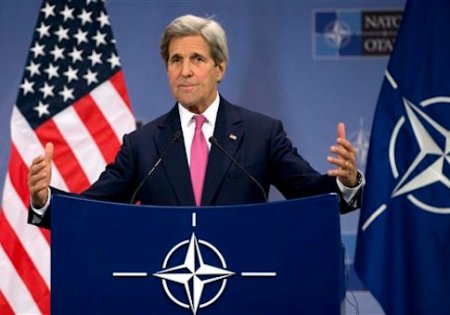
U.S. Secretary of State John Kerry speaks during a media conference at NATO headquarters in Brussels on Thursday, May 19, 2016. NATO foreign ministers this week will discuss how the alliance can deal more effectively with security threats outside Europe, including by training the Iraqi military and cooperating with the European Union to choke off people-smuggling operations in the central Mediterranean. (AP Photo/Virginia Mayo)

U.S. Secretary of State John Kerry speaks during a media conference at NATO headquarters in Brussels on Thursday, May 19, 2016.  (AP Photo/Virginia Mayo)

The Obama administration will not commit to halting its effort to help Iran access the U.S. dollar, despite past commitments to do so, according to a new congressional inquiry obtained by the Washington Free Beacon into the Treasury Department’s refusal to uphold its promises.

Leading senators are threatening to block all consideration of Treasury Department nominees until the administration ends its bid “to enable Iranian access to U.S. dollars” throughout the international financial system, according to a letter sent Thursday to the Treasury Department by Sens. Marco Rubio (R., Fla.) and Mark Kirk (R., Ill.).

Potential Iranian access to the U.S. dollar has caused friction between Congress and the Obama administration, which initially vowed during negotiations with Iran that such a move was out of the question.

However, senior administration officials, including Secretary of State John Kerry, have publicly sought to encourage Europeans to reengage in business with the Islamic Republic following last summer’s comprehensive nuclear agreement.

“We want to make it clear that legitimate business, which is clear under the definition of the agreement, is available to banks,” Kerry said in London last week.

The administration has been intentionally side-stepping questions about methods to give Iran backdoor access to the U.S. dollar, according to senior congressional sources informed of the matter.

The administration has assured lawmakers it will not grant Iran direct access to the U.S. financial system. However, it will not discuss backdoor methods in which U.S. dollars are given to Iran via international banks, source said.

“Whenever the administration gets asked whether it’ll allow Iran’s terror-sponsoring regime access to dollarized transactions outside of the U.S. financial system, a transaction that some people are starting to refer to as ‘Z-turn’ transactions, it flat-out avoids the question and instead says it doesn’t plan to allow Iran to engage in so-called ‘U-turn’ transactions or direct access to the U.S. financial system, something which lawmakers already know,” the source explained.

“This is the equivalent of giving an answer about oranges when you’ve been repeatedly asked about apples, and doesn’t change the fact that the critical questions about ‘Z-turn’ transactions for Iran really need to be clearly answered by the Treasury Department, once and for all,” the source said.

The apparent shift in the administration’s rhetoric on the issue has deepened concerns on Capitol Hill about alleged White House efforts to mislead Congress and the American people about the contents of the nuclear deal.

Rubio and Kirk are threatening to block all Treasury Department nominees from Senate consideration until the Obama administration answers questions about efforts to help Iran get access to U.S. dollars in the international marketplace, according to the letter obtained by the Free Beacon.

“We are disappointed that you ignored the request in the March 30th letter from Senators Rubio and Kirk to provide ‘assurances that the United States will not work on behalf of Iran to enable Iranian access to U.S. dollars elsewhere in the international financial system, including assisting Iran in gaining access to dollar payment systems outside the U.S. financial system,’” the senators wrote. “We do not support the consideration of Treasury Department nominees until our request is directly answered.”

Kirk and Rubio initially petitioned the Treasury Department in March to seek firm assurances that officials would commit to blocking Iranian access to the U.S. dollar.

The Treasury Department, in a May 11 response to Kirk and Rubio’s initial inquiry, declined to address specific questions regarding efforts to promote Iranian access to the U.S. dollar via foreign transactions outside the American financial system.

A month ago, the Obama administration launched a quiet push on Capitol Hill to reassure lawmakers that it would not grant Iran any access to the U.S. dollar or American financial markets, according to a Free Beacon report at the time.

That stance appears to have shifted in recent weeks, prompting concern from Iran deal critics such as Rubio and Kirk.

The Obama administration is now going above and beyond the purview of the nuclear agreement to help boost Iran’s economy, the senators allege.

“In its determined effort to provide Iran’s terror-sponsoring regime with benefits that were not expressly included in the ill-conceived Joint Comprehensive Plan of Action, the Administration is on a path toward undermining the reputation of the United States as a global leader in antimoney laundering and countering terrorism financing,” they write.

“Access to the U.S. dollar is not an international right. But if Tehran wants access, the onus should be entirely on Iran to clean up its act—including by verifiably ending its sponsorship and financing of terrorism, its ballistic missile program, and its human rights abuses against the peoples of Iran and other nations—and reduce the risks that any financial transaction with Iran poses to the global financial community,” the letter states.

The outgoing Obama administration is waging a public campaign to encourage businesses to reenter the Iranian market place, which has been known as a key front for money laundering and terrorism funding, despite Iran’s continued pursuit of ballistic missile technology, which could carry a nuclear payload over great distances.

“Sadly, the Administration appears to be more focused in capitulating to Tehran than in forcing Iran’s terror regime to fundamentally change its behavior,” the lawmakers write. “It’s high time for the U.S. to stop making unreciprocated concessions and to start holding Iran fully accountable for continuing its dangerous and destructive behavior.”

The Senate Banking Committee is scheduled to hold two hearings on Iran next week and sources disclosed that this issue will be a primary focus for Congress.

EU-Turkey Migrant Deal Unravels

May 18, 2016

EU-Turkey Migrant Deal Unravels, Gatestone InstituteSoeren Kern, May 18, 2016

♦ “It can be expected that, as soon as Turkish citizens will obtain visa-free entry to the EU, foreign nationals will start trying to obtain Turkish passports … or use the identities of Turkish citizens, or to obtain by fraud the Turkish citizenship. This possibility may attract not only irregular migrants, but also criminals or terrorists.” — Leaked European Commission report, quoted in theTelegraph, May 17, 2016.

♦ According to the Telegraph, the EU report adds that as a result of the deal, the Turkish mafia, which traffics vast volumes of drugs, sex slaves, illegal firearms and refugees into Europe, may undergo “direct territorial expansion towards the EU.”

♦ “If they make the wrong decision, we will send the refugees.” — Burhan Kuzu, senior adviser to Turkish President Recep Tayyip Erdogan.

♦ Erdogan is now demanding that the EU immediately hand over three billion euros ($3.4 billion) so that Turkish authorities can spend it as they see fit. The EU insists that the funds be transferred through international aid agencies in accordance with strict rules on how the aid can be spent. This prompted Erdogan to accuse the EU of “mocking the dignity” of the Turkish nation.

The EU-Turkey migrant deal, designed to halt the flow of migrants from Turkey to Greece, is falling apart just two months after it was reached. European officials are now looking for a back-up plan.

The March 18 deal was negotiated in great haste by European leaders desperate to gain control over a migration crisis in which more than one million migrants from Africa, Asia and the Middle East poured into Europe in 2015.

European officials, who appear to have promised Turkey more than they can deliver, are increasingly divided over a crucial part of their end of the bargain: granting visa-free travel to Europe for Turkey’s 78 million citizens by the end of June.

At the same time, Turkey is digging in its heels, refusing to implement a key part of its end of the deal: bringing its anti-terrorism laws into line with EU standards so that they cannot be used to detain journalists and academics critical of the government.

A central turning point in the EU-Turkey deal was the May 5 resignation of Turkish Prime Minister Ahmet Davutoglu, who lost a long-running power struggle with Turkish President Recep Tayyip Erdogan. Davutoglu was a key architect of the EU-Turkey deal and was also considered its guarantor.

On May 6, just one day after Davutoglu’s resignation, Erdogan warned European leaders that Turkey would not be narrowing its definition of terrorism: “When Turkey is under attack from terrorist organizations and the powers that support them directly, or indirectly, the EU is telling us to change the law on terrorism,” Erdogan said in Istanbul. “They say ‘I am going to abolish visas and this is the condition.’ I am sorry, we are going our way and you go yours.”

Erdogan insists that Turkey’s anti-terrorism laws are needed to fight Kurdish militants at home and Islamic State jihadists in neighboring Syria and Iraq. Human rights groups counter that Erdogan is becoming increasingly authoritarian and is using the legislation indiscriminately to silence dissent of him and his government.

European officials say that, according to the original deal, visa liberalization for Turkish citizens is conditioned on Turkey amending its anti-terror laws. Erdogan warns that if there is no visa-free travel by the end of June, he will reopen the migration floodgates on July 1. Such a move would allow potentially millions more migrants to pour into Greece.

European officials are now discussing a Plan B. On May 8, the German newspaper Bild reported on a confidential plan to house all migrants arriving from Turkey on Greek islands in the Aegean Sea. Public transportation to and from those islands to the Greek mainland would be cut off in order to prevent migrants from moving into other parts of the European Union.

Migrants would remain on the islands permanently while their asylum applications are being processed. Those whose asylum requests are denied would be deported back to their countries of origin or third countries deemed as “safe.”

The plan, which Bild reports is being discussed at the highest echelons of European power, would effectively turn parts of Greece into massive refugee camps for many years to come. It remains unclear whether Greek leaders will have any say in the matter. It is also unclear how Plan B would reduce the number of migrants flowing into Europe.
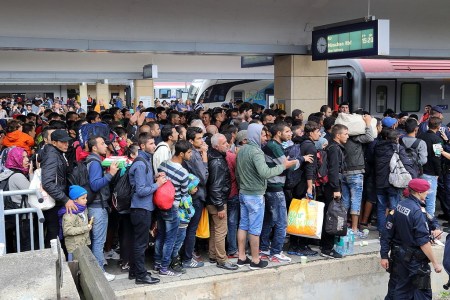
1607Thousands of newly arrived migrants, the vast majority of whom are men, crowd the platforms at Vienna West Railway Station on August 15, 2015 — a common scene in the summer and fall of 2015. (Image source: Bwag/Wikimedia Commons)

Speaking to the BBC News program, “World on the Move,” on May 16, Sir Richard Dearlove, the former head of the British intelligence service MI6, warned that the number of migrants coming to Europe during the next five years could run into millions. This, he said, would reshape the continent’s geopolitical landscape: “If Europe cannot act together to persuade a significant majority of its citizens that it can gain control of its migratory crisis then the EU will find itself at the mercy of a populist uprising, which is already stirring.”

Dearlove also warned against allowing millions of Turks visa-free access to the EU, describing the EU plan as “perverse, like storing gasoline next to the fire we’re trying to extinguish.”

On May 17, the Telegraph published the details of a leaked report from the European Commission, the powerful administrative arm of the European Union. The report warns that opening Europe’s borders to 78 million Turks would increase the risk of terrorist attacks in the European Union. The report states:

“It can be expected that, as soon as Turkish citizens will obtain visa-free entry to the EU, foreign nationals will start trying to obtain Turkish passports in order to pretend to be Turkish citizens and enter the EU visa free, or use the identities of Turkish citizens, or to obtain by fraud the Turkish citizenship. This possibility may attract not only irregular migrants, but also criminals or terrorists.”

According to the Telegraph, the report adds that as a result of the deal, the Turkish mafia, which traffics vast volumes of drugs, sex slaves, illegal firearms and refugees into Europe, may undergo “direct territorial expansion towards the EU.” The report warns: “Suspect individuals being allowed to travel to the Schengen territory without the need to go through a visa request procedure would have a greater ability to enter the EU without being noticed.”

While the EU privately admits that the visa waiver would increase the risk to European security, in public the EU has recommended that the deal be approved.

On May 4, the European Commission announced that Turkey has met most of the 72 “benchmarks of the roadmap” needed to qualify for the visa waiver. The remaining five conditions concern the fight against corruption, judicial cooperation with EU member states, deeper ties with the European law-enforcement agency Europol, data protection and anti-terrorism legislation.

European Commission Vice President Frans Timmermans said:

“Turkey has made impressive progress, particularly in recent weeks, on meeting the benchmarks of its visa liberalization roadmap…. This is why we are putting a proposal on the table which opens the way for the European Parliament and the Member States to decide to lift visa requirements, once the benchmarks have been met.”

In order for the visa waiver to take effect, it must be approved by the national parliaments of the EU member states, as well as the European Parliament.

Ahead of a May 18 debate at the European Parliament in Strasbourg over Turkey’s progress in fulfilling requirements for visa liberalization, Burhan Kuzu, a senior adviser to Erdogan, warned the European Parliament that it had an “important choice” to make.

In a Twitter message, Kuzu wrote: “If they make the wrong decision, we will send the refugees.” In a subsequent telephone interview with Bloomberg, he added: “If Turkey’s doors are opened, Europe would be miserable.”

Meanwhile, Erdogan has placed yet another obstacle in the way of EU-Turkey deal. He is now demanding that the EU immediately hand over three billion euros ($3.4 billion) promised under the deal so that Turkish authorities can spend it as they see fit.

The EU insists that the funds be transferred through the United Nations and other international aid agencies in accordance with strict rules on how the aid can be spent. That stance has prompted Erdogan to accuse the EU of “mocking the dignity” of the Turkish nation.

On May 10, Erdogan expressed anger at the glacial pace of the EU bureaucracy:

“This country [Turkey] is looking after three million refugees. What did they [the EU] say? We’ll give you €3 billion. Well, have they given us any of that money until now? No. They’re still stroking the ball around midfield. If you’re going to give it, just give it.

“These [EU] administrators come here, tour our [refugee] camps, then ask at the same time for more projects. Are you kidding us? What projects? We have 25 camps running. You’ve seen them. There is no such thing as a project. We’ve implemented them.”

In an interview with the Financial Times, Fuat Oktay, head of Turkey’s Disaster and Emergency Management Authority (AFAD), the agency responsible for coordinating the country’s refugee response, accused European officials of being fixated on “bureaucracies, rules and procedures” and urged the European Commission to find a way around them.

The European Commission insists that it was made clear from the outset that most of the money must go to aid organizations: “Funding under the Facility for Refugees in Turkey supports refugees in the country. It is funding for refugees and not funding for Turkey.”

The migration crisis appears to be having political repercussions for German Chancellor Angela Merkel, a leading proponent of the EU-Turkey deal. According to a new poll published by the German newsmagazine Cicero on May 10, two-thirds (64%) of Germans oppose a fourth term for Merkel, whose term ends in the fall of 2017.

In an interview with Welt am Sonntag, Horst Seehofer, the leader of the Christian Social Union (CSU), the Bavarian sister-party to Merkel’s Christian Democrats (CDU), blamed Merkel for enabling Erdogan’s blackmail: “I am not against talks with Turkey. But I think it is dangerous to be dependent upon Ankara.”

Sahra Wagenknecht of the Left Party accused Merkel of negotiating the EU-Turkey deal without involving her European partners: “The chancellor is responsible for Europe having become vulnerable to blackmail by the authoritarian Turkish regime.”

Cem Özdemir, leader of the Greens Party and the son of Turkish immigrants said: “The EU-Turkey deal has made Europe subject to Turkish blackmail. The chancellor bears significant responsibility for this state of affairs.”

Secretary of State John Kerry Urges Europeans to Do Business with Iran

May 12, 2016

Secretary of State John Kerry Urges Europeans to Do Business with Iran

by John Hayward

11 May 2016

Source: Secretary of State John Kerry Urges Europeans to Do Business with Iran – Breitbart

Critics have accused the Obama administration of effectively acting as Iran’s law firm during the nuclear negotiations, but now Secretary of State John Kerry seems determined to volunteer as Iran’s marketing director.

As part of what the Wall Street Journal describes as “the Obama Administration’s moves recently to help integrate Iran into the global economic system after decades of punitive sanctions,” Kerry urged European businesses not to use the remaining U.S. sanctions on Iran as an excuse to avoid doing business with Tehran.

According to the Journal, Kerry told reporters, who were traveling with him to London for an anticorruption summit, that the United States “sometimes gets used as an excuse in this process” by business executives, who claim the American government would disapprove of Iranian deals.

“If they don’t see a good business deal, they shouldn’t say, ‘Oh, we can’t do it because of the United States.’ That’s just not fair. That’s not accurate,” said Kerry.

“Iran has a right to the benefits of the agreement they signed up to and if people, by confusion or misinterpretation or in some cases disinformation, are being misled, it’s appropriate for us to try to clarify that,” he added.

Kerry stressed that European institutions are “are absolutely free to open accounts for Iran, trade and exchange money, facilitate a legitimate business agreement, bankroll it, lend money — all those things are absolutely open,” aside from a few specific individuals and firms that remain under U.S. sanctions.

“Some specific Iranian entities, including companies associated with Iran’s Revolutionary Guard, are still off-limits under sanctions punishing Iran for other behavior,” notes the Associated Press. “And the U.S. maintains a prohibition on Iran accessing the American financial system or directly conducting transactions in U.S. dollars, fueling confusion and practical impediments given that international transactions routinely cross through the U.S. banking system.”

The Secretary of State evidently did not explain why European businessmen would be looking for phony excuses to avoid profitable business deals with the regime in Tehran.

The situation is more complicated than Kerry makes it out to be, according to the Associated Press, which reports that foreign investors are worried about Iran’s “antiquated financial system that fails to meet modern international standards,” its ongoing support for terrorism, its dismal human-rights history, and the fact that the Obama administration has been reluctant to provide written clarification of which business transactions are allowed.

The WSJ suggests two reasons for Kerry’s enthusiasm as an investment counselor for the Iranian theocracy: the Iranians have been loudly complaining that the Obama administration isn’t holding up its end of the nuclear deal, and the outcome of the U.S. presidential election could put the future of the deal in doubt.

At a minimum, presumptive Democratic nominee Hillary Clinton claims she would add more sanctions if Iran comes too close to developing nuclear weapons, while presumptive Republican nominee Donald Trump has said he wants to re-negotiate the deal.

The EU’s Kiss of Death

May 10, 2016

The EU’s Kiss of Death, Gatestone InstituteJudith Bergman, May 10, 2016

♦ The European Union may yet come to realize that this latest ill-concealed jab at the Central- and Eastern European members of the European Union may signal the beginning of the unraveling of the European Union, an event which, considering the authoritarian structure of the organization, might be a good thing. The EU’s authority comes, undemocratically, from the top down, rather than from the bottom up; it is non-transparent, unaccountable and there is no mechanism for removing European Commission representatives.

♦ “We especially do not like it when people who have never lived in Hungary try to give us lectures on how we should cope with our own problems. Calling us racists or xenophobes is the cheapest argument. It’s used just to dodge the issues.” — Zoltán Kovács, spokesman for Hungary’s Prime Minister Viktor Orban.

♦ By persisting in pushing their agendas on European Union member states that still consider themselves sovereign and not merely provinces of the EU, Timmermans and his European Commission bureaucrats may just have given the European Union its kiss of death.

The European Union is hell-bent on forcing member states to take “their share” of migrants. To this end, the European Commission has proposed reforms to EU asylum rules that would see enormous financial penalties imposed on members refusing to take in what it deems a sufficient number of asylum seekers, apparently even if this means placing those states at a severe financial disadvantage.

The European Commission is planning sanctions of an incredible $290,000 for every migrant that recalcitrant EU member states refuse to receive. Given that EU countries such as Hungary, Poland, the Czech Republic, Slovakia and Austria have closed their borders to migrants or are in the process of doing so, it is not difficult to discern at whom the EU is aiming its planned penalties.

The EU may yet come to realize, however, that this latest ill-concealed jab at the Central- and Eastern European members of the European Union — if it passes muster by most member states and members of the European parliament — may just signal the beginning of the unraveling of the European Union, an event which, considering the authoritarian structure of the organization, might be a good thing. The EU’s authority comes, undemocratically, from the top down, rather than from the bottom up; it is non-transparent, unaccountable and there is no mechanism for removing European Commission representatives.

The migrant crisis has revealed a deep and seemingly irreconcilable rift between those countries that roughly two decades ago still found themselves on the wrong side of the Iron Curtain and have not forgotten it, and Western European countries spared from a merciless Soviet totalitarianism. The soft Western Europeans, instead, developed politically correct credos of “diversity” and “multiculturalism,” which they intractably push down the throats of those recently released from captivity, refusing to show the tolerance of which they themselves purport to be high priests.

In September, European Commission Vice President Frans Timmermans said,

“We should know more about Central European history. Knowing that they were isolated for generations, that they were under oppression by Moscow for so long, that they have no experience with diversity in their society, and it creates fear in the society.

“Any society, anywhere in the world, will be diverse in the future — that’s the future of the world. So [Central European countries] will have to get used to that. They need political leaders who have the courage to explain that to their population instead of playing into the fears as I’ve seen Mr Orbán doing in the last couple of months.”

Exactly because central Europeans were subjected to a totalitarian ideology for half a century, they are rather unenthusiastic about submitting to a new, increasingly totalitarian ideology, especially one which seeks to impose itself as the “only truth,” and in its intolerance is averse to any nonconformity — as Timmermans’ comments make condescendingly clear.

The European Union’s vision of an ideal “multicultural” and “diverse” society seems to be viewed by the central Europeans as humbug, perhaps because they have correctly observed that the “multiculturalism” on display in Western Europe is largely a monoculture of the Islamic variety.

If there is anything at which the Central Europeans became experts during their Soviet internment, it was deciphering the doublespeak of communist apparatchiks, which may account for their adeptness at deciphering the doublespeak coming from Eurocrats such as Timmermans. As the Hungarian Prime Minister’s spokesman, Zoltán Kovács, said in September, “… multi-culturalism in Western Europe has not been a success in our view. We want to avoid making the same mistakes ourselves.”

The magic that the European Union once held for Central European countries, which rushed to join the organization after the demise of communism — believing it to be the very antithesis of what they had just experienced under communist rule — is fast evaporating.

In February, Czech Prime Minister Bohuslav Sobotka said that, “If Britain leaves the EU, we can expect debates about leaving the EU in a few years too.” Three-fifths of Czechs say that they are unhappy with EU membership, and according to an October 2015 poll by the STEM agency, 62% said they would vote against it in a referendum.

In March, after the Brussels terrorist attacks, Polish Prime Minister Beata Szydło said, “I see no possibility at this time of immigrants coming to Poland.”

“Until procedures to verify the refugees are put in action, we cannot accept them,” Rafał Bochenek, a government spokesman, told reporters.

“The priority of the government is the safety of Poles … We understand the previous government … signed commitments which bind our country. We cannot allow a situation in which events taking place in the countries of Western Europe are carried over to the territory of Poland.”

In Poland, 64 percent of Poles want the country’s borders closed to migrants.

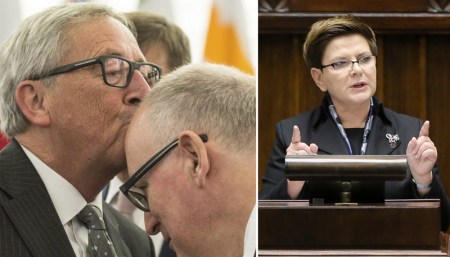
1593The European Commission, led by Jean-Claude Juncker and Frans Timmermans (left), is hell-bent on forcing member states to take “their share” of migrants. In March, Polish Prime Minister Beata Szydło (right) bluntly stated: “I see no possibility at this time of immigrants coming to Poland.”

In Hungary, Prime Minister Viktor Orban’s spokesman, Zoltán Kovács, stated:

“Mr. Timmermans is right that we have not had the same experience as Western Europe, where countries such as Holland, Britain and France have had mass immigration as a result of their colonial legacies. But we would like to deal with our problems in a way that suits us. And we especially do not like it when people who have never lived in Hungary try to give us lectures on how we should cope with our own problems. Calling us racists or xenophobes is the cheapest argument. It’s used just to dodge the issues.”

Even among those Eastern European countries still waiting to be admitted to the EU, the enthusiasm for the EU seems to have dwindled. “The EU that all of us are aspiring to, it has lost its magic power,” Serbian Prime Minister, Aleksander Vucic said in February, “Yes we all want to join, but it is no longer the big dream it was in the past.”

The reactions of countries such as Poland and Hungary are the normal, healthy reactions of nations who wish to remain prosperous, sovereign and safe for the sake of their own citizens. In addition, entertaining no illusions about “multiculturalism,” they appear to have a justifiable apprehension about the detrimental effects of the current migration crisis on national security and finances.

It is not only the newest members of the EU that have begun to realize that is a bad idea to defer decisions about borders and national security to an unelected supranational entity, which appears completely oblivious to the concerns of its member states.

In Norway, the government announced that it will not accommodate any more migrants beyond the 1500 that the country has already agreed to take during the next two years, as part of the EU’s refugee relocation scheme. “We have set a quota for refugees from the EU. Increasing it is not of current interest,” Immigration Minister Sylvi Listhaug said in April. Norway, in fact, has begun paying asylum seekers to return to their own countries.

In Austria, the government is imposing border controls at the Brenner Pass, the main Alpine crossing into Italy, and erecting a barrier between the two countries.

In the face of such resistance from member states, the European Commission’s plan to penalize them for not accepting “their share” of migrants could not possibly be more ill-timed and out of touch. It comes across as a desperate attempt by the EU’s executive body to force its way of handling the migrant crisis onto disobedient EU member states, like an authoritarian parent disciplining its unruly children. There is, however, such a thing as bending something until it snaps. By persisting in pushing their agendas on EU member states that still consider themselves sovereign and not merely provinces of the European Union, Timmermans and his European Commission bureaucrats may just have given the European Union its kiss of death.

Pope Francis Blasts Europe Over Migrants

May 7, 2016

Pope Francis Blasts Europe Over Migrants, Front Page Magazine, Daniel Greenfield, May 7, 2016

02

Sigh.

Europe is struggling to live up to the vision of its founders, Pope Francis has said in a powerful speech that asked: “What has happened to you, the Europe of humanism, the champion of human rights, democracy and freedom?”

Speaking as he became the first pope to accept the prestigious Charlemagne prize for his work on behalf of European solidarity, the pontiff called for Europe to reclaim the principles that had been established after the second world war, above all by embracing integration and revamping its economic model to “benefit ordinary people and society as a whole”.

…Founded in 1950 by Dr. Kurt Pfeiffer, the Charlemagne Prize is “the oldest and best-known prize awarded for work done in the service of European unification,” according to the organization’s website.

Kurt Pfeiffer was a Nazi. There are debates about whether he was a reluctant Nazi or not, but he was certainly a member. Rodney Atkinson has spoken about this in the past, I don’t know that I accept the whole thing, but certainly there are valid questions to be raised here.

The Charlemagne Prize. The prize was originally founded by the Nazis, but was then re-founded in 1949 by the efforts of the Aachen textile merchant Kurt Pfeiffer. Pfeiffer, who had previously been a member of the Nazi Party and of five other Nazi organizations, maintained that he had always tended to be a fundamental believer in Europe. And the Charlemagne Prize Society was to be associated with the imperial idea Reichsidee of the Emperor Charlemagne. The post-war image of Charlemagne as unifier of the Christian west was preceded by his Nazi portrayal as a unifier of the German tribes. Charlemagne had been compared with Hitler, his Reich and Greater Germany. This is clearly exemplified by the career of the Aachen professor of philosophy Peter Mennicken, who took over the professorship previously occupied by an expelled Jew, and who after the war had authorized influence over the symbolism of the Charlemagne Prize and the liturgy of its award ceremonies.

But we’ll skip over to the speech about the ideals of the EU’s founders. Some of whom just happened to Nazi-ish.

He expressed his desire for a Europe “where being a migrant is not a crime but a summons to greater commitment on behalf of the dignity of every human being,” and where youth can “breathe the pure air of honesty” in a culture that is “undefiled by the insatiable needs of consumerism.”

“I dream of fa Europe that promotes and protects the rights of everyone, without neglecting its duties towards all,” he said, and voiced his hope for a Europe “of which it will not be said that its commitment to human rights was its last utopia.”

Except you can’t protect the rights of all. Sometimes you have to choose.

You couldn’t protect German sovereignty and Polish sovereignty at the same time. You couldn’t protect German and French civilians at the same time. You had to make choices. You can’t protect Muslim rights to migrate and the right of the Jewish population of Europe not to be terrorized or murdered.

You have to choose. You have to decide between good and evil rather than providing a fuzzy humanistic picture in which evil does not appear to exist except as selfishness in the face of social justice demands. In which evil is not going along with the latest horrible and disastrous scheme executed at your own expense.

Pointing to French statesman Robert Schuman, the Pope echoed his insistence at the birth of the first European Community that the continent couldn’t be built all at once, but “through concrete achievements which first create a ‘de facto solidarity.’”

Schuman was one of Petain’s ministers. Again, like Pfeiffer, his legacy is complex and mixed, but it’s interesting that so many key EU people are so tainted.

The Pope also stressed the importance of cultural integration, rather than merely resettling foreigners geographically, allowing European peoples to overcome “the temptation of falling back on unilateral paradigms and opting for forms of ideological colonization.”

Francis advocated for a culture of dialogue involving “a discipline that enables us to view others as valid dialogue partners, to respect the foreigner, the immigrant and people from different cultures as worthy of being listened to.”

“Today we urgently need to build coalitions that are not only military and economic, but cultural, educational, philosophical and religious,” he said, and encouraged the leaders to arm their people “with the culture of dialogue and encounter.”

How does the culture of dialogue work within Islam? It’s the old “nice doggie” until you find a big enough rock school of dialogue.

And what does cultural integration mean? It seems to involve listening to Muslim migrants, rather than them listening.

To create dignified, well-paying jobs “requires coming up with new, more inclusive and equitable economic models, aimed not at serving the few, but at benefiting ordinary people and society as a whole,” he said.

“It would involve passing from an economy directed at revenue, profiting from speculation and lending at interest, to a social economy that invests in persons by creating jobs and providing training,” he said, adding that “we need to move from a liquid economy prepared to use corruption as a means of obtaining profits to a social economy that guarantees access to land and lodging through labor.”

An economy is based on profit. A social economy is just a welfare state funded by profitability somewhere. Even Communist countries ended up needing to find a profitable venue. China did really well at it. The USSR was terrible at it and collapsed.

In an actual economy, social mobility and dignity may not be perfect, but they are available. A social economy is just feudalism with more buzzwords and depends entirely on the goodwill of insiders. No one has dignity in a social economy. They have no sense of worth. They depend entirely on charity dispensed by political barons which is stolen from the people who have been enslaved and denied the profits of their work.

Pope Francis closed his speech by voicing his dream for “a new European humanism” based on the welcome for foreigners, care for the poor, and respect for human life and dignity.

You can have two out of three. But if you turn Europe into Pakistan and Saudi Arabia, you’ll eventually have none of the above.

EU: Europeans Must Pay $280K For Each Muslim Migrant they Refuse

May 4, 2016

EU: Europeans Must Pay $280K For Each Muslim Migrant they Refuse, Front Page Magazine, Daniel Greenfield, May 4, 2016

2015-09-09_0134_2

Despite growing opposition, the EU is really doubling down on its aggressive push to distribute Muslim migrants across Europe. This is being described as “fair”, but that’s as fair as your neighbor setting his house on fire and then demanding that you either let him move in with you or he’ll set your house on fire.

Merkel decided to open the doors to any Muslim who wanted to come. Greece chose to pass them along without caring in the least what other countries would suffer. But other countries are supposed to be penalized for Merkel’s bleeding heart.

The European Commission made a proposal on Wednesday to automatically distribute asylum-seekers across the EU from member states overwhelmed by arrivals.

Depending on the number of asylum seekers in the European Union, each country would be assigned a “fair share”, based on the size of its population and economy. Should it face arrivals exceeding 1.5 times the fair share, automatic relocation would start to other EU states until it drops again.

There’s nothing fair about any of this. Nor is it much of a plan because the Muslim migrants have repeatedly said that they want to go to Germany or Sweden. And they want specific cities with large Muslim populations. Trying to send them to Poland won’t work for very long.

Countries could exempt themselves from relocation for one year at a time if they pay 250,000 euros per refugee they would otherwise need to take in to the country that accommodates the person.

The figure is meant to be “dissuasive” and is very high compared to 6,000 euros for every relocated person as offered by the European Commission last year under an emergency relocation plan that was due to cover 160,000 people.

That’s around $280K US. And rather few European countries can afford that. And since Muslim migrants keep coming, the question becomes moot anyway. As countries continue being overwhelmed, the figures will go on being recalculated.

While any reform would only apply mid- to longer-term, a calculation for Poland, the biggest eastern EU state, shows it would have to pay some 1.6 billion euros for fewer than 7,000 people it was assigned – but never took in – under the 160,000 plan.

Of course this isn’t going to shut down anything. It’s just meant to make Germans and some others feel better that other countries will do their “fair share”. It’s a political divide and conquer strategy.

Meanwhile smuggling migrants into Europe is a $7 billion business. And that’s not counting the payoffs that Turkey’s Islamist government will be getting.

The Great Western Retreat

May 4, 2016

The Great Western Retreat, Gatestone InstituteGiulio Meotti, May 4, 2016

♦ Of all French soldiers currently engaged in military operations, half of them are deployed inside France. And half of those are assigned to protect 717 Jewish schools.

♦ This massive deployment of armed forces in our own cities is a departure from history. It is a moral disarmament, before a military one.

♦ Why does anyone choose to fight in a war? Civilized nations go to war so that members of today’s generation may sacrifice themselves to protect future generations. But if there are no future generations, there is no reason whatever for today’s young men to die in war. It is “demography, stupid.”

On March 11, 2004, 192 people were killed and 1,400 wounded in a series of terrorist attacks in Madrid. Three days later, Spain’s Socialist leader, José Luis Rodríguez Zapatero, was elected prime minister. Just 24 hours after being sworn in, Zapatero ordered Spanish troops to leave Iraq “as soon as possible.”

The directive was a monumental political victory for extremist Islam. Since then, Europe’s boots on the ground have not been dispatched outside Europe to fight jihadism; instead, they have been deployed inside the European countries to protect monuments and civilians.

Opération Sentinelle” is the first new large-scale military operation within France. The army is now protecting synagogues, art galleries, schools, newspapers, public offices and underground stations. Of all French soldiers currently engaged in military operations, half of them are deployed inside France. And half of those are assigned to protect 717 Jewish schools. Meanwhile, French paralysis before ISIS is immortalized by the image of police running away from the office of the satirical magazine Charlie Hebdo during the massacre there.

1578French soldiers guard a Jewish school in Strasbourg, February 2015. (Image source: Claude Truong-Ngoc/Wikimedia Commons)

You can find the same figure in Italy: 11,000 Italian soldiers are currently engaged in military operations and more than half of them are used in operation “Safe Streets,” which, as its name reveals, keeps Italy’s cities safe. Italy’s army is also busy providing aid to migrants crossing the Mediterranean.

In 2003, Italy was one of the very few countries, along with Spain and Britain, which stood with the United States in its noble war in Iraq — a war that was successful until the infamous US pull-out on December 18, 2011.

Today, Italy, like Spain, runs away from its responsibility in the war against the Islamic State. Italy’s Defense Minister Roberta Pinotti ruled out the idea of Italy taking part in action against ISIS, after EU defense ministers unanimously backed a French request for help.

Italy’s soldiers, stationed in front of my newspaper’s office in Rome, provide a semblance of security, but the fact that half of Italy’s soldiers are engaged in domestic security, and not in offensive military strikes, should give us pause. These numbers shed a light not only on Europe’s internal terror frontlines, from the French banlieues to “Londonistan.” These numbers also shed light on the great Western retreat.

US President Barack Obama has boasted that as part of his legacy, he has withdrawn American military forces from the Middle East. His shameful departure from Iraq has been the main reason that the Islamic State rose to power — and the reason Obama postponed a military withdrawal from Afghanistan. This US retreat can only be compared to the fall of Saigon, with the picture of a helicopter evacuating the U.S. embassy.

In Europe, armies are no longer even ready for war. The German army is now useless, and Germany spends only 1.2% of GDP on defense. The German army today has the lowest number of staff at any time in its history.

In 2012, Germany’s highest court, breaking a 67-year-old taboo against using the military within Germany’s borders, allowed the military to be deployed in domestic operations. The post-Hitler nation’s fear that the army could develop again into a state-within-a-state that might impede democracy has paralyzed Europe’s largest and wealthiest country. Last January, it was revealed that German air force reconnaissance jets cannot even fly at night.

Many European states slumber in the same condition as Belgium, with its failed security apparatus. A senior U.S. intelligence officer even recently likened the Belgian security forces to “children.” And Sweden’s commander-in-chief, Sverker Göranson, said his country could only fend off an invasion for a maximum of one week.

During the past ten years, the United Kingdom has also increasingly been seen by its allies — both in the US and in Europe — as a power in retreat, focusing only on its domestic agenda. The British have become increasingly insular – a littler England.

The UK’s armed forces have been downsized; the army alone is expected to shrink from 102,000 soldiers in 2010 to 82,000 by 2020 – its smallest size since the Napoleonic wars. The former head of the Royal Navy, Admiral Nigel Essenigh, has spoken of “uncomfortable similarities” between the UK’s defenses now and those in the early 1930s, during the rise of Nazi Germany.

In Canada, military bases are now being used to host migrants from Middle East. Justin Trudeau, the new Canadian prime minister, first halted military strikes against ISIS, then refused to join the coalition against it. Terrorism has apparently never been a priority for Trudeau — not like “gender equality,” global warming, euthanasia and injustices committed against Canada’s natives.

The bigger question is: Why does anyone choose to fight in a war? Civilized nations go to war so that members of today’s generation may sacrifice themselves to protect future generations. But if there are no future generations, there is no reason whatever for today’s young men to die in war. It is “demography, stupid.”

Spain‘s fertility has fallen the most — the lowest in Western Europe over twenty years and the most extreme demographic spiral observed anywhere. Similarly, fewer babies were born in Italy in 2015 than in any year since the state was founded 154 years ago. For the first time in three decades, Italy’s population shrank. Germany, likewise, is experiencing a demographic suicide.

This massive deployment of armed forces in our own cities is a departure from history. It is a moral disarmament, before a military one. It is Europe’s new Weimar moment, from the name of the first German Republic that was dramatically dismantled by the rise of Nazism. The Weimar Republic still represents a cultural muddle, a masterpiece of unarmed democracy devoted to a mutilated pacifism, a mixture of naïve cultural, political reformism and the first highly developed welfare state.

According to the historian Walter Laqueur, Weimar was the first case of the “life and death of a permissive society.” Will Europe’s new Weimar also be brought down, this time by Islamists?