Posted tagged ‘Erdogan’

Turkey: Purge spreads to education sector

July 19, 2016

Turkey to dismiss thousands of deans and educators following attempted coup After firing tens of thousands of military and police officials, judges and lawyers following the unsuccessful coup attempt, Turkey announced that it has now decided to fire thousands of deans and educators from the Turkish education system.

Jul 19, 2016, 7:46PM

Source: Turkey: Purge spreads to education sector | JerusalemOnline

The purge continues. Erdoğan Photo Credit: Reuters / Channel 2 News

The Council of Higher Education in Turkey announced today (Tuesday) that it will be firing 1,577 deans of Turkish academic institution in light of the unsuccessful coup attempt that took place in the country last weekend.

The Turkish News Agency reported that the Council’s announcement followed a Turkish Education Ministry decision, according to which 15,200 educators would be fired. The Ministry claimed that these educators were linked to the conspirators against Turkish President Recep Tayyip Erdoğan.

image description
Official documents were submitted for his extradition. Fethullah Gülen Photo Credit: Reuters / Channel 2 News

The newly fired educators joined the ranks of thousands of military and police officials, as well as lawyers and judges, whom Erdoğan instructed to immediately fire after the attempted coup. The Turkish News Agency also reported that the Turkish Communication Ministry revoked the broadcasting license of television channels that “supported or identified with the conspirators against the regime.”

While the purge campaign in the country deepens, CNN reported that Turkey is also continuing its talks with the US in order to bring about the extradition of Fethullah Gülen, the exiled preacher who Erdoğan claims was behind the coup. Ankara has already submitted official documents to the US as part of the formal request to extradite Gülen, which according to the Turks include evidence that links him to the coup attempt.

Turkish naval ships & choppers reportedly missing since botched coup, Turkey Deputy PM denies

July 19, 2016

Turkish naval ships & choppers reportedly missing since botched coup, Turkey Deputy PM denies

Published time: 19 Jul, 2016 11:11 Edited time: 19 Jul, 2016 13:44

Source: Turkish naval ships & choppers reportedly missing since botched coup, Turkey Deputy PM denies — RT News

FILE PHOTO, Turkish frigate F-495 TCG Gediz. © Wikipedia

Turkey’s navy is still unable to account for 14 ships, while two helicopters with 25 special forces troops are also missing since an unsuccessful coup plot against the government. However, Deputy PM Numan Kurtulmus has denied any naval vessels are unaccounted for.

With suspicions growing that the commanders of the vessels could have been behind a coup plot against the Turkish government and are now seeking asylum at Greek ports.

The ships were on duty in either the Aegean or the Black Seas on Friday before the coup to oust President Recep Tayyip Erdogan took place. However, they have failed to return to port, though in theory radar and satellite tracking technology should be able to determine their locations, according to a report in the Times newspaper.

Read more

A Turkish F-16 fighter jet © Murad Sezer

It is believed that the ships could be heading towards Greek ports.

The Turkish deputy prime minister, Numan Kurtulmus, has dismissed reports that any naval vessels have gone missing. However, he did not give any further details as to their current location.

Eight Turkish military officers have already sought asylum in Greece after landing in the country on Saturday, where they were subsequently arrested.

The Turkish ambassador to Greece, Kerim Uras, has told the Greek authorities that the soldiers who fled to Greece will have a “fair and transparent trial in Turkey.”

He added that if the soldiers are not returned Turkey, this would not help bilateral relations between the two countries.

Meanwhile, the fate of the commander of the Turkish Navy Admiral Veysel Kosele, who has not been heard from since the attempted coup took place, is still unknown. It is also unclear if he took any part in the action against the president or whether he is being held against his will.

According to reports within the Turkish media, Admiral Kosele was tricked onto his ship by those supporting the coup who told him that a terrorist attack was taking place.

Two helicopters and 25 Special Forces troops are also missing since the failed coup, according to a report by the Hurriyet newspaper. It was reported that they were heading for a raid to target Erdogan in Marmaris, where he was enjoying a vacation.

A spokesman for the Turkish president said on Tuesday that 14 soldiers have been detained over the attempted attack on the head of state, but some of the group are still at large, Reuters reports.

Read more

© Medya Gundem

The EU and NATO both said they do not know anything about the missing vessels or planes, the chief spokesperson for the European Commission, Margaritis Schinas, told journalists on Tuesday. Meanwhile, the Greek Defense Ministry says it is unaware of any Turkish ships that have tried to enter its ports following the attempted coup.

“We are looking out for every ship. We had information from talks that took place that at one point they wanted to enter Greece’s territorial waters. However, this did not happen,” a source told RIA Novosti.

The most senior military figure to be arrested since the coup, General Akin Ozturk, the former air force chief, has already appeared in court. He has denied being the mastermind behind the plot.

Meanwhile, a purge of various Turkish government institutions has been taking place following the failed coup d’etat. Prime Minister Binali Yildirim says 7,543 people have so far been detained, including 6,038 soldiers. A court also remanded 26 generals and admirals in custody on Monday.

A senior security official told Reuters that 8,000 police officers, including in the capital, Ankara, and the biggest city, Istanbul, had been removed from duty.

About 1,500 Finance Ministry officials had been suspended, a ministry official said, and CNN Turk said 30 governors and more than 50 high-ranking civil servants had been dismissed. Annual leave was suspended for more than 3 million civil servants, while close to 3,000 judges and prosecutors have been suspended.

Winner Takes All: Erdogan Overcomes Coup Attempt

July 17, 2016

Winner Takes All: Erdogan Overcomes Coup Attempt, Clarion Project, July 16, 2016

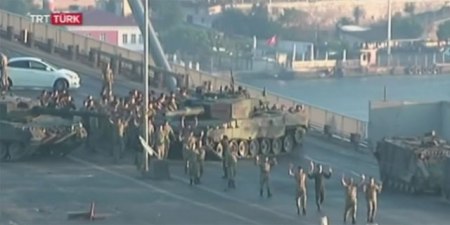
Turkish coup soldiersTurkish soldiers who had attempted a coup surrender on Bosphorus bridge (Photo: Video screenshot)

With U.S. President Obama and NATO leaders praising Erdogan and needing to maintain Turkey’s alliance in the region, the statements made by the leaders of the coup served as futile attempts to bring actual democracies to their side.

Most likely, [Edrogan] will introduce “emergency” measures to prevent any further attempts, which in reality will give his party uninterrupted reign for years to come.

************************

Turkey has just witnessed one of the fastest and strangest attempted coup d’etats in history. And it has failed.

Nearly 3,000 soldiers, including two high-level generals, have been arrested and 2,700 judges fired, as the government begins to clamp down on those it suspects of having links to the attempted coup, which officials say left 265 people dead (161 civilians and 104 accused of plotting the coup).

Of all the details that we may never know about what actually happened last Friday night, only one thing is certain: Turkish President Recep Tayyip Erdogan  — Turkey’s top leader and head of the ruling Islamist AK Party, a known extremist, suppressor of free speech and human rights, and grand supporter of the Muslim Brotherhood and Hamas — has emerged as the ultimate winner.

The attempted coup began Friday night when factions of the military set up blockades of bridges in Istanbul and began a takeover of the Parliament building in Ankara as well as the government’s main news station.

The military faction behind the coup stated that “the Turkish people want their democracy back.” Opposition groups throughout Turkey have consistently been critical of Erdogan’s increasingly authoritarian government which has stripped the country of many democratic and secular freedoms, including free speech, free press and religious tolerance.

Those behind the coup cited increasing human rights violations by Erdogan and his ruling AK Party as justification for the attempted takeover and pledged that “all existing foreign relations will continue.”

Initial reports about the coup showed a peaceful military transition and takeover with few casualties.  Understanding the sitting government’s influence over media in the country, coup leaders took control of the state-run news station to ensure the truth about the takeover was reported rather than government propaganda.

Speaking to RT, Sreeram Chaullia from the Jindal School of International Affairs, also cited the deteriorating security situation as an impetus for the coup. “A series of terrorist attacks signal the inability of the Turkish government to stop these attacks. It has angered some sections of the security establishment that believe that they can do a better job because Erdogan is just playing politics with everything,” he said.

Chaullia sited Erdogan’s mishandling of the war in Syria and Iraq and its impact on Turkey as well as his vicious on-going attacks on the Kurds. In addition, Erdogan has managed to antagonize both Russia and Iran.

Shocking reports have also surfaced proving Erdogan’s support of the Islamic State.

Erdogan made two crucial moves in the first hours of the coup: First, he cut off civilian access to all social media sites, and second, even before rescuing his officials in the parliament building, he immediately sent an F-16 to take out the coup forces at his government news station.

After Erdogan regained control of the media, the news quickly shifted to the story that “the people love their leaders and Erdogan,” “they reject the coup” and the coup was perpetrated by “a small terrorist cell within the military that will be crushed.”

Of course, we will never know the true story of what occurred in Turkey on July 15, 2016. The coup was doomed to failure, however, even if it had a large support of the people whose voices have been stifled in Turkey under Erdogan’s regime. With U.S. President Obama and NATO leaders praising Erdogan and needing to maintain Turkey’s alliance in the region, the statements made by the leaders of the coup served as futile attempts to bring actual democracies to their side.

It is no surprise that those who may have cheered at a successful takeover now claim to have be in support of the government, as it is clear that any dissident voices in Turkey will be violently silenced.

Although Turkish cleric and Erdogan-rival Fethullah Gulen is being blamed for the coup, he claims to have had no part in it.  He also says that the coup could have been a government “show” to further a political strong-arm of the U.S.

Gulen’s movement, Hizmet, began creating a parallel state inside Turkey in the 1970s through a network of schools, media outlets and businesses and recruitment of supporters in the security services and government.  His movement is widely credited with paving the way for the Islamist Justice and Development Party to take power electorally in 2002. However, Gulen and the AK Party had a falling out afterwards.

Gulen fled to the U.S. in 1999 when the Turkish government planned to prosecute him for allegedly trying to undermine the secular nature of the state. The Islamist government of Turkey acquitted him of those charges in 2008.

Erdogan has used the “Gulen excuse” in the past to purge the military and justice system of his supporters who were many.

Whoever was behind the coup, Erdogan will benefit enormously from this attempt takeover while a small number of his military will pay for it. In fact, it serves Erdogan very well. He gets rid of rebels within, consolidates his power and eliminates any and all opposition in the parliament.

The attempted coup will give Erdogan all the power he has been trying to wrench for himself over the past number of years. He can now complete his purge of the army, police and justice system and replace all those he doesn’t trust with loyalists.

Most likely, he will introduce “emergency” measures to prevent any further attempts, which in reality will give his party uninterrupted reign for years to come.

Erdogan will be more in control than ever. Who, after all, will oppose him after he demonstrated his strength (helped by his Islamist backers who took to the streets to lynch opposition soldiers)?

One could say he is now invincible.

Desperate people do desperate things.  For a country whose jails are filled with citizens who disagree with their president’s leadership, one must wonder if a military coup – however feeble — was the only thing they could do to show the world they are not OK with oppressive, Islamist rule.

Breaking !Turkey coup: military attempt to seize power from Erdogan as low flying jets and gunfire heard in Ankara and bridges across Bosphorus in Istanbul closed

July 15, 2016

Live Turkey coup: military attempt to seize power from Erdogan as low flying jets and gunfire heard in Ankara and bridges across Bosphorus in Istanbul closed

Source: Turkey coup: military attempt to seize power from Erdogan as low flying jets and gunfire heard in Ankara and bridges across Bosphorus in Istanbul closed


  • Coup attempt by parts of Turkish military against Erdogan
  • PM Yildirim: Nothing will harm Turkish democracy
  • Low flying jets and gunfire heard in Turkish capital
  • Both of Istanbul’s bridges across the Bosphorus closed

Auto update

9:55PM

Turkey’s currency plummets

Turkey’s currency has suffered its heaviest fall in two months as investors took fright at a coup by the country’s military, Ben Martin reports.

The lira plunged as much as 3.8pc to 2.9901 against the dollar as money managers took fright at reports Turkey’s army had taken control of Ankara, the capital.

US Treasuries, a classic safe-haven investment, were in demand on Friday evening, with yields on American debt falling four basis points to 1.552pc. Bond yields move inversely to prices.

Timothy Ghriskey, of Solaris Asset Management, told Bloomberg: “The financial markets react very quickly to headlines like these, and it’s all about reducing risk.”


9:53PM

All flights from Istanbul’s Ataturk airport reportedly cancelled

All flights from Istanbul’s Ataturk Airport have been cancelled, a Reuters witness said on Friday, citing a pilot, after the military said it had taken control of the government.

Turkish soldiers block Istanbul's Bosphorus Brigde on July 15, 2016 in Istanbul, Turkey. Istanbul's bridges across the Bosphorus, the strait separating the European and Asian sides of the city, have been closed to traffic
Turkish soldiers block Istanbul’s Bosphorus Brigde on July 15, 2016 in Istanbul, Turkey. Istanbul’s bridges across the Bosphorus, the strait separating the European and Asian sides of the city, have been closed to traffic Credit: Getty


9:44PM

Turkey’s top general ‘held hostage’

Reports on Turkish state news agency that the country’s top general ‘held hostage’ at military HQ.

9:42PM

Reports of clashes between police and army

Dorian Jones a British journalist based in Istanbul said:

“Tanks are seen in the streets. There are reports of clashes between the police and the army,” he told Sky News, adding there were also reports that police guarding the presidential palace had been disarmed.

“I have been speaking to various friends across the city, some are reporting that they are hearing gunfire in the streets.”

9:34PM

Turkish military claims to have overthrown Erdogan and taken control of country

In a statement, the Turkish military says the rule of law must remain the priority.

“The power in the country has been seized in its entirety,” said the military statement read on NTV television, without giving further details. The military’s website was not immediately accessible.

State TV TRT reportedly off the air.

tanks


9:28PM

Military jets over Istanbul

https://twitter.com/RudawEnglish/status/754045281214300160/video/1

9:28PM

Tanks on the streets of Istanbul

https://twitter.com/Ayyinemikeder/status/754046084805173248/video/1


9:27PM

‘The army are taking over everything’

Gabriel Turner, 23, a management consultant from north London, is on holiday in Istanbul and described how there had been heavy police and security presence throughout the day before the military coup got underway after sunset.

He told The Telegraph:

“Earlier today there were police everywhere. I thought that was normal but the two Turkish girls I was with told me  it wasn’t normal. We were walking around the centre of Istanbul, at the Grand Bazaar there were police at every entrance and exit with lots of guns.

“A police helicopter was flying very low  at sunset, it was about 8pm. It looked like it was searching for something. Later on, at about 10.30 I was in Karakoy, a bar area in the city centre and everyone started looking at their phones. A man who owns the bar told us that the army are taking over everything.

“Then we walked down towards the a quieter area by the sea. While we were walking, my friend said the army had closed brides across the Bosphorus. We could see army helicopters in the sky.

“We went inside a cafe and everyone was on their phones looking worried, texting. Lots of people were running to catch a ferry – because the bridges were shutting and people wanted to get home. Then policemen came out of the ferries on their walkie talkies, looking very alert.”

9:20PM

Turkish broadcaster NTV shows tanks at Istanbul Ataturk airport


Lots of flight delays:


9:16PM

Twitter, Facebook and YouTube reportedly blocked in Turkey

 https://twitter.com/TurkeyBlocks/status/754043966547431424?ref_src=twsrc%5Etfw


9:07PM

“Attempt by part of muilitary’

Yildirim says “it would be wrong to call it a coup” but that there has been an attempt by “part of the military”.

He describes it as an “illegal attempt” to seize power.

Turkey would never allow any “initiative that would interrupt democracy”, he said, and promised the perpetrators “will pay the highest price”.

9:05PM

Turkey’s PM Yildirim: Nothing will harm Turkish democracy

Binali Yildirim has called for calm.

9:03PM

Update from Istanbul

The Bosphorus and Fatih bridges were closed by the gendarmerie – a branch of the Turkish military dedicated to internal security – for traffic travelling from Asia to Europe, NTV television said. Traffic was still moving in the other direction.

Meanwhile, Turkish military aircraft were heard flying low over Ankara, AFP correspondents in the capital also reported. There was no immediate explanation for the cause of the incidents.

9:02PM

Rumours that Turkey has declared martial law on Twitter

All unconfirmed at this stage.

Something going on in Turkey? Twitter chatter/rumor of martial law … and ETF just fell nearly 3% in a matter of minutes. Crazy times.


8:59PM

Lack of information coming out of Turkey


8:56PM

Gunfire heard in Turkish capital Ankara

Gunshots were heard in the Turkish capital of Ankara on Friday, a Reuters witness said, as military jets and helicopters were seen flying overhead.

Reuters witnesses in Istanbul, Turkey’s biggest city, also spotted helicopters overhead.

Broadcaster NTV reported that both of Istanbul’s bridges across the Bosphorus, the strait separating the European and Asian sides of the city, had been closed to traffic.

It was not immediately clear if the events were related.

More to follow

Anger, Honor and Freedom: What European Muslims’ Attack On Speech Is Really About

June 30, 2016

Anger, Honor and Freedom: What European Muslims’ Attack On Speech Is Really About, Investigative Project on Terrorism, Abigail R. Esman, June 30, 2016

1052

Indeed, much of the Muslim violence in Europe is about exactly this: intimidating non-Muslims into a fearful capitulation, where words like “I hate Muslims” and drawings of Mohammed become extinct because the Muslim communities insist that it be so. It is about forcing Westerners to rearrange their lives, their culture, to accommodate the needs and values and culture of Islam. It is about control, and the power over freedom. And it is about creating a culture in which honor is injured by words and restored through violence and terror.

**********************

“Clash of civilizations,” some say. Others call it the “failure of multiculturalism.” Either way, the cultural conflicts between some Muslims and non-Muslims worldwide continue to play out as Western countries struggle to reconcile their own cultures with the demands of a growing Muslim population.

But herein lies the problem: in many ways, the two cultures are ultimately irreconcilable. There is no middle ground. And hence, the conflicts and the tugs-of-war continue.

Over the past two months, the events surrounding controversial Dutch columnist Ebru Umar have encapsulated that “clash” at its core, a salient metaphor for the tensions, particularly in Europe, between the West’s Muslim populations and its own. More, they illuminate the enormity of the problems we still face.

Umar is no stranger to the spotlight, or to the wrath of Dutch Muslims who read her many columns, most of them published in the free newspaper, Metro. For years, the Dutch-born daughter of secular Turkish immigrants has raged against the failure of other Dutch-born children of immigrants, mostly Moroccan, to assimilate into the culture of their birth. She loudly condemns Dutch-Moroccan families for the shockingly high rates of criminality and violence among Dutch-Moroccan boys – as much as 22 times the rate of Dutch native youth – a phenomenon she ascribes to their Islamic upbringing and their parents’ refusal to allow their children to mingle among the Dutch.

But her critiques have earned her no converts. Instead, Dutch-Moroccan youth, whom she calls “Mocros,” have regularly taunted her, both online and in the street.

This past April, however, Umar added a new team of enemies to her portfolio: when, in response to Turkish president Recep Tayyip Erodogan’s demand that a German satirist be prosecuted for insulting him on TV, Umar tweeted “f***erdogan,” Dutch Turks turned on her in fury. “How dare you insult our president!” cried these Dutch-born subjects of Holland’s King Willem-Alexander. And while Umar took a brief holiday on the Turkish coast, one such Dutch-Turk turned her in to the police. She was arrested at her vacation home in Kusadasi, and though released the following day, was forbidden to leave the country. The charge: Insulting the Turkish president. It took 17 days before discussions between Holland’s prime minister and Turkish authorities enabled her to return to the Netherlands.

But she could not return home. In her absence, Umar’s home had been burgled and vandalized, the word “whore” scrawled on a stairway wall. Death threats followed her both in Turkey and on her return. When it became clear she could not ever return to the apartment she had lived in for nearly 20 years, she announced on Twitter (Ebru Umar posts constantly on Twitter) that she would be moving out.

Meantime, in Metro and elsewhere, she continued her criticism of Moroccans and, as she herself notes, of Islam overall.

And so it was that on the day Ebru Umar moved out of her apartment in Amsterdam, a group of Dutch-Moroccans in their twenties came to see her off, taunting her with chants: Ebru has to mo-o-ve, nyah nyah.” Though furious, she ignored them – until one of them began to film her loading her belongings into her car. For Umar, being taunted by the very people whose threats had forced her from her home in the first place was bad enough: but this violation of what little privacy remained for her was more than she could take. She grabbed her iPhone and began filming them right back. “Go ahead,” she challenged. “Say it for the camera.”

Scuffles ensued, and soon one of the Moroccans had her iPhone in his hand. The others laughed. Then they ran away. Umar filed a police report and, still smarting, took to Twitter once again: “C**t Moroccans, I hate you,” she posted. “I hate you, I hate you, I hate you, I hate you and I hate your Muslim brothers and sisters, too. F**k you all.” (It is important to note that, however offensive, the expression “c**t Moroccans” is a common epithet in the Netherlands.)

But, hey – she was angry. Her phone had been snatched from her hand in a brutal, aggressive gesture that left her feeling violated and, vulnerable. She had just been forced to leave her home. She had endured prison, a criminal inquiry, and death threats, all at the hands of the same group on whom she now spewed her fury.

Her words may have been harsh or inappropriate, but they were words. She had not struck her tormenters as they filmed her. She did not call for their demise, or strap a bomb around her waist and visit the local mosques.

She took to Twitter and said: I hate you.

“But hate,” she tells me later in an e-mail, “is just an emotion.” And in a column penned more than two years ago, she observed, “Hate me till you’re purple, but keep your claws off me.”

Here is where Ebru Umar’s story becomes the story of the Western world. In response to her words (“I hate you. F*** you”), several Muslims – Moroccans and others – filed charges against her for hate speech. (Though ironically, “I hate you” does not legally qualify as “hate speech.”) Such words are an attack upon their honor, a humiliation: and if there is one thing experts on Arab and Muslim culture will agree on, it is the significance of humiliation and honor in governing their lives. For this, Dutch Moroccan youth threaten Umar on the streets, and have done so, she says, for years: after all, she insults them.
1664

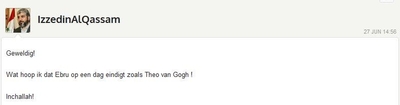
But in truth, it isn’t just the youth. The broader Muslim community stands by, silent: they do not condemn the youth who taunt her, who rip her telephone from her hands, or post things on the Internet like “We hate you, too – can you please kill yourself?” or “Oh, how I hope she ends up like Theo van Gogh.”

Theo van Gogh, also a controversial columnist, was shot and stabbed to death in 2014 by a radical Dutch-Moroccan Muslim.The commenter wishing her the same fate used the name “IzzedinAlQassam,” the founder of modern Palestinian jihad, and an icon of Hamas leader Khaled Meshaal.

For people like this, it doesn’t matter that Umar – or van Gogh – inflicted no violence, any more than it mattered that the editors of Charlie Hebdo were not violent. It was the insult, the humiliation – to them, to Islam, to Mohammed – that mattered: and an insult, a humiliation, deserves a violent response.

Indeed, much of the Muslim violence in Europe is about exactly this: intimidating non-Muslims into a fearful capitulation, where words like “I hate Muslims” and drawings of Mohammed become extinct because the Muslim communities insist that it be so. It is about forcing Westerners to rearrange their lives, their culture, to accommodate the needs and values and culture of Islam. It is about control, and the power over freedom. And it is about creating a culture in which honor is injured by words and restored through violence and terror.

When Umar says “I hate you,” what she hates, really, isn’t the Moroccans who attacked her or their “Muslim brothers and sisters.” What she hates is this – this effort, this battle over honor and speech and freedom, and this clash between violence and expression, guns and conversation.

“I don’t want Muslims to leave,” she tells me, again by e-mail. “I want them to embrace the Enlightenment, Western society, the Netherlands.” And in turn, she calls on the Dutch to “set rules: no violence in any sense. And stop using culture or religion as an excuse for behavior.”

Ebru Umar’s words. More of us should listen.

Israeli-Turkish accord: core of new lineup vs Iran

June 28, 2016

Israeli-Turkish accord: core of new lineup vs Iran, DEBKAfile, June 27, 2016

(Please see also, Israel and Turkey restore relations – peace in our time? — DM)

Turkey_Israel480

The reconciliation agreement announced Monday, June 27 for restoring full normalization between Israel and Turkey after six years of animosity will restart intelligence and security cooperation between the two countries and entail joint military exercises, and investments in energy and defense.

DEBKAfile’s security experts evaluate the deal as offering a valuable and timely increment for Israeli’s national interests on eight scores:

1. It fits neatly into the current joint Saudi-Egyptian bid for Israel to bolster their emerging alliance with Turkey that is designed for drawing a Sunni line against Iran’s expansionist moves in the Horn of Africa, the Red Sea, the Straits of Aqaba and in uncomfortable proximity to the Mediterranean shores of Israel and Egypt.

2. It is designed as the forerunner of a series of interlocking deals. DEBKAfile can disclose that the next bilateral accord expected to be concluded is a reconciliation agreement between Turkey and Egypt for Presidents Recep Tayyip Erdogan and Abdel-Fatteh El-Sisi to bury the hatchet. In at least one respect, this ont will be modeled on the Turkish deal with Israel: Turkey is committed not to let Hamas act against Israel from its soil and, by the same token, not to permit Hamas’s parent and El-Sisi’s archenemy, the Muslim Brotherhood, operate from Turkey.

3. In this regard, Egypt and Turkey will maintain intelligence cooperation.

4. The bilateral intelligence mechanisms to be set up between Turkey and Israel and Turkey and Egypt will pool their input on Iran.

5.  This key aspect of the renewed cooperation between Ankara and Jerusalem lends it a military-intelligence dimension rather than that of a diplomatic protocol. This dimension finds expression in the decision to devolve its implementation not on the holders of political office but the heads of the military-intelligence services of the two countries.

IDF Chief of Staff Lt. Gen. Gady Eisenkot, to whom the head of military intelligence defers, will in fact be in charge of these exchanges, as well as the joint military exercises which are in the active planning stage.

Realizing he had been passed over for this important facet of cooperation with Turkey, Israel’s new defense minister Avigdor Lieberman announced he was opposed to the deal. This was treated as no more than a token protest that will not impede it.

6.  Jordan has been slated as another member of the new alliance. King Abdullah is currently in the process of quietly dismantling the Muslim Brotherhood networks in his kingdom. Many of is members belong to the Palestinian Hamas.

7.  Under the agreement, Israel and Turkey will begin formal talks to build a gas pipeline between the two countries, through which Israel might sell its natural gas, with Turkish assistance, to Europe.

DEBKAfile rates this provision as fundamental to the entire process and of cardinal importance to both their interests. Israel is in need of a major client to boost the development of its offshore gas fields, whereas Turkey wants to be that client and, at the same time, Russia is after a piece of the energy bonanza and most of all a contract to build the pipeline to Europe.

Up until recently, Israel put up a keep out sign for Moscow, mainly under pressure from Washington. But in recent months the conversations between Binyamin Netanyahu and Vladimir Putin have progressed into an inclusive strategic dialogue on Middle East issues, especially on Syria. This opened the door to a Russian role being broached in the export of Israeli gas.

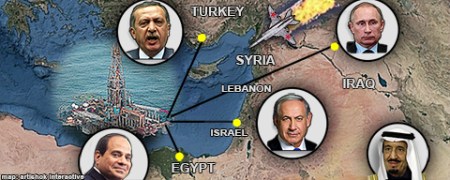
8. This role took another step forward Monday. On the table now is Israeli-Turkish-Russian military and intelligence collaboration for securing the Israeli offshore gas in the Mediterranean – a prospect that brought the Turkish president to finally apologize for his air force downing a Russian Su-24M bomber over the Syrian-Turkish border on Nov. 24, 2015.

For the sake of these promising relations, Turkey was ready to offer compensation in the case of the dead pilot, just as Israel agreed to pay compensation for the nine Turks killed in a clash with Israeli troops during an illicit attempt too breach Israel’s blockade of the Gaza Strip.

Israeli-Turkish-Russian cooperation and goodwill for their mutual benefit on the gas issue may also generate joint efforts in other spheres too.

Brexit – Backlash from mass migration and ISIS

June 25, 2016

Brexit – Backlash from mass migration and ISIS. DEBKAfile, June 24,2016

BREXIT_23.6.16

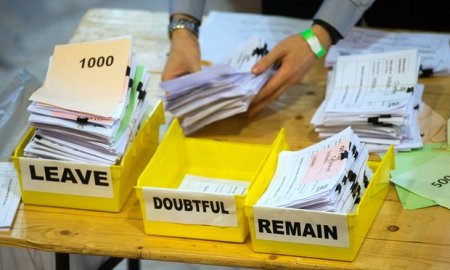
In a historic referendum, millions of British citizens voted Thursday, June 23, to leave the European Union after 43 years by a margin of 52 to 48 percent. Many were undoubtedly moved into approving this pivotal step by three seismic world events:

1. The mass migration flowing into Europe from the Middle East and Africa under the EU aegis. Forebodings in the UK were fueled by figures released a week before the referendum showing an influx of 330,000 migrants to Britain in 2015.

2. The war on the Islamic State which poses a peril which most Western governments avoid addressing by name as World War III in the making.

3. The inability of those governments, beyond empty words, to grapple with the war on ISIS or cope with the  mass of migrants expected to beat on the gates of Western societies for many more hard years.

Many Americans and Europeans are dissatisfied and resentful of President Barack Obama’s approach to the war on ISIS, which is to dismiss the enemy as a minor band of fanatics and thus, rather than a war against Islam. Neither do they accept German Chancellor Angela Merkel’s magnanimous invitation to take refugees in – 1.5 million in two years – as her country’s moral responsibility.

This popular disgruntlement has thrown up such antiestablishment figures as Donald Trump in the US and Boris Johnson in Britain and contributes to the rise of far right-wing movements and extremist violence on both continents.

Those two leaders, though different in most other ways, owe much of their popularity to the pervasive fear in their countries that surging immigration will forever alter the fabric of their societies.

Such social upheaval is the result of a trap deliberately set for the West by two Muslim leaders: ISIS “caliph” Abu Bakr al-Baghdadi, and Turkish President Tayyip Reccep Erdogan.

Al-Baghdadi conceived the idea of flooding the western world with waves of immigrants from Africa and the Middle East as a way to achieve three targets:

a) To change the composition of the population of Western countries by expanding the Muslim increment.

b) To plant networks of ISIS terrorists in the West.

c) To boost ISIS Middle Eastern arms, people and drugs smuggling networks as the organization’s main source of income. Migrants are willing to pay an average of between 5,000 and 10,000 dollars to reach the West even though they know that many never make it alive.

Al Baghdadi made up for the revenue shortfall caused by the US bombing of ISIS-held oil fields and money reserves by pushing over a new wave of immigrants.

President Erdogan’s motives are quite different.

He allowed the waves of immigrants to pass through Turkey on their way to the US and Europe – just as for years, he allowed Western jihadists joining ISIS to reach Siria via Turkey – because he was consumed with the desire to punish the US, namely, the Obama administration, for refusing to back up his hegemonic aspirations in the Middle East; Europe was punished for denying Turkey EU membership year after year.

The victory of Boris Johnson’s “leave” campaign – in the face of Obama’s personal championship of Prime Minister David Cameron’s bid to keep his country in, supported by the Democratic presumptive nominee Hilary Clinton – was a loud and clear signal for politicians running in future elections in the West, including the US presidential vote in November.

Republican candidate Donald Trump’s call to stop Muslim immigration into the US until proper screening measures are in place may sound like an unformed idea, but no other US politician has dared put it on the table, or directly challenge the hollow words and self-righteous hypocrisy of Obama and Clinton on the issues of terror, wars in the Middle East and mass immigration. This alone gives Trump a popular edge in widening circles in the USA over his rival.

Trump is not likely to lose votes either by his pledge to rebuild NATO for leading the West in the war against Islamic terror.

During the five months up until the US presidential election, the West can expect more large-scale ISIS terror coupled with dramatic events in the wars raging in at least seven countries  – Iraq, Syria, Lebanon, Jordan, Egypt, Libya and Afghanistan. Refugees in vast numbers will continue to batter down the doors of countries that are increasingly unable and unwilling to accept them.

Wars in general and religious wars in particular, have throughout history thrown up massive shifts of population displaced by violence, plague, falling regimes, famine and economic hardship.

The year 2016 will go down as the year in which Middle East crises spilled over into the west, bringing social change and far-reaching political turmoil in their wake.

And this is only the beginning.

Erdogan: Infidels “good for nothing. They try to destroy our Islamic values.”

June 3, 2016

Erdogan: Infidels “good for nothing. They try to destroy our Islamic values.”

ByPamela Geller on June 2, 2016

Source: Erdogan: Infidels “good for nothing. They try to destroy our Islamic values.” | Pamela Geller

It is very telling that Obama has called Turkish President Recep Tayyip Erdogan his “most trusted” and “favorite” foreign ally.

Obama has even asked Erdogan for advice on how to raise his daughters. Does he ask him for advice on how to treat infidels?

https://youtu.be/231d9XQGxGk


Turkey recalls Ambassador from Germany after Armenian genocide recognition

June 2, 2016

Turkey recalls Ambassador from Germany after Armenian genocide recognition The German Parliament recognized officially the Armenian massacres as genocide and this created a political tsunami. Turkey has now announced that they are recalling their ambassador from Berlin for consultations.

Jun 2, 2016, 4:09PM

Rachel Avraham

Source: Turkey recalls Ambassador from Germany after Armenian genocide recognition | JerusalemOnline

Archives Photo Credit: Reuters/Channel 2 News

Shortly after Germany decided to recognize the Armenian massacres as genocide and caused much anger in Turkey, the Turkish government instructed to recall their ambassador from Berlin in order to hold consultations.

“The one who is responsible for the decision is the racist Armenian lobby in Germany,” Turkish Prime Minister Binali Yildirim stated. The Turkish Foreign Minister also stated that the German decision is “irresponsible and baseless.”

On the other hand, German Chancellor Angela Merkel stated that relations between Germany and Turkey are strong and good, stressing that there has been no change regarding German policy towards Turkey.

Earlier today, Turkish President Recep Tayyip Erdogan warned German Chancellor Angela Merkel that the decision will have consequences, even if it is a symbolic decision. Ankara is opposed to various governments around the world classifying the Armenian massacres during World War II as genocide. A Turkish government spokesman stated that the German decision was a “historic mistake.”

Erdogan Revs Hate Between Muslims and Turkey’s Minorities

June 1, 2016

Erdogan Revs Hate Between Muslims and Turkey’s Minorities, Clarion Project, William Reed, June 1, 2016

ErdoganPortrait-IP_2Turkish President Recep Tayyip Erdoğan (Photo: © Reuters)

On May 28, Turkish President Recep Tayyip Erdogan visited the predominantly Kurdish city of Diyarbakır and delivered a public speech in which he targeted Kurds requesting official recognition and the right to self-rule, calling them “atheists” and “Zoroastrians.”

In an attempt to appeal to Islamist sentiment, Erdogan claimed that Kurdish militants had burnt down schools and mosques, stating, “They are atheists, they are Zoroastrians. They are useless. They have not and are not acting with our values.”

This was not the first time Erdogan targeted non-Muslims in his public speeches.

In February, 2014, in the city of Balikesir, Erdogan, then prime minister, referred to the students of the Middle East University in Ankara, as “atheists” and “terrorists.” The students had protested the construction of the “1071 Manzikert Boulevard,” to which the police responded with gas bombs and pressurized water.

“On Monday, we opened the boulevard built by our metropolitan municipality of Ankara,” said Erdogan. “Despite whom? Despite those leftists! Despite those atheists! They are atheists! They are terrorists!”

The Battle of Manzikert was fought in 1071 in Anatolia between the Byzantine Empire and the Seljuq Turks, which marked the beginning of the Islamic invasion of Anatolia. The defeat of the Byzantine army and the capture of the Emperor Romanos IV Diogenes paved the way for the gradual Turkification and Islamization of Anatolia and Armenia.

Erdogan bashed the university students in his own unique way: “What is the name of the boulevard? Manzikert 1071. One of them was wearing Byzantine clothes. Alp Arslan [the Sultan of the Seljuq Empire] fought against Byzantium. So he [the student] put himself in the position of Byzantium. Shame on you!”

Apparently, Erdogan knows the easy and certain way of getting votes from much of Turkish public: Target any non-Muslim community – Jews, Christians, atheists, Alevis, Zoroastrians, you name it – and get the votes of millions of people, those who might not even know anything about the said religions or people but whose overall hatred for the “infidel” would be enough to make them enjoy the hate-filled slurs.

In May 2015, in the predominantly Kurdish city of Batman, Erdogan once again publicly targeted the secular, pro-Kurdish Peoples’ Democratic Party (HDP) – for “having nothing to do with Islam.”

“They say they will abolish Diyanet [Turkey’s Presidency of Religious Affairs]. They have nothing to do with religion. The Diyanet that they say they will abolish has published the Kurdish translation of the Koran.

“They [the HDP party] go to extremes by saying that Jerusalem belongs to Jews. They have nothing whatsoever with Islam. Jerusalem is the most important Kaaba [sacred site] of Muslims; it is where we found life.

“We have documents that in the mountains, they [the PKK] give education of the Zoroastrian religion.”

Despite the hateful stigma of Erdogan regarding Zoroastrianism, it is an ancient faith of peace, ethics and wisdom. Basic tenets of Zoroastrians include:

“The basic moral principles that guide the life of a Zoroastrian are three: Humata, ‘Good Thoughts’, Hukhata, ‘Good Words’, and Havarashta, ‘Good Deeds’.

“These three principles are included in many Zoroastrian prayers, and children commit themselves to abide by them at their initiation ceremony, marking their responsible entry into the faith as practicing Zoroastrians. They are the moral code by which a Zoroastrian lives.”

Sadly, this ancient, peaceful religion has become one of the greatest victims of Islamic jihad.

Before Iran (formerly called Persia) was invaded by Muslim armies in the 7th century, Zoroastrianism was the major religion there. Founded by the Prophet Zoroaster, Zoroastrianism was the state religion of several Persian empires.

Muslims should actually feel guilt and shame in the face of the enormous damage and destruction they have brought to the Zoroastrian people, but the Islamist ideology seems to erase even the most humane emotions of its followers.

Another social disease commonplace in Turkey is “atheophobia” ‎– fear or hatred of atheism or atheists.

The 2015 Freedom of Thought Report by the International Humanist and Ethical Union (IHEU) puts Turkey in the category of countries which expose their citizens who identify as atheists or non-religious to “severe discrimination.”

“Freedom of expression is theoretically protected by the current constitution, but is increasingly not respected in practice,” said the report. “Identifying [as an] ‘atheist’ prompts insults, threats, discrimination.”

In 2015, for instance, members of the Turkish Atheism Association (Ateizm Derneği), spoke up about receiving death threats and hate mail, and how “atheist”  is used as an insult or equated with “Satanism” or “terrorism.”

“The term ‘atheist’ is used as a harsh insult – one of the harshest in the country,” said Morgan Romano, vice-president of the Turkish Atheism Association, at the group’s first public conference in Germany.

“Furthermore, atheists are commonly and publicly discriminated against and are subjects of public and private hate speech in Yeni Turkiye [the New Turkey] all the time.”

In March, 2015, the Atheism Association had its website blocked in Turkey in a decision the association protested was “arbitrary.”

Given the Islamic roots of hatred for infidels, it seems that the Atheism Association is engaged in an extremely grueling business in Turkey: trying to promote understanding, tolerance and liberty in a sociologically Islamic society.

“Any person who openly disrespects the religious belief of a group is punished with imprisonment from six months to one year if such act causes potential risk for public peace,” says article 216 of the Turkish penal code.

But this “blasphemy law” seems to be in action only to punish non-Muslims or former Muslims or anyone who speaks critically about Islam. Bringing to account those who insult or even threaten non-Muslims is not very much included within the scope of this law.

The current constitution of Turkey lists secularism as one of the fundamental characteristics of the republic. The written law, which is not even put into practice effectively, is something; but promoting secularism as well as religious freedom and tolerance – through various means including public education and media – is another. And Turkey seems to fail terribly in the latter.