H/t Joopklepzeiker
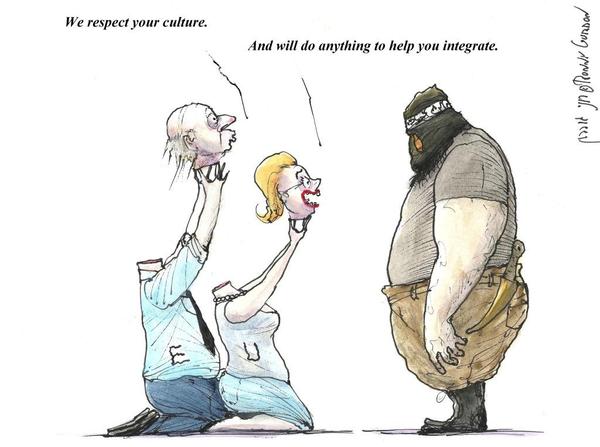
H/t Bring the heat, bring the stupid
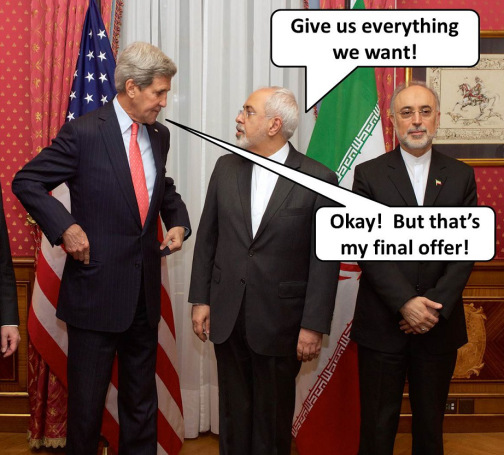
Who is Responsible for the Atrocities in the Muslim World? The Gatestone Institute, Uzay Bulut, June 27, 2015
Every time the ISIS, Boko Haram, Iran, or any terrorist group in the Muslim world is discussed, many people tend to hold the West responsible for the devastation and murders they commit. Nothing could be farther from the truth. Blaming the failures in the Muslim world on Western nations is simply bigotry and an attempt to shift the blame and to prevent us from understanding the real root cause of the problem.
When these Islamic terrorist groups abduct women to sell them as sex-slaves or “wives;” conduct mass crucifixions and forced conversions; behead innocent people en masse; try to extinguish religious minorities and demolish irreplaceable archeological sites, the idea that this is the fault of the West is ludicrous, offensive and wrong.
Western states, like many other states, try to protect the security of their citizens. What they essentially need, therefore, are peaceful states as partners with which they can have economic, commercial and diplomatic relations. They do not need genocidal terrorist groups that destroy life, peace and stability in huge swaths across the Muslim world.
Western states also have democratic and humanitarian values, which Islamic states do not. The religious and historical experiences of the Western world and the Islamic world are so enormously different that they ended up having completely different cultures and values.
The West, established on Jewish, Christian and secular values, has created a far more humanitarian, free and democratic culture. Sadly, much of the Muslim world, under Islamic sharia law, has created a misogynistic, violent and totalitarian culture.
This does not mean that the West has been perfect and sinless. The West still commits some appalling crimes: Europe is guilty of paving the way for the slaughter of six million Jews in the Holocaust, and for still not protecting its Jewish communities. Even today, many European states contort logic to recognize Hamas, which openly states that it aims to commit genocide against Jewish people.
The West, however, accepts responsibility for the failures in its own territories: for instance, not being able to protect European women from Muslim rapists. These men have moved to Europe to benefit from the opportunities and privileges there, but instead of showing gratitude to European people and government, they have raped the women there, and tried to impose Islamic sharia law.
If we want to criticize the West for what is going on in the Muslim world, we should criticize it for not doing more to stop these atrocities.
The West, and particularly the U.S., should use all of its power to stop them — especially the genocides committed against Jews, Christians and other non-Muslims in the Muslim world.
We should also criticize the West — and others, such as the United Nations and its distorted Gaza War report — for supporting those who proudly commit terrorist attacks against Israeli civilians, and we should criticize the West for not siding with the state of Israel in the face of genocidal Jew-hatred.
We should criticize the West for letting Islamic anti-Semitism grow in Europe, making lives unbearable for Jews day by day.
We should criticize the West for having accepted without a murmur the Turkish occupation of Northern Cyprus for more than 40 years.
We should also criticize the West for leaving the fate of Kurds, a persecuted and stateless people, to the tender mercies of Turkey, Iran, Iraq and Syria — and now the Islamic State (ISIS). On June 25, ISIS carried out yet another deadly attack, killing and wounding dozens of people in the Kurdish border town of Kobani, in Syrian Kurdistan.
And we should criticize especially the current U.S. government for not being willing to take serious action to stop ISIS, Boko Haram and other extremist Islamic groups.[1]
The list could go on and on. Moreover, it would not be realistic to claim that these groups or regimes all misunderstand the teachings of their religion in exactly the same way.
It would also not be realistic to claim that the West has created all these hundreds of Islamic terror groups across the Muslim world.
The question, then, is: Who or what does create all these terrorist groups and regimes?
In almost all parts of the Muslim world, systematic discrimination, and even murder, are rampant — especially of women and non-Muslims. Extremist Islamic organizations, however, are not the only offenders. Many Muslim civilians who have no ties with any Islamist group also commit these offenses daily. Jihad (war in the service of Islam) and the subjugation of non-Muslims are deeply rooted in the scriptures and history of Islam.
Ever since the seventh century, Muslim armies have invaded and captured Jewish, Christian, Hindu, Buddhist and Zoroastrian lands; for more than 1400 years since, they have continued their jihad, or Islamic raids, against other religions.
Many people seem to be justifiably shocked by the barbarism of ISIS, but Islamic jihad does not belong just to ISIS. Violent jihad is a centuries-long tradition of Islamic ideology. ISIS is just one jihadist army of Islam. There are many.
All of this is an Islamic issue. The free West has absolutely nothing to do with the creation and preservation of this un-free culture.
The West has, on the contrary, been the victim of Islamic military campaigns and imperialistic pursuits: Christian peoples of Europe have been exposed to Ottoman invasions and subjugation for centuries. The fall of Byzantine Empire marked the peak of Islamic Jihad in Christian lands. Many places in Europe — including Greece, Bulgaria, Albania, Bosnia, Croatia, Hungary, Serbia, and Cyprus, among others — were all invaded and occupied by the Ottoman armies. Other targets, including Venice, Austria, and Poland, had to fight fierce defensive wars to protect their territories.
The historical and current troubles in the Muslim world are not, therefore, problems “imported” from an outside source; they are internal cultural and political problems, which Muslim regimes and peoples have reproduced for centuries.
Some of the things that women in Saudi Arabia may not do were listed in The Week magazine: Saudi women are not allowed to “go anywhere without a male chaperone, open a bank account without their husband’s permission, drive a car, vote in elections, go for a swim, compete freely in sports, try on clothes when shopping, enter a cemetery, read an uncensored fashion magazine and buy a Barbie and so on.”
Of course, there is nothing specific in Islamic scriptures about cars, fashion magazines or Barbie Dolls. But there is enough there that indicates why all of these abuses, and more, are widespread across the Islamic world, and why the clerics, imams and muftis approve them.
The central issue is to see how the lines that the Islamic theology draws seed the soil in which this kind of discrimination systematically buds, why it is extolled and how it is advocated.
Saudi Arabia is not the only Muslim country where women are dehumanized. Throughout almost the almost the entire Muslim world — including Turkey, considered one of the most “liberal” Muslim countries — women are continually abused or killed by their husbands, ex-husbands, boyfriends, fathers, brothers or other males. [2]
Is it America that tells these men to treat their wives or sisters as less than fully human?
Is the West really what stops them from respecting human rights or resolving their political matters through diplomatic and peaceful ways? Are Muslims too stupid to make wise decisions, and act responsibly? Why should Americans or Europeans have evil wishes for the rest of the world?
Demonizing Western nations — even after all of their cultural, scientific and rational progress — is simply pure racism.
“The belief that the West is always guilty is among the dozen bad ideas for the 21st century,”wrote the Australian pastor, Dr. Mark Durie. “This irrational and unhelpful idea is taught in many schools today and has become embedded in the world views of many. It is essentially a silencing strategy, sabotaging critical thinking.”
Another term that prevents one from understanding the root causes of the conflicts in the Muslim world is “moral relativism” — a politically correct term that really means moral cowardice.
Defending “moral relativism” and saying that “all cultures are equal” really means saying a culture that encourages child marriages, beating women and selling girls on slave markets has a value equal to a culture that respects women and recognizes their rights, and which renounces wanton violence.
Another popular target of blame for the failures in the Muslim world is historical British colonialism.
If colonialism were the main problem, however, Muslims, too, were, and still are, colonizers — and not particularly “humanitarian” ones, at that. The Muslim colonizers do not even seem to have contributed much to the culture of the places they invaded and colonized. In fact, they have actually delayed the progress of the areas they colonized. The printing press, for instance, came to the Ottoman territories almost 200 years later than to Europe.
“Books… undermine the power of those who control oral knowledge, since they make that knowledge readily available to anyone who can master literacy,” wrote Professor Daron Acemoglu and James Robinson. This threatened to undermine the existing status quo, where knowledge was controlled by elites. The Ottoman sultans and religious establishment feared the creative destruction that would result. Their solution was to forbid printing.” [3]
“European Empires — the British, French and Italians — had a short-lived presence in North Africa and the Middle East compared with the Ottoman Empire, which ruled over that region for more than 500 years,” said the historian Niall Ferguson.
“The culture that exists in the greater Middle East and North Africa today bears very, very few resemblances to the culture that Europeans tried to implement there, beginning in the late 19th century and carrying on through to the mid-20th century.
“You can’t say it is the fault of imperialism and leave out the longest living empire in the Middle East, which was the Ottoman Empire, a Muslim Empire, which went back much farther than any of the European Empires mentioned in that piece.”
Muslim states continue to occupy and colonize various territories — including Kurdistan, Baluchistan and the northern part of Cyprus, an EU member state.
“One of the most tragic consequences of the 1974 Turkish invasion,” according to the Ministry of Foreign Affairs of the Republic of Cyprus, “and the subsequent illegal occupation of 36.2% of the territory of the Republic of Cyprus, is the violent and systematic destruction of the cultural and religious heritage in the occupied areas.
“Hundreds of historic and religious monuments in various regions of the occupied areas have been destroyed, looted and vandalized. Illegal ‘excavations’ have been carried out and cultural treasures have been stolen from museums and private collections and were sold abroad.”
Muslim groups and regimes continue to persecute indigenous peoples such as Assyrians, Chaldeans, Mandaeans, Shabaks, Copts, Yezidis, and Bedoon, among many others.
“A substantial segment of the Bedoon population lives with the constant threat of deportation hanging over it,” according to the analyst Ben Cohen. “Around 120,000 Bedoon live without nationality and with none of the rights that flow from citizenship.”
“Its members cannot obtain birth or marriage certificates, or identity cards, or driving licenses. They are banned from access to public health and education services. Their second-class status means they have no access to the law courts in order to pursue their well-documented claims of discrimination. And on those rare occasions that they summon the will to protest publicly—as they did in 2011, when demonstrators held signs bearing slogans like, ‘I Have a Dream’—the security forces respond with extraordinary brutality, using such weapons as water cannons, concussion grenades, and tear gas with reckless abandon.”
It is not the West or Israel committing these crimes against the Bedoon community; it is Kuwait, a wealthy Islamic state, which treats defenseless people as if they are slaves.
In Qatar, another wealthy Islamic state, Nepalese migrants building a football stadium, “[h]ave died at a rate of one every two days… This figure does not include the deaths of Indian, Sri Lankan and Bangladeshi workers…. The Nepalese foreign employment promotion board said that 157 of its workers in Qatar had died between January and mid-November” last year. In 2013, the figure for that period was 168.”
 The family of a Nepalese migrant worker, who died in Qatar, prepares to bury him. Nepalese laborers in Qatar are forced to work in dangerous conditions, and die at the rate of one every two days. (Image source: Guardian video screenshot)
“In Libya, naturalisation is only open to a man if he is of Arab descent,” reported the United Nations High Commissioner for Refugees (UNHCR). “And many Akhdam in Yemen, a small ethnic minority who may be descendants of African slaves, are reportedly unable to obtain citizenship.”
Is that not apartheid?
In Kuwait, only Muslim applicants may seek naturalization, while Libya’s nationality law allows for the withdrawal of nationality on the grounds of conversion from Islam to another religion.”
Is that not apartheid? Apartheid laws seem to reign over many places in the Muslim world.
Trying to whitewash the damage the Islamic ideology has done to the Muslim world, while putting the blame of Islamic atrocities on the West, will never help Muslims face their own failures and come up with progressive ways to resolve them.
“All the world’s Muslims have fewer Nobel Prizes than Trinity College, Cambridge. They did great things in the Middle Ages, though,” wrote the evolutionary biologist Richard Dawkins on Twitter, after which other Twitter users piled on to criticize him.
It seems that having oil reserves, per capita, that dwarf anything available to Western countries does not create leading scientific nations.
What holds Muslims back when they have unmatched advantages of underground treasures? Why did the scientific revolution not happen in the Muslim world? Why has much of Islamic history been marked by aggressive jihad?
Islamic jihad and Islamic violence; the sanctioning of sex slavery; dehumanization of women; hatred and persecution of non-Muslims and homosexuals; suppression of free speech; and forced conversions have been commonplace in the Islamic world ever since the inception of the religion.
Many teachings in the Islamic scriptures, as well as the biographies of the founder of the religion, set up the parameters where these abuses not only occur but remain protected on a gigantic scale. These are the teachings that have become the culture of the Muslim world.
Sadly, most Muslims have wasted much time, energy and resources on killing and destruction, but — with the exception of some civilization’s most dazzling artistic splendors — not on scientific and cultural advancement.
Recently, Sheikh Hamad bin Jassim bin Jaber al-Thani, the former Prime Minister of Qatar, said that claims that Qatar paid bribes to win the hosting rights of the 2022 World Cup were “not fair” and stemmed from the West’s Islamophobia and racism towards Arabs.
Recent events indicate that he was, at best, “misinformed.”
Deny everything and blame “the infidel” for your shortcomings. Nothing is more important than your honor, and nothing worse than your shame.
If Muslims wish to create a brighter future, nothing is stopping us but ourselves. We should learn to analyze critically our present and our past.
Human rights activists and academics in the West are lying to Muslims about their culture, and bashing and threatening America, Europe or “Zionism” for the problems of Muslims; this can never lead to any positive developments in the Muslim world. It is the Islamic culture and religious ideology that are responsible for these problems
If there is ever going to be an enlightenment, reform or renaissance in the Muslim world, only a hard look and hard questioning can be its starting point.
_________________
[1] Also the Muslim Brotherhood, Islamic Republic of Iran, al-Qaeda, Al-Badr, al-Gama’a al-Islamiyya, Islamic Jihad, al-Nusra Front, Hizb-ut-Tahrir, Al Ghurabaa, Al-Itihaad al-Islamiya, Al-Mourabitoun, Abdullah Azzam Brigades, Jaish al-Muhajireen wal-Ansar, Jamaat Ul-Furquan, Jamaat-ul-Ahrar, Jamaat-ul-Mujahideen Bangladesh, Jamiat al-Islah al-Idzhtimai, Great Eastern Islamic Raiders’ Front, Al-Shabaab, Abu Sayyaf, Tehreek-e-Nafaz-e-Shariat-e-Mohammadi, Supreme Military Majlis ul-Shura of the United Mujahideen Forces of Caucasus, to name just a few.
[2] See: “Gender Equality Gap Greatest in Islamic Countries, Survey Shows“, by Patrick Goodenough, October 29, 2014; “The Treatment of Women In Islam,” by Rachel Molschky, October 7, 2013; “Women Suffer at the Hands of Radical Islam“, by Raymond Ibrahim, January 9, 2014; “As Muslim women suffer, feminists avert their gaze“, by Robert Fulford, National Post; Ayse Onal, a leading Turkish journalist, says in her book, Honour Killing: Stories of Men Who Killed, that in Turkey alone honour killings average about one a day — 1,806 were reported in the period between 2000 and 2005.
[3] Daron, Acemoglu & Robinson, James (2012), Why Nations Fail: The Origins of Power, Prosperity, and Poverty, Crown Publishing Group.
The Myth of Muslim Radicalization, Front Page Magazine, Daniel Greenfield, June 18, 2015
 Usaama Rahim
Mainstreaming extremism is . . . Obama’s policy. It’s the logic behind nearly every Western diplomatic move in the Middle East from the Israel-PLO peace process to the Brotherhood’s Arab Spring. And these disasters only created more Islamic terrorism.
****************
After some of its quarter of a million Muslims headed to join ISIS, Quebec decided the answer was a $2 million anti-radicalization center headed by a specialist in cultural sensitivity. But if you’re about to be beheaded by a masked ISIS Jihadist, a specialist in cultural sensitivity isn’t going to help you much.
Western governments nevertheless keep rolling out their culturally sensitive approaches to fighting ISIS.
The key element in Obama’s strategy for fighting ISIS isn’t the F-15E Strike Eagle, it’s a Twitter account run by a Muslim Brotherhood sympathizer which claims to “Counter Violent Extremism” by presenting moderate Islamists like Al Qaeda as positive role models for the Islamic State’s social media supporters.
So far 75% of planes flown on combat missions against ISIS return without engaging the enemy, but the culturally sensitive State Department Twitter account has racked up over 5,000 tweets and zero kills.
Cultural sensitivity hasn’t exactly set Iraq on fire in fighting ISIS and deradicalization programs here start from the false premise that there is a wide gap between a moderate and extremist Islam. Smiling news anchors daily recite new stories about a teenager from Kentucky, Boston or Manchester getting “radicalized” and joining ISIS to the bafflement of his parents, mosque and community.
And who is to blame for all this mysterious radicalization? It’s not the parents. It certainly can’t be the moderate local mosque with its stock of Jihadist CDs and DVDs being dispensed from under the table.
The attorney for the family of Usaama Rahim, the Muslim terrorist who plotted to behead Pamela Geller, claims that his radicalization came as a “complete shock” to them.
It must have come as a truly great shock to his brother Imam Ibrahim Rahim who claimed that his brother was shot in the back and that the Garland cartoon attack had been staged by the government.
It must have come as an even bigger shock to Imam Abdullah Faaruuq, the Imam linked to Usaama Rahim and his fellow terrorist conspirators, as well as the Tsarnaev brothers, who had urged Muslims to “grab onto the gun and the sword.”
The culturally insensitive truth about Islamic ‘radicalization’ is that it is incremental.
There is no peaceful Islam. Instead of two sharply divided groups, peaceful Islam and extremist Islam, there is a spectrum of acceptable terrorism.
Muslim institutions have different places on that spectrum depending on their allegiances and tactics, but the process of radicalization is rarely a sharp break from the past for any except converts to Islam.
The latest tragic victim of radicalization is Munther Omar Saleh; a Muslim man living in New York City who allegedly plotted to use a Tsarnaev-style pressure cooker bomb in a major landmark such as the Statue of Liberty or the Empire State Building. Saleh claimed to be following orders from ISIS.
Media coverage of the Saleh arrest drags out the old clichés about how unexpected this sudden radicalization was, but what appears to be his father’s social media account shows support for Hamas.
Likewise one of Usaama Rahim’s fellow mosque attendees said that Rahim and another conspirator had initially followed the “teachings of the Muslim Brotherhood” but that he had been forced to cut ties with them when they moved past the Brotherhood and became “extreme”.
Despite the media’s insistence on describing the Muslim Brotherhood as a moderate organization, it has multiple terrorist arms, including Hamas, and its views on non-Muslims run the gamut from the violent to the genocidal.
A year after Obama’s Cairo speech and his outreach to the Muslim Brotherhood, its Supreme Guide announced that the United States will soon be destroyed, urged violent terrorist attacks against the United States and “raising a jihadi generation that pursues death just as the enemies pursue life.”
Despite this, Obama continued backing the Muslim Brotherhood’s rise to power across the region.
There are distinctions between the Muslim Brotherhood and Al Qaeda, but the latter is a splinter group of the former. Al Qaeda’s current leader came out of the Muslim Brotherhood. A move from one to the other is a minor transition between two groups that have far more in common than their differences.
And since the Brotherhood controls much of the Islamic infrastructure in the United States, the idea that Munther Omar Saleh or Usaama Rahim became radicalized because they went from a Jihadist group that takes the long view in the struggle against the infidel, putting political structures into place to make a violent struggle tactically feasible, to a Jihadist group that focuses more on short term violence, is silly.
Radicalization isn’t transformational; it’s incremental.
It’s the Pakistani kid down the block deciding that instead of joining the Muslim Students Association and then CAIR to build Islamist political structures in America, he should just cut to the chase and kill a few cops to begin taking over America now.
Radicalization is the moderate Imam who stops putting on an act for PBS and the local politicians and moves to Yemen where he openly recruits terrorists to attack America instead of doing it covertly at his mosque in Virginia.
Radicalization is the teenage Muslim girl who forgets about marrying her Egyptian third cousin and bringing him and his fifty relatives to America and goes to join ISIS as a Caliphate brood mare instead.
It’s not pacifism giving way to violence. Instead it’s an impatient shift from tactical actions meant to eventually make Islam supreme in America over many generations to immediate bloody gratification. ISIS is promising the apocalypse now. No more waiting. No more lying. You can have it tomorrow.
Radicalization does not go from zero to sixty. It speeds up from sixty to seventy-five.
It builds on elements that are already there in the mosque and the household. The term “extremism” implicitly admits that what we are talking about is not a complete transformation, but the logical extension of existing Islamic beliefs.
Omar Saleh seemed cheerful enough about Hamas dropping Kassam rockets on Israeli towns and cities. Would he have supported his son setting off a bomb in the Statue of Liberty? Who knows, but his son was already starting from a family position that Muslim terrorism against non-Muslims was acceptable.
Everything else is the fine print.
When Usaama Rahim followed the way of the Muslim Brotherhood, he was with a moderate group whose spiritual guide, the genocidal Qaradawi was the godfather of cartoon outrage and had endorsed the murderous Iranian fatwa against Salman Rushdie.
The slope that leads from Qaradawi’s cartoon rage to trying to behead Pamela Geller isn’t a slippery one; it’s a vertical waterfall. And this is what radicalization really looks like. It doesn’t mean moderates turning extreme. It means extremists becoming more extreme. And there’s always room for extremists to become more extreme which turns old extremists into moderates while mainstreaming their beliefs.
In the UK, Baroness Warsi, Cameron’s biggest mistake, blamed Muslim radicalization on the government’s refusal to engage with… radicals. Or as she put it, “It is incredibly odd and incredibly worrying that over time more and more individuals, more and more organisations are considered by the government to be beyond the pale and therefore not to be engaged with.”
The reason why the government is refusing to “engage” with these organizations is that they support terrorism in one form or another. Warsi is proposing that the UK fight radicalization by mainstreaming it.
Mainstreaming extremism is also Obama’s policy. It’s the logic behind nearly every Western diplomatic move in the Middle East from the Israel-PLO peace process to the Brotherhood’s Arab Spring. And these disasters only created more Islamic terrorism.
The Muslim teenagers headed to join ISIS did not come out of a vacuum. They came from mosques and families that normalized some degree of Islamic Supremacism and viewed some Muslim terrorists as heroes and role models. It’s time for Western governments to admit that the ISIS Jihadist is more the product of his parents and his teachers than of social media Jihadis on YouTube and Twitter.
Radicalization doesn’t begin with a sheikh on social media. It begins at home. It begins in the mosque. It just ends with ISIS.
The Postcolonial Rot Spreads Beyond Middle East Studies, Front Page Magazine,

Middle East Studies programs, Kramer writes, “came under a take-no-prisoners assault, which rejected the idea of objective standards, disguised the vice of politicization as the virtue of commitment, and replaced proficiency with ideology.” The ideology, of course, comprised the old Marxist narrative of Western colonial and imperial crimes, a Third Worldism that idealizes the dark-skinned, innocent “other” victimized by Western depredations, and the juvenile romance of revolutionary violence.
*****************
In theory, Middle East Studies programs are a good idea. One of the biggest impediments to countering modern jihadism has been the lack of historical knowledge about the region and Islam. But even the attention and urgency that followed the terrorist attacks on 9/11 have not led to such knowledge. The result has been policies pursued both by Republicans and Democrats that are doomed to fail, as the current chaos in the region attests.
Rather than enlightening citizens and policy-makers, Middle Eastern Studies programs have darkened our understanding. As Martin Kramer documented in his important 2002 study Ivory Towers on Sand, most programs have become purveyors not of knowledge but of ideology. Under the influence of literary critic Edward Said’s historically challenged book Orientalism––“a work,” historian Robert Irwin has written, “of malignant charlatanry, in which it is hard to distinguish honest mistakes from willful misrepresentations”––Middle East Studies programs, Kramer writes, “came under a take-no-prisoners assault, which rejected the idea of objective standards, disguised the vice of politicization as the virtue of commitment, and replaced proficiency with ideology.” The ideology, of course, comprised the old Marxist narrative of Western colonial and imperial crimes, a Third Worldism that idealizes the dark-skinned, innocent “other” victimized by Western depredations, and the juvenile romance of revolutionary violence.
Yet Said’s baleful influence has not been limited to Middle East Studies programs, one of which has been created at my campus of the California State University, replete with the problems Kramer catalogues. It has insidiously corrupted much of the humanities and social sciences, operating under the innocuous rubric of “postcolonial” studies, which to the unwary suggests a historical rather than an ideological category. Through General Education courses that serve students across the university, and in departments like English that train primary and secondary school teachers, Saidian postcolonial ideology has been shaping the attitudes and presumed knowledge of Islam and the Middle East far beyond the reach of Middle East Studies programs.
Said’s dubious argument in Orientalism is that the work of Western scholars on the Middle East embodied “a Western style for dominating, restructuring, and having authority over the Orient,” thus creating the intellectual infrastructure for justifying colonialism and imperialism. As such, every European scholar perforce was “a racist, an imperialist, and totally ethnocentric.” For social science and humanities departments committed totally to the multiculturalist melodrama of white racism and oppression of the dark-skinned “other,” Said’s work seemingly provides scholarly bona fides to ideas that are in fact expressive of illiberal grievance politics.
English departments have been particularly vulnerable to Said’s work, for he overlaid his bad history with watered down Foucauldian ideas about the relationship of power to discourse. Thus English professors seduced by the poststructuralist theory ascendant in 1978 when Orientalism was published found in that book a seemingly sophisticated theoretical paradigm that shared both poststructuralism’s disdain for objectivity and truth, and its “hermeneutics of suspicion,” the notion that the apparent meaning of a discourse is a mask for the sinister machinations of power at the expense of the excluded “other.”
More important, postcolonialism is a politically activist theory, bound up as it is in the politics of the Middle East, especially the Arab-Israeli conflict. Now English professors could avoid the legitimate charge that poststructuralism, despite its patina of leftist ideology, was in fact an evasion of politics, a “symbolic politics,” as historian Russell Jacoby put it, “a replacement for, and a diversion from, the gritty politics of the community and the street.” On the contrary, the purveyors of postcolonialism were on the barricades, struggling to liberate Palestinians and other Muslims oppressed by a neo-imperialist America and its puppet Israel. Rather than pampered elitists guaranteed jobs for life, now the professors could fancy themselves freedom fighters and champions of the ex-colonial brown peoples still exploited and oppressed by the capitalist, racist West.
Finally, the dogma of multicultural “diversity” now firmly enshrined in American universities likewise has found Saidian postcolonialism a useful tool for interpreting and teaching literature, one that exposes the Western literary canon’s hidden racism and oppression. Moreover, in a university like Fresno State, half of whose students are minorities, a postcolonial perspective can establish a rapport with minority students who are encouraged to interpret their own experiences through the same lens of unjust exclusion and hurtful distortions of their culture and identity. At the same time white students are schooled in their privilege and guilt, minorities can be comforted by a narrative that privileges them as victims of historical oppression, one masked by the unearned prestige of the classics written by “dead white males.” Now minority students learn that Shakespeare’s Caliban is the true hero the Tempest with whom they should identify, the displaced victim of rapacious colonialists and slavers like Prospero who unjustly define the indigenous peoples as savages and cannibals in order to justify the brutal appropriation of their lands and labor.
Over the thirty years I have taught in the California State University, I have seen this transformation of the English department. Reading lists dominated by contemporary ethnic writers are increasingly displacing the classics of English literature, and even when traditional works are on the list, the books are often taught from the postcolonial perspective. New hires more and more comprise those Ph.D.’s whose specialties lie in ethnic or “world” literature, replacing the Shakespeare scholars and others trained to teach the traditional English and American literary canon. The traditional content of a liberal education––“the best which has been thought and said in the world,” as Matthew Arnold wrote––is disappearing, replaced by multicultural melodramas of Western crime and guilt.
More important for the culture at large, many of these students will go on to earn teaching credentials and staff public schools. They will carry the postcolonial ideology into their own classrooms, influencing yet another generation and reinforcing a received wisdom that will shape their students’ understanding of the important threats to our national security and interests emanating from the Middle East, especially jihadism. And it will encourage ordinary citizens to assent to the demonization of our most valuable regional ally, Israel, currently battling the Boycott, Divest, and Sanction movement that can more easily gain traction among those who from grade school to university have been exposed to the postcolonial ideology.
The damage done to our foreign policy by Middle East Studies is obvious. The influence of the godfather of such programs, Edward Said, on the social sciences and humanities departments like English is more insidious and subtle. But it is no less dangerous.
The Islamic State Is Here to Stay, VICE News, Ahmed S. Hashim, June 6, 2015
(Please see also, The Kurd-Shia War Behind the War on ISIS. — DM)
The victories against IS in early 2015 have proven ephemeral — or have been nullified by IS gains elsewhere. On Sunday, CIA director John Brennan said on Face the Nation, “I don’t see this being resolved anytime soon.” Assad’s vaunted offensives of February 2015 have fallen short as the regime faced stiff resistance from a wide variety of opposition fighters, including elements from IS. The failure was alarming in part because the campaign was designed and aided by both Hezbollah and the Iranians, two seemingly ascendant Shia powers.
************************
Just a few months ago, analysts and policy-makers were certain that the defeat of Islamic State (IS) forces was simply a matter of time.
Coalition airstrikes would degrade the group’s capabilities and eventually allow Iraqi forces and Kurdish Peshmerga — though discredited by their poor military showing in mid-2014 — to push back the extremists. And indeed, IS fighters were ejected from Tikrit in March 2015 by the Iraqi army and thousands of motivated fighters from Shia militias. In Kobani in northern Syria, IS fighters were defeated by Syrian Kurdish fighters. Elsewhere in the country, the regime of Bashar al-Assad was going on the offensive with help from Hezbollah and advisers from the Iranian Revolutionary Guard.
The Islamic State, however, rose like a phoenix from the ashes of every setback. And today, the situation is not so rosy.
The victories against IS in early 2015 have proven ephemeral — or have been nullified by IS gains elsewhere. On Sunday, CIA director John Brennan said on Face the Nation, “I don’t see this being resolved anytime soon.” Assad’s vaunted offensives of February 2015 have fallen short as the regime faced stiff resistance from a wide variety of opposition fighters, including elements from IS. The failure was alarming in part because the campaign was designed and aided by both Hezbollah and the Iranians, two seemingly ascendant Shia powers.
The situation in Iraq is just as complicated, something that the Obama administration appears either oblivious to or reluctant to acknowledge. Much of the US strategy continues to hinge on what is increasingly a mirage: a unified, albeit federal, Iraq under the control of Baghdad. Meanwhile, the resilience of IS is greatly enhanced by the ability of its military forces to innovate and adapt faster on the ground than its lackluster opponents.
In light of the constant aerial strikes by the US and its allies, IS has dispersed and made its forces more mobile, no longer presenting dense concentrations of fighting men as it did when it seized Mosul in mid-2014. Instead, when IS seized Ramadi in May 2015, it made use of inclement weather and sent several small units from different directions simultaneously into the city aided by suicide bombers. Moreover, the fact that the group faced ill-equipped and poorly motivated Sunni fighters in and around Ramadi did not do anything for Baghdad’s standing with the country’s already alienated Sunni community, which had pleaded for arms while caught between the unfathomable brutality of IS and revengeful Shia militias.
Many Sunnis are now angling for their own “super-region,” one that would have considerable independence from Baghdad. The problem? In order to have it, the Sunnis would need to first defeat IS. Currently, they’re unable to do so because they lack the resources; despite all the talk from Baghdad and Washington about arming Sunni tribes, Baghdad is not actually keen to do so.
And besides, the Sunnis seem relatively ambivalent about defeating IS. They took an unequivocal stance between late 2006 and 2009, when they joined with the Americans and the Iraqi government to deal the Islamist militants what was then seen as a decisive blow. Now, however, despite Sunnis’ resentment and fear of IS, the Islamists’ existence is seen as a kind of insurance policy against Shia revanchism should Baghdad succeed in retaking the three Sunni provinces of Anbar, Salahuddin, and Ninevah.
(Please see video at the link. — DM
The “victory” of the Iraqi government in Tikrit was more propaganda than reality; a few hundred IS fighters managed to inflict considerable damage on the Shia militias that had been mobilized to fight alongside the Iraqi army, then withdrew because they were outnumbered and wished to avoid being surrounded. The IS forces in Tikrit simply felt that they had done enough damage; there was no need to waste further assets in an untenable situation.
Militarily, the Iraqi Shia militias are better motivated and more dedicated than the regular army. Anecdotal information out of Baghdad suggests that Iraqi Shias are wondering whether the government should invest more effort building these forces into an effective and more organized parallel army. Even that parallel army, however, might be reluctant to commit to any significant long-term offensive to reclaim provinces full of “ungrateful” Sunnis.
But the Shia are willing to die to defend what they have, and there is increased sentiment among the Shia in central Iraq and Baghdad, along with the southern part of the country, that they would be better off without the Sunnis. There also exists the belief that the Kurds have more or less opted out of the Iraqi state despite the fact that they maintain a presence within the government in Baghdad. The Shia would seemingly not be sorry to see them exit the government in a deal that would settle as best as possible divisions of resources and territory. However, whether the Kurds would take the plunge and opt for de jure rather than de facto independence is a question that is subject to regional realities — How would Ankara and Tehran react? — rather than merely a matter of a deal between Baghdad and Erbil.
The Islamic State will continue to be a profound geopolitical problem for the region and the international community, and a long battle lies ahead. Syria and Iraq are more or less shattered states; it is unlikely that they will be put back together in their previous shapes. If Assad survives 2015, it will be as head of a rump state of Alawites and other minorities protected by Hezbollah, Iran, and Alawite militias. Shia Iraq will survive, and will possibly dissociate itself from the nettlesome Sunni regions. The Kurds will go their own way step by step. The international community is currently at a loss for how to stem the flow of foreign fighters to the IS battlefields — and even more serious is the growing sympathy and admiration for the group in various parts of the world among disgruntled and alienated youth.
If the US is serious about defeating IS, it needs to take on a larger share of the fight on the ground. This means more troops embedded with regular Iraqi forces in order to bring about better command, control, and coordination. It also means advisors who can continue to train these forces so that they improve over time. If this is not done, the regular Iraqi military will continue to be nothing more than an auxiliary to the more motivated — and pro-Iranian — Shia militias. Currently, militia commanders are giving orders to the regular military; that cannot be good for morale.
This month, the Islamic State celebrates the first anniversary of its self-declared caliphate. The group has little reason to fear it will be the last.
The “Speech-Denialists,” The Gatestone Institute, Daniel Mael, June 2, 2015
On college campuses, teachers, students and sometimes even administrators seem to have become ever more eager to block any idea with which they disagree.
Often it appears as if their first impulse is to demonize the individual or organization presenting the offending idea, rather than to address the substance of the argument and open a discussion in the “free marketplace of ideas.”
On the campus of Lake Superior State University, wall postings “deemed offensive, sexist, vulgar, discriminatory or suggestive will not be approved.” The campus code of conduct states that if students fail to comply, they may be disciplined — a rule that was named “Speech Code of the Month” for May by the Foundation for Individual Rights in Education (FIRE).
 Lake Superior State University’s campus code of conduct states that wall postings “deemed offensive, sexist, vulgar, discriminatory or suggestive will not be approved.” (Image source: Bobak Ha’Eri/Wikimedia Commons)
Increasingly, individuals and groups, perhaps unknowingly betraying the spirit of classic liberalism, seek to shame or ridicule dissenting opinion into silence. Both in politics and on college campuses, it seems as if aggressive shaming has replaced the art of persuasion as the favored means of argumentation. Substantive, non-politically correct discussion is now at a premium.
In her recently published book The Silencing, life-long liberal and Fox News contributor Kirsten Powers documents the escalating efforts of people claiming to be liberal to silence dissent on issues they regard as contentious. The tactic follows what Powers calls the “authoritarian impulse to silence.”
On issues ranging from campus “speech codes” to feminism, these self-described liberals are unwilling to entertain the notion that a well-intentioned individual from the other side of the aisle might have a different remedy for the problems of the day.
When feminist scholar Christina Hoff Sommers of the American Enterprise Institute gave a lecture on the campus of Oberlin University on the topic of campus sexual assault and due process, protesters labeled her a “rape denialist” and claimed that they felt “unsafe.” Perhaps we should begin calling such protesters “due-process denialists.”
When the subject is religion, these “liberals” maintain a disingenuous double standard. “While the illiberal left seems to hold a special animosity to Christianity,” Powers notes, in a remark that could also apply to Israel, “it is strangely protective of Islam, despite the fact that orthodox Muslims oppose same-sex marriage.” Not only are Muslim attitudes toward gay marriage overlooked or roadsided completely, but if anyone dares to discuss the issue of minorities in the Muslim-majority world, they are labeled “racist,” “Islamophobic,” or other slurs at arm’s reach.
Meanwhile, critics are unrelenting in their animosity toward observant Christians’ views of homosexuality. “If you think about it, we are at the water’s edge of the argument that mainstream Christian teaching is hate speech,” Senator Marco Rubio recently told CBN News. “Because today we’ve reached the point in our society where if you do not support same-sex marriage you are labeled a homophobe and a hater.”
Last year, at Brandeis University, when I sought to bring a human rights display highlighting the oppression of LGBTQ individuals in Yemen, Saudi Arabia and Iran, the initiative was blocked in a flood of administrative bureaucracy. The member of the administration with whom I met was clearly not thrilled by the idea.
Meetings with a gay rights group and the Muslim Students Association (MSA), however, were just as telling. Hoping to solicit partnerships in the initiative, I explained to leaders and members of both organizations that the project was not about Islam, but about how, on a routine basis, certain governments murder people who identify as LGBTQ. Members of the gay rights organization expressed concern about “Islamophobia,” while members of the Muslim Students Association expressed concern about “homophobia.” The initiative was rejected. Both groups evidently prioritized the emotional and intellectual comfort of the campus community over drawing attention to the plight of innocent LGBTQ individuals in the Muslim world.
In denying the average college student the opportunity to hear, think, question and learn, these minority organizations violated the basic principles of a liberal arts education and what higher learning should presumably be about: challenging assumptions and talking openly about issues that might cause discomfort. It is still puzzling why the LGBTQ club and the MSA are not at the forefront of defending other members of their respective groups, regardless of where they may live.
Both micro-sensitivity and political correctness require at best, obfuscating information, and at worst, silencing it. It is incumbent upon those who recognize the dangers of the ever-expanding “speech-denialists” in the “political correctness” movement to put up a fight — figuratively, of course.
The Erosion of Free Speech, Gatestone Institute, Denis MacEoin, May 3, 2015
(Free speech includes the right to offend the easily offended, even if they are sub-human savages.
— DM)
Anyone who has had much to do with publishing, or anyone who cares about books and free speech, will be familiar with the American Library Association’s Office for Intellectual Freedom, an enduring champion of the First Amendment and the public’s right to read whatever they please — without the interference and censorship of self-appointed guardians of inoffensiveness and sexual purity.
Every year, the ALA mounts Banned Books Week, a nationwide celebration of our freedom to read. And every year it issues an unnerving list of Frequently Challenged Books. Unnerving because of the pettiness and obsession betrayed by the people who try to have books banned in local libraries, school boards, and even bookshops. For years, most of the attempts to ban books have come from fundamentalist Christian groups; the reasons have mainly been sex, offensive language, or “controversial issues,” whatever they are. God forbid that anyone in the United States be exposed to “controversial issues.”
This year a new note has entered Banned Books Week. Elizabeth McKinstry, a graduate student at Georgia’s Valdosta State University (which earlier in April witnessed students trampling on the American flag) launched a petition about ALA’s anti-censorship poster, calling it “Islamophobic.” There is nothing on the poster, however, that relates in the slightest way to Islam. The poster shows the top of a woman’s head, then her clothed chest and arms. She is not wearing Islamic dress on her head, and her arms and hands are bare. In front of her face, she holds what looks like a book bearing the text “Readstricted.” Her eyes can be seen looking through the cover where it bears the universal symbol for “Restricted” (a red circle with a white bar). That is all.
In her petition, McKinstry writes, “This poster uses undeniably Islamophobic imagery of a woman in a niqab, appears to equate Islam with censorship, and muslim (sic) women as victims.” She goes on to demand that the poster be “removed immediately from the ALA Graphics store, and the ALA Graphics Store and Office of Intellectual Freedom should apologize and explain how they will prevent using discriminatory imagery in the future.” To make matters worse, she goes on to write: “Whether the poster was intentionally or accidentally a racist design, it is still racist and alienating.”
Not only is this possibly an example of political correctness in overdrive, but the greater irony lies in that McKinstry is studying for an MA in library and information science; works as a library associate, and is a member of the ALA. Here we see a distortion of thinking that is grotesque: a person claiming to be “progressive,” trying to ban an anti-censorship poster in an organization that works to end censorship.
* * *
PEN International is known worldwide as an association of writers. Together they work tirelessly for the freedom of authors from imprisonment, torture, or other restrictions on their freedom to write honestly and controversially. This year, PEN’s American Center plans to present its annual Freedom of Expression Award during its May 5 gala to the French satirical magazine Charlie Hebdo. The award will be handed to Gerard Biart, the publication’s editor-in-chief, and to Jean-Baptiste Thorat, a staff member who arrived late on the day when Muslim radicals slaughtered twelve of his colleagues. This is the sort of thing PEN does well: upholding everyone’s right to speak out even when offence is taken.
This year, however, six PEN members, almost predictably, have already condemned the decision to give the award to Charlie Hebdo, and have refused to attend the gala. Peter Carey, Michael Ondaatje, Francine Prose, Teju Cole, Rachel Kushner and Taiye Selasi have exercised their right to double standards by blaming Charlie Hebdo for its offensiveness. Kushner expressed her discomfort with the magazine’s “cultural intolerance.” Does that mean that PEN should never have supported Salman Rushdie for having offended millions of Muslims just to express his feelings about Islam?
Peter Carey expressed his support, not for the satirists, but for the Muslim minority in France, speaking of “PEN’s seeming blindness to the cultural arrogance of the French nation, which does not recognize its moral obligation to a large and disempowered segment of their population.” We never heard him speaking out when Ilan Halimi was tortured to death for weeks, or when Jews in Toulouse were shot. He seems to be saying that the French government should shut up any writer or artist who offends the extreme sensitivities of a small percent of its population.
Teju Cole remarked, in the wake of the killings, that Charlie Hebdo claimed to offend all parties but had recently “gone specifically for racist and Islamophobic provocations.” But Islam is not a race, and the magazine has never been racist, so why charge that in response to the sort of free speech PEN has always worked hard to advance?
A sensible and nuanced rebuttal of these charges came from Salman Rushdie himself, a former president of PEN: “If PEN as a free speech organization can’t defend and celebrate people who have been murdered for drawing pictures, then frankly the organization is not worth the name. What I would say to both Peter and Michael and the others is, I hope nobody ever comes after them.”
Those six have now morphed into something like 145. By April 30, Carey and they were joined by another 139 members who signed a protest petition. Writers, some distinguished, some obscure, have taken up their pens to defy the principle of free speech in an organization dedicated to free speech, and many of whom live in a land that protects it precisely for their benefit with a First Amendment.
Another irony, at least as distasteful as the one just described, took place on April 22, when Northern Ireland’s leading academic institution, Queen’s University in Belfast, cancelled a conference planned for June. The conference, organized by the university’s Institute for Collaborative Research in the Humanities, was about free speech after the Charlie Hebdo attack in Paris. You could not make this up. The reason given was that the institute had not prepared a proper risk assessment. Risk? Risk to what? To free speech? What a silly thought! No, it turned out to be risk of an Islamist attack in Belfast, a city long weary from terrorism.
The following day, the University of Maryland, many miles to the west, banned a showing of the film American Sniper after complaints from Muslim students. Whether the film was good or bad, free speech was snuffed.[1]
The oddity is that today, newspaper headlines, news websites, radio and television news bulletins are packed every day with stories about the chaos in the Middle East, the threat of Iranian access to nuclear weapons, the march of ISIS, Jabhat al-Nusra, Hezbollah, Hamas, the Taliban, al-Shabaab, and dozens of other terrorist groups across the region. This year’s Charlie Hebdo and kosher supermarket slayings, the rise of anti-Semitism across Europe (closely linked to Islamism), demonstrations filling the streets with chants such as “Hamas, Hamas Jews to the Gas,” and all the other atrocities and social disjunctions that arise from the revival of fundamentalist Islam.
America and Britain have fought, with allies, wars in Iraq and Afghanistan, and as of this writing, the United States is carrying out air strikes against ISIS in Syria.
Such news stories are not occasional, they are everyday. Stories of this kind are seldom crowded out by anything but the most important news items, such as a major airline crash or significant domestic political events. Such stories are even more visible than Cold War geopolitical new ever was, due to the immense proliferation of news outlets since the 1990s. The citizens of the U.S., Europe, Canada, Australia and (above all) Israel do not face a remote threat from a distant country, but daily threats of being blown up in their own streets almost every day. The British security services announce almost daily the likelihood of a terrorist event.
But where are the novels? Where are the Le Carrés and Ludlums, the Flemings and Clancys? The number of novels dealing with Islamist, terrorist, or state-sponsored threats to the world’s stability (and hence to our own stability and safety) are so few in number, I cannot remember even one. Back to the comfort zone.[2]
This bears thinking about. Is it just a matter of fashion, or are there deeper reasons for this apparent neglect of the most important political and military issues of the present day? Is the literary issue a canary in a coal mine of much greater extent?
The answer is yes. Western culture, once built in part on the principle of free speech — a principle enshrined in the U.S. Constitution’s First Amendment and promoted in all liberal democracies — has been weakened by attacks on the right of everyone to right to speak openly about politics, religion, sexuality, and a host of other things.
The first blow to free speech came in 1989 with demonstrations and riots over British author Salman Rushdie’s controversial 1988 novel, The Satanic Verses; and fears grew when Iran’s Supreme Leader, Ayatollah Ruhollah Khomeini, issued a fatwa calling on Muslims to kill Rushdie.
Many people died in riots or were murdered because of association with the book. Bookshops were firebombed in the U.S. and UK; publishers were attacked; booksellers often refused to stock the novel; editors wrote to authors like myself, asking us to decide whether some forthcoming publications dealing with Islam could be safely published, and free speech was under attack.
The most harmful blow, however, came when some Western so-called intellectuals and religious leaders condemned Rushdie and supported a ban on his novel. Immanuel Jakobovits, Chief Rabbi of the United Hebrew Congregations of the Commonwealth, opposed the book’s publication.[3] The Archbishop of Canterbury called for a law of blasphemy that would cover other religions than just Christianity, opening up the spectre that religions, even violent ones such as Islam, could be privileged above other societal actors in a democracy.[4] Sadly, this pattern of betrayal by Western thinkers has been repeated ever since.
What impact has this had? Here is a simple example: Early in 2012, a controversy stormed up in church circles in the United States. Three well-known Christian publishers, Wycliffe Bible Translators, the Summer Institute of Linguistics (SIL) and Frontiers were accused of having pandered to Muslims in their new Arabic and Turkish translations of the New Testament. The translators had replaced terms such as Father (for God) and Son to conform to the Koranic doctrine that God did not have a son and was not a father of anyone. In the Frontiers and SIL translation into Turkish, “guardian” replaces “Father” and “representative” or “proxy” is used for “Son.” Such considerations did not deter earlier Bible translators into Islamic language from an honest statement of a fundamental Christian doctrine. But today, a genuine fear of retribution for a “blasphemous” statement has subdued the will to stand up for one’s own beliefs, values and the right to speak out. This fear has made much of the West submissive, just as Islam — in both its name [Islam means “submission”] and declarations — openly wants.
Since then, the attacks from Islamists on this most basic of Western principles — the central plank in the platform of true democracy and the feature that most distinguishes it from totalitarianism of all forms — have multiplied, culminating in the slaughter carried out by Muslims extremists at the offices of Charlie Hebdo in Paris on January 7, 2015.
Beneath the sporadic physical assaults lies a deeper layer of coercion: the fear lest anyone commit that apparently most unforgiveable crime of all, “Islamophobia!” It now seems that almost anything non-Muslims do may result in such accusations — a bigotry that has also become conflated with racism. The mere criticism of a religious belief shared by people mainly in the Third World has been linked, with no justification, to their genuine prejudice against the inhabitants of the developed world. But since it is Muslims who have been allowed to define “Islamophobia,” often at whim, even the mildest remarks can lead to serious accusations, lawsuits, and criminal attacks.[5]
In the case of Sherry Jones’s novel The Jewel of Medina, historically “revised” to be sympathetic to Islam, Random House in 1988 cancelled the novel’s publication. Its spokesperson stated that the publishing house had been given “cautionary advice not only that the publication of this book might be offensive to some in the Muslim community, but also that it could incite acts of violence by a small, radical segment.”[6]
This time, the condemnation had not come in a fatwa from Iran’s Supreme Leader, but from a Western academic, whose identity is not known to me. On September 28, 2008, British extremist Ali Beheshti and two accomplices set fire to the house of the owner of the UK publishing company that had bought The Jewel of Medina. Fortunately, nobody was killed. But the vise of subjugation to Islamic dictats was tightening round the neck of the free world.
* * *
Rushdie knew he was being controversial; for those who protested, the attacks on him, however reprehensible, had a bizarre justification. Condemnation from Western academics, journalists, interfaith clerics, and politicians shows not how successful intimidation has become, but how timid and craven we have become. To surrender with such spinelessness can only mean that we have entered the first stages of the decline of the Enlightenment values that made the modern West the greatest upholder of human rights and freedoms in history.
Criticism of Islam and everything else will — and should — continue, produced by courageous writers and journalists. Certainly, we know how many times politicians in the United States and Europe have delusionally tried to persuade us that Islamist violence “has nothing to do with Islam.”
There have been many attacks and murders already. Perhaps the best known of these — until theCharlie Hebdo murders — was the murder of Dutch film-maker, Theo van Gogh, on November 2, 2004. Van Gogh had directed a short film called Submission, written by Muslim dissident Ayaan Hirsi Ali, who had worked extensively in women’s shelters in the Netherlands, where she had observed that most of the women were Muslim. Van Gogh’s killer, a 26-year-old Dutch-Moroccan named Mohammed Bouyeri, now serving a life sentence, has described democracy as utterly abhorrent to Islam. (This view, for anyone who cares about the continuation of the West, is held by many Muslims. For them, democracy, made by man, is illegitimate, compared to shari’a law, made by Allah, and therefore the only form of government that is legitimate.) In court, Bouyeri said that ‘the law [shari’a law] compels me to chop off the head of anyone who insults Allah and the prophet.”
The threat of murder has become ever more real. It is no longer possible to dismiss death threats from Muslims as the work of “lone wolves,” “deviant personalities,” or attention seekers. It is the use of death threats that has given radical Muslims the power to deter most writers, film-makers, TV producers, and politicians from tackling Islamic issues. The threat of calling people “racist” as a tool for suppressing critical voices has cast a dark shadow over normal democratic life. Some have died for free speech about Islam; others have faced ostracism, imprisonment, flogging and the loss of a normal life. [7]
Salman Rushdie lives under constant guard. Molly Norris, an American artist who drew a cartoon of Mohammed and proposed an “Everybody Draw Mohammed Day,” has lived in hiding since 2010. On advice from the FBI, she changed her identity and cut off all links with family and friends. The Dutch politician Geert Wilders has been tried for “hate speech,” barely acquitted, and is now being tried for “hate speech” again.
These are just a few of the casualties who have paid a heavy price for their willingness to treat Islam as any of us might treat other subjects or other faiths. No Christian scholar will be tried for arguing that the Gospels contain contradictions, no Reform Jew will be arraigned for criticism of ultra-Orthodox beliefs, no politician will be brought before the law for denouncing the ideologies of Communism or Fascism. You can say that Karl Marx was misguided or that a U.S. president is terrible, and on and on, without dreading for a moment an assassin’s footfall or being locked up for your remarks.
 Theo van Gogh (left) was murdered by an Islamist because he made a film critical of Islam. Salman Rushdie (right) was lucky to stay alive, spending many years in hiding, under police protection, after Iran’s Supreme Leader ordered his murder because he considered Rushdie’s novel The Satanic Verses “blasphemous.”
Incidents such as these or UK Labour Party Leader Ed Miliband’s promise to make Islamophobia a hate crime (without even defining Islamophobia) illustrate the most dangerous result of Islamic agitation and asserted victimhood: it has caused us to turn on ourselves, to abandon our commitment to free speech, open academic enquiry, and the readiness to question everything — the very qualities that have made us strong in the past. When Western so-called intellectuals such as Ian Buruma and Timothy Garton Ash condemn a Muslim apostate such as Ayaan Hirsi Ali for her criticisms of radical Islamism, or when Brandeis University withdraws its offer of an honorary degree for Ms. Ali when Muslim students object, we see our intellectual foundations shake. [8]
It is also necessary to ask, if Geert Wilders and others are being accused of hate speech, then why isn’t the Koran — with its calls for smiting necks and killing infidels — also being accused of hate speech?
If we do not reverse this trend of submission, censorship, blasphemy laws and all the other encumbrances of totalitarianism will return to our lives. The bullies will win, and the Enlightenment will fade and pass away from mankind. Political correctness and shari’a law will rule. How tragic if a senseless fear causes us to do this to ourselves.
[1] If you are old enough to remember the Cold War, you will also recall the remarkable outpouring of literary engagement with the issues it provoked. Not just dissident narratives likeAlexander Solzhenitsyn‘s Gulag Archipelago or novels such as his One Day in the Life of Ivan Denisovitch, but the many spy thrillers by mainly British authors like John Le Carré, Len Deighton, Ian Fleming (the creator of James Bond), and many others, Trevor Dudley-Smith (‘Adam Hall’), and Jack Higgins. Later, several Americans came to match the popularity of their British counterparts: Tom Clancy, Robert Ludlum, Nelson DeMille, and others. But with the collapse of the Soviet Union as a threat, Cold War themes rapidly died out.
[2] There have been several films such as The Siege or the more recent American Sniper, and TV shows such as Homeland and the BBC’s award-winning drama The Honourable Woman. In 2014, a new drama appeared on BBC America and is due to play in the UK this April: The Gameis set in the 1970s and tells a story of spies fighting the Cold War.
[3] The Times, 4 March 1989.
[4] Michael Walzer, “The Sins of Salman,” The New Republic, 10 April 1989.
[5] The most notorious of the many cases involving perceptions of blasphemy started November 25, 2007, when an English kindergarten teacher at a school in Sudan, Gillian Gibbons, was arrested, interrogated and finally put in a cell at a local police station. Her crime? She had allowed her class of six-year-olds to name their teddy bear “Muhammad.” From this innocent mistake, matters got worse for Gibbons. On November 26, 2007, she was formally charged under Section 125 of the Sudanese Criminal Act, for “insulting religion, inciting hatred, sexual harassment, racism, prostitution and showing contempt for religious beliefs.” Sudan’s top clerics called for the full measure of the law [death] to be used against Mrs. Gibbons; and labeled her actions part of a Western plot against Islam.
On November 29, she was found guilty of “insulting religion” and was sentenced to 15 days’ imprisonment and deportation. The next day, approximately 10,000 protesters, some of them waving swords and machetes, took to the streets in Khartoum, demanding Gibbons’s execution.
In the end, Gibbons was released from jail and allowed to return to Britain. But her case put the fear of savagery in many people’s hearts, as they recognized that it take nothing more than a slip of tongue to bring down death on oneself.
In yet another irony, Sherry Jones, an American writer who said she wanted to bring people together, wrote a novel entitled The Jewel of Medina, a story of the romance (if that is the word) between the Prophet Muhammad and his child bride A’isha, who came to be his most beloved wife. This was a noble project designed to show that Westerners are not all “Islamophobes,” and written in sentimental prose to reassure Muslims of Jones’s warm feelings towards their prophet. Random House bought the story for a large fee. Influenced by the leading apologist for Muhammad, the anti-historian, Karen Armstrong, Jones even bowdlerizes the tale, delaying consummation of the marriage until A’isha had fully attained puberty (despite what the Islamic historians tell us, which is that marriage was apparently consummated when A’isha was nine).
A publication date in 2008 was set and a nationwide tour planned – a promotion few new authors get. But neither Jones nor one of America’s oldest and biggest publishing houses had reckoned with the fallout from The Satanic Verses.
[6] Cited Nick Cohen, You Can’t Read this Book, rev. ed., London, 2013, p. 72.
[7] Danish author Lars Hedegaard has suffered an attack on his life and lives in a secret location. Kurt Westergaard, a Danish cartoonist, has suffered an axe attack that failed, and is under permanent protection the of intelligence services. In 2009, Austrian, a politician, Susanne Winter, was found guilty of “anti-Muslim incitement,” for saying, “In today’s system, the Prophet Mohammad would be considered child-molester,” and that Islam “should be thrown back where it came from, behind the Mediterranean.” She was fined 24,000 euros ($31,000) and given a three-month suspended sentence. In 2011, Elisabeth Sabaditsch-Wolff, a former Austrian diplomat and teacher, was put on trial for “denigration of religious beliefs of a legally recognized religion,” found guilty twice, and ordered to pay a fine or face 60 days in prison. Some of her comments may have seemed extreme and fit for criticism, but the court’s failure to engage with her historically accurate charge that Muhammad had sex with a nine-year-old girl and continued to have sex with her until she turned eighteen, regarding her criticism of it as somehow defamatory, and the judge’s decision to punish her for saying something that can be found in Islamic sources, illustrates the betrayal of Western values of free speech in defense of something we would normally penalize.
[8] This backing away from our Enlightenment values has been documented and criticized by many writers, notably Paul Berman in his 2010 The Flight of the Intellectuals, Britain’s Douglas Murray in Islamophilia (2013), or Nick Cohen in You can’t read this book (2012)
Britain’s Labour Party Vows to Ban Islamophobia, Gatestone Institute, Soeren Kern, April 30, 2015
The leader of Britain’s Labour Party, Ed Miliband, has vowed, if he becomes the next prime minister in general elections on May 7, to outlaw “Islamophobia.”
The move — which one observer has called “utterly frightening” because of its implications for free speech in Britain — is part of an effort by Miliband to pander to Muslim voters in a race that he has described as “the tightest general election for a generation.”
With the ruling Conservatives and the opposition Labour running neck and neck in the polls just days before voters cast their ballots, British Muslims — who voted overwhelmingly for Labour in the 2010 general election — could indeed determine who will be the next prime minister.
In an interview with The Muslim News, Miliband said:
“We are going to make it [Islamophobia] an aggravated crime. We are going to make sure it is marked on people’s records with the police to make sure they root out Islamophobia as a hate crime.
“We are going to change the law on this so we make it absolutely clear of our abhorrence of hate crime and Islamophobia. It will be the first time that the police will record Islamophobic attacks right across the country.”
Miliband appears to be trying to reopen a long-running debate in Britain over so-called religious hatred. Between 2001 and 2005, the then-Labour government, led by Prime Minister Tony Blair, made two attempts (here and here) to amend Part 3 of the Public Order Act 1986, to extend existing provisions on incitement to racial hatred to cover incitement to religious hatred.
Those efforts ran into opposition from critics who said the measures were too far-reaching and threatened the freedom of speech. At the time, critics argued that the scope of the Labour government’s definition of “religious hatred” was so draconian that it would have made any criticism of Islam a crime.
In January 2006, the House of Lords approved the Racial and Religious Hatred Act 2006, after amending the text so that the law would be limited to banning only “threatening” words and not those that are merely abusive or insulting. Lawmakers also said that the offense would require the intention — not just the possibility — of stirring up religious hatred. They added that proselytizing, discussion, criticism, abuse and ridicule of religion, belief or religious practice would not be an offense.
Miliband’s renewed promise to make “Islamophobia” (a term he has not defined) an “aggravated crime” may signal an attempt to turn the 2006 Act — which already stipulates a maximum penalty of seven years in prison for stirring up religious hatred — into a full-blown Muslim blasphemy law.
According to British commentator Leo McKinstry, “Miliband’s proposal goes against the entire tradition of Western democracy, which holds that people should be punished only for their deeds, not their opinions.” In an opinion article, he added:
“In Miliband’s Britain, it will become impossible to criticise any aspect of Islamic culture, whether it be the spread of the burka or the establishment of Sharia courts or the construction of colossal new mosques. We already live in a society where Mohammed is now the most popular boy’s name and where a child born in Birmingham is more likely to be a Muslim than a Christian. If he wins, Miliband will ensure that the accelerating Islamification of our country will go unchallenged.”
McKinstry says Miliband is currying favor with Britain’s three million-strong Muslim community to “prop up Labour’s urban vote.”
Muslims are emerging as a key voting bloc in British politics and are already poised to determine the outcome of local elections in many parts of the country, according to a report by the Muslim Council of Britain, an umbrella group.
The report shows that Britain’s Muslim population is overwhelmingly young and will exert increasing political influence as time goes on. The median age of the Muslim population in Britain is 25 years, compared to the overall population’s median age of 40 years.
An extrapolation of the available data indicates that one million British Muslims aged 18 and above will be eligible to vote in this year’s election. According to one study, Muslims could determine the outcome of up to 25% of the 573 Parliamentary seats in England and Wales.
Others say that although Britain’s Muslim community is growing, it is also ethnically diverse and unlikely to vote as a single group. One analyst has argued that the potential for Muslim influence in this year’s election “will remain unrealized because the Muslim vote is not organized in any meaningful way on a national level.”
A study produced by Theos, a London-based religious think tank, found that although Muslims consistently vote Labour, they do so based on class and economic considerations, not out of religious motives.
Indeed, a poll conducted by the BBC on April 17 found that nearly one-quarter of “Asian” voters still do not know which party they will support at the general election. Some of those interviewed by the BBC said that economic issues would determine whom they vote for.
In any event, Muslim influence in the 2015 vote will be largely determined by Muslim voter turnout, which has been notoriously low in past elections: Only 47% of British Muslims were estimated to have voted in 2010.
Since then, several grassroots campaigns have been established to encourage British Muslims to go to the polls in 2015, including Get Out & Vote, Muslim Vote and Operation Black Vote. Another group, YouElect, states:
“A staggering 53% of British Muslims did not vote in the 2010 General Election, such a high figure of Muslim non-voters indicates that many Muslims feel ignored by politicians and disillusioned by the political process.
“With the rise of Islamophobic rhetoric in politics and an ever increasing amount of anti-terror legislation which specifically targets Muslims, it is now more important than ever that Muslims use the vote to send a message to politicians that their attitudes and policies must change.
“YouElect wants to get the message across that there is something you can do about the issues you care about. We have launched a new campaign using the hashtag #SortItOut, which calls on Muslims to use the political process to address the issues that concern them most.
“With 100,000 new young Muslims eligible to vote this year and 26 parliamentary constituencies with a Muslim population of over 20%, the Muslim community has a very real opportunity to make an impact on British politics.”
Not all Muslims agree. The British-born Islamist preacher Anjem Choudary is actively discouraging Muslims from voting. In a stream of Twitter messages using the #StayMuslimDontVote hashtag, Choudary has argued that voting is a “sin” against Islam because Allah is “the only legislator.” He has also said that Muslims who vote or run for public office are “apostates.”
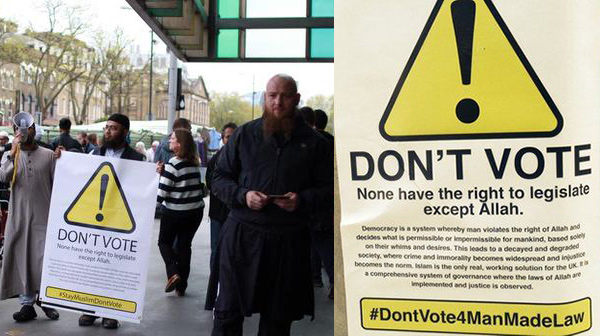 Despite several grassroots campaigns to encourage British Muslims to vote in greater numbers, some prominent Islamists in the UK claim that voting is a “sin.”
Other British Islamists are following Choudary’s lead. Bright yellow posters claiming that democracy “violates the right of Allah” have been spotted in Cardiff, the capital of Wales, and Leicester, as part of a grassroots campaign called #DontVote4ManMadeLaw.
One such poster stated:
“Democracy is a system whereby man violates the right of Allah and decides what is permissible or impermissible for mankind, based solely on their whims and desires.
“Islam is the only real, working solution for the UK. It is a comprehensive system of governance where the laws of Allah are implemented and justice is observed.”
Muslims Trump All Other Minorities Because of the Victim Value Index, Front Page Magazine, Daniel Greenfield, February 27, 2015
(The Islamic State is not valued like Hamas because, as all good Obamabots know, the Islamic State is “not Islamic” and merely engages in random, senseless violence. Perhaps if “real” Jews, Christians and other victims of “real” Islamic and other violence (the Holocaust, for example) were, and had in the past been, more violent they would have higher rankings on the Victim Value Index. Much of the world is insane.– DM)
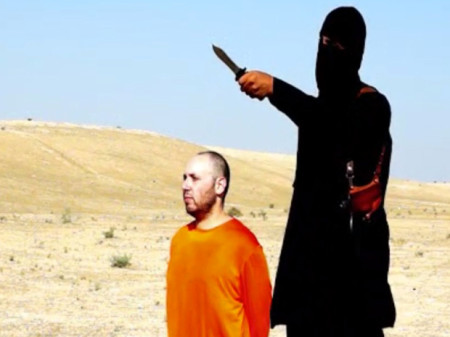
SJW code assumes that the angrier you are, the more oppressed you are. (Unless you’re a straight white male who isn’t pretending to be a woman and isn’t angry on behalf of an oppressed minority group.) But your anger is only useful if it serves the left.
The angriest groups, the ones with the newest rawest edge make the cut. A propensity for violence helps.
**********************
James Kirchick has written an extensive piece on the Victimhood Olympics replete with examples and references. He notes that…
Trans beats gay and Muslim beats black. As someone who writes frequently on the topic of homosexuality, I have learned the hard way what happens to those who challenge the orthodoxy of transgender activists…
This is because in the progressive imagination, the perceived plight of Muslims now trumps the sufferings of all other groups. It is this conceit that goes the furthest in explaining President Obama’s remark to Vox earlier this month that the murder of four Jews at a kosher supermarket in Paris last month was “random,”…
But he fails to explain what the basis for this hierarchy is. Why do Muslims trump Jews and why do trannies trump gay men?
There is a clear Victim Value Index. It’s not random. It has a definitive basis. That basis is the value of a victim identity to the left.
The first thing to understand is the dirty little secret of the Victim Value Index. While loud vocal assertions of suffering are very important, the substance of such suffering is unimportant when moving up the ladder of the Victim Value Index…
Actual suffering doesn’t matter. Neither does historical justice. Both of those are easy to make up, and in a dogma-ridden environment no one will look past the politically correct line anyway.
The Victim Value Index is calculated based on one overriding factor: Disruptiveness. Those who are most disruptive go to the head of the line.
This is the most obvious thing that people have noted about the Social Justice Warrior twitter mobs. They’re angry. They’re disruptive. This is also their virtue.
SJW code assumes that the angrier you are, the more oppressed you are. (Unless you’re a straight white male who isn’t pretending to be a woman and isn’t angry on behalf of an oppressed minority group.) But your anger is only useful if it serves the left.
The angriest groups, the ones with the newest rawest edge make the cut. A propensity for violence helps. Ergo, Muslims win.
Progressivism is a revolution in slow motion, and revolutions need revolutionaries. Disruption is more than just grievance, it’s violence. Those who are willing to ruthlessly attack the status quo clearing the ground for revolution are the ones who go to the head of the line and the dais of honor on top. A little murder and mayhem, and progressives will trot out “moderate” versions of the murderers and mayhemists, usually linked to them, and offer to represent them and tamp down the violence in exchange for meeting their demands.
September 11 and its aftermath is why Muslims have gone to the top of the Victim Value Index. The left may swear up and down that they are interested in Muslim civil rights, but if the Muslims were Sikhs, they would merit a place somewhere in the back. Before Muslims began prominently blowing things up in the United States, the left barely paid any attention to them. Once they did, they began outweighing every other group in the country because killing 3,000 people is the gold standard of revolutionary mayhem.
The Victim Value Index places the most disruptive groups at the front, the somewhat disruptive groups in the middle and the least disruptive groups at the back. The status of groups within the Index can change with their behavior. Muslims used to be shelved in the back with Asians, Indians and Jews. The War on Terror dramatically upgraded their status. The other groups are stuck there because they are relatively successful and aren’t rioting or blowing things up.
Latinos are still somewhere in the middle. Native Americans are in the back along with most unclassified minorities. Homosexuals are somewhere near the front, but behind African-Americans. Their status tends to drift wildly depending on current events, but they cannot overtake African-Americans or fall behind Latinos. Not unless some drastic events take place that change their status. Women are, and have always been, in the back.
The hierarchy can and does change. If Muslim violence were to suddenly disappear, the left’s interest in them in the US would go away. That’s a simple fact. The left values violent groups over non-violent ones. In the social media era, that can be virtual violence, cyberbullying and social media mobs. All that counts as activism and the left is keen to recruit activists for its cause.




 anneinpt
 artaxes
 danmillerinpanama
 davidking1530
 Peter Hofman
 Joseph Wouk
 Peter
Peter Louisiana Steve
 WarSclerotic
Recent Comments