Nigel Farage reacts to the death of Fidel Castro, Fox News via YouTube, November 26, 2016
(And other stuff, such as BREXIT, Trump appointees, election recounts, etc. — DM)
Nigel Farage reacts to the death of Fidel Castro, Fox News via YouTube, November 26, 2016
(And other stuff, such as BREXIT, Trump appointees, election recounts, etc. — DM)
Former Cuban Leader Fidel Castro Dies Aged 90
BY:
November 26, 2016 1:13 am
Source: Former Cuban Communist Leader Fidel Castro Dies Aged 90

Cuba’s former president Fidel Castro attends the closing ceremony of the seventh Cuban Communist Party congress in Havana, April 2016 / REUTERS
By Marc Frank
HAVANA (Reuters) – Fidel Castro, the Cuban revolutionary leader who built a communist state on the doorstep of the United States and for five decades defied U.S. efforts to topple him, died on Friday, state-run Cuban Television said. He was 90.
Castro had been in poor health since an intestinal ailment nearly killed him in 2006 and he formally ceded power to his younger brother Raul Castro two years later.
It was Raul Castro who announced his brother died on Friday evening.
The bearded Fidel Castro took power in a 1959 revolution and ruled Cuba for 49 years with a mix of charisma and iron will, creating a one-party state and becoming a central figure in the Cold War.
He was demonized by the United States and its allies but admired by many leftists around the world, especially socialist revolutionaries in Latin America and Africa.
Transforming Cuba from a playground for rich Americans into a symbol of resistance to Washington, Castro outlasted nine U.S. presidents in power.
He fended off a CIA-backed invasion at the Bay of Pigs in 1961 as well as countless assassination attempts.
His alliance with Moscow helped trigger the Cuban Missile Crisis in 1962, a 13-day showdown with the United States that brought the world the closest it has been to nuclear war.
Wearing green military fatigues and chomping on cigars for many of his years in power, Castro was famous for long, fist-pounding speeches filled with blistering rhetoric, often aimed at the United States.
At home, he swept away capitalism and won support for bringing schools and hospitals to the poor. But he also created legions of enemies and critics, concentrated among Cuban exiles in Miami who fled his rule and saw him as a ruthless tyrant.
In the end it was not the efforts of Washington and Cuban exiles nor the collapse of Soviet communism that ended his rule. Instead, illness forced him to cede power to his younger brother Raul Castro, provisionally in 2006 and definitively in 2008.
Although Raul Castro always glorified his older brother, he has changed Cuba since taking over by introducing market-style economic reforms and agreeing with the United States in December 2014 to re-establish diplomatic ties and end decades of hostility.
Six weeks later, Fidel Castro offered only lukewarm support for the deal, raising questions about whether he approved of ending hostilities with his longtime enemy.
He lived to witness the visit of U.S. President Barack Obama to Cuba earlier this year, the first trip by a U.S. president to the island since 1928.
Castro did not meet Obama, and days later wrote a scathing column condemning the U.S. president’s “honey-coated” words and reminding Cubans of the many U.S. efforts to overthrow and weaken the Communist government.
In his final years, Fidel Castro no longer held leadership posts. He wrote newspaper commentaries on world affairs and occasionally met with foreign leaders but he lived in semi-seclusion.
His death–which would once have thrown a question mark over Cuba’s future–seems unlikely to trigger a crisis as Raul Castro, 85, is firmly ensconced in power.
Still, the passing of the man known to most Cubans as “El Comandante”–the commander–or simply “Fidel” leaves a huge void in the country he dominated for so long. It also underlines the generational change in Cuba’s communist leadership.
Raul Castro vows to step down when his term ends in 2018 and the Communist Party has elevated younger leaders to its Politburo, including 56-year-old Miguel Diaz-Canel, who is first vice-president and the heir apparent.
Others in their 50s include Foreign Minister Bruno Rodriguez and economic reform czar Marino Murillo.
The reforms have led to more private enterprise and the lifting of some restrictions on personal freedoms but they aim to strengthen Communist Party rule, not weaken it.
“I don’t think Fidel’s passing is the big test. The big test is handing the revolution over to the next generation and that will happen when Raul steps down,” Cuba expert Phil Peters of the Lexington Institute in Virginia said before Castro’s death.
REVOLUTIONARY ICON
A Jesuit-educated lawyer, Fidel Castro led the revolution that ousted U.S.-backed dictator Fulgencio Batista on Jan 1, 1959. Aged 32, he quickly took control of Cuba and sought to transform it into an egalitarian society.
His government improved the living conditions of the very poor, achieved health and literacy levels on a par with rich countries, and rid Cuba of a powerful Mafia presence.
But he also tolerated little dissent, jailed opponents, seized private businesses, and monopolized the media.
Castro’s opponents labeled him a dictator and hundreds of thousands fled the island.
Many settled in Florida, influencing U.S. policy toward Cuba and plotting Castro’s demise. Some even trained in the Florida swamps for the disastrous Bay of Pigs invasion.
But they could never dislodge him.
Generations of Latin American leftists applauded Castro for his socialist policies and for thumbing his nose at the United States from its doorstep just 90 miles (145 km) from Florida.
Castro claimed he survived or evaded hundreds of assassination attempts, including some conjured up by the CIA.
In 1962, the United States imposed a damaging trade embargo that Castro blamed for most of Cuba’s ills, using it to his advantage to rally patriotic fury.
Over the years, he expanded his influence by sending Cuban troops into far-away wars, including 350,000 to fight in Africa. They provided critical support to a left-wing government in Angola and contributed to the independence of Namibia in a war that helped end apartheid in South Africa.
He also won friends by sending tens of thousands of Cuban doctors abroad to treat the poor and bringing young people from developing countries to train them as physicians
‘HISTORY WILL ABSOLVE ME’
Born on August 13, 1926 in Biran in eastern Cuba, Castro was the son of a Spanish immigrant who became a wealthy landowner.
Angry at social conditions and Batista’s dictatorship, Fidel Castro launched his revolution on July 26, 1953, with a failed assault on the Moncada barracks in the eastern city of Santiago.
“History will absolve me,” he declared during his trial for the attack.
He was sentenced to 15 years in prison but was released in 1955 after a pardon that would come back to haunt Batista.
Castro went into exile in Mexico and prepared a small rebel army to fight Batista. It included Argentine revolutionary Ernesto “Che” Guevara, who became his comrade-in-arms.
In December 1956, Castro and a rag-tag band of 81 followers sailed to Cuba aboard a badly overloaded yacht called “Granma”.
Only 12, including him, his brother, and Guevara, escaped a government ambush when they landed in eastern Cuba.
Taking refuge in the rugged Sierra Maestra mountains, they built a guerrilla force of several thousand fighters who, along with urban rebel groups, defeated Batista’s military in just over two years.
Early in his rule, at the height of the Cold War, Castro allied Cuba to the Soviet Union, which protected the Caribbean island and was its principal benefactor for three decades.
The alliance brought in $4 billion worth of aid annually, including everything from oil to guns, but also provoked the 1962 Cuban Missile Crisis when the United States discovered Soviet missiles on the island.
Convinced that the United States was about to invade Cuba, Castro urged the Soviets to launch a nuclear attack.
Cooler heads prevailed. Soviet leader Nikita Khrushchev and U.S. President John F. Kennedy agreed the Soviets would withdraw the missiles in return for a U.S. promise never to invade Cuba. The United States also secretly agreed to remove its nuclear missiles from Turkey.
‘SPECIAL PERIOD’
When the Soviet Union collapsed in 1991, an isolated Cuba fell into a deep economic crisis that lasted for years and was known as the “special period.” Food, transport, and basics such as soap were scarce and energy shortages led to frequent and long blackouts.
Castro undertook a series of tentative economic reforms to get through the crisis, including opening up to foreign tourism.
The economy improved when Venezuela’s socialist leader Hugo Chavez, who looked up to Castro as a hero, came to the rescue with cheap oil. Aid from communist-run China also helped, but an economic downturn in Venezuela since Chavez’s death in 2013 have raised fears it will scale back its support for Cuba.
Plagued by chronic economic problems, Cuba’s population of 11 million has endured years of hardship, although not the deep poverty, violent crime, and government neglect of many other developing countries.
For most Cubans, Fidel Castro has been the ubiquitous figure of their entire life.
Many still love him and share his faith in a communist future, and even some who abandoned their political belief still view him with respect. But others see him as an autocrat and feel he drove the country to ruin.
Cubans earn on average the equivalent of $20 a month and struggle to make ends meet even in an economy where education and health care are free and many basic goods and services are heavily subsidized.
It was never clear whether Fidel Castro fully backed his brother’s reform efforts of recent years. Some analysts believed his mere presence kept Raul from moving further and faster while others saw him as either quietly supportive or increasingly irrelevant.
Iran Expanding Terror Network in Latin America, Washington Free Beacon,
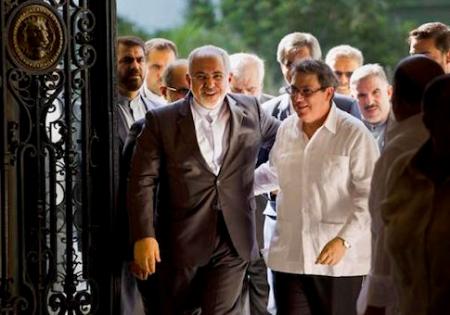
Iranian Foreign Minister Mohammad Javad Zarif, left, is welcomed by Cuban Foreign Minister Bruno Rodriguez, in Havana, Cuba, Monday, Aug. 22, 2016. (AP Photo/Ramon Espinosa)
Iran is solidifying its foothold in Latin America, sparking concerns among U.S. officials that the Islamic Republic will enlist these regional allies in its push to launch terror attacks on U.S. soil, according to conversations with congressional sources.
Iranian Foreign Minister Javad Zarif has been on a diplomatic tour through key Latin American countries known for hostility towards the United States, including Cuba, Venezuela, and a host of other countries believed to be providing shelter to Iranian terrorist proxies such as Hezbollah.
As Iranian-ally Russia boosts its spy operation in the region, sources have raised concerns about the rogue nations working together to foster anti-U.S. unrest.
Zarif’s trip through the region has raised red flags among some senior congressional sources familiar with the region. For example, Zarif took aim at the United States and touted the regime’s desire to align with anti-American countries during his stay in Cuba.
One senior congressional source who works on the issue said to the Washington Free Beacon that Iran is seeking to recruit “potential terrorists who want to cause the U.S. harm.”
Increased ties between Iran and these Latin American nations are setting the stage for terrorists to penetrate close to U.S. soil with little detection.
These individuals “can travel easily to Venezuela, and once there, they can get to Nicaragua or Cuba without passports or visas, which poses a national security risk for our nation,” the source explained.
Iran has also reopened its embassy in Chile, a move that has only added fuel to speculation among U.S. officials that the Islamic Republic is making moves to position its global terror network on America’s doorstep.
“The threat to U.S. national security interests and our allies should be setting off alarm bells,” Rep. Ileana Ros-Lehtinen (R., Fla.), chair of the House Subcommittee on the Middle East and North Africa, said in a statement about Zarif’s Latin American tour.
“The Obama administration has failed to prevent Russia and China from expanding in our Hemisphere, and now Iran is once again stepping up its efforts to gain a greater presence to carry out its nefarious activities,” Ros-Lehtinen said. “I urge the White House to stop downplaying the Iranian threat and take immediate action to prevent the world’s leading state sponsor of terrorism from establishing a regional safe haven in the Americas.”
Asked to comment on Zarif’s trip and the potential repercussions on Monday, a State Department official said to the Free Beacon that the administration had no comment.
Ros-Lehtinen said the high-profile trip by Zarif should serve as a warning.
“The timing of Zarif’s trip is significant as Iran could use many of these rogue regimes to circumvent remaining sanctions, undermine U.S. interests, and expand the drug trafficking network that helps finance its illicit activities,” she said. “Tehran’s classic playbook is to use cultural centers, new embassies or consulates, or cooperative agreements on various areas to act as façades aimed at expanding Iran’s radical extremist network.”
The renewed concerns about Iran’s footprint in Latin America comes nearly two years after the State Department said Tehran’s influence in the region was “waning.”
“The timing of Zarif’s trip speaks volumes,” said the senior congressional aide who would discuss the issue only on background. It “is worrisome that as we just celebrated the 22nd year of the horrific terrorist attack against the AMIA Jewish community center in Argentina, Iran can now have personnel nearby in a new embassy in Chile.”
“Just recently, a Hezbollah member was picked up in Brazil, an explosive device was found near the Israeli embassy in Uruguay, and Hezbollah members are reportedly traveling on Venezuelan passports,” the source added. “It was not too long ago that Venezuela offered flights to Iran and Syria, and as of last week, Hezbollah cells were found in the West Bank where Venezuela lifted its visa requirements for Palestinians.”
Zarif slammed the United States on Monday during a speech in Havana.
“Iran and Cuba could prove to the U.S. that it cannot proceed with its policies through exerting pressure on other countries,” Zarif said, according to Iran’s state-controlled media.
“Now the time is ripe for realizing our common goals together and implement the resistance economy in Iran and materialize [Cuban dictator Fidel] Castro’s goals of reconstruction of the Cuban economy,” Zarif added.
Zarif went on to note that Iran “has age-old and strong relations with the American continent and the Latin American countries.”
Zarif is reported to have brought along at least 60 Iranian officials and executives working in the country’s state-controlled economic sector.
Behnam Ben Taleblu, senior Iran analyst at the Foundation for Defense of Democracies, told the Free Beacon that Iran has boosted efforts to engage Latin America in the wake of last summer’s nuclear agreement.
“Iran’s Foreign Minister Mohammad-Javad Zarif is aggressively continuing Iran’s diplomatic outreach, a policy which began early in the Rouhani administration and was kicked into high gear in the aftermath of the JCPOA—last summer’s nuclear deal,” he said. “Zarif’s sojourn into the Western hemisphere follows on the heels of his May visit to the region. Zarif’s trip symbolically commences in Havana, Cuba, where the Iranian foreign minister harped on themes of steadfastness and resistance to American legal and economic pressure.”
The Iranian leader’s goal is to “build on this experience to help promote an anti-American and anti-capitalist world order,” he added. “What’s most clear however, is that in addition to seeking to solidify the anti-American political orientation of these states, Iran aims to capitalize on the increasingly detached stigma of doing business with it in the aftermath of the nuclear accord. Therefore, we can expect to see trade deals or memorandums of understanding inked. In short, Iran will be looking to deepen to its footprint in Latin America.”
John Kerry’s New Terror Treason, Front Page Magazine, Daniel Greenfield, March 30, 2016
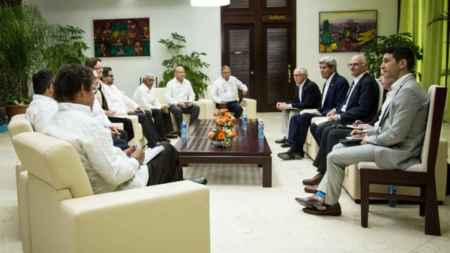
Stop by your local post office and you might just see a poster of Rodrigo “Timochenko” Londono hanging next to the Most Wanted posters of bank robbers and fugitives. The State Department is offering a $5 million reward for information about the Communist terrorist leader.
But all the State Department had to do was ask Secretary of State Kerry. Obama did the wave with the Cuban dictator and Kerry met with Timochenko , the leader of FARC, a Marxist terrorist organization that appears on his own department’s list of foreign terrorist organizations a little above Al Qaeda.
Timochenko is a Communist who was trained at the USSR’s infamous Patrice Lumumba University. The State Department accuses him of ordering the kidnapping of Americans and responsibility for much of the cocaine that is smuggled into the United States. But none of that bothered Kerry who accepted a signed copy of a memoir by the terror group’s former leader which was addressed to “Senor” Kerry.
The signatures in Kerry’s new keepsake include Pablo Catatumbo, a FARC leader with a $2.5 million reward on his head from the State Department, who is wanted for “the production, manufacture, and distribution of hundreds of tons of cocaine to the United States and the world” and “the murder of hundreds of people who violated or interfered with the FARC’s cocaine policies.”Also signing Kerry’s book was Iván Márquez, who has a $5 million reward on his head for most of the same reasons.
Two of the men sitting opposite John Kerry had been convicted of forcing children to join the terror group as soldiers and sex slaves. FARC runs on thousands of child soldiers and sex slaves. Little girls as young as 7 and 9 were brought into the terror group whose fronts have a “quota” of women to fill. Families that refuse to turn over their daughters to FARC have been massacred as a warning to others.
Rape is a typical tactic for the military arm of the Colombian Communist Party. Children were seized from families. Others were “bought” from kidnappers operating in cities. Girls who became pregnant had their children forcibly aborted so the babies wouldn’t interfere with their job of servicing male fighters who protected the narcotics trade while keeping the dream of a Communist dictatorship alive.
But Kerry’s new Communist narcoterrorist chums also had American blood on their hands.
“Take them across the river and burn them.” That was how the lives of three left-wing American environmental activists had ended in the spring of 1999. Their killers were members of the FARC Marxist terror group. The victims were shot in the face after being tortured.
The Clinton administration had engaged in covert contacts with FARC terrorists even while the Marxist terrorists were helping move huge amounts of heroin and cocaine into the United States. Meanwhile it applied pressure on the Columbian government to negotiate with the terrorists by holding up weapons.
Congressman Dan Burton blasted the Clinton White House for “sitting down at the table with a group that actively seeks to wantonly kidnap and murder Americans.”
After the killings, Clinton’s press secretary warned that, “The United States will not rest until those who have committed these crimes have been brought to justice.” The US ambassador to Colombia stated that the United States, “cannot have direct contact with the FARC until it hands over those responsible for the crime.”
That comes as news to Secretary of State John Kerry. Last year, Obama Inc. said that it would not seek the extradition of FARC terrorists. It’s also possible that Obama may hand over Simon Trinidad, a FARC commander serving a sixty-year sentence for his role in taking three American hostages. Freeing Trinidad has become a popular cause for American leftists.
The three hostages, Marc Gonsalves, Thomas Howes, and Keith Stansell, were held for 5 years until they were rescued. Their pilot, 56-year-old Tom Janis, a Vietnam veteran and Bronze Star recipient, was shot. He left behind a wife and four children. Tom is yet another Vietnam vet betrayed by John Kerry.
Mark Rich, David Mankins, and Rick Tenenoff, three missionaries, were kidnapped and murdered by FARC. As were two other missionaries, Tim Van Dyke and Steve Welsh. Frank Pescatore, a geologist, was kidnapped and murdered by FARC in 1996. The Marxist terrorists packed his body with lime and formaldehyde and tried to pretend that he was still alive in the hopes of collecting a ransom for him.
FARC attempted to murder US Ambassador Myles Frechette and the Deputy Assistant Secretary of Defense. It plotted to bomb President Clinton during his visit to Colombia. Agricultural scientist Thomas Hargrove was kidnapped and held by FARC for almost a year. His story inspired the movie Proof of Life. Eldon Lee Horton and Clyde Nolan Killgore, two American oil workers, were also held hostage by FARC. As was missionary Ray Rising. And bird watchers Peter Shen, Todd Mark and Louise Augustine, a former nun and retired schoolteacher. Tom Fiore, another bird watcher, escaped through the jungle.
In 2003, a FARC terrorist threw grenades at bars that Americans often visited. Five Americans were injured in the blast. Vance Vogeli described his reaction. “I looked down and there was blood.” That same year, FARC had tried to set off a car bomb near the US embassy and American hotels.
FARC’s war on America dates back to 1983 when the Marxist terror group took its first American hostage. Its last American hostage, Kevin Scott Sutay, an ex-Marine, was freed only a few years ago.
Now wanted FARC terrorists have met with Kerry and attended a baseball game with Obama. These are some of the most direct contacts possible. The indictments issued by Attorney General Ashcroft and Gonzalez are null and void. The rewards will eventually be erased by the State Department.
The Bush Administration had parted ways with Clinton’s pandering to terrorists. Instead it indicted FARC leaders and helped Colombia target them with smart bombs. Martin Caballero, a FARC commander who had plotted to bomb Clinton was blown away. As was Raul Reyes, who had been indicted in the abduction of the three American hostages.
But the victories against FARC have been thrown away once again. The peace deal gives FARC the breathing room it needs. At their meeting with Kerry, FARC leaders asked for American protection. And there is little doubt that they will receive it. Obama bailed out Cuba and intends to bail out its FARC terror group. Its American victims will never see justice. Instead their killers and torturers will thrive.
In an administration of endless lows, Secretary of State John Kerry has found a new low by meeting with wanted terrorists from a Marxist organization with American blood on its hands.
“This Cuba policy is also our Latin American policy,” Ben Rhodes boasted. Rhodes is the man who wrote Obama’s Cairo speech. The Cuba policy is solidarity with Communist enemies of the United States. Reversing JFK’s inaugural address, Obama and Kerry will pay any price, oppose any friend and support any foe in order to assure the death and defeat of liberty. That much they have pledged and done.
50 years after Kerry first turned traitor, his betrayal of the United States continues without end.
Two left feet: Obama’s week of ‘bad optics’ really just bad leadership, New York Post, Kyle Smith, March 27, 2016
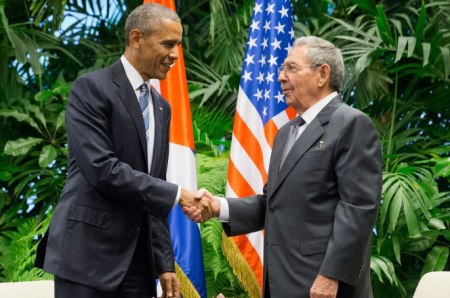 Barack Obama shakes hands with Cuban President Raul Castro. Photo AP
To be a president means regularly to find oneself caught off balance. Sometimes you want to chill at the same moment your enemies move to kill. You may find yourself doing an innocent photo op reading a book to little kids when terrorists launch a coordinated attack on the country.
So let’s have a little sympathy for President Obama this week. It has to be frustrating when you set out to make nice with the leaders of a mass-murdering fanatical regime and at the exact same time a mass murder is carried out by a completely different group of fanatics — the ones you keep saying are no big deal.
It has to get under your skin when you bring a planeload of fanboy hacks with you to a tropical paradise on the understanding that they’ll write nice stories about your kicking back with one half of a pair of homicidal brothers when instead people get all distracted about the tiny detail of 31 people getting killed by a different pair of homicidal brothers.
The president whose acolytes call him No Drama Obama aren’t quite right, but they are on to something. The president does get angry, but not at terrorists, dictators or mass murderers. Every time rage sneaks into his face, he’s talking about his domestic political opponents. He’s talking about budgetary disputes, federal appointments, Constitutional interpretation.
Blood literally running in the streets of Belgium? Heads being cut off by sabers? A movement that wants to kill every Jew and Christian? Shrug. Obama spoke about the ISIS mass murder briefly.
Then he did “the wave” with Raul Castro.
 Obama and Castro wave to the crowd during a exhibition game between the Tampa Bay Rays and the Cuban national team.
As one newspaper headline put it, juxtaposing a photo of Obama doing the tango in Argentina against an image from the latest ISIS atrocity, “Whiskey Tango Foxtrot?” That’s the polite way of referring to the words that are ordinarily indicated by “WTF?”
There are often no great options for a president in times of strain; if President Bush had, when informed that the second plane had hit the World Trade Center, scared the kids by throwing down his copy of “The Pet Goat” and said, “Holy s–t! We’re under attack!” he would have been criticized even more heartily than he was for continuing to read for seven more minutes. (Though it’s hard to grasp exactly what exactly liberals find so outrageous about that notorious delay: Would they be happy if Bush had invaded Afghanistan seven minutes sooner than he did?)
Once Obama decided to go to the ballgame, his only choices were to stick with it and risk looking out of sync with the world’s mood, which is what he did, or ruin his fun day out with a new pal who once ordered up the execution of hundreds of political enemies.
Hey, at least Raul Castro never did anything really vile like declining to appear on a television program with Obama. (In January, The Hill reported, the president grew “visibly angry” when he mentioned the NRA at his gun-control town hall.)
Maybe Obama was invisibly angry with ISIS after the Brussels slaughter. But if you were looking for a signal that he was taking it seriously, you were disappointed. “We defeat them in part by saying, ‘You are not strong, you are weak,’” was his message, reverting to his default reasoning about how terrorism is really all a matter of adjusting your perceptions because the bad guys obviously can’t hurt us if we keep saying we’re not hurt.
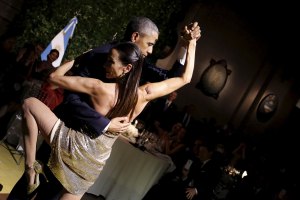 Obama tangos in Argentina.Photo: Reuters
It’s the same logic you heard in high school from your highly educated feminist English teacher, the one who drove a rusted Chevette with a bumper sticker reading, “It will be a great day when schools get all the money they need and the Air Force has to hold a bake sale to buy a bomber.” She told you the best way to beat bullies was to deny them any satisfaction, i.e. to pretend they weren’t pummeling you. “Just curl up into the fetal position, Johnny, you’ll have the last laugh when their punching muscles wear out in an hour or two.” Roughly at the same time, you developed strange new respect for your meathead gym teacher, the one who taught you how to throw a punch in such a way that it would definitely make a nose bleed.
What this week really demonstrated was not that Obama has a wee problem with “the optics” of his job, but that he’s stuck forever in campaign mode, confusing rhetoric with leading. ISIS just laughs and reloads when the president chides them.
Beginning to normalize relations with Cuba is a good idea — but Obama loved the picture of himself giving a speech in Havana so much that he skipped over the part where he’d win concessions from the regime. Giving away the game was his opening bid.
We have the kind of president who would drive away from a car lot congratulating himself on his sweet deal after paying the sucker’s price — plus extra for the “protective undercoating.”
Obama on Freedom vs. Totalitarianism — Whatever Works, Power Line,
During his remarks, Obama stumbled through an embarrassing discourse on “capitalism vs. communism.” The would-be leader of what used to be called the Free World treated the issue as just another false choice, sort of the way he used to speak of Red States and Blue States before he figured out that the dichotomy was central to his election and reelection.
Obama seems to have been nervous during this presentation. At times, his hand gestures resembled those of the person who was translating for the deaf.
I guess the question of capitalism vs. communism is a puzzler for this president. Or maybe he was just embarrassed by what was coming out of his mouth. If not, he should have been.
Obama instructed his young listeners that the question isn’t this system vs. that system, but rather “what works.” In Cuba, he claimed (falsely), communism is working great when it comes to health care. On the other hand, he acknowledged, the country looks like it’s stuck in the 1950s.
The lesson, said Obama, is that markets tend to generate wealth. Thus, they meet his “does it work” test, though they must be heavily regulated. Such is the wisdom imparted by this (once-thought-by many-to-be) towering intellect.
Scandalously, the only argument Obama was willing to make in favor of freedom is its tendency to generate wealth. If communism produced just as much, apparently it would be just as good or better, given the more even distribution of the wealth it purports to produce.
To argue in favor of freedom as a good in itself would, in Obama’s thinking, mean succumbing to ideology. He is much too cool for that.
I infer that during the heyday of the Soviet Union, Obama might well have been a communist. Then it was thought, based on successful propaganda of the kind some now accept when it comes to health care in Cuba, that communism was working fine.
I also infer that Obama may well be a fan of the current Chinese regime. Until recently, many thought it was working quite well.
As for the U.S., Obama’s crude pragmatism militates in favor of some reliance of free markets. However, this doesn’t mean that socialist or communist solutions should be ruled out. It depends on the particular problem your addressing, Obama told his young audience.
Because freedom isn’t a big deal in an of itself, Obama’s “pragmatism” militates in favor of — for example — telling people what kinds of communities they must live in. On such matters, government diktat will “work” better than freedom in producing the kinds of neighborhoods Obama favors.
Obama doesn’t want to kill the Golden Goose of free markets. He just wants to put it in a cage with as little sunlight as is consistent with the continued laying of eggs. And he hopes we will overlook the fact that the eggs are losing their luster.
Obama’s entire speech is below. His remarks regarding capitalism vs. communism begin at around the 41:00 minute mark.
Obama Embarrasses Nation With Visit to Cuba, PJTV via You Tube, March 22, 2016
The Obama Doctrine Applied, Power Line,
In the immediate aftermath of the terror attacks in Brussels yesterday, President Obama gave a previously scheduled speech in Havana “To the People of Cuba.” The speech contrasts rather starkly with the speech suggested by Professor Carlos Eire in “The speech never given,” to the detriment of Obama’s speech.
Obama’s speech wasn’t all bad. Though full of nauseating palaver, it had a good paragraph or two. To the mostly nauseating palaver and gratuitous autobiographical reflections in the prepared text of the speech, Obama tacked on formulaic vacuities to acknowledge the morning’s events in Brussels:
Before I begin, please indulge me. I want to comment on the terrorist attacks that have taken place in Brussels. The thoughts and the prayers of the American people are with the people of Belgium. We stand in solidarity with them in condemning these outrageous attacks against innocent people. We will do whatever is necessary to support our friend and ally, Belgium, in bringing to justice those who are responsible. And this is yet another reminder that the world must unite, we must be together, regardless of nationality, or race, or faith, in fighting against the scourge of terrorism. We can — and will — defeat those who threaten the safety and security of people all around the world.
That’s it. The White House posted video of Obama’s remarks on the attacks here. The video runs for 51 seconds.
Having given the speech, President Obama kept his previously scheduled date with Raul Castro to attend the Rays-Cuba baseball game in Havana. At the game Obama schmoozed with Castro. What a sickening sight. On the plus side, however, Obama didn’t throw out the opening pitch.
Obama commented on the attacks in Brussels to ESPN during the game (video below, about ten minutes). He didn’t appear to be to broken up about them.
“This is just one more example of why the entire world needs to unite against these terrorists,” Obama said. “The notion that any political agenda would justify the killing of innocent people like this is something that’s beyond the pale.” Obama imputes a simply “political agenda” to the attack. Their religious inspiration has been drained from them.
Obama explained why he attended the game as planned: “It’s always a challenge when you have a terrorist attack anywhere in the world, particularly in this age of 24/7 news coverage, you wanna be respectful and understand the gravity of the situation but the whole premise of terrorism is to try to disrupt people’s ordinary lives.”
One of the illuminating passages in Jeffrey Goldberg’s compilation of the wit and wisdom of Barack Obama addresses the subject of terrorism. When it comes to terrorism, this is “the Obama doctrine.” Cool out and learn to live with it. His attitude is complacent. His take on ISIS to Valerie Jarrett represents it: “They’re not coming here to chop our heads off.”
Goldberg adds: “Obama frequently reminds his staff that terrorism takes far fewer lives in America than handguns, car accidents, and falls in bathtubs do. Several years ago, he expressed to me his admiration for Israelis’ ‘resilience’ in the face of constant terrorism, and it is clear that he would like to see resilience replace panic in American society. Nevertheless, his advisers are fighting a constant rearguard action to keep Obama from placing terrorism in what he considers its ‘proper’ perspective, out of concern that he will seem insensitive to the fears of the American people.”
Islam must of course be kept out of the equation. Obama hesitates to confide in us regarding the contribution of Islam to the jihad with which we are contending. We can’t be trusted to deal fairly with it. Goldberg reports that those who speak with Obama about jihadist thought say that he possesses a no-illusions understanding of the forces that drive apocalyptic violence among radical Muslims, but he has been careful about articulating that publicly, out of concern that he will exacerbate anti-Muslim xenophobia (i.e., “Islamophobia”).
The ESPN interview adds Obama’s irritated observation on the role of cable news in aggravating our concerns about terrorism. Taken together, his comments to the ESPN interviewers perfectly represent the application of the Obama doctrine on terrorism to the Brussel attacks.
Race is never far from Obama’s mind. Let me insert here this stray quotable quote from the ESPN interview (my transcription): “Now we still have a long way to go. You know, that’s true in everyday life; it’s true in our sports. You know, if you look at the number of African-American managers, if you look at the number of Latino managers, in baseball, or owners, obviously there’s still a carryover from the past.”
Take Me Out to the Raul Game, Hope n’ Change, March 23, 2016
 He really did this. Also, he did “the wave” with Raul Castro.
Yesterday was the sort of horrible news day in which all of the seemingly unrelated jigsaw pieces end up belonging to one big depressing picture.
In Belgium, a number of terrorist bombs killed dozens of innocents and wounded hundreds more, including Americans. To the surprise of absolutely no one who isn’t in the Obama administration, Isis is taking credit for the explosive deaths, giving further proof that Islam is overdue to either clean house or change their slogan to “The Religion of Pieces.”
Of course, with American casualties (including a U.S. serviceman and his family) did Barack Hussein Obama turn his laser-like focus to strong anti-terrorist rhetoric and actions? He did not. He simply threw a few seconds of “thoughts and prayers, blah, blah, blah, we’ll stand with Belgium, blah, blah, blah” into his previously scripted speech to the desperately poor people of Cuba. Seriously, it’s a miracle he didn’t actually say the words “insert city name here” into his generic Hallmark sentiments.
And his actual speech in Cuba was one that Isis would have found hugely agreeable. Confirming their every assertion of American evil and imperialism, the “New Camelot” president took a long, splashy leak on the grave of the “Old Camelot” president by bringing up the Bay of Pigs invasion. He also declared “the blue waters beneath Air Force One once carried American battleships to this island — to liberate, but also to exert control over Cuba.” Hey, are we rotten bastards or what?!
Obama also gave Cuba and the United States moral equivalency of the lowest kind by sneering that both were colonized by Europeans (those despicable infidels) and “Cuba, like the United States, was built in part by slaves brought here from Africa. Like the United States, the Cuban people can trace their heritage to both slaves and slave-owners.” A simplistic, inaccurate, and belittling view of our people, history, and culture which explains his clear distaste for white Americans.
But despite the degree to which we suck, Obama said that at least our nation can take credit for accepting a seemingly unending flood of immigrants.
Because that’s worked out so frigging well for Belgium.
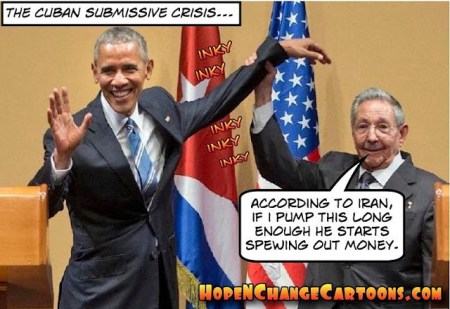 Oh, come one – you KNEW we were going to do something with this pathetic picture.




 anneinpt
 artaxes
 danmillerinpanama
 davidking1530
 Peter Hofman
 Joseph Wouk
 Peter
Peter Louisiana Steve

 WarSclerotic
Recent Comments