Posted tagged ‘Boko Haram’

Hillary Obstructed Boko Haram’s Terror Designation as Her Donors Cashed In

July 28, 2016

Hillary Obstructed Boko Haram’s Terror Designation as Her Donors Cashed In, PJ MediaPatrick Poole, July 28, 2016

(But hashtags should have worked.
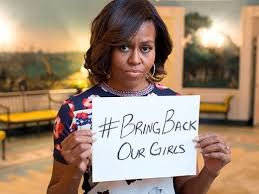
bring back our gals

— DM)

boka harem

In January 2015, I was one of the first to report on a massive massacre by Nigerian terror group Boko Haram in Borno State in northwest Nigeria, with reportedly thousands killed. Witnesses on the ground reported that bodies littered the landscape for miles as towns and villages had been burned to the ground, their populations murdered or fled.

By that time, Boko Haram had already become the most lethal terrorist organization in the world, now responsible for tens of thousands of deaths. Just yesterday, the United Nations accused Boko Haram of “almost unimaginable” levels of violence and brutality.

And yet, as Boko Haram began to ramp up its terror campaign in 2011 and 2012, Hillary Clinton obstructed the official terror designation of the group over the objections of Congress, the FBI, the CIA and the Justice Department.
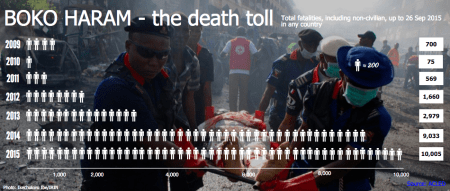
boko death

Why did Hillary Clinton’s State Department drag its feet on the terror designation in the face of near unanimous opposition from the rest of the U.S. government?

A recent series of reports exposes that a close Clinton family confidante — and Hillary campaign bundler — who profited from Nigeria’s lucrative oil fields. He engaged in multiple illegal deals throughout Africa.

Also, other donors to the Clinton Global Initiative are deeply involved in Nigeria’s corrupt oil industry.

Were they the motivation behind Hillary’s inexplicable position on Boko Haram?

As PJ Media’s Bridget Johnson has previously asked, is Boko Haram Hillary Clinton’s biggest scandal? Hillary Clinton is set to accept the Democratic Party nomination for president of the United States. Why is no one in the media talking about Hillary and Boko Haram?

It is worth nothing that Congress had to drag a reluctant State Department kicking and screaming to get Boko Haram designated in November 2013, after Hillary Clinton had left office.

Hillary Clinton’s willful obstruction in the matter is easy to document:

  • Members of Congress discovered in 2014 that the Clinton State Department intentionally lied and downplayed the threat from Boko Haram, and worked to kill bills in both the House and the Senate calling for their designation in 2012.
  • As Reuters reported, the Justice Department’s National Security Division strongly urged the State Department to designate Boko Haram, but then a group of 21 American academics rallied to the State Department’s aid by sending a letter to Hillary Clinton strongly arguing against Boko Haram’s designation.
  • We also now know that the Obama administration was sitting on intelligence — obtained as a result of the Bin Laden raid — that revealed Boko Haram’s direct connection to al-Qaeda and the international terror network in 2011 and 2012. In other words, Hillary’s State Department was arguing that Boko Haram had no such connections, that it wasn’t a transnational terror threat, even though the Obama administration — and likely Clinton herself — knew that was false.

An important two-part investigative series by WORLD Magazine reporters Mindy Belz and J.C. Derrick provides some insight:

Belz and Derrick discovered that Hillary Clinton’s obstruction of the Boko Haram designation, and the continuing chaos in northern Nigeria — Africa’s largest economy and the 10th largest oil producer in the world — directly benefited Clinton Global Initiative donors and a close Clinton confidante who bundled campaign cash for Hillary.

From Belz’s and Derrick’s second article:

Perhaps the most prominent Nigerian with ties to the Clintons is Houston-based Kase Lawal. The founder of CAMAC Energy, an oil exploration and energy consortium, Lawal had a long history with Bill Clinton before becoming a “bundler” for Hillary’s 2008 presidential bid, amassing $100,000 in contributions and hosting a fundraiser in his Houston home — a 14-room, 15,264-square-foot mansion. Lawal maxed out donations to Hillary’s 2016 primary campaign, and his wife Eileen donated $50,000 — the most allowed — to President Obama’s 2009 inaugural committee.Lawal describes himself as a devout Muslim who began memorizing the Quran at age 3 while attending an Islamic school. “Religion played a very important role in our lives,” he told a reporter in 2006. “Every time you finish a chapter they kill a chicken, and if you finish the whole thing, a goat.”

Today the Houston oil exec — who retired in May as CEO but continues as chairman of the board of CAMAC, now called Erin Energy — tops the list of wealthiest Nigerians living in North America. His firm reports about $2.5 billion in annual revenue, making it one of the top private companies in the United States.

In Africa, Lawal has been at the center of multiple criminal proceedings, even operating as a fugitive. Over the last decade, he faced charges in South Africa over an illegal oil scheme along with charges in Nigeria of illegally pumping and exporting 10 million barrels of oil.

In the Democratic Republic of Congo, Lawal arranged a 2011 plot to purchase 4 tons of gold from a rebel warlord, Bosco Ntaganda, linked to massacres and mass rapes. Ntaganda was on a U.S. sanctions list, meaning anyone doing business with him could face up to 20 years in prison. Lawal contacted Clinton’s State Department, and authorities in Congo released his plane and associates in the plot.

He never faced charges in the United States, and he remains a commissioner for the Port Authority of Houston.

Lawal’s energy firm holds lucrative offshore oil licenses in Nigeria, as well as exploration and production licenses in Gambia, Ghana, and Kenya, where he operates in a conflict-ridden area largely controlled by Somalia’s al-Shabaab militants.

The firm also has held contracts in Nigeria for crude oil lifting, or transferring oil from its collection point to refineries. Until last year, when newly elected President Muhammadu Buhari began an effort to reform the process, contracting for lifting has been awash in kickbacks, bribes, and illegal activity.

Overland lifting contracts often involve partnership with the North’s past and present governors, including those who serve as quasi-warlords with ties to Boko Haram and other militants.

Lawal’s enterprises have long been rumored to be involved in such deals, as have indigenous oil concerns like Petro Energy and Oando, Nigeria’s largest private oil and gas company, based in Lagos and headed by Adewale Tinubu, another controversial Clinton donor.

In 2014, Oando pledged 1.5 percent of that year’s pre-tax profits and 1 percent of future profits to a Clinton Global Initiative education program. This year, Adewale gained notoriety when the Panama Papers revealed he holds at least 12 shell companies, leading to suspicion of money laundering, tax evasion, and other corruption.

In 2013 Bill Clinton stood alongside Adewale’s uncle, Bola Tinubu, while attending the dedication of a massive, controversial reclamation project called Eko Atlantic. Critics call Bola Tinubu, leader of the ruling All Progressives Congress party, Nigeria’s “looter in chief.” A Nigerian documentary says that when the billionaire landowner was governor of Lagos State (1999-2007), he funneled huge amounts of state funds — up to 15 percent of annual tax revenues — to a private consulting firm in which he had controlling interest.

In the United States, where he studied and worked in the 1970s and ’80s, Tinubu is still a suspect in connection with a Chicago heroin ring he allegedly operated with his wife and three other family members. In 1993 Tinubu forfeited $460,000 to American authorities, who believe he trafficked drugs and laundered the proceeds.

But wait, there’s more:

Beneath the surface, literally, Boko Haram was making it possible for illicit operators to lay claim to the area for their own purposes, and to pump oil from Nigeria’s underground reserves to Chad. Using 3-D drilling, Chad operators can extract Nigerian oil — without violating Nigerian property rights — to sell on open markets. One benefactor of the arrangement is Ali Modu Sheriff, a leading politician in the North, Borno State governor until 2011, and an alleged sponsor of Boko Haram, who is close friends with longtime Chad President Idriss Déby.The very terrorism that seems to be deterring oil exploration in reality can help illicit extraction, forcing residents to flee and giving cover to under-the-table oil traders. In 2015, a year when overall oil prices dipped 6 percent, Lawal’s Erin Energy stock value skyrocketed 295 percent—the best-performing oil and gas stock in the United States.

Every word of Belz’s and Derrick’s two-part investigative series is worth reading.

Of course, Hillary’s defenders will claim all of this — Clinton obstructing the terrorist designation of what is now the most lethal terrorist organization in the world on behalf of Clinton Foundation donors and close Clinton family confidantes — is crazy conspiracy talk.

But they also said that about Hillary’s role in the fast-tracking approval of Russia’s acquisition of a large chunk of America’s uranium supply — while the Clinton Foundation was taking money from those profiting from the deal.

Hillary Clinton’s obstruction of the Boko Haram terror designation in the face of FBI, CIA, DOJ, and Congressional urging to do so is a documented fact. But the reason for Hillary’s obstruction, which the establishment media has never pressed Clinton for, remains unanswered.

Don’t expect any of the talking heads on tonight’s coverage of Hillary’s DNC convention acceptance speech to press the matter, either.

Girls Choose Suicide Bombing Over Life Under Boko Haram

April 14, 2016

Girls Choose Suicide Bombing Over Life Under Boko Haram, Clarion Project, April 14, 2016

Nigeria-Boko-Haram-Abductions-IP_1Nigerians protest against abductions by Boko Haram, demanding that the government act. (Photo: © Reuters)

A “proof of life” video showing 15 of the Nigerian schoolgirls kidnapped by Boko Haram in August 2014 has been shown to the parents of the girls.

It is believed to be the first footage they have seen proving their children are still alive.

The video is in the hands of negotiators and the Nigerian government.

The video was probably made in December 2015, CNN reported.

Some of those forced into being so called “jihadi brides” are clamoring to become suicide bombers. A 16-year-old teenager, identified only as Fati, told Britain’s The Express that if girls become suicide bombers they can escape a life of continual rape and potentially be rescued.

“They [the Boko Haram fighters] would ask: ‘Who wants to be a suicide bomber?’” Fati recounted. “The girls would shout: ‘Me, me, me.’ They were fighting to do the suicide bombings.”

“If they give them a suicide bomb” she said, “then maybe they would meet soldiers, tell them: ‘I have a bomb on me’ and they could remove the bomb. They can run away.”

Three quarters of the children used as suicide bombers by Boko Haram since 2012 have been girls, according to UNICEF.

Boko Haram is officially known as the Islamic State in West Africa since pledging allegiance to the self-styled Caliph of the Islamic State, Abu Bakr al-Baghdadi in March 2015.

The anatomy of denial

November 23, 2015

The anatomy of denial, Front Page MagazineBruce Thornton, November 23, 2015

boko_haram_main

Western secularism has rendered us incapable of understanding passionate religious beliefs. The banishment of faith from public life is nearly complete in Europe, and we Americans are on the same trajectory.

In contrast, most Muslims are intensely religious to a degree most Westerners can hardly imagine. Religion suffuses their lives, most noticeably in the muezzin’s daily five calls to prayer, and the commands of Allah and the words and deeds of Mohammed are a living presence in every aspect of a devout Muslim’s life. Nor is this religiosity a private affair kept away from the public square, and compartmentalized in people’s lives apart from politics, economics, or foreign policy.

************************

The murder of 27 hotel guests in Mali’s capital city by Boko Haram, now an al Qaeda franchisee, highlights yet again the delusional futility of asserting that, as Hillary Clinton put it in a tweet, “Islam is not our adversary. Muslims are peaceful and tolerant people and have nothing whatsoever to do with terrorism.” Like Obama, Hillary also vigorously condemns the use of a phrase like “Islamist radicalism.”

These evasions are contrary to the history and doctrines of Islam consistent over 14 centuries, and contradict the professed motives for the continuing violence perpetrated across the globe––27,295 deadly attacks just since 9/11–– by Islamic terrorist groups who emulate the Prophet and take seriously his injunction to “slay the idolaters wherever you find them, and take them captive and besiege them, and lie in wait for them in every ambush” (9.5), one of 109 verses––the direct commands of Allah–– that order war against infidels.

Moreover, that most Muslims do not engage directly in such violence, or may even condemn it, does not change the fundamental doctrines that justify it, no more than the millions of Catholic women who use birth control invalidate the church’s doctrine against contraception. The doctrine of jihad has been part of Islam from its beginning, enjoined by the Koran and Hadith, and confirmed and celebrated by the most eminent Islamic historians, jurisprudents, and theologians. One of the most famous, the late-14th century writer Ibn Khaldun, wrote in the Muqaddimah, “In the Muslim community, the holy war is a religious duty, because of the universalism of the Muslim mission and the obligation to convert everybody to Islam either by persuasion or by force.” When we see Muslims in the 21st century killing and dying in service to this traditional religious imperative created in the 7th century, it is perverse blindness to claim that there is no connection between Islam and Islamic terrorism.

The more important question is why anyone would assert something that would have struck our Western ancestors––for a thousand years the victims of Muslim invasion, occupation, enslavement, and slaughter–– as a dangerous fantasy. One rationale appeared in the months after 9/11, when George W. Bush distinguished al Qaeda from the larger Muslim community and engaged in outreach to the latter, inviting imams to the White House and proclaiming Islam the “religion of peace.” The idea was that alienating millions of Muslims would make it harder to fight the jihadists, and even aid in their recruitment. This tactic, of course, has been an obvious failure for over a decade, as there is no evidence that being nice to Muslims––for example, rescuing Afghan and Iraqi Muslims from murderous autocrats––changed traditional Muslim attitudes toward infidels, and predisposed them to turn on their fellow Muslims.

The better answer lies in several bad ideas spawned by modernity. Western secularism has rendered us incapable of understanding passionate religious beliefs. The banishment of faith from public life is nearly complete in Europe, and we Americans are on the same trajectory. What remains of religion is reduced to a private life-style choice, commercialized holiday traditions, and a vague comforting “spiritualism” that makes few demands on its adherents. Secularists relentlessly patrol the public square to attack any sign that religious belief is stepping outside its private ghetto. And any recognition that the Judeo-Christian tradition contributed to the foundational beliefs of the West––equality, unalienable rights, and freedom––is attacked as spiritual colonization and “fundamentalist” bigotry. Hence Obama calls “shameful” the suggestions that Christian Syrians, currently suffering a genocidal persecution, be prioritized over the mostly economic Syrian refugees.

In contrast, most Muslims are intensely religious to a degree most Westerners can hardly imagine. Religion suffuses their lives, most noticeably in the muezzin’s daily five calls to prayer, and the commands of Allah and the words and deeds of Mohammed are a living presence in every aspect of a devout Muslim’s life. Nor is this religiosity a private affair kept away from the public square, and compartmentalized in people’s lives apart from politics, economics, or foreign policy. As Bernard Lewis writes,

In most Islamic countries, religion remains a major political factor, for most Muslim countries are still profoundly Muslim in a way and in a sense that most Christian countries are no longer Christian . . . in no Christian country at the present time can religious leaders count on the degree of belief and participation that remains normal in the Muslim lands . . . Christian clergy do not exercise or even claim the kind of public authority that is still normal and acceptable in mot Muslim countries.

Lacking the constant public presence of spiritual reality in our own lives, we find it hard to accept that religious doctrines advocating violence against the unbeliever, or basing all social, economic, judicial, and political order on a code of law formulated over a thousand years ago, can be real enough to compel violence against innocents. This failure of imagination has been a powerful enabler of our feckless strategies.

So too has been our ignorance of history. Worse yet, what history we do rely on is false or ideologically warped. Few politicians in charge of our foreign policy seem to be aware of the long, violent assault of Islam against the West, the chronicle of massacre, slaving, kidnapping, occupation, and exploitation, all in service to the commands of Allah and the practices of Mohammed. At the same time, our president invents the mythic “golden age” of enlightenment and tolerance in Muslim Cordoba, harps on the Crusades and the Inquisition, excoriates Israel for defending itself against the progeny of invaders, colonizers, and immigrants to the ancient Jewish homeland of Judea and Samaria, and apologizes for imperialism and colonialism. Meanwhile Muslim Turkey is in its fifth decade of the occupation of northern Cyprus that followed an invasion accompanied by ethnic cleansing, population transfers from Turkey, and the destruction or vandalizing of 300 churches.

A good example of this bizarre historical ignorance is the demonic role assigned to the 1916 Sykes-Picot agreement. An ISIS billboard in Iraq reads, “We are the ones who determine our borders, not Sykes-Picot.” In this false history borrowed from self-loathing Westerners, the imperialist French and English divided up the Ottoman Empire in an act of stealth colonialism. This history is false, and strangely diminishes the region’s Muslims, making them the mere passive pawns of external manipulators. But as Efraim Karsh points out in his indispensable new book The Tail Wags the Dog, the region’s leaders “have been active and enterprising free agents doggedly pursuing their national interests and swaying the region pretty much in their desired direction, often in disregard of great-power wishes.” The true history of the region shows that the disorder today has two main sources: the doctrines of Islam that keep the region mired in a premodern, tribal mentality; and the disastrous decision of the Ottoman sultan to join the Central powers in World War I, against the advice of the British, who wanted not colonies, but an Arab empire to replace the Ottomans’.

Such distorted history, in which the West is to blame for dysfunctions created by Muslims themselves, justifies an apologetic tone like that of Obama’s Cairo speech, and rationalizes Muslim violence as an understandable reaction to historical injustice––just as John Kerry did in his despicable comments that the Charlie Hebdo murders had a “rationale that you could attach yourself to.”

Finally, multiculturalism, which is an expression of this false history that makes the West the global villains deserving of payback from the oppressed dark-skinned “other,” compromises a robust and muscular response to Islamic violence. The lexicon of political correctness, predicated on the commandment never to blame the victim “of color,” leads to the sort of duplicitous evasions mentioned earlier, in which traditional Islamic doctrine disappears as motivating force, and effort is wasted on pursuing remedies––economic development, flattering outreach, or democracy promotion––that will not solve the problem of metastasizing jihadism. Moreover, like the British sympathizers with Germany in the 20s and 30s, the charges of racism and neo-imperialist oppression thrown around by the multiculturalists foster a spirit of appeasement and accommodation, sapping our morale and inhibiting our response.

The denial of Islam’s sanctified violence, confessional intolerance, and global ambitions is the biggest impediment to our destroying the enemy. The solution is simple, and memorably expressed in the New Testament: “And ye shall know the truth, and the truth shall make you free.”

Analysis: Boko Haram focuses on seizing territory

August 28, 2014

Analysis: Boko Haram focuses on seizing territory, The Long War Journal, Laura Grosslam & Thomas Joscelyn, August 28, 2014

Shekau threatens to continue Boko Haram’s attacks because the rulers in Nigeria and neighboring countries refuse to forswear what he calls “democracy” and govern according to sharia.

***************

As Boko Haram has continued to unleash its violence across northern Nigeria, the group seems to be gaining ground. Under the leadership of Abubakar Shekau, Boko Haram has evolved from a terrorist group into an insurgency that seeks to establish an Islamic state. And Boko Haram’s tactics have changed accordingly, from smash and dash attacks, killing thousands, into attempts to grab and hold territory.

In a video obtained last weekend by Agence France Presse (AFP), Boko Haram leader Abubakar Shekau celebrated the group’s recent successes and gave a warning to those opposed to him and his ideology. Shekau is shown standing in front of three SUVs, wearing military fatigues with a Kalashnikov slung across his body, as he rants, in a mixture of Arabic and Hausa, to the camera. He holds a notebook in his left hand from which he reads.

After Shekau’s video was released, it was widely reported that he had declared the establishment of an Islamic caliphate covering significant parts of Nigeria. Shekau’s video came less than two months after Abu Bakr al Baghdadi, the head of the Islamic State, declared that he now rules as “Caliph Ibrahim” over large swaths of Iraq and Syria. With that in mind, Shekau’s appearance was widely interpreted as either an attempt to hitch his group to Baghdadi’s bandwagon, or to grab the spotlight for himself by capitalizing on caliphate fever.

But a careful analysis of Shekau’s recording shows that his words were likely misinterpreted. According to a translation obtained by The Long War Journal, Shekau highlights recent attacks perpetrated by his group throughout Nigeria. “Thanks be to God who gave victory to our brethren in Gwoza and made it a state among the Islamic states,” Shekau says. “Thanks be to God who brought grief to the unbelievers like Israel and Britain, or England, and their father America.”

While translations may vary, it does not appear that Shekau uses the specific word “caliphate,” as was reported. A “state among the Islamic states” in Gwoza, which is in northeastern Nigeria, is far short of being a caliphate. And later in the same video Shekau says that he and his followers belong to the “State of Islam” and do not recognize Nigeria as a nation-state. This again falls short of being a “caliphate,” as Shekau is simply repeating the jihadists’ argument that the Muslim community cannot be divided according to national boundaries because it is one “country” that “is governed by Allah’s Book and by the traditions of our Prophet.”

Perhaps Shekau intended to claim that Gwoza, which was seized by Boko Haram earlier this month, is now part of the jihadists’ imagined caliphate. But this interpretation falls short as well. Shekau does not use any of the terminology associated with the jihadists’ caliphate. He does not use the phrase “emir of the believers,” which is usually how the caliph is addressed. In fact, no other jihadist leader is named in the video. The only leader named is Shekau himself. But Shekau says he is the leader of Boko Haram, or the “People of the Sunna Group for Advocacy and Jihad in the country called Nigeria.” Shekau does not describe himself as a caliph, or even as the head of an Islamic state.

There is also no evidence in the video that Shekau intended to associate Boko Haram with Baghdadi and his Islamic State, as has been speculated. Baghdadi is not named, let alone addressed as the “emir of the believers.” He does not mention the Islamic State. And he mentions Iraq only in passing, noting that America is opposed to the jihadists’ imposition of sharia law in that country. Shekau has previously praised the jihadists’ advances in Iraq, but in this video he does not even do that.

Much of Shekau’s speech is a diatribe against democracy. Shekau draws a sharp distinction between his group and those who live under any form of democracy, which he defines very broadly. Shekau says the people of Nigeria cannot be Muslims unless they disassociate themselves “from democracy and other similar sacrileges.” He declares that democracy “is worse than sodomy … adultery … [and] paganism.” Shekau repeats the common jihadist argument that democracy is based on “man’s laws,” “made by man for fellow men.” Democracy is wrong, in Skekau’s view, because it is opposed to the sharia-based governance that Boko Haram seeks to impose based on supposedly divinely-ordained laws.

Shekau threatens to continue Boko Haram’s attacks because the rulers in Nigeria and neighboring countries refuse to forswear what he calls “democracy” and govern according to sharia.

Boko Haram’s territorial ambitions

Boko Haram’s offensive reveals that it is intent on holding territory and gaining new turf. The majority of the group’s attacks have taken place in Nigeria’s northeast, where the jihadists have repeatedly targeted security forces and anyone else opposed to its violent agenda. But Boko Haram’s violence is not without purpose and the group has an extensive reach beyond its strongholds in northern Nigeria. Shekau’s terrorists have, for instance, launched attacks in the capital of Abuja, including hitting a UN office in 2011 and a shopping center ahead of a World Cup match in June.

While Boko Haram has the capacity to strike throughout Nigeria, Shekau has placed greater emphasis in recent months on capturing territory. Boko Haram has attacked towns in northeastern Nigeria and sought to hold the land. The jihadists have hoisted their flags in Damboa, Gwoza, Buni Yadi, Gamboru, and Madagali, among other locations. The Nigerian armed forces have been struggling to regain control in the areas, reportedly recapturing Damboa and surrounding areas in early August. (In his recent video, Shekau claims that it is a “lie” to say that Boko Haram has been defeated in Damboa.)

The group is continuing its offensive in and around Nigeria’s northeastern Borno State. Yesterday the Biu local government council reported that insurgents targeted communication masts in the area, burning them down, and stole a vehicle. Cutting the area’s communications abilities may be a sign that the group intends to take control in Biu.

Additionally, state radio in Cameroon announced that the country’s army killed 27 Boko Haram fighters in continued clashes near Fotokol in Cameroon’s Extreme North region. Boko Haram attacked the neighboring Nigerian border town of Gamboru and an army barracks nearby on Aug. 25, sending over 400 Nigerian soldiers fleeing into Cameroon. The Nigerian press reported yesterday that fighting is ongoing between the Nigerian military and Boko Haram fighters around the strategically important border crossing area.


