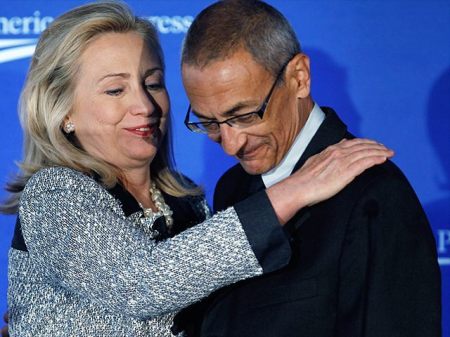
FBI, DOJ launch Probe into Firm of Clinton Campaign Chairman John Podesta

Posted August 21, 2016 by danmillerinpanama
Categories: Clinton campaign, Clinton Foundation, Corruption, Manafort, Podesta, Trump campaign, Uranium

Tags: , , , , , ,

FBI, DOJ launch Probe into Firm of Clinton Campaign Chairman John Podesta, Breitbart, Jerome Hudson, August 20, 2016

clin podGetty

The FBI and Justice Department have launched an investigation into whether the Podesta Group, the lobbying and public relations firm co-founded by Hillary Clinton presidential campaign chairman John Podesta, has any connections to alleged corruption that occurred in the administration of former President of Ukraine Viktor Yanukovych.

The federal probe is, CNN reports, “examining the work of other firms linked to the former Ukrainian government, including that of the Podesta Group.”

The Podesta Group, run by John Podest’s brother Tony Podesta, was retained by the Russia-controlled firm UraniumOne in 2012, 2014, and 2015, to lobby Hillary Clinton’s State Department. The lobbying firm was paid a total of $180,000 according to public records.

Yanukovych took office in February 2010. He was forced to flee to Russian after a political uprising in Ukraine. Federal prosecutors are probing the work Yanukovych’s regime paid the Podesta Group to do while he was the head of the Ukrainian government.

As it was first detailed in the New York Times bestselling book Clinton Cash, Uranium One — which hired the Podesta Group — is the firm that funneled millions to the Clinton Foundation as the Russian government gained ownership of the company.

According to the New York Times, Russian President Vladimir Putin had a “goal of controlling much of the global uranium supply chain.”

The Times reported last April:

As the Russians gradually assumed control of Uranium One in three separate transactions from 2009 to 2013, Canadian records show, a flow of cash made its way to the Clinton Foundation. Uranium One’s chairman used his family foundation to make four donations totaling $2.35 million. Those contributions were not publicly disclosed by the Clintons, despite an agreement Mrs. Clinton had struck with the Obama White House to publicly identify all donors. Other people with ties to the company made donations as well.

“And shortly after the Russians announced their intention to acquire a majority stake in Uranium One, Mr. Clinton received $500,000 for a Moscow speech from a Russian investment bank with links to the Kremlin that was promoting Uranium One stock,” the Times report said.

According to the Daily Caller, Uranium One “paid the Podesta Group $40,000 to lobby the State Department, the Senate, the National Park Service, and the National Security Council for ‘international mining projects,’ according to a July 20, 2012 filing.”

Distancing itself from the work it did for an organization with ties to Yanukovych’s pro-Russian regime, the Podesta group said it hired lawyers to examine its relationship with the organization linked to the ousted Ukrainian president.

“The firm has retained Caplin & Drysdale as independent, outside legal counsel to determine if we were misled by the Centre for a Modern Ukraine or any other individuals with regard to the Centre’s potential ties to foreign governments or political parties,” a Podesta Group statement said, according to CNN. The statement continued:

When the Centre became a client, it certified in writing that ‘none of the activities of the Centre are directly or indirectly supervised, directed, controlled, financed or subsidized in whole or in part by a government of a foreign country or a foreign political party.’ We relied on that certification and advice from counsel in registering and reporting under the Lobbying Disclosure Act rather than the Foreign Agents Registration Act. We will take whatever measures are necessary to address this situation based on Caplin & Drysdale’s review, including possible legal action against the Centre.

The FBI and DOJ investigation is also examining former Donald Trump presidential campaign manager Paul Manafort’s firm, according to CNN.

Spokesman from the federal agencies as well as Manafort’s firm have not commented on the ongoing investigation.

Why the Ayatollah Thinks He Won – WSJ

Posted August 21, 2016 by Joseph Wouk
Categories: Uncategorized

Source: Why the Ayatollah Thinks He Won – WSJ

The U.S. hoped that the nuclear deal would boost Iran’s moderates, but after more than a year, Supreme Leader Ali Khamenei and his allies seem to be the big winners

Iran’s supreme leader, Ayatollah Ali Khamenei, at a meeting with university students in Tehran, Iran, in a picture released by his office’s website on July 11, 2015.
Iran’s supreme leader, Ayatollah Ali Khamenei, at a meeting with university students in Tehran, Iran, in a picture released by his office’s website on July 11, 2015. Photo: Office of the Iranian Supreme Leader/Associated Press

Since the completion last year of a landmark deal limiting Iran’s nuclear program, the country’s supreme leader, Ayatollah Ali Khamenei, has lashed out again and again at the U.S. for its supposed failure to live up to its end of the bargain. But a speech he gave on Aug. 1 in Tehran took his anti-American rhetoric to a new level. He accused the Obama administration of a “bullying policy” and of failing to lift sanctions in a way that benefited “the life of the people.” Mr. Khamenei ruled out cooperation with the U.S. in the fight against Islamic State in Iraq and Syria, telling his audience that Iran’s experience with the nuclear deal “showed us that we cannot speak to [the Americans] on any matter like a trustworthy party.” Many in the crowd chanted anti-U.S. slogans.

Is Iran preparing to walk away from the accord? It’s unlikely. Mr. Khamenei’s speech was classical political posturing intended to rally his hard-line followers. But more than that, his bluster conceals a deeper strategic calculus. For all his complaints about American treachery, Mr. Khamenei and his allies recognize that the nuclear deal has produced significant benefits for their hobbled theocracy and may serve to further entrench the regime brought to power in the 1979 revolution.

President Barack Obama defined the nuclear deal primarily as an arms-control exercise, designed to constrain Tehran’s nuclear program for at least a decade and to keep the U.S. from becoming embroiled in yet another Middle East war. But the White House and its top diplomats, including Secretary of State John Kerry, also quietly suggested that the agreement might open the door to a broader rapprochement between Tehran and Washington and empower Iran’s moderate political forces, particularly its elected president, Hassan Rouhani.

U.S. officials have always cautioned that it would take time for the salutary effects of engagement with Iran to take effect. They have even conceded that, in the short term, the agreement might energize hard-liners opposed to engagement with the West—and that, indeed, seems to be what is happening.

Since the accord was announced last summer, Mr. Khamenei and his elite military unit, the Islamic Revolutionary Guard Corps, have moved to solidify their hold. As international sanctions against Iran have slackened, the ayatollah and his core allies have expanded the Iranian military and pursued new business opportunities for the companies and foundations that finance the regime’s key ideological cadres. Iran has continued to fund and arm its major regional allies, including the Assad regime in Syria, the Lebanese militia Hezbollah and Houthi rebels in Yemen—all of which are at war with America’s regional partners—and the regime has continued to test and develop ballistic missiles. The government has also stepped up arrests of opposition leaders and political activists.

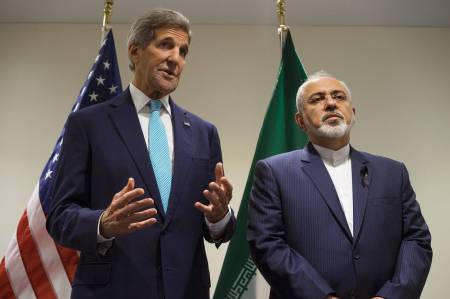
U.S. Secretary of State John Kerry (left) and Iranian Foreign Minister Javad Zarif during a meeting at U.N. headquarters, Sept. 26, 2015.
U.S. Secretary of State John Kerry (left) and Iranian Foreign Minister Javad Zarif during a meeting at U.N. headquarters, Sept. 26, 2015. Photo: Craig Ruttle/Associated Press

Mr. Khamenei has been deeply involved from the start with his country’s talks with the U.S. After the U.N. Security Council imposed tough sanctions on Iran in 2010, he became alarmed by the drain on Tehran’s finances. In 2012, he backed secret talks in hopes of relieving the crippling financial pressure. A collapse in global oil prices made Iran even more vulnerable. As the talks evolved into public negotiations with the U.S. and its partners, Mr. Khamenei instructed his representatives to ensure that Iran could keep the major infrastructure of its nuclear and military programs.

Today, the 77-year-old ayatollah—who reportedly suffers from cancer—is seeking to cement his legacy and to shape the political transition that will occur once he is gone. The nuclear agreement provides him with the building blocks to do that, and for now, at least, Mr. Khamenei and his allies look to be the deal’s big winners. The next U.S. administration is likely to face an unhappy choice: to continue to work with Iran or to challenge an increasingly entrenched supreme leader and his Revolutionary Guard.

For its part, the Obama administration says that the nuclear deal blocks Iran from all paths to develop an atomic bomb and that the agreement’s success doesn’t depend on political change taking root in Tehran. They note that the deal is still in its early stages and suggest that an opening of Iran’s economy could help reformists over time. They also insist that it has served the cause of peace in the region. “The president and I both had a sense that we were on an automatic pilot toward a potential conflict, because no one wanted to talk to anybody or find out what was possible,” Mr. Kerry said in an interview. “I have no doubt that we avoided a war. None.”

To understand Mr. Khamenei’s perspective on the negotiations and the resulting deal, the best place to start is Iran’s nuclear program. The agreement requires Iran to accept key limitations: Previously, the country had nearly 20,000 centrifuge machines producing nuclear fuel and was on the cusp of possessing weapons-grade uranium. A plutonium-producing reactor was also nearly online.

Today, only 5,000 centrifuges are spinning, the plutonium-making reactor has been made inoperable, and most of Iran’s enriched uranium has been shipped out of the country. Iran also agreed to grant greater access to its nuclear sites to inspectors from the U.N.’s nuclear watchdog, the International Atomic Energy Agency, to prevent the country from diverting fissile materials to banned military purposes. “There are serious constraints on their nuclear program for 15 years,” Energy Secretary Ernest Moniz, an important player in the negotiations, said earlier this year. “Fifteen years, with serious verification measures, should give considerably more comfort to our allies in the region.”

Mr. Khamenei, however, doesn’t appear to share this view of the deal’s constraints. Just as Iran’s negotiators were agreeing to these terms in July 2014, the supreme leader delivered a speech about the nuclear program—without consulting his chief negotiator, Foreign Minister Javad Zarif, according to U.S. and European officials. In the address, Mr. Khamenei said that his oil-rich country needed at least 100,000 centrifuges to power its civilian nuclear program in the coming decades. This was more than 20 times what the Obama administration envisaged. Western diplomats wondered whether Iran’s diplomats really spoke for the supreme leader.

Workers in front of Iran’s Bushehr nuclear power plant, south of Tehran, Oct. 26, 2010.
Workers in front of Iran’s Bushehr nuclear power plant, south of Tehran, Oct. 26, 2010. Photo: Mehr News Agency/Reuters

Over the next year, the U.S. and its partners brought the Iranians back down to a capacity of just 5,000 machines. Washington hailed this as a major negotiating victory, but there was a twist: After a decade, the international community would go along with Mr. Khamenei’s vision of an Iran that could develop an industrial-scale, civilian nuclear program without checks on the number or capacity of the centrifuges spinning. The U.S. had won only a short-term pause in the expansion of the Iranian program, and the supreme leader had gained international approval for his longer-term plan.

Indeed, in recent weeks, Iranian officials have talked of their preparations to build 10 new nuclear reactors with Russian help. This will require a steady supply of nuclear fuel from centrifuges that will be allowed to go online in a decade. “The agreement gives us time, provided Iran implements it. But it’s limited,” said Mark Hibbs, a Berlin-based expert on nuclear programs at the Carnegie Endowment for International Peace. “The Revolutionary Guard controls the program, and there’s a risk that in 10 or 15 years, they might decide to restart their [weaponization] activities.”

Mr. Khamenei also came away from the talks with much of what he wanted for reviving Iran’s economy—a longstanding anxiety for the regime. Before the nuclear deal, Iran had been on the financial ropes, especially after the Obama administration ratcheted up international sanctions. The deal relieved that pressure.

The U.S.-led international sanctions campaign against Iran raised alarm bells in the supreme leader’s office in 2013, according to Iranian officials. In just over a year, Iran’s oil exports had been cut by more than half, and its banks were almost completely shut off from the international financial system. Iran’s currency, the rial, fell by two-thirds against the dollar, spurring massive inflation and unemployment. This gave the U.S. an opportunity to extract new concessions from Tehran.

The more moderate Mr. Rouhani was elected president that year with a mandate to improve Iran’s economy and ease the sanctions. His aides say that Mr. Rouhani convinced Mr. Khamenei that sanctions posed an existential threat to the government.

Iran's President Hassan Rouhani waved to reporters after a press conference in Tehran Saturday, Aug. 29, 2015.
Iran’s President Hassan Rouhani waved to reporters after a press conference in Tehran Saturday, Aug. 29, 2015. Photo: Ebrahim Noroozi/Associated Press

Mr. Rouhani got many of the U.S.-imposed penalties lifted under last year’s nuclear agreement. The impact on Iran’s economy has been mixed so far, stoking charges from Iranian leaders that the U.S. hasn’t lived up to its commitments. Iran’s oil exports have largely returned to their pre-2012 levels, and the World Bank projects that Iran will see nearly 5% growth in its gross domestic product next year. But European and Asian banks remain skittish of financing projects in Iran, and the U.S. Treasury Department maintains its ban on dollar transactions with Iran.

This path of modest growth has worked to Mr. Khamenei’s advantage, Iran analysts say. Far from hoping for a flood of foreign investment, the supreme leader has repeatedly warned his people that Western culture and business could undermine the revolution and its values.

Mr. Khamenei says that Iran must remain economically self-sufficient and independent of the West, running a “resistance economy” fueled by domestic production and capacity. “With its calm appearance, and with the soft and glib tongue of its officials, America is damaging us from behind the scenes,” Mr. Khamenei said in his speech earlier this month.

Mr. Khamenei is managing the economy the way that he wants it—with enough money to avoid a financial crisis but not so much that it might threaten his system. The supreme leader’s “system wants technology, and he wants access to imports,” said a political adviser to President Rouhani. “But his ‘resistance economy’ is a way to keep the West out of Iran.”

In an apparent effort to ward off foreign influence, the Revolutionary Guard has stepped up arrests of dual nationals from the U.S., Europe and Canada over the past year. One of the detained Americans, Siamak Namazi, is an oil-industry executive who has written and spoken about the need for Iran to embrace economic and political reforms. Friends and family of Mr. Namazi say that his arrest was a warning to Iranian expatriates not to return home to pursue business dealings. Many Iranian-Americans have heeded the message. The economy is now dominated by the Revolutionary Guard, which controls many of Iran’s largest companies.

As for conventional military capabilities, the deal didn’t do much to curtail Iran’s ambitions. The supreme leader demanded a provision weakening a U.N. Security Council resolution that prohibits Tehran’s ballistic-missile development—and got it. He wanted the U.N. embargo lifted on Iran’s ability to buy or export conventional arms—and got it, in five years. He wanted to retain Iran’s ability to export arms—and the deal does nothing to interfere with that.

“Ayatollah Khamenei has emerged as the single most powerful man in the Middle East,” said Karim Sadjadpour, an Iran expert and senior associate at the Carnegie Endowment for International Peace in Washington. “It will take years to assess the full impact of the nuclear deal on the Middle East and in Iran internally, but the hope that the deal would weaken Khamenei and the Revolutionary Guards so far hasn’t been borne out.”

Finally, the nuclear deal also seems to have boosted Mr. Khamenei’s ability to influence the region. In the ornate former palaces and six-star hotels where the nuclear talks took place in Austria and Switzerland last year, U.S. and European officials talked optimistically about using the deal to stabilize a roiling Middle East. They hoped that Iran, the region’s great Shiite power, might play a constructive role in ending conflicts in Yemen, Iraq and, above all, Syria.

Ayatollah Ali Khamenei in July
Ayatollah Ali Khamenei in July Photo: HO/Agence France-Presse/Getty Images

It hasn’t worked out that way. Even as the talks continued, Mr. Khamenei and his generals were plotting a much broader military campaign in Syria in partnership with Russian President Vladimir Putin, according to European, Arab and Iranian officials. Starting in January 2015, the supreme leader’s top aides began a series of visits to the Kremlin to chart out a plan to bolster the embattled regime of Syrian President Bashar al-Assad.

The result was a highly coordinated operation in Syria that began just weeks after the nuclear deal was completed. Mr. Putin’s air force has pounded Syrian rebels, bombing not just Sunni jihadists associated with Islamic State or al Qaeda but also U.S.-backed fighters. At the same time, Mr. Khamenei’s Revolutionary Guard mobilized thousands of soldiers and Shiite militiamen to launch a ground offensive, with Iranian troops fighting alongside militants from Hezbollah and other Shiite militias. The joint Iranian-Russian operation drove back Syrian rebels who had been advancing on the Assad regime’s stronghold on the Mediterranean coast, according to Arab and U.S. officials, and allowed the minority regime to retake large swaths of territory. The Kremlin announced this week that it has started launching airstrikes in Syria from Iranian territory.

Mr. Khamenei has sworn off any collaboration with the U.S. in the Middle East, even against shared regional enemies like Islamic State. Instead, he has continued Iran’s campaign to control the oil-rich Persian Gulf and weaken the influence of the U.S., Israel and its Sunni Arab allies across the region. U.S. military commanders say that they have seen no tapering off of Revolutionary Guard support for its allies in Yemen, Iraq or the Palestinian territories.

Mr. Khamenei cannot know how the U.S. will respond to his uncompromising stance, especially with a new administration soon to take office. But he may figure that he wins either way. If the deal falls apart, he could call it proof that the Americans never could be trusted and figure that another round of biting U.N. sanctions will prove too difficult to assemble. If the deal survives, he will have his military continue to develop missiles and conventional arms to position Iran to become a latent nuclear weapons power in 10 years.

Either way, it is Mr. Khamenei, not his more moderate rivals, who are acting as if they have been strengthened by the nuclear deal. “Our problems with American and the likes of America…on regional matters and on various other matters are not solved through negotiations,” Mr. Khamenei said in his Aug. 1 speech. “We ourselves should choose a path and then take it. You should make the enemy…run after you.”

Mr. Solomon is chief foreign affairs correspondent for the Journal. His new book, “The Iran Wars: Spy Games, Bank Battles, and the Secret Deals That Reshaped the Middle East,” will be published next week by Random House.
Gazan Rocket Hits Sderot

Posted August 21, 2016 by Peter Hofman
Categories: Uncategorized

Tags: , , , , , , , ,

By: Jewish Press News Briefs

Published: August 21st, 2016

Source: The Jewish Press » » Gazan Rocket Hits Sderot

Rocket crossing!
Photo Credit: Asher Schwartz

Two rocket alerts went off in communities near the Gaza border and in Sderot at around 2:25PM on Sunday.

2:35 PM Residents near the Gaza border are reporting that they heard at least one explosion, possibly two.

2:43 PM Confirmed reports that one rocket from Gaza landed in Sderot between 2 houses. No one was injured.

The rocket was launched from Beit Hanoun.

Police are asking citizens to not go to the area where the rocket fell do the the danger.

3:00 PM Arab sources report that the IDF is striking Beit Hanoun area.

There are no reports on why Iron Dome did not take down he rocket.


Turkey: At least 30 killed in terror attack

Posted August 21, 2016 by Peter Hofman
Categories: Uncategorized

Tags: , , , , ,

Southern Turkey: At least 50 killed, 90 injured in suicide bombing A suicide bomber blew himself up in the lobby of an event venue while a wedding was taking place, killing at least 50 people and injuring more than 90. According to the Turkish authorities, ISIS is responsible for the attack. However, no terrorist organization has claimed responsibility yet.

Aug 21, 2016, 9:40AM

Becca Noy

Source: Turkey: At least 30 killed in terror attack – World News | JerusalemOnline

Photo Credit: Sky News/Channel 2 News

At least 50 people were killed and more than 90 were injured when an explosive device detonated last night (Saturday) in the Turkish city of Gaziantep. The explosion occurred in a lobby filled of people who were celebrating a wedding. Turkish officials believe that this was a terror attack carried out by ISIS against Kurdish targets. However, no organization has claimed responsibility for the attack. Turkish President Recep Tayyip Erdoğan sent his condolences to the families of the victims and said that ISIS is most likely the perpetrator.

Gaziantep Governor Ali Yerlikaya said to a local news outlet that the explosion was most likely caused by a suicide bomber who blew himself up in the lobby of an event venue that was filled of guests.

According to some news reports, the wedding was connected to the Kurdistan Workers Party (PKK), a claim that strengthens the Turkish authorities’ assertion that ISIS is responsible for the attack. “There is no difference between ISIS, the likely perpetrator of the attack in Gaziantep, and the PKK or Fethullah Gülen,” stated Erdoğan yesterday.

image description
Photo Credit: CNN/Channel 2 News

Horrific pictures and videos documenting the scene of the attack flooded social media. In response, the Turkish authorities banned the publication of the documentations of the area and threatened to sue those who violated this restriction.

“The purpose of terror attacks are to scare people but we will not allow this to happen,” said Deputy Prime Minister Mehmet Simsek. “It’s barbaric to attack a wedding.” Simsek represents the city of Gaziantep in the Turkish Parliament.

Trump donors harassed, spit on at fundraiser

Posted August 20, 2016 by danmillerinpanama
Categories: Civility, Democrats, Trump fund raiser

Tags: , ,

Trump donors harassed, spit on at fundraiser, Washington Examiner,  T. Becket Adams, August 20, 2016

( Ain’t civility wonderful? I cannot embed the video at Washington Examiner, but the YouTube video provided below appears to be the same. There is another video at the end of the article, which I could not find at YouTube. Please see also, Hillary Supporters Punch the Elderly, Spit and Turn Violent at Donald Trump Fundraiser (video)… — DM)

Attendees at a Donald Trump fundraiser in Minneapolis Friday night were shouted at, manhandled and even spit on by a crowd of unruly protesters.

Pro-immigration demonstrators gathered outside the Minneapolis Convention Center early Friday evening to protest the GOP nominee’s first visit to the state. The initial demonstration, which was organized by the Minnesota Immigrants Rights Action Committee, was peaceful.

As the evening wore on, however, a growing number of disruptive protesters joined the original group of anti-Trump demonstrators, and that’s when things turned ugly.


Of Course There Should Be an Ideological Test in Immigration

Posted August 20, 2016 by danmillerinpanama
Categories: Countering violent extremism, Islam - submission, Islamic immigration, Islamic jihad, Islamic reformation, Islamisation, Islamists, Islamists vs Islam, Sharia law

Tags: , , , , , , , ,

Of Course There Should Be an Ideological Test in Immigration, National Review, Andrew C. McCarthy, August 20, 2016

Please see also, Will National Security Finally Bring Warring Republicans Together? — DM)

Imagine an American government official, interviewing an alien seeking admission to our country from, say, Syria: U.S. official:

“Will you support the United States Constitution?”

Syrian alien: “Well, sure, except that I believe the government should be overseen by a caliph, who must be Muslim and male, and who must rule in accordance with Islamic law, which no man-made law may contradict. None of this ‘We the People’ stuff; Allah is the sovereign. Non-Muslims should not be required to convert to Islam, of course, but they must submit to the authority of Islamic law — which requires them to live in the second-class status of dhimmitude and to pay a poll tax for that privilege.”

“I also believe women must be subservient to men, and that men are permitted to beat their wives if they are disobedient — especially if they refuse sex, in which they must engage on demand. There is no such thing as marital rape, and proving non-marital rape requires testimony from four male witnesses. Outside the home, a woman should cover herself in drab from head to toe. A woman’s testimony in court should be worth only half of a man’s, and her inheritance rights similarly discounted. Men should be able to marry up to four women — women, however, are limited to marrying one man.” “

Oh, and Muslims who renounce Islam should be put to death . . . as should homosexuals . . . and blasphemers . . . and adulterers — at least the ones we don’t let off with a mere scourging. The penalty for theft should be amputation of the right hand (for highway robbery, the left foot is also amputated); and for drinking alcohol, the offender is to be scourged with 40 stripes.”

“There are a few other odds and ends — you know, jihad and whatnot. But other than that, will I support the Constitution? Sure thing.”

U.S. official: “Whoa, whoa, whoa, hold on a second. That’s not supporting the Constitution. That would be destroying the Constitution.”

Syrian alien: “Yeah, maybe so. But it’s my religion.” U.S. official: “Oh, your religion. Why didn’t you say so? I thought you were spouting some anti-American political ideology. But as long as you say it’s your religion, no problem. C’mon in!”

U.S. official: “Oh, your religion. Why didn’t you say so? I thought you were spouting some anti-American political ideology. But as long as you say it’s your religion, no problem. C’mon in!”

This conversation is impossible to imagine because . . . it would be honest. In the decades-long onslaught of radical Islam against the United States, honesty went out with the benighted notions that we should “know thine enemy” and, God forbid, train our national-security agents in that enemy’s ideology, methods, and objectives.

In our alternative universe, you are not supposed to remember that there is an American constitutional framework of liberty, popular sovereignty, and equality before the law.

You are not supposed to realize that aliens are expected to exhibit fidelity to this constitutional framework as a precondition to joining our society.

You are not supposed to know that there is an Islamic law, sharia, that has far more to do with governance, economics, warfare, civil rights, domestic relations, criminal prosecution, and fashion than it does with spiritual life.

And you are absolutely not supposed to grasp that sharia is antithetical to the Constitution, to the very foundational American principle that the people may make law for themselves, live as they see fit, and chart their own destiny.

You are not supposed to connect the dots and ask, “Well, how is it conceivable that any sharia-adherent alien could faithfully pledge allegiance to our Constitution?”

So, instead, we shrug our shoulders, mumble something about “freedom of religion,” and bury our heads back in the sand — as if the structure of government and the decision of which limb to smite for which larceny had anything to do with religion in a free society that rejects the establishment of any state religion and separates spiritual from political life. Sharia is not religion. Sharia is a totalitarian societal structure and

Sharia is not religion. Sharia is a totalitarian societal structure and legal corpus that anti-American radicals seek to impose. Yes, their motivation for doing so is their interpretation of their religion — the fundamentalist, literalist construction of Islam. But that does not make sharia itself a matter of “religion” in the Western sense, even if vast numbers of Arab Muslims — for whom there is no cognizable separation of mosque and state — say otherwise. If Karl Marx had said, “The workers must control the means of production because God says so,” that would not have transmogrified the tyranny of Communism into the “freedom of religion.”

Two things flow from this.

The first involves immigration. As we’ve previously demonstrated, there is no constitutional prohibition against considering religion in deciding which aliens to allow into the United States — immigration is a privilege, not a right; and our Constitution is security for Americans, not a weapon for aliens to use against Americans.

Nevertheless, even if there were a constitutional bar against “religious tests,” sharia is not religion. There are no constitutional constraints against excluding aliens on grounds of anti-American political ideology. Excluding anti-Americans from America is common sense and was regarded as such for much of our history. In a time of radical Islamic threat to our national security, Donald Trump is right to propose that aliens from sharia-supremacist areas be carefully vetted for adherence to anti-constitutional principles.

Leftists — those notorious disciples of the Framers — claim this is unconstitutional. When shown it is not, they claim that it is against our “tradition” — being, you know, big fans of American tradition. When shown that this is not the case either, when shown that our history supports ideological exclusion of anti-Americans, leftists are down to claiming, “It is not who we are” — by which they always mean it is not who they are, and who they would force the rest of us to be.

A short lesson in how we got to be who “we” are. In the last decades of the Cold War, it became progressive dogma that the Soviet Union was forever, that it was an empire we could do business with, arrive at a modus vivendi with. The real evil, the Left decided, were the anti-Communists — it was their provocations against the Soviets, not the Soviets themselves, that could trigger Armageddon. Therefore, they reckoned, we needed to do away with all this overheated nonsense about how Communists seek the violent overthrow of the United States. That, to the Left, was just a bunch of ideological mumbo-jumbo that nobody ever really took seriously (even if Bill Ayers hadn’t gotten the memo). One major consequence of this conventional wisdom was the campaign waged by leading Democrats to eliminate radical ideology as a basis for excluding aliens. They championed laws decreeing that “mere” radical ideology, in the absence of some provable connection to

One major consequence of this conventional wisdom was the campaign waged by leading Democrats to eliminate radical ideology as a basis for excluding aliens. They championed laws decreeing that “mere” radical ideology, in the absence of some provable connection to violent action, should not bar radicals from entering our country. Thus, the “principle” that America must not vet would-be immigrants for anti-Americanism is not derived from the U.S. Constitution, from our traditions, or from who “we” supposedly are. It stems from the Left’s conviction that Communist ideology was not a real threat to America. Then, about 14 months after the Soviet Union collapsed, jihadists bombed the World Trade Center. They have been attacking us ever since. See,

Then, about 14 months after the Soviet Union collapsed, jihadists bombed the World Trade Center. They have been attacking us ever since. See, however you come out on the question of whether Communists really posed a violent threat to our national security, there cannot be such a question with respect to radical Islam. The front line of that movement is the mass murderers, not the professors. With radical Islam, the threat of violence is not an abstract academic proposition. It is our reality. What’s more, we know from hard experience, and from observing Europe’s new reality, that the threat is not just the jihadists. Equally important are the sharia-supremacist ideologues who seek to forge autonomous enclaves where sharia becomes the de facto law, and where jihadist radicalization, recruitment, fundraising, and training have

What’s more, we know from hard experience, and from observing Europe’s new reality, that the threat is not just the jihadists. Equally important are the sharia-supremacist ideologues who seek to forge autonomous enclaves where sharia becomes the de facto law, and where jihadist radicalization, recruitment, fundraising, and training have safe haven. Our legitimate worries are not limited to the trained jihadist who infiltrates today; they include the sharia supremacist who will get his hooks into young Muslims and turn them into the trained jihadists of tomorrow.

The second thing to consider is Islam. As Robert R. Reilly unfolded in his essential book, The Closing of the Muslim Mind, there is an Islamic tradition of rational inquiry, deeply influenced by Greek philosophy, that has been overwhelmed for nearly a millennium by the fundamentalist tradition. The rationalists may be out-muscled, but they are not dormant. They are Muslims who embrace Western culture, reject the imposition of antiquated sharia as a system of law and governance, and challenge the premises and the aggression of the fundamentalists. They are Muslims who, I can attest, help us infiltrate terror cells and prevent attacks. They are Muslims who fight in our armed forces, work in our intelligence services, serve in our police departments, and thrive in our economy.

We do not have to exaggerate their numbers to recognize that these Muslims exist and that they are our allies — that they are part of us. To appreciate their value and their contributions to our society, we do not need to pretend that they typify Islam as it is lived in Syria, Saudi Arabia, or the no-go zones of Paris.

If we want to win the crucial ideological component of radical Islam’s war against us, we should be empowering these pro-Western Muslims rather than inviting the sharia-supremacist Muslim Brotherhood into our policy-making councils. Like protecting our nation, empowering pro-Western Muslims requires an immigration system that welcomes those who will support our Constitution, and turns away those who would sweep it aside.


No ISIS There – Are U.S. Troops In Hasakah “Advising” Kurds To Attack The Syrian Army?

Posted August 20, 2016 by Peter Hofman
Categories: Uncategorized

Tags: , , , , , , , , , , ,

No ISIS There – Are U.S. Troops In Hasakah “Advising” Kurds To Attack The Syrian Army?

August 19, 2016

Source: M of A – No ISIS There – Are U.S. Troops In Hasakah “Advising” Kurds To Attack The Syrian Army?

Yesterday a fight broke out between Syrian Arab Army troops and local Kurdish forces in the predominately Kurdish city of Hasakah in north-eastern Syria. Hasakah, with some 200,000 inhabitants, has held a SAA garrison for years. There is some enmity between the Kurds and the soldiers but the situation is generally peaceful.

There have been earlier fights but these were local rivalries between Syrian auxiliary National Defense Forces from local Arab (Christian) minorities and some gangs who form a Kurdish internal security force under the label Asayish. Such fights usually ended after a day or two when grown-ups on both sides resolved the conflict over this or that checkpoint or access route.

The Islamic State (grey on the map) once threatened Hasakah but that danger is now far away.


Map via ISW

Yesterday another fight broke out, but got serious. The Syrian air force was called in to defend against direct attacks on the SAA garrison and minority quarters:

Syrian government warplanes bombed Kurdish-held areas of the northeastern city of Hasaka on Thursday for the first time in the five-year-old civil war, the Syrian Kurdish YPG militia and a monitoring group said.
…
The Syrian government still has footholds in the cities of Qamishli and Hasaka, both in Hasaka governorate, co-existing largely peacefully with YPG-held swathes of territory.The cause of this week’s flare-up was unclear.
…
Xelil said government forces were bombarding Kurdish districts of Hasaka with artillery, and there were fierce clashes in the city.

The Syrian Observatory for Human Rights, which tracks the war using a network of activists, said warplanes had targeted Kurdish security forces’ positions in the northwest and northeast of the Hasaka city.

The reason that fighting started might have to do with U.S. troops who, for whatever reason, seem to be in Hasakah. The U.S. military now laments that these troops came under Syrian air force fire:

The Syrian airstrikes took place in the northeastern city of Hasaka, an area that has seen increasing ground clashes between the Kurdish YPG fighters present and the Syrian regime forces. There was a small number of U.S. Special Operators acting as advisers to the YPG when the Syrian airstrikes began.After the Syrian Su-24s began to strike, the U.S. immediately contacted the Russians, Davis said, and made clear that American aircraft would respond if coalition forces were under attack.

The Russians explained that they were not the ones conducting the strikes and the U.S. scrambled manned fighter aircraft to the area to protect the Americans and allies under attack.

By the time the U.S. and coalition aircraft arrived the Syrian attack jets had left.

There is no Islamic State in the area which is now far away from the front line.

  • Why are U.S. troops, who have zero legal grounds of being in Syria at all, in Hasakah city or the wider area?
  • Who are they “advising” there and for what purpose?
  • Why does rare local fighting starts to get serious just when U.S. troops are in the area?

The U.S. has the chutzpah to “warn” the Syrians of defending their own troops on Syrian grounds:

Additional U.S. combat air patrols have been sent to the area yesterday and have been flying there today, as well.Davis said that the Syrians would be “well-advised” not to interfere with coalition forces on the ground in the future.

Syrian government forces are attacked by Kurdish troops who are “advised” by U.S. special forces. According to the U.S. spokesperson the Syrian air force is not allowed to defend them? What has this to do with “fighting ISIS” in eastern Syria which is allegedly the sole reason for U.S. troops being in Syria?

The Syrian air force was back over Hasakah today and continued to bomb position from which the Syrian army was attacked. They would not be flying there without Russian consent. Does the U.S. military want to start a fight with the Syrian air force and its Russian backers?

The YPG Kurds claim they are now evacuating civilians from some city quarters. They seem to expect a prolonged conflict.

Any move against the Syrian army in Hasakah will be watched carefully from Ankara. Turkey fears, with valid reason, that the U.S. supports the Kurdish aim of a  national entity in Syria and Iraq. This would endanger Turkey with its own large Kurdish minority.

If the Kurds expel the Syrian forces from Hasakah with U.S. support, Turkey would know that any U.S. claim to not work against its Turkish ally interest is false. This would deepen already high Turkish animosity against the U.S. and would accelerate its move towards some alliance with Russia and Iran.

Migrant Problems Still Threaten Europe

Posted August 20, 2016 by danmillerinpanama
Categories: Economy, Europe, Islamic invasion, Islamic jihad, Islamisation, Italy

Tags: , , , , ,

Migrant Problems Still Threaten Europe, Gatestone Institute, George Igler, August 20, 2016

♦ In September 2015, a Canadian broadcaster, Ezra Levant, suggested that what Europe was experiencing, was not primarily an influx of “refugees” fleeing conflict, but rather a new Gold Rush, in which young men from the Muslim world were seeking to improve their fortune at Europe’s expense.

♦ Rome-based journalist Barbie Latza Nadeu seriously asked whether Italy was “enabling the ISIS invasion of Europe.”

♦ Profits in the people-smuggling business often flow to terrorist-backed gangs operating in Italy. The numbers drowning in the Mediterranean continue to mount.

Chaotic scenes have erupted on the coastal Mediterranean frontier between Italy and France. On August 4, for instance, hundreds of migrants, chiefly from Eritrea, Ethiopia and the Sudan sought to storm the crossing in their attempts to make it to Northern Europe.

“Both the Italian and French forces at the border were taken by surprise,” remarked Giorgio Marenco, a police commander in Ventimiglia, where tear gas was used to disperse the migrants. Others merely braved the choppy waters of the sea to breach the crossing by swimming towards their goal.

The Italian town contains the last train station in Italy near the border. The besieged terminus lies three miles from the French Riviera. It has been a gathering point for the predominantly Muslim migrants since June 2015. A fractious tent city for migrants has sprung up, mirroring others spread across Italy. The capital of the French holiday district is Nice, which experienced a jihadist massacre on July 14.

Although mercifully free from mass terrorist outrages this year, Italy has already endured several alarming scenes of disorder and protest resulting from the pressure of accepting increasing illegal migrants.

On May 7, violent attempts by “open borders” activists took place, aimed at forcing open the frontier between Italy and Austria. On May 21, various groups in Rome organized mass demonstrations against Italy’s “invasion” by migrants. Apparently the prevalence of populist politics in the country has created movements which do not lie within the usual “Left-Right” political spectrum in which analysts usually classify parties.

The chief example is the presence in Italy of the Five Star Movement, founded in 2009 by the comedian Beppo Grillo, and now considered Italy’s second largest political force. Having taken a back seat after frequently being condemned for his “Islamophobic” anti-mass immigration rhetoric, Grillo’s party nevertheless helped to elect Virginia Raggi, in July, as the new mayor of Rome.

Despite the assurances of Angelino Alfano, the Italian Interior Minister, that Ventimiglia would not turn into “our Calais” — a reference to migrants amassed at the French channel port who are seeking illegal entry into the United Kingdom — the challenges faced by Italy lie not merely in numbers.

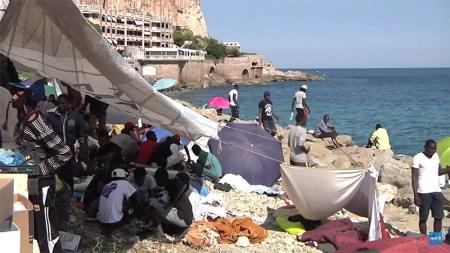
1221 (1)African migrants camp out on the beach in the northern Italian town of Ventimiglia, along the French border, as they wait for the opportunity to cross into France, in 2015. (Image source: AFP video screenshot)

Italy’s terror alert status remains at “Level Two” — the second highest in its security index. On March 30, the Rome-based journalist, Barbie Latza Nadeu, seriously asked whether the country was “enabling the ISIS invasion of Europe.”

After the collapse of Libya — occasioned in 2011 by military intervention masterminded by then French President Nicolas Sarkozy and then UK Prime Minister David Cameron — the North African nation has become the gathering point for those on the continent farther south, who possess the will or resources to push into Europe.

Two separate governments are currently attempting to wrest control from each other in Libya, a former colony of Italy, while ISIS forces also maintain their foothold. It is through this seemingly unresolvable ongoing chaos that people-smugglers ply their lucrative trade.

Waves of migrants heading into Europe, primarily through a corridor beginning in Turkey and resulting in short crossings to nearby Greek islands, are still stranded in the so-called Western Balkan route into the continent.

After the widely derided imposition by the Prime Minister of Hungary of a razor-wire border fence on his country’s southern frontier, other nations nearby, that were subjected to migrant pressure, soon followed suit.

Remaining conscious of Hungarian Prime Minister Viktor Orbán’s analysis, that only half a year’s total migrants come to Europe between January and October, with the other half arriving through the remainder of the year, the steady focus in 2016 is likely to be on Europe’s “soft underbelly” — a term Winston Churchill used during the Second World War to refer to the susceptibility of Italy being invaded by sea — as opposed the susceptibility of the Balkans.

The enthusiasm of the present government of Chancellor Angela Merkel to import Muslims into Germany apparently remains undiminished. As reported by Markus Mahler, a succession of migrant flights into Germany from Turkey are now taking place – in one instance, more than 11 planes landed during the same night at Cologne-Bonn airport – as some analysts predicted last year.

In September 2015, a Canadian lawyer and broadcaster, Ezra Levant, suggested that what Europe was experiencing, was not primarily an influx of “refugees” fleeing conflict, but rather a new Gold Rush, in which young men from the Muslim world were seeking to improve their fortune at Europe’s expense.

Sea crossings from Africa into Italy, which initially targeted the small Italian island of Lampedusa, had begun in 1996. Since then, they have magnified in number year on year, considerably aided between 2013-2014 by the Mare Nostrum program of the Italian navy, which picked up stranded vessels and brought their occupants to Italy, rather than returning migrants to their countries of origin. This program was then superseded by Operation Triton, run by the European Union’s border agency, Frontex.

It is often simpler for migrant ships to send a distress signal while near Italian coastal waters, as happened in January 2015 with the ship Ezadeen, abandoned by its crew of smugglers, after they set the ship on autopilot pointed towards Italy’s southern shore. The ship’s 450 migrant passengers were towed to harbor by a Frontex ship from Iceland.

Profits in the people-smuggling business often flow to terrorist-backed gangs operating in Italy. The numbers drowning in the Mediterranean continue to mount.

Successful migrants from Africa usually then traverse Italy, but can remain stranded if their attempts to penetrate further into Europe become frustrated. That situation frequently leads to violence at migrant camps and outrage at local government level as the migrants are then distributed across the country.

Despite the swelling number of illegal sea crossings, there seems little interest in curtailing them by force, given the existence of international refugee conventions and European legislation on human rights, which some migrants appear to be exploiting.

During four days in July alone, 10,000 illegally crossed by sea into Italy. As in 2015, the vast majority looking for “asylum seeker” status in Europe are military-aged Muslim males seeking eventual European citizenship.

Meanwhile, relations between Italians and their existing established Muslim communities seem to be rapidly eroding. The introduction of gay marriage into Italy on June 5, against fierce opposition in the home of the Roman Catholic Church, has had unforeseen consequences.

As a reciprocal gesture in the spirit of “civil rights,” Hamza Piccardo, the founder of the Union of Islamic Communities and Organizations in Italy, has demanded the legalization of polygamy.

As the pressures grow on the Euro, the currency which binds 19 European nations together both politically and economically, the long-term future of Italy’s banking system has already been called into question.

The picture drawn by the present migration into Europe may fundamentally undermine the “Refugees Welcome” narrative that dominated news reports last year, but the continent-wide economic ramifications of its effects on a country such as Italy, already subject to considerable political tumult, should not be underestimated.

The Donald Trump video every Jew MUST watch!

Posted August 20, 2016 by Peter Hofman
Categories: Uncategorized

Tags: , , ,

Published on Aug 18, 2016

Ezra Levant of TheRebel.media issues an appeal to “my fellow Hebrews,” making the case for a Donald Trump presidency. MORE: http://www.therebel.media/jews_for_tr…
http://www.Facebook.com/JoinTheRebel *** http://www.Twitter.com/TheRebelTV

Cartoons of the Day

Posted August 20, 2016 by danmillerinpanama
Categories: Hillary Clinton, Humor, Islamophobia, Obama

Tags: , ,

H/t Power Line

Obama-Skies-copy


spotter


Hillary-Drive-Through-copy


H/t Vermont Loon Watch

water-hole


H/t Joop

cowards