Archive for the ‘United Nations’ category

Obama’s show of weakness

October 1, 2015

Obama’s show of weakness, Israel Hayom, Prof. Abraham Ben-Zvi, October 1, 2015

The U.S. has been relegated to dragging its feet in a trail blazed by the Russian leader, as Washington is left to practically beg Moscow for a seat at the table where Assad’s fate will be determined.

******************

U.S. President Barack Obama’s address to the U.N. General Assembly on Monday was his worst and most embarrassing yet. Despite the fact that it has been seven years since he was elected president, it seems Obama has yet to learn anything from his growing list of failures, especially when it comes to foreign policy.

Obama continues to naively preach about the importance of traditional diplomacy and broad international cooperation as a prerequisite to conflict resolution; and he does so despite the fact that his decision to prematurely withdraw American troops from Iraq, compounded by his aversion to putting boots on the ground in Syria, have done nothing but breed violence, fanaticism and radical Islamism in the Middle East.

Against the backdrop of the bloody conflicts in Syria, Iraq and Yemen, Obama delivered a disconnected and utterly surreal speech before the U.N., lauding democracy and international agreements, even deficient, hollow ones, like the nuclear deal with Iran.

Beyond the sanctimonious sermon to nations and movements without any loyalty to the principles of Western democracy, Obama’s speech lacked any new message. On the contrary — he essentially legitimized Russia’s military presence in Syria, and the pivotal role Moscow has appropriated in the region due to American inaction against Syrian President Bashar Assad.

This inexcusable failure, which followed Washington’s acquiescence in allowing Russian President Vladimir Putin become the new mediator in the chemical warfare crisis in Syria in 2013, has afforded Moscow a coveted opportunity to become a major player in the Middle East, one shaping a new political and security reality.

The U.S. has been relegated to dragging its feet in a trail blazed by the Russian leader, as Washington is left to practically beg Moscow for a seat at the table where Assad’s fate will be determined.

Indeed, if you strip the envelope of democracy vs. dictatorship from Obama’s speech, it becomes more than evident that he is not only willing to foster partnerships with tyrants and oppressive regimes, but also that the dispute between the White House and the Kremlin over Syria is marginal, as it focuses on Assad’s status in the new political order that will be forged in Syria once the fighting subsides.

The American Gulliver, it seems, is coming to terms with the end of the single-world power hegemony. While the Russian military airlift to Syria continues in full swing, Obama is content with philosophical reflections on the desired nature of the new world order, yielding to the new balance of power emerging in the war-torn country.

One can only lament the fact that the U.S. president’s incomprehensible weakness only undermines the very democratic dream he himself has outlined.

This was evident in the meeting between Obama and Putin following their respective U.N. addresses. Despite Obama’s desire to give his Russian counterpart the cold shoulder, the fact the he declared before dozens of world leaders that the U.S. has “no desire to return to a cold war” took the sting out of his message.

This was nothing but an attempt at damage control over the harm caused to the U.S.’s prestige and status in the global theater by drawing new red lines to limit Russia’s operation in the Middle East. The problem is that we already know how blurry those red lines are when it comes to Syria.

Satire | Three cheers for Terroristine

October 1, 2015

Three cheers for Terroristine, Sultan Knish Blog, Daniel Greenfield, October 1, 2015

(He refers, of course, to “Palestine.” — DM)

We need a terrorist state. Where the politicians are terrorists, the police are terrorists and even the men sitting at the desk when you come in to drop off a form are terrorists.

3egypt081613

There are states that support terrorists, and give safe harbor to them, but that’s not good enough. We don’t want another Pakistan or Iran. We’re not half-assing it this time. What we want is the genuine article. Terrorists from the top down. Terrorists everywhere. A state where every branch of government and the entire country is nothing but terrorists.

Terroristine has been an ancient dream since 1973 or was it 1967. A generation of keffiyah draped thugs, KGB operatives and human rights activists have looked out into the darkness and called it into being. It is a vision of a country where everyone is a murderer and children are taught from a very young age that their purpose in life is to die killing people who don’t share their religion.

And now after decades of negotiations, treaties, suicide bombings, mutilations, billions of dollars in vanishing into Swiss bank accounts and the death of its Egyptian born leader of AIDS– Terroristine is closer than ever to coming into being.

Abbas, its unelected dictator, who has struggled long and hard so that one of his sons might have his own cigarette monopoly in Gaza, has come to the UN to promise that Terroristine will have “will actively contribute to the achievement of economic, cultural, and humanitarian progress of civilization.”

And who can doubt him? Certainly not Terroristinians who don’t have elections or a free press.

Terroristine, whose noble flag (that looks like nearly every other Arab flag) flies over the UN, has done wonders for civilization. Consider the airplane hijacking. The suicide bomber. Has there ever been a civilization that did as much for civilized living as the Terroristinians?

Every time you get groped at an airport, thank Terroristine. Without the Terroristinian contribution to civilization, you might actually be able to get on a plane in peace. Or visit the Twin Towers.

The Terroristinian contribution to human progress is unquestionable. But only one thing stands in the way of it unleashing its full Terroristinian potential for all mankind.

Them. Those pesky people who live in that country that is always in the way. You know the ones, with too many Nobel prizes, newly invented tomatoes and microchips. They stand in the way of the great cultural contributions of Terroristine. They must die so that Terroristine must live.

They must be thrown out of their homes, village by village and city by city, so that the noble Terroristinians can plant their rockets on the rubble of their houses, the charred remains of their fields, and point them at their cities.

Trying to end terrorism by creating a terrorist state makes is like trying to put out a fire with more fire. It can’t work, but we must try. So that we can say that we tried. Over and over again. We’ll keep trying until we run out of land to try with. And people to try with.

Until there’s nothing left but Terroristines everywhere. Until all the world is Terroristine. The question is can we make it happen? Yes, we can. Oh sweet Allah, yes we can.

Israel must return to the 1967 borders, which are really the 1948 borders. Why are the borders of the 1948 war, so much better than the borders of the Six Day War? Because the Terroristinians came closer to winning that war. Came closer to driving the Yahood into the sea and ululating over miles  of their corpses.

boy_bomb.preview

But the dream failed. Farmers armed with outdated rifles. Volunteer pilots from America and Canada. Refitted cargo ships filled with half-dead men, women and children straight from the camps. Used Czech artillery. They held off the armies of seven Terroristinian nations. Farm by farm, they stood off tanks and infantry. In Jerusalem, they fought for every house. And so the Zionist entity survived.

Allah curse them. They survived.

But now it’s back to 1948 again. Every war undone. Every defeat turned to victory. Cut Jerusalem in two. Drive out the farmers. Burn their land. Dig up their graves. March the borders back to 1948. And fly the Terroristinian flag over dust and rubble. Had they won in 1948 or 1967 or 1973, there would be no Israel and no Terroristine. The land would have become part of Syria, Egypt and Jordan. And only when the mobs of the faithful would drive out the tyrants to replace them with Islamic states, would there finally be a Terroristine.

But despite what Abbas says, there is still hope for a two state solution. And we must do everything in our power to salvage the two state solution so that there will be a state of civilization on one side and a state of terrorists on the other. Hospitals here, launching pads there. Schools here, bomb factories there. Life here, death here. We all know the story. Olive trees and bomb belts. Rocks and dead families in burning cars by the side of the road. Children with their throats cut.

A dream. A nightmare. Who even knows anymore.

Why do we need Terroristine? Peace. There can be no peace without a terrorist state. Not a chance of it. The only way we’ll ever have peace is to give the terrorists a country of their own. A country dedicated to terrorism. Only then will the Terroristinians finally give up on all the killing, and dedicate themselves to medical research, quantum mechanics and the arts. It hasn’t happened yet to. But it’s bound to.

After decades as an autonomous territory, spreading death and destruction, it’s time for Terroristine to finally be recognized as an independent state. With contiguous borders cutting Israel in half. It is the only hope for peace in the region. Would Sunnis and Shiites be killing each other from Yemen to Iraq? Assuredly not. The moment the flag of Terroristine rises above the wounded hills, and its peaceful anthem, “Palestine is My Revenge” is heard in the land, then a great echoing sigh will rise up from the mouths of one billion Muslims. And the violence will cease.

The international community is impatient. They want Terroristine and they want it now. Whatever Israel has offered in the past, it isn’t enough. It must offer more and more. Whatever it takes. We know the Terroristinians want their own state. Every time they walk out of negotiations or end them with a round of terrorist attacks, it shows their deep and abiding passion for a state. They want it so badly they aren’t willing to make a single concession for it. Or even negotiate for it.

That’s how committed they are to realizing their great dream to Terroristine. And who can blame them? Have any people suffered the way the Terroristinians have? (Besides all the people the Terroristinians have killed over the last 1,400 years.) Have any other people been wholly subsidized by a UN agency dedicated only to them? Have any other people inspired such a stylish fashion statement? No more excuses. The world demands Terroristine. Middle East peace demands Terroristine.

How much longer can Israel expect to draw out the necessary concessions with weak justifications about terrorism. We know they’re terrorists. That’s why we’re giving them a state. If they weren’t terrorists, they could go to the back of the line with the Jews, Kurds and Armenians.

From one corner of the Muslim world to the other, a cry goes out. “We Are All Terroristinians.” They cry it it Cairo and Damascus, in Tehran and Islamabad, in Dubai and Paris. They mosques go up, the asses go up and the bombs go off. And off to the peace negotiations we go.

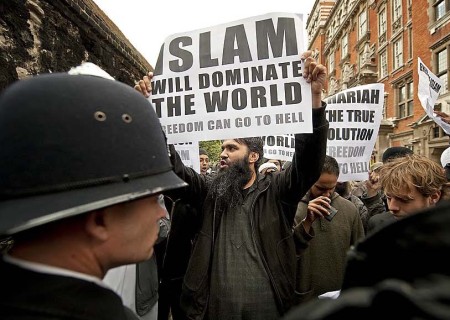
Islam will dominate the world

Everyone is impatient. Everyone is on fire. Especially the Terroristinians. Jewish store windows are smashed in London, Terroristinians butcher Rabbis in Jerusalem synagogues, fuming Terroristinians shoot up American recruiting centers. And the crowds cheer. “We Are All Terroristinians Now.”

It is a great day, I tell you. A great day for negotiating. ISIS impatiently beheads infidels to create its own Islamic Terroristine. In Afghanistan the word goes out, “We are the Taliban, we are the Afghan people, we are Terroristinians.” In Egypt and Turkey, they cry, “Khaybar Ya Yahood”. Churches burn. Soldiers die. The smoke rises to heaven. A man waits in line at the airport. His passport is Dutch, Welsh, German, American, it doesn’t matter. He is a Terroristinian. Yallah.

One day the borders of Terroristine will stretch from Spain to Pakistan. Or beyond Why settle for Jerusalem, when we can have London, Paris and Hamburg too. Why settle for anything at all? Allah is generous to the believers. Our people are in Africa. Even China. The Great Satan himself bows toward Mecca. The old governments are falling. The pawns of the Kufir are fleeing before our eyes.

We are all Terroristinians now. There is no other book on our shelves than the Koran. No law but Sharia in our hearts. And no nation but Terroristine. The ghost of Chamberlain stands outside No. 10 Downing Street promising peace. A Terroristinian refugee beheads him and holds up his spectral head to the cheers of the crowd. Rockets sail through the sky. The crowd cheers. Hip Hip Hooray. Hierosylma Est Perdita. Three cheers for Terroristine.

Putin Plays Mideast Chess as Obama Looks On

October 1, 2015

Putin Plays Mideast Chess as Obama Looks On, American ThinkerJonathan F. Keiler, October 1, 2015

(Unfortunately, Obama was “in the game” which led to the nuke “deal” with Iran. There, he was not incompetent; he got what he sought. — DM)

Obama has made a lot of foreign policy mistakes in office, but his capitulation on the Iranian nuclear talks followed by Russia’s move into Syria is impossible to explain away as anything but a stupendous strategic fiasco.  Incompetence is too nice a word.  Obama was never even in the game.

*********************

It is sometimes said that in negotiations with foreigners, American leaders play checkers, while their wilier opponents play chess.   There is perhaps some truth to this, as American leaders sometimes chase short-term political results, a consequence of democratic governance and constantly changing leadership.  By contrast, despotic Persians are credited with inventing chess, and in modern times autocratic Russians have been its master, and so it is tempting to say of President Obama’s dealings with those two countries that the analogy holds.

But that is way too charitable.  As Vladimir Putin skillfully reasserts Russian power and influence in the Middle East with Islamic Persian Iran as a willing partner, a more apt analogy might be that while the Russians and Iranians move their chessmen, isolating and threatening opposing pieces, Obama is not even at the table, but rather childishly looking on, as he pushes diplomatic dirt around the Middle East sandbox.

For over 150 years, a primary objective of Western diplomatic and military strategy was to keep the Russians out of the Middle East and Southwest Asia.  In the 1850s, the British and French went to war in Crimea to protect the Ottomans from Russian predation and to preserve the balance of power.  Later, the so-called “Great Game” centered on similar British efforts to frustrate Russian domination of Iran and Afghanistan.  A century later, the United States took up the task, offsetting Russian influence in newly socialist Arab dictatorships by backing Israel and more traditional Arab monarchies in the Middle East, while openly and successfully opposing the Soviet incursion into Afghanistan.

Today, one can’t even say there remains any Western strategy regarding Russia.  Western Europe has mostly forfeited its military and political influence overseas to support decadent welfare states, even as it is being progressively and deliberately overwhelmed by millions of Islamist migrants.  Under Obama, who supports and admires Europe’s demise, the United States has increasingly joined in the decline.  The laughable Libyan campaign, “fought” by Europeans while the U.S. led from behind, set an example of pursuing a feckless, feel-good military campaign without regard for consequences or traditional strategic concerns.  Obama’s encouragement of the so-called Arab Spring and its Islamist provocateurs almost lost Egypt and did lose Syria, with catastrophic humanitarian and geopolitical results.

Putin is taking advantage of American weakness and inaction.  A half-century of successful American effort to keep the Russians out of the Middle East has been forfeit in a few months of breathtaking American diplomatic and military incompetence.  Obama’s capitulation in the Iran deal effectively completed the groundwork for the Russian move, Putin having carefully monitored America’s year-long and ineffectual air campaign against ISIS.  Putin now claims that Russia’s push into Syria is to redeem the campaign against ISIS with Russian troops fighting with Syria and Hezb’allah.  Embarrassed by Putin at the U.N., Obama gave up any pretense of strength, effectively welcoming the Russian “intervention” against ISIS.  Unexplained is why a large percentage of Russian anti-ISIS forces are heavily equipped with anti-aircraft weapons, something that even a flaccid NATO command cannot ignore, inasmuch as ISIS have an air force.  Those weapons are useful only against NATO or Israeli aircraft.

So lost was Obama before his meeting with Putin at the U.N. that his stated strategy for dealing with the Russian strongman was to ask him what he was doing.  From the stiff and awkward body language of the president following the meeting (a painful handshake and awkward smile) it is clear that Putin told Obama at least some of the story, whether Obama liked it or not.  Most particularly, his client Bashar Assad will remain in power with Russian backing, regardless of Obama’s view on the matter.  But likely Obama had known what he was in for, and just going through the motions.  The day before, Secretary of State of State John Kerry responded to a question about how long the U.S. could tolerate the survival of Assad, saying, “… it doesn’t have to be on day one or month one or whatever.”  Right, dude, whatever.  Between Obama and Kerry, it is now fair to assume that our much muddled and irresolute Syrian policy is “whatever,” which means we just don’t care.  We take our toys and go home.

If Obama was hoping, as he and his supporters implied, that the Iranian deal would produce a more moderate, cooperative Iran, Putin and the mullahs are doing all they can to demonstrate how wrong he was.  If he was hoping that “international pressure” and the conflict in Ukraine would moderate Putin’s aggressive strategies, he was wrong again.  And if he thinks that by quitting, he has left Putin an unwinnable game, the Russian leader aims to prove him wrong again.  And since Obama is almost always wrong when it comes to foreign policy, it’s a fool’s errand to bet against Putin.

In chess, before going for the opponent’s king, typical strategy calls for supporting one’s important pieces, while threatening and isolating opposing pieces.  The Russians and Iranians are now going about this with a vengeance, without the United States or the West making any noticeably effective counter-moves.  Russia is backing and protecting Assad and has closely allied itself with a newly empowered (thanks largely to Obama) Iran.  Meanwhile, traditional American allies in the region, Israel, Egypt, and the Arab monarchies are indeed increasingly threatened and isolated.  The stage is being set for a Russo-Iranian endgame that could prove disastrous to America’s traditional allies and the West in general.

Some of Obama’s liberal supporters dismiss such analysis as over the top, and insist that Putin’s moves have more to do with domestic politics than a long-term Middle Eastern power play.  They point out Putin’s problems at home, and the relative weakness of the Russian military.  However, relative Russian weakness means little when moving into a power vacuum created by Obama’s flight from international responsibilities and, to a large extent, reality.  And besides, this has been the basic way liberals have sought to excuse Obama whenever he is pushed around by a foreign leader (which is almost always).  Putin’s got problems, so he invades Ukraine, threatens the Baltic States, and moves into Syria.  The Chinese have problems, so they push naval vessels into American waters and fortify disputed Western Pacific archipelagos.  Korea’s got problems, Iran’s got problems, and none of their aggressive actions has anything to do with the dilettante in the White House.  It’s all about solving problems at home with international temper tantrums.

Obama has made a lot of foreign policy mistakes in office, but his capitulation on the Iranian nuclear talks followed by Russia’s move into Syria is impossible to explain away as anything but a stupendous strategic fiasco.  Incompetence is too nice a word.  Obama was never even in the game.


Humor | Shaky Ground

September 30, 2015

Shaky Ground, Hope n’ Change, September 30, 2015

Shaky Ground

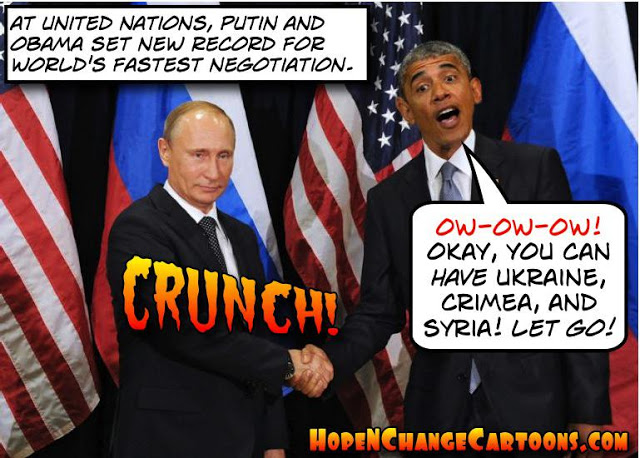
On Monday, Vladimir Putin met briefly with Barack Obama at the United Nations because he was  hungry and wanted to eat the president’s lunch, drink his milk shake, and then gobble up other nations for dessert.

Actually, we think that only happened metaphorically, but we’re not 100% sure because it’s hard to imagine President Dweebypants being in a room with Putin for more than 15 seconds without basically giving the Russian strongman everything he wants.

The two leaders were at the U.N. to explain their differing approaches to the twin crises of Syria and ISIS. Putin believes in arming Syria and its murderous dictator, Assad, and combining forces with other nations to crush ISIS and then crush anyone else who doesn’t like the idea of Putin taking over the world.

Obama, on the other hand, basically said that Assad is a stinker and Putin is on the wrong side of history, and that the United States – which has the most powerful military in the world – was immediately launching a “wish initiative” which consists of hoping (and hoping damn hard) that things will somehow magically “transition” in a way which benefits our national interests.

Mr. Obama also reaffirmed, while wearing his frowny face, that he wouldn’t hesitate to use military force to protect our country or our allies (Iran, last time we looked) but that he really doesn’t want to because the sort of military forcefulness which Putin is employing so successfully is “butch” and lacks panache.

Frankly, Hope n’ Change is embarrassed to have this babbling milquetoast appearing at the U.N. and confirming the increasingly terrified world’s belief that the United States is no longer in the superpower business. We’re also depressed thinking just how much more damage this nitwit can do with his remaining days in office.

Russia and Iran, the UN’s darlings

September 29, 2015

Russia and Iran, the UN’s darlings, Israel Hayom, Boaz Bismuth, September 29, 2015

The situation in the Middle East is very complicated these days, particularly when it comes to the ongoing strife in Syria. On Monday, Russian President Vladimir Putin and Iranian President Hassan Rouhani both gave speeches at the U.N. General Assembly in New York that in normal times could have been dismissed as amusing. But in the era of Islamic State, everyone is suddenly trying to appear to be righteous, including Putin and Rouhani.

Putin, for example, believes that Syria’s future must include Bashar Assad, the tyrant who is responsible for the deaths of 250,000 of his own people. As Putin said, “Only Assad is fighting against Islamic State.” Meanwhile, Rouhani declared, “No country should use terrorism to interfere in another country’s affairs.” Let us remember that these were addresses delivered to the world, rather than jokes uttered on a satire program. What a farce.

The sad reality that exists in the Middle East these days is what allowed these two leaders to make such “comical” statements. The growth of Islamic State and the failure of the U.S.-led coalition against it have given Russia and Iran a great opportunity to bolster their international status.

For the Russians, this is a chance to erase memories of their actions in Ukraine and the Crimean Peninsula. For the Iranians, this provides an opening to deflect attention away from 35 years of exporting terrorism around the globe. Russia and Iran are both fortunate that Islamic State exists.

Putin met with U.S. President Barack Obama on Monday to tell him that the purpose of Russia’s increased military presence in Syria was to fight Islamic State. He also told Obama that the rebuilding of Syria would require the rebuilding of the Assad regime.

Obama was right on Monday when, in his own address to the U.N. General Assembly, he said that Assad must have no political future in Syria. Unfortunately, there are two small things that contradict Obama’s view of the situation. First, the pre-civil war Syria no longer exists. And second, all reconstruction proposals for Syria include a transition period during which a role for Assad would be necessary. And who knows how many years this transition would take?

Obama may not want Assad in power, but in reality, an Assad regime backed by Russia and Iran is what there is in Syria. Since Obama reiterated on Monday that the U.S. cannot solve global problems by itself, perhaps he should have added how wonderful it is to have Russia and Iran to help him. This is the woeful state of our world today.

Obama’s General Assembly address was his second-last before he leaves the White House in January 2017. In Monday’s speech, he tried to outline what his legacy will be. One must give Obama credit for adhering to his outlook, even after all of the mishaps he has been personally responsible for.

Russia and Iran were the big winners in New York on Monday. Putin, who was ostracized after Russia’s annexation of Crimea last year, is now the world’s great hope in the fight against Islamic State. And Iran is already talking about a “new world order,” thanks to the nuclear deal it signed with world powers in July.

And what does this all mean for Israel? “The Zionist regime is the root of all terrorism,” Rouhani said in his speech on Monday. How hopeful!

What is the solution for all this? Who knows? Perhaps we will get the answer at the U.N. General Assembly in 2016.

Iran Bolsters Itself with UN Resolution Condemning Sanctions

September 27, 2015

Iran Bolsters Itself with UN Resolution Condemning Sanctions, Legal Insurrection, September 26, 2015

(Please see also, Iran Openly Declares That It Intends To Violate UNSCR 2231 That Endorses The JCPOA — DM)

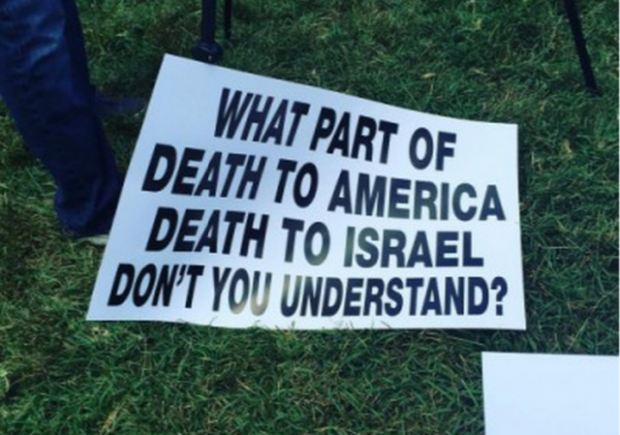
Protest-Sign-Against-Iran-Nuclear-Deal-Death-to-America-e1441978760141-620x435


I think we all know what Iran means when it speaks of political free will. In the wake of the adoption of the Iran nuclear deal, conversations about nightmare “what if” scenarios focused on America’s ability to “snap” sanctions against Iran back into place; now, Iran is trying to reframe the conversation about the use of sanctions by arguing that the use of sanctions at all will constitute a greater violation than what the sanctions are meant to punish.

***************************

This week, Iran used its considerable muscle to launch an attack on US efforts to tamper its nuclear program and otherwise belligerent conduct in the Middle East. These efforts took the form of a proposed resolution in the United Nations Human Rights Council (UNHRC) that condemns the use of sanctions against misbehaving nations as a violation of international law and fundamental human rights.

You won’t see the word “sanctions” more than three times in the resolution; instead, the drafters used the phrase “unilateral coercive measures.” From the proposed resolution:

Recognizing the universal, indivisible, interdependent and interrelated character of all human rights and, in this regard, reaffirming the right to development as a universal and inalienable right and an integral part of all human rights,

Expressing its grave concern at the negative impact of unilateral coercive measures on human rights, development, international relations, trade, investment and cooperation,

Reaffirming that no State may use or encourage the use of any type of measure, including but not limited to economic or political measures, to coerce another State in order to obtain from it the subordination of the exercise of its sovereign rights and to secure from it advantages of any kind,

Recognizing that unilateral coercive measures in the form of economic sanctions have far-reaching implications for the human rights of the general population of targeted States, disproportionately affecting the poor and the most vulnerable classes,

Recalling also article 1, paragraph 2, common to the International Covenant on Civil and Political Rights and the International Covenant on Economic, Social and Cultural Rights, which provides that, inter alia, in no case may a people be deprived of its own means of subsistence,

1. Calls upon all States to stop adopting, maintaining or implementing unilateral coercive measures not in accordance with international law, international humanitarian law, the Charter of the United Nations and the norms and principles governing peaceful relations among States, in particular those of a coercive nature with extraterritorial effects, which create obstacles to trade relations among States, thus impeding the full realization of the rights set forth in the Universal Declaration of Human Rights and other international human rights instruments, in particular the right of individuals and peoples to development;

The writing goes on to demand that member states ignore calls for sanctions, and condemns the use of such “as tools of political or economic pressure against any country, particularly against developing countries, with a view to preventing these countries from exercising their right to decide, of their own free will, their own political, economic and social systems.”

I think we all know what Iran means when it speaks of political free will. In the wake of the adoption of the Iran nuclear deal, conversations about nightmare “what if” scenarios focused on America’s ability to “snap” sanctions against Iran back into place; now, Iran is trying to reframe the conversation about the use of sanctions by arguing that the use of sanctions at all will constitute a greater violation than what the sanctions are meant to punish.

This isn’t a one-off finger-in-the-air from Iran to the US. The UNHRC is a dysfunctional land of multilingual politicking, and now the most dangerous players are using their influence with the greater UN body to bolster the worst violators at the expense of what should be common sense.

More from UN Watch [emphasis mine]:

Earlier this year, the UNHRC’s infamous Consultative Group, with Saudi Arabia’s Faisal Trad then serving merely as Vice-President, successfully picked Algerian hardliner Idriss Jazairy — famous for his efforts as a former diplomat to enact a UNHRC “code of conduct” to intimidate independent human rights experts — as the new “Special Rapporteur on the negative impact of the unilateral coercive measures.”

Jazairy has already accused the U.S. and Europe of being leading human rights violators due to their use of sanctions against countries like Iran and Zimbabwe.

Indeed, many of the resolutions adopted at each session of the UNHRC are sponsored by Cuba, Iran, Pakistan, Algeria, and other non-democracies, and are designed to demonize the West, free market economies, individual rights, or Israel, as part of a strategy to deflect attention from council members who are guilty of subjugating women, trampling religious freedom, persecuting gays, oppressing ethnic minorities and promoting relgious extremism.

This is clever, and part of a bigger strategy meant to counter American and Israeli efforts to speak out against the Iran nuclear deal. Even in the US, the media’s narrative has taken a subtle shift, away from the back and forth in Congress and toward an optic that frames the deal in terms of what it can do to encourage the advent of greater global cooperation. WaPo on Friday published an article needling the Republican Congress’ apparent rejection of “multilateralism”; meanwhile, the NYT editorial board executed a hard pivot away from the political theatre of the moment and toward What We Really Need to be Talking About© in terms of America’s participation in Gulf state politics.

The United Nations itself isn’t necessarily an important player in the American political conversation; international law is obscure, and multilateral relationships are [a] complication and confusing at best. However, if this resolution is adopted (and even if it isn’t) I can just about guarantee that the pro-Iran Deal crowd will use it as a weapon against anti-Deal candidates (primary season doesn’t go away just because we’re dealing with something happening in Geneva) currently warning their colleagues against the folly of attempting to deal with a nation that has proven itself more than adept at sidestepping the rules.

In this case, they’ve taken it upon themselves to rewrite them.

You can read the full proposed resolution here.

Time to delegitimize the UN

September 24, 2015

Time to delegitimize the UN, Israel Hayom, Judith Bergman, September 24, 2015

(The UN has already made numerous heroic efforts to delegitimize itself. Isn’t it finally time for free world nations to leave the UN, stop paying for it and establish a very different organization dedicated to furthering, rather than destroying, western culture? — DM)

The appointment of Saudi Arabia to head this important U.N. Human Rights Council panel displays, once more, how deeply corrupt and truly meaningless the U.N. system and the U.N. Human Rights Council in particular are in practice.

***********************

It was recently publicized that Saudi Arabia has been elected to chair the U.N. Human Rights Council panel in charge of appointing independent experts. According to the U.N. Watch independent monitoring group, Saudi Arabia was chosen to head the Consultative Group, a five-member group of ambassadors that has the power to select applicants from around the world for more than 77 positions dealing with human rights mandates. These include positions such as the U.N. special rapporteur on violence against women and experts for working groups on the issues of discrimination against women and the rights of migrants and religious minorities.

One does not quite know whether to laugh or cry at the appointment of one of the worst human rights offenders in the world to head the selection of such experts. Indeed, Michael Moller, director-general of the United Nations Office at Geneva, does look a little bit uneasy in the photo taken of him, as he shakes the hand of the Saudi ambassador to Geneva, Faisal bin Hassan Trad, at his appointment. It must have been difficult for this Danish-born diplomat, hailing from a Scandinavian country so intensely committed to the pursuit of justice and human rights, to hide a grimace. After all, he was appointing the ambassador of a country where public beheadings are not the actions of criminals or terrorist organization like Islamic State, but a regular working feature of the legal system, which is modeled according to Shariah law. Perhaps the thought of petrodollars made the handshake easier.

Saudi Arabia was first elected to the Human Rights Council in 2013, without any protests from the U.S. and the European Union.

The appointment of Saudi Arabia to head this important U.N. Human Rights Council panel displays, once more, how deeply corrupt and truly meaningless the U.N. system and the U.N. Human Rights Council in particular are in practice. What does it say about the Human Rights Council that it appoints a country that regularly beheads dozens of its own citizens, as well as several of the 9 million foreign workers who constitute over half the workforce and frequently work in slave-like conditions for their Saudi Arabian masters?

While such an appointment clearly undermines any minuscule remnant of credibility that the U.N. Human Rights Council may have left, it should give pause to those who still believe the U.N. can play any credible role in international relations. More than anything, it shows the depraved state of the self-appointed guardian of world human rights.

Unfortunately, it would appear that most human rights advocates do not care much about this appointment, as there has been precious little reaction from them worldwide. Even more disturbing, the same human rights advocates who are so quiet about this are extremely vocal about perceived human rights violations by Israel. It only proves, once more, that they do not truly care about human rights.

What is the innocent blogger Raif Badawi, who has been sentenced to 1,000 lashes in public and 10 years in a prison in Saudi Arabia, supposed to make of this appointment, other than that the international community apparently approves of such punishment for a man who blogged about freedom of speech?

We in Israel hardly have any illusions left when it comes to the U.N., yet we still expend a lot of effort in responding to various U.N. commissions of inquiry, as if anything they conclude carries any kind of meaning or weight. Perhaps it is finally time to create an alliance of nations, with Israel in its midst, to effectively lead a campaign of delegitimization of the U.N., based on that organization’s blatant depravity and utter moral corruption. This is not something that Israel would be able to carry on its own, but although the number of decent nations in the world is shrinking fast, it is still not too late to find allies who might also have an interest in exposing the true face of the U.N. The organization is an expensive and obsolete bureaucratic monster, and there must be other states who would like to see it exposed and reformed.

Nuclear Fiascoes: From Diplomatic Failure With North Korea To Debacle With Iran

September 1, 2015

Nuclear Fiascoes: From Diplomatic Failure With North Korea To Debacle With Iran, Forbes, Claudia Rosett, August 31, 2015

(An excellent comparison of the machinations that led to the nuke “deal” with North Korea and those now leading to the “deal” with the Islamic Republic of Iran. — DM)

[B]oth Clinton and Bush purchased the transient gains of North Korean nuclear deals at the cost of bolstering a North Korean regime that has become vastly more dangerous. . . . Kim Jong Un bestrides a growing arsenal of weapons of mass murder, including chemical and biological, as well as nuclear, plus a growing cyber warfare capability. This is the legacy not least of North Korea’s skill at exploiting the feckless nuclear deals offered by U.S. presidents whose real achievements on this front were to hand off a monstrous and rising threat to the next administration.

Now comes the Iran nuclear deal, which President Obama has described as a perhaps once-in-a-lifetime “historic chance to pursue a safer and more secure world.” And from Israel’s Prime Minister Netanyahu, leader of America’s closest ally and Iran’s prime target in the Middle East, comes the warning that this deal is a “stunning historic mistake,” configured not to block Iran’s path to the bomb, but to pave the way.

Like the North Korea Agreed Framework, the Iran nuclear deal pivots narrowly on nuclear issues, as if ballistic missiles, terrorism, arms smuggling, gross violations of human rights, blatant declarations of destructive intent and the malign character of the regime itself were irrelevant to the promised “exclusively peaceful” nuclear program.

[I]f this Iran deal goes through, is that we are about to see the mistakes made with North Korea amplified on a scale that augurs not security in the 21st century, but a soaring risk of nuclear war.

************************

With Congress due to vote by Sept. 17 on the Iran nuclear deal, there’s a warning worth revisiting. It goes like this: The president is pushing a historic nuclear agreement, saying it will stop a terror-sponsoring tyranny from getting nuclear weapons. And up pipes the democratically elected leader of one of America’s closest allies, to say this nuclear deal is mortal folly. He warns that it is filled with concessions more likely to sustain and embolden the nuclear-weapons-seeking despotism than to disarm it.

This critic has more incentive than most to weigh the full implications of the deal, because his country is most immediately in harm’s way — though it has not been included in the nuclear talks. He notes that the nuclear negotiators have sidelined such glaring issues as human rights, and warns that Washington is naive, and the U.S. is allowing itself to be manipulated by a ruthless dictatorship.

No, the critic I’m referring to is not Israel’s Prime Minister Benjamin Netanyahu, though he has warned of precisely such dangers in the Iran nuclear deal. I am citing the warnings voiced 21 years ago by the then-President of South Korea, Kim Young Sam, as the Clinton administration bargained its way toward the 1994 nuclear deal with North Korea known as the Agreed Framework.

As it turned out, Kim Young Sam’s misgivings were right on target. The 1994 Agreed Framework did not stop North Korea’s pursuit of the bomb. Instead, it became a pit stop on North Korea’s road to the nuclear arsenal it is amassing today.

For all the differences between North Korea and Iran, there are parallels enough to suggest that the failed 1994 nuclear bargain with North Korea is an excellent guide to the future trajectory with Iran, if the U.S. goes ahead with the nuclear deal — the Joint Comprehensive Plan of Action — announced by the U.S., France, Britain, Germany, Russia, China and Iran on July 14 in Vienna.

Recall that in 1994, faced with the threat of North Korea producing plutonium for nuclear weapons, the U.S. sought a diplomatic solution. Taking a cue from an exploratory trip to Pyongyang by former President Jimmy Carter, the Clinton administration wooed North Korea with an offer of lightwater nuclear reactors to be used exclusively for the peaceful production of electricity. All Pyongyang had to do was give up its nuclear bomb program.

As this agreement was taking shape, South Korea’s Kim Young Sam laid out his concerns in an hourlong interview with the New York Times. In the resulting article, dated Oct. 8, 1994, the Times reported: “After weeks of watching in silent frustration as the United States tries to negotiate a halt to North Korea’s nuclear program, President Kim Young Sam of South Korea lashed out at the Clinton administration today in an interview for what he characterized as a lack of knowledge and an overeagerness to compromise.”

The Times article described Kim’s concerns that “compromises might prolong the life of the North Korean government and would send the wrong signal to its leaders.” Kim was quoted as denouncing the deal then in the making as a “half-baked compromise” which would lead to “more danger and peril.”

President Clinton rolled right past that warning. On Oct. 21, 1994, less than two weeks after Kim’s concerns hit the headlines, the U.S. signed the Agreed Framework with North Korea. Clinton praised the deal as “good for the United States, good for our allies, and good for the safety of the entire world.” Promising that the Agreed Framework would reduce the threat of nuclear proliferation, Clinton further lauded the deal as “a crucial step for drawing North Korea into the global community.”

South Koreans and their leaders, in the main, disagreed. But with South Korea dependent on the U.S. superpower for defense against North Korea, Kim Young Sam had little choice but to follow Clinton’s lead. Seoul damned the deal with faint praise. The Associated Press reported: “South Korean Foreign Minister Han Sung-joo said that even though the deal fell short of expectations, it met South Korea’s minimum policy goals.”

History now shows that the chief policy goals served by the Agreed Framework were those of Pyongyang, which racked up a highly successful exercise in nuclear extortion, and carried on, first secretly, then overtly, with its nuclear weapons program. As South Korea’s president had predicted, the Agreed Framework helped fortify Pyongyang’s totalitarian regime, rather than transforming it.

Some of the negotiators involved in that 1994 deal have since argued that while the North Korean agreement eventually collapsed, it did at least delay Pyongyang’s progress toward nuclear weapons. What they tend to omit from that select slice of history is that the Agreed Framework helped rescue a North Korean regime which in 1994 was on the ropes. Just three years earlier, North Korea’s chief patron of decades past, the Soviet Union, had collapsed. The longtime Soviet subsidies to Pyongyang had vanished. China did not yet have the wealth to easily step in. And just three months before the nuclear deal was struck, North Korea’s founding tyrant, Kim Il Sung, died. His son and heir, Kim Jong Il, faced the challenge of consolidating power during a period of famine at home and American superpower ascendancy abroad.

But in the game of nuclear chicken, it was America that blinked. In exchange for North Korea’s promise to freeze and eventually dismantle its nuclear weapons program, the U.S. agreed to lead a $4.6 billion consortium to build two lightwater reactors for North Korea, and provide shipments of free heavy fuel oil for heating and electricity production while the new reactors were being built. This was augmented by U.S. security guarantees, easing of sanctions and promises to move toward normalizing diplomatic relations, with generous food aid thrown in.

By the late 1990s, just a few years into the deal, North Korea had become the largest recipient of U.S. aid in East Asia. That did not curb Kim Jong Il’s hostile ways. The Pyongyang regime put the interests of its military and its weapons programs before the needs of its starving population. In 1998, North Korea launched a long-range missile over Japan, a test for which it was hard to discern any purpose other than developing a vehicle to carry nuclear weapons. By that time, as a number of former Clinton administration officials have since confirmed, the U.S. was seeing signs that North Korea was cheating on the nuclear deal by pursuing a secret program for uranium enrichment.

Instead of confronting North Korea, Clinton during his last two years in office tried to double down on his crumbling nuclear deal by pursuing a missile deal with Pyongyang. In 2000, that led to an exchange of high-ranking officials, in which the Clinton administration dignified North Korea with the unprecedented move of welcoming one of its top-ranking military officials, Vice Marshal Jo Myong Rok, to a 45-minute sitdown with Clinton at the White House. Clinton then dispatched Secretary of State Madeleine Albright, together with the administration’s special advisor for North Korea policy, Wendy Sherman, to Pyongyang (yes, the same Wendy Sherman recently employed by Obama as chief negotiator of the Iran nuclear deal). Sherman and Albright brought North Korea’s Kim Jong Il a basketball signed by star player Michael Jordan; Kim entertained them with a stadium flip-card depiction of a long-range missile launch. There was no missile deal.

North Korea continued raking in U.S. largesse until late 2002, when the Bush administration finally confronted Pyongyang over its nuclear cheating. North Korea then walked away from the 1994 deal (on which it had by then been cheating for years), withdrew from the Non-Proliferation Treaty (on which it had also been cheating) and began reprocessing plutonium from the spent fuel rods which despite the 1994 deal had never been removed from its Yongbyon nuclear complex. President Bush then made his own stab at nuclear diplomacy, via the Six-Party Talks. North Korea punctuated that process in Oct. 2006 with its first nuclear test. In 2007, the Bush administration led the way to a Six-Party denuclearization deal with North Korea, bull-dozing ahead even after it became clear that North Korea had been helping Syria build a secret copy of North Korea’s plutonium-producing Yongbyon reactor (destroyed in Sept. 2007 by an Israeli air strike). Once again, North Korea took the concessions, cheated on the deal and in late 2008 walked away.

Since Obama took office, North Korea has carried out its second and third nuclear tests, in 2009 and 2013; restarted its plutonium-producing reactor at Yongbyon; and in 2010 unveiled a uranium enrichment plant, which appears to have since at least doubled in size. Having equipped itself with both uranium and plutonium pathways to the bomb, North Korea is now making nuclear weapons, and developing increasingly sophisticated missiles — including long-range — to deliver them.

In sum, both Clinton and Bush purchased the transient gains of North Korean nuclear deals at the cost of bolstering a North Korean regime that has become vastly more dangerous. When Kim Jong Il died in late 2011, North Korea’s regime managed a second transition of power, to third-generation Kim family tyrant Kim Jong Un — who was described last year by the commander of U.S. Forces in Korea, General Curtis Scaparrotti, as “overconfident and unpredictable.” Kim Jong Un bestrides a growing arsenal of weapons of mass murder, including chemical and biological, as well as nuclear, plus a growing cyber warfare capability. This is the legacy not least of North Korea’s skill at exploiting the feckless nuclear deals offered by U.S. presidents whose real achievements on this front were to hand off a monstrous and rising threat to the next administration.

Now comes the Iran nuclear deal, which President Obama has described as a perhaps once-in-a-lifetime “historic chance to pursue a safer and more secure world.” And from Israel’s Prime Minister Netanyahu, leader of America’s closest ally and Iran’s prime target in the Middle East, comes the warning that this deal is a “stunning historic mistake,” configured not to block Iran’s path to the bomb, but to pave the way.

There are surely dissertations to be written on the intricate differences between the North Korea Agreed Framework and the Iran nuclear deal now before Congress. But important and alarming similarities abound.

Like the North Korea deal, the Iran deal dignifies a despotic, murderous regime, and provides its worst elements with relief from economic distress, via a flood of rejuvenating resources. In North Korea’s case, the main help arrived in the form of aid. In oil-rich Iran’s case, it comes in the far more lucrative form of sanctions relief, including access to an estimated $55 billion or more (by some estimates, two or three times that amount) in currently frozen funds held abroad.

Like the North Korea Agreed Framework, the Iran nuclear deal pivots narrowly on nuclear issues, as if ballistic missiles, terrorism, arms smuggling, gross violations of human rights, blatant declarations of destructive intent and the malign character of the regime itself were irrelevant to the promised “exclusively peaceful” nuclear program.

Like the North Korea deal, the Iran deal comes loaded with incentives for the U.S. administration to protect its own diplomatic claims of success by ignoring signs of cheating. Monitoring of nuclear facilities is shunted to the secretive International Atomic Energy Agency, which has no power of enforcement, and will have to haggle with Iran for access to suspect sites.

Like Clinton with North Korea, Obama chose to frame the Iran deal not as a treaty, but as an executive agreement, performing an end-run around vigorous dissent within Congress by submitting the deal pronto for approval by the United Nations Security Council. In the North Korean case, the Security Council gave its unanimous blessing in the form of a presidential statement. In the Iran case, the Obama administration drafted a resolution which the Security Council unanimously approved. Having hustled the deal directly to the U.N., despite legislation meant to ensure Congress a voice, Obama administration officials are now pressuring Congress to defer to the U.N.

To be sure, there are two highly significant differences between the 1994 North Korea deal and the 2015 Iran deal. Iran, with its oil wealth, location in the heart of the Middle East, messianic Islamic theocracy and global terror networks, is even more dangerous to the world than North Korea. And, bad as the North Korea deal was, the Iran deal is much worse. Along with its secret side agreements and its promises to lift the arms embargo on Iran in five years and the missile embargo in eight, this deal lets Iran preserve its large illicitly built nuclear infrastructure and carry on enriching uranium, subject to constraints that will be problematic to enforce, and are themselves limited by sunset clauses that even North Korea never managed to obtain at the bargaining table.

When Israel’s Netanyahu spoke this past March to a joint meeting of Congress, warning that the Iran nuclear deal would lead to “a much more dangerous Iran, a Middle East littered with nuclear bombs and a countdown to a potential nuclear nightmare,” Obama dismissed that speech as “nothing new.” That’s true, in the sense that we have heard similar warnings before. What’s new, if this Iran deal goes through, is that we are about to see the mistakes made with North Korea amplified on a scale that augurs not security in the 21st century, but a soaring risk of nuclear war.
International inspections of Iran’s nuke sites are a sick joke

August 20, 2015

International inspections of Iran’s nuke sites are a sick joke, Dan Miller’s Blog, August 19, 2015

(The views expressed in this post — which for the most part consists of links to and quotations from recent articles posted at Warsclerotic — are mine and do not necessarily reflect those of Warsclerotic or its other editors. — DM)


Over the past few days, Iranian officials have confirmed that international inspections of its nuke sites will be severely limited if permitted at all. This post provides excerpts from recent articles quoting them. 

Iran’s nuke sites

The restrictions noted in this post are in addition to previously disclosed prohibitions on access by International Atomic Energy Agency (IAEA) inspectors to military sites, which Iran itself will inspect instead. Even The Daily Beast has mentioned this problem in reliance on an Associated Press article which states,

All IAEA member countries must give the agency some insight into their nuclear programs. Some are required to do no more than give a yearly accounting of the nuclear material they possess. But nations— like Iran — suspected of possible proliferation are under greater scrutiny that can include stringent inspections. [Emphasis added.]

The agreement in question diverges from normal procedures by allowing Tehran to employ its own experts and equipment in the search for evidence of activities it has consistently denied — trying to develop nuclear weapons. [Emphasis added.]

Olli Heinonen, who was in charge of the Iran probe as deputy IAEA director general from 2005 to 2010, said he could think of no similar concession with any other country.

Recent disclosures

According to an article by Adam Kredo at Washington Free BeaconNo international inspectors will be admitted to Iran unless approved by Iranian intelligence officials.

A senior Iranian official declared on Monday that international nuclear inspectors would only be permitted into the country once they receive approval from the Islamic Republic’s Intelligence Ministry, putting another roadblock between the International Atomic Energy Agency (IAEA) and Iran’s contested nuclear sites.

Sayyed Abbas Araqchi, Iran’s deputy foreign minister and one of the top negotiators in talks that led to the recently inked nuclear deal, told the country’s state-controlled press that Iran’s intelligence apparatus must approve of any inspector who is issued a visa to enter Iran. [Emphasis added.]

Acording to an article at DEBKAfileNo international inspectors will be given access to military sites unless they first submit acceptable evidence of prohibited nuke activities there.

International nuclear inspectors will only be permitted into the country after offering proofs of suspicious activity at the sites to be inspected, Iran’s Defense Minister Brig. Gen Hossein Dehqan said Tuesday. DEBKAfile: This condition is not contained either in the nuclear deal Iran signed with the six world powers last month or in its contract with the IAEA. How will the international watchdog obtain proofs if it is denied visits for inspections? [Emphasis added.]

According to another article by Adam Kredo at Washington Free Beaconthe head of the International Atomic Energy Agency (IAEA) was threatened with “harm” should he tell U.S. officials about the Iran – IAEA secret deal(s)

Iranian leaders prevented a top International Atomic Energy Agency (IAEA) official from disclosing to U.S. officials the nature of secret side deals with the Islamic Republic by threatening harm to him, according to regional reports. [Emphasis added.]

Yukiya Amano, IAEA director general, purportedly remained silent about the nature of certain side deals during briefings with top U.S. officials because he feared such disclosures would lead to retaliation by Iran, according to the spokesman for Iran’s Atomic Energy Organization (AEOI).

Amano was in Washington recently to brief members of Congress and others about the recently inked nuclear accord. However, he did not discuss the nature of side deals with Iran that the United States is not permitted to know about.

Iran apparently threatened Amano in a letter meant to ensure he did not reveal specific information about the nature of nuclear inspections going forward, according to Iranian AEOI spokesman Behrouz Kamalvandi.

“In a letter to Yukiya Amano, we underlined that if the secrets of the agreement (roadmap between Iran and the IAEA) are revealed, we will lose our trust in the Agency; and despite the US Congress’s pressures, he didn’t give any information to them,” Kamalvandi was quoted as saying Monday during a meeting with Iranian lawmakers, according to Tehran’s state-controlled Fars News Agency.

“Had he done so, he himself would have been harmed,” the official added. [Emphasis added.]

If these analyses are correct, and they appear to be, there will be no meaningful “anytime anywhere” international inspections of Iranian military sites. Although Obama has repeatedly said that the current nuke “deal” is not based on trust, that appears to its only basis, an absurd one.

Iran’s missiles

Acording to another DEBKAfile article, Iran’s missile research and development are continuing despite (or perhaps because of) the August 2015 “deal.”

Shortly before US Secretary of State John Kerry was due in Qatar Monday, Aug. 3, Iran’s highest authorities led by supreme leader Ayatollah Ali Khamenei Sunday launched a public campaign to support Tehran’s noncompliance with the Vienna nuclear accord and UN Security Council Resolution 2231 of July 20, on its ballistic missile program. The campaign was designed by a team from Khamenei’s office, high-ranking ayatollahs and the top echelons of the Revolutionary Guards, including its chief, Gen. Ali Jafari. [Emphasis added.]

. . . .

The Security Council Resolution, which unanimously endorsed the Joint Comprehensive Plan of Action (Vienna nuclear accord) signed by Iran’s Foreign Minister Mohammed Javad Zarif, called on Iran not to undertake any activity related to ballistic missiles designed to be capable of delivering nuclear weapons, including launches using such ballistic technology until the date eight years after the JCPOA Adoption Day.” [Emphasis added.]

Tehran retorted that none of its ballistic missiles were designed to deliver nuclear weapons, and so this provision was void. Shortly after its passage, the foreign ministry in Tehran issued an assurance that “…the country’s ballistic missile program and capability is untouched and unrestricted by Resolution 2231.”

On July 30, Ali Akbar Velayati, Khamenei’s senior adviser on international affairs and member of the Expediency Council, told reporters, “The recent UNSC Resolution on Iran’s defensive capabilities, specially (sic) its missiles, is unacceptable to Iran.”

According to an August 16th article at the Iranian media site Tasnim, there is no impediment to continuation of Iran’s missile program.

TEHRAN (Tasnim) – Chief of Staff of the Iranian Armed Forces Major General Hassan Firouzabadi underlined that there are not any obstacles to the country’s missile program. [Emphasis added.]

“The Islamic Republic of Iran’s missile activities, as planned inside the country, will not face any obstacles,” the senior officer stressed on Sunday.

The general also reiterated that Iran’s missile tests are going to be carried out in a timely manner according to the plans endorsed by Supreme Leader of the Islamic Revolution Ayatollah Seyed Ali Khamenei.

Iran – North Korea nuke nexis

Nuke cooperation between Iran and North Korea was not considered during the P5+1 “negotiations.” The text of the current “deal” is silent on the subject. Kerry’s State Department has limited media contact with Douglas Frantz, his Assistant Secretary in charge of the Bureau of Public Affairs, to avoid releasing information on the Iran – North Korea nuke nexus. Mr. Frantz, formerly a highly respected journalist, had written extensively on North Korea’s nuclear program.

An honest accounting would quite likely reveal something that many press reports have alleged, but U.S. administration officials have never publicly confirmed: A history of nuclear weapons collaboration between Iran and nuclear-proliferating North Korea.

. . . .

Drawing on “previously secret reports, international officials, independent experts, Iranian exiles and intelligence sources in Europe and the Middle East,” Frantz wrote that “North Korean military scientists recently were monitored entering Iranian nuclear facilities. They are assisting in the design of a nuclear warhead, according to people inside Iran and foreign intelligence officials.”

. . . .

Perhaps Frantz should recycle that article to Secretary of State John Kerry, who while testifying to a congressional panel last month was asked about its allegations by Rep. Christopher Smith, and ducked the question.

. . . .

[I]t appears that as a State Department advocate of a free and well-informed press, Frantz himself is not free to answer questions from the press about his own reporting on North Korea’s help to Iran in designing a nuclear warhead. The State Department has refused my repeated requests to interview Frantz on this subject. Last year, an official at State’s Bureau of Public Affairs responded to my request with an email saying, “Unfortunately Assistant Secretary Frantz is not available to discuss issues related to Iran’s nuclear program.” [Emphasis added.]

. . . .

Of course, the real problem for the Obama administration is that an officially confirmed story of Iran-North Korea collaboration on nuclear warheads could spell further trouble for winning congressional approval of this nuclear deal.

Conclusions

Assuming (a highly dubious assumption) that Kerry and Obama’s other P5+1 “negotiators” wanted to limit Iran’s Uranium enrichment to peaceful purposes, to terminate its nuke weaponization and to restrict its missile development and use they failed. It might have been entertaining to have watched Obama instruct Kerry on how to negotiate for magic carpets in a Persian market. The Persians saw Obama’s P5+1 “negotiators” as suckers and took all of their cash. They then took whatever honor they may once have had.

With international inspections permitted, if at all, only at Iran’s whim, and international sanctions “snap back” a fantasy, Iran has been given a bright green light to do whatever it pleases. What pleases Iran should not please even Obama, who envisions a new era of Middle East stability as a major fruit of His victory in getting the July 2015 “deal.”

Iran plans to “stabilize” Israel first. Israel is the only free and democratic nation in the Middle East; America was once her most reliable ally. No longer, but perhaps one fine day she will be again.

A conference of religious scholars features speaker after speaker calling Israel’s annihilation inevitable and promising that a “new phase” in that effort is about to begin. [Emphasis added]

While some in the United States and among its Western allies may hope that a nuclear weapons deal with Iran might steer the Islamic Republic in a new, more responsible direction, hardliners draw new lines and issue new threats.

On Monday, Iranian Supreme Leader Ali Khamenei took to social media to attack the United States and Israel. “We spare no opportunity to support anyone #FightingTheZionists,” wrote the ayatollah, whose regime supplies Hizballah and Hamas with rockets and other weapons of terror.

Here’s a recent video from Iranian television showing how Iran plans to eliminate Israel.

The July 2015 “deal” remains a mystery shrouded in secrecy and deception. Obama has tried to mislead the the American public and the Congress. He has threatened members who have voiced opposition and characterized them as disloyal. Congress should kill the “deal.” Those members whose ultimate loyalty is to America rather than to Obama will vote to do so and then to override his veto.

Looking Ahead at Middle East “Peace”

August 17, 2015

Looking Ahead at Middle East “Peace” The Gatestone InstituteShoshana Bryen, August 17, 2015

  • The U.S. has provided approximately $5 billion to the Palestinians in bilateral aid since the mid-1990s and about $540 million this year. The EU added more than €500 million ($558 million), making it the largest single-year donor. Why should Palestinian Authority (PA) not have to pay the bill for its own savage behavior? And why is the U.S. so determined to protect it?
  • According to the deputy head of UNRWA, the organization needs $101 million in order to open schools on time. Why does the Hamas government not pay for its own children to go to school? And why does the Hamas government not pay for the repair of its own people’s houses? UNRWA and the U.S. government seem to believe that the PA and Hamas cannot be expected to spend their own funds — or donated funds — on the needs of their own people. Hamas can therefore use all its funds to make war.
  • As long as Hamas and the PA are permitted both to spend sponsors’ money on terrorism and warfare while escaping responsibility for the needs of their people, and as long as Iran is a key donor — with all the temptations, means and opportunity to “wipe Israel,” as it repeatedly threatens to do — the idea of a U.S.-led “peace process” is fantasy.

The Obama Administration has made it clear that it will not pursue Israeli-Palestinian “peace talks” while the Iran deal remains fluid. But as the President heads into his last year in office, the “two state solution” apparently remains an important political aspiration. The Iran deal and the “peace process” are linked by concerns over Iranian behavior on the non-nuclear front, and concerns about American willingness to remain the sort of ally Israel has found it to be in the past.

The following stories — all involving money and how it is spent — should be understood together:

  • U.S. requests lower bond for Palestinian appeal of terror case
  • Infant mortality in Gaza
  • Schools in Gaza may not open
  • Iranian assistance to Hamas

First, the U.S. Department of Justice this week asked a judge to “carefully consider” the size of the bond he requires from the Palestinian Authority (PA) as it appeals the award of damages to the victims of six terrorist attacks that killed and injured Americans in Israel. Concerned about the possible bankruptcy of the PA, Deputy Secretary of State Antony J. Blinken added a statement to the Justice Department filing, saying, “A P.A. insolvency and collapse would harm current and future U.S.-led efforts to achieve a two-state solution to the Israeli-Palestinian conflict.”

The Palestinian Authority was proven in a U.S. court to have organized and paid for terrorist attacks that killed Americans and Israelis. The U.S. has provided approximately $5 billion to the Palestinians in bilateral aid since the mid-1990s and about $540 million this year. The EU added more than €500 million ($558 million), making it the largest single-year donor. Why should PA not have to pay the bill for its own savage behavior?

And why is the U.S. so determined to protect it?

Second, UNRWA (United Nations Relief and Works Agency for Palestine Refugees in the Near East), which maintains camps for Palestinians in Gaza, Lebanon, Syria and parts of the West Bank, released a broadside last week entitled, “Infant Mortality Rises in Gaza for the First Time in 50 Years.” Subhead: “UNRWA’s Health Director says the [Israeli and Egyptian] blockade may be contributing to the trend.”

Such a rise would be a terrible thing, and Israeli culpability would be terrible also. But is it true? It takes only a few clicks of the computer keys to find out.

Palestinian infant mortality in the West Bank and Gaza has been on a straight downward slope since 1968. Using CIA Factbook figures, infant mortality was 158 per 1000 from 1950-55; 87 per 1000 in 1968 (using an Israeli government publication); 25 per 1000 in 1985-90; and is at 14 per 1000 today in Gaza. Where is the rising trend? The UNRWA release came from an article entitled “Increasing Neonatal Mortality among Palestine Refugees in the Gaza Strip,” published by PLOS ONE, an “open access” online journal.

The study itself notes, “These estimates are based on small numbers of deaths, and the confidence intervals are wide, so the infant mortality rate could in fact be stable or continuing to decline” (emphasis added). Yet its conclusion reads, “In conclusion, we have estimated that, for the first time in five decades, the mortality rate has increased among Palestine refugee newborns in Gaza, and this may reflect inadequate neo-natal care in hospitals.”

An Israeli website that evaluated the entire study caught the inherent contradiction. “They didn’t have enough data to reach the conclusion they did… Those two statements have no place in a serious scientific paper and would merit its immediate rejection.”

Third, having dispensed with scare mongering about infant mortality, let us turn to the other UNRWA broadside of the week: “Without New Cash, UNRWA Schools Won’t Open.” According to the deputy head of the organization, UNRWA needs $101 million in order to open schools on time.

Why does the Hamas government not pay for its own children to go to school?

This is similar to a story last January, in which UNRWA suspended the repair of Palestinian houses in Gaza because of a shortage of international donor money, and it raises the question: Why does the Hamas government not pay for the repair of its own peoples’ houses?

It is UNRWA’s belief — like that of the U.S. government, apparently — that Palestinian governments, including the one on the U.S. list of sponsors of terrorism, have to be protected from the consequences of their own war-making, support for terrorism, and thievery. UNRWA and the U.S. government seem to believe that the Palestinian Authority and Hamas cannot be expected to spend their own funds — or donated funds — on the needs of their own people.

Which brings us to Iran; the only country working assiduously to ensure that its client, Hamas in Gaza, gets the assistance it needs to meet its goals, and then meets those goals.

According to Israeli government sources, Iran’s most recent assistance includes “cash, military training for Hamas fighters, weaponry, and electronics equipment including for use against Israeli drones… Hamas has also been training fighters in the use of anti-tank and anti-aircraft missiles, and is training recruits to fly paragliders across the border.”

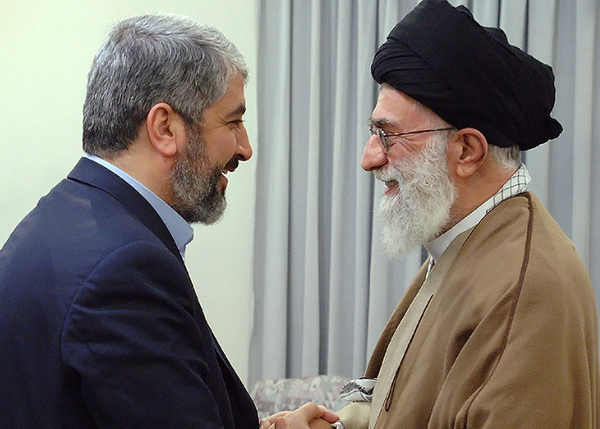
1162Bridging the Sunni-Shia divide, for the goal of genocide: Hamas leader Khaled Mashaal (left) confers with Iranian Supreme Leader Ali Khamenei, in 2010. (Image source: Office of the Supreme Leader)

UNRWA and Iran, with a supporting role played by the United States, have long made it possible for Hamas and the PA to spend other people’s money building more tunnels, arming multiplemilitias, paying “salaries” to convicted terrorists in Israeli jails, and improving the quality of their rockets and missiles. They know — and Israel knows — that between the Israeli government and the international aid agencies including, but not limited to, UNRWA, no Palestinians will starve, no one will go without medical care, no one will go homeless (except those homeless because Hamas confiscated about 20% of the cement and steel meant to restore Gaza houses damaged in last year’s war). Hamas can therefore use all its funds to make war.

As long as Hamas and the PA are permitted both to spend sponsors’ money on terrorism and warfare while escaping responsibility for the needs of their people, and as long as Iran is a key donor — with all the temptations, means and opportunity to “wipe Israel,” as it repeatedly threatens to do — the idea of a U.S.-led “peace process” is fantasy.