Archive for the ‘U.S. Military’ category

Satire| Breakthrough military technology enables cutting-edge micromanagement

March 27, 2016

Breakthrough military technology enables cutting-edge micromanagement, Duffel Blog, March 27, 2016

TRUSTOVISION-1000x600

FORT MEADE, Md. — New technology unveiled by the Pentagon today promises to offer the Army “an unparalleled level of battlefield supremacy in micromanagement,” according to Pentagon Spokesman Peter Cook.

The breakthrough technology, dubbed “Trust-o-Vision,” enables the company commander on the battlefield the previously-limited ability to send continuous reports to higher and receive instant verbal critiques, guidance, and second guessing.

Col. Peter Hammond, Brigade Commander of 1st Brigade, 10th Mountain Division, heralded the advancement in technology as “exactly what Corps, brigade, and battalion commanders need in order to more efficiently keep control at ever increasing distances of time, space, and reality,” he said.

“With Trust-o-Vision, my junior leaders can rest assured that I will always be watching,” Hammond added, “and always be ready to step in at a moment’s notice when I’ve decided I’m needed.”

The next generation technology, set to be installed in garrison headquarters and Tactical Operations Centers (TOCs), as well as every vehicle and personal residence of company-level leaders everywhere, features a persistent full HD audio and video feed of every commander at every echelon, from Battalion to Chief of Staff of the Army.

Cook introduced a video demonstration of a recent field test of “Trust-o-Vision” by 2nd Brigade, 4th Infantry Division, during their deployment to Southern Afghanistan.

A captain using the callsign “Legion 6” contacts a lieutenant with callsign “Legion 1-6.” As Legion 6 announces movement of another unit, 3-6, an interruption occurs.

“Break break break,” says the voice, identified by subtitles as Brig. Gen. James Mingus, who is then immediately followed by Maj. Gen. Ryan Gonsalves, who asks “Hey! What is that guy doing?”

Mingus then asks the unidentified captain, “Why is that rifleman facing that direction? Shouldn’t someone be calling out sectors of fire.”

Gonsalves can then be heard ordering a machine gun team to “go cyclic on that 240, dummy!” while an unidentified voice argues they should use “sustained fire, to keep their heads down, stupid!”

Cook noted as the video ended that, “A number of awards are pending for the Division Staff for their unparalleled handling of the company in the face of sustained enemy resistance.”

Sources confirm that the static “Trust-o-Vision” will be supplemented in 2018 with a drone-based version that will be able to constantly hover in front of a dismounted company commander’s face.

Lee Ho Fuk and Jay contributed to this report


Dunford: U.S. Military Isn’t Ready Across the Board

March 22, 2016

Dunford: U.S. Military Isn’t Ready Across the Board, Washington Free Beacon, March 22, 2016

Gen. Joseph Dunford, chairman of the Joint Chiefs of Staff, told lawmakers Tuesday that the United States military currently is not prepared or capable across all the service branches of addressing the threats facing the country.

Dunford gave his assessment of the military’s readiness while testifying before the House Armed Services Committee alongside Defense Secretary Ash Carter on the fiscal year 2017 proposed defense budget.

Rep. Mac Thornberry (R., Texas), chair of the committee, first listed evidence he has heard from other senior military officers to illustrate how the military does not have sufficient readiness capabilities across the services.

“Let me just offer a handful of other quotes on the record,” Thornberry told Dunford. “[Marine Corps Commandant] Gen. [Robert] Neller said, ‘Our aviation units are currently unable to meet our training and mission requirements, primarily due to Ready Basic Aircraft shortfalls.’ [Army Chief of Staff] Gen. [Mark] Milley and Gen. [John] Allen have testified [that] less than one-third of Army forces are at acceptable forces of readiness. The readiness of the United States Army is not at a level that is appropriate for what the American people would expect to defend them.”

Thornberry then referenced Air Force Secretary Deborah Lee James’ testimony from last week in which she said that “less than half our combat forces are ready for a high-end fight… the Air Force is the smallest, oldest, and least ready force across the full spectrum of operations in our history.”

“Do you agree that we have a significant readiness problem across the services, especially for the wide variety of contingencies that we’ve got to face?” Thornberry asked.

“Chairman, I do, and I think those are accurate reflections of the force as a whole,” Dunford said. “From my perspective, there’s really three issues: There are the resources necessary to address the readiness issue, there’s time, and then there’s operational tempo.”

Dunford said that the readiness problem is the result of several years of an “unstable fiscal environment” combined with an “extraordinarily high operational tempo,” or rate of military actions.

The general warned it will take many years to dig out of this situation, but said he is satisfied that the FY 2017 budget meets the fiscal requirements of each service for readiness.

The U.S. cannot buy its way out of the readiness problem this year, Dunford said, because of time and the growing need to deploy resources quickly.

He added that the Army, Navy, and Marine Corps will not be sufficiently ready to counter the challenges they need to until around fiscal year 2020, and the Air Force likely will not reach that point until fiscal year 2028.

Beyond resources, time, and operational tempo, Dunford explained that depot-level maintenance has been back-logged in Marine aviation, and likely in other branches as well, contributing to the delay in reaching full readiness.

“I think it’s important for us and for y’all to continue to not only watch this issue but really understand down deeper what’s happening,” Thornberry said. “Statistics are one thing, but you talk to these folks eyeball to eyeball, and the sense of frustration and concern is very evident.”

The military has been steadily downsized over the course of the Obama administration, with the number of active-duty ships in the Navy reduced to pre-World War I levels and the Marine Corps the smallest it has been since the Korean War in the early 1950s. The size of the Army has been reduced as well.

How American Soldiers Used Pig’s Blood and Corpses to Fight Muslim Terrorism

February 26, 2016

How American Soldiers Used Pig’s Blood and Corpses to Fight Muslim Terrorism, Front Page Magazine, Daniel Greenfield, February 26, 2016

(Wouldn’t that suggest that terrorists are Muslims? Unthinkable! — DM)

mn


A century before American soldiers fought Muslim terrorism in the Middle East, they fought it in the Philippines. Their attackers were Moro Muslims whose savage fanaticism appeared inexplicable. A formerly friendly Muslim might suddenly attack American soldiers, local Muslim rulers promised friendship while secretly aiding the terrorists and the yellow left-wing press at home seized on every report of an atrocity to denounce American soldiers as murderers whose honor was forever soiled.

Much of what went on in that conflict, including the sacrifices of our soldiers, has been forgotten. The erasure has been so thorough that the media casually claims that the American forces did not use pig corpses and pig’s blood to deter Muslim terrorists. Media fact checks have deemed it a “legend”.

It’s not a legend. It’s history.

The practice began in the Spanish period. A source as mainstream as the New Cambridge History of Islam informs us that, “To discourage Juramentados, the Spaniards buried their corpses with dead pigs.”

Juramentados was the Spanish term for the Muslim Jihadists who carried out suicide attacks against Christians while shouting about Allah. American forces, who had little experience with Muslim terrorists, adopted the term and the Spanish tactics of burying Muslim terrorists alongside dead pigs.

It was a less sensitive age and even the New York Times blithely observed that, “The Moros, though they still admire these frenzied exits from the world, have practically ceased to utilize them, since when a pig and a man occupy a single grave the future of the one and the other are in their opinions about equal.”

The New York Times conceded that the story “shocked a large number of sensitive people,” but concluded that, “while regretting the necessity of adopting a plan so repugnant to humane ideas, we also note that the Moros can stop its application as soon as they choose, and therefore we feel no impulse either to condemn its invention or to advise its abandonment. The scheme involves the waste of a certain amount of pork, but pork in hot climates is an unwholesome diet, anyhow, and the less of it our soldiers and other ‘infidels’ in the Philippines have to eat the better for them.”

Colonel Willis A. Wallace of the 15th Cavalry claimed credit for innovating the practice in March 1903 to dissuade the Muslim terrorist who believed that “every Christian he kills places him so much closer in contact with the Mohammedan heaven.”

“Conviction and punishment of these men seemed to have no effect,” Colonel Wallace related. After a “more than usually atrocious slaughter” in the marketplace, he had the bodies of the killers placed on display and encouraged “all the Moros in the vicinity who cared to do so to come and see the remains”.

“A great crowd gathered where the internment was to take place and it was there that a dead hog, in plain view of the multitude, was lifted and placed in the grave in the midst of the three bodies, the Moro grave-diggers themselves being required to do this much to their horror. News of the form of punishment adopted soon spread.”

“There is every indication that the method had a wholesome effect,” Colonel Wallace concluded.

Colonel Wallace was certainly not the only officer to bury pigs with Muslim terrorists in the Philippines, though he was apparently the only one to discuss it in such great detail.

Medal of Honor winner Colonel Frank West buried three pigs with three Muslim terrorists after the murder of an American officer. He appears to have done so with the approval of General Perishing. Some stories mention Colonel Alexander Rodgers of the 6th Cavalry becoming so celebrated for it that he was known to Moro Muslims as “The Pig”. One contemporary account does describe him burying a pig with the corpse of a Muslim terrorist who had murdered an American soldier.

Rear Admiral Daniel P Mannix III had contended that, “What finally stopped the Juramentados was the custom of wrapping the dead man in a pig’s skin and stuffing his mouth with pork”.

Media fact checks have claimed that General John “Black Jack” Perishing would not have offended Muslims by authorizing such a course of action and that any claims of his involvement are also a legend.

General Perishing however wrote in his autobiography that, “These Juramentado attacks were materially reduced in number by a practice that the Mohamedans held in abhorrence. The bodies were publicly buried in the same grave with a dead pig. It was not pleasant to have to take such measures, but the prospect of going to hell instead of heaven sometimes deterred the would-be assassins.”

We can be certain then that the practice of burying Muslim terrorists with pigs was indeed real and fairly widespread. Was pig’s blood also used on Muslim terrorists as a deterrent to prevent attacks?

The Scientific American described just such an event. In a hard look at the area, it wrote of a place where, “Polygamy is universally practiced and slavery exists very extensively. Horse stealing is punishable by death, murder by a fine of fifty dollars. The religion is Mohamedan.”

A Muslim terrorist, the magazine wrote, “will suddenly declare himself ‘Juramentado’, that is inspired by Mohammed to be a destroyer of Christians. He forthwith shaves his head and eyebrows and goes forth to fulfill his mission.”

The Scientific American described how a Muslim terrorist who had disemboweled an American soldier was made an example of. “A grave was dug without the walls of the city. Into this the murderer was unceremoniously dropped. A pig was then suspended by his hind legs above the grave and the throat of the animal cut. Soon the body lay immersed in gore… a guard stood sentry over the grave until dusk when the pig was buried side by side with the Juramentado.”

“This so enraged the Moros that they besieged the city. Matters became so grave that General Wood felt called upon to disperse the mob resulting in the death of a number of Moros.”

It is clear from these accounts which encompass General Perishing’s autobiography, the New York Times and the Scientific American that the use of pig corpses and pig’s blood in the Philippines was not a legend, but fact. It was not carried out by a few rogue officers, but had the support of top generals. It was not a single isolated incident, but was a tactic that was made use of on multiple occasions.

American forces in the Philippines faced many of the same problems that our forces do today. But they were often free to find more direct solutions to them. When Muslim rulers claimed that they had no control over the terrorists whom they had sent to kill Americans, our officers responded in kind.

“Shortly after General Bates’ arrival on the island, the Sultan sent word that there were some half dozen Juramentados in Jolo over whom he had no control. General Bates replied, ‘Six hundred of my men have turned Juramentado and I have no control over them.’”

Another version of this story by Rear Admiral Mannix III had Admiral Hemphill dispatching a gunboat to shell the Sultan’s palace and then informing him that the gunboat had “turned Juramentado”. As with pig corpses and blood, such blunt tactics worked. Unfortunately political correctness makes it difficult to utilize them today. And political correctness carries with it a high price in American lives.

It is important that we remember the real history of a less politically correct time when American lives mattered more than upsetting those whom the New York Times deemed “sensitive people” and what another publication dismissed as the “sensitive spirit” of the Muslim terrorist.

But as that publication suggested, “It is not necessary to go into spasms about the insult to the Mahometan conscience. Every Christian that walks the earth is a living insult to that ‘sensitive spirit’”.

“The murderer may feel that he is unduly treated by being defiled with the touch of the swine, but he can avoid it by refraining from becoming a practical Juramentado. Our sympathies, if anywhere, are with the innocent pig slaughtered for such a purpose and buried in such company.”

These days we do not bury pigs with Muslim terrorists. Our political and military leaders shudder at the thought of Muslims accusing us of blasphemy. And so instead we bury thousands of American soldiers.

Exclusive: Obama Refuses to Hit ISIS’s Libyan Capital

February 18, 2016

Exclusive: Obama Refuses to Hit ISIS’s Libyan Capital, Daily Beast, Nancy A. Youssef, February 18, 2016

(Please see also, ISIS Leader Moves to Libya. — DM)

Islamic State in Libya

Despite the growing threat from the self-proclaimed Islamic State in Libya, the Obama administration has turned down a U.S. military plan for an assault on ISIS’s regional hub there, three defense officials told The Daily Beast. 

In recent weeks, the U.S. military—led by its Africa and Special Operations Commands—have pushed for more airstrikes and the deployment of elite troops, particularly in the city of Sirte. The hometown of former Libyan leader Muammar Gaddafi, the city is now under ISIS control and serving as a regional epicenter for the terror group.

The airstrikes would target ISIS resources while a small band of Special Operations Forces would train Libyans to eventually be members of a national army, the officials said.

Weeks ago, defense officials told The New York Times that they were crafting military plans for such strikes, but needed more time to develop intelligence so that they could launch a sustained air campaign on ISIS in Sirte.

But those plans have since been put on the back burner.

“There is little to no appetite for that in this administration,” one defense official explained.

Instead, the U.S. will continue to do occasional strikes that target high-value leaders, like the November drone strike that killed Abu Nabil al-Anbari, the then-leader of ISIS in Libya.

“There’s nothing close to happening in terms of a major military operation. It will continue to be strikes like the kind we saw in November against Abu Nabil,” a second defense official explained to The Daily Beast.

The division over what action the U.S. and the international community should take in Libya speaks to the uncertainty about when and where ISIS should be countered.

For Europe, Libya is uncomfortably close and already a jumping off point for migrants willing to take on the rough Mediterranean waters in search of asylum. ISIS pronouncements have previously pointed out that Rome is nearby.

For the United States, there are major concerns about allowing another ISIS hub to emerge in the region. The Libyan city of Sirte is under ISIS control and some believe the terror group seeks to turn Sirte into a center of operations, like Raqqa in Syria and Mosul in Iraq.

Leaders across Europe have hinted that more should be done in Libya but have fallen short on specifics. In an interview with Der Spiegel last month, the German envoy to Libya said: “We simply cannot give up on Libya.”

According to U.S. military figures, there are roughly 5,000 ISIS fighters in Libya, a spike from 1,000 just a few months ago. Defense officials believe that ISIS supporters are moving toward Libya, having found it increasingly difficult to travel to Iraq and Syria.

Perhaps because of that, Sirte, and areas around it, are increasingly falling victim to ISIS’s barbaric practices. And some are urging the international community not to wait until Sirte falls further under ISIS control, and filled with fighters mixed in with civilians.

According to this report, residents there cannot leave the city freely as ISIS fighters—many of them from Egypt, Chad, Niger, and Tunisia—inspect cars for signs of residents trying to escape. As in Raqqa and Mosul, residents do not have access to cellphone or Internet networks and live under an ISIS judicial system that issues death sentences to those who do not practice the terror group’s brand of Islam.

Moreover, in nearby cities like Ras Lanouf, ISIS is destroying oil installations, cutting off a key potential source of revenue for any newly cobbled unified Libyan government. ISIS has set its sights across the country, from Misrata in the west to Derna in the east.

Some fear the terror group is hunkering down in places like Sirte in preparation for a potential U.S. offensive.

The administration had said that it would not intervene until Libya, which now is governed by two rival governments on opposite sides of the country, had created a single entity to govern the state.

At a press conference Tuesday, during this year’s summit of the Association of Southeast Asian Nations, President Obama referred to United Nations efforts to help build a government in Libya, suggesting any military effort could create even more political fractures. On Sunday, a member of Libya’s Presidential Council announced that a list of 13 ministers and five ministers of state had been sent to Libya’s eastern parliament for approval.

But while the president said the U.S. would go after ISIS “anywhere it appeared,” he stopped short of saying the U.S. would expand its effort in Libya unilaterally.

“We will continue to take actions where we’ve got a clear operation and a clear target in mind. And we are working with our other coalition partners to make sure that as we see opportunities to prevent ISIS from digging in, in Libya, we take them. At the same time, we’re working diligently with the United Nations to try to get a government in place in Libya,” the president said. “And that’s been a problem.”

Some military officials believe Obama feels that France and Italy, which both have hinted at intervention, should take the lead on any military effort. Both countries were key to the NATO-led campaign in 2011 that led to Gaddafi’s fall. Still others believe the United States wants to limit its war against the Islamic State to Iraq and Syria.

Since Gaddafi’s death in October 2011, the state has become especially susceptible to outside extremists. With no tradition of an independently strong state military, militias have served as security forces and now are unwilling to disarm.

With no stable government or security forces, parts of Libya have become vulnerable to groups like ISIS looking for territory to set up a self-described caliphate.

As many as 435,000 of the country’s 6 million people are internally displaced, according a recent UN report. An estimated 1.9 million require some kind of humanitarian aid. And as of August, 250,000 migrants had entered, turning Libya into a key hub for those seeking to enter Europe.

Tuesday marked the five-year anniversary of Libya’s Arab Spring. It’s now considered a bittersweet day, rather than the beginning of a democratic movement the protests launched that day once promised.

US-Russian marines set up bridgehead in E. Libya for campaign against ISIS

January 24, 2016

US-Russian marines set up bridgehead in E. Libya for campaign against ISIS, DEBKAfile, January 23, 2016

1 (1)

President Barack Obama resolved earlier this month, much to the surprise of Washington insiders, to open a third anti-terror front in Libya to eradicate the Islamic Front’s tightening grip on the country.

This top-secret decision was first revealed by DEBKA Weekly 692 on Jan. 1.

While collaborating with Russia in the Syrian arena, and with the Iranians and the Iraqi army and Sunnis in Iraq, Obama took his close aides by surprise by another decision – to lead the Libya campaign again in conjunction with Russia, as well as with concerned Western Europe allies.

The first step in this campaign took place this weekend: A group of US, Russian, French and Italian Special Forces quietly landed at a point south of Tobruk near the Libyan-Egyptian frontier. Standing by after preparing the ground were some 1,000 British SAS troops.

The landing area is located some 144 kilometers from Darnah, the main bastion of extremist Libyan Islamic groups linked to Al Qaeda or ISIS, of which the ultra-violent Ansar al Sharia is the most powerful.

The joint US-Russian war offensive building up in Libya, the first such collaboration in many decades, may be seen as an extension of their expanding military partnership in Syria, DEBKAfile’s military sources report.
Preparations for the campaign were assigned to two special operational commands set up at the Pentagon and at the US Central Command, CENTCOM, in Tampa, Florida.

According to the scenario sketched in advance by DEBKA Weekly, large-scale US air, naval and ground units are to spearhead the new coalition’s combined assault on the main Libyan redoubts of ISIS, Al Qaeda, Ansar al-Sharia and other radical Islamist organizations. Cruise missiles strikes will blast them from US, British, French and Italian warships on the Mediterranean.

At the peak of the assault, large-scale US, British and French marines will land on shore for an operation first billed as the largest allied war landing since the 1952 Korean War. The attachment of Russian forces was negotiated later.

According to this scenario, one group will be dropped ashore from the Gulf of Sidra (see attached map) to seize the town of Sirte, a city of 50,000, where ISIS has located its central military command center in Libya.

This group will then split up into two task forces.

One will head south to take over Tripoli and its oil fields 370 kilometers away and reinstate Libya’s central government, which had been exiled to Tobruk, at its seat in the capital.

On its way to Tripoli, the force will take control of three renegade towns: Misrata, Zliten and Khoms.

The second task force will head north to capture the eastern Libyan capital of Benghazi, seizing Ras Lanuf, 200 kilometers east of Sirte, en route. A second marine force will meanwhile land in eastern Libya to capture the radical Islamist stronghold of Darnah, a port city with 150,000 inhabitants.

The Obama administration will therefore be going into Libya for the second time in four years – only this time up front and on the ground – for three objectives:

1. Control of Libya’s oil and gas fields.

2. Stripping ISIS of its jumping-off base for terrorizing Europe, especially Italy, from across the Mediterranean.

3. Saving Tunisia, Algeria and Morocco from the noose ISIS and Al Qaeda are pulling around them from their back yard.

The scenario was first published in DEBKA Weekly 692 (for subscribers) on Jan. 1, 2016

Humor| Navy Downgraded To ‘Regional Force For Good’

January 14, 2016

Navy Downgraded To ‘Regional Force For Good’ Duffel Blog, January 13, 2016

sailors-iran-1000x600

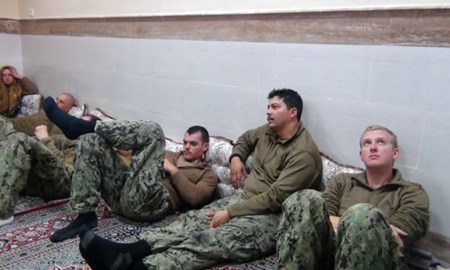
PERSIAN GULF — Following the recent capture and release of two US Navy riverine war vessels by Iran on Tuesday, the Navy has officially rebranded itself as a “Regional Force for Good,” sources report. The Navy backed off from its previous “Global Force For Good” branding earlier this year, replacing it with a series of giant red blobs meant to emphasize “presence.”

“Let’s be honest,” Adm. John Richardson, Chief of Naval Operations said. “The F-35 has sucked our budget dry like one of those Twilight vampires giving a horny teenager an undeath-hickey.”

“We can’t afford to be in more than a couple places at a time, and once we get there, we usually have to fire the skipper and come right home.”

Though the new brand had been under consideration for some time, he contentious “catch and release” of 10 Navy sailors in Iranian waters prompted a rapid decision on it. The Navy has not announced how these sailors let their boats drift into Iranian territory, although some are blaming the Naval Academy’s Celestial Navigation training.

The sailors were released without harm, but Navy officials are scrambling to manage the negative optics of the situation.

“We thought about playing it off as a stunt raising awareness for the ‘Hands Up Don’t Shoot’ initiative,” a Navy public affairs official admitted, “but ultimately we decided to just pull a Blackwater and re-brand instead.”

“We’ve really been a regional force since Clinton anyway,” Richardson added. “‘Global’ set the bar too high, and between scary Chinese island-building and sequestration, we’re just not living up to our advertisements. Regional is definitely more in our comfort zone.”

Secretary of the Navy Ray Mabus revealed another spin during a press conference, remarking that “this historic event with Iran proves that women can be prisoners of war just as well as men can. I look to the Marine Corps to emulate this shining example.”


Re-evaluating the law that benefits the terrorists

January 5, 2016

Re-evaluating the law that benefits the terrorists, Washington Times, Fred Gedrich, January 4, 2015

In the aftermath of Islamic terrorist attacks in Paris and San Bernardino, Calif., U.S. presidential candidate Donald Trump created a political and media firestorm by provocatively suggesting the United States is fighting a “politically correct” war, and since jihadists “don’t care about their lives you have to take out their families.”

Predictably, critics such as Jeb Bush, Rand Paul and others immediately pounced on his comment as a non-serious response or, if implemented, would be tantamount to engaging in international war crimes. Once again, Mr. Trump succeeded in putting a topic on the debate table that needs to be discussed, even though it might have been better if he advocated hitting jihadis when family members are present as opposed to specifically targeting family members.

To be fair, Mr. Trump’s critics should acknowledge that President Obama has already admitted that U.S. drones (the president’s covert program that targets terrorists from afar) have killed civilians, but the United States insists that terrorists themselves are to blame for using family or other civilians as human shields. Also, the United Nations and groups such as Amnesty International, Human Rights Watch and others disagree, stating that current U.S. policy may constitute international war crimes.

Why would Mr. Trump bring up this issue? A recent CNN/ORC Poll offers an answer: 75 percent of those polled say they are unhappy with Mr. Obama’s progress in the war on terror. And it’s clear to many of them that something else needs to be done to deter jihadists.

What should be done? A good start would be for U.S. leaders to acknowledge that jihadists use international law and political correctness as a tactical weapon against the West, and their success is being enhanced by the support of witless enablers in America and elsewhere.

Terror groups like the Islamic State (ISIS), al Qaeda and others know their adversaries fight based on the idea that the rule of law is what separates the civilized world from the barbarians. They have shrewdly and callously exploited civilized rules of warfare to their advantage.

Jihadists’ weapons of choice are improvised explosive devices, suicide bombing attacks, videotaped beheadings, and caged executions by fire and drowning. They seek to inflict as much mutilation, death, destruction and terror on civilian and military targets as possible.

In the regions of the world that bore them, many jihadists are treated as heroes and, shockingly, in many quarters of the civilized world, including the United Nations and some media, they are considered freedom fighters, insurgents or militants — even though, among other things, they disguise themselves as civilians; use willing family members and civilians as human shields; store weapons in hospitals, schools and mosques; and kill, maim and torture with impunity.

When attacked, jihadists respond by claiming the retaliatory violence is misdirected against civilian populations and religious, educational and humanitarian institutions.

If killed, fellow jihadists claim innocent civilians have been killed.

If captured, the terrorists claim they have been denied legal rights as prisoners of war under Geneva Conventions and Protocols.

If questioned by the International Red Cross and Red Crescent, they claim they have been tortured and abused.

The flagrant barbarism of the region would, a reasonable person might think, lead to a quick and general consensus on the need for military action and swift and appropriate justice for the terrorists — but they haven’t. Since his capture in 2003, Sept. 11 accused mass murderer Khalid Sheikh Mohammed still hasn’t stood trial owing to a string of legal wranglings.

The Geneva Conventions and Protocols of 1949 and 1977, behind which the terrorists attempt to hide, are the civilized world’s most recent attempt to control wartime behavior. These rules established, among other things, laws governing the conduct of soldiers and the treatment of prisoners and civilians during conflict.

At the heart of the conventions and protocols are clear distinctions between warring parties (combatants) and civilians (noncombatants). Their chief benefits are to make it easier for combatants to avoid targeting noncombatants and for lawful combatants (soldiers) from being prosecuted for acts of war.

To qualify as a lawful combatant under Article IV of the Geneva Convention, a soldier must:

1. Be commanded by a person responsible for subordinates;

2. Have a fixed distinctive sign recognizable at a distance (a uniform);

3. Carry arms openly;

4. Conduct operations in accordance with laws and customs of war.

Conversely, an unlawful combatant (jihadi) is a fighter who does not conduct operations according to these rules — and arguably is not entitled to Geneva Convention protections. This is the type of combatant the world and humanity currently faces.

It’s beyond time for White House decision-makers and policymakers, and congressional lawmakers and others — instead of reflexively criticizing someone like Mr. Trump — to recognize that this is a battle against stateless, lawless and uncivilized Islamic jihadists who have no regard for the civilized world’s laws of war but are effectively using those laws against it. Action should be taken to debate, re-examine and change those laws, international or otherwise, that impede successful prosecution of this war against Islamic jihadists that threaten Western civilization. The international order and humanity depend on it.

A year of Taliban gains shows that ‘we haven’t delivered,’ top Afghan official says

December 28, 2015

A year of Taliban gains shows that ‘we haven’t delivered,’ top Afghan official says, Washington PostSudarsan Raghavan, December 27, 2015

As the fighting intensifies, the stakes are growing higher for the United States in its longest war. “I will not allow Helmand to fall,” Campbell told the Afghan officials in the recent meeting with the Afghan National Security Council. “But I can’t make you fight. You’ve got to want it more than we do.”

******************************

As the Afghan convoy entered the battered village, Taliban fighters opened fire. U.S.-trained Afghan policemen poured out of their Humvees and began wildly shooting their AK-47 rifles in every direction.

“The enemy is firing one bullet, and you are responding with dozens!” their commander, Col. Khalil Jawad, screamed into his radio in frustration. “Aim, then fire!”

A minute later, the militants melted away. On this day in early December in the southern province of Helmand, they had delivered their message: The Taliban is back, its fighters showing a battle discipline and initiative far superior to the Afghan security forces trained and equipped by the United States.

In private, top Afghan and American officials have begun to voice increasingly grim assessments of the resurgent Taliban threat, most notably in a previously undisclosed transcript of a late-October meeting of the Afghan National Security Council.

“We have not met the people’s expectations. We haven’t delivered,” Abdullah Abdullah, the country’s chief executive, told the high-level gathering. “Our forces lack discipline. They lack rotation opportunities. We haven’t taken care of our own policemen and soldiers. They continue to absorb enormous casualties.”

[Please refer to map here.]

With control of — or a significant presence in — roughly 30 percent of districts across the nation, according to Western and Afghan officials, the Taliban now holds more territory than in any year since 2001, when the puritanical Islamists were ousted from power after the 9/11 attacks. For now, the top American and Afghan priority is preventing Helmand, largely secured by U.S. Marines and British forces in 2012, from again falling to the insurgency.

As of last month, about 7,000 members of the Afghan security forces had been killed this year, with 12,000 injured, a 26 percent increase over the total number of dead and wounded in all of 2014, said a Western official with access to the most recent NATO statistics. Attrition rates are soaring. Deserters and injured Afghan soldiers say they are fighting a more sophisticated and well-armed insurgency than they have seen in years.

As of last month, about 7,000 members of the Afghan security forces had been killed this year, with 12,000 injured, a 26 percent increase over the total number of dead and wounded in all of 2014, said a Western official with access to the most recent NATO statistics. Attrition rates are soaring. Deserters and injured Afghan soldiers say they are fighting a more sophisticated and well-armed insurgency than they have seen in years.

As Afghan security forces struggle, U.S. Special Operations troops are increasingly being deployed into harm’s way to assist their Afghan counterparts. Since Nov. 4, four members of the U.S.-led coalition have been wounded in Helmand, said U.S. Army Col. Michael Lawhorn, a military spokesman. Officially, U.S. military personnel have a mandate only “to train, advise and assist” Afghan forces.

In the confidential October meeting, Gen. John F. Campbell, the commander of U.S. and allied forces in Afghanistan, told his Afghan counterparts that he was as guilty as they were of “just putting our finger in the dike in Helmand.”

But he was highly critical of Afghan security officials for “not managing” their forces in a way that ensured they got enough training, and for allowing “breakdowns in discipline” in the ranks. “The Taliban are not 10 feet tall,” he said. “You have much more equipment than they do. You’re better trained. It’s all about leadership and accountability.”

Campbell vowed “to fix Helmand.”

“I will use more of my SOF and enablers to buy you more space and time,” he said, referring to Special Operations forces. A senior U.S. defense official, speaking on the condition of anonymity because of military rules, said Campbell’s comments represented “an attempt to encourage the Afghans to take action in Helmand province.”

Progress unraveling

Helmand was a key focus in a major American offensive launched in 2010, after President Obama dispatched a “surge” of 30,000 troops to Afghanistan. Marja was the first place Marines launched operations, and by the end of the surge, in late 2012, the Taliban had been subdued in much of its southern heartland.

Now, the fresh concerns over Helmand arrive at the end of a year in which the Taliban and other insurgent groups, including the Islamic State, have steadily advanced, particularly in the north. They have taken advantage of the end of the U.S. and NATO combat mission, which has left a military and political vacuum, forcing Obama to extend the U.S. role by keeping at least 5,500 U.S. troops here after he leaves office.

A Pakistani military operation has also flushed hundreds of well-trained foreign fighters into Afghanistan, bolstering the Taliban and the Islamic State.

Meanwhile, the government is grappling with its own problems. The economy is crippled; high unemployment and corruption remain entrenched, breeding public resentment. Political infighting, policy disputes and leadership woes have deepened inside the administration of President Ashraf Ghani, who shares power with Abdullah, the chief executive. The cabinet remains incomplete, with no defense minister as the security issues become more serious.

The gains by the Taliban have come amid internal divisions and a leadership crisis triggered by the surprise announcement in the summer that its leader, Mohammad Omar, had been dead for more than two years. The contest for power and territory among Taliban factions, rather than weakening the movement, has spawned more uncertainty and violence.

The group’s infighting has blocked efforts by Ghani to bring the Taliban to peace talks. The insurgents’ new leader, Akhtar Mohammad Mansour, appears determined to prove his mettle and strengthen the Taliban’s bargaining position by escalating attacks, Western diplomats and analysts said. In September, the Taliban briefly seized Kunduz, the first city to fall since the demise of its regime, prompting the U.S. military to dispatch Special Operations troops and stage airstrikes to help the Afghan security forces retake control.

Now, the insurgents are on the doorsteps of several provincial capitals, applying more pressure on urban areas than in any year of the conflict. The clashes in Helmand have reflected the Taliban strategy that led to the takeover of Kunduz — seizing surrounding districts before moving in on the provincial capital. Already, the Taliban are in the enclave of Ba­baji, within the borders of Helmand’s capital, Lashkar Gah.

Helmand, which lies along the Pakistani border, is the source of much of the country’s opium, providing lucrative funding for the insurgents, who also collect “taxes” from the marble mining business. The province is home to the Kajaki Dam, which provides electricity to Helmand and to neighboring Kandahar, the cradle of the Taliban. In some districts, electricity bills are paid to the Taliban.

In the Afghan National Security Council meeting, Rahmatullah Nabil, the nation’s intelligence chief, described the province as “the biggest recruiting tool for the Taliban” and its “primary source of revenue.” Nabil resigned Dec. 10 to protest Ghani’s peace overtures to Pakistan, which is viewed with suspicion by most Afghans for its backing of the Taliban.

Losing control of Helmand

The 21-mile-long road from Lashkar Gah to Marja is peppered with craters from bombs planted by the Taliban. Stores are shuttered; villages are silent. The residents have fled.

A mile from a civil-order police base, built by U.S. Marines for $17 million, a charred, mangled Humvee lies in the middle of the highway. A rocket-propelled grenade tore into it, and the Taliban later set it afire. On a recent day, the base was as far as anyone could go, at least by road: Less than a mile ahead, the Taliban had buried more mines.

“They have destroyed bridges. They have burned our houses,” Ghul Mawla Malang, a tribal elder who leads Marja’s Afghan Local Police (ALP), a U.S.-funded pro-government militia, told top police commanders in a meeting at the base.

A few minutes later, the Taliban fired a few rounds toward the base. The senior officials cut short their visit and left in their Humvees.

If there was one province in Afghanistan that the Taliban should have found impenetrable, it was Helmand. The Afghan army has its entire215th Corps based here, numbering more than 18,000 soldiers. There are also thousands of Afghan police officers. Yet a few hundred Taliban fighters managed to overrun parts of Marja and other districts. Soldiers and police officers fled with little resistance or surrendered to the insurgents.

In Babaji, nine police officers including Abdul Qadim Hemat were unprepared last month when the Taliban fighters attacked their outpost. They were running out of ammunition. And reinforcements they had requested never turned up. “I watched seven comrades killed in front of me,” recalled Hemat, who soon fled along with the remaining officer. Both then deserted.

“We were surrounded, but we didn’t get any help,” Hemat said. “I will not shoot one bullet for the government again.”

In parts of Marja, villagers pine for U.S. troops — and the British forces who were once based here — to return.

“When they were here, Marja was as peaceful as this city,” said Ahmed Jan, who was bringing his 13-year-old nephew to a hospital in Lashkar Gah. A bullet had struck the boy in their village during fighting. “Now, the Taliban are like the government in my village. They drive police vehicles and Humvees, and they have raised their white flag over houses.”

A well-equipped enemy

In an interview, Gen. Mohammed Moeen Faqir, the commander of the 215th Corps, said that “only half of a percent” of his force may have deserted and that new recruits were filling the void. He noted that the police and ALP forces in Helmand were also under his command and that “whenever they needed reinforcements, I sent them.”

But the confidential transcript of the minutes from the National Security Council meeting presents a grimmer picture.

The Afghan army’s chief of staff, Gen. Qadam Shah Shaheem, said that limited reinforcements and new recruits couldn’t make up for force attrition in Helmand, according to the transcript, which was provided to The Washington Post by an official concerned by the insecurity in Helmand.

Some 40 percent of Afghan army vehicles in Helmand are broken, Shaheem said. He described a leadership crisis within the security forces, where “clashing personalities exist between the security pillars,” according to the transcript.

The morale of the security forces was low, said Nabil, the intelligence chief, and some soldiers had complained that they had not been home in two years. Junior commanders, he added, were “openly defying their superiors.” Gen. Mohammad Salem Ehsas, the top ALP commander, said that troops were tired and that there was poor coordination among the various security organs.

Campbell said that only about half the troop positions in the 215th Corps were manned. Western and Afghan officials said that was largely because of desertions, high casualty rates and a lack of new recruits.

“The blame game must stop now,” Campbell said. “If I hear one more policeman complain about the army or vice versa, I will pull my advisers immediately. It’s over. You’re Afghans first. Work together.”

Soldiers and police officers on the front lines say they face an enemy that is well trained and equipped with heavy artillery and machine guns, rockets and mortars — and a seemingly endless supply of ammunition. Taliban snipers now have night-vision scopes on their rifles. And as they have overrun bases, the militants have seized an arsenal of U.S. weaponry provided to the Afghans.

Nabil said the insurgents have night-vision goggles and have captured more than 45 Humvees in Helmand. They also have Russian-made ZSU antiaircraft guns with night capability, an abundant supply of mortars and a communications network that is difficult to infiltrate.

Stakes grow higher

U.S. Special Operations troops arrived in early November at an empty school in Chanjar, a front line about 15 miles west of the provincial capital. The walls of the compound bore the impact of shells the size of baseballs. A group of soldiers and police officers was stationed there. Taliban militants were in houses less than 20 yards away.

“The Americans told us that they wanted to push the Taliban back,” recalled Sgt. Abdul Mohamad. “They were here to give coordinates for an airstrike.”

But the Taliban fired a mortar, the men said, wounding one of the Americans. The Americans quickly left the area, in Nad Ali district, with their injured comrade.

Lawhorn, the U.S. military spokesman, confirmed that a U.S. coalition member was injured in the district Nov. 4.

Brig. Gen. Wilson Shoffner, the U.S. military’s top spokesman, said in an interview that U.S. troops were adhering to their limited mandate of “train, advise and assist” and that their Afghan counterparts were taking the lead.

But Afghans, including senior military officials, no longer even pretend that they can fight the Taliban effectively on their own.

“When the foreigners were here, we had plenty of facilities and equipment,” said 1st Lt. Naseer Ahmad Sahel, 30, a civil-order police company commander who was wounded last month in a firefight in Marja. “There were 100 cameras overlooking Marja alone.”

Faqir, the commander of the 215th Corps, said, “We don’t have the air support that we should have.”

As the fighting intensifies, the stakes are growing higher for the United States in its longest war. “I will not allow Helmand to fall,” Campbell told the Afghan officials in the recent meeting with the Afghan National Security Council. “But I can’t make you fight. You’ve got to want it more than we do.”

US-Iranian-Russian-Iraqi offensive launched to recover Ramadi from ISIS

December 22, 2015

US-Iranian-Russian-Iraqi offensive launched to recover Ramadi from ISIS, DEBKAfile, December 22, 2015

Ramadi_Map

Ramadi, the capital of the vast Anbar Province, was the second major Iraqi city to fall to the Islamic State after the devastating loss of Mosul. The importance of the offensive launched Tuesday, Dec. 22 for its recapture from ISIS lies chiefly in the makeup of the assault force, which is unique in contemporary Syrian and Iraqi conflicts.

DEBKAfile’s military sources name its partners as US and Russian army and air force elements, two varieties of Iraqi militia – Shiites under Iranian command and Sunnis, as well as the regular Iraqi army.

The Iraqi army is depicted as leading the assault. But this is only a sop to its lost honor for letting this Sunni city fall in the first place. The real command is in the hands of US Special Operations officers alongside Iraqi troops, and the Russian officers posted at the operational command center they established last month in Baghdad.

This Russian war room is in communication with US military headquarters in the Iraqi capital. It is from the Russian war room that the top commanders of the pro-Iranian militias send their orders. The most prominent is Abu Mahadi al-Muhandis, who heads the largest Iraqi Shiite militia known as the Popular Mobilization Committee.

Noting another first, our military sources disclose that Iranian officers liaise between the Americans and Russians on the front against ISIS. If this combination works for Ramadi, it will not doubt be transposed to the Syrian front and eventually, perhaps next summer, serve as the format for the general offensive the Americans are planning for wresting Mosul from the Islamic State.

When US Defense Secretary Ashton Carter was in Baghdad last week to review the final preparations for the Ramadi operation, US officials were still insisting that the Iraqi army was fit for the heavy lifting after being trained by American instructors.

By Tuesday, US sources were admitting that pro-Iranian militias were also part of the operation.

DEBKAfile’s military sources report on the division of tasks as follows:

Iraqi army forces are attacking the Ramadi city center from the north; Shiite militias from the south. The US air force is pounding ISIS targets inside the town in order to cripple its ability to fight off the oncoming forces. The Russian air force is standing by, ready to destroy any ISIS reinforcements attempting to cross in from Syria to aid their comrades in beleaguered Ramadi.

Experts keeping track of the offensive have no doubt that it will end in success. The jihadists holding Ramadi are few in number – 400-500 fighters at most. However, cleansing the town after victory will presents a daunting difficulty. In Tikrit and the refinery town of Baiji, ISIS split its defense structure into two levels – one on the surface and the second hidden underground.

The top level was thinly manned by fighting strength, but crawling with mines, booby-trapped trucks and IEDs detonated by remote control.

The lower level, consisting of deeply-dug interconnected tunnel systems, was where ISIS fighters hid out and jump out at night for attacks. According to the experience gained in other Iraqi battle arenas against ISIS, neither the Iraqi army nor local Shiite militias have been able to plumb and destroy these tunnel systems. And so they could never really purge the Islamic State from “liberated” towns.

Ramadi will face the same quandary.

The stories we tell ourselves – South China Sea.

November 6, 2015

The stories we tell ourselves, Foreign Policy Situation Report, November 6, 2015

It appeared to be a simple enough story, but over the last week, Pentagon and Obama administration officials have struggled to explain exactly what the USS Lassen did when it sailed near Subi Reef in the South China Sea. FP’s Dan De Luce and Keith Johnson have been following the ship’s wake, and have found conflicting accounts of what the ship was up to. When questioned by FP, “officials offered conflicting accounts as to whether the ship took steps to directly challenge China’s maritime claims in the strategic waterway — or whether it pulled its punches, tacitly conceding Beijing’s position,” they write.

Good idea, bad P.R. You’ll have to read the story to get a full sense of the linguistic knots the Pentagon is tying itself in, but the crux of the issue is that officials originally insisted the Lassen carried out a “freedom of navigation” operation, which could mean the vessel operated sonar, had its helicopters take off from the deck, or lingered in the area. But some officials weren’t ready to go that far, suggesting the ship might have just sailed through quietly without doing any of those things, making the trip an “innocent passage,” which carries with it the recognition of China’s territorial rights over the area. But doing so would undermine the whole point of the mission in the first place. Read the story.

Fair winds. While debate swirls around what to call the Lassen’s trip, the commanding officer of the ship has been telling reporters that the Chinese warships that shadowed his vessel for 10 days were full of nice, talkative people. Speaking aboard the the aircraft carrier USS Theodore Roosevelt during Defense Secretary Ash Carter’s visit this week, Cmdr. Robert Francis said the Chinese “were very cordial the entire time … even before and after the Spratly islands transit.” Finally, “when they left us they said, ‘Hey, we’re not going to be with you anymore. Wish you a pleasant voyage. Hope to see you again’.”