Archive for the ‘Sharia law’ category

Sharia in Denmark

March 22, 2016

Sharia in Denmark, Gatestone InstituteJudith Bergman, March 22, 2016

♦ Documentary filmmakers in Denmark conducted an undercover investigation, with hidden cameras, into claims that imams are working towards keeping parallel societies for Muslims within Denmark.

♦ Abu Bilal, imam of the Grimhøj mosque, told Fatma that her husband is entitled to take another wife. Fatma is not allowed to deny her husband his “sexual rights,” even when he is violent.

♦ The imam of the Hamad Bin Khalifa mosque gave Fatma the same answers she had received in all the other mosques: She must not take a job without her husband’s permission, and even if her husband continues to beat her, she must not contact the police.

♦ Umm Abdullah told Fatma that she should only meet with Danish people in order to tell them about Islam. This is necessary, she said, to save the Danes from hell, and the only reason Muslims should interact with Danes.

The issue of parallel Muslim societies has sparked renewed debate in Denmark after a three-part television documentary, “The Mosques Behind the Veil” was aired at the beginning of March on Danish TV2.

The documentary consists of an undercover investigation into claims that Muslim imams are working towards keeping parallel societies for Muslims within Denmark.

The filmmakers had two young Muslims — brought from outside Denmark — go undercover in Gellerupparken, an area best described as a predominantly Muslim ghetto in Aarhus, Denmark’s second city. For three months, the two lived as a fictitious couple, Fatma and Muhammed, while visiting eight different mosques in Aarhus, Odense and Copenhagen — the three largest cities in Denmark — with hidden cameras. The goal was to hear what imams say behind closed doors about Danish law and authorities, gender equality and general contact with Danish society, such as Muslim women participating in the Danish job market. There are approximately 140 mosques in all of Denmark.

The film is similar in concept to the British BBC Panorama documentary, “Secrets of Britain’s Sharia Councils,” which aired in April 2013. The BBC went undercover to document the discrimination practiced in British sharia councils against Muslim women. (The existence of British sharia councils were no secret to the British; the Danish film, it turned out, documented a Danish sharia council for the first time).

For the purpose of the documentary, Fatma was given a personal cover story — based on real-life dilemmas — for which she would seek advice from the different imams: Her husband is violent, and she does not wish to have sex with him. She cannot get pregnant and his family has found a second wife for him. She consulted with a Danish girlfriend about the violence, which has left her bruised, and the girlfriend told her to go to the police.

What do the imams think she should do?

The series begins in the Grimhøj mosque. The mosque has been in the Danish headlines for years, especially since police statistics in 2013 showed that 22 out of the 27 Muslims from Aarhus who left to fight with Islamic State in Syria had frequented it. The head of the mosque, Oussama El Saadi, has, in fact, said that he hopes the Islamic State will win and that there will be an Islamic world government. The imam of the same mosque, Abu Bilal, was sentenced last year in Germany for inciting hatred against both Jews and non-Jews, and fined €10,000.

1520Abu Bilal, imam of the Grimhøj mosque in Denmark, was fined €10,000 last year in Germany, after being found guilty of inciting hatred against both Jews and non-Jews. (Image source: MEMRI video screenshot)

Fatma, during her visits to the mosque, learned from imam Abu Bilal that married women who commit infidelity should be stoned to death, and that Muslims who leave Islam may be killed. He makes no reservations about these teachings. She also learned that young children who refuse to pray should be beaten (a woman asks the imam specifically, how she should conduct those beatings). Fatma was also informed that a woman may not take a job without her husband’s permission.

Abu Bilal further says that her husband is entitled to take another wife. Fatma is not allowed to deny her husband his “sexual rights,” even when he is violent. When she asks the imam if she should involve the police, the answer is an emphatic “no.”

Officially, the spokesman of the Grimhøj mosque, along with spokesmen from three of the eight mosques, professes that the mosque respects Danish law. But behind closed doors — on hidden camera — he advocates polygamy and beating children. He also instructs Fatma to go back to her abusive spouse and to let him commit what amounts to rape.

Fatma attended three other mosques in Aarhus, one of which publicly claims to be “moderate.” All of the clerics gave her the same answers. Some told her that violence is not allowed, but made it clear that there is nothing she can do. The imam at the Fredens mosque added that she might be able to obtain a divorce, if necessary, from their sharia council.

Muhammed, reporting what he experienced in the mosques, told TV2 news that he had been warned in the mosques against the Danes; informed that they were kuffar (unbelievers), and that he should avoid them and their social functions, such as birthday parties. One imam told the couple that they should “not melt into Danish society,” but simply surround themselves with other Muslims.

In Copenhagen, Fatma consulted the leader of the female section of the Islamisk Trossamfund mosque, Umm Abdullah. The claim at Islamisk Trossamfund is that it is in contact with several thousand Muslims every week, and thus among the biggest mosques in Denmark. Umm Abdullah tells Fatma that she must not go to birthday parties; there would be, she says, alcohol and mixed male and female company — and she should only meet with Danish people in order to tell them about Islam. This is necessary, says Umm Abdullah, to save the Danes from hell, and the only reason why Muslims should interact with Danes. When Fatma asks her about her personal problems, Umm Abdullah tells her that she must not contact the police about the violent husband. “Why should you become a laughing stock in front of the infidels?” she rhetorically asks.

Fatma also went to see the imam at the Hamad Bin Khalifa mosque in Copenhagen, better known in Denmark as “Stormoskeen” [“the big mosque”]. Named after the former emir of Qatar and fully sponsored by him, it opened in 2014. The organization behind the Hamad Bin Khalifa mosque, the Danish Islamic Council, has claimed that the people who operate the mosque have chosen a moderate interpretation of Islam that is compatible with Danish society.

On camera, the spokesman from the Hamad Bin Khalifa mosque confidently assured the journalists from TV2 News that the mosque thoroughly respects Danish laws. He even assured them that women enjoy even better rights than men.

When Fatma spoke to the imam of the Hamad Bin Khalifa mosque, however, and filmed it with a hidden camera, she was given the same answers she had received in all the other mosques: She must not take a job without her husband’s permission, and even if her husband continues to beat her, she must not contact the police. This most “moderate” of all the Danish mosques also advocated polygamy, and the right of the husband to his wife’s body, even when she might prefer to refuse him.

One of the questions Danes are asking themselves after viewing the documentary, is whether Danish Muslims actually listen to the imams and do what they say. According to a poll conducted in October 2015, 40% of all Danish Muslims believe that the law in Denmark should be based solely on the words of the Quran and 77% believe that the Quran should be followed to the word. Ten years ago, the figure was 62%. The poll showed that 50% of all Danish Muslims pray five times a day; ten years ago, the figure was 37%.

While the working assumption has been that with time, Muslims would become less, not more, religious, these numbers fly in the face of the wish that Muslims might be comfortably assimilated into Danish culture.

At the end of the documentary, Fatma and Mohammed visit the sharia council — which, since the documentary aired, has been dismantled, but others are believed to exist — at the Fredens mosque in Aarhus. Here, Fatma pleads over ten times for a divorce from her violent husband, but the council refuses, telling her to go back home and try again.

These were exactly the same responses as those given by the imams of the British sharia councils in the BBC Panorama documentary from 2013. Genuinely abused women pleaded in vain for divorce, and sometimes had to wait for ten years to obtain it. The answers they received from the imam were identical with the answers that Fatma heard from the eight different imams in Denmark: Go back to your violent spouse and try to work it out.

TV2 presented the secret recordings to all the mosques that had been investigated, but the mosques refused to comment on them.

Instead, 31 Danish mosques and Islamic organizations decided to react to the exposure of their goings-on by collectively condemning the way that TV2 had portrayed the Islamic organizations in the documentary. The organizations held the TV station responsible for the “way that it was destroying the integration that the organizations had worked on for the past 30 years in Denmark” and claimed that “Danish Muslims are an integral part of Danish society and play a positive role in integrating Muslims into Danish society.” They also reaffirmed that “Muslims have a right to seek advice about Islam, Islamic rules and Islamic sharia in Denmark.”

The ongoing public debate that has followed the broadcast, shows — unsurprisingly — that neither politicians, opinion makers nor so-called “experts” have any workable plans for how to deal with what the TV documentary revealed. Some have suggested that imams get a special university education or go through a licensing process. Others have suggested closing the Grimhøj mosque — an act that would doubtless be regarded as provocation, and one that would not solve anything in other, similar, mosques. Still other observers have suggested looking more closely at possibilities in the Danish constitution for dealing with the problem. One thing is clear: Denmark is as far away from solving this problem as the rest of Europe — and it is not going to get any easier.

The Democrats’ Soft Spot for Islam

March 21, 2016

The Democrats’ Soft Spot for Islam, Front Page Magazine, Robert Spencer, March 21, 2016

bn

The hard-Left online organ Salon has discovered the secret of Donald Trump’s success: “Islamophobia.” Citing theAmerican National Election Studies 2016 pilot survey, Salon solemnly intones that “Trump supporters are far more likely to express Islamophobic attitudes than other respondents, even other Republicans.” A “stunning 60 percent of Trump supporters” expressed the “Islamophobic” idea that “the word ‘violent’ describes Muslims ‘very’ or ‘extremely’ well.” Salon cannot fathom how anyone could possibly have gotten the idea that Muslims are violent (even including “a bit more than a quarter of Democrats”), and neither can the dominant voices in the Democratic Party. This blind spot regarding jihad terror is nothing less than Democratic Party policy.

Salon demonstrates its myopia about the problem of jihad terror when it notes that “for comparison, only 7 percent of Trump supporters said that the word ‘violent’ describes white people extremely or very well.” “White people”? What about Islamic jihad terrorists who are “white people,” such as al-Qaeda’s late sometime spokesman Adam Gadahn, the Boston Marathon jihad bombers Tamerlan and Dzhokhar Tsarnaev, would-be Wichita airport jihad bomber Terry Lee Loewen, and so many others? Salon doesn’t consider them: for the Left, and for the Democratic Party in particular, concern about jihad terror is just another form of racism, and that’s that. White Muslim jihad terrorists simply don’t exist.

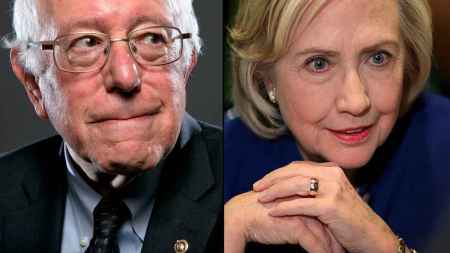
They don’t exist for Bernie Sanders, either. Last October, a Muslim student, Remaz Abdelgader, referred to Ben Carson’s statements about not wanting a Muslim President and said to Sanders: “Being an American is such a strong part of my identity, but I want to create a change in this society. I’m so tired of listening to this rhetoric saying I can’t be president one day, that I should not be in office. It makes me so angry and upset. This is my country.” Sanders replied: “If we stand for anything we have to stand together and end all forms of racism in this country. I will lead that effort as president.”

What race is Islam again? What race is Sharia oppression of women, non-Muslims, gays again? That was what the controversy over Carson’s remarks was really about: he raised a legitimate question about the compatibility of Sharia and the U.S. Constitution. Sharia denies the freedom of speech and the equality of rights of women and non-Muslims before the law, and contravenes the Constitution in other ways as well. In 1960, John Kennedy was subjected to baseless prejudice as a Roman Catholic, and today Sanders and others consigns concerns about a Muslim President to an analogous baseless prejudice. But Kennedy actually addressed concerns, and assured Americans that he would obey and enforce the Constitution and no other law. Nowadays, asking a hypothetical Muslim candidate if he would obey and enforce the Constitution and not Sharia, as far as the leading lights in the Democratic Party are concerned, is “racism.”

So what would happen if a Sharia-compliant Muslim candidate did become President, and began working against the freedoms that the Constitution allows but Sharia does not? Would all those who voted for him simply congratulate themselves on their resistance to “racism” as their freedoms were eroded away?

The likely nominee is no better. Last November, Hillary Clinton tweeted: “Let’s be clear: Islam is not our adversary. Muslims are peaceful and tolerant people and have nothing whatsoever to do with terrorism.” How will President Hillary Clinton have the slightest chance of defeating the Islamic State when she is so divorced from reality as to say something like this? Obviously an uncomfortable number of Muslims do in fact have something to do with terrorism, and the fact that many do not says nothing whatsoever about whether or not Islam contains teachings and exhortations that make all too many Muslims believe that it is actually our adversary.

Both Sanders and Clinton were just playing to the Democratic Party base – the base that is sure that “white people” are just as violent or even more violent than Muslims, and that concern about jihad terror is “racism.” The aptly-named Party of Treason’s refusal to acknowledge the seriousness of the challenge of jihad terror only ensures that, whoever becomes President on January 20, 2017, there will be in the U.S. in the coming years much, much more jihad terror.

Sharia Law or One Law for All?

March 12, 2016

Sharia Law or One Law for All? Gatestone InstituteDenis MacEoin, March 12, 2016

♦ Here is the fulcrum around which so much of the problem turns: the belief that Islamic law has every right to be put into practice in non-Muslim countries, and the insistence that a parallel, if unequal, legal system can function alongside civil and criminal law codes adhered to by a majority of a country’s citizens.

♦ Salafism is a form of Islam that insists on the application of whatever was said or done by Muhammad or his companions, brooking no adaptation to changing times, no recognition of democracy or man-made laws.

♦ The greatest expression of this failure to integrate, indeed a determined refusal to do so, may be found in the roughly 750 Muslim-dominated no-go zones in France, which the police, fire brigades, and other representatives of the social order dare not visit for fear of sparking off riots and attacks. Similar zones now exist in other European countries, notably Sweden and Germany. According to the 2011 British census there are over 100 Muslim enclaves in the country.

As millions of Muslims flow into Europe, some from Syria, others from as far away as Afghanistan or sub-Saharan Africa, several countries are already experiencing high levels of social breakdown. Several articles have chronicled the challenges posed in countries such as Sweden and Germany. Such challenges are socio-economic in nature: how to accommodate such a large influx of migrants; the rising costs of providing then with housing, food, and benefits, and the expenses incurred by increased levels of policing in the face of growing lawlessness in some areas. If migrants continue to enter European Union countries at the current rate, these costs are likely to rise steeply; some countries, such as Hungary, have already seen how greatly counterproductive and self-destructive Europe’s reception of almost anyone who reaches its borders has been.

The immediate impact, however, of these new arrivals is not likely to be a simple challenge, something that may be remedied by increasing restrictions on numbers, deportations of illegal migrants, or building fences. During the past several decades, some European countries ­– notably Britain, France, Germany, Sweden, and Denmark — have received large numbers of Muslim immigrants, most of them through legal channels. According to a Pew report in 2010, there were over 44 million Muslims in Europe overall, a figure expected to rise to over 58 million by 2030.

The migration wave from Muslims countries that began in 2015 is likely to increase these figures by a large margin. In France, citizens of former French colonies in Morocco, Algeria, and some sub-Saharan states, together with migrants from several other Muslim countries in the Middle East and Asia, form a population estimated at several million, but reckoned to be the largest Muslim population in Europe. France is closely followed by Germany – a country now taking in very large numbers of immigrants. There are currently some 5.8 million Muslims in Germany, but this figure is widely expected to rise exponentially over the next five years or more.

The United Kingdom, at around 3 million, has the third largest Muslim population in Europe. Islam today is the second-largest religion in the country. The majority of British Muslims originally came from rural areas in Pakistan (such as Mirpur and Bangladesh’s Sylhet), starting in the 1950s. Over time, many British Muslims have integrated well into the wider population. But in general, integration has proven a serious problem, especially in cities such as Bradford, or parts of London such as Tower Hamlets; and there are signs that, as time passes, assimilation is becoming harder, not easier. A 2007 report by British think tank Policy Exchange, Living Apart Together, revealed that members of the younger generation were more radical and orthodox than their fathers and grandfathers – a reversal almost certainly unprecedented within an immigrant population over three or more generations. The same pattern may be found across Europe and the United States. A visible sign of this desire to stand out from mainstream society is the steady growth in the numbers of young Muslim women wearing niqabs, burqas, and hijabs – formerly merely a tradition, but now apparently seen as an obligatory assertion of Muslim identity.

In Germany, the number of Salafists rose by 25% in the first half of 2015, according to a report from The Clarion Project. Salafism is a form of Islam that insists on the application of whatever was said or done by Muhammad or his companions, brooking no adaptation to changing times, no recognition of democracy or man-made laws. This refusal to adapt has been very well expressed by Iran’s Ayatollah Ruhollah Khomeini:

“Islam is not constrained by time or space, for it is eternal… what Muhammad permitted is permissible until the Day of Resurrection; what he forbade is forbidden until the Day of Resurrection. It is not permissible that his ordinances be superseded, or that his teachings fall into disuse, or that the punishments [he set] be abandoned, or that the taxes he levied be discontinued, or that the defense of Muslims and their lands cease.”

The greatest expression of this failure to integrate, indeed a determined refusal to do so, may be found in the roughly 750 zones urbaines sensibles in France, Muslim-dominated no-go zones, which the police, fire brigades, and other representatives of the social order dare not visit for fear of sparking off riots and attacks. Similar zones now exist in other European countries, notably Sweden and Germany.

In the UK, matters have not reached the pitch where the police and others dare not enter. But in some Muslim-dominated areas, non-Muslims may not be made welcome, especially women dressed “inappropriately.” According to the 2011 British census there are over 100 Muslim enclaves in the country. “The Muslim population exceeds 85% in some parts of Blackburn,” notes the scholar Soeren Kern, “and 70% in a half-dozen wards in Birmingham and Bradford.” There are similarly high figures for many other British cities.

Maajid Nawaz of the anti-extremist Quilliam Foundation has spoken of the growing trend for some radical young Muslims to patrol their streets to impose a strict application of Islamic sharia law on Muslims and non-Muslims alike, in direct breach of British legal standards.

In Britain “Muslims Against the Crusaders” have recently declared an Islamic Emirates Project, in which they are seeking to enforce their brand of sharia in 12 British cities. They have named two London boroughs, Waltham Forest and Tower Hamlets, among their targets. Little surprise then that in these two boroughs hooded “Muslim patrols” have taken to the streets and begun enforcing a strict view of sharia over unsuspecting locals. The “Muslim Patrols” warn that alcohol, “immodest” dress and homosexuality are now banned. To add to these threats, all this is filmed and uploaded onto the internet. Now, in East London, some shops no longer feel free to employ uncovered women or sell alcohol without fear of violent payback.

Nawaz goes on to write: “[T]he Muslim patrols could become a lot more dangerous and, perhaps willing to maim or kill if they are joined by battle-hardened jihadis.” Muslims have been beaten up for smoking during Ramadan; non-Muslims have been forced to leave for carrying alcohol on British streets.

A recent report by Raheem Kassam cites British police officers who admit that they often have to ask permission from Muslim leaders to enter certain areas, and that they are instructed not to travel to work or go into certain places wearing their uniforms.

Here is the fulcrum around which so much of the problem turns: the belief that Islamic law has every right to be put into practice in non-Muslim countries, and the insistence that a parallel, if unequal, legal system can function alongside civil and criminal law codes adhered to by a majority of a country’s citizens. More than one non-Muslim has been ordered to leave “Islamic territory,” and some radicals have attempted to set up “Shariah Controlled Zones,” where only Islamic rules are enforced. Stickers placed on lampposts and other structures declare: “You are entering a Shariah Controlled Zone,” where there can be no alcohol, no gambling, no drugs or smoking, no porn or prostitution, and even no music or concerts.

And that is not all. Soeren Kern wrote in 2011:

A Muslim group in the United Kingdom has launched a campaign to turn twelve British cities – including what it calls “Londonistan” – into independent Islamic states. The so-called Islamic Emirates would function as autonomous enclaves ruled by Islamic Sharia law and operate entirely outside British jurisprudence.

The Islamic Emirates Project, launched by the Muslims Against the Crusades group, names the British cities of Birmingham, Bradford, Derby, Dewsbury, Leeds, Leicester, Liverpool, Luton, Manchester, Sheffield, as well as Waltham Forest in northeast London and Tower Hamlets in East London as territories to be targeted for blanket Sharia rule.

All of this is, of course, illegal. The illegality could not be clearer. Here we see self-appointed disaffected Muslim entities, who take action to exercise the power of imposing law on the streets of European cities, and in practice the writ of Islamic law runs in many towns and cities. Not long ago, considerable numbers of Muslims from Paris and the surrounding region would enter the city and take over entire streets in order to perform the noon Friday prayer. Traffic was blocked, residents could neither enter or leave their homes, businesses had to close because customers could not reach them; and all the while, the police stood by, watching but not interfering, knowing that, if they acted to preserve the law a riot would ensue. Videos of these incidents are available online. In places where gangs of radicals operate as if they are a mafia, crimes such as honor killings, female genital mutilation (FGM), expulsion or worse of individuals considered apostates, and more, are known to take place. More commonly, many Western states are powerless to prevent forced and underage marriages, compulsory veiling, polygamy, and more.

The police, afraid of charges of racism and “Islamophobia,” are reluctant to take action: In 2014 and 2015, the police and social workers turned a blind eye for years to Muslim gangs grooming, prostituting, and raping young white British teenagers in cities such as Oxford, Birmingham,Rochdale and Rotherham. Professor Alexis Jay’s report on the situation in Rotherham alone showed serious failings on the part of several bodies from the police to social services. The offenses in these cases were, of course, a breach of sharia law, not an enforcement of it.[1] Yet there seems to have been an attitude, too, that Muslims are entitled to behave as they wish, and that British law enforcement is irrelevant. In the trial of nine men in Rochdale, Judge Gerald Clifton states in his sentencing that “All of you treated the victims as though they were worthless and beyond any respect – they were not part of your community or religion.” This statement alone seems to illustrate the heart of this problem.

But the clash between Islamic law and national law in several European countries has focussed more than anything on the establishment of sharia councils or sharia courts. These have provoked a wider debate than even Islamic finance, now well situated within the international banking system even though it is as if Germany under the Third Reich had its own banking system in which all transactions would go exclusively to strengthening the Third Reich. In the UK this year, it has been revealed that, in order to finance extensive repairs to the House of Lords and the House of Commons, a deal has been done to use Islamic bonds. One result of this is that peers and MPs will not be allowed to have bars or to consume alcohol on their own premises.

The Sharia court debate has been particularly intense in the United Kingdom, where attempts (some successful) to introduce sharia within the legal system have been made since 2008. Speaking to the London Muslim Council in July of that year, Britain’s leading judge, Lord Chief Justice Phillips, declared that he believed the introduction of sharia into the UK would be beneficial to society, provided it did not breach British law. It is that stipulation which has not been adhered to. Not many months earlier, in February, Rowan Williams, the Archbishop of Canterbury, Britain’s leading churchman — also, as Phillips, with a seat in the House of Lords — expressed the view that it would be appropriate for British Muslims to use sharia. He argued that “giving Islamic law official status in the UK would help achieve social cohesion because some Muslims did not relate to the British legal system.” He went on to say,

“It’s not as if we’re bringing in an alien and rival system; we already have in this country a number of situations in which the internal law of religious communities is recognised by the law of the land … There is a place for finding what would be a constructive accommodation with some aspects of Muslim law, as we already do with some kinds of aspects of other religious law.”

That is where the debate began. Williams’s call for the introduction of sharia was rejected at once by the Prime Minister, Gordon Brown, and by the Conservative peer and shadow minister for community cohesion and social action, Sayeeda Warsi. Warsi, herself a Muslim, argued as follows:

“The archbishop’s comments are unhelpful and may add to the confusion that already exists in our communities … We must ensure that people of all backgrounds and religions are treated equally before the law. Freedom under the law allows respect for some religious practices. But let’s be absolutely clear: all British citizens must be subject to British laws developed through parliament and the courts.”

One year before, however, sharia had already entered the country. An organization called the Muslim Arbitration Tribunal had set itself up on the basis of the 1996 Arbitration Act. It allows individuals and businesses to enter into mutually agreed consultation in which a third party decides between their competing arguments. Mutual agreement is, of course, the central plank on which the legislation is based. Muslim tribunals are limited to financial and property issues. They use sharia standards for intervention, not just between Muslims, but even between non-Muslims who wish to settle disputes using sharia standards. Since 2007, the MAT has opened tribunals in Nuneaton, London, Birmingham, Bradford, and Manchester. They are all considered legal, and their rulings can be confirmed by county courts and the High Court.

Acquiescence to the regularization of sharia within UK legal processes received a major boost for a short time when, in March 2014, the Law Society issued guidance to permit high street solicitors to draw up “sharia compliant” wills, even though these might discriminate against widows, non-Muslims, female heirs, adopted children and others. When the debate grew more heated and the Law Society was severely criticized, some months later it withdrew the guidelines and apologized for having introduced them at all. It was a healthy expression of the way open debate in democratic societies achieves results.

By that time, however, there were around 85 sharia councils operating — most of them openly, some behind the scenes, across the UK. They had all been granted recognition by the establishment. These councils are often confused with the arbitration tribunals, but are, in fact, quite different. A council (sometimes termed a court) functions as a mediation service — also legal in British law. However, the decisions of these councils have no standing under British law. They are usually composed of a small number of elderly men with varying degrees of qualification in Islamic law, and they generally issue advice or fatwas [religious opinions] based on the rulings of one or another of the main schools of Muslim law.

It is these councils that are the greatest cause for concern, especially the limited range of matters on which they issue judgements: marriage, divorce, child custody, and inheritance. In all of these areas, the concerns rest principally on the treatment of Muslim women. Among the leading critics of Sharia on these grounds is one of the most visionary members of Britain’s House of Lords, Baroness Caroline Cox.[2] The first thing she did after her elevation to the peerage was to set off in a 32-ton truck for Communist Poland, Romania, and the Soviet Union, to bring medical supplies behind the Iron Curtain. She was one of the first Western politicians to take the threat of Islamism seriously, setting out her arguments in a 2003 book, The ‘West’, Islam and Islamism. Is ideological Islam compatible with liberal democracy? .

This concern with Islamism and its incompatibility with secular democratic norms focuses especially on the application of sharia law within countries such as the UK, where all citizens are considered to be equal under the law. Speaking about sharia courts in 2011, Baroness Cox declared,

“We cannot sit here complacently in our red and green benches while women are suffering a system which is utterly incompatible with the legal principles upon which this country is founded… If we don’t do something, we are condoning it.”

Recently, she authored a report entitled, A Parallel World: Confronting the abuse of many Muslim women in Britain today, published by the Bow Group. In it, she not only describes the problems faced by many Muslim women before Sharia councils, but provides extensive testimony from women who have been discriminated against and abused by these “courts.”[3]

In May 2012, Baroness Cox introduced her first Arbitration and Mediation Services (Equality) Bill in the House of Lords. The bill had its second reading in October that year, but went no farther. It was backed, however, by a considerable body of evidence presented in a document, Equal and Free?, from the National Secular Society. In June, 2015, Cox introduced a modified version of the bill. It had its second reading in October, and in November it reached the committee stage. It still has to pass a few stages before it may possibly move to the House of Commons, one day perhaps to receive Royal Assent and become law. It received a very warm reception from members of the Lords, with only one dissenting opinion, that of Lord Sheikh, a Muslim peer who sees little or no fault in anything Muslims say or do. However, the government minister, Lord Faulks, argued that current civil legislation is all that is needed to guarantee justice for Muslim women.

Matters are far from as simple as the government would like them to be. Sharia law is not a cut -and-dried system that can be easily blended with Western values and statutes. There is no problem when imams or councils hand out advice on the regulations governing obligatory prayer, fasting, pilgrimage, alms-giving, the appropriateness or inappropriateness of following this or that spiritual tradition, or even whether men and women may sit together in a hall or meet without a chaperone. For pious Muslims, those are things they need to know, and although the advice they may receive on some rulings will differ according to the school of law or the cultural practices of their specific community, that has no bearing whatever on British law.

But much more goes on beneath the surface. One problem is that it is difficult if not impossible to reform sharia. Legal rulings are fossilized within one tradition or another and given permanency because they are deemed to derive from a combination of verses from the Qur’an, the sacred Traditions, or the standard books of fiqh or jurisprudence. It is, therefore, hard to restate laws on just about anything in order to accommodate a need to bring things up-to-date within terms of modern Western human rights values. Many Muslims today may be uncomfortable about the use of jihad as a rallying cry for terrorist organizations such as the Islamic State, but no single scholar or group of scholars is entitled to abolish the long-standing law of jihad. Innovation (bid’a) is tantamount to heresy, and heresy leads to excommunication and hellfire, as has been stated for centuries. The growing influence of Salafi Islam is based precisely on the grounds that any revival of the faith means going back to the practices and words of Muhammad and his companions, not forwards via reform.

In the sharia councils there appears to be no formal method for keeping records of what is said and decided on. There is next to no room for non-Muslims to sit in on proceedings, and, as a result, neither the government nor the legal fraternity has any regular means of monitoring proceedings. Even Machteld Zee, whose forthcoming book, Choosing Sharia? Multiculturalism, Islamic Fundamentalism and British Sharia Councils, will be the first academic analysis of what happens in the councils, only spent two afternoons at a council in Leyton and an afternoon at one in Birmingham. Unannounced spot checks by qualified government-appointed personnel are not permitted. There is nothing remotely like the government schools inspection body, Ofsted, which has periodically (albeit not always correctly) gone into Muslim schools. So there is really no way of knowing just what happens, apart from the testimonies of women who have reported abusive or illegal practices.

Magistrates’ courts, county courts, and crown courts are all entirely transparent (except for matters dealt with in camera), full records are kept, and members of the public are free to visit and observe. The risks of allowing councils to pass judgements without there being an inspectorate to observe them are obvious. And if full records of proceedings are not kept, it will always be difficult to go back to examine a case in full should legal issues arise at a later date.

Furthermore, the British legal system has no say in the appointment of sharia council panels. There appears to be no agreed mechanism for appointments, and the source and identity of candidates remain causes for concern in several ways. There is no single range of qualifications for Muslim scholars (‘ulama) or jurisprudents (fuqaha’). Most will attend some sort of madrassa [Islamic religious school], and many will sit at the feet of a particular sheikh to obtain an ijaza from him: usually this means he is given permission to teach from a book written by that sheikh. Some will finish a course of study, but there may be little coherence. Growing numbers have qualifications from UK-based madrassas, notably from the Darul-Uloom in Bury or the higher standard equivalent in Dewsbury, although there are other Darul-Ulooms in the UK. In London, the junior classes are inspected by Ofsted, others not. Bury and other madrassas belong to the radical Deobandi form of Islam (based in northern India, Pakistan, Bangladesh, and Afghanistan). The Pakistani madrassas from which the Taliban emerged were and are Deobandi in belief. Many Saudi-funded madrassas in Pakistan have been used to recruit for jihad.

The Wahhabi-influenced Deobandis control a majority of mosques in Britain, but they are far from the only group with mosques and other institutions.[4] There are also smaller numbers of Salafi imams and scholars, many of whom come from Saudi-funded madrassas.[5]

This situation grows more complicated when one adds the larger numbers of scholars and jurisprudents emerging from colleges in Pakistan, Bangladesh and India. These tend to be very conservative and still play a major role providing imams and members of Sharia councils.

In sum, these variations in training, qualifications, linguistic abilities, and so on mean that there is no level playing field for expertise, but that there is considerable latitude with regard to the interpretation of sharia law. Very often, scholars with adherence to one branch of Islam will violently disagree with others. It is generally reckoned that sharia councils and Muslim Arbitration Tribunals are conservative, with few advocates for the Universal Declaration of Human Rights in sight.

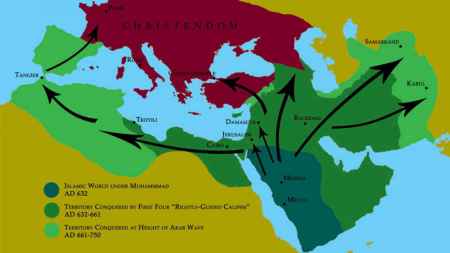
Finally, there is a less-known feature of modern sharia theory that impacts on Europe, North America, and elsewhere in the West. In classical Islamic theory, the world is divided between the Realm of Islam (Dar al-Islam), territories ruled by Islamic governments, and the Realm of War (Dar al-Harb), regions under non-Muslim control. Strictly speaking, a Muslim who finds himself living in a non-Muslim country is obliged to leave it and return to a Muslim state, usually somewhere within a Muslim empire. Strictly speaking, it is proper, even obligatory, for Muslims to live in non-Muslim countries when those countries are under Muslim rule, regardless of the size of the two populations. All the early Islamic empires had a majority of non-Muslims. Muslim expansion and imperialism meant that Muslims controlled territories where, at first, they were not in a majority. These territories were considered as Dar al-Islam. Later, when Muslims were expelled from places such as Portugal and Spain, those countries became Dar al-Harb and in the view of many Muslims, it became necessary to fight them in order to return them to Islam, as is happening with regard to Israel today.

When, in the 19th and 20th centuries, non-Muslim forces took control of Muslim lands, compromises became necessary. However, during the late 20th century and increasingly in the current one, large numbers of Muslims came to live in Western countries. With the 2015 influx of refugees into Europe, Muslims living outside Islamic territories have been faced with dilemmas about the application of sharia, especially where it conflicts with the civil laws of their host countries.

The response of many Muslim scholars has been to develop a new form of Islamic jurisprudence, fiqh al-‘aqaliyyat, “jurisprudence of the minorities.” This began in the 1990s, mostly through the efforts of two Muslim scholars, Shaykh Taha Jabir al-Alwani and Shaykh Yusuf al-Qaradawi. Alwani is president of the Graduate School of Islamic and Social Sciences in Ashburn, Virginia (now part of the Cordoba University), and is the founder and former president of the Fiqh Council of North America, an affiliate of the Islamic Society of North America (ISNA). ISNA itself has, of course, long been identified as a front organization for the hardline Muslim Brotherhood. That connection becomes more visible when one looks at Qatar-based Yusuf al-Qaradawi, one of the leading ideologues of the Muslim Brotherhood. Qaradawi’s television program, al-Sharīʿa wa al-Ḥayāh, attracts an international following of some 60 million, and his comprehensive online fatwa site, Islam Online is consulted by millions.

1507The Muslim scholars Yusuf al-Qaradawi (left) and Taha Jabir al-Alwani (right) developed a new form of Islamic “jurisprudence of the minorities,” which partly concerns whether non-Muslim countries with large Muslim minorities are still considered the “Realm of War”

The principles under which the jurisprudence for minorities operates are somewhat complex. Part of the debate concerns whether non-Muslim countries with large Muslim minorities are still the “Realm of War;” the notion is generally rejected. If Western states are not in a state of war with Islam, then Muslims are not obliged to leave them to seek refuge in an Islamic country. In that event, it is necessary to interpret sharia rulings to make it possible for Muslims to live in territories to which they have migrated, or in which they find themselves for limited periods, as in staying abroad to study. However, adjustments to Western ways do not permit actual change to sharia.

In 1997, the government of Qatar provided funding to establish an institution known as the European Council for Fatwa and Research, based in Dublin, Ireland. The council, whose president is Qaradawi himself, was set up under the auspices of the Federation of Islamic Organizations in Europe, another front for the Muslim Brotherhood, with close associations to the Muslim Brotherhood’s Palestinian branch, Hamas. The ECFR has 32 members, roughly half from European states, the rest from North America, North Africa, and the Gulf. Its fatwas do little to integrate sharia norms within European societies. One fatwa declares:

“Sharia cannot be amended to conform to changing human values and standards; rather, it is the absolute norm to which all human values and conduct must conform; it is the frame to which they must be referred; it is the scale on which they must be weighed.”

The true significance of the ECFR and its international cast of member jurists is that it is an extra-territorial body that passes judgements, provides legal solutions, and adjudicates on all aspects of Islamic law. Its impact on national sharia courts, such as the British Muslim Arbitration Tribunal and the UK Islamic Sharia Council, cannot be calculated easily, but is certain to play an important role. If one reads the fatwas of the ECFR and the many online fatwa sites, it is clear that national sharia bodies in Western countries are operating outside the confines of British, French, and other legal systems. No European or American state can exercise full control over who serves on such councils, who influences them, and which rulings inspire their judgements.

Although the ECFR is the leading fatwa body in Europe, several other national organizations — in France, Germany, and Norway, for example — issue fatwas in other languages. Everywhere, the approach is much the same. Whether through conventional jurisprudence or the jurisprudence of minorities, there seems no clear path to improved assimilation of Muslims into European societies, and no accommodation of sharia law alongside Western, man-made law.

Unless reform enters the thinking of the Muslim clergy, Salafi Islam will continue to beckon Muslims to the past. Under strict sharia, the question remains: what is to become of the growing millions of newcomers for whom Western law codes are of secondary value — for whom they are, perhaps, just an obstacle in the path towards an ultimate goal of total separation from host societies?

In Sharia Law or One Law for All, I drew attention to another level of sharia rulings that provide fatwas for numbers of British Muslims, in particular of the younger generation. These are online sites: “fatwa banks.” Individuals or couples send questions to the muftis who run the sites, and receive answers in the form of fatwas that are considered authoritative. The questions and answers are preserved in galleries of rulings, which can be browsed by anyone seeking advice. The sites are by no means consistent, differing from one scholar to another. But they do provide an insight into the kinds of rulings that may be given in the sharia councils.

For example:

  • a Muslim woman may not marry a non-Muslim man unless he converts to Islam (such a woman’s children will be separated from her until she marries a Muslim man)
  • polygamous marriage (two to four wives) is legal
  • a man may divorce his wife without telling her about it, provided he does not seek to sleep with her
  • a husband has conjugal rights over his wife, and she should normally answer his summons to have sex (but she cannot summon him for that)
  • a woman may not stay with her husband if he leaves Islam
  • non-Muslims may be deprived of their share in an inheritance
  • a divorce does not require witnesses (a man may divorce his wife and send her away even if no one else knows about it)
  • re-marriage requires the wife to marry, have sex with, and be divorced by another man
  • a wife has no property rights in the event of divorce (which may be initiated arbitrarily by her husband)
  • sharia law must override the judgements of British courts
  • rights of child custody may differ from those in UK law
  • taking up residence in a non-Muslim country except for limited reasons is forbidden
  • taking out insurance is prohibited, even if required by law
  • there is no requirement to register a marriage according to the law of the country
  • it is undesirable to rent an apartment belonging to a Christian church
  • a Muslim lawyer has to act contrary to UK law where it contradicts sharia
  • employment by driving a taxi is prohibited
  • it is allowable to be a police officer, provided one is not called upon to do anything contrary to the sharia
  • women are restricted in leaving their homes and driving cars
  • an adult woman may not marry anyone she chooses
  • sharia law of legitimacy contradicts the Legitimacy Act 1976
  • a woman may not leave her home without her husband’s consent (a restriction that may constitute false imprisonment)
  • legal adoption is forbidden
  • a man may coerce his wife to have sex
  • a woman may not retain custody of her child after seven (for a boy) or nine (for a girl)
  • a civil marriage may be considered invalid
  • sharia law takes priority over secular law (for example, a wife may not divorce her husband in a civil court)
  • fighting the Americans and British is a religious duty
  • recommendation of severe punishments for homosexuals
  • a woman’s recourse to fertility treatment is discouraged
  • a woman cannot marry without the presence and permission of a male guardian (wali)
  • if a woman’s ‘idda (three months, to determine whether or not she is pregnant) has expired and she no longer has marital relations with her husband, he is excused alimony payments
  • an illegitimate child may not inherit from his/her father.

Some of these fatwas advise illegal actions and others transgress human rights standards as they are applied by British courts. They show vividly just how questionable it is to permit a parallel system of law within a single national system.

Sharia as the Jihad’s Point of Coordination

February 4, 2016

Sharia as the Jihad’s Point of Coordination, Front Page Magazine, Daniel Greenfield, February 4, 2016

arabwave

Stephen Coughlin has a really important paper out and you should read it all, but I just want to highlight one area.

The three entities (the ummah, dawah and jihadi) do not have to act along formal chains of command to interoperate successfully. This is because they each execute according to their own functional orientation to Islam that reconciles through a common understanding of Islamic law.

And further

To appreciate the strategy, it should be visualized along the lines of the starfish rather than the spider: Cut an appendage from a starfish, and the severed part can grow into a fully functional starfish. Cut off a spider’s head, and all appendages become useless. In terms of command relationships, we in the West tend to think like spiders. While the Soviet Union was a spider; the Islamic Movement, the Muslim Brotherhood, al-Qaeda and ISIS are starfish.

These are very important points that need to be understood to grasp the larger scope of the struggle. Finally…

To say the threat arises out of Islam is to say that it emanates from shariah. Hence, the arrow in the diagram reflects the recognition that the three lines of operation emanate from Islam through a common understanding of shariah. For this reason, shariah also provides a common reference point based on Islamic legal concepts recognized as settled. This doctrinal framework is commonly understood and easily communicated in the Islamic world. For this observation to be valid, one does not have to prove that the underlying Islamic law reflects “true Islam,” or even that most Muslims agree with it.

As I’ve said, read the whole thing, but this needs to be kept in mind, particularly when arguing with the “ISIS is not real Islam” or “Hamas is not real Islam” school of deniers.

The Patience of the Jihadists

January 26, 2016

The Patience of the Jihadists, Amerian ThinkerEileen F. Toplansky, January 26, 2016

The ongoing interpretations concerning natural-born citizenship may eventually become a moot point.  With the burgeoning immigration of groups of people who have little to no devotion to American ideals but who will have children born on American soil, one can easily envision that, in the not so distant-future, an American-born individual schooled in the hatred of jihad could conceivably occupy the White House.

Already the radical Muslim Brotherhood has “built the framework for a political party in America that seeks to turn Muslims into an Islamist voting bloc.”  The U.S. Council of Muslim Organizations (USCMO) aims to elect Islamists in Washington in order to institute sharia law and dismantle the American Constitution.

The Center for Security Policy’s Star Spangled Shariah: The Rise of America’s First Muslim Brotherhood Party is part of its Civilization Jihad Reader Series (Volume 5).  The Center asserts:

[T]he Muslim Brotherhood has been actively infiltrating American government and society since shortly after the Second World War. But March 2014 marked a significant step forward for the Brotherhood in America. Some of its key leadership figures joined together to establish the U.S. Council of Muslim Organizations (USCMO), the first political activist group in this country to be openly associated with the jihadist Muslim Brotherhood. Formation of the USCMO was announced  … [in] March 2014, just blocks from the U.S. Capitol Building. At the podium were: Ousama Jammal, Secretary General USCMO and past President of The Mosque Foundation; Naeem Baig, President, Islamic Circle of North America (ICNA); Nihad Awad, National Executive Director, Council on American-Islamic Relations (CAIR); Mazen Mokhtar, Executive Director, Muslim American Society (MAS); Imam Mahdi Bray, National Director, American Muslim Alliance (AMA)[.] The significance of this move is best understood in the context of what the Muslim Brotherhood itself calls ‘civilizational jihad,’ a term used in its 1991 strategic plan: An Explanatory Memorandum on the General Strategic Goal of the Group in North America. As the Explanatory Memorandum states, the Brotherhood’s mission in America is ‘destroying Western civilization from within,’ preparing the way for its replacement by the rule of Islam’s supremacist code, shariah (Islamic law). Unlike more immediately violent Brotherhood off-shoots – for example, al-Qa’eda, Egyptian Islamic Jihad, the Islamic State or HAMAS, the Brotherhood in the West has generally taken care to operate stealthily, under the radar, even to the point of sometimes denying its very presence in the United States.

And it has been stunningly successful.

Obama continually exhibits a preference for Islam and has, over the period of his two terms, shown a “willingness … to engage in dialogue, outreach, and collaboration with self-identified jihadis.”  In February 2015, at a White House Summit to Counter Violent Extremism, Obama actually said that “the notion that the West was at war with Islam was an ‘ugly lie.'”  Furthermore,  he asserted that “when people feel marginalized, that opens a door for the terrorist ideology.”  He implied that Americans who criticize Islam are guilty of provoking Islamic terrorists.  This, coupled with the disturbing in-depth piece by Soeren Kern entitled “Islam and Islamism in America” for the period January-March 2015 wherein one learns that Representative Andre Carson (D-Indiana), a convert to Islam with extensive ties to the Muslim Brotherhood, was appointed to the House Permanent Select Committee on Intelligence should make one shudder.

Obama’s appeasement toward Iran and his indifference to the jihadist danger in Europe and  America have paved the way to what the jihadists crave – Islamization of America.  Obama is the prelude to this Islamization, since his “fundamentally transforming the United States of America” has helped “advance the Brotherhood’s ‘civilization jihad agenda.'”  For example, Obama stated he was “committed to working with American Muslims to ensure that they could fulfill zakat,” or charitable giving, but conveniently glossed over the fact that this charitable giving requires a fixed percentage to be donated to jihad.

The USCMO is actually the “first religious identity political party” in the history of America.  And while it projects “an image of patriotic transparency,” it is, in fact, “shrouding its actual anti-Constitutional activities and objectives.”  Its members participate in anti-Semitic, pro-Hamas, pro-Muslim Brotherhood demonstrations and raise funds for Islamic Relief USA.  According to Ryan Mauro at the Clarion Project, “IRUSA is the American branch of Islamic Relief Worldwide (IRW), based in the United Kingdom.”  In 2014, the United Arab Emirates banned IRW as a terrorist group.  In fact, under the guise of philanthropy and social welfare, the organization raises funds for Hamas.  Mauro explains that IRUSA “donated to a fundraiser for the Chicago chapter of CAIR in March 2012 and the annual joint MAS-ICNA [Muslim American Society-Islamic Circle of North America] conference in December 2012.”  Yet in 2011, “an anonymous high-ranking Justice Department official was quoted as saying, ‘ten years ago we shut down the Holy Land Foundation. It was the right thing to do. Then the money started going to KindHearts. We shut them down too. Now the money is going through groups like Islamic Relief[.]'”

In 2014, the USCMO joined anti-Israel protesters in downtown Chicago.  This “Stand with Gaza” event marked USCMO’s “first public demonstration in solidarity with Hamas, the Palestinian branch of the Muslim Brotherhood.  Recall that Hamas’ Covenant commits it to the “destruction of the Jewish State of Israel.”

USCMO financially supports U.S. representatives Keith Ellison and Andre Carson.  Their remarks made at the Muslim Brotherhood political party banquet held in June of 2014 have never been made public.  Both of these elected American politicians are committed to “mobilizing the Muslim political machine in the United States.”  Carson has stated that “America will never tap into educational innovation and ingenuity without looking at the model that we have in our madrassas, in our schools, where innovation is encouraged, where the foundation is the Quran.”  Neither Ellison nor Carson has explained why he was participating at a USCMO event in an official capacity.

Is it a coincidence that USCMO debuted in Illinois politics in 2014, considering Obama’s own roots in the windy city?

As the 2016 presidential election looms, the USCMO is attempting to “fortify Muslim citizenship rights.”  Obama is rushing to bestow citizenship on immigrants in part “by adjusting Justice Department rules so that those who want to help with the citizenship process can get their credentials quicker.”  In addition, there is a “blitz of television promotional spots” aimed at enticing legal permanent residents who have been here for a minimum of three years to take the test.

And while it has been clarified that Pine Bush High School in New York did not compel students to say, “I pledge allegiance to the Flag of the United States of America, and to the Republic for which it stands, one Nation under Allah,” this can be taken as yet one more incremental step toward softening American sensibilities – reciting the pledge in any other language still must maintain the truth of the translation, which clearly this did not do.

Daniel Greenfield explains that “[w]hat ISIS accomplishes by brute force, the Muslim Brotherhood does by setting up networks of front groups. Both ISIS and the Brotherhood control large Muslim populations. ISIS conquers populations in failed states. The Muslim Brotherhood however exercises control over populations in the cities of the West. We could bomb Raqqa, but can we bomb Dearborn, Jersey City or Irvine? This is where the Caliphate curve truly reaches its most terrifying potential.”

Moreover, “we are not at war with an organization, but with the idea that Muslims are superior to non-Muslims and are endowed by Allah with the right to rule over them, to rob them, to rape them and enslave them.  ISIS is the most naked expression of this idea.  But it’s an idea that everyone [such as the Muslim Brotherhood and the USCMO] on the Caliphate curve accepts.”

I urge everyone to obtain a copy of Star Spangled Shariah in order to comprehend the depth and breadth of the Muslim Brotherhood’s desire to install sharia law into America.  It is very evident that “the United States of America faces a clear and present danger from the Muslim Brotherhood through the United States Council of Muslim Organizations (USCMO) members because of their shariah compliant agenda that supports and advocates jihad.”

Sharia is a supremacist and totalitarian law that is totally and absolutely incompatible with the Constitution.  It is imperative that Americans understand this difference and demand the passage of American laws for American citizens.  Furthermore, Americans must publicly object to the conversion of churches into mosques.

Ultimately, Americans need to question candidates about their views on Islam and sharia.  The duplicity of the Muslim Brotherhood and the USCMO have to be continually exposed if the Republic is to survive.  This is, indeed, a civilizational conflict between freedom and slavery.


Law chiefs give Crown Court judge permission to rule at SHARIA court

January 10, 2016

Law chiefs give Crown Court judge permission to rule at SHARIA court set up by hardline cleric who led demonstration against Charlie Hebdo, Daily Mail, January 10, 2016

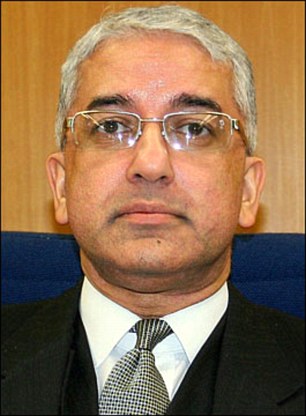
Shria judgeCrown court judge Shamim Qureshi, pictured, is also sitting in the Sharia Muslim Appeals Tribunal

A Muslim Crown Court judge has been granted permission to sit on a ‘Sharia court’ to rule on disputes such as marriage breakdowns in accordance with Islamic principals.

Judge Shamim Qureshi, who ordinarily sits at Bristol Crown Court has been granted permission by judicial authorities to act as the ‘presiding judge’ at the controversial Muslim Arbitration Tribunal (MAT).

The ‘court’ was established in 2007 by hardline cleric Sheikh Faiz-ul-Aqtab Siddiqi, who was a leading figure in protests against Charlie Hebdo magazine after 11 of their journalists were massacred by Muslim extremists.

According to the Telegraph, Home Secretary Theresa May is set to launch an independent review into the MAT following allegations that the Muslim court undermined the rights of women.

Campaigners have claimed the tribunal, which is based in Nuneaton, Warwickshire, is discriminatory towards women and often rules unfairly in favour of men.

According to the tribunal’s website, it specialises in Islamic divorce, inheritance law and Islamic wills, family meditation and mosque dispute resolution.

It was established under the 1996 Arbitration Act on a statutory basis and as a result its decisions can be upheld by English courts.

In 2008,  in its first ruling, MAT decided an inheritance case involving three sisters and two brothers.  in accordance with standard Sharia principles, the male heirs should be given twice as much money as the women.

According to the Telegraph there is no suggestion that Judge Qureshi has been involved in any controversial decisions with the Tribunal.

However, in March 2015 he ordered hardline Christian preacher Mike Overd to pay a £200 fine and pay £250 compensation after the former paratrooper quoted offensive passages from the Bible concerning homosexuality in public.

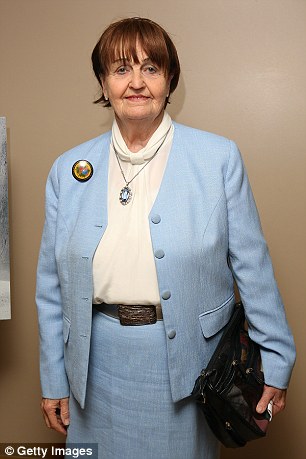
Baronness CoxCross bench peer Baroness Cox, pictured, has introduced private member’s bill to restrict the powers of Sharia courts

Baroness Cox told the House of Lords: ‘The Bill will strengthen the position of vulnerable women who need protection from exploitation. It will ensure that all such women, whatever sect or creed, get the help they need to enjoy full lives.

‘There can be no exceptions to the laws of our land which have been so painfully honed by the struggle for democracy and human rights.’

Baroness Cox said her bill will address a number of major problems in the country including: ‘The suffering of women oppressed by religiously sanctioned gender discrimination in this country; and a rapidly developing alternative quasi-legal system which undermines the fundamental principle of one law for all—a matter of especial significance as we mark the 800th anniversary of the signing of Magna Carta.

‘The Bill is also strongly supported by many organisations concerned with the suffering of vulnerable women, including the Muslim Women’s Advisory Council, Karma Nirvana, Passion for Freedom as well as by the National Secular Society: I am grateful to them all.’

Baroness Cox used an example of a man who wanted a doctor to perform an illegal operation on his wife so he could sell her to a Pakistani man who would marry her and receive a British passport.

She said there are approximately 100,000 Islamic marriages in the UK which are not registered with the civil authorities.

She revealed: ‘A consultant gynaecologist described to me a request from a 63 year- old man for a repair of the hymen of his 23 year-old wife.

‘The gynaecologist refused as this is an illegal operation, whereupon the man became intensely angry, claiming that doctors in his town, not far from London, frequently undertake this operation under another name.

‘He wanted this surgical procedure for his wife in order to take her back to their country of origin to marry another man. Her next husband could then obtain a visa to enter the UK. He would probably abuse and then divorce his wife and marry another or more wives here.

‘The man who asked for this operation said that he earned about £10,000 for effecting this arrangement, which was very helpful as he was unemployed. Such shocking cases surely cannot be allowed to continue.

‘The rights of Muslim women and the rule of the law of our land must be upheld.’


What is Sharia?

January 7, 2016

What is Sharia? What is the Threat, January 7, 2016

sharia-300x225

Earlier this week, UTT published the first in a series of articles about sharia (Islamic law) entitled “Understanding the Threat” which amplified the fact that sharia is the focal point and driving force behind everything jihadis across the globe are doing.

Today, we will breakdown what sharia actually is and its origins.

All Islamic sources define Islam as a “complete way of life governed by sharia.”

According to the most widely used text book in Islamic junior high schools in the United States (What Islam is All About), “The Shari’ah is the ideal path for us to follow.”

There are two sources of sharia:  the Koran and the Sunnah.

Islam is the system of life under sharia.  Those who submit to Islam and the sharia are called “Muslims.”

The Koran (also Quran or Qur’an)

According to Islam, the Koran is the “uncreated word of Allah,” who is the Islamic god, and the contents of the Koran were revealed to the Prophet Mohammad between the years 610 A.D. and 632 A.D. in the Arabian peninsula through an angel.  The Koran has 114 chapters or “suras” which are arranged in no particular order.  They are generally arranged by size from largest to smallest.  However, the first chapter is approximately the smallest, and the sizes of the chapter vary so this is not a perfect rule.

The Islamic scholars have authoritatively listed the chapters of the Koran in chronological order.  This is very important because Allah said in the Koran (2:106, 16:101) that whatever comes chronologically last overrules anything that comes before it.  This is called “abrogation.”  Allah revealed his message to Mohammad progressively over time.  By the time it was all revealed, what came last was the most important and overrules anything that was said earlier.

“It is a Qur’an which We have divided into parts from time to time, in order that though mightest recite it to men at intervals: We have Revealed it by stages.” (Koran 17:106)

So, for instance “Let there be no compulsion in religion” (Koran 2:256) is overruled or abrogated by “Whoever seeks a religion other than Islam will never have it accepted of him” (Koran 3:85) which is why we get “Take not the Jews and the Christians as your friends…” (Koran 5:51).  Chapter 5 in the Koran is the last chronologically to speak about relations between Muslim and non-Muslims.

Chapter 9 is the last to discuss jihad.

“Fight and slay the unbeliever wherever you find them, capture and besiege them,  and lie in wait for them in each and every ambush (strategem of war).” (Koran 9:5)

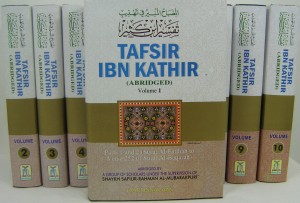
Furthermore, every verse in the Koran has been legally defined in the Tafsir.  The most authoritative Tafsir scholar in Islam is a man named Ibn Kathir.  For instance, the Tafsir defines a portion of verse 9:5 above as follows:  “This is the Ayah (verse) of the sword…’and capture them’ (means) executing some and keeping some as prisoners…’and besiege them, and lie in wait for them in each and every ambush’ (means) do not wait until you find them.  Rather, seek and besiege them in their areas and forts, gather intelligence about them in the various roads and fairways so that what is made wide looks ever smaller to them.  This way, they will have no choice, but to die or embrace Islam.”  (Tafsir Ibn Kathir, Vol 4, pages 375-376)

tafsir-300x203

The Tafsir is taught at mosques in the United States on a regular basis.  There is no such thing in Islam as a “personal interpretation” of a particular verse of the Koran.

The Sunnah

The Sunnah is the example of the Prophet Mohammad who is considered the al Insan al Kamil in Islam – the most perfect example of a man.  If Mohammad did it or said it, it is an example for all Muslims to follow for all time.

His words and deeds are recorded in the authoritative biographies (Sira) and the collection of the Hadith or stories about him. In Islam there are many Hadith scholars, but the most authoritative are by men named Bukhari and Muslim.

The Prophet said, “The hour of judgment will not come until the Muslims fight the Jews and kill them. It will not come until the Jew hides behind rocks and trees. It will not come until the rocks or the trees say, ‘O Muslim! O servant of God! There is a Jew behind me. Come and kill him.”  Al-Bukhari: 103/6, number 2926. Volume: Jihad; Chapter: Fighting the Jews

The above quote from Mohammad is doctrine in Islam.  Mohammad said it and it is authoritatively recorded by Bukhari, the most authoritative hadith scholar in all of Islam.  This is why the above quote is not only in the Hamas Covenant, it is taught at the first grade level in Islamic schools.

Example:  Why is it okay for a 60 year old Muslim man to marry an 8 year old girl?  Because Mohammad married Aisha when she was six (6) years old and consummated the relationship when she was nine (9). Mohammad is the perfect example, therefore, it is a capital crime in Islam to suggest this is wrong behavior.

The Koran, as understood with the Koranic concept of abrogation, and the Sunnah form the “Sharia” or the way for all Muslims to follow. This is a totalitarian legal system and cannot be altered or amended because it comes from Allah and was exemplified by the actions and words of Mohammad.  Therefore, when it comes to the definition of jihad, the obligation of jihad, the law of jihad, the obligation of the Caliphate (Islamic State), the rules under the Caliph, and relations between Muslims and non-Muslims, there is no disagreement among any of the scholars.

If Allah said it chronologically last in the Koran, Mohammad said it, and Mohammad did it, how could there be a legal “gray area” in sharia?

  1. “Fight and slay the unbeliever wherever you find them, capture and besiege them,  and lie in wait for them in each and every ambush (strategem of war).” (Koran 9:5)
  2. Mohammad said:  “I have been commanded to fight people until they testify that there is no god but Allah and that Mohammad is the Messenger of Allah.”  Hadith reported by Bukhari and Muslim
  3. Mohammad went out and fought many battles against non-Muslims until they converted to Islam or submitted to Islam.  Those who did neither were killed.

Any questions?

Can the Dubai Model Inspire Arabs?

January 1, 2016

Can the Dubai Model Inspire Arabs? Daniel Pipes Organization, Daniel Pipes, December 31, 2015

(As Paul Harvey frequently said, here’s the rest of the story. Dubai may well be a model, but not a good one.– DM)


DUBAI – At a time of civil war, anarchy, extremism, and impoverishment in the Middle East, the city-states of Dubai and Abu Dhabi stand out as the places where Arabic speakers are flourishing, innovating, and offering a model for moving forward.

But can it last? I recently visited the United Arab Emirates to seek answers.

To begin with, some basic facts: Once called the Trucial States by British imperialists, the UAE consists of seven small monarchies bordering the Persian Gulf. They banded together in 1971, as the British retreated, to form a single federation.

The country has been doubly blessed: oil and gas abundance along with a smart and commercially-minded group of leaders. The former gives the country immense resources, the latter keeps it out of harm’s way, free of ideological extremism, with a focus on the economy. The result looks and feels like a basically happy place, especially as the lot of immigrant laborers is improving.

To me, perhaps the UAE’s most noteworthy feature is the entrepôt quality of Dubai, which resembles a Middle Eastern version of Hong Kong. I was also impressed by the innovative religious spirit (where else does one find prayer rooms separated by gender?) and the cultural playfulness (building condos that resemble Yemeni-style high-rises, wearing traditional clothing one day and Western style the next).

But count the ways the country stands vulnerable:

Demographics: Due to phenomenal growth in immigration, the UAE population has a doubled to nearly 10 million in about nine years, making it much larger than neighboring states such as Oman and Kuwait. Only about one of nine residents are nationals; the other eight are expatriates, with 55 percent coming from South Asia. While currently quiescent, one can imagine their discontent and rebelliousness should the good times end.

Economy: Thanks to fracking, the Chinese economic slow-down, and other factors, UAE oil revenue has gone down from US$75 billion to $48 billion since 2010. Even in a country with about a trillion U.S. dollars of reserves, this trend causes pain, especially if it continues for many years.

3325

Environmental: Dubai has the amazing statistic of desalinating 98.8 percent of its water even as the UAE has the highest per-capita consumption of water in the world. Obviously, this makes the country extraordinarily susceptible to hydrological crisis.

Regional: Nestled about 400 miles from Iraq, 100 miles from Iran, and sharing a border with Saudi Arabia, UAE could be invaded, occupied, and annexed as readily as Kuwait was by Saddam Hussein’s Iraq 25 years ago. Not to be forgotten: on the eve of independence in 1971, the shah of Iran seized three UAE islands.

Sunni Islamism: Although the authorities have firmly kept domestic extremists under control, they remain in place, biding their time, waiting for an opportunity to lash out.

Intensely aware of these dangers, the rulers have adopted two intelligent strategies. One links the country to the outside world via sports events (I was in town during a Formula 1 car race),cultural connections (I attended a talk atNew York University’s Abu Dhabi campus), tourism (see my selfie atop the world’s highest building), and international organizations (the International Renewable Energy Agency, or IRENA, recently opened its doors in Abu Dhabi). In combination, these activities send a signal that the UAE is not just a spoiled, self-indulgent artifice but a place with aspirations to contribute as well as consume, that it deserves support.

The second is to master the fine art of compromise. In foreign policy, this means not adopting the Saudis’ total anti-Iran focus or the Egyptians’ total anti-Muslim Brotherhood focus, but balancing the two. It also means accepting an Israeli mission to IRENA but insisting on it not having a larger significance.

In domestic policy, compromise means allowing liquor stores to function but hiding them away under false names and requiring a permit from the police to purchase booze. It also means signs in hotels that permit bikinis but prohibit public displays of affection.

3327Once you can find it, this Abu Dhabi liquor store, High Spirits, is well stocked.

At a time of civil wars in Libya, Yemen, Syria, and Iraq, of Islamist rule in Turkey and Iran, and of looming catastrophe in Egypt, Jordan, and Pakistan, the small, privileged emirates offer a way forward based on globalization and compromise. Will others pay them heed? Will they survive the many dangers ahead?

I hope so, for the UAE offers a path ahead to a region badly needing just that.

Mr. Pipes (DanielPipes.org, @DanielPipes) is president of the Middle East Forum. © 2015 by Daniel Pipes. All rights reserved.

“To Be or Not To Be: What ‘Muslim’ Actually Means

December 30, 2015

“To Be or Not To Be: What ‘Muslim’ Actually Means, Center for Security PolicyClare M. Lopez, December 30, 2015

The entire debate about what it means to be “Muslim” and shariah-compliant might be solved with a quick lesson in Arabic grammar.

This is because the word “Muslim” contains in its Arabic meaning its own definition.

You see, the word “Muslim” in Arabic has two parts: the “Mu” prefix and the triliteral root that forms the word “Islam.” That root word, “Islam,” is a verbal noun that means “submission.” When an “Mu” prefix is attached to such a root in Arabic, the resulting noun means “a person who does the thing that root word denotes.”

Therefore, with “Islam” being a verbal noun meaning submission, “Muslim” therefore means “one who submits.” Submits to what? To Allah’s will, which is shariah. Islamic Law. Thus, anyone who presents as a Muslim is by definition shariah-adherent, because that’s what the word itself actually means. If someone claims to be a Muslim, or converts to Islam, or was born into Islam but does not apostatize or separate from it, then it is reasonable to conclude that such a person is shariah-compliant—at a minimum, tacitly—unless and until told otherwise. And the converse must also be true: one who does not submit to shariah, one who does not adhere to shariah, does not meet the linguistic definition of “Muslim.”

As for “shariah,” which is defined and understood by the Islamic scholars to be an all-encompassing, legal-military doctrinal system that features some religious beliefs, it is binding for Muslims, even as the word “Muslim” dictates. Although shariah includes a multitude of obligations, among which many are innocuous (to believe in the oneness of Allah; to pray five times per day; to avoid eating pork, etc.), jihad as warfare to spread Islam is also a core, compelling obligation. All who are Muslim by birth or conversion are obligated to actively support the establishment of a universal governmental system (Caliphate/Imamate) based on shariah and the replacement by means of jihad of any political system not governed by shariah.

It is this commandment to Islamic supremacism that is most problematic for non-Muslims and responsible for much of the debate about what exactly “being Muslim” means. But if we realize that the answer lies in the etymology of the Arabic word “Muslim” itself, then it will be understood that unless and until that identity as “one who submits” is abjured by the individual in question, the person is accorded full credit for living a shariah-adherent life.

Jews Denied Security Clearance While Huma Infiltrates the Government

December 24, 2015

Jews Denied Security Clearance While Huma Infiltrates the Government, Front Page MagazineJoseph Klein, December 24, 2015

(This has nothing to do with Islam or Obama? Please see also, The United States and Islam: What Is Going On? — — DM)

huma_abedins_muslim_brotherhood_ties

The Obama administration’s anti-Israel sentiment knows no bounds. The latest example involves the denial of a security clearance to a Jewish-American dentist, Dr. Gershon Pincus, on the grounds that he has “divided loyalties.” All that Dr. Pincus wanted to do was to use the experience and skills he had gained over a lifetime of private practice to give back to his country – the United States of America. He wanted to serve American troops as a dentist at an off-base U.S. Navy clinic. Nothing doing, decided the Obama administration after a second security investigation of the dentist. Using a McCarthyite guilt by association rationale, the dentist was disqualified because of his close family ties in Israel and the possible contact of his family members with their Israeli neighbors. 

Dr. Pincus’s original security investigation had reached a positive conclusion: “There is nothing in subject’s background or character that would make him vulnerable to blackmail, extortion, coercion or duress.” That should have ended the matter. After all, Dr. Pincus was not applying for a sensitive job in the Department of Defense or the CIA. He was simply seeking to provide dental services at an off-base U.S. Naval clinic.

However, the Obama administration was not through investigating Dr. Pincus. It ordered a second investigation, conducted this time by a contract investigator sent by the Office of Personnel Management. The bill of particulars resulting from this second investigation are set out in the “Statement of Reasons” for denying Dr. Pincus’s request for security clearance. They included such shocking details as the fact that the dentist’s ailing mother now lives in Israel along with his brother and sister. He sends money to his mother to help her pay her rent. He calls his family members and has even visited Israel three times in the last eight years for his father’s funeral, his niece’s wedding and to see his mother. Dr. Pincus’s deceased son was a dual citizen of the U.S. and Israel and also served for six months in the Israeli Army.

“Foreign contacts and interests may be a security concern due to divided loyalties or financial foreign interests,” quoted the Statement of Reasons from the federal government’s Adjudicative Guideline B – Foreign Influence. They “may be manipulated or induced to help a foreign person, group, organization, or government in a way that is not in U.S. interests, or is vulnerable to pressure or coercion by any foreign interests.”

Just regurgitating this expression of security concerns from the Guideline is meaningless without considering the context in which it is supposed to be applied. Guideline B lists a number of mitigating circumstances that investigators are expected to take into account, among which are whether “the nature of the relationships with foreign persons, the country in which these persons are located, or the positions or activities of those persons in that country are such that it is unlikely the individual will be placed in a position of having to choose between the interests of a foreign individual, group, organization, or government and the interests of the U.S.”

In Dr. Pincus’s case, the Statement of Reasons explaining the decision to deny his security clearance does not point to any security risk posed by the dentist himself or his relatives living in Israel. There is not a single shred of evidence cited, including any questionable statements or associations, which calls into question the loyalty of Dr. Pincus’s family members to the United States.  Nor are any activities referenced that could pose a conflict of interest for Dr. Pincus in serving as a dentist at the Navy clinic. The dentist’s son who had served in the Israeli army is no longer alive. His mother is ailing. His brother does not want to become an Israeli citizen. His sister does hold dual citizenship, but there is nothing to indicate that she is in a position of influence in Israel that would force Dr. Pincus to have to choose between Israel’s interests and the interests of the United States, assuming there were even a circumstance in which his dental activities and access to the Navy clinic could cause a problem.

Moreover, the Statement of Reasons admits that Dr. Pincus himself has “no intentions of moving to Israel, or obtaining Israeli citizenship.” Nevertheless, the second investigation led to his disqualification.

This disgraceful decision was not an isolated occurrence. Although subject to an appeal, there is not much cause for optimism that it will be reversed. A Wall Street Journal Op Ed by Bret Stephens reported that “there have been a total of 58 cases in which Israeli ties were a significant factor in the decision. Of these, 36 applicants—an astonishing 62% of the total—lost their appeals and had their clearance applications denied.”

Contrast the arbitrary, discriminatory treatment of a Jewish American dentist who has family ties to Israel with a Muslim American who has family ties to Saudi Arabia and the Muslim Brotherhood.  The latter, Huma Abedin, was allowed to serve in the Obama State Department and remains a close confidante of Hillary Clinton.

Obama’s Office of Personnel Management and State Department evidently did not consider Ms. Abedin a security risk for a much more sensitive job than serving as a dentist at an off-base Navy clinic, despite the following undisputed facts:

1. Although born in the United States, Huma Abedin grew up in Saudi Arabia, where her parents were recruited by Abdullah Omar Naseef (a jihadist affiliated with al-Qaeda and the Muslim World League) to establish an organization known as the Institute of Muslim Minority Affairs (IMMA). The principle underlying the notion of Muslim Minority Affairs is to discourage assimilation of Muslim minority populations into the culture and society of their host non-Muslim majority countries. Such separatism would enable the Muslim minority population to grow over time and expand the influence of sharia law in their host countries.

2. Huma Abedin returned to the United States from Saudi Arabia to attend George Washington University, where she was an executive board member of George Washington University’s Muslim Brotherhood-affiliated Muslim Students Association.

3. Huma’s late father founded IMMA’s Journal of Muslim Minority Affairs, now run by Abedin’s mother, Saleha Mahmood Abedin.  Saleha Abedin is a sociologist with ties to numerous jihadist organizations, including the Muslim Brotherhood. She has directed the Jordan-based International Islamic Committee for Woman and Child (IICWC), which supports the implementation of strict sharia law. Saleha Abedin still lives in Saudi Arabia.

4. Huma Abedin served as an assistant editor for the Journal of Muslim Minority Affairs for twelve years, leaving shortly before she joined the State Department in 2009. The first seven of the years in which Huma was an assistant editor overlapped with the al-Qaeda-affiliated Naseef’s active presence at IMMA, including one year in which Huma and Naseef served together on the editorial board of the journal.

5. Huma Abedin did not distance herself from her mother, despite her mother’s jihadist views that place sharia law over man-made law and self-governance. In fact, Huma Abedin introduced Hillary Clinton to her mother during a visit to Saudi Arabia, while Hillary was serving as Secretary of State.

In short, Huma Abedin has a family connection to Saudi Arabia, the source of the Wahhabi jihadist ideology and the country where fifteen of the nineteen 9/11 hijackers came from. She grew up there. Huma’s mother is a well-known jihadist in Saudi Arabia still active in pushing a sharia law agenda that is antithetical in material respects to the Constitution of the United States and American values. Dr. Gershon Pincus has a mother, brother and sister living in Israel, which, at least prior to the Obama administration, has been our closest ally in the Middle East. His mother has dementia and neither she, nor Dr. Pincus’s siblings, have expressed any ideology incompatible with the U.S. Constitution or American values.

Yet Huma Abedin, a self-proclaimed “proud Muslim,” slid through her security screening to a highly sensitive job at the State Department and is now a key adviser to the leading Democratic candidate for president. No such luck for Dr. Pincus, who just wanted to take care of the dental needs of some Navy personnel. If this isn’t an example of blatant discrimination against American Jews with family members living in Israel, then pray tell what is?