Archive for the ‘Saudi Arabia’ category

Saudi Arabia Sentences Poet To Death For Being An Atheist and Insulting The Country

November 23, 2015

Saudi Arabia Sentences Poet To Death For Being An Atheist and Insulting The Country, Jonathan Turley, November 23, 2015

(A fitting “tribute” to Saudi Arabia, esteemed American ally and head of the UN Human Rights Council panel that “selects top officials who shape international human rights standards and report[s] on violations worldwide.” — DM)

Our (legitimate) criticisms of Iran seem deeply hypocritical when our close ally in Saudi Arabia continues to apply equally extreme applications of Islamic law and authoritarian practices. Indeed, it is hard to distinguish between the killing of homosexuals and artists by ISIS from such cases in Saudi Arabia beyond the rather laughable pretense of one of these Sharia “courts.”

***************************

We have long discussed our close alliance with Saudi Arabia despite that country’s denial of the most fundamental human rights for women, non-Muslims, journalists, and political dissidents. While the State Department continues to vaguely reference “reforms” in the Kingdom, the Saudi Sharia courts and religious police continue to generate shocking medieval cases where people are flogged or executed for exercising free thought or associations. The latest outrage is the death sentence given Ashraf Fayadh, a Palestinian poet and leading member of Saudi Arabia’s contemporary art scene. He has been sentenced to death for renouncing Islam, being an atheist (which he denies) and insulting Saudi Arabia. Many view his real offense as being his embarrassment of the infamous religious police (mutaween) in Abha after he posted a video of their lashing a man in public. As is often the case in the pseudo, “courts” of Saudi Arabia, he was denied counsel and any real opportunity to present a defense.

Fayadh, 35, was also accused of illicit relations with women due to photos on his phone, which he explained were actually taken during art events. Fayadh (who was born in Saudi Arabia) has been a member of the British-Saudi art organisation Edge of Arabia and represents the population of educated Saudis who want to see their country shed the religious ignorance, medieval practices and Sharia punishments that have long characterized the country. He was originally sentenced to four years in prison and 800 lashes by a court in Abha in May 2014. However, he was then retried by a new panel of judges that found that he could be put to death instead. He was unable to get a lawyer because the religious practice took his ID.

His supporters say that he was fingered by man who had a personal dispute over the appearance of contemporary art at a cafe in Abha. The man went to the religious police and said that he had cursed Muhammad, insulted the country, and promoted atheism in his book. The book, Instructions Within, published in 2008, is actually about his being a Palestinian refugee but in Saudi Arabia any example of free or creative thought is often seen as dangerous and blasphemous.

Of course, it is an outrage for the Saudis to continue to execute people who are atheists or viewed as guilty of apostasy. The Kingdom also bars any other religion from have a house of worship in the country. This is the same country that has sought to create an international blasphemy standard and has objected to any perceived slight against Islam in other countries.

Fayadh insisted that he is a faithful Muslim and repented any sins, but it did not matter.

Our (legitimate) criticisms of Iran seem deeply hypocritical when our close ally in Saudi Arabia continues to apply equally extreme applications of Islamic law and authoritarian practices. Indeed, it is hard to distinguish between the killing of homosexuals and artists by ISIS from such cases in Saudi Arabia beyond the rather laughable pretense of one of these Sharia “courts.” I have met very modern and educated Saudis who are ashamed of these abuses and want reform. However, the Kingdom continues to maintain a close alliance the Wahabi clerics in the imposition of extreme forms of Islamic law. It makes the work of women, journalists, and artists like Fayadh all the more inspirational when they face the threat of not only arrest by Saudi religious police but actual death at the hands of these grotesque Sharia courts.

Islam — Radical, Extremist and Mainstream

November 21, 2015

Islam — Radical, Extremist and Mainstream, Dan Miller’s Blog, November 21, 2015

(The views expressed in this article are mine and do not necessarily reflect those of Warsclerotic or its other editors. — DM

In largely secular western societies, Islam and its history are viewed by many non-Muslims as substantially irrelevant to how devout Muslims behave. Perhaps the view that religion is of little importance to devout Muslims is based on the role, minor if any, that religion and religious history play in their own secular lives. However, both Islamic teachings and history give devout Muslims their grounding in Islam and teach them that Islam is the religion of war, not peace: Islam must become the world’s only religion by extirpating all others.

Islam was founded by Mohamed ( c. 570 CE – 8 June 632 CE) in the sixth century. Mohamed

is considered, almost universally,[n 2] by Muslims to have been the last prophet sent by God to mankind[3][n 3] to restore Islam, which they believe to be the unaltered original monotheistic faith of Adam, Abraham, Moses, Jesus, and other prophets.[4][5][6][7] [Emphasis added.]

Islam considers the words of Mohamed, as transcribed in the “Holy” Quran and Hadith, to be the words of Allah. “Restoring” other monotheistic religions means changing them to comport with Islam as dictated to Mohamed by Allah; unaltered, those other religions cannot continue to exist; it is the duty of Muslims to force them to change or to exterminate them.

Islam provides the basis for Sunni and Shiite (principal branches of Islam) efforts to govern world civilization according to Islamic principles as voiced by Allah through his prophet, Mohamed. Since Islamic principles tolerate no religious or political freedoms (let alone contemporary gender equality or homosexuality notions), such western ideas must be extirpated — as they have been in Saudi Arabia (now the head of the UN Human Rights Council) and Iran. Islamic principles are also manifested by the hopes and efforts of the Islamic State (Sunni, like Saudi Arabia) and the Islamic Republic of Iran (Shiite) to achieve their own caliphates.

Sheikh Muhammad Abdullah Nasr is a scholar of Islamic law and a graduate of Egypt’s Al Azhar University — regularly touted as the world’s most prestigious Islamic university. Al Azhar University co-hosted Obama’s 2009 “New Beginnings” address in Cairo, to which Obama insisted that at least ten members of the Muslim Brotherhood be invited. According to an article at Jihad Watch,

After being asked why Al Azhar, which is in the habit of denouncing secular thinkers as un-Islamic, refuses to denounce the Islamic State as un-Islamic, Sheikh Nasr said:

It can’t [condemn the Islamic State as un-Islamic].  The Islamic State is a byproduct of Al Azhar’s programs.  So can Al Azhar denounce itself as un-Islamic?  Al Azhar says there must be a caliphate and that it is an obligation for the Muslim world [to establish it].  Al Azhar teaches the law of apostasy and killing the apostate.  Al Azhar is hostile towards religious minorities, and teaches things like not building churches, etc.  Al Azhar upholds the institution of jizya [extracting tribute from religious minorities].  Al Azhar teaches stoning people.  So can Al Azhar denounce itself as un-Islamic? [Emphasis added.]

Nasr joins a growing chorus of critics of Al Azhar.  Last September, while discussing how the Islamic State burns some of its victims alive—most notoriously, a Jordanian pilot—Egyptian journalist Yusuf al-Husayni remarked on his satellite program that “The Islamic State is only doing what Al Azhar teaches… and the simplest example is Ibn Kathir’s Beginning and End.”

Since the world’s preeminent Islamic university teaches Islam as proclaimed by the Islamic State, how can non-Muslims claim that the Islamic State is not Islamic? Why do many, even conservatives, refer to the Islamic State and its allied Islamic terror groups as “radical” or “extremist?”

Martin Luther was “radical” and “extreme” because he tried to reform aspects of Roman Catholicism which he deemed malign.

He strongly disputed the claim that freedom from God’s punishment for sin could be purchased with money. He confronted indulgence salesman Johann Tetzel, a Dominican friar, with his Ninety-Five Theses in 1517. His refusal to retract all of his writings at the demand of Pope Leo X in 1520 and the Holy Roman Emperor Charles V at the Diet of Worms in 1521 resulted in his excommunication by the Pope and condemnation as an outlaw by the Emperor.

Unlike Martin Luther’s eventually successful efforts to reform aspects of Roman Catholicism, the efforts of Egyptian President Sisi and other moderate Muslims to reform Islam have thus far gained little traction. Obama appears to support President Sisi’s principal opponent in Egypt, the Muslim Brotherhood and its affiliate, the Council on American-Islamic Relations (CAIR). Sisi and other moderates — rather than the Islamic State and Islamic nations such as Iran and Saudi Arabia — should be characterized as “radical” or “extreme” because they dispute the teachings of Allah as relayed through his prophet, Mohamed. The proponents of Islam as it now exists are “mainstream,” and therefore neither “radical” nor “extreme.” We should support “radicals” like President Sisi.

As noted in an article titled Beware of Islamic Terrorism,

All Islamic terrorists — not only the Islamic State group and al-Qaida — systematically and deliberately target civilians, stabbing their Muslim and “infidel” host countries in the back, abusing their hospitality to advance 14 centuries of megalomaniac aspirations to rule the globe in general, and to reclaim the “waqf” (Allah-ordained) regions of Europe in particular.

Emboldened by Western indifference, these destabilizing and terror-intensifying aspirations have been bolstered by the Islamic educational systems in Europe, the U.S. and other Western countries. These proclaim a supposedly irrevocable Islamic title over the eighth-century Islamic conquests of Lyon, Nice and much of France, as well as all of Spain; the ninth-century subjugation of parts of Italy; and the ninth- and 10th-century occupations of western Switzerland, including Geneva. [Emphasis added.]

Europe has underestimated the critical significance of this long anti-Western history in shaping contemporary Islamic education, culture, politics, peace, war, and the overall Islamic attitude toward Europe, North America, Australia, and other “arrogant infidels.” “Infidel” France has been the prime European target for Islamic terrorists, with 11 reported attacks in 2015, despite France’s systematic criticism of Israel and support for the Palestinian Authority — dispelling conventional “wisdom” that Islamic terrorism is Israeli or Palestinian-driven.

Europe has ignored the significant impact the crucial milestones in the life of the Prophet Muhammad have had on contemporary Islamic geostrategy, such as his seventh-century Hijrah, when Muhammad, along with his loyalists, emigrated or fled from Mecca to Yathrib (Medina), not to be integrated and blend into Medina’s social, economic or political environment, but to advance and spread Islam through conversion, subversion and terrorism, if necessary. Asserting himself over his hosts and rivals in Medina, Muhammad gathered a critical mass of military might to conquer Mecca and launch Islam’s drive to dominate the world. [Emphasis added.]

According to a moderate Muslim, Maajid Nawaz, writing in an article at the Daily Beast titled ISIS Is Just One of a Full-Blown Global Jihadist Insurgency,

Our political leaders have been restricting the definition of this problem to whichever jihadist group is causing them the biggest headache at the present time, while ignoring the fact that they are all borne of the same Islamist ideology. Before ISIS emerged, the U.S. State Department strangely took to naming the problem “al Qaeda-inspired extremism,” even though it was not al Qaeda that inspired the radicalism. Rather, Islamist extremism inspired al Qaeda. And in turn, ISIS did not radicalize those 6,000 European Muslims who have traveled to join them, nor the thousands of supporters the French now say they are monitoring. [Emphasis added.]

This did not happened overnight and could not have emerged from a vacuum. ISIS propaganda is good, but not that good. No, decades of Islamist propaganda in communities had already primed these young Muslims to yearn for a theocratic caliphate. When surveyed, 33 percent of British Muslims expressed a desire to resurrect a caliphate. ISIS simply plucked the low-hanging fruit, which had been seeded long ago by various Islamist groups, and it will now require decades of community resilience to push back. But we cannot even begin to do so until we recognize the problem for what it is. Welcome to the full-blown global jihadist insurgency. [Emphasis added.]

The author of that article claims that Islamism (often referred to as “political Islam“) is not Islam:

I speak as a former Liberal Democrat candidate in the U.K.’s last general election and as someone who became a political prisoner in Egypt due to my former belief in Islamism. I speak, therefore, from a place of concern and familiarity, not enmity and hostility to Islam and Muslims. In a televised discussion with CNN’s Fareed Zakaria on the issue, I have argued that of course ISIS is not Islam. Nor am I. Nor is anyone, really. Because Islam is what Muslims make it. But it is as disingenuous to argue that ISIS has “nothing to do with Islam” as it is to argue that “they are Islam.” ISIS has something to do with Islam. Not nothing, not everything, but something. . . . [Emphasis added.]

It is important to define here what I mean by Islamism: Islam is a religion, and like any other it is internally diverse. But Islamism is the desire to impose a very particular version of Islam on society. Hence, Islamism is Muslim theocracy. [Emphasis added.]

In another article, Mr. Nawaz acknowledges,

Islamism has been rising in the UK for decades. Over the years, in survey after survey, attitudes have reflected a worrying trend. A quarter of British Muslims sympathised with the Charlie Hebdo shootings. 0% have expressed tolerance for homosexuality. A third have claimed that killing for religion can be justified, while 36% have thought apostates should be killed. 40% have wanted the introduction of sharia as law in the UK and 33% have expressed a desire to see the return of a worldwide theocratic Caliphate. Is it any wonder then, that from this milieu up to 1,000 British Muslims have joined ISIS, which is more than joined the Army reserves.

I wish Mr. Nawaz well and hope that his efforts to change Islam succeed. However, in drawing distinctions between Islam and Islamism, he seems to have forgotten, or perhaps to have chosen to ignore, the teachings of Allah as relayed by his messenger and Islam’s founder, Mohamed, referenced at the beginning of this article. Mohamed (and presumably Allah himself) would be surprised by and even horrified at such notions as “Islam is what Muslims make itand that Islam does not contemplate a Muslim theocracy. So, in all probability, would be many of the clerics at Egypt’s Al Azhar University.

Here are a few videos of Islamic clerics spreading their messages of Islamic peace, love and tolerance. The last of the bunch is about one of Obama’s favorite Muslims.

To close on a somewhat lighter note, here are a few observations by Jonah Goldberg taken from his Goldberg file (November 20, 2015 e-mail),

If you Google “Christian terrorism,” you’re probably a jackass to begin with. But if you do — bidden not by your own drive to jackassery but by the natural curiosity inspired by this “news” letter — you’ll find lots of left-wingtrollery about how the worst terrorist attacks on American soil have been committed by Christians. Much of it is tendentious, question-begging twaddle. But I really don’t want to waste a lot of time on whether Tim McVeigh was a Christian or not (he really wasn’t).

What I find interesting is that many of the same people who clutch their pearls at the mere suggestion that Islamic terrorism has anything to do with — oh, what’s the word again? — oh right: Islam, seem to have no problem making the case that “Christian terrorism” is like a real thing. Remember how so many liberals loved — loved — Obama’s sophomoric and insidious tirade about not getting on our “high horses” about ISIS’s atrocities in the here and now because medieval Christians did bad things a thousand years ago? They never seem to think that argument through. Leaving out the ass-aching stupidity of the comparison, it actually concedes the very point Obama never wants to concede. By laying the barbaric sins of Christians a thousand years ago at the feet of Christians today, he implicitly tags Muslims with the barbarism committed in their name today. [Emphasis added.]

Now, I see no need to wade too deeply into the theology here, but I think I am on very solid ground when I say that Islamic terrorism draws more easily and deeply from the Koran than Tim McVeigh drew from the Christian Bible. Of course, you’re free to disagree. In a free society, everybody has the right to be wrong in their opinions. (But don’t tell anyone at Yale that.)

. . . .

But it is simply a lie — an obvious, glaring, indisputable, trout-in-the-milk lie — that Muslims have nothing whatsoever to do with terrorism.

Simply put, this is nonsense. . . .  The jihadists say they are motivated by Islam. They shout “Allahu akbar!” whenever they kill people. “Moderate Muslims” in Saudi Arabia and elsewhere have been funding Islamic radicals around the world for nearly a century. This morning in Mali, terrorist gunmen reportedly released those hostages who could quote the Koran. The leader of ISIS has a Ph.D. in Islamic Studies and openly talks about restoring the Caliphate. [Emphasis added.]

Despite all of this, don’t be distracted from the greatest threat to our security; or perhaps we should be:

theo3

Satire | US Not Sure Who It’s Fighting In Middle East, Bombs Israel ‘Just To Be Sure’

November 19, 2015

US Not Sure Who It’s Fighting In Middle East, Bombs Israel ‘Just To Be Sure’ Duffel Blog, November 19, 2015

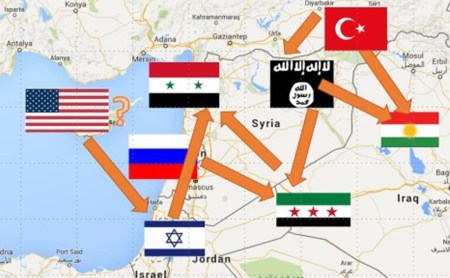
US bombs IsraelUS officials are confident they understand the situation on the ground in Syria. (Duffel Blog photo.)

WASHINGTON, D.C. — Pentagon spokesperson Col. Steve Warren announced US aircraft participating in Operation Inherent Resolve, the code name for the campaign against the Islamic State of Iraq and al-Sham (ISIS), struck targets in Tel Aviv today.

When asked why US warplanes would attack a long-standing ally, Warren explained, “Look, guys, this all makes perfect sense,” pointing to a nebulous PowerPoint slide.

“This was all supposed to be a campaign to topple Bashar al-Asad in Syria, starting with the Arab Spring in 2011. Which, in turn, allowed us to get back at Iran and Russia, both of whom support Syria,” said Warren. “So the CIA considered arming the rebels in Syria, which kind of backfired, and now we have ISIS, a group we thought we had already defeated back when they were al-Qaeda in Iraq.”

Secretary of Defense Ashton Carter further explained, “Sure, we were a little worried when ISIS started running around the Middle East, chopping everyone’s heads off. But fortunately, Iran came to our rescue. Well, in Iraq, that is. We’re still fighting Iran in Yemen.”

Chairman of the Joint Chiefs General Joe Dunford stressed the contributions of America’s coalition partners.

Dunford explained how the US tried to empower allies among the Gulf States to take on ISIS, “which in turn sort of helps us get back at Iran.”

“Unfortunately, most of those states also covertly support ISIS, even though they’re nominally our long-standing allies. Whoops,” said Dunford.

“That’s not to say we don’t have some powerful allies in the region, though,” Dunford explained. “The Kurds have proven to be our greatest allies there, and the Turks are one of our longest-standing NATO allies. Unfortunately, they spend more time fighting each other than ISIS. That old saying, ‘nothing brings people together like a common enemy’ is completely useless here.”

Dunford concluded, “So, you see, ISIS is supported by Arabs, who are opposed by Iranians, who are both opposed and allied with the US, who is sort of allied with Turkey and the Kurds, who are opposed to each other. Since the enemy of my friend is now my enemy, it made sense for the US to bomb Israel, Iran’s bitter adversary.”

Events grew even more complicated in the wake of the deadly terrorist attacks in Paris last Friday. The attacks were reportedly the work of ISIS, who also claimed credit for the bombing of a Russian airliner earlier this month.

“France and Russia have formed an alliance, though in doing so, they automatically caused Germany, Austria-Hungary, and the Ottoman Empire to declare war in return,” said Pentagon Press Secretary Peter Cook. “And, let’s face it, this whole thing really is the fault of the Ottomans when you think about it.”

The briefing then shifted to issues surrounding Afghanistan and Pakistan.

“There, the situation is much more simple,” Cook continued.  “The US is fighting the Taliban by providing billions of dollars in military aid to Pakistan, which is supporting the Taliban. Basically, it’s like that scene in The Empire Strikes Back where Luke Skywalker thinks he’s fighting Darth Vader, only to find his own face in Darth Vader’s helmet. That’s pretty much what we’ve gotten ourselves into.”


Egypt-Saudi Arabia Relations

November 11, 2015

Egypt-Saudi Arabia Relations: Substantial Rifts Despite Shared Basic Interests, MEMRI, Y. Graff*, November 9, 2015

Introduction

Since the ouster of Muhammad Mursi in July 2013, Saudi-Egyptian relations have been close and marked by common interests. Saudi Arabia backed the Egyptian military’s ousting of Mursi and supported its claim that the ouster expressed the will of the people, in the face of international claims that it was a military coup. Alongside political support for the new regime, Saudi Arabia also donated billions of dollars to restore Egypt’s economy. However, despite the friendly relations, Arab press has reported that, since the death of Saudi King ‘Abdallah in January 2014 and the ascension of King Salman, relations between the countries have chilled. Outwardly, the leaders of the two countries strive to demonstrate unity and friendship, yet reports in the Arab media point at a growing tension between Egypt and Saudi Arabia, mainly due to fundamental disagreements on various political issues.

It should be mentioned that, contra to Saudi expectations and despite this country’s generous financial assistance, Al-Sisi’s Egypt does not regard itself bound by Saudi policies. In fact, it has employed an independent policy in the hopes of forging bonds of friendship and alliances on several concurrent fronts – in a manner that has sometimes contravened and even thwarted Saudi foreign policy. This has led to disagreements with Saudi Arabia on several fronts:

The Saudi openness towards the Muslim Brotherhood (MB), to Egypt’s dismay: Saudi fears regarding Iran – which substantially increased after Iran’s Houthi allies took control of the Yemeni capital of Sana’a in September 2014, and later of all of southern Yemen, including Aden, and parts of the north up to the Saudi border, and after Iran signed the JCPOA with the P5+1 Group – have caused a tactical Saudi shift towards the MB after years of animosity towards it and towards its sponsors, Qatar and Turkey. This, in an attempt to form a unified Sunni front to confront the Iranian threat in the region. Saudi Arabia’s openness towards the MB, which Egypt sees as an enemy of the regime and a terrorist organization, is expressed in the Saudi view of the MB as future partners in ruling Yemen and Syria. Further expressions were a visit by Hamas Political Bureau Chief Khaled Mash’al to Saudi Arabia in July 2015, where he met with King Salman, as well as Saudi Arabia’s siding with Qatar in February 2015 when the latter opposed Egypt’s attack in Libya.

This Saudi rapprochement with the MB, Qatar and Turkey displeases the Egyptian regime, which regards them as its bitter enemies and rejects any cooperation with them, even at the cost of thwarting the cause of forming a united Sunni front against Iran.

An Egyptian openness towards Iran, to the chagrin of Saudi Arabia: Saudi Arabia sees Iran as a strategic threat to its security and the security of the entire Sunni world. Conversely, many elements in Egypt do not regard Iran as an existential threat and are reluctant to enter the Sunni-Shi’ite struggle. Al-Sisi’s Egypt is seeking economic investments and alliances to fill its dwindling coffers, and some there see the lifting of sanctions from Iran as an opportunity to renew business relations with it, even if this goes against Saudi Arabia and despite the fact that Egypt and Iran have had historically tense relations and do not maintain full diplomatic relations to this day.

Egypt’s openness towards the Syrian regime: Saudi Arabia demands the ouster of Assad, whether by political or by military means, and even supports the armed opposition to that end. Conversely, Egypt opposes a military solution and advocates dialogue with the Assad regime to achieve a solution that would preserve Syria’s state institutions and its unity. Moreover, Egypt refrains from addressing the issue of Assad’s personal fate.

Saudi disappointment at absence of sufficient support for its military operation in Yemen: Saudi Arabia, which is leading a large-scale military operation in Yemen against the Houthis and supporters of ousted president ‘Ali ‘Abdallah Saleh, is disappointed at Egypt’s refusal to participate more fully in this operation. Moreover, there are reports on disagreements between the two countries regarding the attitude towards the Yemeni MB, as well as reports that Egypt is in contact with Saudi Arabia’s rivals in Yemen in the hopes of finding a political solution to the crisis there.

This report will review the points of contention between Saudi Arabia and Egypt on various topics, as was reported in Arab media.
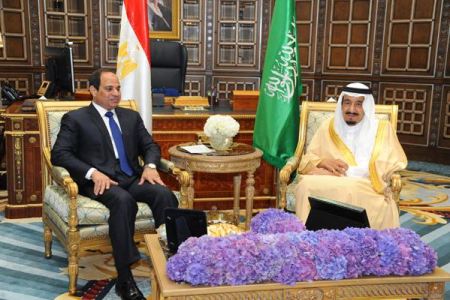
25685Egyptian President Al-Sisi with Saudi King Salman (image: elpah.com)

Egypt Furious Over Saudi Arabia Growing Close To Qatar, Turkey, MB

Since his ascension to the Saudi throne, King Salman continued efforts by his predecessor, King ‘Abdallah, to connect the traditional Sunni axis, led by Saudi Arabia and Egypt – which includes countries such as Jordan, the UAE, and Bahrain – with the MB axis – which includes Turkey, Qatar, and the various MB organizations and parties in the region such as Hamas, Al-Islah in Yemen, and the Syrian MB. The Saudis support the idea that both these axes should come together to confront Iran and its regional allies. In the opinion of Saudi Arabia and other Gulf states, Iran has become an increasing threat in the past decade after gaining crucial influence in three Arab capitals: Beirut, Baghdad, and Damascus. In the past year, Iran has also added the Yemeni capital of Sana’a to the list,[1] after the Shi’ite Houthi movement took control of it, as well as of South Yemen and Aden together with forces supporting ousted president ‘Ali ‘Abdallah Saleh. This takeover created a strategic threat to Saudi Arabia after the Houthis took control of the Strait of Bab Al-Mandeb, prompting the kingdom to launch Operation Decisive Storm in order to restore the rule of its ally President Hadi.

Up until the Houthi takeover of Sana’a, Saudi Arabia, much like Egypt, saw the MB axis as an equal threat to the one posed by Iran. It defined the MB as a terrorist organization, and conducted a public conflict with Qatar over this issue, which triggered a recall of its ambassador in March 2014.[2] However, the deterioration of the situation in Yemen, as well as the constant motion towards a nuclear agreement between Iran and the U.S. (which was eventually achieved in July 2015), caused Saudi Arabia to shift towards Iran as the central threat to its national security and the safety of Arabs in general. As part of this view, Saudi Arabia decided to grow close to its MB axis rivals and undertake the compromises necessary to achieve this.

Accordingly, Saudi Arabia began normalizing its relations with Qatar, even backing it in February 2015 during a harsh disagreement with Egypt.[3] Saudi Arabia’s openness towards Qatar and towards its ally, the MB, was also expressed by releasing many Egyptian MB prisoners, including high ranking activists who were imprisoned in Saudi Arabia during the reign of King ‘Abdallah, as well as by ending Saudi pressure on Britain to define the MB as a terrorist organization.[4]

Arab press also began reporting on contacts between MB officials and Saudi leadership. For example, Saudi officials met with Europe-based billionaire Youssef Nada, who is a noted MB donor;[5] Jordanian MB General Guide Himam Sa’id visited Saudi Arabia in June 2015 and met with the Saudi minister of religious endowments, and a delegation of Hamas officials led by Political Bureau Chief Khaled Mash’al held a meeting with King Salman in Mecca in July 2015, which led to a release of Hamas activists imprisoned in the kingdom.

In order to bring Egypt closer to the MB axis as well, Saudi Arabia attempted to reconcile between it and Qatar, and Egyptian and Gulf sources even claimed that it explored the possibility of promoting inter-Egyptian reconciliation between the regime and the MB.[6] In recent months, the Saudi press featured articles criticizing Egypt’s rigid policy towards the MB. Senior Saudi political analyst Khaled Al-Dakhil, writing in the London-based Saudi daily Al-Hayat on June 21, 2015, called it “a phobia” and “McCarthyism,” hinting that the Egyptian regime, which warns of a totalitarian MB rule, does not behave much differently itself. According to him, “this McCarthyist [attitude] towards the MB cannot be sustained for long… We need an alternative [to persecuting the MB], which has thus far not materialized.”[7] Saudi columnist Daoud Al-Shiryan made explicit calls for reconciliation with the MB in his June 17 column in the same daily: “The [Egyptian] enthusiasm for [meting out] the death penalty [to MB leaders], and the view that regards this as a tool for deterring and restraining them, and for imposing the country’s authority [over them], is an erroneous policy, since Egypt’s interest today demands to close the book on this topic and open a new horizon for political reconciliation [with the MB] while looking to the future.”[8]

Reports that Saudi Arabia was growing closer to the MB were of great concern to Egypt, but it seems that Mash’al’s visit to the kingdom and his meeting with King Salman were the straw that broke the camel’s back. Following the visit, several Egyptian columnists published articles featuring harsher tones than had been acceptable in Egypt up to that point. For example, ‘Abd Al-Rahim ‘Ali, editor of the Egyptian news portal Albawabhnews.com, who is close to Egyptian security forces, claimed in an article on Saudi-Egyptian tensions that Saudi Arabia was trying to “thaw the ice” with Hamas and grow close to this organization so it would join the anti-Iranian Sunni axis that Saudi Arabia heads and mediate between the kingdom and the Yemeni Al-Islah party. According to him, Egypt responded to these attempts by conveying that it refuses to be party to any plan in which the MB is involved. He claimed further that Egypt had conveyed a message to Saudi Arabia that “its alliance with this organization poses a threat to the Arab’s national security and especially to Egypt’s national security.” [9]

Even more critical of the Saudi openness towards the MB was editor-in-chief of the official daily Al-Ahram, ‘Abd Al-Hadi ‘Allam, who did not mention Saudi Arabia by name but alluded to it in a highly resentful tone. He wrote: “Forming an alliance with political Islam organizations [such as the MB] will never benefit the region and the Arab forces [such as Saudi Arabia] that aspire to forge a new alliance against Tehran… as though those organizations were not party to the regional chaos and bloodshed.” He added: “The thought that we can combat the pox of terrorism and extremist organization [referring to Shi’ite militias such as the Houthis and Hizbullah] by supporting equally radical organizations [such as Hamas and the various arms of the MB] constitutes ignorance, near-sightedness, and politically folly.”[10]

Different Attitudes Towards Iran As Strategic Threat To The Region

Egypt’s objections to Saudi Arabia growing close to the MB also touch on their differing views on Iran as a strategic threat. Egypt disagrees with the Saudi position that Iran constitutes such a threat to Arab national security as to justify allying with the MB. Egypt sees the MB as a no lesser threat to Arab national security, and some elements there even argue that Iran does not constitute a significant threat at all.

Egyptian Foreign Minister Sameh Shoukry said after the signing of the JCPOA that Egypt’s relations with Iran “are unrelated to the attitude of the Gulf states towards it.” He added: “Nobody is tying our hands. We are forging ties with [Iran] based on many considerations, including the regional one, not based on formal matters like the name of a street.”[11] Also, in late September, Shoukry met with his Iranian counterpart, Javad Zarif, on the periphery of the UN General Assembly, and conveyed to him that Egypt expects Iran to support regional stability and Arab national security. The two also discussed a political solution in Syria and the implications of the JCPOA.[12] Then Egyptian Oil Minister Sherif Ismail, who is now prime minister, even expressed hope that Egypt could begin importing oil from Iran, thus easing its severe energy crisis.[13]

Several Egyptian columnists strengthened this position and called Egypt to see the JCPOA as a chance to economically develop Egypt and foster ties with Iran after many years of disconnect. Al-Ahram columnist Ibrahim Sengab argued that “naming a street in Tehran for the murderer of President Sadat [Khalid Al-Islambouli] cannot be grounds for severing ties between the countries.[14] Al-Ahram columnist Muhammad Idris wrote that in light of the rise of Iranian might in the region, Egypt is faced with two options. One is to create “strategic integration with Saudi Arabia” and lead a joint Arab force that would constitute a counterbalance to Iran, and the other is to normalize relations with Iran. According to him, the schism between Saudi Arabia and Egypt, and Saudi attempts to compete with Egypt rather than cooperate with it, indicate that normalizing relations with Iran is the better option.[15] However, it should be mentioned that many Egyptian articles sided with the Saudi position that sees the JCPOA as dangerous.

Another Iran-related disagreement between Egypt and Saudi Arabia revolves around the Egyptian regime’s estimate that Saudi Arabia is turning its conflict with Iran into a Sunni-Shi’ite sectarian conflict, which Egypt has no interest in. Egyptian journalist Mai ‘Azzam harshly attacked Saudi Arabia’s conduct vis-à-vis Iran on this account, claiming that “Saudi Arabia is spearheading the transforming of the regional conflict into a sectarian one. It is the one that dragged the region into civil wars… [in which] members of the same nationality fight under sectarian banners, and it seems that this is a war between Shi’ites and Sunnis rather than a war of interests between Saudi Arabia and Iran.” She explained that “the clash between the interests of Saudi Arabia and Egypt is crystal clear.”[16] The editor of Al-Ahram, ‘Abd Al-Hadi ‘Allam, also addressed this point and stated in his aforementioned article that Egypt “would never lead a sectarian war against Iran.”[17]

Saudi-Egyptian Disagreements Regarding Resolution Of Syrian Crisis

Saudi and Egyptian officials have been stressing that there is no disagreement between the countries with regards to the Syrian crisis. Saudi Ambassador to Egypt Ahmad Qattan argued in an August 4 press conference that the two countries no longer disagree on the means to resolve the crisis, and that the two had always agreed on the goal: a political solution that preserves state institutions, while distancing Assad himself from a position of influence.[18] Egypt’s foreign minister also stressed, in a joint press conference with his Saudi counterpart, that the two countries had never disagreed and do not disagree today on the solution to the Syria crisis.[19]However, these statements do not seem to reflect reality, which points to major differences of opinion between the countries regarding the fate of Bashar Al-Assad and the ways to deal with the crisis. Egypt’s position on these matters appears closer to that of Russia, the strategic ally of the Assad regime along with Iran, than to that of Saudi Arabia.

The Saudi-Egypt disagreements on the Syrian issue can be divided into several topics:

Ways To Deal With The Syrian Crisis And The Fate Of President Assad

While Saudi Arabia sees Assad as the root cause of the problem, and sees his ouster as a condition to solving the crisis, Egypt believes that removing Assad would only exacerbate the crisis and lead to chaos, as happened with the ouster of Saddam Hussein in Iraq and of Mu’ammar Al-Qadhafi in Libya. While Egypt does not openly state that it supports Assad remaining in power, it does routinely warn of the implications of his ouster. In its view, removing Assad is not a condition to solving the crisis, and Assad’s fate is in the hands of Syrians – a position similar to that of Russia, Iran, and the Syrian regime itself. This was expressed in statements made by Egyptian President Al-Sisi, who called for a political solution in Syria, “not in order to support one side over the other, but rather to preserve the Syrian state and its institutions, and to solve [the crisis] without collapsing them.”[20]Egyptian Foreign Minister Shoukry also said that Assad’s fate should only be determined by the Syrian people, “who have a right to decide [their leadership] by [establishing] a transitional government and later in free elections held under international oversight and as part of the implementation of the Geneva 1 agreement.”[21]

Egypt does not view the “military option” as an alternative if a political solution cannot be reached, as Saudi Arabia has threatened.[22] Moreover, official elements in Egypt stress that a military solution in Syria is impossible, and that military action to topple the regime will only exacerbate the civil war in the country.

In Egypt’s opinion, only a political solution that ensures that the Syrian army and state institutions not be harmed can guarantee the stability of Syria and of the region. This Egyptian position was expressed in a document constituting a kind of roadmap to solving the Syrian crisis, which was presented by the Egyptian foreign ministry to several Syrian opposition parties and was published on the liberal Saudi website elaph.com on December 25, 2014.[23] The Egyptian document does not touch on the fate of Bashar Al-Assad, but stresses that the Syrian army cannot be dismantled since it is “the national institution defending the state and ensuring its independence and sovereignty, and [since it] will preserve national security and not interfere in politics.”[24]

The Root Causes Of The Crisis And The Priorities In Dealing With It

The two countries both see the spread of ISIS in Syria as a threat to the existence of the state and to regional stability, but differ on how to deal with it and the priorities in doing so. Saudi Arabia believes that the root of the problem is the Assad regime itself, since it is the cause of the uprising and the emergence of ISIS and other extremist Islamic groups, and therefore ousting it will end the uprising and weaken these groups.

Egypt, on the other hand, shares Russia’s, Iran’s, and the Syrian regime’s view that the essence of the crisis is the extremist Islamic terrorist organizations such as ISIS and Jabhat Al-Nusra, and therefore the top priority is eliminating them. Moreover, Egypt sees the Syrian army as the spearhead of the fight against ISIS. It supports the Russian initiative that calls to establish a regional alliance against ISIS together with the Assad regime. Egypt even expressed support for Russian airstrikes in Syria, in contrast to Saudi Arabia, which opposes them. Egyptian Foreign Minister Sameh Shoukry even supported the Russian involvement in Syria in an interview with the Saudi Al-Arabiya TV, saying that “the info given us in our direct contacts with the Russian side indicates that Russia is interested in combating terrorism and working to reduce the spread of terrorism in Syria.” He added that the Russian involvement would help eliminate terrorism in the country.[25]

Attitude Towards Syrian Opposition

Egypt and Saudi Arabia’s disagreement regarding the status of Assad is also reflected in their support for different opposition elements. Saudi Arabia supports armed opposition groups such as the Free Syrian Army and moderate Islamic militias with equipment, weapons, and money. The Saudis, in a joint move with Turkey and Qatar, which also support militias combatting Assad, recently established Jaish Al-Fath – an umbrella organization for several armed factions, including Islamist ones, which has made impressive achievements against the regime. Additionally, Saudi Arabia supports the National Coalition for Syrian Revolutionary and Opposition Forces, an unarmed political opposition to the regime, in which the Muslim Brotherhood (MB) has considerable weight, and which also calls for the ouster of Bashar Al-Assad.

Egypt, on its part, while not boycotting the National Coalition, supports opposition elements willing to conduct dialogue with the Syrian regime, such as the National Coordination Committee for the Forces of Democratic Change (NCC), which is based in Syria and receives Russia’s support. Additionally, Egypt does not recognize MB elements that are members of the National Coalition. Thus, in June 2015, Egypt organized a summit for Syrian oppositionists in Cairo, but did not invite any MB representatives. In response, the National Coalition boycotted the summit.

Furthermore, unlike the Saudis, Egypt rejects a military solution in Syria, and opposes armed opposition. In this context, it is worth mentioning an article penned by Ahmed Sayyid Al-Naggar, head of the board of directors ofAl-Ahram, who harshly criticized the Free Syrian Army and Saudi Arabia’s support for armed opposition in Syria. He wrote: “Egypt should not permit the rending of Syria and the destruction of the unity of the Syrian state, as is being attempted today by the terrorist gangs of Jabhat Al-Nusra, ISIS, and the ‘Free Collaborator Army’ [pejorative term for the FSA] with the support of several regional countries…”[26]

Saudi Arabia’s dissatisfaction with Egypt’s policy on solving the Syrian crisis is embodied by criticism levelled by the former editor of the London-based Saudi daily Al-Sharq Al-Awsat, Tariq Alhomayed, at Egyptian Foreign Minister Shoukry due to his statements in support of Russian involvement in Syria. According to Alhomayed, these statements by Shoukry indicate that he is “taking the criminal Assad lightly, and even showing sympathy for him, and [his statements] do not acknowledge that [Assad’s] crimes are the reason that Syria is in its current state, or that Assad is the official sponsor of terrorism and the reason for the appearance of ISIS there [in Syria]… It is a duty to say, even with a substantial delay, that there is a severe lack of understanding of the Syrian crisis in Egypt… What some people in Egypt do not understand is that the Assad army is sectarian and [moreover] has [now] been replaced by Shi’ite and Iranian militias and by Russian forces, and is no longer the same as the Egyptian army.”[27]

Reports On Warming In Egyptian-Syria Relations

In fact, since Al-Sisi’s rise to power in Egypt, and to Saudi Arabia’s dismay, there has been a noticeable warming of relations between Egypt and the Assad regime, embodied by Egypt’s uncompromising support for the survival of this regime and its army. This Egyptian position can be explained by the fact that the Syrian and Egyptian regimes both represent the Middle East’s old guard (authoritarian regimes leaning mainly on the army); by the strong ties between their militaries; by their similar view of the MB, ISIS and Al-Qaeda as threats to their security; and by their shared hostility for Turkey and Qatar, who sponsor the MB. It seems that similar interests and the similarity in the structure of both regimes lead Egypt to fear that the ouster of the Assad regime and its army, as well as the division of Syria, would open the door to a similar scenario in Egypt. Additionally, Egypt’s tightening relations with Russia – a strategic ally of the Syrian regime along with Iran – have contributed to its positive relations with the Assad regime. Furthermore, unlike its Gulf allies, Egypt did not participate in the international coalition attacks on ISIS in Syria, which the Assad regime called “illegitimate.”[28]

Over the past year, the Assad regime has recognized these disagreements between Saudi Arabia and Egypt and has attempted to exploit them to grow close to Egypt, including with positive statements on Egypt made by Syrian officials, and the dispatching of envoys to the country. For example, in a speech to Ba’th Party members in November 2014, President Assad showered Egypt with praise, saying: “We can describe the Egyptian role as positive. Our relations with the Egyptian security mechanisms, even during the days of [previous president Muhammad] Mursi, were good, and now they have developed; first, thanks to the rise of President ‘Abd Al-Fattah Al-Sisi, and second, due to the blows dealt to the MB in Egypt. This led to a major warming [between the countries].”[29] In an interview with Hizbullah’s Al-Manar TV in August 2015, Assad stressed the importance of relations with Egypt: “Even when Mursi, of the MB, was Egyptian president and despite his offenses towards Syria, we never tried to harm Egypt; first, due to the importance of our relations, and second, because contacts between Syria and Egypt were not severed even during the reign of Mursi.” Assad hinted at the pressure Saudi Arabia is applying to Egypt to avoid forging stronger ties with Syria, saying: “We want Egypt to play the role of an important… and influential country, [one] that assists the other Arab countries on the basis of its ancient history, not on the basis of a handful of petrodollars and recent history.” According to Assad, “rival countries are pressing Egypt in attempt to keep it from playing the part we wish it to play.” He also said that Syria-Egypt relations help attain balance in the Arab arena and that “Syria believes that it is in the same trench as the Egyptian army and people in dealing with terrorists…”[30]

Syrian Foreign Minister Walid Al-Mu’allem told the Egyptian daily Al-Ahram that “Egypt does not play a part [in Syria] for obvious reasons,” alluding to its alliance with Saudi Arabia, and added: “The Mursi regime, which decided to downgrade diplomatic relations [with Syria], is gone, and we hope that they will now return [to the previous level].”[31] In an interview with the Egyptian daily Al-Akhbar, Al-Mu’allem said that there is security coordination between Syria and Egypt and that it was an advanced step towards normalizing relations between the countries.[32] The Lebanese daily Al-Safir, which is close to the Syrian regime, even reported in February 2015 that Al-Sisi had renewed security coordination with Syria “to a small degree.”[33] Additionally, the website Alahednews.com, which is owned by Hizbullah, reported that Egypt was arming the Assad military.[34]

25686Al-Mu’allem (center) posing with members of the Egyptian media (Image: Al-Ahram, Egypt, August 20, 2015)

Alongside these messages, the Syrian regime dispatched several envoys to Egypt. In December 2014, a delegation headed by ‘Imad Al-Assad, the cousin of President Bashar Al-Assad, visited Egypt.[35] One month later, in January 2015, an unnamed Syrian regime envoy met with Egyptian officials in Cairo. According to reports on a Syrian opposition website, the visit was meant to bolster Egyptian efforts to unite the Syrian opposition and promote indirect talks between the regime and opposition as a preamble to direct talks with Egyptian or international presence.[36]

Though Egyptian officials make sure to avoid explicit expressions of support for the Assad regime, the administration’s mouthpieces do express such support, unreservedly. Official Egyptian press featured numerous articles calling for Assad to remain in power and backing him in his struggle against terrorism. They also featured articles praising the tight relations between the two countries and peoples, articles which presented the events in Syria from the Egyptian regime’s standpoint, and discussed the common enemies of the two countries and the need for the Egyptian army to assist its Syrian counterpart.[37]

Thus, chief editor of Al-Ahram, ‘Abd Al-Hadi ‘Allam, wrote in April 2015 that “distancing Bashar Al-Assad from any solution to the crisis is a akin to imposing guardianship upon the Syrian people and its choices, and [constitutes] interference in its affairs, and marginalization of parts of the Syrian people who see him as a component in a solution.” ‘Allam also claimed that, had the MB regime remained in power in Egypt and had the Assad regime been ousted, tens of thousands of ISIS fighters would have entered Egypt, and therefore “the mighty stand of the Syrian regime and army in the face of terrorism constitutes defense of Egypt and its national security…”[38]

Similarly, Morsi ‘Atallah, former head of Al-Ahram‘s board of directors, wrote in June 2015 that, contrary to statements by Saudi Foreign Minster Al-Jubeir that Egypt and Saudi Arabia agreed that Assad must be removed and that Egypt would press Russia to abandon him, “this trend does not match the principles of Egyptian policy… which is far from sticking its nose into the internal affairs of its Arab sisters… regardless of circumstances and excuses.”[39] In a February 2015 article, Al-Ahram columnist Makram Muhammad Ahmad stated that Bashar Al-Assad would “necessarily be part of a peaceful solution to the Syrian crisis” because he still controls a large portion of the country, because the army will remain loyal to him, as well many minorities; and especially in light of estimates that the only alternative to his rule is ISIS.[40] In another article on September 8, 2015, written on the backdrop of the wave of Syrian refugees fleeing to Europe, Ahmad wrote that Syria “is being worn away by ISIS and Al-Qaeda due to the insistence on getting rid of Assad as a precondition to a nonviolent solution,” adding that “the crimes Assad has committed against his people are of limited [scope] compared to the crimes of Arabs who stand silent and helpless in the face of the great disaster of the Syrian people.”[41]

The Yemen Crisis: Saudi Arabia Disappointed At Insufficient Egyptian Aid; Egypt Fears MB Inclusion In Future Arrangement

It initially appeared that there was solidarity and cooperation between Egypt and Saudi Arabia on the Yemeni situation, since Egypt dispatched aerial and naval forces to join the Saudi-led coalition that launched Operation Decisive Storm in March against the Houthis and the supporters of ousted president ‘Ali ‘Abdallah Saleh. However, as time wore on, the rift between the countries became apparent, embodied by Egypt’s reluctance to dispatch ground troops to Yemen, while other coalition members such as the UAE, Sudan, and Mauritania have already done so.[42]

Egypt sees the Strait of Bab Al-Mandeb, which is the gateway to the Red Sea, as a strategic area, and Egyptian officials have repeatedly stressed that their country would prevent the Houthis from taking control of it. Moreover, in April 2015, President Al-Sisi said that Bab Al-Mandeb and the security of the Gulf States were matters of Egyptian national security, and that the Egyptian army would be mobilized to deal with them if necessary.[43]Nevertheless, it appears that Egypt is avoiding taking a more active role in this operation, possibly due to several reasons: The Egyptian army’s preoccupation with combating ISIS terrorism in Sinai; bitter memories of Egypt’s failed war in Yemen 50 years ago, which claimed the lives of thousands of Egyptian soldiers; and Egypt’s aversion to Saudi Arabia’s pact with the Yemeni MB against the Houthis and Saleh.

Since the onset of the Arab Spring in 2011, Saudi Arabia has opposed the MB-affiliated Al-Islah Party in Yemen, but since the ascension to the throne of King Salman, the Saudis seem to have been seeking to improve their relations with it.[44] The Al-Islah Party welcomes the anti-Houthi Saudi operation in Yemen, and Saudi reports even indicate that it has taken an active part in it. The independent Egyptian daily Al-Shorouq reported that Saudi Arabia has even insisted that Al-Islah be given a substantial role in the Yemeni regime. Egypt, on the other hand, is apparently still avoiding cooperating with the MB in Yemen or bolstering its political power. Al-Shorouqcited Egyptian sources as saying that, despite understanding Saudi fears of an Iranian takeover, they do not want to replace one religious force in Yemen (meaning the Houthis) with another (meaning the MB).[45] According to the Lebanese daily Al-Akhbar, Egypt in fact told Saudi Arabia that its participation in Operation Decisive Storm was conditional upon the Al-Islah Party not becoming part of the future regime in the country, and the Saudis were forced to make assurances along these lines, while simultaneously trying to preserve their alliance with the party.[46]

Two additional events in Egypt demonstrate this country’s opposition to Saudi policy in Yemen: In April 2015, a protest against Operation Decisive Storm was held outside the Saudi embassy in Cairo, which featured offensive slogans aimed at the Saudi king. A report in the Egyptian daily Al-Yawm Al-Sabi’ claimed that this was “a plot of the Egyptian MB to drive a wedge between Saudi Arabia and Egypt.”[47] However, the fact that such a protest even took place in Egypt, which strictly regulates protest activity,[48] raised many questions. Thus, following the protest, the independent e-daily Rai Al-Yawm wondered whether it had received the implicit blessing of the Egyptian regime, which does not air out its differences with Arab countries, choosing instead to express them in indirect ways and via messages in the media. The daily asked: “Is it possible that Egyptian authorities used this means to express their differences with Saudi Arabia [on Yemen]?”[49]

25687Egyptians protesting Saudi Operation in Yemen. Right: “Stop barbaric aggression against Yemen.” Left: “Salman, you coward, you agent of the Americans” (Images: Watan.com, Arabic.cnn.com, April 6, 2015)

The second event took place in July 2015. The London-based Saudi daily Al-Hayat reported that the El-Sawy Culture Wheel[50] in Cairo, which is considered one of Egypt’s largest and most important cultural centers, was holding an exhibition depicting “Saudi aggression in Yemen,” adopting the Houthi narrative of events.[51] Saudi journalist Jasser Al-Jasser attacked the El-Sawy Culture Wheel in a July 16 article, calling it the abode of “political mercenaries” – a reference to Egypt’s political elites. According to him, the exhibition falsified reality and facts and constituted “a hostile act against all Saudis” and an offense to Saudi martyrs.[52] It should be mentioned that, according to a report in Al-Hayat, the Culture Wheel denied holding such an exhibition, likely after it caused diplomatic embarrassment to Egypt, which quickly issued a statement via the foreign ministry spokesman denying that there were any disagreements between it and Saudi Arabia on Yemen.
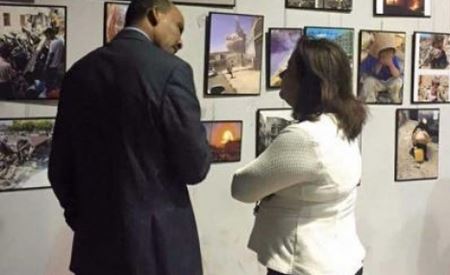
25688The exhibition at the El-Sawy Culture Wheel (Image: Al-Misryyoun, Egypt, July 9, 2015)

However, Arab media featured reports on meetings held in Cairo between Egyptian officials and Abu Bakr Al-Qirbi, an emissary for ousted president Saleh, to formulate a solution to the Yemeni crisis that would not include the Al-Islah party. Sources said that Saudi Arabia had told Egypt it was displeased by this move.[53]   Conversely, the Lebanese daily Al-Akhbar reported on July 24 that the Egyptian officials’ meetings with Saleh’s and Houthi representatives had been held with Saudi Arabia’s knowledge.[54]

Saudi Arabia Thwarts Egyptian Initiative To Establish “Joint Arab Force”

Another clear expression of the many disagreements between Egypt and Saudi Arabia can be seen in the fact that in recent months, Saudi Arabia has repeatedly delayed an initiative presented by President Al-Sisi to establish a joint Arab force empowered by the Arab League to carry out missions to defend Arab countries. Al-Sisi intends for this new force to be sent by the Arab League to Libya, to remove the increasing threat to Egypt from terrorist elements operating there, including ISIS.

Al-Sisi presented this initiative to Arab leaders at the Arab League summit in March 2015, shortly after ISIS in Libya executed 21 Egyptian Copts living in the country. The initiative received the support of Arab leaders at the summit, and it was decided to hold deliberations and formulate a protocol to establish it. However, the Arab defense and foreign ministers summit that is set to convene to approve the formulated protocol has already been postponed twice – once on July 26,[55] and again on August 26.[56]

The London-based Qatari daily Al-Quds Al-Arabi claimed on September 2, 2015 that Saudi Arabia was behind the postponements. The report stated that Saudi Arabia had thwarted the Egyptian initiative due to the severe disagreements between the two countries on various topics, chiefly Syria and Yemen, and added that “the fact that a [new] date has not been set for the summit indicates that the disagreements run deep.” According to sources cited in the report, one of the main reasons for Saudi Arabia blocking the Egyptian move is the strong ties between the Al-Sisi and Al-Assad regimes, and Egypt’s efforts to achieve a political solution to the Syrian crisis that ensures Assad remains in power, which is contrary to the Saudi position. The report also states that initially, Saudi Arabia supported the establishment of the Joint Arab Force in an attempt to entice Egypt do join its coalition for Operation Decisive Storm in Yemen, but after Egypt did not commit to the coalition sufficiently, Saudi Arabia decided to reign in the Egyptian initiative. The report also cited analysts and associates of the Saudi regime who estimated that Al-Sisi’s aim in establishing the Joint Arab Force was not to combat terrorist organizations in Libya, but rather to suppress pro-MB Libyan rebels and establish a government under his sponsorship, allowing him to take control of the oil in eastern Libya. They said that Saudi Arabia was disinclined to take sides in the Libyan crisis and preferred to reach an UN-brokered solution geared at establishing a national consent government that includes the MB.[57]

Saudi Arabia Fails To Block Egyptian Media Assault; Tense Relations Persist

On July 30, 2015, Saudi Crown Prince Muhammad bin Salman arrived in Cairo for an official visit, meeting with President Al-Sisi and attending a graduation ceremony at the military college, during which Al-Sisi stressed that the prince’s visit to Egypt sent the message that Saudi Arabia and Egypt were “together.” The visit ended with the “Cairo Declaration,” which states that both countries will work to strengthen their military and economic ties and will cooperate on the strategic level.[58] The visit alleviated the concerns of many in the Egyptian media for a time, and the Cairo Declaration assured that the future of cooperation between the countries was secure. And indeed, immediately after the visit, Egypt approved an extension of its forces’ activity in Yemen until the end of the operation, even committing to dispatch ground forces to protect the ports of ‘Aden after they were liberated by forces loyal to Yemeni President Hadi. Furthermore, during and after the visit, the Egyptian press featured several articles praising the close relations between the countries. An article by journalist Mohammed Mujahid Al-Zayyat, published in Al-Ahram on August 3, even directly rejected the anti-Saudi allegations published in the Egyptian press mere weeks earlier. He claimed that Saudi Arabia did not really belong to the Turkey-Qatar-MB axis and that the visit to Saudi Arabia by Hamas Political Bureau Chief Khaled Mash’al had not been meant to show Saudi support for Hamas, which is in conflict with Egypt, or to circumvent Egypt as mediator in the intra-Palestinian reconciliation.[59]

25689Saudi Crown Prince Muhammad Bin Salman and Egyptian President Al-Sisi during the former’s visit to Cairo (Image: Al-Quds Al-Arabi, London, July 30, 2015)

However, Al-Misryyoun editor Gamal Sultan, who is known for criticizing the regime, stressed that anti-Saudi articles had appeared in official dailies, indicating that the tensions were real.[60] Moreover, even though there are occasional high-level meetings between Egypt and Saudi Arabia where the strong cooperation between the countries is emphasized and reports on their disagreements are denied, Arab press continues to feature numerous reports on the ongoing tensions between them. Thus, for example, Al-Quds Al-Arabi reported that King Salman had been scheduled to visit Egypt in early September after visiting the U.S., but eventually did not come. The daily claimed that the king’s change of plans reflected ongoing Saudi-Egyptian tensions.[61] On the other hand, Egyptian Foreign Minister Sameh Shoukry said in an interview on September 10 that the countries were preparing for a visit to Egypt by King Salman, even though a date had not been set yet, and reiterated that there were no disagreements between the countries, but rather that each country “has its own role and its own attitude…”[62]

On October 13, Al-Quds Al-Arabi reported that, following a proposal by Saudi ambassador to Egypt Ahmad Qattan, Saudi Arabia had paid to fly 50 Egyptian media figures to participate in the annual pilgrimage to Mecca and Medina. The daily stated that each year, Saudi Arabia funds the pilgrimage of media figures from countries friendly to Saudi Arabia, and that this year the largest group had been from Egypt. According to the report, Saudi Arabia hoped this move would help bridge its gaps with the Egyptian media, but this goal was not achieved. When the journalists returned to their country, they once again attacked Saudi policy, mainly on Syria.[63] This may have angered the Saudi ambassador, who reportedly had a harsh argument several days later with Sayyid Ahmed Al-Naggar, head of Al-Ahram‘s board of directors, during a festive dinner at the home of the Algerian ambassador to Egypt. Following the argument, news sites reported that the Saudi ambassador had left Cairo in a rage. Qattan quickly denied these reports, and speaking to the Egyptian daily Al-Watan he said: “Would I leave Egypt because of Ahmed Al-Naggar? That makes no sense.”[64] Official elements in both countries also issued swift denials that the ambassador had left Egypt, but the e-daily Rai Al-Yawm remained unconvinced, and claimed, in an October 19 editorial, that alongside the cancellation of King Salman’s visit to Egypt, this was another expression of the deteriorating relations between the countries.[65]


* Y. Graff is a research fellow at MEMRI.


Endnotes:


[1] See MEMRI Inquiry & Analysis Series Report No. 1155, Iran’s Support For The Houthi Rebellion In Yemen: ‘Without Iran There Would Be No War In Syria And Ansar Allah Would Have Never Emerged’, April 21, 2015.

[2] See MEMRI Inquiry & Analysis Series Report No. 1075, Unprecedented Tension Between Qatar And Saudi Arabia/UAE/Bahrain Threatens To Break Up Gulf Cooperation Council, March 14, 2014.

[3] After ISIS executed 21 Egyptian Copts living in Libya, Egypt retaliated by attacking ISIS targets in the country, an attack backed by the Arab League, aside for Qatar, which expressed reservations about the move. Egypt’s representative to the Arab League claimed that Qatar’s position “reveals its support for terrorism,” leading Qatar to recall its ambassador from Egypt. The Gulf Cooperation Council (GCC), in which Saudi Arabia is a central member, condemned the Egyptian Arab League representative’s statements against Qatar and the London-based Saudi dailies Al-Sharq Al-Awsat and Al-Hayat published articles expressing reservations about the military attack in Libya (see for example a February 18, 2015 article by Tariq Alhomayed in Al-Sharq Al-Awsatand a February 18, 2015  article by Randa Takieddine  in Al-Hayat).

[4] Al-Arabi Al-Jadid (London), March 15, 2015.

[5] Al-Shorouq (Egypt), July 24, 2015.

[6] Al-Akhbar (Lebanon), April 18, 2015.

[7] Al-Hayat (London), June 21, 2015.

[8] Al-Hayat (London), June 17, 2015.

[9] Albawabhnews.com, July 18, 2015.

[10] Al-Ahram (Egypt), July 24, 2015.

[11] Al-Shorouq (Egypt), July 13, 2015. The reference is to a street in Tehran which the Iranian regime named after Khalid Al-Islambouli, who assassinated Egyptian president Sadat in 1981. Officially, Iran has had no diplomatic relations with Egypt since 1980, when Khomeini severed them in protest of the Israel-Egypt peace treaty and of Egypt’s hosting of the deposed Iranian Shah. The name of the street in Tehran has long been emblematic of the difficulties facing a reconciliation between Egypt and Iran.

[12] Alarabiya.com, September 24, 2015.

[13] Al-Ahram (Egypt), July 29, 2015.

[14] Al-Ahram (Egypt), July 22, 2015.

[15] Al-Ahram (Egypt), September 8, 2015.

[16] Al-Masri Al-Yawm (Egypt), July 23, 2015.

[17] Al-Ahram (Egypt), July 24, 2015.

[18] Al-Masri Al-Yawm (Egypt), August 5, 2015.

[19] Al-Riyadh (Saudi Arabia), October 26, 2015.

[20] Al-Ahram (Egypt), September 10, 2015.

[21] Al-Sharq Al-Awsat (London), September 9, 2015.

[22] While Saudi Arabia states that it supports a political solution for the crisis, it seems to believe that the Assad regime should be pressured militarily in order to bring him to the negotiating table and force far-reaching concessions from him. Following a meeting of the Gulf Cooperation Council (GCC) foreign ministers on September 16, Saudi Foreign Minister ‘Adel Al-Jubeir said that if a political solution cannot be reached, then “the military option is still on the table,” and that the Syrian opposition has been dealing with Assad with increasing effectiveness. Al-Watan (Saudi Arabia), September 16, 2015. Al-Jubeir reiterated these statements in a press conference during the UN General Assembly on September 30. Al-Watan (Egypt), September 30, 2015.

[23] After elaph.com published the document, Egypt issued an official denial that it had formulated an initiative to solve the Syrian crisis. Elaph.com, December 25, 2014. The document published by the website proposed that opposition and regime delegations conduct direct talks sponsored by the UN based on the Geneva 1 declaration, Security Council resolutions on Syria, and the six point peace plan proposed by Kofi Annan, who served as the UN and Arab League’s joint special envoy to Syria, which he presented to the Security Council on March 16, 2012. Annan’s plan included: calling on the Assad regime to commit to a political process that meets the aspirations of the Syrian people; ending fighting and withdrawing troops from population areas; enabling the transfer of humanitarian aid; releasing political prisoners; and enabling journalist’s freedom of movement as well as freedom of expression and protest. See Aljazeera.com, March 27, 2012.

[24] In his speech at the 70th UN General Assembly on September 28, 2015, Al-Sisi called on Syrian opposition and regime elements to come to Cairo to negotiate “in order to formulate a clear vision for a transitional phase in accordance with the Geneva document, which will provide a common ground for all Syrians to build a democratic Syria that is sovereign over all its territory, and which preserves the state’s essence and institutions, respects the variety of elements in its population, and strengthens their national affinity.” He stressed that “these Syrian national elements are invited today to participate and invest every effort in negotiations to find a political solution to the crisis that realizes the ambitions of the Syrian people. ” Al-Quds Al-Arabi (London), September 30, 2015. In this statement, Al-Sisi expressed the main principles of Egypt’s policy on the Syrian crisis: Finding a political solution through dialogue with the regime, and preserving existing state institutions.

[25] Al-Ahram (Egypt), October 5, 2015.

[26] Al-Ahram (Egypt), September 7, 2015.

[27] Al-Sharq Al-Awsat (London), October 4, 2015.

[28] See MEMRI Inquiry & Analysis Series Report No. 1125, Egypt’s Position On International Anti-ISIS Coalition: Reserved Support Alongside Refusal To Commit To Military Participation, October 22, 2014.

[29] Al-Akhbar (Lebanon), January 3, 2015.

[30] Presidentassad.net, August 25, 2015.

[31] Al-Ahram (Egypt), August 20, 2015.

[32] Al-Akhbar (Egypt), August 19, 2015.

[33] Al-Safir (Lebanon), February 11, 2015.

[34] Alahednews.com, September 22, 2015.

[35] Al-Hayat (London), December 18, 2014.

[36] Aksalser.com, January 26, 2015.

[37] See for example, Riyadh Sanih, Al-Ahram (Egypt), August 9, 2015; ‘Asim Bakri, Al-Masri Al-Yawm (Egypt), August 19, 2015; Gamil ‘Afifi, Al-Ahram (Egypt), September 8, 2015; and Muhammad Hussein Abu Al-Hassan,Al-Ahram (Egypt), September 9, 2015.

[38] Al-Ahram (Egypt), April 17, 2015.

[39] Al-Ahram (Egypt), June 9, 2015.

[40] Al-Ahram (Egypt), February 17, 2015.

[41] Al-Ahram (Egypt), September 8, 2015.

[42] Al-Shorouq (Egypt), May 31, 2015.

[43] Al-Yawm Al-Sabi’ (Egypt), April 4, 2015.

[44] Al-Akhbar (Lebanon), April 17, 2015.

[45] Al-Shorouq (Egypt), May 31, 2015.

[46] Al-Akhbar (Lebanon), August 21, 2015.

[47] Al-Yawm Al-Sabi’ (Egypt), April 6, 2015.

[48] See MEMRI Inquiry & Analysis Series Report No. 1061, Egyptians Deeply Divided Over Law Restricting Public Protests, January 28, 2014.

[49] Raialyoum.com, April 9, 2015. The article mentioned a tweet by Saudi journalist Jamal Khashoggi, who also implied that Egyptian authorities might have quietly approved of the protest or even organized it, since “the operating principle of the Egyptian police is: If you protest without authorization – you will be killed.”

[50] Named for Abdel Moneim El-Sawy (died 1984), who founded the Egyptian news agency and served as culture minister under President Sadat.

[51] Al-Hayat (London), July 13, 2015.

[52] Al-Jazirah (Saudi Arabia), July 16, 2015.

[53] Al-Arabi Al-Jadid (London), June 6, 2015; Albawabhnews.com, July 18, 2015.

[54] Al-Akhbar (Lebanon), July 24, 2015.

[55] Al-Sharq Al-Awsat (London), July 27, 2015.

[56] Alarabiya.com, August 26, 2015.

[57] Al-Quds Al-Arabi (London), September 2, 2015.

[58] Al-Hayat (London), August 3, 2015.  At the last Summit of South American-Arab Countries, held in Riyadh on November 10-11, 2015, Al-Sisi met with the Saudi king in another show of unity. Following this meeting the two countries’ FMs signed a protocol for establishing an “Egyptian-Saudi Corrdination Council” to implement the resolutions of the Cairo Declaration. Elaph.com, November 11, 2015.

[59] Al-Ahram (Egypt), August 3, 2015.

[60] Al-Misryyoun (Egypt), August 2, 2015.

[61] Al-Quds Al-Arabi (London), September 8, 2015.

[62] Al-Sharq Al-Awsat (London), September 9, 2015.

[63] Al-Quds Al-Arabi (London), October 13, 2015.

[64] Al-Watan (Egypt), October 17, 2015.

[65] Raialyoum.com, October 19, 2015.

The Secret Awfulness of Saudi Arabia

October 20, 2015

The Secret Awfulness of Saudi Arabia, Gatestone InstituteDouglas Murray, October 20, 2015

(The article strikes me as excessively optimistic. Iran is now held in increasing esteem by the “international community,” even though its past and present human rights violations are no less substantial than those of Saudi Arabia, the new head of the UN Human rights council. — DM)

  • Ali Mohammed Al-Nimr, arrested in Saudi Arabia at the age of seventeen, has been sentenced to beheading and crucifixion.
  • Last week, two Saudi human rights activists were sentenced to jail for illegally establishing a human rights organization, questioning the credibility and objectivity of the judiciary, interfering with the Saudi Human Rights Commission (one can imagine what that is like), and describing Saudi Arabia as a police state.
  • Karl Andree, a 74-year-old British grandfather and a UK citizen who has been imprisoned in Saudi Arabia for the last year, is due to receive 350 lashes for unpardonable crime of being caught with some homemade wine.
  • British Justice Minister Michael Gove has now reportedly insisted that the UK could not possibly enter into a contract to train Saudi prison guards.
  • The naïve Western leaders are those who expect our countries to carry on with “business as usual” with a regime that sentences our citizens to flogging, and that beheads and crucifies political dissidents.
  • The naïve politicians are those who think the publics of the West do not know what a human rights sewer Saudi Arabia is, or think that we will put up with it. If that were ever the case, that time is over.

Is international opinion on Saudi Arabia finally shifting? For years, one of the great embarrassments and contradictions of Western diplomacy has been the intimacy of the West’s relationship with the House of Saud. Of course, both Britain and America have some responsibility for installing and then maintaining the Saudi royal family in their position. Were it not for this circumstance, in addition to the world’s largest oil reserves, the people we now call the Saudi royal family would be neither richer nor any more famous than any other group of goat-herders in the region.

For decades now, the Saudi royal family has been a continuing embarrassment for the civilized world. Their brand of extreme Wahhabi Islam is not only — against some very stiff competition — one of the worst interpretations of the Islamic faith. It is the basis of a religious and judicial system that they have not been content to keep within their borders, but rather regard as such a success that they have sponsored it around the world, while promoting violence abroad to keep it from exploding at home.

From the mosques of North Africa to the schools of Europe, these abusive and retrograde Wahhabi teachings can be found everywhere. Ten years ago, the Saudi-sponsored King Fahad Academy in West London was found to be using Saudi Ministry of Education textbooks that, among much else, taught their young students that Christians and Jews are apes and monkeys. But even while such teachings have been pushed into our countries, they have been swallowed by Western leaders. The possibility that whatever regime follows the House of Saud in Arabia could be even worse could have been one reason for this, at least in recent years. Another reason, probably much more likely, was the simple desire for a slice of the desert kingdom’s cash. So, even while Saudi Arabia practices and exports a brand of Islam essentially indistinguishable from that of ISIS, the alliance has gone on. Until now.

In March of this year, Sweden’s Foreign Minister, Margot Wallstrom, spoke out against Saudi Arabia’s brutalizing repression of 50% of its population: women. She also objected to the Saudi regime’s sentencing of blogger Raif Badawi to a thousand lashes for the crime of writing a mild blog regarding the wish for a bit more speech. The sentence was, said Wallstrom, “medieval” and a “cruel attempt to silence modern forms of expression.”

The Saudi propaganda regime promptly attacked the Swedish minister for “unacceptable interference in the internal affairs of Saudi Arabia.” The Saudi propaganda machine has had to issue similar statements quite a lot as of late, most recently when worldwide attention finally focussed in the past few weeks on the case of Ali Mohammed Al-Nimr, arrested at the age of seventeen, who has been sentenced to beheading and crucifixion. The international uproar that this unspeakable sentence has finally triggered suggests that the House of Saud may – in the media Information Age — not only have overstretched itself, but come to the end of a road.

This past week, another two Saudi human rights activists — Abdelrahman Al-Hamid and Abdelaziz Al-Sinedi — were sentenced to jail for, among other similar charges, illegally establishing a human rights organization, questioning the credibility and objectivity of the judiciary, interfering with the Saudi Human Rights Commission (one can imagine what that is like), and describing Saudi Arabia as a police state.

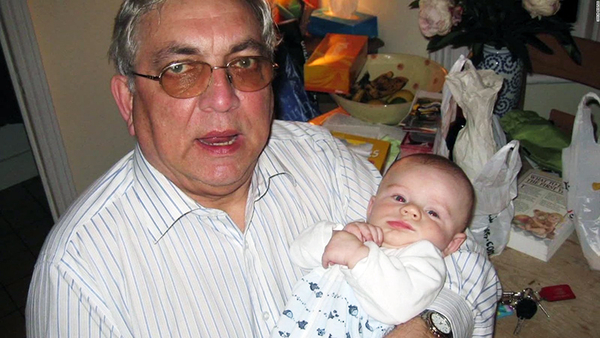
These cases are, finally, being noticed in a significant way, and being picked up in mainstream newspapers and media outlets. Now, there is a British case that has caught international attention. In recent days, Karl Andree, a 74-year-old grandfather and British citizen, who has been imprisoned in Saudi Arabia for the last year, is due to receive 350 lashes after being found guilty of the unpardonable crime of being caught with some homemade wine.

As his family back home in Britain have said in an appeal to Prime Minister David Cameron, it is likely that this sentence will kill Mr. Andree, who has already been weakened by cancer.

1310British citizen Karl Andree, a 74-year-old grandfather and cancer survivor, has been in a Saudi Arabian prison for the last year and is due to receive 350 lashes — all for the crime of possessing homemade wine.

It is significant that cases such as this, of routine Saudi barbarism, are finally causing a reaction. The UK and Saudi Arabia had agreed on a contract worth £5.9 million (USD $9.1 million) for the UK to train Saudi prison guards, but in recent days the UK government withdrew from this contract. The cause was a cabinet discussion in which the new British Justice Minister, Michael Gove, reportedly insisted that the UK could not possibly have such an agreement with Saudi Arabia. The two specific cases he is said to have highlighted were the case of Mr Andree and the case of Ali Mohammed Al-Nimr.

The Foreign Secretary is alleged to have disagreed with Mr. Gove, describing his views as “naïve.” But the Justice Minister, appropriately enough, prevailed. It is not Michael Gove, of course, who is naïve. The naïve Western leaders are those who expect our countries to carry on with “business as usual” with a regime that sentences our citizens — or anyone — to flogging, and that beheads and crucifies political dissidents.

The days of the secret awfulness of Saudi Arabia are long over. Now the routine abuses and atrocities of Saudi Arabia are rapidly moving from the blogosphere to the newspapers to the tables of cabinet with an unstoppable momentum. The naïve politicians are the ones who think the publics of the West do not know what a human rights sewer Saudi Arabia is, or think that, while knowing this, we in the West will all sit back and put up with it. If there were ever a time when this was the case, that time is over.

Saudis Sentence Brit to 350 Lashes for Possession of Wine

October 13, 2015

Saudis Sentence Brit to 350 Lashes for Possession of Wine, The Clarion Project, October 13, 2015

(The UN Human Rights Council, of which Saudi Arabia is the head, must be very proud of that splendid nation’s human rights achievements. — DM)

Karl-Andree-640-320Karl Andree, right. (Screenshot from video)

In a case that has recently become public, a British citizen was sentenced to 350 lashes and one year in jail by the Saudi regime after morality police found homemade wine in his car.

All alcohol is strictly prohibited in the Gulf kingdom which enforces sharia law as state law.

Karl Andree, 74, has already served the one year in prison. The sharia court which sentenced him mandated that the flogging would occur at the end of his prison time and in public.

Andree is in poor health, and it is not believed he will survive the flogging. He is being held in Jeddah’s Briman prison. Prior to his arrest he was an oil executive who worked in Saudi Arabia for 25 years.

His three children, Hugh, 46, Kirsten, 45, and Simon, 33, have now gone public with the story, though the incident took place last year in the port city of Jeddah. They are now calling on UK Prime Minister David Cameron to intervene with Saudi Arabia to secure his release.

“Our father has given 25 years of his working life to Saudi Arabia, and this is how he is treated” they said in a statement reported by The Sun. “Until his arrest, he has always been happy working there and felt safe.”

“He is 74 years of age, has had cancer three times and his wife is dying in a home in the UK. He now needs medical care for his cancer and asthma, and there is no doubt in our mind that 350 lashes will kill him. We implore David Cameron to personally intervene and help get our father home. The Saudi government will only listen to him.”

Saudi Arabia has recently drawn fire for its appalling human rights record, with two cases in particular causing an international outcry:

  • Blogger Raif Badawi was sentenced to ten years in prison and 1,000 lashes for running a website critical of the government. The sentence was upheld by an appeals court in June, leaving him no further legal recourse other than a royal pardon. He received the first batch of 50 lashes in January, which incapacitated him. The rest have been temporarily postponed due to his ill health and an international outcry.
  • Human rights activist, Ali Mohammed al-Nimr, now 21, was sentenced to beheading and crucifixion for taking part in pro-democracy protests during the Arab Spring in 2011 when he was just 17.


What could a “harsh” Iranian reaction to Riyadh constitute?

October 10, 2015

What could a “harsh” Iranian reaction to Riyadh constitute? Al-MonitorAli Omidi, October 9, 2015

[A]s history has shown, a country’s desire to start a military campaign is not always logical. Iran might decide that no matter what, it must launch a military campaign against Riyadh in order to punish Saudi Arabia.

**********************

TEHRAN, Iran — Hundreds of Iranian pilgrims were killed in the Sept. 24 stampede in Mina, near Mecca. The incident was followed by Saudi negligence in reporting the situation on time, and failure to collaborate with Iranian authorities. This prompted Iran’s Supreme Leader Ayatollah Ali Khamenei to call on Saudi Arabia to apologize to the “Muslim world” and Iran. Ayatollah Khamenei also accused Riyadh of not fulfilling its obligations in returning the bodies of the Iranian pilgrims, and behaving “maliciously.” He further warned, “The slightest disrespect to tens of thousands of Iranian pilgrims in Mecca and Medina as well as the Saudi government’s refusal to fulfill its duties with regard to the transfer of the pure corpses [of those killed during the hajj] will elicit a harsh and tough reaction from Iran.”

Meanwhile, upon the Oct. 3 return of the bodies of 104 Iranian pilgrims, President Hassan Rouhani issued an additional warning. He said, “So far, our language has been one of brotherhood. When necessary, we have used the language of diplomacy; however, if needed, the language of authority will be used as well.”

Indeed, on the very same day, Maj. Gen. Mohammad Ali Jafari, the commander of the Islamic Revolutionary Guard Corps (IRGC), said, “The IRGC has prepared all its possible potentials in order to fulfill the will of the great leader of the Islamic Revolution and make the Saudi dynasty answer for the crimes it committed in Mina and restore the rights of the victims. We are ready and are awaiting orders.” Jafari added, “The Muslim World is tired of the Saudis’ betrayals and ignorance, which reminds us of Abu Lahab, including the massacre of the people of Yemen, displacement of the poor people of Syria, repression of the people of Bahrain, ethnic massacres in Iraq, creation of ethnic tension and support of terrorism. The Saudis shall melt in the anger of the Muslims.”

Lastly, former IRGC Cmdr. Mohsen Rezaei, who is also adviser to Ayatollah Khamenei, warned Riyadh, “Don’t play with fire, because the fire will burn you … don’t follow the example of Saddam [Hussein], who in the middle of the Iraq-Iran War had no way out.”

In response, Saudi Arabia has accused Iran of playing politics with the stampede. “I think the Iranians should think of more productive activities than to play politics with a tragedy that has befallen those people who were performing their most sacred religious duty,” Saudi Foreign Minister Adel al-Jubeir told the UN General Assembly. Mindful of the increasingly hostile rhetoric, the question arises of what the “harsh and tough reaction” that Iran has warned of could potentially constitute.

In general, harsh reaction translates into military action. Iran has just finished its negotiations with the six world powers over its nuclear program, and thus considers itself to be in a stronger position. Separately, Iran also assesses that Saudi Arabia is in a desperate situation in Yemen. Therefore, in the case of a possible military confrontation with Saudi Arabia, there are several scenarios that Tehran could consider:

    • A ground campaign. For this kind of campaign to be possible, Iran would need to cross both Iraq and Kuwait. Neither of these countries will allow Iran to enter their territory in order to attack Saudi Arabia. Therefore, this option is not on the table. In addition, such a military campaign requires a large and well-equipped army as well as logistical, financial and economic abilities enjoyed by a superpower. Iran is only considered a mid-level power in the region. There is also the historical example of the US reaction to Iraq’s 1991 invasion of Kuwait for Iran to consider.


    • A naval campaign. This would mean that Iran has to travel a distance of 200 miles to reach the eastern coast of Saudi Arabia. Such a campaign is impossible considering the Iranian armed forces’ lack of strategic depth vis-a-vis Saudi Arabia, as the latter has the advantage of controlling the sea from land.


    • Supporting allies in proxy wars. This would mean that Iran will, more determinedly than ever, support Syrian President Bashar al-Assad in his fight against opposition forces. Tehran would also support Hezbollah against pro-Saudi elements of the Lebanese government, as well as in Israel, and the Houthis in Yemen. Of course, while supporting Hezbollah and Assad is possible and easy, it is more difficult to give military support to the Houthis since Yemen is under naval blockade. Moreover, UN Resolution 2216 forbids provision of military support to the Houthis. Iran can, however, achieve this goal via smugglers and private contractors.


    • Restricting Saudi access to the Strait of Hormuz. Considering Iran’s familiarity with the Strait of Hormuz and the military advantages that it enjoys in this regard, this option is possible. The problem, however, is that this scenario can lead to a battle of tankers, as it did toward the end of the 1980-88 Iran-Iraq War. Indeed, Saudi ships could be prompted to raise a third party flag. In addition, this scenario will give an excuse to world powers to increase their military presence in the Persian Gulf, which runs counter to Iran’s objectives.


    • Destroying the bridge that connects Saudi Arabia to Bahrain. The King Fahd Causeway, which is 25 kilometer (15.5 miles) long, was used for the first time in December 1986. If the bridge is destroyed by high-explosives missiles from the air, the Saudi military support for Bahrain is likely to decrease, which will in turn weaken the Bahraini regime. If such an attack is carried out, and Iran at the same time manages to provide opposition groups in Bahrain with logistic and military support, the Bahraini regime is likely to collapse. However, considering that the United States maintains a military presence in Bahrain, it is not possible for Iran to conduct a direct military campaign against Bahrain.


    • Supporting the Shiite population of Qatif, in Saudi Arabia’s Eastern Province, with the condition that in case of receiving military and logistic support, the Shiites of Saudi Arabia will rebel with the aim of toppling the Saudi government. Considering that Saudi Arabia has built a very long wall on its border with Iraq, and also considering the distance between the Shiite-inhabited region of Saudi Arabia and Iran, this is hardly a probable option. In addition, there are doubts about whether Saudi Shiites will in fact rebel against their government if provided with such support.


  • Firing missiles at Saudi Arabia. As Iran is equipped with multiple types of missiles, it can hit a variety of targets inside Saudi Arabia. Since Saudi Arabia does not have the necessary infrastructure for an effective air defense, such as an Iron Dome, an Iranian missile attack will be effective. The problem, however, is that in such a scenario, Saudi Arabia and its allies will destroy Iran’s oil infrastructure in retaliation.

Considering the options above, and existing limitations, any “harsh” response on the part of Iran will likely be limited to options three through six above. Of course, in case of any kind of confrontation between Iran and Saudi Arabia, all the Arab states of the Persian Gulf — minus Oman — and more than likely the United States and Israel, will offer their complete support to Saudi Arabia. Nevertheless, as history has shown, a country’s desire to start a military campaign is not always logical. Iran might decide that no matter what, it must launch a military campaign against Riyadh in order to punish Saudi Arabia. It is therefore more beneficial, for both Iran and Saudi Arabia, to solve their problems via diplomatic means. However, the current exchange of harsh words between Saudi and Iranian officials shows that the situation will either get critical, or the current cold war will continue.


Egypt’s secular culture minister ruffles Salafi feathers

October 7, 2015

Egypt’s secular culture minister ruffles Salafi feathers, Al-MonitorRami Galal, October 6, 2015

(Building a secular Muslim state in a region dominated by Islamists is difficult and takes time, as Egypt and Al-Sisi are learning. — DM)

helmiEgypt’s newly appointed Culture Minister Hilmi al-Namnam appears on the Egyptian talk show 25/30, Nov. 11, 2014. (photo by youtube.com/ONtv)

CAIRO — On Sept. 19, a new Egyptian Cabinet, headed by Prime Minister Sherif Ismail, was sworn in before President Abdel Fattah al-Sisi. Among the new ministers is the journalist Hilmi al-Namnam, who holds the culture portfolio. The appointment of Namnam, a secularist, has sparked controversy among Egyptian Salafis and aroused opposition in Saudi Arabia. Such Saudi writers and intellectuals as Jamal Khashoggi, editor-in-chief of Al-Arab News Channel, object to Namnam’s appointment because he opposes Wahhabi Salafism, the religiopoliticial movement that originated in the Nejd region of the Saudi kingdom.

Muhammad ibn Abd al-Wahhab founded what became the Wahhabi movement in the 18th century. In 1744, Wahhab allied with Muhammad ibn Saud, emir of the Nejd and founder of the first Saudi state, to increase followers of the Quran, Sunnism and the words and actions of the Salaf, the first three generations of Muslims. In doing so, they sought to purify Islam of misguided practices negatively affecting the Islamic essence of unity and various forms of heresy.

Immediately after Namnam assumed the culture portfolio, a video of him from July 2013 went viral. In it, Namnam stated, “The political Islam current must leave the political game completely, especially the Salafist Nour Party, which is more dangerous than the Muslim Brotherhood.” He compared the Nour Party to a “whore who extorts her husband if he doesn’t fulfill her demands by escorting someone else.” Namnam also said, “We lie when we say Egypt is a naturally religious country. It is high time we said Egypt is a naturally secular state.”

The Nour Party came in second in the 2012 parliamentary elections. Among its positions at the time were prohibitions on electing women and Copts, saluting the flag and singing the national anthem. The party altered these platforms, however, after lending its stamp of approval in 2013 to the June 30 revolution, although most of its leading figures waivered over what course to take.

On Sept. 19, Shaaban Abdel Aleem, a member of the Nour Party’s board, requested information on the selection criteria used for appointing the new ministers. On the same day, Khashoggi, who is close to Saudi decision-makers, commented on Namnam’s appointment via Twitter. “For whoever is planning mutual cultural exchanges with our brothers in Egypt, the following piece of information could be useful: Namnam is not only a critic of Wahhabism, but abhors it and blames it for all his country’s catastrophes,” Khashoggi tweeted. In a separate tweet, he wrote, “Honestly, for the sake of relations between Saudi Arabia and Egypt, and due to the nature of the regime there, Egypt should not appoint a minister like Namnam, who has taken it too far in offending the kingdom.”

Namnam responded that evening in a phone call to “Al-Ashera Masaa,” a show on Dream TV, saying, “I did not say Wahhabism was the mother of vices. These are not my words, but I am against terrorist groups in general.” He added that he had criticized “attempts to export Wahhabism to Egypt,” but that he “respects the kingdom’s choices, just as the kingdom’s writers should respect Egypt and Egyptians’ choices.”

Khashoggi immediately replied, again on Twitter, writing, “Egypt’s minister of culture claims he respects Wahhabism, but admits that he is against exporting it to Egypt. I would like to tell him that Wahhabism cannot be exported. It is a pillar of the Egyptian revolution and is represented by emblematic figures like the followers of Sheikh Muhammad Abduh.” The Islamic jurist Abduh, an Egyptian, is a founder of Islamic modernism. He spearheaded the movement at the end of the 19th century, beginning of the 20th century to counter intellectual and cultural stagnation and revive the Islamic nation in line with the times.

Khashoggi argued, “Salafism preceded the Muslim Brotherhood in Egypt, as there was the Ansar al-Sunna al-Muhammadiyah group, which remains the oldest reformist Islamic organization in Egypt and the world.” Ansar al-Sunna al-Muhammadiyah seeks absolute unity and the rejection of superstitions and cults. It began in Cairo’s Hadara Mosque in 1926. Many Al-Azhar scholars and Salafist preachers were welcoming of it.

On Oct. 2, tensions escalated when Namnam said during an interview on the Sada al-Balad channel that he was ready to be “martyred to spare Egypt from turning into a caliphate state.” He added that secularism is not the adversary of Islam, as some claim. “Every moderate Muslim is necessarily secular. But, not every secularist is a Muslim,” he said.

The following day, Yasser Borhami, deputy leader of the Salafist Call, implored Sisi to intervene and forbid Namnam from making such statements, which he said contradict the constitution given that Sharia is the primary source of legislation.

Nour Party leader Younes Makhyoun entered the fray Oct. 3, asserting that Namnam should remain impartial or be dismissed. “The person [Sisi] who appointed this minister must oblige him to respect the constitution,” he stated.

Sayyed Mustafa, deputy chair of the Nour Party, told Al-Monitor, “The party did not look into Namnam’s old opinions, because they stem from personal freedom. Each person has the right to believe whatever they wish. But he must realize that he is the minister of culture for 90 million Egyptians. The Ministry of Culture should represent all currents, not just one, be it secular or nonsecular.” He added, “As a minister handling a political portfolio, Namnam must take into consideration Egypt’s foreign relations in general and brotherly relations in particular, like those it shares with Saudi Arabia.”

Zubeida Atta, former dean of Helwan University’s faculty of arts and a member of the Supreme Council of Culture, has a different perspective on the issue. “The concept of secularism that Namnam called for is not a heretical one. It relies on the use of education and its application in countries to improve them and ensure their civil aspects, instead of mixing religion with political life. The latter [mixing of the two] would send Egypt down a sectarian abyss that would threaten its existence,” she told Al-Monitor. “The Nour Party demanded clarifying the selection criteria of ministers. I demand clarifying the criteria that allow such a religious party to participate in political life and in parliamentary elections.”

As for the rumblings from the Gulf, Atta asserted, “Egypt does not dare suggest a Saudi Arabian minister for a certain ministry in the kingdom or criticize a current minister in the Saudi Arabian regime, because this is an internal Saudi Arabian matter. Why is Khashoggi, among others, allowing himself to interfere in the appointment of a minister in the Egyptian Cabinet?”


IRGC Ready for Rapid, Tough Response to Al Saud: Commander

October 3, 2015

IRGC Ready for Rapid, Tough Response to Al Saud: Commander, Tasnim News Agency, October 3, 2015

(Iranian rhetoric sounds increasingly like North Korea’s, but is all mere rhetoric? Does the IRGC commander actually contemplate military action against Saudi Arabia? — DM)

139209140106248561674533

Elsewhere in his comments, the IRGC commander pledged that his forces “will take revenge from the Al Saud for the terrible crime.”

***********************

TEHRAN (Tasnim) – Commander of the Islamic Revolution Guards Corps (IRGC) Major General Mohammad Ali Jafari said his forces are ready to show rapid and harsh reaction to make Saudi Arabia accountable after the Kingdom’s mismanagement of Hajj claimed the lives of hundreds of Iranian pilgrims.

Speaking on the sidelines of a military meeting on Saturday, the senior commander underlined that the IRGC enjoys “all possible capacities for Iran’s rapid and tough reaction” to Al Saud and for obliging the monarchy to accept responsibility for the terrible disaster.

On September 24, a crush of pilgrims in Mina, near Mecca, killed around 4,700 people, including 464 Iranians.

Major General Jafari said the IRGC is fully prepared to act under orders from Supreme Leader of the Islamic Revolution Ayatollah Seyed Ali Khamenei.

Back on Wednesday, Ayatollah Khamenei warned Riyadh that any disrespect for the Iranian Hajj pilgrims or its failure to repatriate the bodies of those killed in the Mina crush will draw Iran’s “severe and tough reaction”.

Following the straightforward warning, Saudis began to cooperate with the Iranian officials and have repatriated bodies of some of the victims.

Elsewhere in his comments, the IRGC commander pledged that his forces “will take revenge from the Al Saud for the terrible crime.”

If necessary, the general underscored, the IRGC is firmly and powerfully ready to take any action, in any region and at any time, to protect the dignity of Muslims, particularly to defend the honor of the Iranian people in the face of “oppressive and ignorant rulers of Al Saud.”

Ayatollah Khamenei had announced that Iran has had respect for fraternity in the Islamic world up to now, showing self-restraint and Islamic politeness.

“However,” the Leader had noted, “they (Saudis) should know that the slightest disrespect for tens of thousands of Iranian pilgrims in Mecca and Medina and failing in their duties to transfer the holy bodies (of pilgrims to Iran) will result in Iran’s severe and tough reaction.”

The Moscow-Washington-Tehran Axis of Evil

October 3, 2015

The Moscow-Washington-Tehran Axis of Evil, Canada Free PressCliff Kincaid, October 3, 2015

(I am not posting this because I currently accept its conclusions or some of their bases. However, it’s frightening, interesting and has at least some food for thought. — DM)

KINCAID100315

The conventional wisdom is that Vladimir Putin has blindsided Barack Obama in the Middle East, catching the U.S. off-guard. It’s another Obama “failure,” we’re told. “Obama administration scrambles as Russia attempts to seize initiative in Syria,” is how a Washington Post headline described it. A popular cartoon shows Putin kicking sand in the faces of Obama and Secretary of State John Kerry on a beach.

The conventional wisdom is driven by the notion that Obama has the best of intentions but that he’s been outmaneuvered. What if his intention all along has been to remake the Middle East to the advantage of Moscow and its client state Iran? What if he knows exactly what he’s doing? Too many commentators refuse to consider that Obama is deliberately working against U.S. interests and in favor of the enemies of the U.S. and Israel.

In his U.N. address, Obama said, “As President of the United States, I am mindful of the dangers that we face; they cross my desk every morning. I lead the strongest military that the world has ever known, and I will never hesitate to protect my country or our allies, unilaterally and by force where necessary.”

This is laughable. We still have a strong military, but the inevitable conclusion from what’s recently transpired is that he doesn’t want to protect the interests of the U.S. or its allies in the Middle East. This is not a “failure,” but a deliberate policy.

The trouble with conventional wisdom is the assumption that Obama sees things the way most Americans do. In order to understand Obama’s Middle East policy, it is necessary to consult alternative sources of news and information and analysis. That includes communist news sources.

A fascinating analysis appears in the newspaper of the Socialist Workers Party, The Militant, one of the oldest and most influential publications among the left. You may remember the old photos which surfaced of Lee Harvey Oswald selling copies of The Militant before he killed the American president.

The headline over The Militant story by Maggie Trowe caught my eye: “‘Reset’ with US allows Moscow to send arms, troops to Syria.” It was not about Hillary Clinton’s reset with Moscow years ago, but a more recent one.

Here’s how her story began: “Moscow’s rapid military buildup in Syria is a result of the ‘reset’ in relations forged with the Russian and Iranian governments by the Barack Obama administration. The deal—reshaping alliances and conditions from Syria, Iran and the rest of the Middle East to Ukraine and surrounding region—is the cornerstone of U.S. imperialism’s efforts to establish a new order in the Mideast, but from a much weaker position than when the now-disintegrating order was imposed after World Wars I and II.”

Of course, the idea that “U.S. imperialism” is served by giving the advantage to Russia and Iran is ludicrous. Nevertheless, it does appear that a “reset” of the kind described in this article has in fact taken place. The author writes about Washington’s “strategic shift to Iran and Russia” and the “downgrading” of relations with Israel and Saudi Arabia. She notes that Moscow “seeks more influence and control of the country [Syria] and its Mediterranean ports and a stronger political hand in Mideast politics.” Iran “has sent Revolutionary Guard Quds forces to help prop up Assad, and collaborates with Moscow on operations in Syria,” she notes.

It is sometimes necessary to reject the conventional wisdom and instead analyze developments from the point of view of the Marxists, who understand Obama’s way of thinking. They pretend that Obama is a pawn of the “imperialists” but their analysis also makes sense from a traditional pro-American perspective. Those who accept the evidence that Obama has a Marxist perspective on the world have to consider that his policy is designed to help Moscow and Tehran achieve hegemony in the region.

At the same time, the paper reported, “Since Secretary of State John Kerry’s congenial visit with Putin in May, it has become clear that Washington would accept Moscow’s influence over its ‘near abroad’ in Ukraine and the Baltics, in exchange for help to nail down the nuclear deal with Tehran.” Hence, Obama has put his stamp of approval on Russian aggression in Europe and the Middle East. This analysis, though coming from a Marxist newspaper, fits the facts on the ground. It means that more Russian aggression can be expected in Europe.

The wildcard is Israel and it looks like the Israeli government is being increasingly isolated, not only by Obama but by Putin. The story notes that Israeli Prime Minister Benjamin Netanyahu met with Putin in Moscow on September 21, saying his concern was to “prevent misunderstandings” between Israeli and Russian troops, since Israel has carried out airstrikes in Syrian territory targeting weapons being transported to the Iranian-backed Hezbollah terrorists in Lebanon.

Some reports indicated that Israel had set up a joint mechanism with the Russian military to coordinate their operations in Syria.

However, the Russian leader reportedly told Obama during their U.N. meeting that he opposes Israeli attacks in Syria. The Israeli newspaper Haaretz ran a story that Russia intends to “Clip Israel’s Wings Over [the] Syrian Skies.” The paper added that Putin’s remarks to Obama showed that despite Netanyahu’s meeting with Putin in Moscow, “Russia intends to create new facts on the ground in Syria that will include restricting Israel’s freedom of movement in Syrian skies.”

It hardly seems to be the case that Obama has been outsmarted in the Middle East, or that Putin and Obama don’t like each other. Instead, it appears that Obama is working hand-in-glove with Putin to isolate Israel and that Obama is perfectly content to let the former KGB colonel take the lead.

Israel has always been seen by most U.N. members as the real problem in the region. Obama is the first U.S. President to see Israel in that same manner and to act accordingly. This is why Putin has not caught Obama off-guard in the least. They clearly see eye-to-eye on Israel and Iran.

Don’t forget that Obama actually telephoned Putin to thank him for his part in the nuclear deal with Iran. The White House issued a statement saying, “The President thanked President Putin for Russia’s important role in achieving this milestone, the culmination of nearly 20 months of intense negotiations.”

Building off the Iran nuclear deal, it looks like the plan is for Russia and the United States to force Israel to embrace a U.N. plan for a nuclear-free Middle East. That would mean Israel giving up control of its defensive nuclear weapons to the world body. Iran will be able to claim it has already made a deal to prohibit its own nuclear weapons development.

Such a scheme was outlined back in 2005 in an article by Mohamed Elbaradei, the director-general at the time of the U.N.‘s International Atomic Energy Agency (IAEA). That’s the same body that is now supposed to guarantee Iranian compliance with the terms of the nuclear deal signed by Russia and the U.S.

Elbaradei argued there would have to be “a dialogue on regional security as part of the peace process,” to be followed by an agreement “to make the Middle East a nuclear-weapons-free zone.”

The “dialogue” appears to be taking place now, mostly under the authority and auspices of the Russian government, with President Obama playing a secondary role.

The obvious danger is that Israel would be forced to comply with the plan for a “nuclear-weapons-free-zone,” while Iran would cheat and develop nuclear weapons anyway.

Netanyahu told the U.N. that “Israel deeply appreciates President Obama’s willingness to bolster our security, help Israel maintain its qualitative military edge and help Israel confront the enormous challenges we face.”

This must be his hope. But he must know that Israel’s security is slipping and that the survival of his country is in grave danger in the face of this Moscow-Washington-Tehran axis.

Before Putin further consolidates his military position in the Middle East and Iran makes more progress in nuclear weapons development, Netanyahu will have to launch a preemptive strike on the Islamic state. “Israel will not allow Iran to break in, to sneak in or to walk in to the nuclear weapons club,” the Israeli Prime Minister said.

In launching such a strike before the end of Obama’s second presidential term, Israel would bring down the wrath of the world, led by Russia and the U.S., on the Jewish state.