Archive for the ‘P5+1’ category

Iran: Nuclear Deal Will Enable Support for Terrorism

August 26, 2015

Iran: Nuclear Deal Will Enable Support for Terrorism, Washington Free Beacon, August 25, 2015

Iranian Foreign Minister Mohammad Javad Zarif speaks at the New York University (NYU) Center on International Cooperation in New York April 29, 2015. REUTERS/Lucas Jackson Iranian Foreign Minister Mohammad Javad Zarif speaks at the New York University (NYU) Center on International Cooperation in New York April 29, 2015. REUTERS/Lucas Jackson

Multiple senior officials in recent days have said that the Iranian nuclear deal will help the Islamic Republic fund its global terrorist operations, including the financial backing of Hamas and other regional groups, according to a briefing by an Israeli intelligence group.

Iranian officials, speaking at multiple forums in recent days, stressed that the nuclear deal will embolden Iran’s support for its “regional allies” and that weapons and military support would continue to be delivered on the “resistance front,” according to a recent brief by the Meir Amit Intelligence and Terrorism Information Center.

The officials outlined Iran’s plan to bolster its global terrorism operation and stated that the recent nuclear deal between Tehran and global powers will do nothing to deter Iran’s pursuit of regional dominance.

Ali-Akbar Velayati, Supreme Leader Ali Khamenei’s adviser for international affairs, stated at a recent conference in Tehran that support for the “resistance front” is a top foreign policy objective.

The nuclear agreement, Velayati said, “would make it possible to increase Iran’s support for its regional allies,” according to recent comments noted in the brief. The official went on to say that “the situation of the resistance front had improved.”

Other senior Iranian officials have echoed these remarks.

Foreign Minister Javad Zarif, who led nuclear negotiations with the United States, recently travelled to Syria and Lebanon to announce Iran’s renewed support for Hezbollah and the embattled regime of President Bashar al-Assad in Syria, according to the brief.

Iran will “continue providing weapons to support the Middle Eastern countries fighting terrorism,” Zarif is quoted as saying by Iran’s state-controlled press.

In light of the nuclear deal, Iran will “preserve its defensive capabilities and send weapons to its regional allies,” according to Zarif, who stressed that “without Iran and the weapons it provided to the countries fighting terrorism, the capital cities of the Middle East would have been occupied by” the Islamic State (IS, also known as ISIS or ISIL).

Iran also intends to boost its support for fighters in Yemen and Palestinian terrorist groups.

More than 70 members of the Iranian parliament, for instance, recently petitioned President Hassan Rouhani to increase “Iranian support for the regional resistance front after the nuclear agreement,” according to the report.

“They called on the president to use the ministries of defense and foreign affairs to send aid to the Palestinians in accordance with instructions from the Supreme Leader to arm the Palestinians in the West Bank,” the report notes.

Another senior Iranian national security official, Javad Karimi Qoddousi, demanded this month that “all the senior Iranian officials … support aid for the Palestinian people and the resistance front so that the nuclear agreement [is not] exploited to strengthen Israel’s security,” according to the brief.

These remarks have been accompanied by aggressive military moves by Iran, which has conducted multiple war drills in recent weeks and announced the upcoming launch of missiles, a move that could violate current United Nations Security Council resolutions barring such activity.

Iran appears to be attempting “to impress its allies with its commitment to continue supporting them even after the nuclear agreement with the West,” the Meir Amit center concluded in its brief. “The speeches of senior officials also reflected Iran’s approach to the rise and strengthening of ISIS and radical Sunni Islam.”

Iran also has committed itself to preventing the United States from gaining a foothold in the Middle East.

Iran will “not allow the United States to again extend its political influence in the region,” Velayati said in another recent interview. “Middle Eastern countries and people, led by Iran, had awakened and were standing firm” against America.

Senior Hamas officials have also disclosed in recent days that a delegation would soon be visiting Tehran.

Since the nuclear deal was secured, “relations between Hamas and Iran [have been] good,” according to these officials.

Cartoon of the day

August 26, 2015

H/t Vermont Loon Watch

choices

asdf

Why the US government is on track to ‘normalizing’ ISIS

August 25, 2015

Why the US government is on track to ‘normalizing’ ISIS, NY PostAlex VanNess, August 23, 2015

(That “normalizing” the Islamic State would be lunacy is itself a good argument that Obama will do it. — DM)

Photo: AP

How long will it take the United States to recognize the Islamic State as a legitimate actor?

That may sound ridiculous. After all, ISIS is a barbaric and sociopathic band of terrorists who proudly highlight their brutality over the Internet. Unfortunately, recent history suggests this doesn’t disqualify them, as horrific as it sounds, from eventual recognition.

Since before 9/11, the Taliban laid claim to numerous terror attacks on civilian populations throughout Afghanistan. They harbored Osama bin Laden, and since the beginning of Operation Enduring Freedom, they’ve been directly responsible for the deaths of more than 2,000 American troops.

Yet in January, White House Press Secretary Josh Earnest cryptically explained that the Taliban was not a terrorist group but instead falls under a “different classification.”

Earnest’s verbal gymnastics were deployed in the service of explaining away the president’s decision to trade five members of the Taliban for the release of American soldier-captive Bowe Bergdahl.

Hamas is an openly anti-Semitic terrorist organization that has claimed responsibility for the deaths of hundreds of innocent civilians, including several Americans. Since its creation, the Gaza-based Hamas has been dedicated to the destruction of Israel and the murder of Jews. Hamas is brutally repressive toward women and gays; they have a tendency to savagely drag dead bodies through the streets.

Last year, Palestinian President Mahmoud Abbas swore in a new unity government that incorporated Hamas-appointed ministers. Instead of cutting off financial support to the new government, as required by US law, the Obama administration jumped through hoops to legitimize the new government. Officials said they would continue supporting the Palestinian government because the new ministers were “technocrats” that “don’t represent . . . hard-core Hamas leadership.”

The legitimacy granted to Hamas by this administration is a reflection of the trend held by many pro-Palestinian protestors who now brazenly chant, “we are Hamas!” through the streets of US cities such as Miami.

Cuba has a long history of human-rights abuse. The Cuban government regularly harasses and imprisons dissidents and has been a state sponsor of terrorism for decades. Cuba continues to serve as a safe haven for terrorists and maintains close ties to both North Korea and Iran.

In 2013, Cuba was caught sending weapons to North Korea. It aids terrorist groups like the Revolutionary Armed Forces of Colombia, Iranian proxy Hezbollah and the Basque Fatherland of Liberty (ETA).

Despite this behavior, the administration still decided to take Cuba off the list of State Sponsors of Terrorism and has begun the process of normalizing the relationship between the United States and Cuba.

The State Department justified this removal by stating that “Cuba has not provided any support for international terrorism during the previous six-months” and citing vague promises that they “will not support acts of international terrorism in the future.”

So to recap, within this past year we have stopped referring to the Taliban as terrorists, provided de facto recognition and funding to Hamas and have opened up to the repressive terror-sponsoring Cuban government.

Why should we assume that ISIS will be treated any differently than these groups?

As each day passes, ISIS solidifies its presence in the region. Sure, ISIS commits terrible atrocities. The group regularly — and indiscriminately — beheads innocent people; rapes women and sells them as sex slaves and employs children as executioners.

But its leaders have undeniably been working to establish the Islamic State as, well, as a functioning state. They issue identification cards, pave roads, pick up trash, operate power stations and offer social-welfare programs.

ISIS has carved out its territory by filling the Middle East’s power vacuums, and are thus, in some places, the only game in town. How long before the international community recognizes the ISIS government?

The past precedent of legitimizing various terrorist groups and repressive dictatorships make this all too real of an issue. It’s imperative that the United States stops this trajectory of providing legitimacy to these regimes and turns back the ISIS tide, or we may one day soon be debating the opening of an embassy to the Islamic State in what used to be Iraq.

Alex VanNess is the manager of public information for the Center for Security Policy.

Obama’s end-run around the Nuclear Non-Proliferation Treaty

August 25, 2015

Obama’s end-run around the Nuclear Non-Proliferation Treaty, Power LinePaul Mirengoff, August 25, 2015

In an article for Forbes, Harold Furchtgott-Roth argues that President Obama’s executive agreement with Iran violates and/or modifies the Nuclear Non-Proliferation Treaty of 1969. Thus, it cannot lawfully take effect without true congressional approval (as opposed to the process established by the Corker-Cardin legislation). Furchtgott-Roth’s article appeared about a month ago, but has only recently come to my attention.

It is axiomatic, I should think, that an executive agreement cannot supersede a treaty. As Furchtgott-Roth explains, treaties are the law of the land and have the status of federal statutes. As such, they cannot be overridden by executive action.

The Iran deal is not a treaty, nor is it a statute. It will not even muster the level of congressional support sufficient to enact a statute.

To be sure, Congress through the Corker-Cardin legislation agreed to process by which the Iran deal could take effect with less than majority support. It did so before it had seen the terms of the deal. Thus, says Furchtgott-Roth, it had no reason to believe that the terms would violate the Nuclear Non-Proliferation Treaty. Indeed, the public statements of John Kerry indicated that there would be no clash.

In any event, the Corker-Cardin bill established a process to review an executive order, not a treaty amendment. I doubt that Congress can bind itself in advance (or at all) to a process to create or amend a treaty that differs from the one established by the Constitution.

The question thus becomes whether the Iran deal modifies the Nuclear Non-Proliferation Treaty. Furchtgott-Roth presents a good case that it does:

1. Under Article I of the NPT, “Each nuclear-weapon State Party to the Treaty [US] undertakes … not in any way to assist, encourage, or induce any non-nuclear weapon State [Iran] to … otherwise acquire nuclear weapons or other nuclear explosive devices, or control [ICBMs] over such weapons or explosive devices.”

Yet the entire Iran Deal is a road map for Iran to obtain devices that provide “control over such weapons or explosive devices.” The Iran Deal lifts embargoes on missiles that could be used for nuclear weapons. The deal ends prohibitions on nuclear weapons after a fixed number of years. The deal gives access to Iran to hundreds of billions of dollars immediately, all or part of which can finance the acquisition of nuclear weapons or related components.

Thus the Iran Deal modifies or violates U.S. responsibilities under Article I of the NPT.

2. Under Article II of the NPT:

“Each non-nuclear-weapon State Party to the Treaty undertakes not to receive the transfer from any transferor whatsoever of nuclear weapons or other nuclear explosive devices or of control over such weapons or explosive devices directly, or indirectly; not to manufacture or otherwise acquire nuclear weapons or other nuclear explosive devices; and not to seek or receive any assistance in the manufacture of nuclear weapons or other nuclear explosive devices.”

Yet there is nothing in the Iran Deal that limits its ability ultimately to obtain nuclear weapons and various related control devices such as ICBMs. The Iran Deal merely places a timeline on that acquisition. The Iran Deal modifies Article II of the NPT.

3. Under Article III of the NPT:

“Each non-nuclear-weapon State Party to the Treaty undertakes to accept safeguards, as set forth in an agreement to be negotiated and concluded with the International Atomic Energy Agency in accordance with the Statute of the International Atomic Energy Agency and the Agency’s safeguards system, for the exclusive purpose of verification of the fulfillment of its obligations assumed under this Treaty with a view to preventing diversion of nuclear energy from peaceful uses to nuclear weapons or other nuclear explosive devices.”

The Statute of the IAEA. . .states. . .:

[T]he Agency [IAEA] shall have the … responsibilities…To send into the territory of the recipient State or States inspectors, designated by the Agency after consultation with the State or States concerned, who shall have access at all times to all places and data and to any person who by reason of his occupation deals with materials, equipment, or facilities which are required by this Statute to be safeguarded…

Press accounts suggest that the Iran Deal does not provide for IAEA inspection “at all times to all places and data and to any person…” Partly, there is a 24-day notice and review requirement before any inspection. That is inconsistent with the NPT. Neither the Iran Deal nor press accounts indicate that IAEA inspection will be “at all times to all places.”

The Iran Deal modifies Article III of the NPT.

4. Article VIII of the NPT provides in detail a method to modify and amend the NPT. That is not the process used for the Iran Deal. Thus the Iran Deal modifies or violates U.S. responsibilities under Article VIII of the NPT. . . .

Assuming that this analysis is sound, i.e., that Obama’s deal modifies a treaty, the questions become: what can Congress do about it and what is Congress prepared to do?

I doubt that Congress is prepared to abandon the Corker-Cardin procedure. To my knowledge, there has been no sign of willingness to do so in the month since Furchtgott-Roth’s article appeared.

I also believe that if Congress did ditch Corker-Cardin and treated the deal as a treaty amendment (two-thirds vote needed in the Senate; no vote in the House), Obama would thumb his nose at Congress and proceed to implement his deal.

Traitor senators took money from Iran lobby, back Iran nukes

August 25, 2015

Traitor senators took money from Iran lobby, back Iran nukes, Front Page Magazine, Daniel Greenfield, August 25, 2015

em

Senator Markey has announced his support for the Iran deal that will let the terrorist regime inspect its own Parchin nuclear weapons research site, conduct uranium enrichment, build advanced centrifuges, buy ballistic missiles, fund terrorism and have a near zero breakout time to a nuclear bomb.

There was no surprise there.

Markey had topped the list of candidates supported by the Iran Lobby. And the Iranian American Political Action Committee (IAPAC) had maxed out its contributions to his campaign.

After more fake suspense, Al Franken, another IAPAC backed politician who also benefited from Iran Lobby money, came out for the nuke sellout.

Senator Jeanne Shaheen, the Iran Lobby’s third Dem senator, didn’t bother playing coy like her colleagues. She came out for the deal a while back even though she only got half the IAPAC cash that Franken and Markey received.

As did Senator Gillibrand, who had benefited from IAPAC money back when she first ran for senator and whose position on the deal should have come as no surprise.

The Iran Lobby had even tried, and failed, to turn Arizona Republican Jeff Flake. Iran Lobby cash had made the White House count on him as the Republican who would flip, but Flake came out against the deal. The Iran Lobby invested a good deal of time and money into Schumer, but that effort also failed.

Still these donations were only the tip of the Iran Lobby iceberg.

Gillibrand had also picked up money from the Iran Lobby’s Hassan Nemazee. Namazee was Hillary’s national campaign finance director who had raised a fortune for both her and Kerry before pleading guilty to a fraud scheme encompassing hundreds of millions of dollars. Nemazee had been an IAPAC trustee and had helped set up the organization.

Bill Clinton had nominated Hassan Nemazee as the US ambassador to Argentina when he had only been a citizen for two years.  A spoilsport Senate didn’t allow Clinton to make a member of the Iran Lobby into a US ambassador, but Nemazee remained a steady presence on the Dem fundraising circuit.

Nemazee had donated to Gillibrand and had also kicked in money to help the Franken Recount Fund scour all the cemeteries for freshly dead votes, as well as to Barbara Boxer, who also came out for the Iran nuke deal. Boxer had also received money more directly from IAPAC.

In the House, the Democratic recipients of IAPAC money came out for the deal. Mike Honda, one of the biggest beneficiaries of the Iran Lobby backed the nuke sellout. As did Andre Carson, Gerry Connolly, Donna Edwards and Jackie Speier. The Iran Lobby was certainly getting its money’s worth.

But the Iran Lobby’s biggest wins weren’t Markey or Shaheen. The real victory had come long before when two of their biggest politicians, Joe Biden and John Kerry, had moved into prime positions in the administration. Not only IAPAC, but key Iran Lobby figures had been major donors to both men.

That list includes Housang Amirahmadi, the founder of the American Iranian Council, who had spoken of a campaign to “conquer Obama’s heart and mind” and had described himself as “the Iranian lobby in the United States.” It includes the Iranian Muslim Association of North America (IMAN) board members who had fundraised for Biden. And it includes the aforementioned Hassan Nemazee.

A member of Iran’s opposition had accused Biden’s campaigns of being “financed by Islamic charities of the Iranian regime based in California and by the Silicon Iran network.” Biden’s affinity for the terrorist regime in Tehran was so extreme that after 9/11 he had suggested, “Seems to me this would be a good time to send, no strings attached, a check for $200 million to Iran”.

Appeasement inflation has since raised that $200 million to at least $50 billion. But there are still no strings worth mentioning attached to the big check.

Questions about donations from the Iran Lobby had haunted Kerry’s campaign. Back then Kerry had been accused of supporting an agreement favorable to Iran. The parameters of that controversial proposal however were less generous than the one that Obama and Kerry are trying to sell now.

The hypothetical debates over the influence of the Iran Lobby have come to a very real conclusion.

Both of Obama’s secretaries of state were involved in Iran Lobby cash controversies, as was his vice president and his former secretary of defense. Obama was also the beneficiary of sizable donations from the Iran Lobby. Akbar Ghahary, the former co-founder of IAPAC, had donated and raised some $50,000 for Obama.

It’s an unprecedented track record that has received very little notice. While the so-called “Israel Lobby” is constantly scrutinized, the fact that key foreign policy positions under Obama are controlled by political figures with troubling ties to an enemy of this country has gone mostly unreported by the mainstream media.

This culture of silence allowed the Iran Lobby to get away with taking out a full-page ad in the New York Times before the Netanyahu speech asking, “Will Congress side with our President or a Foreign Leader?”

Iran’s stooges had taken a break from lobbying for ballistic missiles to play American patriots.

Obama and his allies, Iranian and domestic, have accused opponents of his dirty Iran deal of making “common cause” with that same terror regime and of treason. The ugly truth is that he and his political accomplices were the traitors all along.

Democrats in favor of a deal that will let a terrorist regime go nuclear have taken money from lobbies for that regime. They have broken their oath by taking bribes from a regime whose leaders chant, “Death to America”. Their pretense of examining the deal is nothing more than a hollow charade.

This deal has come down from Iran Lobby influenced politicians like Kerry and is being waved through by members of Congress who have taken money from the Iran Lobby. That is treason plain and simple.

Despite what we are told about its “moderate” leaders, Iran considers itself to be in a state of war with us. Iran and its agents have repeatedly carried out attacks against American soldiers, abducted and tortured to death American officials and have even engaged in attacks on American naval vessels.

Aiding an enemy state in developing nuclear weapons is the worst form of treason imaginable. Helping put weapons of mass destruction in the hands of terrorists is the gravest of crimes.

The Democrats who have approved this deal are turning their party into a party of atom bomb spies.

Those politicians who have taken money from the Iran Lobby and are signing off on a deal that will let Iran go nuclear have engaged in the worst form of treason and committed the gravest of crimes. They must know that they will be held accountable. That when Iran detonates its first bomb, their names will be on it.

Cartoon of the day

August 24, 2015

H/t Vermont Loon Watch

inspect-this

The Iran deal and the Israeli veto

August 24, 2015

The Iran deal and the Israeli veto, Power LinePaul Mirengoff, August 23, 2015

(How long can Israel wait? Please see also, Thinking About the Unthinkable: An Israel-Iran Nuclear War and WHY IRAN IS NUCLEAR NOW. — DM)

CNN’s report thus raises this obvious question: Will Israel attack Iran now that the U.S. and its European allies are about to enter a deal that effectively grants Iran the right to become a nuclear power?

***********************

This weekend, CNN reported that in recent years, Israeli leaders planned three attacks on military targets in Iran. CNN bases this story on an audio recording with former Defense Minister (and one-time Prime Minister) Ehud Barak. The recording was leaked to an Israeli television station.

Why didn’t Israel carry through with the planned attacks? In the first case (2010), Israeli military leaders reportedly nixed the idea. The head of the Israeli Defense Force (IDF) simply didn’t believe the planned attack was “operational.”

In the second case (2011), the IDF signed off on an attack. However, two key ministers had doubts that could not be overcome.

In the third case (2012), the attack didn’t come off because of scheduling issues. Supposedly, the planned strike conflicted with a joint military exercise with the United States. The Israeli didn’t want to embarrass Washington by attacking Iran just as it was set to engage in the joint military exercise because this would give the appearance that the Americans were involved. (The explanation in CNN’s report for why the attack wasn’t rescheduled is garbled).

In all three instances, Prime Minister Netanyahu wanted to attack. In all three instances, Barak, who is not a member of Netanyahu’s party, concurred.

In none of these instances does it appear that President Obama’s obvious opposition to an Israeli attack on Iran was the dealbreaker, if CNN’s report is to be believed (though Obama’s views may have contributed to the two ministers getting cold feet in 2011).

CNN’s report thus raises this obvious question: Will Israel attack Iran now that the U.S. and its European allies are about to enter a deal that effectively grants Iran the right to become a nuclear power?

One might think not. The deal has the support of European governments eager to allow their businessmen to take advantage of Iranian markets. Here in the U.S., the deal is unpopular, but Obama considers it the main element of his foreign policy legacy.

There will be hell to pay if Israel upsets these expectations by attacking Iran.

But the more we learn about the farcical nature of this deal, the more Israel’s calculus may tilt in favor of an Israeli attack — if not in 2015 or 2016, then in 2017 when Obama is no longer president. After all, the hell Israel would pay if it attacks Iran must be weighed against the threat of a nuclear Iran. CNN’s report, if accurate, adds plausibility to the view that Israel sees the latter as more hellacious.

In a very real sense, then, the key people evaluating Obama’s deal aren’t U.S. Senators and Representatives, but rather Israeli generals, intelligence chiefs, and ministers. They are the ones who, effectively, can nullify the deal.

It seems to be that with every revelation of a major Obama/IAEA concession to the mullahs, the prospect that Israel will exercise its veto increases.

Thinking About the Unthinkable: An Israel-Iran Nuclear War

August 23, 2015

Thinking About the Unthinkable: An Israel-Iran Nuclear War, Amerian Thinker, John Bosma, August 23, 2015

(We live in “interesting times.” — DM)

The signing of a Munich-class agreement with Iran that hands it more than it ever hoped to pull off represents a shocking, craven American capitulation to an apocalyptic crazy state: a North Korea with oil. Nothing in Western history remotely approaches it, not even Neville Chamberlain’s storied appeasement of another antisemitic negotiating partner.

But it also augurs the possibility of a nuclear war coming far sooner than one could have imagined under conventional wisdom worst-case scenarios. Following the US’s betrayal of Israel and its de facto detente with Iran, we cannot expect Israel to copy longstanding US doctrines of no-first-nuclear-use and preferences for conventional-weapons-only war plans. After all, both were premised (especially after the USSR’s 1991 collapse) on decades of US nuclear and conventional supremacy. If there ever were an unassailable case for a small, frighteningly vulnerable nation to pre-emptively use nuclear weapons to shock, economically paralyze, and decapitate am enemy sworn to its destruction, Israel has arrived at that circumstance.

Why? Because Israel has no choice, given the radical new alignment against it that now includes the US, given reported Obama threats in 2014 to shoot down Israeli attack planes, his disclosure of Israel’s nuclear secrets and its Central Asian strike-force recovery bases, and above all his agreement to help Iran protect its enrichment facilities from terrorists and cyberwarfare – i.e., from the very special-operations and cyber forces that Israel would use in desperate attempts to halt Iran’s bomb. Thus Israel is being forced, more rapidly and irreversibly than we appreciate, into a bet-the-nation decision where it has only one forceful, game-changing choice — early nuclear pre-emption – to wrest back control of its survival and to dictate the aftermath of such a survival strike.

Would this involve many nuclear weapons? No – probably fewer than 10-15, although their yields must be sufficiently large to maximize ground shock. Would it produce Iranian civilian casualties? Yes but not as many as one might suppose, as it would avoid cities. Most casualties would be radiological, like Chernobyl, rather than thermal and blast casualties. Would it spur a larger catalytic nuclear war? No. Would it subsequently impel Russia, China and new proliferators to normalize nuclear weapons in their own war planning? Or would the massive global panic over the first nuclear use in anger in 70 years, one that would draw saturation media coverage, panic their publics into urgent demands for ballistic missile self-defense systems? Probably the latter.

The Iranian elite’s ideology and controlling political psychology is inherently preferential towards nukes and direct population targeting as a way to implement Shi’ite messianism and end-times extremism. Iran is a newly nuclear apocalyptic Shi’ite regime that ranks as the most blatantly genocidal government since the Khmer Rouge’s Sorbonne-educated leaders took over Cambodia in April, 1975. Senior Iranian officials have periodically tied nuclear war to the return of the Twelfth Imam or Mahdi, which Iran’s previous president anticipated within several years. This reflects not just the triumphalist enthusiasm of a new arriviste nuclear power that just won more at the table than it dared to dream. It also reflects a self-amplifying, autarchic end-days theology that is immune to both reality testing and to Western liberal/progressive tenets about prim and proper nuclear behavior.

Admittedly, Iranian leaders have lately resorted to envisioning Israel’s collapse in more restrained terms through Palestinian demographic takeover of the Israeli state and asymmetric warfare. Still there remains a lurid history of Iranian officials urging the elimination of Israel and its people, of allocating their nukes to Israeli territory to maximize Jewish fatalities, of Iranian officials leading crowds in chants of “Death to Israel!” Iran’s government also released a video game allowing players to target various kinds of Iranian ballistic missiles against Israeli cities – this as part of intensive propaganda drumming up hatred of Jews. A more recent video game envisions a massive Iranian ground army marching to liberate Jerusalem. In all, Iran’s official stoking of genocidal Jew hatred is far beyond what Hitler’s government dared to advocate before the 1939 outbreak of World War 2.

The deliberate American silence over Iran’s genocidal intentionality sends an unmistakable signal to Israel that the US no longer recognizes a primordial, civilizational moral obligation to protect it from the most explicit threats imaginable. It is truly on its own, with the US in an all-but-overt alliance with its worst enemy. The shock to Israel’s leaders of this abrupt American lurch into tacitly accepting this Iranian intentionality cannot be understated. Iran is violating the core tenets of the 1949 Geneva Conventions, a US initiative after the Tokyo and Nuremberg war-crimes trials to codify genocide as a crime against humanity. Now the US is silent.

But this shift is also recent. Every US government prior to President Obama would have foresworn nuclear talks with such a psychopathic regime or would have walked out in a rage upon such utterances. Yet Iran’s genocidal threats have had no discernible effect on Obama’s canine eagerness for a deal. It’s as if 75 years ago a US president had cheerfully engaged in peace talks with Hitler and his SS entourage despite learning the details of the Nazis’ secret Wannsee Conference where Hitler signed off on the Final Solution for the Jews. But whereas Hitler had the sense in that era to keep that conclave secret, Iran’s Wannsee intentionality toward Israel and world Jewry has for years been flamboyantly rude-and-crude and in-your-face. That this Iranian advocacy of a second Holocaust drew no objection from the US negotiators of this deal should make moral pariahs out of every one of them – including our president and Secretary of State.

These two factors alone, especially the abrupt evaporation of the US’s ultimate existential bargain with Israel through Obama’s de facto alliance with the mullahs, would drive Israel to the one attack option it can unilaterally use without running short of munitions and experiencing the massive US coercion embedded in that dependence. But there are other reasons why early Israeli nuclear pre-emption is not only justified but almost mandatory.

First, it is too late to stop Iran’s bomb-making momentum with conventional weapons or sanctions. That nation’s science and technology base is robust and improving. It has learned to domestically produce high-performance gas centrifuges whose uranium gas output is such that smaller numbers of them are needed for breakout. The US spent decades and many billions at labs like Oak Ridge National Laboratory on composites, software-controlled magnetic bearings, gas flow separations, thermal controls and ultra-precision manufacturing for these thin-wall, very-high-speed devices. Yet Iran has come up the centrifuge learning curve with surprising speed. Its metallurgists are familiar with a novel aluminum forging method that may yield nanophase aluminum shells so strong that they approach the centrifugal strength usually associated with more demanding composite-shell gas centrifuges. Also, Iran’s bomb engineering and physics can tap the sophisticated bomb designs and re-entry vehicle (RV) skills of North Korea, which is reducing the weight and mass of its H-bombs to fit on ballistic missiles and whose collaboration with Iran reportedly included Iranian technicians at North Korean bomb tests.

Other technology sources in the Nuclear Bombs R Us cartel for wannabe proliferators set up by rogue nuclear scientist A.Q. Khan of Pakistan include China, Russia and Pakistan. Worst of all, under the US-Iran deal, Iran’s ballistic missiles can improve their reliability, accuracy, throw-weight and their post-boost RV-release thrusters.

Second, Iran’s underground nuclear targets are likely harder than American and Israeli hard-target munition (HTM) developers have assumed. Why? Because Iranian engineers have perfected the world’s toughest concrete, developing mixtures using geopolymers, quartz powders (called fume) and metal and ceramic fibers. The result is hardness levels reportedly up to 50,000-60,000 psi in experimental samples. This means that even shallow “cut and cover” hard targets like the Natanz centrifuge enrichment plant, an armored complex in an excavated pit that is then covered, can resist destruction by the US’s most lethal hard-target bomb: the 30,000-lb “Massive Ordnance Penetrator.” Only the B-2 and the B-52 can carry the MOP. Yet while the MOP can penetrate ~200 ft into 5000-psi targets, it only reaches 25 feet into 10,000-psi concrete – and Iranian cement for new or up-armored underground bunkers has likely progressed well beyond that.

US and Israeli HTM alternatives include staged-warhead penetrators and – high on the wish list – novel energetic chemistries with orders-of-magnitude more power than current HTMs. Tactical HTMs with up to four sequential warheads use precursor warheads to blast an initial opening for larger follow-through charges to destroy tanks, fortifications and bridge piers. But these impact at slow speeds compared to what’s needed to kill deep hard targets. The latter need superhard casings (probably single-crystal metals) and packaging to keep their sequenced charges intact during violent impacts of thousands of feet/second (fps). One benchmark is the Department of Energy’s Sandia lab’s success years ago in firing a simulated hard-target RV into rock at 4400 fps. Similarly, reactive-material (RM) munitions and next-generation HEDM (high-energy-density material) explosives and energetic chemistries with orders-of-magnitude more power look promising for the future. But these require years of iterative fly-redesign-fly testing to assure they’ll survive impact with their deep targets.

Bottom line: with even the US’s best non-nuclear HTMs marginal against Iran’s critical deep targets, Israel’s HTMs probably wouldn’t do the job either, being lower in kinetic energy on target. Alternatives like using HTMs to destroy entrances to such targets and ventilation shafts may work – but unless Iranian military power and recovery are set back months or years, this damage would be repaired or worked round. Moreover, nuclear facilities tunneled into mountains would be almost impossible to destroy with conventionals.

Still, the brains behind Iran’s nuclear bomb, missile and WMD is concentrated in soft targets like the Iranian universities run by the IRGC (Iran Revolutionary Guard Corps), custodian of the bomb program). These can be hit by conventionals under a Peenemunde targeting strategy to kill as many weapon scientists and technicians as possible. (This recalls Prime Minister Winston Churchill’s directive for British bombers to target the residential housing on the small Baltic island where Hitler had sited his V-2 rocket program.) Alternatively, conventional or nuclear EMP (electromagnetic pulse) or HPM (high-power microwave) weapons could destroy for months all the computers and communications that support university-hosted bomb work. This would keep these scientists and surrounding urban populations alive.

Third, Obama’s decision to provide Iran “training courses and workshops to strengthen Iran’s ability to prevent, protect and respond to nuclear security threats, including sabotage, to nuclear facilities and systems as well as to enable effective and sustainable nuclear security and physical protection systems” is the clearest indicator that this accord is aimed squarely at Israel. Why? It eliminates the sole option Israel has left now that it lacks the US-supplied conventional HTMs to destroy unexpectedly hard deep targets, forcing it at best into a slow-motion conventionals-only campaign. This would expose it to brutal political and military blowback by Iran and its Chinese, Russian and European suppliers – and by an enraged American president. In essence, it appears that the Obama regime has under the accord deliberately stripped Israel of every option except nuclear pre-emption – which Obama, in typically liberal-progressive fashion, assumes would never happen. Ergo, Israel would be forced to accommodate Iranian military supremacy.

Fourth, what may drive an early Israeli nuclear attack are two considerations: (a) Russian S-300 ATBM/SAMs (anti-tactical ballistic missile/surface-to-air missile) in Iranian hands; and (b) Hezb’allah’s thousands of missiles. Russia’s agreement to supply Iran four batteries of its fearsome S-300 by late August for defending priority targets would make it very difficult for Israel to mount the complex precision bombing strategies needed for tough targets. The S-300, the world’s best, can knock down high-speed aircraft from near ground level to almost 100,000 feet. It can also engage some ballistic missiles.

Meanwhile, Hezb’allah’s arsenal of more than 60,000 rockets (by some estimates) is a much greater threat to Israel, especially its air force, than is appreciated. Hezb’allah has retrofitted an unknown fraction of these missiles, whose range now covers almost all of Israel, with GPS and precision guidance, allowing them to hit critical targets. Unfortunately, Israel’s Iron Dome and David’s Sling interceptors were designed on the assumption that most incoming missiles would be inaccurate and so the interceptors could be saved only for those approaching critical targets. The result? Hezb’allah rocket campaigns targeting Israeli airbases and other military targets could quickly run Israel out of interceptors. Iran could easily order such a campaign to throw Israel off balance as it focuses on the deadly US-abetted nuclear threat from Iran.

An Israeli nuclear pre-emption is thus eminently thinkable. Every other option has been stripped away by Obama’s decision, concealed from Israel, Congress and our allies until it was too late to challenge, to let Iranian bomb-making R&D run free and to harden Iran’s bomb-making infrastructure against Israel – while imposing lethal restrictions on Israeli countermeasures and forswearing any US and allied military attacks, such as B-2’s and B-52’s dropping MOP bombs.

The die is now cast. Nuclear pre-emption becomes attractive to a nation in extremis, where Israel is now:

…Israel needs to impart a powerful, disorganizing shock to the Iranian regime that accomplishes realistic military objectives: digging out its expensive underground enrichment plants, destroying its Arak plutonium reactor and maybe Bushehr in the bargain, killing its bomb and missile professionals, scientists and technicians, IRGC bases, its oil production sites, oil export terminals and the leaders of the regime where they can be found.

…its initial strike must move very fast and be conclusive within 1-2 hours, like the Israeli air attack opening the 1967 Six-Day War. The goal is to so stun the regime that Israel controls the first and subsequent phases of the war and its ending. This means that Israel must hit enough critical targets with maximum shock – and be willing to revisit or expand its targets – so as to control blowback and retaliation from Iran’s allies. In essence, this involves a very fast-paced Israeli redesign of the Middle East in the course of a nuclear war for survival.

…what is poorly appreciated is that nuclear weapons from 10 to 300 kilotons (KT) – depending on accuracy – can destroy deep hard targets to 200+ meters depth by ground coupling if they penetrate merely 3 meters into the ground (Effects of Nuclear Earth Penetrators and Other Weapons: National Research Council / National Academy Press, 2005, pp. 30-51). Israel could lower bomb yields or achieve deeper target kills by its reported tests of two-plane nuclear attacks in which the first plane drops a conventional HTM like a GBU-28 to open up a channel; the second plane drops its tactical nuclear bomb into that ‘soft’ channel for greater depth before bursting. This unavoidably would produce fallout on cities downwind. Fortunately, the same medical countermeasures used for radiological accidents (Chernobyl accidents, etc.)  – potassium iodide pills (available domestically from www.ki4u.com) – can be airdropped for use by exposed urbanites.

…the more important objective, however, is decapitation and economic paralysis by EMP and HPM effects that destroy all electronic, electrical and electromechanical devices on Iranian territory. While a high-altitude nuclear burst would affect most of Iran’s territory, it may not be necessary if smaller, lower-altitude weapons are used.

…A small number of nuclear weapons (10-15?) may suffice: one each for known underground hard targets, with one held in reserve pending bomb-damage assessments; several low-yield bombs for above-ground bomb-related depots; and low-yield neutron weapons to hit IRGC and regime targets while avoiding blast and fallout. Reactors can be hit with conventional HPM pulse weapons to burn out electrical, electronic and electromechanical systems for later reactor destruction by Special Forces. A targeting priority (using antipersonnel conventionals) would be university-hosted bomb/missile scientists.

…Israeli F-15s and F-16s provide the most accurate delivery for the initial phase – assuming that the S-300 batteries can be decoyed, jammed or destroyed (where Israeli air force experience is unmatched). The small stock of Jericho-2 ballistic missiles probably would be held in reserve. They can’t be used against buried targets unless their re-entry vehicles (RVs) are fitted with penetrator casings and decelerators like ribbon parachutes (used to slow down US test RVs for shallow-water recovery at Pacific atolls) to avoid disintegrating on impact. (Both methods require flight-testing, which is detectable.) Israel’s Dolphin subs in the Red Sea and Indian Ocean can launch nuclear or (probably) conventional cruise missiles with cluster munitions for IRGC targets.

The final issue is how Israeli and US leaders would operate in these conditions. An Israeli decision to go nuclear would be the most tightly held decision in history, given the prospect of out-of-control blowback by our current president if that was leaked. Still, Israel sees itself being driven into a Second Holocaust corner, possibly within weeks as the S-300s begin deploying around Iran’s nuclear targets. Once it decides nukes are its only way out, it would simulate and map out all possible event chains and surprises once it launches. Unavoidably, it would also have to decide what to do if it learns the US is feeding its pre-launch mobilization information to Iran, using its electronic listening posts and missile-defense radars in the region. It may have to jam or destroy those US sites.

For the US, however, this no-warning nuclear war would land like a thunderbolt on an unprepared White House that would likely panic and lash out as Obama’s loudly touted “legacy” goes up in smoke. The characteristic signatures of nuclear bursts would be captured and geolocated by US satellite. The commander of NORAD (North American Aerospace Defense Command) under Cheyenne Mountain in Colorado Springs would call the White House on the famous red phone. (As one of the few civilians who sat through a red phone alert at NORAD in July 1982, after a Soviet missile sub launched two test missiles off the Kamchatk Peninsulaa, I can testify it is a frightening experience for which nothing prepares you.) Given the psychology of our current president and his emotional investment in his Iran deal, what might follow could challenge the military chain of command with orders that previously were unthinkable.

Now retired, John Bosma draws on a 40-year background in nuclear war-gaming and strategic arms control (SALT 1 and 2, Soviet arms-racing and SALT violations, US force upgrades) at Boeing Aerospace (1977-1980); congressional staff and White House experience (1981-1983) in organizing the “Star Wars” ballistic missile defense (BMD) program and proposing its “defense-enforced strategic reductions” arms-control model adopted by the Reagan State Department; military space journalism (1984-1987); and technology scouting in conventional strategic warfare, rapid (1-2 hours) posture change in space, novel BMD engagement geometries with miniature air-launched interceptors, counter-WMD/terrorism, naval BMD and undersea warfare. Clients included DARPA (Defense Advanced Research Projects Agency), the Missile Defense Agency, the Office of Secretary of Defense (OSD) Advanced Systems and Concepts Office, the Navy and the  He follows Israeli forces and BMD and has studied Iran’s nuclear R&D programs. All of his work is open-source


Inspector Clouseau was unavailable (4)

August 22, 2015

Inspector Clouseau was unavailable (4), Power LineScott Johnson, August 21, 2015

Amano’s defense of the Parchin side deal comes amid speculation that the IAEA is being subject to overwhelming pressure by the Americans and the Iranians. On the American side, the leverage is straightforward: Amano is up for reelection next year, and he perennially relies on Western nations to provide him with slim majorities [r].

************************

Omri Ceren emails an update on the IAEA side deal with Iran on Parchin. I think that readers who have followed this important story so far will find this of interest as well. Omri writes:

As was more or less inevitable, today was all about the AP scoop describing the secret IAEA-Iran side deal on Parchin, the military base where Iran conducted hydrodynamic experiments relevant to the detonation of nuclear warheads. The IAEA has been trying to get access to the facility for years to figure out how far the Iranians got, as a prerequisite to setting up a verification regime preventing them from going further. The Obama administration told lawmakers throughout the Iran talks there could be no deal without the Iranians providing that access, but the AP yesterday published the text of a side deal between the IAEA and Iran indicating that the West had caved on that demand.

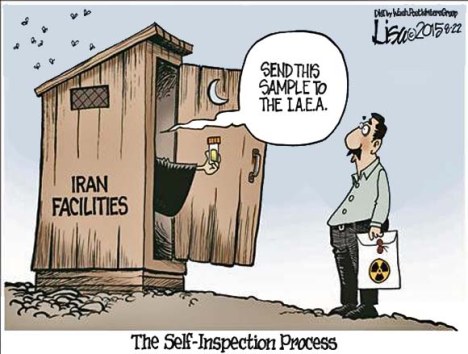
The document, titled “Separate arrangement II” – which was referenced in a Wednesday AP story and published Thursday – indicates that Iranians will be allowed to inspect themselves for evidence of the nuclear work they conducted at Parchin [a][b]. Instead of allowing IAEA inspectors to collect evidence from the facility, samples will be collected by the Iranians using Iranian equipment. Instead of allowing the IAEA to collect everything it wants, only seven samples will be handed over from mutually agreed upon areas. Instead of giving inspectors access to facilities, photos and videos will be taken by the Iranians themselves, again only from mutually agreed upon areas.

Iran deal supporters haven’t settled on just one response. As of last night administration liaisons were playing for time by telling lawmakers that the earlier AP story about the side deal was just a rumor. Then the AP published the actual draft. So this morning White House allies – including groups that have worked with the administration in lobbying Congress – tweeted around the theory that maybe the AP document was forged, at one point even referencing Israeli Prime Minister Benjamin Netanyahu [c][d][e]. Other validators have been trying to argue that the IAEA can still do its work even without access [f]. The White House will end up taking that latter claim – the IAEA stuff, not the Parchin Truther insanity – and insulating it with the argument that past work doesn’t matter anyway because what matters is the verification regime for future inspections. State Department spokesman Kirby was already floating that claim at yesterday’s press briefing [g].

That talking point might work on a political level. Administration officials can simply assert that the side deal is adequate and then – when pressed for details – declare that they can’t reveal their reasoning because it’s classified. They’ll heavily leverage yesterday’s statement from IAEA chief Amano saying that, for all sorts of classified reasons, the IAEA can live with the arrangement [h]. The opacity might well get the White House through the next month and a half of Congressional review.

But on a policy level, the side deal guts the JCPOA’s verification regime for future violations, which the administration has put at the center of the Iran deal. Administration officials really had no choice: once they gave up on any demands that would physically preclude the Iranians from going nuclear – dismantling centrifuges, mothballing facilities, etc – verification was all they had left. But it’s difficult to see how the pretense of verification can be sustained now that the Parchin side deal has been detailed:

(1) The side deal will become the precedent for future inspections of military sites — The Parchin arrangement – no physical access, restricted sampling, restricted video surveillance, etc. – will likely be used at least in part as a precedent for inspections of future sites. There is at least one other secret side deal out there: the AP’s Parchin document describes itself as “Separate arrangement II,” so presumably there’s a ‘Separate arrangement I’ that isn’t public and that may describe the verification arrangements. The Iranians were already saying that the future verification regime will not include inspector access to military sites, which would track with the Parchin precedent [j][k][l]. David Albright, president of the Institute for Science and International Security, told CNN about the Parchin arrangement “you have to worry that this would set a bad precedent in the Iran context and in the context of other countries” [m]. Rep. Royce sent Kerry a letter a few weeks ago that was even more explicit: the “side deals of today will become central to the agreement’s verification provisions tomorrow” [n] [quote omitted].

(2) IAEA sign-off suggests the agency has bent to political pressure — The Parchin arrangement is a humiliation for the IAEA. Heinonen told CNN that “It is very unusual… I find it really hard to understand why you would let someone else take the samples and only see through the camera” while Albright said “It’s really not normal… I don’t know why they accepted it. I think the IAEA is probably getting a little desperate to settle this” [o]. Until very recently Amano was explicit that the agency required further access to Parchin to resolve PMD issues: last March he “what we don’t know [is] whether they have undeclared activities or something else. We don’t know what they did in the past… we cannot tell we know all their activities” and last June he reiterated “the Agency is not in a position to provide credible assurance about the absence of undeclared nuclear material and activities in Iran” [p][q].

Amano’s defense of the Parchin side deal comes amid speculation that the IAEA is being subject to overwhelming pressure by the Americans and the Iranians. On the American side, the leverage is straightforward: Amano is up for reelection next year, and he perennially relies on Western nations to provide him with slim majorities [r]. On the Iranian side, there are several mechanisms that are getting attention. Some are overt: this week Iran’s Fars News Agency published a boast that Amano knew he “would have been harmed” had he disobeyed Iranian wishes and revealed details of the side deal to Congress (the threat was scrubbed after it garnered international attention; some Iran defenders have suggested that Fars published the threat due to a mistranslation of a speech, though it’s unclear why having a state-controlled vehicle go out of its way to mistranslate and publish a threat is supposed to be reassuring [s][t]). Other Iranian pressure mechanisms are more subtle: for the first eight years of the JCPOA Iran is only bound to provisionally apply, rather than to ratify, the Additional. Even JCPOA supporters describe the concession as being “all about Iran keeping some leverage over the IAEA… it wants to be able to keep the option of revoking its provisional implementation, and not ratifying the AP, as leverage” [u].

[a] http://bigstory.ap.org/article/d8bfeff00c8341caab084841f44d9cde/what-secret-agreement-between-iran-and-un-says
[b] http://bigstory.ap.org/article/bedd428e26924eed95c5ceaeec72d3a4/text-draft-agreement-between-iaea-iran
[c] https://twitter.com/jstreetdotorg/status/634743999597801472
[d] https://twitter.com/tparsi/status/634743163467526144
[e] https://twitter.com/Max_Fisher/status/634726697263349761
[f] http://www.nbcnews.com/id/57764838/ns/msnbc-all_in_with_chris_hayes/#.VdeLL_mrT4Y
[g] http://www.state.gov/r/pa/prs/dpb/2015/08/246211.htm
[h] https://www.iaea.org/newscenter/pressreleases/statement-iaea-director-general-yukiya-amano-1
[i] http://www.powerlineblog.com/archives/2015/07/speaking-of-iran-6.php
[j] http://english.farsnews.com/newstext.aspx?nn=13940429001105
[k] http://en.mehrnews.com/news/108760/No-military-sites-inspections-Velayati
[l] http://www.latimes.com/world/middleeast/la-fg-iran-deal-zarif-20150722-story.html
[m] http://edition.cnn.com/2015/08/20/politics/iran-inspections-report-nuclear-deal-experts/index.html
[n] http://foreignaffairs.house.gov/sites/republicans.foreignaffairs.house.gov/files/Parchin%20side%20deal_0.pdf
[o] http://www.cnn.com/2015/08/20/politics/iran-inspections-report-nuclear-deal-experts/index.html
[p] http://www.pbs.org/newshour/bb/iaea-monitoring-irans-nuclear-program/
[q] https://www.iaea.org/newscenter/statements/introductory-statement-board-governors-63
[r] http://carnegieendowment.org/2012/11/20/plan-for-iaea-safeguards
[s] http://freebeacon.com/national-security/iran-threatened-harm-to-top-nuke-inspector-to-prevent-disclosure-of-secret-deal/
[t] http://english.farsnews.com/newstext.aspx?nn=13940526000960
[u] http://armscontrollaw.com/2015/07/15/much-much-more-on-the-jcpoa/

Inspector Clouseau was unavailable (3)

August 22, 2015

Inspector Clouseau was unavailable (3), Power LineScott Johnson, August 21, 2015

I think it is very likely the side-deal documents were drafted by the United States and given to the IAEA, which agreed to make them into secret agreements with Iran to finalize the main agreement.

***********************

The pushback against George Jahn’s AP scoop on the IAEA side deal with Iran now includes the allegation that the draft of the side deal posted by the AP is a forgery — perhaps an Israeli forgery. Fred Fleitz has reported the relevant details with links and evidence here at NR’s Corner. Fleitz’s knowledgeable assessment seems reasonable to me:

First, the errors and non-IAEA prose in the AP’s transcribed document appear to indicate a first draft written by a party other than Iran or the IAEA to resolve the Parchin issue. This is consistent with my assessment that the side deal documents were drafted by the United States and handed to the IAEA to finalize after U.S. diplomats were unable to resolve the issues of the Parchin military base and possible military dimensions of Iran’s nuclear program during the talks. The AP says it was told by two anonymous officials that this document is a draft and “does not differ from the final, confidential agreement between the IAEA and Iran.” I believe it probably is a first draft written by a political appointee at the State Department or an NSC staffer.

Second, to believe this is a forgery one has to believe George Jahn and the Associated Press were deceived by two anonymous diplomats or U.S. officials. I doubt this could happen to a reporter as experienced as Jahn. (MSNBC believes otherwise and attacked Jahn as “not a real reporter” for his article.) The AP is standing by this story and I doubt it would put its reputation on the line if it did not believe Jahn’s article was rock solid.

Third, claims by backers of the Iran deal that this is an Israeli forgery are nonsense. If the Israelis wanted to do a forgery like this it would be perfect. An Israeli foreign ministry or intelligence officer would never use the wrong terminology for Iran.

My bottom line is that the side-deal document transcribed by the AP is not a forgery but a first draft written by a third party that is essentially the same as the final version agreed to by the IAEA and Iran. The outstanding question is who wrote this initial draft. Given Secretary Kerry’s efforts in May and June to drop the issues of the Parchin base and possible military dimensions, I think it is very likely the side-deal documents were drafted by the United States and given to the IAEA, which agreed to make them into secret agreements with Iran to finalize the main agreement.

Fleitz adds in the final paragraph of his post that “what [Jahn] reported apparently is consistent with classified briefings provided to Congress on the secret side deals[.]”

I trust that all will become clear in time. The relevant self-inspection provisions of the side deal are so absurd that they should be fraudulent. Consistent with Fleitz’s conclusion, however, I believe they will prove to be an integral part of the finalized side deal. Neither the administration nor the IAEA disputes the accuracy of Jahn’s reportage. I conclude that the terms of the side deal reported by Jahn are a joke, but not a forgery.