Archive for the ‘Obama’s America’ category

Iran orders from China 150 J-10 fighter jets that incorporate Israeli technology

July 30, 2015

Iran orders from China 150 J-10 fighter jets that incorporate Israeli technology, DEBKAfile, July 30, 2015

J-10Chinese Chengdu J-10 for Iranian air force

The scale of Iran’s multibillion acquisitions from China and Russia – 550 warplanes in all so far – indicates that Tehran’s top spending priority upon receipt of the funds released by the removal of sanctions, is to be a spanking new air force.

**********************

Iran is about to conclude a transaction with China for the purchase of the Chengdu J-10 multirole jet fighter, known in the West as the Vigorous Dragon, according to an exclusive report from DEBKAfile’s military and intelligence sources. Beijing has agreed to sell Tehran 150 of these sophisticated jets.

While the Chinese J-10 is comparable to the US F-16, our sources report that it is virtually a replica of the Lavi, the super-fighter developed by Israel’s aerospace industry in the second half of the 80s. Israel sold China the technology, after Washington insisted on Its discontinuing the Lavi’s production. The US also objected to the sale of the Lavi’s avionics, claiming that it contained some American components.

The Chinese plane comes in two versions – the multirole single-seat J-10A and the two-seat J-10B, which serves for training, ground assaults and electronic warfare.

Iran has additionally weighing the purchase in Moscow of 250 highly-advanced Sukhoi-Su-30MK1 twinjet multirole air superiority fighters, known in the West as Flanker-H.

On Wednesday, July 29, an Indian Air Force Su-30MK1 took part for the first time in a British air maneuver, Rainbow, where it dueled with the European Typhoon fighter.

The sophisticated Flanker has been found to have a major shortcoming. To carry eight tons of ordnance, it must use both of its AL-31FP engines, and the transition from one to two – and the reverse – often causes engine failure.

The Indian Air Force has reported three such malfunctions in a month, as well another shortcoming: The time needed for making the aircraft serviceable is too long. As a result, only half of the Indian fleet can be airborne at one time.

In a confrontation, the Iranian Air Force may find that, because of these drawbacks, the Chinese Su-30MK1 is outmatched by its American and European counterparts in the service of the Israeli, Saudi and UAE air forces.

On July 22, DEBKAfile revealed that Moscow and Tehran had concluded a giant transaction for the acquisition of a fleet of 100 IL78 MK1 (Midas) in-flight refueling planes for extending the range of its warplanes up to 7,300 km and able to refuel 6-8 planes at once.

DEBKAfile: The scale of Iran’s multibillion acquisitions from China and Russia – 550 warplanes in all so far – indicates that Tehran’s top spending priority upon receipt of the funds released by the removal of sanctions, is to be a spanking new air force.

Iran: Obama Admin Lying About Nuclear Deal for ‘Domestic Consumption’

July 30, 2015

Iran: Obama Admin Lying About Nuclear Deal for ‘Domestic Consumption’ Washington Free Beacon, July 30, 2015

( It’s clear that the Obama administration is lying, but what lies do the Iranian officials claim are being told? Do they involve the secret deals? — DM)

AP

Senior Iranian officials are accusing the Obama administration of lying about the details of the recent nuclear accord in order to soothe fears among U.S. lawmakers and Americans about the implications of the deal, which will release billions of dollars to the Islamic Republic while temporarily freezing its nuclear program, according to reports from Iran’s state-controlled media.

As Secretary of State John Kerry and other senior Obama administration figures launch a full-court press to convince Congress to approve the  deal, Iranian leaders are dismissing the rhetoric as “aimed at domestic consumption.”

Kerry and other top administration officials have been defending the deal on Capitol Hill in recent days, claiming that it will rein in the Islamic Republic’s contested nuclear program and fix its nuclear “breakout” period, the time required for it to obtain the amount of highly enriched uranium necessary for a nuclear weapon, at one year.

Critics have noted that the deal provides Iran with billions of dollars in sanctions relief that could be spent on terrorism and lifts bans on Iran’s export of weapons and construction of ballistic missiles.

When addressing claims this week by the administration that the deal shuts down Tehran’s nuclear infrastructure, Iranian officials scoffed and said that the Obama administration is misleading the public in order to sell the deal.

Hamid Baeidinejad, an official in the Iranian foreign ministry and one of the country’s nuclear negotiators, scoffed on Wednesday at the Obama administration’s comments, saying that they were meant to placate an American domestic audience.

“The remarks by the western officials are ambiguous comments which are merely uttered for domestic use and therefore we should say that there is no ambiguity in this (nuclear) agreement,” the Fars news agency quoted Baeidinejad saying in an interview with state-controlled radio.

Baeidinejad said that the Obama administration is misleading Americans about the deal in order to “calm opponents in the Congress and Zionist lobbies to soothe the internal conditions prevailing over debates on the nuclear agreement in that country,” Fars, which is also run by the Iranian state, reported.

As Congress spends 60 days reviewing the deal, which it may reject, the Iranian parliament is undertaking the same task.

During a meeting on Wednesday with Laurent Fabius, the French foreign minister, President Hassan Rouhani of Iran urged world powers to keep its commitments under the deal.

These includes lifting sanctions on the nearly $100 billion dollar financial empire of the Iranian Supreme Leader Ali Khamenei and agreeing to bar American inspectors from all Iranian nuclear sites.

“The Iranian government is standing strong on the path of (implementing) the agreement and we will remain committed to our undertakings as long as the other side remains loyal to its obligations,” Rouhani was quoted as saying during a meeting in Tehran with Fabius, who served as a key negotiator for the French.

Rouhani said the agreement could help Iran become a key player on the international stage.

“This agreement is not against any country and our cooperation and consultations to settle the regional problems, including fight against terrorism, humanitarian aids, and materialization of nations’ demands can prove it,” Rouhani was quoted as saying.

Meanwhile, Fabius was met at the airport by Iranian protestors who accused him of serving as an Israeli spy.

“The protesters chanted slogans such as ‘Aids, A French Gift to Iran’, ‘We Neither Forgive nor Forget’, ‘Fabius, Servant of the US, Spy of Israel’ and ‘No Welcome to Aids Lord,’” according to Fars.

What information collected by Israeli intelligence reveals about the Iran talks

July 29, 2015

What information collected by Israeli intelligence reveals about the Iran talks, TabletRonen Bergman, July 29, 2015

It is possible to argue about the manner in which Netanyahu chose to conduct the dispute about the nuclear agreement with Iran, by clashing head-on and bluntly with the American president. That said, the intelligence material that he was relying on gives rise to fairly unambiguous conclusions: that the Western delegates crossed all of the red lines that they drew themselves and conceded most of what was termed critical at the outset; and that the Iranians have achieved almost all of their goals.

***********************

On Nov. 26, 2013, three days after the signing of the interim agreement (JPOA) between the powers and Iran, the Iranian delegation returned home to report to their government. According to information obtained by Israeli intelligence, there was a sense of great satisfaction in Tehran then over the agreement and confidence that ultimately Iran would be able to persuade the West to accede to a final deal favorable to Iran. That final deal, signed in Vienna last week, seems to justify that confidence. The intelligence—a swath of which I was given access to in the past month—reveals that the Iranian delegates told their superiors, including one from the office of the Supreme Leader Ayatollah Khamenei, that “our most significant achievement” in the negotiations was America’s consent to the continued enrichment of uranium on Iranian territory.

That makes sense. The West’s recognition of Iran’s right to perform the full nuclear fuel cycle—or enrichment of uranium—was a complete about-face from America’s declared position prior to and during the talks. Senior U.S. and European officials who visited Israel immediately after the negotiations with Iran began in mid 2013 declared, according to the protocols of these meetings, that because of Iran’s repeated violations of the Nuclear Non-Proliferation Treaty, “Our aim is that in the final agreement [with Iran] there will be no enrichment at all” on Iranian territory. Later on, in a speech at the Saban Forum in December 2013, President Barack Obama reiterated that in view of Iran’s behavior, the United States did not acknowledge that Iran had any right to enrich fissile material on its soil.

In February 2014, the first crumbling of this commitment was evident, when the head of the U.S. delegation to the talks with Iran, Wendy Sherman, told Israeli officials that while the United States would like Iran to stop enriching uranium altogether, this was “not a realistic” expectation. Iranian foreign ministry officials, during meetings the Tehran following the JPOA, reckoned that from the moment the principle of an Iranian right to enrich uranium was established, it would serve as the basis for the final agreement. And indeed, the final agreement, signed earlier this month, confirmed that assessment.

The sources who granted me access to the information collected by Israel about the Iran talks stressed that it was not obtained through espionage against the United States. It comes, they said, through Israeli spying on Iran, or routine contacts between Israeli officials and representatives of the P5+1 in the talks. The sources showed me only what they wanted me to see, and in these cases there’s always a danger of fraud and fabrication. This said, these sources have proved reliable in the past, and based on my experience with this type of material it appears to be quite credible. No less important, what emerges from the classified material obtained by Israel in the course of the negotiations is largely corroborated by details that have become public since.

In early 2013, the material indicates, Israel learned from its intelligence sources in Iran that the United States held a secret dialogue with senior Iranian representatives in Muscat, Oman. Only toward the end of these talks, in which the Americans persuaded Iran to enter into diplomatic negotiations regarding its nuclear program, did Israel receive an official report about them from the U.S. government. Shortly afterward, the CIA and NSA drastically curtailed its cooperation with Israel on operations aimed at disrupting the Iranian nuclear project, operations that had racked up significant successes over the past decade.

On Nov. 8, 2013, Secretary of State John Kerry visited Israel. Israeli Prime Minister Benjamin Netanyahu saw him off at Ben Gurion Airport and told him that Israel had received intelligence that indicated the United States was ready to sign “a very bad deal” and that the West’s representatives were gradually retreating from the same lines in the sand that they had drawn themselves.

Perusal of the material Netanyahu was basing himself on, and more that has come in since that angry exchange on the tarmac, makes two conclusions fairly clear: The Western delegates gave up on almost every one of the critical issues they had themselves resolved not to give in on, and also that they had distinctly promised Israel they would not do so.

One of the promises made to Israel was that Iran would not be permitted to stockpile uranium. Later it was said that only a small amount would be left in Iran and that anything in excess of that amount would be transferred to Russia for processing that would render it unusable for military purposes. In the final agreement, Iran was permitted to keep 300kgs of enriched uranium; the conversion process would take place in an Iranian plant (nicknamed “The Junk Factory” by Israel intelligence). Iran would also be responsible for processing or selling the huge amount of enriched uranium that is has stockpiled up until today, some 8 tons.

The case of the secret enrichment facility at Qom (known in Israel as the Fordo Facility) is another example of concessions to Iran. The facility was erected in blatant violation of the Non Proliferation Treaty, and P5+1 delegates solemnly promised Israel at a series of meetings in late 2013 that it was to be dismantled and its contents destroyed. In the final agreement, the Iranians were allowed to leave 1,044 centrifuges in place (there are 3,000 now) and to engage in research and in enrichment of radioisotopes.

At the main enrichment facility at Natanz (or Kashan, the name used by the Mossad in its reports) the Iranians are to continue operating 5,060 centrifuges of the 19,000 there at present. Early in the negotiations, the Western representatives demanded that the remaining centrifuges be destroyed. Later on they retreated from this demand, and now the Iranians have had to commit only to mothball them. This way, they will be able to reinstall them at very short notice.

Israeli intelligence points to two plants in Iran’s military industry that are currently engaged in the development of two new types of centrifuge: the Teba and Tesa plants, which are working on the IR6 and the IR8 respectively. The new centrifuges will allow the Iranians to set up smaller enrichment facilities that are much more difficult to detect and that shorten the break-out time to a bomb if and when they decide to dump the agreement.

The Iranians see continued work on advanced centrifuges as very important. On the other hand they doubt their ability to do so covertly, without risking exposure and being accused of breaching the agreement. Thus, Iran’s delegates were instructed to insist on this point. President Obama said at the Saban Forum that Iran has no need for advanced centrifuges and his representatives promised Israel several times that further R&D on them would not be permitted. In the final agreement Iran is permitted to continue developing the advanced centrifuges, albeit with certain restrictions which experts of the Israeli Atomic Energy Committee believe to have only marginal efficacy.

As for the break-out time for the bomb, at the outset of the negotiations, the Western delegates decided that it would be “at least a number of years.” Under the final agreement this has been cut down to one year according to the Americans, and even less than that according to Israeli nuclear experts.

As the signing of the agreement drew nearer, sets of discussions took place in Iran, following which its delegates were instructed to insist on not revealing how far the country had advanced on the military aspects of its nuclear project. Over the past 15 years, a great deal of material has been amassed by the International Atomic Energy Agency—some filed by its own inspectors and some submitted by intelligence agencies—about Iran’s secret effort to develop the military aspects of its nuclear program (which the Iranians call by the codenames PHRC, AMAD, and SPND). The IAEA divides this activity into 12 different areas (metallurgy, timers, fuses, neutron source, hydrodynamic testing, warhead adaptation for the Shihab 3 missile, high explosives, and others) all of which deal with the R&D work that must be done in order to be able to convert enriched material into an actual atom bomb.

The IAEA demanded concrete answers to a number of questions regarding Iran’s activities in these spheres. The agency also asked Iran to allow it to interview 15 Iranian scientists, a list headed by Prof. Mohsen Fakhrizadeh, whom Mossad nicknamed “The Brain” behind the military nuclear program. This list has become shorter because six of the 15 have died as a result of assassinations that the Iranians attribute to Israel, but access to the other nine has not been given. Neither have the IAEA’s inspectors been allowed to visit the facilities where the suspected activities take place. The West originally insisted on these points, only to retreat and leave them unsolved in the agreement.

In mid-2015 a new idea was brought up in one of the discussions in Tehran: Iran would agree not to import missiles as long as its own development and production is not limited. This idea is reflected in the final agreement as well, in which Iran is allowed to develop and produce missiles, the means of delivery for nuclear weapons. The longer the negotiations went on, the longer the list of concession made by the United States to Iran kept growing, including the right to leave the heavy water reactor and the heavy water plant at Arak in place and accepting Iran’s refusal of access to the suspect site.

It is possible to argue about the manner in which Netanyahu chose to conduct the dispute about the nuclear agreement with Iran, by clashing head-on and bluntly with the American president. That said, the intelligence material that he was relying on gives rise to fairly unambiguous conclusions: that the Western delegates crossed all of the red lines that they drew themselves and conceded most of what was termed critical at the outset; and that the Iranians have achieved almost all of their goals.

Israel’s choice

July 29, 2015

Israel’s choice, Power LineScott Johnson, July 29, 2015

The Iran deal finances and otherwise facilitates Iran’s acquisition of nuclear weapons. It even sets up the United States and the other parties as protectors of Iran’s nuclear program.

Why would President Obama want to do that? He seems to believe that Iran should play the role of “a very successful regional power.” If he believes that this is in the national interest of thee United States, he is a fool. Yet he has said as much, and in this case it may not be naive to take his his words as expressing his view.

By contrast with Obama, the American people (on average) have Iran sized up as an implacable enemy of the United States and of Israel. In his New York Post column, John Podhoretz takes a look at the polls of America public opinion on the Iran deal. He concludes: “The more people know, the more they are inclined to oppose it.”

The state of American public opinion is one element that differentiates the Iran deal from the Munich Agreement. The American people (on average) have no illusions about the Islamic Republic of Iran. They do not think that their Supreme Leader is about to be made a friend of the United States. They do not think that the Supreme Leader’s imprecations of “Death to America” are to be discounted and laughed off. They do not view the imprecations as something like the pabulum and prevarications that Obama himself regularly serves up to them for their consumption. They view the Supreme Leader’s imprecations as consistent with actions taken by the Islamic Republic of Iran roughly from the regime’s inception.

As for the people of Israel and other actors in the region, this is also the case, only even more so, and they do not have the luxury of turning a blind eye. The threat to Israel presented by a nuclear Iran belies the country’s reason for being. See Michael Oren’s memoir Ally for the deep sense of betrayal that Obama’s actions have produced in Israel, even on the part of a sophisticated observer like Oren.

The new status quo is obviously untenable for Israel. If the Islamic Republic of Iran could be contained or deterred, the new status quo might hold, but Iran can’t be deterred and the new status quo won’t hold. It won’t hold any more than the new status quo produced by the Munich Agreement. It may last longer than the Munich Agreement’s 10 months, but the new status quo is inherently untenable.

Norman Podhoretz reiterates the essential facts in his Wall Street Journal column “Israel’s choice” (accessible here via Google). Podhoretz writes:

[I]n allowing Iran to get the bomb, [Obama] is not averting war. What he is doing is setting the stage for a nuclear war between Iran and Israel.

The reason stems from the fact that, with hardly an exception, all of Israel believes that the Iranians are deadly serious when they proclaim that they are bound and determined to wipe the Jewish state off the map. It follows that once Iran acquires the means to make good on this genocidal commitment, each side will be faced with only two choices: either to rely on the fear of a retaliatory strike to deter the other from striking first, or to launch a pre-emptive strike of its own.

Yet when even a famous Iranian “moderate” like the former President Hashemi Rafsanjani has said—as he did in 2001, contemplating a nuclear exchange—that “the use of even one nuclear bomb inside Israel will destroy everything. However, it will only harm the Islamic world. It is not irrational to contemplate such an eventuality,” how can deterrence work?

The brutal truth is that the actual alternatives before us are not Mr. Obama’s deal or war. They are conventional war now or nuclear war later. John Kerry recently declared that Israel would be making a “huge mistake” to take military action against Iran. But Mr. Kerry, as usual, is spectacularly wrong. Israel would not be making a mistake at all, let alone a huge one. On the contrary, it would actually be sparing itself—and the rest of the world—a nuclear conflagration in the not too distant future.

This seems to me something like the irreducible common sense of the matter.

John Kerry is blowing the Iran nuke deal

July 29, 2015

John Kerry is blowing the Iran nuke deal, Front Page Magazine, Daniel Greenfield, July 29, 2015
john_kerry_senator_from_ma-2

Kerry doesn’t care about Iran’s nukes or its breakout times and he resents having to memorize this stuff. What excites him is giving the finger to America and meeting up with enemies of this country. It’s how he began his career and it’s how he’s ending it now.

********************

Want to buy a used nuclear Armageddon from Hanoi John?

It’s hard to imagine a worse salesman for the Iran deal than John Kerry. Kerry couldn’t sell himself to Americans as a presidential candidate. Now he has to sell a nuclear Armageddon to Americans.

National security was Kerry’s undoing during his presidential campaign. He had shot American soldiers in the back during Vietnam to build a base for his own political future. He had eagerly pandered to Marxist-Leninist terrorists who massacred native peoples and burned their churches. He had been for the Iraq War before he was against it and for Assad’s Syrian dictatorship before he was against it.

Now Kerry is supposed to sell the most controversial and explosive national security issue since the Cold War to a skeptical nation. And he’s doing just about as well as you would expect.

John Kerry’s tour of the Senate Foreign Relations Committee and the Council on Foreign Relations came with all the nervous tics, the stumbling statements and erratic claims that everyone has come to expect from the only man who could have possibly made Hillary Clinton’s Secretary of State tenure look good.

Asked whether he really believed that Iran, which is sitting on a mountain of oil and gas, just wants a peaceful nuclear program “to generate electricity”, Kerry admitted that it already has a military program.

Then he insisted that we had to go through with the deal anyway so he wouldn’t be embarrassed in front of the ayatollah.

“I mean, do you think the ayatollah is going to come back to the table if Congress refuses this and negotiate again?… I mean, please. I would be embarrassed to try to go out—I mean, what am I going to say to people after this as secretary of State?,” Kerry whined.

The Secretary of State for the greatest nation in the world had been reduced to complaining that he would be too embarrassed to renegotiate the deal. Congress had to play it cool and stop embarrassing him in front of his cool new ayatollah friends.

Kerry couldn’t offer a direct answer to the question because he had already argued that Iran “believed deeply that they had a right to… have a peaceful nuclear program; because they resented the fact the United States had supported Saddam Hussein in Iraq”. Iran did restart its nuclear program during the war with Iraq, and, like most nuclear programs during wartime, it was as peaceful as a bomb.

“O Allah, for your satisfaction, we sacrificed the offspring of Islam and the revolution,” Ayatollah Khomeini wrote after the Iran-Iraq War. The letter quoted the need for “atomic weapons” and evicting America from the Persian Gulf.

Iran’s current Supreme Leader had told top officials that Khomeini had reactivated Iran’s nuclear program, vowing that it would prepare “for the emergence of Imam Mehdi.”

Imam Mehdi was never going to be impressed with a slightly lower electric bill.

Kerry had contradicted himself in a single response, admitting that the nuclear program had reemerged during the Iran-Iraq War while claiming that it was peaceful.

But Kerry’s real focus was always on empathizing with the enemy.

“I know, the degree to which Iran felt isolated by that and the sort of impact of the choices that were made during that period of time. So we’re trying to make up for that now. We’re where we are. We’re not blaming anybody,” he offered in his new role as the Ayatollah’s infidel therapist.

He insisted that 24 days was plenty of time just to get access to an Iranian rogue nuclear site while admitting that, “The breakout time goes down to always somewhere in the vicinity of a month or two.” And he suggested that Iran would become peaceful because he had “friends” who had been to Tehran and told him it was “teeming with young people who all have smartphones.”

And Kerry just wanted to go to Tehran and hang out with all the teeming cool young people and their smartphones.

The need for approval from enemies of the United States was quintessential Kerry. Utterly unwilling to acknowledge that there was a different worldview on the other side of the table, he namedropped his opposite number as “Foreign Minister Zarif, who lived here in New York” as if a man who lived in the city couldn’t possibly be a fanatical enemy of the United States.

That would have come as a surprise to Mahmud Abouhalima or Leon Trotsky.

But Kerry had just begun embarrassing himself.

Challenged on welcoming back a terrorist state to the international arena, Kerry claimed that he had told the Iranians that their chants of “Death to America” were not helpful. Asked about other states getting nuclear weapons to compete with Iran, Kerry quipped that, “You can’t just go out and buy a nuclear weapon. You don’t ship them FedEx, you know.”

If Kerry had been paying attention in the Senate, he would have known that the Khan nuclear network which shipped kits of nuclear equipment and bomb plans, had been caught by Bush shipping crates to Libya. It wasn’t FedEx, but it was close. Bush had managed to achieve a complete shutdown of Libya’s nuclear program, while Kerry had legalized the other beneficiary of the Khan network in Iran.

This would have been a month’s worth of gaffes for any other politician, but for John Kerry, it was just one question and answer session gone wrong.

Kerry had already told PBS that Iran isn’t “allowed” to transfer any of the $140 billion in sanctions relief to terrorists because of a UN resolution, before admitting that Iran would probably do it anyway. Then he had backpedaled by claiming that money wouldn’t make much of an impact on terrorism anyway.

When asked about Iranian Supreme Leader Ayatollah Ali Khamenei’s threats to America and announcement that he would continue funding terrorists, Kerry spluttered that he doesn’t “know how to interpret it at this point in time”.

“Death to America” can be surprisingly nuanced when analyzed by a master of nuance like John Kerry.

Kerry had managed to torpedo a plan for air strikes on Syria through his own inept statements. Now he’s sabotaging another administration policy goal.

The more Kerry talks, the more he comes off as a car salesman pushing the latest gently used nuclear Armageddon. He stumbles unconvincingly from one rationalization to another, revealing more about his insecurities than his policies.

Every Kerry argument is a thread and it doesn’t take much tugging on it for the whole dirty garment to come apart in a snarl of rationalizations and half-truths. Like a bad liar, he instinctively contradicts himself. And like a worse liar, he follows it up with false choices and false accusations.

His every argument comes down to some version of “Well what’s your alternative” or “If we walk away now, we lose all credibility”. It’s the argument you expect to hear from a man who has sent his fortune off to a Nigerian prince, not the Secretary of State of the United States.

The conclusion to every Kerry argument is the desperate pessimism of, “We have no other choice.” While Iran’s leadership gleefully celebrates, Kerry tells us that there are no other options. The more he talks, the more he convinces everyone who listens that the United States lost.

Underneath it all is a persistent whine. It’s the tone of an overgrown teenager who just wants to hang out with all the cool Marxist-Leninist rebels, Islamic terrorists and Viet Cong bosses. Somewhere in his mind, Kerry is still a petulant teenager resentful that he has to justify his fun times with Zarif, who used to live in New York and probably knows lots of teenagers with smartphones, by testifying to Congress.

Kerry doesn’t care about Iran’s nukes or its breakout times and he resents having to memorize this stuff. What excites him is giving the finger to America and meeting up with enemies of this country. It’s how he began his career and it’s how he’s ending it now. The more questions he has to answer, the more flustered he becomes because we’re the mean parents embarrassing him in front of the cool ayatollah.

Fred Fleitz discusses the secret side deals to the Iran agreement on On Point with Tomi Lahren

July 29, 2015

Fred Fleitz discusses the secret side deals to the Iran agreement on On Point with Tomi Lahren, Center for Security Policy via You Tube, July 28, 2015


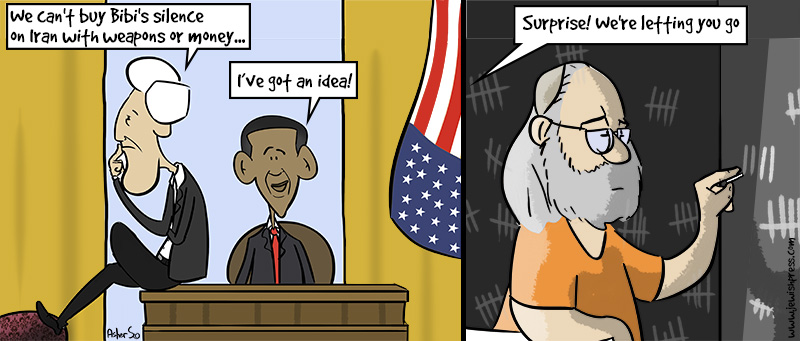
Cartoons of the day

July 29, 2015

H/t Counter Jihad Report

ckytodqwcaiu2md

H/t The Jewish Press

pollardrelease

John Kerry’s ugly warning to Israel

July 28, 2015

John Kerry’s ugly warning to IsraelPaul Mirengoff, July 28, 2015

Issues of blame pale in comparison to issues of security — Israel’s, the wider Middle East’s, and ultimately our own. If Kerry had a strong case that his deal promotes security, he probably wouldn’t be resorting to thinly veiled threats against Israel.

*********************

Secretary of State John Kerry has warned that if Congress rejects the Obama administration’s nuclear deal with Iran, Israel will be blamed. “I fear that what could happen is if Congress were to overturn it, our friends Israel could actually wind up being more isolated and more blamed,” Kerry told the Council of Foreign Relations.

The question is: “more blamed” by whom?

The answer, I think, is “more blamed” by the Obama administration. As Jennifer Rubin says:

Kerry does not “fear” Israel would be blamed; he is threatening to blame Israel if U.S. lawmakers decide that the deal is not in the interests of the United States. Not only is he inciting anti-Israel fervor, but he also is repeating another canard, namely that Israel controls Congress.

In doing all this, the administration echoes ancient tropes against the Jews and not-so-ancient ones against an Israeli government that won’t meekly assent to its death.

Israel will indeed be blamed if Congress rejects the Iran deal. It will be blamed by the usual suspects, among whom the Obama administration features prominently, who blame Israel for a wide range of ills, including the rise of anti-Semitism in Europe and the break down of peace talks between Israel and Palestine.

As Michael Oren says, “the threat of the Secretary of State who, in the past, warned that Israel was in danger of becoming an apartheid state, cannot deter us from fulfilling our national duty to oppose this dangerous deal.” Nor should it deter Israel’s friends in Congress (and elsewhere).

The Obama administration is on its way out. The other “usual suspects” will continue to blame Israel for whatever, but their utterances have never counted for much.

Issues of blame pale in comparison to issues of security — Israel’s, the wider Middle East’s, and ultimately our own. If Kerry had a strong case that his deal promotes security, he probably wouldn’t be resorting to thinly veiled threats against Israel.

Op-Ed: Obama Knows Iran will Use its Nukes on Israel

July 28, 2015

Op-Ed: Obama Knows Iran will Use its Nukes on Israel, Israel National News, Mark Langfan, July 28, 2015

(The very notion that Iran wants to send the Jews of Israel to the ovens is ridiculous. Iran just wants to send the ovens to the Jews of Israel. Since they won’t even have to be transported and shoved in, why make a big deal of it? Hmmmm. — DM)

At first, Obama said we couldn’t talk about his Iranian Nuke Deal unless it was finalized.  Then, Obama said we couldn’t talk about his Iranian Nuke Deal unless we read it all – and simply didn’t disclose all of his side-deals.  Now, he says Mike Huckabee’s comparison of shipping the Jews of Israel to the new ovens of the Iranian Auschwitz-Nuke is “ridiculous.”

Perhaps Obama wants to wait until Iran nukes Israel for it to be politically correct to call Iran’s wiping Israel off the map a “Holocaust.”  But, make no mistake, Obama knows full well that Iran intends to wipe Israel off the map with its Obama-blessed Nukes.

Come on, does anyone (except the American left-wing cool-aid drinking Jews) really believe that Iran will abide by their “voluntary” protocols under the Vienna announcement?  Of course not!  Are Obama or any of the European Unionleaders so rank stupid and naïve that they think Iran won’t build a bomb just like North Korea?  Does anyone not know that one of Iran’s first targets will be to annihilate Israel?

Of course Obama knows Iran will seek to annihilate Israel, so that must be what Obama wants.

Obviously, Obama doesn’t care if he enables the murder of another 6 million Jews through a Palestinian State’s chemical Sarin-tipped Katyusha rockets, or an Iranian Nuke.  It’s simple: Obama wants Israel and its Jews offed.  What is so difficult to understand about that?  Every move Obama has made from the very first moment of his presidency has been to irreparably harm Israel and Saudi Arabia, and irrevocably empower Iran.  It doesn’t matter what Obama’s specific motivation is.  Obama may believe in Farrakhan’s and Rev. Wright’s virulent Chicago anti-Semitism; Obama may be merely steeped in anti-British anti-Colonialism; or both.  All that matters is Obama is acting in ways that will allow others to wipe Israel off the face of the earth. If Obama walks like a Jew-hater, arms Iran like a Jew-hater, and creates a PA “West Bank” State like a Jew-hater, he’s a Jew-hater.

But, now here come the American Leftist Jewish “Holocaust” speech-police like Debbie Wasserman-Schulz who say one isn’t allowed to invoke the “Holocaust” or “Auschwitz” into a political debate when it is Iran’s highest leaders who have repeatedly, openly, and notoriously injected into the political debate that they intend to wipe Israel off the map.  And, in plain sight, Obama is crowning Iran, the greatest openly Holocaust-threatening, terror-state in the world, the nuclear hegemon-state of the Middle East because Iran is “stable.” I guess Obama forgot he helped quash a popular uprising there  as his first foreign policy debacle.

And, let’s also not forget that Iran’s “stability” in Syria has murdered over 250,000 Syrian Sunnis. The Hiroshima “Little Boy” Uranium Gun-type Nuke killed about 150,000 Japanese, and the Nagasaki “Fat Man” Plutonium Implosion Nuke killed about 40,000 Japanese. So, Iran has already killed 2 Hiroshima’s worth of Syrian Sunnis or 6 Nagasaki’s worth of Syrian Sunnis.  So, the 150 Billion Dollars Obama is giving Iran is actually a weapon of mass destruction in itself.  All of the additional hundreds of thousands of dead Sunnis spilt by Iran’s malign use of the 150 Billion dollars is on the hands of Obama, Susan Rice, John Kerry and Samantha Power.

What Is so loathsome, is that every word, every sentence Obama says  is a lie tainted with a patina of truth, Take for example Obama’s statement that Iran had enough enriched Uranium for 10 nukes, but it will be cut down under the supposed deal.  When exactly did Iran enrich 10 nukes worth of Uranium?  Iran enriched the uranium solely in the last 6 years because the CIA’s published declassified number had virtually zero enriched Uranium when Obama became President.  And, Iran’s method to cut down its enrichment is a chemical process that can easily be reversed by a chemical process.

And you have to love Obama’s “If Iran’s ‘stable’ give them nukes” foreign policy.  Under Obama’s “Stability” theory, Obama would have also armed Hitler with an arsenal of nukes because Hitler’s Nazi Germany was very stable.

In short, Obama knows full well that Iran is building an Auschwitz-Nuke that it wants to use to annihilate Israel; and, Obama is doing everything he can to ensure that it can do so.

Don’t let Jew-haters like Obama and Wasserman-Schultz turn “Never again,” into “Too Late.

Obama’s Gamble with Iran’s Theocratic Regime

July 28, 2015

Obama’s Gamble with Iran’s Theocratic Regime, The Gatestone InstituteRobert D. Onley, July 28, 2015

[T]he gravest consequence of Obama’s Iran deal, and the most damning of its continued defense, is that the world bestowed ideological legitimacy on the Islamic Republic’s radical theocracy, and in so doing has consigned the people of Iran to near permanent rule under the iron fist of Twelver Shi’a Islamism.

************************

  • Obama’s Iran deal is a direct manifestation of the President’s fundamentally misguided worldview, one that wishes away danger and then believes in the wishes.
  • Even more concerning is that the Iran deal may directly conflict with U.S. obligations as a signatory of the Non-Proliferation Treaty. The Iran deal may be unconstitutional, violate international law and feature commitments that President Obama could not otherwise lawfully make. By seeking approval of the deal under the UN Security Council, Obama has bound the U.S. under international law without Senate consent.
  • The gravest consequence of Obama’s Iran deal is that the world bestowed ideological legitimacy on the Islamic Republic’s radical theocracy, and in so doing has consigned the people of Iran to near permanent rule under the iron fist of Shi’a Islamism.
  • A total reversal of the Iranian regime’s behavior should have been, and still can be, a precondition for the removal of any sanctions related to Iran’s nuclear program. An end to Iran’s financial and material support for terrorist forces such as Hezbollah and Hamas must be demanded, along with the return of the four American hostages Iran is holding.
  • There is still time for a better deal that can be had.

As President Obama and Secretary Kerry dominated the airwaves with rounds of media interviews to defend the Iran deal last week, German Vice Chancellor and Economic Minister Sigmar Gabriel flew straight to Tehran for the first of what are certain to be countless meetings by P5+1 leaders to capitalize on new business opportunities in Iran.

In Europe, it seems, there is no debate to be had over the Iran deal; rather, it is a fait accompli.

But in the United States, the domestic debate is heating up, fueled by a Presidential primary campaign and increasingly justified bipartisan anxiety over the bill.

Independent of these political realities, however, the immediacy and tenacity of the White House’s defense of the Iran deal (which now has its own @TheIranDeal Twitter account, no less), betrays an acute unspoken discomfort by many Democrats with the practical flaws and global security dangers that the deal presents.

Obama’s Iran deal is a direct manifestation of the President’s fundamentally misguided worldview, one that wishes away danger and then believes in the wishes.

Haunted by his electorally-motivated premature withdrawal from Iraq in 2011; his refusal in 2013 to confront Syria’s Bashar Assad when he used chemical weapons on his own people; his betrayal by Russia’s Vladimir Putin to whom he had offered a reset button, and his impotence in failing to respond to the aggressive expansionist moves of Russia, ISIS, Iran and China, the President and Democrat Party, in signing the Iran deal, seem to be trying to absolve the United States of its role at the forefront of the global fight against Islamic radicalism and other threats.

Citing the failed EU-led negotiations with Iran in 2005, which resulted in Iran’s massive expansion of centrifuge production, defenders of the deal, such as Fareed Zakaria, have painted a bleak and zero-sum counterfactual argument. It is claimed that the result of Congress’s opposition will be an international community that forges ahead on renewed trade relations with Iran, while leaving the United States outside the prevailing global reconciliation and supposed love-in with the Islamic Republic.

There are several serious problems with this defense, and similarly with the White House’s blitzkrieg public relations campaign to fend off detractors of the Iran deal, with Secretary of State John Kerry commanding the preemptive, and often totally inaccurate, strikes against Congress. In consideration of the colossal failure represented by the North Korea nuclear precedent, let us consider the issues unique to Iran.

Foremost, opponents of the Iran deal are not universally suggesting the Iran deal be killed outright or immediately resort to “war.” This is simply disingenuous. Instead, the opponents’ fundamental premise is that a better deal was left on the table, and thus remains available. The very fact that the Iranian regime was at the negotiating table was indeed a sign of Iran’s weakness; any timelines for the P5+1 to “close” the deal were artificial constraints that surely erased further achievable concessions.

Second, much ink has already been spilled about the technical weaknesses of the Iran deal. Namely: that Iran’s vast nuclear infrastructure remains in place; that the most important restrictions expire in 10 years (a mere blip for humanity); that Iran’s uncivilized domestic and regional behavior was a naughty unmentionable; and finally, that the deal undoubtedly initiated a regional nuclear arms race while supercharging the Iranian regime’s finances.

Third, the gravest consequence of Obama’s Iran deal, and the most damning of its continued defense, is that the world bestowed ideological legitimacy on the Islamic Republic’s radical theocracy, and in so doing has consigned the people of Iran to near permanent rule under the iron fist of Twelver Shi’a Islamism.

This capitulation occurred precisely at a time when the West and the broader Middle East are facing off against the Islamic State — a terrorist force which, when stripped of its social media allure, is ultimately a Sunni-branded spin-off of the extremist Shi’a Islamism that has ruled in Iran since 1979.

The Iranians may be convenient allies as enemies of our enemies today, but not for one second have Iran’s rulers suggested their ultimate intent is anything other than the all too familiar “Death to America” and “Death to Israel” propaganda seen for the past 36 years. In what is objectively and wholly a strange deadly obsession, the Supreme Leader of Iran, Ayatollah Khamenei, has been rousing crowds with calls for the destruction of two nation-states both during and after nuclear negotiations.

In spite of this public malice, defenders of the deal suggest that “the [Obama] administration is making a calculated bet that Iran will be constrained by international pressure.” Why exactly then is Khamenei making clear the opposite?

1173

President Obama’s willingness to concede Iran’s new-found normalized membership in the community of nations on the basis of this nuclear deal is an affront to the liberal, free, democratic principles that have stood against the forces of tyranny throughout American history.

It is also an affront the American political system and to the members of both parties who are now being cornered by the President into supporting, or not supporting, such an intrinsically dangerous and needlessly flawed bargain with an avowed enemy.

Even more concerning is that the Iran deal may directly conflict with U.S. obligations as a signatory of the Non-Proliferation Treaty (NPT). As a number of critics have pointed out, the Iran deal may be unconstitutional, violate international law and feature commitments that President Obama could not otherwise lawfully make.

By seeking approval of the deal under the UN Security Council, President Obama has bound the United States under international law without Senate consent.

If the United States is to remain the vanguard of human liberty, President Obama must distinguish between the vain pursuit of his legacy, and the civilized world’s deepest need at this consequential hour for the American President to defend comprehensively the fundamental principles that underpin the modern order. Unless his desired legacy is actually to destroy it.

As opponents of the Iran deal have noted, there is still time for a better deal that can be had.

To start, a total reversal of the Iranian regime’s behavior should have been, and still can be, a precondition for the removal of any sanctions related to Iran’s nuclear program. Congress can lobby for this change, and should maintain American sanctions and applicable provisions in the U.S. Treasury Department’s SWIFT terrorist tracking finance program.

Next, while Iran’s regional malignancy may run deep in the regime’s veins (through the many twisted arms of Tehran’s Islamic Revolutionary Guards Corps), an end to Iran’s financial and material support for terrorist forces such as Hezbollah and Hamas must be demanded, along with the return of the four American hostages Iran is holding.

Third, those who argue that Iran’s human rights record was not “on the table” in Geneva have needlessly abdicated the West’s moral and intellectual high ground to the forces of barbarism and hate that are now waging war across the region. Respect for international humanitarian norms should never be discarded in such negotiations.

At the end of the day, the deeper questions for Obama and the entire P5+1 are this: By whose standards were negotiations conducted? And whose worldview will rule the 21st century?

In defense of Obama’s approach, the deal’s supporters point out that the Iranians are a “proud, nationalistic people,” which is undoubtedly true, but irrelevant, just as it was for the leadership of Germany’s Third Reich.

The Iranian regime, by virtue of its radical religious nature, weak economy and political experiment with theocracy, should have borne the burden of coming to the negotiating table with the most to lose. Instead, President Obama, on behalf of the free world, is allowing this pariah state to guarantee its place among the nations, lavishly rewarded for having violated the Non-Proliferation Treaty, and in all its about-to-be-well-funded lethality.