American Islami Forum for Democracy via YouTube, February 15, 2017
Four Muslim Groups Reject US Counter-Terror Funding, Clarion Project, Ryan Mauro, February 13, 2017
(Good! Now perhaps some of the funding will go to anti-Islamist groups, likely to use the money to discourage rather than to encourage radicalization. — DM)
 Four Minnesota youth from the Somali community who were convicted of terrorism-related offenses.
The good news is that there are plenty of non-profits, including Muslim ones with an unequivocal stand against Islamism that deserve the grant money. These organizations generally lack financial support from which to build a network, provide services, etc.
If certain Muslim nonprofits choose to put politics and ego above fighting extremism, then there are plenty of other options for these grants.
***********************************
In a revealing trend, four nonprofits groups involved with the Muslim-American community have rejected federal funding for countering violent extremism. For these groups, their image — as well as making a political point – is a higher priority than fighting radical Islam and helping their communities.
The four Muslim groups had been privileged to receive Homeland Security grants to support their efforts to “counter violent extremism,” a generic and politically-correct term that the Obama Administration used to avoid verbiage related to Islam.
Now, these groups are willing to sacrifice that funding and cut their programs just to stick it to President Trump. Their form of protest is not to use their voices, but to try to show how bad President Trump is by increasing the suffering and danger for their constituents and country more broadly.
An organization for Somali youth in Minnesota named Ka Joog is rejecting $500,000 that was supposed to promote education, prevent radicalization, drug use and other harmful activities. Whether you agree with the premise that radicalization is caused by those problems or not, the fact is that Ka Joog chose to deny help to Somali youth in need.
Apparently unaware of how ridiculous his sentence sounded, executive director Mohamed Farah said the decision was made because President Trump is “promoting a cancerous ideology.” Yes, he actually said he’d decline an opportunity to fight the cancerous ideology of radical Islam because he is offended by the so-called “cancerous ideology” of President Trump.
One local Somali activist with a record of standing against radical Islam, Omar Jamal, said he disagrees with President Trump but “the community desperately needs the money” and it’s better to work with the government as best you can, regardless of politics.
A group in Michigan, Leaders Advancing and Helping Communities, won’t take $500,000 because it believes President Trump’s counter-extremism programs involve spying on Muslims. The group provided no evidence that accepting the money would actually require them to do that.
The organization’s programs involve public health, human services, youth development and education. They will suffer because of a hypothetical requirement that hasn’t happened yet or even been proposed by the Trump Administration.
The third group to join in, Unity Productions Foundation of Virginia, was offered $400,000 to develop films featuring Islamic scholars condemning terrorism and Muslim-Americans contributing to society.
Muslim-American leadership regularly complains that Islamic condemnations of terrorism do not get adequate attention and the public doesn’t seeing how Muslim-Americans are a positive part of the country.
This group was given a whopping $400,000 to do just that—but instead, it is responding to President Trump’s alleged anti-Muslim sentiment by rejecting money from his administration to combat anti-Muslim sentiment.
That makes absolutely no sense.
The Bayan Claremont Islamic school in California is the latest to join the trend, turning down $800,000 that was to be given to “improve interreligious cooperation, civic engagement and social justice.” About $250,000 of that would have been transferred to a dozen other nonprofits doing work for the Muslim-American community.
The school’s faculty includes some controversial Islamic leaders accused of spreading radicalism and ties to the Muslim Brotherhood. The staff includes Imam Suhaib Webb, Omid Safi and Ihsan Bagby.
Its president, Jihad Turk, said it was partially a response to reported plans by the Trump Administration to rename the Countering Violent Extremism programs to a title identifying radical Islam as the focus.
Keep in mind, Trump’s controversial plans—the travel pause (derided as a “Muslim ban”) designed to identify threats of radical Islam—don’t alter these services. These policies do not stop these groups from combating extremism on their own or from providing charity to those in need. You don’t have to agree with your president to help others and work to protect your country to the best of your ability.
By this logic, schools that dislike Education Secretary Betsy DeVos should punish their students by turning away federal funding.
Another element is at play here: Pressure from Islamists and their allies.
Fox News reports that two of the nonprofits “said they were rejecting grants they had already been awarded under the program because of concerns that it could damage their credibility or come with uncomfortable strings attached.”
Such attacks can make the Trump Administration lose Muslim partners, enabling Islamists to rally the community together like a single political party under their helm. An added bonus is that any danger and controversy that arises from the severed relationships can be blamed on Trump’s policies that these Muslim groups sabotaged.
The good news is that there are plenty of non-profits, including Muslim ones with an unequivocal stand against Islamism that deserve the grant money. These organizations generally lack financial support from which to build a network, provide services, etc.
If certain Muslim nonprofits choose to put politics and ego above fighting extremism, then there are plenty of other options for these grants.
Raheel Raza Hopes To Be The Muslim Extremists Hate Most, Investigative Project on Terrorism, Abigail R. Esman, February 6, 2017

Just a month into 2017 and America’s hot-button issues are already clear: women, radical Islam, and the civil rights of Muslims in the West. The Trump presidential campaign, fraught as it was with controversy over his comments about women, sexual harassment, immigration and Muslims, has been followed, in his presidency, by protests, political debates, executive orders, and above all, confusion.
Sorting out that confusion requires profound understanding of the issues. And the irony here is that few people understand them better than do Muslim women – particularly the Muslim women who stand up against radical Islam and who denounce the abuse and oppression of women in Muslim countries. They, best of all, know what it means to be the victim of sharia laws that deny them even the most basic of human rights. They, best of all, recognize the portions of the Quran that can be – and are – manipulated by extremists to suit their needs. They, too, best recognize those areas of their faith that must be modernized, that need to be reformed, to suit modern understanding of basic human rights, human dignity, democracy, and justice.
Yet these are the people who also are most virulently attacked. Muslim fundamentalists accuse them of not being “really” Muslim. They are called apostates, and their lives and families threatened. Some non-Muslims accuse them of lying, of being part of an underground “stealth jihad” conspiracy aimed at Islamizing the West. Their work takes selflessness, determination, and extraordinary courage.
Among those leading that fight is writer-activist Raheel Raza, a Pakistani-born Canadian and author of Their Jihad, Not My Jihad: A Muslim Canadian Woman Speaks Out. As a human rights leader, she has spoken out loudly against gender inequality in Muslim families, called for a ban on the hijab and burqa in Canada, and condemned groups that support the introduction of sharia law in the West. In 2012, she founded Muslims Facing Tomorrow, an organization with a core mission “to reclaim Islam for, as the word itself means, securing Peace for all people, and to oppose extremism, fanaticism and violence in the name of religion” while supporting Enlightenment ideals of free speech and democracy.
Most notably, she participated in Paula Kwestin’s award-winning documentary “Honor Diaries.” Described as a “movement to expose women’s rights in the Middle East,” the film exposes hard truths about honor violence and the oppression of women in the Muslim world. In a discussion with other female Muslim leaders in the film, Raza minced no words: “We need systematic change in the Muslim world.”
The Investigative Project interviewed Raza about her views, her courage, her work, and her vision for both Muslims and the West in the years ahead.
(This transcript was edited lightly for style and clarity.)
Abigail R. Esman What made you first feel you needed to speak out as a Muslim woman on the issues you now champion?
Raheel Raza: While I was growing up in Pakistan, I lived in a culture that considered women should be seen and not heard. There was also an honor based environment where everything was about “what others will say.” I rebelled against this and gender discrimination at a young age (for which I was always in trouble). I left Pakistan when I was very young to embrace the West for its values of gender equality, freedom of expression and a liberal democracy. I found my voice and have never stopped speaking out for those who do not have a voice.
ARE: What was the initial response like? Did it cause you to doubt what you were doing?
RR: The initial response was more against my gender, i.e. how can a Muslim woman speak out? Not against the content because deep down people know that I am speaking from within my faith and also addressing a compelling issue that affects Muslim majority society in a deep way. I never doubted what I am doing because the intention is to reform the way Muslims interpret and implement the faith.
ARE: When and why did you create Muslims Facing Tomorrow? Do you feel you are meeting your objectives?
RR: We launched Muslims Facing Tomorrow in 2012 with an intent and vision to be an alternate narrative to the voices of extremists. We are about ideas, as it is a violent ideology that we have to defeat. We are slowly but surely meeting our objectives because the world is hearing our voice to understand that there are Muslims who are the largest victims of radical Jihad and that we are concerned citizens who are speaking out.
ARE: Have you faced threats from radical Muslims for your work? If so, how have you handled them?
RR: Yes, of course – how else would I know that they are listening? I am the proud recipient of a fatwa, death threat and hostile emails. I am also listed as number six on the website of the world’s most hated Muslims, and I plan to become number one.
ARE: “Honor Diaries” was an extremely important project – but a controversial and difficult one. What made you want to get involved?
RR: I have always been committed to women’s rights and have worked on this my entire adult life. Three years ago I was approached by the producer of “Honor Diaries” about the idea of having ‘voices from within’ – Muslim women speaking on the issue. I agreed, with one condition: that this would not be scripted because for too long we (Muslim women) have been scripted, so they agreed, and [the] rest is history.
ARE: Do you feel the film has been successful in influencing change?
RR: “Honor Diaries” has been very successful in implementing and influencing change because it is more than a film. It’s a movement which has picked up traction globally. In Canada we sent copies of the film to each Member of Parliament and as a result, we have Bill S-7, which is a bill about zero tolerance for barbaric cultural practices. Similarly in [the] UK, a law was passed making female genital mutilation and forced/underage marriage a criminal offence. I gave testimony in the Swedish Parliament about Honor Based Violence and also addressed the UK House of Lords as a result of which there is a bill which is being tabled. We screened “Honor Diaries” at the United Nations Human Rights Council in Geneva, so overall it has won awards and was the first documentary to openly address these issues.
Now of course there are many others, which gives us hope. “Honor Diaries” also empowered the victims of honor-based violence to speak out because they felt the solidarity, so we have activists on the ground all over the globe who are working on these critical issues.
The movement has now become even more important because it has led to a yearly event called CWFF — the Censored Women’s Film Festival — in which Honor Diaries hosts films by not-yet-known film makers on taboo topics that have had pushback.
ARE: More recently, many of your fellow modern Muslim activists [such as and Shireen Qudosi and Asra Nomani] supported Donald Trump for president. You, I gather, did not. What would you say to them?
RR: In a way I do support Mr. Trump, although he is brash with his words. However when I look at eight years of the Obama administration, nothing was done to defeat a radical jihadist ideology. In fact Mr. Obama could not even articulate the words! So the radicals felt empowered and grew in numbers and action as we have seen with the slew of terrorist attacks last year. Mr. Trump (for all his faults) has addressed the issue head on and has also put out feelers to say that he will dialogue and sit with reform minded Muslims around the table to find solutions. This has yet to happen but I am hopeful that change will come to this global threat.
ARE: You had at one time called for a stop on immigration to Canada from countries with high terror rates. Now President Trump has issued his executive order in the U.S. against specific countries, but also not including other, obvious sponsors of terrorism like Saudi Arabia. What are your thoughts on this move?
RR: President Trump is implementing his election promises so no surprise here. I had suggested a temporary moratorium in Canada from countries that fund and promote terrorism because the safety and security of my country is paramount to the future of my children and grand children.
On not including some countries, I can’t comment on the inner workings of the U.S. political system as I am not American but we should wait and watch where this goes.
ARE: Still, the work you do is not easy, and often misunderstood. What keeps you going?
RR: Activism is never easy – you go against the flow and the status quo. It’s doubly challenging if you happen to be a woman. I do this work for the future of the next generation. This is for a better world for my children and grandchildren. In a way I am very spiritual and I believe that each one of us is answerable to the creator about what we did when the world was burning. I can sleep at night knowing I am doing my part. The backlash against me is a very small drop in the ocean of work that has to be done, so I continue despite the challenges.
A Muslim Reformer Speaks Out About His Battle Against Islamism And PC, The Federalist, Steve Postal, January 30, 2017
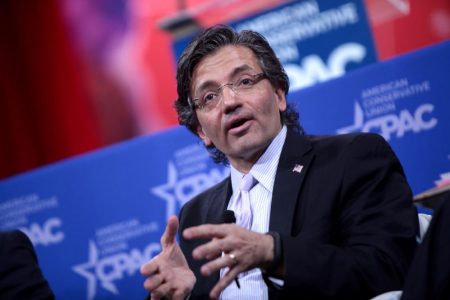
Dr. M. Zuhdi Jasser stands at the forefront of the Muslim Reform Movement (MRM), which celebrated its first anniversary on December 4, 2016. He and representatives from fourteen other Muslim reform groups formed the MRM, which held its inaugural press conference on December 5, 2015.
There, they announced their two-page declaration of principles that discusses counterterrorism, human rights, and secular governance. In a nod to Martin Luther nailing his 99 theses to the door of the All Saint’s Church in Wittenberg, Germany in 1517, several MRM members then taped their principles to the door of the Islamic Center of Washington DC.
The following is an interview with Dr. M. Zuhdi Jasser, CEO of the American Islamic Forum for Democracy (AIFD) and co-founder of the MRM. Jasser is a physician and former U.S. Navy officer whose parents fled Syria. Jasser agreed to reflect on the MRM’s one-year anniversary, the current battle between reformists and Islamists, and the Syrian Civil War.
Q (Postal): What is the MRM, and what are its main objectives?
A (Jasser): The Muslim Reform Movement is a coalition of diverse Muslim organizations and leaders. We wanted to articulate the versions of Islam that we knew and loved, and that were compatible with modernity. We determined that the clearest way to define ourselves was to create a simple “declaration” of principles and goals. The declaration is a firewall of principles that we as Westerners and “modern Muslims” who believe in freedom, liberty, and universal human rights would not compromise.
Whether it is the rejection of any Islamic state and its identity, any caliphate (a global unification of many Islamic states), or the institutionalization of sharia (Islamic jurisprudence as interpreted by Islamic jurists), our Muslim Reform Movement felt that the only way to truly counter-radicalize Muslims is through an unapologetic defense of the Universal Declaration of Human Rights (UDHR) and modern society. Our principles stand in stark contrast to the Cairo Declaration of Human Rights (of 1991) which was based in the interpretations of sharia of the Organization of Islamic Cooperation (OIC).
Q: What events spurred the creation of the MRM?
A: While each of us began separate journeys against Islamism after 9/11 (and some even before), it was the Arab Awakening that brought us all together. So-called “secular” military dictatorships across the Muslim majority world have been profoundly suffocating critical inquiry. (I say “so-called” because these dictatorships essentially govern with sharia.)
I would, for example, put Egypt, Jordan, Qatar, Saudi Arabia, and Syria in this category, though Turkey is a waning democracy cum Islamist dictatorship and Iran is an outright theocracy. Muslims cannot reform their interpretations of Islam under the boots of regimes that manifest interpretations of Islam through blasphemy, apostasy, and treason laws.
The Arab Awakening signaled to Muslims across the world that there was an opportunity for renewed critical thought by the people against the religious establishment and its tyrannical regimes. Unfortunately, since 2011, and perhaps even in the last 1,000 years, the Islamists were far better funded and organized. These opportunities gave way to large-scale violence, war, and chaos rather than heralding reform and modern institutions. Tunisia is thus far perhaps the one exception.
We reformists observed the rise of radical Islam’s attacks against the West since 9/11, and realized that we have a responsibility as Americans, patriotic Westerners, free thinkers, Muslims, and parents to counter and defeat the ideological underpinnings of Islamism.
Q: What accomplishments of the MRM have you seen in the past year? What are its goals?
A: Our greatest accomplishment to date is our declaration. While we are disappointed in the relative silence from most Muslim leaders, we recognize that their avoidance and inability to critique it has also demonstrated that it is on target. Our declaration has also withstood scrutiny from those who have been skeptical of the capacity of Muslims to have modern interpretations of Islam.
Given that we seek to counter a global theo-political establishment, our growth has certainly not been as rapid as we would like, but we are proud of how far we have come in a year.
Our successes as a coalition are highlighted by the successes of each of our respective organizations and leaders. I encourage readers of this interview to look into the works of each of these leaders, and help them make them known. Raheel Raza, Sohail Raza, and Hasan Mahmud with Muslims Facing Tomorrow in Toronto; Imam Usama Hasan with Quilliam Foundation in London; Asra Nomani, journalist and author; Farahnaz Ispahani, former member of Pakistan’s parliament, in Washington DC; Naser Khader in Denmark; myself, Courtney Lonergan, and Arif Humayun with our AIFD in Phoenix; Salma Siddiqui with the Coalition of Progressive Canadian Muslim Organizations in Canada; Tahir Gora, author, journalist, activist, in Toronto, Canada; Tawfik Hamid, Islamic thinker and reformer, Oakton, Virginia, to name a few, have all continued to grow in their programmatic reach.
We had our second annual retreat in Phoenix in October 2016 and expanded our strategic plan for the next few years. In 2017, we hope to see government, academia, media, and the interfaith establishment begin to give reformist Muslims from the MRM an equal seat at the table of any public conversations regarding Muslims and Islam.
On the government front, domestic and foreign policies should be directed by a “liberty doctrine” which engages Muslims positively on the principles embodied in our declaration and refutes those who reject any part or all of the declaration. Homeland security and foreign policy needs to focus more on “countering violent Islamism” rather than the nebulous “countering violent extremism.”
Q: In the MRM’s inaugural press conference, you said American mosques that reject the MRM’s declaration of principles are part of the problem, while those that accept the principles are part of the solution. How many mosques did the MRM approach? Did most of these mosques accept or reject these principles?
A: We spent significant resources on this outreach over a period of ten months. We reached out through snail mail, e-mail, and telephone to over 3,000 mosques and over 500 known public American Muslims. We received only 40-plus rather dismissive responses from our outreach, and sadly less than ten of them were positive. In fact, one mosque in South Carolina left us a vicious voice mail threatening our staff if we contacted them again.
We will continue to persevere with our outreach. On the one hand, we see the open hypocrisy of American Islamist groups effectively working together to sign documents, such as the recent “Open Letter to Donald Trump.” But to get their attention as reformists against Islamism, we face an uphill battle. If it’s grievances against Americans, people quickly sign on to almost anything. But getting people to sign on to an internal honest declaration of reform is like pulling teeth.
I can guess why we had shortcomings in outreach. If we had more funding, we could study this more scientifically. “Muslim” and “Islamic” institutions are often Islamist and thus unlikely to sign on to our declaration. Some estimate that 70-80 percent of Muslim organizations and mosques in the U.S. are die-hard Islamist. However, this needs to be put into an appropriate context. American Muslims, especially Sunni, are not tied to any clergy or organized “mosque” for faith practice or membership so the majority (60-70 percent) of American Muslims do not regularly participate in mosques or established Muslim institutions.
No one knows truly how that majority of Muslims feels about Islamist ideologies. National security is in desperate need of helping us study that. Our MRM is dedicated to creating new Western Muslim institutions outside the mosques and outside the “establishment” Islamist leadership to appeal to Muslims estranged from Islamist political tribalism. We have not been able to effectively reach out to the majority of Muslims because of resources and the absence of effective platforms.
Q: What are the key differences between Muslim reformers and Muslim Islamists?
A: Reformers reject any Islamic state and its legal apparatus empowered through sharia. Reformers believe that individual Muslims have a right to publicly criticize Muslim thought leaders and their legal interpretations. Islamists believe that democracy is majoritocracy and thus in countries where Muslims are a majority, the national identity should be “Islamic” or “Muslim” and sharia should govern the legal system. Islamists believe that the rights of all citizens come from Islam and the state’s legal system and public discourse should be based upon Islamic precepts and exegesis. They view the mosque and its pulpit as the center of that political movement.
Reformers, however, believe that the rights of all citizens come from God and thus all citizens, Muslim and non-Muslim, are created equal and the legal system and public discourse should be based in reason. Reformers believe rights belong to human beings, not to ideas, while Islamists believe that the legal system should protect certain ideas (like Islam) from public defamation. Islamists believe in some form of a theo-political system domestically, and ultimately globally in some form of caliphate. Reformers believe in secular governance, and reject any and all forms of the Islamic state and the global caliphate.
We at AIFD are currently working on a formal response to the “Letter to Baghdadi” signed by Western Islamists. While it admonishes the head of ISIS, Sheikh Abu Bakr Al-Baghdadi for illegitimacy in declaring jihad, establishing an Islamic state and a caliphate among other interpretations of Islamic law by al-Baghdadi, it is also a full-throated defense of an Islamic state, a caliphate, armed jihad, and other Islamist fundamentals that stand in stark contrast to Western secular liberal ideals and universal human rights.
Q: Do you believe the MRM is seeking to reform Islam itself, or Muslim interpretation of Islam? Does such reform require a change in the way Muslims interpret doctrine, or does it require Muslims to adopt humanist values apart from Islam?
A: Your question is the very reason we called this movement the Muslim Reform Movement rather than Islamic reform. If you define Islam as Wahhabi Islam or Salafi Islam, then yes we are reforming that. However if you define Islam as the Islam of the God of Abraham then we believe we are simply modernizing the interpretation to one commensurate with twenty-first century universal principles of human rights.
We understand that many may feel that Islam at its core or at its founding was problematic. But what should matter to the free world is not the origins of Islam but how Muslims are interpreting Islam in the twenty-first century.
We reformists are Muslims who are reforming the interpretation of Islam away from an Islam tied to the political construct of an Islamic state and sharia. Like the Founding Fathers of America, who sought to render unto Caesar what is Caesar’s and unto God what is God’s by preventing the establishment of religion by government, we too seek to interpret Islam in a way that separates mosque and state. Just as Muslims can embrace medical, natural, and computer science, we can embrace political science beyond the constructs of the seventh century.
Q: In the last 30 years, Saudi Arabia has spent more than an estimated $100 billion to fund the spread of Wahhabism worldwide (in contrast to the $7 billion the USSR spent spreading communism from 1921 through 1991). How does the MRM hope to compete with these vast Saudi expenditures?
A: That’s the elephant in the room. The West needs a major information program to advance ideas of liberty. The hope is that the free world will take the side of liberty, and theocracies and quasi-theocracies will fall.
Q: You and other members of the MRM have criticized the Council on American-Islamic Relations (CAIR) in the past. CAIR’s vision, mission, and core principles at first glance appear to be liberal and tolerant. What are the MRM’s concerns with CAIR?
A: The MRM believes, of course, that civil rights—chiefly, freedom of speech and religious expression—are cornerstones of our democracy, and we absolutely support efforts to protect these. CAIR can, to the untrained eye, seem to be in support of these principles as well.
However, this Hamas offshoot is hardly a true champion of civil rights. They silence dissidents, and initiate and actively support campaigns targeting LGBT Muslims, ex-Muslims, and more generally all anti-Islamists. Any cursory review of their practices reveals that they are not the progressive element they claim to be. On the contrary, they represent the very worst elements within our community.
They are, in essence, one of the centerpieces of the DC lobby of the Organization of the Islamic Cooperation (OIC). The OIC is today’s “neo-caliphate” and it seeks to keep the West on constant ideological defense apologizing for its so-called “Islamophobia.” That defensiveness then prevents us in the West from dealing with the deep ideological cancer of the Islamic state (sharia state) identity movements.
Q: You and other members of the MRM have also criticized the Muslim Brotherhood. There are currently bills in both the House (H.R. 377) and Senate (S. 68) that, if passed, would designate the Muslim Brotherhood as a terrorist organization. Do you support that legislation, and why or why not?
A: Personally, I support the designation of the Egyptian branch of the Muslim Brotherhood as a terrorist organization. This is a group that has been responsible for the targeting of Christians, Jews, and dissidents, the persecution of minority Muslims, and the abuse, torture, and murder of women, gay people, and other marginalized groups. It has also made significant efforts to export its hateful ideology internationally.
I think we have to be strategic with regards to the global “Ikhawni” or Brotherhood movement. I would compare it in the Cold War to fighting the militant version of communism as embodied in the Soviet threat, versus other versions of communism. Odds are there are links between communist parties and global Soviet sympathies but outlawing “communist parties” would have made counter-ideology and monitoring far more difficult.
Similarly with the Ikhwan, Turkey’s AKP, Tunisia’s Ennahda, and so many other Islamist parties are part of the “Ikhwani” movement. We will never defeat all of their common Islamism by declaring them terror groups. Authoritarian regimes in the Middle East have proven that such designations often serve as arson to the Islamist fire.
Q: What are your thoughts on branding any criticism of Islam as “Islamophobia?” Does such branding have any impact on your reform efforts?
A: I have spoken about this for well over a decade, and invite your readers to look at my and my organization’s discussions of this. While some anti-Muslim bigotry is real, “Islamophobia” is a word often thrown around by Islamists to silence any critical discussion of Islam, Muslims, and—most significantly—the common pathways of radicalization from Islamism.
The obsession some have with “Islamophobia” means that these conversations are censored if not entirely shut down, and reformers like me are maligned, harassed, and threatened not just from within our community, but from those outside of it as well.
Non-Muslims in particular need to learn that it is not bigotry to discuss radicalization. It is bigotry to hate people based on their religion, appearance, gender, sexual orientation, or race. It is not bigotry to want to combat a force—Islamism—that in fact promotes bigotry and violence against all marginalized peoples.
Q: As an American of Syrian descent, whose parents fled Syria for the United States in the mid 1960s, what if anything do you think the United States should do to resolve the Syrian refugee crisis?
A: America must remain a refuge for the downtrodden and oppressed who share our values. But in order to remain so, we must also remain the safest country in the world, committed to our principles and to promoting them in the world. We are and will always be “the last best hope” for freedom and that “city on a Hill” for those who seek liberty.
I have advocated at great length for a robust vetting system against any and all Islamists, whether violent or nonviolent. I have also advocated for comprehensive integration programs that help new arrivals integrate their Muslim and Arab identities with their identities as American residents and perhaps future citizens.
Q: Are you concerned that the Muslim Brotherhood will rise to power in Syria currently, or in any post-Assad Syria?
A: There is always the concern that an Islamist force will replace a dictatorship, but this question is also often used to advocate for inaction against brutal dictatorships. Further, it is not even the primary question on the table right now, as far as I’m concerned.
Several years ago, this question was used to allow Assad to remain in power. Today, over half a million people are dead, including many of the very reformers and lovers of liberty that could have saved my parents’ homeland from the twin evils of Islamist theocracy and secular fascism.
Make no mistake, Assadists and their Iranian benefactors are the Shia jihadist side of the Islamist coin opposite the Sunni Islamists of ISIS and the Muslim Brotherhood. The truth is that whatever emerges first from this genocide may be intensely problematic, and we will have to address that as well. Most revolutions often need multiple iterations before there is ever a chance for liberal democracy. But first, we must address the ongoing genocide.
Q: How do you see the Syrian civil war ending?
A: First, I don’t call this a “civil war.” It is not. It is a conflict wherein the people rose against a dictatorial regime, and that regime responded with genocidal mass rape, torture, and murder, aided by the Russians, Iranians, and global inaction. In the end, Syria could become a more formalized Iranian or Russian proxy, or it could be taken over by radical elements that are anti-Assad, anti-Ba’ath, and anti-Khomeinist. Remember, the Sunni Islamists are fueled and radicalized by their Saudi, Qatari, and Turkish Islamist benefactors.
The only solution to this Shia-Sunni Islamist stalemate is to build a third pathway of secular liberalism and civil society away from all forms of Islamist tyranny. As in the Cold War, the West needs to slowly work with those groups who share our values with a long-term vision rather than futile and ineffective short-term whack-a-mole programs.
The author would like to thank Dr. M. Zuhdi Jasser for participating in this interview.




 anneinpt
 artaxes
 danmillerinpanama
 davidking1530
 Peter Hofman
 Joseph Wouk
 Peter
Peter Louisiana Steve
 WarSclerotic
Recent Comments