Archive for the ‘Moderate Muslims’ category

CAIR Intertwines with US-based, Terror-Linked Fuqra Group

February 9, 2016

CAIR Intertwines with US-based, Terror-Linked Fuqra Group, Clarion ProjectRyan Mauro, February 9, 2016

Gilani-HP_1Sheikh Mubarak Ali Gilani, the radical head of Jamaat ul-Fuqra, a terrorist organization fronted in the U.S. by Muslims of the Americas.

The Council on American-Islamic Relations (CAIR) and its “moderate” image is suffering from a self-inflicted wound now it has become intertwined with the Muslims of the Americas, a radical anti-Semitic front for the Jamaat ul-Fuqra terrorist group.

CAIR’s Massachusetts chapter now shares an official with MOA and two CAIR officials spoke at MOA’s International Islamophobia Conference.

The Massachusetts chapter of CAIR recently chose MOA’s general counsel, Tahirah Amatul Wadud, as a board member. CAIR, a U.S.Muslim Brotherhood entity banned for its own terror links in the UAE, wisely omitted mention of MOA. It described her generically as a “general counsel for a New York Muslim congregation.”

Wadud reportedly posted an article by MOA’s Pakistan-based leader, Sheikh Mubarak Ali Gilani, on her Facebook claiming the Islamic State (ISIS/ISIL) is a puppet of the British government and a Jewish conspiracy perpetrated the attacks on Pearl Harbor and September 11, 2001. The Clarion Project was the first to report on the inflammatory article.

“There was no need for America to go to war against Hitler. Hitler was not the enemy of America or the American people. There was a mutual animosity between Hitler and the Jews. So, the American people paid a very heavy price for fighting someone else’s war,” Gilani wrote.

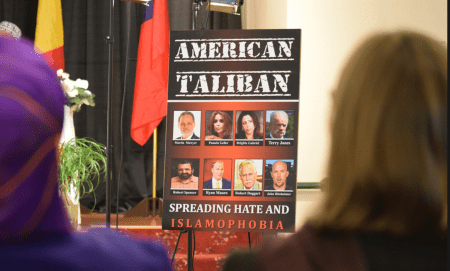
American Taliban _ Mauro-240x145

Two CAIR officials spoke at MOA’s International Islamophobia Conference, which included a poster featuring the faces of the “American Taliban” that included Clarion Project national security analyst Ryan Mauro. They were CAIR-Michigan Executive Director Dawud Walid and CAIR-ArizonaExecutive Director Imraan Siddiqi. Walid was one of the CAIR officials who have questioned whether Muslims should honor fallen U.S. servicemen on Memorial Day, sparking a backlash from Muslims who appreciate the U.S. military.

Jamaat ul-Fuqra is led by Gilani. It is best known for a series of terrorist attacks and plots in the 1980s and early 1990s and for setting up “Islamic villages” across the country, including at least two that were shut down by the authorities. These “villages” are known to have been used for guerilla warfare training. Fuqra now goes primarily by the name of Muslims of the Americas (MOA), among other names. The group says it has 22 such “villages” in the U.S.

The Clarion Project obtained video of female members receiving basic paramilitary instruction in military fatigue at its “Islamberg” headquarters in New York. The date of the footage is cut off, only stating “Jan. 28 20,” presumably meaning it was made in 2000 or after. The best explanation MOA members have come up with is that it was a “self-defense class.”

View the video here:

The Clarion Project identified a Fuqra “village” in Texas in 2014 and retrieved an FBI intelligence report from 2007 that stated MOA “possess an infrastructure capable of planning and mounting terrorist campaigns overseas and within the U.S.” and “the documented propensity for violence by this organization supports the belief the leadership of the MOA extols membership to pursue a policy of jihad or holy war against individuals or groups it considers enemies of Islam, which includes the U.S. Government.”

The FBI also said “members of the MOA are encouraged to travel to Pakistan to receive religious and military/terrorist training from Gilani.” In 2001, ATF Special Agent Thomas P. Gallagher testified in court that “individuals from the organization are trained in Hancock, N.Y., and if they pass the training in Hancock, N.Y., are then sent to Pakistan for training in paramilitary and survivalist training by Mr. Gilani.”

After Clarion Project identified the Texas site and published the FBI report, a dozen Muslim groups have signed a statement calling for Fuqra’s designation as a Foreign Terrorist Organization. Of course, CAIR isn’t one of them. CAIR actually came to Fuqra/MOA’s defense. And now CAIR and Fuqra have shared leadership through CAIR-Massachusetts and hold events together.

CAIR Two Officials Siddiqi Walid-240x323

MOA’s International Islamophobia Conference took place at the Muslim Community Center of the Capital District in Schenectady, New York. CAIR-Arizona Executive Director Imraan Siddiqi is listed as a member of the Board of Directors, indicating he played more than a speaking role in setting the MOA event up.

The MOA’s event featured delegates representing the U.S., Canada, Pakistan, Senegal, India, Taiwan, Bangladesh and Egypt. Siddiqi was the delegate representing India. MOA flyers also list headquarters in Caracas, Venezuela and Las Lomas, Trinidad & Tobago. The MOA claims it had nearly 300 attendees and thousands watched online. It announced it would start a new political coalition named the “International United Muslim Forum.”

Ironically, MOA has tried to excuse itself from its terrorist and criminal history by claiming that it was infiltrated by Wahhabist/Muslim Brotherhood operatives who were sent to undermine Sheikh Gilani. It even claims that one operative was a shape-shifter who could go “through physical changes before speaking to people as if he were Sheikh Gilani.”

And now MOA is collaborating with a known Muslim Brotherhood entity. You can read our documented profiles of CAIR and MOA here and here.

Islam — Radical, Extremist and Mainstream

November 21, 2015

Islam — Radical, Extremist and Mainstream, Dan Miller’s Blog, November 21, 2015

(The views expressed in this article are mine and do not necessarily reflect those of Warsclerotic or its other editors. — DM

In largely secular western societies, Islam and its history are viewed by many non-Muslims as substantially irrelevant to how devout Muslims behave. Perhaps the view that religion is of little importance to devout Muslims is based on the role, minor if any, that religion and religious history play in their own secular lives. However, both Islamic teachings and history give devout Muslims their grounding in Islam and teach them that Islam is the religion of war, not peace: Islam must become the world’s only religion by extirpating all others.

Islam was founded by Mohamed ( c. 570 CE – 8 June 632 CE) in the sixth century. Mohamed

is considered, almost universally,[n 2] by Muslims to have been the last prophet sent by God to mankind[3][n 3] to restore Islam, which they believe to be the unaltered original monotheistic faith of Adam, Abraham, Moses, Jesus, and other prophets.[4][5][6][7] [Emphasis added.]

Islam considers the words of Mohamed, as transcribed in the “Holy” Quran and Hadith, to be the words of Allah. “Restoring” other monotheistic religions means changing them to comport with Islam as dictated to Mohamed by Allah; unaltered, those other religions cannot continue to exist; it is the duty of Muslims to force them to change or to exterminate them.

Islam provides the basis for Sunni and Shiite (principal branches of Islam) efforts to govern world civilization according to Islamic principles as voiced by Allah through his prophet, Mohamed. Since Islamic principles tolerate no religious or political freedoms (let alone contemporary gender equality or homosexuality notions), such western ideas must be extirpated — as they have been in Saudi Arabia (now the head of the UN Human Rights Council) and Iran. Islamic principles are also manifested by the hopes and efforts of the Islamic State (Sunni, like Saudi Arabia) and the Islamic Republic of Iran (Shiite) to achieve their own caliphates.

Sheikh Muhammad Abdullah Nasr is a scholar of Islamic law and a graduate of Egypt’s Al Azhar University — regularly touted as the world’s most prestigious Islamic university. Al Azhar University co-hosted Obama’s 2009 “New Beginnings” address in Cairo, to which Obama insisted that at least ten members of the Muslim Brotherhood be invited. According to an article at Jihad Watch,

After being asked why Al Azhar, which is in the habit of denouncing secular thinkers as un-Islamic, refuses to denounce the Islamic State as un-Islamic, Sheikh Nasr said:

It can’t [condemn the Islamic State as un-Islamic].  The Islamic State is a byproduct of Al Azhar’s programs.  So can Al Azhar denounce itself as un-Islamic?  Al Azhar says there must be a caliphate and that it is an obligation for the Muslim world [to establish it].  Al Azhar teaches the law of apostasy and killing the apostate.  Al Azhar is hostile towards religious minorities, and teaches things like not building churches, etc.  Al Azhar upholds the institution of jizya [extracting tribute from religious minorities].  Al Azhar teaches stoning people.  So can Al Azhar denounce itself as un-Islamic? [Emphasis added.]

Nasr joins a growing chorus of critics of Al Azhar.  Last September, while discussing how the Islamic State burns some of its victims alive—most notoriously, a Jordanian pilot—Egyptian journalist Yusuf al-Husayni remarked on his satellite program that “The Islamic State is only doing what Al Azhar teaches… and the simplest example is Ibn Kathir’s Beginning and End.”

Since the world’s preeminent Islamic university teaches Islam as proclaimed by the Islamic State, how can non-Muslims claim that the Islamic State is not Islamic? Why do many, even conservatives, refer to the Islamic State and its allied Islamic terror groups as “radical” or “extremist?”

Martin Luther was “radical” and “extreme” because he tried to reform aspects of Roman Catholicism which he deemed malign.

He strongly disputed the claim that freedom from God’s punishment for sin could be purchased with money. He confronted indulgence salesman Johann Tetzel, a Dominican friar, with his Ninety-Five Theses in 1517. His refusal to retract all of his writings at the demand of Pope Leo X in 1520 and the Holy Roman Emperor Charles V at the Diet of Worms in 1521 resulted in his excommunication by the Pope and condemnation as an outlaw by the Emperor.

Unlike Martin Luther’s eventually successful efforts to reform aspects of Roman Catholicism, the efforts of Egyptian President Sisi and other moderate Muslims to reform Islam have thus far gained little traction. Obama appears to support President Sisi’s principal opponent in Egypt, the Muslim Brotherhood and its affiliate, the Council on American-Islamic Relations (CAIR). Sisi and other moderates — rather than the Islamic State and Islamic nations such as Iran and Saudi Arabia — should be characterized as “radical” or “extreme” because they dispute the teachings of Allah as relayed through his prophet, Mohamed. The proponents of Islam as it now exists are “mainstream,” and therefore neither “radical” nor “extreme.” We should support “radicals” like President Sisi.

As noted in an article titled Beware of Islamic Terrorism,

All Islamic terrorists — not only the Islamic State group and al-Qaida — systematically and deliberately target civilians, stabbing their Muslim and “infidel” host countries in the back, abusing their hospitality to advance 14 centuries of megalomaniac aspirations to rule the globe in general, and to reclaim the “waqf” (Allah-ordained) regions of Europe in particular.

Emboldened by Western indifference, these destabilizing and terror-intensifying aspirations have been bolstered by the Islamic educational systems in Europe, the U.S. and other Western countries. These proclaim a supposedly irrevocable Islamic title over the eighth-century Islamic conquests of Lyon, Nice and much of France, as well as all of Spain; the ninth-century subjugation of parts of Italy; and the ninth- and 10th-century occupations of western Switzerland, including Geneva. [Emphasis added.]

Europe has underestimated the critical significance of this long anti-Western history in shaping contemporary Islamic education, culture, politics, peace, war, and the overall Islamic attitude toward Europe, North America, Australia, and other “arrogant infidels.” “Infidel” France has been the prime European target for Islamic terrorists, with 11 reported attacks in 2015, despite France’s systematic criticism of Israel and support for the Palestinian Authority — dispelling conventional “wisdom” that Islamic terrorism is Israeli or Palestinian-driven.

Europe has ignored the significant impact the crucial milestones in the life of the Prophet Muhammad have had on contemporary Islamic geostrategy, such as his seventh-century Hijrah, when Muhammad, along with his loyalists, emigrated or fled from Mecca to Yathrib (Medina), not to be integrated and blend into Medina’s social, economic or political environment, but to advance and spread Islam through conversion, subversion and terrorism, if necessary. Asserting himself over his hosts and rivals in Medina, Muhammad gathered a critical mass of military might to conquer Mecca and launch Islam’s drive to dominate the world. [Emphasis added.]

According to a moderate Muslim, Maajid Nawaz, writing in an article at the Daily Beast titled ISIS Is Just One of a Full-Blown Global Jihadist Insurgency,

Our political leaders have been restricting the definition of this problem to whichever jihadist group is causing them the biggest headache at the present time, while ignoring the fact that they are all borne of the same Islamist ideology. Before ISIS emerged, the U.S. State Department strangely took to naming the problem “al Qaeda-inspired extremism,” even though it was not al Qaeda that inspired the radicalism. Rather, Islamist extremism inspired al Qaeda. And in turn, ISIS did not radicalize those 6,000 European Muslims who have traveled to join them, nor the thousands of supporters the French now say they are monitoring. [Emphasis added.]

This did not happened overnight and could not have emerged from a vacuum. ISIS propaganda is good, but not that good. No, decades of Islamist propaganda in communities had already primed these young Muslims to yearn for a theocratic caliphate. When surveyed, 33 percent of British Muslims expressed a desire to resurrect a caliphate. ISIS simply plucked the low-hanging fruit, which had been seeded long ago by various Islamist groups, and it will now require decades of community resilience to push back. But we cannot even begin to do so until we recognize the problem for what it is. Welcome to the full-blown global jihadist insurgency. [Emphasis added.]

The author of that article claims that Islamism (often referred to as “political Islam“) is not Islam:

I speak as a former Liberal Democrat candidate in the U.K.’s last general election and as someone who became a political prisoner in Egypt due to my former belief in Islamism. I speak, therefore, from a place of concern and familiarity, not enmity and hostility to Islam and Muslims. In a televised discussion with CNN’s Fareed Zakaria on the issue, I have argued that of course ISIS is not Islam. Nor am I. Nor is anyone, really. Because Islam is what Muslims make it. But it is as disingenuous to argue that ISIS has “nothing to do with Islam” as it is to argue that “they are Islam.” ISIS has something to do with Islam. Not nothing, not everything, but something. . . . [Emphasis added.]

It is important to define here what I mean by Islamism: Islam is a religion, and like any other it is internally diverse. But Islamism is the desire to impose a very particular version of Islam on society. Hence, Islamism is Muslim theocracy. [Emphasis added.]

In another article, Mr. Nawaz acknowledges,

Islamism has been rising in the UK for decades. Over the years, in survey after survey, attitudes have reflected a worrying trend. A quarter of British Muslims sympathised with the Charlie Hebdo shootings. 0% have expressed tolerance for homosexuality. A third have claimed that killing for religion can be justified, while 36% have thought apostates should be killed. 40% have wanted the introduction of sharia as law in the UK and 33% have expressed a desire to see the return of a worldwide theocratic Caliphate. Is it any wonder then, that from this milieu up to 1,000 British Muslims have joined ISIS, which is more than joined the Army reserves.

I wish Mr. Nawaz well and hope that his efforts to change Islam succeed. However, in drawing distinctions between Islam and Islamism, he seems to have forgotten, or perhaps to have chosen to ignore, the teachings of Allah as relayed by his messenger and Islam’s founder, Mohamed, referenced at the beginning of this article. Mohamed (and presumably Allah himself) would be surprised by and even horrified at such notions as “Islam is what Muslims make itand that Islam does not contemplate a Muslim theocracy. So, in all probability, would be many of the clerics at Egypt’s Al Azhar University.

Here are a few videos of Islamic clerics spreading their messages of Islamic peace, love and tolerance. The last of the bunch is about one of Obama’s favorite Muslims.

https://www.youtube.com/watch?v=3CQwU_QhrHE

https://www.youtube.com/watch?v=MNYZX6lt49k

To close on a somewhat lighter note, here are a few observations by Jonah Goldberg taken from his Goldberg file (November 20, 2015 e-mail),

If you Google “Christian terrorism,” you’re probably a jackass to begin with. But if you do — bidden not by your own drive to jackassery but by the natural curiosity inspired by this “news” letter — you’ll find lots of left-wingtrollery about how the worst terrorist attacks on American soil have been committed by Christians. Much of it is tendentious, question-begging twaddle. But I really don’t want to waste a lot of time on whether Tim McVeigh was a Christian or not (he really wasn’t).

What I find interesting is that many of the same people who clutch their pearls at the mere suggestion that Islamic terrorism has anything to do with — oh, what’s the word again? — oh right: Islam, seem to have no problem making the case that “Christian terrorism” is like a real thing. Remember how so many liberals loved — loved — Obama’s sophomoric and insidious tirade about not getting on our “high horses” about ISIS’s atrocities in the here and now because medieval Christians did bad things a thousand years ago? They never seem to think that argument through. Leaving out the ass-aching stupidity of the comparison, it actually concedes the very point Obama never wants to concede. By laying the barbaric sins of Christians a thousand years ago at the feet of Christians today, he implicitly tags Muslims with the barbarism committed in their name today. [Emphasis added.]

Now, I see no need to wade too deeply into the theology here, but I think I am on very solid ground when I say that Islamic terrorism draws more easily and deeply from the Koran than Tim McVeigh drew from the Christian Bible. Of course, you’re free to disagree. In a free society, everybody has the right to be wrong in their opinions. (But don’t tell anyone at Yale that.)

. . . .

But it is simply a lie — an obvious, glaring, indisputable, trout-in-the-milk lie — that Muslims have nothing whatsoever to do with terrorism.

Simply put, this is nonsense. . . .  The jihadists say they are motivated by Islam. They shout “Allahu akbar!” whenever they kill people. “Moderate Muslims” in Saudi Arabia and elsewhere have been funding Islamic radicals around the world for nearly a century. This morning in Mali, terrorist gunmen reportedly released those hostages who could quote the Koran. The leader of ISIS has a Ph.D. in Islamic Studies and openly talks about restoring the Caliphate. [Emphasis added.]

Despite all of this, don’t be distracted from the greatest threat to our security; or perhaps we should be:

theo3

Muslim Activists Demand Action vs Islamist Extremism

November 17, 2015

Muslim Activists Demand Action vs Islamist Extremism, Clarion Project, Elliot Friedland, November 13, 2015

(Shhh. Don’t tell Obama, but these Muslims think that the Islamic State is Islamic and want reform. He might treat them as he does Egyptian President Sisi.– DM)

Iraq-Protest-Sharia-Legislation-HP_1Protesters in Iraq march against anti-women sharia legislation. (Photo: © Reuters)

“The threat of global terrorism is unlikely to end until the resolution of the civil war of ideas between Muslim modernisers and those adhering to an outmoded theology of Islamic dominance.”

***************************

In the aftermath of Friday’s Paris attacks, Muslim human rights activists around the world are galvanizing the fightback against the Islamist extremist ideology and those who deny the conection between the Islamic State and Islam.

The chairman of the UK’s Conservative Muslim Forum, Mohammed Amin, slammed the inaction of Muslim groups saying “condemning terrorism is not enough if you are unwilling to acknowledge its causes.”

He said condemnations of terrorism from groups like Council on American Islamic Relations (CAIR) and the Muslim Council of Britain left him “feeling frustrated –  because they look so incomplete.”

“I am utterly fed up with hearing people, both Muslim and non-Muslim, argue that the religious views of the terrorists are irrelevant,” he said.

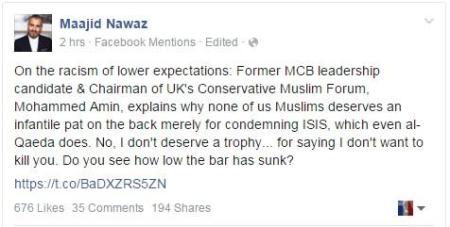
Counter-extremism activist Maajid Nawaz supported Amin on Facebook saying,“None of us Muslims deserves an infantile pat on the back merely for condemning ISIS, which even al-Qaeda does.”

Maajid-Nawaz-pat-on-back-500x253

Anti-extremism activist and journalist Felix Marquardt went further, demanding “We Muslims must hunt down these monsters who make a mockery of our religion” in a fiery op-ed in Britain’s The Daily Telegraph.

He called out Muslims who merely say ISIS has “nothing to do with Islam,” despite that being the first reaction of a Muslim. He labelled it “dubious intellectually and altogether irresponsible to keep our reaction at that.”

Dr. Zudhi Jasser, head of the American Islamic Forum for Democracy, identified a “cultural battle, a battle of ideologies” as the root cause.

Raheel Raza of the Council of Muslims Facing Tomorrow implored both Muslims and non-Muslims to “connect the dots to get to the root of terrorism,” arguing that “Since 9/11, the West has been waffling in the quicksand of political correctness and refuse to call a spade a spade.”

She too identifies the root cause of the Islamic State as the ideology of radical Islamism.

The former ambassador of Pakistan to the United States, Hussein Haqqani, also pointed to extremist ideology as the root cause of the Paris attacks.

“Just as the post-9/11 war against al-Qaeda degraded Osama bin Laden’s group but gave rise to the Islamic State in Iraq and the Levant (ISIL)” he writes, “extremist Islamist ideology will likely give birth to ‘Terrorism 3.0’ once the world has fought, contained and eliminated ISIL.”

This is because, he argues, “The threat of global terrorism is unlikely to end until the resolution of the civil war of ideas between Muslim modernisers and those adhering to an outmoded theology of Islamic dominance.”

Haqqani resoundingly concludes “only a concerted ideological campaign against medieval Islamist ideology, like the one that discredited and contained communism, could turn the tide.”

These are just a handful of the growing number of Muslims who are fighting the Islamist ideology on the front lines and within their own communities.

They, more than anyone, know that this is not a “clash of civilizations” between East and West but a political battle between tolerance and intolerance, between fundamentalism and openness and between theocracy and democracy.

These brave thinkers and leaders are sounding the charge and deserve our support.

Maajid Nawaz of the Quilliam Foundation names the Islamist ideology:

https://www.youtube.com/watch?v=HVC8r6Yt_qI

Egypt’s secular culture minister ruffles Salafi feathers

October 7, 2015

Egypt’s secular culture minister ruffles Salafi feathers, Al-MonitorRami Galal, October 6, 2015

(Building a secular Muslim state in a region dominated by Islamists is difficult and takes time, as Egypt and Al-Sisi are learning. — DM)

helmiEgypt’s newly appointed Culture Minister Hilmi al-Namnam appears on the Egyptian talk show 25/30, Nov. 11, 2014. (photo by youtube.com/ONtv)

CAIRO — On Sept. 19, a new Egyptian Cabinet, headed by Prime Minister Sherif Ismail, was sworn in before President Abdel Fattah al-Sisi. Among the new ministers is the journalist Hilmi al-Namnam, who holds the culture portfolio. The appointment of Namnam, a secularist, has sparked controversy among Egyptian Salafis and aroused opposition in Saudi Arabia. Such Saudi writers and intellectuals as Jamal Khashoggi, editor-in-chief of Al-Arab News Channel, object to Namnam’s appointment because he opposes Wahhabi Salafism, the religiopoliticial movement that originated in the Nejd region of the Saudi kingdom.

Muhammad ibn Abd al-Wahhab founded what became the Wahhabi movement in the 18th century. In 1744, Wahhab allied with Muhammad ibn Saud, emir of the Nejd and founder of the first Saudi state, to increase followers of the Quran, Sunnism and the words and actions of the Salaf, the first three generations of Muslims. In doing so, they sought to purify Islam of misguided practices negatively affecting the Islamic essence of unity and various forms of heresy.

Immediately after Namnam assumed the culture portfolio, a video of him from July 2013 went viral. In it, Namnam stated, “The political Islam current must leave the political game completely, especially the Salafist Nour Party, which is more dangerous than the Muslim Brotherhood.” He compared the Nour Party to a “whore who extorts her husband if he doesn’t fulfill her demands by escorting someone else.” Namnam also said, “We lie when we say Egypt is a naturally religious country. It is high time we said Egypt is a naturally secular state.”

The Nour Party came in second in the 2012 parliamentary elections. Among its positions at the time were prohibitions on electing women and Copts, saluting the flag and singing the national anthem. The party altered these platforms, however, after lending its stamp of approval in 2013 to the June 30 revolution, although most of its leading figures waivered over what course to take.

On Sept. 19, Shaaban Abdel Aleem, a member of the Nour Party’s board, requested information on the selection criteria used for appointing the new ministers. On the same day, Khashoggi, who is close to Saudi decision-makers, commented on Namnam’s appointment via Twitter. “For whoever is planning mutual cultural exchanges with our brothers in Egypt, the following piece of information could be useful: Namnam is not only a critic of Wahhabism, but abhors it and blames it for all his country’s catastrophes,” Khashoggi tweeted. In a separate tweet, he wrote, “Honestly, for the sake of relations between Saudi Arabia and Egypt, and due to the nature of the regime there, Egypt should not appoint a minister like Namnam, who has taken it too far in offending the kingdom.”

Namnam responded that evening in a phone call to “Al-Ashera Masaa,” a show on Dream TV, saying, “I did not say Wahhabism was the mother of vices. These are not my words, but I am against terrorist groups in general.” He added that he had criticized “attempts to export Wahhabism to Egypt,” but that he “respects the kingdom’s choices, just as the kingdom’s writers should respect Egypt and Egyptians’ choices.”

Khashoggi immediately replied, again on Twitter, writing, “Egypt’s minister of culture claims he respects Wahhabism, but admits that he is against exporting it to Egypt. I would like to tell him that Wahhabism cannot be exported. It is a pillar of the Egyptian revolution and is represented by emblematic figures like the followers of Sheikh Muhammad Abduh.” The Islamic jurist Abduh, an Egyptian, is a founder of Islamic modernism. He spearheaded the movement at the end of the 19th century, beginning of the 20th century to counter intellectual and cultural stagnation and revive the Islamic nation in line with the times.

Khashoggi argued, “Salafism preceded the Muslim Brotherhood in Egypt, as there was the Ansar al-Sunna al-Muhammadiyah group, which remains the oldest reformist Islamic organization in Egypt and the world.” Ansar al-Sunna al-Muhammadiyah seeks absolute unity and the rejection of superstitions and cults. It began in Cairo’s Hadara Mosque in 1926. Many Al-Azhar scholars and Salafist preachers were welcoming of it.

On Oct. 2, tensions escalated when Namnam said during an interview on the Sada al-Balad channel that he was ready to be “martyred to spare Egypt from turning into a caliphate state.” He added that secularism is not the adversary of Islam, as some claim. “Every moderate Muslim is necessarily secular. But, not every secularist is a Muslim,” he said.

The following day, Yasser Borhami, deputy leader of the Salafist Call, implored Sisi to intervene and forbid Namnam from making such statements, which he said contradict the constitution given that Sharia is the primary source of legislation.

Nour Party leader Younes Makhyoun entered the fray Oct. 3, asserting that Namnam should remain impartial or be dismissed. “The person [Sisi] who appointed this minister must oblige him to respect the constitution,” he stated.

Sayyed Mustafa, deputy chair of the Nour Party, told Al-Monitor, “The party did not look into Namnam’s old opinions, because they stem from personal freedom. Each person has the right to believe whatever they wish. But he must realize that he is the minister of culture for 90 million Egyptians. The Ministry of Culture should represent all currents, not just one, be it secular or nonsecular.” He added, “As a minister handling a political portfolio, Namnam must take into consideration Egypt’s foreign relations in general and brotherly relations in particular, like those it shares with Saudi Arabia.”

Zubeida Atta, former dean of Helwan University’s faculty of arts and a member of the Supreme Council of Culture, has a different perspective on the issue. “The concept of secularism that Namnam called for is not a heretical one. It relies on the use of education and its application in countries to improve them and ensure their civil aspects, instead of mixing religion with political life. The latter [mixing of the two] would send Egypt down a sectarian abyss that would threaten its existence,” she told Al-Monitor. “The Nour Party demanded clarifying the selection criteria of ministers. I demand clarifying the criteria that allow such a religious party to participate in political life and in parliamentary elections.”

As for the rumblings from the Gulf, Atta asserted, “Egypt does not dare suggest a Saudi Arabian minister for a certain ministry in the kingdom or criticize a current minister in the Saudi Arabian regime, because this is an internal Saudi Arabian matter. Why is Khashoggi, among others, allowing himself to interfere in the appointment of a minister in the Egyptian Cabinet?”


Satire | Three cheers for Terroristine

October 1, 2015

Three cheers for Terroristine, Sultan Knish Blog, Daniel Greenfield, October 1, 2015

(He refers, of course, to “Palestine.” — DM)

We need a terrorist state. Where the politicians are terrorists, the police are terrorists and even the men sitting at the desk when you come in to drop off a form are terrorists.

3egypt081613

There are states that support terrorists, and give safe harbor to them, but that’s not good enough. We don’t want another Pakistan or Iran. We’re not half-assing it this time. What we want is the genuine article. Terrorists from the top down. Terrorists everywhere. A state where every branch of government and the entire country is nothing but terrorists.

Terroristine has been an ancient dream since 1973 or was it 1967. A generation of keffiyah draped thugs, KGB operatives and human rights activists have looked out into the darkness and called it into being. It is a vision of a country where everyone is a murderer and children are taught from a very young age that their purpose in life is to die killing people who don’t share their religion.

And now after decades of negotiations, treaties, suicide bombings, mutilations, billions of dollars in vanishing into Swiss bank accounts and the death of its Egyptian born leader of AIDS– Terroristine is closer than ever to coming into being.

Abbas, its unelected dictator, who has struggled long and hard so that one of his sons might have his own cigarette monopoly in Gaza, has come to the UN to promise that Terroristine will have “will actively contribute to the achievement of economic, cultural, and humanitarian progress of civilization.”

And who can doubt him? Certainly not Terroristinians who don’t have elections or a free press.

Terroristine, whose noble flag (that looks like nearly every other Arab flag) flies over the UN, has done wonders for civilization. Consider the airplane hijacking. The suicide bomber. Has there ever been a civilization that did as much for civilized living as the Terroristinians?

Every time you get groped at an airport, thank Terroristine. Without the Terroristinian contribution to civilization, you might actually be able to get on a plane in peace. Or visit the Twin Towers.

The Terroristinian contribution to human progress is unquestionable. But only one thing stands in the way of it unleashing its full Terroristinian potential for all mankind.

Them. Those pesky people who live in that country that is always in the way. You know the ones, with too many Nobel prizes, newly invented tomatoes and microchips. They stand in the way of the great cultural contributions of Terroristine. They must die so that Terroristine must live.

They must be thrown out of their homes, village by village and city by city, so that the noble Terroristinians can plant their rockets on the rubble of their houses, the charred remains of their fields, and point them at their cities.

Trying to end terrorism by creating a terrorist state makes is like trying to put out a fire with more fire. It can’t work, but we must try. So that we can say that we tried. Over and over again. We’ll keep trying until we run out of land to try with. And people to try with.

Until there’s nothing left but Terroristines everywhere. Until all the world is Terroristine. The question is can we make it happen? Yes, we can. Oh sweet Allah, yes we can.

Israel must return to the 1967 borders, which are really the 1948 borders. Why are the borders of the 1948 war, so much better than the borders of the Six Day War? Because the Terroristinians came closer to winning that war. Came closer to driving the Yahood into the sea and ululating over miles  of their corpses.

boy_bomb.preview

But the dream failed. Farmers armed with outdated rifles. Volunteer pilots from America and Canada. Refitted cargo ships filled with half-dead men, women and children straight from the camps. Used Czech artillery. They held off the armies of seven Terroristinian nations. Farm by farm, they stood off tanks and infantry. In Jerusalem, they fought for every house. And so the Zionist entity survived.

Allah curse them. They survived.

But now it’s back to 1948 again. Every war undone. Every defeat turned to victory. Cut Jerusalem in two. Drive out the farmers. Burn their land. Dig up their graves. March the borders back to 1948. And fly the Terroristinian flag over dust and rubble. Had they won in 1948 or 1967 or 1973, there would be no Israel and no Terroristine. The land would have become part of Syria, Egypt and Jordan. And only when the mobs of the faithful would drive out the tyrants to replace them with Islamic states, would there finally be a Terroristine.

But despite what Abbas says, there is still hope for a two state solution. And we must do everything in our power to salvage the two state solution so that there will be a state of civilization on one side and a state of terrorists on the other. Hospitals here, launching pads there. Schools here, bomb factories there. Life here, death here. We all know the story. Olive trees and bomb belts. Rocks and dead families in burning cars by the side of the road. Children with their throats cut.

A dream. A nightmare. Who even knows anymore.

Why do we need Terroristine? Peace. There can be no peace without a terrorist state. Not a chance of it. The only way we’ll ever have peace is to give the terrorists a country of their own. A country dedicated to terrorism. Only then will the Terroristinians finally give up on all the killing, and dedicate themselves to medical research, quantum mechanics and the arts. It hasn’t happened yet to. But it’s bound to.

After decades as an autonomous territory, spreading death and destruction, it’s time for Terroristine to finally be recognized as an independent state. With contiguous borders cutting Israel in half. It is the only hope for peace in the region. Would Sunnis and Shiites be killing each other from Yemen to Iraq? Assuredly not. The moment the flag of Terroristine rises above the wounded hills, and its peaceful anthem, “Palestine is My Revenge” is heard in the land, then a great echoing sigh will rise up from the mouths of one billion Muslims. And the violence will cease.

The international community is impatient. They want Terroristine and they want it now. Whatever Israel has offered in the past, it isn’t enough. It must offer more and more. Whatever it takes. We know the Terroristinians want their own state. Every time they walk out of negotiations or end them with a round of terrorist attacks, it shows their deep and abiding passion for a state. They want it so badly they aren’t willing to make a single concession for it. Or even negotiate for it.

That’s how committed they are to realizing their great dream to Terroristine. And who can blame them? Have any people suffered the way the Terroristinians have? (Besides all the people the Terroristinians have killed over the last 1,400 years.) Have any other people been wholly subsidized by a UN agency dedicated only to them? Have any other people inspired such a stylish fashion statement? No more excuses. The world demands Terroristine. Middle East peace demands Terroristine.

How much longer can Israel expect to draw out the necessary concessions with weak justifications about terrorism. We know they’re terrorists. That’s why we’re giving them a state. If they weren’t terrorists, they could go to the back of the line with the Jews, Kurds and Armenians.

From one corner of the Muslim world to the other, a cry goes out. “We Are All Terroristinians.” They cry it it Cairo and Damascus, in Tehran and Islamabad, in Dubai and Paris. They mosques go up, the asses go up and the bombs go off. And off to the peace negotiations we go.

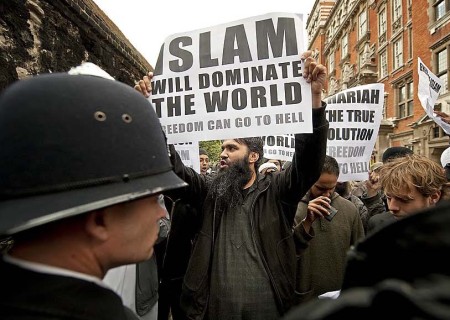
Islam will dominate the world

Everyone is impatient. Everyone is on fire. Especially the Terroristinians. Jewish store windows are smashed in London, Terroristinians butcher Rabbis in Jerusalem synagogues, fuming Terroristinians shoot up American recruiting centers. And the crowds cheer. “We Are All Terroristinians Now.”

It is a great day, I tell you. A great day for negotiating. ISIS impatiently beheads infidels to create its own Islamic Terroristine. In Afghanistan the word goes out, “We are the Taliban, we are the Afghan people, we are Terroristinians.” In Egypt and Turkey, they cry, “Khaybar Ya Yahood”. Churches burn. Soldiers die. The smoke rises to heaven. A man waits in line at the airport. His passport is Dutch, Welsh, German, American, it doesn’t matter. He is a Terroristinian. Yallah.

One day the borders of Terroristine will stretch from Spain to Pakistan. Or beyond Why settle for Jerusalem, when we can have London, Paris and Hamburg too. Why settle for anything at all? Allah is generous to the believers. Our people are in Africa. Even China. The Great Satan himself bows toward Mecca. The old governments are falling. The pawns of the Kufir are fleeing before our eyes.

We are all Terroristinians now. There is no other book on our shelves than the Koran. No law but Sharia in our hearts. And no nation but Terroristine. The ghost of Chamberlain stands outside No. 10 Downing Street promising peace. A Terroristinian refugee beheads him and holds up his spectral head to the cheers of the crowd. Rockets sail through the sky. The crowd cheers. Hip Hip Hooray. Hierosylma Est Perdita. Three cheers for Terroristine.

Germany’s Appeasement of Radical Islam

September 10, 2015

Germany’s Appeasement of Radical Islam, Gatestone Institute, Vijeta Uniyal, September 10, 2015

  • German, and possibly European, demographics are being set to change forever.
  • “No one knows exactly what actually happens in Islamic classes in German primary schools.” — Abdel-Hakim Ourghi, head of the Faculty for Islamic Theology and Religious Studies at the Freiburg University of Education.
  • In Ourghi’s assessment, conservative Islam, the one dominant in Germany, is incapable of thinking critically about its past.
  • According to the report, the textbooks fail to “confront the problematic verses of Koran.” The curriculum also fails in its most important purpose — integrating Muslims into the German society — as it fails to reconcile the “Islamic faith of the students with the reality of the western society” they are living in.
  • By legitimizing extremist groups such as DITIB within German Muslim society as the sole legitimate representatives of Islam, the German government has marginalized genuine voices of reform and dissent within its Muslim population.
  • These courageous dissident Muslim men and women are left to face threats and intimidation on their own, while the government is busy appeasing the self-proclaimed leaders of the faith.

As Muslim migration is being set to change German, and possibly European, demographics forever, Germany is gearing up for the new challenge — not by integrating and assimilating young Muslims in a free and democratic Western society, but by handing over the religious education of the next generation of German Muslims to Islamist radicals.

Worse yet, German authorities see no problem in doing that.

With Germany predicted to receive 800,000 migrants — mostly Muslims — this year alone, and millions more waiting to cross Europe’s unguarded borders, the Muslim population in Germany is seeing a historic rise from the current figure of nearly 6 million. Several German states including Bavaria, Hesse and North Rhine-Westphalia have introduced Islamic Studies in their public schools. The state of Hesse has become the first in Germany to offer Islamic education in public schools, with religious instruction starting as early as the first grade.

Giving young children religious and moral instruction might sound like a good idea, if not for the content of the newly written Islamic curriculum and the influence of Islamist elements over the recruitment of teachers.

The writing of textbooks is being overseen by the Turkish-Islamic Union for Religious Affairs (DITIB). In an agreement reached between the State of Hesse and DITIB, the organization will play a key role in setting the curriculum, selecting the teachers and monitoring the Islamic religious instruction. The organization is apparently assuming a similar role in several other key German states.

DITIB is the largest Muslim organization in Germany and controls several prominent mosques. The group depends heavily on the Turkish government for its funding, and maintains close ties with Turkish President Recep Tayyip Erdogan’s Islamist party, the AKP.

The newly compiled Islamic curriculum for public schools in Hesse has come under great scrutiny. An independent report conducted by Abdel-Hakim Ourghi, who heads of the Faculty for Islamic Theology and Religious Studies at the Freiburg University of Education, has sharply criticized the curriculum.

According to an article in Die Welt, Ourghi, a prominent Muslim scholar, has been raising concern about the activities of DITIB and other conservative Muslim organizations operating in Germany. “No one knows exactly what actually happens in Islamic classes in German primary schools,” he says. In his assessment, conservative Islam, the one dominant in Germany, is incapable of thinking critically about its past.

According to Ourghi’s report, the textbooks fail to “confront the problematic verses of Koran.” The report also says that the curriculum fails in its most important purpose — integrating Muslims into the German society — as it fails to reconcile the “Islamic faith of the students with the reality of the western society” they are living in.

Confronted with the damning report, Hesse’s Minister of Education and Culture, Alexander Lorz,dismissed the allegations and called the Hesse’s Islamic education a “success.”

Meanwhile, despite Lorz’s stance, young German Muslims from his state keep heading to Syria and Iraq to join the ranks of the Islamic State (ISIS). And despite DITIB’s regular lip service to denouncing the terrorist organization, the Islamic State receives a continuous flow of freshrecruits from DITIB-run mosques.

According to a recent investigative report by the German news magazine, Focus, a DITIB-run Mosque in Cologne is a key base in Germany for Turkey’s intelligence agency, the MIT. The intelligence team not only gathers information on Turkish President Erdogan’s opponents in Germany, but also maintains a local “thug squad” to mete out “tough punishments” to Turkish dissidents in Germany.

1241The Cologne Central Mosque is used as a key base in German for Turkey’s intelligence agency, where they run a local “thug squad” to mete out “tough punishments” to Turkish dissidents in Germany. (Image source: © Raimond Spekking/CC BY-SA 4.0, via Wikimedia Commons)

By legitimizing extremist groups such as DITIB as the sole legitimate representatives of Islam within German Muslim society, the German government has marginalized genuine voices of reform and dissent within its Muslim population.

These courageous dissident Muslim men and women are left to face threats and intimidation on their own, while the government is busy appeasing the self-proclaimed leaders of the faith.

The fruits of liberty enjoyed by Germans today are not Germany’s to squander in the first place. Every bit of this precious freedom was paid for in blood — from the beaches of Normandy to the pavements of the Warsaw Ghetto — often meter-by-meter with bare knuckles and bloody fists.

As if history has come full circle, in the span of less than a century, Germany’s state institutions are folding again at the mere sight of an organized band of fascists.

Egypt’s Christians in the Shadow of the Muslim Brotherhood

August 11, 2015

Egypt’s Christians in the Shadow of the Muslim Brotherhood, Washington Free Beacon, August 11, 2015

(Please see also, WFB’s Bill Gertz discusses story on Obama support for Muslim Brotherhood on Steve Malzberg Show. — DM)

Copts view the Obama administration cynically. Egyptians now whisper that the American president who pleased Arab liberals with his speech “A New Beginning” at al-Azhar in 2009 is secretly funding the Muslim Brotherhood and purposefully neglecting the Islamic State. A group of Copts protested outside of the White House in February 2015, demanding more aggressive action against IS following the beheading of the 21 Copts.

Al-Ahram, the largest newspaper in Egypt, published reports in 2013 that the United States diplomatic mission in Egypt, led by Ambassador Anne Patterson, was discouraging Coptic Christians from participating in protests against Morsi. Even though Patterson adamantly denied the accusations, the report sowed more distrust among Copts.

Tensions between the Coptic community and the administration worsened when, in the same year, an Obama Homeland Security adviser named Mohamed Elibiary suggested Copts raising awareness of their persecution were promoting “Islamophobic” bigotry.

**************************
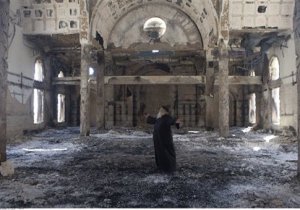
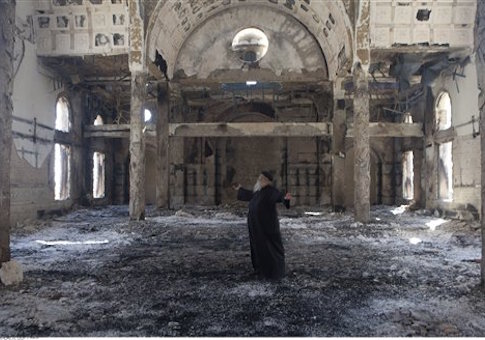
Christian Coptic Priest Father Samuel reacts as he stands inside the burned and heavily damaged St. Mousa church in Minya, Egypt / AP

In the nearly five years of turmoil that have followed the resignation of President Hosni Mubarak in 2011, no group in Egypt has suffered more than the 15 million Coptic Christians. Both a religious and ethnic minority, the Copts are descended from the native population of Egypt who lived and ruled there from the time of the pharaohs until the Roman conquest in 31 B.C. They are the largest Christian community in the Middle East today.

Copts have long been the target of discrimination and persecution in the majority-Arab nation. But this ancient people faced a terrifying new prospect in 2012: Muslim Brotherhood rule.

After Mubarak was ousted, the violence began almost immediately. Churches and schools were burned; peaceful protestors were massacred. When parliamentary elections were held nine months later, they were swept by the Muslim Brotherhood and other Islamist parties. When Mohamed Morsi won the presidential election in May 2012, the party’s victory looked complete. The same year, Morsi gave himself unlimited powers and the party drafted a new constitution inspired by Sharia law.

Morsi benefitted from the organizational advantage of the Muslim Brotherhood. Backed by imams preaching the benefits of religious rule, the previously banned political party was able to defeat the fractured coalitions of the pro-West, liberal, and secular candidates.

“They used thugs to carry out political intimidation against Christians,” a former member of Egyptian Parliament told the Washington Free Beacon. Chants celebrating the Brotherhood victory echoed through the streets of Cairo. “Morsi won! Copts out!”
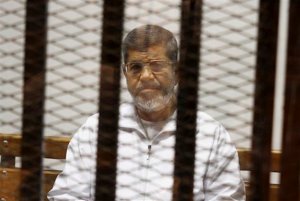
Ousted president Mohamed Morsi / AP

During Morsi’s rule, Christians were murdered and tortured by the hundreds. Attacks and abductions of Christian children spiked significantly. “Most Americans do not know how vicious and bloody the Muslim Brotherhood is,” Ahmed, a 24-year old secular Muslim, said. “They really can’t understand.”

Pope Tawadros II, Egypt’s Coptic Christian leader, criticized Morsi for negligence after six Christians were killed when police and armed civilians besieged Egypt’s largest cathedral. “We want actions, not words,” the Pope said.

Public accusations of blasphemy also became ubiquitous. A Facebook post interpreted as undermining Islam could bring a mob of fundamentalists with rocks and Molotov cocktails to the homes of Christians, surrounding them with families trapped inside. Sham trials with no legal representation would follow. Anti-Christian terrorism was not punished, but the wrong words often landed Copts in prison, forcing the church to make public apologies and families to leave their towns and villages.

Lydia, an activist who provides relief supplies to torn Christian communities in Upper Egypt, and who requested that only her first name be used to preserve her safety and that of her colleagues, witnessed the Muslim Brotherhood offer the very poorest Egyptians social services that bought their allegiance. “When you have no food or money, you will listen to anyone who gives you the resources your family desperately needs,” Lydia said. “They brainwash the illiterate with extremism so they hurt Christians.”

Still, Morsi’s authoritarian rule—rewriting the constitution, disbanding the Egyptian parliament, tossing potentially obstructive judges into jail—was not long lived. Barely a year after he assumed office, a reported 35 million citizens took to the streets to protest his rule, leading the Egyptian military, under Gen. Abdel Fattah al-Sisi, to remove him from power in July 2013.

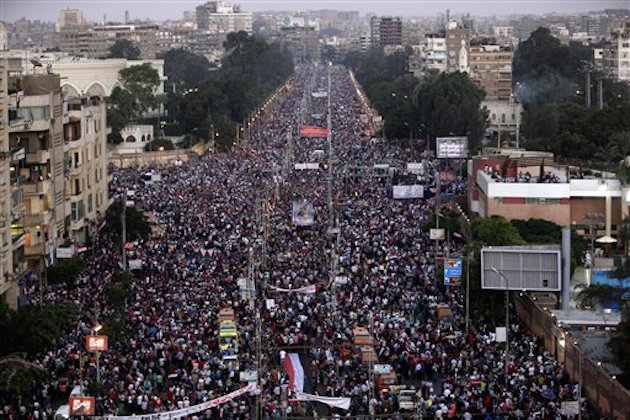
Egypt’s ousted President Mohammed Morsi protest at the presidential palace in Cairo, Egypt, Friday, July 26, 2013 / AP

Sen. James Lankford (R., Okla.) told the Free Beacon that had al-Sisi not responded, the promise of Egyptian Democracy would have died. “What it seemed the Egyptian people wanted was more opportunity to be able have some sort of functioning democracy, elections, input into their own government,” Lankford said. “It was the immediate understanding as soon as the Muslim Brotherhood was elected, that was the last election Egypt would have.”

In 2014, al-Sisi was elected Egypt’s new president. He won a solid electoral victory, giving him control of the Egyptian government with the responsibilities of forming a new constitution, a new parliament, and a new judicial system. The Coptic Church fervently supported al-Sisi’s candidacy because the new president promised Copts equality in citizenship, security in their communities, and the ability to build places of worship.

The new Egyptian president challenged the leaders of the Islamic world to push a more moderate message. In December 2014, hundreds of Christian and Muslim theologians gathered at al-Azhar, Egypt’s leading mosque and religious university, participated in a conference to fight “jihad” and promote inclusion. Al-Sisi ambitiously called for a “religious revolution” in January 2015, saying that clerics bear responsibility for the growing extremism in the Middle East.

As president, al-Sisi took many symbolic steps to integrate the Coptic community with the majority Sunni population. In a surprise to most Egyptians, al-Sisi attended a mass at Saint Mark Orthodox Cathedral in Cairo on Christmas Eve, a first for any Egyptian president. Al-Sisi regularly invites Pope Tawadros II to appear beside him when he announces major policy rollouts or requests public dialogue from senior advisers.

Al-Sisi also appointed two Copts as members of his cabinet. Under the constitution, the president of Egypt has the power to select 10 members of parliament. Political observers believe he will select Copts to fill a majority of those appointed seats to offer a more representative parliament.

“Our lives haven’t changed much but one positive result of the revolution is the Egyptian people have politically woken up,” said Hala, a Mubarak-era government official who also wished to be identified by her first name only because she fears political retribution. “We no longer accept what we are told. Egyptians are at least aware of the government’s actions and they are more aware of the troubles Copts face.”

But while al-Sisi’s administration provides a welcome change of tone toward the Coptic community, the day-to-day lives of Copts remain little changed from the Mubarak days.

Coptic Solidarity is a five-year-old public charity organization and advocacy group devoted to advancing equality for Copts in Egypt. Their efforts have helped raise awareness about the persecution Christians face in the Middle East. Alex Shalaby, an Egyptian businessman currently residing in the United States and Coptic Solidarity’s new president, believes Egypt under al-Sisi has continued many of the same practices as previous presidents Sadat, Mubarak, and Morsi.

“Discrimination is rampant, especially in Upper Egypt. We still see reconciliation tactics pressuring the closing of Christian churches and there are still very few Coptic government appointees, he explained. “Coptic Solidarity monitors all developments within Egypt and we are not able to say much has been accomplished in terms of real change to improve Coptic lives in the last 12 months.”

Human rights groups have been critical of al-Sisi’s record. Amnesty International’s Hassiba Hadj Sahraoui accused the president of “employing the same methods of torture and other ill-treatment used during the darkest hours of the Mubarak era.” The Egyptian government received heavy criticism after a court sentenced hundreds of Muslim Brotherhood members to death, intensifying its crackdown on Islamists.

Despite assurances from al-Sisi, sectarian violence still regularly occurs in the rural villages of Upper Egypt where the government has less control.

In Nasreya, Islamists responded to a video of five Christian students making fun of the Islamic State terrorist groups by demanding the students be turned over to the authorities for insulting the religion of Islam. Villagers hurled rocks at Copts and vandalized their property. No arrests were reported for the attacks but the teacher and students were imprisoned for days.

On March 26, 2015, in El Galaa another horde gathered to protest the building of a new church that served 1,400 Christians, also attacking Christian homes in a similar manner. The local government forced the new church to have no outer symbol of Christianity. In Mayana and Abu Qurqas villages, police raided churches, confiscated items from the altar, and shut down reconstruction work.

Lydia, the activist based in Upper Egypt, has witnessed firsthand the damage from these attacks. “I had to console a girl, nine years old, crying because she was afraid her parents were going to be kicked out of their own home,” she said.
“They are poor, illiterate, and now their home is burned and their own community has banned them. All because they are Christians,” she continued.

“The police don’t bother to protect Christians. They do the exact opposite in Upper Egypt,” Lydia said. “The local governments have been loaded with Islamists for years.”

But violence is not exclusive to the country’s outskirts. On June 30, 2015, the two-year anniversary of the popular uprising against Morsi, Islamists detonated bombs by the homes of well-known Christians. Additionally, The Fathers Church in Alexandria was firebombed on July 22, 2015. This summer’s assassination of Egypt’s Attorney General Hesham Barakat in a car bombing, reportedly carried out by a wing of the Muslim Brotherhood, served as an ugly reminder that Egypt’s violence has not passed.

An Egyptian policeman stands guard at the site of a car bombing that killed n Egyptian policeman stands guard at the site of a car bombing that killed Hesham Barakat / AP

Despite these problems, al-Sisi still enjoys support among prominent Copts. Amir Ramzy is a prominent Coptic judge and public figure in Egypt’s legal system, and a loyal defender of al-Sisi’s administration.

“We cannot remove prejudice overnight,” Ramzy said. “We must focus on changing the attitude of the people on the ground first.”

The judge pointed to the dire state al-Sisi found the country in when he took office as reason for slow progress.

“Egypt is fighting Islamists inside and outside our borders. Egypt is fighting a horrid economy with massive unemployment. Al-Sisi is taking on large projects to change these conditions,” Ramzy said. “It is difficult to control chaos and promote social change at the same time.”

The judge referred to the decades it took the United States to implement civil rights reforms. He asked for reasonable expectations out of Egypt’s new president and insists under al-Sisi the country is heading in the right direction. “Just one year after his election, Egypt has new roads, a new canal, new investments, and a new hope for the poor.”

Despite not being content with the pace of progress, Shalaby said al-Sisi is an improvement over his predecessor. As a retired executive, he said he understood national security and economic development should be the president’s priority. “Al-Sisi must do what is best for Egypt first. What is best for Egypt is what is best for Copts. What is good for Copts is good for Egypt.”

Abdel-Fattah al-Sisi / AP

Copts view the Obama administration cynically. Egyptians now whisper that the American president who pleased Arab liberals with his speech “A New Beginning” at al-Azhar in 2009 is secretly funding the Muslim Brotherhood and purposefully neglecting the Islamic State. A group of Copts protested outside of the White House in February 2015, demanding more aggressive action against IS following the beheading of the 21 Copts.

Al-Ahram, the largest newspaper in Egypt, published reports in 2013 that the United States diplomatic mission in Egypt, led by Ambassador Anne Patterson, was discouraging Coptic Christians from participating in protests against Morsi. Even though Patterson adamantly denied the accusations, the report sowed more distrust among Copts.

Egyptians publicly celebrated when Patterson left the country.

Tensions between the Coptic community and the administration worsened when, in the same year, an Obama Homeland Security adviser named Mohamed Elibiary suggested Copts raising awareness of their persecution were promoting “Islamophobic” bigotry. Elibiary, who generated controversy due to views perceived by some to be friendly to the Muslim Brotherhood, released a series of tweets with the R4BIA salute, perceived to be a symbol of hate by many in Egypt.

Elbiary later deleted his tweets and removed the symbol. Bishop Angaelos, Pope Tawadros II’s personal representative called the incident “disturbing.” Elbiary left the Obama administration under pressure from critics in 2014.

Following the ouster of Morsi, the United States canceled weapons deliveries to Egypt and halted all military aid. As the White House took its time to build a relationship with al-Sisi, Russian President Vladimir Putin visited the country and signed a nuclear agreement.

The White House announced in the spring of 2015 that weapons deliveries to Egypt would ultimately be resumed.

Despite the uneasiness in the country, Christians believe they will one day be equal citizens in their homeland. Such progress may be slow and painful, but amidst anxiety there is hope in Egypt.

Much of this hope is derived from the perception of al-Sisi’s decent treatment of the Copts. Ramzy, the judge, told theFree Beacon, “al-Sisi may not be perfect, but he is Copts’ best chance to promote ourselves from second class citizens. He should receive America’s support.”
American Dream Does not Stop Radicalization of Terrorists

July 23, 2015

American Dream Does not Stop Radicalization of Terrorists, Act for America, July 22, 2015