Archive for the ‘Khamenei’ category

Obama on Iran and Syria: See no evil

June 28, 2015

Obama on Iran and Syria: See no evil, Israel Hayom, Elliott Abrams, June 28, 2015

(Obama sees evil only where he wants to see it, starting with his position that Islam is the religion of peace. — DM)

See no evil — once again. Iran’s role is systematically ignored or underplayed, because (as ‎Hof puts it), “The administration has other fish to fry with Tehran.” Namely, the nuclear ‎deal.

******************

The slaughter in Syria and the awful human rights violations in Iran cannot be denied by ‎the Obama administration, but they sure can be downplayed and ignored.‎

On the Iran point, consider the release yesterday, four months late, of the State ‎Department’s annual human rights reports. The reports were presented by Secretary of ‎State John Kerry and Assistant Secretary of State for Human Rights Tom Malinowski. The Iran report is ‎tough. Here’s an excerpt:

The most significant human rights problems were severe restrictions on civil liberties, ‎including the freedoms of assembly, speech, religion, and press; limitations on the citizens’ ‎ability to change the government peacefully through free and fair elections; and disregard ‎for the physical integrity of persons, whom authorities arbitrarily and unlawfully detained, ‎tortured, or killed.‎

“Other reported human rights problems included: disappearances; cruel, inhuman, or ‎degrading treatment or punishment, including judicially sanctioned amputation and ‎flogging; politically motivated violence and repression; harsh and life-threatening ‎conditions in detention and prison facilities, with instances of deaths in custody; arbitrary ‎arrest and lengthy pretrial detention, sometimes incommunicado; continued impunity of ‎the security forces; denial of fair public trial, sometimes resulting in executions without due ‎process; the lack of an independent judiciary; political prisoners and detainees; ineffective ‎implementation of civil judicial procedures and remedies; arbitrary interference with ‎privacy, family, home, and correspondence; severe restrictions on freedoms of speech ‎‎(including via the internet) and press; harassment and arrest of journalists; censorship and ‎media content restrictions; severe restrictions on academic freedom; severe restrictions on ‎the freedoms of assembly and association; some restrictions on freedom of movement; ‎official corruption and lack of government transparency; constraints on investigations by ‎international and nongovernmental organizations (NGOs) into alleged violations of human ‎rights; legal and societal discrimination and violence against women, ethnic and religious ‎minorities, and lesbian, gay, bisexual, and transgender (LGBT) persons based on perceived ‎sexual orientation and gender identity; incitement to anti-Semitism; trafficking in persons; ‎and severe restrictions on the exercise of labor rights.‎”

Iran is of course an important country, so how much of this did Kerry and Malinowski ‎mention in their own opening remarks? Not a word. Not one. Kerry mentioned about 10 ‎countries and “the LGBTI community,” but not Iran. Malinowski mentioned about 20 ‎countries, but not Iran (until pressed by reporters). Do we think this is accidental, that ‎neither man mentioned Iran? How likely is that?‎

Yesterday also brought another superb analysis of events in Syria, and U.S. policy there, ‎from Fred Hof of the Atlantic Council — once the administration’s lead man and “special adviser” on Syria. It is titled “Syria: Civilians Pay the Price,” Hof quotes from the June ‎‎23 report of the Independent International Commission of Inquiry on the Syrian Arab ‎Republic. And here are the excerpts he quotes:

“The government continues to direct attacks towards locations where civilians are likely ‎to congregate, among them, bus stations, marketplaces, and bakeries.”‎

‎”In particular, the continuing use of barrel bombs in aerial campaigns against whole areas, ‎rather than specific targets, is in violation of international humanitarian law and, as ‎previously documented, amounts to the war crime of targeting civilians.”‎

“The larger strategy [of the regime] appears to be one of making life unbearable for civilians ‎who remain inside armed-group controlled areas.”

“The previously documented pattern of attacks indicating that government forces have ‎deliberately targeted hospitals, medical units, and ambulances remains an entrenched ‎feature of the conflict.”‎

“Government sieges are imposed in a coordinated manner. … In particular, government ‎forces have refused to allow aid deliveries of essential medicines and surgical supplies. … Government authorities act in direct breach of binding international humanitarian law ‎obligations to ensure that wounded and sick persons are collected and cared for, and to ‎ensure the rapid and unimpeded passage of humanitarian relief.”

“Everyday decisions — whether to go visit a neighbor, to send your child to school, to step out ‎to buy bread — have become, potentially, decisions about life and death. Large numbers of ‎children have been killed in bombardments of their homes, schools, and playgrounds.”‎

What’s the link to Iran? Hof explains:‎

“The administration also knows that Iran is the principal foreign facilitator of regime war ‎crimes and crimes against humanity. It is the Iranian factor that accounts, in large ‎measure, for the administration’s decision to leave Syrian civilians entirely at the mercy of ‎Tehran’s Syrian client. The administration has other fish to fry with Tehran. So Syrian ‎civilians get to pay the price.‎

“One searches White House and State Department press conferences in vain for any ‎systematic examination of this issue. Even though Russian leverage is as limited as its good ‎intentions, one wonders how prominently civilian protection is featured in Secretary of State ‎John Kerry’s periodic encounters with his Russian counterpart. Even though nuclear talks ‎are important, one wonders if Tehran’s facilitation of Assad regime criminality arises at all ‎in official U.S.-Iranian exchanges. Has there been a systematic diplomatic campaign aimed ‎at persuading Tehran and Moscow to oblige their client to respect pertinent United Nations ‎Security Council resolutions? Is Iran being asked to force its client to stop barrel bombing ‎and lift starvation sieges?‎”

See no evil — once again. Iran’s role is systematically ignored or underplayed, because (as ‎Hof puts it), “The administration has other fish to fry with Tehran.” Namely, the nuclear ‎deal.

This is disgraceful, as Hof states with restraint but with force:‎<

“The indelible stain that can mark the Obama legacy forever on this issue is nothing ‎compared to the terror and suffering that can be mitigated if the president elects to try. ‎Whether the motivation to act springs from legacy concerns, degrading and destroying ‎ISIL, or profound revulsion over what is happening to children and their parents, is ‎unimportant. The Iranians can negotiate while facilitating mass murder. No doubt, they can ‎do so if the greatest power on earth pushes back a bit. President Obama should act now to ‎protect Syrian civilians.‎”

Or as he puts it more angrily, what do those who complain about this policy want? “They ‎want … to persuade the president of the United States to give a damn about suffering, ‎terrified human beings.”

Let’s stop protecting, ignoring, and downplaying the murderous role Iran is playing in Syria ‎and the terrible human rights violations taking place in Iran itself.‎

Iran’s supreme leader is laughing, for good reason

June 25, 2015

Iran’s supreme leader is laughing, for good reason, Israel Hayom, Boaz Bismuth, June 25, 2015

143522169662385559a_bIranian Ayatollah Ali Khamenei | Photo credit: AP

In Tehran on Tuesday, Khamenei spoke about his country’s “red lines.” Red lines? Can someone maybe explain what those are to the Obama administration?

********************

Iranian Ayatollah Ali Khamenei feels confident enough, only a few days before June 30 (the deadline for a final-status nuclear deal with world powers), to thumb his nose at the international community, including the American government, and declare Iran’s three noes: no to freezing its nuclear program, no to international oversight at its nuclear facilities, no to a phased lifting of sanctions (as proposed by the French). In other words, Khamenei is telling the world: Dear superpowers — bite me.

Meanwhile, almost simultaneously, we have received an Associated Press report from Vienna that the U.S. and its partners conducting the negotiations with Iran are prepared — for the sake of reaching a deal — to even provide the Iranians with advanced nuclear reactors and equipment. This isn’t a joke.

It’s possible, perhaps, to imagine Khamenei rejecting this generous offer outright because the Americans aren’t also including ballistic missiles in the package. If you’re going to be generous, then you might as well go all the way.

Truth be told, this entire business to this point seems quite like a joke. The problem is that it’s coming at our expense. And it’s also not that funny.

French Foreign Minister Laurent Fabius met on Wednesday with his Saudi counterpart and promised him a “tough deal.” The Saudis are no less worried than we are about a bad deal. But who is promising us a “tough deal?” The French, who ultimately always fall in line with the Americans, whose help they need for more burning issues closer to home (Ukraine)? Who? The Russians? The Chinese? The Americans? The Germans? The British? The truth is, it would be best to trust the Iranians to torpedo the deal on their own, but Khamenei’s and even Iranian President Hassan Rouhani’s promulgations from two weeks ago aren’t enough to scare anyone off.

In November 2013, as a reminder, we were just several days before the interim agreement. I remember how the Iranian and Western delegations leaked information about the many difficulties in the negotiations, but that in the end, in the middle of the night, the deal was born (how shocking). Eventually, we saw virtually the same scenario unfold in Lausanne this past March — the numerous problems were made public, the deadline was extended by a few days, and finally on April 2 we received the framework deal.

We can assume that in the coming days we will get to see “the best show in town,” at the end of which, in contrast to the previous rounds, we can expect a final status deal with an Iran that is not only slated to become a nuclear power but a stabilizing force in our crumbling Middle East.

In Tehran on Tuesday, Khamenei spoke about his country’s “red lines.” Red lines? Can someone maybe explain what those are to the Obama administration?

Khamenei sacks Qassem Soleimani from command of the Syrian war

June 24, 2015

Khamenei sacks Qassem Soleimani from command of the Syrian war, DEBKAfile, June 14, 2015

Qassem_Suleimani_Tal_Ksaiba_in_Salahuddin_6.15Gen . Qassem Soleimani on the Iraqi warfront

Uproar in Iran’s Revolutionary Guards Corps: Ayatollah Ali Khamenei has relieved Gen. Qassem Soleimani, the  Al Qods Brigades chief and supreme commander of Iranian Middle East forces, of his Syria command after a series of war debacles. He was left in charge of Iran’s military and intelligence operations in Iraq, Yemen and Lebanon. This is revealed by DEBKAfile’s exclusive Iranian and intelligence sources.

Since Soleimani last visited Damascus on June 2, in the aftershock of the historic town of Palmyra’s fall to the Islamic State, the situation of President Bashar Assad and his army has gone from bad to worse.

The Iranian general’s bravado in stating then that “In the next few days the world will be pleasantly surprised from what we (the IRGC) working with Syrian military commanders are preparing,” turned out to be empty rhetoric. The thousands of Iranian troops needed to rescue the Assad regime from more routs never materialized. Since then, the Syrian forces have been driven out of more places. Hizballah is not only stymied in its attempts to dislodge Syrian rebel advances in the strategic Qalamoun Mountains, it has failed to prevent the war spilling over into Lebanon. There is strong evidence that the high Iranian command in charge of the Syrian and Lebanese arenas are stuck.

These reverses have occurred, our military sources report, owing to Tehran’s failure to foresee five developments:

1.  The launching of a combined effort by the US, Saudi Arabia, Qatar and the UAE – among the wealthiest nations in the world – in support of rebel groups fighting Bashar Assad. Their massive injections of military assistance, weapons and financial resources have thrown Iran’s limitation into bold relief.

2.  The ineptitude of the Shiite militias mustered by Soleimani in Iraq, Pakistan and Afghanistan to fight Iran’s wars in Syria and Iraq. None of those imported troops met the combat standards required in those arenas and become liabilities rather than assets.

3.  Those shortcomings forced Tehran to admit that it had come up short of military manpower to deploy in four ongoing warfronts: Syria, Yemen, Lebanon and Iraq.  Soleimani took flak for the over-ambitious plans he authored which pulled Iran into military commitments that overtaxed its resources and did not take into account the messy political and military consequences which followed.  Above all, he miscalculated the numbers of fighting strength needed on the ground for winning battles in those wars.

4. In the final reckoning, Iran finds has been drained of the strategic reserves that should have been set aside for the contingency of a potential  ISIS encroachment of its territory.

Hajj Amin Husseini’s Anti-Semitic Legacy

June 24, 2015

Hajj Amin Husseini’s Anti-Semitic Legacy, The Middle East Quarterly, Boris Havel, Summer 2015

(Islamic hatred of Jews goes back at least to the sixth century A.D. The pamphlet reproduced below, Islam and Judaism, was written by The Jerusalem Mufti, Muhammad Hajj Amin Husseini, apparently in the 1940s.  A fascinating book by Anthony Pagden titled Worlds at War, The 2,500-year struggle between East and West, provides a scholarly account of rivalries and wars and includes highlights of the rise of Islam. 

Jew hatred is now most visible in the Islamic Republic of Iran, soon to be welcomed into the “community of nations” by P5+1 “negotiators” under Obama’s guidance. — DM)

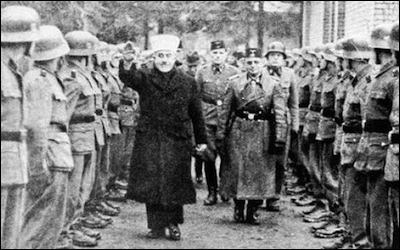
1379The Jerusalem mufti, Muhammad Hajj Amin Husseini (left), meets with SS-Reichsführer Heinrich Himmler, April 1943.

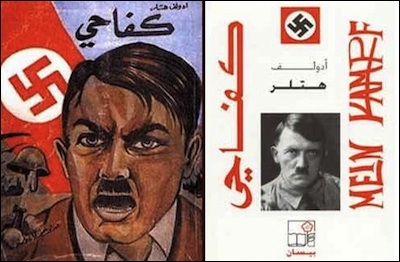
Hitler’s Mein Kampf has been a bestseller for years in predominantly Muslim countries, including the Palestinian Authority and Turkey.

***********************

The Jerusalem mufti, Muhammad Hajj Amin Husseini, leader of the Palestinian Arabs from the early 1920s to the late 1940s, is widely known for his close collaboration with the Nazis during World War II. Aspects of the collaboration remain to be more thoroughly scrutinized.[1]However, and without discounting his culpability for the collapse and dispersal of Palestinian Arab society (or al-Nakba, the catastophe, as it is called by Palestinians and Arabs), Hajj Amin’s role in shaping Muslim perceptions of Jews might be a far more important and lasting legacy than his political activism in Palestine, Germany, or elsewhere.[2] An important source supporting this fact is a booklet he authored for Muslim soldiers enlisted in the Nazi SS division in Bosnia.

During the mufti’s stay in Berlin in 1941-45, he befriended Hitler’s right-hand man, Reichsführer-SS Heinrich Himmler. Himmler’s fascination with Islam and the mufti’s zealous support for the Nazi cause resulted in several common enterprises, notably the establishment of a volunteer Waffen-SS division in Bosnia, made up mostly of Bosnian Muslims, later named the Handzar division. Most books about the division display photographs of its soldiers—distinguishable by its insignia on uniform lapels and fez headgear—reading a booklet titled Islam und Judentum—most certainly the German version of the mufti’s Croatian or Bosnian pamphlet Islam i židovstvo (Islam and Judaism).

In whatever language the pamphlet was originally written, the intended readers were Muslims (Bosnian or otherwise) and not Germans. This author has been unable to locate a German copy of the pamphlet, but it is reasonable to regard the text written in the language of the Bosnian Muslims (at the time called Croatian) as the most relevant. A translation of the booklet is presented below, followed by an analysis of its significance and far reaching implications.[3]

_________________

Islam and Judaism (Islam i židovstvo)

For us Muslims, it is unworthy to utter the word Islam in the same breath with Judaism since Islam stands high over its perfidious adversary. Therefore, it would be wrong to carry out comparison of those two generally different counterpoints.

Unfortunately, it is insufficiently known that animosity between Islam and Judaism is not of a recent date. It reaches long back in history, all the way to the time of the Prophet Muhammad. This short historical overview will demonstrate the importance and perfidiousness of Jewry and its animosity toward the founder of Islam, the Prophet Muhammad.

Jews are known in history only as a subjugated people. Their vulgar[4] nature
and insufferable stance toward the nations that offered them hospitality, and toward their neighboring nations, are the reason that those same nations had to resort to [certain] measures in order to suppress a Jew’s efforts to obtain his[5] desire by force.

The history of antiquity shows us that the pharaohs were already forced to use all means against Jewish usury and Jewish immorality. Ancient Egyptians finally expelled the Jews from their land. Led by Moses, the Jews then arrived in the Sinai desert.

Arab theologian Muhammad ibn Jarir al-Tabari [839-923 C.E.] narrates that the Jews even wanted to kill their leader and savior Moses when he came back from Mount Sinai. Because of that, God punished them, and they had to meander in the wilderness for forty years. It should have brought them to their senses, and the new generation should have been cleansed from the low esteem of their fathers.

Following that, the Jews spread like locust all over the Arab peninsula. They came to Mecca, to Medina, to Iraq, and to Palestine, which is the land of milk and honey. The group of the Jews that came to Syria and Palestine was now under Roman rule. The Romans, however, soon discerned the peril that threatened the land from the Jews, and so they introduced harsh measures against them. Besides that, a serious, contagious illness of plague erupted, which was by common opinion brought into the land by Jews. When even medical doctors stated that the Jews were indeed the source of the infection—and their opinion was obviously correct—there arose among the people such upheaval against the Jews that many Jews were killed. In addition, that event is the reason why the Jews have been called “microbes” in Arabia to this very day.

1380The mufti of Jerusalem, Muhammad Hajj Amin Husseini, visits the volunteer Nazi Waffen-SS division in Bosnia, made up mostly of Bosnian Muslims. The mufti was instrumental in the division’s formation.

The Arabs have a particular understanding for introducing forceful measures against Jews in Germany and for their expulsion from the country. After the [First] World War, England and America enabled the Jews to settle in Palestine and to establish a Jewish state there. Jewish excrement from all countries assembled there, rascally striving to seize the land from Arabs. And indeed, they succeeded in buying land from the poorest of the poor and from unscrupulous landlords. By doing so, they took poor widows’ bread and stole food from children to fatten themselves.[6] When the Arabs opposed the Jewish settlement, the Jews did not shun bloody murders. So they robbed many families of their livelihood and threw the families into misery and troubles. (God will punish them for those disgraceful deeds).

The Jewish struggle against Arabs is nothing new for us, except that as time passed, the location of the battlefield changed. Jews hate Muhammad and Islam, and they hate any man who wishes to advance the prosperity of his people and to fight against Jewish lust for possessions and Jewish corruption.

Struggle between Jews and Islam began when Muhammad fled Mecca to Medina where he created the base for the development of Islam. At that time, Jews were merchants, already permeated with guile, and they understood that Muhammad’s influence, in both the spiritual and business spheres, could turn into a danger for them. Thus they were possessed by a deep hatred toward Islam; hatred that intensified as Islam was growing more solid and powerful. The Jews breached the agreement they had concluded with Muhammad in Khaibar, of which we shall speak later. Moreover, their rage grew immensely when the Qur’an revealed the deepest inclinations of their soul, their heartlessness, and unscrupulousness by which their ancestors had been commonly known. At that time, the Jewish methods were already the same as they are today. Their weapon has been, as always, slander and quarrel, and so they attempted to humiliate Muhammad in the eyes of his followers. They claimed that he was a deceiver, an enchanter, and a liar. When they did not succeed in this, they attempted to undermine Muhammad’s honor by spreading a rumor that his wife Aisha committed adultery. The purpose of spreading such a rumor was to sow doubt in the hearts of Muhammad’s followers.

When that failed, they tried to show Muhammad’s teaching in a bad light. With that purpose, several Jews converted to Islam; only a few days later, they returned to the Jewish faith. When asked why they changed their mind so suddenly, they replied that they were very willing to settle in Islam but found that all of it is nothing but a lie. The following Qur’anic verse alludes to that:

Many of those knowledgeable in the Scriptures attempt to somehow render you infidels again by converting to our religion. It was, though, nothing but their souls’ envy, when they comprehended truth.[7]

When the Jews understood that they would not reach their goal by the means used until then, they started to ask Muhammad various meaningless and unsolvable questions. Thus, they wanted to convince others that Muhammad was poor in knowledge and wisdom. However, that method achieved no success. As they were thus persuaded that Islam was deeply rooted in the hearts of the Muslims, they commenced with the attempts to destroy the Muslims. Pursuant to that goal, they paid some non-Muslim tribes to fight against Muhammad. The almighty God, however, wanted it differently. With iron fist, Muhammad defeated the rebellious tribes and conquered their city. The Jews could not bear such a defeat, and so they decided to destroy Muhammad in every way. They hired men to murder him.

The Medina Jews lived in the city district of Banu Nadir. When Muhammad came to Medina, he concluded a contract with them. One day he set out to that city district, accompanied by only ten companions, to talk to the Jews and to try to convert them to Islam. Muhammad explained the principles of Islam to the Jews, and they seemed very interested and open-minded. Yet as Muhammad was talking in a friendly way with some of the Jews, another group prepared an attempt on his life. They persuaded a man to throw a piece of rock on Muhammad’s head. Surely Muhammad would have been killed were it not for God, who warned him. An inner voice advised him to leave that place, and so the treacherous Jews could not carry out their design. Consequently Muhammad sent a companion to deliver his message to the Jews to leave the city within ten days. They had breached the contract they concluded with him by trying to take his life. Any Jew found in the city after those ten days would be punished by death.

However, some of the Jews, who outwardly accepted Islam but in their innermost remained Jewish, persuaded other Jews not to leave the city. When the ten days passed, Muhammad was forced to expel the Jews from the city by armed force. Part of the Jews fled to Khaibar and part to Syria.

The Jews who fled to Khaibar, however, would not concede defeat and decided to avenge themselves on Muhammad. For that purpose, they turned to other Khaibar Jews and to the Jews of Taima and of Wadi Qura. Together they plotted a conspiracy: With large sums of money, they agitated non-Muslim Arab tribes to attack Medina. When Muhammad discovered their plan he quickly armed his men and set out toward the plotters’ base in Khaibar. Muhammad’s companions captured Khaibar and expelled most Jews from the site. With the remaining Jews, Muhammad concluded a contract by which peace was guaranteed.

Only after that devastating defeat [of the Jews] could an Islamic Empire peacefully develop. But when one takes into account the Jewish significance, it was not to be wondered that Jews, in spite of the agreements made, did not abandon their plans and continued to try to destroy Muhammad by all available means. They invited him to a feast, and he accepted the invitation suspecting no evil. In front of him was placed a roasted lamb prepared by the Jewess Zainab, wife of Sallam ibn Mishkam.[8] The [topic of] conversation around the table was the contract and a peaceful life in mutual agreement in which they now lived. Muhammad had not the slightest suspicion about treason. The Prophet and his faithful companion Bashr ibn Bara each took a piece of lamb meat. Muhammad, however, did not swallow his bite because its taste made him suspicious.

“The bone tells me that the lamb was poisoned,” he said and called the Jewess Zainab to ask whether the meat had been poisoned. She answered, “You know I am highly esteemed by the Jews, and I acknowledge that I have poisoned the lamb. In so doing, I thought that if you were a king, I would only kill a king, but if you were indeed a prophet, you would know that the meat had been poisoned.”

Muhammad’s companion soon succumbed to the poison’s effect, whereas Muhammad, despite spitting the poisonous bite, later suffered various health disorders, and the impact of the poison had always been evident. Some historians even believe that Muhammad’s death was a consequence of that poisoning. In this matter, they refer to a hadith by Abu Huraira, whereby the Prophet said shortly before his death, “The effect of Khaibar’s feast will manifest in me until I die!”[9]
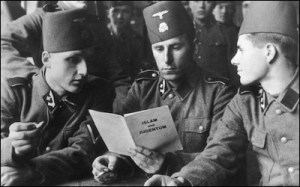
1381Many books about the Waffen-SS division in Bosnia display photographs of its soldiers reading a booklet titled Islam und Judentum—most certainly the German version of the mufti’s Croatian or Bosnian pamphlet Islam i židovstvo (Islam and Judaism). The booklet offers a stark illustration of the lengths taken by the mufti to demonize Jews and Judaism and clearly was produced for propaganda and incitement purposes.

Now, the Jews were persuaded that Muhammad was immune to their attacks. Therefore, they made a decision to spread discord among the Arab tribes, so as to break the power of Islam. When Muhammad went back to Medina, he succeeded in reconciling the Arab tribes of Kawsha and Karasha,[10] which had been fighting each other ceaselessly for 120 years. In doing so, he significantly strengthened Islam’s position. Members of those two [formerly] hostile tribes became brethren in Islam, and peace entered the city. In this regard, the Jews tried to undermine the Islamic empire.

A revengeful old man by the name of Shas ibn Qais one day walked with his friends and came across an assembly of the reconciled tribes held in city square. He could not bear to see how [the members of] those two tribes, formerly at war with each other, now communicated nicely, and so devised a hellish plan. He sent to their assembly a friend of his, knowledgeable in war poems, and persuaded him to recite some of his old poems that were full of hatred. That Jew, an outstanding orator, came indeed to the assembly and started to recite old war poems of both tribes. By doing so, he managed to find in each tribe a man in whom old hatred flared up. Those two men started to fight each other and then urged their fellow-tribesmen to take up arms. An immense tragedy would have ensued were it not for Muhammad, who learned about the fight amongst brethren and hurried up to the battlefield.

“Oh my God, are the old times returning even while I am still amongst you!” he shouted. “When I gave you Islam as religion, the old fratricidal discord was buried, and you became brothers in your hearts. Do you wish to slip into infidelity again?”

Both tribes understood that disturbances among them were sown by the Jews alone. They threw away their weapons and asked God for forgiveness, and then they hugged each other and concluded a new brotherly alliance. Regarding Shas ibn Qais the Jew, it is said in the Qur’an,

Oh, you scribes,[11] why do you prevent the believer from walking on God’s path when you are witnesses yourselves? But God is not blind for what you do.[12]

Regarding the tribes of Kawsha and Karasha, the Qur’an said,

Oh, you who believe, would you listen to those who received the Scripture, so that they would turn you into unbelievers again, after you have received faith! How can you be infidels when God’s words were read to you, and his apostle is among you? He who holds unto God has already been introduced to a straight path.[13]

Notwithstanding their attempts, the Jews never succeeded in spreading division among Muhammad’s followers and in dragging them back into infidelity. However, even after all these events should have taught them the futility of their efforts, they persistently continued to carry out their devilish plans. Once, they tried by deceit to even bring down Muhammad himself.

There was a quarrel between two Jewish tribes, and the side that was wrong held an assembly and sent its leaders to Muhammad. Those Jewish leaders said to Muhammad, “You know that we are influential people. If you support us in our dispute with our opponents, we will apply all our influence to make all Jews convert to Islam.” Muhammad, of course, dismissed them. There is a verse in the Qur’an about this event:

Be careful to make decisions according to what God has revealed and not to consider their desires. Keep your guard toward them so that they would not even partially shift you from what God has revealed to you. If they rebel, know that God will surely punish them for a part of their sins. There are, indeed, many men who are evildoers.[14]

Another example of Jewish subversive action was recorded by Ibn Abbas. At the time when Muhammad went from Mecca to Medina, prayers were directed toward Jerusalem. However, it lasted only for seventeen months. Then Muhammad received God’s revelation that the direction of prayers should be Mecca, and ever since, prayers are uttered with faces turned to Mecca. The Qur’an says about this:

We see how you turn your face toward heaven, and we would like to give it a direction which you will like: Turn your face toward the holy place of prayer; wherever you find yourselves, turn your face in that direction. Don’t you see that even those who had received the Scripture know that it is the truth before their Lord? And God is never heedless of what they do.[15]

When the Jews found out about this Qur’anic verse, they were angered and asked Muhammad to return to the previous direction of prayer, which was Jerusalem. Were he to do so, they promised, all Jews would accept Islam. Muhammad, however, did not allow himself to be led astray by such a proposal and to transgress against God’s command. We find the following in the Qur’an about that:

The direction to which you used to turn in prayer until now we have changed only for the purpose of distinguishing those who follow apostles from those who turn on their heel. That was surely difficult but not for those led by God. And God does not want to destroy your faith because God is full of goodness and compassionate to men.[16]

Here is another example how the Jews did not hesitate to stab Muhammad in the back at the time of his utmost distress. When Muhammad won the Battle of Badr, he sent a messenger on his own camel, because that camel was the fastest, to carry the news about his victory to Medina. The Jews, however, tried to bring confusion into the Muslims’ ranks by spreading false rumors that Muhammad had been killed in the battle. As evidence, they pointed out that Muhammad’s camel returned to the city with another rider.

When even that design failed, the Jews turned to Mecca to incite Muhammad’s enemies against him. Moreover, they declared their readiness to support the Meccans in their fight against Muhammad with an army of theirs. When the pagans of Mecca asked the Jews—since the Jews had received the Holy Scripture even before Muhammad—whether or not Muhammad’s religion was good, the Jews answered, “You know that we are men of letters. Believe us, therefore, when we tell you that your religion is much better.” The following verse is in the Qur’an about this:

Don’t you see those who received the Scriptures? They believe in Jibt and Taghut [superstition and idolatry], but they nevertheless say about pagans that their way is better than believers’ way. Those are the ones whom God has cursed, and he who was cursed by God cannot be helped.[17]

As we see, that curse came true. Without a homeland, the Jews are scattered throughout the whole world, and nowhere do they find true help and support. Another Qur’anic verse reads:

You will certainly find out that the greatest animosity toward the believers foster the Jews and the pagans.[18]

That idea has been even better expressed by words of Muhammad: “It will never be possible for you to see a Muslim and a Jew together without secret intention in the [heart of the] Jew to destroy the Muslim.”[19] Abu Huraira passed to us the following hadith:

Judgment Day will not come before the Muslims completely destroy the Jews, and when every tree with a Jew hidden behind will say to the Muslim, “There is a Jew behind me, kill him!” Only the gharqad tree, which is a small bush with many thorns growing around Jerusalem, will not participate in it because it is a Jewish tree! [Bukhari-Muslim VIII, p. 188].

_____________________

Assessing the Pamphlet

The booklet Islam and Judaism offers a stark illustration of the lengths taken by the mufti to demonize Jews and Judaism. Qur’anic passages are freely paraphrased without reference to sura and verse while apparent quotations (like those about Jews converting insincerely to Islam in order to drag Muslims away from their faith) are nowhere to be found in the Qur’an, certainly not in the translation by Muhammed Pandža and Džemaluddin Čaušević[20] used by Yugoslav Muslims since 1937. Indicating the pamphlet’s clear propaganda and incitement purpose, this sloppiness reflected both Hajj Amin’s poor religious credentials and his apparent conviction that the pamphlet would not be subjected to critical scrutiny or even read by believers well-versed in the Qur’an. For, though bestowed with the title of Grand Mufti of Jerusalem, Mandatory Palestine’s highest religious authority, it was common knowledge at the time that Hajj Amin did not possess the necessary religious credentials for such a lofty post. Indeed, he even failed to make the final short-list for the mufti’s post having received only nine of the electors’ sixty-four votes; but the Husseinis and their British champions forced one of the final three candidates to step down in his favor, paving the road to his appointment.[21]

Some of the pamphlet’s assertions indicate the mufti’s deficient familiarity with Islamic history and theology. Nor was Hajj Amin averse to introducing novelties and fabrications for the purpose of defaming Jews. His text contains details with an unconventional interpretation of Qur’anic accounts, some of them erroneous. He accuses the Jews of having “attempted to undermine Muhammad’s honor by spreading a rumor that Muhammad’s wife Aisha committed adultery.” But renowned Islamic scholars, including Tabari, to whom the mufti refers in the booklet, do not mention the Jews at all in the context of this event: Aisha’s accusers were all Arabs. Some came from the tribe of Kharzaj; at least one was from the Quraish, Muhammad’s tribe, and another was the sister of Muhammad’s wife. Their names are listed in both Ibn Ishak’s and Tabari’s accounts of the event. After God revealed Aisha’s innocence to Muhammad, some of the accusers were punished by flogging.[22]

Furthermore, the mufti claimed that Muhammad attacked Khaibar because its Jews bribed Arab tribes to attack Medina. The sources, however, do not mention any such activity by the Khaibar Jews. Khaibar was in alliance with the Arab tribe of Ghatafan—which at this point seemed to be rather defensive—with the Quraish, and with the Persians. Muhammad’s attack occurred shortly after he concluded the peace of Hudaibiya (March 628) with the Meccans. It is hard to envisage that Muhammad’s enemies would plot an attack from the north without Meccan support. On the contrary, it seems that he concluded the peace of Hudaibiya to secure his southern front so as to be able to attack the Khaibar Jews, whose Persian allies had just been defeated by the Byzantine army.[23]
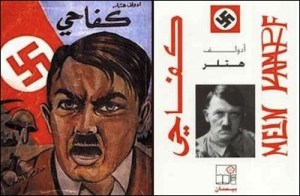
1382There remains a deep connection between Islamism and Nazism based on the common characteristics of racism, nationalism, religious bigotry, and intolerance. Hitler’s Mein Kampf has been a bestseller for years in predominantly Muslim countries, including the Palestinian Authority and Turkey.

There was, however, an event reminiscent of the mufti’s story that occurred a year earlier. The Jews of Medina had invited the Quraish and Ghatafan tribes to attack Muhammad. It was at this point, after the Battle of Badr, that the Quraish asked the Jews whose religion was better, theirs or Muhammad’s. Encouraged by the Jews, the two tribes marched on Medina, and their subsequent abortive attack came to be known as the Battle of the Ditch. After their retreat, Muhammad attacked Medina’s Jewish tribe of Banu Quraiza.[24] It seems likely that the mufti—unless he intentionally invented stories, a possibility that cannot be ruled out—confused the episode of the Banu Quraiza with that of Muhammad’s war on Khaibar.

Far more important than these technical details and idiosyncratic interpretations are the novelties the pamphlet introduces in Islamic political discourse regarding the Jews. By combining the Islamic canon with pre-Christian and Christian anti-Judaism, it attributes strengths and powers to Jews that cannot be found in Islamic tradition by portraying them as far more cunning and successful in their vicious designs than previous mainstream Islamic thought had recognized or permitted.

A simpler example of this anti-Jewish eclecticism can be found in the mufti’s accusation that Jews brought plague to Arabia. This statement evokes medieval European myths with similar themes. More significant is the notion that Muhammad’s death might have been a result of poison given to him by a Khaibar Jewess.

To be sure, Ibn Ishak and Tabari do mention how during the illness that led to his death Muhammad spoke to Umm Bashr, mother of his poisoned companion, and complained about his pain, caused by poisonous meat he had tasted three years earlier.[25] However, in classic Islamic thought, this tradition was not interpreted as proof that the Jewess had succeeded in her attempt on the Prophet’s life but as a desire to attribute to the Prophet the highest of virtues: martyrdom. In Ibn Ishak’s words, “The Muslims considered that the apostle died as a martyr in addition to the prophetic office with which God had honored him.”[26] Tabari repeats this explanation, as does Ibn Kathir (1300-73), who referred to eight different hadiths asserting that Muhammad had been warned by God about the poison: proof of his being a genuine prophet. Conversely, Ibn Kathir states that “the Messenger of God died a martyr.”[27]

The core theme of all these traditions is the Prophet’s martyrdom and not the Jews’ lethal craft; the reader is left with the clear impression that the two phenomena were unrelated. In contrast, the mufti’s pamphlet establishes the link and changes the emphasis from the Prophet’s virtue to the Jews’ mendacity. Apparently, his intention was to draw parallels with Christian traditions regarding Christ’s killing by the Jews. This accusation was intended to provoke more anger among Muslims, but it also violated Islamic tradition and theology.

The implications of the mufti’s claim that the Jews were successful in killing Muhammad despite God’s warning imply that Jews possess the power to defy God’s will. Such a blasphemous thought would be worse than Christian accusation of deicide. Jesus overcame death, and by his suffering, death and resurrection brought salvation to his community of believers; however, Muhammad not only remained dead but also failed to appoint his successor due to the rapid progression of his illness and his sudden, untimely demise. Consequently, the umma was split by different claimants to authority, and the dispute eventually led to the fiercest internecine strife in the history of early Islam, known as the fitna.

While the mufti’s Palestinian successors would not tire of reiterating this story (as late as November 2013, Palestinian Authority minister of religious affairs Mahmoud Habbash claimed that Yasser Arafat was poisoned by the Jews just as they had poisoned the Prophet Muhammad to death),[28]most contemporary Islamic scholars have a different understanding of this hazardous theology; inasmuch, the accusation that the Jews killed the Prophet has largely faded as a theological theme with mainstream Islamic commentary viewing the Jews, along the Qur’anic derision, as “adh-dhilla wa-l-maskan,” translated by Yehoshafat Harkabi as “humiliation and wretchedness.”[29] Bernard Lewis further explained:

The outstanding characteristic, therefore, of the Jews as seen and as treated in the classical Islamic world is their unimportance. … For Muslims, he might be hostile, cunning, and vindictive, but he was weak and ineffectual—an object of ridicule, not fear. This image of weakness and insignificance could only be confirmed by the subsequent history of Jewish life in Muslim lands.[30]

Departing from this conventional view, the mufti did not interpret contemporary events as a new historical phenomenon to which Muslims should respond in a new, ad hoc manner. Instead, he traced Jewish accomplishments of the 1920s, 1930s, and 1940s, and the alleged Jewish power and ambitions, to supposed Jewish activities at the time of Muhammad. In doing so, he created a precedent, later followed by prominent Islamic actors in the Middle East and elsewhere, particularly after Israel’s stunning military victories over its Arab adversaries. Thus Hamas accuses the Jews of “wiping out the Islamic caliphate” by starting World War I and of starting the French and the communist revolutions, establishing “clandestine organizations” and financial power so as to colonize, exploit, and corrupt countries.[31] Likewise, former Malaysian prime minister Mahathir Muhammad accused Jews of ruling the world by proxy.[32] Attributing such gargantuan accomplishments to the Jews, many of them at the expense of Muslims, presents a theological innovation with an immediate political consequence. Linking early Islamic with medieval Christian depictions of Jews results in their portrayal as “a demonic entity,” thus making their “extermination legitimate.”[33]

______________________

[1] Klaus-Michael Mallmann and Martin Cüppers, Nazi Palestine: The Plans for the Extermination of the Jews in Palestine, trans. Krista Smith (New York: Enigma Books in Association with the United States Holocaust Memorial Museum, 2010), p. viii.

[2] Boris Havel, “Haj Amin al-Husseini: Herald of Religious Anti-Judaism in the Contemporary Islamic World,”The Journal of the Middle East and Africa, 3 (2014): 221-43.

[3] The following text has been translated from the original pamphlet: Veliki Muftija Jeruzalemski Hadži Emin el-Huseini, Islam I Židovstvo (Zagreb: Hrvatski tiskarski zavod, 1943). I wish to thank the staff of the National and University Library in Zagreb for tracing the booklet. The Qur’anic verses and hadith are translated as they appear in the original text.

[4] The word “prostačkoj” can also be translated as: obscene, dirty, or indecent.

[5] This word was written in singular in the original text and introduces the notion that the average Jew was such; by referring to “a Jew,” the author refers to the whole people.

[6] The mufti fails to note that prominent members of his own family, including his father, were among the “unscrupulous landlords” selling plots of land to the Jews. See Efraim Karsh, Palestine Betrayed (New Haven: Yale University Press, 2010), pp. 15-19.

[7] Sura 2:109.-Ed.

[8] Ibn-Ishak, The Life of Muhammad: A Translation of Ibn Ishaq’s “Sirat Rasul Allah” by A. Guillaume(Karachi: Oxford University Press, 2004; repr., 1967), p. 516; Tabari, The History of al-Tabari [Ta’rikh al-Rusul Wal-Muluk] (New York: State University of New York Press, 1987-97), vol. VIII, pp. 123-4.- Ed.

[9] Bukhari’s Hadith, 4.394.-Ed.

[10] The author probably refers to the Arab tribes of Aws and Kharzaj though the transliteration (Kauša i Karaša) barely resembles those names.

[11] The word “pismenjaci” refers to the “People of the Book” (sljedbenici knjige in Čaušević-Pandža).

[12] Sura 3:99.-Ed.

[13] Sura 3:99-101.-Ed.

[14] Sura 5:41-5.-Ed.

[15] Sura 2:144-9.-Ed.

[16] Sura 2:142-3.-Ed.

[17] Sura 4:51-5.-Ed.

[18] Sura 5:82.-Ed.

[19] There is no Qur’anic verse with this message. The mufti perhaps refers to a non-canonical hadith or obscure tradition.

[20] Muhammed Pandža and Džemaluddin Čaušević (eds.), Kuran, Sedmo Izdanje (South Birmingham: Islamic Relief, 1937-89). Though the Qur’an condemns those who falsely feigned Islamic belief (e.g., sura 2:8-9, or sura 63), this condemnation does not specifically apply to the Jews but rather to the wider category of “hypocrites.”

[21] Karsh, Palestine Betrayed, p. 17; David Dalin and John Rothmann, Icon of Evil: Hitler’s Mufti and the Rise of Radical Islam (New York: Random House, 2008), p. 252.

[22] Ibn-Ishak, The Life of Muhammad, pp. 492-9; Tabari, The History of al-Tabari, vol. VIII, pp. 57-67; Qur’an: sura 24:11-26.

[23] Michael Lecker, “The Hudaybiyya-Treaty and the Expedition against Khaybar,” Jerusalem Studies in Arabic and Islam, 5 (1984), pp. 1-12.

[24] Ibn-Ishak, The Life of Muhammad, pp. 450-69.

[25] Tabari, The History of al-Tabari, vol VIII, p. 124.

[26] Ibn-Ishak, The Life of Muhammad, p. 516.

[27] Ibn-Kathir, The Life of the Prophet Muhammad (al-Sira al-Nabawiyya), trans. Trevor Le Gassick (Reading: Garnet Publishing, 2000-06), vol. 3, pp. 283-7.

[28] Palestinian Authority TV, Nov. 8, 2013; “PA: Arafat was poisoned by Jews like Islam’s Prophet Muhammad,” trans. Palestinian Media Watch, Nov. 12, 2013.

[29] Yehoshafat Harkabi, Arab Attitudes to Israel (Jerusalem: Israel Universities Press, 1972), p. 220.

[30] Bernard Lewis, Semites and Anti-Semites (London: Phoenix, 1997), pp. 117-39.

[31] See, for example, “Hamas Covenant 1988,” Yale Law School Avalon Project, accessed Mar. 14, 2015.

[32] CNN, Oct. 16, 2003.

[33] Moshe Sharon, Jihad: Islam against Israel and the West (Jerusalem: Moshe Sharon, 2007), pp. 77-8.
The Iran scam grows even worse – Part I, Nuke site inspections

June 15, 2015

Dan Miller’s Blog, May 15, 2015

(The views expressed in this article are mine and do not necessarily reflect those of Warsclerotic or its other editors. — DM

It is likely that the P5+1 nuke deal with Iran will be approved soon. Military and other nuke sites which Iran has not “disclosed” will not be inspected. Nor will Iran’s nuke ties with North Korea — which P5+1 member China seems to be helping, Iran’s massive support for terrorism and abysmal human rights record be considered because they are also deemed unnecessary for deal approval. Sanctions against Iran are moribund and will not be revived regardless of whether there is a “deal.” However, a bronze bust of Obama may soon be displayed prominently in Supreme Leader Khamenei’s office and one of Khamenei may soon be displayed proudly in Dear Leader Obama’s office.

Iran fenced in

Part I — Nuke site inspections

According to a June 11, 2015 article by the Middle East Research Institute (MEMRI), Iran’s Supreme Leader has said there will not even be “token” IAEA inspections.

This past week, members of Iran’s nuclear negotiating team revealed details about the Iran-U.S. nuclear negotiations. The negotiations were dealt a blow when Iranian Supreme Leader Ali Khamenei rejected an agreement reached by the two sides concerning a token inspection of military facilities and questioning of several nuclear scientists and “military personnel”; these were to be the response to the IAEA’s open dossier on possible military dimensions (PMD) of Iran’s nuclear program to which Iran has so far refused to respond.

Iranian reports on these developments show that in order to arrive at a comprehensive agreement, the U.S. is willing to forgo actual inspection of Iranian military facilities and to settle for inspection of declared nuclear facilities only, as set forth under the Additional Protocol, while the ongoing monitoring of Iran’s nuclear program will be left to intelligence elements. [Emphasis added.]

Also on June 11th, it was reported that

CIA Director John Brennan likely came to Israel last week to tell Israeli officials that a final nuclear deal with Iran does not have to include a commitment by Tehran to provide access to military bases, or Iranian consent to interview its scientists, a new report by the Middle East Media Research Institute (MEMRI) said. [Emphasis added.]

On June 12th, Iranian President Rouhani reiterated that

the country will never allow its secrets to be exposed under the Additional Protocol of the Nuclear Non-Proliferation Treaty (NPT) or any other treaty.

“Certainly, Iran will not allow its secrets to be obtained by others under the pretext of implementing the (Additional) Protocol or any other treaty,” President Rouhani said at a press conference in Tehran.

He reaffirmed that foreigners will be denied access not only to Iran’s military secrets but also to secret information in other technological fields.

Here’s a video with comments by Former DIA Director Lt. General Michael Flynn and Ambassador Robert Joseph on Iran’s ballistic missile program and other aspects of the “deal:”

Here’s the Obama administration’s most recent waffle on inspections of Iran’s nuclear sites and sanctions relief:

Although the State Department spokesman waffled, his comments were, unfortunately, at least generally consistent with the January 14, 2014 White House Summary of the framework for subsequent P5+1 negotiations. As I noted here in January of 2014, that summary failed even to mention such military sites as Parchin — even though the IAEA “had reason to think that there had been implosion testing in 2011 but was refused access to inspect” it, Iran’s development and testing of rocketry capable of delivering nuclear warheads and its development and testing of nuclear warheads.

It had been reported on November 27, 2013 that

Despite Tehran’s protestations that it has no intention of ever creating a nuclear weapon, Iran, in fact, has been developing a warhead for some 15 years. That design is now near perfect. [Emphasis added.]

It had been reported on November 28, 2013 that

A top Iranian military leader announced late Tuesday that Iran has developed “indigenous” ballistic missile technology, which could eventually allow it to fire a nuclear payload over great distances. [Emphasis added.]

Why does the White House Summary fail to mention such things? Probably because they are not within the parameters of the November 24, 2013 Joint Plan of Action.

The Joint Plan of Action, — on which the White House Summary seems to have been based — states, in a superficially comforting preamble,

The goal for these negotiations is to reach a mutually-agreed long-term comprehensive solution that would ensure Iran’s nuclear programme will be exclusively peaceful. Iran reaffirms that under no circumstances will Iran ever seek or develop any nuclear weapons. This comprehensive solution would build on these initial measures and result in a final step for a period to be agreed upon and the resolution of concerns. This comprehensive solution would enable Iran to fully enjoy its right to nuclear energy for peaceful purposes under the relevant articles of the NPT in conformity with its obligations therein. This comprehensive solution would involve a mutually defined enrichment programme with practical limits and transparency measures to ensure the peaceful nature of the programme. This comprehensive solution would constitute an integrated whole where nothing is agreed until everything is agreed. This comprehensive solution would involve a reciprocal, step-bystep process, and would produce the comprehensive lifting of all UN Security Council sanctions, as well as multilateral and national sanctions related to Iran’s nuclear programme. [Emphasis added.]

There would be additional steps in between the initial measures and the final step, including, among other things, addressing the UN Security Council resolutions, with a view toward bringing to a satisfactory conclusion the UN Security Council’s consideration of this matter. The E3+3 and Iran will be responsible for conclusion and implementation of mutual near-term measures and the comprehensive solution in good faith. A Joint Commission of E3/EU+3 and Iran will be established to monitor the implementation of the near-term measures and address issues that may arise, with the IAEA responsible for verification of nuclear-related measures. The Joint Commission will work with the IAEA to facilitate resolution of past and present issues of concern.

However, while the Joint Plan of Action calls for “enhanced monitoring” of Iran’s facilities, its focus is on nuclear enrichment, not Iran’s militarization of nukes.

Enhanced monitoring:

Provision of specified information to the IAEA, including information on Iran’s plans for nuclear facilities, a description of each building on each nuclear site, a description of the scale of operations for each location engaged in specified nuclear activities, information on uranium mines and mills, and information on source material. This information would be provided within three months of the adoption of these measures.

Submission of an updated DIQ for the reactor at Arak, designated by the IAEA as the IR-40, to the IAEA.  Steps to agree with the IAEA on conclusion of the Safeguards Approach for the reactor at Arak, designated by the IAEA as the IR-40.

Daily IAEA inspector access when inspectors are not present for the purpose of Design Information Verification, Interim Inventory Verification, Physical Inventory Verification, and unannounced inspections, for the purpose of access to offline surveillance records, at Fordow and Natanz.

IAEA inspector managed access to: centrifuge assembly workshops; centrifuge rotor production workshops and storage facilities; and, uranium mines and mills.

Despite Obama’s claims, Iran appears to have increased, not rolled-back, its nuclear enrichment program. According to the New York Times on June 1st,

With only one month left before a deadline to complete a nuclear deal with Iran, international inspectors have reported that Tehran’s stockpile of nuclear fuel increased about 20 percent over the last 18 months of negotiations, partially undercutting the Obama administration’s contention that the Iranian program had been “frozen” during that period.

But Western officials and experts cannot quite figure out why. One possibility is that Iran has run into technical problems that have kept it from converting some of its enriched uranium into fuel rods for reactors, which would make the material essentially unusable for weapons. Another is that it is increasing its stockpile to give it an edge if the negotiations fail.

Here’s an “explanation” by Marie Harf, the “the Senior Advisor for Strategic Communications to U.S. Secretary of State John Kerry at the U.S. State Department. . . .”

Iran will not budge on inspection of its military and other sites it has not disclosed and which are claimed by the IAEA to be places where Iran’s weaponization of nukes is likely. The Obama Administration will not budge on permitting Iran to get away with it.

Although Israel has been the only free and democratic nation consistently to oppose the P5+1 “negotiations” and the framework on which they are based from the beginning, France has sometimes opposed Obama’s pursuit of a bad “deal.” Recently, France even demanded the inspection of Iran’s sites as sought by the IAEA and stated that it would not consent to a P5+1 “deal” without them.

However, “the French position creates a problem for President Obama because the deal has to be agreed on by the P5+1, not the ‘P4+1-with-one-vote-in-opposition’.” Of the P5+1 members (China, France, Russia, the United Kingdom, and the United States, plus Germany), France appeared to stand alone on this point. However, the linked article suggests that Obama may be trying to use France’s support for a Palestinian state within Israel to convince her to agree that such inspections are unnecessary.

The first story is about France, a member of the P5+1 negotiating a deal with Iran on nuclear capabilities. The French government has expressed increasing concern that the emerging deal is flawed — perhaps fatally.

The other story is that Obama’s

expressed skepticism about the achievability of an Israeli-Palestinian agreement appears to have given way to the French notion that “all other ways have been explored,” and that it is time to let the UN determine parameters for a “big overarching deal.” And, as it happens, the French draft corresponds with the President Obama’s own — strongly held — belief that Israel has to ascribe to the President’s view, despite having just elected a Prime Minister who disagrees.

. . . .

Smash the two stories together, you get an American president supporting France in its efforts to be a major player in the Middle East in exchange for French support of the P5+1 deal with Iran.

In both cases, guess who pays the price: Israel.

The rest of the “free world,” such as it has become, will also pay a hefty price for such a “deal” with Iran.

On a similar note, it was reported on June 9th that

A senior Western diplomat told Ma’ariv in a report published Tuesday that “a diplomatic attack against Israel is expected soon that will surprise even the pessimists in Jerusalem.”  [Emphasis added.]

“In the (UN) Security Council, in western capitals and at EU headquarters, they are just waiting for the Iran deal to be signed and for it to be approved by the American Congress,” warned the diplomatic source.

It appears that the waiting period will likely expire in September, at which time a UN General Assembly will open in tandem with the first shots of the diplomatic barrage against Israel.

Diplomatic sources familiar with Western European positions vis-a-vis Israel said the EU already has a list ready, itemizing sanctions against Israel in the fields of trade, agriculture, science and culture. [Emphasis added.]

That list is to be translated into an economic assault – unless Israel presents a new set of concessions it is willing to make for a new round of peace talks, after the last set of talks was torpedoed by the PA signing a unity deal with the Hamas terrorist organization.

“S‭enior officials in Jerusalem are aware of the existence of sanctions documents at EU headquarters, some of which have even fallen into their hands,” one diplomatic source revealed to Ma’ariv.

Were Israeli Prime Minister Netanyahu to have agreed with Obama on the Iran nuke “negotiations,” Israel’s punishment by imposing economic sanctions on her as those on Iran cease would now be unlikely.

Obama seems to be happy with any “deal” that Iran is willing to sign, despite Iran’s ongoing nuke militarization, the Iran-North Korea-China connection, Iran’s continued massive support for terrorism and its abysmal human rights record. With such a “deal,” Iran will be able to pursue such goals essentially unimpeded, at least until a different administration takes over in Washington.

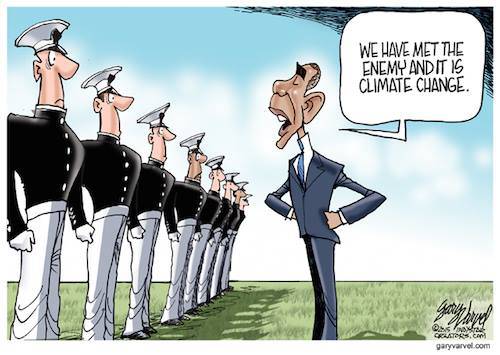
gary_varvel_gary_varvel_for_04272014_5_-500x367 (H/t Freedom is just another word.)

Parts II through ?? of this series will be posted over the next several days.

Rouhani: Saving environment starts with sanctions removal

June 9, 2015

Rouhani: Saving environment starts with sanctions removal, Al-MonitorArash Karami, June 8, 2015

(Human rights, Iranian missiles, Iranian threats, Iranian proxies, theocratic dictatorship? Those are not relevant to the deal. But whatever may help the environment and therefore stop climate change is my top priority — Obama.

enemy

— H/t Freedom is just another word. — DM)

Rouhani’s comments linking the country’s various environmental problems and employment woes to the nuclear negotiations and sanctions relief have upset conservatives, who believe the administration is too eager to resolve the dispute and too optimistic about what the deal means for the country.

**********************

Iranian President Hassan Rouhani has been criticized for suggesting that once a comprehensive nuclear deal is made it will open the door to improving the country’s environmental problems. “The oppressive sanctions must be removed so that investment can come and the problems of the environment, employment, industry and drinkable water are resolved,” Rouhani said at a ceremony on June 7 commemorating Environment Week in Iran.

Rouhani described the sanctions as “a small fever … that at the beginning no attention was paid to this fever, but when the sick person fell ill and was not able to move anymore, we sought a remedy for the illness. Some did not know the reason of the sanctions but step by step, the problems became larger.”

Rouhani added that while “the oppressive sanctions must be removed,” this does not mean “that we must submit to the unreasonable wants of others.”

Iran and five permanent members of the UN Security Council plus Germany (P5+1) are working through the final details of a comprehensive deal that would see Iran reduce its nuclear activity in return for sanctions relief, particularly banking sanctions that have hurt the country’s ability to sell its oil and conduct trade and have prevented Western investment in the country.

But Rouhani’s comments linking the country’s various environmental problems and employment woes to the nuclear negotiations and sanctions relief have upset conservatives, who believe the administration is too eager to resolve the dispute and too optimistic about what the deal means for the country.

In an article titled, “The water, wind, soil and forests have also been tied to sanctions,” the conservative Javan newspaper criticized Rouhani’s latest comments. The article said, “Despite experts warning of not connecting domestic issues of the country to the nuclear issue and negotiations, at this ceremony Rouhani once again suggested that with the removal of sanctions not only will investment become fluid in Iran but the issues of the environment, youth employment, water and banking will be [resolved].”

The article continued that Rouhani’s comments “resulted in many experts becoming surprised and a few hours afterward many hostile Western networks and media … took this point and broadcast this to show [that] sanctions have brought Iran to its knees.”

In an article sarcastically titled, “Solving all the problems is tied to the negotiations, even drinking water,” the Kayhan newspaper also criticized Rouhani. Kayhan repeated Javan’s warning that analysts have warned of not tying the nuclear negotiations to domestic issues and cast doubt that so many problems could be resolved with the removal of sanctions. Kayhan wrote, “Stranger than anything else, Rouhani said the removal of sanctions would increase the water levels.”

Kayhan said, “The issue of sanctions is one the most important obstacles for the negotiators because the Americans do not want to remove sanctions, which is a tool to apply pressure on Iran.”

According to his previous statements, Iran’s Supreme Leader Ayatollah Ali Khamenei, who has final say on the nuclear program, has warned Iranian officials about being optimistic regarding the sanctions and has emphasized focusing on domestic capabilities instead.

On April 29, he said, “The key to solving economic issues is not in Lausanne, Geneva or New York,” three locations where the Iran and P5+1 nuclear talks have taken place under the Rouhani administration. “Without a doubt, sanctions and pressure cannot stop organized and planned efforts to increase domestic production.”


Leaked Information: Khamenei’s Lies Exposed

June 9, 2015

Leaked Information: Khamenei’s Lies Exposed, Front Page Magazine, June 9, 2015

(?????????????????? — DM)

1.29.13-Ayatollah-Ali-Khamenei-431x350

[W]hat the ayatollah is announcing to the media — that basically the Islamic Republic does not desire to seal a final nuclear deal with the six world powers — is not the truth.  The leaked information (in Persian language) indicates that the Supreme Leader has already instructed the nuclear negotiating team and his advisors to ignore his public statements and seal the final nuclear deal.

******************

Iran’s paramount religious leader can be described as one of the longest-ruling dictators in the Middle East who still enjoys the throne. An ideologue and a Shiite Islamist, he is also a shrewd Machiavellian politician.

Although he attempts to project himself to the Muslim world as a united religious leader who pursues truth, faith, and honesty, his double-faced character can easily be detected in the discrepancies among his statements and policies.

When Khamenei came to power, he lacked the charisma of his predecessor, Ayatollah Ruhollah Khomeini. To rule, he continued the major policies of his predecessor, relying on hard power and hardliners to suppress domestic opposition, making different statements to the public than in private, and funding Shiite or non-Shiite extremists groups in the region such as Hezbollah and the Houthis.

In addition, he created the Office of the Supreme Leader, comprised of close advisors and excluding the presidential and other major offices in order to further consolidate his power and prevent the leaking of information. The Islamic Republic’s major domestic and foreign policy decisions are made in the small gilded circle of his office and he is the final decision-maker of the country.

To rule, the ayatollah began wielding power without being held accountable. In order to do so, his government pre-select a handful of candidates to become president. Presidents do not have any actual power, but would be held accountable, blamed for any gaffes such as economic mismanagements and failure in nuclear talks, among other things. This system has so far worked for the ayatollah.

His predecessor and founder of the Islamic Republic came to power by promising people that oil revenues will be distributed among the population and that people do not have to pay for major bills such as electricity or water (in a speech that he gave in Behesht e Zahra). The videos and audios of that speech were removed from public access. Now, one can even be punished or executed by the Islamic Republic if the government finds that particular speech in one’s possession.  Ayatollah Khamenei also continued this dual policy of deceiving the public.

Most recently, with regards to the marathon nuclear negotiations, Mr. Khamenei’s double standards have become more obvious due to leaked information.

In less than a month, the six world powers (known as the P5+1; the United States, China, Germany, United Kingdom, France, and Russia) and the Islamic Republic will be reaching the deadline for their marathon nuclear talks, marking one the lengthiest international negotiations of our generation.

The position and opinion of the Islamic Republic’s paramount leader, Ayatollah Ali Khamenei, on the nuclear negotiations and the terms of the final nuclear deal can be characterized as the most crucial factor in determining whether a final deal will be reached by the end of June or not.

Khamenei recently stated, “We will never yield to pressure… We will not accept unreasonable demands… Iran will not give access to its (nuclear) scientists,” he added, “They say we should let them interview our nuclear scientists. This means interrogation… I will not let foreigners talk to our scientists and to interrogate our dear children… who brought us this extensive (nuclear) knowledge… We will not allow the privacy of our nuclear scientists or any other important issue to be violated.”

Nevertheless, what the ayatollah is announcing to the media — that basically the Islamic Republic does not desire to seal a final nuclear deal with the six world powers — is not the truth.  The leaked information (in Persian language) indicates that the Supreme Leader has already instructed the nuclear negotiating team and his advisors to ignore his public statements and seal the final nuclear deal.

The Supreme Leader’s double-standards and the difference in what he states publicly and what he instructs behind the scenes, indicate that he indeed needs the final nuclear deal and he will be more likely willing to allow inspections in order to obtain the deal. Ayatollah Khamenei is cognizant of the fact that the final nuclear deal is geopolitically, economically, and ideologically a win for him. Iran’s nuclear infrastructure will not be dismantled, Iran’s break-time to become a nuclear state will shrink from one year to zero in the next few years, Iran’s economy will be strengthened, and the US will likely ignore Iran’s increasing influence and their proxy wars in the region because of the nuclear deal.

Khamenei is being disingenuous with the public and other nations for several reasons. First of all, The fact that Iran’s negotiating team are continuing with the talks, sitting at the same table with Obama administration’s diplomats, and the fact that there is contradiction between what the Supreme Leader and his advisors stated publicly and behind the scenes indicates that Khamenei is giving a green light to the nuclear team to get a nuclear agreement from the White House, the major player in the talks.  Secondly, by showing that Iran is not in need of such a deal, Khamenei is giving leverage to the Iranian negotiating team to obtain more concessions from the West.

Khamenei attempts to publicly show that he is a strong religious and nationalistic leader who is totally against foreign inspection and monitoring of his country. Finally, he desires to project the picture that he is not desperate for the final nuclear deal in order to get as many concessions as he can from the Obama’s administration. And so far, his tactics and dual policies have worked for him in further strengthening his throne and power.

Super Power Poker – Live From Iran

June 9, 2015

Super Power Poker – Live From Iran, Clarion Project via You Tube, June 9, 2015

The stakes are the highest they’ve ever been. Nuclear Iran. The US, Iran, Saudi Arabia and Israel play for the security of the world. This is the ultimate hold’em game. Who holds the aces, who will go all in, who is bluffing and who has a tell that will leave them with nothing but a mushroom cloud. No nukes for Iran.


Two major Mid East escalations: Yemeni rebels fire Scuds at Saudi air base. ISIS warns Syrian rebels

June 6, 2015

Two major Mid East escalations: Yemeni rebels fire Scuds at Saudi air base. ISIS warns Syrian rebels, DEBKAfile, June 6, 2015

us_patriot_missiles_saudi_arabia_6.6.15US Patriots stationed in Saudi Arabia

Saudi military sources reported Saturday, June 6, that Patriot air defense batteries had intercepted Scud missiles fired by Yemen Houthi rebels against the kingdom’s largest air base at Khamis al-Mushait in the south west. It is from there that Saudi jets take off to strike the Yemeni rebels. DEBKAfile’s military sources report that the Patriot anti-missile systems, which were activated for the first time, were manned by American teams. This was the first direct US military intervention on the Saudi side of the Yemen conflict.

It was also the first time that Houthi rebels or their allies had fired Scud missile into the oil kingdom. Our sources add that the launch was supervised by Hizballah officers. They were transferred by Tehran to Yemen to ratchet up the conflict – although US, Saudi, Yemeni government and Houthi representatives meeting secretly in Muscat Friday agreed to attend a peace conference in Geneva this month.

Nonetheless, through Friday night and Saturday morning, Houthi forces and allied military units kept on battering at Saudi army and National Guard defense lines, in an effort to break through and seize territory in the kingdom’s southern provinces. The insurgents were evidently grabbing for strategic assets to strengthen their hand at the peace conference.

Iran’s supreme leader Ayatollah Ali Khamenei is also juggling his chips on the deteriorating Syrian warfront. In the coming hours, he is widely expected to announce the activation of the mutual defense pact signed between Iran and Syria in 2006, under which each signatory is committed to send military troops if necessary to defend its partner.

Thursday, June 4, Khamenei fired sharp verbal arrows at the Obama administration: “The United States tolerates extremist groups in Syria and Iraq and even helps them in secret,” he charged.

Our military sources add that although various Mid East publications, especially in Lebanon, are reporting that Iran has already sent units in numbers ranging from 7.000 to 15,000 troops to Syria, none have so far landed, except for the Shiite militias brought over at an earlier stage of the Syrian conflict. The expected Khamenei announcement may change this situation.

ISIS was not waiting. Saturday morning, the group issued a warning to the Syrian rebel forces fighting in the south – the Deraa sector of southern Syria near the meeting point of the Jordanian and Israeli borders and the Quneitra sector opposite the Israeli Golan. They were ordered to break off contact with the US Central Command Forward Jordan-CF-J which is located north of Amman, and the IDF operations command center in northern Israel. Any Syrian rebels remaining in contact with the two command centers would be treated as infidels and liable to the extreme penalty of beheading, the group warned.

The impression of ominous events brewing in the regime was rounded off Friday night by an unusual announcement by the Israeli army spokesman that Iron Dome anti-missile batteries had been deployed around towns and other locations in the south, although no reference was made to any fresh rocket attacks expected from the Gaza Strip. DEBKAfile adds: The first batteries were arrayed Thursday night, June 4, at vulnerable points in southern Israel – from the southernmost Port of Eilat on the Gulf of Aqaba to the western Port of Ashdod on the Mediterranean.

Iran Short Film Series – 3. Believe Them!

June 2, 2015

Iran Short Film Series – 3. Believe Them! Clarion Project, via You Tube, June 1, 2015

(But to believe what Iranian leaders say, repeatedly, would be Islamophobic. Or something. — DM)