Archive for the ‘Israel’ category

Has the Pope Abandoned Europe to Islam?

May 26, 2016

Has the Pope Abandoned Europe to Islam? Gatestone InstituteGiulio Meotti, May 26, 2016

♦ In 2006, Pope Benedict XVI said what no Pope had ever dared to say — that there is a link between violence and Islam. Ten years later, Pope Francis never calls those responsible for anti-Christian violence by name and never mentions the word “Islam.”

♦ Pope Francis does not even try to re-evangelize or reconquer Europe. He seems deeply to believe that the future of Christianity is in the Philippines, in Brazil and in Africa. Probably for the same reason, the Pope is spending less time and effort in denouncing the terrible fate of Christians in the Middle East.

♦ “Multiculturalism” in Europe is the mosque standing on the ruins of the church. It is not the synthesis requested by Pope Francis. It is the road to becoming extinct.

♦ Asking Europe to be “multicultural” while it experiences a dramatic de-Christianization is extremely risky. In Germany, a new report found that “Germany has become demographically a multi-religious country.” In the UK, a major inquiry recently declared that “Britain is no longer a Christian country.” In France, Islam is also overtaking Christianity as the dominant religion.

To scroll the list of Pope Francis’s apostolic trips — Brazil, South Korea, Albania, Turkey, Sri Lanka, Ecuador, Cuba, United States, Mexico, Kenya, Uganda, Philippines — one could say that Europe is not exactly at the top of his agenda.

The two previous pontiffs both fought for the cradle of Christendom. Pope John Paul II took on Communism by toppling the Berlin Wall and the Iron Curtain. Benedict XVI took on “the dictatorship of relativism” (the belief that truth is in the eye of the beholder) and bet everything on re-evangelizing the continent by traveling through it (he visited Spain three times) and in speeches such as the magnificent ones at Regensburg, where he spoke bluntly about the threat of Islam, and the German Bundestag, where he warned the gathered politicians against declining religiosity and “sacrificing their own ideals for the sake of power.”

Pope Francis, on the contrary, simply ignores Europe, as if he already considers it lost. This former Argentinian Cardinal, a representative of the “global South” Christianity, made spectacular trips to the migrants’ islands of Lampedusa (Italy) and Lesbos (Greece), but never to the heart of the old continent. Pope Francis has also made it difficult for Anglicans to enter into the Catholic Church, by downplaying the dialogue with them.

Most importantly, however, in his important May 6 speech for the Charlemagne Prize, the Pope, in front of European leaders, castigated Europe on migrants and asked its leaders to be more generous with them. He next introduced something revolutionary into the debate: “The identity of Europe is, and always has been, a multicultural identity,” he said. This idea is questionable.

Multiculturalism is a specific policy formulated in the 1970s. and it was absent from the political vocabulary of Schuman and Adenauer, two of Europe’s founding fathers. Now it has been invoked by the Pope, who spoke of the need for a new synthesis. What is this all about?

Today, Christianity appears marginal and irrelevant in Europe. The religion faces an Islamic demographic and ideological challenge, while the post-Auschwitz remnants of Jewish communities are fleeing from the new anti-Semitism. Under these conditions, a synthesis between the old continent and Islam would be a surrender of Europe’s claim to the future.

“Multiculturalism” is the mosque standing on the ruins of the church. It is not the synthesis requested by the Pope. It is the road to becoming extinct.

Asking Europe to be “multicultural” while it is experiencing a dramatic de-Christianization is also extremely risky. In Germany, a new report just found that “Germany has become demographically a multi-religious country.” In the UK, a major inquiry recently declared that “Britain is no longer a Christian country.” In France, Islam is also overtaking Christianity as the dominant religion. You find the same trend everywhere, from Protestant Scandinavia to Catholic Belgium. That is why Pope Benedict was convinced that Europe needed to “re-evangelized.” Pope Francis does not even try to re-evangelize or reconquer Europe. Instead, he seems deeply to believe that the future of Christianity is in the Philippines, Brazil and Africa.

Probably for the same reason, the Pope is spending less time denouncing the terrible fate of Christians in the Middle East. Sandro Magister, Italy’s most important Vatican observer, sheds light on the Pope’s silences:

“He remained silent on the hundreds of Nigerian schoolgirls abducted by Boko Haram. He remained silent on the young Sudanese mother Meriam, sentenced to death solely for being Christian and finally liberated by the intervention of others. He remains silent on the Pakistani mother Asia Bibi, who has been on death row for five years, because she too is an ‘infidel’, and [He] does not even reply to the two heartrending letters she has written to him this year, before and after the reconfirmation of the sentence.”

In 2006, Pope Benedict XVI, in his Regensburg lecture, said what no Pope had ever dared to say — that there is a link between violence and Islam. Ten years later, Pope Francis never calls those responsible for anti-Christian violence by name, and never mentions the word “Islam.” Pope Francis also recently recognized the “State of Palestine,” before it even exists — a symbolic and unprecedented first. The Pope also might abandon the Church’s long tradition of a “just war,” one regarded as morally or theologically justifiable. Pope Francis always speaks of the “Europe of peoples,” but never of the “Europe of Nations.” He advocates welcoming migrants and washes their feet, while he ignores that these uncontrolled demographic waves are transforming Europe, bit by bit, into an Islamic state.

1624In 2006, Pope Benedict XVI (left) said what no Pope had ever dared to say — that there is a link between violence and Islam. Ten years later, Pope Francis (right) never calls those responsible for anti-Christian violence by name and never mentions the word “Islam.” (Image source: Benedict: Flickr/Catholic Church of England | Francis: Wikimedia Commons/korea.net)

That is the meaning of Pope Francis’ trips to the islands of Lampedusa, Italy, and Lesbos, Greece — both symbols of a dramatic geographical and civilizational boundary. That is also the meaning of the Pope’s speech for the Charlemagne Prize.

Has the head of Christianity given up on Europe as a Christian place?
Canada Home to Islamic Radicals

May 25, 2016

Canada Home to Islamic RadicalsThe Toronto Sun via Middle East Forum, Tarek Fatah, May 24, 2016

2683

In November 2014, while testifying before the Senate Committee on National Security and Defence, I raised the issue of Islamic clerics using mosque sermons to attack the foundational principles of Western civilization and liberal secular democracy.

Liberal Senator Grant Mitchell was outraged by my testimony that at most Canadian mosques, the Friday congregation includes a ritual prayer asking, “Allah to give victory to Muslims over the ‘Kufaar’ (non-Muslims).” In a heated exchange with me, the senator suggested I wasn’t telling the truth, implying I was motivated by Islamophobia. Sadly, Sen. Mitchell is not alone in such views.

But neither is there any let-up in the attacks on Canadian values emanating from many mosque pulpits and Islamic conferences hosted by radical Islamist groups.

For example, in a sermon on Friday, May 6, delivered at a mosque in Edmonton, an imam invoked the memory of Prophet Muhammad to whip up hatred against Israel. He declared peace accords with Israel are “useless garbage” and vowed that Jerusalem will be conquered “through blood.”

In February, the same cleric predicted Islam would soon conquer Rome, “the heart of the Christian state.”

The Edmonton mosque diatribe was not isolated.

On May 13, just north of Toronto, an Islamic society hosted a celebration of Iranian mass murderer, Ayatollah Khomeini. The poster promoting the event described Khomeini as a, “Liberator and Reformer of the Masses.”

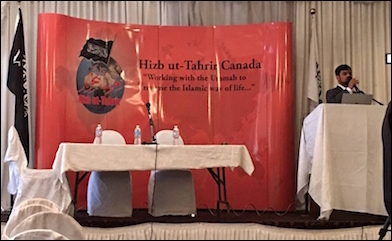
On Saturday, the Islamist group Hizb-ut-Tahrir, banned in some countries, hosted a conference to discuss the re-establishment of a global Islamic caliphate.

Pakistan-Canadian writer Tahir Gora went to cover the event, but was barred from entering the hall. “They said this was a closed door, in-camera meeting for our supporters,” Gora told me after he was asked to leave.

2684A speaker addresses the Hizb-ut-Tahrir conference in Mississauga, Ontario, on May 21.

Fortunately, one Palestinian-Canadian woman was able to enter the event.

She shared with me some of the proceedings from inside the gathering. “I walked into the banquet hall with approximately 100 attendees who were gender segregated. I sat next to a woman who said she had been in Canada for 40 years.” When I asked her if she felt any disconnect between enjoying 40 years of democracy, yet supporting the Hizb-ut-Tahrir who wanted to end it, she explained that democracy has done nothing good to people, so she and other believers follow Allah’s rule.

“The first speaker reminded Muslims that they are obligated to implement Allah’s orders that fulfil the Islamic State. It is “not permissible for us to choose’ he said, citing the Quran. However, he said it was necessary to win the public’s hearts and minds; and to partner with people of power, citing examples from the life of the Prophet.”

“At the end, a three-minute video was presented to demonstrate the collective oil and natural gas production capabilities of the Muslim world, the human capital needed to mine and process these resources … the military power required to protect them and the types of weapons needed to make such a military effective.”

While this was unfolding we received news that the Trudeau government, as part of its infrastructure development program, had authorised a $200,000 grant to a southern Ontario mosque with links to the Muslim Brotherhood.

Which begs the question: Who’s minding the store?

Anti-Israel Socialists Chosen to Write Official Democratic Party Platform

May 25, 2016

Anti-Israel Socialists Chosen to Write Official Democratic Party Platform, PJ MediaRon Radosh, May 24, 2016

Israel_-_Boycott_divest_sanction.sized-770x415xt

Bernie Sanders’ goal is to transform the Democratic Party, which is already a European style social-democratic party, into a full-fledged vehicle for socialism.

This is why he is still campaigning.

Even though Sanders knows Hillary Clinton will be the nominee, he is not giving up until the end. He is fighting for one reason: so his socialist supporters get to play a major role in formulating the Democratic Party’s platform for the 2016 general campaign and beyond. Now, with the announcement of those appointed by both Sanders and Clinton to the important platform committee of the Democratic Party, we already can see his influence.

Worried about keeping the support of Bernie’s people after her nomination is wrapped up, Clinton is being forced to tilt further to the left than she would like, making it much harder for her to shift back to the center in the general election campaign. A move to the center is necessary if she is to win the support of centrists, moderates, and independents. However, Bernie’s pressure has successfully gotten her to cave to his demands for a left-wing platform.

Let’s examine some of the five people Bernie Sanders has gotten appointed to the platform committee. What stands out?

First, their well-known animosity to Israel and support of the Palestinian Authority in the West Bank — and also, yes, of Hamas in Gaza.

Cornel West

The most prominent name among the five is the professor and radical black activist Cornel West. West has toured with Sanders and opened up rallies for him. West is a leading BDS activist.

He has said that the Gaza Strip is “the ‘hood on steroids.” In 2014, he wrote that the crimes of Hamas “pale in the face of the U.S. supported Israeli slaughters of innocent civilians.”

Like Sanders, West has long considered himself a democratic socialist, and has in the past worked with Dissent magazine and the late Michael Harrington’s Democratic Socialists of America.

James Zogby

The next prominent person appointed by Sanders to the committee is James Zogby, president of the Arab American Institute. As co-chair of the Democratic resolution committee, Zogby now has a direct hand in drafting the actual party platform.

In 1996, Zogby’s group sponsored a rally at which protesters held signs saying:

[Israeli Prime Minister Shimon] Peres and Hitler are the Same — The Only Difference is the Name.

In 2011, Zogby said the Palestinians are suffering their own “Holocaust.” Like West, Zogby supports the BDS movement, which he calls “a legitimate and moral response to Israeli policy” and to Israel’s “bullying tactics.”

Zogby told the Washington Post that his aim is to draft a platform that meets the needs of both Palestinians and Israelis, but from his own work it is most clear he is an enemy of the current Israeli government. He is also a fierce critic of the mainstream view about which group in the Middle East is responsible for the failure of peace talks between Palestinians and Israelis over the past few decades.

Keith Ellison

Sanders also picked Rep. Keith Ellison. The only Muslim in Congress, Ellison is a major critic of Israel and will undoubtedly stand with Zogby and West. All three will work — probably successfully — to implement a strong anti-Israel stance in the official Democratic Party platform.

How will Clinton — who has recently attempted to portray herself as opposed to BDS and as a strong supporter of Israel — choose to deal with this?

Will she make a tactical judgment about votes rather than a moral judgment?

On domestic policy, all of the platform committee members will favor leftist economic and political measures. Perhaps the only disagreement will be over backing Hillary’s more modest health care proposals vs. Sanders’ demand for fully state-run socialized medicine.

Clinton’s choices for the platform committee also reflect how she has been pulled towards socialist positions to satisfy Sanders’ supporters.

Wendy Sherman, a former deputy secretary of State, was a lead negotiator in the Iran nuclear talks; recall the Obama administration maneuvered to prevent Congress from voting on the agreement.

Neera Tanden is president of the Center for American Progress — a pro-Clinton think tank that has sought to create dialogue between Israel and the American “progressive” community.

Rep. Debbie Wasserman Schultz, current head of the Democratic National Committee, was allowed to select four members of the 15-member platform committee. Note that Sanders attacked her for supporting Clinton throughout the primary process, which is perhaps why her selections are also quite revealing.

Wasserman Schultz appointed Maryland’s Rep. Elijah Cummings as the committee’s chairman.

Cummings fiercely defended Obama’s Iran deal, often getting into arguments with Republicans while it was discussed in congressional committees on which he sits.

Cummings does happen to represent a district with a large Jewish population. So he “supports” Israel to the extent one can do so while favoring the Iran deal, and he is involved in a program that sends African American high school students from Baltimore to Israel.

Rep. Howard Berman of California is a legitimate pro-Israel legislator. He supported sanctions against Iran in 2010 when he was chairman of the House Foreign Affairs Committee.

To balance these two (plus one other pro-Israel member), Wasserman Schultz also appointed the far-left Rep. Barbara Lee of California. Lee stands out as perhaps the only elected representative further to the left than Bernie Sanders.

Lee once was a chief aide to a leftist congressman from Oakland, Ca., Ron Dellums. Lee joined 59 other House members in signing a letter following the 2009 Gaza war that urged the Obama administration to pressure Israel to allow more aid to Gaza. She spoke — along with Ellison —against a resolution condemning the 2009 UN report on the Gaza war. That resolution was supported by the Israeli government and the mainstream of the American pro-Israel community.

Lee, along with Cummings, Ellison, and Rep. Luis Gutierrez — a Clinton appointee to the Committee — have all been endorsed by the political affiliate of the left-wing J Street. That group, as we fully know, has been leading the opposition to sanctions against Iran and has lobbied strenuously amongst the American Jewish community to gain support for the Iran deal.

In April of 2009, journalist Mark Hemingway wrote an article about her appropriately titled “Comrade Barbara.” He revealed Lee to be a supporter of Fidel Castro:

[Lee is] still in the thrall of just about every discredited personality and idea the Left has produced in the last 50 years, and utterly convinced of her own righteousness.

Lee was a good friend of the late thug and leader of the Black Panther Party, Huey Newton, who escaped to Cuba for three years to dodge trial on various charges. Of Newton, who murdered opponents and made a living dealing drugs in the ghetto in Oakland, Lee wrote in her biography that “despite his roughness, my mother really liked him.”

Instead of acknowledging that the Panthers had become a full-fledged criminal organization, Lee argued that anything “bad” the Panthers did was the fault of the FBI, which actually carried out the measures which they blamed on the Panthers.

Perhaps the most egregious action Lee took came during Ronald Reagan’s presidency over the island of Grenada. Until the military intervention carried out by Reagan, Grenada was in the hands of a tyrannical Marxist-Leninist regime. It was negotiating for a new extension of an airfield so that the island could be used by Soviet jets in order for the USSR to get a military presence in the Caribbean.

After the collapse of the communist regime, the “Grenada papers” were published. They included correspondence between Lee and the island’s rulers in which she advised them on how to issue reports on the airfield to make it appear that it was not being built for military use.

In one letter, Lee wrote of Rep. Dellums:

[Dellums is] really hooked on you and Grenada and doesn’t want anything to happen to building the Revo[lution] and making it strong.

Hemingway concludes his article with this:

Perhaps the reason Lee has made dozens of trips to Cuba is that outside of her Berkeley congressional district, the oppressive Communist dictatorship is the closest place to home where she can be said to speak for anybody.

Perhaps Wasserman Schultz believes that Lee’s appointment will soften Bernie Sanders’ disdain for her. However, she has given Sanders yet one more ally who will undoubtedly support all of his far-left, socialist suggestions for the forthcoming platform.

Hillary Clinton’s negatives are now slightly below those of Donald Trump. The forthcoming far-left platform might satisfy Bernie Sanders’ deluded young followers, but will assure a further loss of support for the Democrats from centrists and independents.

French Political Gymnastics and How to Help the Palestinians

May 23, 2016

French Political Gymnastics and How to Help the Palestinians, Gatestone InstituteShoshana Bryen, May 23, 2016

“I call on the Palestinian people to elect new leaders, leaders not compromised by terror. I call upon them to build a practicing democracy, based on tolerance and liberty. If the Palestinian people meet these goals, they will be able to reach agreements with Israel, Egypt and Jordan on security and other arrangements for independence.” — President George W. Bush, 2002.

The Palestinians do not have “a practicing democracy based on tolerance and liberty,” but erasing Israel evidently remains their goal.

Rather than offering the Palestinians no-cost recognition, the French should demand a few changes first.

The French government seems to be falling over itself to undo its craven vote in favor of a UNESCO resolution accusing Israel — referred to as the “Occupying Power” in Jerusalem — of destroying historic structures on the Temple Mount:

  • Prime Minister Manuel Valls apologized. “This UNESCO resolution contains unfortunate, clumsy wording that offends and unquestionably should have been avoided, as should the vote.”
  • Interior Minister Bernard Cazeneuve apologized. [I do] “not take a supportive view of the text.” The resolution “should not have been adopted” and “was not written as it should have been.”
  • President François Hollande apologized. [The vote was] “unfortunate,” and, “I would like to guarantee that the French position on the question of Jerusalem has not changed… I also wish to reiterate France’s commitment to the status quo in the holy places in Jerusalem… As per my request, the foreign minister will personally and closely follow the details of the next decision on this subject. France will not sign a text that will distance her from the same principles I mentioned.”
  • Foreign Minister Jean-Marc Ayrault did not quite apologize: “France has no vested interest but is deeply convinced that if we do not want to let the ideas of the Islamic State group prosper in this region, we must do something.”

It sounds as if they thought they had made a mistake. But the vote was not a mistake. Underestimating the depth of Israel’s anger about it might have been a mistake, but not the vote. The French — who, according to their foreign minister, have “no vested interest” but need to “do something” about Islamic State — could not have thought that a UNESCO resolution that offended Israel would do anything to slow ISIS “in the region” or in Europe. There is no way it could; the two are not connected.

The French however, apparently thought a vote accusing Israel of something, anything, would keep the Palestinian Authority from presenting a resolution on Palestinian independence to the UN Security Council; Ayrault implied in Israel that the UNESCO vote was a quid pro quo. Why? The French have a veto they could exercise in the UN Security Council. But the Palestinians might then object to France replacing the U.S. as the “Great Power” in the “peace process.” They already have experience with a veto-wielding interlocutor — the U.S. — and they do not want another. The price of an elevated status for the French appears to entail not vetoing Palestinian resolutions, voting for them in UNESCO, and sacrificing Israel in a process that will end in French recognition of a Palestinian State, whether Israel agrees to be bound to the altar or not.

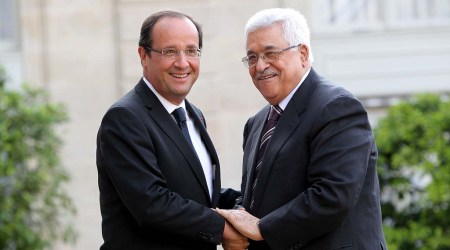
1614French President François Hollande welcomes Palestinian Authority President Mahmoud Abbas in Paris, July 8, 2012. (Image source: Office of the President of France)

It should be noted that the Russians immediately put out a statement that the UN-sponsored Middle East Quartet is the “only mechanism” for resolving the Palestinian issue. It is not clear whether Putin was supporting American or Israeli interests. Iran and ISIS are similarly disinclined to see the French ascend on this issue.

The Palestinians, on the other hand, are thrilled to have an international conference where others will make demands of Israel as the Palestinian experiment in self-government degenerates into poverty and chaos by its own economic, political and social choices, looking more like Venezuela every day.

For Palestinians in the street, killing Jews in the “knife intifada” did not take the edge off the popular anger and frustration with their own leadership.

Under the circumstances, the French, and France’s enabler, U.S. Secretary of State John Kerry, might usefully consider the approach taken in fact by President George W. Bush, which required changes in Palestinian behavior as a prerequisite for support for statehood. Honored mainly in the breach, Bush’s 2002 speech nevertheless remains the best statement of American, and Western, interest in moving the Palestinians toward a functioning state:

It is untenable for Israeli citizens to live in terror. It is untenable for Palestinians to live in squalor and occupation. And the current situation offers no prospect that life will improve. Israeli citizens will continue to be victimized by terrorists, and so Israel will continue to defend herself…

Peace requires a new and different Palestinian leadership, so that a Palestinian state can be born.

I call on the Palestinian people to elect new leaders, leaders not compromised by terror. I call upon them to build a practicing democracy, based on tolerance and liberty. If the Palestinian people meet these goals, they will be able to reach agreements with Israel, Egypt and Jordan on security and other arrangements for independence.

And when the Palestinian people have new leaders, new institutions and new security arrangements with their neighbors, the United States of America will support the creation of a Palestinian state whose borders and certain aspects of its sovereignty will be provisional until resolved as part of a final settlement in the Middle East.

I wrote at the time that,

“Mr. Bush made one huge leap of faith in the speech when he said, ‘I’ve got confidence in the Palestinians. When they fully understand what we’re saying, that they’ll make the right decisions when we get down the road for peace.’ What, in fact, will the U.S. do if the Palestinian people weigh a new constitution and free political parties and STILL decide that blowing up Jews is better? What if they have transparent government, economic advancement and an independent judiciary, and STILL decide Jewish sovereignty must be eradicated with the blood of their children?”

The Palestinians have answered half the question. They do not have a “practicing democracy based on tolerance and liberty,” but erasing Israel evidently remains their goal. Rather than offering no-cost recognition, the French should demand a few changes first.

Egyptian Commentator Calls to Establish Death Squads That Will Kill Israelis, Mutilate Their Bodies

May 23, 2016

Egyptian Commentator Calls to Establish Death Squads That Will Kill Israelis, Mutilate Their Bodies, MEMRI-TV via YouTube, May 23, 2016

The blurb beneath the video states,

Egyptian political commentator Nabih Al-Wahsh accused Israel of downing EgyptAir Flight 804, and called for Egyptians and Arabs to kill any Israeli they come across and to mutilate his body. Al-Wahsh, a lawyer, filed a lawsuit with Egyptian courts four years ago in an attempt to abolish the Camp David Accords. Al-Asseema TV presenter tried to stop Al-Wahsh from inciting to violence, but to no avail, as Al-Wahsh called for the establishment of “death squads” that would hunt down Israelis all over the world. The show aired on May 20.

Sisi and Mideast Peace

May 21, 2016

Sisi and Mideast Peace, American ThinkerC. Hart, May 21, 2016

Egyptian President Abdel Fatah al-Sisi’s speech on Tuesday, May 18, set ripples through Israel’s political establishment. Speaking in the southern city of Assiut, Sisi signaled to the Arab world, the Palestinians, and Israel that it is time for an historic breakthrough in peace negotiations.

Responding immediately to Sisi’s comments, Israeli Prime Minister Benjamin Netanyahu stated that he is open to working with Egypt and Arab states towards advancing the peace process, not only with the Palestinians but with the peoples of the Middle East region.

Netanyahu’s comments come on the heels of a visit to Israel by French Foreign Minister Jean-Mark Ayrault. The two men met but disagreed on how to advance peace.

France insists on hosting an international parley to force Israel and the Palestinians to come to the peace table. Israel is against the French initiative.

Netanyahu would like to go beyond the Israeli-Palestinian conflict and work directly with moderate Arab states on a comprehensive peace deal. Sisi could be instrumental in building an Arab coalition for peace which would dismiss or weaken the divisive French initiative, releasing Israel from conceding to European demands.

Former Israeli ambassador to Egypt, Zvi Mazel, is currently working as a Research Fellow at the Jerusalem Center for Public Affairs (JCPA). He is a Middle East expert who has represented Israel’s Ministry of Foreign Affairs as former Ambassador to Sweden and Romania, as well. This writer asked Mazel if Sisi’s comments were spontaneous or were released at this time for political reasons because he wants to strengthen Egypt’s position in the region by helping Israel.

“I don’t think there is a big design… I think that Sisi understands what is going on in the Middle East and he is identifying according to his view — a kind of possibility of advancing the peace process.”

Egypt, Saudi Arabia, the Gulf countries, and Israel have common enemies: Iran and Islamic State. Already there have been discreet diplomatic and business ties between Israel and these nations

According to Mazel, Sisi is also emerging as a strong respected leader among Egyptians despite the Western media’s portrayal of him as a dictator similar to former Egyptian President Hosni Mubarak.

“Sisi sees himself as a president quite stable among his people. I know that this is not the way they think in the Western media — New York Times and company. They see him as a kind of military dictator; absolutely not! He’s a good man. He’s not Mubarak. He’s Sisi.”

Mazel explains that Egypt is on the way to economic sustainable development. This is what Sisi has been focused on over the past two years and he is seeing success. Unemployment has gone down, despite the fact that almost 90 million people live in Egypt and the country is poor.

“He has started something quite positive, and Sisi thinks that the time has come for Egypt to be in the international arena.”

What that means, according to Mazel, is that Egypt’s current role is still minor. Sisi is asking Israelis and Palestinians to go forward, yet he, himself, does not have a plan. But, in the future, Egypt could emerge as a larger player in the region.

Mazel is pragmatic about the short-term. “It’s a positive step for Egypt, but it is not going to change the world.”

Current peace advances that are being prepared for release are not a positive development for Israel: (a) the French Initiative; (b) a document showing the obstacles to Israeli-Palestinian peace efforts soon to be reported by the Quartet; (c) the 2002 Arab Peace Initiative that, despite being outdated, is still considered a serious option by the Arab world.

In the coming days, the Arab League plans to meet and discuss the Israeli-Palestinian conflict. Mazel thinks that Sisi’s statement was good timing for that meeting, but otherwise, was not connected to a bigger scheme.

However, on Wednesday, May 18, American Secretary of State John Kerry arrived in Egypt one day after Sisi gave his emotional speech. Some analysts believe that the U.S. is behind Sisi’s bold words, in an effort to circumvent the French from becoming a new power broker in the Middle East.

The question is whether Sisi’s encouragement will lead to Israel courting the Arab nations and the Arab nations courting Israel, while by-passing the Palestinians. Mazel thinks that kind of change is slow in coming, because the Arabs continue to entrench themselves in old positions that favor Palestinian demands.

Refusing to sit down and negotiate with Israel, the Palestinians have insisted on preconditions which the Arab League has accepted. They demand that Israel agree on the right of return for so-called Palestinian “refugees” to Israeli land; that Israel withdraw to the 1967 borders; and, that Israel stop building in West Bank settlements (Judea and Samaria). Palestinian President Mahmoud Abbas also expects Israel to release hundreds of Palestinian prisoners, who have blood on their hands, serving time in Israeli jails because of terrorist attacks against the Israeli population.

So far, these unresolved issues have kept Abbas away from face-to-face negotiations with Netanyahu. However, his real diplomatic scheme is to get the international community to affirm the Palestinian position and force Israel to concede to Palestinian demands. Right now, Abbas sees the best venue to accomplish his goal as a French-sponsored future peace conference, followed by a stinging UN anti-Israel resolution.

Meanwhile, the future pressure on Israel will be to immediately stop settlement construction in order to get the peace process going. Mazel declares, “Absolutely not… we have to go on! Half a million people live there. And, they are the shield of Israel. We continue to build until there is peace.”

Mazel has a real problem with the demands of the Arab League, as well. “The Arab Peace Initiative is more or less the same as the Palestinian attitude. The ‘right of return’ is still there. It should be taken completely out. Most importantly, the Palestinians and the Arabs should recognize a Jewish State in Israel.”

Mazel is also not sure that Netanyahu’s insistence on widening his government, to provide greater stability, is a wise idea. Reportedly, Yisrael Beytenu Chairman Avigdor Liberman will soon become Israel’s new Defense Minister as Netanyahu brings several more ministers into his coalition. Mazel thinks this will not provide a wider diplomatic envelope; nor, will it help change European or Arab attitudes towards Israel; nor will it end the Boycott-Divestment-Sanctions (BDS) movement against Israel.

Then there is U.S. President Barack Obama’s failed Middle East policy, which includes his lackluster support of American allies in the region. Mazel says this policy cannot continue.

“It cannot be like that, because America is the most important power in the world… And, whoever will win the presidency, whether it will be Mrs. Clinton or Trump, both of them are in a certain way connected to the Middle East.”

Mazel believes that with 22 countries and more than 300 million people living in the region, the next U.S. president will be more engaged in leading the nations into greater stability.

In the meantime, currently 80% of the Egyptian people support Egyptian President Sisi. His nation has already made peace with Israel (along with Jordan). Helping Israel to extend an olive branch to other Arab countries will encourage Egypt to take up an important leadership role in a region that continues to be embroiled in major upheaval and violence.


Peace: A deceptive, dictatorial word

May 20, 2016

Peace: A deceptive, dictatorial word, Israel Hayom, Martin Sherman, May 20, 2016

No matter how many far-reaching compromises and gut-wrenching concessions Israel has made, they have never been enough to elicit any commensurate counter-concessions from the Arabs. Indeed, rather than satiate the Arab appetite, they have merely whetted it, with each Israeli gesture only leading to further demands for more “gestures.”

****************************

After a long absence, “peace” is back in the headlines, due in large measure to this week’s visit to Israel by French Foreign Minister Jean-Marc Ayrault, who came to try to promote a new French initiative that somehow, by as yet unspecified means, would resuscitate the moribund “peace process.”

Perversely planned to take place without either Israel or the Palestinians, the principal protagonists, the conference has now fortuitously been delayed to accommodate the schedule of U.S. Secretary of State Kerry, who apparently had better things to do than take part in yet another doomed charade to forge “peace” in the Middle East.

However, despite its ill-conceived rationale and dauntingly dim prospects, the planned summit can and should serve one constructive purpose: to focus attention not only on what the quest for the elusive condition of “peace” really entails, but on the even more fundamental question of what is actually meant, and what can realistically be expected, when we talk of “peace” as a desired goal, particularly in the context of the Middle East and particularly from an Israeli perspective.

Indeed, the need for such clarification becomes even more vital and pressing because of recent reports of possible Egyptian involvement in attempts to initiate “peace” negotiations with Arab regimes teetering on the brink of extinction and involving a perilous Israeli withdrawal to indefensible borders. All this in exchange for grudging recognition as a non-Jewish state by a partially no longer existent, partially disintegrating, Arab world.

A dictatorial word

It takes little reflection to discover that, in fact, “peace” is a word that is both dictatorial and deceptive.

It is dictatorial because it brooks no opposition. Just as no one can openly pronounce opposition to a dictator without risking severe repercussions, so too no one can be openly branded as opposing peace without suffering grave consequences to personal and professional stature.

Life can be harsh for anyone with the temerity to challenge the tyrannical dictates of the politically correct liberal perspectives. As British columnist Melanie Phillips remarked several years ago in an interview on Israel’s Channel 1: “Believe me, it [failing to abide by political correctness] has a very chilling effect on people, because you can lose your professional livelihood, your chances of promotion, you lose your friends.”

In a surprisingly candid admission, The New York Times’ Nicholas Kristof wrote that “universities are the bedrock of progressive values, but the one kind of diversity that universities disregard is ideological. … We’re fine with people who don’t look like us, as long as they think like us.”

This peer-imposed doctrinaire uniformity has had a debilitating impact on the quality of intellectual discourse in general, and on the question of “peace” in the Middle East in particular.

A New York Times opinion piece by Arthur C. Brooks cautioned: “Excessive homogeneity can lead to stagnation and poor problem solving.” Citing studies that found a “shocking level of political groupthink in academia, he warned that “expecting trustworthy results on politically charged topics from an ideologically incestuous community [is] downright delusional.”

A deceptive word

The considerable potential for defective analysis in the intellectual discourse on such a politically charged topic as “peace” also accounts for another detrimental attribute of the word.

Not only is it rigidly dictatorial, but, perhaps even more significantly, “peace” is a grossly deceptive word. It can be, and indeed is, used to denote two disparate even antithetical political situations. On the one hand, “peace” can be used to describe a state of mutual harmony between parties, but on the other hand it can just as aptly be used to characterize an absence of violence maintained by deterrence.

In the first meaning, “peace” entails a situation in which the parties eschew violence because they share a mutual perception of a common interest in preserving a tranquil status quo. In the second meaning, “peace” entails a situation in which violence is avoided only by the threat of incurring exorbitant costs.

The significance of this goes far beyond semantics. On the contrary. If it is not clearly understood, it is likely to precipitate calamitous consequences.

The perilous pitfalls of ‘peace’

It is crucial for practical policy prescriptions not to blur the sharp substantive differences between these two political realities. Each requires different policies both to achieve and, even more importantly, to sustain them.

The misguided pursuit of one kind of peace may well render the achievement — and certainly the preservation — of the other kind of peace impossible.

Countries with the mutual harmony variety of “peace” typically have relationships characterized by openness and the free movement of people and goods across borders. As in the relationship between Canada and the U.S., there is little or no effort needed to prevent hostile actions by one state against the other. Differences that arise are not only settled without violence, but the very idea of using force against each other is virtually inconceivable.

By contrast, in the second, deterrence-based variety of peace, such as those between the U.S. and USSR during the Cold War or between Iran and Iraq up to the 1980s, the protagonists feel compelled to invest huge efforts in deterrence to maintain the absence of war.

Indeed, whenever the deterrent capacity of one state is perceived to wane, the danger of war becomes very real, as was seen in the Iraqi offensive against an apparently weakened and disorderly Iran after the 1979 Islamic Revolution.

In this type of “peace,” there is no harmonious interaction between the peoples of the states. Movements across borders are usually highly restricted and regulated, and often prohibited.

It is not surprising to find that peace of the “mutual harmony” variety prevails almost exclusively between democracies, since its characteristic openness runs counter to the nature of dictatorial regimes.

The perils of pursuing one type of peace (mutual harmony) when only the other type (deterrence) is feasible were summed up over two decades ago by Prime Minister Benjamin Netanyahu in his acclaimed book “A Place Among the Nations: Israel and the World.” In it, he calls for making a clear distinction between the “peace of democracies” and the “peace of deterrence.”

“As long as you are faced with a dictatorial adversary, you must maintain sufficient strength to deter him from going to war. By doing so, you can at least obtain the peace of deterrence. But if you let down your defenses … you invite war, not peace,” he wrote.

Much earlier, in 1936, Winston Churchill underscored the dangers: “The French Army is the strongest in Europe. But no one is afraid of France. Everyone knows that France wants to be let alone, and that with her it is only a case of self-preservation. … They are a liberal nation with free parliamentary institutions. Germany, on the other hand, under its Nazi regime … [in which] two or three men have the whole of that mighty country in their grip [and] there is no public opinion except what is manufactured by those new and terrible engines — broadcasting and a controlled press fills unmistakably that part [of] … the would-be dominator or potential aggressor.”

Compromise counterproductive

To grasp the potential for disaster when a policy designed to attain a harmonious outcome is pursued in a political context in which none is possible, it is first necessary to recognize that, in principle, there are two archetypal configurations. In one, a policy of compromise and concession may well be appropriate; in the other, such a policy will be devastatingly inappropriate.

In the first configuration, an adversary interprets concessions as conciliatory, and feels obliged to respond with a counter-concession. Thus, by a series of concessions and counter-concessions, the process converges toward some amicably harmonious resolution of conflict.

However, in the second configuration, the adversary sees any concession as a sign of vulnerability and weakness, made under duress. Accordingly, such initiatives do not elicit any reciprocal gesture, only demands for further concessions.

But further concessions still do not prompt reciprocal moves toward a peaceable resolution. This process ill necessarily culminate either in total capitulation or in large-scale violence, either because one side finally realizes that its adversary is acting in bad faith and can only be restrained by force, or because the other side realizes it has extracted all the concessions possible by non-coercive means, and will only win further gains by force.

In such a scenario, compromise is counterproductive and concessions will compound casualties.

Whetting, not satiating, Arab appetites

Of course, little effort is required to see that the conditions confronting Israel today resemble the latter situation far more than the former. No matter how many far-reaching compromises and gut-wrenching concessions Israel has made, they have never been enough to elicit any commensurate counter-concessions from the Arabs. Indeed, rather than satiate the Arab appetite, they have merely whetted it, with each Israeli gesture only leading to further demands for more “gestures.”

If in any “peace” negotiations such compromises undermine Israeli deterrence by increasing its perceived vulnerability, they will make war, not peace, more imminent.

Indeed, it was none other than Shimon Peres, in recent years one of the most avid advocates of the land-for-peace doctrine (or dogma), who, in his book “Tomorrow is Now,” warned vigorously of the perils of the policy he later embraced.

After detailing how surrendering the Sudetenland made Czechoslovakia vulnerable to attack, Peres writes of the concessions Israel is being pressured to make today to attain “peace” : “Without a border which affords security, a country is doomed to destruction in war. … It is of course doubtful whether territorial expanse can provide absolute deterrence. However, the lack of minimal territorial expanse places a country in a position of an absolute lack of deterrence. This in itself constitutes almost compulsive temptation to attack Israel from all directions.”

e also warns: “The major issue is not [attaining] an agreement, but ensuring the actual implementation of the agreement in practice. The number of agreements which the Arabs have violated is no less than number which they have kept.” Since then, of course, their record has hardly improved.

Will Netanyahu 2016 heed Netanyahu 1993?

In 1996, shortly after Netanyahu was elected prime minister for the first time, Ari Shavit of Haaretz interviewed him on positions he had articulated in “A Place Among the Nations.”Shavit: “In your book, you make a distinction between … a harmonious kind of peace that can exist only between democratic countries, and peace through deterrence, which could also be maintained in the Middle East as it currently is. Do you think we need to lower our expectations and adopt a much more modest concept of peace?”

Netanyahu: “One of our problems is that we tend to nurse unrealistic expectations. … When people detach themselves from reality, floating around in the clouds and losing contact with the ground, they will eventually crash on the rocky realities of the true Middle East.”

Let us all hope that Netanyahu of today will heed the advice of Netanyahu of then. It is the only way Israel will be able to avoid the ruinous ravages of the deceptive and dictatorial word “peace.”

Perception as deterrence – Israel’s new Defense Minister

May 20, 2016

Perception as deterrence – Israel’s new Defense Minister, American ThinkerRon Jager, May 20, 2016

The recent news that Avigdor Liberman, a former Israeli Foreign Minister and head of the Yisrael Beiteinu party, a small right-wing party, will replace Moshe “Bogie” Ya’alon as the new Israeli defense minister  and has been portrayed by the Israeli media and their elitist opinion makers with dismay and stupefaction.  In Tel-Aviv, a city known for its progressive and leftist inclination, many muttered that the municipality should start opening up the air raid shelters as Lieberman’s appointment hit the airwaves. Lieberman, a politician feared and despised by the Israeli left, is being demonized and delitigitimized even before his appointed has gone into effect. Yet the potential appointment of Avigdor Lieberman as Defense Minister has thrown the whole Palestinian leadership and Israeli Arab politicians into a frenzy, making the reaction by Israel’s leftist elite seem mild. Claiming that Israel is adopting characteristics of a fascist regime and calling for the boycott of Israel; stating that “the Israeli government is sending a message to the world that Israel prefers extremism, dedication to the occupation and settlements over peace,” and encouraging blatant racism, are only a fraction of the derogatory and slanderous accusations against a veteran politician who has been democratically elected.

The potential appointment of Avigdor Lieberman to the position of Defense Minister may very well herald a new and more effective deterrence against the Palestinians’ desire to get up in the morning and murder a Jew. The Palestinian Arab perception of Lieberman as a person who believes in the sanctification of power, ruthlessness, violence, and ignorance with murderous potential can very well be exactly what will cause the Palestinians to adopt a more realistic assessment of what a negotiated settlement will look like.

This is their dilemma, and this is their choice. Either continue and deny reality, taking their chances with a Defense Minister who is perceived as having no problems with employing a strict crackdown wherever Palestinian terror erupts, who has no qualms about enforcing strict rules of engagement, making it crystal clear that Israel’s strategy is based on the adage of our Sages, “If someone rises to kill you, kill him first,” or begin to negotiate seriously and honestly to achieve a sustainable peace agreement with Israel. The perception of Avigdor Lieberman by the Palestinian Arabs could very well facilitate this change.

As Israel’s strategic deterrence and capabilities have been proven to be highly effective in recent years with land, sea, and air strategic capabilities becoming literally impenetrable, the main task facing Israel’s Defense Minister will be primarily in the Palestinian theatre. The Middle East, being a region highly susceptible to a cultural disposition to base one’s reaction on who how one perceives one’s enemy, may very well bring the Palestinian Arab leadership to fold their cards and start the arduous and unavoidable process of negotiating with Israel.

For the majority of the past eight years, President Obama and State Department “experts” have been treating the Israeli-Palestinian conflict as the central generator of political upheaval ravaging the Middle East. They do not realize just how marginal the conflict with the Palestinian Arabs has become or understand that as far as the Sunni Arab nations of the Middle East, the future Palestinian State, should it be established, will be just another failed Arab nation in perpetual conflict with its own people and with her neighbors.

As far as the Palestinian Authority (PA) that resides in Ramallah is concerned, the lack of legitimacy in the eyes of their own people is only exceeded by the widespread and institutionalized corruption by its leaders, sustained by international funding from the United States and the European Union. Having rejected over the years any possibility of a negotiated settlement, the PA leadership have proven without a doubt that they have no intention of reaching any agreement.. The only goal of the Palestinian Arab leadership has been to gain territories and use them for the next attack aimed at minimizing and weakening Israel. Apart from that, there is nothing: No democracy, no economy, no law and no future for the Palestinian Arabs other than being in a perpetual cycle of meaningless and unsuccessful conflict with Israel. Israel will continue to move ahead and forge alliances with Sunni Arab neighbors and the Palestinian Arabs will wallow in their misery as they continue to deny reality and believe in their own made-up propaganda narrative.

The unprecedented political changes having taken place in the Middle East in recent years mainly due to Obama’s irresponsible and failed strategic policy decisions have resulted in new emerging alliances between Israel and her neighbors. Despite the challenges that Iran continues to pose to Israel and the potential of her leaders who might use the conflict with Israel as a means of rallying political support in her war with the Sunni Arab nations, the threat of renewed conventional conflict between Israel and her Arab neighbors has been downgraded, while more realistic scenarios envision a greater focus on economic cooperation and regional stability. Although it is far too early to predict the success of the new political alliances and strategic order that will eventually emerge from the changes in the Arab world, the inherent asymmetry of the conflict between Israel and the Palestinian Arabs will maintain this conflict on low burner for the foreseeable future with sporadic eruptions of terror and limited missile attacks similar to what that the Israeli population has had to endure in recent years.


How Terrorists and Dictators Silence Arab Journalists

May 19, 2016

How Terrorists and Dictators Silence Arab Journalists, Gatestone InstituteKhaled Abu Toameh, May 19, 2016

♦ That is the sad state of journalism in the Arab world: “If you’re not with us, then you must be against us and that is why we need to shut your mouth.” A journalist who does not agree to serve as a governmental mouthpiece is denounced as a “traitor.”

♦ Hamas shut the Gaza offices of Al-Arabiya in July 2013, under the pretext that the station broadcasted “incorrect news” about the situation in the Gaza Strip. The closure did not receive much attention from the international community and human rights organizations. Had the office been closed by Israel, there would have been an international outcry, with journalists screaming about Israeli “assaults on freedom of the media.”

♦ Al-Arabiya, like many other Arab TV stations, has a bureau in Israel, and its reporters enjoy more freedom reporting out of Jerusalem and Tel Aviv than they do in the Arab world. Today, the only free and independent Arabic newspapers in the Middle East can be found inside Israel.

Thirty-five Arab journalists have been fired since the beginning of April as a result of a campaign of intimidation and terrorism waged against them by Hamas and Hezbollah.

The journalists were working for the Saudi-owned pan-Arab Al-Arabiya television news channel, based in Dubai Media City in the United Arab Emirates. The network was previously rated by the BBC among the top pan-Arab stations.

But life for Al-Arabiya reporters has never been easy. Like most Arab journalists covering the Arab and Islamic countries, they too have long faced threats from various parties and governments.

That is the sad state of journalism in the Arab world: “If you’re not with us, then you must be against us and that is why we need to shut your mouth.” A journalist who does not agree to serve as a governmental mouthpiece is denounced as a “traitor.”

The absence of democracy and freedom of speech in most Arab and Islamic countries has forced many Arab journalists to relocate to the West. In the past four decades, some of the Arab world’s best journalists and writers moved to France and Britain, where they could work without fearing for their lives.

But in the Arab world, freedom of the media remains a far-fetched dream. There, if you are not threatened by the government, there is always someone else who will find a reason to target you.

The case of the Al-Arabiya journalists is yet another example of the dangers facing media representatives who do not toe the line or who dare to challenge a government or a terrorist group.

Earlier this week, Al-Arabiya announced that it was firing its eight workers in the Gaza Strip — three years after the Hamas government decided to shut the station’s offices there. The workers are Mohamed Jahjouh, Jamal Abu Nahel, Hanan al-Masri, Rula Elayan, Mahmdouh al-Sayed, Sha’ban Mimeh, Ala Zamou and Ahmed al-Razi.

In an email to the workers, the Al-Arabiya management wrote:

“We appreciate your work with us during the previous period. You were all an example of professional performance, but the time has come for the hard decision after we exhausted all attempts to reopen the offices, which were forcibly closed, as you know, by the party that controls the street in the Gaza Strip.”

Hamas shut the Gaza offices of Al-Arabiya in July 2013, under the pretext that the station had been broadcasting “incorrect news” about the situation in the Gaza Strip. In addition to the closure, Hamas also confiscated the equipment and furniture with an estimated value of $500,000, and prevented the employees from entering the offices.

1609Hamas shut the Gaza offices of Al-Arabiya in July 2013, under the pretext that the station had been broadcasting “incorrect news” about the situation in the Gaza Strip. (Image source: JN1 video screenshot)

The closure of the Al-Arabiya offices in the Gaza Strip did not receive much attention from the international community and human rights organizations. Had the office been closed by Israel, of course, there would have been an international outcry, with journalists around the world screaming about Israeli “assaults on freedom of the media.”

Here is an unpleasant fact: Al-Arabiya, like many other Arab TV stations, has a bureau in Israel, and its reporters enjoy more freedom reporting out of Jerusalem and Tel Aviv than they do in the Arab world. Today, the only free and independent Arabic newspapers in the Middle East can be found inside Israel.

In the West Bank and Gaza Strip, the only newspapers available are those that serve as an organ for the Palestinian Authority (PA) and Hamas. Many Arab journalists feel unsafe working under the PA in the West Bank. For the PA and Hamas alike, criticism is a crime.

Just this week, for example, Palestinian Authority security officers arrested journalist Tareq Abu Zeid in Nablus after confiscating his personal computer and mobile phone. No reason was given for Abu Zeid’s arrest. He joins scores of other journalists and bloggers who have been arrested or interrogated by the PA in recent years.

Even Arab countries that once used to boast of being a base for free media, such as Lebanon, are no longer able to defend journalists from threats and violence.

Last month, Al-Arabiya also closed its offices in Beirut, citing “security concerns.” In a statement, the Saudi-owned station said that the decision to quit Beirut was taken “out of concern for the safety” of its 27 employees.

The decision is believed to be the direct result of threats by the Iranian-backed Hezbollah militia. Hezbollah is furious with Saudi Arabia and other Arab countries for their recent decision to label the Shiite militia as a terrorist group.

Al-Arabiya’s decision to close its bureau in Beirut came shortly after suspected Hezbollah thugs went on the rampage inside the offices of the Saudi-owned newspaper Asharq Al-Awsat, destroying equipment and furniture.

The attack came after the pan-Arab newspaper published a cartoon marking April Fool’s Day, which was deemed “offensive” to Lebanon and its flag. The message behind the cartoon was that Lebanon has become a failed state because of the growing power of Hezbollah and Iranian meddling in the internal affairs of the country — something that has prevented the election of a new Lebanese president.

The crackdown on Arab journalists and media outlets by Hamas, Hezbollah and many Arab governments (including the Palestinian Authority) is not only aimed at silencing critics, but also at hiding from the world what life is like under dictators and terrorists. In light of the fact that Al-Arabiya’s staff has been recently decimated, advocates of freedom of the media might wish to tune in.

“Palestinians” Attempt to Appropriate “Star of David” as Muslim Symbol

May 17, 2016

“Palestinians” Attempt to Appropriate “Star of David” as Muslim Symbol, Front Page Magazine, Daniel Greenfield, May 17, 2016

fatah

The whole “Palestinian” identity is a parasitic entity that can only exist in terms related to its hostility to the indigenous Jewish inhabitants. The desperate attempts to appropriate Jewish identity has now led Fatah, the core terrorist organization behind the “Palestinian” state to claim that the Jewish Star of David is really an Islamic symbol.

This comes from the official Facebook page of Fatah which claims that the Star of David was used in Arab-Islamic architecture hundreds of years before the rebirth of the State of Israel.

Considering that the symbol dates back to the House of David, thousands of years ago, that’s pretty much last week. Also the Islamic six pointed “stars” referenced tend to look like Chinese checkers boards and not like the very distinctive ‘knot’ design of the Star of David.

Why even bother doing this? Because the entire fake Palestinian identity is a colonial Islamic effort based on erasing the identity of the Jewish indigenous population. That means claiming that classic Jewish historical figures were Muslim or, even more ridiculously, Palestinian. It means claiming that the Star of David is an Islamic symbol.

Meanwhile Muslim students in the US protest that Israelis are “culturally appropriating” falafel.