Archive for the ‘Islamists’ category

Donald Trump and Islamists

August 19, 2016

Donald Trump and Islamists, Dan Miller’s Blog, August 20, 2016

(The views expressed in this article are mine, and do not necessarily reflect those of Warsclerotic or its other editors. — DM)

An “Islamist” is a Muslim who seeks to impose Islamic (Sharia) law worldwide, including in America. There are Muslims in America who do not want that to happen, yet few of them seek actively to prevent it. I refer here to those who do try, not as “moderate Muslims” — an essentially badly used and hence meaningless term — but as “Muslim reformers.”

On August 15th, Donald Trump delivered an address, generally well-received in conservative circles, on the dangers of Islamist immigration and how he intends to guard against those who intend to have Sharia law imposed and/or to engage in terrorist activities.

Here’s a video of Trump’s address:

https://www.youtube.com/watch?v=lIfTKOWAWt8

The text is available here.

Here’s a video about Trump’s plan:

According to an article at Breitbart titled Donald Trump’s Outreach to Moderate Muslim Leaders Highlights Clinton Failure in Egypt,

In his foreign policy speech on Monday, Donald Trump stated that he would “amplify the voice” of moderate Muslim reformers in the Middle East, saying, “Our Administration will be a friend to all moderate Muslim reformers in the Middle East, and will amplify their voices.”

He also said that he would work with Egypt, Jordan and Israel in combating radical Islam, saying, “As President, I will call for an international conference focused on this goal. We will work side-by-side with our friends in the Middle East, including our greatest ally, Israel. We will partner with King Abdullah of Jordan, and President Sisi of Egypt, and all others who recognize this ideology of death that must be extinguished.” [Emphasis added.]

He said that, as President, he would establish a “Commission on Radical Islam,” saying, “That is why one of my first acts as President will be to establish a Commission on Radical Islam – which will include reformist voices in the Muslim community who will hopefully work with us. We want to build bridges and erase divisions.”  [Emphasis added.]

. . . .

Under the Obama Administration, US policy has not been friendly towards our Muslim allies such as Egypt. Hillary Clinton recently said in a primary debate with Bernie Sanders that, in Egypt, you basically have an “army dictatorship”.

Egypt is one of the most catastrophic foreign policy failures of the Obama Administration and Hillary Clinton’s State Department. President Obama started his outreach to the Egyptian Muslim Brotherhood when he delivered his 2009 Cairo speech. The US Embassy invited 10 members of the Muslim Brotherhood to attend the speech, undermining US ally Mubarak – who had rejected to previous U.S. efforts to reach out to the Brotherhood. [Emphasis added.]

Islamism

Islamism is a totalitarian vision to impose Sharia law worldwide:

Unfortunately, Obama’s “countering violent extremism” farce has chosen to ignore, if not to encourage and even adopt, Sharia law and its consequences:

Dr. Zuhdi Jasser is a Muslim reformer of the type Trump hopes to recruit for his efforts. A video of an interview with Dr. Zuhdi Jasser, an American Muslim of Syrian descent and a proponent of an Islamic reformation, is provided below. However, first it will be useful to understand the goals of Dr. Jasser and his His organization, American Islamic Forum for Democracy:

The American Islamic Forum for Democracy’s (AIFD) mission is to advocate for the preservation of the founding principles of the United States Constitution, liberty and freedom, through the separation of mosque and state.

AIFD is the most prominent American Muslim organization directly confronting the ideologies of political Islam and openly countering the common belief that the Muslim faith is inextricably rooted to the concept of the Islamic State (Islamism). Founded by Dr. M. Zuhdi Jasser, AIFD looks to build the future of Islam through the concepts of liberty and freedom.

AIFD’s mission is derived from a love for America and a love of our faith of Islam. Dr. Jasser and the board of AIFD believe that Muslims can better practice Islam in an environment that protects the rights of an individual to practice their faith as they choose. The theocratic “Islamic” regimes of the Middle East and some Muslim majority nations use Islam as a way to control Muslim populations, not to glorify God as they portend. The purest practice of Islam is one in which Muslims have complete freedom to accept or reject any of the tenants or laws of the faith no different than we enjoy as Americans in this Constitutional republic.

AIFD believes that the root cause of Islamist terrorism is the ideology of political Islam and a belief in the preference for and supremacy of the Islamic state. Terrorism is but a means to that end. Most Islamist terror is driven by the desire of Islamists to drive the influence of the west (the ideas of liberty) out of the Muslim consciousness and Muslim majority societies. The underlying philosophy of Islamism is what western society should fear most. With almost a quarter of the world’s population Muslim, American security will never come without an understanding and winning out of the ideas of liberty by Muslims and an understanding of the harm of political Islam by non-Muslims.

AIFD seeks to build and establish an institution that can provide an ideological infrastructure for the ideas of liberty and freedom to Muslims and our future generations. We seek to give Muslims a powerful intellectual alternative to political Islam (Islamism) ultimately seeking the defeat of political Islam as a theo-political ideology.

Some readers will likely think that Dr. Jasser’s efforts to reform Islam would, in the unlikely event that they prove successful, create something that is not Islam. I disagree. Mohamed (and hence Islam) changed quite radically when he was driven out of Mecca and settled in Medina, where he became a warlord. In Mecca, he had been relatively peaceful and tolerant of other religions. As Ayaan Hirsi Ali states here,

In the early days of Islam, when Muhammad was going from door to door in Mecca trying to persuade the polytheists to abandon their idols of worship, he was inviting them to accept that there was no god but Allah and that he was Allah’s messenger.

After 10 years of trying this kind of persuasion, however, he and his small band of believers went to Medina, and from that moment, Muhammad’s mission took on a political dimension. Unbelievers were still invited to submit to Allah, but after Medina, they were attacked if they refused. If defeated, they were given the option to convert or to die. (Jews and Christians could retain their faith if they submitted to paying a special tax.) [Emphasis added.]

No symbol represents the soul of Islam more than the Shahada. But today there is a contest within Islam for the ownership of that symbol. Who owns the Shahada? Is it those Muslims who want to emphasize Muhammad’s years in Mecca or those who are inspired by his conquests after Medina? On this basis, I believe that we can distinguish three different groups of Muslims.

The first group is the most problematic. These are the fundamentalists who, when they say the Shahada, mean: “We must live by the strict letter of our creed.” They envision a regime based on Shariah, Islamic religious law. They argue for an Islam largely or completely unchanged from its original seventh-century version. What is more, they take it as a requirement of their faith that they impose it on everyone else.

I shall call them Medina Muslims, in that they see the forcible imposition of Shariah as their religious duty. They aim not just to obey Muhammad’s teaching but also to emulate his warlike conduct after his move to Medina. Even if they do not themselves engage in violence, they do not hesitate to condone it. [Emphasis added.]

It is Medina Muslims who call Jews and Christians “pigs and monkeys.” It is Medina Muslims who prescribe death for the crime of apostasy, death by stoning for adultery and hanging for homosexuality. It is Medina Muslims who put women in burqas and beat them if they leave their homes alone or if they are improperly veiled.

The second group—and the clear majority throughout the Muslim world—consists of Muslims who are loyal to the core creed and worship devoutly but are not inclined to practice violence. I call them Mecca Muslims. Like devout Christians or Jews who attend religious services every day and abide by religious rules in what they eat and wear, Mecca Muslims focus on religious observance. I was born in Somalia and raised as a Mecca Muslim. So were the majority of Muslims from Casablanca to Jakarta. [Emphasis added.]

Yet the Mecca Muslims have a problem: Their religious beliefs exist in an uneasy tension with modernity—the complex of economic, cultural and political innovations that not only reshaped the Western world but also dramatically transformed the developing world as the West exported it. The rational, secular and individualistic values of modernity are fundamentally corrosive of traditional societies, especially hierarchies based on gender, age and inherited status.

Trapped between two worlds of belief and experience, these Muslims are engaged in a daily struggle to adhere to Islam in the context of a society that challenges their values and beliefs at every turn. Many are able to resolve this tension only by withdrawing into self-enclosed (and increasingly self-governing) enclaves. This is called cocooning, a practice whereby Muslim immigrants attempt to wall off outside influences, permitting only an Islamic education for their children and disengaging from the wider non-Muslim community.

It is my hope to engage this second group of Muslims—those closer to Mecca than to Medina—in a dialogue about the meaning and practice of their faith. I recognize that these Muslims are not likely to heed a call for doctrinal reformation from someone they regard as an apostate and infidel. But they may reconsider if I can persuade them to think of me not as an apostate but as a heretic: one of a growing number of people born into Islam who have sought to think critically about the faith we were raised in. It is with this third group—only a few of whom have left Islam altogether—that I would now identify myself. [Emphasis added.]

These are the Muslim dissidents. A few of us have been forced by experience to conclude that we could not continue to be believers; yet we remain deeply engaged in the debate about Islam’s future. The majority of dissidents are reforming believers—among them clerics who have come to realize that their religion must change if its followers are not to be condemned to an interminable cycle of political violence.

How many Muslims belong to each group? Ed Husain of the Council on Foreign Relations estimates that only 3% of the world’s Muslims understand Islam in the militant terms I associate with Muhammad’s time in Medina. But out of well over 1.6 billion believers, or 23% of the globe’s population, that 48 million seems to be more than enough. (I would put the number significantly higher, based on survey data on attitudes toward Shariah in Muslim countries.)

In any case, regardless of the numbers, it is the Medina Muslims who have captured the world’s attention on the airwaves, over social media, in far too many mosques and, of course, on the battlefield.

The Medina Muslims pose a threat not just to non-Muslims. They also undermine the position of those Mecca Muslims attempting to lead a quiet life in their cultural cocoons throughout the Western world. But those under the greatest threat are the dissidents and reformers within Islam, who face ostracism and rejection, who must brave all manner of insults, who must deal with the death threats—or face death itself. [Emphasis added.]

For the world at large, the only viable strategy for containing the threat posed by the Medina Muslims is to side with the dissidents and reformers and to help them to do two things: first, identify and repudiate those parts of Muhammad’s legacy that summon Muslims to intolerance and war, and second, persuade the great majority of believers—the Mecca Muslims—to accept this change. [Emphasis added.]

Islam is at a crossroads. Muslims need to make a conscious decision to confront, debate and ultimately reject the violent elements within their religion. To some extent—not least because of widespread revulsion at the atrocities of Islamic State, al Qaeda and the rest—this process has already begun. But it needs leadership from the dissidents, and they in turn stand no chance without support from the West. [Emphasis added.]

Is Dr. Jasser a Mecca Muslim, who wants Islam to revert to the religion as practiced in Mecca? So it seems to me, and that is by no means what the Council on American Islamic relations (CAIR) wants. It has labeled Dr. Jasser and his organization “Islamophobic:”

In 2013, CAIR published a major report, “Legislating Fear: Islamophobia and its Impact in the United States,” which identifies 37 organizations dedicated to promoting the type of anti-Islam prejudice that can lead to bias-motivated incidents targeting American Muslims. The Islamophobia report isavailable on Kindle.

Jasser was featured in that report as an enabler of anti-Muslim bigotry. The report noted that Jasser heads a group that “applauded” an amendment to Oklahoma’s state Constitution that would have implemented state-sponsored discrimination against Islam.

Jasser also narrated “The Third Jihad,” a propaganda film created by the Clarion Fund, which depicts Muslims as inherently violent and seeking world domination. Following revelations that the film was shown as part of training at the New York Police Department, Police Commissioner Ray Kelly called it “wacky” and “objectionable.”

Here is the “propaganda film” referred to by CAIR:

https://www.youtube.com/watch?v=4XUub1no1qw

Finally, here is Dr. Jasser’s video about Trump’s plan to evaluate the ideological views of Muslims who attempt to enter the United States with a view to keeping out those who favor Sharia law, terrorism and the Islamisation of America. Dr. Jasser favors it and also offers good advice.

If, as seems likely, President Trump replaces the Islamist Muslim Brotherhood and Hamas-linked organizations such as CAIR with non-Islamist, Muslim reform organizations such Dr. Jasser’s, the focus will shift from the Department of Homeland Security’s “Countering Violent Extremism” program of demonizing “Islamophobia” to excluding Islamists from American and preventing their domestic terror activities as well as defeating their efforts directed to the Islamisation of America and the imposition of Sharia law.

Dr. Jasser and his reformist colleagues have not been shy about how they view Islam and how they want it to change. As Hirsi Ali noted in the article quoted above,

[T]hose under the greatest threat are the dissidents and reformers within Islam, who face ostracism and rejection, who must brave all manner of insults, who must deal with the death threats—or face death itself.

I submit that it up to us, not to reject them on the notion that all Muslims are dangerous, but to accept them — as Donald Trump appears to have done — and to work with them in their efforts to change not only Islam but how it functions in America.
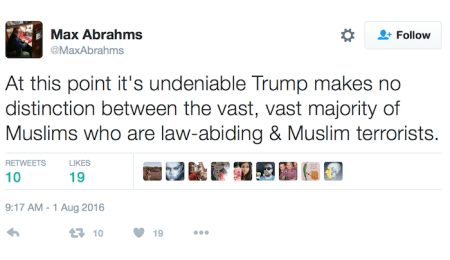
CFR “terrorism theorist” Max Abrahms hits Trump for not distinguishing “law-abiding” Muslims from terrorists

August 2, 2016

CFR “terrorism theorist” Max Abrahms hits Trump for not distinguishing “law-abiding” Muslims from terrorists, Jihad Watch, 

Max Abrahms, who describes himself as “#Terrorism Theorist / Northeastern Prof / Council on Foreign Relations / Center for Cyber & Homeland Security,” is the quintessential establishment foreign policy analyst, a hack fronting policies that have failed again and again and again, and that Abrahms, and the establishment in general, don’t even realize have failed.

Yesterday he joined the general establishment pile-on against Donald Trump, belatedly, since his colleagues, friends and allies have been noting this “undeniable” point for weeks and months before Max arrived on the scene, breathless with discovery:

Abrahms-no-distinction

When Trump first proposed his temporary moratorium on Muslim immigration, I was amazed to see otherwise clear thinking writers publishing articles with titles such as, “Don’t Ban Muslims, Just Ban Islamists.” This is is less surprising coming from as muddled and limited a thinker as Max Abrahms, but that he would express this view underscores that it has become the establishment line against Trump’s proposal, no doubt prevailing at the Council on Foreign Relations and at Northeastern University.

The problem is that while it sounds sensible to ban “Islamists” only, or “jihadis” only, rather than all Muslims, or at least those coming from rogue terror states, what none of those who have criticized Trump for this proposal have ever recognized is that it is impossible to distinguish Islamists and jihadis from among peaceful Muslims. This is especially true since the Islamic State has instructed jihadis not to appear overtly religious, but instead to be clean-shaven, wear Western dress, and appear to be exactly the “moderate Muslim” that is the object of all the West’s hopes. And so it’s easy to dismiss Trump as a bigot for suggesting this, but no one has ever offered an alternative suggestion for how to prevent jihadis from entering the country.

If Max Abrahms had a modicum of wit and understanding of the problem of which he purports to be a “theorist,” he would realize that it is not Donald Trump, but Islamic jihadis themselves, who have made sure that there is no distinction between “the vast, vast majority of Muslims who are law-abiding” and “Muslim terrorists.” Trump is not refusing to recognize that there are Muslims who are law-abiding, but acknowledging that it is impossible to identify the jihadis who are among them. Max Abrahms would rather see Americans die in jihad attacks than take politically incorrect steps to try to prevent those deaths.

How Serious Is Sweden’s Fight against Islamic Terrorism and Extremism?

July 17, 2016

How Serious Is Sweden’s Fight against Islamic Terrorism and Extremism? Gatestone InstituteNima Gholam Ali Pour, July 17, 2016

♦ Jihadists who come to Sweden know that there are many liberal politicians looking for invisible “right-wing extremists”, and feminists who think what is really important is using “gender perspective” in the fight against extremism and terrorism.

♦ Perhaps the Swedish government has a secret plan to convince jihadists to become feminists? As usual, Swedish politicians have chosen to politicize the fight against extremism and terrorism, and address the issue as if it were about parental leave instead of Sweden’s security.

♦ “As soon as these people… say ‘Asylum’, the gates of heaven open.” — Inspector Leif Fransson, Swedish border police.

♦ Experts in Sweden’s security apparatus have clearly expressed that violent Islamism is a clear and present danger to the security of Sweden, but the politicized debate about Islamic terrorism and extremism does not seem capable of absorbing this warning.

Like all other European countries, Sweden is trying to fight against jihadists and terrorists, but it often seems as if the key players in Sweden have no understanding of what the threats are or how to deal with them.

In 2014, for instance, the Swedish government decided to set up a post called the “National Coordinator Against Violent Extremism.” But instead of appointing an expert as the national coordinator, the government appointed the former party leader of the Social Democrats, Mona Sahlin. Apart from Sahlin having a high school degree, she is mostly known for a corruption scandal. As a party leader of the Social Democrats, she lost the 2010 election, and as a minister in several Socialist governments, she has not managed to distinguish herself in any significant way. Göran Persson, who was Prime Minister of Sweden from 1996 to 2006, described Mona Sahlin this way:

“People believe she has a greater political capacity than she has. What comes across her lips is not so remarkable. Her strength is not thinking, but to convey messages.”

With such a background, it was no surprise that she was ineffective as National Coordinator Against Violent Extremism. But the fact that she used her high government agency to help her friends came as a shock to the Swedish public. Sahlin had hired her former bodyguard for a position at her agency and signed a false certificate that he earned $14,000 dollars monthly, so that he could receive financing to purchase a $1.2-million-dollar home.

Sahlin also gave the man’s relative an internship, even though the application had been declined. Before Sahlin resigned in May 2016, she said, “I help many of my friends.”

Despite the fact that Sweden has a Ministry of Justice responsible for issues that would seem far more related to violent extremism, Sweden has, for some reason, placed the agency to combat violent extremism under the Ministry of Culture.

While the U.S sees the fight against Islamic extremism as a security issue, Sweden evidently believes that combating violent extremism should be placed in a ministry responsible for issues such as media, democracy, human rights and national minorities. With such a delegation of responsibility, the government seems either to be trying to hamper efforts to combat violent extremism, or it does not understand the nature of the threat.

The lack of understanding of violent extremism, combined with politicizing the problem, has been evident, for instance, in Malmö, Sweden’s third largest city. After the November 2015 terrorist attacks in Paris, the city councilor responsible for safety and security in Malmö, Andreas Schönström, said that European right-wing extremism is a bigger threat than violent Islamism. And on June 5, 2016, Jonas Hult, Malmö’s security manager, wrote: “The right-wing forces in Malmö are the biggest threat.”

With such statements, one would think that perhaps Malmö is a city filled with neo-Nazi gangs. Not so. Malmö is a city that usually ends up in the news because of Islamic anti-Semitism or extremist activists working to destroy Israel. There have been no reports of any neo-Nazi movements in Malmö in the recent past.

When supporters of Pegida (an anti-Islamic migration political movement in Europe) came to Malmö, they had to be protected by the police due to thousands of extremist activists and Muslims protesting the presence of Pegida. Of Malmö’s residents, 43.2% were either born abroad or their parents were.

Further, the Social Democrat politicians have held local municipal power in Malmö since 1919. To say that Malmö is somehow a place where right-wing extremism is a threat is simply not based on facts. Instead of seriously combating violent extremism, many in Sweden have chosen — possibly imagining it easier — to politicize the problem.

Sweden also has not yet reached the point where the authorities distance themselves from violent extremism. The association Kontrakultur (a cultural and social association in Malmö)receives about $37,000 annually from the municipal cultural committee of Malmö. On its website, Kontrakultur writes that it cooperates with an organization called Förbundet Allt åt alla (“The Association Everything for Everyone”). This organization, in turn, according to the National Coordinator Against Violent Extremism, consists of violent extremist activists.

The idea that municipal funds should in no way go to organizations that cooperate with violent extremists is something not yet rooted in Sweden. In June 2016, for example, a 46-year-old Islamic State jihadi arrived in Malmö. He was taken into custody by the police for speedy deportation. But when he applied for asylum, the Swedish Migration Agency took over the matter to examine his asylum application, and ordered the deportation stopped. Inspector Leif Fransson of the border police described the situation:

“As soon as these people throw out their trump card and say ‘Asylum’, the gates of heaven open.”

In August 2015, the Swedish government submitted a document to Parliament outlining the Swedish strategy against terrorism. Among other things, the document stated:

“It is important that there is a gender perspective in efforts to prevent violent extremism and terrorism.”

Under the headline “Gender Perspective” in a committee directive from the Swedish government on the mission of the National Coordinator Against Violent Extremism you can observe:

“The violent extremist environments consist mainly of men, and in the extremist movements there are individuals who oppose gender equality and women’s rights. It is therefore important that there is a gender perspective in efforts to prevent violent extremism, and that norms that interact and contribute to the emergence of violent environments are effectively counteracted.”

Perhaps the Swedish government has a secret plan to convince jihadists to become feminists? But as usual, Swedish politicians have chosen to politicize the fight against extremism and terrorism, and address the issue as if it were about parental leave instead of Sweden’s security.

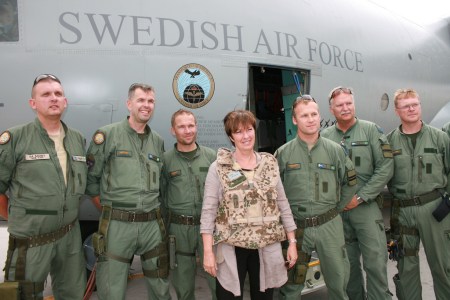
914Mona Sahlin, who was Sweden’s “National Coordinator Against Violent Extremism,” until she resigned in May amid corruption allegations, is shown posing with Swedish soldiers in Afghanistan in July 2010. The Swedish government’s directives to her agency stressed that it is “important that there is a gender perspective in efforts to prevent violent extremism.” (Image source: Social Democratic Party)

There is no evidence that “gender perspective” is relevant or useful in the fight against extremism and terrorism, yet we see that the Swedish government, in several documents related to terrorism and extremism, evidently believes that “gender perspective” is what should be used in the fight against those threats. This gives just some idea of how strenuously Sweden wants to disregard the problem, or even ask experts for help.

One might argue that this is because Sweden has never been exposed to Islamic terrorism or that extremism is not something that concerns the nation. Sweden has, however, had experience in facing Islamic terrorism. On December 11, 2010, a jihadist blew himself up in central Stockholm. Taimour Abdulwahab did not manage to hurt anyone, but Sweden got a taste of Islamic terrorism and has every reason to want to defend itself against more of it.

Islamic extremism is, unfortunately, becoming more widespread, especially in Sweden’s major cities. Gothenburg, for example, has been having major problems with it. In November 2015, there were reports that 40% of the 300 Swedish jihadists in Syria and Iraq came from Gothenburg. The only country that has, per capita, more of its citizens as jihadists in Iraq and Syria than Sweden, is Belgium.

As facts accumulate, there is much information indicating that Sweden has huge problems dealing with Islamic extremism and jihadism. The Swedish Security Service (Säpo), in the beginning of 2015, published a press release using the words “historic challenge” to describe the threat from violent Islamism. Already in May 2015 the head of Säpo, Anders Thornberg, expressed doubts that the agency could handle the situation if the recruitment of jihadists in Sweden continued or increased.

Experts in Sweden’s security apparatus have clearly expressed that violent Islamism is a clear and present danger to the security of Sweden, but the politicized debate about Islamic terrorism and extremism does not seem capable of absorbing this warning.

This general politicization, combined with the failure to prioritize the fight against terrorism and extremism, is the reason Sweden is, and continues to be, a magnet for extremists and terrorists. Jihadists who come to Sweden know that there are many liberal politicians looking for invisible “right-wing extremists”, and that there are feminists who think what is really important is using “gender perspective” in the fight against extremism and terrorism.

Jihadists also know that there are large gaps in the Swedish bureaucracy and legislation that can be exploited. These are the policies that have been created by Swedish politicians. One can therefore only question if Sweden seriously wants to fight the threats of terrorism and extremism.

Newt Gingrich: Deport every Muslim who believes in Sharia

July 15, 2016

Newt Gingrich: Deport every Muslim who believes in Sharia, Fox News via YouTube, July 14, 2016

Defense Intel Head: I Was Sacked for Calling Out Radical Islam

July 11, 2016

Defense Intel Head: I Was Sacked for Calling Out Radical Islam, Clarion Project, July 11, 2016

Michael-Flynn-HPRetired General Michael Flynn

After a distinguished career spanning more than three decades in the military, retired Lt. Gen. Michael Flynn was sacked in 2014 as head of the Defense Intelligence Agency (DIA).

When he asked the director of national intelligence James Clapper, who came to deliver the news to him, if his forced retirement had anything to do with his leadership of the agency, the answer was “no.”

“I knew then it had more to do with the stand I took on radical Islamism and the expansion of al Qaeda and its associated movements,” Flynn wrote in a first-person account published by theNew York Post. The account specifically calls out how the “intel system (has become) way too politicized.”

Flynn, who is reportedly one of the names surfacing as a running mate for Donald Trump, outlined his strategy for defeating America’s “global enemy,” who he defines as an alliance of secular dictatorships (North Korea, Cuba and Venezuela) with Iran and other radical Muslim countries and organizations such as the Islamic State, Al Qaeda and the Taliban.

Of the alliance, he says, “That’s a formidable coalition, and nobody should be shocked to discover that we are losing the war.”

However, Flynn believes the enemy can be defeated. He says they must be fought on both the battlefield and politically, especially through combating jihadist doctrines.

“On military battlefields, we have defeated radical Islamic forces every time we have seriously gone after them, from Iraq to Afghanistan,” he says.  “Their current strength is not a reflection of their ability to overwhelm our armed forces, but rather the consequence of our mistaken and untimely withdrawal after demolishing them …

But defeat on the battlefield is not enough, according to Flynn. It is a known tenet of groups like the Islamic State that they view their battlefield successes as a nod of approval from Allah.

Flynn explains this doctrine, saying, “Defeat on battlefields does great damage to their claim to be acting as agents of divine will. After defeating al Qaeda in Iraq, we should have challenged the Islamic world and asked: ‘How did we win? Did Allah change sides?’ We need to denounce them as false prophets, as we insist on the superiority of our own political vision. “

In terms of the secular dictatorships that Islamists are allied with, the same strategy applies. “Is North Korea some sort of success story?” he asks. “Does anyone this side of a university seminar think the Cuban people prefer the Castro’s tyranny to real freedom?”

Flynn worked more than 33 years in Army intelligence, including coordinating on-the-ground operations in Iraq and Afghanistan. His colleagues included General Stanley McChrystal, General David Petraeus and Admiral Mike Mullen.

His book about the subject, The Field of Fight: How We Can Win the Global War Against Radical Islam and Its Allies, is due to be released Tuesday.

Dr. Jasser joins Fox and Friends discussing profiling as a means to combat radicalism 07.02.2016

July 5, 2016

Dr. Jasser joins Fox and Friends discussing profiling as a means to combat radicalism 07.02.2016 via YouTube, July 5, 2016

A Ramadan Piece: The “Other” Islam

July 5, 2016

A Ramadan Piece: The “Other” Islam, Gatestone InstituteSalim Mansur, July 5, 2016

(A fascinating history of the battle between political Islam and non-political Islam. The battle continues. — DM)

♦ Abrahamic monotheism as represented in Judaism, Christianity, and Islam, precedes and stands apart from politics as an ethical vision that transcends history. It was a vision which invited people to embrace their common humanity as created and gifted by one omnipotent deity, and to follow a revealed code of ethics for righteous living, holding the promise of peace with an end to interminable conflicts that divided people into warring tribes.

♦ Thoughtful Muslims, for nearly a century before the demise of the Ottoman Empire and the abolition of the Caliphate, had been writing about the need for an Islamic reform. Europe’s cultural advancement following the Reformation and Enlightenment held up a mirror for the Islamic world to follow in similar direction to similar ends. There was a consensus among Muslims that Islam was not intrinsically opposed to the modern world, and a readiness to follow in the footsteps of the West.

♦ This is the “other” Islam. This is submission to truth, whose most righteous exemplar was Abraham when his faith was tested by his Deity, according to the Hebrew Bible, to sacrifice his son. And this is the faith of Sufis who took Muhammad’s message to people in places far removed from the desert confines of Arabia. It is simply, as the Qur’an reminds (30:30), deen al-fitrah, the natural religion, or inclination, of man to know his Creator. There is no return of this “other” Islam; it never went missing.

The cover of the January 1976 issue of Commentary magazine announced its main story, “The Return of Islam,” by Bernard Lewis. The year of publication coincided with the coming end of the fourteenth century of Islam, and the anticipation of a new Islamic century beginning in 1979. Forty years later this essay by Lewis, widely recognized and respected as the most eminent scholar on the Middle East and Islam alive today, came to be celebrated as the first warning of the coming upheaval inside the world of Islam.

Lewis’s essay was a corrective to viewing the Middle East and its people, Arabs and Muslims, in terms of Western values. “Modern Western man,” wrote Lewis, “being unable for the most part to assign a dominant and central place to religion in his own affairs, found himself unable to conceive that any other peoples in any other place could have done so… [or to] admit that an entire civilization can have religion as its primary loyalty.” This meant, Lewis continued, the “inability, political, journalistic, and scholarly alike, to recognize the importance of the factor of religion in the current affairs of the Muslim world”.

Recent events have proven that Lewis was correct in pointing to this critical flaw in much of Western understanding of Islam and Muslims. But the title of the essay was unfortunate and misleading; there was no “return of Islam” for Muslims, since at no point in Islamic or Muslim history had Islam been missing, or dormant.

Instead of the “return of Islam,” it was the return of political Islam, or Islamism. Lewis’s essay was a timely review of Muslim history in terms of political Islam. But political Islam is but one facet of Islam. It is a recurring mistake to see political Islam as the defining feature of Islam that obscures Islam’s spiritual dimension, which is more vital than the coarse authoritarian features of political Islam.

In antiquity, politics was inseparable from religion. It might be said that politics was the handmaiden of religion. A ruler among people in ancient times was a chief priest, or a demigod. This feature of the ancient world in which religion and politics were bound together could be described as “theopolitics”, and Islam was as much influenced in its history by theopolitics as were Judaism and Christianity.

Lewis wrote:

“The three major Middle Eastern religions are significantly different in their relations with the state and their attitudes to political power. Judaism was associated with the state and was disentangled from it; its new encounter with the state at the present time raises problems which are still unresolved. Christianity, during the first formative centuries of its existence, was separate from and indeed antagonistic to the state with which it only later became involved. Islam from the lifetime of its founder was the state, and the identity of religion and government is indelibly stamped on the memories and awareness of the faithful from their own sacred writings, history, and experience.”

A lot of history is compressed in this passage, and so some misreading of that history is inevitable. Lewis went on to discuss Islam as being entwined with political Islam since its inception. “Islam was associated with power from the very beginning,” wrote Lewis, “from the first formative years of the Prophet and his immediate successors.” Consequently, in Islam “religion is not, as it is in Christendom, one sector or segment of life, regulating some matters while others are excluded; it is concerned with the whole of life—not a limited but a total jurisdiction.”

The problem with Lewis’s view of Islam is that he uncritically accepted the theology of political Islam. This theology was constructed during the three centuries after the Prophet Muhammad when, in the course of events between the seventh and the tenth century of the Common Era, Arabs came to rule a vast empire. It was consistent with the temper of late antiquity, and it put a stamp on Islam ever since that most Muslims have accepted without questioning.

Abrahamic monotheism as represented in Judaism, Christianity, and Islam, however, precedes and stands apart from politics as an ethical vision that transcends history. It was a vision which invited people to embrace their common humanity as created and gifted by one omnipotent deity, and to follow a revealed code of ethics for righteous living, holding the promise of peace with an end to interminable conflicts that divided people into warring tribes.

It was the resistance of pagans and polytheists to Judaism, Christianity, and Islam at their origins that compelled their early followers in the course of their respective histories to seek in politics protection for their religious beliefs. In Judaism and Islam, the founders — Moses and Muhammad — combined in their personalities the roles of prophet, warrior, and statesman. The life of Jesus, in this respect, was different.

In Moses’s case, he never entered the promised land, and it was left to his successors to eventually found a state for the Jews. In the instance of Muhammad, there is the question that has divided Muslims ever since his death: was his prophetic mission primarily to establish an Islamic state that would define, for Muslims for all times, Islam as the ideal arrangement in which religion and politics were one and indivisible?

The answer to this question was surrounded in controversy right from the moment of the Prophet’s last illness before his death. The controversy over his succession, and what such succession meant, tore apart the immediate followers of the Prophet, and incited tribal warfare, fratricide and schisms that since then have provided the backdrop to Muslims in respect to their own understanding and practice of Islam as religion and politics.

Islam as the Abrahamic vision of man’s relation with God was supplanted by the theology of political Islam. The process began in the midst of the Prophet’s last illness and accelerated with his death. The majority Sunni sect in Islam coalesced around the view that the immediate successors of the Prophet, elected or chosen, ought to be the closest companions of Muhammad, and their rulings in the formative stage of Muslim history became the standard by which subsequent generations of Muslims innovated the requirements of ruling an empire.

Those Muslims who dissented from the majority view represented by Sunni Islam were the Shi’a, or the party of Ali. Ali was a cousin of the Prophet, raised from his childhood in the Prophet’s household and, hence, the closest companion of Muhammad. Ali was also the Prophet’s son-in-law by marriage to Fatima, his only surviving child. The Shi’a Muslims believed Ali was the designated successor of the Prophet because of their familial ties, but he was forcefully denied the succession by those who usurped it immediately following the Prophet’s demise. Shi’a Islam evolved as the main minority sect with its own theopolitics within Islam.

The first Muslims were Arabs of the desert, the Bedouins, among whom Muhammad was born. Their tribalism persisted despite the Prophet’s warnings and it shaped Islam from the first hour of the post-Prophetic history. Sectarianism within Islam was the unavoidable outcome of clan and tribal conflicts among the first Muslims, and the Sunni-Shi’a divide became the main cleavage as a result, setting the template of further divisions as sects proliferated over time in the history of Islam.

Less than a century after the Prophet’s death in 632 C.E., his followers, the Bedouin Arabs, became the rulers of an empire that stretched from the Iberian Peninsula in the West to the Indus River in the East. There was nothing in the Qur’an, or in the traditions of the Prophet, to instruct these Arabs on the mechanics of administrating an empire. They took to imitating the rulers of Persia, whom they defeated, and adopted the administrative manuals of both Byzantine and Persian officialdom to rule the lands and peoples they conquered. And in order to provide legitimacy in the name of Islam to Arab rule in Damascus and later in Baghdad, the ulema(religious scholars) worked out the details of law and society, the Sharia, derived from the Qur’an and the Prophetic traditions.

The origin of Islamic culture and civilization lies in the empire that Bedouin Arabs, through the force of arms, established in a very short period. This was also the origin of political Islam, which came to represent the dominant face of Islam as theopolitics.

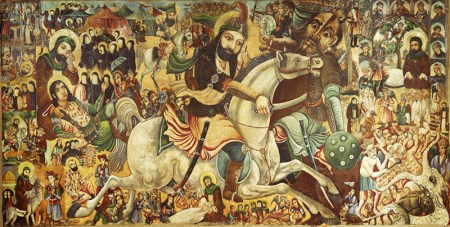
The fight that erupted, with the news of the Prophet’s demise, among his closest companions over succession related to temporal power that the Prophet had exercised, and not his role as a Messenger of God (Rasul Allah). This fight culminated in 680 C.E. with the defeat of the Prophet’s grandson, Husayn, killed and decapitated in the field of Kerbala, close to the banks of the Euphrates in Iraq, by the army sent out by Yazid I, the Ummayad Caliph of the rapidly expanding Islamic empire.

The event in Kerbala was a watershed in the history of Islam. Ethnic Arabs, recently converted to Islam, delivered Husayn’s cruel end. Ever since, this crime, as sordid as the crucifixion of Jesus, has stained Muslim history with the mark of Cain.

After Kerbala, it could no longer be said that Islam, as Abrahamic monotheism, guided politics ethically along the path of justice and mercy. Instead, the politics that surfaced upon the death of the Prophet hardened after the killing of Husayn, and politics henceforth came to define Islam as faith, culture, and society.

699In the Battle of Kerbala, depicted in Abbas Al-Musavi’s painting, Husayn, the son of Ali and grandson of Muhammad, was killed along with his family and all his followers by the armies of the Umayyad Caliphate. It was the most crucial moment in the split between Shi’a and Sunni Islam. (Image source: Brooklyn Museum)

The Ummayads in Damascus, the imperial capital, were the first dynastic rulers among Arabs in Islamic history. The founder of the dynasty, Muawiyyah, seized power following the murder of Ali, the fourth Caliph and the cousin and son-in-law of the Prophet. With the Ummayads the institution of the Caliphate, which was an innovation to fill the void of leadership among the Arabs in Medina following Muhammad’s death, adopted the pomp and pageantry of the Persian and Byzantine rulers. The Caliphate, from that first century of Islamic history until its abolition in 1924 by Mustafa Kemal Ataturk, the founder of modern Turkey, was the embodiment of Oriental Despotism.

Those Muslims who witnessed the tribal conflicts erupt after the Prophet’s demise and recoiled in revulsion from politics turned inward in seeking union with the divine mystery, as mentioned in the Qur’an. They sought solace in the spiritual dimension of Islam and emulated the Prophetic tradition of withdrawal from the world through prayer and meditation. They became the founders of the Sufi, or mystical, tradition in Islam. This was the “other” face of Islam, distinct from political Islam.

The physical expansion of the Islamic empire was carried forth by the armies of the Caliphs. But the spread of Islam as a faith tradition was a slow process, carried forth by Sufi missionaries belonging to various fraternal orders and independent of political rulers of the world of Islam.

There is a world of difference in conversion brought about at the point of sword of conquering armies, and conversion that results from the communion of hearts and minds among people. The latter is more genuine and transformative than the former in every religion. The Qur’an itself — verse 49:13 — warned the Prophet that the acceptance of Islam by the Arabs of the desert was one of submission in the face of defeat, and that belief had not entered their hearts. This verse might be read as forewarning of crimes Muslims would commit through history in the cause of political Islam, beginning with the killing of Husayn in Kerbala.

Political Islam from its outset was an inquisition. It began with Abu Bakr, the first Caliph, when he subverted the Islamic principle stated in the Qur’an — “there is no compulsion in religion” (2:256) — and declared war on those Arab tribes who withheld their loyalty from him following the death of the Prophet. The “Ridda Wars,” or the “Wars of Apostasy,” launched by Abu Bakr inaugurated political Islam, and since then, the precedent he set for Muslim-on-Muslim violence has plagued Islamic history into our times.

The role of the a’lem (pl. ulema; religious scholars) was instrumental in the making of political Islam. The ulema provided legitimacy to the Ummayad Caliphs in Damascus in the period of intra-tribal conflicts that had led to the killings of the three Caliphs (Umar, Uthman, and Ali) after Abu Bakr and then the massacre in the field of Kerbala.

The consensus of the ulema — accepted by those who eventually came to represent the majority Sunni Muslims (the word “Sunni” derived from Sunna, meaning following the path or tradition of the Prophet) — was that political and social order however provided and maintained was preferable to fitnah (disorder). This consensus provided doctrinal legitimacy to the Caliphs. In return, the Caliphs recognized the special function of the religious scholars and jurists in the drafting, codification, and implementation of Sharia, or Islamic laws.

As a result of this bargain between men wielding swords and men wielding pens, the foundational arrangement of political Islam was firmly established. It was an arrangement consistent with the thinking prevalent in antiquity that religion (deen in Arabic) prescribed the totality of human affairs. This meant, as it was understood by the ulema in the formative period of Islamic history, that the primary function of state and government (dawlat in Arabic) was the establishment of the rule of Sharia. As Ann K.S. Lambton in her study, State and Government in Medieval Islam(1981), observed:

“The law precedes the state and is immutable at all times and under all conditions. The state is there to carry out the law. To disobey a law or to neglect a law is not simply to infringe a rule of the social order: it is an act of religious disobedience, a sin, and as such involves a religious penalty.”

Once the bricks and mortar of political Islam were set in the making of the Islamic civilization, Islam as the official doctrine of the state and empire clearly demarcated the norm as prescribed in the Sharia and made the ulema its official guardians. The Islamic state was a nearly perfect embodiment of a closed totalitarian system designed by men towards the end of the first millennium of the Common Era, and any suggestion of change or adoption of new idea in matters of either religion or politics was condemned as bid’ah (heresy deserving punishment).

But Muslim dissidents who viewed the doctrine of political Islam, or what might also be referred to as “official” Islam, as an aberration, went underground and kept the “other” Islam free from the shackles of politics. Beneath the hardened features of political Islam, the “other” Islam of Sufis provided solace to Muslims by tending to their humanity in the light of God’s most favoured attributes of mercy and compassion.

The “other” Islam, unlike political Islam, is not bound by time and space. It is directed to man’s inner yearnings for that which is eternal. It plunges in search of the inner meaning of the Qur’an as the Word of God, and the assuredness that God’s mercy is not denied to any of His creations. The Qur’an states, “We are nearer to man than his jugular vein” (50:16), reassuring man that he is not alone and God is not some distant uncaring deity.

Whereas the defining characteristic of political Islam was religion inseparable from politics, in “other” Islam politics was the corruption of religion and the dissolution of belief. Hence, from the perspective of “other” Islam, the Sharia as the corpus of Islamic laws codified by the ulema and sanctioned by the Caliphs was a poor, even corrupt, representation of the divine Sharia (in Arabic, a “path”) imprinted in the hearts of all believers as the path to acquiring God’s infinite grace.

ii.

Political Islam and the Islamic civilization it inaugurated was time-bound as a theopolitical system constructed in a certain historical period or context. It was a construct of late antiquity and the early medieval era. Since it was a fixed and closed system, it was invariably given to decay and dissolution.

During the Middle Ages, the Islamic civilization flourished just as other civilizations had. As Abdus Salam (1926-1996) — a physicist of Indo-Pakistani origin and the first Muslim scientist awarded the Nobel Prize for Physics in 1979 — observed in one of his lectures, the world of Islam and the world of Christianity (Europe) were more or less at a similar stage of development around the middle of the seventeenth century.

The evidence of this relative equality of the two civilizations, Salam suggested, could be seen in their technological achievements represented by the two monuments, the Taj Mahal in Agra, India, and St. Paul’s Cathedral in London, England, completed about the same time. Some two decades later, Salam observed,

“there was also created — and this time only in the West — a third monument, a monument still greater in its eventual import for humanity’s future. This was Newton’s Principia, published in 1687.”

Newton’s monument had no counterpart in India, or anywhere else in the Muslim world.

The Renaissance, the Age of Enlightenment and the Scientific Revolution, led by men of astounding intellect from Leonardo da Vinci to Galileo and Newton, propelled Europe out of the medieval age into the making of the modern world. But Islamic civilization, held together by political Islam, descended into a death spiral. A century after Newton published his major work, the Ottoman Empire was turning irreversibly into a pale shadow of a civilization that once had threatened the powers of Europe at the gates of Vienna.

In the aftermath of September 11, 2001 attacks in New York and Washington by the Islamist terrorists of al Qaeda, Bernard Lewis published What Went Wrong? (2002). It was Lewis’s effort to answer why, and how, the world of Islam had failed to accommodate the imperatives of the modern world.

“In most of the arts and sciences of civilization, medieval Europe was a pupil and in a sense a dependent of the Islamic world,” wrote Lewis.

“And then, suddenly, the relationship changed. Even before the Renaissance, Europeans were beginning to make significant progress in the civilized arts. With the advent of the New Learning, they advanced by leaps and bounds, leaving the scientific and technological and eventually the cultural heritage of the Islamic world far behind them.”

The civilizational success of political Islam in late antiquity and the early medieval era ironically carried within it the seeds of its own decline and demise. World War I eventually put an end to the anachronism that the Ottoman Empire had become, and the abolition of the Caliphate was a formal effort to bury political Islam for good.

Thoughtful Muslims, for nearly a century before the demise of the Ottoman Empire and the abolition of the Caliphate, had been thinking and writing about the need for an Islamic reform. Europe’s cultural advancement following the Reformation and Enlightenment held up a mirror for the Islamic world to follow in similar direction to similar ends.

In India under British rule, for instance, there were a significant number of Muslims who painfully recognized the malaise of Islamic societies and offered remedy for their advancement into the modern world. Among them the notable were Sir Sayyid Ahmad Khan (1817-98), the founder of the Aligarh University; Syed Ameer Ali (1849-1928), jurist and historian; and Muhammad Iqbal (1877-1938), poet and philosopher.

One of the most important works was published in 1925 by Ali Abd al-Raziq (1888-1966), an Egyptian scholar and jurist at Al-Azhar University in Cairo. In his seminal work, titled al-Islam wa ‘Usul al-Hukm (Islam and the Fundamentals of Authority), al-Raziq pointed out that there was no basis in the Qur’an and the Sunnah (traditions) of the Prophet for the institution of the Caliphate.

Al-Raziq was not someone from outside the ranks of the ulema, or a lay scholar unfamiliar with the intricacies of Islamic jurisprudence and theology in the construction of Sharia. He was a student of Muhammad Abduh (1849-1905) at al-Azhar, when Abduh had been appointed the Grand Mufti of Egypt.

Al-Raziq’s main contention was based on the distinction between spiritual and temporal authority. He indicated that the confusion among Muslims in the period after the Prophet arose from their inability to distinguish between the Apostolic role of Muhammad and the authority he derived as the Messenger of God (Rasul Allah), and the Caliphate as a temporal institution. Al Raziq wrote:

“Muhammad was but an apostle, sent on behalf of a religious summons, one pertaining entirely to religion and unmarred by any taint of monarchy or of summons to a political state; and he possessed neither kingly rule nor government, and he was not charged with the task of founding a kingdom in the political sense, as this word and its synonyms are generally understood.”

Al-Raziq was denounced by his peers. He was made to appear before the Council of the Greatest Ulema of Al-Azhar to hear the judgment against him, as his license to teach and practice law was revoked. Egypt was then ruled under Britain’s supervision, which likely saved al-Raziq from even more severe punishment.

But al-Raziq had stripped away the argument of traditional Islam on the sanctity of the Caliphate, and with it went the idea of Sharia being sacred. In the half-century following the abolition of the Caliphate by Mustafa Kemal, Muslims under European rule gained their independence as new states emerged in the Middle East and elsewhere in the world of Islam.

This period in the middle decades of the last century was a period of intense expectations on the part of Muslims for progress in their living conditions. A massive effort was invested to make the transition from the world of pre-Newtonian knowledge and learning to the modern world of science, industry and democracy.

There was a consensus among the rich and the poor that Islam was not intrinsically opposed to the modern world. There was a readiness among Muslims to follow in the footsteps of the West.

This consensus was reflected in a well-known and widely circulated aphorism attributed to Muhammad Abduh. On returning to Cairo from a visit to Europe, Abduh told his students, “I travelled in the West and found Islam, but no Muslims; I have returned to the East and find Muslims, but not Islam.”

The transition into the modern world, however, proved immensely complex and difficult. Europe’s transition had required several generations and a couple of centuries to break away from the feudal age into the modern age. The resistance from those invested in the ancien arrangements of society and culture was immense, and wars that followed were fierce.

Something similar to the European experience was unavoidable for Muslims in their effort to break from the hold of their traditional culture. And not unlike the wars in Europe, wars within the world of Islam since the 1970s are symptoms of the Muslim struggle to transit into the modern world.

iii.

The abolition of the Caliphate in 1924 was the formal announcement of political Islam’s death. But it refused to die, even as it was laid to rest. Its twitching was felt in the deep dark interior of the world of Islam, in remote and unwelcome places such as Nejd inside Arabia.

Here in Nejd, the medieval theology of Ibn Taymiyyah had struck roots. It had impressed an eighteenth-century itinerant preacher in the region, Abdul Wahhab (1703-92), who turned Ibn Taymiyyah’s extremist thinking into an even more rigid and austere doctrine, hostile to all things inimical to the Bedouin tribal culture of his time and environment.

Abdul Wahhab’s version of political Islam impressed a local tribal chief, and the marriage of convenience between the preacher and the tribal leader gave birth to the first Saudi state in the interior of Arabia. But when it sent tribal warriors to raid towns inside the frontiers of the Ottoman Empire, it provoked the Caliph of Islam in Istanbul, on whose orders this nascent state of the Wahhabi ruler was destroyed.

But the eventual collapse of the Ottoman Empire provided the conditions for the rebirth of the Saudi state as a kingdom under Abdul Aziz ibn Saud in the 1920s. Fortune, in the guise of great power politics, smiled upon him. He seized the support offered by the British, in return for influence in a region of strategic importance. The discovery of oil made the Saudi kingdom a prize to be protected by the Western powers, first Britain and later the United States, with far reaching consequences for the rest of the world, and even more so for the world of Islam and Muslims.

Any modernizing revolution is hugely disruptive. The movement from one stage of social development to another is not linear; it is, instead, filled with zigzags and reversals at every stage of the process toward an uncertain future.

When a people, however, pushes back against this process of change in their midst, or seeks to abort it, this reactionary effort pins its hopes on longing for an idealized past. The Newtonian revolution and the emergence of modern Europe made political Islam anachronistic. Wahhabism, as the official doctrine of the Saudi kingdom, was much more than a return of the most extreme version of political Islam in the early decades of the last century. It was, and remains, a demented effort of the most backward people within the world of Islam to remain culturally tied to antiquity, or jahiliyya (the age of ignorance), which Islam at its origin derided and rejected.

Political Islam in whatever version — Wahhabism, Khomeinism, Ikhwanism (the Muslim Brotherhood) and their derivatives — has no answer for Muslims on how to make their historic transition into the modern world. It can continue to rage against the modern world until its civilized inhabitants, including Muslims, have had enough of its destructiveness and obliterate it.

Then that vision of Abrahamic monotheism, which Muhammad was mysteriously directed to deliver to his people, will be emancipated from political Islam.

This message Muhammad was given admonished Arabs for their lack of faith, provided them with ethics for living honorably, told them in no uncertain term that the God of Abraham made no distinction among nations and people who believe in Him, and that on the Day of Final Reckoning, they need have no fear if they strive in doing what is right.

This is the “other” Islam. This is submission to truth, whose most righteous exemplar was Abraham when his faith was tested by his Deity, according to the Hebrew Bible, to sacrifice his son. And this is the faith of Sufis who took Muhammad’s message to people in places far removed from the desert confines of Arabia. It is simply, as the Qur’an reminds (30:30), deen al-fitrah, the natural religion, or inclination, of man to know his Creator. There is no return of this “other” Islam; it never went missing.

Op-Ed: The American Gulag

June 26, 2016

Op-Ed: The American Gulag, Israel National News, Phyllis Chester, June 26, 2016

For years, beginning in 2003, I have personally faced both censorship and demonization. When I began publishing pieces about anti-Semitism, anti-Zionism, and Islamic gender and religious apartheid at conservative sites, I was seen as having “gone over to the dark side,” as having joined the legion of enemies against all that was right and good.

My former easy and frequent access to left-liberal venues was over. I learned, early on, about the soft censorship of the Left, the American version of the Soviet Gulag. One could think, write, and even publish but it would be as if one had not spoken–although one would still be constantly attacked for where one published as much as for what one published.

Since then, Left censorship has only gotten worse. (There is also censorship on the Right–but not quite as much.)

A week ago, a colleague of mine was thrilled that a mainstream newspaper had reached out to him for a piece about the violent customs of many male Muslim immigrants to Europe. He discovered, to his shock, that his piece had been edited in a way that turned his argument upside down and ended up sounding like American Attorney General Loretta Lynch’s view, namely, that home-grown terrorists need “love and compassion,” not profiling or detention.

I told him: One more left-liberal newspaper has just bitten the Orwellian dust. He could expose this use of his reasoned view for propaganda purposes–or wear out his welcome at this distinguished venue.

“But,” I said, “on the other hand, what kind of welcome is it if they change your words and the main thrust of your argument?”

That same week, right after the Jihad massacre in Orlando, another colleague, long used to being published–and published frequently at gay websites–wrote about the male Muslim immigrant/refugee physical and sexual violence against girls and women (their own and infidel women); against homosexuals–and paradoxically, also against young boys. He counseled gays to understand that the issues of gun control and “hate,” while important, were also quite beside the point, that “homosexuality is a capital crime in Islam.”

His piece was rejected by every gay site he approached. One venue threatened him:  If he published his piece “anywhere,” that his work would no longer be welcome in their pages.

I welcomed him to the American Gulag.

He told me that he finally “had” to publish the piece at a conservative site.

Gently, I told him that what he wrote was the kind of piece that was long familiar only at conservative sites and that he should expect considerable flack for where he’s published as well as for what he’s published.

Another gay right activist told me that when he described Orlando as a Jihad attack, he was castigated as a “right-wing hater.” He, too, had to publish what he wanted to say at a conservative site.

I published two pieces about Orlando. I said similar kinds of things and I privately emailed both articles to about 30 gay activists whom I know.

The silence thereafter was, as they say, deafening. I was not attacked but I was given the Silent Treatment.

For a moment, I felt like gay activist Larry Kramer might have felt when, in the 1980s, he tried to persuade gay men to stop going to the baths and engaging in promiscuous sex, that their lust was literally killing them. Kramer was attacked as a spoilsport and as the homophobic enemy of the gay lifestyle. Alas, Kramer had been right and many gay male lives were lost to AIDS.

Thus, gay activists see their collective interests as best served by marching, lock-step, with politically correct politicians who view “mental illness,” “gun control,” and “American right-wing hatred of gays”–not Jihad–as the major problems. Such gay activists also prefer “Palestine” to Israel. It makes absolutely no difference that Israel does not murder its homosexual citizens and that in fact, Israel grants asylum to Muslim Arab men in flight from being torture-murdered by other Muslim Arab men.

A number of European activists have recently visited me.  They described what has been happening to women who undertake the journey from Iraq, Syria, Afghanistan, Turkey;  along the way, the girls and women are continually groped and sexually assaulted, even penetrated in every possible orifice, by gangs of male Muslim immigrants. If they want to live, their husbands and fathers can do nothing.

So much for Muslim immigrant women on the move.

And now, European women are being told to “dye their hair black,” stay home “after 8pm,” “always have a male escort at night;” a group of German nudists, whose tradition goes back 100 years, have just been told to “cover up” because refugees are being moved into the rural lake community.

Where will this all end? In Europe becoming a Muslim Caliphate dominated by Sharia law and by all its myriad misogynist interpretations? In Muslim immigrants assimilating to Western ways? In Europeans voluntarily converting to Arab and Muslim ways? In non-violent but parallel Muslim lives?

Bravo to England which has just taken its first, high risk steps to control its borders and its immigrant population.

How Much of our Culture Are We Surrendering to Islam?

June 21, 2016

How Much of our Culture Are We Surrendering to Islam? Gatestone InstituteGiulio Meotti, June 21, 2016

♦ The same hatred as from Nazis is coming from Islamists and their politically correct allies. We do not even have a vague idea of how much Western culture we have surrendered to Islam.

♦ Democracies are, or at least should be, custodians of a perishable treasury: freedom of expression. This is the biggest difference between Paris and Havana, London and Riyadh, Berlin and Tehran, Rome and Beirut. Freedom of expression is what gives us the best of the Western culture.

♦ It is self-defeating to quibble about the beauty of cartoons, poems or paintings. In the West, we have paid a high price for the freedom to do so. We should all therefore protest when a German judge bans “offensive” verses of a poem, when a French publisher fires an “Islamophobic” editor or when a music festival bans a politically incorrect band.

It all occurred in the same week. A German judge banned a comedian, Jan Böhmermann, from repeating “obscene” verses of his famous poem about Turkish President Recep Tayyip Erdogan. A Danish theater apparently cancelled “The Satanic Verses” from its season, due to fear of “reprisals.” Two French music festivals dropped Eagles of Death Metal — the U.S. band that was performing at the Bataclan theater in Paris when the attack by ISIS terrorists (89 people murdered), took place there — because of “Islamophobic” comments by Jesse Hughes, its lead singer. Hughes suggested that Muslims be subjected to greater scrutiny, saying “It’s okay to be discerning when it comes to Muslims in this day and age,” later adding:

“They know there’s a whole group of white kids out there who are stupid and blind. You have these affluent white kids who have grown up in a liberal curriculum from the time they were in kindergarten, inundated with these lofty notions that are just hot air.”

As Brendan O’Neill wrote, “Western liberals are doing their dirty work for them; they’re silencing the people Isis judged to be blasphemous; they’re completing Isis’s act of terror.”

A few weeks earlier, France’s most important publishing house, Gallimard, fired its most famous editor, Richard Millet, who had penned an essay in which he wrote:

“the decline of literature and the deep changes wrought in France and Europe by continuous and extensive immigration from outside Europe, with its intimidating elements of militant Salafism and of the political correctness at the heart of global capitalism; that is to say, the risk of the destruction of the Europe and its cultural humanism, or Christian humanism, in the name of ‘humanism’ in its ‘multicultural’ version.”

Kenneth Baker just published a new book, On the Burning of Books: How Flames Fail to Destroy the Written Word. It is a compendium of so called “bibliocaust,” the burning of books from Caliph Omar to Hitler, and includes the fatwa on Salman Rushdie. When Nazis incinerated books in Berlin they declared that from the ashes of these novels would “arise the phoenix of a new spirit.” The same hatred is coming from Islamists and their politically correct allies. We do not even have a vague idea of how much Western culture we have surrendered to Islam.

Theo Van Gogh’s movie, “Submission,” for which he was murdered, disappeared from many film festivals. Charlie Hebdo‘s drawings of the Islamic prophet Mohammed are concealed from the public sphere: after the massacre, very few media reprinted these cartoons. Raif Badawi’s blog posts, which cost him 1,000 lashes and ten years in prison in Saudi Arabia, have been deleted by the Saudi authorities and now circulate like forbidden Samizdat literature was in the Soviet Union.

871 (1)After the massacre of Charlie Hebdo’s staff, very few media reprinted their Mohammed cartoons. Pictured above, Stéphane Charbonnier, the editor and publisher of Charlie Hebdo, who was murdered on January 7, 2015 along with many of his colleagues, is shown in front of the magazine’s former offices, just after they were firebombed in November 2011.

Molly Norris, the American cartoonist who in 2010 drew Mohammed and proclaimed “Everyone Draw Muhammad Day,” is still in hiding and had to change her name and life. The Metropolitan Museum of Art in New York pulled images of Mohammed from an exhibition, while Yale Press banned images of Mohammed from a book about the cartoons. The Jewel of Medina, a novel about Mohammed’s wife, was also pulled.

In the Netherlands, an opera about Aisha, one of Mohammed’s wives, was cancelled in Rotterdam after the work was boycotted by the theater company’s Muslim actors, after it became evident that they would be a target for Islamists. The newspaper NRC Handelsblad headlined its coverage “Tehran on the Meuse,” the river that passes through the Dutch city.

In England, the Victoria and Albert Museum took down Mohammed’s image. “British museums and libraries hold dozens of these images, mostly miniatures in manuscripts several centuries old, but they have been kept largely out of public view,” The Guardian explained. In Germany, the Deutsche Opera cancelled Mozart’s opera Idomeneo in Berlin, because it depicted the severed head of Mohammed.

Christopher Marlowe’s “Tamburlaine the Great,” which includes a reference to Mohammed being “not worthy to be worshipped,” was rewritten at London’s Barbican theater, while Cologne’s Carnival cancelled Charlie Hebdo‘s float.

In the Dutch town of Huizen, two nude paintings were removed from an exhibition after Muslims criticized them. The work of a Dutch Iranian artist, Sooreh Hera, was yanked from several Dutch museums because some of the photographs included the depictions of Mohammed and his son-in-law, Ali. According to this disposition, one day London’s National Gallery, Florence’s Uffizi, Paris’ Louvre or Madrid’s Prado might decide to censor Michelangelo, Raffaello, Bosch and Balthus because they offend the “sensibility” of Muslims.

The English playwright Richard Bean has been forced to censor an adaptation of Aristophanes’s comedy, “Lysistrata“, in which the Greek women hold a “sex strike” to stop their men from going to war (in Bean’s script, Muslim virgins go on strike to stop suicide bombers). Several Spanish villages stopped burning effigies of Mohammed in the commemoration ceremony celebrating the reconquest of the country in the Middle Ages.

There is a video filmed in 2006, when the death threats against Charlie Hebdo became worrisome. Journalists and cartoonists are gathered around a table to decide on the next cover for magazine. They speak about Islam. Jean Cabu, one of the cartoonists later murdered by Islamists, puts the issue this way: “No one in the Soviet Union had the right to do satire about Brezhnev.”

Then another future victim, Georges Wolinski, says, “Cuba is full of cartoonists, but they don’t make caricatures about Castro. So we are lucky. Yes, we are lucky, France is a paradise.”

Cabu and Wolinski were right. Democracies are, or at least should be, custodians of a perishable treasury: freedom of expression. This is the biggest difference between Paris and Havana, London and Riyadh, Berlin and Tehran, Rome and Beirut. Freedom of expression is what gives us the best of the Western culture.

Thanks to the Islamists’ campaign, and the fact that now only some “crazies” still venture in the exercise of freedom, are we now going to be just fearful? “Islamophobic” cartoonists, journalists and writers are the first Europeans since 1945 who have withdrawn from public life to protect their own lives. For the first time in Europe since Hitler ordered the burning of books in Berlin’s Bebelplatz, movies, paintings, poems, novels, cartoons, articles and plays are literally and figuratively being burned at stake.

The young French mathematician Jean Cavailles, to explain his fateful involvement in anti-Nazi Resistance, used to say: “We fight to read ‘Paris Soir’ rather than ‘Völkischer Beobachter’.” For this reason alone, it is self-defeating to quibble about the beauty of cartoons, poems or paintings. In the West, we have paid a high price for the freedom to do so. We should all therefore protest when a German judge bans “offensive” verses, when a French publisher fires an “Islamophobic” editor or when a music festival bans a politically incorrect band.

Or is it already too late?

Robert Spencer on why the Muslim Brotherhood is a terrorist organization

June 21, 2016

Robert Spencer on why the Muslim Brotherhood is a terrorist organization, Jihad Watch, Robert Spencer via YouTube